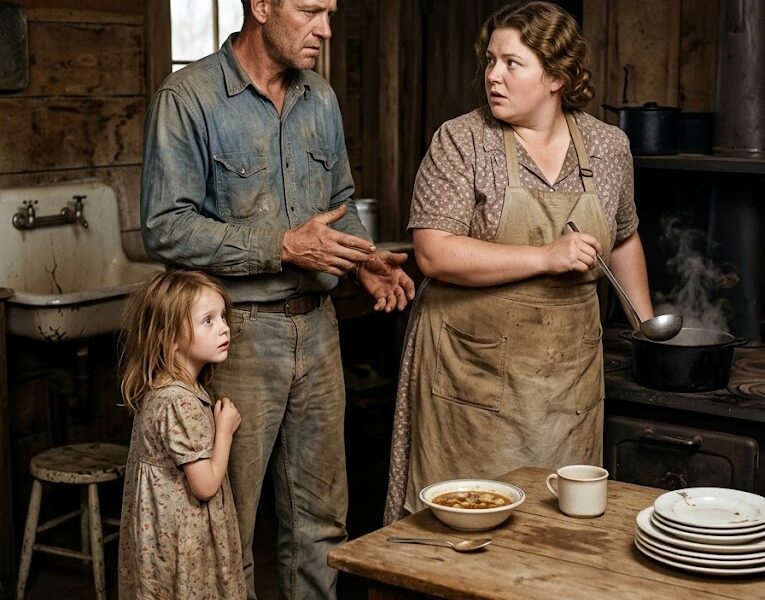
HE OFFERED ME HIS NAME TO SILENCE THE TOWN—BUT HIS SIX-YEAR-OLD DAUGHTER ASKED ME FOR SOMETHING FAR MORE DANGEROUS
“I don’t want your name, Calvin.”
The words landed between us harder than an insult.
Calvin Holt sat across the kitchen table with both hands resting beside a coffee cup that had gone cold twenty minutes earlier. Outside, wind scraped dry branches against the farmhouse siding. Somewhere down the hallway, his two-year-old son was sleeping. His six-year-old daughter was supposed to be sleeping.
The stove ticked softly behind me.
Calvin’s face barely changed.
That was his way.
Grief had taught him how to make a fortress out of stillness.
But I had lived with a quiet man before. I knew the difference between calm and pain pretending to be calm.
His jaw tightened.
“You understand what I’m offering?”
“I do.”
“A permanent home.”
“I have a roof.”
“My protection.”
“I’ve survived without it.”
“My name.”
I looked at him.
There it was.
The thing the town believed a woman like me should have been grateful to receive.
The thing Calvin believed might solve everything.
And maybe, in another life, it would have.
But I had already spent too many years learning what happened when a woman confused being chosen with being valued.
So I said the sentence that changed everything.
“I don’t want your name.”
Then I looked toward the dark hallway where his children slept.
“But I can feed your children.”
Calvin stared at me.
He did not know that before sunrise, I would pack my bag.
He did not know his daughter would see it.
And neither of us knew that the smallest person in that house was about to make the decision the adults had been too frightened to make.
But that came later.
Months earlier, I had been walking alone down a road with three dollars and fifty cents hidden inside my boot.
Three dollars and fifty cents.
That was what I had to show for winning the Mill Haven Harvest baking competition.
The judge had gone silent after tasting my bread.
I remember that silence because it was different from the kind I usually received.
People often went quiet around me, but usually after looking at me.
I was thirty-two, broad-shouldered, heavyset, strong enough to carry a flour sack under each arm, and possessed of the unfortunate habit of taking up exactly as much physical space as God had given me.
Women whispered.
Men looked through me.
Employers praised my cooking and then hired somebody smaller.
That afternoon at the fair, every woman who placed beside me found work before sunset.
One was hired by a boarding house.
Another by a ranch family.
A third by the hotel kitchen.
Then people came to me.
They smiled.
They complimented the bread.
And somehow every position had just been filled.
“So sorry.”
“Maybe next season.”
“We need someone who can manage the stairs quickly.”
That last one almost made me laugh.
Almost.
Instead, I folded my prize money twice, slipped it inside my boot, picked up my bag, and walked.
I had nowhere particular to go.
But forward had always made more sense than staying somewhere I was unwanted.
I had been a widow for two years.
Thomas died in winter.
A fever.
Three days.
That was all it took to turn a husband into a memory and a home into a place where every object accused you of surviving.
His boots stayed beside the door for six months.
I kept moving them when I swept.
Never far.
Just enough to clean beneath them.
One morning I realized I could no longer remember the exact sound of his footsteps.
That frightened me more than the day we buried him.
So eventually I left.
I told people I needed work.
That was partly true.
The other truth was that grief had filled every room of our little house, and I had begun to fear that if I stayed long enough, I would become another piece of furniture inside it.
For three days after the fair, I walked.
Dust.
Silence.
Blisters.
A bag growing heavier by the mile.
On the third afternoon, I heard water and left the road.
The creek was narrow and cold. I crouched beside it, drank from my hands, then filled my canteen.
That was when I heard the child.
At first, I thought it was an animal.
Then I listened again.
It was crying.
No.
Not exactly crying.
Something beyond crying.
The hollow, exhausted rhythm children make after they have cried so long they no longer expect anyone to answer.
I stood.
Across the field sat a farmhouse.
No smoke rose from the chimney.
One shutter hung crooked.
The yard had the peculiar stillness of a place where people still lived but nobody had enough strength left to care how living looked.
I should have kept walking.
I knew that.
Strangers did not wander into other people’s homes.
Widowed women especially learned to avoid situations that could become gossip before becoming kindness.
Then the child made that sound again.
My feet decided before my mind did.
I crossed the field.
The front door opened after my second knock.
A little girl stood there.
Maybe six.
Thin.
Dark-haired.
Serious.
She was holding a boy who looked two or three, except she was carrying him the way a mother carries a child—one hip turned outward, one hand supporting his weight, the other rubbing his back automatically.
Children should not know how to do that.
Not like that.
The boy’s cheeks were wet.
His eyes were swollen.
“What’s your name?” I asked.
“May.”
“And him?”
“Eli.”
“Where’s your father?”
“The south field.”
“He know Eli’s been crying?”
She shook her head.
“He can’t hear from there.”
I hesitated.
“And your mother?”
For one second, May became six years old.
Her eyes filled.
Her mouth trembled.
Then the expression disappeared so quickly another person might have missed it.
I didn’t.
I knew that trick.
I had used it after Thomas died.
Make the grief small.
Make it obedient.
Put it somewhere nobody can see.
Then keep moving.
Eli lifted his head.
He looked at me.
Children look differently from adults. Adults compare you with everything they have already decided. Children simply look.
His eyes moved across my face.
My hair.
My dress.
Then he reached both arms toward me.
May stiffened.
I did too.
But I took him.
The boy collapsed against my chest as though he had been waiting all day to stop holding himself together.
His face pressed into my neck.
Then came one long breath.
Not crying.
Not relief exactly.
More like surrender.
May stared.
“I can light your stove,” I said. “If you’ll let me.”
She stepped aside.
The kitchen explained everything.
The dishes were stacked.
The table had been wiped.
A broom leaned neatly against the wall.
Someone was trying desperately to keep that house functioning.
That someone was six years old.
The stove was cold.
I set Eli on the counter.
“Stay there.”
He nodded solemnly.
I found wood.
Matches.
A pot.
A little flour.
Potatoes.
An onion beginning to soften.
Beans.
Enough.
There is almost always enough for something if you know what to do with what remains.
The first flame caught.
Eli slapped the counter twice in approval.
Then he noticed the gray cat curled near the stove.
He pointed.
“Mine.”
May spoke from behind me.
“He says that about the cat.”
“Does the cat agree?”
“No.”
“Does she have a name?”
“Papa calls her Cat.”
“That’s her name?”
May shrugged.
“She doesn’t come when anybody calls, so it doesn’t matter.”
That was the first time I almost saw her smile.
Almost.
By dusk, food was on the table.
Then the back door opened.
Calvin Holt walked in.
He was tall, sun-darkened, tired in a way sleep would not repair.
He stopped.
His son was sitting on the counter eating from a spoon held by a strange woman.
His daughter was seated at the table.
Eating.
Actually eating.
Steam rose from a pot.
Fire glowed inside the stove.
For a moment, Calvin looked less angry than confused.
As though he had entered the wrong house.
His eyes found May.
“What is this?”
May swallowed.
“She made supper.”
“Who?”
May looked at me as if this question had an obvious answer.
“Her.”
Calvin’s gaze moved to my bag.
Then to my dress.
Then back to the food.
“From town?”
I knew what he meant.
Charity.
I had heard that tone before.
May shook her head.
“She knocked.”
“And you let her inside?”
“Eli was hungry.”
Calvin’s face changed.
Only slightly.
But enough.
I pointed toward the empty chair.
“Sit.”
His eyebrows rose.
“There’s enough.”
“You always order strangers around in their own houses?”
“Only hungry ones.”
May stared into her bowl.
I saw the corner of her mouth move.
Calvin saw it too.
That was why he sat down.
We ate mostly in silence.
Spoons against bowls.
Wood cracking.
Eli making small satisfied noises.
The cat pretending none of us existed.
After supper, I handed Eli to his father and picked up my bag.
Calvin looked at it.
“You’re passing through.”
“Yes.”
His gaze went to the empty bowls.
Then May.
Then Eli, already heavy-eyed against his shoulder.
“You could pass through slower.”
He said it to the table.
Not to me.
Maybe that was why I believed him.
I put my bag down.
One night became two.
Two became five.
Nobody discussed it.
I woke before sunrise and lit the stove.
Calvin came in from the barn and found coffee waiting.
He drank it.
His face tightened slightly.
Too weak.
The next morning, I made it stronger.
He drank that too.
No reaction.
The morning after that, I made it stronger still.
He took one sip.
Nothing changed except his shoulders dropped perhaps half an inch.
That was how Calvin said thank you.
Eli was less complicated.
He found me before breakfast, grabbed my skirt and lifted both arms.
“Up.”
I picked him up.
He immediately looked toward the cat.
“Mine.”
The cat continued sleeping.
May was harder.
She had been running that house too long.
Every kindness looked suspicious to her.
Every offer of help looked like an invasion.
So I did something adults rarely do with children.
I asked.
“Where are the eggs?”
“Second shelf.”
“How does Eli like them?”
“Soft. Not wet.”
“How much milk?”
“He doesn’t like milk in them.”
“Then no milk.”
She watched me carefully.
The following morning, she began preparing the eggs herself.
I let her.
The next morning, I asked her to cut bread.
The morning after that, she waited.
I made the eggs.
She said nothing.
That was the first thing she gave me.
A job she no longer believed she had to do.
Trust rarely arrives looking like trust.
Sometimes it looks like a six-year-old deciding not to cook breakfast.
Eli followed me everywhere.
Kitchen.
Laundry.
Garden.
Pantry.
“Up.”
He would raise his arms.
I lifted him.
May began appearing beside me when I baked.
Not helping.
At first.
Just watching.
Then handing me flour before I asked.
Then salt.
Then a bowl.
Calvin watched everything from the edges.
He watched May’s shoulders loosen.
He watched Eli finish meals.
He watched his house slowly begin making sounds again.
One afternoon I reached for a jar on the top shelf.
My fingers missed it.
Calvin walked behind me, reached over my shoulder, took it down, placed it in my hands, and kept walking.
“Thank you,” I said.
He lifted one hand without turning.
May sat at the table pretending to be very interested in a piece of bread.
Another night, Eli fell asleep during supper.
Not after.
During.
One second he was chewing.
The next his face dropped directly into his bowl.
I stared.
Calvin stared.
Then we looked at each other.
Something nearly became laughter.
Neither of us permitted it.
May did.
A tiny snort escaped her.
We all looked at her.
She became serious instantly.
That somehow made it worse.
Calvin covered his mouth.
I turned toward the stove.
May started laughing.
And for perhaps thirty seconds, that farmhouse sounded like a home that had never known death.
Then Calvin stood.
“I’ll put him down.”
His voice was rough.
He carried Eli away.
When he returned, his eyes were red.
Neither May nor I mentioned it.
Three weeks after I arrived, a letter came.
Calvin read it at breakfast.
His jaw tightened.
He folded it.
Placed it above the fireplace.
Said nothing.
I did not ask.
That evening I heard Eli laughing while I played a hand game with him.
Again.
Again.
Again.
Children can find infinity inside repetition.
I did not see Calvin standing in the hallway.
May did.
He stood there listening to his son laugh.
Then quietly turned around and went back outside.
Ten minutes later, he came through the front door as though he had only just returned from the field.
But May had seen him.
She looked at him.
Then at me.
A latch moved somewhere inside that child.
Not open.
Not yet.
But no longer locked.
That night Eli would not sleep.
May tried everything.
Water.
Blanket.
Song.
Holding him.
For fourteen months, bedtime had been her responsibility.
Then I heard a knock on my bedroom door.
May stood outside.
She said nothing.
She simply turned.
I followed.
Eli was crying.
“Ru,” he sobbed.
“Ru.”
The instant I stepped into the room, he stopped.
He reached for my finger.
I sat beside him.
Within a minute, he was asleep.
May remained in the corner.
Watching.
She stayed until she was certain I wasn’t leaving.
Then she went to bed.
I sat in the dark holding Eli’s tiny hand and understood something I had been trying very hard not to understand.
They were becoming attached to me.
And I was becoming attached to them.
That should have felt beautiful.
Instead, it terrified me.
Because I knew exactly what love eventually asked from you.
Something to lose.
Winter came.
I stayed.
I learned every sound in the house.
Which floorboard creaked outside Eli’s room.
Which cupboard stuck in cold weather.
Which silence meant May was angry and which meant she was hurting.
I learned Calvin drank stronger coffee on bad mornings.
He learned I needed the flour sack moved to the lower shelf without my ever asking.
May started kneading bread beside me.
Eli continued negotiating ownership of the cat.
He offered her bread.
She ate it.
A carrot.
She accepted that too.
A wooden spoon.
She ignored him.
One morning he removed his sock and placed it carefully in front of her.
The cat sat on it.
Eli looked at me triumphantly.
“Mine.”
May sighed.
“He thinks she likes him.”
“Maybe she does.”
“She bit Papa.”
Calvin entered at exactly the wrong moment.
“That animal has poor judgment.”
May looked at him.
“You picked her up wrong.”
“There is no correct way to pick up that cat.”
The cat opened one eye.
May whispered, “She heard you.”
Calvin looked at the animal.
The animal looked at Calvin.
He left.
May laughed.
A real laugh.
Calvin stopped outside the door.
He didn’t turn around.
But I saw his hand close around the frame.
That was when I began to understand the problem.
I had thought I was helping a grieving family.
In reality, they were making me part of one.
Then Daniel arrived.
Calvin’s younger brother rode in on a Tuesday.
He had Calvin’s jaw and none of Calvin’s patience.
He stepped into the kitchen and saw May beside me kneading dough, Eli sitting beside the cat, and a fire burning.
His expression told me he had heard about me before meeting me.
“Aunt Helen misses you,” he told May.
May’s hands stopped.
“Your room is ready anytime.”
“My room is here.”
Daniel’s eyes shifted toward me.
There was no cruelty in his face.
That would have been easier.
There was certainty.
“I don’t know what you came here looking for.”
“Daniel,” May said quietly.
He continued.
“But these children have already had enough people disappear.”
I wiped flour from my hands.
Daniel glanced toward the hallway.
“My sister-in-law died in that back room fourteen months ago.”
May went completely still.
“She found her.”
My eyes went to May.
Daniel noticed.
“She was five.”
The room changed.
Everything I had wondered about May suddenly had an answer.
Why she carried Eli like a mother.
Why she never called for help.
Why she watched adults leave rooms.
Why trust came from her in teaspoons.
Daniel looked directly at me.
“A woman passing through isn’t a solution.”
I could have defended myself.
Instead I said, “You’re right.”
That surprised him.
It surprised me too.
Because I had been thinking the same thing every night.
Daniel continued more quietly.
“It’s another loss waiting to happen.”
May’s face had gone white.
I crossed the kitchen.
Then I did something I had never done.
I picked her up.
Her entire body stiffened.
She was six years old and had somehow gone fourteen months without anyone remembering she was still small enough to carry.
For one second, she resisted.
Then her arms came around my neck.
Not tightly.
Just enough.
I carried her from the room.
Over my shoulder, she stared at Daniel.
Not angry.
Not forgiving.
Just tired.
That night, Daniel and Calvin talked.
They thought I was asleep.
The walls were thin.
“She won’t stay,” Daniel said.
Silence.
“Women passing through leave when life gets difficult.”
More silence.
“And when she goes, May loses somebody else.”
Calvin finally answered.
“She was sick three days last month.”
“What?”
“She could barely stand.”
“And?”
“She stayed.”
Daniel said nothing.
Neither did I.
But his question remained long after he left.
Would I stay?
I didn’t know.
Then one morning, I couldn’t get out of bed.
Fever.
Hard and sudden.
Calvin found me after noticing the stove was cold.
I remember opening my eyes and seeing him in the doorway.
For one terrifying second, he looked not concerned but frightened.
Not of illness.
Of history repeating itself.
“I’m fine,” I whispered.
He pulled a chair beside my bed.
“No.”
That was the entire conversation.
Calvin was not tender with language.
He was tender with tasks.
Cold cloth.
Fresh water.
Blankets.
Medicine.
Firewood.
A hand behind my shoulders when I needed to drink.
He stayed through the night.
May took over the kitchen.
Again.
Watching her do it hurt more than the fever.
Eli did not understand.
He watched Calvin dip a cloth into water and press it against my forehead.
Then he disappeared.
A minute later he returned carrying his wooden spoon.
Dripping wet.
He had dipped it in the washbasin.
With an expression of enormous concentration, he pressed the wet spoon against the doorframe beside me.
Calvin stared at him.
Eli looked up, waiting for approval.
Something broke across Calvin’s face.
He looked toward the window until it passed.
Then he patted the floor beside his chair.
Eli sat there.
The cat joined us in the doorway.
Nobody asked her.
On the second night, my fever climbed.
Calvin thought I was asleep.
“She used to hum.”
I opened my eyes.
He was staring at the cloth in his hands.
“Your wife?”
He nodded.
“Every morning. Before the children woke. I could hear her from the barn.”
His throat moved.
“I never told her I liked hearing it.”
I said nothing.
“I kept meaning to.”
There are sentences grief preserves because they can never be completed.
After a while, I whispered, “I got good at looking fine after Thomas died.”
Calvin looked at me.
“So good that one morning I realized I didn’t remember what not being fine felt like.”
The fire shifted.
“That scared me more than missing him.”
Calvin refolded the cloth.
Placed it on my forehead.
Our walls did not fall that night.
Something quieter happened.
For a little while, we stopped needing them.
When I recovered, Calvin never returned to his old distance.
He did not move close.
He simply stopped moving away.
One evening, May sat beside me on the porch.
We watched darkness settle across the field.
“Eli calls you Ru,” she said.
“I know.”
“He called Mama ‘Mama.’”
My chest tightened.
May kept looking forward.
“He doesn’t say Mama anymore.”
I could think of nothing safe to answer.
So I said nothing.
She stood.
Went inside.
And left me holding the most fragile gift she had ever given me.
Not permission.
Not replacement.
Recognition.
Spring came.
By then I had survived an entire winter at Holt Ranch.
That frightened me more than the road ever had.
Because temporary things were easy.
You could survive temporary.
But Eli woke each morning and called, “Ru?” before opening his eyes fully.
May rolled her sleeves like mine when we baked.
Calvin began leaving supplies where I needed them.
The cat had allowed Eli to sit against her side.
I had stopped thinking about where I would go next.
Then Calvin took me into town.
And the town reminded me exactly who I was supposed to be.
At the general store, conversations shifted when we entered.
A man smiled at Calvin.
“Interesting arrangement you’ve got out there, Holt.”
Calvin went still.
“Ruth keeps my house.”
The man lifted both hands.
“Didn’t mean anything.”
“My children are fed. My son is gaining weight for the first time in over a year.”
The smile disappeared.
Calvin’s voice remained quiet.
“I don’t remember asking what you thought of the arrangement.”
I stood near the fabric.
Blue cotton in my hands.
Then I heard a woman behind me.
“Bless her heart.”
Her friend murmured something.
The woman answered louder.
“You have to wonder what a man keeps a woman like that around for.”
Pause.
“Can’t be for the looking at.”
I stared at the blue fabric.
Twenty years disappeared.
I was fifteen again.
Too large.
Too noticeable.
Too easy to laugh at.
I had learned the rules.
Never show them it lands.
So I folded the cloth.
Once.
Twice.
Calvin came over.
He took it from my hands.
He said nothing.
Outside, he placed it in the wagon.
Then he helped me climb up.
His hand closed around mine.
He could have released it immediately.
He didn’t.
Neither did I.
Three days later, after the children were asleep, Calvin sat across from me.
“The town is talking.”
“I know.”
“I can stop it.”
I looked up.
He took a breath.
“I can give you my name.”
For several seconds, I did not understand.
Then I did.
Marriage.
Not romance.
Not exactly.
A solution.
Security.
Respectability.
Protection.
Calvin Holt fixing a practical problem the way he repaired a fence.
“You’d have a permanent place here,” he said. “Nobody could question it.”
I studied him.
This man had sat beside my bed all night.
He knew how I took my tea.
He trusted me with his children.
He had shown me the wound his dead wife left behind.
But he was offering marriage because strangers were talking.
I had spent my entire life being measured by other people.
I could not let the most important choice I had ever made become another answer to them.
“I don’t want your name.”
Calvin froze.
“But I can feed your children.”
His face closed.
I immediately wished I could take the pain out of the sentence without changing its truth.
“I didn’t mean—”
“I understand.”
“No. You don’t.”
He stood.
“I’m not asking you to repay anything.”
“I know.”
“Then what are you saying?”
I struggled for words.
“I’m saying I need to know that if I stay, it’s because I chose this house. Not because the town shamed you into giving me permission.”
Calvin looked at me.
“And me?”
The question was so quiet I nearly missed it.
“What?”
“If you stay for the house and the children…”
His eyes met mine.
“…what am I?”
I had no answer.
That hurt him more than rejection.
He went to his room.
The door closed.
The cat jumped onto the table and stared at me.
“Don’t.”
She began washing herself.
I thought of Daniel.
A passing woman is not a solution.
I thought of May.
He doesn’t say Mama anymore.
I thought of Eli.
Ru.
Up.
Mine.
And suddenly I understood the trap.
I loved them.
Which meant I could lose them.
So I did what frightened people sometimes call wisdom.
I decided to leave before anyone could leave me.
I went to my room.
Opened my bag.
Folded my dress.
Packed my stockings.
Put my three dollars and fifty cents—what remained of it—at the bottom.
Then I sensed someone behind me.
May.
She looked at the bag.
Not at me.
The bag.
She understood instantly.
She turned and walked away.
I closed my eyes.
Good.
Better this way.
No scene.
No pleading.
No promises I couldn’t make.
Then I heard Eli’s bedroom door.
May whispering.
Small footsteps.
They returned together.
Eli wore his nightshirt.
His hair was flattened on one side.
His eyes were barely open.
May put him down.
He looked at me.
Then at the bag.
His arms rose automatically.
“Ru.”
My throat closed.
May stood behind him.
She was not crying.
Of course she wasn’t.
May had learned long ago that crying did not keep people alive.
Then she said one word.
“Stay.”
Nothing else.
No speech.
No accusation.
Just stay.
Eli kept his arms raised.
I looked at May.
Suddenly I saw every act of trust she had given me.
The eggs she stopped making.
The flour she handed me.
The knock on my bedroom door.
The secret about her mother.
The mornings beside me.
She had asked almost nothing from me.
Because children who lose someone early learn that asking is dangerous.
And now she was asking.
I put the bag down.
Eli climbed into my arms.
The cat walked into the room.
Looked at us.
Then climbed directly onto my packed bag and sat down.
Eli pointed.
“Mine.”
A laugh escaped me through tears.
May’s mouth trembled.
Then Calvin appeared in the doorway.
He looked at the bag.
The cat sitting on it.
Eli in my arms.
May beside me.
Then me.
Nobody spoke.
Calvin walked to the kitchen and sat down.
I followed.
May took Eli back to bed.
I stood across from Calvin.
“I’m staying.”
His eyes lifted.
“But not because of your name.”
“I know.”
“Not because of the town.”
“I know.”
“Not because I owe you.”
His voice was barely audible.
“I know.”
I sat down.
He looked at my hands.
“What about me?”
There it was again.
The question I had run from.
I reached across the table.
Not far.
Just enough that my fingertips touched his.
“You’re part of why I’m afraid to stay.”
He looked at our hands.
Then at me.
For Calvin, that was enough.
Daniel returned several weeks later.
He stopped in the kitchen doorway.
May and I were making bread.
Eli sat beside the cat with one hand resting reverently against her back.
Calvin walked behind me for his coffee.
I shifted without looking.
He reached without asking.
A tiny choreography built by repetition.
Daniel watched.
At supper, Eli climbed into his lap and fell asleep.
Daniel froze.
Then slowly placed one hand across the boy’s back.
When he left, he stopped beside me.
“He hasn’t looked like himself in over a year.”
I waited.
Daniel glanced toward Calvin.
“He does now.”
Then he rode away.
After that, the house changed again.
Not dramatically.
That was never how healing happened there.
May began laughing more.
Eli attempted to sweep the kitchen with a broom three times his height and repeatedly ended up underneath it.
The cat began sleeping on his bed.
When May discovered it, she looked genuinely shocked.
“She’s never done that.”
“He wore her down,” I said.
May considered this while kneading dough.
“Is that how it works?”
“What?”
“You keep showing up until they let you stay?”
I stopped kneading.
May stared at the dough.
I knew she wasn’t asking about the cat.
“Sometimes,” I said.
She nodded.
“Good.”
Months passed.
Then came an ordinary evening.
Those are the evenings that change lives most often.
Supper was finished.
Eli slept.
The dishes were clean.
The cat had stolen Calvin’s chair, forcing him into another.
Calvin and I sat together in the quiet.
Not the old quiet.
The old quiet had been empty.
This one was full.
Then May appeared in the hallway wearing her nightgown.
She looked at Calvin.
Then me.
Then our hands resting separately on the table.
“If you stay forever,” she asked, “do you become our mother?”
Neither Calvin nor I moved.
There are questions adults spend years learning how not to ask.
Children walk directly into them.
May waited.
I thought of the woman who had died in the back bedroom.
The mother May had found.
The woman whose place I would never take.
I thought of Thomas.
I thought of the road.
Three dollars and fifty cents inside my boot.
A cold stove.
A hungry child.
A little girl carrying her brother because nobody else was there to do it.
I had believed that day I was simply feeding strangers.
In truth, four lonely people had been standing at different edges of the same emptiness.
Calvin reached across the table.
His hand covered mine.
This time there was no town.
No arrangement.
No offer of protection.
No bargain.
Just his hand.
And mine beneath it.
I looked at May.
“If you want me to,” I said.
May considered this with the seriousness she gave everything important.
Then she nodded.
“All right.”
As if she had just approved a repair to the barn.
She turned toward the hallway.
“May?”
She stopped.
“I can’t replace your mother.”
Her shoulders became still.
“I know.”
“She belongs to you.”
“I know.”
“And I’ll never ask you to forget her.”
May looked back at me.
For a moment, she was six.
Not the little woman who carried Eli.
Not the child who kept the house alive.
Just six.
“I don’t remember her voice anymore.”
Calvin closed his eyes.
May’s lower lip trembled.
“I try.”
I stood.
She came toward me.
This time I did not pick her up.
I waited.
She crossed the room herself and put her arms around my waist.
I held her.
Behind us, Calvin covered his face with one hand.
Nobody pretended not to notice.
From the hallway came Eli’s sleepy voice.
“Ru?”
I laughed softly through my tears.
“I’m here, Eli.”
A rustle.
Then silence.
He needed nothing else.
May eventually went back to bed.
Calvin remained at the table.
So did I.
His hand found mine again.
Neither of us discussed marriage.
Not that night.
There would be time for names.
Papers.
Promises.
There would be difficult days too.
A home does not become safe simply because people decide to love one another.
Grief would return unexpectedly.
May would remember things.
Calvin would withdraw sometimes.
I would still hear old voices when I looked in mirrors.
Eli would grow old enough to ask questions none of us were ready to answer.
Love would not erase any of that.
But perhaps love had never been about erasing.
Perhaps it was simply about refusing to leave someone alone with what remained.
The stove burned behind us.
I remembered the first afternoon I saw it.
Cold.
Dead.
A six-year-old had been trying to keep an entire household alive while her father disappeared into work and her baby brother cried until crying itself became useless.
And then a stranger walked in.
A widow with sore feet.
A heavy bag.
Three dollars and fifty cents hidden in her boot.
No destination.
No beauty anyone in Mill Haven considered worth hiring.
No plan.
I thought I had arrived with nothing.
I had been wrong.
I knew how to light a stove.
I knew how to stretch food.
I knew what grief looked like when somebody tried to hide it.
I knew how to stay beside pain without demanding that it become smaller for my comfort.
Sometimes those are the things that save a family.
Not money.
Not beauty.
Not the right name.
Just someone who sees what needs doing and does not walk away.
Outside, the fields disappeared into darkness.
Inside, Calvin’s thumb moved once across the back of my hand.
The cat slept in his chair.
Down the hallway, May’s door was slightly open.
Eli murmured something in his sleep.
Then the farmhouse became quiet.
But it was no longer the terrible quiet I had heard the first day.
That silence had belonged to people waiting for someone who was never coming back.
This silence belonged to sleeping children.
A cooling stove.
A tired man.
A woman who had finally put down her bag.
For most of my life, people had looked at me and decided what I was worth before I could speak.
Too large.
Too plain.
Too capable.
Too much.
Calvin once thought the greatest thing he could offer me was his name.
He was wrong.
May thought she was asking me to become her mother.
She was wrong too.
What that family gave me was something I had stopped believing existed after Thomas died.
A place where staying did not mean surrender.
A place where being needed did not require disappearing.
A place where I was not tolerated despite the space I occupied.
I was part of the reason the space felt full.
Calvin squeezed my hand.
I looked at him.
“You know,” I whispered, “if that cat keeps taking your chair, eventually you’re going to have to do something.”
He stared at the sleeping animal.
“I tried once.”
“She bit you.”
“May told you?”
“May tells me everything.”
“That is deeply concerning.”
I smiled.
Calvin smiled back.
Not much.
Enough.
Then, from down the hallway, Eli’s sleepy voice floated through the darkness one final time.
“Ru?”
I looked toward his room.
“I’m here.”
Two words.
That was all.
But perhaps every home is built from some version of them.
Not grand promises.
Not perfect people.
Not even names.
Just someone waking in the dark, frightened that what they love might have disappeared—
and another voice answering,
I’m here.









