He Ordered a Mail-Order Bride—Then She Opened a Doctor’s Bag and Saved the Boy Everyone Else Had Given Up On
The boy was already turning blue when Harriet Sloan stepped off the train.
She had been in Fairwater, Nebraska, for less than five minutes.
She had not met the man she had crossed half a country to marry.
She had not seen the ranch where she was supposed to spend the rest of her life.
She had not even set both of her suitcases on the platform.
And already, someone was dying.
“Thomas!”
A woman’s scream cut through the hiss of the locomotive.
Harriet turned.
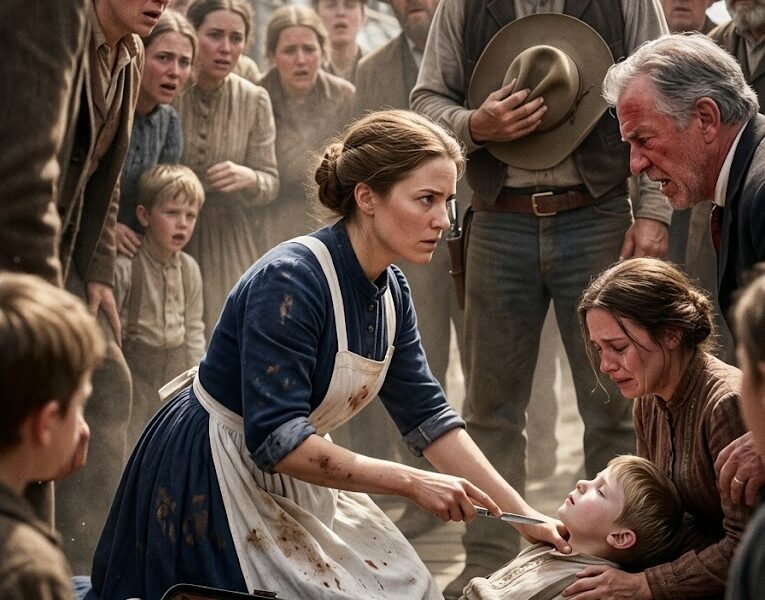
A small boy lay on the wooden platform perhaps twenty feet away, his mother on her knees beside him. His little boots kicked once against the boards and then stopped.
A gray-haired man in a dark coat crouched over him.
Someone shouted, “Give Dr. Cruz room!”
The crowd pulled back.
Harriet did not.
She watched the doctor lift the boy’s chin. Watched him put two fingers against the child’s throat. Watched the boy’s chest strain desperately without drawing enough air.
Then she saw the doctor’s face.
Not confusion.
Not concentration.
Defeat.
Harriet knew that face.
She had seen it in hospital wards.
She had seen it in country bedrooms lit by kerosene lamps.
She had seen it on her own father when a patient had traveled too far beyond medicine’s reach.
But this child was not beyond reach.
Not yet.
Harriet dropped her suitcase.
The sound made several people turn.
She was thirty years old, dusty from the journey, wearing a dark traveling dress wrinkled from days aboard trains, her hair pinned beneath a modest hat.
To Fairwater, she looked like what she had come there pretending she could become.
A respectable woman.
A prospective wife.
Someone who would pour coffee, mend shirts, keep a clean house, perhaps bear children if God was generous.
Then Harriet picked up the black leather bag beside her suitcase.
And everything changed.
“Move,” she said.
Dr. Cruz looked up.
“What?”
“Move away from the child.”
His eyebrows rose.
“Madam—”
“He cannot breathe.”
“I am aware of that.”
“Then move.”
There was something in Harriet’s voice that made the boy’s mother look at her.
Not hope.
Hope was already leaving the woman’s face.
It was desperation.
“Can you help him?”
Harriet looked at the boy.
His lips were blue.
His body had gone frighteningly still.
She had seconds.
“Yes.”
Dr. Cruz stood.
“Who the devil are you?”
Harriet was already kneeling.
“Someone who needs you to move.”
The doctor caught her wrist.
“You will not touch my patient.”
Harriet looked at his hand.
Then at his face.
“If you have another treatment, Doctor, use it now.”
Silence.
Cruz’s grip loosened.
Harriet understood.
There was no other treatment.
She opened the black bag.
The metal instruments inside caught the afternoon light.
Someone gasped.
Harriet barely heard it.
The world narrowed.
The platform disappeared.
The crowd disappeared.
The man she had come west to marry disappeared.
There was only a child without air.
Her hands moved.
Fast.
Precise.
Certain.
“What is she doing?” someone whispered.
“My God.”
“Stop her.”
“Is she cutting him?”
The mother made a broken sound.
Harriet did not look up.
“Hold his shoulders.”
Nobody moved.
Harriet’s voice sharpened.
“Hold him!”
The mother obeyed.
Dr. Cruz stared.
Harriet made the small incision with the steadiness of someone who had spent years training herself not to tremble when trembling meant death.
Blood touched her fingers.
The crowd recoiled.
A woman screamed.
Then Harriet inserted the airway.
For one horrible second, nothing happened.
The boy lay still.
Harriet bent close.
Come on.
Not aloud.
Not yet.
She cleared the obstruction.
She gave him air.
Once.
Again.
The boy’s chest rose.
A sound came from somewhere behind Harriet.
A prayer, perhaps.
Then the child convulsed.
He dragged in a thin, ragged breath.
Another.
His eyes opened.
And he began to cry.
It was not a beautiful sound.
It was hoarse and terrified and weak.
To Harriet, it sounded like church bells.
His mother collapsed over him.
“Oh, God. Oh, God, Thomas.”
Harriet sat back on her heels.
Only then did she realize there was blood on her dress.
Only then did she realize that the entire platform had fallen silent.
Forty or fifty people were staring at her.
At the instruments.
At the black bag.
At the child who had been dying thirty seconds earlier.
Dr. Cruz looked as though Harriet had slapped him.
And behind the crowd stood a tall man in a work coat, hat in one hand, watching her with an expression she could not read.
Harriet knew who he was before he spoke.
“Miss Sloan?”
Her heart sank.
Of course.
Of all the men in Nebraska, the one witnessing this had to be Garrett Poe.
The rancher who had advertised for a wife.
The stranger Harriet had agreed to marry.
The man who had been expecting a respectable woman from Ohio and had instead found her kneeling in railroad dirt with a child’s blood on her hands and surgical instruments scattered around her.
Harriet slowly rose.
“Yes.”
Garrett looked at the crying boy.
Then at the black bag.
Then back at Harriet.
For the first time since leaving Ohio, Harriet Sloan was frightened.
Not because she had almost watched a child die.
Because the lie she had spent months carefully avoiding had survived less than five minutes in Nebraska.
Garrett Poe had sent east for a wife.
What he had received was a doctor.
And Harriet had no idea which one Fairwater would hate more.
The wagon ride to Garrett’s ranch was almost entirely silent.
Fairwater disappeared behind them beneath the orange light of late afternoon.
Harriet sat beside Garrett with her hands folded tightly in her lap.
The black bag rested between her boots.
Neither mentioned it.
That somehow made it worse.
Garrett Poe was perhaps thirty-eight, broad-shouldered from ranch work, with a face that looked weathered rather than old. His wife had died several years earlier. His advertisement had been practical and painfully brief.
Nebraska rancher. Widower. Thirty-eight. Own land and livestock. Seeking respectable woman of sound character for marriage and companionship.
No poetry.
No promises of romance.
Harriet had liked that.
She had spent too many years being disappointed by pretty promises.
So she had answered with equal practicality.
She told him she was thirty.
Unmarried.
Educated.
Accustomed to hard work.
She mentioned that her father had been a physician and that she possessed medical training.
That last phrase had been technically true.
It had also been cowardly.
She had never written:
I graduated from medical college.
I am a physician.
I intend to practice medicine if anyone will let me.
And I am answering your advertisement partly because marriage to a Nebraska rancher may give me the one thing my degree never did—a place where people cannot easily send me away.
Now Garrett knew.
At least some of it.
Harriet finally broke the silence.
“You may ask.”
Garrett kept his eyes on the road.
“Ask what?”
“What you have been wanting to ask for the last six miles.”
“I’ve been thinking.”
“That is usually what people say before asking something unpleasant.”
The corner of his mouth moved.
Not quite a smile.
“I suppose you’ve had practice with unpleasant questions.”
“More than you might imagine.”
Another mile passed.
Then Garrett said, “Were you trained to do what you did back there?”
“Yes.”
“Properly trained?”
Harriet turned toward him.
The question struck an old nerve.
“What do you mean by properly?”
His eyes flicked toward her.
“I mean exactly what I asked.”
She straightened.
“Yes. Properly.”
“Medical school?”
“Yes.”
His hands tightened slightly on the reins.
“You’re a doctor.”
“Yes.”
There it was.
Harriet waited for the reaction she knew.
Disbelief.
Humiliation.
Anger.
Perhaps laughter.
She had received all four before.
Garrett merely nodded once.
Then he drove on.
That was somehow unbearable.
“Say something.”
“I’m thinking.”
“You have done enough thinking.”
This time he did smile.
Barely.
“All right.”
He pulled the wagon to a stop near a stand of cottonwoods.
Harriet looked at him.
Garrett set the brake.
“Tell me all of it.”
So she did.
Perhaps because there was nothing left to protect.
Perhaps because she was exhausted.
Perhaps because watching Thomas breathe again had reminded her how tired she was of pretending that the best thing about her was something shameful.
“My father was a country doctor in Ohio,” she began.
She had ridden beside him from childhood, first carrying towels and boiled water, then preparing instruments, then recognizing symptoms before he spoke them aloud.
Her father had noticed.
More importantly, he had not been afraid of what he noticed.
When Harriet was seventeen, he began teaching her seriously.
Anatomy.
Disease.
Childbirth.
Wound care.
Diagnosis.
At twenty-one, through favors and letters and humiliating appeals, he found a medical college willing to admit women.
Harriet entered.
Men laughed when she walked into lectures.
Some professors refused to address female students directly.
Patients sometimes demanded that she leave.
She stayed.
She studied harder.
She graduated near the top of her class.
She had believed the degree would change everything.
It changed almost nothing.
Hospitals refused her.
Established physicians refused her.
Families refused her.
She rented a tiny office once and hung a shingle bearing the words:
HARRIET SLOAN, M.D.
Someone smeared mud across it the first night.
Someone else wrote WOMAN in chalk beneath M.D., as if it were a diagnosis.
She lasted six months.
Then another town.
Then another.
Everywhere the same answer.
A woman might nurse.
A woman might assist.
A woman might comfort.
But diagnose?
Operate?
Prescribe?
No.
Her father died during Harriet’s twenty-eighth year.
After the funeral, she discovered how little money remained.
Her training had cost nearly everything.
Her attempts to practice consumed the rest.
By thirty, Harriet Sloan possessed a medical degree, years of experience, a black bag full of instruments—
and barely enough money to eat.
Garrett listened without interruption.
Finally Harriet said, “Then I saw your advertisement.”
“And decided Nebraska was desperate.”
She almost smiled.
“I decided distance sometimes weakens stupidity.”
Garrett laughed once.
A short, surprised sound.
Harriet continued.
“I thought a small frontier town might care less about who held the instrument if someone was bleeding badly enough.”
“And the marriage?”
Her smile vanished.
“That was the doorway.”
Garrett looked at her.
She forced herself not to look away.
“I was honest that I had medical training. But I was not honest enough about what it meant.”
“No.”
“No.”
“You thought I wouldn’t send for you.”
“Yes.”
“Would you have married me if there were another way to practice?”
There was the question Harriet had feared.
She answered it anyway.
“I don’t know.”
Garrett absorbed that.
Harriet’s throat tightened.
“If you believe I deceived you, I will understand.”
“Understand what?”
“If you want me gone.”
His expression changed slightly.
“I didn’t say that.”
“You did not have to.”
“No. You decided it for me.”
Harriet fell silent.
Garrett looked toward the horizon.
Then back at her.
“Are you a good doctor?”
She blinked.
“What?”
“I asked whether you’re good.”
No one had ever asked her that first.
Not whether women belonged in medicine.
Not whether male patients would tolerate her.
Not whether it was decent.
Not whether she planned to neglect a husband.
Simply—
Are you good?
Harriet felt something inside her shift.
“Yes.”
Garrett waited.
She raised her chin.
“Yes. I am.”
“Better than Cruz?”
Harriet remembered the platform.
“Yes.”
That answer could have sounded arrogant.
It did not.
It sounded tired.
Garrett nodded.
“All right.”
“All right?”
“A doctor who can save a boy everyone else has given up on seems useful.”
“You cannot possibly think it is that simple.”
“I generally find people make simple things complicated when their pride is involved.”
Harriet stared at him.
“You ordered a wife.”
“I wrote an advertisement.”
“You expected someone to keep your house.”
“I can keep a house badly on my own.”
Despite herself, Harriet laughed.
Garrett looked down at the black bag.
Then he said something Harriet would remember long after the Nebraska wind had erased the wagon tracks beneath them.
“I don’t see much sense in letting people die because the person who can save them is wearing a skirt.”
Harriet looked away quickly.
She did not want him to see what those words had done to her.
Garrett picked up the reins.
“Fairwater may disagree.”
“It will.”
“Then Fairwater can learn.”
“And if it refuses?”
Garrett clicked his tongue to the horses.
“Then I suppose Fairwater can keep burying people until it gets tired of being foolish.”
Harriet watched him.
She had crossed hundreds of miles hoping to find a loophole.
She had not expected to find an ally.
That frightened her almost as much as rejection.
Because rejection was familiar.
Hope was not.
Fairwater did refuse.
By sunrise the next morning, the story had traveled from the railroad platform to nearly every kitchen, barn and storefront in town.
By noon, Harriet had become three different women depending on who was telling it.
To some, she was the brave stranger who saved Thomas Wheeler.
To others, she was an unstable woman who cut into a child without permission.
To Dr. Cruz, she was something worse.
Competition.
He visited Garrett’s ranch two days later.
Harriet was unpacking medical books when she heard voices outside.
Cruz stood beside the porch.
Garrett leaned against a post.
“I’m telling you for your own good,” Cruz said. “This sort of thing will bring trouble.”
“What sort?”
Cruz glanced toward Harriet.
“This.”
Harriet stepped outside.
“You may say it while looking at me.”
Cruz’s jaw tightened.
“I do not recognize your authority to practice here.”
“My degree does.”
“This is not Ohio.”
“Disease changes remarkably little at state lines.”
Garrett coughed into his hand.
Harriet suspected he was hiding a smile.
Cruz did not.
“You embarrassed me publicly.”
“A child was suffocating.”
“I was treating him.”
“You had stopped.”
His face reddened.
“You know nothing about this town.”
“I know Thomas Wheeler is alive.”
“That does not make you our physician.”
“No.”
Harriet stepped closer.
“But neither does being male.”
Cruz left without another word.
Three days later, Harriet hung her father’s old shingle beside the ranch gate.
HARRIET SLOAN POE, M.D.
She had married Garrett quietly.
No celebration.
No church full of strangers.
Only vows, witnesses and the strange knowledge that the man beside her knew exactly why she had come and had married her anyway.
Then she waited.
No patients came.
A week passed.
Then another.
Harriet sat in the small room Garrett had cleared for her clinic and listened to horses moving outside.
She polished instruments that were already clean.
Reorganized bottles.
Read medical journals she could practically recite.
Every morning the shingle hung beside the road.
Every evening Harriet carried the unused black bag back inside.
The silence began to feel familiar.
Ohio had sounded like this.
Indiana had sounded like this.
Every locked door sounded like this.
One evening Garrett found her removing the shingle.
“What are you doing?”
“Saving you the embarrassment.”
“Put it back.”
“No.”
“Harriet.”
“They will not come.”
“They haven’t come yet.”
“There is a difference only to optimists.”
Garrett took the sign from her.
She resisted for half a second, then released it.
“You cannot force them to trust me.”
“No.”
He rehung the sign.
“But I can keep you from surrendering before they get the chance.”
Harriet stared at him.
“You make persistence sound very noble.”
“Usually it’s just refusing to take something down.”
The first patient arrived two weeks later.
Not because he trusted Harriet.
Because Dr. Cruz had failed.
A ranch hand named Eli Mercer had fallen from a hayloft and broken his forearm badly.
Cruz set it.
Three days later, the swelling worsened.
Garrett brought Eli to Harriet.
Eli resisted.
“I ain’t being doctored by a woman.”
Garrett looked at the crooked arm.
“Then keep it crooked.”
Eli frowned.
Harriet almost sent them both outside.
Instead she examined him.
The setting was wrong.
She reset the fracture.
Eli screamed so loudly a horse kicked its stall wall.
Six weeks later, the bone had healed straight.
Eli showed everyone.
That mattered more than ten advertisements.
Then came Martha Bell, laboring for nearly a day.
Cruz could not turn the child.
Harriet could.
Mother and baby survived.
Then Samuel Reed arrived with an infected wound in his leg.
Cruz recommended amputation.
Harriet cleaned it aggressively, monitored him and saved the limb.
One patient became four.
Four became twelve.
People still whispered.
But the whispers changed.
Did you hear what she did?
Mrs. Bell would have died.
Mercer’s arm is straight.
Reed still has his leg.
Harriet knew better than to call it acceptance.
It was only doubt.
But doubt was a crack.
And cracks were how walls eventually failed.
Then summer came.
And people began dying.
The first child developed fever on a Tuesday.
By Friday there were nine cases.
By Sunday, twenty-three.
Fairwater changed almost overnight.
Doors stayed closed.
The church canceled services.
Mothers kept children inside.
Men spoke quietly outside the general store as if loud voices might attract disease.
Dr. Cruz called it summer fever.
Harriet did not.
She rode from house to house, asking questions that seemed strange to frightened families.
Where do you get your water?
Who else drinks from it?
When did the vomiting begin?
Who became ill first?
Which well?
Again and again, the same answer emerged.
The central well.
Harriet rode there at dusk.
She stood beside the wooden structure, looking uphill.
A privy.
Farther beyond it, the old burial ground.
Recent rain had softened the earth.
Garrett found her crouching near the slope.
“You know what it is,” he said.
Harriet nodded.
“What?”
“Typhoid.”
He looked toward town.
“From here?”
“I believe so.”
“How certain?”
“Certain enough that no one should drink another cup.”
Garrett did not ask whether she was sure again.
He went for his horse.
The town meeting was called that night.
Harriet stood before nearly a hundred frightened people.
Dr. Cruz stood across from her.
“You want us to close the main well,” he said.
“Yes.”
“On a theory.”
“On evidence.”
“You have not tested the water.”
“There is no laboratory within hundreds of miles capable of giving us what you want quickly enough.”
“So you admit you don’t know.”
Harriet looked around the room.
Faces she had treated.
Faces that still distrusted her.
Faces terrified enough to listen but proud enough to hesitate.
“I know the sick households cluster around people who drink from that well. I know the cases began after heavy rain. I know there is contamination uphill. And I know that if I am right, every bucket you draw risks another life.”
Cruz shook his head.
“This is hysteria.”
The room shifted.
That word.
Harriet had heard versions of it all her adult life.
Emotional.
Unnatural.
Overeducated.
Hysterical.
Words used when answering the argument itself was inconvenient.
Cruz continued.
“You would shut the town’s primary water source in the middle of summer because of speculation from a woman who has been here a matter of months.”
Harriet felt anger rise.
She buried it.
“Boil every drop.”
Murmurs.
“Separate the sick from the healthy.”
Louder murmurs.
“Close the well tonight.”
Someone shouted, “And get water where?”
“South well.”
“That’s half a mile!”
Harriet answered, “Half a mile is shorter than a funeral procession.”
Silence.
Cruz scoffed.
Then Garrett stood.
He had been at the back.
Harriet had almost forgotten he was there.
“I’m no doctor,” he said.
Several men turned.
“But I know enough arithmetic to understand this.”
He looked at Cruz.
“If my wife is wrong, we walk farther for water and burn more firewood boiling it.”
Then he looked around the hall.
“If she’s right and we ignore her, our children die.”
No one spoke.
Garrett’s voice hardened.
“I’ve watched this town argue for months about whether Harriet Poe has the right kind of hands to heal us.”
His gaze moved from face to face.
“I’m done with it.”
Harriet stared at him.
“So here’s my vote. Shut the well. Boil the water. And if anybody’s pride is wounded by taking instructions from a woman, I suggest you nurse that wound quietly while she keeps your family alive.”
The well was closed before midnight.
And then the real nightmare began.
The town hall became a fever ward.
Cots filled the floor.
Windows stayed open despite the heat.
Buckets of boiled water lined the walls.
Harriet worked until time lost meaning.
Morning became afternoon became night without ceremony.
She changed cloths.
Checked pulses.
Measured fluids.
Comforted mothers.
Ordered Garrett to bring more clean water.
Ordered men twice her size to scrub their hands.
Argued with Cruz.
Slept twenty minutes sitting against a wall.
Then stood again.
The epidemic did not care that Fairwater had finally begun listening.
It had already entered too many homes.
A little girl named Annie died on the third night.
Harriet sat beside her body after the parents left.
She had saved Thomas on the platform.
She had saved Martha Bell.
Samuel Reed.
Eli Mercer.
Some part of her had begun believing skill might always be enough.
Annie taught her otherwise.
Garrett found Harriet alone.
“You need sleep.”
“No.”
“You’ve been awake almost two days.”
“There are seventeen patients in this room.”
“And one doctor.”
“Exactly.”
“Which means losing the doctor would be a poor strategy.”
She looked at him.
“I lost her.”
Garrett understood.
He sat beside her.
For a while neither spoke.
“I knew what to do,” Harriet whispered.
“I know.”
“I did everything.”
“I know.”
“She was seven.”
Garrett’s jaw tightened.
Harriet looked at her hands.
“These hands are supposed to matter.”
“They do.”
“Not to Annie.”
Garrett turned toward her.
“You think being a doctor means nobody dies?”
“No.”
“Then don’t punish yourself for failing at being God.”
Harriet looked sharply at him.
He did not retreat.
“You closed the well,” he said. “You recognized what nobody else did. There are people breathing in this room because you are here.”
“And there are people who aren’t.”
“Yes.”
His voice softened.
“You carry both.”
That nearly broke her.
But someone called from across the hall.
“Dr. Poe!”
Harriet stood.
The grief would have to wait.
For three weeks, almost everything waited.
And slowly, impossibly, the numbers changed.
Fewer new cases.
Fewer occupied cots.
More empty beds for the right reason.
Autumn wind arrived.
The fever weakened.
Then one morning Harriet walked into the town hall and discovered there were only four patients left.
She stood in the doorway.
Garrett was asleep in a chair with a bucket beside him.
A mother was feeding broth to her son.
Sunlight crossed the floor.
No one was screaming.
Harriet suddenly understood.
They had survived.
Not everyone.
Never everyone.
But enough.
Far more than would have lived if the well had remained open.
Fairwater had come frighteningly close to being destroyed by its own water.
And by its own pride.
Now nearly every family in town owed someone’s life to the woman they had refused to call Doctor.
That was when Fairwater finally changed.
Not politely.
Not elegantly.
Necessity had simply crushed prejudice faster than argument ever could.
Women began appearing at Harriet’s door with children before they considered anyone else.
Men who once laughed at her removed their hats when she passed.
One morning, Dr. Cruz came to the ranch.
Harriet expected another argument.
Instead, he placed a box of medical supplies on her table.
“I won’t be needing these.”
She studied him.
“You’re leaving?”
“Retiring.”
“Why?”
Cruz looked older than he had during the summer.
“Because there are things you know that I do not.”
Harriet said nothing.
He looked toward the black bag.
“I was wrong about you.”
The apology seemed to cost him something.
Perhaps that was why Harriet accepted it.
“Thank you.”
Cruz nodded.
At the door, he paused.
“The boy on the platform would have died.”
Harriet looked up.
“I know.”
He gave a humorless smile.
“So do I.”
Then he left.
By winter, Harriet’s days belonged to the county.
Births at midnight.
Broken bones at dawn.
Fevers.
Burns.
Farm accidents.
Pneumonia.
Children with coughs.
Old men pretending chest pain was indigestion.
She traveled with the black bag beside her through snow, mud and Nebraska wind.
And almost without noticing when it happened, Harriet stopped being the lady doctor.
She became Dr. Poe.
The difference was everything.
Her marriage changed too.
The arrangement that had brought her west softened into companionship.
Companionship deepened into something neither of them named for a long time.
Garrett learned when Harriet needed coffee without asking.
Harriet learned that he hummed when repairing tack.
He built shelves for her medical books.
She stitched a cut over his eyebrow after a fence repair went wrong.
They argued about her riding alone at night.
She accused him of worrying too much.
He accused her of worrying too little.
Neither won.
Then one evening after the fever had passed, they sat together on the porch.
The prairie was turning gold beneath the sunset.
Garrett said, “I owe you an apology.”
Harriet looked over.
“For what?”
“My advertisement.”
She smiled.
“That seems rather late.”
“I said I wanted a wife.”
“You received one.”
“I thought I wanted someone to keep the house.”
Harriet raised an eyebrow.
Garrett looked embarrassed.
“I was a fool.”
“Yes.”
He laughed.
Then became serious.
“I didn’t know what I was asking for.”
Harriet waited.
“I thought loneliness was the problem.”
His voice lowered.
“Then you came.”
Something in Harriet’s chest tightened.
“And?”
“And I watched you kneel in dirt and save a boy before you’d even met me.”
He looked toward the darkening fields.
“I watched this town try to make you smaller because making you smaller was easier than admitting it had been wrong.”
Harriet said nothing.
“I watched you keep working anyway.”
Garrett swallowed.
“I watched you walk into that fever ward every morning knowing somebody might die in your hands before nightfall.”
He turned toward her.
“And somewhere in all of that, I stopped thinking of this as an arrangement.”
Harriet’s pulse quickened.
Garrett Poe was not a man who wasted words.
That made every word heavier.
“I love you.”
She looked down.
For years Harriet had trained herself against wanting things that could be taken away.
Respect.
Opportunity.
Belonging.
Love belonged on the same dangerous list.
Garrett continued.
“I don’t love you despite the doctoring.”
Harriet looked up.
“I love you partly because of it.”
Her eyes burned.
He smiled faintly.
“I don’t know whether that was the correct thing to say.”
“It was.”
“I want this marriage to be real.”
“It is legally real.”
“You know what I mean.”
She did.
Harriet looked at the black bag near the doorway.
Then at the man beside her.
“I came to Nebraska because I thought I had to choose.”
“Between what?”
“Medicine and a life.”
Garrett frowned.
“Who told you that?”
“Almost everyone.”
He looked offended on her behalf.
Harriet laughed through sudden tears.
“I thought if I wanted to practice, I would have to give up being loved. And if I wanted a husband, I would eventually have to close the bag.”
Garrett glanced toward it.
“That bag isn’t going anywhere.”
“No.”
“And neither am I.”
That was when Harriet cried.
Not loudly.
Years of humiliation did not leave a person dramatically.
Sometimes they left quietly, in tears on a Nebraska porch, beside a man who had done nothing more miraculous than refuse to be threatened by the woman he loved.
Harriet took his hand.
“I love you too.”
And the marriage that had begun as an escape route finally became a home.
The following spring nearly took that home away.
Garrett was breaking a young horse when Harriet heard the crash.
Then shouting.
She ran from the house.
Two ranch hands were already inside the corral.
Garrett lay near the fence.
He was conscious.
Barely.
His leg bent at an angle no leg should bend.
Blood darkened his shirt along his side.
For one second Harriet stopped.
Not Dr. Poe.
Harriet.
Wife.
Woman.
Terrified.
“Harriet,” Garrett whispered.
The fear vanished behind training.
She dropped beside him.
“Do not move.”
He attempted a smile.
“Wasn’t planning to.”
“Eli, get my bag.”
The ranch hand ran.
“Ben, clean the kitchen table. Boil water. Bring every clean cloth in the house.”
Garrett looked at her.
“You’re giving orders again.”
“Be quiet.”
“That’s my wife.”
“Garrett.”
Something in her voice made him stop smiling.
She touched his face.
Only once.
Then she became his physician.
They carried him inside.
The wound in his side was deep.
The bleeding frightened her.
The fracture was complicated.
Harriet’s hands remained steady.
Inside, she was screaming.
Every decision suddenly carried two futures.
Do this wrong and your patient dies.
Do this wrong and Garrett dies.
She cleaned the wound.
Controlled the bleeding.
Set the leg.
Hours passed.
Night came.
Garrett drifted in and out.
Once, his eyes opened.
“Harriet?”
“I’m here.”
“Knew you would be.”
“Do not talk.”
“I married a very bossy woman.”
“Save your strength.”
His eyes closed.
Harriet kept working.
She did not cry.
Not when his pulse weakened.
Not when fever threatened.
Not when dawn appeared through the window and Garrett still had not fully awakened.
She had learned years earlier that fear could sit in the room.
It simply could not be allowed into her hands.
So Harriet put terror in one corner of her heart and medicine in the other.
And medicine won.
Garrett survived.
Weeks later, he sat propped against pillows while Harriet changed his bandage.
He caught her wrist.
“What?”
“I remember that night.”
“Parts of it.”
“I heard you.”
Harriet continued working.
“You were delirious.”
“I heard your voice.”
She stopped.
Garrett looked at her.
“You sounded calm.”
“I was not.”
“Your hands were.”
Harriet looked down.
He squeezed her fingers.
“I understood something lying there.”
“What?”
“You were afraid.”
“Terrified.”
“But I couldn’t feel it in your hands.”
Harriet’s eyes filled.
Garrett smiled.
“That may be the bravest thing I have ever known about you.”
The tears came then.
Weeks late.
Harriet sat beside him and cried for everything she had refused to feel while his life depended on her.
Garrett held her with one good arm.
The woman the world had called unfit had saved the man she loved.
And the man she loved had trusted those supposedly unfit hands without hesitation.
After that night, there was nothing left in Fairwater to prove.
Years passed.
The prairie changed.
Children Harriet delivered grew old enough to bring children of their own to her.
Her black hair silvered.
Garrett’s shoulders stooped.
The ranch expanded.
Fairwater grew.
And Harriet Sloan Poe practiced medicine for forty years.
The town eventually built a proper little hospital.
Harriet objected when they proposed putting her name on it.
The town ignored her.
It was perhaps the only time Fairwater’s refusal to listen pleased everyone.
The poisoned well was sealed permanently.
A marker stood near it.
Most children growing up later never understood why adults occasionally stopped there.
They only knew the story.
Once, long ago, Fairwater had nearly killed itself because it trusted pride more than evidence.
And a woman carrying a black bag had saved it.
Harriet trained others.
Especially girls.
Whenever she recognized curiosity in a young woman—the kind her father had recognized in her—Harriet fed it rather than extinguishing it.
She taught anatomy.
Wound care.
Observation.
Discipline.
She wrote recommendation letters.
She sent promising women east to medical colleges.
Some returned as doctors.
Others built careers elsewhere.
Every letter they sent Harriet mattered.
Each was another door opening where she had once found a wall.
Garrett never complained when Harriet left dinner for an emergency.
Never asked her to become smaller so he could feel larger.
When people praised him for being unusually tolerant of his wife’s career, he disliked the word.
“Tolerate?” he once said. “You tolerate a squeaky wheel. Harriet saves lives.”
They had children.
Their daughters grew up believing something Harriet had needed half a lifetime to learn:
Love did not have to demand surrender.
One daughter eventually became a physician herself.
And when Harriet’s hands became too stiff to carry the black bag on winter calls, that daughter carried it.
The same bag Harriet’s father had once packed.
The same bag Fairwater had stared at with suspicion.
The same bag that had opened beside a dying child on a railroad platform decades earlier.
Eventually Harriet stopped practicing.
Age accomplished what prejudice never had.
Her body simply could no longer keep pace with her will.
The black bag was hung inside the hospital.
Young doctors often stopped beneath it.
Some knew the story.
Others asked.
Harriet always told them.
Not because she wanted admiration.
Because she wanted them to understand the price of things they had begun taking for granted.
She told them about the medical degree that had not been enough.
The hospitals that refused her.
The empty office.
Her father’s death.
The marriage advertisement.
The train.
Thomas Wheeler turning blue on the platform.
Dr. Cruz stepping back.
Garrett watching from the crowd.
The fever.
The well.
The children she saved.
The ones she could not.
She told all of it.
Especially the failures.
Because Harriet had learned that legends were dangerous when they erased the cost of becoming one.
Thomas Wheeler grew old too.
The child Harriet saved during her first minutes in Fairwater became a husband and father.
When his first son was born, his mother reminded him of the stranger who had knelt in railroad dirt when everyone else believed he was dying.
Thomas brought the baby to Harriet.
“What are you naming him?” she asked.
Thomas smiled.
“Garrett.”
Harriet laughed.
“After my husband?”
“Partly.”
Garrett, already gray, looked suspicious.
“What’s the other part?”
Thomas glanced toward Harriet.
“My mother said one Poe saved me with her hands and the other gave her the place to do it.”
For once, Garrett had no reply.
Harriet did.
She cried.
Near the end of Harriet’s life, a young woman visited the hospital.
She had recently completed medical training.
She carried herself in a way Harriet recognized immediately.
Straight-backed.
Controlled.
Angry.
Hopeful despite herself.
The young woman explained that hospitals had rejected her.
Physicians refused to hire her.
Families did not want a woman doctor.
She had done everything required of her.
Still, the world had moved the door.
“I don’t know what else I’m supposed to do,” she said.
Harriet was old by then.
Her hands trembled.
Her mind did not.
She asked the young woman to help her stand.
Together they walked slowly down the hospital corridor.
They stopped beneath the black leather bag.
“What is that?” the young woman asked.
“My dowry.”
She laughed uncertainly.
Harriet smiled.
“I came west to marry a stranger because nobody would let me be a doctor.”
The young woman stared.
So Harriet told her.
Not the polished version.
The true one.
She told her about hunger.
Humiliation.
Fear.
About answering Garrett’s advertisement because desperation sometimes disguised itself as courage.
About arriving in Fairwater intending to reveal her skill slowly and instead finding a child dying before she had even properly introduced herself.
“I did not ask permission that day,” Harriet said.
“Weren’t you afraid?”
“Terrified.”
“Then how did you do it?”
Harriet looked up at the bag.
“Because he was more afraid than I was.”
The young woman said nothing.
Harriet reached for her hands.
“The world will sometimes demand that you prove yourself twice before allowing you half as much.”
The woman’s eyes filled.
“That isn’t fair.”
“No.”
“What do I do?”
Harriet thought about Ohio.
About the muddy shingle.
About the empty waiting rooms.
About Nebraska.
About Thomas breathing.
About Garrett standing in the town hall and telling frightened men that inconvenience was cheaper than funerals.
About Annie, whom she could not save.
About the hundreds she had.
Then Harriet answered.
“You become so good at the work that when the moment comes, the truth of what you can do is harder to deny than the prejudice against you.”
“And if they still refuse?”
Harriet smiled sadly.
“Some will.”
“That’s it?”
“No.”
She squeezed the young woman’s hands.
“You find the door they forgot to guard.”
The woman laughed through her tears.
Harriet pointed toward the bag.
“That was mine.”
Years later, people would remember Harriet Sloan Poe in different ways.
Some remembered the typhoid summer.
Some remembered the babies she delivered.
Some remembered Garrett’s accident.
Some remembered riding through blizzards to fetch her.
Some remembered the hospital.
Some remembered the black bag.
But the oldest people in Fairwater remembered the beginning.
Spring, 1883.
A train breathing smoke into the Nebraska sky.
A mother screaming.
A little boy turning blue.
An old doctor with nothing left to try.
And a stranger stepping forward.
She was supposed to be somebody’s mail-order bride.
She was supposed to keep her head down until the town decided what it thought of her.
She was supposed to wait for permission.
Instead, Harriet Sloan dropped her suitcase.
Opened her father’s black leather bag.
And knelt in the dirt.
That single decision changed the rest of her life.
It changed Garrett Poe’s.
It changed Fairwater.
Perhaps that was the strangest part of Harriet’s story.
The town had spent months deciding whether a woman was allowed to save them.
Disease never bothered asking.
A broken bone never cared.
A bleeding man never cared.
A dying child certainly did not care.
In the end, Fairwater learned what suffering teaches faster than pride ever does:
When death comes through the door, people stop asking whether the hands reaching toward them are the hands they expected.
They only pray those hands know what to do.
Harriet’s did.
For forty years, they did.
And when those hands finally became too old to carry the black bag, the bag remained hanging on the hospital wall, its leather cracked, its brass fittings dull, its instruments long retired.
Garrett was gone by then.
Many of the people who had once doubted her were gone too.
Even Thomas Wheeler had gray in his hair.
But sometimes, on quiet afternoons, Harriet would sit beneath that old bag and hear young doctors moving through the halls.
Men.
Women.
People who had walked through doors she once had to bleed to open.
She never told them they owed her anything.
That had never been the point.
She would simply look at the bag.
And remember the first time she opened it in Nebraska.
The screaming mother.
The blood on her hands.
The crowd staring.
Garrett standing beyond them.
And one little boy taking a breath nobody expected him to take.
Then another.
Then another.
For Harriet, that sound had been the beginning of everything.
And perhaps that was why, even near the end of her life, when people asked whether she regretted crossing half a country to marry a stranger just for the chance to practice medicine, she always gave the same answer.
She would look toward the hospital window, toward the Nebraska land beyond it, and smile.
“No.”
Sometimes she added one more thing.
“I only regret that the boy had to stop breathing before anyone was willing to let me begin.”









