HE ORDERED A QUIET WIFE—THEN SHE STEPPED OFF THE TRAIN WITH A RIFLE
The first thing Porter Mabry noticed about the woman he was supposed to marry was the rifle.
The second was the way she looked at Redwater Station as if she expected somebody there to try something stupid.
The third was that somebody immediately did.
Porter had been standing beneath the depot awning for nearly twenty minutes, holding a fistful of Texas wildflowers that had already begun to wilt in the September heat.
He had changed his shirt twice that morning.
He had polished his boots.
He had even shaved the narrow strip beneath his jaw that he usually missed.
And while he waited for the noon train, he kept repeating the description the matrimonial agency had given him.
Quiet.
Modest.
Domestic.
A woman of reserved temperament seeking a settled rural home.
Those words had mattered to Porter.
Especially quiet.
Then the locomotive screamed into Redwater beneath a cloud of black smoke, the passenger door opened, and the woman who stepped onto the platform looked nothing like the wife he had constructed from six short letters.
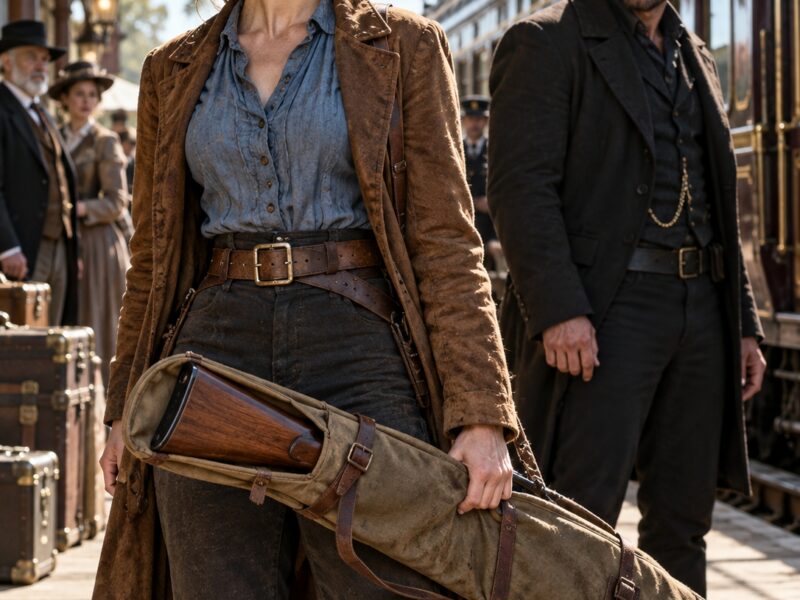
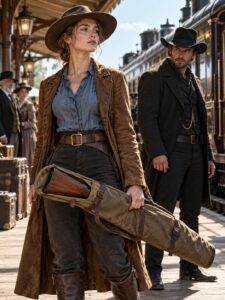
She wore a plain brown traveling coat over a faded blue blouse.
Her boots were men’s riding boots, scuffed white at the toes.
A canvas rifle case hung from one hand.
Her dark hair was pinned beneath a practical hat that seemed chosen less for fashion than for keeping the Texas sun out of her eyes.
She wasn’t delicate.
She wasn’t shy.
And she definitely wasn’t looking around Redwater as though she needed a man to tell her where she was.
She studied the platform.
The hotel.
The telegraph office.
The hitching rail.
The men pretending not to stare.
Then her eyes found Porter.
He tightened his grip on the flowers.
Somewhere between Texas and wherever she had boarded that train, he thought, a terrible clerical mistake had been made.
He took one step forward.
“Miss Deane?”
He never finished.
The locomotive released a violent hiss of steam.
A mule tied beside the freight platform reared in panic.
Someone shouted.
The animal jerked backward, its lead rope tangling around a barrel. The barrel toppled, frightening the mule further, and suddenly six hundred pounds of terrified animal was charging toward three children standing beside the water tank.
A woman screamed.
Porter dropped the flowers.
He started running.
The stranger dropped her suitcase.
Her right hand disappeared beneath her coat.
Porter saw metal.
Then heard the shot.
The sound cracked across Redwater.
For one horrible instant, Porter thought she had shot the mule.
She hadn’t.
The bullet had cut the rope.
Clean through.
Freed from the dragging barrel, the mule veered into the open freight yard, galloped another fifty yards, then slowed without touching a single child.
Silence swallowed the depot.
The woman lowered her pistol.
She returned it beneath her coat.
Picked up her suitcase.
Then walked toward Porter.
As though nothing unusual had happened.
“You’d be Porter Mabry.”
It wasn’t a question.
Porter stared at her.
Behind him, half the town stared too.
She stopped three feet away.
“Frankie Deane.”
She glanced down at the crushed wildflowers beside his boot.
Then back at him.
“You wrote for a wife.”
Porter’s mouth went dry.
Frankie looked at the rifle case in her own hand, then at his expression.
One eyebrow rose.
“I expect they told you to look for something a little more folded up than this.”
She extended her hand.
Porter stared at it.
Ladies in Redwater did not shake men’s hands when introduced.
Ladies in Redwater lowered their eyes and smiled.
Frankie Deane simply waited.
So Porter shook it.
Her grip was firm.
Warm.
Steady.
The hand of someone who had worked for a living.
When he released it, she caught him still looking at her.
“Finished?”
Porter blinked.
“Ma’am?”
“Your inspection.”
His face burned.
“I’m sorry.”
“Don’t be. I’ve been looked at professionally.”
He had absolutely no idea what that meant.
Before he could ask, Frankie bent, retrieved his wilted flowers, and held them out.
“Were these mine?”
Porter considered lying.
“Yes.”
“They’re nice.”
“They were nicer twenty minutes ago.”
That almost made her smile.
Almost.
And for reasons Porter could not explain, that tiny movement at the corner of her mouth unsettled him more than the gunshot.
Because the matrimonial agency had made one thing perfectly clear.
Frankie Deane had come to Texas intending to marry him.
And by supper, every soul in Redwater would know Porter Mabry’s mail-order bride could shoot a rope in half at twenty paces.
He had spent his entire adult life trying to make the town forget his name.
It had taken Frankie less than four seconds to ruin that plan.
The wagon ride to the Mabry place lasted nearly an hour.
Porter wished it lasted three.
Frankie did not chatter.
That should have pleased him.
He had asked for quiet.
But hers wasn’t the timid silence he’d imagined from the letters.
She watched.
That was different.
Her eyes moved across fences, cattle, clouds, cottonwoods, riverbanks.
Nothing escaped her.
Finally she said, “How long since you’ve had proper rain?”
Porter glanced over.
“Nearly three months.”
“Thought so.”
“You know land?”
“Enough to know when it’s thirsty.”
A mile passed.
She looked toward the Brazos, where the water ran low between muddy banks.
“Land’s hungry.”
Porter waited.
“But honest,” she added.
He frowned.
Frankie glanced at him.
“That’s more than I can say for most men I’ve known.”
Porter couldn’t decide whether he’d just been insulted or complimented.
He decided not to ask.
The Mabry ranch appeared beyond a rise.
A thousand acres sounded impressive when written on paper.
It looked less impressive in person.
The main house had four rooms and a porch that sagged slightly on the east side.
The barn roof needed replacing.
Two sections of fence had been repaired with mismatched timber.
Porter’s cattle were healthy but too few.
Everything he owned was paid for.
Almost nothing was luxurious.
Frankie looked at it for a long moment.
Porter prepared himself for disappointment.
Instead she said, “It’s yours?”
“Bank owns forty acres on the north edge until January.”
“The rest?”
“Mine.”
She nodded.
“Then it’s more than I’ve ever had.”
Something in her voice made Porter look at her.
She had already turned away.
That evening, she told him the truth.
All of it.
Or at least the part she believed he had a right to know before either of them pretended this arrangement was anything it wasn’t.
They sat across from one another at Porter’s small kitchen table.
There was beef stew between them.
Cornbread.
Coffee.
Frankie’s pistol lay upstairs with her luggage.
The rifle was against the wall.
Porter had spent the meal trying not to look at it.
Finally Frankie put down her fork.
“There’s something you ought to know before tomorrow.”
Porter felt his stomach tighten.
“What?”
“My letters weren’t exactly lies.”
That was not an encouraging beginning.
“But they weren’t exactly the truth either.”
Porter leaned back.
Frankie folded her hands.
“My father was a professional marksman.”
Porter said nothing.
“We traveled with exhibitions. County fairs. Wild West shows. Anything that paid.”
“Your father taught you?”
“He taught me everything he knew.”
“How old were you?”
“When I started?”
She considered it.
“Twelve.”
Porter stared.
Frankie continued calmly.
“By fourteen I could split playing cards edge-on at thirty paces. By sixteen I could shoot coins out of the air.”
Porter’s eyes moved involuntarily toward the rifle.
Frankie noticed.
“You asked for a quiet woman.”
“I remember.”
“I’ve spent half my life firing guns while strangers paid to watch.”
That explained the sentence at the station.
I’ve been looked at professionally.
“When my father died last winter,” she continued, “the show manager offered me another season.”
“You refused.”
“Yes.”
“Why?”
For the first time that evening, something shifted behind her expression.
Weariness.
Not physical weariness.
Something older.
“I got tired of being something people bought a ticket to see.”
The room went very still.
Frankie looked around Porter’s little kitchen.
“I wanted a piece of ground. Work that mattered after the crowd went home. A door I could lock. Maybe a garden.”
Her gaze returned to him.
“A woman like me doesn’t get courted in parlors, Mr. Mabry.”
“Porter.”
“Porter.”
She took a breath.
“So I wrote the agency.”
“And wrote me.”
“Yes.”
“You knew what I wanted.”
Her eyes did not move.
“I knew what you thought you wanted.”
That irritated him.
“You hardly knew me.”
“No.”
“Then how could you know?”
“Because you used the word modest three times in one letter.”
Porter felt his neck grow hot.
Frankie almost smiled again.
Then the humor disappeared.
“I kept my letters short because I knew what would happen if I wrote the truth.”
“What would’ve happened?”
“You wouldn’t have answered.”
Porter opened his mouth.
Nothing came.
Because he couldn’t honestly say she was wrong.
Frankie nodded slightly.
“That’s what I thought.”
She pushed her chair back.
“If you want me on tomorrow’s train, I’ll go.”
Porter stared at her.
“I won’t make trouble. I won’t cry on your porch. And I won’t tell anybody you broke an agreement.”
She stood.
“But if I stay, understand something.”
Her voice remained quiet.
Not submissive.
Quiet like a loaded gun lying untouched on a table.
“I spent too many years letting men put me in costumes and tell me where to stand. I won’t spend a marriage folding myself small enough to make a stranger comfortable.”
Then she left him alone with the cooling stew.
Porter sat there a long time.
He should have been angry.
He had been deceived.
Partly.
But the strangest thing was that he didn’t feel cheated.
He felt embarrassed by how clearly she had seen him.
Porter knew why he’d asked for quiet.
His father had been Cyrus Mabry.
Everybody along the Brazos remembered Cyrus.
Some remembered his fists.
Others his whiskey.
Most remembered both.
Cyrus had feuded with neighbors, threatened merchants, gambled away cattle, and once broken a man’s jaw in front of the Redwater church.
Porter had spent twenty years trying to become everything his father wasn’t.
He paid bills on time.
Never raised his voice.
Never drank enough to stumble.
Never gave Redwater anything interesting to say.
Then, at twenty-seven, he’d courted Eleanor Whitcomb, the banker’s daughter.
For eight months Porter believed he might finally have purchased himself a respectable life with good behavior.
Then Eleanor left him for a cattle broker from Fort Worth with twice Porter’s acreage and a brick house.
She announced it at a church social.
In front of everyone.
Someone laughed.
Porter still remembered that laugh.
Afterward, he’d stopped wanting happiness.
He wanted invisibility.
And he’d somehow convinced himself they were the same thing.
So he’d ordered peace through the mail.
Instead, a woman carrying a rifle had arrived.
A woman who had spent her entire life being stared at and wanted the exact same thing he did.
A place where she didn’t have to perform.
That was the cruel joke of it.
They had both lied.
Frankie had hidden how extraordinary she was.
Porter had hidden how frightened he was.
He found her on the porch.
Her suitcase sat beside her.
“You don’t have to leave tomorrow.”
Frankie looked up.
“I’m not promising anything,” Porter said.
“I didn’t ask you to.”
“I don’t know what we’re doing.”
“Neither do I.”
“And Redwater is going to talk.”
“Redwater already talks.”
He frowned.
She shrugged.
“At least now they’ll have something accurate to say.”
Despite himself, Porter laughed.
It surprised both of them.
Frankie looked at him for several seconds.
Then picked up her suitcase.
That was how she stayed.
Not with romance.
Not with promises.
With an agreement between two lonely people that neither would lie about who they were again.
Neither understood yet how expensive that promise would become.
Their first month together was an argument conducted mostly through chores.
Frankie rose before Porter.
Porter hated that.
She repaired things without asking.
He hated that more.
She moved the coffee tin.
He moved it back.
She moved it again.
He told her the north pasture gate had always been tied with rope.
She replaced the broken hinge.
He spent two days annoyed before admitting the gate worked better.
Then one of Porter’s ranch hands, sixteen-year-old Samuel Kessler, damaged the rear sight on an old Winchester.
Porter told him the rifle was finished.
Frankie heard.
“Let me see it.”
Samuel hesitated.
Frankie held out her hand.
Twenty minutes later, she had the sight disassembled on the kitchen table.
An hour after that, she handed the rifle back.
Samuel stared at it.
“You fixed it?”
“Probably.”
“Probably?”
“Shoot it before thanking me.”
He did.
It was perfect.
Within a week, three ranch hands from neighboring spreads appeared at the Mabry gate carrying damaged firearms.
Porter found Frankie beneath the cottonwood with pieces of a shotgun arranged across a cloth.
“How do they know?”
Frankie didn’t look up.
“Samuel.”
“I knew I shouldn’t have hired a sixteen-year-old.”
“You hired him when he was fourteen.”
“That proves my judgment was bad twice.”
She laughed.
And Porter forgot what he had been angry about.
The problem became Redwater.
Frankie could ignore gossip.
Porter couldn’t.
Their first Sunday in town together nearly killed him.
They had just left the mercantile when a traveling salesman leaned against the hitching rail and called loudly enough for everyone to hear:
“Hey, Mabry. Heard your mail-order girl shoots better than she cooks.”
Several men laughed.
Porter froze.
Frankie stopped.
The salesman smiled.
“That true, sweetheart?”
Porter stepped forward.
Frankie touched his sleeve.
Then she turned to the salesman.
“Name a mark.”
His smile faded slightly.
“What?”
“Any mark.”
People began emerging from the mercantile.
The salesman pointed toward the livery stable.
A metal rooster turned on the weather vane roughly two hundred feet away.
“Tail feather.”
Frankie handed Porter her shopping sack.
Then drew her pistol.
The street went silent.
Porter whispered, “Frankie.”
She fired.
The metal rooster spun violently.
When it slowed, daylight showed through the tin tail feather.
Frankie holstered the pistol.
She took the shopping sack back from Porter.
Then looked at the salesman.
“Thank you.”
“For what?”
“The demonstration.”
She walked into the flour store.
Porter stood motionless.
Someone laughed.
Not at him.
At the salesman.
That distinction changed something.
Only slightly.
But Porter felt it.
Over the following weeks, the town’s relationship with Frankie became more complicated.
Respectable women avoided her.
Working women watched her.
Men joked until they stood close enough to see her eyes.
Then they tended to become polite.
Cowboys began bringing rifles for her to repair.
She never charged.
She also never humiliated anyone for not knowing something.
That surprised Porter.
He’d assumed talent like hers would produce arrogance.
Instead it seemed to produce patience.
She had already spent years proving she was better than people.
She had no interest in doing it anymore.
One afternoon, Margaret Kessler rode to the ranch.
A month earlier, Margaret had crossed the street to avoid Frankie.
Now she stood beside her horse with a shotgun wrapped in cloth.
Frankie recognized her.
She said nothing about the insult.
Margaret looked embarrassed.
“My husband drives cattle three months every year.”
Frankie waited.
“I’m alone with the children.”
Another pause.
“Could you teach me?”
Frankie unwrapped the shotgun.
“Yes.”
That was all.
No revenge.
No lecture.
No reminder.
She spent four hours teaching the woman who had publicly ignored her how to protect her own children.
Porter watched from the barn.
Something inside him shifted again.
His father had spent a lifetime using strength to make people afraid.
Frankie used strength to make frightened people less afraid.
Porter had never understood there could be such a difference.
That evening he found her cleaning the shotgun.
“I think I asked the agency for the wrong thing.”
Frankie glanced up.
“What did you ask for?”
“Quiet.”
She returned to the gun.
“Quiet’s overrated.”
“Is it?”
“Usually by people who’ve never had to fight for permission to speak.”
Porter leaned against the doorway.
“Redwater doesn’t bother you?”
“Sometimes.”
“You never show it.”
“Showing pain and feeling pain aren’t the same thing.”
That answer stayed with him.
So did another realization.
He had believed Frankie fearless because she refused to bend.
He was beginning to understand that courage had nothing to do with not feeling the blow.
Courage was refusing to become the shape the blow demanded.
And before winter came, the entire Brazos Valley would need to learn that lesson.
Because Slade Purdom had decided it belonged to him.
Purdom owned the Anvil Ranch.
Depending on whom you asked, he controlled fifteen thousand acres or twenty.
Nobody knew exactly because Purdom’s fences had a habit of moving.
His cattle drank from streams that did not always belong to him.
His riders crossed land they hadn’t been invited onto.
His money reached the county sheriff.
His whiskey reached the deputy.
And his patience reached farther than either.
Purdom didn’t need to buy small ranches fairly.
He simply made them impossible to keep.
First came missing cattle.
Then cut fences.
Then poisoned wells.
Then nighttime gunshots.
The Hensleys lost twelve cattle in one night.
Two weeks later they sold their land to an Anvil foreman for less than half its value.
Widow Ackley found her breeding bull dead in shallow water.
A month later somebody burned the hay shed on the Mercer place.
Nobody saw anything.
Nobody ever did.
The sheriff called everything unfortunate.
Porter called it what it was.
War.
But it was a war the small ranchers couldn’t win.
Not separately.
The men met in barns after dark.
They complained.
They cursed Purdom.
They discussed riding against the Anvil.
Then somebody mentioned Purdom had forty armed men.
Another mentioned the sheriff.
Everybody went home.
Frankie attended the third meeting.
The men didn’t like it.
Porter knew before they said anything.
Frankie knew too.
She sat against the barn wall and listened.
Finally a rancher named Eli Mercer slammed his fist against a post.
“What do you expect us to do? Outshoot forty men?”
Frankie spoke for the first time.
“Why would you?”
Mercer stared at her.
“What?”
“Why fight the battle he expects?”
Nobody answered.
Frankie looked around the barn.
“How does Purdom control Sheriff Bell?”
Silence.
“Money?” she asked.
“Probably,” someone said.
“Probably isn’t an answer.”
The men shifted.
Frankie continued.
“Where does the Anvil water its cattle?”
“The Brazos.”
“Where else?”
“Dry Creek.”
“Whose land?”
A pause.
“Purdom’s.”
“You sure?”
Another pause.
Frankie looked at Porter.
“Who surveyed it?”
He didn’t know.
She asked, “Who owns the river access north of Kessler’s?”
Again, nobody knew.
Mercer became irritated.
“What does any of that have to do with men shooting our cattle?”
Frankie looked directly at him.
“Everything.”
“How?”
“Because Purdom isn’t beating you with guns.”
She leaned forward.
“He’s beating you with loneliness.”
That quieted the barn.
“He makes one family afraid. Then another. Then another. He doesn’t need forty riders at every ranch. He needs each of you to believe that when he comes, you’ll be alone.”
Widow Ackley was there.
Small woman.
Gray hair.
Hands twisted by arthritis.
She said, “She’s right.”
Frankie nodded.
“Give people their nerve back and a bully loses half his army.”
Porter watched the faces around the barn.
Something was happening.
Not agreement.
Not yet.
But a question had entered the room.
And questions, Porter was learning, were Frankie’s most dangerous weapon.
Purdom discovered that soon enough.
Three nights later, Anvil riders came to the Mabry ranch.
Porter woke to hoofbeats.
He grabbed his father’s shotgun.
Outside, four riders approached across the flat.
One carried a torch.
Porter headed for the porch.
Frankie caught him by the shirt.
“Where are you going?”
“Outside.”
“Why?”
“They’re coming for our barn.”
“I can see that.”
“I’m not hiding.”
“No. You’re thinking like an idiot.”
He stared at her.
She extinguished the lamp.
Darkness swallowed the room.
“Frankie—”
“Upstairs.”
“This is my land.”
“And it’ll still be your land tomorrow if you stop trying to die impressively on it.”
That hit too close to Cyrus Mabry.
Porter followed.
Frankie opened the upstairs window.
She rested the rifle against the frame.
The riders came closer.
One shouted.
Another laughed.
The torch rose.
Frankie breathed out.
The rifle cracked.
The torch exploded from the rider’s hand.
Darkness.
The men cursed.
A second rider drew his pistol.
Another shot.
His hat flew away.
The third raised a rifle.
Frankie fired again.
The stock shattered beside his cheek.
Three shots.
Three warnings.
No bodies.
The riders wheeled their horses.
Within seconds they were disappearing into the night.
Porter stared at Frankie.
“You could’ve killed them.”
“Yes.”
“Why didn’t you?”
She lowered the rifle.
“Dead men make martyrs.”
She looked toward the darkness where the riders had vanished.
“Frightened men tell stories.”
By sunrise, they did.
By noon, everyone along the Brazos had heard about the ghost at the Mabry window who could shoot a torch from a moving man’s hand in darkness.
And before sunset, the first ranchers arrived.
Two.
Then five.
Then eleven.
They stood in Porter’s yard.
Some carried rifles.
All carried fear.
Eli Mercer spoke for them.
“Teach us.”
Porter’s answer was immediate.
“No.”
Frankie turned toward him.
He ignored her.
“This is our property. My wife isn’t your private army.”
“We’re not asking—”
“You’re asking her to make herself Purdom’s target.”
Porter looked at Frankie.
“This isn’t your fight.”
The silence that followed felt dangerous.
Frankie walked toward him.
The ranchers watched.
“Say that again.”
Porter lowered his voice.
“Frankie.”
“Say it.”
“This isn’t your fight.”
Her expression changed.
Not anger exactly.
Something deeper.
“Porter Mabry, I spent my childhood shooting at marks other people chose.”
He said nothing.
“I wore clothes other people chose. Smiled when they told me. Missed when the promoter wanted a close call. Hit when the crowd needed applause.”
Her voice tightened.
“I spent half my life being pointed at things for money.”
She gestured toward the ranchers.
“This is the first time anybody has asked me to aim at something I believe deserves hitting.”
Porter’s jaw tightened.
“I’m trying to protect you.”
“From what?”
“Purdom.”
“No.”
She stepped closer.
“You’re trying to protect yourself from being afraid for me.”
That stopped him.
Frankie lowered her voice.
“I understand why.”
For a moment, tenderness appeared beneath the steel.
Then it vanished.
“But don’t you dare fold me small now.”
Porter looked at the people in his yard.
Widow Ackley stood among them.
So did Samuel Kessler.
Margaret Kessler.
Families Purdom had frightened separately.
Frankie was right.
Again.
Porter hated how often that was happening.
He stepped aside.
“All right.”
Frankie looked toward the gathered ranchers.
“Tomorrow morning.”
Mercer nodded.
“How many rifles?”
“Bring everything.”
“How much ammunition?”
“Enough to discover how bad you are.”
For the first time in months, several men laughed.
Fear had cracked.
Just a little.
Sometimes that was enough.
Frankie did not teach them trick shooting.
She taught them discipline.
Breathing.
Patience.
Distance.
Cover.
Signals.
Most importantly, she taught them not to fire because they were frightened.
“Fear pulls the trigger early,” she told them.
“And early gets people killed.”
Widow Ackley turned out to be one of the best shots.
That delighted Frankie.
It offended several younger men.
Frankie delighted in that too.
But guns were only half the plan.
She organized lantern stations.
One lantern meant riders spotted.
Two meant attack.
Three meant fire.
Every ranch had neighbors assigned to answer.
Nobody would stand alone anymore.
The first test came at the Kessler place.
Anvil riders approached after midnight.
Margaret Kessler saw them.
Her lantern went up.
A light answered from the Mabry ranch.
Then another.
Then another.
Within minutes, lanterns appeared along the Brazos like stars descending to earth.
The riders reached the Kessler fence expecting one frightened family.
They found twenty armed neighbors arriving from three directions.
Shots were fired.
Nobody died.
Two Anvil men lost their hats.
One lost his nerve.
All of them fled.
By morning, the story had changed.
It was no longer about Frankie Deane.
It was about the valley.
Purdom had built his power by isolating people.
Frankie had broken it by teaching them to answer one another.
And Porter, watching his wife move through the yard that evening, finally understood what he had fallen in love with.
Not her shooting.
Not even her courage.
It was the way people became larger around her.
Samuel stood straighter.
Widow Ackley laughed more.
Margaret Kessler no longer crossed streets to avoid anybody.
Even Porter had stopped checking who was watching before he spoke.
He found Frankie beside the barn after everyone left.
“You’re staring.”
He didn’t deny it.
“You’re good at this.”
“Shooting?”
“Making people remember who they were before they got scared.”
That silenced her.
Porter stepped closer.
“I think you did it to me too.”
Frankie looked away.
Neither moved.
The distance between them was perhaps eighteen inches.
It felt enormous.
Then a rider appeared on the road.
The moment broke.
Samuel galloped into the yard.
“Porter!”
He slid from the saddle.
“Purdom’s men hit Mercer.”
Frankie’s expression hardened.
“Anyone dead?”
“No.”
“Then what?”
Samuel swallowed.
“They left a message.”
He handed Porter a piece of wood.
Burned into it were four words.
SELL OR BURY YOUR DEAD.
Porter felt Frankie’s shoulder touch his.
She did not move away.
“He’s afraid,” she said.
Porter looked at the threat.
“Doesn’t look afraid.”
“That’s because you’re looking at the words.”
Frankie looked toward the dark road.
“I’m looking at why he needed to write them.”
And that was when she changed the war again.
She stopped looking at Purdom’s guns.
She started looking at his paperwork.
Three days later, Porter and Frankie rode north along Dry Creek.
They carried no visible rifles.
Frankie’s Winchester was wrapped beneath a blanket.
She dismounted beside a weathered survey marker.
“This isn’t where Purdom claims the boundary is.”
Porter studied the post.
“No.”
“How far?”
“Nearly two miles.”
Frankie crouched.
“That’s a lot of land to misplace.”
They found another marker.
Then an abandoned federal survey stake.
Then the remains of an old public access trail to water that Purdom had fenced shut.
Frankie stood beside the wire.
“There.”
Porter understood.
“He doesn’t own it.”
“Maybe.”
“Maybe?”
“We need paper.”
They went to the county office.
Sheriff Bell tried to send them away.
Frankie didn’t argue.
That unsettled him more than an argument would have.
She asked for land records.
The clerk hesitated.
Porter stepped beside her.
“We’re entitled.”
Sheriff Bell appeared in the doorway.
“You folks ought to go home.”
Frankie turned.
“Why?”
“Because you’re stirring up trouble.”
“No.”
Her voice remained perfectly calm.
“We’re checking who owns dirt.”
Bell’s face darkened.
“Same thing lately.”
Frankie smiled.
That was the moment Porter knew they’d found something.
Within a week, twenty ranchers rode into the county seat together.
Widow Ackley came too.
They filled the sheriff’s office.
Bell could ignore one widow.
He could dismiss one rancher.
He could call Frankie a spectacle.
He could not dismiss a valley.
They demanded the state land office be contacted.
Then the federal office.
The survey records arrived.
And Slade Purdom’s empire began to unravel on paper.
He had fenced public water.
Claimed public range.
Blocked legal access.
His intimidation campaign had not simply been cruelty.
It had been part of a systematic effort to force legitimate ranchers from land adjoining territory he had no lawful right to control.
For years, everyone had assumed the Anvil was powerful because Purdom owned everything.
The truth was uglier.
He was powerful because nobody had forced him to prove what he owned.
When the federal land agent scheduled a trip to Redwater, Purdom understood the danger.
And men like Slade Purdom had only one language left when paperwork stopped obeying them.
Violence.
The noon train was due at twelve seventeen.
By eleven forty, Redwater knew Purdom was coming.
Nobody knew who sent the warning.
It didn’t matter.
The lantern system had taught the valley something greater than signaling.
It had taught people to answer.
Porter stood on the same depot platform where he’d first seen Frankie months earlier.
He remembered the flowers.
The embarrassment.
The rifle case.
How desperately he had wanted nobody to notice them.
Now nearly fifty people stood behind him.
Ranchers.
Cowhands.
Shopkeepers.
Women.
Men who once laughed at Frankie.
Women who once pretended she didn’t exist.
Widow Ackley stood near the front holding a shotgun.
Frankie looked at it.
“Loaded?”
“Of course.”
“Safety?”
Widow Ackley glared.
Frankie nodded approvingly.
The train whistle sounded in the distance.
Then hoofbeats came from the south road.
Twelve riders.
Slade Purdom rode in front.
He was bigger than Porter expected.
Gray coat.
Black hat.
Silver revolver.
He stopped twenty yards from the platform.
His eyes found Frankie.
“So you’re the circus girl.”
Porter moved.
Frankie’s hand stopped him.
Purdom smiled.
“Been hearing about you.”
Frankie said nothing.
“I hear you’re fast.”
Still nothing.
Purdom’s smile faded.
The train approached behind them.
He raised his voice.
“That federal man gets off this train, he’s getting back on.”
Nobody moved.
Purdom looked around.
“You people forget who feeds this town?”
Eli Mercer answered.
“We feed ourselves.”
Someone laughed.
Purdom’s face changed.
Porter recognized the moment.
It was the same thing Frankie had seen in the burned message.
Fear.
Not fear of death.
Fear of losing obedience.
The locomotive entered the station.
Brakes screamed.
Steam rolled across the platform.
The federal agent stepped down.
Purdom moved his hand toward his revolver.
Everything happened in less than a second.
Porter saw the draw begin.
He saw Frankie’s hand move.
One shot.
Purdom screamed.
His revolver shattered against the dirt.
He clutched his hand.
Frankie’s pistol remained trained on him.
She could have put the bullet through his chest.
Everyone there knew it.
Purdom knew it most of all.
Frankie lowered the barrel slightly.
“I’ve killed enough targets for applause.”
Her voice carried across the silent station.
“I’m not killing a man just because he mistakes cruelty for importance.”
Nobody spoke.
Then Sheriff Bell stepped forward.
For once, he understood which direction power had moved.
The federal agent ordered Purdom detained.
One by one, his riders surrendered.
No grand battle came.
No heroic bloodbath.
That was perhaps the greatest humiliation of all.
Slade Purdom had built his legend on the assumption that violence made him larger than ordinary men.
In the end, ordinary people simply stopped believing him.
The Anvil Ranch was investigated.
Illegal fences came down.
Public water reopened.
Claims were challenged.
Night riders testified.
The machinery Purdom had constructed from money, fear and silence collapsed because once people stopped being afraid separately, they started remembering things together.
The Hensleys remembered names.
The Mercers remembered horses.
Widow Ackley remembered dates.
A stable boy remembered who had purchased kerosene before a barn burned.
The truth had always existed.
Fear had merely kept it in separate rooms.
Frankie opened the doors.
That evening, Porter found her alone at the depot.
The town was celebrating several streets away.
Music drifted from the saloon.
Someone had opened three bottles of champagne that nobody in Redwater knew how to pronounce.
Frankie sat on a bench.
Porter sat beside her.
For a while neither spoke.
The silence felt different now.
Not empty.
Not frightened.
Full.
Porter looked at the tracks.
“I brought you flowers here.”
Frankie smiled.
“Terrible flowers.”
“They weren’t terrible when I picked them.”
“They looked half dead.”
“They’d been waiting twenty minutes.”
“So had you.”
“Longer than that, apparently.”
She turned toward him.
Porter rubbed his palms together.
He had faced armed riders more easily than what he needed to say next.
“The night before you arrived, I prayed.”
Frankie’s eyebrow rose.
“You?”
“Don’t look so surprised.”
“I’m listening.”
“I prayed you’d be quiet.”
She laughed softly.
“I’m serious.”
“I know.”
“I wanted a woman nobody would notice.”
Frankie’s smile faded.
Porter looked at her.
“I thought if nobody noticed my wife, maybe nobody would notice me.”
He swallowed.
“I spent my whole life trying not to become my father. Somewhere along the way, I started believing the opposite of being him was disappearing.”
Frankie said nothing.
“And then you came.”
“With a rifle.”
“With a rifle.”
He smiled.
“And ruined everything.”
“You’re welcome.”
He laughed.
Then became serious.
“You taught me something.”
Frankie’s eyes lowered.
“I didn’t want quiet.”
Porter’s voice softened.
“I wanted to stop being ashamed.”
That made her look at him.
“I was ashamed of my father. Ashamed of being poor. Ashamed when Eleanor left me. Ashamed whenever Redwater laughed.”
He paused.
“And when you stepped off that train, I was ashamed of you.”
Frankie’s expression became unreadable.
Porter’s throat tightened.
“I’ve hated myself for that.”
“Porter—”
“No. Let me finish.”
He turned fully toward her.
“You were everything I thought would make people look at me.”
His eyes burned.
“And it turns out being beside someone worth looking at isn’t humiliation.”
Frankie went very still.
“It’s the proudest thing that’s ever happened to me.”
She looked away.
That frightened Porter more than if she’d laughed.
“Frankie?”
She wiped quickly beneath one eye.
Porter pretended not to notice.
“I lied in those letters,” she whispered.
“You told me.”
“Not all of it.”
His chest tightened.
She looked at her hands.
“I didn’t only hide the shooting because I thought you wouldn’t answer.”
Her voice had lost the steadiness it carried with a gun.
“I hid it because I thought nobody could want all of me.”
Porter said nothing.
“I’ve been stared at since I was twelve.”
She swallowed.
“Men paid to see me. Promoters advertised me. Newspapers wrote about me. Drunks waited behind tents because they thought buying a ticket bought something else too.”
Porter’s jaw tightened.
Frankie continued.
“People wanted the trick.”
Her eyes met his.
“Nobody wanted the woman after the trick was finished.”
The sounds of celebration seemed very far away.
“So when I wrote you, I thought maybe if I cut enough pieces off myself on paper, there’d be something left a decent man could tolerate.”
Porter felt something break quietly inside him.
“Frankie.”
“I came here expecting tolerance.”
She gave a small, embarrassed laugh.
“I thought that would be enough.”
“It isn’t.”
“I know that now.”
He moved closer.
“What do you want?”
Her eyes filled.
The woman who could shoot a pistol from Slade Purdom’s hand couldn’t answer.
Porter did.
“I want the whole thing.”
She stared at him.
“The rifle?”
“Yes.”
“The boots?”
“Unfortunately.”
She laughed through tears.
“The temper?”
“I’m negotiating that separately.”
She hit his shoulder.
Porter caught her hand.
Then neither laughed.
“I want all of you,” he said.
The words were barely louder than breath.
“Not because I learned to tolerate you.”
He squeezed her fingers.
“Because somewhere along the way, you became home.”
Frankie stared at him.
For most of her life, people had looked at Frankie Deane.
Crowds.
Promoters.
Men.
Women.
Children.
Strangers.
They had watched her split cards.
Shoot coins.
Break glass.
Perform impossible things.
Being watched had never frightened her.
But being seen did.
Because being seen meant there was nowhere left to hide.
Porter leaned toward her.
He stopped inches away.
Frankie closed the distance.
The kiss was not shy.
Neither were they.
Somebody across the street whistled.
Porter almost pulled away.
Frankie caught the front of his shirt.
“No.”
He looked at her.
“Let them look.”
So they did.
For once, Porter didn’t care.
They married properly that autumn.
Redwater’s church could not hold everyone.
Ranchers stood outside.
Cowboys crowded the windows.
Widow Ackley cried into a handkerchief she’d saved for funerals and weddings.
Margaret Kessler brought flowers.
Samuel wore a coat two sizes too large.
Even the traveling salesman who had mocked Frankie sent a set of china with an apology.
Porter stood before the entire valley beside the most talked-about woman in Texas.
And he discovered something almost funny.
Nobody’s laughter frightened him anymore.
The Mabry ranch prospered slowly.
Never dramatically.
That suited them.
They repaired the barn.
Expanded the herd.
Replaced the porch.
Frankie planted her garden.
It failed spectacularly the first year.
Porter never let her forget it.
She reminded him she could shoot the buttons off his shirt without touching him.
He stopped mentioning the tomatoes.
Children began coming to the ranch.
At first ranchers sent boys.
Frankie refused.
“If you’re sending your sons, send your daughters.”
Some fathers objected.
Frankie stared at them until they stopped.
So girls came too.
She taught them what her father had taught her.
But differently.
Nobody wore sequins.
Nobody bought tickets.
Nobody applauded.
She taught them to breathe.
To wait.
To understand what a weapon meant before touching one.
Most importantly, she taught them that fear was information, not an order.
Years passed.
Slade Purdom became a name parents used when telling old stories.
The Anvil’s stolen fences disappeared.
The valley remained divided into separate ranches, but the lantern system stayed.
Not because Purdom returned.
Because people remembered what loneliness had almost cost them.
When storms came, lanterns answered.
When cattle broke fencing, neighbors answered.
When a house burned, the valley answered.
That became Frankie’s true legacy.
Not the impossible shots.
Not Purdom’s shattered revolver.
Not even the famous hole through the Redwater weather vane that remained visible for decades.
It was the answer.
One light going up.
Then another.
Then another.
Proof that darkness became less powerful the moment people stopped facing it alone.
Porter never became the forgotten man he once wanted to be.
For many years, strangers arriving in Redwater asked where they could find Frankie Deane Mabry.
Porter would point toward the ranch.
Sometimes they’d ask whether the stories were true.
Did she really shoot a rope in half the minute she arrived?
Did she really frighten four night riders without killing one?
Did she really organize the Brazos?
Did she really shoot Slade Purdom’s revolver from his hand?
Porter always gave the same answer.
“Mostly.”
Then he’d smile.
“The parts you wouldn’t believe are the truest.”
Much later, when their hair had gone gray and the Mabry place had become one of the steadiest ranches along the river, Porter found an old wooden box in the attic.
Inside were six letters.
Frankie’s letters.
The ones she’d sent before coming to Texas.
He sat beside the window and read them again.
They were exactly as he remembered.
Brief.
Careful.
Polite.
A woman describing herself in the smallest possible language.
He read the last one twice.
I desire only a settled home, honest work, and a peaceful life.
Frankie appeared in the doorway.
“What’ve you got?”
He held up the letters.
She groaned.
“Burn those.”
“Why?”
“I sounded ridiculous.”
“You sounded quiet.”
“Exactly.”
Porter laughed.
She sat beside him.
For several minutes they looked through the old pages.
Then Porter noticed something.
The paper trembled slightly in Frankie’s hand.
“What’s wrong?”
“Nothing.”
“Frankie.”
She looked through the window.
Children were practicing in the far field.
A girl’s rifle cracked.
A tin plate rang.
Frankie smiled.
“I was so scared.”
Porter looked at her.
“When?”
“Coming here.”
He almost laughed.
“You?”
“Terrified.”
“You shot a rope in half ten seconds after stepping off the train.”
“That was easy.”
She looked at him.
“You were hard.”
Porter’s smile disappeared.
“I’d faced crowds. Drunks. Guns. Men who wanted things from me.”
Her fingers moved across the old letter.
“But getting off that train and hoping one person might want me after he knew everything?”
She shook her head.
“Hardest thing I’d ever done.”
Porter reached for her hand.
Outside, another shot rang.
Then children’s laughter.
Frankie leaned her head against his shoulder.
“I nearly didn’t get off.”
“What?”
“I stood inside the train for almost a minute.”
Porter stared.
“The conductor asked whether I was staying aboard.”
“What changed your mind?”
She smiled.
“I saw you.”
“That helped?”
“You were holding those ridiculous flowers.”
“They were good flowers.”
“They were dying.”
“They were nervous.”
Frankie laughed.
Porter squeezed her hand.
“What did you think when you saw me?”
She considered it.
“That you looked more frightened than I was.”
“Wonderful.”
“And I thought…”
She stopped.
“What?”
Frankie looked at the letters.
Then through the window toward the land she’d crossed half a country hoping to find.
“I thought maybe a man who was that frightened and still came to the station might understand courage eventually.”
Porter smiled.
“Did he?”
Frankie rested against him.
“Eventually.”
The afternoon light moved across the floorboards.
Outside, the Brazos ran beyond the cottonwoods.
The ranch was no longer poor.
The porch no longer sagged.
The fences stood straight.
But none of that was the true measure of what had grown there.
The true increase was harder to count.
Children who had never learned to bow their heads to a bully.
Women who knew they could protect their own homes.
Men who understood that courage wasn’t noise.
Neighbors who answered lanterns.
A husband who had once believed peace meant disappearing.
And a woman who had crossed Texas carrying a rifle because she believed she needed to hide everything else about herself to deserve a home.
Frankie had spent her childhood standing beneath canvas tents while strangers shouted for impossible shots.
Hit the card.
Break the bottle.
Clip the coin.
Again.
Again.
Again.
For years, somebody else had chosen every target.
Then one afternoon she stepped off a train in Redwater and began choosing her own.
A piece of land.
A locked door.
Honest work.
A valley that would not surrender to fear.
A man who would look at everything she had once hidden and ask her to become smaller for none of it.
In the end, those were the hardest targets.
And the only ones that mattered.
Long after the stories about Slade Purdom faded, people still remembered the day Frankie Deane stepped down from the noon train carrying a rifle in a canvas case.
Some remembered the gunshot.
Some remembered the mule.
Some remembered Porter’s wilted flowers.
But Porter remembered something else.
He remembered the way she had stood on that platform.
Taking up exactly the amount of space she needed.
Not an inch more.
And, more importantly, not an inch less.
He had once wanted a wife who would help him disappear.
Instead, life sent him a woman who taught an entire valley how to stand where it could be seen.
And by the time Porter understood the difference, he no longer wanted to disappear at all.
He only wanted to stand beside her.









