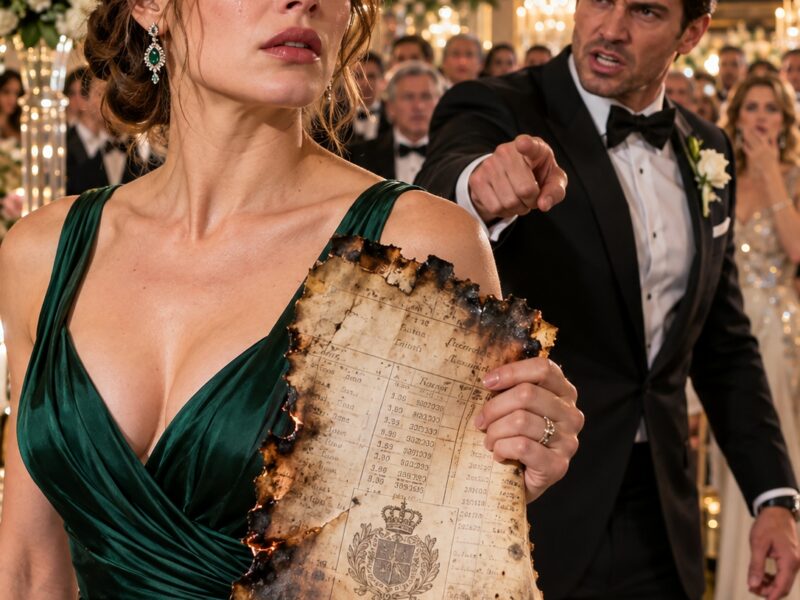
HE ORDERED HER OUT OF HIS WEDDING—THEN SHE FOUND THE PAINTING THAT COULD DESTROY HIS FAMILY

Marco Gardoni hit the banquet table so hard that three champagne glasses jumped.
One tipped over.
Another shattered against a white porcelain plate.
And the third remained trembling between his fingers as three hundred guests inside the Gardoni estate ballroom slowly stopped talking.
“Get her out of my wedding.”
He wasn’t looking at security.
He wasn’t looking at his older brother.
He was looking directly at the woman in the dark green dress sitting two seats from the center of the head table.
Khloe Voss.
The name moved through the room before anyone whispered it.
Some names did that.
Some names had been buried so deeply under scandal that simply hearing them spoken again felt like somebody opening a grave.
Khloe felt Sylvio Gardoni go still beside her.
Across the table, Marco’s new wife, Elisa, touched his wrist.
“Marco.”
He pulled away.
“Her father stole from this family.”
Nobody moved.
Marco stood, breathing harder now, his face flushed from champagne and something older than alcohol.
“Arthur Voss destroyed people. He stole millions from us. And she walks in here on my brother’s arm like none of it happened?”
Khloe could hear the candles burning.
Not literally, perhaps.
But in the silence, even the smallest movement seemed to have a sound.
A server stopped six feet away holding a tray of untouched wine.
An elderly woman at the nearest table lowered her fork.
Someone near the ballroom doors quietly lifted a phone.
Khloe kept both hands in her lap because the right one was beginning to shake.
What nobody in that room knew was that beneath the table, pressed against the side of her chair, was a slim black document tube containing a piece of canvas she had cut out of a burning building less than twenty-four hours earlier.
What nobody knew was that the canvas contained account numbers, transfers, shell corporations, dates, signatures—and the Gardoni family seal.
And what Marco absolutely did not know was that every number on that canvas suggested one devastating possibility.
Arthur Voss had never stolen from the Gardonis.
Someone inside the Gardoni organization had used him.
Khloe looked at Marco.
For twenty years she had imagined what she might say if she ever stood face-to-face with one of the people who had treated her father’s guilt as fact.
In those fantasies, she was always eloquent.
Calm.
Devastating.
But reality was different.
Reality was a ballroom full of strangers.
Reality was the word thief hovering above her dead mother’s memory.
Reality was the seven-year-old version of herself sitting in a courtroom while her father was led away in handcuffs.
She opened her mouth.
Sylvio spoke first.
“She stays.”
He said it quietly.
That made it worse.
Marco stared at his brother.
“What?”
Sylvio picked up his fork as if they were discussing an inconvenience in the dinner service.
“Khloe is my guest.”
“She is a Voss.”
“I’m aware of her name.”
“Then you should know better.”
Sylvio turned his head.
There was no anger in his expression.
Khloe had learned during the previous eighteen hours that Sylvio Gardoni did not need anger to frighten people.
“She is under my protection,” he said. “Anyone who humiliates her in this room is humiliating me.”
Marco’s jaw tightened.
For one long second, the brothers looked at each other across flowers, crystal, candles and twenty years of lies.
Then Marco slowly sat down.
The room began breathing again.
Conversations restarted in awkward fragments.
Silverware touched china.
A waiter moved.
Someone laughed too loudly near the bar.
Khloe reached for her water glass.
That was when she saw the painting.
It hung thirty-five feet away between two tall windows.
A Renaissance pastoral scene in an ornate dark frame.
Old trees.
A river.
Figures in period clothing.
At first glance, there was nothing remarkable about it.
At second glance, everything was wrong.
Khloe forgot Marco.
Forgot the wedding.
Forgot three hundred watching strangers.
The crackle pattern across the painted surface was too even.
The discoloration was too carefully distributed.
The aging was excellent.
But it was artificial.
And she had seen exactly the same technique the night before.
She stared at the painting until Sylvio noticed.
“What?”
Khloe didn’t answer.
Beside the frame was a small card.
She could read only the larger words from where she sat.
WITH LOVE AND CONGRATULATIONS.
THE VALENTE FAMILY.
Khloe’s stomach tightened.
She turned to Sylvio.
He saw something in her face and stopped moving.
“What is it?”
She leaned close enough that nobody else could hear.
“That painting is fake.”
His eyes remained on his plate.
“How sure?”
“Sure enough that you should stop eating.”
A muscle moved once in his jaw.
Khloe glanced toward the far end of the ballroom.
An older man with white hair stood beside the bar holding a glass of brandy.
Etor Valente.
Thirty years with the Gardoni family.
Adviser to Sylvio’s father.
Mentor to Sylvio.
The man Marco trusted enough to believe Arthur Voss had helped murder their father.
Valente lifted his glass.
Not to toast her.
Not exactly.
More like acknowledgment.
Khloe felt cold move down her spine.
Because suddenly she understood something horrifying.
The painting wasn’t decoration.
It had been put there for someone to find.
And she had the terrible feeling that someone was her.
The night before, Khloe Voss had been alone beneath the Chicago Historical Archive at 11:40 p.m., listening to a dehumidifier hum while she removed two hundred years of grime from the face of a woman who had never existed.
The portrait had arrived six weeks earlier.
No publicity.
No donor ceremony.
Just a wooden crate, basic paperwork and the name of a private foundation that Khloe discovered—after ten minutes of curiosity and two cups of bad coffee—had been dissolved four years earlier.
Her supervisor had shrugged.
“People donate weird things.”
“Dead corporations usually don’t.”
“Put it in storage if you don’t like it.”
Khloe hadn’t.
Something about the painting bothered her.
Not emotionally.
Technically.
At thirty-one, she had worked in art conservation for eight years, long enough to distrust anything trying too hard to look old.
Real age was inconsistent.
Humidity attacked one corner more than another.
Canvas shifted.
Wood warped.
Pigments reacted differently to light.
Three centuries never damaged anything symmetrically.
But this painting had the theatrical perfection of fake decay.
Under magnification, the crackle looked almost right.
Under ultraviolet light, it became suspicious.
Under chemical testing, suspicion became certainty.
Someone had aged it deliberately.
And someone had been very good.
Khloe should have reported it immediately.
She didn’t.
That decision bothered her later.
At the time, however, she had already discovered the first number.
Sixteen digits.
Tiny.
Almost invisible beneath the painted sleeve of the portrait’s left hand.
She changed the ultraviolet frequency.
Another number appeared.
Then another.
Dates.
Transfer references.
Offshore routing codes.
The deeper Khloe went, the less the painting looked like a forgery and the more it looked like a filing cabinet disguised as one.
At 1:17 a.m., three weeks before the fire, she found the symbol.
A stylized G surrounded by laurel.
Her breath stopped.
She knew that seal.
She had known it since childhood.
The Gardoni crest had appeared on court exhibits, newspaper photographs and documents her mother had kept inside an accordion folder beneath the kitchen sink.
For most people in Chicago, the Gardonis were an old family with restaurants, commercial real estate, logistics companies and whispered connections no respectable journalist could ever fully prove.
For Khloe, the name meant something much simpler.
It meant the people whose money had sent her father to prison.
Arthur Voss had been a forensic accountant.
The irony was cruel enough that journalists had loved it.
THE ACCOUNTANT WHO STOLE FROM THE MOB.
THE QUIET BOOKKEEPER BEHIND A $2.3 MILLION FRAUD.
He had been convicted in 2005.
Khloe had been seven.
She remembered very little about the trial itself.
She remembered her mother’s hand squeezing hers too tightly.
She remembered her father turning around before officers took him through the side door.
He had smiled at her.
Not because anything was funny.
Because she was seven, and fathers lied with their faces when they were trying to protect children.
For the next twenty years, Arthur insisted he had been framed.
Almost nobody believed him.
Khloe did.
Her mother did.
Belief had not been enough.
Her mother died in 2018 still writing Arthur every week.
Khloe visited him every month.
And gradually the world learned to identify her not as Khloe Voss, conservator, but as Khloe Voss, daughter of that accountant.
That was why she preferred paintings.
Paintings did not whisper when she entered a grocery store.
Paintings did not change tables in restaurants.
Paintings did not ask whether she thought her father had hidden some of the money.
Damage was honest.
People weren’t.
By the Tuesday night the archive burned, Khloe had spent three weeks studying the hidden records.
She had told no one.
Not yet.
She wanted to be certain.
Certainty had become a religion in her family.
Her father had lost twenty years because people had been certain too quickly.
At 11:43 p.m., she found the transaction that changed everything.
The transfer had been authorized using Arthur’s credentials.
But the internal approval seal had been applied seventeen minutes after security logs placed Arthur inside a bank meeting twelve miles away.
Someone else had access.
Someone who understood the Gardoni structure.
Someone who could use Arthur’s professional identity and make every transaction point back toward him.
Khloe stared at the numbers until her vision blurred.
Then she found another.
And another.
Her father hadn’t stolen the money.
He had been used to move it.
Then discarded when the structure needed someone to blame.
She reached for her phone.
The lights went out.
Khloe froze.
The dehumidifier died.
Emergency lighting failed to activate.
That was wrong.
The backup line ran independently.
Only facility staff knew where the secondary panel was located.
Then she heard footsteps upstairs.
Not one person.
At least two.
Deliberate.
Controlled.
A door opened.
Something metallic touched concrete.
Khloe stood beside the worktable in complete darkness.
She could hear her heartbeat.
She could also smell something.
At first she thought solvent.
Then she understood.
Gasoline.
“No,” she whispered.
The archive contained letters from soldiers who had died before seeing home.
Photographs rescued from floods.
Newspapers documenting riots, elections, births, fires and funerals.
Objects that had survived because generations of strangers had decided survival mattered.
Somebody intended to turn all of it into smoke.
Khloe looked at the portrait.
It was too large to carry.
The frame alone weighed more than forty pounds.
She could try and lose everything.
Or destroy the object she had spent her adult life being trained never to destroy.
Her hand went to the conservation blade.
“I’m sorry,” she whispered to a woman who had never been real.
Then she cut.
The blade moved through the canvas with a sound so small it almost broke her.
She removed the section containing the densest financial entries and the Gardoni seal, rolled it around a support tube and wrapped it in acid-free tissue.
Smoke appeared beneath the door.
Khloe ran.
She knew the basement by memory.
Twelve steps.
Right turn.
Thirty feet.
Emergency door.
She hit the release bar with her hip and stumbled into the alley behind the archive as the first internal alarm finally began screaming.
Rain struck her face.
She bent over, coughing.
Behind her, orange light grew inside a third-floor window.
Then she saw the car.
Black.
Engine running.
Headlights off.
Parked at the end of the alley like it had been waiting.
Khloe tightened both arms around the canvas.
The rear door opened.
A man stepped into the rain.
She recognized him immediately.
Sylvio Gardoni.
Older brother of Marco Gardoni.
Current head of the family.
A man who appeared in newspapers beside mayors and union executives and occasionally in photographs beside men who disappeared from public life shortly afterward.
He stopped three feet away.
His dark suit was already wet.
He looked at the canvas beneath her arm.
“You got it.”
Not a question.
Khloe’s fear sharpened into anger.
“Who are you?”
One corner of his mouth moved.
“You know who I am.”
“I know your name. That isn’t the same thing.”
He studied her.
Most powerful men looked at Khloe as if they had already determined her value.
Sylvio looked at her the way she examined an unfamiliar canvas.
Patiently.
“You’re cold,” he said. “Get in.”
“I’m not getting into your car.”
“The archive is burning.”
“I noticed.”
“The people who started that fire are still close.”
“Are they yours?”
“No.”
“How convenient.”
He glanced toward the building.
“If I wanted you dead, Ms. Voss, there were easier ways to arrange it than coming here personally.”
Khloe hated that the logic worked.
She got in.
The Maybach’s interior was warm and almost silent.
Expensive cars, she discovered, did not eliminate the world.
They muted it.
Rain became distant.
Sirens became soft.
Fire became something happening to somebody else.
Khloe sat against the opposite door.
Sylvio joined her.
For several seconds, neither spoke.
Then he said, “My brother is getting married tomorrow.”
“I know.”
“I assumed you would.”
“Your family has occupied a lot of my life.”
There was no response to that.
“Three hundred guests,” Sylvio continued. “Business owners. Attorneys. politicians. people who have known this family for decades. And people who would be pleased to watch it weaken.”
“What does that have to do with me?”
“I need you there.”
Khloe stared.
“You need the daughter of Arthur Voss at a Gardoni wedding.”
“I need someone who sees things other people miss.”
“I restore paintings.”
“You walked out of a burning building carrying evidence everyone else spent twenty years failing to find.”
“That doesn’t make me your employee.”
“No.”
He looked at the canvas.
“It makes you useful.”
Khloe almost laughed.
“You say romantic things to all your dates?”
“I generally avoid dates.”
“I’m relieved.”
His expression did not change, but she saw the smallest shift behind it.
Almost amusement.
It vanished quickly.
Khloe looked through the rear window toward the archive.
Flames had reached the upper floor.
“You knew about this painting.”
“I knew my father hid a financial record sometime around 2003. I didn’t know where.”
“Why hide it?”
“He believed someone inside his organization was building something without his authorization.”
“And?”
“He died before he could tell me who.”
Khloe turned back.
The official record said Vincent Gardoni had been killed during a dispute with a rival organization in 2006.
“You think his death is connected.”
“I think coincidences are explanations people use when they’re tired.”
“Who else knew about the record?”
“Very few people.”
“Then one of them sent those men.”
“Yes.”
The simplicity of the answer frightened her more than denial would have.
“And you want me at the wedding because whoever burned the archive will be there.”
“Probably.”
“That is an insane invitation.”
“Most useful invitations are.”
She held the canvas tighter.
“I want my father’s name cleared.”
“I know.”
“No. You don’t.”
Her voice changed.
For the first time, emotion reached it.
“I was seven when they took him away. My mother died with half the neighborhood still believing she was married to a thief. Every job application I filled out, every background check, every time somebody searched my name, his conviction was waiting.”
Sylvio listened.
Khloe leaned forward.
“So understand this clearly. I do not care about your family’s reputation. I do not care who wins whatever war is happening inside your organization. If that canvas proves my father was framed, it goes to lawyers, prosecutors, judges—anyone required to clear him.”
“I understand.”
“That isn’t negotiable.”
“I know what a condition sounds like.”
“And if I discover you’re using me to protect your family?”
She looked into his eyes.
“I’ll burn what’s left of it myself.”
Sylvio nodded.
Not offended.
Not amused.
Almost satisfied.
“Ten tomorrow morning.”
“You really think I’m coming.”
“I think you’ve waited twenty years to get into a room with the people who know what happened.”
He was right.
Khloe hated him for approximately five seconds.
Then the car pulled away from the burning archive.
She looked at her left palm.
A thin cut crossed it where the conservation blade had slipped.
Her hands were shaking.
Her father used to tell her that professionalism was not the absence of fear.
It was the ability to keep your hands useful while you were afraid.
Khloe pressed both palms flat against the canvas.
Eventually, the shaking stopped.
She did not sleep that night.
At three in the morning, she unrolled the canvas across the desk of the hotel room Sylvio had arranged.
She checked every number again.
The seal.
The dates.
The accounts.
Part of her still feared she had invented meaning because she needed it too badly.
Grief could make patterns.
Hope could make patterns.
But the numbers remained numbers.
At 7:15 a.m., someone delivered a dark green dress.
No jewelry.
No note except four words.
Your size. You’re enough.
Khloe stared at the handwriting.
Not Sylvio’s, she assumed.
Probably an assistant.
Still, something about it irritated her.
At 9:58, Sylvio knocked.
He wore charcoal.
No tie.
No visible weapon.
Which meant very little.
His gaze moved over the dress.
“You look different.”
“Disappointed?”
“No.”
“Impressed?”
“I didn’t say that either.”
“Then we’re making progress.”
His gaze dropped toward the canvas tube.
“That stays with me.”
“No.”
“It isn’t safe.”
“Neither are you.”
Another tiny almost-smile.
“Fair.”
They left.
During the drive north, Sylvio named the people Khloe needed to watch.
Dominico Ferri, who controlled freight contracts on the South Side.
Sylvia Marchetti, who managed legitimate real-estate shells.
Several lawyers.
Two judges.
Three business owners.
Then—
“Etor Valente.”
Sylvio’s voice changed slightly.
Khloe caught it.
“Who is he?”
“My father’s adviser.”
“Was?”
“Then mine.”
“You trust him?”
Sylvio watched the road.
“Yesterday I would have said completely.”
“And today?”
“Today I brought you.”
The estate appeared beyond iron gates and old trees.
Nothing about it screamed wealth.
That was how Khloe knew the people who owned it were very wealthy.
New money advertised.
Old money assumed.
When Sylvio opened her door, Khloe understood immediately that the gesture had nothing to do with manners.
He wanted everyone to see them arrive together.
Fine.
She could use symbolism too.
Guests noticed her.
Some recognized the name.
Most did not.
Those who did developed the same carefully neutral expression people used when pretending not to recognize scandal.
The ceremony took place in the garden.
Marco Gardoni stood at the altar looking younger than Khloe expected.
Nervous too.
His hands kept moving.
His bride, Elisa Moretti, walked toward him with the composure of a woman who understood exactly the family she was marrying into.
Khloe wondered if anyone ever understood such a thing exactly.
Marco noticed her halfway through the ceremony.
His smile disappeared.
Four seconds.
Khloe counted.
Then he looked away.
That was when she knew the afternoon would not remain polite.
At the reception, Dominico Ferri approached Sylvio first.
He embraced him.
Complimented the wedding.
Asked after business.
Then saw Khloe.
“Who is your friend?”
“Khloe Voss.”
Nothing changed in Ferri’s smile.
Everything changed behind it.
His pupils tightened.
His shoulders locked for half a second.
Fear.
After he left, Khloe murmured, “He knows my name.”
“Yes.”
“You expected that.”
“I hoped.”
She turned.
“You could have warned me.”
“I needed to see whether he warned himself.”
She almost snapped back.
Then understood.
Ferri had reacted involuntarily.
Meaning her name was connected to something he believed dangerous.
Sylvio wasn’t merely displaying her.
He was shaking the room to see what fell loose.
Khloe hated the tactic.
She respected it too.
That combination bothered her.
Dinner began.
Marco had been drinking.
Khloe knew before he spoke.
She saw the change in his face, the slight delay between impulse and judgment.
Then came the question.
Why is she here?
Then Arthur’s name.
Then theft.
Then humiliation.
Then Marco demanding she be removed.
And Sylvio saying no.
Afterward, Khloe told herself to eat.
Normal gestures were armor.
She lifted her fork.
That was when she saw the painting on the wall.
Now, as the music began after dinner, she stood.
Sylvio did not stop her.
Khloe walked toward the painting as if she were looking for the restroom.
Thirty-five feet.
Twenty.
Ten.
Up close, the forgery was excellent.
The same chemical aging.
The same carefully induced crack patterns.
The same hand, almost certainly.
Khloe touched the frame and tilted it barely an inch.
A label on the stretcher.
Warehouse code.
47C.
She memorized it.
Then she saw the gift card.
ETOR VALENTE.
Her pulse accelerated.
She returned to Sylvio.
“The same person made both paintings.”
His fork stopped.
“There’s a code behind it.”
“What kind?”
“Looks like logistics.”
“Meaning?”
“Meaning the painting is carrying something.”
Before Sylvio could answer, glass exploded across the head table.
Marco had deliberately crushed his champagne flute against the edge.
He stood.
“I checked.”
His voice spread across the room.
Every conversation died again.
“I had somebody check Arthur Voss.”
Khloe felt the next blow before he delivered it.
“He wasn’t only stealing.”
“Marco,” Sylvio warned.
“He created the financial access that helped the people who killed Dad.”
The world became very small.
Khloe heard herself breathe.
Once.
Twice.
Sylvio’s face changed.
“Who told you that?”
Marco pointed across the room.
“Etor.”
Silence.
Khloe looked toward Valente.
He had not moved.
Of course he hadn’t.
The man looked like a grandfather at a formal dinner.
White hair.
Tailored tuxedo.
Calm hands.
Nothing about him resembled danger.
That was probably why he had survived so long.
Khloe looked at Sylvio.
He was doing the same calculation.
Valente’s name on the painting.
Valente’s story about Arthur.
The archive fire.
The timing.
“He’s lying,” Khloe said.
Marco laughed once.
“You would say that.”
“I’m not talking about you.”
She stood.
“I’m talking about the man who told you.”
Marco stared.
“I can prove my father didn’t steal your money.”
“Then prove it.”
“I will.”
“When?”
“When the person who buried the truth stops trying to burn it.”
Heads turned.
Etor Valente set his glass down.
Softly.
Khloe heard it anyway.
And in that moment, she knew the game had changed.
She leaned toward Sylvio.
“The painting. Now.”
He touched his wrist as if checking a watch.
Across the ballroom, a man in catering whites repositioned himself near the kitchen corridor.
Security.
Sylvio’s.
Khloe moved.
She reached the painting.
Pressed the lower-left section.
The canvas gave beneath her thumb.
A hidden channel.
Something flat inside.
Document.
Photograph.
She couldn’t extract it without tools.
Then she looked up.
Etor stood fifteen yards away.
Watching.
He smiled.
Not kindly.
Not cruelly.
With recognition.
You found it.
That was what the smile said.
Khloe walked back without rushing.
“Hurrying is information,” her father used to say when she was a child and he was teaching her to balance household accounts.
Back then, she had thought it was about numbers.
Now she understood it had always been about people.
“He saw me,” she whispered.
Sylvio’s jaw tightened.
“Was he surprised?”
“No.”
Sylvio looked toward the corridor.
“He’s never surprised.”
“Maybe because he arranges what happens.”
Sylvio’s eyes moved to hers.
Then both understood at once.
Marco’s outburst.
The room watching the head table.
Everyone distracted.
The painting.
They ran.
The wall was empty.
Only the hook remained.
Six minutes.
Somebody had removed it in six minutes.
Khloe and Sylvio pushed through the kitchen corridor.
At the far end, a door closed.
They reached the service yard just in time to see a man in a poorly fitted catering uniform moving toward the north lawn with the painting.
He ran.
Sylvio chased him.
Khloe kicked off her heels.
The wet grass was freezing beneath her feet.
The man reached the fence.
Sylvio hit him from behind.
They went down hard.
The painting landed three feet away.
Khloe grabbed it.
Found the channel.
Pressed.
A hidden panel opened.
Inside was a photograph.
Warehouse.
Art crates.
Frames stacked along the walls.
At the bottom, written by hand:
PORT TERMINAL 7. MIDNIGHT. EVERYTHING IS HERE.
Khloe stopped.
The handwriting.
She knew it.
She had seen it on birthday cards.
Prison letters.
Notes tucked into her lunchbox twenty-five years ago.
“No.”
Sylvio looked at her.
“What?”
Khloe’s hands began shaking.
“This is my father’s handwriting.”
The captured courier spoke in broken English.
“Old man give.”
“What old man?” Sylvio demanded.
“White hair.”
Valente.
“Why?”
The courier pointed toward Khloe.
“He say woman must see.”
Khloe looked at the photograph.
“He wanted me to find this.”
Sylvio stood.
“This is a trap.”
“Yes.”
“We’re not going.”
Khloe looked up.
“My father wrote it.”
“He has been in prison twenty years.”
“Then somebody has been communicating with him.”
“Or copying him.”
“I know.”
The words hurt.
Because that possibility was obvious.
But another was worse.
“What if he’s there?”
Sylvio said nothing.
Khloe held the photograph.
“If there is even a one-percent chance my father is at that terminal, I am going.”
“You could die.”
“He has already lost twenty years.”
“Khloe—”
“I’m going.”
He looked at her for several seconds.
Then adjusted his cuff.
“Not alone.”
They left Marco’s wedding before the first dance.
Marco watched from the head table.
The anger was gone from his face.
Fear had replaced it.
The drive to Terminal 7 took forty minutes.
Sylvio made calls.
Khloe organized facts.
Facts were safer than feelings.
Arthur framed.
Vincent Gardoni murdered.
Hidden financial records.
Fake paintings.
Etor controlling information.
A warehouse code.
Her father’s handwriting.
Every element seemed connected.
She simply could not see the shape yet.
“Tell me about Valente,” she said.
Sylvio was quiet.
“He came to my father when I was four.”
“What did he do?”
“Everything my father didn’t want to explain.”
Sylvio stared through the windshield.
“My father operated on instinct. Etor translated that instinct into structure. He handled negotiations. Relationships. Debts. Risk.”
“He raised you.”
“In some ways.”
“And after your father died?”
“He kept me alive.”
There was no drama in the sentence.
That made it sadder.
“I was twenty-six. I had enemies who thought grief had made me weak. Etor knew who to call. Who to pay. Who to threaten. Who to forgive long enough for them to become careless.”
Khloe watched him.
“He made himself indispensable.”
Sylvio turned toward her.
The realization settled between them.
“Yes.”
“Do you think he killed your father?”
For several seconds, Sylvio said nothing.
Then:
“I think I’m afraid the answer is yes.”
Terminal 7 sat along the industrial edge of Chicago like something the city had forgotten to demolish.
Steel containers.
Dead cranes.
Chain-link fences.
Lake wind.
Sylvio’s men had arrived before them.
Khloe used the code 47C to navigate the container grid.
Her father had once explained commercial port numbering during a prison visit.
She had been fourteen.
She remembered because it was the same visit when she asked if he thought he would ever come home.
Arthur had looked at her for a long time.
“Yes.”
“When?”
“I don’t know.”
“What if it takes forever?”
“Forever is a word people use when they’re afraid to count.”
Now Khloe counted rows.
Forty-five.
Forty-six.
Forty-seven.
C.
One container stood open.
Warm work lights glowed inside.
Khloe entered.
The photograph became real.
Crates.
Climate-controlled art cases.
Frames.
Dozens.
Hundreds, perhaps.
Some were forgeries.
Some were not.
Khloe recognized one seventeenth-century landscape reported stolen from a European private collection eleven years earlier.
Another frame looked like a missing American portrait she had studied in graduate school.
“This isn’t a warehouse,” she whispered.
Sylvio looked around.
“What is it?”
“A collection.”
“A stolen one?”
“Yes.”
On a folding table lay a cloth-covered journal.
Khloe knew it before touching it.
Her father had owned one exactly like it when she was a child.
Blue-gray fabric.
Tape repaired along the spine.
Bent lower corner.
She picked it up.
Inside the cover:
If Khloe finds this, she found everything.
That means I was right to trust.
Her eyes filled.
“Dad.”
The container doors closed.
Metal bars slammed into place outside.
Sylvio drew a gun.
Khloe clutched the journal.
A speaker hidden somewhere in the wall crackled.
Then Etor Valente’s voice filled the container.
“I’ve waited a very long time for this.”
Sylvio looked toward the ceiling.
“Open the door, Etor.”
“I’m afraid we’ve passed that stage.”
“What did you do?”
Etor sighed through the speaker.
It sounded almost paternal.
“Everything I did was necessary.”
“Did you kill my father?”
Silence.
Then:
“Yes.”
Sylvio’s face became empty.
Khloe had seen empty faces before.
They were not emotionless.
They were what happened when emotion became too large to display.
Etor continued.
“Your father discovered financial relationships he didn’t understand.”
“I think he understood them perfectly.”
“He became sentimental.”
“You murdered him.”
“He was going to destroy everything.”
“You murdered him.”
“The family survived.”
Khloe opened the journal.
Entries.
Account numbers.
Transfers.
Names.
Dates.
Nine years of handwriting.
Nine years.
“My father sent this to you.”
Etor paused.
“He believed he was sending it to someone else.”
Khloe’s blood went cold.
“What?”
“Arthur established a communication channel from prison. Quite clever. An outside contact who promised to help build an appeal.”
“You intercepted it.”
“Nine years ago.”
Khloe closed her eyes.
For nine years her father had believed someone was listening.
For nine years he had reconstructed transfers from memory.
Written names.
Dates.
Structures.
For nine years he had built a road toward freedom and unknowingly sent every brick to the man who had buried him.
“You framed him,” Khloe said.
“Your father was useful.”
The sentence almost broke her.
Etor continued calmly.
“He processed transactions without understanding their true purpose. When the structure became vulnerable, he was the obvious explanation.”
“He was innocent.”
“Unfortunately.”
Khloe looked at the final journal entry.
Dated three weeks earlier.
I believe they’re close.
I believe someone is finally listening.
I’m not afraid anymore.
Her anger became quiet.
Not fire.
Ice.
Khloe stood beneath the work light and looked at the sealed doors.
Then she understood something.
Etor wanted the evidence.
Which meant he did not know whether copies existed.
She raised her voice.
“I made copies.”
Sylvio looked at her.
She didn’t look back.
Etor’s voice paused.
Khloe continued.
“The canvas. The journal. Everything.”
Lie.
She had made nothing.
She had not had time.
“I gave them to someone before we came.”
Still lie.
“If I don’t contact that person, the entire file goes to federal prosecutors.”
Silence.
Sylvio understood.
He said nothing.
“Open the door.”
Etor laughed softly.
“You expect me to believe that?”
“No.”
Khloe pressed the journal to her chest.
“I expect you to ask yourself whether you’re certain enough to kill us.”
Silence.
Longer now.
“Because that’s what matters, isn’t it?” she continued. “Not whether I’m lying. Whether you know I’m lying.”
The speaker went quiet.
Then—
Clunk.
The locking bar moved.
Khloe nearly exhaled aloud.
The bluff had worked.
The doors opened.
Etor stood outside with four armed men.
He looked smaller than his voice.
Older too.
“You’re lying,” he said.
“Maybe.”
Khloe stepped out.
“Would you bet thirty years on it?”
One of his men shifted.
Khloe noticed.
Employees.
Not believers.
That mattered.
Sylvio stepped beside her.
“How long?” he asked Etor.
The older man looked almost sad.
“Longer than you want to know.”
“My father.”
“He discovered what I had built.”
“You mean what you built in his name.”
“He wanted to dismantle it.”
“So you killed him.”
“I protected you.”
“No.”
Sylvio’s voice broke for the first time.
Not loudly.
Just enough.
“You killed my father and then raised his sons.”
Etor’s face tightened.
“Everything I did afterward was for you and Marco.”
“Do not say that.”
“Sylvio—”
“Do not ever say that to me again.”
Grief moved through Sylvio’s body.
Khloe recognized it.
She had lived beside grief long enough to understand its physics.
It could collapse inward.
Or explode.
Either was dangerous.
She looked toward the northern crane station.
A shadow moved.
One of Sylvio’s men.
“Sylvio.”
He glanced at her.
“Is that your man by the crane?”
“Yes.”
“Tell him to run it.”
“What?”
“Now.”
Sylvio touched his wrist.
The crane roared to life.
Huge machinery began moving overhead.
Every armed man looked up.
Khloe grabbed the container door and pulled it between herself and Etor’s men.
A shot struck metal.
The impact vibrated through her spine.
Then chaos.
Footsteps.
Gunfire.
A shout.
Sylvio moving.
Khloe ran.
Not toward the gate.
Into the container maze.
She carried the journal and canvas.
Nothing else mattered.
One shoe disappeared.
Then the other.
She ran barefoot across gravel and oil-stained concrete.
Two corridors.
Left.
Dark.
Right.
Fence.
She hit an old support post with her shoulder.
Once.
Twice.
It bent.
She climbed.
Barbed wire tore her forearm.
Pain came later.
First came heat.
Then blood.
She dropped onto the perimeter road.
Headlights appeared.
Khloe froze.
Sylvio’s Maybach stopped.
The driver jumped out.
He saw the torn dress, blood, bare feet and evidence in her arms.
He opened the rear door.
No questions.
Khloe got inside.
She counted seconds.
At four minutes and thirty seconds, the opposite door opened.
Sylvio climbed in.
Blood ran below his ear.
His shirt was dark near one shoulder.
“How bad?” she asked.
“I’ve been worse.”
“That’s a terrible answer.”
“It’s the one I have.”
He saw her arm.
“Give me that.”
“What?”
“Your arm.”
She extended it.
His hands were unexpectedly careful.
He examined the cut.
“Deep, but not arterial.”
“Good.”
“Nothing about this qualifies as good.”
“Valente?”
“In custody.”
Khloe exhaled.
Then Sylvio said, “Your father is here.”
She thought she had misheard.
“What?”
“My men found him.”
No sound came out.
“Container 39A.”
Khloe stared.
“He was transferred from Stateville twenty-two days ago using fraudulent medical documents.”
“My father…”
“He’s alive.”
The world tilted.
Twenty years.
Twenty years of prison glass.
Plastic phones.
Visiting schedules.
Guards.
Letters.
Waiting.
And now—
“Take me to him.”
“Khloe.”
“Take me to him.”
The car turned.
Container 39A was open.
A camping lantern glowed inside.
Arthur Voss sat on a cot wrapped in a gray blanket.
He looked thinner than any version of him she had allowed herself to imagine.
Older.
His hair almost completely gray.
His shoulders narrower.
But when he looked up, his eyes were exactly the same.
“Khloe.”
She crossed the container in four steps.
Then she was seven years old again.
She threw both arms around him.
Arthur caught her.
For thirty seconds, neither tried to speak.
Twenty years collapsed into the space between his shoulder and her face.
She smelled soap.
Metal.
Cold air.
Her father.
When she finally pulled back, she held his face.
“I found it.”
His eyes filled.
“The painting?”
“The painting. The journal. Everything.”
Arthur looked at the tube.
“I thought it burned.”
“Not all of it.”
“You saved it?”
“I cut it out.”
He almost smiled.
“Your mother would have loved that.”
Khloe’s throat closed.
“Don’t.”
“She would.”
“Dad.”
“She used to say you were stubborn enough to carry things out of burning buildings.”
A broken laugh escaped Khloe.
“That is a very specific prediction.”
“She knew you.”
He touched the bandage temporarily wrapped around her arm.
“You’re hurt.”
“So is everybody tonight.”
“That isn’t an answer.”
She looked at him.
Even after twenty years, he was still her father.
Still capable of making her feel fourteen with one sentence.
“It’s not bad.”
“Good.”
Khloe sat beside him and opened the journal.
“Did you know who you were sending this to?”
Arthur shook his head.
“I had a contact name.”
“Etor intercepted it.”
Her father stopped moving.
“For how long?”
“Nine years.”
The number landed.
Arthur stared at the journal.
Khloe watched hope die in a man without destroying him.
It was one of the hardest things she had ever seen.
Finally Arthur said, “The documentation is still accurate.”
Khloe blinked.
“What?”
“It doesn’t matter who received it.”
“Dad, he used you.”
“Yes.”
“You spent nine years—”
“I know.”
“He let you believe—”
“I know.”
Arthur put his hand over hers.
“But the numbers are still true.”
Khloe looked at him.
That was her father.
That had always been her father.
Facts before comfort.
Accuracy before pride.
Truth even after truth had failed him.
“The numbers are still true,” she repeated.
“Yes.”
Outside, helicopters arrived.
Searchlights swept across the containers.
Federal teams entered through the south gate.
Sylvio appeared outside 39A.
Khloe went to him.
“You knew they were coming.”
“I suspected an operation was close.”
“Whose?”
“Federal corruption task force.”
Khloe looked at the canvas.
Then the journal.
One copy of each.
One fire, one bullet, one dishonest officer and twenty years could disappear again.
“I need your phone.”
Sylvio handed it over.
No question.
“Who is the federal prosecutor Etor can’t buy?”
That got a reaction.
Sylvio stared at her.
“Patricia Morse.”
“Number.”
“You’re serious?”
“Number, Sylvio.”
He gave it.
Morse answered on the third ring.
“Morse.”
“My name is Khloe Voss.”
Pause.
“My father is Arthur Voss. Convicted in 2005 in the Gardoni fraud case.”
Another pause.
Longer.
Khloe continued.
“I am standing inside Terminal 7 with original evidence that can exonerate him and identify the person who engineered the financial structure behind the conviction.”
“Where exactly are you?”
“Grid 39A.”
“What evidence?”
“A coded canvas containing transfer records and a handwritten journal maintained by Arthur Voss.”
“Is Arthur Voss with you?”
“Yes.”
The silence on the line changed.
“He was transferred illegally from Stateville three weeks ago.”
“Do not give those materials to anyone.”
“That’s why I called.”
“I’m coming personally.”
Khloe looked at the agents moving through the terminal.
“How long?”
“Less than an hour.”
“Good.”
“Ms. Voss?”
“Yes?”
“Do not be heroic for the next forty-five minutes.”
Khloe looked at the blood on her dress.
“I think I’ve met my quota.”
Morse arrived at 12:31 a.m.
She was fifty, compact, direct and dressed like somebody who had been pulled from bed but had refused to waste even thirty seconds resenting it.
She examined Khloe first.
“You need stitches.”
“Later.”
“Everyone says later until later becomes surgery.”
“Evidence first.”
Morse looked at her for two seconds.
“All right. Evidence first.”
Khloe unrolled the canvas beneath the lantern.
She explained the chemical aging.
The hidden ink.
The routing numbers.
The seal.
Morse asked exact questions.
No unnecessary sympathy.
No dramatic reactions.
Khloe appreciated her immediately.
Then Arthur’s journal.
Nine years.
Names.
Transfers.
Instructions.
Etor’s communications.
Morse became quieter the further she read.
Eventually she looked toward Arthur.
“I reviewed your father’s original case three years ago.”
Khloe straightened.
“Why?”
“Because parts of it overlapped with the port corruption case I was building.”
“And?”
“There were inconsistencies.”
“They weren’t inconsistencies.”
Morse met her eyes.
“No.”
Khloe tapped the canvas.
“They were fingerprints.”
Morse looked at the evidence.
“Yes.”
It was the first official yes Khloe had heard in twenty years.
Not exoneration.
Not freedom.
Not yet.
But yes.
It mattered.
Marco arrived shortly after two in the morning.
No tuxedo.
No champagne.
No groom surrounded by guests.
Just a younger brother walking into the wreckage of everything he thought he knew.
He spoke to Sylvio outside the container.
Khloe watched from a distance.
At one point, Marco placed a hand behind his brother’s neck.
A brief gesture.
Childhood surviving adulthood.
Then Marco approached Arthur.
“Mr. Voss.”
Arthur looked up.
Marco swallowed.
“I owe you something I don’t know how to give back.”
“You believed what you were told.”
“I repeated it.”
His eyes moved toward Khloe.
“Publicly.”
“I remember,” she said.
“I’m sorry.”
Khloe looked at him.
She had imagined this too.
An apology.
She had believed it might feel like victory.
It didn’t.
It felt like a first payment on a debt too large to calculate.
“I can’t forgive twenty years tonight.”
“I understand.”
“Ask me again when tonight is over.”
Marco nodded.
That was enough.
For now.
By four in the morning, Etor Valente was inside a federal transport vehicle.
Khloe watched him pass.
He looked at her through the glass.
No smile this time.
No acknowledgment.
Just an old man discovering that patience had finally worked against him.
Khloe expected to feel satisfaction.
Instead she felt something quieter.
A weight setting down.
At 5:00 a.m., Arthur was prepared for transport.
He was not free.
That was the cruel technicality.
The discovery did not erase a conviction overnight.
Morse would file for emergency review and retrial proceedings.
There would be hearings.
Motions.
Experts.
Arguments.
Arthur might still spend months in custody while the system admitted what it had done.
“Six months,” Morse estimated.
“Maybe less.”
Khloe looked at her.
“He already gave you twenty years.”
“I know.”
“No, you know the number.”
Khloe’s voice softened.
“You don’t know what it weighs.”
Morse accepted that without defensiveness.
“No,” she said. “I don’t.”
At the south gate, Arthur stopped.
Dawn had started turning the lake sky gray.
He looked back toward the terminal.
“The world changed,” he said.
“You’ve been gone twenty years.”
“No.”
He looked at her.
“You changed.”
Khloe smiled weakly.
“So did you.”
“Prison does that.”
“Life does too.”
He touched her face.
His hand was rougher than she remembered.
“Your mother would be proud.”
Khloe closed her eyes.
“She should be here.”
“Yes.”
“She believed you until the end.”
“I know.”
“She wrote every week.”
“I know.”
“She never…”
Her voice failed.
Arthur drew her closer.
“You don’t have to finish every sentence.”
Khloe pressed her forehead against his.
For twenty years she had believed that if she could prove her father innocent, some invisible machinery might reverse.
Her mother would return.
Childhood would return.
The whispers would disappear backward through time.
Nothing worked that way.
Truth could change what came next.
It could not rewrite what had already cost them.
Arthur stepped into the federal vehicle.
“Six months,” he said.
“Six months.”
“Count them.”
Khloe almost laughed.
“Forever is what people say when they’re afraid to count.”
He smiled.
“You remembered.”
“I remember everything.”
The vehicle drove away.
Khloe remained at the gate until the taillights disappeared.
When she turned around, Sylvio stood ten yards behind her.
He had deliberately stayed away while she said goodbye.
For the first time since meeting him, she appreciated something about him without qualification.
He understood when a space did not belong to him.
She approached.
His shoulder was bandaged beneath a borrowed jacket.
“You need a hospital.”
“I’ve been examined.”
“That sentence sounds suspiciously different from yes.”
“It is.”
They looked at each other.
Less than thirty hours earlier, they had been strangers in an alley.
Now Khloe knew who had killed his father.
Sylvio knew who had stolen twenty years from hers.
Strange intimacy.
Not romance.
Not yet.
Maybe never.
Something more complicated.
“You suspected Etor before the archive,” she said.
Sylvio did not deny it.
“For eight months.”
“You used me.”
“Yes.”
The answer surprised her.
No excuse.
No softening.
“You saw me walk out with the canvas and realized I was something Etor hadn’t planned for.”
“Yes.”
“And you brought me to the wedding to provoke him.”
“I brought you because you could see what I couldn’t.”
“That sounds nicer.”
“It’s also true.”
Khloe folded her arms.
“You used me.”
“And you used me.”
She considered arguing.
Couldn’t.
She had needed access.
Protection.
A path into the Gardoni world.
They had used each other honestly.
Oddly, it felt cleaner than many relationships she had known.
“What happens to the Gardonis now?”
“Whatever survives investigation.”
“You could lose everything.”
“Yes.”
“You seem calm.”
“I’ve learned that panic does not preserve assets.”
Despite herself, she smiled.
“That sounded like my father.”
“I’ll take it as a compliment.”
“It was.”
Sylvio looked toward the sunrise.
“The legitimate businesses should survive. Real estate. Hospitality. Two logistics companies. Around three hundred employees who knew nothing about Etor.”
“And the rest?”
“Ends.”
“That simple?”
“No.”
“Good. I distrust simple endings.”
He looked at her.
“So do I.”
After a moment, Sylvio said, “There’s something else.”
Khloe waited.
“The Gardoni Foundation.”
Her face hardened instinctively.
“It’s legitimate.”
“So you say.”
“Morse confirmed it.”
“That helps.”
“My father created it. Scholarships. civic restoration grants. Hospital contributions.”
Sylvio paused.
“We have had a proposal sitting unfunded for two years.”
“What proposal?”
“A conservation center.”
Khloe said nothing.
“For historical works without major institutional backing. Documents. paintings. private family collections. things likely to disappear because nobody wealthy considers them important enough to save.”
Now he had her attention.
“It wasn’t funded?”
“Other priorities.”
“Etor’s priorities.”
“Yes.”
Sylvio looked at the canvas tube in her hands.
“I want to fund it.”
“Then fund it.”
“I want to name it for Arthur Voss.”
Khloe stared.
“No.”
He seemed surprised.
“No?”
“My father isn’t dead.”
“You don’t have to be dead to have your name on a building.”
“You usually do.”
“That’s a custom, not a law.”
She shook her head.
“You’re trying to pay a debt.”
“Yes.”
“I don’t want your guilt building a monument.”
“Neither do I.”
“Then what do you want?”
Sylvio thought before answering.
“To build something that does the opposite of what Etor spent thirty years doing.”
Khloe waited.
“He hid things,” Sylvio said. “Changed labels. Built false structures around the truth.”
His eyes moved toward the tube.
“You uncover them.”
The words landed harder than she expected.
“He spent thirty years making false things look legitimate. Your father spent twenty years documenting what was real.”
Sylvio’s voice lowered.
“And you spent eight years preserving things people forgot mattered.”
The lake wind moved between them.
“If there should be a Gardoni project left after this,” he said, “I would rather it be that.”
Khloe looked toward the road where her father had disappeared.
“Ask him.”
“When?”
“When he’s free.”
“And if he says yes?”
“Then I want independent governance.”
Sylvio blinked.
She continued.
“My staff. My conservation standards. Transparent funding. Outside board members. Public audits.”
“Anything else?”
“Yes.”
“Of course.”
“My father gets a board seat.”
“All right.”
“And your family doesn’t use it for reputation laundering.”
“You negotiate aggressively for someone who has been awake thirty hours.”
“I negotiate aggressively because I’ve been awake thirty hours.”
That almost-smile appeared again.
“All right.”
The sun was rising now.
Not dramatically.
No cinematic orange explosion.
Just light becoming stronger by degrees.
The city would soon wake.
News would spread.
A wedding scandal.
A federal raid.
Stolen art.
Etor Valente.
Arthur Voss.
Gardoni.
Voss.
Names that had been enemies for twenty years suddenly attached to the same truth.
Sylvio’s car waited.
“Where do I take you?” he asked.
Khloe thought about hospitals.
Police statements.
Federal interviews.
Lawyers.
Monday morning.
The conservation lab, probably sealed after the fire.
Then she thought about her small apartment.
Her kitchen.
Silence.
“Home.”
The drive through Chicago was quiet.
The city looked almost innocent at dawn.
Bakery lights came on.
A man walked a dog.
Street sweepers moved through intersections.
Somewhere, coffee shops were unlocking doors.
Normal life continued with an almost offensive confidence.
Khloe held the canvas tube in her lap.
Sylvio sat beside her.
At her building, she opened the door.
Then stopped.
“The conservation center.”
“Yes?”
“I want to run it.”
Sylvio looked at her.
“Independent.”
“You mentioned that.”
“I’m mentioning it again.”
“Your terms.”
“My terms.”
“Fine.”
“My staff.”
“Yes.”
“My methods.”
“Yes.”
“My father on the board.”
“When he’s free.”
She narrowed her eyes.
“And I want it to do actual work.”
“What did you think I meant?”
“No galas where wealthy people drink champagne beside damaged paintings they never look at.”
“That description sounds oddly specific.”
“It has been a long day.”
She stepped out.
Sylvio leaned slightly toward the open door.
“Khloe.”
She looked back.
“Thank you.”
“For what?”
He considered the question.
“For not letting me kill Etor in that corridor.”
“You’re welcome.”
“And for calling Morse.”
“That wasn’t for you.”
“I know.”
“Good.”
She closed the door.
Inside her apartment, Khloe placed the canvas tube on the kitchen table.
Then the journal.
For a long time she simply stood there.
Her green dress was torn at the hem.
Blood had dried along one side.
Her feet were dirty.
Her forearm throbbed.
She looked nothing like the woman who had entered the Gardoni wedding.
She went to the bathroom.
Turned on the light.
Looked into the mirror.
Eight years of conservation had taught her never to begin with what something was supposed to be.
You began with what was there.
You documented the damage.
You identified later additions.
You distinguished original material from restoration.
You removed what could safely be removed.
You stabilized what remained.
You never promised perfection.
That was the mistake amateurs made.
Restoration was not returning something to the moment before it was hurt.
That moment was gone.
The goal was truth.
Make the real thing visible again.
Her phone rang.
Unknown number.
Khloe answered.
“Ms. Voss. Patricia Morse.”
“You work early.”
“I haven’t stopped.”
“Neither have I.”
“I reviewed the preliminary materials.”
Khloe gripped the phone.
“And?”
“I’m filing the first motion on your father’s conviction Monday morning.”
Her eyes closed.
“What time?”
“Nine.”
“I’ll be there.”
“Good.”
Morse paused.
“You did something significant tonight.”
Khloe looked toward the kitchen.
At the canvas.
At her father’s journal.
“No.”
“No?”
“I found something that was already there.”
“That distinction matters to you?”
“It’s the only distinction that matters.”
Morse was quiet.
Then:
“Monday. Nine a.m.”
“I’ll be there.”
The call ended.
Khloe returned to the kitchen.
She sat down.
Placed both hands flat beside the evidence.
The city outside was fully awake now.
Cars.
Buses.
Somebody laughing on the sidewalk.
A delivery truck backing into an alley.
Ordinary sounds.
For twenty years, Khloe had imagined the day her father’s innocence would finally become visible.
She had imagined celebration.
Justice.
Vindication.
Maybe reporters.
Maybe anger.
Maybe somebody important admitting that the system had failed.
Instead she was sitting alone at a kitchen table wearing a ruined dress, too tired to cry.
Her father was still technically a prisoner.
Her mother was still dead.
Twenty years were still gone.
Etor’s arrest would not return them.
No court could order childhood restored.
No prosecutor could cross-examine grief until it confessed.
No judge could sentence time itself.
But there was a canvas on her table.
There was a journal beside it.
There was a meeting on Monday.
There was a father who had looked at her in a shipping container and said six months instead of forever.
And for the first time in twenty years, the future contained a date instead of a wish.
Khloe lowered her head onto her folded arms.
She intended only to rest for a minute.
Before her eyes closed, she thought of the fake Renaissance portrait.
Beautiful from a distance.
Convincing beneath ordinary light.
Built specifically so people would see what someone wanted them to see.
It had taken ultraviolet light to expose what lay underneath.
Maybe people were not so different from paintings after all.
Maybe families weren’t either.
Maybe cities weren’t.
Maybe truth did not disappear merely because someone painted something prettier over it.
Sometimes it waited.
Under soot.
Under varnish.
Under money.
Under shame.
Under twenty years of somebody else’s story.
Waiting for the right light.
Waiting for someone stubborn enough to keep looking.
Khloe closed her eyes.
And for the first time since she was seven years old, she fell asleep knowing exactly where her father was.
More importantly, she knew where he was going.
Home.









