He Paid $2 for the Scarred Bride No One Wanted—By Winter, the Entire Town Owed Her Their Children’s Lives
The first man laughed when the price dropped to five dollars.
The second laughed when it dropped to three.
But when the matrimonial agent finally called out, “Two dollars! Surely one of you gentlemen will give me two dollars for a wife,” nobody laughed anymore.
The silence was worse.
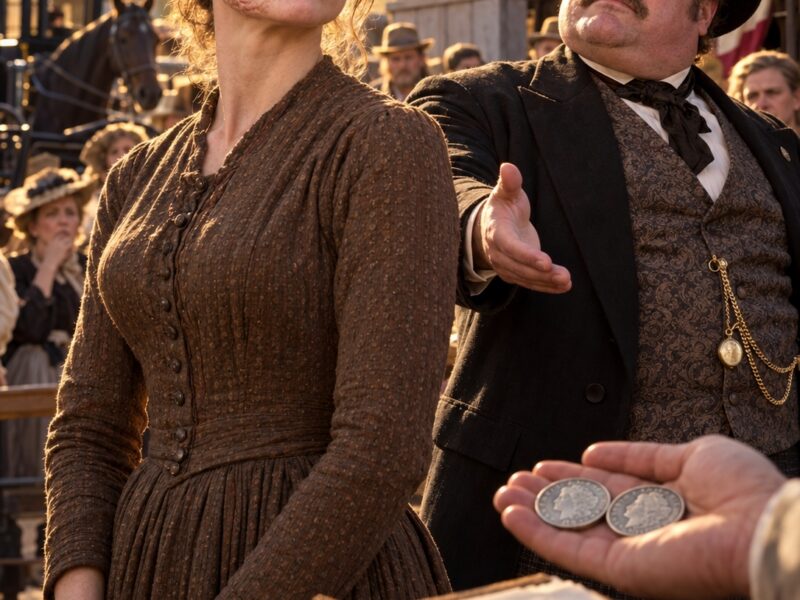
Ruth Adair stood on a platform made from three freight crates outside the railway office in Coldwater, Kansas, while nearly forty strangers stared at the left side of her face.
Or tried not to.
The scar began beneath her temple, crossed her cheekbone in a pale silver sheet, and tightened the skin all the way to her jaw. It was old. Healed. Ugly enough, apparently, to make men who had traveled thirty miles hoping to buy themselves wives suddenly discover they preferred loneliness.
September wind pulled at Ruth’s plain brown dress.
She did not touch the scar.
She did not lower her eyes.
She did not give them the satisfaction.
Mr. Pruitt, the matrimonial agent who had brought four women west from St. Louis, wiped sweat from his upper lip despite the cool afternoon.
Three women had already been claimed.
A young seamstress with blue eyes had gone with the blacksmith.
A widow and her little daughter had left with the owner of the livery stable.
A round-faced woman who laughed easily had accepted the hand of a sheep farmer before noon.
Ruth was the last.
And everyone knew why.
“Strong woman,” Pruitt called desperately. “Healthy. Educated enough. Keeps a proper house. Surely somebody here needs a sensible wife.”
A voice came from the crowd.
“What happened to the other half of her face?”
Several men snickered.
Ruth heard them.
Amos Kerr knew she heard because she became even more still.
That was the thing he would remember years later.
Not the scar.
Not the brown dress.
Not even the cruelty of the joke.
He remembered how still she became.
There was a kind of stillness that came from peace.
This was not it.
This was the stillness of a person gripping the last piece of dignity she owned with both hands.
Amos had not come to Coldwater for a wife.
He had come for flour, fence nails, lamp oil, and a replacement hinge for his barn door.
At thirty-eight, he owned a quarter section of land north of the creek, two horses, seven cattle, a stubborn dog named Moses, and a house that had been quiet since his mother died.
He had become accustomed to that quiet.
At least, that was what he told himself.
Then he saw Ruth Adair standing on those boxes while strangers decided she was worth less than a sack of winter feed.
Pruitt tried again.
“Two dollars.”
Nothing.
“Gentlemen?”
Nothing.
The agent’s smile weakened.
“Two dollars for a lifetime companion.”
Someone near Amos muttered, “You’d have to pay me.”
This time the laughter returned.
And Amos heard his own voice before he had time to decide whether the words belonged to him.
“I’ll give two.”
Silence.
Every face turned.
Amos felt the flour sack under his arm suddenly become ridiculous.
Pruitt recovered first.
“Sold!”
Amos almost said no.
Almost.
But then Ruth turned toward him.
For the first time, their eyes met.
He expected humiliation.
Perhaps gratitude.
Perhaps fear.
There was none.
Her gray eyes were steady, intelligent, almost severe.
And they seemed to ask him one thing.
What exactly do you think you just bought?
Amos had no answer.
Not then.
By Christmas, half the people standing in that crowd would owe Ruth Adair the lives of their children.
But on that September afternoon, they only watched Amos Kerr reach into his pocket and place two silver dollars in Pruitt’s hand.
The coins made a small sound.
Amos would remember that sound too.
It felt obscene.
Pruitt, suddenly cheerful again, produced papers from his leather case.
“There is the matter of the marriage agreement.”
Amos stared at him.
“The what?”
Pruitt blinked. “Surely you didn’t think this was merely an introduction.”
Apparently, he had.
A circuit clerk happened to be in town. For another fifty cents, he informed Amos, the marriage could be made legal immediately.
Amos looked at Ruth.
For the first time, something changed in her face.
Not fear exactly.
Weariness.
“You don’t have to do this,” she said.
Her voice surprised him.
Low. Controlled. Educated.
Pruitt stopped arranging his papers.
Ruth continued.
“You’ve already made your point.”
“I wasn’t making a point.”
“You stopped them laughing.”
“That wasn’t—”
“You did.”
She glanced toward the men drifting away from the platform.
“You can pay Mr. Pruitt his money and leave. I’ll think well of you for it.”
Amos frowned.
“What happens to you?”
“I go back to St. Louis.”
“With him?”
“Yes.”
“And then?”
Another town.
Another platform.
Another group of men looking at her face.
Neither of them said it.
They didn’t need to.
Amos shifted the sack of flour under his arm.
“Do you want me to leave?”
That question seemed to catch her.
She looked at him for several seconds.
Then Ruth did something Amos would come to recognize as characteristic of her.
She answered the exact question she had been asked.
“No.”
Pruitt looked up.
Ruth ignored him.
“I have eleven cents,” she said. “No family. No position waiting for me. And a face that has closed nearly every door I’ve knocked on for the last four years.”
Amos said nothing.
“I would rather take my chances with the man who spoke when everybody else was silent than climb back into Mr. Pruitt’s wagon.”
Then her expression hardened.
“But I won’t be pitied.”
“I don’t pity you.”
“Don’t answer quickly.”
“I wasn’t.”
“Pity changes.”
She looked toward the road.
“It begins feeling noble. Then winter comes. Money gets short. Two people discover things about each other they dislike. One morning the noble man looks across his breakfast and sees the burden he rescued.”
Her gaze returned to Amos.
“Pity curdles, Mr. Kerr.”
Something about the phrase struck him.
Not because it sounded bitter.
Because it sounded learned.
As though Ruth had watched it happen before.
“It’s not pity,” he said.
“What is it?”
Amos considered lying.
Instead he shook his head.
“I don’t know yet.”
For the first time, the corner of her mouth almost moved.
“That’s a remarkably poor proposal.”
“It’s the only honest one I’ve got.”
Ruth looked at the marriage papers.
Then at him.
“Honesty will do.”
They signed.
His handwriting looked like a frightened chicken had run through ink.
Hers was clean and strong.
Ruth Adair.
The clerk had them place their hands on a Bible and say words neither had expected to say that morning.
Ten minutes later, Amos Kerr was married.
His wife climbed onto his wagon between a sack of flour and a barrel of nails.
Coldwater watched them leave.
A mile outside town, Ruth finally spoke.
“I should tell you something.”
Amos tightened his hands on the reins.
There it was.
The part nobody had mentioned.
A dead husband.
A criminal charge.
Some illness.
Perhaps all three.
“All right.”
“You didn’t buy what Mr. Pruitt advertised.”
“I suspected that.”
“I am not primarily a housekeeper.”
“That’s unfortunate. My kitchen could use one.”
She looked at him.
He couldn’t tell whether she knew he was joking.
Then she said, “I’m a nurse.”
Amos glanced over.
“A nurse?”
“Trained in St. Louis. Four years in a hospital. Before that, I worked under the widow of an army surgeon. She taught me more than the hospital did.”
Amos slowed the horses slightly.
“Why didn’t Pruitt say that?”
“Because men shopping for wives aren’t generally asking whether the woman knows how to clean a wound.”
There was enough contempt in the sentence to answer several other questions.
Amos looked at the scar again.
This time she caught him.
“You may ask.”
He hesitated.
“The burn?”
“Hospital fire.”
Her voice changed almost imperceptibly.
“There were children inside.”
“How many?”
“Two in the ward I entered.”
“And?”
“I carried both out.”
Amos looked at her fully now.
Ruth kept her eyes on the road.
“The beam came down before I reached the door.”
She touched her scar for the first time.
Only once.
“The children lived.”
“And you?”
A faint, humorless smile.
“Evidently.”
He didn’t know what to say.
Ruth saved him the trouble.
“I’ve never regretted going into that room. Not once.”
Then, after a pause:
“I have occasionally regretted what the fire did to my prospects.”
The wagon rolled on.
“So,” she said, “you didn’t pay two dollars for a plain woman who can keep your house.”
“No?”
“You paid two dollars for a woman who knows how to keep people alive.”
Amos considered this.
Then he nodded solemnly.
“Mrs. Kerr?”
Ruth looked over.
“I believe I got the better end of that bargain.”
For the first time, Ruth Adair Kerr smiled.
Barely.
But enough.
And Amos would spend the next several weeks learning just how much truth had been hidden inside that sentence.
His farm sat north of the creek, far enough from town that at night there were no lights except his own.
Ruth stepped down from the wagon and examined the house the way a general might inspect a poorly defended fort.
She walked through every room.
Opened cupboards.
Checked windows.
Looked inside the root cellar.
Then she went outside.
Amos followed.
She stopped beside the well.
“Where’s the privy?”
He pointed.
Ruth measured the distance with her eyes.
“How far?”
“Forty feet, maybe.”
“Move one.”
“What?”
“The well or the privy.”
“Why?”
“Because forty feet is close enough to poison your drinking water and far enough away for you to call the fever bad luck.”
Amos stared at her.
Ruth stared back.
“When?”
“Before spring.”
She walked inside.
That was how marriage began.
Not with a kiss.
With sanitation.
Ruth took the small room beside the kitchen.
Amos kept the loft.
Neither mentioned the arrangement.
They were husband and wife legally, strangers practically, and Ruth seemed determined not to pretend otherwise.
Yet something strange happened to the house.
It began changing.
Not dramatically.
Quietly.
The root cellar was reorganized.
Clean cloths appeared in sealed tins.
A shelf became dedicated to medicines.
Ruth wrote a list of herbs she wanted planted in spring.
The well bucket was scrubbed.
The kitchen stopped smelling faintly of damp wood.
Even Moses, Amos’s suspicious old dog, abandoned his usual place beside the stove and began sleeping outside Ruth’s door.
“You’ve stolen my dog,” Amos told her.
“He has judgment.”
“He never liked my cousin Ezra.”
“Then he has excellent judgment.”
Amos almost laughed.
Their marriage accumulated small kindnesses neither acknowledged.
Ruth noticed his right knee hurt when the temperature dropped.
A thicker cushion appeared on his chair.
Amos noticed she liked coffee strong enough to frighten sensible people.
He began making it that way.
Neither thanked the other.
Neither needed to.
One rainy evening, water began dripping through the kitchen ceiling.
Amos placed an old pot beneath it.
Ruth watched.
“What?”
“How long has the roof leaked?”
“Three years.”
“And every time it rains?”
“I put the pot there.”
She stared at him.
“What?”
“You could repair the flashing.”
“I could.”
“And then?”
“Then it wouldn’t leak.”
“Precisely.”
Amos looked at the pot.
Then at his wife.
There was something so dry in her expression that laughter escaped him before he could stop it.
Ruth looked startled.
Then she smiled too.
The next morning, Amos repaired the roof.
The old pot went onto a shelf.
It never caught rain again.
For reasons Amos could not explain, that felt like the first day the house became theirs.
Coldwater, however, was less willing to change.
People had found a name for Ruth.
The two-dollar bride.
Children whispered it.
Men used it after whiskey.
Women used it when Ruth passed and pretended they hadn’t.
The worst was Dorothea Vance.
Her husband owned the bank, but Dorothea owned something more powerful in a town that size: the authority to decide who belonged.
She chaired the church committee.
Organized suppers.
Approved marriages without being asked.
Destroyed reputations while appearing concerned for them.
One afternoon Ruth was choosing thread at the mercantile when Dorothea spoke loudly to another woman four feet away.
“Some women will sell themselves for any roof.”
The store went quiet.
Ruth continued examining the thread.
Dorothea went on.
“In my day, a woman had standards. If she couldn’t obtain a husband respectably, she simply did without.”
Amos was two aisles away.
His body went rigid.
He started toward them.
Ruth spoke first.
“In your day, Mrs. Vance, I expect women did without a great many things.”
Dorothea turned.
Ruth placed three spools of thread on the counter.
“And called the lack virtue because they had no other word for it.”
Someone inhaled sharply.
Dorothea’s face reddened.
Ruth looked at the storekeeper.
“Three spools, please, Mr. Hobb. And needles.”
Then she added, deliberately:
“My husband and I have a long winter ahead.”
My husband.
Amos stopped moving.
It was the first time she had claimed him publicly.
Something shifted inside his chest.
He had no name for it.
Not yet.
Dorothea did.
“Impudent woman.”
Ruth collected her package.
“No, ma’am.”
She met Dorothea’s eyes.
“Merely one who has learned the price of allowing other people to decide what she’s worth.”
Then Ruth walked out.
The town talked about that exchange for days.
But before October ended, nobody cared about Dorothea Vance’s wounded pride.
Because the Hobb boy started coughing.
His name was Samuel.
Six years old.
First came the sore throat.
Then fever.
Then a harsh cough.
Dr. Pierce called it croup.
He was an aging physician whose hands had once been good and whose whiskey had slowly become better company than his medical books.
He prescribed syrup.
Samuel worsened.
By the fourth day, he could barely swallow.
His mother came into the mercantile pale and shaking.
Ruth happened to be there.
Mrs. Hobb forgot, for one terrified moment, that she was supposed to look down on her.
“My boy can’t breathe.”
Ruth’s entire body changed.
“How high is the fever?”
“I don’t know.”
“What does his throat look like?”
“Gray.”
Ruth froze.
“Gray how?”
“There’s something over it. Like skin.”
“Can he swallow water?”
“Barely.”
“How many other children are in the house?”
“Three.”
Ruth set down the package in her hand.
“Take me to him.”
Mrs. Hobb hesitated.
It lasted perhaps one second.
But Ruth saw it.
“You need to decide quickly.”
“Dr. Pierce said—”
“Dr. Pierce is wrong.”
The store went silent.
Ruth stepped closer.
“Your son does not have croup.”
Mrs. Hobb’s lips trembled.
“What does he have?”
Ruth looked toward the people gathered near the counter.
When she answered, she spoke quietly.
“Diphtheria.”
Nobody moved.
The word traveled through the room faster than shouting would have.
Someone whispered, “God help us.”
Ruth shook her head.
“No.”
Everyone looked at her.
“God may help us later.”
She picked up her coat.
“Right now, we help ourselves.”
Within an hour Ruth had examined Samuel Hobb.
Within two, she had found another child with the same gray membrane.
By sunset, there were four suspected cases.
And Ruth knew something Coldwater did not.
The disease was already ahead of them.
At the Hobb house, Dr. Pierce confronted her.
“You’ve no license to practice medicine in Kansas.”
“No.”
“You’re not a physician.”
“No.”
“And you’re telling people I’m wrong?”
“Yes.”
The old man’s face darkened.
Amos stood near the doorway.
Ruth did not move.
“Doctor, I’ve worked two diphtheria winters in St. Louis. I’ve cleaned these membranes from children’s mouths. I’ve watched families lose three children in four days because they waited too long to separate the sick from the well.”
Pierce said nothing.
Ruth pointed toward Samuel.
“That boy’s breathing is narrowing while we’re arguing.”
Pierce looked at him.
Some of the anger disappeared.
Ruth lowered her voice.
“If I’m wrong, you’ll have every right to throw me out tomorrow.”
“And if you’re right?”
“Then tomorrow is too late.”
That ended it.
Ruth turned to Mrs. Hobb.
“I need an answer.”
The mother was crying.
“What answer?”
“I can help your son. But if I take control, you do exactly what I tell you. Everyone does.”
She looked around the room.
“No visitors. No church calls. No neighbors bringing pies. No children running between houses. Bedding boiled. Rags burned. Hands washed until you’re sick of hearing me say it.”
Mrs. Hobb nodded desperately.
Ruth caught her shoulders.
“Don’t agree because you’re frightened. Understand me.”
“I understand.”
“Good.”
Then Ruth looked at Amos.
“Find the church key.”
That was how Coldwater’s church became a hospital.
Ruth had the pews shifted aside and cots brought in.
Windows were opened despite the cold.
Water boiled constantly.
Sick children were separated from healthy families.
Cloths were burned.
Buckets were marked.
She divided the building into zones and threatened to throw out anyone who ignored them.
At first people resisted.
Then the fifth child became ill.
Then the seventh.
Then Dorothea Vance appeared at the church after midnight carrying her youngest daughter.
The same woman who had said Ruth would sell herself for any roof stood in the doorway with her hair loose and her expensive dress buttoned incorrectly.
“Please.”
That was all Dorothea could say.
Ruth looked at the little girl.
“Put her here.”
Dorothea obeyed.
Ruth examined the child’s throat.
Her expression remained unreadable.
Dorothea grabbed her wrist.
“Is she going to die?”
Ruth looked at the hand.
Dorothea released her.
“We caught it early.”
Dorothea nearly collapsed.
“Thank God.”
“Don’t thank anybody yet.”
Ruth rolled up her sleeves.
“Your daughter has a chance. But you’re going to help me.”
“Anything.”
“You do exactly what I say.”
Dorothea nodded.
Ruth looked directly at her.
“Even if the instruction comes from a woman you consider beneath you?”
Dorothea’s face broke.
For a moment Amos thought Ruth had finally chosen revenge.
Instead she handed Dorothea a clean cloth.
“Good. Wash your hands.”
No lecture.
No humiliation.
No reminder of the mercantile.
There were children dying.
Ruth had no time for smaller things.
The outbreak lasted three weeks.
By the end of the first, Ruth was sleeping in fragments of twenty minutes.
Amos hauled water.
Chopped wood.
Burned contaminated cloth.
Carried messages.
Drove through freezing rain to isolated farms.
He learned not to ask Ruth whether she needed anything.
She always needed something.
So he watched.
When the wood pile dropped, he filled it.
When the lamps dimmed, he trimmed them.
When Ruth forgot food, he put bread beside her hand.
One night Dr. Pierce found Amos outside.
The old physician looked ten years older.
“I was wrong.”
Amos waited.
Pierce stared toward the church.
“I treated what I remembered.”
He rubbed his face.
“Your wife treated what was actually in front of her.”
“Tell her.”
“I intend to.”
Pierce looked embarrassed.
“If she’ll have me, I’ll fetch and carry.”
Amos almost smiled.
“She’ll have you.”
“How do you know?”
“Because she doesn’t waste useful things.”
Pierce laughed once.
Then stopped.
A scream came from inside.
Amos ran.
Samuel Hobb was dying.
His mother stood beside the cot.
The boy’s lips had turned blue.
His chest jerked violently, but almost no air entered.
Pierce bent over him.
Then stepped back.
“I can’t—”
Ruth pushed past him.
She examined Samuel’s throat.
For the first time since Amos had known her, he saw fear.
Not panic.
Fear.
There was a difference.
Panic ran.
Fear understood exactly what was happening and stayed anyway.
“His airway is closing.”
Mrs. Hobb screamed.
“Do something!”
Ruth was already opening her instrument case.
Pierce saw what she was taking out.
“No.”
Ruth ignored him.
“You’ve never done that.”
“No.”
“Ruth.”
She looked at him.
“I’ve watched it twice.”
Pierce stared at her.
“Twice?”
“Yes.”
“That isn’t enough.”
“No.”
Her hands continued moving.
“But it’s twice more than anybody else in this room.”
Samuel’s body convulsed.
Ruth looked at his mother.
“If I do nothing, your son dies within minutes.”
Mrs. Hobb covered her mouth.
“If I attempt this, I may kill him.”
The mother stared at her.
Ruth did not soften the truth.
She never did.
“Those are your choices.”
“How do I choose that?”
“You don’t.”
Ruth placed a hand against Samuel’s hair.
“The disease already chose. I’m only asking whether I fight it.”
Mrs. Hobb broke into sobs.
Then she nodded.
“Fight.”
Ruth looked at Amos.
“Lamp.”
He brought it.
“Closer.”
He moved closer.
“Your hand cannot shake.”
Amos looked at Samuel.
Then at the small blade.
Then at his wife.
“It won’t.”
Ruth positioned the knife.
“Mrs. Hobb, hold his hands. Look at your son, not me. Talk to him.”
The mother bent close.
“Samuel? Mama’s here.”
Ruth made the incision.
Blood appeared.
Amos’s stomach turned.
His hand did not.
Pierce whispered something that sounded like a prayer.
Ruth worked quickly.
A short length of boiled reed.
A careful movement.
Then—
Nothing.
Samuel’s chest jerked.
Nothing.
Ruth’s face went white.
“Come on.”
Another second.
Then she put her mouth to the reed and drew hard.
Something shifted.
And Samuel Hobb breathed.
A raw, whistling, magnificent breath tore through the little tube.
Then another.
Then the boy began to cry.
His mother collapsed across the cot.
Pierce turned away.
Amos realized tears were running down his own face.
Ruth sat back on her heels.
Her hands were still perfectly steady.
Her lips weren’t.
She looked at Samuel for several seconds.
Then said:
“Now we keep the opening clean.”
She stood.
“And if we do that, he lives.”
Amos stared at her.
She had just pulled a child back from death.
Ruth walked to the basin.
Washed her hands.
And went to the next cot.
Because three beds away, another child was calling her name.
Samuel lived.
Dorothea Vance’s daughter lived.
The liveryman’s stepson lived.
The sheep farmer’s young wife lived.
Eleven others lived.
Two children did not.
Ruth sat with both as they died.
She refused to let either leave the world alone.
Then she washed her hands and returned to those she could still save.
That was the part of the epidemic Amos understood least.
How Ruth could grieve and continue.
One night he found her alone behind the church.
Snow had begun falling.
She was sitting on an overturned crate.
Her hands were bleeding from repeated washing.
“Ruth?”
“Go inside.”
“No.”
“There’s work.”
“Pierce has it for five minutes.”
She looked at him.
“You should sleep.”
“So should you.”
“I’m not tired.”
“You’re lying.”
“Yes.”
It was such an unusual admission that Amos sat beside her.
For a while they watched the snow.
Then Ruth whispered, “Her name was Anna.”
Amos knew immediately.
One of the children they had buried.
“She was five.”
“Yes.”
“She asked me if dying hurt.”
Amos closed his eyes.
“What did you tell her?”
“That I wouldn’t let her be alone.”
“Did you?”
“No.”
Ruth stared at her cracked hands.
“I couldn’t save her.”
Amos wanted to say something comforting.
He realized Ruth would hate that.
So he said the truth.
“No.”
She looked at him.
“You couldn’t.”
Something inside her expression gave way.
Not much.
Just enough.
She leaned her shoulder against his.
They stayed that way for five minutes.
Then Ruth stood.
“Pierce will need help.”
And went inside.
By the first hard freeze, the epidemic finally began to loosen its grip.
The last child left the church in November.
Nobody in Coldwater called Ruth Kerr the two-dollar bride anymore.
Not where Amos could hear.
Not where anyone could hear.
Now doors opened when she approached.
Men removed their hats.
Women who had once pulled their skirts away from her brought bread to the farm.
Children ran toward her instead of staring.
Ruth accepted all of it with the same calm expression she had worn when they rejected her.
That disturbed Amos more than anger would have.
On the night the last recovered child went home, he drove Ruth north beneath a sky full of hard white stars.
She was so tired she swayed beside him.
After several miles, she spoke without opening her eyes.
“Say it.”
Amos glanced at her.
“Say what?”
“Whatever you’ve been refusing to say since September.”
He stared at the road.
Ruth continued.
“You’re a quiet man. Ordinarily I appreciate that.”
A pause.
“Tonight I’m too tired to guess.”
Amos swallowed.
“I’ve been thinking about the day I bid.”
“So have I.”
“I told myself I did it because I couldn’t stand what they were doing to you.”
Ruth opened her eyes.
“And?”
“I don’t think that was all.”
He slowed the horses.
“I saw you standing there while they laughed.”
Ruth looked away.
“You never flinched.”
“I wanted to.”
“I know.”
That surprised her.
Amos continued.
“I thought you were the strongest person I’d ever seen.”
She gave him a tired smile.
“You knew me for approximately six minutes.”
“Sometimes six minutes is enough to see one thing clearly.”
The wagon creaked through the darkness.
“I’ve lived alone north of that creek a long time.”
Ruth said nothing.
“I thought I preferred it.”
“And now?”
“Now I think maybe I just got good at it.”
He looked at her.
“When I saw you standing there, I thought—there’s somebody who knows how to stand alone too.”
Ruth’s eyes glistened.
“And maybe I didn’t want either of us to keep doing it.”
For once she had no immediate answer.
Amos took a breath.
“I paid two dollars for a wife.”
Ruth’s face tightened slightly.
“But that’s not what I got.”
She looked at him.
“I got a partner.”
His voice roughened.
“The equal of any man I’ve ever known. Better than most.”
“Amos—”
“Let me finish.”
She did.
“The two dollars are the thing I’m most ashamed of.”
He smiled faintly.
“And somehow the best money I ever spent.”
Ruth stared at him.
“I don’t know how both can be true.”
“They can.”
She reached across the wagon.
Her hand was cracked, burned, reddened by weeks of boiling water.
She placed it over his.
“I married you because you bid when nobody else would.”
Amos turned his hand beneath hers.
Ruth continued.
“But that’s not why I’m staying.”
Something caught in his throat.
“Why are you?”
“Because when children were dying, you didn’t ask whether the work belonged to a man.”
She looked ahead.
“You hauled water. Dug burning pits. Held lamps. Sat with fathers who couldn’t cry in front of their wives.”
A small breath.
“And you never once asked me to become smaller so you could feel larger.”
Amos could not speak.
“I am not a warm woman,” Ruth said.
“I disagree.”
“You’re wrong.”
That made him smile.
“I don’t know how to be soft, Amos.”
“I didn’t ask you to.”
“No.”
Her fingers closed around his.
“You didn’t.”
She looked at him.
“But I am loyal.”
“I know.”
“If I give you my word, you’ll never have to wonder where I stand.”
“I know.”
“For some men that wouldn’t be enough.”
Amos lifted her hand.
“I’m not some men.”
He kissed her knuckles.
Ruth’s eyes closed.
For the rest of the ride home, neither spoke.
They didn’t need to.
Spring came green and improbable.
And Coldwater found itself faced with an uncomfortable problem.
How did a town repay a woman it had once valued at two dollars?
People tried.
Mr. Hobb refused to charge Ruth for supplies.
The sheep farmer delivered meat.
Farmers repaired Amos’s fence before he could stop them.
And Dorothea Vance did something nobody expected.
She stood before the church congregation and admitted she had been wrong.
A proper sick room had been added behind the meeting hall.
Bright windows.
Clean cots.
A stove.
Shelves.
Fresh water.
When construction was finished, Dorothea stood before the town.
“We need someone to run it.”
Everyone already knew who.
Ruth sat beside Amos.
Dorothea faced her.
“Mrs. Kerr.”
Ruth rose.
Dorothea’s hands trembled slightly.
“We nearly paid for our ignorance with graves.”
The room was silent.
“We had a doctor who had stopped learning.”
Dr. Pierce, seated near the back, nodded.
“And we had a trained nurse standing among us.”
Dorothea swallowed.
“A woman many of us were too foolish to see.”
Ruth watched her.
“I was the worst,” Dorothea said.
Nobody moved.
“I said things about you I cannot take back.”
Her eyes filled.
“I judged your face.”
Then her voice broke.
“And weeks later, those same scarred hands held my daughter while she fought to breathe.”
Ruth’s expression changed.
Only slightly.
Dorothea continued.
“I cannot undo September.”
“No,” Ruth said.
The word was not cruel.
Only true.
Dorothea nodded.
“But perhaps we can decide what we do after it.”
She gestured toward the new room.
“Coldwater needs a healer.”
Then she looked directly at Ruth.
“And whether we deserve her or not, I believe we already have one.”
Silence.
Then applause began.
One person.
Another.
Then the whole room.
Ruth stood inside the sound without smiling.
Amos knew why.
Applause could not erase a freight platform.
Respect did not undo humiliation.
People often wanted forgiveness to mean the injured person agreed the injury no longer mattered.
Ruth would never lie that way.
When the room quieted, she spoke.
“I’ll run it.”
Dorothea exhaled.
“On three conditions.”
Several people smiled.
Amos did too.
Of course there were conditions.
“Every well in Coldwater that sits too near a privy gets moved before summer.”
A few farmers stopped smiling.
“Second, every child is examined twice a year whether sick or healthy.”
Ruth looked around the room.
“And third—”
Now nobody moved.
“We never again decide a person’s worth by looking at their face.”
Dorothea lowered her eyes.
Ruth waited.
“Those are my terms.”
Someone asked, “Negotiable?”
Ruth looked toward the voice.
“No.”
Laughter rolled gently through the church.
This time nobody was laughing at her.
Coldwater accepted all three.
The wells were moved.
Children were examined.
The sick room became permanent.
And within a year, the woman nobody had wanted became the person everybody wanted when the knock came after midnight.
Ruth Kerr.
They spoke the name differently now.
A rider would appear at the farm.
“Mrs. Kerr, the baby won’t stop coughing.”
Or:
“Mrs. Kerr, my husband’s been kicked by a horse.”
Or:
“Mrs. Kerr, there’s blood.”
And Ruth would take her bag.
Amos would hitch the wagon.
Sometimes they would return before dawn.
Sometimes they wouldn’t.
Years passed.
The scar never faded.
That was important.
Nothing magical happened to Ruth’s face.
It did not become beautiful because people learned to love her.
It remained scarred.
The change happened in the eyes looking at it.
Children born after the epidemic never understood why adults had once found Ruth frightening.
To them, the silver scar simply belonged to Mrs. Kerr.
Like her medical bag.
Like her severe gray eyes.
Like the smell of herbs drying in the Kerr kitchen.
Like Amos waiting outside with the wagon.
The town eventually began calling him “the healer’s husband.”
Someone once apologized.
Amos laughed.
“Why?”
The man thought he was joking.
He wasn’t.
He wore the title proudly.
They never had children of their own.
Neither spoke much about it.
Perhaps by the time Ruth arrived in Kansas, that season of her life had already passed.
Perhaps there were private sorrows even Amos did not ask her to name.
But their house was rarely empty.
Samuel Hobb visited often.
He grew tall.
Married.
Had children.
And carried a small pale scar at the base of his throat for the rest of his life.
When his first son was born, Samuel brought the baby to Ruth before almost anyone else.
She held him awkwardly.
“You look terrified,” Amos said.
“I am.”
“You’ve delivered babies.”
“That’s medicine.”
“And this?”
Ruth looked down at the sleeping infant.
“This is somebody trusting me.”
Amos smiled.
“They’ve been doing that for thirty years.”
“Fools.”
But she did not give the child back for a long time.
Dorothea Vance grew older too.
She and Ruth never became sentimental friends.
Neither woman was built for sentimentality.
But they became something sturdier.
When Dorothea’s husband died, Ruth sat beside her through the night.
When Ruth developed pneumonia years later, Dorothea organized meals for Amos without being asked.
Some debts change shape with time.
Some become friendship before anyone notices.
And Amos?
Amos simply remained.
That was his gift.
He remained when Ruth was strong.
He remained when she was impossible.
He remained when patients woke them at two in the morning.
He remained when she failed to save someone and sat silently at the kitchen table until sunrise.
He remained as her hair went gray.
As his back bent.
As the farm shrank because he no longer had strength for all of it.
The house north of the creek grew old around them.
The roof leaked only once more.
Ruth pointed at the pot.
Amos groaned.
“You’ve waited forty years for that.”
“Possibly.”
He fixed the roof.
Again.
In the end, Ruth died in the room Coldwater had built for her.
She was an old woman.
The silver scar was softer now, nearly white.
Her hands were thin.
Still capable-looking.
Amos sat beside the bed holding one.
Outside, people waited.
Samuel Hobb was there.
So was Dorothea, older than anyone had imagined Dorothea Vance would ever permit herself to become.
Children Ruth had saved stood beside children Ruth had delivered.
Then grandchildren.
The room was quiet.
Ruth opened her eyes.
“Amos.”
“I’m here.”
“You always are.”
He smiled.
“Part of the contract.”
Her mouth moved.
That tiny almost-smile from the wagon returned.
“Terrible contract.”
“Cost me two dollars.”
Ruth’s eyes opened wider.
“Overpaid.”
“Not by much.”
She squeezed his hand weakly.
Amos leaned closer.
“Do you remember what you told me?”
“I’ve told you many things. Most of them correct.”
He laughed through his tears.
“You said you weren’t warm.”
“I wasn’t.”
“You were wrong.”
Ruth’s eyes closed.
“I don’t like being told that.”
“I know.”
A long silence.
Then she whispered:
“Amos?”
“Yes?”
“I’m glad you spoke.”
He knew exactly what she meant.
Not tonight.
September.
The freight office.
Forty strangers.
Two dollars.
A silence that had almost become the final verdict on her life.
Amos pressed her hand to his face.
“So am I.”
Ruth Kerr died before sunset.
The whole town came to bury her.
Not because it was proper.
Not because Dorothea organized it.
Not because they still owed Ruth something.
By then debt had become something else.
Love, perhaps.
Or gratitude stretched across enough years that nobody could tell where one ended and the other began.
The church women paid for the gravestone.
Amos allowed them.
It bore Ruth’s name.
Her dates.
Nothing about two dollars.
Nothing about the freight platform.
Nothing about the scar.
Then beneath her name were words Dorothea Vance had chosen.
Amos stood before them for a long time.
SHE BID ON US WHEN WE WOULD NOT BID ON HER.
Samuel Hobb stood beside him.
The scar on Samuel’s throat was still visible.
“It’s right,” Samuel said.
Amos nodded.
“Yes.”
He touched Ruth’s stone.
Decades earlier, he had gone into Coldwater intending to buy flour and nails.
He had returned with a wife.
That was how people told the story.
But Amos knew better.
He had not rescued Ruth Adair.
That version was easier.
Cleaner.
And completely wrong.
He had interrupted one cruel afternoon.
That was all.
Everything afterward, Ruth had done herself.
She had walked into the house north of the creek and made it a home.
Walked into a town that despised her and refused to become bitter enough to resemble it.
Walked into a church full of dying children and stood between them and death.
Walked through decades with a scar the world had mistaken for evidence that she was damaged when it had actually been evidence that she had once run into fire for strangers.
Amos had paid two dollars.
But Coldwater had been the thing purchased.
Purchased out of ignorance.
Out of cruelty.
Out of fear.
And the price had been paid by a woman they once believed had no value.
Years later, after Amos was gone too, children still stopped at Ruth’s grave.
Some were brought by parents.
Others by grandparents.
They heard about the brown dress.
The freight crates.
The laughing crowd.
The rancher who raised his hand.
The winter sickness.
The church ward.
The little boy who could not breathe.
And the woman with the burned face who had bent over him while an entire room waited to discover whether courage would be enough.
But the oldest people in Coldwater always corrected one part of the story.
“Don’t say Amos bought Ruth Kerr for two dollars.”
Then what happened?
They would point toward the stone.
“Amos was simply the first man in Coldwater smart enough to understand that the price had nothing to do with her worth.”
And if the child was old enough, they told them the harder part.
The part that mattered.
There will always be crowds.
There will always be people eager to measure a human being by the easiest thing they can see.
A scar.
A dress.
A bank account.
A mistake.
An accent.
A past.
And sometimes a whole room will agree on the wrong answer simply because nobody has the courage to speak first.
On a Saturday afternoon in September 1879, Coldwater looked at Ruth Adair and decided she was worth two dollars.
By winter, they were begging her to save their children.
By spring, they were asking her to heal their town.
And by the time they lowered her into Kansas earth many years later, the people who once refused to raise a hand for her stood shoulder to shoulder beside her grave.
The woman nobody wanted had become the woman they could not imagine having lived without.
And beneath her name remained the only verdict that mattered.
She bid on us when we would not bid on her.









