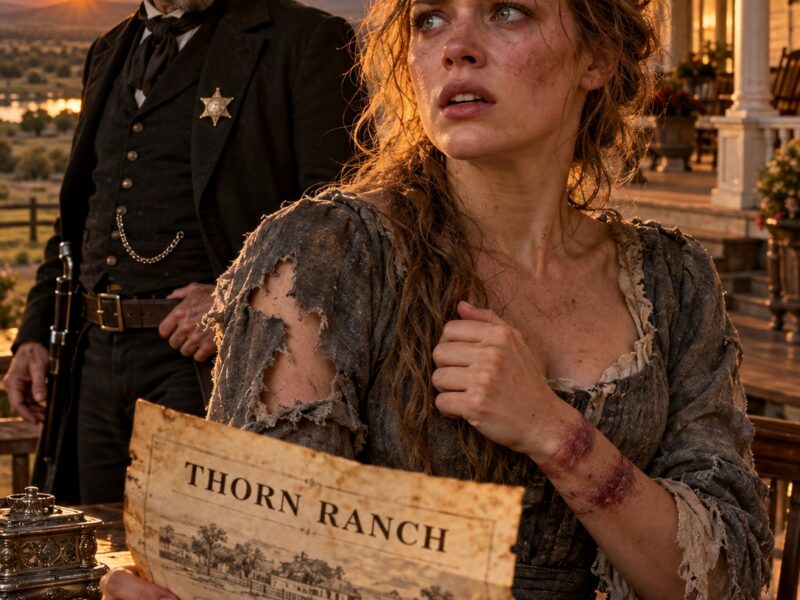
HE PAID $20 TO SET HER FREE—THEN SHE SAW THE NAME ON HIS PAPERS
“Go ahead.”
The young woman held out both bruised wrists.
“You paid for me. So do whatever you bought me for.”
Garrick Thorn stared at her beneath the dying West Texas sun, then slowly lowered himself to his knees in the dust.
He did not touch her.
He did not reach for the torn gray dress hanging from one shoulder.
Instead, the fifty-six-year-old rancher placed the iron key between them and said five words Adelaide Pruitt had forgotten men were capable of saying.
“You don’t belong to me.”
Her face didn’t soften.
It hardened.
Because after six years of being lied to, hunted, traded, threatened, and told that every cruelty committed against her was somehow legal, kindness frightened Adelaide more than violence.
Violence announced itself.
Kindness made you wonder what it wanted.
What neither of them knew was that somewhere beyond the darkening ridges, Sheriff Virgil Strand had just learned who had paid twenty dollars for the woman he had spent six years trying to erase.
And Strand understood something Garrick did not.
If Adelaide Pruitt ever returned to Toyah Creek, one of the most powerful men in West Texas could hang.
The trouble began that morning in a barn outside Limpia Crossing.
Thirty men stood beneath warped rafters while July heat pressed against the roof like a hand. Flies circled the horses tied outside. Dust floated in shafts of white sunlight. Somewhere behind the barn, a loose sheet of tin knocked steadily in the wind.
Nobody looked uncomfortable.
That was what Adelaide hated most.
Not the platform.
Not the iron around her wrists.
Not even Hollis Pike, the thin auctioneer with yellow teeth and a fraudulent debt paper rolled inside his fist.
It was the ordinary way everyone behaved.
One man chewed tobacco.
Another complained about the price of feed.
Two ranch hands discussed rain.
And Adelaide stood three feet above them with a bruise along her cheek while Pike sold the legal fiction that she owed a debt large enough to justify transferring her labor to another man.
“Twenty-four years old,” Pike announced. “Strong. Healthy. No husband. No family coming to claim her.”
A few men laughed.
Adelaide stared at a black knot in one of the floorboards.
She had learned not to meet their eyes.
Six years earlier, she would have.
Six years earlier, Adelaide Pruitt had ridden bareback beside Toyah Creek and argued with her father about whether she could repair a fence faster than his hired men.
She had owned two blue dresses.
She had known how fresh peaches tasted.
She had slept with her bedroom window open because she liked hearing water moving over stone.
Then men came carrying papers.
After that came fire.
After fire came death.
After death came years in which Adelaide stopped counting doors because every door eventually locked behind her.
Pike lifted the paper.
“Five dollars.”
Silence.
“Come on, gentlemen. Five.”
Someone near the wall snorted.
“She won’t last winter.”
Another man laughed. “Wouldn’t feed her for five.”
Pike’s smile tightened.
“Four dollars.”
Adelaide’s fingers curled inside the cuffs.
She wasn’t humiliated anymore.
Humiliation required believing you still belonged among people whose opinion mattered.
She had passed that point years ago.
Then a voice came from the doorway.
“Twenty.”
The barn went quiet.
Adelaide did not look up.
Pike blinked. “Twenty?”
“That’s what I said.”
Boots crossed the packed dirt.
Slow.
Heavy.
Unhurried.
Adelaide saw them before she saw the man: worn leather, dust to the ankles, one boot repaired twice along the side.
Then his shadow fell across the platform.
Garrick Thorn stood taller than most men in the room, though age had begun to bend him slightly through the shoulders. His beard was gray. Sun and wind had cut permanent lines around his eyes. A rifle rested against his back, and a canvas pouch hung from his belt.
He looked like a man who spent more time listening to weather than people.
Pike recovered quickly.
“Twenty dollars. Sold.”
The wooden handle of his makeshift gavel struck the railing.
Adelaide flinched.
Garrick did too.
He reached into the pouch and counted coins and folded bills into Pike’s hand.
Everything he had earned trapping and selling hides that season.
Pike counted twice.
“You know there’s no refund.”
Garrick looked at him.
Pike’s smile disappeared.
“Just making it clear.”
Then Garrick turned toward the platform.
For the first time, Adelaide raised her eyes.
Something changed in his face.
Not desire.
Not satisfaction.
Recognition.
His gaze dropped to her left wrist.
Above the iron cuff was a small pale crescent.
A scar.
Garrick stopped breathing.
For an instant, the barn disappeared.
He saw an eighteen-year-old girl sitting on the Pruitt porch six summers earlier, furious because a broken preserves jar had cut her wrist.
“Hold still, Addie.”
“I am holding still.”
“You’ve moved three times.”
“Because you pour whiskey like you’re watering corn.”
Her father, Josiah, had laughed from the doorway.
Garrick remembered wrapping the wrist in clean cloth.
He remembered Adelaide asking whether it would scar.
“Probably not.”
“You’d better be right.”
He hadn’t been.
“Addie?”
The name escaped him.
Adelaide’s head lifted sharply.
Nobody had called her that in six years.
Garrick saw the girl she had been for less than a second.
Then she vanished again.
“Don’t call me that.”
His throat tightened.
“Adelaide Pruitt?”
Pike’s eyes moved between them.
Adelaide took one step backward.
The chain between her cuffs rattled.
“How do you know my name?”
Garrick had imagined this moment hundreds of times, though in every version Adelaide was dead.
He had imagined standing at her grave.
He had imagined apologizing to a stone.
He had imagined Josiah Pruitt rising from the earth to ask why Garrick had done nothing when his own father destroyed an innocent family.
He had never imagined Adelaide alive.
And he had certainly never imagined finding her on an auction platform.
“I knew your father.”
Her face became absolutely still.
That frightened him more than anger would have.
Pike cleared his throat.
“Well. That’s touching. Take your purchase and get out.”
Garrick looked at the cuffs.
“Key.”
Pike hesitated.
“The key.”
Pike dug into his vest.
When Garrick reached for it, Pike kept his fingers around the metal.
Then he leaned close enough that only Garrick could hear him.
“You know who wanted her gone?”
Garrick’s eyes narrowed.
Pike’s breath smelled of tobacco.
“Sheriff Strand.”
A coldness moved through Garrick.
“Virgil Strand?”
Pike released the key.
“Paid me to put her on a wagon headed east. Said he didn’t care where she ended up, provided she never crossed back into Reeves County.”
“Why?”
Pike smiled without humor.
“You paid for the woman, Thorn. Not the answer.”
Garrick’s hand closed around the key.
Behind him, Adelaide whispered, “Thorn?”
He turned too quickly.
But Pike was already shouting for someone to open the barn doors.
Garrick guided Adelaide down from the platform.
She pulled away when his hand neared her elbow.
He immediately withdrew it.
Outside, sunlight struck hard enough to make her squint.
Garrick brought his gray mule forward.
“You can ride.”
She stared at him.
“What?”
“You’re barefoot.”
“So?”
“So the road is hot.”
Adelaide looked toward the open country.
For one wild second, Garrick thought she might run.
He would have let her.
Then she looked at the rifle across his shoulder, the men standing behind them, and the empty road stretching beneath a merciless sun.
Freedom was not the same thing as having somewhere to go.
She climbed onto the mule.
Garrick walked beside her.
He did not tell her his last name.
That omission lasted less than two hours.
But it was long enough to become the first lie between them.
The town disappeared behind dust.
Adelaide barely spoke.
Every few steps, the chain between her wrists clicked against the saddle horn.
Garrick hated the sound.
He had the key in his pocket, but the road near Limpia Crossing was exposed. If Pike had lied about the legality of the papers—and Garrick had no doubt he had—unlocking her in sight of witnesses could give Strand an excuse to call her a fugitive.
So Garrick waited until they reached the broken country near the foothills.
That decision nearly got them killed.
The mule raised its head first.
Garrick stopped.
A faint dust cloud moved behind cedar trees a quarter mile back.
Adelaide noticed his hand drift toward his revolver.
“What is it?”
“Get down.”
Her body stiffened.
“Why?”
“Two riders.”
She looked back.
“I don’t see anyone.”
“They don’t want to be seen.”
Fear changed her immediately.
Not panic.
Preparation.
Garrick recognized it and hated whoever had taught her.
He pointed toward a sandstone outcrop.
“Behind there.”
Adelaide didn’t move.
“If I hide, what happens to you?”
“That’s my concern.”
“No.”
He stared at her.
She swallowed.
“I’ve heard men say that before.”
Something inside him shifted.
He lowered his voice.
“Then make it yours. Hide where you can see me. If I turn that gun toward you, run.”
That answer surprised her.
She slid down.
Garrick slapped the mule hard across the rump.
It bolted along the road.
Seconds later, two riders burst from the cedar line and chased it.
Garrick moved behind a rock.
The first shot tore stone above his shoulder.
Adelaide dropped flat.
Another shot cracked through the canyon.
Garrick fired once.
One rider pitched sideways from his saddle.
The second wheeled around and fired wildly.
Garrick’s next bullet struck him high in the shoulder.
The man screamed, clung to his horse, and disappeared south through the trees.
Then there was only wind.
Adelaide remained behind the rock.
Garrick waited.
“It’s over.”
She didn’t move.
He holstered his revolver.
“Adelaide?”
Slowly, she stood.
Her face had lost its color.
“You killed him.”
Garrick looked toward the fallen rider.
“No.”
The man was moving.
Garrick approached carefully, kicked the rifle away, and crouched beside him.
The rider groaned.
Garrick recognized him.
“Earl Mays.”
Earl opened bloodshot eyes.
“Damn you.”
“Who sent you?”
Earl laughed weakly.
“You know.”
“Pike?”
No answer.
Garrick pressed a folded cloth against the man’s wound.
Adelaide stared.
“You’re helping him?”
“If I don’t, he may bleed to death.”
“He tried to kill you.”
“Yes.”
She looked genuinely confused.
Garrick tied the cloth.
Earl’s face twisted.
“Strand’s gonna bury you for this.”
Adelaide heard it.
So did Garrick.
Neither spoke until they had left Earl beside the road with his horse tied within reach.
They found the mule half a mile farther north.
An hour later, beneath an old oak overlooking a narrow canyon, Garrick finally removed the key from his pocket.
Adelaide’s breathing changed.
He noticed.
“I’m taking them off.”
She watched his hands.
The first cuff opened.
Then the second.
The iron fell into Garrick’s palm.
Adelaide rubbed her wrists but said nothing.
Garrick walked to the edge of the canyon.
He looked once at the cuffs.
Then threw them.
They struck rock far below.
The sound echoed upward.
Adelaide stared after them.
“No one should wear those,” Garrick said.
He handed her his canteen.
She drank.
Then she wiped her mouth with the back of her hand.
“You paid twenty dollars.”
“Yes.”
“For me.”
“No.”
Her eyes hardened.
“I was standing on a platform. You handed him money. Don’t insult me by changing the words.”
Garrick accepted that.
“All right. I paid twenty dollars to get you off that platform.”
“And what do you want?”
“Nothing.”
“Nobody wants nothing.”
“I do.”
She laughed.
It was a terrible sound.
She stepped closer and held out her wrists.
“Then go ahead.”
Garrick frowned.
“You bought me. Do whatever you intended to do.”
Understanding hit him.
His face changed.
Adelaide saw it and almost hated him for the pity there.
Garrick slowly lowered himself onto one knee.
He kept both hands visible.
“I didn’t pay to own you.”
She said nothing.
“I paid because nobody was bidding against me at twenty dollars.”
“What does that mean?”
“It means I wanted Pike to stop.”
Her jaw tightened.
“You expect me to believe you spent everything in that pouch because you suddenly became a saint?”
“No.”
“Good.”
“I’m not one.”
That answer caught her.
Garrick looked down at the dust.
“I knew Josiah Pruitt.”
Adelaide went still.
“He was a good man.”
“Everyone says good things about dead men.”
“I said them while he was alive.”
“Did you?”
“Yes.”
“Then where were you when they killed him?”
The question struck exactly where she intended.
Garrick had no defense.
His silence answered for him.
Adelaide looked away.
“That’s what I thought.”
By sunset they were climbing toward Garrick’s cabin in the Davis Mountains.
The temperature fell.
Adelaide wore his spare coat around her shoulders.
For the first time in years, there was no chain on her body.
Yet she felt less safe with every mile.
Because Garrick knew too much.
He knew her childhood name.
He knew her father.
He had looked at the scar on her wrist like a man seeing a ghost.
And he refused to explain why.
Then, while Garrick stopped to check a loose strap, Adelaide saw a folded paper protruding from his saddlebag.
She pulled it free.
At the top, stamped in faded ink, were two words.
THORN RANCH.
Her fingers went cold.
She remembered her father’s voice from six years earlier.
Ezra Thorn wants our land.
She remembered another voice outside the house the night before the fire.
The Thorns will have this valley before winter.
Garrick turned.
The document was in her hands.
Neither moved.
“Your name,” Adelaide whispered.
He closed his eyes briefly.
“Tell me your full name.”
“Garrick Thorn.”
She stepped backward as if he had struck her.
“No.”
“Adelaide—”
“No.”
Her hand went toward the small knife Garrick had given her after removing the cuffs.
He saw it.
He did not reach for his gun.
“Ezra Thorn,” she said. “What was he to you?”
Garrick’s answer came quietly.
“My father.”
Adelaide drew the knife.
And somewhere in the darkness behind them, a horse whinnied.
Garrick turned.
A rifle fired.
The bullet buried itself in the pine beside his head.
“Down!”
He grabbed Adelaide around the waist and pulled her behind a boulder as another shot tore through the branches.
She fought him.
“Let go!”
“Someone’s shooting at us.”
“You’re a Thorn!”
“Be angry when we’re alive.”
That stopped her for half a second.
Garrick fired toward the muzzle flash.
Hooves crashed through brush.
Then silence returned.
He waited several minutes before standing.
The shooter was gone.
Adelaide still held the knife.
Garrick looked at it.
“If you mean to use that on me, wait until we reach the cabin.”
She stared at him.
“Why?”
“Because Strand’s men are behind us, and you don’t know these mountains.”
“You think I need you.”
“Tonight? Yes.”
Her eyes flashed.
“At least you’re finally telling the truth.”
The cabin appeared shortly before midnight.
It was small, built from stone and timber, with a stable against one side and a narrow porch facing the valley.
Garrick lit a lamp.
Adelaide remained near the door.
There was one bed.
She noticed immediately.
Garrick noticed her noticing.
“You take it.”
“Where will you sleep?”
“Barn.”
“Why?”
He looked tired.
“Because if I say the floor, you’ll spend the night wondering whether I’ll get up.”
She had no answer.
He placed food on the table.
Dried beef.
Beans.
Bread hard enough to require soaking.
Then he set the cabin’s only door key beside her plate.
Adelaide stared at it.
“You can lock me out.”
“Why give me this?”
“So you don’t have to ask.”
He gathered a blanket.
Before leaving, he stopped.
“My father helped destroy your family.”
Adelaide’s hand froze above the bread.
Garrick continued.
“I knew enough to stop him.”
Her eyes lifted.
“And?”
“I didn’t.”
Silence filled the cabin.
“Tomorrow,” Garrick said, “I’ll tell you everything.”
“Why not now?”
“Because you’ve been awake almost two days, men tried to kill us twice, and if I tell you what I know, you may decide to ride straight to Toyah Creek.”
“Maybe I will.”
“Then I want you rested before you make a dangerous decision.”
He stepped outside.
Adelaide locked the door.
Then she stood with her forehead against the wood, listening to his boots move away.
She should have hated him.
Part of her did.
But hatred was simpler when the man you hated behaved like the monster you expected.
Garrick Thorn was making that impossible.
The next morning, she found him asleep against a bale of hay in the barn.
His rifle lay several feet away.
Adelaide stood over him with the knife.
One movement.
That was all it would take.
Garrick opened his eyes.
He saw the blade.
He did not move.
“If you’re going to do it,” he said, voice rough with sleep, “don’t hesitate.”
Her hand trembled.
“Why aren’t you stopping me?”
“Because maybe you have the right.”
That made her angrier.
“Don’t make me responsible for forgiving you.”
“I wouldn’t.”
She lowered the knife.
“Tell me.”
So Garrick did.
Six years earlier, Toyah Creek had been becoming valuable.
Railroad surveyors were moving through West Texas. Water rights mattered. Land that had once seemed remote could become worth ten times its price if a rail spur passed nearby.
Josiah Pruitt owned nearly four thousand acres along one of the most dependable water sources in the region.
Ezra Thorn wanted it.
Josiah refused to sell.
Then the war ended.
Accusations were easy to manufacture in a country still full of grudges.
Ezra claimed Josiah had supplied Confederate raiders after surrender.
Sheriff Strand produced witnesses.
Garrick knew at least one was lying.
“What did you do?” Adelaide asked.
“Nothing.”
The word landed harder than an excuse.
Garrick continued.
“My father told me to stay out of it.”
“And you obeyed.”
“Yes.”
“Why?”
He looked toward the barn door.
“Because I was a coward.”
Adelaide stared at him.
No justification.
No story about loyalty.
No attempt to make himself noble in hindsight.
That honesty hurt more.
“The night our house burned,” she said, “were you there?”
Garrick’s face changed.
“No.”
“Did you know it would happen?”
“No.”
“Did your father?”
“I don’t know.”
“You’re lying.”
“I wish I were.”
She stepped closer.
“My father died in that house.”
“I know.”
“I watched the roof fall.”
Garrick closed his eyes.
“And I ran barefoot through mesquite until my feet were bleeding. Strand found me the next morning.”
His eyes opened.
Adelaide’s voice became quieter.
“He said my father had debts. He said the ranch was gone. He said nobody would believe the daughter of a traitor.”
Garrick’s hands curled.
“He sent me to a family outside Pecos. They kept me for eleven months. Then they transferred the debt.”
She swallowed.
“Then another man did.”
Garrick looked away.
“Look at me.”
He did.
“Three times.”
His eyes shone, but he did not ask her to stop.
“Three times I was sold because of papers your father helped create.”
Garrick nodded once.
“Yes.”
“And you went into the mountains.”
“Yes.”
“To feel guilty?”
“Yes.”
She laughed bitterly.
“How difficult that must have been.”
He accepted that too.
Adelaide walked outside.
For three days, she barely spoke to him.
She could have left.
Garrick gave her a horse, boots, clothes, food, a revolver, and the remaining coins he kept hidden beneath a floorboard.
“Where am I supposed to go?” she asked.
“Anywhere.”
“That’s not an answer.”
“No.”
She looked toward the southern horizon.
“Toyah Creek.”
Garrick’s expression tightened.
“No.”
Her eyes narrowed.
“You said anywhere.”
“Anywhere that isn’t where Strand expects you.”
“My father’s land is there.”
“Your father’s land belongs to Thorn Ranch now.”
The words hung between them.
Adelaide slowly turned.
“What?”
Garrick knew there was no gentle way to say it.
“My father took possession after Josiah died.”
“Your father stole it.”
“Yes.”
“And now?”
“Ezra died three years ago.”
“So who owns it?”
Garrick did not answer quickly enough.
Adelaide understood.
“You.”
“On paper.”
“You own my home.”
“On paper.”
She slapped him.
The sound cracked through the yard.
Garrick’s face turned with the blow.
He did not raise a hand.
Adelaide’s breathing shook.
“You bought me for twenty dollars while standing on land bought with my father’s blood.”
“This isn’t Thorn land.”
“But Toyah Creek is.”
“Yes.”
“Then give it back.”
“I will.”
She froze.
Garrick walked into the cabin and returned with the document she had found.
He handed it to her.
It was the deed.
THORN RANCH.
Four thousand one hundred and sixty acres.
Including the Pruitt property.
At the bottom was Garrick’s name.
“I came to town because I intended to file a transfer,” he said. “I was going to return the land to the county until I found someone from your mother’s family.”
Adelaide looked at him.
“You thought I was dead.”
“Yes.”
“So why keep it six years?”
“Because Strand challenged every attempt I made to change the title.”
“Why?”
“I didn’t know.”
Adelaide stared at the deed.
Then she remembered Pike.
Sheriff Strand wanted this one sent far away.
A terrible possibility began forming.
“What if the land wasn’t what they wanted?”
Garrick frowned.
“What?”
“What if there was something on it?”
That afternoon, Garrick opened a locked trunk he had not touched in years.
Inside were letters belonging to Ezra Thorn.
Receipts.
Survey maps.
A ledger.
Garrick had taken them after his father’s death but had never fully examined them.
Adelaide sat across the table as they read.
Most meant nothing.
Then she found a survey dated October 1865.
Toyah Creek.
A proposed rail corridor.
Beneath it, handwritten in Ezra’s unmistakable script:
STRAND GETS EAST WATER ACCESS AFTER PRUITT REMOVAL.
Adelaide stopped breathing.
“Removal.”
Garrick took the paper.
Below the note was a figure.
$600.
Beside it:
V.S.
Virgil Strand.
“This isn’t enough,” Garrick said.
“For what?”
“To prove murder.”
Adelaide stared at him.
“I don’t need a court to tell me what happened.”
“No. But if you ride into Toyah Creek accusing Strand with this, he’ll kill you before sunset.”
“Then what do you suggest?”
Garrick looked at the papers.
“We find something he can’t explain.”
That was when Adelaide remembered the kitchen wall.
She had not thought about it in years.
Her father had kept important papers in a cavity behind a loose stone beside the fireplace.
“Before the fire,” she said, “he told me something.”
Garrick waited.
“He said if men ever came asking about the ranch, I should remember where my mother kept the blue jar.”
“What blue jar?”
“There wasn’t one.”
Garrick frowned.
Then Adelaide looked at him.
“It was a code.”
They rode for Toyah Creek before dawn.
For the first time, Adelaide chose to travel beside Garrick rather than behind him.
It was not forgiveness.
It was purpose.
Three days later, they saw the creek.
Adelaide stopped her horse.
The valley looked smaller.
That was the cruelty of returning to childhood places.
Memory made them enormous.
Reality did not.
Cottonwoods still followed the water. The ridge remained gold in late afternoon. The old barn was gone.
And where the Pruitt house had stood, only the stone chimney remained.
Adelaide dismounted.
Garrick stayed back.
She walked alone.
Six years disappeared with every step.
She saw her mother hanging sheets.
Her father carrying a bucket.
She saw herself running from the porch with a ribbon loose in her hair.
Then she saw flames.
Adelaide stopped beside the chimney.
Garrick heard her whisper something.
“What?”
“I was eighteen.”
He said nothing.
“I kept thinking if I survived long enough, I could come back and everything would explain itself.”
She touched the stone.
“It doesn’t.”
“No.”
She looked at him.
“Why didn’t you come back?”
“I did.”
“When?”
“Two days after the fire.”
Her face changed.
“I found your father’s body.”
Adelaide’s lips parted.
“He wasn’t inside?”
Garrick shook his head.
“Where?”
“Near the creek.”
She stared.
Everyone had told her Josiah died in the fire.
Garrick’s voice lowered.
“He’d been shot.”
Adelaide stepped backward.
“No.”
“I’m sorry.”
“You knew?”
“Yes.”
“For six years?”
“Yes.”
She struck his chest with both hands.
“You knew!”
“I did.”
“You let me believe—”
“I thought you were dead.”
“That doesn’t excuse it!”
“No.”
She hit him again.
Then again.
Until anger broke into something else.
Garrick stood there while she wept against the front of his coat.
He did not hold her until she grabbed the fabric and pulled him closer.
Only then did his arms rise.
Carefully.
As if touching something injured.
That night they searched the ruins.
The fireplace stone was still there.
Behind it was a narrow cavity blackened by smoke.
Inside sat a rusted metal box.
Adelaide’s hands shook as Garrick pried it open.
There were three documents.
A letter from a railroad representative offering Josiah Pruitt a substantial sum for right-of-way access.
A copy of Josiah’s original deed.
And a handwritten statement signed by Deputy Samuel Crane.
Crane claimed Sheriff Strand had ordered him to fabricate evidence against Josiah.
At the bottom were seven words.
IF I DISAPPEAR, VIRGIL STRAND DID IT.
Adelaide stared at the page.
“Where is Samuel Crane?”
Garrick knew.
He wished he didn’t.
“Dead.”
“How?”
“Horse accident. Five years ago.”
Adelaide looked toward the darkness.
“Of course.”
Then a voice came from behind them.
“Put the box down.”
Sheriff Virgil Strand stood ten yards away.
He was sixty now, broad through the shoulders, wearing a black coat despite the heat.
Four armed men stood with him.
Strand smiled at Adelaide.
“Six years.”
Garrick moved slightly in front of her.
Strand noticed.
“Well, Garrick. Your father would be disappointed.”
“My father spent his life disappointing me.”
“Ezra understood business.”
“He understood theft.”
Strand’s smile thinned.
Adelaide stepped beside Garrick.
“You killed my father.”
Strand looked almost bored.
“Your father made poor decisions.”
“Did you shoot him?”
“Careful.”
“Did you?”
Strand’s gaze settled on the metal box.
“You have no idea what you’re carrying.”
“I have Samuel Crane’s statement.”
For the first time, Strand’s expression changed.
Only slightly.
But Adelaide saw it.
Fear.
There it was.
Six years of power.
Six years of papers, badges, threats, locked doors.
And underneath all of it was a frightened man terrified of one sheet of paper.
Strand extended his hand.
“Give it to me.”
“No.”
His men raised their rifles.
Garrick’s voice was quiet.
“Virgil.”
Strand looked at him.
“If you fire, you may kill us.”
“That is generally the purpose.”
“But you won’t kill the copies.”
Silence.
Adelaide turned toward Garrick.
Copies?
Garrick did not look at her.
Strand’s eyes narrowed.
“What copies?”
“The ones I left in Limpia Crossing.”
It was a bluff.
Adelaide realized it instantly.
Strand didn’t.
Garrick continued.
“With a lawyer. Instructions to deliver them to the federal marshal if we don’t return.”
One of Strand’s men shifted uneasily.
Strand saw it.
“He’s lying.”
“Maybe.”
Garrick smiled faintly.
“Would you hang your life on maybe?”
For several seconds, nobody moved.
Then Strand drew his revolver.
Everything happened at once.
Adelaide dropped behind the chimney.
Garrick fired.
One of Strand’s men threw down his rifle and ran.
Another fired into the stones.
A bullet tore through Garrick’s coat.
He fell.
“Garrick!”
Adelaide crawled toward him.
“Stay down!”
Strand moved closer.
The metal box lay in open dirt.
He wanted it.
That was his mistake.
Adelaide saw the revolver Garrick had given her.
She picked it up.
Strand stepped toward the box.
She aimed.
“Stop.”
He turned.
For the first time since she was eighteen, Virgil Strand looked directly at Adelaide Pruitt without chains between them.
He laughed.
“You won’t shoot.”
Adelaide’s hands trembled.
“No?”
“You’re still the frightened girl I pulled from those mesquite trees.”
Something inside her became very still.
“No,” she said. “That girl survived you.”
Strand raised his gun.
A shot exploded.
He staggered.
But Adelaide had not fired.
Garrick had.
From the ground.
Strand’s revolver dropped.
Adelaide kicked it away.
Minutes later, horses thundered toward the ruins.
Strand smiled through clenched teeth.
“You fool. Those are my men.”
Garrick listened.
“No.”
The riders came into view.
At their head was a federal deputy marshal.
Beside him rode Hollis Pike.
Adelaide stared.
Pike looked miserable.
“I decided,” he shouted, “that being alive was worth more than Strand’s money.”
Garrick almost laughed.
Before leaving Limpia Crossing, he had told Pike exactly where he was going and exactly what Strand’s wounded rider had said.
Fear had done what conscience never could.
Pike talked.
He talked about payments.
Illegal debt papers.
Transfers.
Threats.
Women and laborers sent out of the county.
And most importantly, he told the marshal Strand had ordered Adelaide Pruitt removed permanently if she ever returned.
Virgil Strand was arrested before sunset.
The investigation lasted months.
It uncovered more than Garrick and Adelaide expected.
Ezra Thorn had indeed initiated the scheme against Josiah Pruitt, but Strand had expanded it. He had used wartime accusations to seize land from three families, forged debts, intimidated witnesses, and arranged the disappearance of anyone who challenged his authority.
Josiah had discovered part of it.
That was why he died.
Ezra Thorn had wanted his land.
Virgil Strand had wanted his silence.
Garrick testified to everything he knew.
Including his own failure.
When the attorney asked why he had waited six years, Garrick answered without looking at Adelaide.
“Cowardice.”
The room went silent.
“You understand that answer reflects poorly on you?”
“It should.”
Adelaide watched from the back.
That was the moment something changed.
Not because Garrick became innocent.
He never did.
But because he finally stopped trying to survive the truth.
Months later, the fraudulent transfer of the Pruitt ranch was voided.
The original deed was restored.
Adelaide Pruitt owned Toyah Creek again.
The morning the papers arrived, she sat at Garrick’s kitchen table and read her name three times.
He poured coffee.
“It’s yours.”
She looked up.
“It always was.”
“Yes.”
“Then don’t say you gave it back.”
Garrick nodded.
“All right.”
She folded the deed.
“You returned what your family stole.”
“Yes.”
“That matters.”
He looked at her.
“But it doesn’t erase anything.”
“No.”
She appreciated that he never asked it to.
Winter came early to the Davis Mountains.
Adelaide stayed.
At first she told herself it was because the trial required her nearby.
Then because the Pruitt house needed rebuilding.
Then because snow had closed the northern road.
By spring, she stopped inventing reasons.
She and Garrick repaired the old Pruitt barn together.
They argued about roof beams.
They argued about horses.
They argued about whether coffee could be considered drinkable after Garrick had boiled it for twenty minutes.
Sometimes Adelaide woke from nightmares.
Sometimes Garrick woke because she was standing beside the door with a revolver.
He never told her to put it away.
He simply lit the lamp.
One night she asked him, “Do you ever wish you hadn’t seen me in that barn?”
Garrick thought for a long time.
“No.”
“Even knowing what came after?”
“Yes.”
“That doesn’t make sense.”
“It does to me.”
She waited.
He looked into the fire.
“I spent six years believing guilt was the same thing as paying for what I’d done.”
Adelaide said nothing.
“It isn’t.”
“No.”
“Guilt is easy when nobody asks anything of you.”
She looked at him.
“And what do I ask?”
“The truth.”
A faint smile touched her mouth.
“You find that difficult?”
“Terribly.”
She almost laughed.
It was the first sound of its kind he had heard from her.
Real laughter.
Quiet.
Rusty from disuse.
But real.
Garrick smiled.
Adelaide immediately stopped.
“Don’t make too much of it.”
“Wouldn’t dream of it.”
By summer, the new Pruitt house had walls.
Adelaide refused to rebuild it exactly as before.
“That house belonged to a girl who doesn’t exist anymore.”
Garrick understood.
So they made the windows larger.
Moved the kitchen.
Built a wider porch.
Adelaide planted peach trees near the creek.
One afternoon Garrick found her sitting beneath them.
“You know they won’t bear fruit for years.”
“I know.”
“You may not even like peaches anymore.”
“I know.”
He sat beside her.
After a while, Adelaide said, “I remembered you.”
Garrick turned.
“The day you wrapped my wrist.”
He looked at the crescent scar.
“I thought you didn’t.”
“I did.”
“Why didn’t you say anything?”
“Because I also remembered your name.”
That hurt.
She saw it.
Good, she thought.
Some truths should hurt.
Then she added, “But I remembered something else.”
“What?”
“You told my father I should be allowed to ride that black mare.”
Garrick smiled.
“Your father said she’d throw you.”
“She did.”
“Twice.”
“Three times.”
“I was trying to protect your reputation.”
Adelaide looked toward the creek.
“Garrick?”
“Yes?”
“I don’t forgive your father.”
“I know.”
“I don’t forgive Strand.”
“You shouldn’t.”
“And there are days I don’t forgive you.”
His expression did not change.
“I know.”
She looked at him.
“But there are other days.”
He waited.
She didn’t finish.
She didn’t have to.
Three years later, travelers passing Toyah Creek began noticing something unusual.
Near the road stood a small building with two beds, a stove, clean water, and a hand-painted sign.
No one could be sold here.
No debt could purchase a human being.
Anyone arriving in chains would be sheltered without charge.
Adelaide never explained the sign.
She didn’t need to.
People began coming.
Runaway laborers.
Women escaping violent households.
Men cheated by fraudulent contracts.
Children separated from relatives during the chaos that followed the war.
Adelaide helped them read papers before they signed.
Garrick taught some to ride.
Others simply slept for a night behind a door they were allowed to lock themselves.
The old Thorn property was eventually sold.
Garrick used his share to expand the shelter.
He never put his name on it.
When Adelaide asked why, he said, “There have been enough Thorn names on things that weren’t ours.”
She understood.
Years passed.
The crescent scar on Adelaide’s wrist faded until it was almost invisible.
Almost.
On certain winter mornings, when the light struck from the side, Garrick could still see it.
He never forgot the first time he noticed it above an iron cuff.
Adelaide never forgot the sound of those cuffs disappearing into the canyon.
They did not marry quickly.
Garrick never asked while she still depended on him.
Adelaide noticed that too.
It was nearly five years after the auction when he finally stood beside the creek and said, with remarkable awkwardness, “I’ve been thinking.”
“That sounds dangerous.”
“It usually is.”
She waited.
“I’d like to spend whatever years I have left here.”
“You already do.”
“With you.”
She looked at him.
Garrick swallowed.
“I don’t have a ring.”
“Good.”
“I thought you might say that.”
“And I’m not changing my name.”
“I hoped you wouldn’t.”
“And Toyah Creek stays Pruitt land.”
“Of course.”
“And if you’re asking because you think saving me means I owe you—”
“Adelaide.”
She stopped.
Garrick looked at her with the same expression he had worn beneath the oak tree years earlier.
Empty hands.
Nothing demanded.
“I have never wanted you to owe me.”
The creek moved softly behind them.
Adelaide studied the man who had once been part of the worst memory of her life.
Not the cause.
Not innocent.
Something harder.
A man who had failed when courage mattered, then spent years learning that remorse meant nothing unless it eventually became action.
She stepped closer.
“You still haven’t actually asked me anything.”
Garrick blinked.
She almost smiled.
He cleared his throat.
“Adelaide Pruitt, would you—”
“Yes.”
He stared.
“I hadn’t finished.”
“You’ve had five years.”
She laughed.
This time she didn’t stop herself.
Years later, after Garrick’s beard had turned completely white and Adelaide had silver in her hair, visitors sometimes asked about the framed twenty-dollar bill hanging inside the shelter.
It wasn’t the same money Garrick had handed Hollis Pike.
That money was long gone.
The bill in the frame was symbolic.
Beneath it was a small iron key.
Nothing else.
No explanation.
One autumn evening, a young woman staying at the shelter asked Adelaide what it meant.
Adelaide was sitting on the porch, watching Garrick repair a fence badly enough that she knew she would have to redo it tomorrow.
She looked at the framed bill through the open doorway.
Then at the key.
“A man once paid twenty dollars because he thought he was buying my freedom.”
The young woman frowned.
“Wasn’t he?”
Adelaide shook her head.
“No.”
“What did he buy?”
Adelaide watched Garrick drop the hammer, mutter something impolite, and bend painfully to retrieve it.
A smile touched her face.
“He bought a chance to do the right thing.”
The young woman considered that.
“And your freedom?”
Adelaide looked toward Toyah Creek.
Toward the peach trees.
Toward the house she had rebuilt differently because she had learned that healing did not mean recreating the person you were before someone hurt you.
“That,” she said softly, “I had to take back myself.”
Garrick looked toward the porch.
“You talking about me?”
Adelaide raised her voice.
“I was telling her you can’t build a straight fence.”
“I built half this place.”
“And I’m still repairing it.”
The young woman laughed.
Garrick shook his head and returned to work.
Adelaide remained on the porch until sunset turned the creek copper.
Sometimes she still remembered the barn.
The men.
The dust.
The wooden platform.
She remembered Hollis Pike shouting “Sold.”
She remembered the weight of iron around her wrists.
Those memories never disappeared.
But they no longer owned the rooms inside her.
That was the difference.
Near dusk, Garrick came up the path and sat beside her.
For a while, neither spoke.
They had reached the age when silence no longer needed explanation.
Then Adelaide noticed him looking at the pale crescent on her wrist.
“You’re doing it again.”
“What?”
“Staring.”
“I wasn’t.”
“You were.”
Garrick smiled.
“Maybe.”
She turned her hand over.
The scar was barely there.
“Funny,” she said. “You once promised this wouldn’t leave a mark.”
“I’ve been wrong about many things.”
“Yes.”
“Frequently.”
“Very.”
He nodded solemnly.
“Good thing I married a forgiving woman.”
Adelaide gave him a look.
Garrick laughed.
Then she slipped her hand into his.
Not because he had purchased it.
Not because he had rescued her.
Not because suffering had magically transformed guilt into love.
She held his hand because years earlier, beneath a lonely oak tree, a frightened young woman had offered him her bruised wrists because she believed every human kindness carried a price.
And Garrick Thorn had knelt in the dust.
He had opened his hands.
He had asked for nothing.
It had taken Adelaide years to understand what that moment truly meant.
Twenty dollars had not bought a woman.
It had not purchased forgiveness.
It had not erased a murdered father, a stolen ranch, six lost years, or the cowardice of a man who had once remained silent when speaking might have changed everything.
Twenty dollars had bought only one thing.
A door.
Garrick opened it.
Adelaide walked through it herself.
And neither of them ever allowed anyone to lock it again.









