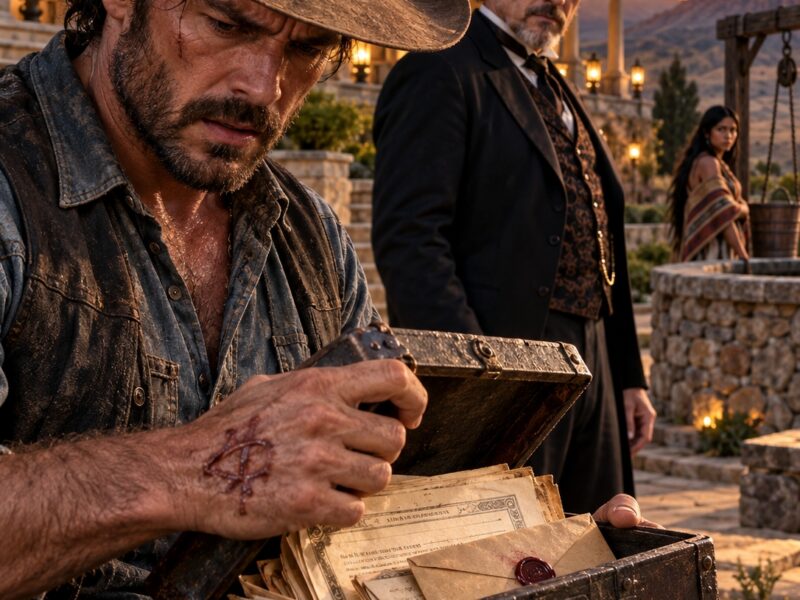
He Paid $50 to Free Two Apache Sisters—Then They Showed Him What Had Been Buried Beneath His Ranch for 20 Years
“Fifty dollars.”
The laughter stopped.
Not slowly.
Not politely.
It died all at once beneath the white Arizona sun.
Men who had been leaning against fence rails straightened. A rancher with tobacco stained between his teeth lowered his cup. Someone near the back muttered a curse.
Even the auctioneer seemed uncertain he had heard correctly.
At the center of the dusty yard stood two Apache sisters with their wrists tied together.
The older one did not lower her eyes.
The younger one could not stop trembling.
And twenty feet away, beneath the shadow of a battered brown hat, Elías Carrasco had just offered nearly every dollar he had left in the world.
The auctioneer squinted at him.
“Did you say fifty?”
Elías looked at the rope cutting into the younger girl’s wrists.
“I said fifty.”
A burst of laughter rolled through the yard.
“Carrasco’s lost his damn mind.”
“He can’t even pay Oister.”
“Maybe he plans to put them to work.”
“Maybe he plans something else.”
That last remark drew uglier laughter.
Elías did not turn toward it.
He was thirty-nine years old, sun-browned, broad-shouldered, and exhausted in the particular way a man became exhausted when sleep had stopped helping years ago.
His boots were cracked.
His shirt had been repaired at both elbows.
His ranch was mortgaged.
His cattle were thinning.
His well had begun producing water with a bitter metallic taste.
And in thirty-one days, Cyrus Oister’s bank would demand five hundred dollars Elías did not have.
Fifty dollars should have mattered to him.
It should have mattered desperately.
Instead, he looked at the younger sister’s bleeding wrist.
“Fifty,” he repeated.
The auctioneer shrugged.
Nobody bid against him.
The hammer came down.
“SOLD.”
The word echoed through the yard.
The older sister’s face did not change.
Her name was Nasota.
She was twenty-four, though hardship had taught her the stillness of someone much older.
Beside her stood sixteen-year-old Inola, her younger sister.
Inola flinched when the auctioneer shoved the rope toward Elías.
“Your problem now, Carrasco.”
Elías took it.
Nasota looked directly at him.
There was no gratitude in her eyes.
Only calculation.
She was studying the man who now held the rope.
His revolver.
His hands.
His horse.
The distance to the gate.
The men surrounding them.
The possibility of escape.
Elías understood.
He had seen that expression before.
A long time ago.
On another face.
On another terrible night.
“Come on,” he said quietly.
He led them away while laughter followed him into the street.
No one noticed Sheriff Boyd Mercer standing beneath the awning of the mercantile across the road.
Mercer was not laughing.
He watched Elías leave.
Then his gaze shifted toward the bank at the opposite end of Pueblo Seco.
A tall man stood behind the second-floor window.
Cyrus Oister.
The richest man in the county.
Oister watched too.
And when Elías disappeared beyond the last building, Cyrus slowly stepped away from the glass.
Two hours later, Elías stopped beside a dry wash several miles outside town.
There was nothing around them but red earth, thorn brush, distant mesas and a sky so wide it made human problems seem foolishly small.
He dismounted.
Nasota immediately stepped in front of Inola.
Elías reached toward his belt.
Inola gasped.
He pulled out a knife.
Nasota’s body tightened.
“If you touch her—”
Elías crouched.
Then cut the rope.
Once.
Twice.
The fibers fell into the dust.
Neither sister moved.
Elías stood and returned the knife to his belt.
“You’re free.”
Nasota stared at him.
He nodded toward the northern hills.
“Go wherever you want.”
Inola rubbed her wrists.
Nasota said nothing.
Elías waited.
A minute passed.
Then another.
Finally he frowned.
“Did you understand me?”
“Yes,” Nasota said.
Her Spanish was careful but clear.
“Then go.”
“We cannot.”
Elías glanced around the empty desert.
“Why not?”
Nasota’s expression hardened.
“Because you bought us.”
His jaw tightened.
“I bought a piece of paper from men who claimed that paper gave them authority over you.”
He kicked the severed rope aside.
“I didn’t buy you.”
Something flickered across Nasota’s face.
Not trust.
Not yet.
Perhaps surprise.
“That distinction may matter to you,” she said. “It will not matter to the sheriff.”
Elías said nothing.
“If we disappear today,” Nasota continued, “what will people say?”
“That you left.”
“They will say two Apache women disappeared after Elías Carrasco took them into the desert.”
His eyes narrowed.
Nasota held his gaze.
“And Sheriff Mercer will ask where you buried us.”
That landed.
Because she was right.
Boyd Mercer did not investigate truth.
He arranged truth according to whoever paid him.
Elías looked toward Inola.
The girl was trying to hide the blood on her wrists.
“Do you have family nearby?”
Nasota’s face changed.
“No.”
“A village?”
“No.”
“Friends?”
Silence.
Elías understood the answer.
He looked toward his horse.
“My ranch is about four miles west.”
Nasota stiffened.
“You want us to work?”
“If you want.”
“As servants?”
“No.”
“Then what do you expect?”
“Nothing.”
She almost laughed.
It was not amusement.
It was disbelief.
“Men rarely expect nothing.”
Elías met her eyes.
“I have horses that need tending. A garden that hasn’t grown anything useful in months. Fences falling down faster than I can repair them.”
He gestured toward the road.
“You can stay until you find somewhere safer. Help if you want. Don’t if you don’t.”
“And afterward?”
“You leave.”
“We owe you nothing?”
“Nothing.”
Nasota studied him.
“Why?”
Elías looked back toward Pueblo Seco.
The town was invisible now.
But the sound of that auctioneer’s hammer seemed to remain inside his skull.
“Because somebody should’ve stopped that auction before it started.”
He mounted his horse.
Then rode west.
He did not look back for almost a minute.
When he finally did, the sisters were following.
Elías Carrasco believed that was the strangest decision he would make that summer.
He was wrong.
Because before the month ended, one of those sisters would tell him there was a dead woman beneath his land.
And Elías would realize he knew exactly how she had gotten there.
His ranch sat between two low ridges where the desert flattened into a pale basin.
Once, it had been beautiful.
Twenty years earlier, cottonwood trees had grown near the wash. Horses had grazed beyond the south fence. The well had produced clean, cold water.
Now everything seemed tired.
The adobe house leaned slightly west.
The porch had three good boards and several that complained beneath every step.
The barn roof needed repair.
A chicken wandered around the yard as if searching for better ownership.
Inola looked at it.
The chicken looked at her.
For the first time that day, the girl smiled.
Elías noticed.
He pretended not to.
“You can sleep in the back room,” he said.
Nasota examined the house.
“Where do you sleep?”
“Front room.”
“Does the door lock?”
Elías paused.
Then understood.
“From inside.”
He showed her.
Nasota tested the latch herself.
“You keep the key,” Elías said.
“There is no key.”
“Then tomorrow I’ll make one.”
That earned him another long look.
Inside, the house was sparse.
A table.
Four mismatched chairs.
A wood stove.
Two shelves.
A rifle above the fireplace.
One photograph turned facedown beside a candle.
Inola reached toward it, then stopped herself.
Elías noticed that too.
“My wife,” he said.
He turned the photograph upright.
A young woman stood beside him beneath an apple tree.
She was laughing.
Elías was not looking at the camera.
He was looking at her.
“Her name was Isabel.”
Nasota glanced at him.
“Where is she?”
“Dead.”
The word ended the conversation.
Elías turned the photograph facedown again.
That evening, Inola went to the well.
She carried a bucket with both hands.
The sun was sinking behind the western ridge, staining the sky orange and violet.
She lowered the bucket.
The rope slid across the old stone rim.
Halfway down, Inola stopped.
She touched one of the stones.
There was a symbol scratched into it.
Three short lines.
A circle.
A broken arrow.
Her breathing changed.
“Sister.”
Nasota came from the barn.
Inola pointed.
Nasota froze.
For several seconds she did not move.
Then she crossed the yard.
Her fingertips touched the marking.
The expression on her face vanished.
She looked around.
At the barn.
The house.
The ridge.
Then the cottonwood stump beside the wash.
“No,” she whispered.
Inola swallowed.
“What?”
Nasota leaned over the well.
Darkness stared back.
“Father told us about this place.”
Inola’s face went pale.
Nasota touched the symbol again.
Their father had carved it twenty years earlier.
The night he watched a woman die.
That night, after Elías went to sleep, Nasota returned to the well.
Moonlight silvered the stones.
Inola followed barefoot.
“Are you certain?” she whispered in Apache.
Nasota nodded.
“He described the broken ridge.”
She pointed east.
“The well beside the cottonwood.”
Her fingers traced the symbol.
“And this.”
Inola stared into the darkness.
“What happened to the woman?”
Nasota closed her eyes.
Their father had told the story only twice.
Both times after drinking enough mescal to make his hands shake.
He had been nineteen.
A stable hand at the Bicomb ranch.
There had been shouting inside the main house.
A woman had run into the yard.
Three men followed.
One of them was young.
One was powerful.
One wore a silver ring.
Their father had tried to intervene.
There had been blood.
Fire.
A branding iron.
A wagon moving through the desert after midnight.
And a well.
“He said they buried her where nobody would ever look,” Nasota whispered.
Inola stared toward the house.
“And Elías?”
“I don’t know.”
“You think he was there?”
Nasota remembered the black glove covering Elías’s left hand.
Always.
Even while eating.
Even beneath the Arizona sun.
“I think,” she said, “we need to find out.”
The following morning, Elías woke to the smell of coffee.
For one beautiful, disorienting second, he thought Isabel was alive.
Then he opened his eyes.
The illusion disappeared.
He sat up.
His left hand was bare.
The scar crossed his palm and curled around his wrist, thick and shiny after two decades.
He quickly pulled on the black glove.
Outside, Inola was kneading flour.
“You made coffee?”
She nodded.
“Bad coffee.”
Elías tasted it.
It was terrible.
He drank again.
“I’ve had worse.”
She smiled faintly.
“Where’s your sister?”
Inola pointed toward the corral.
Elías walked outside.
Then stopped.
Nasota stood beside Centella.
The mare had earned her name because she moved like lightning and possessed approximately the same willingness to be controlled.
She had bitten one ranch hand.
Kicked another.
Thrown Elías twice.
Now Centella stood motionless while Nasota ran a hand along her neck.
Elías approached carefully.
“Don’t stand behind her.”
Nasota glanced over.
“Why?”
“She kicks.”
“Not if she knows where I am.”
“She knows where I am and kicks anyway.”
Nasota almost smiled.
“She is afraid of rough hands.”
“That horse has nearly killed two experienced riders.”
“Then perhaps the experienced riders frightened her.”
Centella lowered her head.
Elías stared.
“What did you do?”
“Nothing.”
“That’s impossible.”
“I stopped trying to make her obey.”
That answer stayed with him longer than he expected.
Over the next several days, something strange happened at the Carrasco ranch.
It began to feel inhabited again.
Not happy.
That would have been too much.
But alive.
Inola cleared the garden and discovered several surviving pepper plants beneath the weeds.
Nasota worked with the horses.
Elías repaired the south fence.
They ate together most evenings, although Nasota always positioned herself where she could see both the door and Elías’s revolver.
He never mentioned it.
He also never entered the sisters’ room without knocking.
One evening, Inola accidentally broke a ceramic bowl.
The crash brought Elías running.
He found her frozen beside the table.
Her face had gone white.
“I am sorry.”
Elías looked at the pieces.
“It’s a bowl.”
“I can repay—”
“With what?”
Her fear deepened.
He immediately regretted the question.
Elías crouched and began gathering the pieces.
“Inola.”
She looked at him.
“It’s a bowl.”
He tossed the broken pieces into a bucket.
“I have three more.”
“You are not angry?”
“I’ve broken better things.”
His eyes drifted toward Isabel’s photograph.
The sentence suddenly meant something else.
Nasota heard it.
So did he.
Nobody spoke for a while.
That night, Nasota found Elías sitting alone on the porch.
He held a small embroidered handkerchief.
Blue flowers had been stitched along one corner.
“Your wife’s?”
Elías closed his fist around it.
“Yes.”
Nasota remained standing.
“How did she die?”
He looked into the darkness.
“Fever.”
Nasota waited.
Elías knew she did not believe him.
Neither did most people.
Because Isabel had not been sick.
Not at first.
She had become frightened.
Then secretive.
Then ill.
Three days before her death, she had told Elías she had discovered something about the ranch.
Something hidden.
Something dangerous.
He had been too tired, too proud, and too afraid to listen.
By morning, she was vomiting.
Two days later, she was dead.
The doctor called it fever.
Elías had spent three years pretending he believed him.
“What did she know?” Nasota asked.
Elías turned sharply.
“I didn’t say she knew anything.”
“No.”
Nasota looked toward the well.
“But your face did.”
Before Elías could answer, hoofbeats approached.
Three riders entered the yard.
Sheriff Boyd Mercer rode in front.
He was fifty-three, heavy through the shoulders, with a gray mustache and the slow confidence of a man who had spent years discovering how rarely anyone challenged a badge.
He dismounted.
“Carrasco.”
Elías stood.
“Mercer.”
The sheriff glanced toward Nasota.
Then toward Inola watching from the doorway.
“I hear you’re keeping two Apache women.”
“They’re staying here.”
“You paid for them.”
“I paid to get them out of that yard.”
Mercer smiled.
“Interesting distinction.”
“Not to me.”
Mercer’s smile disappeared.
He stepped closer.
“Folks in Pueblo Seco don’t like trouble.”
“Then they should stop creating it.”
One deputy snickered before Mercer silenced him with a glance.
“Cyrus Oister wants his money.”
Elías’s jaw tightened.
“Debt isn’t due for another month.”
“Twenty-seven days.”
“I can count.”
“Five hundred dollars.”
“I know.”
“And if you don’t have it?”
“He takes the ranch.”
Mercer glanced around.
The dying grass.
The patched barn.
The cracked trough.
Then his gaze settled on the well.
Something changed.
Barely.
But Nasota saw it.
Mercer walked toward the stones.
“Funny thing about this place.”
Elías followed.
“What?”
“People have always told stories about this ranch.”
“What stories?”
Mercer touched the rim.
“That there might be something valuable underground.”
Nasota went still.
Elías frowned.
“Gold?”
Mercer smiled.
“Maybe.”
He looked into the well.
“Maybe something else.”
Then he turned toward Elías.
“You’d be smart to sell before Oister takes it.”
“Is Oister offering?”
“He might.”
“How generous.”
Mercer stepped close enough that only Elías could hear.
“You’ve spent twenty years surviving something that would’ve killed a smarter man.”
Elías’s expression changed.
Mercer smiled.
“Don’t start remembering now.”
He mounted.
Then rode away.
Elías stood motionless.
Nasota watched him.
That evening she finally asked the question.
“Why do you wear the glove?”
Elías did not look up from the bridle he was repairing.
“Old injury.”
“From what?”
“Fire.”
“A branding iron?”
His hands stopped.
The silence became enormous.
Nasota stepped closer.
“My father once burned a man’s hand with a branding iron.”
Elías slowly raised his head.
“Where?”
“At the Bicomb ranch.”
The leather strap slipped from his fingers.
Inola stood in the doorway.
Elías looked from one sister to the other.
“What was your father’s name?”
Nasota answered.
“Taza.”
Elías stopped breathing.
Twenty years disappeared.
He could smell burning wood.
Hear horses screaming.
Hear a woman crying.
Hear a young Apache stable hand shouting for him to run.
“Taza,” Elías whispered.
Nasota’s eyes sharpened.
“You knew him.”
Elías stood.
His chair scraped backward.
Nasota did not retreat.
“My father died because of what happened at Bicomb.”
Elías looked toward the well.
Nasota followed his gaze.
“The woman he tried to save,” she said, “is buried beneath this ranch.”
Elías went pale.
“You don’t know what you’re talking about.”
“My father described this well.”
“No.”
“He carved that symbol.”
“No.”
“He said three men brought her here after midnight.”
Elías backed away.
Nasota stepped forward.
“And he said one man left Bicomb that night with a burned left hand.”
Elías stared at her.
Then slowly removed his glove.
The scar appeared.
Inola covered her mouth.
Nasota’s face hardened.
“You were there.”
“Yes.”
“You helped them.”
“No.”
“My father said—”
“I tried to stop them.”
“Then tell me what happened.”
Elías looked at his scar.
Twenty years of silence sat between them.
Finally he whispered:
“Her name was Elena Oister.”
Nasota froze.
Inola frowned.
“Oister?”
Elías nodded.
“Cyrus’s sister.”
The revelation seemed impossible.
Everyone in Pueblo Seco knew Cyrus Oister had inherited his fortune after his older sister disappeared.
The official story was that Elena had run away with money from the family estate.
Elías knew differently.
Twenty years earlier, he had been nineteen and working at Bicomb Ranch.
So had Taza.
Elena Oister had arrived one evening carrying documents.
She was terrified.
She claimed her brother Cyrus and Silas Bicomb were stealing land through forged deeds, fraudulent debts and threats.
Several properties belonged to families who could not read the contracts being placed before them.
Others belonged to widows.
Some belonged to Apache families who had been driven away before anyone could challenge the transfers.
Elena had discovered the records.
And she planned to expose them.
“She trusted the wrong person,” Elías said.
“Who?”
“Boyd Mercer.”
Nasota understood.
“The sheriff.”
“He wasn’t sheriff then.”
Elías stared into the darkness.
“He was Cyrus Oister’s hired gun.”
Elena had given Mercer copies of the documents.
Mercer had delivered them directly to Cyrus.
That night, Cyrus came to Bicomb.
So did Mercer.
There was an argument.
Elías heard Elena screaming.
He ran inside.
Taza followed.
Cyrus had Elena by the arm.
Mercer held a revolver.
Silas Bicomb stood near the fireplace.
Elías tried to intervene.
Mercer struck him.
Taza grabbed the nearest weapon he could find—a branding iron from the brazier.
He swung.
Mercer ducked.
The iron struck Elías’s hand.
“And Elena?” Nasota whispered.
Elías closed his eyes.
“She ran.”
They chased her into the yard.
Taza helped Elías up.
Then came the gunshot.
One.
Elena fell near the stable.
Cyrus stood behind her holding the revolver.
“He killed his own sister?”
“He said it was an accident.”
Elías laughed bitterly.
“Then he pointed the gun at us and explained how accidental our deaths could be too.”
Taza escaped.
Elías did not.
Mercer beat him until he could barely stand.
Then they forced him to help load Elena’s body into a wagon.
“Why here?” Nasota asked.
“This ranch belonged to Bicomb then.”
Elías looked toward the well.
“They brought her here.”
Inola whispered, “And put her inside.”
“Yes.”
Nasota’s voice shook.
“My father knew.”
“He followed us.”
Elías looked at her.
“He saw everything.”
Taza tried to expose them.
Nobody believed him.
Within weeks, he was arrested for horse theft.
Then escaped custody.
Months later, word came that he had been killed.
Nasota’s eyes filled with tears she refused to release.
“You never spoke?”
Elías looked ashamed.
“I was nineteen.”
“That is not an answer.”
“I was afraid.”
“My father died.”
“I know.”
“You lived.”
“I know.”
Her anger finally broke through.
“You bought us for fifty dollars and thought cutting a rope made you a good man?”
Elías flinched.
“I never said I was.”
“You knew our father’s name.”
“Not until tonight.”
“You knew what happened.”
“Yes.”
“And you said nothing for twenty years.”
“Yes.”
Nasota stepped closer.
“Then maybe Mercer was right.”
Elías looked at her.
“Maybe you should not start remembering now.”
She walked away.
That night nobody slept.
Before sunrise, Elías went to the well.
Nasota was already there.
“I want to bring her up,” he said.
Nasota stared at him.
“You waited twenty years.”
“I know.”
“Why now?”
“Because your father tried to do the right thing when I didn’t.”
She said nothing.
“And because Isabel died after telling me she’d found something hidden on this ranch.”
Nasota looked at him sharply.
“You think Oister killed your wife?”
“I think I should’ve asked that question three years ago.”
Together they began examining the well.
The water level had fallen dramatically during the drought.
Near the bottom, beneath approximately six feet of water, Elías saw something unusual.
A ledge.
And beside it—
wood.
They spent the morning rigging ropes.
Nasota insisted on descending.
Elías refused.
“It could collapse.”
“Then you go.”
“Yes.”
“With one injured hand?”
He looked at her.
Nasota tied the rope around her waist.
“You freed me because you believed I should decide what happens to my own life.”
She tightened the knot.
“Do not change your principles when they become inconvenient.”
Elías had no answer to that.
He lowered her down.
Twenty feet.
Thirty.
Forty.
Then her voice echoed upward.
“Stop.”
Elías locked the rope.
“What do you see?”
Silence.
“Nasota?”
Her answer came softly.
“There is a box.”
They pulled it up first.
It was iron-banded, blackened by moisture and heavy enough that Elías needed both hands.
Then Nasota climbed out.
Her face had changed.
“What else?” Elías asked.
She looked at him.
“Bones.”
Inola began crying.
Elías sat beside the well.
For twenty years, Elena Oister had been beneath his feet.
But the box was the greater surprise.
Inside were oilcloth-wrapped documents.
Ledgers.
Deeds.
Letters.
And one envelope addressed to:
ELÍAS CARRASCO.
His hands trembled.
The handwriting belonged to Isabel.
He opened it.
Elías,
If you are reading this, I was right to be afraid.
The papers beneath our well prove what Cyrus Oister has done.
Do not take them to Sheriff Mercer.
He is part of it.
I found records showing Cyrus poisoned wells and forced indebted ranchers to sell their land.
Our well is not failing naturally.
Someone has been contaminating it.
There is more.
Look beneath the blue flowers.
Elías stopped.
His eyes moved toward the house.
The handkerchief.
Isabel’s handkerchief.
Blue flowers embroidered in one corner.
He ran inside.
Beneath the mattress, he found it.
Nasota and Inola followed.
Elías examined the stitching.
Something had been sewn inside the hem.
He cut it carefully.
A small brass key fell into his palm.
And a folded strip of paper.
PUEBLO SECO BANK — BOX 17.
The bank belonged to Cyrus Oister.
That afternoon, three riders appeared on the eastern ridge.
Mercer.
And two deputies.
Nasota saw them first.
“They know.”
Elías looked at the open box.
“How?”
Then he remembered the auction.
Mercer had been watching.
Cyrus had been watching.
The sisters had not accidentally come into his life.
Someone had been afraid of what they knew.
Mercer rode into the yard with his revolver already drawn.
“Step away from the box.”
Elías moved in front of the sisters.
Mercer smiled.
“Still trying to be a hero?”
“No.”
Elías rested his hand near his gun.
“Just tired of being a coward.”
Mercer’s smile vanished.
The deputies spread apart.
“You should’ve sold the ranch.”
“You should’ve stayed away from my wife.”
For the first time, Mercer looked uncertain.
That was enough.
Elías knew.
“You knew Isabel found the papers.”
Mercer said nothing.
“You killed her.”
“No.”
“Cyrus?”
Silence.
Nasota watched Mercer’s face.
That silence answered more than words could.
Mercer raised his revolver.
“You’re coming with me.”
“On what charge?”
“Murder.”
Elías almost laughed.
“Whose?”
Mercer pointed toward the well.
“Elena Oister.”
The trap became clear.
Mercer intended to claim Elías had killed Elena twenty years earlier and hidden her body.
The scar.
His presence at Bicomb.
His ownership of the ranch.
Everything could be arranged to fit.
Except one thing.
Nasota stepped forward.
“My father witnessed the murder.”
Mercer looked at her.
“And your father is dead.”
“Not before writing down what he saw.”
Mercer’s eyes changed.
Nasota was bluffing.
Elías knew it.
Mercer did not.
“Where?”
Nasota smiled.
“You tell me.”
Mercer lifted his revolver toward her.
Elías drew.
The gunshot exploded across the ranch.
Centella screamed inside the corral.
One deputy fell from his saddle.
Mercer’s bullet tore through Elías’s shoulder.
Elías fired again.
Mercer ducked behind the well.
Inola ran toward the barn.
The second deputy chased her.
Nasota grabbed a shovel and struck him across the face as he passed.
He collapsed.
Mercer fired twice.
Stone shattered beside Elías.
Then Centella burst through the corral gate.
Inola had opened it.
The mare charged across the yard.
Mercer turned.
Too late.
Centella struck him hard enough to send him into the dust.
His revolver skidded away.
Nasota reached it first.
Mercer looked up.
She pointed the gun at him.
For a moment, twenty years stood between them.
Her father.
Elena.
Isabel.
Everything Mercer had helped bury.
“Do it,” he whispered.
Perhaps he expected revenge.
Perhaps he wanted it.
Nasota lowered the weapon.
“No.”
Mercer laughed.
“Weak.”
Nasota shook her head.
“No. Alive.”
Her eyes hardened.
“You are going to tell everyone what you did.”
Mercer’s expression changed.
That frightened him more than death.
But Cyrus Oister was not finished.
By sunset, smoke rose above the northern ridge.
Six riders were coming.
Elías recognized Cyrus in front.
They had less than twenty minutes.
“Box Seventeen,” Elías said.
Nasota looked toward town.
“We cannot reach the bank.”
“We don’t need the bank.”
He held up Isabel’s key.
“We need witnesses.”
Pueblo Seco had spent twenty years living beneath Cyrus Oister’s money.
Elías intended to make the entire town watch him fall.
They tied Mercer to a horse and rode.
Elías nearly passed out twice from blood loss.
Inola held cloth against his shoulder.
Nasota rode Centella.
The mare carried her as if they had known each other for years.
They reached Pueblo Seco shortly before dark.
People emerged from buildings when they saw Sheriff Mercer tied to his own saddle.
Then they saw the box.
Then Cyrus Oister rode into town behind them.
“What is the meaning of this?”
His voice carried across the street.
Elías dismounted.
Barely.
“The meaning,” he said, “has been buried under my ranch for twenty years.”
Cyrus saw the box.
The color left his face.
That was the moment the town began believing.
Not because Elías accused him.
Because Cyrus Oister looked afraid.
Elías held up Isabel’s key.
“Box Seventeen.”
Cyrus moved toward him.
“You have no authority—”
Nasota stepped between them.
“My father died because of what is inside that box.”
Cyrus stared at her.
“Who was your father?”
“Taza.”
Cyrus stopped.
Recognition.
Again.
Another mistake.
Another truth revealed without words.
Dozens of townspeople were watching now.
The bank clerk, Mr. Hollis, stood near the door.
Elías handed him the key.
“Open it.”
Hollis looked at Cyrus.
Then Elías.
“I could lose my job.”
Elías almost smiled.
“If we’re right, you won’t have a bank to work for tomorrow.”
Someone in the crowd laughed nervously.
Hollis opened the door.
Box Seventeen contained letters, original land deeds, payment records, and a handwritten ledger documenting bribes to Mercer.
There was also a sealed statement from Elena Oister.
She had prepared it before going to Bicomb.
Cyrus had killed her before she could deliver it.
Isabel had discovered the key years later.
And Cyrus had discovered that Isabel knew.
Mercer finally broke.
Perhaps he understood Cyrus would sacrifice him.
Perhaps twenty years of loyalty had suddenly become too expensive.
“He told me to put something in her medicine.”
The crowd went silent.
Elías stared at him.
Mercer looked away.
“Isabel?”
“Yes.”
Elías crossed the distance before anyone could stop him.
He hit Mercer once.
Then again.
Years of grief exploded through his body.
He raised his fist a third time.
Nasota caught his arm.
“Elías.”
He turned.
Her eyes were steady.
“If you kill him now, he becomes your last mistake.”
Elías’s fist trembled.
Then lowered.
Mercer collapsed into the dirt.
Cyrus tried to run.
He made it twelve feet.
The same men who had once laughed when Elías paid fifty dollars for two bound women blocked his path.
Not because they had suddenly become good.
Not because prejudice vanished in an afternoon.
But because corruption had finally become too visible to ignore.
Cyrus Oister was arrested.
Mercer testified.
Elena’s remains were recovered from the well and buried beneath her real name.
Several stolen properties were eventually returned.
Others became tangled in years of legal disputes.
Justice did not arrive cleanly.
It rarely does.
Taza’s name was cleared.
That mattered most to Nasota.
Elías stood beside her when the official record was read aloud.
She did not cry until everyone else had gone.
Then she sat beneath the cottonwood stump and wept for a father who had died branded a criminal because powerful men needed him to be one.
Elías sat several feet away.
He did not touch her.
He did not tell her grief would pass.
He knew better.
After a long time, Nasota spoke.
“My father was right about you.”
Elías looked over.
“What did he say?”
“He said there was a young man at Bicomb who wanted to be brave.”
Elías looked down.
“He was wrong.”
Nasota shook her head.
“No.”
She wiped her eyes.
“He said wanting to be brave and being brave were different things.”
Elías almost smiled.
“That sounds more accurate.”
“He also said sometimes a coward is simply a brave man who has not reached the right day yet.”
Elías looked toward the horizon.
“Twenty years is a long time to wait.”
“Yes.”
Nasota stood.
“But the day came.”
The mortgage disappeared after investigators proved Cyrus had manipulated the debt.
Elías kept the ranch.
The poisoned well was sealed.
They dug another one farther south.
When clean water finally came up, Inola laughed so loudly that Elías heard her from the barn.
He found her standing beside the pump, soaked from head to toe.
Nasota was laughing too.
It was the first time he had heard her do it.
Something inside the old ranch changed after that.
Inola replanted the garden.
Tomatoes came first.
Then peppers.
Nasota trained Centella until the mare could be ridden without a bit.
Elías repaired the porch.
He put Isabel’s photograph upright.
And left it that way.
Autumn arrived.
Then winter.
One cold morning, Elías found two saddled horses near the barn.
Nasota was packing blankets.
His heart sank.
He had always known this day would come.
“You’re leaving.”
Nasota looked at him.
“You told us we could.”
“I did.”
Inola hugged him before he could say anything else.
It surprised him enough that he stood stiffly for several seconds.
Then carefully hugged her back.
“Where will you go?”
“We found relatives north of here,” Inola said.
Nasota tightened the saddle strap.
Elías nodded.
“Good.”
That was all he trusted himself to say.
Nasota approached.
From her pocket, she removed something.
Fifty dollars.
She placed it in his hand.
Elías stared.
“No.”
“You paid fifty dollars.”
“Not for you.”
“I know.”
“Then keep it.”
Nasota closed his fingers around the money.
“You still do not understand.”
He looked at her.
“You didn’t buy us that day.”
She glanced toward the road where he had cut their ropes months earlier.
“You bought a choice.”
Elías swallowed.
Nasota continued.
“For the first time in a long time, someone gave us one.”
She stepped back.
“That is why we stayed.”
Elías looked at the money.
“And now?”
“Now we choose to leave.”
He nodded.
Painful as it was, there was something beautiful in those words.
Choice meant nothing if it only existed when someone chose you.
Nasota mounted Centella.
Elías looked up sharply.
“That’s my horse.”
For perhaps the first time since he had met her, Nasota grinned.
“She disagrees.”
Inola burst out laughing.
Elías stared at Centella.
The mare stared back without shame.
“Fine.”
Nasota’s smile softened.
Then she turned north.
The sisters rode away.
Elías remained beside the fence until they disappeared beyond the ridge.
The ranch became quiet again.
But it was no longer the same kind of quiet.
Years passed.
Pueblo Seco changed.
Mercer died in prison.
Cyrus Oister never returned.
The old auction yard was torn down.
Elías expanded the ranch slowly, never becoming wealthy but never again belonging to a bank.
Every spring, blue flowers appeared near Isabel’s grave.
Every year, he placed fresh ones there.
And every year, sometime near the beginning of autumn, two riders appeared on the northern ridge.
At first it was only Nasota and Inola.
Later Inola came with a husband.
Then children.
Nasota never married.
She became known for breeding horses that seemed impossible for anyone else to handle.
Centella lived to an absurdly old age.
Whenever Nasota visited, she and Elías rarely discussed the auction.
Some memories did not improve through repetition.
One evening, many years later, they sat together on the repaired porch.
Elías’s hair had turned gray.
Nasota had lines around her eyes.
Children were chasing chickens through the yard.
The new well pump creaked in the distance.
Elías looked at his left hand.
He had stopped wearing the glove years earlier.
The scar remained.
It always would.
“Do you ever wonder,” he asked, “what would’ve happened if I hadn’t gone to that auction?”
Nasota watched the sunset.
“Yes.”
“And?”
She thought for a moment.
“Then perhaps the wrong question is what would have happened to us.”
Elías looked at her.
“What’s the right question?”
“What would have happened to you?”
He smiled faintly.
“I would’ve kept my fifty dollars.”
Nasota laughed.
Then her expression softened.
“No.”
She looked toward the place where the old well had once stood.
“You would have kept your secret.”
The words settled between them.
Elías understood.
For years, he had believed he rescued two sisters from an auction yard.
That was the version people in Pueblo Seco liked to tell.
It made a clean story.
A cowboy saw cruelty.
He paid fifty dollars.
He cut two ropes.
Two women went free.
But life had never been that simple.
Nasota and Inola had arrived carrying the truth he had spent twenty years avoiding.
They had forced him to look beneath his own land, beneath his grief, beneath his fear, beneath every excuse he had used to survive.
They had uncovered Elena.
They had uncovered Isabel’s final act of courage.
They had cleared Taza’s name.
And somewhere along the way, they had uncovered Elías Carrasco too.
The sun disappeared behind the ridge.
Nasota rose to go inside.
Elías remained on the porch.
In the fading light, the scar across his hand looked almost silver.
Once, he had hidden it because he believed scars were proof of shame.
Now he understood something different.
A scar did not prove a man had been brave.
It did not prove he had been innocent.
It did not erase the years he had remained silent.
It only proved that something had happened.
What mattered was what he chose to do afterward.
Elías looked across the ranch.
At the horses.
At the garden.
At the children running where armed men had once ridden.
At clean water rising from ground that had held terrible secrets.
Then he heard Inola calling everyone inside for supper.
Nasota stood in the doorway.
“Are you coming?”
Elías looked once more toward the old well.
For twenty years, he had thought the dead woman beneath it was the darkest secret buried on his ranch.
He had been wrong.
The darkest thing buried there had been his silence.
And the day two frightened sisters refused to leave was the day that silence finally began to die.
Elías stood.
He left the darkness behind him.
And went inside.









