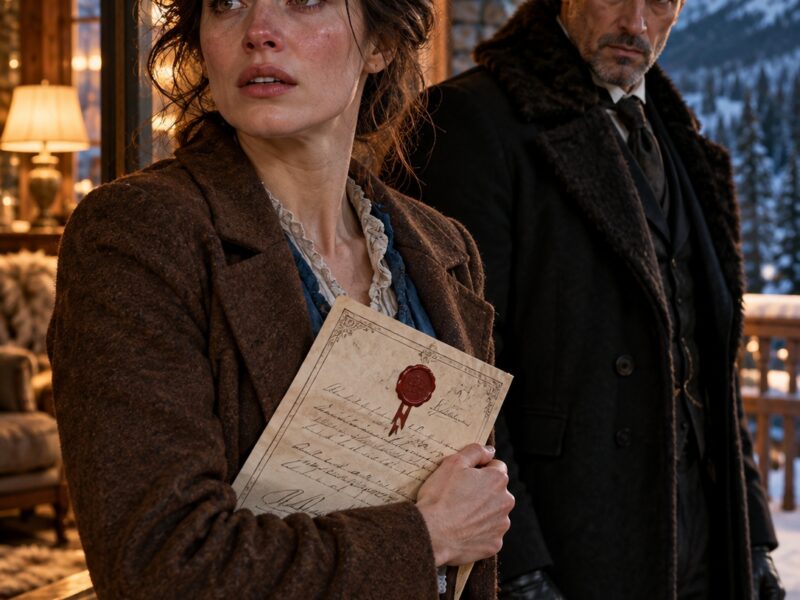
HE PAID FOR ONE MAIL-ORDER BRIDE—BUT THREE STARVING STRANGERS STEPPED OUT OF THE STAGECOACH
The stagecoach door opened, and Caleb Boon knew immediately that something had gone terribly wrong.
He had paid for one woman.
Three people stepped into the snow.
For a few seconds, Caleb simply stood there in the cutting March wind, staring at them while the old stagecoach creaked behind them and the horses blew white clouds into the mountain air.
The first was a woman.
She was perhaps thirty, though hunger and exhaustion had added years to her face. Dark hair had been pinned into a bun that was losing its battle with the wind. Her dress had once been respectable. Now it had been patched so many times that Caleb could barely tell what color it had originally been.
Behind her stood two little girls.
The older one looked about eight.
The younger couldn’t have been more than six.
Both were so thin that their winter clothes seemed to hang from their shoulders instead of covering them.
Caleb looked from the children to the woman.
Then back to the children.
“No.”
The woman’s face went white.
“Mr. Boon—”
“No.”
The stagecoach driver, an old man wrapped in scarves and bad temper, shifted uncomfortably beside the horses.
Caleb pointed at the coach.
“Put them back.”
The younger girl flinched.
Not dramatically.
She didn’t cry out.
She simply moved closer to the older child, as if she had learned that the safest way to survive angry adults was to become smaller.
That tiny movement bothered Caleb more than tears would have.
The woman swallowed.
“Please let me explain.”
“There isn’t anything to explain.”
“There is.”
“I paid for one person.”
Her eyes hardened despite the fear in them.
“You paid an agency to introduce you to a woman willing to marry you. You did not purchase livestock.”
Caleb stared at her.
The driver made a suspicious sound that might have been a cough hiding a laugh.
The woman seemed to realize she had pushed too hard.
Her shoulders lowered.
“My name is Eliza Hart,” she said more quietly. “You wrote to me.”
“I know who you are.”
“These are my sisters. Anna and Ruthie.”
“I didn’t ask who they were.”
Anna’s chin lifted.
Ruthie stared at the snow.
Eliza stepped closer.
“I couldn’t leave them.”
“That wasn’t our arrangement.”
“I know.”
“You said nothing about children.”
“They aren’t my children.”
“That doesn’t make three mouths into one.”
Pain flashed across her face.
Caleb hated himself slightly for noticing it.
He hated himself more for noticing how cold the girls looked.
March in the Colorado Rockies had no respect for calendars. Winter still owned the mountains. Snow clung to the pines and filled the ravines. Wind came down through the pass sharp enough to find every opening in a man’s coat.
And these children had arrived wearing shoes meant for another season.
Caleb turned toward the driver.
“Take them back.”
“Can’t.”
“You brought them.”
“And this is the end of my route.”
“Then take them when you leave.”
“Road’ll be worse after sundown.”
“Not my problem.”
The words sounded reasonable.
They also sounded ugly.
Eliza heard both.
“Mr. Boon.”
Something in her voice made him look at her.
She wasn’t begging now.
She was trying desperately not to.
“I will do everything we discussed. I can cook. Sew. Preserve food. Tend animals. I can keep house. I can work a garden. I’ll help with whatever needs doing.”
“I asked for a wife, not hired help.”
“I know.”
“Do you?”
Her jaw tightened.
“Yes.”
“Because it looks to me like you answered an advertisement under false pretenses.”
That struck home.
Anna looked at her sister.
Eliza’s face burned with shame, but she did not look away from Caleb.
“I did.”
The admission surprised him.
“I lied by omission. I knew if I told the agency about Anna and Ruthie, they wouldn’t accept me.”
“Then maybe they shouldn’t have.”
“Maybe.”
Her voice trembled.
“But the boardinghouse put us out. The factory wouldn’t hire a woman with two dependents. The church had already helped as much as it could. We had almost no money left.”
She glanced at the girls.
“When your letter came, I had a choice.”
Caleb waited.
“Leave them behind and save myself.”
The wind moved a loose strand of hair across her cheek.
“Or lie.”
Her eyes returned to his.
“So I lied.”
No excuse.
No performance.
Just the truth.
Caleb wished she had made it easier to hate her.
“You think I want this?” she asked.
He frowned.
“You think this was some grand plan? Travel across three states to marry a man I’ve never seen and live on a mountain where the nearest town is half a day’s ride away?”
The driver suddenly found the horses fascinating.
Eliza took another step toward Caleb.
“I came because my sisters were hungry.”
Her voice broke.
She recovered before the tears could come.
“I will work harder than any woman that agency could have sent you. I won’t complain. I won’t ask for anything we don’t need. But I will not abandon them.”
“And if I say no?”
She looked at Anna.
Then Ruthie.
“Then we go back.”
“To what?”
A long silence.
“Whatever is left.”
That answer landed harder than Caleb expected.
He looked at the younger girl again.
Ruthie had tears on her cheeks.
She made no sound.
She wasn’t asking him to save her.
That was the problem.
She looked as though she had stopped believing adults saved children at all.
Six years earlier, Caleb had watched his wife die in a snowstorm.
Rebecca had gone into labor too early.
The nearest doctor had been nearly fifty miles away.
Caleb had held her hand while the storm buried the trail outside, and he had lied to the woman he loved.
Help is coming.
Hold on.
You’re going to be all right.
Help had not come.
Rebecca died.
So did their son.
Afterward, Caleb built another cabin because he could no longer sleep in the room where she had died.
For six years, he told himself solitude was safer.
No wife meant no widowhood.
No children meant no tiny graves.
No love meant nothing left for death to steal.
Then, one January night, he caught himself speaking to Rebecca’s empty chair.
That frightened him enough to answer a ridiculous advertisement in an old newspaper.
PRACTICAL WOMEN SEEKING PRACTICAL ARRANGEMENTS.
Correspondence marriages for western territories.
No romance promised.
No foolish expectations.
That suited Caleb.
He sent forty dollars—almost everything he’d saved from the previous trapping season—to an agency in Missouri.
He wanted companionship.
Someone practical.
Someone who understood that love had nothing to do with it.
Instead, the mountain had delivered a frightened woman and two starving children.
“Damn it,” Caleb muttered.
Eliza stiffened.
He turned toward the cabin.
Behind him, nobody moved.
The driver called, “That mean yes?”
Caleb kept walking.
“Get their things.”
Silence.
Then Eliza inhaled sharply.
Caleb did not turn around.
He didn’t want to see gratitude.
Gratitude created obligations.
He had enough of those already.
“What there is of them,” he added.
A few moments later he heard footsteps behind him.
Three sets.
That was how Caleb Boon made the first mistake that would eventually save his life.
He just didn’t know it yet.
The cabin had one room.
One bed.
Two chairs.
One table.
A stone fireplace.
Shelves lined with flour, beans, dried meat, preserves, coffee, ammunition and everything else a man needed to survive months when snow made the mountain almost unreachable.
There was also a wooden trunk in the corner.
Rebecca’s things were inside.
Caleb had not opened it in six years.
Eliza entered and stopped.
Her eyes moved across the room.
One bed.
One man.
Three strangers.
Caleb could practically hear her calculating danger.
“You and the girls take the bed,” he said.
“Where will you sleep?”
“Here.”
He nodded toward the chair beside the fireplace.
“For how long?”
Caleb looked at her.
“Let’s survive tonight before we start negotiating eternity.”
Anna almost smiled.
Almost.
Then Eliza said quietly, “The girls haven’t eaten since yesterday morning.”
Caleb froze.
He turned.
“Yesterday?”
“We ran out of money in Denver.”
The children swayed slightly where they stood.
Caleb suddenly understood why they were so quiet.
They were conserving energy.
“Sit.”
They didn’t move.
“I said sit.”
Anna looked at Eliza first.
Only when Eliza nodded did the girls squeeze together onto one chair.
Caleb put bread, cheese and dried venison on the table.
Ruthie grabbed the cheese with both hands and shoved it into her mouth.
Anna reached for bread.
Then stopped.
Her hand hovered over it.
“Eat,” Caleb said.
She looked suspicious.
“As much as you need.”
Still she hesitated.
Eliza whispered, “It’s all right.”
Anna finally ate.
Fast.
Too fast.
The way children ate when they had learned food could disappear before hunger did.
Caleb turned away.
Something inside his chest felt wrong.
He told himself it was irritation.
He knew better.
When the girls finished, Ruthie fell asleep sitting upright against Anna’s shoulder.
Caleb looked at Eliza.
“You too.”
“I’m not hungry.”
“You’re lying.”
“I can wait.”
“No.”
He pushed bread toward her.
“You’re no use to anybody if you fall over.”
Eliza stared at the bread.
Then she took it.
That night Caleb sat beside the fire with a blanket around his shoulders.
Across the room, Eliza slept between her sisters.
Anna had one arm around Ruthie.
Ruthie had both hands clenched into Eliza’s dress.
Caleb listened to their breathing.
For six years his cabin had been silent enough that he could hear snow settling on the roof.
Now there were three strangers in his bed.
One of them had lied to him.
Two of them had eaten half a week’s provisions.
And somehow, for the first time since Rebecca died, the cabin did not feel like a tomb.
That realization frightened him more than anything else.
The first weeks were awkward.
Eliza worked as if every chore were part of a debt she expected Caleb to collect.
She rose before him.
Cooked.
Cleaned.
Mended clothes.
Organized supplies.
Scrubbed surfaces that were already clean.
She taught Anna lessons at the table and kept Ruthie close enough to touch whenever strangers or unfamiliar noises frightened her.
Caleb eventually realized something else.
Ruthie almost never spoke.
At first he assumed she was shy.
Then he noticed Anna answering for her.
“Does she talk?”
Eliza’s hands stopped over the dough she was kneading.
“She used to.”
“Used to?”
Eliza looked toward Ruthie.
The girl was sitting near the fireplace arranging small stones into careful rows.
“She’s been through things.”
Caleb waited.
Eliza said nothing more.
He understood that kind of silence.
So he didn’t force it.
Instead he showed Ruthie how to feed the chickens.
Then how to identify rabbit tracks.
Then how to hold a piece of wood steady while he carved.
He didn’t ask her questions that required answers.
He simply let her exist beside him.
Some days that seemed enough.
Anna was different.
Anna asked everything.
“Why do you live up here?”
“Because people live down there.”
“Do you dislike people?”
“Most of them.”
“Do you dislike us?”
Caleb looked at her.
She stared back with unsettling seriousness.
“No.”
“Why?”
“Don’t push your luck.”
That earned the first real smile he had seen from her.
Something changed after that.
Not quickly.
Real things rarely changed quickly.
But the cabin developed rhythms.
Four bowls instead of one.
Children’s boots beside Caleb’s.
Eliza humming while she worked.
Anna reading aloud.
Ruthie’s stones appearing in strange little arrangements across the windowsill.
One evening Caleb returned from checking traps and heard laughter before he opened the door.
He stopped outside.
The sound went through him like a blade.
Rebecca had laughed in his old cabin.
For one terrible second, Caleb wanted to turn around and walk back into the snow.
Instead he opened the door.
Eliza had flour on her cheek.
Anna was laughing so hard she could barely breathe.
Ruthie was smiling.
Eliza looked at him.
The laughter faded.
Caleb suddenly understood.
They were afraid they had been too loud.
In his house.
Around him.
“What’s funny?”
Anna looked at Eliza.
Eliza tried not to smile.
“Your biscuits.”
“My biscuits?”
“Anna says they could stop bullets.”
Caleb looked at the tray.
“They’re supposed to be hard.”
“They’re supposed to be food,” Eliza said.
Anna lost control again.
A second later, Eliza laughed too.
Then, unexpectedly, Ruthie made a tiny breathy sound.
Not quite laughter.
But close.
Caleb put down his coat.
“Fine. Tomorrow you make them.”
“I already do.”
“Then why am I being insulted?”
“Because yours are terrible.”
He looked at Anna.
“You started this.”
She grinned.
Something warm and dangerous opened inside him.
Family, he thought.
Then immediately rejected the word.
No.
This was temporary.
Practical.
An arrangement.
He had believed that when they arrived.
The truth was already becoming something else.
And the mountain wasn’t finished with them.
The men came in early April.
Three riders.
Caleb saw them before they reached the cabin.
Eliza saw his expression.
“What?”
“Take the girls inside.”
Her face changed.
“Caleb—”
“Inside.”
She obeyed.
The riders stopped near the porch.
The man in front introduced himself as Ashford.
His clothes were too expensive for the mountain.
His smile was worse.
“We’re looking for Eliza Hart.”
“You found my property.”
“I asked for Eliza Hart.”
Caleb stepped down from the porch.
“What business do you have with her?”
“Financial.”
Behind him, the cabin door opened.
Eliza stood there.
The moment she saw Ashford, all color left her face.
That told Caleb everything he needed to know.
Ashford smiled.
“Miss Hart.”
Eliza whispered, “How did you find me?”
“People who owe money are surprisingly easy to find when one is persistent.”
Anna appeared behind Eliza.
Ruthie clung to her dress.
Caleb looked from them to Ashford.
“What money?”
Eliza closed her eyes.
Ashford answered.
“Her father’s debt.”
“My father is dead.”
“Debts aren’t.”
Caleb looked at Eliza.
“You knew they were coming?”
“I hoped they wouldn’t.”
There it was.
The second lie.
Or perhaps the first lie finally becoming visible.
Ashford produced papers.
“The amount due is three hundred forty dollars.”
Caleb stared at him.
“Three hundred forty?”
“With accumulated interest, administrative fees, transfer costs and collection expenses.”
Caleb looked at Eliza.
“How much did he borrow?”
She didn’t answer.
“Eliza.”
“Sixty.”
The mountain seemed to become very quiet.
Caleb looked at Ashford.
“Sixty dollars became three hundred forty?”
“Legally.”
“That wasn’t my question.”
Ashford’s smile disappeared.
“We are not here to negotiate.”
“Then you wasted a ride.”
Ashford glanced toward Eliza.
“Miss Hart will return with us.”
Caleb stepped between them.
“No.”
“You don’t understand the legal situation.”
“I understand you want to take a woman off my property over sixty dollars.”
“Three hundred forty.”
“Sixty.”
Ashford looked toward the other men.
One was young.
Uncomfortable.
The other kept a hand near his coat.
Caleb noticed.
His voice lowered.
“Tell your man to move his hand.”
Ashford laughed.
“You threatening us?”
“No.”
Caleb’s gaze stayed on the man’s hand.
“I’m preventing a misunderstanding.”
The hand moved away.
Eliza came onto the porch.
“Caleb, don’t.”
He didn’t turn.
Ashford lifted the papers.
“Harboring a debtor can create complications for you.”
Caleb said the first thing that came into his head.
“Can’t harbor my wife.”
Silence.
Behind him, Eliza stopped breathing.
Ashford stared.
“Your what?”
“My wife.”
It was reckless.
Legally questionable.
And not entirely true.
But Caleb had spent six years learning that there were moments when hesitation cost more than consequences.
Ashford looked at Eliza.
“You married him?”
Eliza’s eyes found Caleb’s.
One second passed.
Two.
Then she walked down the steps and stood beside him.
“Yes.”
Caleb felt something shift in the air.
Ashford narrowed his eyes.
“When?”
“That’s our business,” Caleb said.
“This is fraud.”
“This is my property.”
“You think a false marriage erases debt?”
“No.”
Caleb stepped closer.
“But I think it means you aren’t taking her anywhere.”
Ashford promised to return.
Next time with legal authority.
Next time with the sheriff.
Next time Caleb would not be able to hide behind threats and mountain isolation.
After the riders disappeared, Eliza stood motionless in the snow.
Then she turned on Caleb.
“Why did you say that?”
“What?”
“That I’m your wife.”
“It worked.”
“For today!”
Her voice rose.
Anna pulled Ruthie farther inside.
Eliza lowered it immediately.
“You don’t understand what you’ve done.”
“Then explain it.”
She looked toward the road.
“My father borrowed sixty dollars when my mother was sick.”
Caleb said nothing.
“When he died, the debt was still there. The landlord told me I had to sign papers accepting responsibility or Anna and Ruthie would be sent to an orphanage.”
“How old were you?”
Eliza hesitated.
“Fifteen.”
Caleb’s jaw tightened.
“You signed because they threatened your sisters?”
“Yes.”
“And these men call that legal?”
“They have papers.”
“Paper doesn’t make theft honest.”
“You don’t understand.”
“No, I understand perfectly.”
He turned toward the cabin.
She grabbed his sleeve.
“They’ll come back.”
“Let them.”
“With the sheriff.”
“Fine.”
“With more men.”
“Then I’ll make more coffee.”
“Caleb!”
He turned.
She was crying now.
Not loudly.
That somehow made it worse.
“I should have told you.”
“Yes.”
“I should never have brought this here.”
“Probably.”
“You could lose everything because of me.”
He looked at her for a long moment.
Then at the cabin.
Anna stood in the doorway.
Ruthie hid behind her.
His cabin.
His mountain.
His silence.
Only it wasn’t silent anymore.
“They’re not taking you.”
Eliza stared at him.
“Why?”
Caleb had no answer he wanted to say aloud.
Because Anna had started leaving drawings beside his coffee.
Because Ruthie followed him to the chicken coop every morning.
Because Eliza had somehow learned exactly how strong he liked his coffee.
Because he had started looking forward to coming home.
Because for six years he had thought Rebecca’s death had killed everything inside him that mattered.
And now he was discovering that grief had not killed it.
It had only buried it.
“Because some things aren’t for sale,” he said.
Eliza looked at him as if nobody had ever said anything like that to her before.
That was when Caleb understood the real danger.
It wasn’t Ashford.
It wasn’t the sheriff.
It wasn’t the debt.
It was that he had begun to care whether these three people stayed.
Ashford returned.
Caleb offered seventy dollars—sixty for the original debt and ten for reasonable trouble.
Ashford refused.
The amount, he insisted, was three hundred forty.
Caleb called it what it was.
Predatory arithmetic.
When Ashford threatened legal action, Eliza stepped beside Caleb.
This time she didn’t hide behind him.
“It’s Mrs. Boon,” she said.
Ashford blinked.
Eliza glanced at Caleb.
“We were married three weeks ago.”
Caleb understood immediately.
She was completing the lie he had started.
But when she took his hand, something about it did not feel like lying.
Ashford left furious.
He returned later with the sheriff.
Snow was falling hard that night.
Five riders came through it.
Caleb stood in the doorway.
Eliza stood beside him.
Anna and Ruthie watched from the table.
The sheriff looked tired before anyone said a word.
“Caleb, we need to settle this.”
“Already settled.”
“Mr. Ashford disagrees.”
“Mr. Ashford disagrees with arithmetic.”
The sheriff produced documents.
“They say Eliza Hart owes three hundred forty dollars.”
“Her name is Boon.”
The sheriff studied him.
“You’re claiming marriage?”
“Common law.”
Ashford laughed.
“He’s lying.”
The sheriff ignored him.
“Caleb, common-law marriage isn’t something you invent because debt collectors appear.”
“We live together. Present ourselves as husband and wife. Intend to remain together.”
The sheriff looked at Eliza.
“You agree with that?”
Her hand found Caleb’s.
“I do.”
“And the girls?”
Eliza glanced back.
“My sisters.”
The sheriff looked at Caleb.
“You claim them too?”
Caleb did not hesitate.
“Yes.”
Anna’s eyes widened.
Ruthie stared at him.
The sheriff rubbed his face.
“Damn it, Caleb.”
“I know.”
“You’re making this difficult.”
“No. They are.”
The sheriff looked at Ashford.
Then at the papers.
Then at the children.
Finally he sighed.
“I cannot determine the validity of a common-law marriage in the middle of a snowstorm. That’s a matter for a judge.”
Ashford began protesting.
The sheriff raised one hand.
“And I cannot remove a woman from a home where a man claims she is his lawful wife without a court order.”
Ashford’s face reddened.
“So here’s what happens. Mrs. Boon stays.”
Eliza exhaled.
“A circuit judge is due through in May. You all appear before him. Until then, nobody drags anybody anywhere.”
Ashford stepped forward.
“This is corruption.”
“This is me being cold,” the sheriff snapped. “And tired. And unwilling to turn a mountain cabin into a battlefield over a debt whose legitimacy I can’t determine tonight.”
He looked at Caleb.
“You better be able to prove what you’re claiming.”
Caleb nodded.
“I will.”
When the riders finally disappeared into the storm, Eliza remained in the doorway beside him.
“We have until May,” she whispered.
“Yes.”
“And then?”
Caleb looked at her.
“We convince a judge we’re married.”
Her face was pale.
“And if we can’t?”
Neither of them answered.
Because they both knew what failure could mean.
But the problem was worse than either of them wanted to admit.
To convince a judge their marriage was real, they might actually have to make it real.
They began with a ceremony.
Not because Ashford demanded it.
Not entirely.
Not anymore.
Caleb found himself standing before Reverend Michaels with Eliza beside him, Anna and Ruthie close enough to touch.
His mother’s ring was on Eliza’s finger.
When Caleb looked at it, he felt unexpectedly unsteady.
Rebecca had once worn another ring.
For years, Caleb had believed placing a ring on another woman’s hand would somehow betray the dead.
Now he understood grief differently.
Loving Eliza did not erase Rebecca.
Nothing could.
The heart was not a grave with room for one name.
It was something stranger.
It could break.
Scar.
Change shape.
And somehow continue.
The ceremony was simple.
The town watched.
Some people came out of kindness.
Some from curiosity.
Some because scandal was scarce entertainment in mountain country.
Caleb barely noticed them.
He noticed Eliza.
When Reverend Michaels asked if she entered the marriage freely, she looked directly at Caleb.
“I do.”
Not frightened.
Not desperate.
Free.
When Caleb gave his answer, his voice was rough.
“I do.”
Afterward, Anna hugged him.
Ruthie simply slipped her small hand into his.
Caleb looked down.
“Something you need?”
Anna answered for her.
“She wants to know if she can call you Pa.”
Caleb stopped breathing.
He looked at Ruthie.
Then Anna.
Then Eliza.
“I…”
For once, no useful words came.
Anna frowned.
“Do you want us to?”
Caleb crouched until he was level with them.
“If that’s what you want.”
Anna considered him with great seriousness.
“I think so.”
Ruthie tightened her fingers around his hand.
And Caleb Boon, who had spent six years telling himself he had already had his family and lost it, realized the universe had quietly given him another.
Which meant there was now more to lose than ever.
The weeks before the hearing became a performance.
Church every Sunday.
Visits to neighbors.
Community dinners.
People watching how Caleb and Eliza stood together.
How they spoke.
Where the girls sat.
Whether their marriage looked convincing.
Caleb hated every second.
“We shouldn’t have to prove this,” he said after one exhausting Sunday.
Eliza removed her gloves.
“We do.”
“We know what we are.”
“The judge doesn’t.”
Caleb stared into the fire.
“What are we?”
The question came out before he could stop it.
Eliza became still.
He looked at her.
She looked at him.
Neither smiled.
Finally she said, “Something real.”
“That’s not an answer.”
“It’s the only one I have.”
Caleb nodded.
Strangely, it was enough.
Then word reached them that Ashford was returning with lawyers from Denver.
Not one lawyer.
Several.
Men who knew how to turn human lives into documents and documents into weapons.
For the first time, Eliza talked about running.
Caleb refused.
“I’ve spent six years hiding on this mountain,” he told her. “I’m done letting fear make decisions.”
“This isn’t your fight.”
“Yes, it is.”
“Why?”
“Because you’re my wife.”
She stared at him.
“We both know how this started.”
“I know exactly how it started.”
“You paid forty dollars to an agency.”
“And got a terrible bargain.”
Her mouth fell open.
He almost smiled.
“I asked for one stubborn woman. Got one stubborn woman, two children, a predatory debt collector, a preacher who won’t mind his business, and half the town examining my marriage.”
Despite everything, she laughed.
Then the laughter disappeared.
“Do you regret it?”
Caleb looked at her.
“No.”
One word.
But something in Eliza’s face changed.
Later that night, after the girls slept, she sat beside him near the fire.
“I spent my whole life surviving,” she said.
Caleb waited.
“My mother died. Then my father. Then every adult who was supposed to help us found some reason not to.”
She twisted his mother’s ring around her finger.
“I thought if I worked hard enough, nobody could accuse me of being a burden.”
“You work like you’re trying to pay rent for breathing.”
Her eyes lifted.
“That obvious?”
“To me.”
She looked at the fire.
“I’m tired.”
Caleb understood that sentence better than she knew.
“Then stop.”
“I can’t.”
“Try.”
“What happens if I stop being useful?”
He frowned.
“What?”
“If I don’t cook enough or clean enough or work enough. If I become another mouth. Another problem.”
Caleb leaned forward.
“Eliza.”
She looked at him.
“You don’t have to earn the right to stay every morning.”
Her eyes filled.
“Then why do I get to stay?”
The answer frightened him.
Because he knew it now.
Not obligation.
Not pity.
Not the forty dollars.
“You know why.”
She searched his face.
He thought she might make him say it.
Instead she leaned forward.
Their first kiss was not dramatic.
No thunder.
No sweeping music.
Just two exhausted people sitting beside a fire, both afraid of losing something they had never expected to find.
When they separated, Eliza rested her forehead against his.
“This makes everything more complicated.”
Caleb almost laughed.
“Little late to worry about that.”
The hearing arrived in May.
By then the mountain had begun to thaw.
Snow pulled back from the slopes.
Streams ran high.
Green appeared in places that had looked dead for months.
Caleb wondered if people could do the same.
Judge Harrison held court in town.
Ashford arrived with polished lawyers, leather folders and enough paper to make guilt look official.
Caleb and Eliza sat on the opposite side.
Thomas and several neighbors had agreed to testify.
Anna and Ruthie sat between Caleb and Eliza.
The judge struck his gavel.
Ashford’s lawyer stood.
Silver-haired.
Expensive suit.
A voice smooth enough to make cruelty sound civilized.
He called the marriage fraudulent.
He described Eliza as a debtor who fled Missouri.
He described the girls as undisclosed dependents.
He described Caleb’s decision to shelter them as a scheme.
He described their wedding as a convenient legal maneuver.
Every fact was technically recognizable.
Together, they created a story that felt nothing like the truth.
Eliza interrupted him once.
“Mrs. Boon.”
The lawyer paused.
“Excuse me?”
“My name is Mrs. Boon.”
His smile was thin.
“Of course.”
Then he continued dismantling her life.
When Caleb’s turn came, he stood.
He had no lawyer’s language.
No polished argument.
So he told the truth.
“I married her because I wanted to.”
The judge watched him.
“Can you explain?”
Caleb looked at Eliza.
“I lived alone six years after my first wife died.”
His voice roughened.
“I thought that was living. It wasn’t.”
He looked toward Anna and Ruthie.
“Then Eliza arrived half-starved with two girls I hadn’t agreed to. I should’ve sent them back.”
Anna frowned at him.
Caleb almost smiled.
“I didn’t.”
He looked at the judge again.
“She cooked. Worked. Took care of those girls. Fought with me about everything. Made my cabin noisy. Made me worry. Made me start thinking about tomorrow again.”
Eliza’s eyes filled.
“Somewhere between all that, the cabin stopped feeling like a place I was waiting to die.”
Nobody moved.
Caleb swallowed.
“It became home.”
Ashford’s lawyer stood.
“A touching story, Your Honor. But words are cheap.”
Caleb’s jaw tightened.
The lawyer continued.
“The facts remain. Miss Hart—”
“Mrs. Boon,” Eliza said.
The lawyer’s eyes flashed.
“Mrs. Boon arrived in March. Collection began in April. A marriage claim followed. A formal ceremony was then arranged before this hearing. The chronology is remarkably convenient.”
“People marry for convenience every day,” Caleb said.
The lawyer smiled.
“Exactly.”
“Didn’t say that’s why I married her.”
“You expect this court to believe a man who refused to remarry for six years suddenly fell in love precisely when marriage protected a debtor living under his roof?”
Caleb stood.
“I expect this court to understand that people don’t choose when their lives start again.”
The lawyer opened his mouth.
A small voice cut across the courtroom.
“What debt?”
Everyone turned.
Anna was standing.
Eliza whispered, “Anna.”
Anna ignored her.
The judge leaned forward.
“Young lady—”
“What debt?”
Her hands were clenched at her sides.
“The three hundred forty dollars?”
Ashford’s lawyer frowned.
“This isn’t appropriate.”
“Because my sister’s father borrowed sixty?”
The room changed.
Anna’s voice grew stronger.
“Sixty dollars became three hundred forty because your client added fees and interest and travel costs.”
“The obligation was legally transferred.”
“To Eliza when she was fifteen.”
The lawyer stiffened.
“She signed.”
“Because they told her they’d take us to an orphanage if she didn’t.”
Silence.
Anna looked at the judge.
“Is that a choice?”
The judge said nothing.
Anna’s eyes shone, but she refused to cry.
“You want proof they’re a family?”
She pointed at Caleb and Eliza.
“Look at them.”
Then she pointed at herself and Ruthie.
“Look at us.”
Eliza covered her mouth.
“Three months ago we were starving. We didn’t have a home. We were scared all the time.”
Anna’s voice cracked.
“People have taken things from us our whole lives.”
Her mother.
Her father.
Their home.
Their security.
Their childhood.
She didn’t have to list them.
They were visible in her face.
“Eliza kept us alive.”
Anna looked at Caleb.
“And he gave us somewhere to stop running.”
Caleb’s throat tightened.
“He didn’t have to keep us. He didn’t even want us.”
A few people almost laughed.
Anna didn’t.
“But he did.”
She looked at the judge again.
“He’s my father now.”
Caleb closed his eyes for one second.
When he opened them, Ruthie was standing.
Eliza froze.
Everyone did.
Ruthie had not spoken in months.
She looked tiny in the courtroom.
Too tiny to carry the memories she carried.
Her fingers clutched Anna’s dress.
The judge leaned closer.
Ruthie’s lips moved.
No sound came.
Then she tried again.
“Family.”
One word.
Barely a whisper.
But it broke Eliza.
She pulled Ruthie against her and began crying.
Caleb looked away because his own vision had blurred.
Judge Harrison sat back.
He studied Ashford.
The lawyers.
The stacks of papers.
Then the four people across from them.
When he finally spoke, the room was absolutely silent.
The original debt, he ruled, was sixty dollars.
The inflated three hundred forty was predatory and likely unenforceable.
Caleb would pay sixty dollars plus ten dollars in reasonable collection costs.
Seventy total.
Exactly what he had offered before.
Ashford shot up.
“Your Honor—”
“Sit down.”
Ashford sat.
Judge Harrison continued.
Then came the marriage.
“Yes,” he said, the union had practical benefits.
Yes, it offered security.
Yes, its timing was convenient.
But convenience did not automatically make a marriage fraudulent.
People married for survival.
For companionship.
For property.
For protection.
Sometimes practical arrangements became something else.
Something real.
The judge looked directly at Caleb and Eliza.
Their marriage was valid.
Ashford’s collection efforts were finished.
The gavel came down.
For a moment, nobody reacted.
Then Thomas began clapping.
Someone joined him.
Then another.
Ashford stood red-faced while his own lawyers packed their folders.
“We’ll appeal.”
Judge Harrison regarded him calmly.
“You may.”
Ashford stopped.
“But if you do, I may find it necessary to examine your collection practices more closely.”
That ended the conversation.
Outside, people surrounded Caleb and Eliza.
Neighbors shook their hands.
Reverend Michaels behaved as if he had always known justice would prevail.
Caleb barely heard any of it.
He was watching Ruthie.
The child who had arrived in his snow without hope had spoken one word.
Family.
On the ride home, Anna and Ruthie fell asleep in the wagon.
Eliza sat beside Caleb.
Their shoulders touched.
“We won,” she whispered.
“Seems that way.”
“I thought they’d take us.”
“They weren’t going to.”
“You couldn’t know that.”
“I did.”
“How?”
Caleb looked at her.
“Because I wasn’t letting them.”
She laughed through tears.
“You cannot solve everything by being stubborn.”
“Worked so far.”
“Caleb Boon.”
“You married me.”
“Twice, apparently.”
“Want to try a third time?”
She leaned her head against his shoulder.
“I think twice is enough.”
They rode higher into the mountains.
Spring water flashed between rocks.
Snowmelt ran beneath the pines.
Behind them, the town disappeared.
Ahead, the cabin waited.
Home.
Later that evening Caleb stood at the window while Eliza made coffee.
“What are you thinking?” she asked.
“That I wasted six years.”
She came beside him.
“You survived six years.”
“Same thing sometimes.”
“No.”
He looked at her.
She shook her head.
“Surviving got you here.”
Caleb considered that.
“I thought being alone was safer.”
“Was it?”
“No.”
He looked toward the bed where the girls slept.
“Just slower dying.”
Eliza slipped her hand into his.
“Being together isn’t safe either.”
“I know.”
“People still leave.”
“I know.”
“People die.”
“I know.”
“Hearts break.”
Caleb looked at her.
“At least you’re alive when they do.”
Her eyes filled with that strange mixture of sadness and hope he had come to recognize.
“Is that what this is?”
“What?”
“Being alive?”
Caleb pulled her closer.
“I think so.”
Summer softened the mountain.
Anna grew stronger.
Ruthie began speaking again—not much, but enough.
Good morning.
Thank you.
Caleb.
Eventually, Pa.
Each word felt like a door opening.
She still hid food sometimes.
Still woke from nightmares.
Still became silent around unfamiliar men.
Healing did not erase what had happened.
It simply stopped the past from owning every room in her life.
Eliza changed too.
She worked hard, but no longer as if exhaustion were the price of being allowed to stay.
She planted a garden.
Vegetables first.
Then herbs.
Then flowers.
Caleb stared at those.
“We can’t eat those.”
“No.”
“They don’t keep pests away?”
“Not particularly.”
“Then why plant them?”
“Because they’re beautiful.”
Caleb considered this suspiciously.
Eliza smiled.
“Not everything has to earn the space it takes up.”
He knew she wasn’t talking about flowers.
He didn’t answer.
But the next time he went to town, he brought home another packet of seeds.
One July evening they sat on the porch after the girls were asleep.
Eliza leaned against him.
“I want you to adopt them.”
Caleb looked at her.
“Anna and Ruthie?”
“No, the chickens.”
He gave her a flat look.
She smiled.
“Yes. The girls.”
His expression changed.
“You sure?”
“They already think you’re their father.”
Caleb stared out at the dark mountains.
The idea terrified him.
Which was how he knew it mattered.
“If something happens to me,” Eliza continued, “I need to know they stay with you.”
“Nothing’s happening to you.”
“You can’t promise that.”
“No.”
She was right.
He hated that.
“But I can promise what happens after.”
Eliza waited.
“They stay with me.”
Her eyes filled.
“Then let’s make it legal.”
Caleb nodded.
“All right.”
She rested against him.
“Thank you.”
“For what?”
“For choosing us.”
He looked at the stars.
“I didn’t do all the choosing.”
“What does that mean?”
Caleb was quiet for so long that she looked up.
“I spent six years thinking Rebecca’s death was the end of my life.”
Eliza said nothing.
“I thought everything afterward was just time I had to survive.”
He swallowed.
“But I was wrong.”
“How?”
“It wasn’t the end.”
His voice softened.
“It was a chapter.”
Eliza’s eyes were wet.
“A terrible one.”
“The worst.”
He looked at her.
“But not the last.”
She smiled.
“And what are we?”
“The next one.”
He paused.
“A different kind of love.”
“Different how?”
Caleb searched for words.
Rebecca had been young love.
Dreams built before either of them understood what life could take.
This was different.
“This is rebuilt love.”
Eliza’s breath caught.
“It’s knowing exactly what losing somebody can do to you.”
He took her hand.
“And choosing them anyway.”
She kissed him.
Inside, Ruthie cried out.
Eliza started to rise.
Caleb stopped her.
“I’ll go.”
Ruthie sat upright in bed, breathing hard.
Caleb sat beside her.
“Bad dream?”
She nodded.
“You’re safe.”
Her hand found his.
“Don’t go away.”
The words almost broke him.
He remembered Rebecca asking whether help was coming.
He remembered promises he had made because he wanted them to be true.
This promise was different.
This one was his to keep.
“I’m not going anywhere.”
Ruthie studied his face.
“Promise?”
Caleb squeezed her hand.
“As close to forever as anybody gets.”
She lay down.
He stayed until she slept.
When he returned outside, Eliza was waiting.
“She all right?”
“Yeah.”
He sat beside her.
“She needed to know we weren’t leaving.”
Eliza looked at him.
“We aren’t.”
“I know.”
A long silence passed.
Then she asked the question she had asked before.
“Do you ever regret answering that advertisement?”
Caleb thought about it.
Forty dollars.
A broken stagecoach.
Three starving strangers.
Debt collectors.
Sheriffs.
Lawyers.
Church.
A courtroom.
Fear.
Noise.
Love.
“No.”
“Not even a little?”
“Not even a little.”
“Why?”
He looked at the woman who had arrived believing she needed him to save her.
“Because you saved me too.”
Years later, Anna would write about that winter.
She would write about arriving half-starved in the snow.
About a hard-faced mountain man who could have sent them away.
About Eliza refusing to surrender her sisters.
About Ruthie losing her voice and finding it again.
About learning that home was not always the place where you were born.
Sometimes home was something people built after everything else had been taken.
Sometimes the people who saved you were drowning too.
But that would come later.
For now Anna was eight.
Ruthie was six.
And Caleb was still learning how to be a father.
In August, the sheriff rode up the mountain alone.
Caleb was repairing the roof when he heard the horse.
Old instincts made his hand move toward his knife.
Then he recognized the rider.
“What trouble you bringing me now?”
The sheriff dismounted.
“No trouble.”
“That’d be new.”
“Paperwork.”
He reached into his saddlebag.
Caleb climbed down.
The sheriff handed him several documents.
“Judge Harrison signed them.”
Caleb looked down.
He read the first page.
Then read it again.
Anna and Ruthie Boon.
His hands began shaking.
The sheriff pretended not to notice.
“They’re legally yours now. Yours and Eliza’s.”
Caleb swallowed.
“Thank you.”
“Thank your wife. She’s the one who kept pushing it through.”
The sheriff mounted.
Then paused.
“You’ve got a good family up here.”
Caleb looked toward the cabin.
“I know.”
“Don’t take it for granted.”
“I won’t.”
After the sheriff left, Caleb carried the papers inside.
Eliza was teaching the girls to make bread.
Flour covered the table.
Flour covered Eliza.
Flour covered Anna.
Somehow Ruthie had flour in her hair.
They were laughing.
Eliza looked up.
Then saw Caleb’s face.
“What happened?”
He held up the papers.
Nobody moved.
“It’s official.”
Eliza’s hand went to her mouth.
Caleb looked at the girls.
“You’re ours.”
Anna stared.
“Really?”
“Really.”
“Forever?”
There it was again.
The word children used because they had not yet learned that adults could not command time.
Caleb crouched.
“As close to forever as we can make it.”
Anna ran at him.
She hit him hard enough to nearly knock him backward.
Ruthie followed.
Quieter.
Fiercer.
She wrapped both arms around his neck.
Caleb held them.
Over their shoulders, he saw Eliza crying.
Six years earlier, Caleb Boon had stood beside a bed in a snowstorm and watched the future he had imagined disappear.
He had thought that was the cruelest thing life could do.
He had been wrong.
The cruelest thing would have been convincing him never to risk imagining another one.
Outside, the mountains remained mountains.
Winter would return.
Storms would come.
There would be illness and arguments and failed crops and frightening nights.
There would be losses none of them could predict.
Love had not made them safe.
That was never what love promised.
It had made them alive enough to have something worth losing.
Caleb looked down at the adoption papers crumpled slightly between Ruthie’s arm and his chest.
Legal words.
Official signatures.
Proof, according to the world, that these children belonged to him.
But the truth had happened long before the judge signed anything.
It happened when he fed two starving girls.
When Anna first laughed at his terrible biscuits.
When Ruthie silently took his hand.
When Eliza stood beside him in the snow and called herself his wife.
When he chose not to close the door.
Maybe that was what family really was.
Not blood.
Not paperwork.
Not the absence of fear.
A door left open when closing it would have been easier.
A chair pulled closer to the fire.
Food placed on a table.
A hand held when powerful men arrived.
A promise made carefully because someone had heard too many promises broken.
And the decision, made again and again, to stay.
Eliza came toward him.
Caleb reached for her with one arm while still holding the girls with the other.
For a moment all four of them stood tangled together in the middle of the cabin.
Flour everywhere.
Adoption papers bent.
Anna crying and laughing at once.
Ruthie holding him as if she still needed to make sure he was real.
Caleb looked toward the window.
Afternoon sunlight spilled across the floor of a cabin that had once been built for one grieving man.
He remembered the day the stagecoach arrived.
He remembered seeing three strangers step into the snow and thinking his life had just become impossibly complicated.
He had been right.
They had brought trouble.
Fear.
Debt.
Noise.
Danger.
Responsibility.
They had destroyed the quiet life he had built so carefully after Rebecca died.
And thank God they had.
Because Caleb finally understood something he wished he had learned years earlier.
Peace was not an empty cabin where nothing could hurt you.
Peace was knowing the people you loved were inside it.
And when Ruthie lifted her flour-covered face from his shoulder and whispered, “Pa,” Caleb closed his eyes.
Outside, the mountain wind moved through the pines.
Inside, his family laughed.
And for the first time in six years, Caleb Boon did not hear the silence at all.









