HE POURED WINE ON THE “NOBODY” AT HIS $2 BILLION PARTY—THEN THE MAN MADE ONE PHONE CALL
“Freeze everything.”
Kai Bennett said the words so quietly that the people nearest him almost missed them.
Almost.
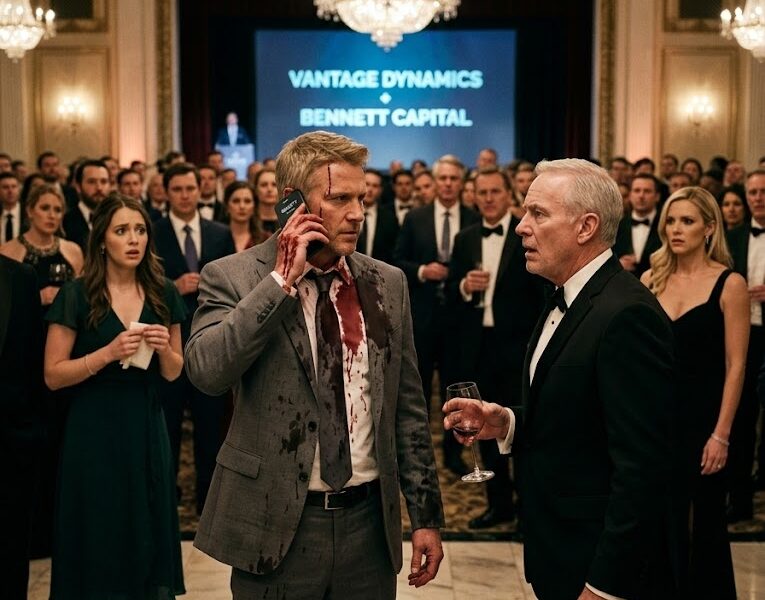
Across the ballroom, a violinist was still holding her bow above the strings. A waiter had stopped midstep with a silver tray balanced against one trembling palm. Two hundred executives, investors, spouses, attorneys, and journalists stood beneath the chandeliers of the Aster Grand, staring at the man whose gray suit was soaked in red wine.
The wine ran from Kai’s collar down the front of his white shirt.
A drop hung from his chin before falling onto the polished marble.
Dalton Wade, CEO of Vantage Dynamics, was still holding the empty crystal glass.
His daughter Jordan stood beside him with a smile that had not yet realized it was supposed to disappear.
Kai pressed the phone closer to his ear.
“Every agreement tied to Vantage Dynamics,” he said. “Freeze it immediately.”
A pause.
Then a voice answered through the phone.
“Immediately, Mr. Bennett.”
Kai’s eyes never left Dalton.
“And tomorrow’s signing?”
“We’ll suspend it.”
“No.”
His voice remained calm.
“There isn’t going to be a signing.”
He ended the call.
For half a second, nobody moved.
Then Dalton laughed.
It was the wrong laugh.
Too loud. Too forced. The laugh of a man who had built his entire life on knowing who mattered and who didn’t—and who still believed the wine-soaked stranger standing in front of him belonged firmly in the second category.
“You expect me to believe that little performance?” Dalton asked.
Kai slipped the phone into his jacket.
“No.”
He took a clean napkin from Payton Reed, the event director standing beside him.
“I expect you to remember it.”
Then he turned toward the elevators.
Dalton did not know it yet.
Jordan did not know it yet.
The reporters raising their phones did not know it yet.
But four hundred miles away, inside a conference room filled with attorneys, three people had just stood up so quickly their chairs scraped backward across the floor.
A digital signature portal was being shut down.
A banking authorization was being recalled.
And the largest investment in Vantage Dynamics’ history had just begun disappearing.
All because Dalton Wade had poured a glass of wine over a man he believed was nobody.
Six hours earlier, Kai Bennett had entered the Aster Grand without a driver.
That alone would have shocked the people who actually knew him.
There were not many.
At forty-two, Kai controlled Bennett Capital Group, a private investment company with interests spread across manufacturing, logistics, energy infrastructure, medical technology, and industrial software. Financial journalists occasionally wrote about him as though he were some mysterious creature living behind smoked glass.
There were photographs of his father.
Photographs of board members.
Photographs of Bennett Capital’s headquarters.
But very few clear photographs of Kai himself.
He preferred it that way.
His name could move hundreds of millions of dollars before lunch.
His face could still stand in line at a coffee shop without anyone looking twice.
Kai considered that one of the last luxuries money had not ruined.
Tonight, it was useful.
Vantage Dynamics had spent eleven months negotiating with Bennett Capital.
The proposed investment was two billion dollars.
Not a loan.
Not a bailout.
A strategic partnership that would give Vantage the capital to acquire two competitors, expand three manufacturing facilities, and move into a market Dalton Wade had been chasing for nearly a decade.
The paperwork was almost finished.
The attorneys had approved the structure.
The board had approved the structure.
Dalton had already begun speaking about the deal as though the money belonged to him.
Only one approval remained.
Kai’s.
He could have signed from his office.
Everyone expected him to.
Instead, he put on a plain gray suit, left his watch at home, and went to the celebration unnoticed.
Because Kai had learned something his analysts could never put into a spreadsheet.
Numbers told him whether a company knew how to make money.
People told him whether it deserved more.
He had been inside the Aster Grand less than four minutes when the first test arrived.
A young waiter came around a marble column carrying two overloaded trays of champagne.
Someone backed into him.
The waiter stumbled.
One tray tilted dangerously.
Kai reached out and caught the edge.
“Got it.”
The waiter stared at him.
“Sir—thank you.”
“Take the other side.”
Together they steadied it.
The waiter exhaled.
“I thought I was dead.”
“Over champagne?”
“My manager would make it feel that way.”
Kai glanced toward the ballroom.
“Then your manager needs a different job.”
The waiter laughed nervously.
“You’re not from hospitality.”
“No.”
“I could tell.”
“Was it the suit?”
“It was the fact that you didn’t blame me.”
Before Kai could answer, a broad-shouldered guest in a tuxedo pushed between them.
“Move.”
The waiter immediately stepped aside.
“Sorry, sir.”
The man did not even look at him.
Kai did.
Not at the guest.
At the waiter.
“You weren’t in his way.”
The waiter gave a small shrug that said this was not a battle worth fighting.
Kai knew that shrug.
He had seen it thousands of times.
People learned quickly which humiliations their paycheck required them to swallow.
He moved deeper into the ballroom.
The Aster Grand had been designed for people who wanted to feel richer than they already were. Thirty-foot windows framed the city skyline. White orchids rose from black glass centerpieces. Crystal chandeliers threw warm light across marble floors polished until they reflected shoes.
A jazz quartet played near the terrace.
Photographers clustered near the entrance.
A wall-sized display carried the Vantage Dynamics logo above the words:
BUILDING TOMORROW.
Kai almost smiled.
Companies loved slogans.
They were usually the easiest promises to break.
Near the registration table, a young woman dropped a stack of seating cards.
Hundreds scattered across the floor.
“Oh, no.”
She dropped to her knees.
Guests walked around her.
One expensive shoe landed on a card.
The man wearing it kept walking.
Kai crouched.
The woman looked up.
“You don’t have to—”
“Alphabetical?”
“Yes.”
“Then start with A through H. I’ll take the rest.”
She stared at him.
“You’re serious?”
“Unfortunately.”
For the next minute, the invisible billionaire and the visibly terrified event assistant crawled across the marble collecting place cards.
When they finished, she held the stack against her chest.
“You just saved my life.”
“That dramatic?”
“You haven’t met my manager.”
“Apparently everyone here is afraid of their manager.”
Her smile faded.
“Pretty much.”
That stayed with him.
He walked another twenty feet.
A bartender dropped two champagne flutes.
They shattered.
The sound was sharp enough to turn heads.
Nobody helped.
The bartender immediately knelt and started picking up glass with his bare fingers.
Kai grabbed a cloth napkin.
“Use this.”
“I’ve got it.”
“You’re going to cut yourself.”
“I need to clean it before—”
“Before someone important notices?”
The bartender looked up.
Kai handed him the cloth.
“Wrap the larger pieces first.”
The bartender hesitated.
Then took it.
“You work events?”
“No.”
“You sure?”
Kai smiled.
“Very.”
A voice behind him said, “There you are.”
Kai turned.
A woman in a dark green dress was walking toward him quickly.
She was perhaps thirty-five, with chestnut hair pinned loosely at the back and an event headset tucked discreetly beneath it.
She reached him.
Stopped.
Blinking.
“Oh.”
Kai waited.
She looked embarrassed.
“You’re not Daniel.”
“I was worried for a second.”
She laughed.
“Sorry. From behind you look exactly like one of my vendors.”
“Hopefully he’s handsome.”
“Unfortunately, yes.”
She extended her hand.
“Payton Reed. I’m running tonight.”
“Kai.”
“No last name?”
“Do I need one?”
“For the seating chart, yes. For conversation, probably not.”
He shook her hand.
Her grip was warm and confident.
Then her gaze dropped toward the bartender.
“You were helping?”
“He broke a couple glasses.”
“And you decided to get on the floor?”
“He was already there.”
Payton studied him.
Most people studied Kai because they wanted something.
She seemed to be studying him because she genuinely could not figure him out.
“That’s unusual.”
“What is?”
“People helping when there’s nothing in it for them.”
Kai looked toward the ballroom.
“That should probably bother us more than it does.”
Something changed in her expression.
Not attraction.
Not yet.
Recognition, maybe.
Like she had found someone else who had noticed the same ugly little things she spent her working life pretending not to notice.
“So why are you here?” she asked.
“I was invited.”
“That wasn’t what I meant.”
“What did you mean?”
Payton folded her arms.
“Most men who walk into a room like this alone spend their first ten minutes hunting for whoever has the biggest title.”
“I found a bartender.”
“And a waiter.”
“And some seating cards.”
“I saw.”
Kai smiled.
“You’ve been watching me?”
“I run the event. I watch everybody.”
“Sounds exhausting.”
“It is.”
“Then why do it?”
Her eyes moved across the room.
“Because someone has to make everything look effortless.”
There was something underneath the answer.
Kai noticed it.
He noticed almost everything.
Before he could ask, the ballroom doors opened.
Cameras erupted.
Applause followed.
Dalton Wade entered like a man arriving at his own coronation.
At sixty-one, Dalton was tall, silver-haired, perfectly tailored, and skilled at projecting warmth toward anyone who could increase his net worth.
His daughter Jordan walked beside him.
Thirty-three.
Executive vice president.
Harvard MBA.
Sharp cheekbones, sharper instincts, and a reputation inside Vantage for firing people before learning their names.
Kai had read every report.
He had also read the employee complaints.
The turnover data.
The confidential exit interviews.
The discrimination settlements that never reached court.
That was one reason he had come.
Jordan scanned the ballroom.
Her eyes passed over investors.
Board members.
Politicians.
Then landed on Kai.
She frowned.
She leaned toward an assistant.
“Who is that?”
The assistant followed her gaze.
“I’m not sure.”
“He’s standing in the VIP area.”
“I can check.”
“He looks like staff.”
Kai heard it.
Payton heard it too.
Her face tightened.
Dalton barely glanced over.
“Leave it. Security can clear the room before the announcement.”
Then father and daughter continued toward the cameras.
Payton turned to Kai.
“I’m sorry.”
“For what?”
“That.”
Kai looked after them.
“They weren’t talking about me.”
“They absolutely were.”
“No.”
He picked up a glass of sparkling water.
“They were talking about what they think I am.”
Payton stared.
“And that doesn’t bother you?”
“It tells me more about them than it tells anyone about me.”
She was quiet.
Then she said, “You’re either the most secure man I’ve ever met or completely insane.”
“I’ve been called worse.”
“Which one is it?”
“I’m still deciding.”
She laughed.
And across the ballroom, Jordan Wade noticed.
Her expression hardened.
The night moved forward.
Kai watched.
He watched Dalton shake hands with a state senator and ignore the janitor who moved a trash bin out of his way.
He watched Jordan snap her fingers at a server.
He watched a vice president blame an assistant for forgetting a folder the vice president himself had left upstairs.
He watched a senior manager joke that interns were “cheap furniture with college debt.”
People laughed.
Kai remembered the names.
He did not need to write them down.
Then he watched Payton.
She thanked every server.
She quietly moved an exhausted employee onto a break when his supervisor objected.
She found a chair for a pregnant photographer.
She personally carried a box of replacement glassware because two banquet workers were already overloaded.
Nobody applauded her.
Nobody photographed it.
That mattered.
Kai found her later near the windows.
“You’re still working,” he said.
“I’m always working.”
“That sounds unhealthy.”
“Event management is organized panic in expensive shoes.”
Kai looked down.
“Those do look expensive.”
“They’re destroying my feet.”
“Then why wear them?”
“Because apparently women become incompetent if our heels are under three inches.”
He laughed.
Payton leaned against the window ledge.
“You’ve avoided every networking circle here.”
“I noticed.”
“That was me noticing you.”
“Again?”
“Don’t get excited.”
“Too late.”
She smiled.
Then her expression softened.
“What do you actually do, Kai?”
He looked out over the city.
“I invest.”
“In what?”
“People.”
“That is suspiciously vague.”
“It’s still true.”
“Are you a recruiter?”
“No.”
“Private equity?”
He glanced at her.
She caught it.
“Oh.”
“What?”
“That face.”
“What face?”
“The one people make when I get too close to the answer.”
Kai smiled.
“You’re dangerous.”
“I organize rich people for a living. I have to be.”
Across the room, Jordan Wade was watching.
Again.
This time she started walking toward them.
Payton saw her first.
Her smile vanished.
“Here we go.”
Jordan stopped beside them.
“Excuse me.”
Kai turned.
Jordan did not offer her hand.
“Staff mingling areas are through those doors.”
Payton stepped forward.
“He’s not—”
Jordan raised one finger without looking at her.
“I wasn’t speaking to you.”
Payton froze.
Something cold moved behind Kai’s eyes.
Not anger.
Something more controlled.
“I appreciate the directions,” he said.
“Then use them.”
“I’m comfortable here.”
Jordan looked him up and down.
“This section is reserved for invited guests.”
“I am an invited guest.”
She laughed.
One short sound.
“Of course you are.”
“He does have an invitation,” Payton said.
Jordan finally looked at her.
“So does the catering company.”
Then she walked away.
Payton’s face went red.
“I cannot believe she said that.”
“I can.”
“That’s twice tonight.”
Kai took a sip of water.
Payton stared at him.
“You’re really not angry?”
“I didn’t come here to be liked.”
“Then why did you come?”
He looked toward Dalton.
“To decide whether I trust somebody.”
Payton followed his gaze.
“What exactly are you investing in?”
Kai almost told her.
Almost.
Instead he said, “You’ll know soon.”
The ballroom lights dimmed.
Music faded.
A spotlight illuminated the stage.
Dalton Wade walked to the microphone.
“Ladies and gentlemen.”
Applause rolled through the room.
“Tonight is not simply a celebration of Vantage Dynamics. Tonight marks the beginning of our next era.”
More applause.
Jordan joined him onstage.
A giant screen behind them displayed VANTAGE + BENNETT CAPITAL.
Kai watched silently.
Dalton spread his arms.
“In the coming minutes, we expect to finalize a two-billion-dollar partnership that will position Vantage as one of the most important industrial technology companies in America.”
The room erupted.
Champagne glasses lifted.
Cameras flashed.
Kai did not clap.
Payton looked at the screen.
Then at him.
Bennett.
She turned slowly.
“Kai…”
Before she could finish, Dalton continued.
“And none of this happens without leadership. Without standards. Without knowing exactly what kind of people belong at the table.”
His eyes shifted.
Toward Kai.
Jordan saw it.
Smiled.
Kai’s expression did not change.
Dalton stepped down from the stage.
He accepted a glass of red wine from a server.
Then he began walking across the ballroom.
Straight toward Kai.
Payton whispered, “Oh, no.”
People noticed.
Conversations faded.
Dalton stopped two feet away.
“You.”
Kai nodded.
“Good evening.”
“I thought someone told you to leave this area.”
“I was invited.”
Dalton smiled at the surrounding executives.
“Why do people insist on embarrassing themselves?”
A few people chuckled.
Jordan joined them.
“Maybe we can find him a cafeteria position after the expansion.”
More laughter.
Payton stepped between them.
“Mr. Wade, please. He really does have a valid invitation.”
“Payton.”
Dalton’s voice changed.
“Return to your duties.”
“He hasn’t done anything.”
“I said return to your duties.”
Kai touched her elbow lightly.
“It’s okay.”
“No,” she whispered. “It isn’t.”
Dalton swirled his wine.
“You know what’s wrong with people like you?”
Kai met his eyes.
“I don’t know people like me.”
A few laughs.
Dalton’s smile thinned.
“You think getting through a door means you belong on the other side.”
“No.”
Kai’s voice remained soft.
“I think respect shouldn’t depend on which side of the door somebody is standing.”
Dalton laughed.
“Listen to the philosopher.”
Jordan crossed her arms.
“You should leave before security does it for you.”
Kai looked at Dalton.
“Is that what you want?”
Something about the question made Payton look sharply at him.
Dalton missed it.
“Yes.”
“You’re certain?”
“Completely.”
Kai nodded once.
That should have been the end.
But humiliation is addictive to people who mistake cruelty for power.
Dalton lifted the wineglass.
Payton saw the movement.
“Mr. Wade—”
Too late.
Dalton tipped the glass.
Red wine poured over Kai’s face.
His collar.
His white shirt.
His gray jacket.
A splash struck the marble.
The room gasped.
Somebody whispered, “Jesus.”
Payton grabbed napkins.
“Oh my God.”
Kai did not move.
For several seconds, he simply stood there.
Wine dripped from his chin.
Dalton waited.
He wanted rage.
He wanted shouting.
He wanted the satisfaction of watching the smaller man lose control.
Kai accepted one napkin.
“Thank you, Payton.”
He wiped his cheek.
Then his jaw.
Then the front of his shirt.
Slowly.
Methodically.
When he finished, he folded the stained napkin into a neat square.
Then he looked Dalton directly in the eyes.
“I hope that made you feel important.”
Dalton’s smile flickered.
Kai took out his phone.
Dialed.
Someone answered before the second ring.
“This is Kai.”
A voice responded.
“Good evening, Mr. Bennett.”
Dalton’s smile disappeared.
Kai continued.
“Freeze everything tied to Vantage Dynamics.”
Payton stopped breathing.
Jordan’s arms dropped.
“Immediately, sir?”
“Immediately.”
“And tomorrow’s signing?”
“There isn’t one.”
Kai ended the call.
Nobody laughed now.
Dalton stared at him.
The name had registered.
But not fully.
Not yet.
“Bennett?” Jordan whispered.
Kai put away his phone.
Then turned to Payton.
“Thank you.”
“For what?”
“For being kind when you thought it couldn’t benefit you.”
Her eyes widened.
“Kai…”
He started walking.
Payton followed him to the elevators.
“You didn’t deserve that.”
“I know.”
“I’m sorry.”
“You’ve apologized enough for other people tonight.”
The elevator arrived.
The doors opened.
Payton looked at his ruined suit.
Then his face.
“Who are you?”
Kai stepped backward into the elevator.
For the first time all night, something almost sad appeared in his eyes.
“Someone who really hoped tonight would go differently.”
The doors began closing.
“Will I see you again?” Payton asked.
Kai looked at her through the narrowing gap.
“I hope so.”
Then he disappeared.
Five minutes later, Dalton Wade learned exactly what he had done.
He returned to the stage.
His microphone stopped working halfway through his first sentence.
He tapped it.
“Hello?”
Nothing.
He turned toward the technicians.
One of them wasn’t looking at him.
He was staring at his phone.
Then Vantage’s chief financial officer rushed across the ballroom.
His face had gone gray.
“Dalton.”
“What?”
“The signing portal is offline.”
“Restart it.”
“We did.”
“Then call Bennett’s legal team.”
“We did.”
“And?”
“They terminated the session.”
Dalton stared.
Another executive arrived.
“Our banking contacts aren’t responding.”
A third followed.
“The Bennett attorneys left.”
“What do you mean left?”
“They left the building.”
Jordan hurried over.
“Dad.”
“Not now.”
“Dad.”
She held up her phone.
Vantage’s share price was falling.
Fast.
The first news alert appeared.
BENNETT CAPITAL SUSPENDS $2 BILLION VANTAGE TRANSACTION.
Dalton read it twice.
Then a second alert appeared.
VANTAGE BOARD CALLS EMERGENCY SESSION.
Then another.
CREDIT REVIEW TRIGGERED FOLLOWING INVESTMENT WITHDRAWAL.
The room began collapsing around him.
Phones rang.
Guests moved toward exits.
Investors whispered.
Reporters started recording.
Jordan grabbed his arm.
“Who was that man?”
Dalton looked toward the elevator doors.
“I don’t know.”
A voice behind them answered.
“Yes, you do.”
The chairman of Vantage’s board stood there.
He looked twenty years older than he had an hour earlier.
Dalton turned.
“What?”
The chairman’s gaze moved to the wine stain still visible on the marble.
“I warned you.”
“About what?”
“Character.”
Dalton’s face twisted.
“What does character have to do with two billion dollars?”
“Tonight?”
The chairman gave a hollow laugh.
“Everything.”
Jordan stepped forward.
“Who was he?”
The chairman looked at her.
“You never asked who owns Bennett Capital.”
“Some holding company.”
“No.”
“Then the board.”
“No.”
Dalton’s voice became impatient.
“Stop talking in riddles.”
The chairman leaned closer.
“The man you just humiliated owns fifty-eight percent of Bennett Capital Group.”
Jordan went completely still.
“No.”
“He founded it.”
Dalton’s lips parted.
“He personally approves every major transaction.”
The ballroom seemed to recede around them.
“No.”
“He came here tonight because he wanted to see Vantage before he put two billion dollars into it.”
Jordan’s eyes filled with panic.
“No.”
The chairman looked at the elevator.
“Yes.”
Payton stood twenty feet away.
Her mind replayed every conversation.
I invest in people.
I came here to decide whether I trust somebody.
You’ll know soon.
Her stomach dropped.
Dalton grabbed the chairman’s arm.
“Call him.”
“I already did.”
“And?”
“He didn’t answer.”
“Call again.”
“I did.”
“Again.”
The chairman pulled his arm away.
“You still don’t understand.”
Dalton stared at him.
“This isn’t a negotiation anymore.”
By midnight, footage from the gala was everywhere.
Nobody had captured the entire confrontation cleanly.
They didn’t need to.
There were twelve angles of Dalton approaching Kai.
Six of Jordan laughing.
Three showing the wine hitting Kai’s shirt.
And dozens of witnesses willing to describe what had been said.
But the most damaging thing was not the video.
It was what happened next.
Former Vantage employees began talking.
One posted:
I worked there six years. What happened tonight wasn’t unusual. It was just the first time they treated the wrong person that way.
Another described managers humiliating warehouse employees during meetings.
Another posted screenshots of an executive referring to support staff as “replaceable bodies.”
A former assistant described Jordan throwing a folder at her because a restaurant reservation had been moved fifteen minutes.
A maintenance supervisor described Dalton walking past an employee having a medical emergency because investors were waiting upstairs.
One story became ten.
Ten became hundreds.
By sunrise, the gala was no longer a story about a billionaire getting wine thrown on him.
It was a story about a culture.
That distinction mattered.
At 6:40 a.m., Dalton was sitting alone in his penthouse kitchen.
He had not changed out of his tuxedo.
His bow tie lay on the counter.
His phone had not stopped vibrating.
He poured coffee.
His hand shook badly enough to spill it.
Jordan entered.
She looked as though she had aged overnight.
“Dad.”
He didn’t answer.
“We need to talk.”
“Not now.”
“The board scheduled a meeting at nine.”
“I know.”
“They’re asking whether you’ll resign.”
He looked at her.
“Are you?”
She recoiled.
“I’m trying to tell you what’s happening.”
“You think I don’t know?”
“You poured wine on him.”
His jaw tightened.
“You laughed.”
Jordan looked away.
Neither spoke.
The silence between them contained the one thing neither wanted to admit.
Kai Bennett had not created their disaster.
He had merely stopped protecting them from it.
At nine, the board meeting became a war.
At ten, two directors demanded Dalton’s resignation.
At eleven, a major client suspended a contract.
At noon, Vantage shares had lost nearly forty percent of their value.
By one, Dalton’s lawyers were trying to reach Bennett Capital.
At two, Kai finally answered.
Not Dalton.
The board chairman.
Kai agreed to one meeting.
Saturday.
Ten a.m.
Bennett Capital headquarters.
No press.
No lawyers speaking for Dalton.
No excuses.
Saturday morning, Dalton and Jordan entered a glass boardroom forty-eight floors above the city.
Every Vantage board member was already seated.
Then Kai entered.
No gray suit.
No wine.
No mystery.
He wore a charcoal jacket over a white shirt without a tie.
Everybody stood.
Kai paused.
“Please sit.”
They did.
Dalton remained standing.
“I owe you an apology.”
Kai took his seat.
“For which part?”
Dalton swallowed.
“The misunderstanding.”
Kai’s expression hardened.
“It wasn’t a misunderstanding.”
“I judged the situation incorrectly.”
“No.”
Dalton blinked.
“You understood the situation exactly as you believed it to be.”
Nobody moved.
Kai leaned back.
“You believed I was a man without status.”
Dalton said nothing.
“You believed my clothes told you what I was worth.”
Still nothing.
“You believed humiliating someone beneath you would entertain the people around you.”
Dalton lowered his eyes.
“I made a horrible mistake.”
“You made several.”
Jordan spoke.
“We judged you before we knew who you were.”
Kai turned toward her.
“No.”
Her face tightened.
“You judged me because you thought I was nobody.”
The words landed harder than shouting could have.
Kai continued.
“If I actually had been a waiter, would what you did have been acceptable?”
Jordan opened her mouth.
Nothing came out.
“If I had been maintenance staff?”
Silence.
“A driver?”
Nothing.
“A catering employee?”
Her eyes filled.
Kai looked at Dalton.
“If my name had been Thomas instead of Bennett, would you be sitting here apologizing?”
Dalton whispered, “No.”
It was the first honest thing he had said.
Kai nodded.
“That’s the problem.”
He stood and walked toward the windows.
For several seconds he looked down at the city.
“My grandfather cleaned office buildings.”
Nobody expected that.
Kai kept his back to them.
“Thirty years.”
His voice changed slightly.
“He worked nights because it paid more. Sometimes, when my mother had nobody to watch me, I went with him.”
He turned.
“I remember sitting in empty executive offices while he emptied trash cans.”
Nobody interrupted.
“I remember desks bigger than our kitchen.”
His eyes moved toward Dalton.
“I remember framed photographs of men smiling beside senators and governors.”
Then toward Jordan.
“I remember people coming back late and walking past my grandfather without saying hello.”
His jaw tightened.
“One night, a man threw papers on the floor in front of him because he said the trash can smelled.”
Jordan closed her eyes.
“I asked my grandfather why he didn’t yell at him.”
Kai smiled faintly.
“He told me, ‘Because that man already has to live with being that man.’”
The boardroom was completely silent.
“Then he told me something else.”
Kai placed both hands on the table.
“He said the richest person in any room is the one who never needs to make someone else feel small.”
Dalton looked down.
Jordan wiped her cheek.
“We’ll change,” she whispered.
Kai watched her.
“I hope you do.”
“Then give us another chance.”
“That’s not mine to give.”
Jordan looked confused.
“You’re the one withdrawing the money.”
“I am.”
“Then you can save Vantage.”
Kai shook his head.
“Money can keep a company alive.”
He looked around the table.
“It cannot make it worth saving.”
Dalton finally lifted his head.
“Please.”
There was no authority left in his voice.
Hundreds of employees depend on us.”
Kai’s expression softened.
“That’s why I’m not trying to destroy Vantage.”
Dalton stared.
“Then reconsider.”
“No.”
“But you just said—”
“I’m not destroying your company.”
Kai moved toward the door.
“You already did that yourselves.”
He stopped.
“The board can replace leadership. The employees can rebuild the culture. Clients can decide whether to return.”
His gaze settled on Dalton.
“But Bennett Capital will not reward what I saw.”
Then Jordan asked the question that stopped him.
“Was there anything we could have done after the wine?”
Kai turned.
“Yes.”
Hope flashed across her face.
“What?”
“You could have apologized to the waiter before you apologized to me.”
Jordan froze.
Kai left.
Three weeks later, Dalton Wade resigned as CEO.
The announcement called it a “leadership transition.”
Nobody believed that language.
Jordan resigned from every executive position.
For several months, she disappeared from public view.
People expected her to return somewhere else with a new title.
Instead, she did something almost nobody expected.
She began volunteering with a nonprofit that trained entry-level workers for management positions.
At first, people called it image rehabilitation.
Maybe part of it was.
People rarely change for pure reasons.
But six months later she was still there.
A year later, she was still there.
Dalton’s change was slower.
Harder.
For the first time in forty years, he was no longer the most important man in every room.
Some days he hated it.
Some days, perhaps, he needed it.
Vantage survived.
Barely.
The board appointed a new CEO, Elena Torres, who had started her career on a manufacturing floor in Ohio.
Her first week, she did something Dalton had never done.
She spent five days meeting hourly employees without executives present.
No cameras.
No speeches.
She listened.
Then she published the complaints internally.
All of them.
Several senior managers resigned.
Others were fired.
Policies changed.
Titles changed.
But the hardest thing to change was the instinct people had learned under Dalton—that power meant being allowed to look downward.
That took longer.
Kai watched from a distance.
Bennett Capital never restored the deal.
Instead, it invested in a smaller manufacturing company in Wisconsin whose employee turnover was unusually low.
When Kai’s analysts asked why, he gave them the answer he had always given.
“Look at how the supervisors speak to the night shift.”
That told him enough.
And Payton?
Payton returned to work at the Aster Grand.
For weeks, people asked her about Kai.
Reporters called.
Podcasts offered money.
A television producer asked her to recreate the wine incident.
She refused all of it.
She had no interest in turning the worst night of someone else’s life into entertainment.
But the night changed her.
She began noticing everything.
Who thanked the valet.
Who ignored the dishwasher.
Who learned a server’s name.
Who looked at employees only when something went wrong.
Once you saw the invisible hierarchy inside beautiful rooms, it became impossible to unsee.
One Friday afternoon, her phone rang.
Unknown number.
“Hello?”
“Payton?”
She knew the voice immediately.
Her heart stumbled.
“Kai.”
“I hope I’m not interrupting.”
“You disappeared.”
“I’ve been told I do that.”
“You’re terrible at goodbyes.”
“I’m working on it.”
She smiled despite herself.
“What do you want?”
“A favor.”
“That sounds dangerous coming from a billionaire.”
There was silence.
Then Kai laughed.
It was the first time she had heard him laugh without something heavy underneath it.
“Bennett Capital is creating a leadership development program.”
“Okay.”
“For people who’ve been overlooked.”
Her smile faded.
“Assistants. Shift supervisors. hospitality workers. Warehouse employees. People who already lead but never got the title.”
“That sounds good.”
“I want you to run it.”
Payton nearly dropped the phone.
“What?”
“I watched you that night.”
“Kai—”
“You defended an employee when doing it could have hurt your job.”
“I was just doing what was right.”
“Exactly.”
“I don’t have an MBA.”
“Good.”
She laughed nervously.
“I’m serious.”
“So am I.”
“Why me?”
Kai became quiet.
“Because leadership is easiest to fake when everyone is watching.”
She remembered him kneeling beside broken champagne glasses.
“And?”
“You were leading when nobody important was supposed to notice.”
Payton sat down.
Her eyes stung.
“What would I actually be doing?”
“Finding people nobody looks at twice.”
“And then?”
“Giving them the chance somebody should have given them years ago.”
Payton looked across the hotel lobby.
A young bellman was helping an elderly woman lift a suitcase.
Nobody noticed.
She smiled.
“Yes.”
Kai paused.
“Yes?”
“Yes.”
“I was hoping you’d say that.”
Six months later, the first class graduated.
Payton insisted on one location.
The Aster Grand.
Kai resisted.
She convinced him.
“If the place means something,” she told him, “then change what it means.”
So they returned.
The chandeliers were the same.
The marble was the same.
The skyline was the same.
But the room was different.
There were no velvet ropes.
No VIP section.
Security guards sat beside executives.
Assistants sat beside managing directors.
The hotel’s servers were paid to attend the dinner after service rather than being sent home through a back corridor.
Kai had insisted on that.
Payton had made him add dessert.
He complained about the budget.
She reminded him he was a billionaire.
He lost that argument.
After her graduation speech, Payton stepped down from the stage.
Kai waited near the doors.
This time his suit was dark blue.
She approached him.
“You changed this place.”
“We changed it.”
“You always do that.”
“Do what?”
“Refuse credit.”
“I accept credit for dessert.”
“That was my idea.”
“I funded it.”
She laughed.
Kai looked around the ballroom.
At one table, a former warehouse supervisor was talking with a company president.
At another, a hotel housekeeper who had completed the program was showing her daughter the certificate she had received.
Nobody looked invisible.
Not tonight.
Payton’s expression softened.
“It’s strange.”
“What?”
“The best thing that ever happened to my career started with the worst night of yours.”
Kai glanced down at his suit.
“I lost a very good jacket.”
“That’s what you remember?”
“It was tailored.”
She shook her head.
“You’re impossible.”
“You called me.”
“You called me.”
“Technicality.”
She slipped her hand into his.
Kai looked down at their hands.
Then at her.
Neither made a joke.
Music drifted through the ballroom.
Together they stepped onto the terrace.
The city stretched beneath them in thousands of lights.
For a while, they simply stood there.
Then Payton asked, “Do you ever think about Dalton?”
“Sometimes.”
“Jordan?”
“Yes.”
“Do you think people really change?”
Kai considered it.
“I think people can.”
“That’s not an answer.”
“It’s the only honest one.”
She rested her elbows on the railing.
“Do you regret pulling the deal?”
“No.”
“Not even after what happened to the employees?”
“I regret that innocent people paid for leadership failures.”
He looked toward her.
“But if we keep rewarding bad leadership because stopping it might hurt, eventually everybody gets hurt anyway.”
Payton nodded.
Then she smiled.
“You know, when I first saw you, I thought you were a vendor.”
“I remember.”
“And Jordan thought you were staff.”
“I remember that too.”
“Dalton thought you were nobody.”
Kai looked out at the city.
“That’s the part people always get wrong.”
“What?”
“There are no nobodies.”
Payton became quiet.
Behind them, the ballroom doors opened.
The young waiter Kai had helped that first night stepped onto the terrace carrying two glasses of sparkling water.
He recognized Kai.
Kai recognized him.
For a moment, both men simply stared.
Then the waiter smiled.
“Careful with this one, sir.”
Kai took the glass.
“No overloaded trays tonight?”
“I got promoted.”
“Did you?”
“Banquet captain.”
Kai smiled.
“Congratulations.”
“Thanks.”
The young man started back toward the ballroom.
Then stopped.
“Mr. Bennett?”
Kai turned.
The waiter hesitated.
“That night… when you helped me?”
“Yes?”
“I knew you weren’t staff.”
Kai raised an eyebrow.
The waiter smiled.
“But I definitely didn’t think you had two billion dollars.”
Payton burst out laughing.
Even Kai laughed.
The waiter disappeared inside.
Payton looked at him.
“What happens now?”
Kai watched the ballroom through the glass.
He saw executives.
Servers.
Managers.
Assistants.
People who had money.
People who did not.
People who would someday have power.
People who already had more of it than they realized.
Then he looked back toward the city.
“Now?”
He squeezed her hand.
“Now we keep building places where nobody has to become rich before people decide they deserve respect.”
Payton rested her head lightly against his shoulder.
The sun was disappearing behind the skyline.
And for a man whose name could move markets, Kai Bennett had finally learned that the most important investments rarely appeared on a balance sheet.
Sometimes they began with a stranger dropping seating cards.
Sometimes with broken glass.
Sometimes with a woman in a green dress choosing to speak when silence would have been safer.
And sometimes they began with a glass of red wine thrown across a room by a powerful man who believed he was humiliating someone beneath him.
Dalton Wade had been wrong about many things that night.
But his greatest mistake was not failing to recognize a billionaire.
It was believing recognition should have mattered at all.
Because the way a person treats someone they believe has nothing to offer them is never really a judgment of that stranger.
It is a confession.
A mirror held up in public.
And sooner or later, every mirror tells the truth.









