He Refused to Look at the Woman He Was Forced to Marry—Until He Discovered Why She Had Really Chosen Him
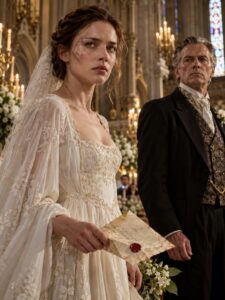
The first thing Adrien Blackwood heard on his wedding day was someone whispering that his bride had finally arrived.
The second was three hundred people gasping.
He still refused to turn around.
Snow had been falling over London since dawn, softening the streets around St. Margaret’s until the city seemed quieter than it had any right to be. Inside the church, candlelight trembled against old stone, stained glass threw bruised colors across the floor, and every important family in London appeared to have sent someone to witness the humiliation of the Duke of Ravenhurst.
Adrien stood before the altar with his hands locked behind his back.
Thirty years old.
Seven years a duke.
Eight years paying for a dead father’s sins.
And less than an hour away from becoming the husband of a woman whose face he had deliberately never seen.
Behind him, whispers moved through the pews.
“The doors are opening.”
“Good Lord.”
“Is that really her?”
Adrien stared harder at the stained-glass figure of St. Michael above the altar.
The saint held a flaming sword.
For one bitter second, Adrien wondered whether heaven might consider lending it to him.
Beside him, his oldest friend, Christopher Hail, suddenly went rigid.
That frightened Adrien more than the whispers.
Christopher was almost impossible to surprise.
Adrien spoke without turning.
“What?”
Christopher did not answer.
“Christopher.”
Still nothing.
Then the organ began.
Three hundred guests rose.
Adrien heard footsteps coming toward him.
One pair.
No father escorting the bride.
No bridesmaids.
No procession designed to announce wealth.
Just the slow, steady sound of a woman walking alone toward the man who had agreed to marry her without first looking at her face.
And then Adrien smelled orange blossom.
For reasons he hated, he thought of Catherine.
He had loved Catherine Doyle when he was twenty-two and still foolish enough to believe love was something powerful families could not purchase, threaten, relocate, or destroy.
She had been the daughter of a country vicar.
She read Wordsworth.
She got ink on her fingers.
She laughed too loudly.
His father despised her.
Adrien had come home from Oxford one summer convinced he would marry Catherine and spend the rest of his life proving that a Blackwood could choose happiness over duty.
His father had listened.
Then he had paid Catherine to disappear.
At least that was the story Adrien had been given.
By the time Adrien discovered what had happened, she was gone.
No forwarding address.
No letter.
No explanation.
Six months later, the old Duke of Ravenhurst died and left his son a title, a collapsing fortune, mountains of debt, and a permanent distrust of anything that called itself love.
Adrien spent the next eight years cleaning up the wreckage.
He sold two estates.
Dismissed half the household staff.
Closed rooms in Ravenhurst House because heating them cost too much.
He stopped traveling.
Stopped gambling.
Stopped buying anything unnecessary.
Some winters, the bedroom he used was so cold he could see his own breath when he woke.
He almost succeeded.
Then, the previous November, just as the Blackwood finances were finally beginning to stabilize, something impossible happened.
Every major creditor appeared at once.
Old debts.
Forgotten notes.
Private loans his father had signed decades earlier.
All called in during the same week.
Pay immediately.
Or lose everything.
Ravenhurst House.
The remaining land.
The family collection.
Possibly even the name.
No one could explain why debts scattered across England had suddenly converged like wolves around an injured animal.
Then Theodore Callaway came to visit.
Callaway was not nobility.
He was something increasingly more powerful.
Rich.
Shipping, wine, insurance, warehouses, overseas property—he seemed to own a piece of anything that crossed water.
He had money enough to save Ravenhurst.
And a daughter.
The proposal had been delivered with brutal simplicity.
Callaway would clear every Blackwood debt on the morning of the wedding.
In return, Isabelle Callaway would become the Duchess of Ravenhurst.
Adrien had hated the arrangement instantly.
But hatred did not pay creditors.
So he agreed.
With one condition.
He would not see Isabelle before the wedding.
Not in person.
Not in a portrait.
Not across a ballroom.
Not even in a miniature.
If he was being sold, he had told Callaway, then everyone involved could at least have the decency not to call it courtship.
It was petty.
Childish, perhaps.
But pride was the only thing Adrien believed he still owned.
Now that pride stood frozen at an altar while his unknown bride approached behind him.
The footsteps stopped.
The bishop cleared his throat.
Adrien finally turned.
And for the first time that morning, the whispers disappeared.
Isabelle Callaway was nothing like the woman he had imagined.
He had expected jewels.
Ribbons.
Diamonds purchased to compensate for a missing pedigree.
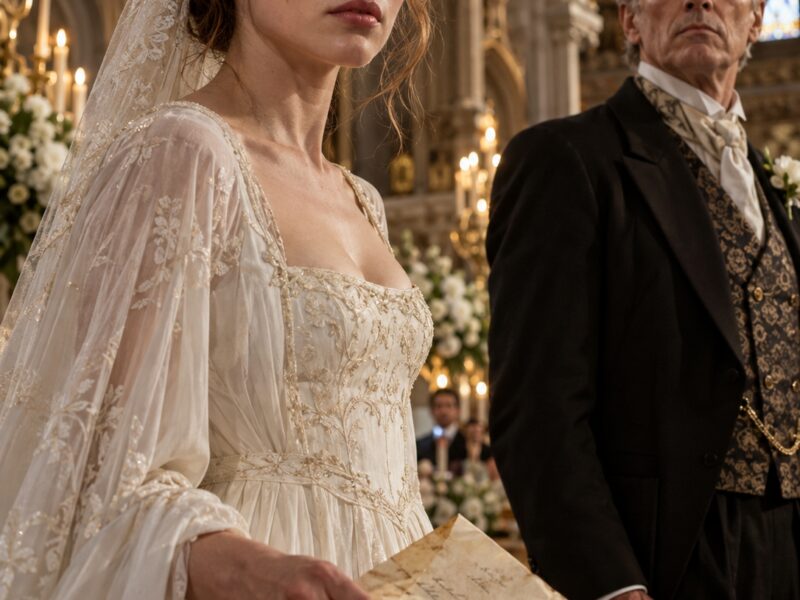
Instead, she wore a simple ivory silk gown without embroidery.
No veil.
No necklace.
No tiara.
In one hand she held a single sprig of orange blossom.
Her dark hair was pinned plainly behind her head.
Her chin was slightly too strong for fashionable beauty. Her nose had a small unevenness suggesting it had once been broken.
But it was her face that had silenced the church.
A scar began near her left temple, crossed her cheekbone and disappeared beneath the high collar of her dress.
It was not delicate.
It was not easily ignored.
It was the kind of scar that told you something terrible had happened to a child and the child had survived anyway.
Adrien looked at it.
Then into her eyes.
Amber.
Almost gold beneath the candles.
She did not lower them.
There was no shame there.
No apology.
No plea for approval.
Only a strange, steady intelligence.
Adrien had prepared himself to pity his bride.
Instead, he felt something much more unsettling.
Recognition.
He knew what it looked like when damage stopped being something a person tried to hide.
Isabelle glanced toward him.
The corner of her mouth lifted.
“Your Grace,” she murmured.
Her voice carried a faint Spanish warmth beneath the English pronunciation.
“Shall we?”
Adrien realized everyone was waiting.
“Yes.”
The vows passed in fragments.
He remembered her hand.
That was what stayed with him.
When he slid the wedding ring onto her finger, Isabelle’s hand remained perfectly steady.
His did not.
He hated that she noticed.
He knew she noticed because something almost amused moved through her eyes.
Then the bishop pronounced them husband and wife.
Adrien leaned toward her for the brief ceremonial kiss.
Isabelle tilted her head.
“You may kiss your bride, Your Grace,” she whispered.
He frowned.
Her eyes glittered.
“I promise not to bite.”
A laugh nearly escaped him.
He kissed her.
It was supposed to last a second.
Somehow, it lasted two.
Orange blossom.
Warm skin.
Something underneath the perfume that reminded him absurdly of stone warmed by summer sunlight.
When Adrien stepped back, Isabelle looked perfectly composed.
But her eyes were laughing at him.
Or perhaps at both of them.
The sold duke.
The purchased duchess.
Two strangers performing happiness for an audience hungry to see them fail.
At the wedding breakfast, Adrien discovered something else.
His wife was dangerous.
Not because she was cruel.
Because she could survive cruelty without giving the person delivering it the satisfaction of seeing blood.
Lady Petton approached first.
“What an unusual appearance you have, Duchess.”
Isabelle smiled.
“How kind of you to notice.”
Christopher nearly choked on his champagne.
Later, Christopher’s mother studied Isabelle’s scar with theatrical concern.
“My dear, forgive me, but however did that happen?”
“A runaway horse in Seville.”
“How dreadful.”
“I was ten.”
The older woman touched her chest.
“Were you terribly injured?”
Isabelle took a sip of wine.
“I was. The horse, I’m pleased to report, escaped unharmed.”
Three people laughed before remembering they were supposed to be scandalized.
Adrien found himself watching her.
She never clung to him.
Never manufactured affection.
Never tried to convince the room they were passionately in love.
She simply stood beside him and refused to be embarrassed.
It should have relieved him.
Instead, inexplicably, it irritated him.
By evening, the guests were gone.
Snow had turned blue beneath the gathering darkness.
Adrien found Isabelle alone in the drawing room, standing near the window.
He stopped several feet behind her.
“Your rooms have been prepared in the east wing.”
She turned.
“Mine are in the west,” he continued. “I assumed you would prefer privacy. I don’t expect that we—”
“How fortunate.”
He stopped.
Isabelle smiled politely.
“Neither do I.”
He had expected awkwardness.
Perhaps wounded pride.
He had not expected relief.
“You walked down the aisle alone,” he said.
“Yes.”
“Your father seemed displeased.”
“He was.”
“Why?”
“He offered me his arm.”
“And?”
“I declined it.”
“Why?”
She looked toward the snow.
“Because I wanted to arrive on my own feet.”
Something in the answer stayed with him.
Isabelle crossed the room and sat.
“Now,” she said, “shall we discuss our marriage?”
Adrien almost laughed at the absurdity of the sentence.
Instead, he sat opposite her.
“My father has paid your debts,” Isabelle said. “All of them.”
“Yes.”
“In exchange, I have acquired your name, your household, and enough social legitimacy to satisfy his ambitions.”
Hearing it aloud made Adrien flinch.
Isabelle noticed.
She continued anyway.
“I have no intention of becoming a burden. I read. I ride. I have charitable interests. I can manage a household. I do not require constant entertainment.”
“And what do you require?”
“Three things.”
She raised one finger.
“Courtesy in public.”
A second.
“Privacy in my correspondence and freedom of movement.”
Then a third.
“No mistress beneath this roof.”
Adrien stared at her.
Isabelle’s expression remained calm.
“What you do discreetly elsewhere is your affair. But I will not be humiliated inside my own home.”
“No mistress,” Adrien said.
Something flickered across her face.
Surprise, perhaps.
“And what,” he asked, “do I receive?”
“A wife who performs her duties, runs your household properly, protects your reputation and makes no emotional demands.”
“That sounds very efficient.”
“I thought efficiency might appeal to you.”
“You believe you understand me already?”
“No.”
That stopped him.
Isabelle leaned back.
“I believe you made certain I could not understand you before today.”
There was no accusation in her tone.
That made it worse.
Adrien looked away.
“We needn’t make each other miserable,” she said more softly. “We only need to be civil.”
It was everything he had wanted.
A clean arrangement.
No expectations.
No vulnerability.
No possibility of betrayal.
So Adrien could not understand why, when Isabelle left for the east wing, he felt as though a door had quietly closed somewhere inside him.
For the first month, they perfected the art of avoiding each other.
Adrien worked.
Isabelle built a life that apparently required nothing from him.
Within three weeks, the servants adored her.
She remembered names.
Visited the kitchens.
Had blankets sent to an elderly footman’s sick mother without announcing she had done it.
She reorganized neglected household accounts and somehow did so without making Adrien feel criticized.
She rode early in Hyde Park before fashionable London appeared.
She read in the library.
And she wrote letters.
Always to Spain.
Always sealed with dark red wax.
Adrien noticed other things too.
She favored her left leg when rain was coming.
She always chose the chair nearest the fire.
She disliked anyone approaching her unexpectedly from behind.
And despite her father living in London, no letters ever arrived from Theodore Callaway.
Then one afternoon Adrien passed his father’s old study and found Isabelle inside.
She stood before shelves no one had properly touched in years.
Old ledgers surrounded her.
“What are you doing?”
She turned without appearing startled.
“Trying to bring order to chaos.”
“My father specialized in chaos.”
“I noticed.”
She smiled faintly.
“There’s enough dust here to bury a man.”
Adrien looked at the old papers.
For one fleeting moment, he wondered why Isabelle was interested in them.
Then she sneezed.
He laughed.
The question vanished.
That mistake would nearly destroy them.
Weeks later, Adrien returned late from his club and heard music.
Not the pleasant, careful music young women played after dinner.
This was something else.
He followed it to the music room.
Isabelle sat at the pianoforte alone.
The melody was fierce.
Beautiful.
Full of grief so old it seemed to have forgotten the event that created it.
Adrien remained outside until the final note disappeared.
Then he opened the door.
Isabelle looked up.
For perhaps one second, she forgot to protect herself.
He saw loneliness.
Exhaustion.
A woman much younger than the one London believed it knew.
Then the expression disappeared.
“That was extraordinary,” Adrien said.
“You were listening?”
“I couldn’t help it.”
He approached the instrument.
“Who taught you?”
Isabelle hesitated.
“My mother.”
He waited.
“She was Spanish. From Seville.”
Adrien sat nearby.
“She died when I was twelve. Two years after the accident.”
“The horse?”
“Yes.”
Isabelle touched her scar unconsciously.
“My father brought me permanently to England afterward. He believed another country might help me forget.”
“Did it?”
“No.”
Her fingers rested on the keys.
“It taught me to become two people.”
Adrien said nothing.
“The merchant’s English daughter during the day,” she continued, “and my mother’s child after dark.”
“The letters you write to Spain?”
Her eyes moved sharply toward him.
He almost apologized.
Instead, she answered.
“My aunt Pilar. My mother’s sister.”
Adrien nodded.
Then Isabelle studied him.
“My turn.”
“For what?”
“A question.”
He almost smiled.
“Ask.”
“Why would the Duke of Ravenhurst, who could have married any number of respectable women, agree to marry a scarred merchant’s daughter without even looking at her?”
He could have lied.
He almost did.
But something about the room made lying seem cowardly.
“Because I had already sold everything else.”
Isabelle’s expression changed.
“My father left debts. I sold land. Houses. Paintings. Horses. Anything that wasn’t essential.”
He looked at his hands.
“My pride was the last thing I believed belonged entirely to me. So I spent it on a ridiculous condition about refusing to see you.”
Silence.
Then Isabelle moved sideways on the bench.
“Do you play?”
“Not anymore.”
“That wasn’t my question.”
Adrien looked at her.
She tapped the empty space beside her.
“Sit.”
He did.
Their shoulders almost touched.
Isabelle played a simple phrase.
“Your turn.”
“I’ve forgotten.”
“Then remember.”
That was how it began.
Not with desire.
Not exactly.
With breakfast.
Books.
Music.
Arguments about the garden.
Evening rides.
Small things.
Dangerous things.
Adrien started finding excuses to return home earlier.
He discovered Isabelle preferred coffee to tea and despised boiled carrots.
She learned that he read financial documents when anxious because numbers were easier than feelings.
Their hands brushed across a book one afternoon.
Neither moved immediately.
During a carriage ride, she laughed at something he said and rested her hand briefly on his arm.
He thought about the touch for two days.
Then spring arrived.
One afternoon, Adrien came home and found the Duchess of Ravenhurst kneeling in mud.
He stopped.
Isabelle wore an old riding habit. Her gloves had been discarded. Hair escaped its pins.
She was attacking the earth with a small garden trowel.
“What,” Adrien asked, “are you doing?”
She looked up.
There was dirt on her cheek.
“Saving your roses.”
“My roses?”
“They were dying.”
“I didn’t know we had roses.”
“That is precisely why they were dying.”
He laughed.
And Isabelle smiled.
Not the controlled smile she gave society.
A real one.
It transformed her face.
Adrien forgot the scar.
Then realized, with something like shame, that he had forgotten it because he had finally learned to see everything else.
He knelt beside her.
“You’re ruining your trousers,” she said.
“They were ugly.”
“They’re expensive.”
“Then this is an act of rebellion.”
She shook her head.
“These were my mother’s favorite flowers.”
Adrien looked at the small plants waiting beside her.
“You brought Spanish roses?”
“Some.”
“Why?”
Isabelle suddenly became interested in the soil.
“I thought…”
“What?”
She swallowed.
“That perhaps something might grow here.”
The sentence struck him with unexpected force.
Adrien reached out.
With his thumb, he wiped the dirt from her cheek.
His fingers passed over the edge of her scar.
Isabelle did not move.
“I need to tell you something,” he said.
Her smile faded.
“Her name was Catherine Doyle.”
The trowel stopped in Isabelle’s hand.
Adrien did not notice.
He told her everything.
The vicar’s daughter.
Oxford.
His father.
The money.
Catherine’s disappearance.
Eight years of wondering whether she had accepted the money willingly.
Eight years of telling himself it no longer mattered.
When he finished, Isabelle was staring at the earth.
“That is why you wouldn’t look at me,” she said.
“I was afraid.”
Her eyes rose.
Adrien forced himself to continue.
“I was so afraid someone could hurt me again that I decided to hurt you first.”
“Adrien—”
“You deserved better.”
He touched her face.
“From the moment you walked into that church.”
Her eyes became bright.
“And yet,” she whispered, “here you are in the mud.”
“Talking about roses.”
A tear escaped her before she could stop it.
Adrien wiped it away.
“I don’t want the arrangement anymore.”
Isabelle stopped breathing.
“I don’t want separate lives. Separate wings. Courtesy in public and silence in private.”
He leaned closer.
“I want you.”
She stared at him.
“If you’ll have me.”
For one terrifying second, she said nothing.
Then Isabelle kissed him.
It was sudden.
Warm.
Tasted faintly of rain and earth.
Adrien caught her around the waist.
When she pulled back, she was laughing and crying at once.
“You impossible man.”
“What?”
“Did you honestly think I asked for separate rooms because I didn’t want you?”
He stared.
“I asked because you had made it painfully clear you didn’t want me.”
“I was wrong.”
“Yes.”
“Very wrong.”
“Extremely.”
He kissed her again.
“I love you.”
That silenced her.
Adrien cupped her face.
“I’ve been falling in love with you for weeks. Perhaps longer. I was simply too proud to recognize it.”
Isabelle closed her eyes.
When she opened them, there was happiness there.
But something else too.
Fear.
Adrien mistook it for fear of loving him.
He had no idea that, at that very moment, his wife was carrying a secret capable of destroying everything they had just begun.
After the garden, Ravenhurst House changed.
Adrien moved from the west wing.
The connecting door between their rooms stayed open.
They breakfasted together.
Isabelle taught him Spanish.
At night they learned each other more slowly.
More carefully.
He discovered scars across her knee and shoulder from the childhood accident.
She discovered he woke sometimes from dreams in which creditors were emptying Ravenhurst room by room.
They stopped pretending not to need each other.
London noticed.
At their first ball as a real couple, Adrien danced with his wife three times.
Twice more than convention recommended.
Lady Petton cornered Isabelle afterward.
“How remarkable, Duchess.”
“What is?”
“Your husband.”
Isabelle smiled.
“I find him remarkable too.”
“He seems transformed. One might almost believe this had become a love match.”
Isabelle looked across the ballroom.
Adrien was watching her.
Their eyes met.
“One might,” she said.
“Love has been known to grow in unlikely soil.”
Lady Petton smiled.
She was the kind of woman who could smell a secret across a ballroom.
And Isabelle had one.
In July, Adrien returned from a meeting and knew something was wrong before anyone spoke.
Ravenhurst House was too quiet.
Pembrook, the elderly steward, waited in the hall.
“Your Grace.”
“What happened?”
“I think you should come to the old study.”
Adrien’s stomach tightened.
The door was open.
Isabelle sat on the floor.
Ledgers surrounded her.
His father’s private ledgers.
Books Adrien had not even known still existed.
A letter rested in her lap.
Another lay open on the desk.
Spanish.
Dark red wax.
Adrien had been studying the language for months.
He could read enough.
His eyes found the first line.
Have you found it, my girl?
Then the second.
Time is short.
Then—
Do not let love make you soft.
Adrien felt something inside him go cold.
Isabelle stood.
“Adrien.”
Footsteps sounded in the corridor.
Then Lady Petton appeared behind Pembrook.
“I do hope I’m not intruding.”
She stopped.
Her gaze moved from Isabelle to the ledgers.
Then the Spanish letter.
Then Adrien.
A slow smile formed.
By dinner, half of London would know something had happened.
But Adrien no longer cared about London.
He cared about one question.
Hours later, after the last visitor had gone and the servants had retreated upstairs, he found Isabelle sitting alone in the drawing room.
She had been there since four.
Adrien stood in the doorway.
“Was any of it real?”
Isabelle looked up.
She did not pretend not to understand.
“All of it.”
He almost breathed.
Then she added:
“Not all of it was honest.”
His chest tightened.
“Tell me.”
Isabelle closed her eyes.
“My mother’s name was Elena Duran.”
Adrien remained standing.
“She came from an old family near Seville. They owned olive groves. A stone house. Land that had belonged to them for generations.”
She looked at him.
“Twenty-six years ago, a young English duke traveled through Andalusia.”
Adrien already knew.
“My father.”
“Yes.”
The word barely made a sound.
“He played cards with my grandfather.”
Adrien felt sick.
“The game lasted most of the night. By morning, my grandfather had lost the Duran estate.”
Isabelle’s hands trembled.
“He died within a year. My grandmother followed. The family scattered. My mother never recovered.”
“And Pilar?”
“Never forgave.”
Adrien looked toward the old study.
“You came here looking for proof.”
“Yes.”
The answer hurt more because she did not soften it.
“My aunt always believed the card game was rigged. She believed your father kept records of everything. Letters. Payments. Something.”
“And your father?”
“He agreed to help us.”
Adrien laughed once.
There was no humor in it.
“So Theodore Callaway arranged our marriage.”
“Yes.”
“So you could search Ravenhurst.”
“Yes.”
Each answer landed like a hammer.
“I was a door.”
“No.”
“I was access.”
“At first.”
Adrien turned away.
“God.”
“I never intended to love you.”
He looked back.
Isabelle’s face crumpled for the first time since he had known her.
“That was the plan,” she whispered. “Be civil. Search the papers. Find the proof. Leave emotionally untouched.”
She laughed bitterly.
“Then you walked into the music room.”
Adrien said nothing.
“Then you sat beside me.”
Her voice broke.
“Then you knelt in the dirt and told me about Catherine.”
She wiped her face.
“I stopped searching in April.”
“Why?”
“You know why.”
He did.
That was the worst part.
“I couldn’t keep lying while loving you.”
“Yet you did.”
“Yes.”
The word was barely audible.
Adrien felt every betrayal of his childhood waking at once.
His father lying.
Catherine disappearing.
Creditors arriving.
A marriage arranged in secret.
Everyone always knowing something he did not.
“Go to the east wing,” he said.
Isabelle went pale.
“Adrien—”
“I cannot do this tonight.”
She stood.
At the door, she stopped.
“I told you my father never writes to me.”
Adrien said nothing.
“You might ask yourself why.”
Then she left.
For four days, Adrien barely emerged from his father’s study.
He read everything.
Every account.
Every letter.
Every private book.
If Isabelle had come looking for proof, Adrien would find it himself.
On the third night, he did.
A folded letter hidden inside an old ledger.
Written by his father.
Adrien read it once.
Then again.
Then a third time.
It described the card game.
Signals.
Marked cards.
Brandy deliberately supplied to weaken Señor Duran’s judgment.
A division of the winnings.
And beneath his father’s signature was another name.
T. Callaway.
Adrien stared at it.
The room seemed to tilt.
Theodore Callaway had not been helping the Durans recover their estate.
He had helped steal it.
Adrien searched further.
The pieces became monstrous.
Callaway had been a young wine agent in Cádiz when Adrien’s father visited Spain.
After the fraudulent game, a company linked to Callaway had quietly acquired control of parts of the Duran property.
A year later, Callaway married Elena Duran.
Isabelle’s mother.
Adrien felt physically ill.
Then he remembered the debts.
All those creditors appearing in the same week.
He pulled the records.
Different names.
Different solicitors.
But money had moved through the same agents.
Callaway.
He had purchased the Blackwood debts.
He had deliberately forced Ravenhurst toward collapse.
Then appeared as its savior.
And two years earlier, someone acting anonymously had tried to purchase the old Duke’s private papers.
Pembrook had refused.
Adrien finally understood.
Theodore Callaway had not married Isabelle into Ravenhurst so she could find the evidence.
He had sent her there so the evidence could be destroyed.
The following morning, Pembrook knocked.
“Your Grace?”
Adrien looked up.
“There is a woman downstairs asking for the Duchess.”
“Who?”
“She says she has come from Spain.”
Adrien stood.
“Her name is Catherine Delgado.”
The chair fell backward.
Adrien did not remember crossing the hallway.
The woman waiting below wore a plain traveling cloak.
She was older.
Twenty-eight now.
Brown hair.
A tired, gentle face.
But he knew her instantly.
“Catherine.”
She looked at him.
Eight years disappeared.
“Adrien.”
He could not speak.
Catherine smiled sadly.
“It’s all right.”
Nothing was all right.
“I haven’t come to reopen old wounds,” she said.
“Then why are you here?”
“Because Pilar Duran sent me.”
Adrien stared at her.
“And because your wife is in more danger than either of you understands.”
Isabelle entered the library minutes later.
She stopped dead when she saw Catherine.
“Catherine Doyle.”
Adrien turned toward her.
“You knew?”
Isabelle’s face lost all color.
“My aunt wrote about an English woman who taught her sons.”
“You knew Catherine was with Pilar?”
“I suspected.”
“When?”
Isabelle closed her eyes.
“When you told me her name in the garden.”
Adrien recoiled.
“That was why you froze.”
“Yes.”
“And you said nothing.”
“I was afraid.”
“Of what?”
“That if I admitted I had recognized her name, you would never believe another word I said.”
Her voice cracked.
“That was another lie. I know.”
Catherine looked between them.
“Enough.”
They both turned.
“Neither of you has enough time left to punish yourselves.”
Then Catherine told them what had happened.
After Adrien’s father separated them, Catherine had been placed aboard a Callaway ship bound for Cádiz.
A sympathetic clerk eventually helped her find work.
The employer was a widow.
Pilar Duran.
Over the years, Pilar told Catherine the family history.
Catherine never told Pilar she had once loved the son of the man who destroyed them.
“What good would it have done?” Catherine said.
Then she removed a folded letter from her cloak.
“Three weeks ago, Pilar received this.”
Isabelle recognized the handwriting immediately.
“My father.”
Catherine nodded.
“Theodore threatened her.”
Isabelle’s lips parted.
“He said that if you failed to find and destroy the evidence, he would ruin her financially and seize the house where she lives.”
Adrien’s jaw tightened.
“Pilar finally understood.”
Catherine handed him the letter.
“She had trusted Callaway because he married Elena. She believed he was trying to repair what the Blackwoods had done.”
Adrien looked at Isabelle.
She seemed unable to breathe.
“My father didn’t want justice for Mama.”
“No,” Catherine said.
“He wanted the past buried.”
Isabelle gripped the chair.
“So no one could discover what he had done.”
Adrien crossed the room.
For four days he had been angry.
He had rehearsed accusations.
Questions.
Punishments.
None survived the sight of his wife realizing that her own father had used her grief as a weapon.
He wrapped his arms around her.
Isabelle collapsed against him.
“I am sorry,” she whispered.
“So am I.”
“I should have trusted you.”
Adrien pressed his cheek against her hair.
“I should have looked at you.”
She pulled back.
“What?”
“From the beginning.”
His voice broke.
“I spent my entire life refusing to look at anything that might hurt me. My father’s cruelty. Catherine disappearing. You.”
He touched her scar.
“If I had looked—really looked—I might have asked why you were afraid.”
Isabelle covered his hand with hers.
Catherine watched them quietly.
Then she smiled.
“Your father broke my heart once, Adrien.”
He looked at her.
“It is a relief,” she said, “to discover he did not teach you how to keep one broken.”
Theodore Callaway arrived at Ravenhurst the following evening.
Adrien’s note had contained only four words.
Your daughter is unwell.
Callaway entered the drawing room quickly.
“Isabelle?”
Then he stopped.
His daughter stood beside Adrien.
Catherine sat near the fireplace.
Pembrook held a leather folder.
And on the table lay a letter twenty-six years old.
For perhaps three seconds, Theodore Callaway remained the jovial businessman London knew.
Then he saw the signature.
The mask disappeared.
Adrien pointed toward a chair.
“Sit.”
Callaway did.
Adrien had decided beforehand that he would not shout.
His father had shouted.
Weak men often mistook volume for power.
Adrien placed the old letter on the table.
“You helped my father cheat Señor Duran.”
Callaway said nothing.
“You helped steal the estate belonging to the family of the woman you later married.”
Still nothing.
“Then last year, you purchased my father’s debts through intermediaries.”
Callaway’s eyes sharpened.
“You called them all in simultaneously and manufactured the financial crisis that forced me to marry Isabelle.”
Adrien leaned forward.
“You sent your daughter into my house believing she was recovering justice for her mother’s family.”
Callaway smiled faintly.
“A colorful theory.”
Isabelle stepped forward.
“It’s your signature.”
Her father looked at her.
“Papa.”
Her voice trembled.
“You stood beside Mama’s grave.”
Something crossed Callaway’s face.
Shame.
Perhaps.
It vanished quickly.
“I gave you everything,” he said.
Isabelle stared.
“Everything?”
“A life your mother’s family could never have provided. Education. Travel. Money. Now a title.”
His voice hardened.
“What did the Durans give you? A dead woman’s pride and some olive trees?”
Isabelle’s expression changed.
Adrien had seen that look before.
The woman walking alone down the church aisle.
“They gave me a name.”
Callaway frowned.
“They gave me people who existed before your money.”
She moved closer.
“And you made me lie in their name.”
“I protected you.”
“No.”
Her eyes filled with tears.
“You used me.”
Callaway stood.
“You are being emotional.”
“No, Papa.”
Her voice became very quiet.
“For the first time in my life, I am being clear.”
Adrien placed another document on the table.
“Here are your choices.”
Callaway looked at him.
“A copy of your letter is already with my solicitor.”
Adrien placed a second paper beside it.
“Another is secured elsewhere.”
Then a third.
“And instructions have been prepared for publication if anything happens to Isabelle, Pilar, Catherine, me, or the evidence.”
Callaway laughed.
“You would publish your own father’s confession?”
“Yes.”
“You would destroy the Blackwood reputation?”
“If necessary.”
“For what? A Spanish farm?”
Adrien looked at his wife.
Then back at Callaway.
“London has already spent a year saying I was sold by the pound.”
He smiled coldly.
“I’ve discovered public embarrassment is survivable.”
Callaway stopped smiling.
“You will return the Duran estate to Pilar.”
Silence.
“You will withdraw every threat.”
Adrien leaned closer.
“And you will never approach my wife again unless she asks to see you.”
“You cannot order me away from my own daughter.”
Adrien looked toward Isabelle.
“No.”
He straightened.
“But she can.”
Callaway turned.
Isabelle’s face was wet with tears.
She did not wipe them away.
For the first time, Theodore seemed uncertain.
“Isabelle.”
She shook her head.
“You taught me money could purchase anything.”
“Don’t be childish.”
“You purchased debts.”
“Isabelle—”
“You purchased access.”
His jaw tightened.
“You purchased my marriage.”
“I gave you Ravenhurst.”
“No.”
She looked at Adrien.
Then back at her father.
“You forced open the door.”
Her voice softened.
“What happened after I walked through it belongs to me.”
Callaway stared at her.
Then at Adrien.
Finally, he sat.
Pembrook placed the transfer documents before him.
Callaway signed.
One page.
Then another.
Each scratch of the pen sounded enormous.
When he finished, he stood.
At the doorway he turned toward Isabelle.
His expression suggested he wanted one final weapon.
One sentence cruel enough to follow her for years.
She did not let him find it.
“Goodbye, Papa.”
Callaway froze.
Isabelle’s voice was gentle.
“I hope someday you find something to love that isn’t money.”
The door closed behind him.
For several seconds, no one moved.
Then Ravenhurst House seemed to breathe.
Adrien turned toward Isabelle.
There were witnesses.
Catherine.
Pembrook.
Christopher, waiting beyond the doors.
For once, Adrien did not care.
“I have a question.”
Isabelle gave a shaky laugh.
“We’ve had rather enough questions.”
“One more.”
He took both her hands.
“I would like to be married to you properly.”
Her eyes widened.
“No debts.”
He squeezed her fingers.
“No bargain.”
She started crying again.
“No separate wings. No terms. No arrangement.”
“Adrien—”
“Just me.”
He swallowed.
“And you, if you’ll still have me.”
Isabelle laughed through her tears.
“You know I never said no.”
“Then say yes now.”
“Yes.”
He smiled.
“Again.”
“Yes.”
“Again.”
She hit his chest.
“Yes, you impossible man.”
Adrien kissed her.
When they separated, Isabelle touched his face.
“Look at me.”
The words silenced him.
They carried the whole story inside them.
The church.
The scar.
The separate rooms.
The secret letters.
The lies.
The garden.
The old ledger.
Everything he had refused to see.
Adrien held her gaze.
“I am.”
His voice was barely more than a whisper.
“I finally am.”
Then he kissed the scar on her cheek.
“And I don’t intend to stop.”
The following spring, St. Margaret’s filled again.
This time there was no snow.
Flowers crowded the church.
Adrien’s sister Margaret married Christopher Hail beneath the same stained-glass window where Adrien had once stood terrified of turning around.
Beside him, Isabelle held his hand openly.
Her other hand rested against the gentle curve of her belly.
“A girl,” she whispered.
“You cannot possibly know that.”
“I know.”
“How?”
“Superior intelligence.”
Adrien laughed.
After the ceremony, they watched the newlyweds leave beneath a storm of flower petals.
Isabelle leaned against him.
“Do you remember our wedding?”
“Unfortunately.”
“You wouldn’t look at me.”
“I was terrified.”
“Of my scar?”
Adrien shook his head.
“Of wanting to be wrong.”
She looked up.
He kissed her forehead.
Then the scar.
Then her mouth.
Several respectable people nearby pretended not to notice.
By summer, Pilar Duran’s home was safe.
The olive groves were pruned and replanted.
The estate that had been stolen through cards and greed finally returned to the family whose name it carried.
Catherine remained in England for a month.
She and Isabelle spent long afternoons together speaking English and Spanish, reconstructing memories neither woman had expected to share.
When Catherine finally left, she gave Adrien a small bundle.
Letters.
His letters.
The ones he had written to her when he was twenty-two.
The ones he believed had disappeared.
On top was a note.
Only one sentence.
Be kind to each other. It is the whole secret.
Adrien kept it.
Not because Catherine represented the life he should have had.
But because she reminded him of something more important.
Love did not always fail because it was weak.
Sometimes people failed it.
Sometimes fear failed it.
Sometimes pride.
Sometimes fathers.
Sometimes silence.
And sometimes, if people were very lucky, they received another chance to do better.
Six years after that strange winter wedding, Ravenhurst House no longer felt like a mausoleum built for a dying family.
Children ran through it.
The east and west wings—the rooms Adrien and Isabelle had once chosen to keep themselves safely apart—were connected by corridors filled with toys, books and small muddy shoes.
Their daughter, Isabella Maria Blackwood, called Bella by everyone except her mother when she was in trouble, had Isabelle’s amber eyes and Adrien’s dark hair.
Edmund arrived two years later.
A third child was on the way.
Isabelle transformed the neglected gardens into a mixture of English roses and Spanish herbs.
She eventually published a botanical study under her own name.
Some of London considered that scandalous.
Isabelle considered their disapproval encouraging.
Adrien learned Spanish badly but enthusiastically.
He improved at the pianoforte.
On warm evenings, he and Isabelle still played together.
Bella usually ruined the performance by climbing between them and striking the keys with both hands.
Neither parent ever stopped her.
One night, years after everything had ended, Isabelle lay beside Adrien in the room they now shared.
Moonlight crossed the bed.
Her fingers traced slow circles over his chest.
“Adrien?”
“Hmm?”
“Do you ever regret it?”
His eyes opened.
“What?”
“Marrying me.”
He turned toward her.
“Every day.”
Isabelle went completely still.
Adrien allowed the silence to last precisely long enough to become dangerous.
Then he smiled.
She narrowed her eyes.
“You are a terrible man.”
“I regret every day I spent married to you without actually seeing you.”
Her expression softened.
“Every breakfast I avoided. Every conversation I refused to have. Every evening I stayed in that miserable west wing pretending solitude was dignity.”
He lifted her hand and kissed it.
“Those are the days I regret.”
Isabelle blinked rapidly.
“Foolish man.”
“Yes.”
“I would have waited forever for you to see me.”
Adrien looked at the woman beside him.
The scar had faded slightly with time.
He could still trace every inch of it from memory.
He remembered the first morning he had seen her.
Three hundred guests.
Snow against the church windows.
A woman walking alone because she wanted to arrive on her own feet.
And a frightened man staring straight ahead because turning around meant admitting that life might still surprise him.
“You didn’t have to wait forever,” he whispered.
Isabelle moved closer.
“No.”
She rested her head against his chest.
“I didn’t.”
Outside, London slept beneath a clear night sky.
Inside Ravenhurst House, their children dreamed in rooms that had once been closed because there was no money to heat them.
Roses Isabelle had planted years earlier climbed the garden walls.
Somewhere downstairs, the old pianoforte waited for morning.
And in the darkness, Adrien held the woman he had once married without looking at her.
He had believed refusing to look was strength.
He had believed distance could protect him.
He had believed a heart that expected nothing could lose nothing.
He had been wrong about all of it.
Because the deepest wounds in their marriage had never come from the scar on Isabelle’s face, the debts his father left behind, the stolen Spanish estate, or even the lies that brought them together.
They came from the moments when fear convinced two people that silence was safer than truth.
Adrien understood that now.
Some love stories begin when two people see each other across a crowded room.
Theirs did not.
Theirs began with a man too frightened to turn around…
and a woman brave enough to keep walking toward him anyway.
Until, finally, he found the courage to look.









