He Rejected Her for Three Winters—Then the Night He Finally Asked Her to Dance, She Said No
For three winters, Lady Evelyn Ashcombe had waited for the Duke of Renford to cross a ballroom for her.
On the fourth, he finally did.
And she broke his heart in front of half of London.
Snow pressed against the tall windows of Blackthorne Hall that night, turning the city beyond the glass into a blur of white and silver. Inside, hundreds of candles burned beneath crystal chandeliers. Silk whispered over polished floors. Violins carried a waltz through rooms crowded with titles, fortunes, whispered scandals, and people who had spent their entire lives learning how to watch one another without appearing to stare.
But when Alistister Renford began walking across the ballroom, everyone stared.
He was a duke.
Men like him did not hurry.
They did not cross crowded rooms with uncertainty in their eyes.
And they certainly did not approach women they had publicly ignored for three consecutive seasons.
Yet Alistister did exactly that.
Evelyn saw him coming.
For one dangerous heartbeat, the girl she had once been came alive inside her.
That girl remembered standing beside ballroom windows at nineteen, pretending to admire the snow while secretly waiting for one man to notice her.
She remembered sending her name to his dance card.
She remembered gathering enough courage to approach him herself.
And she remembered the six words he had given her each time.
I do not dance, my lady.
The first time, she had believed him.
The second time, she had doubted him.
The third time, she had watched him dance with someone else.
Now he stopped directly before her.
“Lady Evelyn.”
His voice was different.
No polished coldness.
No effortless distance.
No invisible wall.
She looked up.
“Your Grace.”
Around them, conversation thinned.
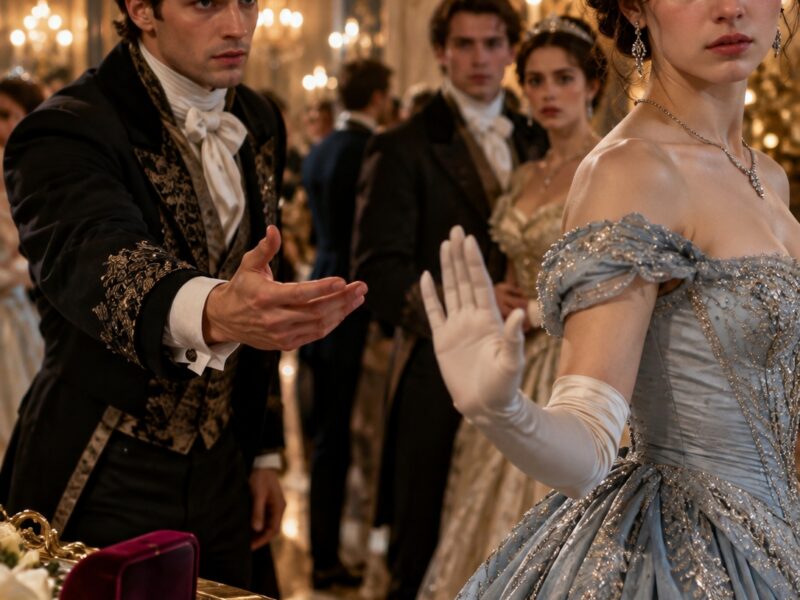
Alistister extended his hand.
“This dance belongs to you.”
Four years earlier, those words would have changed Evelyn’s entire world.
Three years earlier, she might have cried from happiness.
Two years earlier, she would have forgiven everything without asking why.
But heartbreak had a strange way of changing the value of things.
Sometimes what you desperately wanted arrived only after you had learned you could live without it.
Evelyn looked at his hand.
Then she looked into his eyes.
And smiled.
“I’m sorry, Your Grace.”
His expression changed.
Only slightly.
But she saw it.
“Three winters ago,” Evelyn continued softly, “I wanted nothing more than to dance with you.”
The orchestra played on.
Nobody near them seemed to breathe.
“This winter…”
She let the silence remain between them for one final second.
“…I no longer do.”
Then she curtsied.
Turned away.
And left the Duke of Renford standing in the middle of the ballroom with his hand still extended.
For the first time in Evelyn Ashcombe’s life, she was not the woman waiting.
And for the first time in Alistister Renford’s life, he understood what waiting could cost.
Four winters earlier, Evelyn would never have believed she could become that woman.
Back then, she had arrived in London carrying the dangerous optimism of someone who had not yet learned that hope could humiliate you.
The Ashcombes were old enough to be respected and poor enough to be discussed.
Their family name still opened doors.
Their bank accounts did not.
Evelyn’s father had inherited land, responsibilities, several deteriorating properties, and just enough income to maintain the appearance that nothing had changed.
Nothing mattered more among their class than appearances.
A family could be quietly drowning as long as the silver remained polished.
Evelyn understood that from childhood.
She had learned to repair lace rather than replace it, to wear gowns altered from her sister Margaret’s older dresses, and to smile when women with twice her dowry asked whether she intended to spend another season in London.
She was not considered the most beautiful woman in any room.
She was worse.
She was memorable only after someone bothered to speak with her.
Her beauty revealed itself slowly—in intelligent gray-green eyes, in a smile that arrived unexpectedly, in the warmth with which she listened, in the dry humor she usually hid beneath good manners.
Most men wanted beauty that announced itself from across a ballroom.
Evelyn required attention.
And during her first winter in London, Alistister Renford gave it to her.
Or at least she thought he did.
She first noticed him at Lady Carroway’s January ball.
Everyone noticed him.
The Duke of Renford had inherited his title young after the sudden death of his father. At twenty-eight, he carried himself like a man who had been born understanding that rooms would make space for him.
Tall.
Dark-haired.
Controlled.
Rarely smiling.
Women discussed him as though he were an estate being privately auctioned.
Evelyn disliked that.
Then she saw him kneel to retrieve an elderly woman’s fallen glove when no one important was watching.
That was what ruined her.
Not the title.
Not Renford House.
Not the acreage.
The glove.
She had watched him return it with a small bow, wait until the woman was comfortably seated, then disappear back into the crowd before anyone could praise him.
Perhaps, Evelyn thought, everyone had misunderstood him.
That thought became curiosity.
Curiosity became attention.
And attention, given enough evenings, became hope.
Once, during a concert, she looked across the room and found him already watching her.
He looked away first.
Evelyn spent the following week remembering it.
At the next ball, she gathered her courage.
“Go,” Margaret whispered.
“I cannot simply walk toward a duke.”
“You have legs.”
“Margaret.”
“He has looked at you three times.”
“Perhaps something is wrong with my hair.”
“Then go allow him a closer inspection.”
Evelyn nearly laughed.
That helped.
She crossed the room.
Alistister saw her coming.
She did not know that his heartbeat changed.
She did not know he had already noticed the way she tilted her head when listening to someone, or that he knew she preferred quieter corners of crowded rooms.
She knew only that he looked impossibly calm when she stopped before him.
“Your Grace.”
“Lady Evelyn.”
The music changed.
Couples began moving toward the floor.
Evelyn swallowed.
“If your card is not already full…”
She hated herself for the tremor in her voice.
“Would you perhaps—”
“I do not dance, my lady.”
Six words.
Polite.
Perfect.
Final.
“Oh.”
She smiled immediately.
Girls like Evelyn were trained to smile immediately.
“Of course.”
She curtsied.
Walked away.
And did not allow herself to cry until she was inside the carriage.
Even then, she turned her face toward the window so Margaret would not see.
Perhaps he truly did not dance.
That was what she told herself.
Until two weeks later, when she saw him dancing with Lady Caroline Montrose.
Evelyn stared for exactly three seconds.
Then looked away.
Margaret noticed.
She always noticed.
“Do you want to leave?”
“No.”
“Evelyn.”
“I said no.”
She remained at the ball another two hours.
It became one of the first lessons of her adult life.
Sometimes dignity was simply surviving an evening without giving strangers the satisfaction of knowing they had wounded you.
What Evelyn did not know was that Alistister had seen her see him.
And it had nearly made him stop dancing.
Nearly.
But Alistister Renford had spent most of his life mastering the word nearly.
Renford House looked wealthy because Renford House had always looked wealthy.
That was the problem.
Its marble halls required money.
Its tenants required investment.
Its farms had suffered two poor seasons.
Several business ventures made by Alistister’s father had failed before his death, leaving behind debts concealed beneath layers of respectable paperwork.
By the time Alistister inherited the title, the truth had become unavoidable.
Renford was bleeding.
Not dramatically.
Quietly.
Which was more dangerous.
One property mortgaged.
Then another.
Loans refinanced.
Land considered for sale.
Letters arriving from creditors who addressed him as “Your Grace” before explaining exactly how much money he owed them.
His mother, the Dowager Duchess, approached the crisis as generations of aristocratic families had approached similar crises.
Marriage.
Lady Beatrice Holloway had money.
Lady Catherine Pembroke had more.
The Wexford family wanted a title.
The Renfords needed liquidity.
Everyone could pretend romance had something to do with it.
Alistister hated every conversation.
“You must think beyond yourself,” his mother told him one rainy morning.
“I have thought of almost nothing else for three years.”
“Then understand what is required.”
“A wife with a sufficiently wealthy father?”
“A wife who understands responsibility.”
He laughed without humor.
“Call it whatever makes it easier.”
His mother’s expression hardened.
“You inherited more than a title, Alistister.”
“I am aware.”
“No. You are angry.”
“I am also aware of that.”
She softened then.
Only slightly.
“I wish things were different.”
So did he.
And that was precisely why Evelyn frightened him.
She had no fortune capable of saving Renford.
No politically useful connections.
No enormous dowry.
Only herself.
And Alistister had begun wanting that far more than was convenient.
So he did what frightened men often convince themselves is noble.
He made the decision for both of them.
He stayed away.
He told himself Evelyn deserved someone free.
Someone who could offer affection without turning marriage into a financial negotiation.
Someone whose mother was not quietly discussing bank ledgers behind drawing-room doors.
If he allowed Evelyn to believe he cared for her, she might wait.
If she waited, she might refuse someone better.
If she refused someone better, he might ruin her life without ever marrying her.
Distance, therefore, became kindness.
At least that was the lie.
And Alistister became very good at believing it.
The second winter, Evelyn tried again.
She hated herself for it afterward.
Hope had survived humiliation.
That was its cruelest quality.
She sent her name through a mutual acquaintance.
The answer returned.
“I do not dance, my lady.”
Exactly the same words.
This time Evelyn did not cry.
She stood beside Margaret afterward, watching couples move beneath the chandeliers.
“Say it,” Evelyn murmured.
“Say what?”
“That I’m an idiot.”
“You’re not.”
“I asked twice.”
“You hoped twice.”
“Is there a difference?”
“Yes.”
Evelyn looked at her sister.
Margaret squeezed her hand.
“An idiot ignores the truth forever. A hopeful person simply needs longer to accept it.”
Evelyn almost smiled.
Almost.
Across the room, Alistister watched them.
His friend Charles Whitmore followed his gaze.
“You could simply speak to her.”
“No.”
“You have been staring at Lady Evelyn for the better part of ten minutes.”
“I am looking across the room.”
“At her.”
“There are several people standing there.”
Charles lifted an eyebrow.
“Remarkable. I had not realized several people had Evelyn Ashcombe’s face.”
Alistister gave him a warning look.
Charles ignored it.
“Do you dislike her?”
“No.”
“Then you are making a remarkably convincing performance of it.”
“You do not understand.”
“Then explain.”
Alistister stared into his brandy.
“I cannot offer her anything.”
Charles glanced around Renford’s glittering ballroom.
“Your definition of nothing is fascinating.”
“You know what I mean.”
“I know you believe suffering privately makes your choices noble.”
Alistister’s jaw tightened.
“Be careful.”
Charles stepped closer.
“No. You be careful. A woman can only stand at a closed door for so long before she understands she is not welcome.”
Alistister looked toward Evelyn again.
She was smiling at something Margaret had said.
But the smile never reached her eyes.
He knew Charles was right.
He also believed that changed nothing.
That was his second mistake.
By the third winter, Evelyn no longer asked.
That hurt Alistister more than he expected.
She simply stood near the dance floor one evening beneath tall windows silvered with frost.
She wore ivory.
Candlelight caught gold in her brown hair.
Alistister saw her.
Evelyn saw him seeing her.
Neither moved.
For one suspended moment, the entire distance between them could have been crossed in twenty steps.
Alistister took one.
Then remembered the letter waiting in his study.
A creditor.
A deadline.
His mother’s latest list of “suitable” women.
He stopped.
Lady Caroline approached.
“Your Grace?”
Alistister turned.
Evelyn watched him offer Caroline his hand.
Something inside her became very quiet.
That was worse than pain.
Pain still wanted something.
Quietness did not.
That night, she went home and removed her earrings before Margaret entered her room.
“You left early.”
“I was tired.”
Margaret leaned against the door.
“Do not lie to me.”
Evelyn placed one earring into its velvet box.
Then the other.
“He saw me.”
Margaret said nothing.
“He looked directly at me.”
Evelyn’s fingers rested on the closed box.
“And?”
“And he turned away.”
Her voice did not break.
That frightened Margaret more than tears would have.
Evelyn looked at herself in the mirror.
“I think I finally understand.”
“What?”
“I have spent three years believing there must be some hidden reason.”
She gave a small, exhausted laugh.
“Perhaps he was shy. Perhaps the timing was wrong. Perhaps he was afraid. Perhaps tomorrow would be different.”
“Evelyn—”
“But eventually, Margaret, a closed door is simply a closed door.”
She removed the ribbon from her hair.
“I am finished knocking.”
And she meant it.
Mostly.
Healing rarely begins with certainty.
Sometimes it begins because exhaustion becomes stronger than hope.
The fourth winter arrived beneath heavy snow.
Evelyn stepped from the Ashcombe carriage outside Renford House and did something she had never done before.
She did not look toward the windows.
Inside, she greeted friends.
Accepted cider.
Laughed.
Actually laughed.
Then Thomas Bradford asked her to dance.
Thomas was not mysterious.
That was refreshing.
“Lady Evelyn.”
“Mr. Bradford.”
“You appear dangerously unoccupied.”
“Do I?”
“I fear so.”
“How terrible.”
“I could rescue you.”
“From what?”
“Another conversation with Lady Westerby about her Pomeranian.”
Evelyn glanced toward Lady Westerby, who was indeed holding a tiny dog and cornering an unfortunate baronet.
“Mr. Bradford, you have convinced me.”
She took his hand.
Across the room, Alistister stopped listening to the man speaking beside him.
Thomas touched Evelyn’s waist.
Evelyn smiled.
Alistister’s fingers tightened around his glass.
Charles noticed.
Naturally.
“Something wrong?”
“No.”
“That poor glass disagrees.”
Alistister loosened his grip.
“Bradford seems very familiar with Lady Evelyn.”
“They are dancing.”
“I can see that.”
“Excellent. I feared the estate troubles had affected your eyesight.”
Alistister ignored him.
The dance ended.
Another man immediately approached Evelyn.
Then another.
Something hot and unfamiliar moved through Alistister.
Jealousy was an ugly emotion when one had no right to it.
Perhaps that was why it burned so badly.
“She seems different,” he said.
Charles stared at him.
“Does she?”
“She never used to…”
Alistister stopped.
“Used to what?” Charles asked.
“Nothing.”
Charles understood anyway.
“She used to watch you.”
Alistister’s silence answered.
Charles took a drink.
“She stopped.”
Alistister looked toward Evelyn again.
She was speaking with Thomas, completely unaware of him.
“When?”
Charles gave him a long, almost pitying look.
“When she realized you weren’t coming.”
Freedom surprised Evelyn.
She had imagined giving up on Alistister would feel like losing something.
Instead, it created space.
She discovered concerts were enjoyable when she actually listened to the music.
She discovered winter mornings were beautiful when she was not replaying a man’s rejection in her head.
She discovered she liked riding too quickly through fresh snow.
She liked orange marmalade.
She disliked poetry recited badly.
She loved arguing about novels.
And she discovered there were men in London who could speak with her without making her feel she was auditioning for their attention.
Then Nathaniel Vale returned from abroad.
He was thirty-one, quietly handsome, and possessed none of Alistister’s instinct for making silence feel like judgment.
Nathaniel listened.
That alone distinguished him from half the men Evelyn knew.
At dinner one evening, she mentioned a book.
Nathaniel asked what she thought of its ending.
Not whether she liked the book.
What she thought.
They spent twenty minutes disagreeing.
Evelyn went home smiling.
A week later they met again.
Then again.
Nathaniel never rushed her.
Never performed.
Never made her guess.
One evening he brought her a book they had discussed.
“You remembered.”
“Of course.”
Evelyn looked at him.
Such a small sentence.
Yet it touched something unexpectedly tender inside her.
Across the room, Alistister watched.
Nathaniel leaned toward Evelyn.
She laughed.
Alistister walked away before anyone could notice the expression on his face.
Charles found him later.
“How long?”
Charles sighed.
“Not this again.”
“How long have Vale and Evelyn been…close?”
“Why?”
“I asked a question.”
“So did I.”
Alistister glared.
Charles relented.
“Several weeks.”
“That quickly?”
Charles almost laughed.
“Quickly?”
Alistister’s expression hardened.
Charles stepped nearer.
“Alistister, she waited three years.”
Silence.
Then Charles delivered the sentence Alistister would remember for the rest of his life.
“She became close to Nathaniel when she stopped waiting for you.”
And walked away.
That night, Alistister returned to Renford House and opened the financial ledgers.
Numbers stared back.
Debts.
Payments.
Land revenues.
Obligations.
For years, these pages had controlled his life.
He had sacrificed Evelyn to them without ever telling her they existed.
He had called it protection.
But sitting alone at two in the morning, he began wondering whether protection given without another person’s consent was simply another form of control.
He had decided Evelyn could not bear his burdens.
He had never asked her.
He had decided she would be happier without him.
He had never asked her.
He had decided distance was kindness.
She had received only rejection.
Intentions, he realized, did not erase consequences.
The realization came too late.
Or perhaps almost too late.
Blackthorne Hall changed everything.
The ball was the largest of the season.
Evelyn arrived in pale blue silk.
Alistister arrived late.
The moment he entered, he found her.
And for once, he did not calculate.
He walked.
People noticed.
Evelyn noticed.
Nathaniel noticed.
Alistister stopped before her.
“Lady Evelyn.”
“Your Grace.”
He extended his hand.
“This dance belongs to you.”
He expected surprise.
Perhaps anger.
Perhaps vindication.
What he did not expect was peace.
Evelyn looked peaceful.
That terrified him.
“I’m sorry, Your Grace.”
His heart dropped.
“Three winters ago, I wanted nothing more than this.”
He could feel the room watching.
“This winter, I no longer do.”
His hand remained suspended.
“You’re refusing me?”
The instant he said it, he heard the arrogance in the question.
Evelyn heard it too.
Not cruelty.
Assumption.
That was almost worse.
She smiled sadly.
“I am.”
Then she left him there.
The humiliation mattered less than he expected.
The loss mattered more.
For years, he had believed Evelyn remained somewhere beyond the wall he had built, waiting patiently for him to open a gate.
Now he understood.
She had walked away from the wall entirely.
Alistister began appearing everywhere.
Afternoon teas.
Musical evenings.
Dinner parties he previously would have considered intolerably dull.
Evelyn recognized the effort.
She refused to reward it merely because it existed.
He sent a note.
She answered politely.
He approached her at a concert.
She spoke with him for four minutes.
No more.
The Duke of Renford, who could summon bankers and estate managers with a letter, discovered that Evelyn Ashcombe could not be summoned at all.
Nathaniel found the situation quietly amusing.
“You enjoy this,” Evelyn accused one evening.
“A little.”
“You are terrible.”
“Only because you are pretending not to notice him.”
“I notice him.”
“That sounds dangerous.”
She gave him a look.
Nathaniel smiled.
Then his expression softened.
“Do you still love him?”
Evelyn stopped walking.
Snow crunched beneath their boots.
The garden around them glowed with lanterns.
“I don’t know.”
Nathaniel waited.
That was what he did best.
Evelyn looked toward the dark trees.
“I loved who I thought he might become.”
“And now?”
“Now I know I can survive if he never becomes that man.”
Nathaniel studied her.
“That was not my question.”
She smiled faintly.
“No.”
“It wasn’t.”
Evelyn exhaled.
“I spent so long wanting him to choose me that I confused being chosen with being loved.”
Nathaniel said nothing.
“I don’t want that anymore.”
“What do you want?”
She considered.
“To be met halfway.”
Unknown to either of them, Alistister had entered the garden behind them.
He heard only the final words.
To be met halfway.
They followed him home.
Two days later, Charles mentioned casually that the Ashcombes were considering spending spring with relatives outside London.
Possibly longer.
Alistister froze.
“Evelyn is leaving?”
Charles looked over his newspaper.
“Lady Evelyn.”
“When?”
“After the season.”
“For how long?”
“I am not her secretary.”
Alistister stood.
Charles folded the newspaper.
“Where are you going?”
“I don’t know.”
“That is perhaps the first honest answer you’ve given all winter.”
Alistister went home.
He sat before the fire.
He wrote Evelyn a letter.
Tore it up.
Wrote another.
Tore that one up too.
By midnight, twelve versions lay in the grate.
His mother found him there.
“You look miserable.”
“Thank you.”
“Is it Evelyn?”
Alistister looked up sharply.
The Dowager Duchess sat opposite him.
“How long have you known?”
“That you care for her?”
She almost smiled.
“Longer than you have.”
Alistister stared.
“You spent years telling me I needed to marry for money.”
“I did.”
“And now?”
“Now I am telling you that you have behaved like a fool.”
He almost laughed.
Almost.
“The estate—”
“Is stable.”
Alistister went still.
His mother explained.
A profitable lease.
Restructured debt.
Improved harvest revenues.
Land sold at an unexpectedly favorable price.
The crisis had not vanished.
But the catastrophe he had feared no longer existed.
“For how long?”
“Nearly a year.”
Alistister stood.
“A year?”
“You knew the figures.”
“I knew we were improving.”
“You refused to understand what that meant.”
He stared at her.
“Why didn’t you tell me?”
Her expression sharpened.
“I am your mother, Alistister, not the keeper of your heart. At some point a man must notice when the prison door is open.”
He looked toward the dying fire.
For nearly a year, he had continued protecting Evelyn from a danger that no longer existed.
Worse.
He had continued hiding behind it.
“What do I do?”
His mother’s answer was immediate.
“Tell her the truth.”
“And if she refuses me?”
“Then you respect her enough to survive it.”
The following morning, Alistister rode through heavy snow to Ashcombe Manor.
He did not send notice.
He did not bring flowers.
He did not bring a ring.
For once, he brought nothing that could speak for him.
Evelyn opened the door herself.
Her surprise was almost comical.
“Your Grace?”
“I came to apologize.”
Snow covered his shoulders.
“You traveled all this way to apologize?”
“Yes.”
“You could have written.”
“I tried.”
“How many times?”
“Twelve.”
Despite herself, Evelyn nearly smiled.
“None survived.”
“I assumed as much.”
He looked at her.
“May I come in?”
Evelyn hesitated.
Then stepped aside.
They sat before a modest fire.
Alistister did not know where to begin.
So he began at the worst place.
“I lied to you.”
Evelyn’s expression changed.
“Not with words,” he added. “With everything else.”
He told her about the debt.
His father.
The threatened properties.
His mother’s pressure.
The strategic marriages.
The fear.
Then he told her the part that mattered.
“I noticed you the first night.”
Evelyn stared at him.
“The first?”
“Yes.”
“You refused me the first winter.”
“I know.”
“You told me you did not dance.”
“I know.”
“I watched you dance with Lady Caroline two weeks later.”
Pain crossed his face.
“I know.”
Her voice sharpened.
“Stop saying that.”
Alistister fell silent.
“You don’t know.”
She stood.
“You know what you intended. You do not know what it felt like.”
He stood too, then deliberately stopped himself from moving closer.
“You’re right.”
Evelyn blinked.
No defense.
No explanation.
He continued.
“I believed if I let you close, I would trap you inside a life I could not control.”
“So you humiliated me instead?”
“Yes.”
The answer stunned her.
Not because it was cruel.
Because it was honest.
“I told myself I was protecting you,” he said. “But I never asked whether you wanted my protection.”
Evelyn’s eyes burned.
“No.”
“I decided for you.”
“Yes.”
“I was wrong.”
Silence.
The fire snapped.
Evelyn looked away.
“Why now?”
Alistister did not answer immediately.
Because the truthful answer was not flattering.
Finally he said, “Because now I understand what it feels like to watch someone walk away.”
Her gaze returned to him.
He swallowed.
“I thought losing you would be something I could control because I was the one creating the distance.”
His voice lowered.
“I was wrong about that too.”
“And if I don’t come back?”
There it was.
The real test.
Not whether he loved her.
Whether he respected her freedom when it hurt him.
Alistister looked directly at her.
“Then I will regret what I did for the rest of my life.”
Evelyn said nothing.
“But I will respect your decision.”
Something inside her shifted.
Not healed.
Not forgiven.
Shifted.
Alistister bowed.
Then left.
He did not ask when he might see her again.
That mattered.
“You owe him nothing,” Margaret said later.
“I know.”
“Do you?”
“Yes.”
Margaret studied her sister over the rim of her teacup.
“He waited four years to tell you the truth.”
“I know.”
“Stop sounding like him.”
Evelyn laughed.
Margaret did too.
Then became serious.
“Do you believe him?”
Evelyn stared into her tea.
“I believe he believes what he said.”
“That is not the same thing.”
“No.”
“What would convince you?”
Evelyn thought for a long time.
“Time.”
And time was exactly what Alistister gave her.
He did not arrive with jewels.
He did not make dramatic declarations.
He simply changed.
Quietly.
Consistently.
When Evelyn declined an invitation, he accepted it.
When she disagreed with him, he listened.
When Margaret challenged him openly over dinner, he did not retreat behind his title.
When Nathaniel joined their conversation one evening, Alistister did not behave like a jealous boy guarding property.
That surprised Evelyn most.
Nathaniel noticed too.
Later he approached Alistister privately.
“You know I care for her.”
Alistister’s jaw tightened.
“Yes.”
“I might ask her to marry me.”
The words landed exactly as Nathaniel intended.
Alistister went pale.
But after a moment, he said, “Then she will answer you.”
Nathaniel studied him.
“You won’t interfere?”
“I have interfered with her choices enough.”
For the first time, Nathaniel smiled.
“Perhaps there is hope for you.”
Alistister did not ask what that meant.
He was too afraid of the answer.
The blizzard arrived without mercy.
By afternoon, roads outside London disappeared beneath drifting snow.
Evelyn’s carriage became trapped returning from a small country gathering.
Alistister’s carriage, traveling the same road several minutes behind, met the same fate.
By dusk, both parties had taken shelter at a small country residence belonging to a distant Renford cousin.
The household was nearly empty.
Two servants.
A cook.
Enough firewood.
Enough food.
No possibility of leaving.
Evelyn stared through the window.
“You find this amusing,” she said.
Alistister stood behind her.
“I would not dare.”
“You are smiling.”
“I am terrified.”
She turned.
“Of snow?”
“Of being trapped in a house with a woman who has rejected me publicly.”
Evelyn laughed before she could stop herself.
Alistister’s smile disappeared.
He simply watched her.
“What?”
“I had forgotten that sound.”
Her laughter faded.
The room changed.
Evelyn looked away first.
That night they ate together.
No ballroom.
No spectators.
No Nathaniel.
No Margaret.
No titles needed.
Just two people and the uncomfortable truth between them.
The following evening, Evelyn sat beside the fire.
Alistister read across from her.
Or pretended to.
“Alistister.”
He looked up.
It was the first time she had used his name.
“Yes?”
“If we could go back…”
She hesitated.
“To the first winter.”
His book closed.
“Would you dance with me?”
“From the first dance of the first evening.”
No hesitation.
Evelyn’s throat tightened.
“Then why didn’t you?”
Alistister looked at the fire.
“Fear.”
“You said duty.”
“Duty was the respectable name I gave it.”
That answer surprised her.
He continued.
“I was afraid of wanting something I might not be allowed to keep.”
“And pride?”
“Yes.”
“Control?”
“Yes.”
She looked at him.
“You cost me three years learning how to live without needing you.”
The words entered him slowly.
“I know.”
Evelyn almost became angry.
Then she noticed his face.
He was not defending himself.
“I cannot give those years back,” he said.
“No.”
“I cannot make what I did smaller.”
“No.”
“And I cannot ask you to pretend it hurt less simply because I meant something different.”
Her eyes filled.
That was the apology she had needed.
Not regret.
Recognition.
A long silence passed.
Then Alistister stood.
He crossed the room.
Stopped before her.
Extended his hand.
Evelyn stared at it.
Memory rushed back.
Three winters.
Three refusals.
Three versions of herself waiting.
Alistister spoke quietly.
“This time, you may refuse.”
Something broke open inside her.
Because that was the difference.
Once, she had wanted his hand because she believed receiving it would prove she was worthy.
Now she knew better.
She did not need him.
She could walk away.
She could choose Nathaniel.
She could leave London.
She could build a life in which Duke Alistister Renford became nothing more than a painful story she once survived.
And precisely because she knew she could live without him, she finally understood what it meant to choose him freely.
Evelyn placed her hand in his.
“Just one dance.”
Relief crossed his face.
There was no music.
So Alistister hummed.
Badly.
Evelyn laughed.
“You are terrible.”
“I have other qualities.”
“I am still evaluating them.”
They moved slowly across the wooden floor.
Outside, snow covered the world.
Inside, the fire burned low.
“Do you forgive me?” he asked.
Evelyn looked up.
“I don’t know yet.”
He smiled.
“Then I’ll wait.”
Her expression softened.
“Do not wait too long.”
Alistister stopped breathing for half a second.
“Is that a warning?”
“Perhaps.”
“Or an invitation?”
Evelyn smiled.
“Do not become arrogant again, Your Grace.”
He laughed.
And they continued dancing.
When the roads cleared, nothing was magically fixed.
That was important.
Evelyn did not wake the next morning transformed into the girl who had once adored him.
She did not want to become that girl again.
Alistister did not erase years of hurt because they had shared one dance beside a fire.
Trust returned in ordinary pieces.
A conversation.
A letter.
A walk.
A disagreement survived without punishment.
A promise kept.
Nathaniel remained in Evelyn’s life.
One afternoon, he asked her to walk with him.
She knew before he spoke.
“I had intended to ask you something,” Nathaniel said.
Evelyn’s chest tightened.
“Had?”
He smiled sadly.
“Yes.”
“Nathaniel…”
“Do not apologize.”
“You deserve—”
“Please do not tell me what I deserve. Apparently London has suffered enough from people deciding other people’s futures for them.”
She laughed through sudden tears.
Nathaniel looked toward the bare trees.
“I would have made you a good husband.”
“Yes.”
“And that is an extraordinarily irritating answer.”
“I’m sorry.”
“So am I.”
He offered his arm.
“Come. At least allow me to escort you home before Renford appears behind a hedge.”
“He would never.”
Nathaniel gave her a look.
“You have made that man attend three poetry evenings.”
“That proves devotion.”
“That proves psychological collapse.”
Evelyn laughed.
But before they reached the house, Nathaniel became serious.
“Make certain you are choosing him, Evelyn.”
She looked at him.
“Not the apology. Not the history. Not the girl you used to be.”
“I know.”
“Choose the man he is now.”
Evelyn remembered those words.
The final ball of the season was held at Renford House.
Four winters had passed since Evelyn first entered those rooms hoping one particular man might notice her.
Now she arrived in deep green silk and did not hope for anything.
That was why she was ready.
The chandeliers remained the same.
The windows remained the same.
Even some of the faces were the same.
But Evelyn was not.
Alistister found her beside the tall window where she had once waited alone.
He approached.
Stopped at a respectful distance.
Bowed.
Then, instead of simply extending his hand, he asked.
“Lady Evelyn, would you care to dance with me?”
Evelyn studied him.
No assumption.
No certainty.
Only a question.
Four years reduced to a question.
She could say no.
She knew that now.
More importantly, he knew it too.
“Yes.”
The word was almost a whisper.
Alistister smiled.
Not triumphantly.
Gratefully.
He offered his hand.
Evelyn took it.
They walked onto the floor.
Whispers moved through the room.
Evelyn heard none of them.
The orchestra began.
Alistister’s hand settled carefully at her waist.
Her fingers rested against his shoulder.
They moved.
Once, Evelyn had imagined this moment hundreds of times.
In those fantasies, the dance had always been an ending.
The Duke finally saw her.
The Duke finally chose her.
Therefore she mattered.
How young she had been.
Now she understood the dance was not an ending.
It was simply two people meeting after taking far too long to learn how.
“I lost three winters,” Alistister murmured.
“Yes.”
He looked almost wounded by her immediate agreement.
Evelyn smiled.
“You did.”
“I hoped you might soften that.”
“I spent years softening things for you.”
“Fair.”
They turned beneath the chandeliers.
Outside, the last snow of winter drifted down.
“But you’re here,” he said.
Evelyn looked at him.
“Yes.”
Wonder entered his expression.
She knew what he was thinking.
That perhaps she had waited after all.
Perhaps some part of the girl beside the window had survived unchanged.
Evelyn needed him to understand.
So she leaned slightly closer.
“Alistister.”
“Yes?”
“I am not here because you finally chose me.”
His smile faded.
Not from anger.
From attention.
She continued.
“I used to think that was all I wanted.”
They turned again.
“I thought if you crossed the room, if you asked me, if you looked at me the way I wanted to be looked at…then somehow that would mean I had been worthy all along.”
His hand tightened slightly around hers.
“But you were.”
“I know.”
Two words.
Simple.
Absolute.
They struck him harder than accusation.
Evelyn smiled.
“I know that now.”
The orchestra softened.
“And that is why tonight is different.”
Alistister waited.
Evelyn looked directly into the eyes of the man she had once spent three years being afraid to lose.
“I’m not here because you finally chose me.”
A pause.
“I’m here because this time…”
Her fingers tightened gently around his.
“…I chose you.”
Alistister closed his eyes for one brief second.
When he opened them, the careful Duke of Renford looked almost unbearably human.
“Thank you.”
Evelyn shook her head.
“No.”
“No?”
“Do not thank me as though I’ve given you something.”
He looked confused.
She smiled.
“Just don’t waste it.”
“I won’t.”
“You cannot promise that.”
“Then what can I promise?”
Evelyn thought about it.
“Tell me when you’re afraid.”
He blinked.
“What?”
“The next time duty frightens you. The next time you believe silence is noble. The next time you decide you must protect me from something…”
She held his gaze.
“Tell me.”
Alistister nodded.
“And let me choose?”
“Yes.”
A faint smile touched his mouth.
“I can promise that.”
“Good.”
They continued dancing.
Around them, London watched the story it thought it understood reach its conclusion.
But London was wrong.
Love stories did not end when two people finally danced.
That was where the difficult part began.
Spring came.
Then summer.
There were disagreements.
Alistister remained stubborn.
Evelyn remained capable of informing him exactly when he was being stubborn.
Renford’s finances continued improving, though neither pretended money would cease being a responsibility.
Evelyn spent increasing amounts of time at the estate and discovered that Alistister’s tenants knew a version of him London rarely saw.
He remembered children’s names.
He worried over roofs.
He secretly paid a retired groom’s medical expenses.
He also became impossible when exhausted and had an irritating habit of assuming silence counted as communication.
Evelyn corrected that habit repeatedly.
In autumn, Alistister proposed.
Not at a ball.
Not before witnesses.
Not beneath chandeliers.
They were walking along the edge of a field at Renford, leaves burning red and gold around them.
He stopped.
Evelyn noticed immediately.
“What?”
“I have a question.”
“You look ill.”
“I may be.”
“Should I fetch someone?”
“Evelyn.”
She smiled.
“Yes?”
Alistister took a breath.
Then, astonishingly, he did not kneel.
Not yet.
“Before I ask, I need you to know something.”
“All right.”
“If your answer is no, nothing changes.”
Her smile disappeared.
He continued.
“You keep your freedom. You keep my respect. You keep every promise I have made to you.”
Evelyn’s eyes burned.
“And if my answer is yes?”
“Then I spend the rest of my life attempting to deserve it.”
Only then did he kneel.
Evelyn looked down at him.
For a moment, she saw every winter layered over the scene.
The girl beside the ballroom wall.
The woman walking away at Blackthorne Hall.
The firelit room.
The dance without music.
The last snow.
All of it.
Alistister opened his hand.
A ring rested in his palm.
“Lady Evelyn Ashcombe, will you marry me?”
She allowed him to suffer for three seconds.
Perhaps four.
“Evelyn.”
She laughed.
“Yes.”
His shoulders dropped.
“But.”
His face changed.
“There is a but?”
“There is always a but.”
He stood slowly.
“What is it?”
“No deciding what is best for me without me.”
“Agreed.”
“No heroic silence.”
“Agreed.”
“No pretending you do not dance.”
Alistister finally laughed.
“That particular lie has already caused sufficient damage.”
Evelyn touched his face.
“Yes.”
Then she kissed him.
Years later, people still told the story incorrectly.
They said Lady Evelyn Ashcombe waited three winters for the Duke of Renford.
They said he finally realized he loved her.
They said she taught him a lesson by refusing him.
They said he pursued her until she surrendered.
Society preferred stories like that.
Simple stories.
A proud man.
A patient woman.
A grand gesture.
A happy ending.
But Evelyn knew the truth was quieter.
She had not won because a duke eventually wanted her.
Alistister had not won because persistence finally earned him the woman he desired.
They had nearly lost each other because both had misunderstood love.
Evelyn had mistaken longing for destiny.
Alistister had mistaken control for protection.
She had needed to learn that rejection did not determine her worth.
He had needed to learn that loving someone did not grant him the right to choose their life for them.
Years after their marriage, during another winter ball at Renford House, Evelyn stood beside the same tall windows.
Snow fell outside.
Music floated through the room.
Alistister approached from behind.
“Lady Renford.”
She turned.
“Your Grace.”
He bowed with exaggerated formality.
“Would you care to dance with me?”
Evelyn pretended to consider.
Alistister narrowed his eyes.
“Do not.”
“Do not what?”
“You know exactly what you are doing.”
She smiled.
“How long are you prepared to wait?”
His expression softened.
“As long as the answer remains yours.”
That silenced her.
Even after all those years, he occasionally managed to surprise her.
Evelyn placed her hand in his.
“Yes.”
They walked toward the dance floor.
Before they reached it, she stopped.
“What is it?” he asked.
Evelyn looked back toward the window.
For a moment she could almost see her younger self standing there.
Nineteen.
Hopeful.
Embarrassed.
Waiting.
She wished she could reach backward through time and tell that girl something.
Not that the Duke would eventually love her.
Not that everything would work out.
Something better.
Leave the window.
Dance anyway.
Laugh with someone else.
Build a life so full that anyone who wishes to share it must walk toward you.
Because the greatest thing Evelyn gained during those three painful winters was not Alistister.
It was herself.
“What are you thinking?” he asked.
She turned back to him.
“Nothing you need to worry about.”
“That sounds suspiciously like heroic silence.”
Evelyn laughed.
“Very well.”
She looked once more toward the snow.
“I was thinking about the girl who used to wait here.”
Alistister’s expression grew quiet.
“I hurt her.”
“Yes.”
“I’m sorry.”
“I know.”
He no longer flinched when she acknowledged the truth.
That, too, had taken years.
Evelyn slipped her arm through his.
“But she survived you.”
Alistister gave her an offended look.
“Barely, apparently.”
“She became rather formidable.”
“She terrifies me.”
“She should.”
He smiled.
Then Evelyn leaned closer.
“And eventually, she learned something.”
“What?”
She looked toward the crowded ballroom.
There were young women standing at its edges.
Young men pretending not to care.
Old mistakes beginning.
New stories waiting.
Evelyn smiled.
“She learned that love should never require someone to disappear while waiting for another person to become brave.”
Alistister was silent.
Then he nodded.
“No.”
“It should ask both people to be brave.”
“Yes.”
“At the same time, preferably.”
“That would have saved us considerable trouble.”
“Four winters.”
“Three.”
“Four.”
“I approached you during the fourth.”
“After wasting most of it.”
Alistister sighed.
“I married a ruthless woman.”
“You chose her.”
“No.”
He took her hand.
Evelyn looked up.
His eyes held the same warmth she had once searched for across entire ballrooms.
But she no longer needed to search.
“I asked,” he said. “You chose.”
Outside, snow drifted silently against the windows.
Inside, the orchestra began another waltz.
And once again, the Duke of Renford extended his hand.
Not because Evelyn had been waiting.
Not because he believed she belonged to him.
Not because a ballroom expected a romantic ending.
He simply asked.
“May I?”
Evelyn looked at his hand.
Then at the man offering it.
And she remembered the most important difference between the first winter and all the winters that followed.
Once, she had believed his choice would determine her worth.
Now she knew her worth had never been his to determine.
So she smiled.
Placed her hand in his.
And answered the way a woman can only answer when she knows she is entirely free to say no.
“Yes.”
They stepped onto the floor as snow covered the world beyond the windows.
No one watching could see the three lost winters between them.
No one could see the letters burned in a fireplace, the tears hidden in carriages, the humiliations swallowed behind polite smiles, the debts, the fear, the pride, or the lonely nights during which two people had slowly become capable of loving each other without trying to own the outcome.
They saw only the dance.
Perhaps that was enough.
Because sometimes the most beautiful ending is not getting what you once begged life to give you.
Sometimes it is becoming strong enough to live without it…
and then, when it returns changed and asks rather than assumes,
choosing it freely.
Evelyn rested her head briefly against Alistister’s shoulder.
His hand tightened gently around hers.
The snow continued falling.
The music continued playing.
And the woman who had once waited three winters for one man to cross a ballroom never waited for anyone to choose her again.









