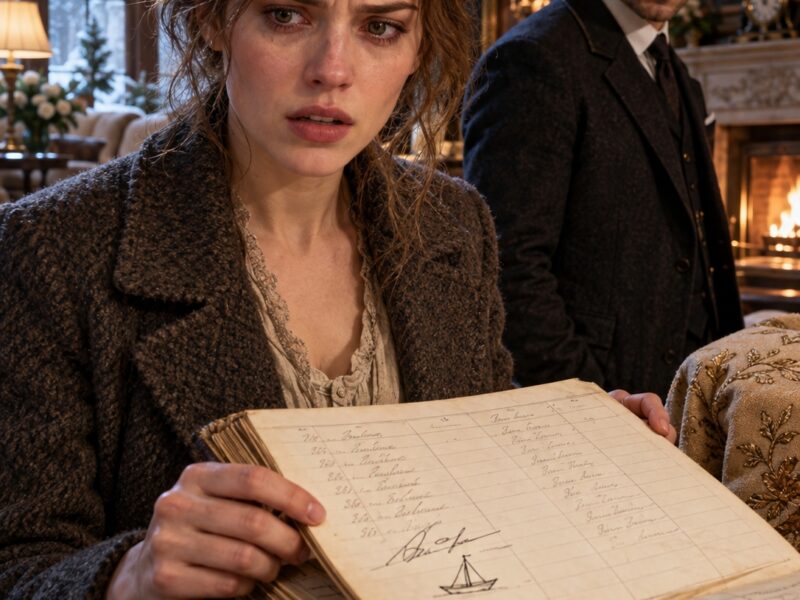
He Said She’d Be Gone by Christmas—Then the Woman He Looked Down On Found the Secret That Could Destroy His Entire Family

“She’ll be gone by Christmas.”
Julian Mercer said it quietly.
That somehow made it worse.
He wasn’t shouting. He wasn’t angry. He wasn’t even looking at Clara Bennett when he decided how long she belonged in his family’s house.
He was standing beside the tall windows of his grandfather’s study, watching snow erase the long driveway of Blackthorne Hall, while his father sat behind him with a glass of bourbon and an expression that suggested he had already heard enough.
“She runs a roadside inn, Dad.”
Captain Edmund Mercer lifted one eyebrow.
“She runs it successfully.”
“That doesn’t make her qualified to manage Blackthorne.”
“It makes her more qualified than the last three people you hired.”
Julian turned.
“She also thinks Adrien is lying.”
“And perhaps,” Edmund said, “you’re angry because you’re afraid she may be right.”
Julian’s jaw tightened.
Neither man noticed the shadow beyond the half-open study door.
Neither knew Clara Bennett was standing there with one battered suitcase in one hand and her father’s old ring of keys in the other.
She had taken the wrong hallway while looking for the service stairs.
Now she stood perfectly still.
“She’ll be gone by Christmas,” Julian repeated.
This time, Clara lowered her eyes to the keys.
Then she turned around and walked away without making a sound.
She didn’t confront him.
She didn’t cry.
She didn’t tell him she had heard.
She simply went downstairs, found the kitchen freezing cold, rolled up her sleeves, and lit the first fire Blackthorne Hall had seen in years.
And before that winter was over, the woman Julian Mercer wanted out of his house would uncover a lie capable of taking the house away from him.
But that wasn’t the worst part.
The worst part was that exposing the lie would destroy a grieving mother who already knew the truth.
Or at least enough of it to be afraid.
Three weeks earlier, Clara Bennett’s world had been much smaller.
At twenty-six, she owned the White Hart Inn, a weathered stone-and-timber building beside a two-lane road in northern Vermont, not far from the Canadian border.
The inn had belonged to her father.
And before him, to his father.
There was nothing glamorous about it.
The roof above the stables leaked.
Two upstairs windows rattled when the wind came from the north.
The furnace worked only when threatened.
The oak bar had been polished so many times that Clara could still see the faint circular stain where her father had rested his coffee every morning for twenty-seven years.
She loved every inch of it.
Her father had taught her to run the place before he taught her to drive.
He had also taught her to watch people.
“Anybody can lie with their mouth,” Thomas Bennett used to tell her. “Most people forget to teach their hands.”
Clara never forgot that.
It was the last week of November when the first major snowstorm buried the Vermont hills.
By five in the afternoon, the road outside the White Hart was disappearing beneath white.
Truckers came in stomping snow from their boots.
A retired couple from Albany canceled their reservation.
Old Mr. Pritchard occupied his usual stool and announced for the third time that winter had been more respectable when he was young.
Clara was kneeling beside the fireplace, separating damp logs from dry ones, when headlights swept across the front windows.
A black SUV pulled into the parking lot.
The door opened.
A man stepped out.
Clara looked up.
Something about him made the entire room quiet.
He was in his late thirties, perhaps forty. Lean. Dark-haired, though gray had begun to show near his temples. His face had the exhausted, sun-weathered look of someone who had spent years somewhere much hotter than Vermont.
His coat was expensive.
His shoes were expensive.
But neither looked as if they belonged to him.
A second man hurried in behind him.
“Road’s closed north of here,” the driver said. “We need rooms.”
Clara stood.
“Of course.”
The stranger looked at her.
“Clara Bennett?”
“Yes.”
His expression changed.
“You’re Thomas Bennett’s daughter.”
Clara felt something cold move through her that had nothing to do with the open door.
“You knew my father?”
The man hesitated.
Then smiled.
“Long ago.”
He extended his hand.
“Adrien Whitmore.”
Someone near the bar dropped a glass.
It hit the floor and shattered.
Nobody moved.
Clara stared at the stranger.
The Whitmore name was known throughout northern Vermont.
Blackthorne Hall sat eight miles from the White Hart, hidden behind iron gates and hundreds of acres of forest, farmland and apple orchards.
The Whitmores had owned it for generations.
Twelve years earlier, Adrien Whitmore—the only son of Richard and Eleanor Whitmore—had gone to India to oversee a family charitable foundation.
Months later, news came that he had died during a severe fever outbreak.
There had been no body returned.
Only documents.
Witness statements.
A death certificate.
A memorial service.
Clara had been fourteen.
She remembered the church bells.
She remembered seeing Eleanor Whitmore arrive in black.
And she remembered something else.
Something small.
Something she couldn’t quite reach.
Now the dead man was standing inside her inn.
“I survived,” he explained later.
Everyone had questions.
Adrien had answers.
Illness.
Confusion.
A hospital transfer.
Memory loss.
Years spent moving through clinics and charitable missions.
Fragments of his identity returning slowly.
A newspaper photograph finally showing him Blackthorne Hall and triggering something he could no longer ignore.
It was an extraordinary story.
Extraordinary enough that most people wanted to believe it.
Clara served him dinner.
And watched.
His expensive shoes pinched his feet.
She could tell from the way he shifted his weight.
His tailored coat was slightly broad through the shoulders.
When Polly, Clara’s teenage waitress, nearly lost control of a tray, Adrien moved before anyone else.
Not away.
Toward her.
One hand caught the tray.
The other steadied Polly’s elbow.
“Careful.”
“Thank you, sir.”
Adrien froze for half a second at the word sir.
Then smiled.
Later, when Clara brought his meal, she noticed how he ate.
His left arm curled protectively around his plate.
His shoulders angled forward.
Quick bites.
Minimal space.
The posture of someone accustomed to crowded staff tables, cafeterias or places where meals disappeared if you weren’t paying attention.
Not the posture of a man raised in Blackthorne Hall.
Clara hated herself for noticing.
Because kindness wasn’t evidence.
Neither were uncomfortable shoes.
Neither was posture.
So she said nothing.
Near midnight, Adrien came to the desk.
“Could I borrow a pen?”
Clara handed him one.
He signed the register.
Adrien Whitmore.
Slow.
Deliberate.
Then beneath the signature, almost unconsciously, the pen made another mark.
A curved line.
A second stroke.
A tiny triangular sail.
A little boat riding a wave.
Clara stopped breathing.
Adrien closed the register.
“Good night, Ms. Bennett.”
“Good night.”
He walked upstairs.
Clara reopened the book.
The little boat remained beneath his name.
She touched the edge of the page.
She had seen it before.
She knew she had.
But where?
The next morning, Polly came downstairs looking confused.
“Miss Bennett?”
“What?”
“Mr. Whitmore didn’t sleep in his bed.”
Clara looked up.
“What do you mean?”
“The covers weren’t touched. He sat in the chair all night.”
“Maybe he couldn’t sleep.”
“That’s not the strange part.”
Polly lowered her voice.
“He put the chair beside the door.”
Clara felt the memory of her father’s voice.
Watch the hands.
An hour later, another vehicle pulled into the White Hart.
Julian Mercer stepped out.
Thirty-three years old.
Six feet two.
Dark wool coat.
Snow on his shoulders.
No driver.
No assistant.
No entourage.
Julian had inherited control of the Whitmore family estate after Adrien’s presumed death and Richard Whitmore’s death two years earlier.
Technically, the holdings were controlled through trusts and family companies rather than anything as romantic as an aristocratic title.
But locally, Blackthorne was still Blackthorne.
And Julian Mercer was the man responsible for keeping it alive.
Clara had seen him before.
Usually from a distance.
He was known for being private, disciplined and almost painfully serious.
That morning, his boots were covered in mud and snow.
He had driven himself.
Clara noticed that, too.
“I’m here for my cousin.”
His voice was calm.
“Of course.”
She hesitated.
“Mr. Mercer?”
Julian looked at her.
“Your cousin didn’t sleep last night.”
A slight change came over his face.
“What?”
“He sat beside the door until morning.”
Julian’s eyes remained on hers.
“And?”
“That’s all.”
“You think it means something?”
“I don’t know.”
His expression hardened.
“Then perhaps we shouldn’t make it mean something.”
He walked past her.
Clara watched the two men meet.
Julian stopped several feet away from Adrien.
For a moment neither spoke.
Then Julian stepped forward and held out his hand.
“Welcome home.”
Adrien looked at it.
Then at Julian.
“Thank you.”
The handshake lasted perhaps three seconds.
But Clara saw fear in both men.
Different kinds.
Adrien looked afraid of being discovered.
Julian looked afraid of wanting him to be.
A week later, Edmund Mercer came to the White Hart.
Julian’s father had been a Navy captain before retirement, and age had not softened him much. Arthritis had slowed his walk, but his eyes remained sharp.
He sat near Clara’s fireplace.
“My sister-in-law has stopped wearing black.”
Clara poured him coffee.
“Mrs. Whitmore?”
“Lavender yesterday.”
He smiled sadly.
“I hadn’t seen Eleanor wear a color in twelve years.”
Clara understood what he wasn’t saying.
If Adrien was a fraud, exposing him wouldn’t simply correct an inheritance.
It would kill something inside Eleanor Whitmore.
Still, Clara told Edmund what she had noticed.
The shoes.
The coat.
The servants’ habits.
The untouched bed.
The little boat.
Edmund listened.
When she finished, he stared into the fire.
“Adrien was spoiled.”
Clara said nothing.
“God forgive me for speaking ill of a boy everyone thought dead, but he was. He never carried luggage. Never remembered a server’s name. Once made a driver wait three hours because he changed his mind about going somewhere.”
Clara wiped the counter.
“The man who stayed here thanked Polly every time she poured coffee.”
Edmund looked at her.
“Exactly.”
Silence settled between them.
Then he said, “Blackthorne needs a house manager.”
Clara laughed.
Edmund didn’t.
“You’re serious?”
“Very.”
“I run an inn.”
“You run a building with guests, employees, inventory, repairs, heating, food service and accounts.”
“That doesn’t make me qualified to run Blackthorne Hall.”
“No. Your brain does.”
Clara stared at him.
“Until the end of March,” Edmund said. “My sister-in-law has moved back in. People are coming from everywhere to see Adrien. The current manager resigned yesterday.”
Clara thought of the stable roof.
For two winters she had been saving to repair it.
Blackthorne would pay enough in four months to finish the work.
She could leave the White Hart with her longtime stable manager and his wife.
And she would be close enough to observe Adrien.
That last reason frightened her most.
“I’ll do it.”
Edmund smiled.
“Julian will hate this.”
“Comforting.”
“He’ll survive.”
Clara would remember those words later.
Because when she arrived at Blackthorne Hall carrying one suitcase, Julian Mercer had already decided she wouldn’t survive until Christmas.
The first thing Clara discovered about Blackthorne Hall was that beautiful houses could be miserable places.
The kitchen was freezing.
The central heating had been partially shut down to save money.
Three fireplaces were unusable.
Several guest rooms smelled of mildew.
One wing had been closed for nearly a decade.
And everyone seemed to have accepted discomfort because discomfort had become tradition.
Clara didn’t believe in suffering for tradition.
She found Polly’s cousin Emily shivering beside a tiny kitchen heater.
“Where’s the fireplace key?”
Emily blinked.
“The main hearth?”
“Yes.”
“No one uses it.”
“Why?”
“Mr. Whitmore didn’t like smoke.”
“Which Mr. Whitmore?”
“The old one.”
“He’s dead.”
Emily stared at her.
Clara held out her hand.
“The key.”
Twenty minutes later, flames climbed the stone fireplace.
Warmth began pushing into the room.
Emily almost cried.
Clara stood with soot on her cheek and thought of Julian’s words.
She’ll be gone by Christmas.
“We’ll see,” she whispered.
She attacked Blackthorne the way she attacked a winter storm at the White Hart.
One problem at a time.
She brought in chimney cleaners.
Reopened bedrooms.
Had mattresses aired.
Reorganized the pantry.
Repaired schedules so house staff stopped working fourteen-hour days because nobody had bothered to coordinate shifts.
She learned names.
Not positions.
Names.
Within two weeks, Blackthorne began to change.
Smoke rose from chimneys that had been cold for years.
Lights appeared in windows after sunset.
People laughed in the kitchen.
One afternoon Julian returned from inspecting the southern orchards.
He entered the great room and stopped.
A massive fireplace was burning.
Clara stood on a ladder adjusting a wreath.
“You lit that?”
She looked down.
“The fireplace?”
“Yes.”
“It was cold.”
“My uncle prohibited fires in here.”
Clara climbed down.
“Why?”
“He thought the smoke damaged the paintings.”
Clara glanced at the enormous stone chimney.
“The chimney was blocked.”
Julian stared at her.
“I had it cleaned.”
“That wasn’t what I asked.”
“No.”
She stepped off the ladder.
“Your uncle is dead, Mr. Mercer.”
Julian’s eyebrows lifted.
Clara immediately added, “Respectfully.”
Something almost happened to his mouth.
Almost.
“You’re remarkably comfortable ignoring instructions.”
“Only dead people’s instructions.”
This time he did smile.
Barely.
It vanished so quickly she wondered whether she had imagined it.
But she hadn’t.
And that frightened her for reasons that had nothing to do with Adrien.
By mid-December, visitors were arriving daily.
Everyone wanted to see the man who had returned from the dead.
Adrien performed beautifully.
He remembered names.
Stories.
Horses.
Childhood vacations.
A broken window in the west wing.
A disastrous Thanksgiving when someone burned the turkey.
The more Clara watched, the more unsettled she became.
Because he knew the facts.
But he didn’t inhabit them.
When people told stories about young Adrien being reckless, impatient and arrogant, the man before them laughed as though remembering someone else.
He was too gentle.
Too observant.
Too accustomed to disappearing around powerful people.
He used service hallways without thinking.
He knew where cleaning supplies were stored.
He carried his own bags.
He moved aside for employees.
And every act of kindness made Clara more certain he was lying.
That was the cruelest contradiction.
She liked him.
The real Adrien Whitmore, according to everyone who remembered him, had been difficult.
The false one was decent.
And Eleanor Whitmore adored him.
At sixty-four, Eleanor’s eyesight was failing badly.
She wore a wheat-colored Kashmir shawl almost every evening, embroidered with small red and blue flowers.
Adrien had supposedly sent it from India shortly before his death.
For twelve years, it had been one of the few objects Eleanor possessed that had last passed through her son’s hands.
She distrusted Clara immediately.
“So you’re the innkeeper.”
“Yes, ma’am.”
“My brother-in-law seems determined to turn this house into a hotel.”
Clara smiled politely.
“I’ll try not to put a vacancy sign outside.”
Eleanor did not smile.
But Clara understood her hostility.
Eleanor had spent twelve years mourning.
Now happiness had returned wearing her son’s face.
Anyone who threatened that happiness became an enemy.
One afternoon, Clara was folding linen with Martha Reed, Eleanor’s longtime personal assistant.
Martha had served the family for almost thirty years.
Clara asked casually, “Did Adrien have anyone with him in India?”
Martha’s hands stopped.
“A man named Samuel.”
Clara looked up.
“Samuel what?”
“Pike.”
The name meant nothing.
Not yet.
“What was he like?”
“Quiet. Polite. Working-class family. Somewhere near the coast in Maine, I think. His father was a fisherman.”
“What happened to him?”
“Died, apparently.”
“In India?”
“That’s what we were told.”
Clara folded another sheet.
“Did they find his body?”
Martha looked at her.
“No.”
That night Clara couldn’t sleep.
The next Sunday, she walked back to the White Hart.
Snow squeaked beneath her boots.
Inside, everything smelled like coffee, old wood and home.
She stood behind her father’s counter.
Then she saw the guest register.
The boat.
Memory struck so hard she actually grabbed the counter.
Twelve years earlier.
Adrien Whitmore had stopped at the White Hart before leaving for India.
Her father never threw away a ledger.
Clara ran upstairs.
Opened boxes.
Dragged old registers from a trunk.
Dust filled the air.
Her fingers shook as she searched.
Then she found it.
Twelve years earlier.
Adrien Whitmore.
A huge, careless signature.
A joke scribbled beside it.
Nothing like the careful handwriting in the current book.
Beneath it:
Samuel Pike.
Small handwriting.
Neat.
And below the name—
a tiny boat on a curling wave.
Clara sat down hard.
She remembered.
She had been fourteen.
Adrien and his friends had been drinking loudly.
Samuel had sat alone near the end of the bar.
Clara had been bored.
He had noticed.
Without saying much, Samuel took a newspaper and folded it.
Once.
Twice.
Again.
A paper boat.
He placed it in a wash basin and showed her how to blow gently across the water.
She had laughed.
A tiny kindness.
Almost nothing.
Twelve years later, it had survived in her memory.
Clara carried both ledgers back to Blackthorne.
Julian was in his study.
She closed the door.
“What happened?”
She opened the books.
“Look.”
He did.
His face changed slowly.
“This is Adrien’s signature from twelve years ago.”
“Yes.”
“And this?”
“Samuel Pike.”
Julian stared at the identical boats.
Clara’s voice was almost a whisper.
“The man living in your house signs his name with Samuel Pike’s hand.”
For several seconds, Julian didn’t move.
Then he closed his eyes.
Not because he didn’t believe her.
Because some part of him did.
“What do you want me to do?”
“Nothing yet.”
His eyes opened.
“We investigate quietly.”
“No.”
“Julian—”
It was the first time she had almost used his name.
She stopped herself.
“Mr. Mercer, if he knows we suspect him—”
“If that man is Adrien, I refuse to treat him like a criminal.”
“And if he isn’t?”
Julian looked toward the window.
“Then I’ll ask him directly.”
Clara felt dread settle into her stomach.
“You’re giving him time to prepare an answer.”
“I’m giving my family the dignity of hearing it from him.”
That evening, Julian confronted Adrien.
And Adrien had the perfect explanation.
Samuel Pike, he said, had been unable to write properly.
Adrien had often helped him.
The boat had been Samuel’s personal symbol, inspired by his fisherman father.
Samuel had died in Adrien’s arms.
Afterward, Adrien had adopted the boat as a memorial.
Eleanor wept.
She held his face.
“My boy.”
Adrien closed his eyes.
Clara watched from the doorway.
Something about his expression chilled her.
Not triumph.
Pain.
Eleanor learned Clara had found the ledger.
“Get her out.”
Julian refused.
“Eleanor—”
“She is trying to destroy my son.”
“No.”
“She is trying to take him from me!”
Julian looked toward Clara.
“You will continue managing this house.”
Then, once they were alone in the corridor, his restraint broke.
“And you will do nothing else.”
Clara stared at him.
“Excuse me?”
“No more investigating.”
“You asked me what I saw.”
“And I listened.”
“You didn’t listen. You gave him the evidence and allowed him to explain it away.”
His eyes flashed.
“Enough.”
Clara’s chin lifted.
“Very well.”
She walked away.
Near midnight, Julian found her in the kitchen.
She was repairing a torn tablecloth beside the dying fire.
“I owe you an apology.”
Clara kept sewing.
“That was fast.”
“I was angry.”
“I noticed.”
He sat opposite her.
“You were right about one thing.”
“Only one?”
His mouth twitched.
“He answered too quickly.”
Clara finally looked up.
Julian leaned forward.
“As though he had rehearsed it.”
“Yes.”
She told him about being fourteen.
About Samuel.
About the paper boat.
When she finished, Julian said, “If you believe he’s Samuel, why are you protecting him?”
Clara stared at the needle between her fingers.
“Because he was kind to me once.”
“That’s enough?”
“No.”
She looked toward the dark doorway.
“But I don’t think he’s cruel.”
“He’s stealing my family’s estate.”
“I know.”
“He’s lying to Eleanor.”
“I know.”
“Then what do you think he is?”
Clara took a long breath.
“Trapped.”
Julian said nothing.
“I think Samuel Pike started a lie he believed he could control. And now your aunt loves him.”
She swallowed.
“I don’t want to see him destroyed. But I think the lie is drowning him.”
For the first time, Julian looked at her without suspicion.
And Clara realized something equally dangerous.
She no longer saw him as an arrogant rich man defending his inheritance.
She saw a man terrified that wanting to save his home might make him selfish.
Days later, Clara found Julian kneeling in snow in the southern orchard.
A rabbit had stripped bark from a young apple tree.
Julian was wrapping the damaged trunk.
His bare hands were red.
“That might survive,” Clara said.
He looked up.
“My father saved a pear tree like that once.”
Julian returned to the work.
“I planted this one.”
“I know.”
He glanced at her.
“How?”
“You talk about these trees more affectionately than most people talk about relatives.”
He laughed once.
Then his expression faded.
“I thought I’d see them grow.”
Clara understood.
If Adrien’s claim succeeded, Julian could lose control of Blackthorne.
The estate.
The woods.
The orchards.
Everything he had spent two years restoring.
“I hate what this is doing to me,” he said.
Clara waited.
“I’m glad Eleanor has her son back.”
He pressed mud around the wrapping.
“And I want this land.”
There it was.
The confession he couldn’t make to anyone else.
“What if every suspicion I have is greed?” he asked. “What if I’ve convinced myself Adrien is an impostor because the alternative costs me everything?”
Clara looked at the wounded tree.
Then she held out her hand.
“Then let me do the doubting.”
Julian looked up.
“Why?”
“Because I have no orchards to lose.”
He took her hand.
She pulled him to his feet.
Neither released the other immediately.
Something passed between them.
Quiet.
Uninvited.
Dangerous.
On the walk back, Julian stayed on the windward side so the snow struck him instead of her.
He never mentioned it.
Neither did Clara.
But after that day, they stopped pretending nothing had changed.
Christmas Eve transformed Blackthorne.
Clara revived traditions the house had abandoned years earlier.
Employees and family ate in the same great room.
Garlands hung over the doors.
Music filled the halls.
For one evening, Blackthorne felt less like an inheritance and more like a home.
Then Eleanor stood.
The room quieted.
She removed the Kashmir shawl from her shoulders.
“Adrien.”
Samuel—still wearing another man’s name—went pale.
Eleanor crossed to him.
“You sent this to me when you thought you were dying.”
She placed it around his shoulders.
“Now you’re home.”
People applauded.
Samuel didn’t move.
Clara saw his fingers close around the fabric.
His face looked like a man being strangled.
Later, after midnight, Clara was tending the fireplace when Julian entered.
“It’s Christmas.”
“So it is.”
He waited.
She smiled faintly.
“And I’m still here.”
Julian frowned.
Then understood.
“You heard me.”
“Every word.”
He sat beside her.
“I was an ass.”
“Yes.”
“I’ve been waiting for you to disagree.”
“I try not to lie at Christmas.”
He laughed softly.
Then grew serious.
“I’m glad I was wrong.”
Clara looked at him.
His voice dropped.
“I haven’t been so glad to be wrong about anything in a very long time.”
He took her hand.
For a moment she thought he might kiss her.
Instead, he lifted her fingers to his lips.
The gesture was almost painfully restrained.
Then he left.
Clara remained beside the fire with her hand pressed against her chest.
For one night, she allowed herself to be happy.
By New Year’s, everything began to collapse.
Samuel started disappearing.
He drove into Burlington or Montreal without explanation.
Letters arrived from New York.
Whenever Eleanor mentioned formalizing his inheritance claim, panic crossed his face.
Then, one Sunday evening, Clara returned to the White Hart.
A stranger was drinking whiskey beside the fireplace.
Expensive coat.
Hard eyes.
New York accent.
He was showing Clara’s stable manager something.
Fabric.
Wheat-colored Kashmir.
Red and blue flowers.
Clara stopped.
Eleanor’s shawl.
“Where did you get that?”
The stranger smiled.
“Interested?”
“Where?”
“Guy owed me money.”
“What guy?”
“None of your business.”
“Burlington?”
His eyes narrowed.
“Maybe.”
Clara knew.
Samuel had taken the most precious thing Eleanor owned.
Not stolen from a stranger.
Taken from the woman who believed he was her dead son.
Clara went upstairs.
Under her bed was a metal cashbox.
Two years of savings.
The stable roof.
She brought it downstairs.
“How much?”
The stranger laughed.
“You’re serious?”
“How much?”
When he left, the box was empty.
Clara held the shawl.
Two winters of savings were gone.
But she had something more important now.
Proof.
She returned to Blackthorne the following evening.
Samuel was alone in the library.
She closed the door.
Placed a package on the desk.
He opened it.
The color left his face.
“Where did you get this?”
“My inn.”
Samuel sank into the chair.
Clara remained standing.
“I paid for it.”
His eyes filled with shame.
“I haven’t told Julian.”
He looked up.
“Or Eleanor.”
“Why?”
“Because I’m giving you a chance.”
Samuel stared at her.
“To do what?”
“Stop.”
His face twisted.
“You think it’s that simple?”
“No.”
“You know nothing about—”
“I know your name.”
Silence.
Clara said it.
“Samuel.”
His entire body went still.
She had him.
For one second, she saw relief.
Not fear.
Relief.
“You remember me,” Clara whispered.
His eyes closed.
Before he could answer, Eleanor’s voice sounded outside.
“Adrien?”
Samuel panicked.
It happened instantly.
His chair crashed backward.
He grabbed the shawl.
Opened the door.
“Mother!”
Clara’s stomach dropped.
Eleanor approached with Martha behind her.
Samuel held up the shawl.
“I found it.”
Eleanor stopped.
“What?”
Samuel looked at Clara.
And Clara saw the decision happen inside him.
Fear defeated conscience.
“This disappeared from my room last week.”
Clara stared at him.
Samuel’s voice shook.
“I didn’t tell you because I knew what it meant to you.”
Eleanor looked from the shawl to Clara.
“Where was it?”
Samuel swallowed.
“With her.”
People were gathering.
Employees.
Guests.
Julian was not there.
Clara could barely breathe.
“That isn’t what happened.”
Eleanor’s expression hardened.
“Then explain.”
“I bought it from a man at the White Hart.”
“Who?”
“I don’t know his name.”
“Receipt?”
“No.”
“Witness?”
“My stable manager saw him.”
Samuel said nothing.
Clara looked directly at him.
“Tell her.”
His eyes dropped.
“Tell her how he got it.”
Nothing.
Eleanor’s voice cracked through the hallway.
“Get out of my house.”
Clara turned toward her.
“Mrs. Whitmore—”
“You thief.”
The word landed harder than Clara expected.
Not because Eleanor believed it.
Because everyone heard it.
The employees Clara had defended.
The people whose schedules she had fixed.
The young women whose rooms she had warmed.
The staff she had fed at Christmas.
All watching.
Clara looked at Samuel.
He still couldn’t meet her eyes.
Julian entered from outside.
“What happened?”
Eleanor pointed at Clara.
“She stole Adrien’s shawl.”
Julian looked at Clara.
Then Samuel.
Then the shawl.
“No.”
Eleanor stared at him.
“What?”
“Clara didn’t steal it.”
“You weren’t here.”
“I don’t need to have been.”
Eleanor’s face tightened.
“So choose.”
Julian went still.
“Excuse me?”
“Choose.”
Her voice trembled.
“The woman you’ve known for a few weeks—or my son.”
Julian opened his mouth.
Clara saw his answer before he spoke.
He would choose her.
And if he did, the family would split open in that hallway.
“No.”
Everyone looked at Clara.
She lifted her chin.
“There’s no choice to make.”
“Clara—” Julian began.
“I’m leaving.”
“You are not.”
“Yes.”
She looked at Eleanor.
“I won’t remain where I’m considered a thief.”
Then she looked at Samuel.
He finally raised his eyes.
What she saw there wasn’t victory.
It was devastation.
Fifteen minutes later, Clara carried her suitcase through Blackthorne’s front doors.
Snow was falling.
Julian stood beside his truck.
“I’m driving you.”
“You don’t need to.”
“I wasn’t asking.”
They rode in silence.
Halfway to the White Hart, Julian pulled onto the shoulder.
Clara looked at him.
“What are you doing?”
He turned.
“I believe you.”
Three words.
That was all.
Clara looked away quickly.
“I know.”
“No, I need you to hear me.”
His voice was rough.
“I believe you.”
He gripped the steering wheel.
“And if Adrien was willing to destroy your reputation to protect himself, then he can lie about anything.”
Clara looked at him.
“I should have listened earlier.”
“Yes.”
“I was a coward.”
She said nothing.
“I kept telling myself I was protecting Eleanor.”
His voice broke slightly.
“But maybe I was protecting myself from having to act.”
Clara reached across the console.
Placed her hand over his.
“We act now.”
Julian looked down at their hands.
“How?”
Clara glanced toward the distant lights of her inn.
“From my counter.”
The White Hart became their intelligence network.
Truckers.
Delivery drivers.
Traveling salesmen.
Retired cops.
Farmers.
Fishermen.
Hotel workers.
People talked.
Clara listened.
Every night she wrote names in her father’s ledger.
Samuel Pike.
India.
New York.
Maine.
Fishing family.
Little boat.
Weeks passed.
Nothing.
Then, in late February, a delivery driver from coastal Maine stopped because an interstate accident had forced him west.
Clara asked her usual question.
“Samuel Pike?”
The man frowned.
“Pike?”
“Yes.”
“Fisherman’s kid?”
Clara’s pulse jumped.
“You know him?”
“Not personally. His mother lives near Lubec.”
Clara gripped the counter.
“His mother?”
“Old Mrs. Pike. Husband drowned years ago.”
“Samuel came back from India?”
“Sure did.”
The room seemed to tilt.
“He worked in New York for years.”
“When did she last hear from him?”
“Three years, maybe.”
“Do you know how he signed his letters?”
The driver laughed.
“Funny thing. Little boat.”
Clara stopped breathing.
Julian arrived at the White Hart that evening.
He had been in New York investigating Samuel’s employment.
He looked exhausted.
“I found the hotel.”
Clara stood.
“And?”
“Samuel Pike worked there.”
She closed her eyes.
Julian continued.
“He was good. Everyone liked him.”
“What happened?”
“Gambling.”
Clara’s eyes opened.
“Debts?”
“Bad ones.”
“How bad?”
Julian placed documents on the counter.
“Bad enough that he promised people repayment from Blackthorne.”
Clara stared at him.
“He couldn’t.”
“He could if he became Adrien.”
Julian’s face was pale with anger.
“The moment the inheritance is recognized, these agreements become leverage against family assets.”
“The orchards?”
“Yes.”
“The woods?”
“Yes.”
Clara looked at him.
“I found Samuel’s mother.”
Julian froze.
“She’s alive.”
For the first time in weeks, hope entered his face.
“Will she come?”
“No.”
“Why?”
“She thinks we’ll send her son to prison.”
Julian stood quietly.
Then reached for his coat.
“What are you doing?”
“Going to Maine.”
“Julian—”
“She needs to hear it from me.”
“What?”
“That I won’t destroy her son.”
Clara studied him.
“You can’t promise the authorities won’t prosecute fraud.”
“No.”
He buttoned his coat.
“But I can promise I won’t pursue revenge.”
He paused.
“And I can promise that if Samuel tells the truth before he takes Blackthorne, I’ll do everything legally possible to keep this from becoming vengeance.”
Clara watched him leave.
She remembered the man who had said she would be gone by Christmas.
That man had measured people by where they belonged.
The man walking into the snow now was about to sit at the door of a poor fisherman’s widow and ask for help.
Maybe houses weren’t the only things capable of becoming warmer.
Mrs. Pike refused to open her door.
Julian waited.
He didn’t mention the Mercer name.
Didn’t tell her how much Blackthorne was worth.
Didn’t threaten.
He sat on an overturned fishing boat in the March wind.
Nearly an hour passed.
Finally the door opened.
A small elderly woman looked out.
“You’re the man asking about Samuel.”
“Yes.”
“Are you police?”
“No.”
“Lawyer?”
“No.”
“Then what do you want?”
“To bring your son home.”
Her face changed.
Julian stood.
“He’s alive.”
Mrs. Pike grabbed the doorframe.
“He’s done something terrible, hasn’t he?”
Julian didn’t lie.
“Yes.”
She began closing the door.
“But he’s also done something kind.”
She stopped.
Julian told her about Eleanor.
About reading aloud.
About sitting beside her.
About giving a grieving woman several months in which she believed her child had come home.
“It doesn’t excuse what he did.”
Mrs. Pike was crying silently.
“But it tells me your son isn’t only the worst thing he’s done.”
The old woman looked at him for a long time.
“What will happen?”
“I don’t know.”
“Will you hurt him?”
“No.”
“Will you have him arrested?”
Julian took a breath.
“I will not seek revenge against Samuel.”
It was the most honest promise he could give.
Mrs. Pike opened the door.
“Come inside.”
The confrontation happened on the last Tuesday of March.
Eleanor was taking Samuel to Boston to finalize the remaining legal steps of his inheritance claim.
Their route passed the White Hart.
Edmund convinced Eleanor to stop.
She entered reluctantly.
“I don’t know why we’re here.”
Clara stood behind the counter.
Eleanor did not look at her.
Samuel entered last.
He automatically helped the driver with a bag before coming inside.
Then he saw the woman beside the fireplace.
Everything stopped.
Mrs. Pike rose.
Her coat was old.
Her hands were worn.
Her eyes were brown.
Exactly like his.
She said one word.
“Samuel.”
He didn’t breathe.
Eleanor turned toward him.
“Adrien?”
Samuel’s mouth opened.
Nothing came.
Mrs. Pike took one step.
“My boy.”
Samuel broke.
Not gradually.
Completely.
He crossed the room and dropped to his knees.
Pressed his face into his mother’s hands.
And wept.
Eleanor stood motionless.
“Who is that woman?”
Samuel lifted his head.
The lie had nowhere left to go.
He turned toward Eleanor.
“My name is Samuel Pike.”
Nobody moved.
“The real Adrien died in India.”
Eleanor’s face emptied.
Samuel continued because stopping would have been worse.
“He died from fever. I was with him.”
Eleanor sat down.
“I came home afterward. Worked in New York.”
His voice shook.
“I gambled. I borrowed. Then I borrowed to repay what I’d borrowed.”
He laughed bitterly.
“When Richard Whitmore died, I read about it.”
Julian stood near the window.
Samuel looked at him.
“I knew everything about Adrien. He talked constantly. Childhood stories. Family. Blackthorne. His mother.”
His gaze moved to Eleanor.
“I thought I could pretend for a few months.”
Eleanor whispered, “Why?”
“Money.”
The word nearly destroyed him.
“I needed the inheritance to settle my debts.”
Eleanor’s hands trembled.
Samuel stepped toward her.
“But then you hugged me.”
She recoiled.
He stopped.
“You called me your son.”
His voice broke.
“And every morning I told myself I would confess that night.”
Clara felt tears burn behind her eyes.
“Then night came, and you asked me to read.”
Samuel covered his face.
“And I couldn’t take him away from you again.”
Eleanor whispered, “The shawl.”
Samuel lowered his hands.
“I gave it to a creditor.”
Eleanor closed her eyes.
“Clara bought it back.”
Eleanor opened them.
Samuel turned toward Clara.
“She used her own money.”
His voice was barely audible.
“She came to me privately. She gave me a chance to confess.”
He swallowed.
“And I called her a thief.”
The silence afterward was unbearable.
Clara had imagined this moment many times.
She had imagined vindication.
Satisfaction.
Perhaps anger.
Instead, she felt only sadness.
Eleanor stood.
She walked toward Mrs. Pike.
The other mother looked frightened.
Eleanor slowly removed the Kashmir shawl from her shoulders.
She folded it.
Then placed it around Mrs. Pike.
The room went still.
“Your son came home.”
Mrs. Pike began crying.
Eleanor touched the shawl once.
“Mine didn’t.”
No one had an answer.
There are griefs too large for apologies.
Eleanor walked outside.
Martha followed.
Edmund stopped beside Julian before leaving.
He gave his son one small nod.
Then he was gone.
Samuel remained near his mother.
Julian approached him.
“I gave her my word.”
Samuel looked up.
“I know.”
“I’m keeping it.”
Samuel’s eyes filled again.
“You’ll still have to cooperate in undoing everything you signed.”
“I will.”
“The creditors won’t touch Blackthorne.”
Samuel nodded.
Then he looked toward Clara.
Something changed in his face.
“You.”
Clara waited.
“The girl.”
She smiled faintly.
“At the counter.”
His eyes widened.
“You remember.”
“You made me a paper boat.”
Samuel laughed through his tears.
“I thought nobody remembered.”
“I did.”
His mother took his hand.
Samuel looked at Clara one last time.
“I’m sorry.”
She nodded.
“I know.”
It wasn’t forgiveness.
Not yet.
But it was enough to let him leave.
By afternoon, the White Hart was quiet again.
Clara sat beside the fireplace.
Julian sat across from her.
Neither had spoken for several minutes.
Finally he said, “You saved Blackthorne.”
Clara shook her head.
“We did.”
“No.”
“The documents, the orchards, the woods—without you, I would have lost all of it.”
“And without you, Mrs. Pike would never have come.”
Julian looked into the fire.
“You sat outside her house for an hour.”
“She was afraid.”
“You could have demanded.”
“That would have made her more afraid.”
Clara smiled.
“Exactly.”
Julian looked at her.
Something in the room changed.
Clara felt it.
So did he.
“You brought her,” Clara said. “I couldn’t have done that alone.”
Then, without thinking, she added:
“Julian.”
His face changed.
She had never called him that.
Not directly.
Not until now.
He stood.
Crossed the small distance between them.
Then, to Clara’s astonishment, he knelt beside her chair.
“What are you doing?”
“Paying for something.”
“What?”
He took both her hands.
“I told my father you’d be gone by Christmas.”
Clara laughed.
“You’re still worried about that?”
“I expect to be paying for it for the rest of my life.”
Her smile faded.
Julian’s expression didn’t.
“I would like to.”
Clara stopped breathing.
“I love you.”
There was no grand audience.
No orchestra.
No Blackthorne ballroom.
Only the White Hart.
Her father’s fireplace.
Mud on Julian’s boots.
And a man who looked more frightened than he had while facing the possible loss of his entire inheritance.
“I think I started falling in love with you the day you lit the great fireplace without asking permission.”
Clara laughed softly.
“That was romantic?”
“It was terrifying.”
He squeezed her hands.
“You walked into a house everyone had accepted as cold and decided cold wasn’t good enough.”
His voice softened.
“You did the same thing to me.”
Clara’s eyes filled.
“Julian…”
“Marry me.”
She stared at him.
He waited.
Clara looked around the White Hart.
The old counter.
The worn floor.
The fireplace her father had taught her to build.
“I have a condition.”
“Anything.”
“I keep the inn.”
Julian blinked.
“Of course.”
“I mean legally.”
“Clara—”
“It stays mine. I don’t sell it. I don’t transfer it into some family trust. I don’t become someone who needs permission to come home.”
Julian smiled.
“Keep it.”
“And I still work here.”
“Fine.”
“And nobody from Blackthorne changes the menu.”
“Now you’re becoming unreasonable.”
She laughed.
Julian rose just enough to bring his face close to hers.
“So?”
“So what?”
“Will you marry me?”
Clara let him suffer for three more seconds.
“Yes.”
His forehead dropped against hers.
“When?”
“Easter.”
Julian pulled back.
“Easter?”
“Yes.”
“That’s three weeks away.”
“I own a hospitality business. I can organize a wedding.”
He stared at her.
“You’re serious.”
“Completely.”
Then Clara leaned down and kissed him.
Julian wrapped his arms around her.
And for the first time since she had known him, she heard him laugh without restraint.
Not the polite laugh of a man trained to carry responsibility.
Not the dry sound he used in meetings.
A real laugh.
Warm.
Relieved.
Alive.
Blackthorne Hall had survived.
But Clara suspected something else had survived with it.
The wounded tree.
The grieving family.
Perhaps even Samuel.
Not unchanged.
But alive.
Sometimes that had to be enough.
They married on Easter morning.
The snow had melted from the Vermont hills.
Apple blossoms had begun appearing along the southern slopes of Blackthorne.
Eleanor did not attend.
Clara understood.
Grief could not be ordered into forgiveness simply because the truth had finally arrived.
But when Clara and Julian walked out of the small white church, Martha Reed was waiting near the gate.
She carried a bunch of pale spring flowers.
“Mrs. Whitmore picked these herself.”
Clara stopped.
Martha held them out.
“She asked me to give them to you.”
No apology.
No speech.
No explanation.
Clara accepted the flowers.
“Tell her thank you.”
Martha nodded.
Clara carried them for the rest of the day.
By autumn, the orchard produced its first apples.
Julian brought six to the White Hart in his hat as if he had personally invented agriculture.
Clara laughed at him.
He kissed her behind the counter.
Edmund complained loudly that married people were becoming intolerable.
Eleanor moved into the smaller guesthouse on the Blackthorne property.
Edmund visited her most evenings.
He read aloud badly.
Skipped lines.
Mispronounced names.
Eleanor complained constantly.
And every evening she asked when he was coming back.
Samuel returned to the coast with his mother.
The legal mess took months to resolve.
He sold what little he owned to settle part of his debts and worked out agreements for the rest.
He never became Adrien Whitmore again.
He repaired his father’s old fishing boat.
On Sundays, his mother wore a wheat-colored Kashmir shawl to church.
And Clara kept the White Hart.
The stable roof was finally repaired.
One cool October evening, Clara stood behind her father’s oak counter.
The guest book was open.
Julian sat near the fireplace wearing muddy boots.
Exactly the sort of boots Clara’s father would have told her to notice.
She rested one hand lightly against her stomach.
There was one secret she had not yet told anyone except Julian.
Their first child would arrive in spring.
Outside, a horn sounded on the road.
Two short blasts.
One long.
Clara smiled.
Only a traveler needing a room.
Once, a winter traveler had arrived at her door carrying another man’s name.
That lie had taken her into Blackthorne Hall.
It had gotten her called a thief.
It had cost her two years of savings.
It had forced one mother to lose her son for the second time and another to find hers.
But it had also taught Clara something her father had never written in any ledger.
Truth was rarely clean.
Good people could do terrible things.
Grief could make intelligent people choose beautiful lies.
Love could make cowards brave and honest people afraid.
And sometimes the person everyone underestimated was the only one standing far enough outside the story to see it clearly.
Clara closed the guest book.
Julian looked up.
“Another customer?”
“Probably.”
“Want help?”
She glanced at his boots.
“You’ll track mud everywhere.”
“I own half the mud in Vermont.”
“You own none of my floor.”
He smiled.
Clara opened the door.
Cold autumn air entered.
Behind her, the fire burned steadily.
Above the bar hung her father’s old ring of keys.
And tucked inside the oldest guest ledger was a yellowed piece of newspaper Clara had folded years later into the shape she remembered.
A tiny paper boat.
A reminder that the smallest kindness could survive longer than a lie.
That one forgotten gesture could cross twelve years and expose a stolen identity.
That a house could be inherited, lost, recovered and repaired.
But a home was something else.
A home was the place where someone noticed you were cold—
and lit the fire.
Julian Mercer had once looked through a window at a young innkeeper arriving with one battered suitcase and confidently predicted she would be gone by Christmas.
He had been wrong.
By Christmas, Clara Bennett had become the one person he trusted.
By spring, she had saved Blackthorne.
And by the following winter, when snow covered the orchard again and smoke rose from every chimney of the house that had once been freezing, nobody wondered whether Clara Bennett belonged there anymore.
Least of all Julian.
Because in the end, she had not married into Blackthorne Hall.
She had done something far more difficult.
She had taught everyone inside it how to come home.









