HE SHOT A WIDOW’S LAST COW TO STEAL HER LAND—FIVE DAYS LATER, A STRANGER DESTROYED HIS FAMILY’S EMPIRE
The rifle cracked across the Nebraska prairie just before sundown.
Sarah Doyle heard the shot from inside her kitchen.
Her youngest boy dropped his tin cup.
Her daughter froze beside the stove.
And Sarah knew—before she reached the door, before she saw the rider in the pasture, before she smelled the gun smoke drifting through the cold autumn air—that something had just been taken from her.
Again.
She ran outside without her coat.
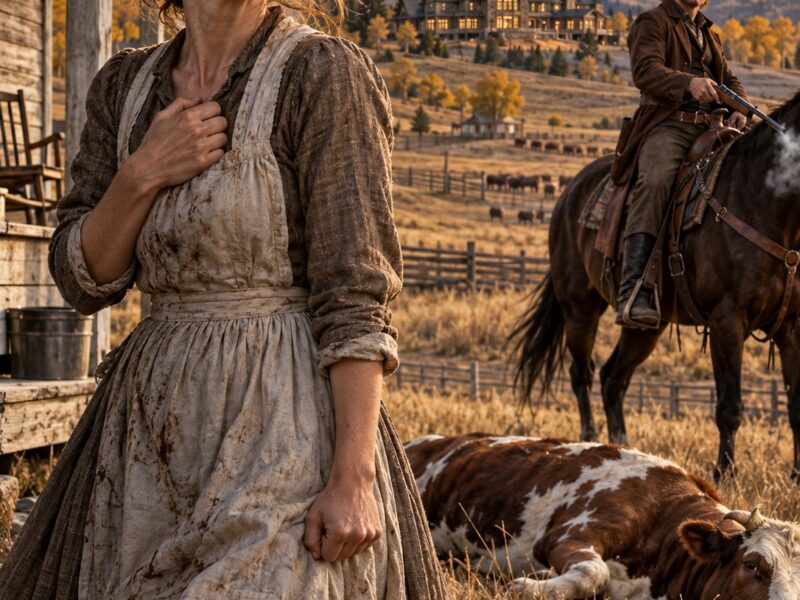
The grass was waist-high and turning brown beneath an iron-colored sky. Fifty yards from the house, their last milk cow lay on its side, legs jerking weakly against the earth.
Bo Kessler sat above it on a chestnut horse.
His rifle was still smoking.
Sarah stopped.
For one terrible second, neither of them spoke.
The cow gave a low, broken sound.
Then it became still.
Bo rested the rifle across his saddle as casually as if he had just finished shooting at a fence post.
“You have until the end of the month, Mrs. Doyle.”
Sarah stared at him.
Her breathing came shallow and fast.
“That cow fed my children.”
Bo glanced toward the animal.
“Then maybe you should’ve thought about your children when my father offered to buy this place.”
“He offered a quarter of what it’s worth.”
“He offered you a way out.”
“No.”
The word surprised even Sarah.
It came out quietly.
Bo’s mouth curved.
For two years, men in Larkin County had learned not to say that word to a Kessler.
No to Silas Kessler.
No to his son.
No to the loans.
No to the grazing agreements.
No to the suspiciously generous purchase offers that always arrived shortly after a well went bad or a bank suddenly called in a debt.
Men with wives and children had packed wagons rather than keep saying it.
Sarah Doyle had kept saying it.
And Bo hated her for that.
He leaned slightly forward in the saddle.
“You’re a widow with three children and eighty acres nobody important cares about.”
Sarah’s jaw tightened.
“My husband cared about it.”
“Your husband is dead.”
The words struck harder than the gunshot.
Sarah didn’t move.
Bo smiled.
Then another voice came from the county road.
“Did that cow ever do anything to you?”
Bo turned.
Sarah did too.
A stranger sat on a tired bay gelding beyond the fence.
He wore a weather-stained canvas duster, dusty boots, and a battered brown hat pulled low enough that his face seemed made mostly of shadow.
There was nothing impressive about him.
Nothing threatening.
Nothing that should have mattered.
Bo stared at him for a second.
Then laughed.
He spat into the grass.
“What’d you say?”
The stranger looked at the dead cow.
Then at Bo.
“Asked if the cow did anything to you.”
Bo laughed again.
This time louder.
He had spent two years frightening farmers, threatening widows, poisoning wells, cutting off credit, and watching men twice his age lower their eyes when he entered a room.
A passing drifter asking about a dead cow was not something he knew how to fear.
Not yet.
“You’d be smart to keep riding.”
The stranger’s gaze moved briefly toward Sarah.
Her dress was muddy around the hem.
Her hands were shaking.
Behind her, three children stood in the doorway of a weather-beaten farmhouse.
The oldest boy was trying not to cry.
Bo followed the stranger’s gaze.
Something almost playful entered his voice.
“See them?”
The stranger said nothing.
“That’s what happens when people get stubborn.”
Then Bo turned his horse.
He looked back at Sarah.
“End of the month.”
He tapped the rifle against his thigh.
“Next warning won’t be livestock.”
Then he rode away.
Sarah watched him until the prairie swallowed him.
Only then did her knees begin to weaken.
She thought the stranger would leave too.
Everyone else did.
For two years, that had been the lesson.
People saw.
People knew.
People lowered their voices.
And then they went home.
But the stranger swung down from his horse.
He tied the gelding to the fence.
Then he walked toward the dead cow.
Sarah stiffened.
“I don’t have money to pay you for anything.”
“I didn’t ask.”
“I don’t need charity.”
“Didn’t offer that either.”
He crouched beside the animal.
His eyes moved over the wound, the angle of the body, the churned grass around the hooves.
Then he looked toward the road Bo had taken.
“How long?”
Sarah swallowed.
“How long what?”
“Kesslers been doing this.”
Something inside her almost laughed.
Not because it was funny.
Because the question was absurdly large.
How long?
How long since her life had stopped feeling like her own?
How long since every broken fence looked deliberate?
Every sick animal looked suspicious?
Every knock at the door made her children quiet?
“Two years,” she said.
The stranger looked at her.
Sarah continued.
“Maybe longer for other people.”
He waited.
That was all.
No interruption.
No sympathetic noises.
No promise.
So Sarah told him.
And once she started, two years came spilling out.
Her name was Sarah Doyle.
She had come west with her husband Patrick nine years earlier.
They had arrived with one wagon, two horses, sixty-three dollars, and the kind of optimism only young people and fools could afford.
They built the first half of the house themselves.
Patrick dug the well.
Sarah planted cottonwoods near the porch.
Their first child was born during a spring thunderstorm.
Their second came two winters later.
Their third had Patrick’s eyes.
Then fever came through Larkin County the previous winter.
Patrick was sick for nine days.
On the tenth morning, Sarah became a widow.
Silas Kessler sent flowers.
Three weeks later, he sent an offer for her land.
Sarah refused.
A month after that, her well tasted bitter.
Then two calves died.
Then Emmett Fowler at the general store stopped extending her credit.
He had looked ashamed when he told her.
“Bank’s instructions.”
“What bank?”
He wouldn’t say.
Then someone cut a section of fence during a storm.
Then cattle trampled her vegetable field.
Then came the letters.
Sell.
Sell now.
Take the offer while it’s still generous.
Think about your children.
Finally, Bo began coming himself.
Sometimes alone.
Sometimes with two men.
Always smiling.
The stranger listened until Sarah had nothing left to say.
Then he asked, “You remember dates?”
Sarah stared at him.
“All of them.”
“Sure?”
She looked toward her house.
“I wrote them down.”
For the first time, something changed in the stranger’s face.
Not surprise exactly.
Interest.
“Everything?”
“Everything strange that happened after Patrick died. Dates. Names. What people said. What animals got sick. When the bank changed terms. When the fences were cut.”
“Why?”
Sarah looked toward the three children still watching from the doorway.
“Because everyone kept telling me I was imagining a pattern.”
Her voice hardened.
“I thought someday I might need to prove I wasn’t crazy.”
The stranger stood.
“You willing to show those records to somebody who can do something about them?”
Sarah almost smiled.
“Sheriff Bramwell?”
“No.”
“Then who?”
“Territorial land office.”
Her expression changed.
Hope was dangerous.
She had learned that too.
Hope made you spend food money.
Hope made you plant crops after drought.
Hope made you believe the sheriff when he said he’d investigate.
Hope made disappointment hurt worse.
“Why would they listen to me?”
“Maybe they won’t.”
Sarah’s face closed.
Then the stranger added, “But they’ll listen to a pattern.”
That sentence kept her awake that night.
So did the memory of Bo’s rifle.
So did another fact she had told nobody.
Sarah Doyle’s records did not begin with her husband’s death.
They began six months before it.
And one name appeared in them more often than any other.
Silas Kessler.
Silas Kessler had spent twenty years becoming the kind of man people described with words like successful when they were afraid to use the word dangerous.
At sixty-one, he owned the largest cattle operation in three counties.
His ranch house sat on a rise overlooking miles of grassland, built from imported lumber with a wide veranda and windows large enough to remind visitors that the owner could afford glass where poorer men used shutters.
He had started modestly.
That part of the story was true.
His father left him a respectable herd.
Silas multiplied it.
Then multiplied the land beneath it.
At first he bought honestly.
Later he discovered fear was cheaper.
A rancher desperate to sell because his cattle had lost access to water did not negotiate hard.
A farmer whose credit vanished unexpectedly accepted whatever cash was offered.
A widow frightened for her children was supposed to become reasonable.
That was the word Silas preferred.
Reasonable.
He never called it coercion.
He called it business.
Bo came through the front door shortly after dark.
Silas was eating supper.
“You handle Doyle?”
Bo poured whiskey.
“She’ll be gone by month’s end.”
Silas cut his steak.
“You said that last month.”
“I made it clearer.”
Silas looked up.
“How?”
Bo smiled.
Silas stopped chewing.
“What did you do?”
“Shot the cow.”
The room went silent.
Bo expected approval.
Instead his father’s expression tightened.
“Which cow?”
“Does it matter?”
“Yes.”
“Her last milk cow.”
Silas set down his knife.
“You idiot.”
Bo’s smile disappeared.
“She wasn’t listening.”
“She was afraid already.”
“Not enough.”
Silas pushed his plate away.
“You think fear means making noise?”
Bo stared at him.
Silas stood.
“Fear works best when people can’t prove where it came from. A well goes bad. Credit changes. A fence breaks. A buyer happens to arrive when a family is desperate.”
He stepped closer.
“A bullet has a direction.”
Bo rolled his eyes.
“Nobody cares about a widow’s cow.”
Silas studied his son.
Then asked quietly, “Who saw you?”
Bo hesitated.
Silas noticed.
“Who?”
“Some drifter.”
“What drifter?”
“Nobody.”
Silas’s face darkened.
“There is no such thing as nobody when a rifle has just been fired.”
Bo took a drink.
“He was riding north. Probably halfway to the next county by now.”
Silas remained still.
“What did he say?”
Bo laughed.
“Asked if the cow had done anything to me.”
Silas did not laugh.
And that irritated Bo more than anger would have.
“You worried about a drifter now?”
Silas walked to the window.
Darkness had swallowed the ranch.
“No.”
But he was.
Not because of the stranger.
Because of Sarah Doyle.
He had underestimated her once already.
Perhaps more than once.
And somewhere in the back of Silas Kessler’s mind was a thought he did not share with his son.
Patrick Doyle had kept records too.
The stranger slept that night in Emmett Fowler’s stable rather than pay for the room above the saloon.
At sunrise he was already awake.
By seven, he was sitting at Sarah’s kitchen table.
Sarah placed a cloth-bound ledger in front of him.
Then another.
Then a bundle of receipts tied with string.
The stranger looked at the pile.
“You kept all this?”
“My husband taught bookkeeping before we came west.”
The stranger opened the first ledger.
Sarah had written neatly.
Dates.
Weather.
Purchases.
Bank notices.
Dead livestock.
Visitors.
Threats.
Changes in water.
Fence damage.
Offers from Silas.
Statements from Bo.
Even the sheriff’s responses.
The stranger read for nearly an hour without speaking.
Sarah prepared breakfast for the children.
Her oldest, Thomas, kept glancing toward him.
Finally the boy asked, “Are you a lawman?”
The stranger looked up.
“No.”
“Gunfighter?”
“Eat your eggs.”
Sarah nearly laughed.
It was the first time she had wanted to in months.
Then the stranger stopped turning pages.
“What’s this?”
Sarah came over.
He pointed to an entry dated seven months before Patrick’s death.
Patrick Doyle had written it himself.
Kessler offered again. Refused. Mentioned northern spring access. Says county may reconsider boundaries.
The stranger turned several pages.
Another entry.
Kessler men seen near Mercer well before contamination discovered.
Then another.
Met Harold Mercer. Says Kessler offered purchase three days before bank called loan.
Another.
Fowler says credit instructions came through Union Territorial Bank.
Another.
Sheriff unwilling to record complaint.
The stranger looked at Sarah.
“These aren’t just about you.”
“No.”
“How many families?”
“I don’t know.”
“You know names?”
“Some.”
He closed the ledger.
“Let’s find the rest.”
That was when Sarah understood he was staying.
She didn’t know why.
She didn’t know who he was.
She didn’t know what kind of man could look at two years of fear and respond by quietly asking where the next witness lived.
But by noon, they were riding.
And before sundown, Silas Kessler learned they had visited the Mercer place.
The Mercers had already sold.
So had the Whitcombs.
So had old Benjamin Hale.
All three parcels now belonged to Kessler.
On paper, each transaction looked ordinary.
In person, the stories sounded almost identical.
Harold Mercer’s well became undrinkable.
Two weeks later, his bank demanded immediate payment on a loan that had never before been delinquent.
Silas offered cash.
Mercer sold.
The Whitcombs lost forty head of cattle after someone opened a gate during a winter storm.
Their insurance claim was rejected.
Silas offered cash.
They sold.
Benjamin Hale’s barn burned.
Sheriff Bramwell called it an accident.
Silas offered cash.
Hale sold.
The stranger asked the same question every time.
“Would you swear to it?”
The first two hesitated.
Hale didn’t.
The old man leaned on his cane.
“I spent eighteen months telling myself I sold because I wanted to leave.”
His eyes watered.
“I didn’t.”
Sarah watched him sign the statement.
Something was happening.
Not justice.
Not yet.
Something smaller.
People were beginning to say aloud what fear had forced them to whisper.
By the second evening, three statements lay beside Sarah’s ledgers.
The stranger spread them across her kitchen table.
Sarah stood behind him.
“What happens now?”
“I ride to the territorial office.”
“How long?”
“Depends.”
“On what?”
“Whether somebody there still likes doing their job.”
Sarah almost smiled.
Then she saw something through the window.
Three riders.
Coming fast.
Her face drained.
“Bo.”
The stranger didn’t turn immediately.
“How many?”
“Three.”
He folded the statements.
Placed them inside his coat.
“Children?”
“Bedroom.”
“Put them there.”
“What are you going to do?”
He stood.
“Talk.”
Sarah stared at him.
“You don’t know Bo Kessler.”
The stranger put on his hat.
“No.”
Then he looked at her.
“But I’m starting to.”
He stepped onto the porch.
Bo stopped twenty yards from the house.
Two hired men flanked him.
Bo’s expression changed when he saw the stranger.
“You.”
The stranger rested one shoulder against a porch post.
Bo looked past him.
Sarah stood in the doorway.
“You’ve been busy, Mrs. Doyle.”
Sarah said nothing.
Bo dismounted.
“So here’s what happens now.”
He pulled an envelope from his coat.
“My father increased the offer.”
Sarah laughed once.
It sounded strange even to her.
“No.”
Bo’s face hardened.
“You haven’t heard the number.”
“No.”
“You should.”
“No.”
He stepped toward the porch.
The stranger shifted slightly.
Bo stopped.
“You planning to make yourself a problem?”
“No.”
“Good.”
The stranger looked toward the envelope.
“Seems like you already have enough.”
One hired man chuckled nervously.
Bo didn’t.
“What exactly have you been telling people?”
“Mostly asking.”
“About my family?”
“About their land.”
“Same thing.”
The stranger looked at him.
“No. That’s your problem.”
Bo’s hand moved near his gun.
Sarah saw it.
The stranger saw it too.
Nothing about his posture changed.
And for some reason, that frightened Bo.
The moment stretched.
Finally Bo stepped backward.
He threw the envelope into the dirt.
“To hell with both of you.”
Then he mounted.
As he turned, he looked at Sarah.
“You think a few stories change anything?”
Sarah looked down at the envelope.
Then back at him.
“They already changed me.”
Bo rode away.
The stranger watched until the three riders disappeared.
Then Sarah asked, “Was that stupid?”
“What?”
“What I said.”
“No.”
“Why?”
“Because you meant it.”
That night Sarah burned Silas Kessler’s offer in the stove.
At dawn, the stranger rode toward the territorial land office carrying enough paper to threaten an empire.
But Silas Kessler had no intention of letting him arrive.
Sheriff Otis Bramwell had been a decent man once.
That was the part that hurt him most.
He had worn his badge proudly when he was younger.
He had broken up saloon fights.
Tracked horse thieves.
Sat through winter nights beside injured ranch hands.
Then drought came.
His own ranch nearly failed.
Silas Kessler controlled the upstream water easement.
One signature saved Bramwell’s cattle.
One favor became two.
Then five.
Then silence.
By the time Sarah Doyle’s cow was shot, Bramwell had spent years confusing gratitude with obedience.
Silas arrived at the sheriff’s office before sunrise.
“You let this go too far.”
Bramwell looked tired.
“What’s happened?”
“A drifter’s stirring people up.”
“That isn’t illegal.”
“Neither is riding too fast on a bad road.”
Bramwell looked at him.
Silas placed both hands on the desk.
“You understand me?”
“I understand you’re asking a sheriff to stop a man who hasn’t broken a law.”
Silas’s voice became quiet.
“I’m reminding a rancher where his water comes from.”
Bramwell stared at him.
There it was.
Not gratitude.
Not friendship.
Ownership.
For the first time, the sheriff understood that he had never been Silas Kessler’s ally.
He had been another parcel.
Another asset.
Another frightened man acquired cheaply.
“I won’t arrest him.”
Silas’s eyes narrowed.
“I didn’t ask you to.”
He walked out.
Bramwell sat alone.
Then opened a drawer.
Inside was Sarah Doyle’s original complaint about the first dead cow.
He had never filed it.
He read it twice.
Then reached for his coat.
The stranger never reached the territorial office that morning.
Three miles outside town, he found a wagon overturned across the road.
A man waved frantically.
“Wheel came off!”
The stranger slowed.
Then saw the man’s boots.
Too clean.
He turned his horse.
A rifle fired from the trees.
The bullet tore through the edge of his coat.
The bay gelding reared.
Another shot.
The stranger dropped from the saddle, rolled behind the wagon, and drew his revolver.
Silence.
He waited.
One second.
Two.
Three.
A branch moved.
His revolver fired once.
A rifle fell from the brush.
The stranger did not shoot again.
“Come out.”
A man stumbled from the trees holding his bleeding hand.
Another emerged behind him.
Both worked for Kessler.
The stranger recognized them.
“Who sent you?”
Neither answered.
He looked at the wagon.
Then at their horses hidden among the trees.
“Don’t matter.”
He collected their rifles.
Removed the ammunition.
Then rode on.
But now the bullet hole in his coat meant something.
This was no longer intimidation.
Silas had made the mistake careful men make when fear stops working.
He had become impatient.
And impatience leaves evidence.
The territorial investigator returned with the stranger on the fourth day.
His name was Nathaniel Ward.
He was thin, gray-haired, unimpressed by wealth, and possessed the bureaucratic cruelty of a man who genuinely enjoyed finding numbers that did not match.
Silas Kessler would later say Ward was the most dangerous man ever to enter Larkin County.
Not because he carried a gun.
Because he carried subpoenas.
Ward spent three hours with Sarah.
Then five with the Mercers.
Then two with Hale.
He requested bank ledgers.
Land deeds.
Sheriff reports.
Water access agreements.
Credit correspondence.
Tax records.
By nightfall, Silas knew.
Someone at Union Territorial Bank sent word.
Ward had requested everything.
Silas stood in his office reading the message.
Bo paced behind him.
“We scare him off.”
“No.”
“We did it before.”
“No.”
“Then what?”
Silas turned.
For the first time in Bo’s life, his father looked old.
Not weak.
Old.
There was a difference.
“What exactly did you do to that drifter on the road?”
Bo hesitated.
Silas’s expression changed.
“You sent men?”
“They weren’t supposed to kill him.”
Silas closed his eyes.
“You stupid son of a bitch.”
Bo exploded.
“I’ve done everything you taught me!”
“No.”
Silas slammed his fist onto the desk.
“I taught you pressure. I taught you leverage. I taught you never to create a crime when desperation could do the work for you.”
“You taught me to win.”
Silas stared at him.
Bo’s chest heaved.
Then Silas said something his son would remember for the rest of his life.
“I taught you to make people afraid of losing everything.”
He stepped closer.
“I never taught you what to do when they had nothing left to lose.”
The next morning, people began gathering outside Fowler’s general store.
Nobody had called a meeting.
Fear simply changed direction.
For years, farmers had watched Kessler riders pass and wondered whose property they were headed toward.
Now they watched Silas’s ranch.
And wondered what the investigators would find.
Sarah stood on the porch of the store beside Emmett.
Thomas held her hand.
Her younger children stayed inside.
Nathaniel Ward crossed the road carrying documents.
Sheriff Bramwell approached him.
Silas watched from horseback across the square.
Bramwell handed Ward a file.
“What is that?” Silas demanded.
The sheriff turned.
“My reports.”
Silas stared at him.
Bramwell continued.
“The ones I filed.”
A pause.
“And the ones I didn’t.”
Silas’s face went pale.
That was the moment Larkin County saw the first crack.
Not when the investigator arrived.
Not when Sarah produced her ledgers.
When a man Silas believed he owned walked across the street and chose shame over fear.
Bo saw it too.
And panic began replacing arrogance.
By afternoon, investigators discovered something worse.
The poisoned wells weren’t random.
The properties had been targeted in sequence.
Each one bordered Kessler grazing land.
Each family received a purchase offer shortly before or after financial pressure began.
Each sale expanded Silas’s access to water or pasture.
And Union Territorial Bank records showed unusual correspondence between a Kessler-controlled cattle company and a regional loan officer.
Ward spread a map across Fowler’s counter.
Red marks formed a ring.
At the center sat Kessler Ranch.
Sarah stared.
“My land.”
Ward pointed.
“Last independent parcel blocking direct access between his southern pasture and the spring.”
Sarah finally understood.
This had never been about eighty acres.
Her property controlled access.
If Silas acquired it, his scattered holdings became one uninterrupted grazing operation.
Worth far more than the sum of its pieces.
Patrick had known.
That was why he refused every offer.
That was why Silas kept coming.
Sarah looked at the stranger.
“My husband knew.”
The stranger nodded.
“And that’s why they never stopped.”
Sarah’s throat tightened.
Then another thought came.
“If Patrick knew…”
She couldn’t finish.
The stranger understood.
“Fever killed your husband.”
Sarah looked at him.
“That’s what the doctor said.”
Neither spoke.
The question hung between them.
A terrible new question.
Had Patrick Doyle simply died at the most convenient possible moment?
Or had Sarah spent a year misunderstanding the worst thing Silas Kessler had ever done?
Doctor Elias Webb was seventy years old and drank too much.
When Sarah and Ward questioned him, his hands shook.
“Patrick died of fever.”
“You’re certain?” Ward asked.
“As certain as medicine allows.”
“Any reason to suspect poisoning?”
“No.”
Sarah exhaled.
Relief should have come.
Instead she cried.
Because part of her had wanted one final monster to blame.
Something simple.
Something clean.
But Patrick had died because people died.
And Silas Kessler had merely looked at a grieving widow afterward and seen opportunity.
Somehow that felt worse.
Doctor Webb reached into a cabinet.
“Patrick gave me something before he got too sick.”
Sarah looked up.
“What?”
“He said if anything happened, I should give it to you.”
Her face changed.
“You never did.”
“I forgot.”
“You forgot?”
The old doctor looked ashamed.
“Then Kessler came asking whether Patrick had left papers with anyone. I got frightened.”
He removed a sealed envelope.
Sarah recognized her husband’s handwriting.
Her hands trembled as she opened it.
Inside was a single sheet.
A map.
Property boundaries.
Water rights.
And at the bottom:
Sarah—if Kessler keeps pushing, don’t sell. The spring access makes our parcel the last piece he needs. I have spoken with three neighbors. Something isn’t right about the sales. Keep records.
Sarah covered her mouth.
The stranger stood near the door.
He said nothing.
He didn’t need to.
Patrick had left her no fortune.
No hidden weapon.
No miraculous deed.
He had left her an instruction.
Keep records.
And Sarah had.
Bo Kessler stopped pretending to be calm that evening.
He rode out with two hired hands and found the stranger on the county road.
The same stretch where he had laughed four days earlier.
Clouds pressed low over the prairie.
The wind smelled of rain.
Bo blocked the road.
The stranger stopped his horse.
“You’ve made yourself a considerable enemy,” Bo said.
The stranger looked at the three men.
“No.”
Bo frowned.
“No?”
“Made you nervous.”
One of the hired hands shifted.
Bo’s jaw tightened.
“My family’s owned this county’s respect for twenty years.”
“Fear.”
“What?”
“You owned fear.”
Bo drew a breath.
“Whatever you think you found, it doesn’t erase twenty years.”
“Already has.”
Bo stared.
The stranger continued.
“Investigator has Sarah Doyle’s records. Statements from Mercer, Whitcomb and Hale. Bank correspondence. Sheriff’s files.”
He paused.
“Doctor had Patrick Doyle’s map.”
Bo’s face changed.
He hadn’t known about the map.
Neither, apparently, had Silas.
“You’re lying.”
The stranger said nothing.
That silence told Bo more than words could.
His hand moved.
A small signal.
The two hired men reached for their guns.
What happened next took less than two seconds.
The stranger moved.
One revolver appeared in his hand as though it had always been there.
He fired into the dirt inches from the first man’s boot.
The horse jerked sideways.
The man’s weapon fell.
The stranger struck the second man’s wrist with the barrel before his pistol cleared leather.
The gun spun into the road.
Bo froze.
The stranger’s revolver settled on him.
No rage.
No trembling.
No satisfaction.
Just certainty.
Bo slowly lifted his hands.
For the first time in two years, someone had made him understand the exact feeling he had been selling to everyone else.
Helplessness.
“My father built everything out here.”
The stranger said nothing.
“Who’s going to run all this when he’s gone?”
The stranger looked beyond him.
Across the grass.
Toward farms Bo’s family had nearly emptied.
“Same people who were running their lives before you poisoned their wells.”
Bo’s face twisted.
“You don’t know anything about this county.”
The stranger holstered his gun.
“This county never needed your family.”
Then he rode past.
Bo remained in the road.
The hired men stared at him.
And none of them noticed Sarah Doyle standing on the distant rise with Sheriff Bramwell until it was already over.
She had seen Bo raise his hands.
She had seen fear finally cross his face.
She expected satisfaction.
Instead she felt tired.
Because revenge was not what she wanted.
She wanted mornings when a horse approaching her house didn’t make her children hide.
The inquiry moved quickly after that.
Once fear cracked, witnesses appeared everywhere.
A former Kessler employee admitted being paid to damage fences.
Another confessed to contaminating the Mercer well.
A bank clerk produced letters.
A ranch hand described opening the Whitcomb gate.
The men who had ambushed the stranger traded testimony for leniency.
Their statements tied Bo directly to the attack.
Bo blamed his father.
Silas blamed Bo.
For twenty years, the Kesslers had presented themselves as one immovable force.
It took less than a week for self-preservation to turn father against son.
Sarah attended one hearing.
Only one.
Silas sat across the room.
Without his ranch.
Without his riders.
Without people lowering their eyes.
He looked smaller.
He noticed Sarah.
For a moment they simply stared at one another.
Then Silas said, “You could have taken the money.”
Sarah felt something cold pass through her.
“You could have left us alone.”
“That land was important.”
“So were we.”
Silas looked away.
Sarah understood then that he would never truly understand.
Men like Silas did not wake one morning and discover empathy.
They discovered consequences.
Sometimes that was the only justice available.
The Kesslers stood trial that winter.
The territorial investigation established a sustained pattern of coercive land acquisition, financial manipulation, property damage and intimidation.
Parcel by parcel, disputed acreage was examined.
Families returned.
Some reclaimed land.
Some accepted compensation because too much time had passed.
Sheriff Bramwell resigned.
Before leaving office, he visited Sarah.
“I should’ve helped you.”
“Yes.”
He seemed surprised by the answer.
Perhaps he expected forgiveness.
Sarah wasn’t cruel enough to lie.
“I was afraid,” he said.
“So was I.”
“I had something to lose.”
Sarah looked through the window toward her children.
“So did I.”
Bramwell lowered his eyes.
There was nothing else to say.
Snow covered Larkin County when Sarah received the final judgment.
She kept her homestead.
She received compensation for livestock, property damage and documented losses.
Enough to repair the well.
Enough to replace the cattle.
Enough to put money away for the children.
Enough, finally, to breathe.
Thomas asked the obvious question.
“Are we rich now?”
Sarah laughed.
“No.”
“Are we poor?”
She looked around the kitchen.
The repaired window.
The warm stove.
Her husband’s ledgers stacked safely on the shelf.
“No.”
“What are we?”
Sarah considered it.
“Still here.”
The boy smiled.
For Sarah, that was wealth enough.
There was only one problem.
The stranger was gone.
She learned it from Emmett Fowler.
“He left before sunrise.”
Sarah stared at him.
“When?”
“Yesterday.”
“Why didn’t he say goodbye?”
Emmett shrugged.
“Maybe he doesn’t like goodbyes.”
“Where did he go?”
“North.”
“You know his name?”
Emmett shook his head.
Nobody did.
The man had spent days in Larkin County.
He had eaten at Sarah’s table.
Ridden beside her.
Risked being shot.
Carried her records.
Faced Bo.
Changed everything.
And somehow nobody had asked the simplest question.
Sarah ran outside.
The road was empty.
Snow stretched pale across the prairie.
For a long time, she stood there.
Then she saw tracks.
One horse.
Heading north.
She followed them with her eyes until they vanished.
Spring returned.
Grass covered the place where the cow had died.
Sarah bought another.
Then two more.
The children named one Daisy.
Thomas wanted to name another Justice.
Sarah refused.
“That’s a terrible name for a cow.”
Years passed.
The Kessler ranch was broken apart.
Some acreage returned to former owners.
Other portions were sold.
The great house remained for a while, standing above land its builders no longer controlled.
People said it looked haunted.
Sarah disagreed.
Houses weren’t haunted by what happened inside them.
People were.
Emmett Fowler grew old behind the counter of his store.
Thomas Doyle eventually married.
Sarah’s daughter became a teacher.
Her youngest son inherited the homestead.
And Sarah kept the ledgers.
Every page.
Every date.
Every threat.
Every receipt.
Patrick’s map remained folded inside the first volume.
Sometimes people asked why she didn’t burn them after the Kesslers were gone.
Sarah always gave the same answer.
“Because forgetting is how men like that get another chance.”
Stories about the stranger spread too.
A ranching family in Wyoming supposedly lost land after an unexpected territorial investigation.
Someone in Colorado claimed a quiet traveler had helped expose another coercive land scheme.
A banker in Kansas swore a weather-beaten man had once sat across from him asking strangely precise questions about foreclosures.
Maybe those stories were true.
Maybe people simply needed them to be.
Sarah never knew.
She never saw the stranger again.
But twenty-three years later, when a young reporter came to interview her about the Kessler scandal, he asked the question everyone eventually asked.
“What do you remember most about him?”
Sarah was sixty now.
Silver had entered her hair.
Her hands were thinner.
She sat on the same porch where Bo Kessler had once thrown an envelope into the dirt.
She thought about the gunfight.
The investigation.
The recovered land.
The trials.
The mysterious departure.
Then she shook her head.
“None of that.”
The reporter looked surprised.
“What, then?”
Sarah gazed across the pasture.
Cattle moved slowly through summer grass.
Children—her grandchildren now—were laughing near the fence.
“He stopped.”
The reporter frowned.
“Stopped?”
“Everybody else knew what was happening.”
Her voice remained soft.
“The sheriff knew something. The banker knew something. The storekeeper suspected something. Neighbors knew. Everybody knew a piece.”
She looked toward the county road.
“But they had families. Debts. Land. Fear. Reasons to keep moving.”
She smiled faintly.
“He didn’t.”
“What made him different?”
“I don’t know.”
The reporter waited.
Sarah looked at the place where, decades earlier, her last cow had fallen.
“He heard one rifle shot.”
A breeze moved through the cottonwoods Patrick had planted.
“And he stopped his horse.”
By the time Sarah Doyle died, nobody in Larkin County could agree on the stranger’s name.
Some claimed he had been a former marshal.
Others said a soldier.
One old rancher insisted he had been an investigator traveling unofficially through the territory.
Another swore he was simply a man who had lost a family somewhere farther south and could no longer tolerate seeing powerful men frighten people who had nobody to defend them.
No evidence proved any of it.
Perhaps that was why the legend lasted.
Because the truth was less romantic.
A nameless man happened to be riding down an ordinary county road on an ordinary autumn afternoon.
He heard a rifle.
He saw a dead cow.
He saw a widow standing in the grass.
He saw three children in a doorway.
And instead of deciding it wasn’t his business, he asked one question.
Did that cow ever do anything to you?
Bo Kessler laughed.
That laugh cost his family almost everything.
Not because the stranger was more powerful.
Not because he arrived with an army.
Not because he was secretly rich.
He simply understood something Silas Kessler had forgotten.
Cruelty survives best in silence.
Silas had spent two decades buying silence.
Sarah Doyle had spent two years writing it down.
And the stranger merely carried those words somewhere they could no longer be ignored.
Years later, families settling in Larkin County were still told the story.
They were told about the widow who refused to sell.
About Patrick’s map.
About the poisoned wells.
About the sheriff who waited too long to find his courage.
About Silas Kessler, who mistook fear for respect.
About Bo, who believed a rifle made him untouchable.
And about the stranger whose name nobody remembered because, perhaps, his name had never been the important part.
What mattered was the moment he could have kept riding.
North waited for him.
Another town waited.
Another meal.
Another road.
Another life.
He owed Sarah Doyle nothing.
He had never met her.
Her children weren’t his.
Her land wasn’t his.
Her dead cow certainly wasn’t his.
But he stopped anyway.
And sometimes an empire built on fear doesn’t collapse because somebody stronger finally attacks it.
Sometimes it collapses because one frightened widow kept the receipts.
Because one ashamed sheriff finally opened a drawer.
Because three defeated families finally told the truth.
Because one arrogant young man fired one unnecessary bullet.
And because one stranger, riding toward somewhere else entirely, decided that what he had witnessed was worth five days of his life.
On quiet evenings, long after the Kesslers were gone, Sarah would sometimes sit on her porch and watch riders moving along the distant county road.
Most passed without slowing.
She never resented them.
People had destinations.
Families.
Promises.
Lives waiting elsewhere.
But every once in a while, a rider would pause at the fence and lift a hand.
Sarah would raise hers in return.
And for the briefest moment she would remember a tired bay gelding beneath a gray autumn sky.
A battered brown hat.
A quiet voice.
A dead cow in the grass.
And the sound of a powerful family’s future beginning to crack—not with another gunshot, but with a simple question no one had bothered to ask before.
Then the rider would continue.
The dust would settle.
The prairie would become quiet again.
And Sarah Doyle would look across the land Patrick had refused to surrender, the land her children had grown up on, the land fear had nearly stolen but records had helped return.
She never learned the stranger’s name.
Maybe she wasn’t supposed to.
Some people enter your life to stay.
Others enter only long enough to change the direction of it.
And somewhere beyond Larkin County, perhaps another frightened family once looked toward a road and saw a lone rider slowing his horse.
Perhaps not.
Sarah never needed to know.
Because in her pasture, beneath the Nebraska sky, stood the only proof that mattered.
Her home was still there.
Her children had grown up free of the Kesslers.
The cottonwoods Patrick planted had grown tall.
And every spring, new grass covered the exact patch of earth where Bo Kessler had once believed killing a widow’s last cow would finally make her surrender.
Instead, it became the one shot his family could never take back.









