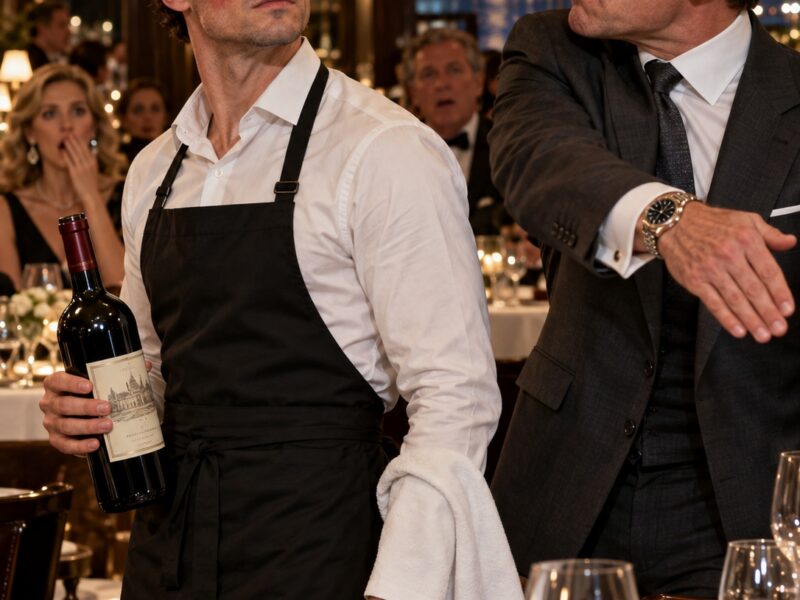
He Slapped a Waiter Over a $4,200 Bottle of Wine—Then an Old Man Across the Room Asked One Question
The wine was warm by maybe two degrees.
That was all.
Two degrees.
But for Preston Blackwood, two degrees were apparently enough to humiliate a man in front of an entire restaurant.
He lowered the crystal glass from his mouth, stared at the dark red wine as though it had personally offended him, then looked at the server standing beside his chair.
“Do they actually train people here?”
The dining room went quieter.
Not silent.
Not yet.
At a nearby table, a woman continued cutting into her halibut, but more slowly. A man near the bar stopped halfway through a sentence. Someone at the far end of the room lowered a menu without appearing to look over it.
The server’s name was Evan Rourke.
Thirty-nine years old.
White shirt pressed so sharply the sleeves seemed drawn with a ruler. Black apron. Polished shoes. Brass name tag over his heart.
He stood with a folded service towel over his left forearm and a bottle worth more than some people’s monthly rent in his hand.
He did not look embarrassed.
That was Preston’s first problem.
He did not look angry, either.
That became Preston’s second.
Evan simply said, “I can bring a cooling sleeve if you’d prefer it colder, sir.”
Preston leaned back.
Around him sat seven people whose combined watches probably cost more than Evan’s apartment.
Two attorneys.
Three executives.
A managing partner from New York.
And Preston’s younger sister, Vivien Blackwood, who had spent most of her adult life learning how to recognize the moment her brother stopped wanting something and started wanting someone to lose.
She recognized it now.
“Preston,” she said quietly.
He ignored her.
His eyes remained on Evan.
“You think this is acceptable?”
“I think the bottle came from the cellar at fifty-five degrees and has been on the table less than four minutes,” Evan said. “But if you prefer it cooler, I’d be happy to adjust it.”
One of the attorneys looked down.
The managing partner from New York almost smiled.
And that was when Preston Blackwood decided the evening was no longer about wine.
It was about the waiter.
More specifically, it was about making the waiter bend.
What Preston did not know was that Evan Rourke had spent years learning exactly how not to.
And four tables away, a sixty-one-year-old man with silver hair had just put down his fork.
Because there was something about the waiter’s stillness he recognized.
Something he had not seen in a restaurant in a very long time.
Something that had nothing to do with serving wine.
The Marlow Room occupied the ground floor of an understated luxury hotel three blocks from Boston Harbor.
There was no neon sign outside.
No velvet rope.
No oversized logo begging to appear in photographs.
People who belonged there already knew where it was.
The dining room had forty-two seats, heavy curtains, dark walnut walls, linen so white it almost looked blue beneath the low amber lights, and carpet thick enough to swallow footsteps.
Conversation stayed where it belonged.
At the table.
Dinner for four could cost more than a month’s rent in some neighborhoods, and the people eating there rarely looked at the right side of the menu.
Evan had worked there for nearly two years.
In those two years, nobody had ever seen him hurry.
Not because he was slow.
Because he was almost never late.
He arrived forty minutes before every shift. Pressed his own shirts. Checked his station twice. Knew the wine list beyond the notes management required servers to memorize.
If table twelve needed water, Evan seemed to notice before table twelve did.
If a guest dropped a fork, another one appeared before the first hit the carpet.
When people complained, he listened.
When they apologized for complaining, he somehow made them feel they had not needed to apologize.
He was good at his job in a way that made the work look smaller than it was.
And nobody knew much about him.
He lived alone in Dorchester.
Ran along the water before sunrise.
Read constantly.
Drank coffee black.
Did not date anyone the staff knew about.
Did not join gossip sessions near the walk-in refrigerator.
Did not tell stories about his past.
His employment application contained a long stretch summarized in four words.
Military service, United States Navy.
The hiring manager had asked about it once.
Evan had smiled politely.
“Long time ago.”
That had been the entire answer.
Eventually people stopped asking.
Which was exactly what Evan wanted.
Then, on the last Friday of October, Carter Whitmore called the staff meeting an hour before service.
Carter was fifty-one and had managed the Marlow Room for six years. He had the permanently polished appearance of a man who considered wrinkles an administrative failure.
That afternoon, his shoulders were straighter than usual.
His tie was tighter.
His voice carried the careful seriousness reserved for politicians, celebrities, and customers who could make quarterly numbers move.
“We have the Blackwood party tonight.”
A few people exchanged glances.
Nolan Pierce, the executive chef, leaned against the kitchen doorway with a towel over his shoulder.
Carter continued.
“Preston Blackwood closed a major investment transaction this week. Eight guests. They originally booked the private room, but there may be changes. I want everyone sharp. No improvising. No surprises.”
Evan adjusted his cuff.
“People order,” he said. “We serve them.”
Carter gave him a look.
“It’s not quite that simple.”
“For me it is.”
It was not arrogance.
That was what made Evan difficult for certain people to understand.
He genuinely meant it.
A guest could be worth ten dollars or ten billion dollars. Evan’s responsibilities remained almost identical.
Know the menu.
Know the wine.
Watch the table.
Do the work.
Nolan waited until Carter left before looking at Evan.
“Not every guest comes here to be served.”
Evan glanced at him.
Nolan folded his arms.
“Some come because they want to watch somebody bow. Food’s just the excuse.”
Evan tied his apron.
“Then they’ll probably be disappointed.”
Nolan laughed once.
Neither man knew how accurate that sentence would become.
The Blackwoods arrived at 8:08 p.m.
The room changed before Preston had said a word.
He entered first.
Forty-two years old. Tall. Broad-shouldered. Charcoal suit made by someone who had probably measured him personally. Silver watch visible beneath one cuff.
He handed his coat to the hostess without looking at her.
Seven people followed.
Vivien Blackwood came last.
At thirty-eight, she ran the Blackwood family investment fund and had a face that seemed composed even when her eyes were not. She thanked the hostess.
She was the only member of the group who did.
Their first problem was the room.
Preston had reserved the private dining room.
He now wanted the long table beside the main windows.
That table was already prepared for six guests who had booked it a month earlier.
Carter moved them.
No argument.
No hesitation.
The displaced guests received complimentary champagne and an apology vague enough not to mention why their reservation mattered less than someone else’s preference.
Preston sat down.
Then the lighting was too yellow.
Carter adjusted it.
The music was too loud.
Carter lowered it.
The chair was too far from the table.
A busser moved it.
Then another chair needed moving.
Then all eight did.
One inch.
Maybe an inch and a half.
A young server named Hannah placed a napkin near one of the attorneys.
Preston looked at Carter.
“Does this restaurant train its staff anymore?”
Hannah froze.
She had done nothing wrong.
Carter apologized anyway.
Evan saw her expression as she walked toward the service corridor.
It was not anger.
Anger would have been easier.
It was the expression people wear when they have been made to feel small but still have four hours left on their shift.
Something moved inside Evan’s chest.
He put it away.
He was very good at putting things away.
At 8:45, Carter approached him.
“Take their wine service.”
“Why?”
“You know why.”
Evan did.
He was the steadiest server on the floor.
And if Preston Blackwood was searching for somebody to rattle, Carter had just selected the person least likely to give him the satisfaction.
It seemed like a smart decision.
For about twenty minutes.
Evan approached the table.
Preston looked at his name tag.
“Evan.”
“Yes, sir.”
Preston lifted the wine list.
“Tell me something. Do you actually know anything about this Bordeaux, or are you going to repeat whatever your manager told you before service?”
A small pause followed.
It was not a question asked for information.
Everyone at the table knew that.
Evan answered anyway.
He named the vintage.
The growing season.
The commune.
The blend.
Then he explained the temperature range at which the wine would show best.
Four sentences.
No performance.
No defensiveness.
No attempt to embarrass Preston back.
The managing partner from New York raised his eyebrows.
“That’s better than the explanation I got in Napa last month.”
Someone laughed.
Preston did not.
Because attention had moved.
Only for a few seconds.
But Preston had spent his entire life sensing exactly when a room stopped orbiting him.
He looked at Evan.
“Not bad for a waiter.”
“Thank you, sir.”
Evan poured the wine.
Then he stepped away.
That should have ended it.
Instead, Preston called him back four minutes later.
A napkin had a loose thread.
Evan replaced it.
Then a water glass supposedly had a mark.
Evan replaced that.
Then the steak knife felt wrong.
Another knife.
Sparkling water became still water.
Six minutes later, still became sparkling again.
Nine separate requests in roughly forty minutes.
No please.
No thank you.
Evan fulfilled every one.
Same pace.
Same expression.
Same calm voice.
And the calmer he became, the more irritated Preston looked.
Vivien noticed.
So did the attorney beside her.
So did Nolan through the kitchen pass.
Then Preston ordered the bottle he had apparently been saving for the performance.
Pétrus.
$4,200.
He said the name loudly enough for the neighboring table to hear.
Evan retrieved it.
Presented the label.
Cut the foil.
Removed the cork cleanly.
Poured the tasting measure.
Preston swirled the wine beneath the lights.
Smelled it.
Tasted.
Waited.
Then frowned.
“Warm.”
Evan knew instantly it was not.
The cellar was maintained at fifty-five degrees.
The bottle had been upstairs less than four minutes.
Still, he said, “I can bring a cooling sleeve immediately.”
Preston looked around.
Now people were watching.
Finally.
“You call this service?”
The volume of his voice was no longer appropriate for the distance between them.
Carter began crossing the room.
Vivien set down her fork.
“Preston.”
“What?”
“It’s wine.”
He looked at her.
“It’s a four-thousand-dollar bottle of wine.”
“And?”
“I expect competence.”
Evan remained beside the table.
Carter arrived breathless despite having walked only twenty feet.
“Mr. Blackwood, I’m terribly sorry. Clearly we’ve fallen short tonight. Of course the bottle will be removed from the bill—”
“I’m not talking to you.”
Carter stopped.
Preston pointed toward Evan without looking away from him.
“I want him to apologize.”
Evan spoke.
“I’m sorry the bottle hasn’t met your expectations, sir. I’d be happy to replace it with another bottle and serve it at your preferred temperature.”
There.
Clean.
Professional.
Finished.
Except Preston had never wanted an apology.
He wanted submission.
“Look at me when you say it.”
Vivien closed her eyes for half a second.
Evan lifted his head.
Their eyes met.
And something changed.
Preston had dealt with angry men.
He understood anger.
He had dealt with frightened men.
He preferred fear.
Evan was neither.
There was no challenge in his eyes.
No resentment.
No pleading.
No calculation.
Just attention.
Steady and complete.
It was the look of someone for whom Preston’s anger did not qualify as danger.
Some primitive part of Preston understood that before his pride did.
And pride hated what instinct had just told him.
Evan reached for the bottle.
“I’ll replace this.”
“I didn’t dismiss you.”
Evan stopped.
Turned.
“Is there anything else you need, sir?”
It was an ordinary sentence.
Servers said versions of it thousands of times.
But Preston heard a door closing.
He stood.
Conversation disappeared from the room.
“Do you know who I am?”
Carter went pale.
Vivien whispered, “Oh, for God’s sake.”
Evan considered the question.
Then answered.
“You’re a guest of this restaurant.”
Nothing more.
Nothing insulting.
But that was precisely why it landed.
Preston Blackwood had spent forty-two years believing his name changed the rules of whatever room he entered.
Evan had just told him, calmly and publicly, that tonight it did not.
Preston reached out and yanked the service towel from Evan’s arm.
Carter stepped between them.
“Mr. Blackwood, please. We can resolve this.”
“Fire him.”
“Preston,” Vivien snapped.
“I said fire him.”
Carter looked at Evan.
For a fraction of a second, the calculation was visible.
The Blackwood account.
Private events.
Hotel ownership connections.
Hundreds of thousands of dollars.
One server.
“Evan,” Carter said quietly. “Step into the back.”
Preston smiled.
He had finally made something move.
But Evan did not move.
Preston leaned closer.
“Maybe you need to learn some respect for the people who pay for your life.”
For forty minutes, Evan had absorbed every insult.
He had allowed each one to pass through him.
This one stopped.
His voice remained quiet.
“Money doesn’t give you the right to humiliate anyone.”
The slap came less than a second later.
Open hand.
Hard.
Sharp.
The sound cracked across the dining room.
Evan’s head turned.
A woman at table nine froze with her water glass halfway to her mouth.
Nolan came through the kitchen door.
Vivien shot to her feet.
Carter stopped breathing.
And four tables away, Graham Callaway dropped his fork.
Because Evan Rourke’s body had just done something almost nobody else in that room understood.
His right hand closed.
His weight shifted.
His left shoulder lowered.
Barely an inch.
Then everything stopped.
The fist opened.
The weight returned.
The shoulder relaxed.
The $4,200 bottle in his other hand had barely moved.
It lasted perhaps one second.
Maybe less.
But Graham recognized it.
The preparation.
The decision.
And, more importantly, the restraint.
Evan turned his face back toward Preston.
A red mark was already appearing along his cheek.
“You shouldn’t do that again.”
Preston laughed because thirty people had just watched him hit another man and laughter was the only weapon left that did not look like fear.
“Is that a threat?”
“No.”
Evan’s voice did not change.
“It’s advice.”
And that was when Graham Callaway knew.
Not everything.
But enough.
Graham was sixty-one.
Silver hair.
Dark suit.
Retired, officially.
He had spent thirty-one years in defense contracting and had sat across from admirals, intelligence officers, engineers, diplomats, men who spoke softly because entire rooms moved when they did.
He had also spent years around people who had trained at Coronado.
He knew certain habits.
The hands close to the centerline.
The preference for standing with a wall behind you.
The glance toward entrances without moving the head.
The stillness.
Especially the stillness.
People misunderstood that kind of stillness.
They thought it meant calm.
Sometimes it did.
Sometimes it meant a man was holding an entire response inside his body and choosing not to release it.
Graham had watched Evan throughout dinner without realizing why.
Now he knew.
Carter grabbed Evan by the elbow.
“Back. Now.”
Evan allowed himself to be guided into the service corridor.
Carter followed.
He did not ask if Evan was hurt.
He did not ask whether he wanted the police called.
He said, “This is a catastrophe.”
Evan stared at him.
“A guest just struck one of your employees.”
“I know.”
“In front of the entire room.”
“I know.”
“What are you going to do about it?”
Carter rubbed both hands over his face.
“It’s complicated.”
“No,” Evan said. “It isn’t.”
“Blackwood has done sixteen private events here in two years.”
Evan said nothing.
“One was a senator’s daughter’s rehearsal dinner.”
Still nothing.
“The hotel renovation is bleeding money. We cannot lose this account over—”
Carter stopped himself.
Too late.
“Over what?” Evan asked.
Carter looked away.
Evan nodded once.
Then he untied his apron.
He folded it in half.
Then again.
Set it beside a stack of clean napkins.
Carter swallowed.
“Go home. We’ll talk Monday.”
Evan took his jacket from the hook.
“I understand.”
That was all.
Two words.
No shouting.
No threat.
No dramatic resignation.
Which somehow made Carter feel worse.
Evan walked back into the dining room because it was the only route to the front door.
People tried not to stare.
Preston was seated again.
His glass had been refilled.
Then Graham Callaway stood.
He crossed the room and stepped directly into Evan’s path.
Evan stopped.
The two men looked at each other.
Graham studied his face.
Then asked one word.
“Coronado?”
Evan’s expression changed.
Barely.
But it changed.
Nobody else understood.
To most of the room, Coronado was a wealthy California town.
To Graham and Evan, it meant cold Pacific surf, sand, exhaustion, pain, and a brass bell some men rang when they decided they had reached their limit.
Evan looked at him.
“It’s been a while.”
Graham’s eyes sharpened.
“Team?”
Evan hesitated.
Then said quietly:
“Four.”
Graham exhaled.
Behind them, Preston called out.
“What is this? Some kind of club?”
Graham slowly turned.
Whatever pleasant retirement had softened in his face disappeared.
“Mr. Blackwood.”
Preston lifted his glass.
“Yes?”
“You just slapped the wrong man.”
Preston laughed.
Actually laughed.
He gestured toward Evan’s white shirt.
Toward the apron folded somewhere behind the service door.
“He’s a waiter.”
Graham allowed the words to hang there.
“Tonight,” he said, “yes.”
Then he looked at Evan.
“He wasn’t always.”
For the first time that evening, Preston’s expression shifted.
Not into remorse.
Into calculation.
“A veteran?”
Graham did not answer immediately.
Preston shrugged.
“And here he is.”
The meaning was obvious.
Once important.
Now carrying wine.
Vivien looked at her brother as though something inside her had finally exhausted itself.
But Preston had made the same mistake everyone else in the room was about to make.
They assumed Evan’s apron represented where his life had collapsed.
It didn’t.
It represented where he had chosen to go.
Evan Rourke had not washed out of the Navy.
He had not been disgraced.
He had not been injured into retirement.
He had not returned home unable to function.
When he left active service, he had options.
Many.
Private security companies contacted him.
Defense contractors.
Maritime risk firms.
Executive protection groups.
One offer started around $160,000 a year.
Another offered more than twice that for overseas work.
He turned them down.
Every one.
Not because he could not do the work.
Because he knew exactly what the work would require him to keep carrying.
For more than a decade, Evan had lived in a world where rank mattered, force mattered, access mattered, and mistakes did not end when the shift did.
He had watched men become addicted to being necessary.
He had watched competence turn into identity.
He had felt some of it happening inside himself.
So when he finally had the freedom to choose, he chose something almost embarrassingly ordinary.
He wanted to finish a day.
Completely.
He wanted work with edges.
A beginning.
An end.
He liked wine.
He liked restaurants.
He liked the strange choreography of eleven people moving through a narrow service corridor for six hours without colliding.
He liked noticing that table six needed water before table six noticed.
He liked making a difficult night easy for strangers.
At midnight, he wanted to untie an apron and leave the entire day behind.
The Marlow Room was not where Evan Rourke had fallen.
It was where he had gone on purpose.
Graham understood enough of that to correct the room.
But when he began to mention something about an old operation involving civilian engineers and an evacuation that had gone bad, Evan stopped him.
“That’s enough.”
Graham turned.
Evan’s discomfort was visible now for the first time all evening.
He did not want the story.
He did not want strangers deciding the slap had been wrong because he possessed a history they found impressive.
That would still mean the waiter mattered only because he had once been something else.
And Evan refused to accept that bargain.
Across the room, Vivien understood before almost anyone.
She grabbed her brother by the arm.
“Come with me.”
Preston resisted.
“Viv—”
“Now.”
She took him toward the bar.
Her voice dropped.
“I don’t care if he was a SEAL.”
Preston blinked.
“You should.”
“No. You should listen to what I’m saying.”
She stepped closer.
“You assaulted an employee in front of two outside attorneys, a managing partner, thirty strangers, and at least six phones.”
Preston’s face changed.
There it was.
The first genuine concern of the night.
Vivien continued.
“This room has cameras.”
He looked toward the ceiling.
“And I saw at least three people recording you.”
The silence between them suddenly felt different.
Preston looked back toward Evan.
The waiter had become the least dangerous problem in the room.
Preston found Carter.
His tone was calm now.
Professional.
The same man who had slapped someone minutes earlier had apparently vanished.
“Obviously,” Preston said, “nobody benefits from a misunderstanding like this circulating.”
Carter stared at him.
“I’m not sure what you’re asking.”
“I’m not asking anything improper.”
Of course he wasn’t.
Men like Preston rarely did.
Not explicitly.
“This is a private restaurant. Your guests expect privacy. I assume you have policies concerning internal security footage.”
Carter understood.
“No one needs an ugly misunderstanding becoming public,” Preston continued. “We have three events booked next quarter. We’ve also been discussing an annual arrangement.”
There it was.
Money placed gently on one side of a scale.
Carter looked toward the office.
He had already chosen the Blackwoods once that evening.
He was dangerously close to doing it again.
Then the front door opened.
Miles Barrett walked in.
The owner.
He was not dressed for work.
Gray sweater.
Dark jeans.
A father who had left his daughter’s recital early because Nolan had called him from inside the walk-in refrigerator and said five words.
You need to come here.
Miles asked two questions.
Then he opened the security footage.
He watched it once.
Then again.
The room remained almost silent.
Finally he closed the laptop.
Looked at Carter.
“You sent Evan home?”
Carter swallowed.
“Yes.”
“You were going to let Blackwood stay?”
“I was trying to de-escalate.”
Miles’s jaw tightened.
“And were you about to make this footage disappear?”
Carter began speaking.
Three different explanations started.
None finished.
Miles walked away before the fourth could begin.
He crossed the dining room.
Stopped at Preston’s table.
“Mr. Blackwood.”
Preston looked up.
Miles nodded toward the door.
“Your dinner is finished.”
Preston stared at him.
“Excuse me?”
“There won’t be a check.”
A small smile appeared on Preston’s face.
Not amusement.
Warning.
“Do you know what my family spends in this building?”
“I do.”
“Then you understand how expensive this little performance could become.”
Miles put his hands into his pockets.
Preston continued.
“We have friends in the hotel ownership group.”
“I know.”
“I will call them.”
“I assumed you would.”
“And?”
Miles looked at him.
“There are some clients I’m genuinely glad to lose.”
Nobody moved.
Then the managing partner from New York pushed his chair back.
Not Preston.
The managing partner.
He buttoned his jacket.
“Vivien.”
She stood.
One by one, the others followed.
The Blackwood party left in less than four minutes.
Preston was last.
He paused near Miles.
“This will cost you.”
Miles looked toward the service corridor where Evan’s folded apron remained.
“Some things should.”
The door closed behind Preston.
That could have been the end.
It wasn’t.
Because Graham Callaway was still standing near the host stand.
And Preston Blackwood had no idea that the old man he had dismissed as another wealthy diner was connected to the most important transaction of his career.
Graham did not make an angry phone call.
He did not threaten anyone.
He did not post the video.
He did not use Evan’s military history to publicly humiliate Preston.
On Monday morning, he wrote four paragraphs.
That was all.
One of the boards Graham advised was connected to an aviation and defense joint venture entering late-stage negotiations.
The Blackwood Fund held a position worth more than $200 million.
Preston was the family’s designated representative.
Graham’s memo did not mention morality.
It did not mention class.
It did not call Preston cruel.
It did not even mention Evan’s past.
Instead, Graham raised one narrow professional concern.
The representative chosen for the venture would be expected to negotiate with regulators, union leaders, foreign officials, and difficult counterparties under sustained provocation.
Graham had personally observed Preston Blackwood lose control of himself in a public dining room over the temperature of a glass of wine.
Perhaps the board should reconsider whether he was the appropriate representative.
That was it.
No outrage.
No adjectives.
Which made it devastating.
Because anger could be dismissed.
Facts were harder.
Meanwhile, something strange happened.
Nothing went viral.
Several guests possessed recordings.
At least one video captured the entire slap.
Yet Evan contacted none of them.
He gave no interviews.
Made no posts.
Sunday morning, he slept until seven.
Ran four miles along the water.
Bought coffee.
Read in his apartment.
By Sunday afternoon, Vivien Blackwood had found him.
Not at a law office.
Not at a television studio.
At a diner in Dorchester.
He sat alone in a booth with a chipped coffee cup and a biography open beside him.
Vivien slid into the seat opposite.
He looked up.
“Ms. Blackwood.”
“So you remember me.”
“Yes.”
She had rehearsed the conversation three times during the drive.
All three versions disappeared.
“What will it take?”
Evan closed his book.
“For what?”
“To settle this.”
He watched her.
She named a number.
Enough money to represent several years of his restaurant salary.
“A written apology is available,” she added. “A public statement, if you want it. And if you intend to pursue an assault complaint, I’m not asking you not to. I want to be clear about that.”
Evan rotated his coffee cup slightly on the saucer.
“My attorney will handle whatever the ordinary process requires.”
“And the money?”
“No.”
Vivien frowned.
“Why?”
“I don’t want it.”
“You lost your job.”
“I’ll find another one.”
“My brother humiliated you.”
“Yes.”
“In front of an entire room.”
“Yes.”
“He hit you.”
Evan said nothing.
Vivien leaned forward.
“Most people would take the money.”
“Probably.”
“They’d demand the apology.”
“Probably.”
“They might sue him.”
“They’d have that right.”
She stared at him.
“Then why aren’t you?”
Evan looked toward the window.
Outside, a city bus stopped.
An elderly woman climbed aboard.
A man crossed the street carrying groceries.
Nothing about the afternoon seemed remotely connected to what had happened Friday night.
Then Evan looked back at Vivien.
“Because if I have to ruin your brother to prove I’m worth something, then he won.”
Vivien went still.
Evan picked up his coffee.
He had not said it dramatically.
That was what made it difficult to escape.
Vivien had spent years around people who believed every injury created leverage.
Every mistake had a price.
Every embarrassment could be converted into advantage.
Evan was refusing the transaction itself.
She suddenly understood that the popular version of the story would get almost everything wrong.
A rich man humiliates a waiter.
The waiter turns out to be a Navy SEAL.
The rich man learns he picked the wrong victim.
Satisfying.
Simple.
And morally empty.
Because that lesson only meant you should be careful whom you mistreat.
Maybe the waiter is dangerous.
Maybe the janitor knows someone powerful.
Maybe the driver owns the company.
Maybe the quiet employee is secretly a millionaire.
That is not respect.
That is risk management.
It still leaves open the possibility that some people are safe to humiliate.
Evan had deserved dignity before anyone knew about Coronado.
He deserved it when he was only a brass name tag at Preston’s table.
He would have deserved it if he had never worn a uniform.
Never rescued anyone.
Never made more than minimum wage.
Never possessed the ability to hurt Preston back.
Vivien sat across from him and realized that her brother’s mistake had not begun with the slap.
It began the instant he entered the restaurant and decided some people were furniture.
On Thursday, the Blackwood board met.
The language was bloodless.
Corporate.
Almost boring.
Conduct in a public setting raising concerns regarding representational risk.
Preston was removed as the fund’s representative in the aviation venture pending review.
Nobody needed Evan’s military record.
They watched twenty-two seconds of footage.
A wealthy forty-two-year-old man losing control of himself over wine while his sister stood three feet away telling him to stop.
That was enough.
Carter Whitmore lasted eleven more days at the Marlow Room.
Miles fired him in a conversation that took six minutes.
Not because Carter had thrown the slap.
He had not.
Not because he could have predicted it.
He could not.
Miles fired him because twice in one hour Carter had chosen the money of a guest over the safety of an employee.
First, he removed Evan instead of Preston.
Then he almost protected the footage instead of the man who had been hit.
“A manager’s job,” Miles told him, “is to stand between his staff and the worst guest in the building. You stood on the wrong side.”
Carter had no answer.
Six weeks passed.
Then, on a cold Thursday afternoon, the staff entrance opened.
Nolan looked up from the kitchen.
Evan Rourke walked in carrying a freshly pressed white shirt on a hanger.
Not a suit.
Not a medal.
Not an executive briefcase.
A server’s shirt.
Miles had called him weeks earlier and offered him Carter’s old job.
General manager.
Roughly triple his previous pay.
Evan declined.
Miles thought he had misheard.
“You’re sure?”
“Yes.”
“Why?”
Evan considered it.
“Managing this place means taking the building home every night.”
“And?”
“I’ve spent enough years taking work home in my head.”
“So what do you want?”
“My section.”
Miles laughed.
“You’re serious.”
“I usually am.”
Evan accepted a raise he had not requested.
The restaurant hired a new general manager who had started years earlier as a busser and knew every employee’s name.
At 4:20 that Thursday, Evan tied the same black apron around his waist.
Nolan leaned through the kitchen pass.
“Attention, everyone.”
Several cooks looked up.
Nolan pointed at Evan.
“We have instituted a new policy.”
Evan closed his eyes.
Nolan continued.
“If any guest says his wine is too warm, we will immediately bring him ice.”
The kitchen erupted.
Even the new dishwasher laughed despite having no idea why.
And for the first time anyone could remember, Evan laughed loudly enough that he had to put down the stack of napkins he was holding.
Then service started.
Table three wanted sparkling water.
Table eight had a shellfish allergy.
A couple near the window celebrated their twenty-seventh anniversary.
And Evan returned to the life everyone else kept trying to interpret as something smaller than it was.
Graham Callaway returned in January.
Tuesday night.
Quiet.
He specifically requested Evan’s section.
He ordered steak and Burgundy.
Nothing extravagant.
When Evan presented the bottle, Graham studied the label with exaggerated seriousness.
Evan removed the cork.
Poured.
Graham lifted the glass.
Swirled it.
Smelled it.
Then looked at Evan.
“Temperature okay?”
Evan stared at him.
A corner of his mouth moved.
“You tell me.”
They laughed quietly.
Nobody else understood why.
Graham raised his glass.
Not to Team Four.
Not to Coronado.
Not to whatever redacted report had once crossed his desk.
He raised it to the man standing in front of him.
White shirt.
Black apron.
Service towel.
Exactly where he had chosen to be.
Evan gave the smallest nod and moved toward another table.
Outside, Boston Harbor was black beneath the January sky.
Inside, silverware touched porcelain.
A cork came free from another bottle.
Someone asked for more water.
The room continued.
And maybe that was the part Preston Blackwood had never understood.
He had looked at an apron and believed it told him how much respect the person wearing it deserved.
Then, when he learned Evan had once belonged to an elite military unit, he made a second mistake.
He assumed the uniform beneath the apron was what made the man valuable.
It wasn’t.
Evan’s past did not retroactively make the slap wrong.
It had been wrong before Graham stood up.
Wrong before anyone whispered the word Coronado.
Wrong when Evan was nothing more to Preston than a waiter carrying wine.
That was the truth Preston had avoided for forty-two years.
The dangerous lesson would have been: Be careful who you humiliate. They may be more powerful than they look.
The harder lesson was this:
There should never be anyone you consider safe to humiliate.
Because dignity is not a reward for hidden power.
Respect is not something another human being has to earn by proving they could destroy you.
And Evan Rourke’s greatest act that night was not anything he had done years earlier in a uniform.
It happened in the second after Preston’s hand struck his face.
When Evan’s body remembered exactly what it was capable of.
When anger offered him an answer.
When almost everyone in that room would have forgiven him for taking it.
And he chose instead to open his fist.
Months later, people would remember the rich man.
The expensive wine.
The slap.
The old man asking about Coronado.
The board meeting.
The consequences.
But Graham remembered something smaller.
A January evening.
A server walking away from his table carrying an empty wine bottle.
A man with nothing left to prove.
The black apron moved softly against Evan’s legs as he crossed the room, disappearing for a moment behind another table before emerging again beneath the warm lights.
No one stared.
No one whispered.
No one knew what he had once been.
And Evan, finally, seemed perfectly happy that way.









