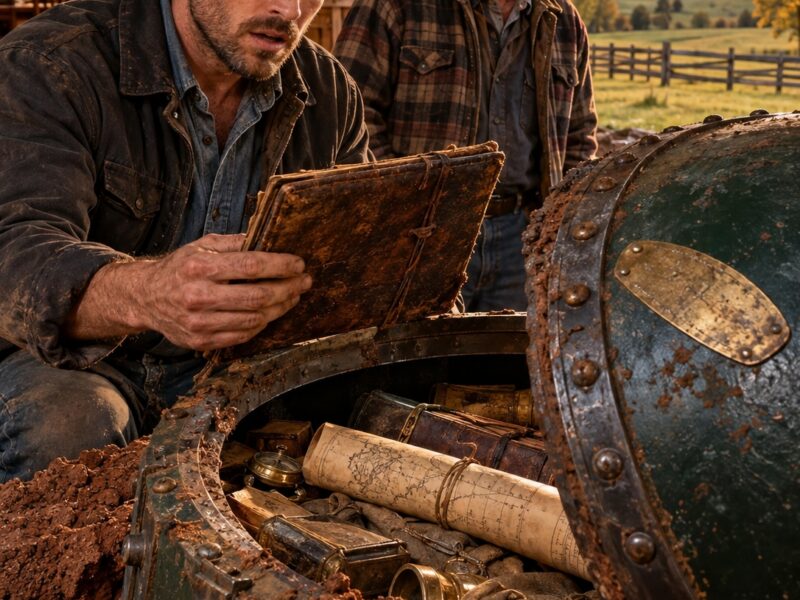
HE SPENT HIS LAST $12,000 ON THE FARM EVERYONE CALLED WORTHLESS—THEN HIS PLOW HIT SOMETHING BURIED SINCE 1914, AND HIS OWN NAME WAS INSIDE
The first sound was not the plow breaking.
It was something underneath the earth answering back.
A deep metallic blow traveled up through the steel frame of Ethan Vance’s tractor and hit him hard enough in the spine that his hands slipped from the steering wheel.
The engine groaned.
The rear tires spun once in the wet Virginia clay.
Then everything stopped.
For several seconds, Ethan sat absolutely still.
October wind moved through the scrub grass around him. Somewhere beyond the lower pasture, a crow called from the tree line. The tractor’s cooling engine ticked softly beneath him.
Ethan looked over his shoulder at the furrow.
“Please don’t be the plow.”
He had owned the land for six months.
Six months was apparently long enough for eighteen acres to nearly bankrupt a man.
The locals had warned him.
They had warned him at the feed store, at the county office, outside the diner, even at the gas station where an old cattle farmer named Earl Mercer had laughed when Ethan mentioned what he had bought.
“The Stony Waste?”
Earl had stared at him.
“You bought that?”
Ethan had nodded.
“All eighteen acres.”
“For what?”
“To farm.”
Earl had laughed so hard he had to put his coffee down.
Now, standing in the middle of that same miserable pasture with a tractor stuck in red mud and what sounded like a ruined plow buried behind him, Ethan wondered whether Earl Mercer had been right.
Maybe everybody had been right.
Maybe twelve thousand dollars—the last twelve thousand dollars Ethan had in the world—had bought him nothing but eighteen acres of proof that stubbornness and courage sometimes looked exactly the same until one of them ruined you.
He shut off the ignition.
Silence fell over the field.
Then Ethan climbed down.
At thirty-two, he still moved like the diesel mechanic he had been most of his adult life: deliberately, efficiently, never wasting a step. Years spent leaning over engines had taught him that machines usually told you what was wrong before they failed completely.
You only had to listen.
The plow had been telling him something.
And it had not sounded like stone.
He crouched behind the tractor.
One of the three steel discs had vanished halfway into the soil.
“Great.”
He pulled on his gloves, grabbed a hand trowel, and started scraping away wet clay.
The ground was cold and heavy.
After several minutes, the edge of something dark appeared beneath the dirt.
Ethan tapped it with the trowel.
Clang.
He stopped.
Not limestone.
Not granite.
Metal.
He cleared another six inches.
Then another.
The object kept going.
“What the hell are you?”
He abandoned the trowel for a shovel.
Twenty minutes later, sweat had soaked through the back of his work shirt despite the forty-eight-degree afternoon.
A curved iron surface emerged from the earth.
Then a steel band.
Then another.
Ethan stood over the trench, breathing hard.
Whatever he had hit was enormous.
And somebody had buried it deliberately.
That realization changed the feeling in the field.
Until then, Ethan had been irritated.
Now he felt watched.
He glanced toward the road.
Nothing.
Just the old fence, brown weeds, mountains beyond them, and eighteen acres everybody in Grayson County had decided were worthless.
He returned to the hole.
More clay came away.
A row of round iron rivets appeared.
The metal beneath them was dark green.
Strangely dark green.
Ethan rubbed it with his glove.
There was almost no rust.
That was impossible.
Anything buried in Virginia soil for more than a few years should have shown corrosion.
Yet this thing looked as if somebody had designed the earth around it.
He dug toward the upper curve.
His shovel struck something smaller.
Brass.
Ethan knelt.
A rectangular plate was attached to the cylinder.
Mud filled the engraved letters.
He wiped them with his thumb.
Nothing.
He grabbed a rag from the tractor, spat on it, and rubbed harder.
The first words appeared.
PROPERTY OF
Ethan leaned closer.
GRAYSON VALLEY GRAIN COOPERATIVE.
His heartbeat slowed.
There was one final line beneath it.
SEALED 1914.
Ethan stared at the date.
For a moment, the wind seemed to disappear.
He read it again.
Then a third time.
“No.”
He sat back on his heels.
The land deed had said nothing about buried structures.
The county auction documents had described the parcel with almost insulting simplicity:
Eighteen acres.
Unimproved pasture.
Rock-heavy soil.
Limited agricultural potential.
No permanent structures.
Nothing about an eight-foot iron cylinder buried eighteen inches beneath the lower pasture.
Nothing about a grain cooperative.
Nothing about 1914.
Ethan looked across the field.
Suddenly the rocks no longer bothered him.
The brush no longer looked random.
Even the gentle rise of the pasture seemed different.
Land could keep secrets.
He had just put a plow through the first one.
And he had no idea yet that three more were waiting beneath his feet.
By sunset, Ethan had exposed enough of the cylinder to understand that it was not an ordinary storage tank.
It measured roughly eight and a half feet long and three feet across, with rounded ends like an oversized capsule. Thick structural iron formed the outer shell. Heavy steel bands reinforced the body.
But what interested Ethan most was the ground around it.
He pushed his shovel beneath the cylinder.
Gravel.
Not natural fieldstone.
River gravel.
Carefully packed.
He moved to the opposite side and dug again.
More gravel.
Someone had excavated a trench, leveled the bottom, created drainage, lowered a fifteen-hundred-pound iron container into it, then covered the entire structure.
This had required men.
Equipment.
Planning.
Money.
“Why?” Ethan whispered.
He climbed out of the trench and stood with his hands on his hips.
The answer could not have been simple storage.
Nobody spent this much effort hiding grain.
Not in 1914.
Not on useless land.
Especially not on land nearly eleven miles from the nearest substantial town.
Ethan considered calling the county.
The thought lasted approximately thirty seconds.
Then he remembered the county auction office.
He remembered the clerk sliding the papers across the desk.
He remembered the expression on her face when she realized he genuinely intended to buy the parcel.
“You understand this property has been listed for more than three years?”
“I do.”
“And you’re aware of the soil assessment?”
“I read it.”
She had hesitated.
“Mr. Vance, there are easier ways to start a farm.”
Ethan had smiled.
“Not for twelve thousand dollars.”
Now he wondered whether the county knew something it had forgotten to put in the paperwork.
Or whether everybody had genuinely forgotten.
He returned to the tractor and retrieved a tape measure, wire brush, brass scraper, crowbar, and rubber mallet.
By the time the sun touched the ridge, he had uncovered the top locking mechanism.
Three heavy iron latches.
Each one had been sealed with lead.
Ethan touched the nearest gasket.
Still intact.
His mechanic’s instincts began arguing with his common sense.
Common sense said call somebody.
The mechanic said whoever built this wanted it opened eventually.
He tapped the lead gently.
A fragment broke away.
Clean iron threads appeared underneath.
Ethan frowned.
Seventy-seven years underground.
And the threads looked almost new.
“Okay,” he murmured. “You definitely weren’t buried by accident.”
He removed the remaining lead.
The first latch resisted.
Then moved.
The second took ten minutes.
The third almost bent his crowbar.
When the central locking bar finally released, the sound cracked across the pasture.
Ethan froze.
For one second nothing happened.
Then—
Hissssss.
Air escaped from beneath the lid.
Ethan stepped backward.
His skin prickled.
The cylinder had been sealed.
Not merely closed.
Sealed.
For seventy-seven years.
He stared at the narrow black seam beneath the lid.
Something had remained inside that darkness since Woodrow Wilson was president.
Something another man had placed there before Ethan’s grandparents were even born.
And now Ethan Vance was about to become the first person to see it.
He hooked both hands beneath the iron lip.
Pulled.
The hinges moved almost silently.
A smell rose from inside.
Not rot.
Not mildew.
Cedar.
Beeswax.
Dry grain.
Ethan’s breath caught.
He lifted the lid farther.
Darkness waited below.
He reached for his flashlight.
And aimed the beam inside.
The interior was lined with cedar.
Three inches thick in places.
The wood had turned darker with age but remained astonishingly dry.
Ethan lowered his flashlight.
Canvas sacks.
Toolboxes.
Metal tubes.
And at the far end, wrapped carefully in oilcloth, something shaped like a large book.
He stood motionless.
This wasn’t trash.
It wasn’t stolen machinery.
It wasn’t somebody’s forgotten junk.
It looked organized.
Prepared.
Preserved.
Like a time capsule designed by people who had not expected to return for it themselves.
Ethan climbed partially inside.
The first compartment held twelve heavy canvas sacks, each double-stitched and sealed with wax.
He brushed dust from one.
Handwritten lettering appeared.
CORN — SOUTH RIDGE — 1914.
Another read:
WINTER WHEAT — HOLLIS FARM.
Another:
WHITE DENT — VANCE.
Ethan stopped.
His flashlight beam trembled slightly.
Vance.
He touched the lettering.
His surname was not unusual in that part of southwestern Virginia, but it was not common enough to ignore.
He told himself it meant nothing.
Then he opened the second compartment.
Six wooden boxes held hand-forged blacksmithing tools, replacement gears, brass measuring equipment, and surveying instruments.
Every object had been greased, wrapped, or packed against moisture.
The third compartment contained the leather ledger.
Ethan lifted it carefully.
The oilcloth peeled away.
The leather beneath it looked old but intact.
He opened the cover.
The paper was almost white.
At the top of the first page, in precise black handwriting, were the words:
GRAYSON COUNTY HERITAGE RESERVE
ESTABLISHED OCTOBER 12, 1914.
Ethan sat down on the tractor tire.
Daylight was disappearing fast.
He should have stopped.
He should have covered the vault, gone home, eaten something, slept, and called the county historical office in the morning.
Instead, he turned the page.
Twenty-four names appeared.
He read them slowly.
Thomas Hollis.
Samuel Carver.
Joseph Reed.
Walter Grimes.
Peter Caldwell.
Then his finger stopped.
Henry Vance.
Ethan stared.
He knew that name.
Not well.
Not personally.
But he knew it.
He had seen it written in his grandmother’s family Bible.
Henry Vance had been his great-granduncle.
The farmer nobody talked about because almost nobody remembered anything about him.
Ethan looked from the name to the pasture surrounding him.
A cold sensation moved through his chest.
He turned another page.
Then another.
The ledger was not a record of buried valuables.
It was a plan.
And the more Ethan read, the less accidental his purchase began to feel.
His mother answered on the sixth ring.
“Ethan?”
“Mom.”
“You sound strange.”
“I found something.”
There was a pause.
“What kind of something?”
He looked at the open vault.
“Do you remember Henry Vance?”
Silence.
Not confusion.
Silence.
Ethan straightened.
“Mom?”
“Where did you hear that name?”
That question bothered him more than it should have.
“I asked if you remember him.”
“He was your grandfather’s uncle, I think.”
“You think?”
“Ethan, it’s been a long time.”
“Did he own land out here?”
Another pause.
“Where are you?”
“At the farm.”
“It’s getting dark.”
“I know.”
“You shouldn’t be working after dark.”
“Mom.”
“What?”
“Did Henry Vance own this land?”
She exhaled.
“I don’t know.”
But something in the way she said it told Ethan that wasn’t quite true.
He looked down at the ledger.
Twenty-four farmers had signed their names beneath a paragraph written in formal script.
He read it again.
The language was old-fashioned, but the meaning was clear.
They feared something was disappearing.
Not money.
Not property.
Knowledge.
By 1914, farming was changing. Commercial agriculture was moving toward standardized crops, industrial equipment, and increasingly centralized systems of production.
The farmers who created the reserve had watched local seed varieties vanish one field at a time.
Corn that had survived drought.
Wheat that tolerated mountain winters.
Plants selected and replanted across generations because they could survive the peculiar red clay, limestone, cold snaps, and dry summers of the Virginia highlands.
To modern eyes, those seeds might have looked primitive.
To the twenty-four men in the ledger, they represented insurance.
Not against a bad harvest.
Against forgetting how to begin again.
Ethan swallowed.
“Mom?”
“Yes?”
“I’m going to call you tomorrow.”
“What did you find?”
Now it was Ethan’s turn to pause.
“My name.”
He hung up before she could answer.
Then he turned another page.
A folded sheet had been tucked between two sections of the ledger.
He unfolded it.
It was a hand-drawn survey map.
Ethan recognized the shape immediately.
His property.
All eighteen acres.
He brought the flashlight closer.
Four red marks had been drawn across the parcel.
One in the lower pasture.
Exactly where he was sitting.
One east.
One north.
One south.
Beside the lower-pasture mark were two words:
RESERVE ONE.
Ethan looked toward the darkness beyond the tractor.
Then back at the map.
Three more.
There were three more vaults.
He barely slept.
Rain began sometime after midnight and drummed against the roof of the small farmhouse.
Ethan lay on his back listening to it.
Every financial mistake he had made seemed to parade through his head.
Leaving the diesel shop.
Buying the tractor.
Buying the land.
Spending nearly everything he had saved since his early twenties because he was tired of repairing other men’s machines and wanted something that belonged to him.
He had imagined hay fields.
A barn.
Maybe cattle eventually.
A place where the horizon did not belong to somebody else.
Instead, he’d bought rocks.
The first month, his neighbor had watched him pull limestone from the lower field and said, “You planning to farm or build a quarry?”
Ethan had laughed.
By August, he had stopped laughing.
The red clay hardened like brick in dry weather and turned slick as grease after rain.
Plow points dulled.
Fuel disappeared.
Nothing happened quickly.
At night Ethan had begun checking his bank balance more often than he wanted to admit.
He had $1,842 left.
Winter was coming.
Then his plow had hit 1914.
At 2:17 a.m., Ethan gave up on sleep.
He carried the ledger to the kitchen.
Placed it beneath the yellow light.
And read.
The twenty-four farmers had called themselves the Grayson Valley Grain Cooperative.
They had pooled money.
They had purchased eighteen acres nobody else wanted.
Ethan almost laughed when he reached that sentence.
Apparently the land had been worthless in 1914 too.
That was the point.
Good farmland attracted attention.
Bad farmland was ignored.
If the reserve was supposed to remain undisturbed for decades, perhaps generations, the safest place to hide it was somewhere nobody would ever bother improving.
The Stony Waste.
The insult had been part of the protection.
Ethan continued reading.
Four reinforced iron vaults.
Gravel drainage beds.
Lead seals.
Cedar insulation.
Seeds.
Tools.
Mechanical components.
Water surveys.
Soil studies.
Land records.
Everything necessary for a farming community to recover after catastrophic crop failure, economic collapse, or some other crisis the men of 1914 could not predict.
They were not trying to preserve their possessions.
They were preserving capability.
The distinction hit Ethan harder than he expected.
He leaned back.
His father had died when Ethan was twenty-three.
A stroke.
Quick.
Unfair.
There had been no dramatic final conversation. No meaningful last words.
One afternoon his father had been repairing a fence.
By evening he was gone.
For years Ethan had been angry about everything he never got to ask.
How do you know when to leave a job?
How do you know when a woman is the right one?
How much debt is too much?
How do you build a life when nobody is there to tell you whether you’re doing it correctly?
Now, in the middle of the night, men dead for most of a century seemed to be answering a different question.
What do you leave behind for people you will never meet?
Ethan turned another page.
Henry Vance’s handwriting appeared in the margin.
One sentence.
Small.
Almost an afterthought.
Land remembers what men forget.
Ethan read it twice.
Then looked toward the rain-black window.
“Who were you?” he whispered.
At sunrise, he drove into town.
The rain had stopped, leaving fog pressed low against the hills.
He found Earl Mercer at the same diner where the old farmer had laughed at him six months earlier.
Earl looked up from his eggs.
“Well. Stony Waste finally kill your tractor?”
Ethan slid into the booth across from him.
“Do you remember the Grayson Valley Grain Cooperative?”
Earl’s fork stopped halfway to his mouth.
That was answer enough.
Ethan leaned forward.
“You do.”
Earl lowered the fork.
“Where’d you hear that?”
“Everybody keeps asking me that.”
“Maybe because nobody’s used that name in fifty years.”
“Henry Vance.”
Earl stared at him.
Then looked toward the counter.
“Keep your voice down.”
Ethan almost smiled.
“Why?”
“Because I don’t enjoy sounding like an old fool before eight in the morning.”
“What was the cooperative?”
“My grandfather mentioned it.”
“And?”
“And nothing. Stories.”
“What stories?”
Earl wiped his mouth.
“Farmers putting things away before the Great War. Seeds. Equipment. Maybe money, depending who was telling it.”
“Money?”
Earl shrugged.
“Every buried-box story eventually grows gold coins.”
“There aren’t gold coins.”
The old man’s eyes sharpened.
Ethan realized his mistake.
Earl slowly placed his napkin beside the plate.
“What did you find?”
Ethan said nothing.
“Son.”
“Why did nobody tell me?”
“Tell you what?”
“That the land belonged to them.”
Earl stared through the window toward Main Street.
“Maybe nobody knew for sure.”
“My deed doesn’t mention it.”
“Deeds don’t mention stories.”
“I found a ledger.”
That did it.
Earl turned back.
“What kind of ledger?”
“1914.”
Earl’s expression changed.
The humor vanished.
“Don’t damage anything.”
“I haven’t.”
“Don’t sell anything.”
“I didn’t say I was going to.”
“And call somebody who knows preservation before you start playing archaeologist with a crowbar.”
Ethan blinked.
“How did you know I used a crowbar?”
“Because you’re a mechanic.”
For the first time in twenty-four hours, Ethan laughed.
Earl didn’t.
“There was something my grandfather used to say,” he continued.
“What?”
“He said the old farmers weren’t scared of running out of food.”
Ethan waited.
“They were scared of running out of the knowledge required to grow it.”
That sentence followed Ethan all the way home.
The second vault took four days to locate.
The 1914 survey did not use modern coordinates. It referenced stone boundaries, old chestnut trees, fence intersections, and measured distances.
One chestnut was long gone.
Two fences had moved.
A stone wall had partially collapsed.
Ethan spent hours comparing the map with the landscape.
He borrowed a metal detector.
Nothing.
He recalculated.
Still nothing.
By the third afternoon, frustration had replaced wonder.
Maybe the other vaults had been removed.
Maybe the survey was inaccurate.
Maybe the first had been all that survived.
Then, near the eastern boundary, the detector screamed.
Ethan dropped to one knee.
He dug.
Red clay.
More clay.
Then gravel.
His pulse jumped.
“There you are.”
He worked slowly.
No tractor this time.
No plow.
By evening, the curved top of another green iron cylinder emerged.
The lead seals were intact.
Ethan sat beside it until dark.
He did not open it.
Not yet.
The next morning, he called the county historical office.
That call led to another.
Then another.
Within days, people who had ignored Ethan’s farm began arriving in pickup trucks and state vehicles.
A local historian named Margaret Shaw stepped into the first excavation and stared at the brass plate for nearly a minute without speaking.
Finally she looked at Ethan.
“You opened this?”
“Yes.”
“With what?”
“A crowbar.”
Margaret closed her eyes.
“I was careful.”
“You opened a sealed seventy-seven-year-old agricultural artifact with a crowbar.”
“I was very careful.”
She stared at him.
Then, against her will, laughed.
“Mr. Vance, I’m going to spend the next several months being angry with you.”
“Fair enough.”
“And possibly thanking you.”
That part Ethan had not expected.
Vault Two contained more than eight hundred pounds of unused equipment.
Hand-forged plowshares.
Copper irrigation valves.
Iron gears.
Mechanical components packed in grease.
Nothing glittered.
Nothing would have impressed a treasure hunter.
But Margaret handled each piece like jewelry.
“This is extraordinary.”
“They’re gears.”
“They’re untouched gears from an agricultural cooperative that effectively vanished from county records.”
“So they’re old gears.”
She looked at him.
“You mechanics have no romance.”
“Machines don’t care about romance.”
“History does.”
Ethan picked up a wrapped plowshare.
“Why store so many?”
Margaret examined the ledger.
“Because if equipment failed during a crisis, replacement parts might be impossible to obtain.”
“So they built redundancy.”
She looked at him.
“You understand that word very well.”
“I spent eleven years fixing diesel engines.”
“Then maybe you’re exactly the person who was supposed to find this.”
Ethan shook his head.
“Don’t do that.”
“Do what?”
“Turn coincidence into destiny.”
Margaret smiled.
“You bought land your ancestor helped purchase seventy-seven years earlier.”
“I didn’t know that.”
“That’s what makes it interesting.”
“It makes it weird.”
“It can be both.”
Then Ethan noticed something scratched into the inside of the vault lid.
Initials.
H.V.
He touched them.
Henry Vance had stood here.
Not figuratively.
Not as a name in a book.
Here.
His hands had touched this iron.
Ethan suddenly felt foolishly emotional.
He turned away before Margaret could see his face.
She saw anyway.
“Family?”
“Great-granduncle.”
Margaret nodded.
Neither of them spoke for a while.
Sometimes silence was the only respectful response to discovering that the dead had left fingerprints for you.
Vault Three changed everything.
According to the map, it lay north, beneath the high pasture.
Finding it required almost a week.
When they finally opened it, Ethan expected more tools.
Instead, they found maps.
Dozens of them.
Water tables.
Geological notes.
Hand-drawn cross sections of the surrounding hills.
Survey measurements.
Margaret spread the largest sheet across Ethan’s kitchen table.
“What am I looking at?”
She traced a blue line.
“Water.”
“I can see that.”
“Not surface water.”
Ethan leaned closer.
The survey indicated an underground spring approximately eighty feet beneath the high pasture.
He frowned.
“That’s impossible.”
“Why?”
“Because the county report says this parcel has poor water access.”
“The county report was based on modern surface assessment.”
“This was surveyed in 1914.”
“Yes.”
“How accurate could they possibly have been?”
Margaret gave him a look.
“People did know things before television, Ethan.”
“That’s not what I meant.”
“I know.”
She smiled.
Then grew serious.
“If this survey is correct, you may be sitting over a substantial natural spring.”
Ethan looked through the kitchen window toward the high pasture.
The same pasture he had considered nearly useless.
The same pasture everyone said would never support a serious farm.
“What would that do to the value?”
Margaret folded her arms.
“Financially?”
“Yes.”
“A reliable private water source changes the property significantly.”
“How significantly?”
“I’d talk to an agricultural appraiser.”
Ethan didn’t answer.
Twelve thousand dollars.
He had spent twelve thousand dollars on land nobody wanted.
For the first time, he allowed himself to wonder whether the biggest mistake of his life had become the best decision he had ever made.
That frightened him more than failure.
Failure was familiar.
Hope had more ways to hurt you.
The fourth vault was the hardest.
Its marker fell near the southern boundary where scrub brush had swallowed an old stone line.
For eleven days, Ethan found nothing.
Cold November rain arrived.
His boots stayed wet.
His hands cracked.
Margaret returned to Richmond for several days to consult archival records.
Earl visited twice and offered advice Ethan had not requested.
“You’re measuring from the wrong wall.”
“The map says southern stone boundary.”
“That isn’t the original boundary.”
“How do you know?”
“My grandfather’s cattle used to get through the old one.”
“Where was it?”
Earl pointed fifty yards west.
Ethan stared at him.
“You could have mentioned that eleven days ago.”
“You didn’t ask.”
Ethan threw his gloves at him.
Earl laughed for nearly five minutes.
They found the gravel bed the following afternoon.
By then, word had begun spreading.
People slowed on the county road.
Neighbors asked questions.
A reporter called.
Then another.
Ethan refused interviews.
He did not want the farm becoming a circus before he understood what was beneath it.
Vault Four contained no treasure.
It contained something better.
Answers.
Complete soil studies.
Mineral analyses.
Land records.
Agricultural notes.
Experiments conducted by farmers who had spent decades learning how to make the supposedly terrible red clay productive.
Ethan read the documents late into the night.
Limestone dust.
Organic compost.
Specific rotation cycles.
Moisture retention.
Crop combinations.
He stopped on one page.
The handwriting belonged to Henry.
Red ground is not dead ground.
It is only impatient ground.
Feed it slowly.
Do not force it.
Ethan laughed quietly.
For six months, he had been fighting the farm.
Trying to overpower it.
Dragging steel through it.
Cursing it.
Calling it useless when it resisted him.
Henry Vance had understood the same soil seventy-seven years earlier.
Don’t force it.
Ethan closed the ledger.
The room became painfully quiet.
He wished his father were alive.
Not because his father would have known what to do.
Because Ethan finally had something worth calling him about.
That realization hurt in a place he thought time had already healed.
He poured coffee he didn’t need and stood at the kitchen window.
Outside, moonlight touched the pasture.
Four vaults had waited beneath that ground through two world wars, the Depression, droughts, technological revolutions, families being born and dying, farms changing hands, roads being paved, tractors replacing horses, and generations forgetting why those eighteen acres mattered.
Then Ethan had arrived with twelve thousand dollars and a stubborn belief that useless land could become something.
Maybe Margaret was right.
Maybe coincidence and destiny could occupy the same field.
The first serious offer arrived in December.
A private agricultural collector called from Pennsylvania.
He wanted the seed stock.
Thirty-five thousand dollars.
Ethan asked him to repeat the number.
“Thirty-five thousand, depending on viability and provenance.”
“For seeds?”
“For historically documented non-hybrid seed lines sealed in 1914.”
Ethan looked at the envelope containing his overdue equipment payment.
Thirty-five thousand dollars would erase almost every immediate problem.
He could repair the barn roof.
Pay down the tractor.
Install fencing.
Buy hay equipment.
Sleep.
“How quickly could you close?”
“Immediately.”
Ethan closed his eyes.
For several seconds, he saw the farm not as history but as numbers.
Bills.
Fuel.
Debt.
Winter.
He thought of the twelve canvas sacks.
Then of Henry’s handwriting.
“What happens to them?”
“To the seeds?”
“Yes.”
“They’d enter private collections. Some may be propagated.”
“Some?”
“Depending on the buyer.”
Ethan opened his eyes.
“No.”
“Excuse me?”
“They’re not for sale.”
The collector increased the offer.
Ethan refused again.
When the call ended, he remained beside the phone.
Thirty-five thousand dollars.
Gone.
His stomach hurt.
Principles sounded noble until they sent invoices.
That evening Earl came by.
Ethan told him.
The old farmer whistled.
“You turned down thirty-five thousand?”
“Yes.”
“You sure you’re not actually stupid?”
“Probably fifty-fifty.”
“Why?”
Ethan looked toward the barn where the seeds were temporarily secured.
“Because those men could have sold them too.”
Earl said nothing.
“They didn’t bury money,” Ethan continued. “They buried something people might need later.”
“And now?”
“Now is later.”
Earl stared at him for a long time.
Then nodded once.
“Good answer.”
It was the closest thing to praise Ethan had ever received from him.
The seed testing began the following spring.
Ethan partnered with agricultural specialists and university botanists.
Nobody promised anything.
Seventy-seven years was seventy-seven years.
Vacuum sealing, wax, cedar, and dry storage could preserve material remarkably well, but biological viability was another question.
They selected samples carefully.
The first seeds went into controlled greenhouse trays.
Ethan visited three days later.
Nothing.
Day five.
Nothing.
Day seven.
Nothing.
He told himself he had expected that.
History was not magic.
Preservation could protect an object.
It could not necessarily preserve life.
On the ninth morning, the phone rang.
“Mr. Vance?”
“Yes.”
“You should come down here.”
His chest tightened.
“Why?”
The botanist laughed.
“Because your dead corn isn’t dead.”
Ethan drove too fast.
When he entered the greenhouse, he saw green.
Tiny green shoots.
Rows of them.
Fragile.
Ordinary.
Impossible.
He crouched beside the tray.
One shoot had pushed through the soil and bent slightly toward the light.
Ethan touched the edge of the tray, afraid to touch the plant itself.
“How many?”
“It’s early.”
“How many?”
The botanist looked at him.
“More than eighty percent of the tested seeds germinated.”
Ethan stared.
Seventy-seven years.
Men had sealed those seeds inside darkness in 1914.
None of them had lived long enough to see this morning.
Yet something they had selected with their own hands was alive again.
The botanist continued talking about viability rates, controls, replication, and further testing.
Ethan barely heard her.
He imagined Henry standing in a field.
Choosing ears of corn.
Drying seed.
Writing labels.
Maybe wondering whether anyone would ever open the vault.
Maybe hoping nobody would need to.
Maybe believing that if somebody did, the seeds would still know what to do.
Grow.
Such a small instruction.
Such an enormous act of faith.
The first experimental planting changed Ethan’s farm.
The heirloom corn behaved differently from the commercial varieties he knew.
Roots drove deep.
Deeper than expected.
They pushed into the rocky red clay rather than struggling near the surface.
Water requirements were dramatically lower.
The plants did not look perfect.
They looked stubborn.
Ethan liked them immediately.
By late summer, green rows crossed land that had been dismissed as useless.
Cars began stopping along the road.
Farmers came.
Then researchers.
Then reporters.
Earl Mercer stood beside Ethan one afternoon watching corn leaves move in the wind.
“Looks terrible.”
Ethan glanced at him.
“Get off my property.”
Earl grinned.
“You remember what I told you when you bought it?”
“That I’d lost my mind.”
“I said there were easier ways to start a farm.”
“You laughed for ten minutes.”
“Was probably eight.”
“You bought coffee for three people just so you’d have an audience.”
“That doesn’t sound like me.”
“It sounds exactly like you.”
Earl looked across the field.
Then his smile faded into something quieter.
“My grandfather would have liked this.”
Ethan nodded.
“So would mine.”
“You never met Henry.”
“No.”
“Then how do you know?”
Ethan watched the corn.
“Because he left instructions.”
Within two years, the Stony Waste had become one of the most talked-about agricultural research plots in the region.
That sentence would later appear in newspapers.
It sounded clean.
Triumphant.
What newspapers did not print were the nights Ethan worried about money.
The failed irrigation fitting.
The greenhouse batch lost to fungus.
The arguments with researchers over how much seed could safely be distributed.
The mornings he stood in the field before sunrise wondering whether he had turned his farm into a museum instead of a livelihood.
Success rarely arrived as one glorious moment.
Mostly it arrived disguised as more work.
Ethan cultivated the old corn and wheat varieties carefully, increasing seed stock without sacrificing genetic integrity.
Small quantities eventually went to specialty growers, organic farmers, researchers, and homesteaders interested in hardy non-hybrid crops.
The underground spring survey proved accurate.
That discovery transformed the farm’s water security.
The old soil studies worked too.
Limestone dust.
Compost.
Patience.
The red clay changed.
Not overnight.
Nothing important did.
But season after season, the soil darkened.
Earthworms appeared where Ethan had once found only compacted clay.
Hay established.
Corn grew.
The land had never been worthless.
People had simply forgotten how to read it.
That realization stayed with Ethan.
Maybe people were like that too.
Maybe a life could be mislabeled because someone assessed it at the wrong moment.
Unproductive.
Difficult.
Unpromising.
Worthless.
Then the right knowledge arrived, and suddenly what looked barren revealed what it had been capable of all along.
In the autumn of 1994, Ethan began building a timber barn above the site where his plow had struck the first vault.
He did much of the work himself.
Earl helped, mostly while complaining.
Margaret arranged preservation guidance for the artifacts.
The restored cylinders were moved into a protected display area inside the barn foyer.
The leather ledger received a climate-controlled case.
The hand-forged tools were cleaned but not polished into artificial newness.
“Leave the marks,” Margaret told him.
Ethan looked at a hammer scarred by use.
“Why?”
“Because restoration isn’t erasure.”
He smiled.
“You’ve been waiting three years to say something like that.”
“Absolutely.”
The original brass plate from the first vault was mounted prominently.
PROPERTY OF GRAYSON VALLEY GRAIN COOPERATIVE.
SEALED 1914.
Beneath it, Ethan installed another brass plate.
He had rewritten the wording six times.
Nothing felt right.
Too grand.
Too sentimental.
Too much about him.
Finally he chose something simple.
GRAYSON COUNTY HERITAGE RESERVE
UNCOVERED OCTOBER 1991
RESTORED BY ETHAN VANCE
BURIED TO PROTECT THE FUTURE.
PRESERVED TO FEED THE NEXT GENERATION.
He tightened the final screw himself.
Then stepped back.
The barn was empty.
Late-afternoon sunlight entered through the windows and touched the green iron cylinder.
For a second Ethan could see both years at once.
Men lowering the vault into the earth.
Him pulling it back out.
Henry closing the lid.
Ethan opening it.
One generation preparing something it would never use.
Another generation discovering something it had never known it needed.
Ethan heard footsteps behind him.
His mother.
She had been quieter about the entire discovery than everyone else.
That had bothered him.
Now she stood beside the ledger case.
“You knew something,” Ethan said.
She did not pretend not to understand.
“Very little.”
“Why didn’t you tell me?”
“There wasn’t much to tell.”
“You knew Henry was connected to the land.”
“I knew there were family stories.”
“What stories?”
She touched the edge of the display case.
“My father used to say Uncle Henry buried the future.”
Ethan stared at her.
“And nobody thought that was worth mentioning?”
She smiled sadly.
“By the time I heard it, it sounded like one of those things old people say that children promise themselves they’ll remember.”
“And then?”
“Then we didn’t.”
Those words landed harder than Ethan expected.
We didn’t.
That was how history disappeared.
Not always through disaster.
Sometimes through ordinary life.
A child left home.
A farm was sold.
A box of papers was misplaced.
Someone died before telling the story.
Someone else assumed there would be time to ask.
Then one day an entire generation realized it had inherited names without explanations.
Ethan looked at Henry’s ledger.
“I spent years wishing Dad had left me more answers.”
His mother looked at him.
“He probably wished the same thing about his father.”
“I know.”
“No, sweetheart. I don’t think you did.”
Ethan swallowed.
She touched his arm.
“None of us do until we’re the ones left asking.”
They stood quietly together.
Outside, the autumn wind moved across the farm.
That evening, after everyone had gone, Ethan walked alone to the lower pasture.
He followed the same path his tractor had taken three years earlier.
The land looked completely different now.
And yet it was the same land.
That mattered.
The transformation had not come because Ethan had replaced it with something better.
It had come because he finally understood what was already there.
He stopped where the plow had struck iron.
He could still remember the violence of that sound.
The tractor shuddering.
His first irritated thought.
Please don’t be the plow.
He smiled.
Had the disc passed six inches to either side, he might not have found the vault that day.
Perhaps not that year.
Maybe never.
The county could eventually have sold the land again.
A developer might have bought it.
A road could have cut through it.
The vaults might have remained beneath the clay until water finally reached them or machines destroyed them.
Instead, an unemployed diesel mechanic with twelve thousand dollars and more stubbornness than sense had bought the Stony Waste.
Ethan bent and picked up a piece of limestone.
For years these rocks had been evidence against the land.
Now he turned the stone in his hand.
Henry had seen the same limestone.
Had probably cursed the same clay.
Had stood beneath the same ridgeline.
Different century.
Same ground.
Ethan put the stone back.
He no longer needed to take anything from that spot.
The farm had already given him enough.
Not wealth exactly.
Though the land was worth far more now.
Not fame.
Though strangers knew his name.
What it had given him was harder to measure.
Continuity.
A sense that a human life did not have to end at the boundary of one’s own years.
Henry Vance had never known Ethan.
He had not known diesel tractors would exist.
He had not known what America would become.
He had not known whether his vault would be opened in ten years or a hundred.
He had simply prepared something useful and trusted an unknown person to finish the work.
Ethan looked toward the barn.
Its windows glowed warmly against the gathering dark.
Inside were tools made by hands long gone.
Maps drawn by men who could not imagine satellites.
Seeds chosen before modern highways crossed the country.
And a ledger containing twenty-four names that almost disappeared from memory.
The old farmers had buried all of it because they feared a future in which people might lose the ability to begin again.
They had been wrong about one thing.
The disaster they feared never arrived in the form they expected.
There was no single catastrophic day when Grayson County woke to discover that agriculture had collapsed and the reserve had to be opened.
Instead, something quieter happened.
People forgot.
They forgot the seeds.
They forgot the soil.
They forgot the water.
They forgot the cooperative.
Eventually they even forgot why eighteen rocky acres had once mattered.
Perhaps forgetting had been the disaster.
And remembering was the recovery.
Ethan shoved his hands into his jacket pockets.
The first stars appeared over the Blue Ridge.
He thought about the plaque inside the barn.
Buried to protect the future.
For months he had believed the future meant him.
Ethan Vance.
The lucky mechanic who bought cheap land and uncovered something valuable.
Now he understood how small that interpretation was.
He wasn’t the destination.
Henry hadn’t buried the reserve for Ethan.
Ethan had simply become the next caretaker.
Someone else would come after him.
Someone who might stand in that barn long after Ethan’s own name had become a line in an old document.
Maybe that person would need the seeds.
Maybe they would need the water maps.
Maybe all they would need was the reminder that people they had never met once cared enough about them to prepare something in advance.
That was the real inheritance.
Not the iron.
Not the acreage.
Not even the seed.
It was the decision to leave something useful behind.
Ethan turned toward home.
Then stopped.
The moon had risen enough to cast pale light across the lower pasture.
For just a second, he imagined the field as it must have looked in October 1914.
Freshly disturbed earth.
Twenty-four farmers standing beside four sealed cylinders.
Men with mud on their boots and no certainty about what the next year would bring.
Henry Vance among them.
Perhaps somebody had asked the obvious question.
What if nobody ever finds these?
Maybe Henry had looked across the same rocky land and answered in the way Ethan had come to understand him.
Then that means they didn’t need them.
And perhaps someone else had asked:
What if they do?
Ethan looked toward the barn one final time.
Then they’ll know we thought about them.
He walked on.
Behind him, wind passed through rows of corn descended from seed that had spent seventy-seven years waiting in darkness.
The leaves whispered against one another beneath the Virginia night.
The sound was soft.
Almost ordinary.
But Ethan had learned that ordinary things could survive astonishing lengths of time when somebody cared enough to preserve them.
A seed.
A name.
A piece of knowledge.
A promise.
And sometimes the land everyone calls worthless isn’t empty at all.
Sometimes it is simply waiting for the right person to dig deep enough to remember what everyone else forgot.









