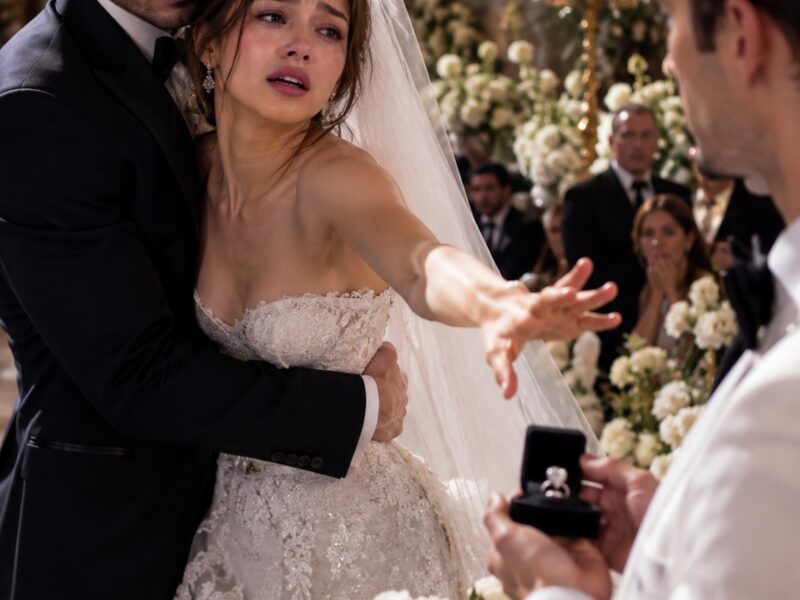
HE STOLE ME FROM MY WEDDING—THEN I DISCOVERED WHY HE HAD CHOSEN ME LONG BEFORE WE EVER MET
“This is not my wedding.”
My voice came out steadier than I felt.
“This is not the man I chose. That is not my grandfather waiting outside those doors. And if you think putting me in a white dress and locking me inside your family chapel makes any of this real, Adrian, then you are more insane than I thought.”
Adrian Vale stood beside me without blinking.
That frightened me more than anger would have.
He was six-foot-three, dressed in a black tuxedo that probably cost more than my first car, with the kind of stillness that made everyone else in the room unconsciously lower their voices. Ministers shook his hand carefully. Bank presidents returned his calls before meetings ended. Men twice his age watched his expression before deciding whether to laugh.
And his hand was wrapped around mine.
“Let go of me.”
“After the ceremony.”
“There will be no ceremony.”
“There will.”
“I hate you.”
“I know.”
No flinch.
No argument.
Just those two words.
I looked toward the enormous carved doors behind us.
“My family is waiting for me.”
“Your family is safe.”
“My grandfather—”
“Safe.”
“Liam—”
Adrian’s jaw tightened.
“Don’t say his name while you’re standing beside me.”
A bitter laugh escaped me.
“You don’t get to be jealous. You kidnapped a bride.”
“I stopped my wife from marrying another man.”
“I am not your wife.”
His eyes dropped briefly to the documents waiting beside the minister.
“Not yet.”
The chapel doors closed.
The sound rolled through the marble room like the lid of a coffin falling shut.
My heart pounded so violently that my ribs hurt.
Eight weeks earlier, Adrian Vale had been nothing more than the difficult older brother of my newest client.
At least that was what I had believed.
Maya Vale had interviewed seven wedding planners before finding me.
Seven.
One had suggested importing white peacocks from Italy. Another wanted to turn the Vale estate into a replica of Versailles. A third had apparently used the phrase “royal coronation aesthetic” so many times that Maya had walked out before the presentation ended.
Then she found Hart & Grace Events.
She called me personally.
“You actually listened,” she told me during our first phone conversation.
“That seems like a low standard for wedding planning.”
“You haven’t met my family.”
I laughed.
Eight weeks later, I would understand exactly what she meant.
The first planning meeting took place at the Vale estate outside Greenwich, Connecticut, a limestone mansion overlooking enough private land to make Manhattan feel imaginary.
Maya met me at the entrance.
Her mother, Celeste, was warm immediately.
Her grandmother, Eleanor Vale, inspected me over the rim of her tea before declaring, “Twenty-five?”
“Yes, ma’am.”
“You look younger.”
“I charge the same either way.”
Eleanor’s mouth twitched.
“I like her.”
Then Adrian walked into the room.
He didn’t introduce himself.
He looked at me.
That was worse.
There are men who stare because they think a woman is beautiful.
There are men who stare because they want something.
Adrian Vale looked at people as though information were hidden beneath their skin and he intended to find it.
“Adrian,” Maya warned, “behave.”
“I always behave.”
“That is the most dishonest sentence you’ve ever spoken.”
I opened my portfolio.
“Day one will be a private family dinner. Day two, the welcome reception. Day three, rehearsal and cultural dinner. The main ceremony will take place on day four, followed by three days of smaller family events.”
“How old are you?”
I stopped.
Maya closed her eyes.
“Adrian.”
“Twenty-five,” I answered.
His gaze remained on me.
“And unless your family’s wedding schedule changes according to my birth certificate, I’d like to continue.”
Eleanor coughed into her napkin to hide a laugh.
Adrian leaned back.
No embarrassment.
No apology.
Only interest.
“Are you married, Miss Hart?”
“Is that another professional question?”
“Perhaps my profession changed this morning.”
“Then you should update your résumé.”
Maya kicked her brother beneath the table.
I pretended not to notice.
I should have noticed something else.
The moment Maya said my full name.
“Elena Hart.”
Something changed in Adrian’s face.
Barely.
But enough.
“Hart?”
“Yes.”
He looked away.
I continued presenting.
Eight weeks of preparation. Full vendor coordination. Security cooperation. Financial changes requiring Maya’s approval.
“You personally attend every event?” Adrian asked.
“That is what your sister requested.”
“Good.”
“Is there a reason that pleases you?”
“Yes.”
“Would you care to share it?”
“Not yet.”
I remember thinking he was arrogant.
I didn’t know he was already trying to remember where he had heard my name.
Later that night, Adrian stood in his study with his security director, Marcus Hale.
“Daniel Hart,” Adrian said.
Marcus frowned.
“Who?”
“Elena’s father.”
“What about him?”
“Find everything.”
“How far back?”
“Thirty years.”
Marcus studied him.
“Legal sources?”
“Everything publicly available. Nothing illegal.”
“That distinction is comforting.”
Adrian ignored him.
Because he remembered.
He had been fifteen when his aunt Vivian disappeared.
Vivian Vale had left behind her purse.
Her jewelry.
Her passport.
Her car.
Everything except herself.
Adrian remembered adults whispering behind doors. His mother crying. His grandfather ordering investigators to keep searching.
And one name appearing again and again in the weeks before Vivian vanished.
Daniel Hart.
Three days later, Adrian cornered me beside six hundred white orchids.
“Your father is Daniel Hart.”
I looked up.
“Was.”
His expression sharpened.
“He’s dead?”
“Missing.”
“How long?”
“Twenty years.”
“Where did he go?”
I stared at him.
“If I knew that, Mr. Vale, he wouldn’t be missing.”
He looked almost disappointed.
That irritated me.
“Why are you suddenly interested in my father?”
“I’m not.”
“Lie.”
One eyebrow lifted.
“A very smooth one,” I added. “But still a lie.”
He smiled.
It wasn’t warm.
But it was the first time I saw something human break through all that polished control.
Over the following weeks, Adrian became a constant inconvenience.
He changed security routes without telling me.
He moved forty-seven guests because of an alleged threat assessment.
He rejected one florist because the loading entrance interfered with surveillance.
I found him one afternoon standing in a linen closet while I counted tablecloths.
“Why are you here?”
“My house.”
“This is a linen closet.”
“Still my house.”
“Move.”
“And if I don’t?”
“I’ll call Maya.”
“Cruel.”
“Efficient.”
His gaze moved over my face.
“You look beautiful when you’re irritated.”
“That isn’t useful information.”
“It wasn’t intended to be useful.”
“Save it for retirement.”
“Dinner with me tonight.”
“No.”
“Tomorrow?”
“No.”
“After the wedding?”
“Still no.”
“You haven’t considered it.”
“I considered it the first three times you asked.”
“And?”
“I concluded mixing a client relationship with a personal one would be inappropriate.”
“The contract ends Sunday at midnight.”
“I look forward to Monday.”
“So do I.”
Something in the way he said it made my stomach tighten.
Not fear exactly.
That was the problem.
By week four, I knew how Adrian took his coffee.
Black.
By week five, he knew I hated roses.
“They’re lazy flowers,” I’d said once.
“Flowers can be lazy?”
“Roses know they’re beautiful. They make no effort.”
He remembered.
He remembered everything.
One night, close to midnight, I found him in the ballroom while I was correcting seating charts.
“You haven’t eaten.”
“I’m working.”
“That isn’t food.”
“Excellent observation.”
“Sit.”
“That sounded like an order.”
“It was.”
“Then no.”
“Elena.”
It was the first time he’d used my first name like that.
Quietly.
Without teasing.
“Please sit.”
I stared at him.
“Much better,” he said.
“You train difficult men quickly.”
“Occupational skill.”
He pushed a plate toward me.
Then, after several minutes, he asked, “Your father. Your mother really believes he didn’t leave voluntarily?”
I put down my fork.
“You ask about him a lot for someone who isn’t interested.”
He said nothing.
I should have walked away.
Instead I told him.
“The morning after my fifth birthday, his coffee was still on the kitchen table. His wallet was upstairs. His car was outside. He’d promised to take me to the zoo.”
Adrian’s face changed.
Just slightly.
“That doesn’t sound like a man running away.”
“No.”
“Your mother waited?”
“Until she died.”
Silence filled the room.
For the first time, Adrian Vale looked almost ashamed.
I didn’t understand why.
Not yet.
The wedding was spectacular.
Maya cried when she saw the ballroom.
Celeste hugged me.
Eleanor kissed my cheek.
Even Adrian admitted I’d prevented him from turning his sister’s reception into “a security summit.”
“You made eleven changes,” I reminded him.
“You counted?”
“I keep records.”
“Good.”
“Why good?”
He stepped closer.
“I like occupying space in your mind.”
“You occupy space in my incident reports.”
Maya overheard us.
“I am begging both of you either to get married or stop talking like this.”
“Neither,” I said.
“We’ll revisit that,” Adrian said.
“We absolutely will not.”
At midnight on the final evening, I closed my laptop.
“Contract completed.”
Adrian checked his watch.
12:00.
“Congratulations, Mr. Vale.”
“Adrian.”
“You’re no longer my client.”
“Exactly.”
He looked almost pleased.
“Dinner tomorrow.”
“No.”
His smile disappeared.
“What’s the excuse now?”
“I don’t want to have dinner with you.”
He stared at me.
“That isn’t an excuse.”
“No. It’s an answer.”
Something flickered in his eyes.
Then he smiled again.
“Good.”
“Good?”
“I’ll change it.”
I should have understood then.
Adrian did not hear refusal the way normal people did.
He heard resistance.
And resistance, to him, was simply the beginning of negotiation.
The first flowers arrived Monday.
Forty-eight roses.
I sent them back.
Another arrangement arrived Tuesday.
I sent that back too.
Wednesday, chocolates.
Thursday, a handwritten invitation to dinner.
Friday, a book I’d mentioned once during a conversation three weeks earlier.
Then I noticed the black sedan outside my office.
Three times in one week.
I walked directly to it.
Adrian lowered the window.
“Are you following me?”
“You noticed.”
“That isn’t charming.”
“I wasn’t trying to charm you.”
“Then explain why your car has been outside my office three times.”
“I wanted to see you.”
“Normal people call.”
“You blocked my number.”
“That was information.”
“I interpreted it as a challenge.”
I stepped closer to the window.
“And that is the size of your problem. Everything becomes something to win.”
“Not everything.”
“Me?”
Silence.
“You think I’m something to win?”
“I think you’re something I want.”
“Wanting isn’t ownership.”
“I know the difference.”
“Then prove it.”
“How?”
“Walk away.”
For once, Adrian had no answer.
I turned.
Behind me, his voice came quietly.
“Elena.”
I kept walking.
That evening, Marcus placed a file on Adrian’s desk.
“We found the connection.”
Adrian opened it.
Photographs.
Hotel receipts.
Telephone records.
Restaurant reservations.
Vivian Vale and Daniel Hart.
Together.
Repeatedly.
For six months before both disappeared.
Daniel vanished first.
Vivian disappeared three weeks later.
Police had quietly considered a connection but never proved one.
Adrian stared at the photographs until suspicion hardened into something uglier.
Two families destroyed.
Two disappearances.
Twenty years later, Daniel Hart’s daughter had walked into Adrian’s home.
Coincidence?
Adrian Vale had stopped believing in coincidence long ago.
While he was deciding whether I might somehow be connected to his family’s oldest wound, I was making another decision.
Liam Grant had known me since childhood.
He knew my grandfather.
He remembered my mother’s birthday.
He knew exactly which diner I went to when I was exhausted and which movie I watched whenever I was sick.
He didn’t make rooms feel smaller when he entered them.
He didn’t watch me like a puzzle.
He didn’t frighten me.
Most importantly, he gave me peace.
Maybe, I told myself, peace was what love was supposed to feel like.
So when Liam proposed in my grandfather’s garden, I said yes.
The news reached Adrian the following morning.
Marcus delivered it.
“Elena Hart is engaged.”
Adrian went perfectly still.
“To whom?”
“Liam Grant. Attorney. Family friend.”
“How long?”
“They’ve been together on and off for several years.”
“And she never mentioned him.”
Marcus gave him a hard look.
“You never had the right to ask.”
“Get out.”
“Gladly.”
Adrian sat alone afterward.
Engaged.
The word felt absurdly physical.
Like a fist closing inside his chest.
He had been told no.
Repeatedly.
She had every right.
He knew that.
Then why could he see another man’s hand touching her?
Another man’s ring on her finger?
Another man’s name beside hers?
By noon, he was standing inside my office.
“Congratulations.”
I looked up.
“You heard.”
“Everyone heard.”
“Thank you.”
“Don’t marry him.”
I almost laughed.
“What?”
“Don’t marry him.”
“Adrian—”
“Marry me.”
The room became silent.
“You don’t even have a ring.”
“I’ll buy whatever ring you want.”
“That is the least problematic part of this conversation.”
“Name your conditions.”
“Marriage isn’t a merger.”
“I know.”
“Do you?”
His face tightened.
“Do you love me?” I asked.
He opened his mouth.
Nothing came.
“Exactly.”
“Elena—”
“You don’t even know me. You want me because I kept saying no.”
“That isn’t true.”
“Then tell me what I drink in the morning.”
“Tea. No sugar.”
I froze.
“Favorite music?”
“Old jazz when you’re working alone.”
My throat tightened.
“What am I afraid of?”
“Being abandoned.”
The answer came too quickly.
I stared at him.
He continued quietly.
“You touch the side of your neck when you’re anxious. You call your grandfather every night you’re working late. You hate roses because you think they’re lazy. And every time you’re angry with me, you pronounce my entire name like you’re preparing criminal charges.”
For one dangerous second, I couldn’t breathe.
Then I forced myself to remember what mattered.
“Knowing things about me isn’t the same as knowing me.”
“Give me the chance.”
“I did.”
“No.”
“Yes. Every time I told you no, I gave you the chance to show me what kind of man you were.”
That landed.
Hard.
“I am marrying Liam.”
His eyes darkened.
“I won’t watch that happen.”
“Then don’t come.”
My grandfather accelerated the wedding.
Friday.
Small ceremony.
Family only.
Afterward, Liam and I would leave the country for two weeks.
“You’re shaking,” Liam said the night before.
“I’m fine.”
“We don’t have to rush.”
“Yes, we do.”
“Because of Vale?”
“Because I want this.”
His expression changed.
“That isn’t how I hoped you’d describe our wedding.”
“Liam—”
“Do you love him?”
“No.”
Too fast.
He noticed.
“Look at me.”
I couldn’t.
“Say you don’t think about him.”
Silence.
That silence broke something in Liam’s face.
“I can’t,” I whispered.
“And that terrifies me.”
The next morning, Adrian Vale walked through my grandfather’s gate.
Security tried to stop him.
He reminded them exactly how many state contracts his companies influenced.
I saw him from the upstairs window.
Black suit.
No tie.
Fury held beneath perfect control.
My grandfather looked at me.
“If you go outside, Elena, understand something. Powerful men become dangerous when they confuse desire with entitlement.”
“I know.”
“Do you?”
I walked outside anyway.
Adrian stopped when he saw me.
“You’re coming with me.”
“No.”
“Elena.”
“Get out.”
“You cannot marry him.”
“Watch me.”
“I asked you.”
“And I answered.”
“Your answer was wrong.”
I stared at him.
“Listen to yourself.”
His jaw flexed.
“Come with me willingly.”
“Never.”
There are moments when a life can still turn back.
Adrian had one.
One step backward.
One apology.
One decent choice.
Instead, he made the worst decision of his life.
“Then I’m sorry.”
I felt cold.
“For what?”
The documents were already prepared.
Legal.
Binding if signed.
I refused.
He threatened nothing directly at first.
Then he mentioned my grandfather’s development project.
Twenty years of work.
Hundreds of jobs.
Permits waiting on approvals.
“By Monday,” Adrian said, “every approval could disappear.”
“You bastard.”
“Yes.”
My grandfather stepped forward.
“Don’t.”
I stopped him.
I looked at Adrian.
“If I sign, you leave my family alone?”
“Yes.”
“Forever?”
“Yes.”
“And you’ll remember every day that I did not choose this?”
Something broke behind his eyes.
But he nodded.
“Yes.”
I held out my hand.
“Give me the pen.”
That was how I became Elena Vale.
Not with vows.
Not with love.
With leverage.
Hours later, standing inside the Vale residence while Eleanor stared at us in disbelief, I said calmly, “Your grandson blackmailed me into marrying him.”
Eleanor turned toward Adrian.
“You did what?”
“It’s complicated.”
“No,” I said. “It’s actually remarkably simple.”
That night Adrian followed me upstairs.
“I’ll sleep in the guest room.”
“You’re sleeping here.”
I turned.
“No.”
“We’re married.”
“That certificate does not give you access to my body.”
He stopped.
For perhaps the first time since I’d known him, he seemed to understand that there was no argument available.
“You’re right.”
I hadn’t expected that.
“If you say no,” he continued, “it means no. Always.”
“Guest room.”
“Guest room.”
He left.
I hated that his obedience mattered to me.
Because the next morning he was still the man who had trapped me.
But now he was making coffee.
Badly.
“You burned the bread,” I said.
“Caramelized.”
“Black.”
“Strongly caramelized.”
I almost smiled.
I hated myself for that too.
Weeks passed.
Adrian stopped sending flowers.
Stopped entering rooms without knocking.
Stopped making decisions about my schedule.
He asked.
Sometimes awkwardly.
Sometimes as though the word “please” physically injured him.
When Liam came to the house, Adrian’s entire body tightened.
“Take your hand off her.”
I turned immediately.
“No.”
Adrian looked at me.
“You don’t decide who touches me.”
His fists slowly unclenched.
“Fine.”
“Good.”
Later, he asked, “Did you love him?”
“Yes.”
“Do you still?”
“Maybe.”
Pain crossed his face.
“Perhaps you should suffer quietly.”
“I am discovering I suffer very loudly.”
I laughed despite myself.
That was the danger.
Not that Adrian became harmless.
He didn’t.
The danger was that I began seeing the man underneath the armor.
He couldn’t cook.
He hated thunderstorms but pretended he didn’t.
He kept every birthday card his younger sister had ever given him.
He woke at four in the morning when his mind wouldn’t stop.
He had spent his entire adult life controlling every variable around him because chaos had taken someone he loved when he was fifteen.
And somehow, impossibly, I began wanting him.
One night we stood too close in the kitchen.
His eyes dropped to my mouth.
“You’re staring.”
“I want to kiss you.”
My heartbeat changed.
“Then kiss me.”
He didn’t move.
“Are you sure?”
That question almost undid me.
“Yes.”
He kissed me slowly.
No grabbing.
No ownership.
No victory.
When I pulled back, I whispered, “This doesn’t mean I’ve forgiven you.”
“I know.”
“Good.”
“I didn’t say stop.”
His mouth curved.
Neither of us heard Eleanor enter.
But we heard her voice.
“Daniel Hart.”
I pulled away.
“What?”
She looked at Adrian.
“Tell her.”
His face went pale.
Something inside me turned cold.
“Tell me what?”
Eleanor placed an old envelope on the counter.
“Vivian.”
Adrian didn’t touch it.
My stomach twisted.
“You knew my father’s name before we met.”
“Elena—”
“You knew.”
“At first, I wanted information.”
The room seemed to tilt.
“Information about what?”
“My aunt’s disappearance.”
I stepped backward.
“This was never random.”
“No.”
“Was I revenge?”
“No.”
“You followed me because of him.”
“At first.”
“At first.”
I laughed, but there was no humor in it.
“You don’t get credit because your obsession developed feelings.”
“I know.”
“Don’t touch me.”
He stopped instantly.
“I won’t.”
Three days passed.
We barely spoke.
Adrian had handled billion-dollar hostile acquisitions more easily than my silence.
For the first time, however, he began asking himself a question he should have asked from the beginning.
Why hadn’t Elena left?
And I was asking myself the same thing.
Partly because I hated him.
Partly because I was afraid of what leaving would do to my grandfather’s project, despite Adrian’s promises.
And partly because, God help me, I wanted him.
But wanting someone who hurt you does not erase the hurt.
A storm came on the third night.
Thunder shook the windows.
I found Adrian sitting alone in the library.
“You hate thunderstorms,” he said.
“I know.”
He waited.
“Sit beside me.”
“Are you sure?”
“Yes.”
He sat.
“Hold me.”
Again he waited.
Then carefully wrapped his arms around me.
“I still haven’t forgiven you.”
“I know.”
“I might never.”
“I know.”
I looked at him.
“But I want to kiss you.”
Something almost hopeful appeared in his face.
“Don’t turn this into a victory.”
“I wouldn’t dare.”
“You look pleased.”
“I’m having a pleasant evening.”
“You’re unbearable.”
“I’m working on charming.”
“Work harder.”
For a few fragile days, we almost resembled something normal.
Then Liam came to see me.
He still loved me.
Adrian knew it.
Liam asked the question I had been avoiding.
“Do you love him?”
“I don’t know what I feel.”
That was the truth.
Adrian heard enough of the conversation to understand that I hadn’t chosen him yet.
Then, five weeks later, everything changed.
I placed the pregnancy test on the bathroom counter.
Adrian stared at it.
Then at me.
“We’re having a baby?”
“Five weeks.”
His face transformed.
Joy.
Pure, unguarded joy.
For one terrible second, I wanted to share it.
Then I remembered the chapel.
The pen.
My grandfather’s project.
The life I’d never chosen.
“I want a divorce.”
The joy vanished.
“Elena.”
“I chose moments with you. I chose kisses. I chose nights beside you.”
I touched my stomach.
“But I never chose this marriage.”
His voice cracked.
“What do I do?”
“Let me go.”
Everything inside him wanted to say no.
He had spent his life believing that if something mattered enough, you fought harder.
Held tighter.
Controlled more.
Then Eleanor Vale entered his study carrying the letter Vivian had written before she disappeared.
Adrian finally opened it.
His aunt’s handwriting trembled across yellowed paper.
Daniel Hart had not destroyed Vivian.
Vivian had destroyed Daniel.
She had loved a married man who would not choose her.
When Daniel tried to end the relationship, Vivian retaliated.
She lied.
Manipulated his marriage.
Damaged his career.
Used the Vale family’s influence against him.
Daniel’s life collapsed beneath accusations he could not fight.
And before Vivian disappeared, shame finally caught up with her.
Her final warning to Adrian had waited twenty years to be read.
If you have harmed Daniel’s family in my name, repair what you broke.
Give them the freedom to hate you.
Give them the freedom to leave you.
That is what love should have looked like when Daniel asked me to let him go.
Adrian read the final sentence three times.
Then he understood.
He had become her.
Not in exactly the same way.
But close enough.
Vivian had called possession love.
So had he.
Daniel had asked Vivian to let him go.
Elena had asked Adrian the same thing.
And both Vales had answered by tightening their grip.
Adrian signed the divorce papers that afternoon.
He permanently insulated my grandfather’s project from every Vale-controlled company, foundation and political relationship.
Then he came to my grandfather’s house alone.
No security convoy.
No lawyers.
No flowers.
No demands.
I opened the door.
He remained outside.
“My aunt destroyed your father’s life.”
I said nothing.
“And I repeated her mistake with you.”
“Keep going.”
He swallowed.
“I investigated you. Followed you. Ignored your boundaries. Used your grandfather’s project to force you into a marriage you did not choose.”
My eyes burned.
“You never had the right.”
“No.”
“Not because you loved me.”
“No.”
“Not because you were afraid.”
“No.”
“Not because Liam was going to marry me.”
“No.”
His voice broke.
“I had no right.”
That was the first apology he ever gave me that contained no defense.
He held out an envelope.
“Divorce papers.”
I looked at them.
“Signed?”
“Yes.”
“And my grandfather?”
“His project is permanently protected. From me most of all.”
I stared at the man who once believed every closed door was an invitation to force it open.
“If I never want to see you again?”
“I’ll leave.”
“If the baby is born and I only want you involved as the father?”
“I’ll respect that.”
“If I walk through that door right now?”
He looked at me.
“I’ll let you—”
“No.”
He stopped.
“You’re doing it again.”
Confusion crossed his face.
“You don’t let me do anything.”
Understanding arrived slowly.
Then painfully.
“You’re right.”
Silence.
“You don’t need me to let you.”
“No.”
He nodded.
“I’m learning.”
“Slowly.”
“Painfully slowly.”
For the first time, I almost smiled.
He glanced toward the porch bench.
“May I sit?”
I stared at him.
“Did Adrian Vale just ask permission to sit?”
“I’m evolving.”
“Very slowly.”
“I’ve been informed.”
I sat beside him.
Not touching.
Not forgiving.
Just sitting.
We talked for almost two hours.
About Vivian.
About my father.
About the investigation Adrian reopened with my permission.
About the possibility that Daniel’s disappearance had been less mysterious than the Vale family had believed—perhaps a broken man leaving because every part of his life had collapsed.
Or perhaps something else.
We still didn’t know.
For once, Adrian did not promise to find the answer.
He only promised that any search would happen if I wanted it.
Before leaving, he said, “Dinner tomorrow?”
I looked at him.
“Are you asking?”
“Yes.”
“Seven-thirty.”
He blinked.
“Seven-thirty?”
“Don’t make me repeat myself.”
His smile was almost boyish.
“Restaurant?”
“Yes.”
“I won’t buy it.”
“You’d better not.”
“I was specifically instructed not to.”
Dinner became another dinner.
Then another.
No contracts.
No roses.
No black cars outside my office.
When Adrian wanted to see me, he called.
When I said no, he said goodnight.
The first time that happened, I sat staring at my phone afterward.
It should have felt ordinary.
Instead, it felt revolutionary.
Trust did not return dramatically.
It returned in small pieces.
A door he knocked on.
A question he waited for me to answer.
A hand he did not place on my back until I reached for it first.
An argument he allowed me to leave.
One evening, months later, Adrian showed me Vivian’s letter again.
“I loved her,” he said.
“I know.”
“I still do.”
“I know.”
“And what she did was terrible.”
“Yes.”
He stared at the page.
“Both things can be true.”
“Yes.”
He looked at me then.
The question in his eyes was obvious.
So I answered it.
“The same is true about you.”
Pain moved across his face.
I loved him.
And what he had done to me was terrible.
Love did not rewrite history.
It did not make coercion romantic.
It did not transform a cage into a home merely because the person who built it eventually regretted closing the door.
Adrian had to live with that.
So did I.
“May I kiss you?” he asked.
I stepped closer.
“Come here.”
His smile appeared before he could stop it.
“You’re smiling,” I whispered.
“I can’t help it.”
“Dangerous.”
“Extremely.”
Our child moved for the first time beneath my palm three weeks later.
Adrian froze.
“Was that—”
“Yes.”
“Can I?”
His hand hovered over my stomach.
I looked down at it.
Months earlier, that hand had closed around mine inside a chapel where I had not wanted to be.
Now it waited.
That difference mattered more than he would ever understand.
I took his wrist and guided his palm against me.
The baby moved again.
Adrian’s eyes filled.
“My child.”
I raised an eyebrow.
“Our child.”
He swallowed.
“Our child.”
“Excellent word.”
“I’m learning.”
“Slowly.”
“Painfully slowly.”
When the baby was due in six weeks, I returned to the Vale estate for dinner.
Eleanor had apparently already instructed the staff to prepare my old room.
Adrian looked horrified.
“Grandmother.”
“What?”
“She may not be staying.”
Eleanor stared at him.
Then at me.
“Remarkable. He can be taught.”
I laughed.
Adrian carried my overnight bag upstairs anyway.
At the doorway he stopped.
“You don’t have to come in.”
“I know.”
He stood there.
No pressure.
No expectation.
“I missed you,” he said.
“I missed you too.”
His eyes searched mine.
“Show me.”
I reached for him.
He kissed me.
Later, as rain tapped softly against the windows, Adrian took an envelope from his coat.
“The papers.”
The divorce documents.
Still valid.
Still signed.
“If you sign them,” he said, “I’ll respect it.”
“You won’t fight me?”
“No.”
“No lawyers?”
“No.”
“No buying judges?”
He looked offended.
“I’ve never bought a judge.”
“That pause was suspicious.”
“Elena.”
I laughed.
Then looked down at the papers.
For months, they had represented the one thing Adrian had once refused to give me.
A door.
An exit.
Choice.
I picked them up.
His face remained carefully blank.
Then I tore them in half.
Adrian stopped breathing.
I tore them again.
And again.
The pieces fell onto the table between us.
He stared at them.
Then at me.
“Elena…”
“Don’t misunderstand.”
“I wouldn’t dare.”
“This does not erase what happened.”
“I know.”
“It doesn’t turn the beginning of our marriage into some beautiful love story.”
“I know.”
“You were wrong.”
“I know.”
“And if you ever decide my choices are inconvenient enough to ignore again—”
“You’ll leave.”
“No.”
His expression changed.
“I’ll choose what happens next.”
He nodded.
“Yes.”
That was the answer I needed.
Not I’ll let you leave.
Not I’ll allow it.
Not I’ll give you freedom.
Just yes.
I touched his face.
For most of my life, I had thought love was supposed to feel certain.
Liam had given me certainty.
Adrian had given me chaos.
For a while, I mistook that chaos for passion, and Adrian mistook his fear of losing me for permission to possess me.
We had both been wrong.
Real love, I eventually learned, was quieter.
It was the space between wanting someone and reaching for them.
The question before the kiss.
The unlocked door.
The unsigned contract.
The hand waiting above my stomach until I invited it closer.
It was knowing you could leave and choosing, today, to stay.
Adrian bent and picked up one torn piece of the divorce papers.
“Can I keep this?”
“Why?”
“A reminder.”
“Of what?”
He looked at the fragment for a long moment.
Then he looked at me.
“That you stayed only after I finally learned how to let you go.”
Outside, the storm was fading.
For once, Adrian didn’t close the curtains against it.
He opened the window.
Cold night air moved through the room, carrying the smell of rain across the hardwood floors.
Somewhere downstairs, Eleanor was arguing with Maya about baby names. Someone laughed. A glass clinked against a table.
Life continued around us.
Imperfect.
Unfinished.
Free.
Adrian held out his hand.
He didn’t take mine.
He simply offered it.
And waited.
I looked at the man I had once hated for believing that wanting me gave him the right to keep me.
Then I looked at the open door behind him.
Nothing blocked it.
Nothing ever would again.
Only then did I place my hand in his.
Not because I belonged to Adrian Vale.
Not because a certificate said I was his wife.
Not because he had won.
But because this time, finally, the choice was mine.









