He Thought She Was Only Passing Through—Until His Six-Year-Old Nephew Begged Her Not to Leave Him Alone Again

The first time Hazel Brooks saw Caleb Mercer, he was on his knees in the dirt before sunrise, trying to braid a nine-year-old girl’s hair while something burned inside his house.
She stopped on the road without meaning to.
The Montana sky was still the color of cold iron. A thin line of orange had begun to cut across the mountains, but the Mercer ranch was already awake.
A boy stood on the porch wearing one boot.
He was crying over the other.
Two ranch hands waited near the fence with horses saddled, pretending not to watch their employer struggle with a blue ribbon between his fingers.
And Caleb Mercer—forty-one years old, broad-shouldered, exhausted, and apparently responsible for every living thing within half a mile—was staring at a crooked braid as though it had personally insulted him.
“Hold still, Josie.”
“I am holding still.”
“You moved.”
“You pulled my hair.”
“I didn’t pull it.”
“You definitely pulled it.”
From inside the house, the little boy shouted, “Something smells bad!”
Caleb closed his eyes.
Just for a second.
Hazel would remember that second later.
Because she knew that expression.
It was the face of someone who had learned there was no point asking life to stop throwing things at you. You simply stood there and caught what you could.
Caleb released the braid.
“Stay here.”
“Uncle Caleb—”
“Please.”
He disappeared into the house.
Smoke drifted through the doorway.
The girl sighed and began taking the braid apart herself.
Hazel almost smiled.
Almost.
Then she remembered she was only passing through.
That was the rule.
She adjusted the government ledger beneath her arm and continued toward the small Greer cabin on the other side of the fence.
She had lived by rules for two years now.
Don’t unpack everything.
Don’t buy anything you can’t carry.
Don’t become important to people.
Don’t let people become important to you.
And above all—
never stay long enough to have something worth losing.
The Greer cabin had been empty since winter.
The county kept it for temporary workers, census recorders, surveyors, men repairing roads, people whose presence came with an expiration date.
Hazel liked that about it.
Nothing expected permanence from her.
She carried one trunk inside.
Then a small toolbox.
Then the coffee pot.
Always the coffee pot.
By seven that morning, she had swept the floor, opened the shutters and discovered that the west window wouldn’t stay closed.
By noon, she had repaired it.
By evening, she had unpacked half the trunk.
Only half.
Never everything.
That night, Hazel filled the coffee pot.
She reached automatically for two cups.
She set them on the table.
Then she stopped.
Steam curled between them.
For several seconds, she simply stared.
Two years.
Four towns.
Four borrowed rooms.
And still her hands hadn’t learned.
She poured both cups anyway.
Hazel sat in one chair.
The other remained empty.
Daniel’s cup cooled across from her.
Of course it wasn’t really Daniel’s cup.
Daniel had been dead for two years.
But grief was strange that way.
It could turn an ordinary object into a person.
A chair into an absence.
A coffee cup into a marriage.
A silence into an entire conversation you would never finish.
Hazel wrapped both hands around her own cup.
“You’d hate this place,” she whispered.
Nothing answered.
She smiled faintly.
“No trees close enough to the house.”
Still nothing.
“And the wind sounds like somebody trying to get in.”
The second cup steamed.
Hazel looked away.
Outside, across the fence, Caleb Mercer called two children in for supper.
She heard a little boy laugh.
Then a door closed.
And for the first time since arriving, the cabin felt very small.
Tuesday morning, Hazel knocked on Caleb Mercer’s door.
He opened it with flour on his hands.
Behind him, something on the stove was losing a battle with heat.
Hazel lifted the ledger.
“Hazel Brooks. County census.”
He looked at the book.
Then at her.
“Caleb Mercer.”
“I know.”
His eyebrow moved.
“It’s written on my list.”
“Right.”
A girl’s voice came from somewhere behind him.
“Uncle Caleb!”
He turned his head.
“What?”
“My braid came out again.”
Caleb’s jaw tightened.
Hazel pretended not to notice.
He stepped aside.
“You’d better come in.”
The Mercer kitchen surprised her.
It was clean.
Not naturally clean.
Not comfortably clean.
It was clean the way a room becomes clean when someone is fighting every day to prevent his life from falling apart.
The chairs were pushed in too precisely.
The dishes were stacked.
A shirt had been mended badly and folded beside the stove.
Three lunch tins waited near the door.
Nothing was careless.
Everything was tired.
Hazel sat at the table and opened her ledger.
“Full name?”
“Caleb James Mercer.”
“Age?”
“Forty-one.”
“Occupation?”
“Rancher.”
“Property acreage?”
He answered.
Livestock?
He answered.
Number of people residing in the household?
He hesitated.
“Three.”
Hazel looked up.
“You and?”
“My niece and nephew.”
She waited.
Caleb’s gaze shifted toward the stove.
“Their parents are gone.”
There were certain answers Hazel had learned not to react to.
She simply wrote.
“I’m sorry.”
“Thank you.”
Neither of them said anything else.
Then the girl appeared.
She held a blue ribbon in one hand.
Her dark hair had come loose over one shoulder.
She had the stillness Hazel had seen in certain children after funerals—the unnatural carefulness of someone too young who had already discovered adults could disappear.
“This came out,” she said to Caleb.
“I’ll fix it.”
The girl’s face revealed exactly how much confidence she had in that promise.
Hazel closed the ledger.
“May I?”
Josie looked at her.
Not shyly.
Carefully.
Hazel knew she was being evaluated.
Finally, the girl crossed the kitchen.
Hazel turned her gently and gathered the loose hair.
Her fingers remembered before the rest of her did.
Separate.
Cross.
Tighten.
Smooth.
Again.
Again.
Again.
For one dangerous moment, she wasn’t in Montana.
She was in another kitchen.
Daniel was complaining that she made coffee strong enough to dissolve horseshoes.
Sunlight was coming through yellow curtains.
There were plans on the table.
A house.
A garden.
Children they had assumed they had time to have.
An apple tree they kept promising they would plant in spring.
Then a small voice pulled her back.
“My mama’s hair was your color.”
Hazel’s hands stopped for less than a heartbeat.
A six-year-old boy stood in the doorway.
Eli.
He was wearing both boots now.
His face was serious.
“Brown like that,” he continued.
Caleb stood at the stove with his back to them.
He didn’t move.
But Hazel saw his shoulders change.
Eli came closer.
“She used to let me hold the ribbon.”
Hazel continued braiding.
Because sometimes adults stopped when children mentioned the dead.
And stopping made the dead feel dangerous.
She didn’t want his mother to be dangerous.
“Was she good at braids?” Hazel asked.
Eli nodded.
“Fast.”
“I’ll have to practice.”
That earned the smallest change in his expression.
Hazel tied the ribbon.
Josie touched the braid.
“Better than Uncle Caleb’s.”
Caleb finally turned around.
“Everybody’s a critic.”
Something almost happened to his mouth.
Not quite a smile.
Hazel opened her ledger again before she could look too closely.
She finished her questions.
At the door, Caleb thanked her.
“County sends you all the way out here alone?”
“I’ve been alone before.”
He studied her for half a second.
Hazel immediately regretted the answer.
So did he, perhaps.
Neither commented.
She crossed the yard.
Reached the fence.
And then the tears came.
Not dramatically.
Thirty seconds.
Maybe less.
Hazel pressed her palm against the weathered fence post and bowed her head.
Brown hair.
Ribbon.
Mama.
Daniel.
The children they never had.
The kitchen they lost before it existed.
She let herself cry until the worst of it passed.
Then she wiped her face.
Opened the ledger.
And walked to the next property.
There were still names to count.
That was the useful thing about work.
It didn’t care if your heart was broken.
Two days later, Hazel noticed Eli’s mittens drying on the Mercer porch.
One thumb had worn through.
Josie’s coat hung beside the door.
Its shoulder seam had been repaired so many times that even the repair was beginning to fail.
Hazel said nothing.
That evening, she took a faded blue wool shaw from her trunk.
It had belonged to Daniel’s mother.
She had carried it through four moves.
There were objects you kept because they were useful.
And objects you kept because throwing them away felt too much like killing someone twice.
Hazel pulled several threads carefully from one loose edge.
She sat by the lamp for two hours.
She repaired Eli’s mittens.
Reinforced the worn palms.
Then strengthened Josie’s coat seam.
Before dawn, she crossed the fence and left everything on the Mercer porch.
No note.
By sunrise, she was back in her cabin.
Caleb found the bundle at six fifteen.
He knew immediately.
Not because Hazel had signed anything.
Because the repairs were too careful.
His own stitches looked like a man had threatened a piece of cloth until it agreed to stay together.
These were different.
Patient.
Small.
Strong.
He stood on the porch holding Eli’s mitten.
Josie appeared behind him.
“Who fixed it?”
Caleb looked across the field.
Smoke rose from the Greer chimney.
“I think I know.”
“Are you going to thank her?”
He considered that.
“No.”
Josie frowned.
“That’s rude.”
“No. I mean—”
He looked at the mitten again.
“I think she didn’t leave a note because she doesn’t want thanking.”
Josie considered this.
“Then what do you do?”
Caleb looked toward Hazel’s cabin.
Three days later, Hazel returned from work and stopped at her gate.
The leaning fence post had been straightened.
The latch had been repaired.
The broken porch step had been braced with fresh-cut pine.
Under the new latch was a single strand of blue wool.
Hazel stared at it.
Then toward the Mercer ranch.
Nobody was outside.
She smiled anyway.
That became their first language.
Not words.
Repairs.
She fixed a mitten.
He fixed a step.
She reinforced Josie’s coat.
He stacked dry wood beside her cabin before rain.
Neither thanked the other.
Neither admitted noticing.
It was safer that way.
The children, unfortunately, had no interest in safety.
Josie began waiting near the fence in the evenings.
Eli invented reasons to cross it.
Sometimes he carried eggs.
Sometimes a hammer Caleb had not asked Hazel to borrow.
Once he appeared with a potato.
Hazel looked at it.
“What’s this for?”
Eli looked equally confused.
“I don’t know.”
“Did your uncle send it?”
“No.”
“Did Josie?”
“No.”
“Then why are you giving me a potato?”
He thought for several seconds.
“I wanted to come over.”
Hazel had to turn away so he wouldn’t see her smile.
It was Josie who told Hazel about the stump.
An enormous old apple tree had once stood near the Mercer house.
Their grandfather had planted it.
Lightning had killed it the same summer Josie and Eli lost their parents.
“Uncle Caleb said he’d plant another,” Josie said.
Hazel touched the silvered wood.
“Sometimes you mean to get to something.”
Josie looked at her.
“And then?”
“And then getting to it becomes harder than doing it.”
Josie understood more than Hazel wished she did.
The stump stayed in Hazel’s mind.
So did the children.
So did Caleb.
She tried not to examine that last part.
Then came the Sunday rain.
It hammered the cabin roof for hours.
By late afternoon Hazel had made too much coffee.
That was the excuse she used.
She carried the pot across the field.
Caleb opened the door.
He looked at the coffee.
Then at her.
“Weather emergency?”
“Exactly.”
He stepped aside.
The kitchen was warm.
Eli was drawing with charcoal.
Josie was reading.
Hazel placed two cups on the table.
Caleb sat opposite her.
She poured.
He stared at the cup.
“I don’t drink coffee.”
Hazel looked up.
“What?”
“I don’t drink coffee.”
She studied him with genuine concern.
“Then how does your morning begin?”
“The sun comes up.”
Hazel leaned back.
“If I didn’t have coffee, the sun itself could come into my bedroom, sit beside the bed and introduce itself by its full Christian name, and I still wouldn’t get up.”
Eli’s head dropped over his drawing.
His shoulders shook.
Josie suddenly became fascinated by the ceiling.
Caleb picked up the cup.
He drank.
His face tightened.
“Bitter.”
“That means it’s real.”
Their eyes met.
And this time he did smile.
Barely.
But Hazel saw it.
Something inside her moved.
Something she immediately ordered to sit back down.
The following morning, when she knocked, there were already two cups on the table.
“Coffee’s ready,” Caleb said.
Hazel looked at him.
“You don’t even like coffee.”
He turned toward the window.
“Apparently that isn’t stopping anybody.”
She sat.
And that should have frightened her.
Instead, it felt like arriving somewhere.
Weeks passed.
Not important weeks.
That was what made them dangerous.
There were no declarations.
No grand gestures.
There were scorched beans.
Broken fences.
Wet boots.
A barn cat that had kittens.
Eli secretly smuggled the smallest kitten inside his coat for two days before Hazel caught him feeding it pieces of biscuit under the supper table.
He presented his defense like a lawyer.
“It was alone.”
“It has a mother.”
“It was cold.”
“It has brothers and sisters.”
“It likes me.”
“That is not legal grounds for moving into the house.”
Caleb leaned against the doorway.
“You’d make a decent circuit judge.”
“I’ve had practice.”
“With what?”
Hazel glanced at Eli.
“Unreasonable men.”
Caleb nearly laughed.
Josie began helping Hazel fold laundry.
Not because anyone asked.
Because being useful was how Josie stayed near people without admitting she wanted them near.
Hazel recognized it.
She had been doing the same thing for two years.
Then one evening, she reached for two coffee cups without thinking.
Caleb was away helping a neighbor.
Only Hazel and the children were there.
She poured both.
Eli noticed.
“Why’d you make two?”
Hazel froze.
“Habit.”
“For who?”
Josie looked up.
Hazel considered lying.
Instead, she sat down.
“My husband.”
“The one who died?” Josie asked softly.
“Yes.”
Eli stared at the second cup.
“What was his name?”
“Daniel.”
“Did he like coffee?”
Hazel smiled.
“He said coffee was never meant for one person.”
She looked at the steam.
“Every morning, he waited until I sat down before he drank his.”
The children were silent.
“When he died, my brother-in-law packed our coffee pot away. He said there wasn’t much point keeping something made for two when there was only one person left.”
“What did you do?” Josie asked.
“I bought another coffee pot.”
Eli frowned.
“Why?”
Hazel swallowed.
“Because he was right.”
They waited.
“Coffee isn’t meant for one person.”
Her voice nearly failed.
“So I kept making two cups.”
“For two years?” Josie whispered.
Hazel looked down.
“I suppose so.”
Eli stared at the untouched cup.
Then he reached across the table.
With both hands, he pushed it toward Hazel.
“Not anymore.”
Hazel stopped breathing.
Josie stood and wrapped her arms around her.
Eli joined her.
That was how Caleb found them.
Three people gathered around one chair.
Two cups on the table.
He stopped in the doorway.
Hazel looked at him over Josie’s shoulder.
Caleb understood.
He didn’t ask questions.
He crossed to the stove.
Filled the second cup.
Sat down.
And drank.
That night Hazel lay awake in the Greer cabin.
Because loneliness had been painful.
But loneliness had also been simple.
Now there were people on the other side of the fence whose absence she would notice.
That was worse.
That was infinitely worse.
A few days later, Franklin Carter asked her to the Pine Creek social.
He was thirty-eight.
The new schoolteacher.
Kind.
Clean-shaven.
Easy to talk to.
Exactly the sort of man a widow should probably consider if she ever intended to stop being one.
“No pressure,” Franklin said. “Just supper and dancing.”
“I’ll think about it.”
She meant it.
Then Eli arrived at her cabin that evening with a basket of eggs.
Josie followed him.
Halfway home, Eli turned.
“Are you going somewhere Saturday?”
Hazel’s stomach tightened.
“Maybe.”
“With the teacher?”
“Maybe.”
He nodded.
That was all.
The next morning, Hazel crossed to the Mercer kitchen.
Two cups were already waiting.
Caleb stood by the window with his land records.
“Coffee’s ready.”
She sat.
He did not ask about Franklin.
She did not tell him.
Saturday came.
Hazel stayed home.
Franklin Carter was a good man.
That was precisely the problem.
She didn’t want a good man.
She wanted a quiet kitchen where a man who hated coffee had started drinking it because she did.
And once she admitted that to herself, the fence between the cabins suddenly seemed much thinner.
Then she bought the apple tree.
It happened at market.
A traveling nursery had set up rows of saplings.
Pear.
Cherry.
Plum.
Apple.
One tree caught Hazel’s eye.
It wasn’t beautiful.
The trunk leaned.
One branch had broken and healed crooked.
The nurseryman saw her looking.
“That one’s tougher than it looks.”
Hazel touched the scar in the bark.
“It survived something.”
The old man looked at her.
“So did you, I’d wager.”
She removed her hand.
Josie appeared beside her.
“You could plant it where Grandfather’s tree was.”
Hazel almost said no.
She almost said she wouldn’t be around long enough.
Her county work would end.
Another town would need records.
Another borrowed room.
Another table.
Another second cup cooling across from her.
She looked at the crooked sapling.
Daniel had wanted an apple tree.
They had always postponed it.
Next spring.
After they saved more money.
After the move.
After the weather improved.
There had always been another spring.
Until there wasn’t.
“I’ll take it,” Hazel said.
They planted it that afternoon.
Caleb dug the hole deeper.
Josie poured the water mostly onto her own boots.
She laughed.
Not the careful laugh Hazel had heard before.
A child’s laugh.
Free and loud.
Caleb heard it too.
His shovel stopped.
For a moment, he looked away.
Hazel understood.
Sometimes happiness hurt when it returned.
Eli inspected the tree.
“It looks small.”
“It won’t stay small,” Caleb said.
When they finished, the four of them stood around it.
Josie looked at Hazel.
“You’ll be gone before it blooms.”
The words landed harder than anyone expected.
Caleb looked down.
Eli stopped kicking dirt.
Hazel touched the thin trunk.
She wanted to promise something.
She couldn’t.
That night, frost came.
Hazel woke before midnight and smelled it through the cracks in the cabin.
She grabbed burlap and ran.
When she reached the tree, a lantern was already there.
Caleb was on his knees packing straw around the roots with bare hands.
He looked up.
Neither spoke.
Hazel wrapped the trunk.
Caleb banked the soil.
Their hands worked together in the dark.
Ten minutes later, the sapling stood protected.
Hazel straightened.
Her breath was visible between them.
Caleb’s fingers were red from cold.
“You thought of it,” she said.
“So did you.”
They looked at the tree.
And both understood the thing neither dared say.
People did not run into freezing darkness for trees they expected to abandon.
Hazel became sick the next morning.
Caleb noticed because her chair was empty.
At six, he looked toward the door.
At seven, Eli set out Hazel’s cup.
At eight, Caleb crossed the fence.
He found her wrapped in a quilt beside a cold stove.
“I’m fine.”
“You can’t light the stove.”
“I’m considering it.”
“That’s not the same thing.”
He lit it.
Twenty minutes later he returned with broth.
Hazel stared at the pot.
“You made this?”
“Josie supervised.”
“Ah.”
“She says I was in the way.”
“She’s perceptive.”
Caleb sat beside her.
Hazel smiled weakly.
Then, perhaps because fever made people careless, she said, “Daniel and I were going to plant an apple tree.”
Caleb didn’t move.
“The spring we married.”
She stared through the window.
“We kept waiting.”
“For what?”
“Everything.”
She laughed once without humor.
“Money. Better weather. A better place. More time.”
Her hands tightened around the cup.
“We thought life would warn us when we were running out of later.”
Caleb lowered his gaze.
Hazel continued.
“After he died, I kept moving. I told myself it was because the county work moved.”
She looked at him.
“But maybe I was looking for the right ground.”
Caleb was quiet.
Then he asked the most dangerous question anyone had asked her in two years.
“Did you find it?”
Hazel met his eyes.
She didn’t answer.
But she didn’t look away.
After that, everything changed without changing at all.
Vegetables appeared on Hazel’s porch.
Firewood appeared beside the cabin.
She left bread at Caleb’s.
Josie started saving stories to tell Hazel at supper.
Eli saved her a chair.
One evening all three Mercers came to her cabin.
“Uncle Caleb said you’d be tired,” Eli announced.
“He walked us over so you wouldn’t eat alone,” Josie explained.
Caleb stood behind them holding his hat.
“I hope we’re not imposing.”
Hazel looked at the three of them.
“You’re not.”
It was the least true thing she had said in weeks.
They ate at her small table.
Eli talked about the kitten.
Josie read aloud.
Caleb repaired a loose chair rung without asking.
After they left, Hazel stood in the doorway watching their lantern cross the field.
Caleb’s hand rested on Eli’s shoulder.
Josie carried the light.
Hazel finally named the feeling in her chest.
Home.
She sat down because her knees suddenly felt weak.
Home was not supposed to happen again.
Then the county supervisor arrived.
“Three ranches left,” he told her.
“Finish Friday.”
Hazel nodded.
“The wagon comes Saturday after next.”
He rode away.
Hazel remained at the table.
Saturday.
She looked through the window.
At the apple tree.
That evening she met Caleb at the fence.
Neither said Saturday.
Which meant Saturday was the only thing between them.
“Nearly finished?” he asked.
“Friday.”
He nodded.
“County might need recorders again.”
“Maybe.”
“Come spring.”
Hazel looked directly at him.
“Is that what you came out here to say?”
Caleb looked toward the tree.
“Eli will miss having somebody to practice braiding with.”
“Eli.”
“Yes.”
She waited.
Caleb said nothing.
Hazel’s heart sank.
“Good night, Caleb.”
“Good night.”
He went inside.
And stood in his dark kitchen hating himself.
He had meant to say Stay.
Instead he’d said Eli will miss you.
He had meant to say I will miss you.
Instead he’d talked about spring.
He had meant to tell her that somewhere in the last six weeks she had stopped being the widow in the Greer cabin and become the person he looked for every morning.
But saying the true thing gave Hazel the power to say no.
Caleb had survived death.
He had survived burying his brother.
He had survived watching two children stand beside their parents’ graves.
But somehow the possibility of Hazel Brooks looking him in the eyes and saying no frightened him more than all of it.
So he said nothing.
And that silence almost cost him everything.
Margaret Callaway arrived the following week.
She was Josie and Eli’s maternal grandmother.
Sixty-two.
Upright.
Sharp-eyed.
A woman accustomed to entering rooms certain that her concern justified whatever came next.
Margaret had loved her daughter Lucy.
That was the complicated part.
She wasn’t cruel.
She was afraid.
And fear, when given enough time and righteousness, could learn to sound exactly like cruelty.
She had heard about Hazel.
Everybody had.
The census widow.
The woman always at the Mercer ranch.
The woman braiding Josie’s hair.
The woman eating supper with Caleb.
The woman whose assignment ended in days.
Margaret had even written a letter asking about a grandmother’s legal standing in a guardianship dispute.
She had not mailed it.
Yet.
Then came the church supper.
Hazel brought apple cake.
She sat beside Josie.
Eli was explaining why the sapling needed exactly the correct amount of water when Hazel noticed Margaret watching her.
Caleb left to get coffee.
Margaret crossed the room.
She sat opposite Hazel.
“You seem like a decent woman.”
Hazel heard immediately that it was not a compliment.
“Thank you.”
“Decent women understand certain things.”
Josie stopped eating.
Margaret continued.
“Caleb is raising two children without a formal family arrangement. People notice things.”
Hazel kept her voice level.
“What things?”
“A widow spending nearly every morning and evening in a bachelor’s household.”
Eli stared at the tablecloth.
“Margaret,” Hazel said quietly, “if you have concerns about Caleb’s household, you should discuss them with Caleb.”
“I’m discussing them with you.”
“Why?”
“Because women sometimes understand what men refuse to.”
Hazel felt every eye at the neighboring table.
Margaret leaned closer.
“You aren’t from here.”
Hazel said nothing.
“You have no roots here.”
Still nothing.
“Your work ends in two days.”
That one hurt.
Margaret saw it.
“What you’re doing with those children may feel harmless to you. But attachment has consequences.”
Hazel’s jaw tightened.
“They’ve already lost their mother.”
“I know.”
“Do you?”
Hazel’s voice remained soft.
That made it sharper.
Margaret blinked.
Before either woman could continue, Josie stood.
Nine years old.
Small shoulders.
Hands shaking.
Voice steady.
“She fixed Eli’s mittens.”
Margaret looked at her granddaughter.
Josie swallowed.
“She fixed my coat. She braids my hair. She sits with me when I can’t sleep.”
“Josie—”
“She planted Grandfather’s tree because Uncle Caleb couldn’t.”
Margaret’s face changed.
Josie’s eyes filled, but she refused to cry.
“She didn’t do those things for nothing.”
Silence swallowed the hall.
Then Caleb returned.
He took in Hazel’s face.
Josie standing.
Eli staring down.
Margaret across the table.
His coffee cup touched the table very slowly.
“You want to know the shape of this household?” he asked.
Margaret stiffened.
“Caleb—”
“Those are my children in every way that matters.”
Josie looked at him.
Eli looked up.
“I will raise them in a house with people who choose to be there.”
His eyes shifted briefly to Hazel.
“If that’s not enough for a judge, then I’ll have that conversation in front of a judge.”
Margaret’s face went pale.
“But I will not have it at a church supper in front of the children.”
“I’m not your enemy.”
“I know.”
His voice softened.
“But tonight you came at Hazel like one.”
Margaret left before dessert.
Eli reached across the table afterward.
He took Hazel’s hand.
No speech.
No tears.
Just his small hand around hers.
Hazel almost broke.
Margaret came to the Greer cabin the next morning.
Alone.
“I buried my daughter eighteen months ago.”
Hazel said nothing.
“I have not been afraid of anything smaller than losing what’s left of her since.”
Margaret’s voice cracked.
Barely.
“I am not a villain.”
“No.”
“But last night I acted like one.”
Hazel stepped aside.
She put on the kettle.
Then she set two cups on the table.
For an hour, they talked.
Margaret told stories about Lucy.
Hazel told stories about Daniel.
Two women sat with warm cups between their hands and discovered that grief could make enemies of people who were actually standing on the same side.
Margaret never mailed the letter.
But Saturday still came.
Cold.
Clear.
Hazel’s trunk sat in the middle of the cabin.
Not packed.
But no longer against the wall.
The wagon would arrive at nine.
Hazel filled the coffee pot.
She reached for two cups.
This time she didn’t stop herself.
She carried one outside.
Set it on the fence post.
The apple tree stood beyond it.
New leaves had opened.
Small.
Green.
Alive.
Caleb came out of the barn.
He saw the cup.
He crossed the yard slowly.
Hazel stared at the tree.
Neither spoke.
Caleb looked at the woman beside the fence and understood, finally, what he had done.
For eighteen months, he had learned how to survive without needing anyone.
Then Hazel Brooks had crossed the fence.
She had repaired mittens.
Burned coffee into his mornings.
Put laughter back into Josie’s mouth.
Put peace back into Eli’s eyes.
Put a second cup on his table.
And Caleb had answered every moment that demanded courage with silence.
The wagon would come in less than an hour.
He opened his mouth.
Nothing came.
Then the cabin door flew open.
Eli came running.
His coat was crooked.
His bootlaces trailed behind him.
“Eli!” Caleb shouted.
The boy ignored him.
He reached Hazel breathing hard.
Then pulled something from his pocket.
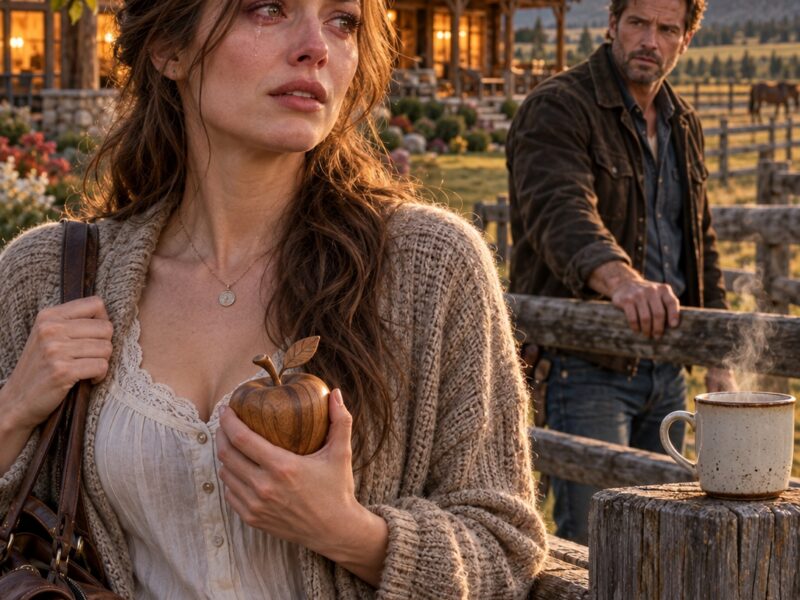
A wooden apple.
Small.
Rough.
Uneven.
One side had been carved too deeply.
“I made it.”
Hazel stared.
“For when you can’t see the real one.”
Her throat closed.
Eli held it toward her with both hands.
“Please take it.”
Hazel took the carving.
Eli’s lower lip trembled.
Then he said the words that finally broke every adult standing in that yard.
“Don’t make him eat alone again.”
Caleb went completely still.
Hazel looked at him.
Josie had appeared on the porch.
Nobody moved.
Caleb set his coffee cup on the fence post.
He looked at Hazel.
“You’ll be gone by spring.”
The sentence sounded stupid the instant it existed.
Hazel almost laughed through her tears.
She looked toward the tree.
Then at the wooden apple in her palm.
Then back at Caleb.
“Then why did I plant an apple tree?”
Silence.
Caleb stared at her.
Josie slowly sat on the porch step.
Eli looked between the adults with exhausted impatience.
Caleb swallowed.
“Spring’s a long way off.”
“It is.”
“The cabin’s empty until then.”
Hazel waited.
“And after.”
There it was.
Not quite Stay.
But finally close enough.
Hazel looked at the man who had learned to raise children but not ask for help.
At the girl who had learned not to hope too loudly.
At the boy who had carved her something to remember them by because he had assumed adults would once again fail to say what mattered.
Then she looked at the apple tree.
Its roots were invisible.
That didn’t mean they weren’t there.
Hazel lifted her bag.
For one terrible second, Caleb thought she was leaving.
Then she placed it on the Mercer side of the fence.
At nine o’clock, the county wagon reached the end of the lane.
It slowed.
The driver looked toward the Greer cabin.
No one came out.
After a moment, the wagon continued down the road.
Hazel watched it disappear.
She expected panic.
Instead, she felt something she hadn’t felt in two years.
Stillness.
Margaret burned the guardianship letter that afternoon.
The next Sunday, she came to supper.
Then the Sunday after that.
Eventually nobody thought of her visits as reconciliation.
They were simply Sundays.
Hazel stayed in the Greer cabin at first.
That mattered.
Love did not erase Daniel.
Caleb did not ask it to.
Some mornings Hazel still poured two cups and remembered a different man waiting for her to sit before drinking his coffee.
Caleb learned not to fear those mornings.
Once, he found her crying quietly at the kitchen table.
He didn’t ask if she still loved Daniel.
He already knew.
Instead, he poured his own coffee and sat down.
Hazel wiped her cheek.
“Doesn’t this bother you?”
“What?”
“That part of me still belongs to him.”
Caleb thought before answering.
“No.”
“Why?”
“Because if you hadn’t loved him, you wouldn’t be you.”
Hazel stared at him.
Caleb drank.
Still bitter.
Still hated it.
Still drank it every morning.
Months later, beneath a clear Montana sky, they married.
The ceremony was small.
The minister.
Two witnesses.
Margaret.
Apple cake Hazel baked herself.
Josie signed her name in careful letters.
Eli spent most of the ceremony fighting with his collar.
When they stepped outside, Eli reached for Caleb’s hand.
Caleb looked down.
For a moment, he couldn’t speak.
Hazel saw it.
The man who had spent so long believing he needed to replace two dead parents had finally understood the truth.
The children had never needed him to become everybody.
They only needed him to stay.
Seven years passed.
The apple tree grew taller than the porch roof.
Eli climbed it recklessly.
Josie stood below telling him he was an idiot.
Some things changed.
Some things didn’t.
The tree produced its first apple in its fourth year.
Hazel carried it inside.
Nobody wanted to cut it.
So it sat on the table all afternoon.
Finally Caleb picked up a knife.
“Four pieces.”
Eli protested.
“It’s the first one.”
“Exactly.”
Caleb cut it.
One piece for Josie.
One for Eli.
One for Hazel.
One for himself.
No ceremony.
No speech.
Just four people eating the first fruit from a tree that had nearly frozen before its roots had taken hold.
Years later, on a Saturday morning, Hazel baked the first apple pie of the season.
Cinnamon filled the kitchen.
The door stood open.
Caleb smelled it from the barn and came inside before she called.
“You have work.”
“This is work.”
“Eating pie?”
“Somebody has to.”
Josie, now sixteen, rolled her eyes.
Eli reached for the knife.
Hazel slapped his hand away.
“Wait.”
“Why?”
“Because civilized people wait for pie.”
“Who decided that?”
“I did.”
Caleb sat at the table.
Four cups waited.
He still drank coffee.
He still didn’t particularly like it.
Outside the window, the apple tree moved in the wind, its branches heavy with fruit.
Hazel set the pie on the table.
And beside the sugar bowl, where it had rested for seven years, sat Eli’s wooden apple.
The carving had cracked along one side.
One edge had darkened where small hands had once held it too tightly.
It wasn’t beautiful.
It wasn’t valuable.
Nobody who entered the house would have understood why Hazel dusted around it instead of moving it.
But the Mercers understood.
There are things you keep because they are useful.
There are things you keep because they are beautiful.
And then there are things you keep because once, on the morning you were supposed to leave, a six-year-old boy placed them in your hands and asked you not to make someone he loved eat alone again.
Hazel looked around the table.
Josie was telling Eli to stop stealing crust.
Eli was denying something everyone had watched him do.
Caleb was pouring coffee.
Four cups.
Not two.
Four.
Hazel looked through the open window at the apple tree.
For years, she had believed Daniel’s death had taught her the most important lesson of her life:
Never wait too long to love what you have.
She had been wrong.
That wasn’t the lesson.
The lesson was harder.
Loss did not mean you had chosen the wrong thing by loving it.
Grief was not proof that love had failed.
Sometimes grief was simply the price of having had something worth mourning.
And refusing to love again did not protect the dead.
It only gave death more than it had already taken.
Caleb slid a cup toward her.
Hazel wrapped her hands around it.
Outside, an apple fell from the tree.
It landed softly in the grass.
Nobody rushed to pick it up.
There were dozens more.
That, Hazel thought, might have been the miracle.
Not that the tree survived the frost.
Not that she stayed.
Not even that Caleb finally learned to say the things he was afraid to say.
The miracle was that after so many years of believing everything beautiful could disappear without warning, they had somehow built a life where there was finally enough.
Enough coffee.
Enough laughter.
Enough Sundays.
Enough apples.
Enough people around the table that no second cup ever had to grow cold again.
Caleb looked at her.
“What?”
Hazel hadn’t realized she was smiling.
“Nothing.”
He raised an eyebrow.
“That’s not a nothing smile.”
She looked toward the tree.
Then at the little wooden apple.
Then at the man sitting across from her.
Seven years earlier, she had arrived with one trunk, one government ledger and a rule that she would never stay anywhere long enough to belong.
Now there were muddy boots by the door.
Josie’s books on the windowsill.
Eli’s jacket thrown over the wrong chair.
Caleb’s hat hanging beside hers.
A pie cooling between four coffee cups.
And an apple tree outside whose roots had gone so deep no one could see where they ended anymore.
Hazel reached across the table and took Caleb’s hand.
He looked down at their fingers.
Then back at her.
She smiled.
“Coffee’s getting cold.”
Caleb took a drink and grimaced.
Seven years.
Still bitter.
Hazel laughed.
And outside the open kitchen window, the apple tree moved gently in the Montana wind, heavy with everything it had once been too small to promise.









