HE TOLD HIS BRIDE HIS MOTHER WAS DEAD—THEN SHE APPEARED AT THE WEDDING
The night before Daniel Carter’s wedding, he looked his mother in the eyes and told her she was dead.
Not dying.
Not dead to him.
Dead.
He had already buried her in conversations she had never heard, erased her from photographs she had never seen, and turned thirty years of sacrifice into a clean little tragedy that sounded respectable at expensive dinner tables.
“My mother passed away years ago.”
That was what Daniel had told his fiancée.
That was what he had told her parents.
That was what he had told friends, coworkers, wedding guests, and anyone else who might have asked too many questions about where he came from.
The only problem was that Margaret Carter was standing three feet away from him, very much alive.
And the following afternoon, she would stand outside the doors of his wedding with no invitation, wearing the nicest dress she owned.
But before that happened, Daniel had to break her heart.
It was nearly ten o’clock when Margaret heard his car pull into the narrow driveway of her little house outside Columbus, Ohio.
She had been sitting at the kitchen table beneath the yellow light above the stove, sorting through an old wooden box of photographs.
She had been doing that more often lately.
Tomorrow, her youngest son was getting married.
Daniel.
Her little boy.
The child who used to crawl into her bed during thunderstorms.
The teenager who once promised he would buy her a mansion when he became successful.
The young man who had kissed her cheek after receiving his college acceptance letter and whispered, “Everything you did was worth it, Mom.”
Margaret held one photograph between her fingers.
Daniel was six in it.
He had chocolate icing around his mouth and a paper birthday crown tilted sideways on his head.
She remembered the exact sound of his laugh that afternoon.
She remembered thinking motherhood was exhausting and frightening and expensive and somehow still the greatest privilege she had ever been given.
“You would never leave me alone,” she whispered to the photograph.
Her mouth curved into a small smile.
“I still remember that little smile.”
Headlights swept across the living-room wall.
Margaret looked toward the window.
For one hopeful second, she thought Daniel had come because he was nervous.
Maybe he wanted his mother before the biggest day of his life.
Maybe he needed advice.
Maybe he wanted to sit in the kitchen like he used to, drinking coffee too late at night while pretending he wasn’t afraid of tomorrow.
She hurried to put the photographs away.
By the time Daniel knocked, she was already opening the door.
He stood beneath the porch light wearing a charcoal overcoat over his white dress shirt. His tie was loosened. His dark hair looked as though he had run his hands through it repeatedly.
But there was something wrong with his face.
No smile.
No warmth.
No nervous excitement.
“Daniel?” Margaret said. “What are you doing here so late?”
He glanced toward the street before stepping inside.
That small movement should have warned her.
Daniel used to enter this house without knocking.
Tonight, he looked afraid someone might see him standing there.
“Mom, I need to talk to you.”
Margaret’s smile faded.
“Is something wrong?”
“No. Nothing’s wrong.”
“Then sit down. I made soup. You probably haven’t eaten properly with everything happening.”
“I’m not hungry.”
“Coffee?”
“No.”
She studied him.
Daniel remained standing.
Margaret slowly pulled out a chair anyway.
“You’re making me nervous.”
He exhaled.
“I need you to stop talking about me to Sophia’s family.”
Margaret blinked.
For several seconds she genuinely didn’t understand.
“What did I say?”
“You spoke to Sophia’s aunt.”
“At the grocery store?”
“Yes.”
“She recognized my last name. She asked whether I was related to you.”
“And what did you tell her?”
Margaret almost laughed because the answer seemed absurdly obvious.
“I told her I’m your mother.”
Daniel’s jaw tightened.
“That is exactly the problem.”
Silence filled the kitchen.
The refrigerator hummed.
A clock above the sink clicked forward one second at a time.
Margaret stared at her son.
“What do you mean?”
“I don’t want people asking questions about my family.”
“Your family?”
“Mom, please.”
“No, Daniel. Explain it to me.”
He rubbed his forehead.
“This is already difficult enough.”
“For whom?”
Daniel looked away.
And suddenly Margaret understood that whatever he had come to say had been rehearsed before he arrived.
Maybe in the car.
Maybe for days.
She lowered herself into the chair.
“Why are you ashamed of me?”
Daniel immediately shook his head.
“I didn’t say that.”
“You didn’t have to.”
“That isn’t what this is about.”
“Then what is it about?”
“My wedding is tomorrow.”
“I know.”
Despite everything, her expression softened.
“I know, sweetheart. I’m so happy for you.”
Daniel swallowed.
“You’re not coming.”
Margaret stopped breathing.
There are sentences that hurt because they are cruel.
And then there are sentences that hurt because the person saying them has no idea what they are destroying.
Margaret looked at him as though she had misheard.
“What?”
“You can’t come tomorrow.”
She gave a tiny nervous laugh.
“Daniel, I’m standing right here.”
“I know.”
“I’m your mother.”
“I know.”
“You sent me the venue address.”
“That was months ago.”
“I bought a dress.”
He said nothing.
Margaret’s hands slowly folded together on the table.
She had spent three afternoons looking for that dress.
Navy blue.
Nothing flashy.
Nothing that might embarrass him.
She had even asked the saleswoman whether it looked appropriate for the mother of the groom.
The woman had smiled and said, “Your son is going to be proud when he sees you.”
Margaret had believed her.
Now Daniel stared at the floor.
“Why?” she whispered.
His answer came quietly.
“I told everyone my mother died years ago.”
For a moment, Margaret thought he must be joking.
Then she saw his face.
And something inside her went completely still.
“You told them I was dead?”
“Mom—”
“You told Sophia I was dead?”
“I didn’t know how serious we were going to become when it first came up.”
Margaret stared at him.
“So you lied.”
“Yes.”
“And then?”
“It became complicated.”
“How?”
“Her family started asking questions.”
“About what?”
“Where I grew up. What my parents did. Schools. Connections. All of it.”
“And you were ashamed to tell them?”
Daniel’s voice sharpened.
“I worked hard to build my life.”
Margaret recoiled slightly.
He continued before he could stop himself.
“I didn’t want people judging me because of my family.”
The words hung there.
Margaret’s eyes changed.
Not anger.
Something worse.
Recognition.
“Your family,” she repeated.
Daniel closed his eyes.
“I didn’t mean it like that.”
“How did you mean it?”
“Mom, you know how Sophia’s family is.”
“No. I don’t.”
“They come from money. Her father knows everyone. Her mother sits on three nonprofit boards. Half the wedding guests are people I work with or people who can affect my career.”
“And what would happen if they knew your mother lived in this house?”
“That isn’t what I said.”
“If they knew I worked two jobs?”
“Please.”
“If they knew your father died owing hospital bills?”
“Mom.”
“If they knew sometimes our electricity got shut off?”
“Stop.”
Margaret’s voice became quieter.
“If they knew where you came from?”
Daniel finally looked at her.
That was answer enough.
After his father, Robert, died, Margaret had been thirty-eight years old with two boys, a mortgage she couldn’t afford, and $412 in the bank.
She had worked mornings in a school cafeteria and nights cleaning offices.
There were winters when she kept the thermostat at fifty-eight degrees and told the boys she liked sleeping under extra blankets.
There were weeks when she ate toast for dinner because Daniel needed money for soccer.
There was one Christmas when she sold her wedding ring to pay the heating bill.
Daniel never knew.
Margaret had made sure of that.
She had believed protecting children meant hiding the price of loving them.
Perhaps that had been her mistake.
“After your father died,” she said, “I raised you alone.”
“I know.”
“I worked every hour I could.”
“I know.”
“I made sure you and Victor stayed in school.”
“I know.”
“I never let you think we were poor.”
Daniel suddenly snapped.
“I never asked you to do all that.”
Margaret went silent.
Daniel’s face changed instantly.
Regret flashed across it.
But some words cannot be pulled back once they have reached the person they were designed to wound.
Margaret nodded slowly.
“No,” she said. “You didn’t.”
“Mom—”
“You were eleven years old. Of course you didn’t ask.”
Daniel looked away.
Margaret’s eyes filled, but she refused to let the tears fall.
“You were my whole world.”
He said nothing.
“That was my choice. Not your debt.”
“That’s not what I meant.”
“Then tell me what you meant.”
Daniel couldn’t.
Because somewhere beneath the expensive suit, the renovated condo, the corporate title, and the polished version of himself he had spent years creating, there was still an eleven-year-old boy who remembered being embarrassed by grocery coupons.
He remembered pretending not to see his mother cleaning the hallway at his middle school.
He remembered classmates joking about his secondhand sneakers.
He remembered scholarship applications asking for household income.
He remembered promising himself that one day nobody would ever look down on him again.
But somewhere along the way, Daniel had confused escaping poverty with escaping the woman who carried him through it.
Margaret stood.
She looked suddenly smaller than he remembered.
“I won’t embarrass you,” she said.
“Mom.”
“I won’t talk to anyone.”
“That’s not enough.”
Her eyes lifted.
“Then stay away.”
Margaret’s lips parted.
Daniel hated himself the instant he said it.
But tomorrow was already moving toward him like a train.
Sophia.
Her family.
His colleagues.
The lies.
He had spent years constructing a version of himself that could walk confidently through rooms where men like him were rarely born.
Now one woman in a navy-blue dress could collapse all of it simply by saying, “I’m his mother.”
“Please, son,” Margaret whispered. “Let me see you get married.”
Daniel stared at her.
She wasn’t demanding a seat at the front.
She wasn’t demanding recognition.
She wasn’t threatening to expose him.
She was begging for permission to witness one of the biggest moments of his life.
“Just let me sit somewhere in the back,” she said. “I won’t speak to anyone. You don’t even have to introduce me.”
Every decent part of Daniel wanted to say yes.
Then he imagined Sophia asking why he had lied.
He imagined her father looking at him differently.
He imagined whispers.
He imagined the life he had built cracking open.
“No, Mom.”
Margaret flinched.
“Daniel—”
“I’m sorry.”
He turned toward the door.
“Daniel, don’t walk away.”
His hand paused on the knob.
Behind him, Margaret struggled to keep her voice steady.
“I only wanted to see you happy.”
Daniel closed his eyes.
For half a second, he nearly turned around.
Then he opened the door.
Cold air entered the house.
Margaret stood alone beneath the kitchen light as her son walked down the steps.
“I only wanted to see you happy,” she whispered again.
The door closed.
Through the window, she watched Daniel climb into his car.
The engine started.
The headlights disappeared down the street.
Only then did Margaret allow herself to cry.
She sat back at the kitchen table.
The wooden box of photographs remained beside her.
She opened it.
Birthday parties.
School concerts.
Baseball games.
Graduation.
Daniel asleep against her shoulder.
Daniel missing his front teeth.
Daniel wearing his father’s oversized jacket.
Daniel holding his college acceptance letter.
Daniel smiling beside her as though there had never been a world in which knowing her might embarrass him.
Margaret touched one photograph.
“How did my little boy become a stranger?”
The following morning, her best friend Helen found her sitting in the same kitchen.
Margaret had barely slept.
“Margaret?”
She looked up.
Helen stopped when she saw her face.
“What happened?”
For several seconds Margaret couldn’t speak.
Then the words came out.
“Daniel told everyone I was dead.”
Helen stared at her.
“He said what?”
“He told Sophia and her family that his mother died years ago.”
Helen slowly put down her purse.
“He doesn’t want people to know I’m his mother.”
“How could he do that?”
Margaret wiped her cheek.
“Maybe he’s ashamed of his past.”
“His past?”
Helen’s anger rose immediately.
“You are not something shameful from his past. You are his mother.”
“Please don’t be angry with him.”
“Margaret, he erased you.”
“He’s scared.”
“He’s thirty-four years old.”
“He worked hard for this life.”
“So did you.”
Margaret looked toward the hallway.
Her navy-blue dress was hanging from the bedroom door.
Helen followed her gaze.
“You’re thinking about going.”
Margaret didn’t answer.
“He told you not to come.”
“I know.”
“You’ll get hurt.”
“I know.”
“Then why?”
Margaret looked at the photographs scattered across the table.
“Because he’s still my son.”
Helen shook her head.
“That doesn’t mean he gets to treat you like this.”
“No.”
Margaret’s voice trembled.
“But I don’t want to ruin his wedding. I don’t want an apology today. I don’t want to expose him.”
“Then what do you want?”
Margaret’s answer was heartbreakingly simple.
“I just want to see my son one last time today.”
Helen stared at her.
“One last time?”
“As my little boy.”
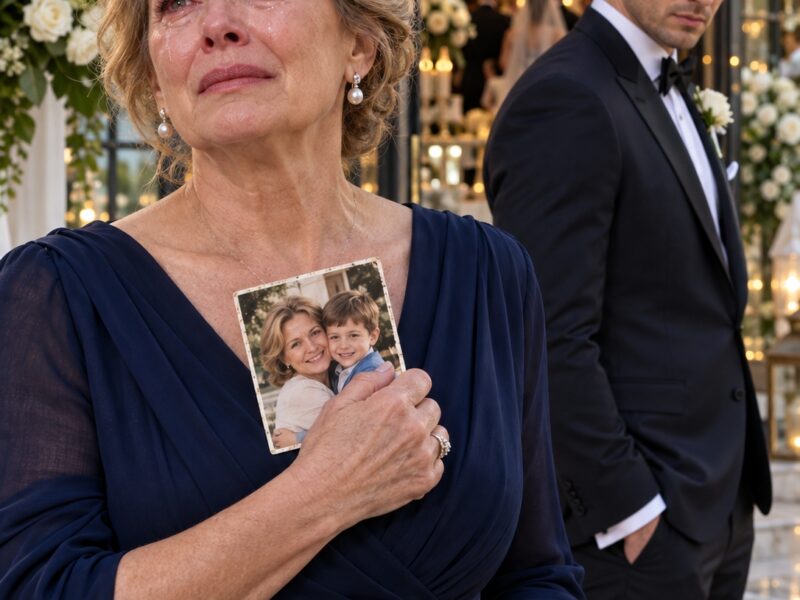
Margaret picked up the photograph of six-year-old Daniel wearing the paper crown.
“After today, he’ll be someone’s husband. He’ll have another family. Maybe children someday.”
Her thumb brushed across his tiny photographed face.
“I just want to see him happy.”
So Margaret dressed.
She put on the navy-blue dress.
She wore pearl earrings Robert had given her on their fifteenth anniversary.
She brushed her silver-streaked hair and pinned it carefully behind one ear.
She even put on lipstick.
Not because Daniel would see her.
Because she had spent her entire life teaching her sons that important days deserved respect.
Before leaving, Margaret stood in front of the mirror.
She looked at herself.
A sixty-one-year-old widow.
Wrinkles around her eyes.
Hands rougher than they should have been.
A dress bought for a wedding she had been forbidden to attend.
“Just one smile, Daniel,” she whispered.
“That is all I want.”
The wedding was being held at Hawthorne Conservatory, a renovated glass-and-stone venue overlooking the Scioto River.
White roses framed the entrance.
Valets moved between luxury cars.
Women in silk dresses stepped onto the pavement while men adjusted cuff links and checked their phones.
Margaret arrived alone.
Immediately, she knew she didn’t belong in Daniel’s new world.
Not because she lacked dignity.
Because everything around her had been designed to announce money quietly.
The flowers.
The champagne.
The string quartet.
The ivory place cards embossed in gold.
Margaret reached the entrance.
A young coordinator with a tablet smiled professionally.
“Good afternoon. Name, please?”
“Margaret Carter.”
The woman scrolled.
Then again.
Her smile changed.
“I’m sorry, ma’am. I don’t see that name.”
“That’s all right.”
“Are you perhaps listed under another guest?”
“No.”
Margaret looked through the glass doors.
“I only want to see my son.”
The coordinator hesitated.
“Your son?”
“Daniel Carter.”
The woman’s expression froze.
“The groom?”
Margaret nodded.
Before the coordinator could respond, another voice came from behind them.
“Who are you?”
Margaret turned.
The bride stood several feet away.
Sophia Bennett.
Margaret recognized her instantly from photographs Daniel had shown her months earlier.
But the photographs had not captured how nervous she looked.
Sophia wore a simple ivory wedding gown with long sleeves and a fitted waist. Her dark hair was pinned beneath a veil. In one hand she held a bouquet of white roses.
She had apparently stepped away from the bridal suite for a quiet moment before the ceremony.
Now she was staring at Margaret.
Margaret swallowed.
“I’m sorry. I shouldn’t be here.”
Sophia glanced toward the coordinator.
“Is there a problem?”
“No problem,” Margaret said quickly. “I’ll leave.”
Something in her voice made Sophia stop her.
“Wait.”
Margaret turned.
Sophia studied her face.
“Who are you?”
There were a thousand possible answers.
A guest.
An old family friend.
Someone who made a mistake.
Margaret could protect Daniel exactly as he had demanded.
Instead, perhaps because a mother can survive being hidden but not asked to deny what she is, she told the truth.
“I am Daniel’s mother.”
Sophia’s bouquet lowered slightly.
“What?”
“I’m his mother.”
Sophia stared at her.
The sounds of the venue seemed to recede.
Finally she whispered, “Daniel told me his mother died years ago.”
Margaret’s face tightened.
“He told you that?”
Sophia’s confusion became something sharper.
“So you really are his mother?”
“Yes.”
“How could he do this?”
“Please.”
Margaret stepped forward.
“Don’t be angry with him.”
Sophia almost laughed from disbelief.
“He told me you were dead.”
“He was afraid.”
“Of what?”
Margaret looked at the marble floor.
“Of where he came from.”
That answer changed something in Sophia.
She looked at Margaret’s carefully chosen dress.
At the pearl earrings.
At the hands clutching an old purse.
At the woman who had arrived at her own son’s wedding without demanding anything.
“You were invited originally, weren’t you?”
Margaret hesitated.
“Yes.”
“And he told you not to come.”
Margaret didn’t answer.
Sophia understood.
Her jaw tightened.
Then she reached for Margaret’s hand.
“You’re coming inside with me.”
Margaret pulled back.
“No.”
“Yes.”
“I don’t want to ruin your wedding.”
“You won’t.”
“Sophia, please. Today is supposed to be beautiful.”
Sophia looked directly at her.
“It won’t be beautiful if it begins with a lie.”
Margaret felt tears threatening again.
“He loves you.”
“Then he can tell me the truth.”
Sophia turned toward the ballroom.
Margaret’s heart began pounding.
“No. Please.”
But Sophia was already walking.
And because Margaret had spent her entire life following her sons when they needed her, she found herself following the woman her son was about to marry.
Inside, guests were settling into rows.
Music drifted beneath the glass ceiling.
Daniel stood near the front with the officiant.
His suit was perfectly tailored.
His boutonniere sat exactly where it should.
His smile was practiced.
Then he saw Sophia entering from the side.
His expression softened.
Until he saw who was walking beside her.
Daniel went white.
Sophia stopped several feet from him.
“Why didn’t you tell me the truth?”
Every nearby conversation died.
“Sophia.”
“No. Don’t ‘Sophia’ me.”
Daniel glanced toward Margaret.
His mother immediately lowered her eyes.
“I can explain.”
“You told me she was dead.”
“I didn’t want my past to become part of our wedding.”
Sophia’s face hardened.
“She is not your past.”
Daniel said nothing.
“She is your mother.”
Several guests turned.
Whispers moved through the room.
Exactly what Daniel had feared.
Except now that it was happening, the whispers seemed smaller than he had imagined.
What felt enormous was his mother’s face.
“Please don’t fight because of me,” Margaret said.
Daniel stared at her.
“Mom.”
The word escaped him instinctively.
Not Margaret.
Not ma’am.
Mom.
And everyone heard it.
Then another voice came from behind the guests.
“Mom?”
Margaret froze.
She knew that voice.
She turned.
A tall man stood at the end of the aisle wearing a dark suit, his travel bag still slung over one shoulder.
His hair was grayer than Daniel’s, his face leaner, but his eyes belonged unmistakably to the same family.
Margaret covered her mouth.
“Victor?”
Her older son smiled through wet eyes.
“I can’t believe you came,” Margaret whispered.
Victor crossed the room quickly and wrapped his arms around her.
“My dear boy.”
For several seconds, Margaret held him like he was twelve again.
Then Victor looked past her.
At Daniel.
The warmth vanished from his face.
“Did you really tell everyone Mom was dead?”
Daniel couldn’t answer.
Victor dropped his bag.
“You actually did it.”
“Victor, not here.”
“Where would you prefer? Somewhere nobody can see the woman who raised us?”
“Stop.”
“No.”
Margaret touched Victor’s arm.
“Please.”
But Victor had spent years living two states away, calling his mother every Sunday, listening to her make excuses for Daniel.
Daniel was busy.
Daniel was working.
Daniel had meetings.
Daniel would visit next month.
Victor had believed some of those excuses.
Now he understood the rest.
“You all should know what this woman did for us,” he said.
Margaret shook her head.
“Victor.”
“No, Mom.”
His voice cracked.
“They should know.”
Daniel’s eyes closed.
And suddenly the wedding disappeared.
Victor was sixteen again.
Daniel was eleven.
Their father had been dead for three months.
Margaret stood in the principal’s office wearing the blue cafeteria uniform from her first job.
She had been awake since five that morning.
The school administrator pushed paperwork across the desk.
“We can extend the payment deadline.”
“Please,” Margaret said. “Make sure my sons can stay in school.”
“We will do what we can.”
“I can pay. I just need more time.”
“Mrs. Carter—”
“I’ll pay.”
That night she took a second job.
Daniel remembered waking after midnight and finding her asleep at the kitchen table with her shoes still on.
He had covered her with a blanket.
Years later, when Victor won a statewide academic competition, Margaret had screamed louder than anyone.
“Mom, I won!”
“I knew you could do it!”
She had hugged him in a school gymnasium filled with parents whose clothes cost more than Margaret earned in a week.
She had never looked ashamed.
Daniel remembered his own promises too.
He was seventeen when he got his first scholarship offer.
He had run into the house waving the letter.
“Mom, when I make money, I’m going to buy you a huge house.”
Margaret laughed.
“That will make me very happy.”
“I mean it. I’ll always take care of you.”
She had touched his face.
“I believe you, sweetheart.”
Daniel had believed himself too.
That was perhaps the cruelest part.
Nobody wakes up one morning and decides to become ashamed of the person who saved them.
It happens in smaller compromises.
Daniel stopped mentioning where he grew up.
Then he changed the subject when people asked about his parents.
Then he let coworkers assume his family had money.
Then he met Sophia.
Her father owned a regional development company.
Her mother chaired charity events.
Their family photographs were taken in homes with staircases wider than Margaret’s living room.
At the first Bennett family dinner, Sophia’s mother had asked gently, “And your parents, Daniel?”
His father was easy.
“My father passed away.”
Then came the question.
“And your mother?”
Daniel had hesitated.
One second.
That was all it took.
“She passed away too.”
Sophia reached under the table and squeezed his hand.
“Oh, Daniel. I’m so sorry.”
He should have corrected himself.
He didn’t.
The lie became easier the second time.
Then easier again.
Eventually, Daniel stopped feeling as if he were lying.
Until his mother stood in front of him.
Alive.
Humiliated.
Still trying to protect him.
Daniel looked around the wedding hall.
Nobody was laughing.
Nobody looked disgusted because his mother had cleaned offices.
Nobody seemed horrified because he had grown up poor.
They looked disturbed because he had lied about a woman who loved him.
And for the first time, Daniel saw his carefully constructed life from outside himself.
It looked pathetic.
He walked toward Margaret.
“Mom.”
She looked at him.
“What is it, son?”
He couldn’t speak.
Margaret waited.
“What is it?”
Daniel’s eyes filled.
“I forgot everything you did for me.”
Margaret studied him for a long moment.
Then she shook her head.
“You didn’t forget, Daniel.”
Her voice was soft.
That made it hurt more.
“You just chose to hide it.”
Daniel broke.
His shoulders dropped.
The polished groom vanished.
“Mom, please forgive me.”
Margaret’s eyes filled.
“You hurt me more than you know.”
“I know.”
“No, you don’t.”
Daniel looked at her.
“I could have survived you telling people we were poor. I could have survived you telling them I cleaned bathrooms. I could have survived anyone in this room thinking I wasn’t good enough to be here.”
Her voice trembled.
“But you told them I was dead.”
Daniel began crying openly.
“I was ashamed of my past.”
Margaret said nothing.
“I cared too much about what people thought.”
He looked around the room.
At Sophia.
At Victor.
At strangers.
At colleagues.
At people whose approval had once seemed more important than anything.
“But I was wrong.”
Sophia stood quietly behind him.
She had every reason to walk away.
Daniel knew it.
A marriage built on lies could become a prison decorated with beautiful photographs.
He turned toward her.
“Sophia, I lied to you.”
“Yes.”
“I don’t have an excuse.”
“No.”
“I was scared you’d see me differently.”
“I do see you differently.”
Daniel’s face fell.
Sophia continued.
“But not because of where you came from.”
That sentence landed harder than anger.
Daniel nodded.
“I understand.”
Sophia looked at Margaret.
Then at him.
“If we get married today, we start with the truth.”
Daniel swallowed.
“No more lies.”
“No more invented history.”
“No.”
“No pretending the people who loved us before we had anything are somehow beneath the life we built afterward.”
Daniel looked at his mother.
“No.”
Margaret wiped her cheeks.
“You don’t have to decide anything because of me.”
Sophia shook her head.
“This isn’t because of you.”
She looked at Daniel.
“This is because of who I need my husband to become.”
Daniel nodded.
“I want to become that man.”
Victor remained unconvinced.
“One apology doesn’t erase years.”
“I know.”
“You ignored her.”
“I know.”
“You made her defend you after you told people she was dead.”
Daniel looked at his brother.
“I know.”
Victor’s eyes were wet.
“You used to tell me she was the strongest person you knew.”
“She still is.”
Margaret finally stepped between them.
“Enough.”
Both sons fell silent.
She looked at Daniel.
There was pain in her face.
But there was also something Daniel had not earned and could not understand.
Love.
“You are still my son.”
Daniel covered his mouth.
Margaret reached up and touched his cheek.
The same way she had when he was seventeen.
“I love you, Mom.”
“I love you too.”
Then Sophia stepped closer.
“Let’s start our family with the truth.”
Daniel took her hand.
The room remained completely silent.
Sophia looked toward the front row.
One chair had been reserved symbolically for Daniel’s supposedly deceased mother.
A small white rose rested on it.
Sophia walked over.
She picked up the flower.
Then she looked at Margaret.
“And this time, Mom will be sitting in the front row.”
Margaret’s face crumpled.
“That is all I ever wanted.”
Daniel walked his mother to the chair himself.
Every step down that short aisle felt longer than the entire road he had taken away from her.
He remembered the cafeteria uniform.
The secondhand shoes.
The scholarship letters.
The nights she waited up.
The promises he made.
The promises he broke.
At the front row, Margaret sat down.
Victor took the seat beside her.
Daniel knelt in front of his mother for a moment, ignoring the guests, the photographer, the schedule and everything else he had once believed mattered.
“I don’t deserve this.”
Margaret looked at him.
“No child earns a mother’s love.”
Daniel lowered his eyes.
“But a grown man should learn to honor it.”
He nodded.
“I will.”
Margaret gave him a sad smile.
“Don’t promise me a house this time.”
Daniel almost laughed through his tears.
“Then what should I promise?”
“Just don’t hide me again.”
He took her hand.
“Never.”
The ceremony began twenty-three minutes late.
Nobody complained.
When Daniel stood opposite Sophia, his hands were still trembling.
The officiant spoke about marriage, honesty, patience, and the families that shape us before we understand what love costs.
Daniel listened differently now.
When he said his vows, he did not sound polished.
He sounded scared.
Human.
Sophia preferred that version.
Margaret watched from the front row.
For years she had imagined this moment differently.
She had imagined Daniel seeing her before the ceremony and smiling.
She had imagined adjusting his tie.
She had imagined whispering that his father would have been proud.
None of that happened.
Instead, she had been erased, rejected, stopped at the door, and exposed before strangers.
Forgiveness did not magically remove those things.
When Daniel looked toward her during the ceremony, Margaret smiled.
But there was sadness inside it.
Daniel saw that.
And he understood something he had never learned while climbing toward the life he wanted.
Forgiveness is not the same as forgetting.
Love can survive a wound and still carry the scar.
After the ceremony, guests moved toward the reception.
Some approached Margaret.
Not with judgment.
With respect.
One of Daniel’s coworkers shook her hand.
“You raised a very determined man.”
Margaret smiled faintly.
“He was always stubborn.”
Sophia’s father introduced himself.
Margaret stiffened at first.
This was one of the men Daniel had apparently been so desperate to impress.
He offered his hand.
“Mrs. Carter.”
“Margaret, please.”
He nodded.
“Then call me Richard.”
She did.
Nothing terrible happened.
The ceiling didn’t collapse.
Daniel’s career didn’t vanish.
Nobody threw Margaret out.
The catastrophe Daniel had spent years fearing existed almost entirely inside his own head.
Later, at the reception, Daniel found his mother standing near a window overlooking the river.
Music played behind them.
Sophia was dancing with her father.
Victor was talking with relatives.
Daniel approached quietly.
Margaret noticed his reflection in the glass.
“You should be with your wife.”
“I will.”
He stood beside her.
“I wanted to ask you something.”
Margaret waited.
“Why did you come?”
She looked outside.
“You told me not to.”
“I know.”
“You knew I might be angry.”
“Yes.”
“You knew you might be humiliated.”
“Yes.”
“Then why?”
Margaret thought about it.
“I wasn’t coming to expose you.”
“I know.”
“I wasn’t even planning to speak to you.”
Daniel looked at her.
“I just wanted to see my son get married.”
His throat tightened.
“After everything I said?”
“You were still my son when you said it.”
Daniel looked away.
Margaret continued.
“That doesn’t make what you did acceptable.”
“I know.”
“And loving you doesn’t mean I’ll pretend it didn’t happen.”
“I understand.”
“Do you?”
Daniel nodded.
“I think I’m starting to.”
Margaret looked toward Sophia.
“She loves you.”
“I know.”
“Then don’t make her pay for the parts of yourself you’re afraid to face.”
Daniel absorbed that quietly.
“Mom?”
“Yes?”
“Were you ever ashamed of us?”
Margaret looked surprised.
“Of you and Victor?”
“When Dad died. When money got bad. When you had to ask the school for more time.”
Margaret shook her head.
“Never.”
“Not even once?”
“I was ashamed sometimes that I couldn’t give you more.”
Daniel’s eyes lowered.
“But I was never ashamed that you were mine.”
There it was.
The difference.
Margaret had spent years apologizing to herself because she couldn’t give Daniel everything.
Daniel had spent years apologizing to the world because of the woman who gave him everything she had.
He looked at her.
“I don’t know how to fix this.”
“You don’t fix thirty years in one afternoon.”
“Then what do I do?”
“You show up tomorrow.”
Daniel frowned.
“What?”
“And the day after that.”
She looked directly at him.
“And the day after that.”
No grand promise.
No mansion.
No dramatic gesture.
Just presence.
Daniel nodded.
“I can do that.”
“We’ll see.”
It was the first time Margaret had made him earn an answer.
And strangely, Daniel was grateful.
A few minutes later, the photographer called for family pictures.
“Immediate family of the groom!”
Daniel froze.
For years, that phrase had terrified him.
Now he turned.
Margaret was already stepping backward.
Old habits.
Old wounds.
She assumed they wanted Victor and Daniel.
Perhaps Sophia’s family.
Perhaps someone more appropriate for the photograph.
Daniel crossed the room.
“Mom.”
Margaret stopped.
He extended his hand.
“Where are you going?”
“I thought—”
“You’re my family.”
The room around them seemed to disappear.
Margaret looked at his hand.
Then at his face.
Slowly, she placed her fingers in his.
Daniel led her toward the camera.
Victor stood on one side.
Margaret stood between her sons.
Sophia joined Daniel.
The photographer lifted the camera.
“Everyone ready?”
Daniel looked at his mother.
Margaret was crying again.
But this time, she was smiling.
“Mom.”
“Yes?”
“Look at me.”
She did.
For one second, Daniel wasn’t a successful executive standing at an expensive wedding.
He was six years old again.
Chocolate icing around his mouth.
Paper crown crooked on his head.
Looking at the only person in the world who had loved him before he had anything worth admiring.
The camera clicked.
Years later, Daniel would keep that photograph framed in his office.
Not the polished wedding portrait.
Not the photograph of him and Sophia beneath the flowers.
That one.
His mother between her two sons.
Because it captured the exact afternoon Daniel finally understood what success had almost cost him.
He had spent half his life trying to outrun a poor childhood.
He had changed his clothes.
His neighborhood.
His vocabulary.
His friends.
His expectations.
He had entered rooms his younger self could never have imagined.
And somewhere during that climb, he had begun treating love like evidence of a crime scene he needed to erase.
Margaret never asked him to return to the past.
She only asked him to stop being ashamed that she had been there.
That night, after most guests had left, Daniel found a small white rose on the chair where his mother had sat.
He picked it up.
For several seconds, he simply stood there.
Sophia approached behind him.
“You okay?”
Daniel nodded.
Then shook his head.
“I almost didn’t let her see this.”
Sophia slipped her hand into his.
“But she did.”
“I told you she was dead.”
“Yes.”
“I don’t know how you can forgive that.”
Sophia looked toward Margaret, who was helping Victor gather coats.
“I haven’t yet.”
Daniel looked at her.
Sophia squeezed his hand.
“But forgiveness can start somewhere.”
Daniel nodded.
Across the ballroom, Margaret laughed at something Victor said.
Daniel hadn’t heard that laugh in years.
For the first time, he realized how much of his mother he had missed while she was still alive.
He walked toward her.
Not because anyone was watching.
Not because a photographer called him.
Not because he needed to repair his reputation.
Because she was his mother.
Margaret looked up as he approached.
Daniel smiled.
A small smile.
The kind he used to give her when he was a boy.
And Margaret recognized it immediately.
For one fragile second, all the years between them seemed to disappear.
She saw the child she had carried through feverish nights.
The boy whose sneakers she had secretly repaired with glue because there was no money for new ones.
The teenager who promised her a house.
The young man who left home determined never to feel poor again.
And the grown man who had finally discovered that poverty had never been the most shameful part of his story.
Shame was.
Daniel opened his arms.
Margaret stepped into them.
This time, he held on.
And while forgiveness would take longer than one wedding day, while trust would have to be rebuilt through ordinary Tuesdays and returned phone calls and dinners where nobody pretended the past had disappeared, something important had changed.
Margaret Carter was no longer a secret.
She was no longer a dead mother in Daniel’s carefully edited biography.
She was standing beneath the lights of his wedding reception, between both her sons, alive enough to forgive and wounded enough to remember.
And perhaps that was the truth Daniel needed most.
The woman he had been ashamed to introduce was the reason he had ever become someone worth introducing at all.
Years earlier, Daniel had promised his mother a big house.
She never got one.
He had promised he would always take care of her.
For a long time, he failed.
But when Margaret finally left the reception that night, Daniel walked her all the way to her car.
He opened the passenger door.
Then, before she got inside, he said the word he had once been too ashamed to let anyone hear.
“Mom.”
Margaret turned.
Daniel glanced back toward the glowing glass walls of the venue.
Several guests were still outside.
People could hear him.
For once, he didn’t care.
“I love you.”
Margaret smiled.
“I know.”
Daniel laughed softly through tears.
“You always say that.”
“Because I always have.”
He kissed her forehead.
Margaret climbed into the car.
Victor started the engine.
As they pulled away, she looked back through the window.
Daniel remained beneath the lights with Sophia beside him.
His hand was raised.
Margaret raised hers too.
She had gone to the wedding expecting nothing more than one distant glimpse of her son.
Instead, she had watched the life he built collide with the truth he buried.
And Daniel had learned, almost too late, that there are some people you can remove from a guest list, from a photograph, even from the story you tell the world.
But you cannot erase the hands that held you together before the world knew your name.
The wedding began with a lie.
The marriage began with the truth.
And in the front row sat the woman who had never needed a mansion, money, status, or an apology spoken in front of strangers.
She had wanted only one thing.
To hear her son call her Mom without shame.









