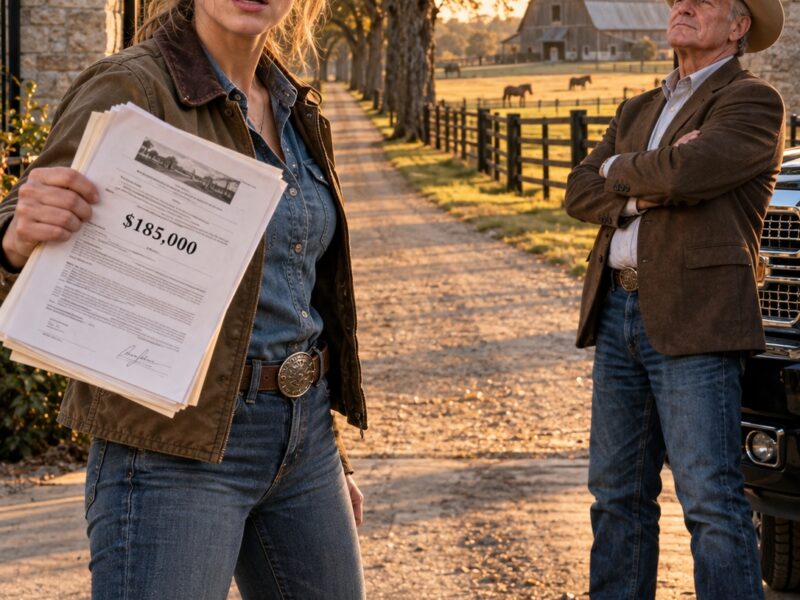
HE TOLD ME MY $420,000 FARM WAS WORTHLESS WITHOUT HIS PERMISSION—THEN I FOUND A ROAD BURIED FOR 100 YEARS
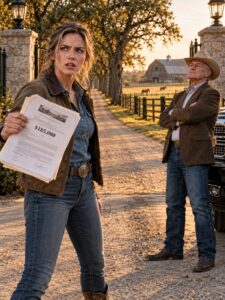
“You spent four hundred and twenty thousand dollars on land you can’t even reach.”
Walter Briggs said it without raising his voice.
That somehow made it worse.
We were standing beside his fence on a cold October morning, with six hundred acres of his family’s land stretching behind him and the farm I had just bought sitting somewhere beyond it.
My farm.
Two hundred and forty acres.
A collapsing barn.
Two neglected ponds.
Rolling pasture.
Good soil.
And absolutely no legal road connecting any of it to the county highway.
Walter slipped both hands into the pockets of his work jacket.
“That’s not an investment, Ms. Carter,” he said. “That’s a mistake.”
I looked past him.
From where we stood, I could barely see the roof of my barn in the distance.
“I own what I paid for.”
Walter gave me a small smile.
Not cruel.
Not friendly either.
It was the smile of a man who had already done the math.
“You own grass.”
I looked back at him.
His smile disappeared.
“You can’t bring a tractor through here without my permission. You can’t haul cattle through here. You can’t get construction equipment through here. Hell, if that barn catches fire, the fire department has to cross my property to reach it.”
“I’m aware.”
“I don’t think you are.”
He pulled a folded document from inside his jacket.
“I’m willing to sell you legal access.”
“How much?”
“One hundred eighty-five thousand.”
For a moment, I honestly thought I had misheard him.
“For a road?”
“For land.”
“A strip of land.”
“A strip you need.”
He held the papers toward me.
“You can review the terms.”
I didn’t take them.
Walter studied my face, probably waiting for panic.
I was twenty-six years old. He had been farming in that county longer than I had been alive. His father had owned that land before him. His grandfather had worked portions of it before paved roads reached half the valley.
He knew exactly what position I was in.
And he knew exactly what his leverage was worth.
“I’ll think about it,” I said.
Walter actually laughed.
“There’s nothing to think about.”
Then he turned toward his truck.
“You’re landlocked.”
He drove away believing the conversation was over.
What he didn’t notice was that I wasn’t looking at his truck.
I was looking beyond the fence.
At two limestone posts standing in the weeds almost a mile away.
And for the first time since I had signed the closing papers, I wondered why anyone would build a gate where there had supposedly never been a road.
Three days after closing, I had driven out there alone to see what $420,000 looked like from the cab of an old Ford pickup.
It looked beautiful.
That was the problem.
The property sat behind Walter Briggs’s land like an island.
The barn was visible in the distance, dark and weathered against a line of hardwoods. The pastures rolled gently toward two ponds almost completely choked with weeds. An old equipment shed leaned toward the south as though the wind had been pushing against it for fifty years.
There was something lonely about the place.
But there was also something alive.
I had felt it the first time I walked the property with the broker.
Everyone else saw what was wrong with it.
I saw what it could become.
The broker had warned me.
“Nia, I need you to understand what landlocked means.”
“I understand.”
“The seller has no recorded access agreement.”
“I know.”
“The current neighbor has allowed occasional crossings, but that doesn’t transfer to you.”
“I know.”
He stared at me.
“Then why are you smiling?”
Because the asking price was low.
Because the soil reports were good.
Because the barn had better bones than it appeared to have.
Because two ponds could be restored.
Because there was enough pasture for cattle, enough flatter acreage for hay and specialty crops, and enough room to build something my father would have understood immediately.
But mostly because of the trees.
Two rows of old hardwoods ran almost perfectly parallel from the western edge of the property toward the barn.
The first time I saw them, I stopped walking.
“What?” the broker asked.
“Those trees.”
“What about them?”
“They’re too straight.”
He shrugged.
“Old farms are full of tree lines.”
But this wasn’t just a tree line.
The ground between the trees was raised.
Only slightly.
Maybe a foot in some places, two in others.
But it was consistent.
There were shallow depressions running along both sides, almost invisible beneath grass and fallen leaves.
Drainage ditches.
Near the barn stood two massive limestone gateposts with rusted iron brackets still bolted into them.
Those brackets faced west.
Toward the county road.
My father would have noticed that.
He repaired farm machinery for most of his life—tractors, combines, balers, logging equipment—and when I was little, I spent hundreds of hours riding beside him from one broken machine to another.
Dad never looked at farms the way other people did.
He read them.
A ditch told him where water wanted to go.
A stand of trees told him what people had stopped mowing.
A depression in the ground told him where machinery had traveled decades earlier.
And whenever somebody called a piece of equipment worthless, Dad would wipe his hands on a rag and say the same thing.
“Price and value aren’t the same thing, Nia.”
I heard his voice when I looked at those trees.
Everyone else called the parcel landlocked.
I wondered if it had simply been forgotten.
That distinction eventually became the difference between losing almost everything I had and changing my life.
But first, it nearly broke me.
The first delivery truck refused to come.
I had ordered nearly $18,000 in structural steel for the barn roof. The dispatcher called the morning of delivery.
“We can’t access the site.”
“I gave you directions.”
“That’s not the issue.”
“What is?”
“Our driver has to cross private property.”
“The neighbor has allowed me through.”
“Do you have a recorded easement?”
“No.”
“Then our insurance won’t cover it.”
The steel never left their yard.
The fencing contractor increased his estimate by almost $30,000.
An excavator I needed for the ponds couldn’t get in.
Livestock haulers wouldn’t commit.
My insurance agent called the barn a high-risk structure because emergency vehicles had no guaranteed legal access.
Every problem eventually became the same problem.
Walter Briggs.
At first, Walter was polite.
He allowed me to cross his land in my pickup. He even waved the first few times.
That friendliness lasted until he realized I wasn’t a young woman playing farmer for a season.
I had survey flags going up.
Contractors coming out.
Soil testing.
Fencing plans.
Water-system estimates.
I intended to build an operation.
And once Walter understood that, his generosity acquired a price.
One hundred eighty-five thousand dollars for the strip itself.
Then came the survey.
Legal fees.
Drainage work.
Gravel.
Fencing along both sides.
By the time I calculated the realistic total, access would cost me close to $250,000.
I had already paid $420,000 for the farm.
Barn repairs and fencing were pushing another $100,000.
Then I still needed equipment, livestock and water infrastructure.
One evening, I sat alone on an overturned wooden crate inside the barn and wrote the numbers on a yellow legal pad.
$420,000.
$100,000-plus.
$250,000.
I stared at the total.
More than $800,000 before the farm earned me one dollar.
For the first time, I allowed myself to think the sentence everyone else had been too polite to say.
Maybe I had made a catastrophic mistake.
The barn creaked around me.
A loose piece of metal tapped somewhere above the rafters.
Wind pushed dry leaves across the dirt floor.
I stayed there until the light began to fade.
Then I walked outside.
The setting sun was low enough to catch the raised strip of earth between those hardwoods.
Suddenly the entire corridor became visible.
Two lines of trees.
A raised center.
Drainage on both sides.
And the limestone gateposts behind me.
I turned slowly toward the west.
Toward Walter’s property.
Toward the county road beyond it.
I had spent weeks asking myself the same question.
How much would it cost me to build a road?
Standing there in the dying light, I realized it was the wrong question.
The right question was:
Who had already built one?
The next morning I came back with a shovel, tape measure, GPS unit and notebook.
I started at the barn.
Fourteen feet.
Then fifteen.
Sixteen.
Back to fourteen.
The raised bed remained remarkably consistent.
I walked farther.
Then I pushed my shovel through the grass.
The blade hit something hard.
I scraped away the topsoil.
Stone.
Not random fieldstone.
Limestone.
Laid stone.
I exposed another section.
Then another.
Fifty feet farther down, I found more.
The drainage depressions weren’t natural either. In two places, old culvert stone was still visible.
I found cedar fence posts turned gray with age.
Square-cut nails.
An iron ring buried beside one post.
Near the limestone pillars, I found the ghost of an old gate.
I stood in the weeds holding that rusted piece of iron and felt my pulse begin to climb.
Almost a mile of old infrastructure was sitting beneath the grass.
I called Caleb Monroe.
Caleb was the surveyor who had worked on the title process when I bought the property. I sent him photographs.
He called me less than an hour later.
“Nia.”
“You see it?”
“I see something.”
“That’s a road.”
“It looks like a road corridor.”
“Same thing.”
“No. Very much not the same thing.”
My excitement died a little.
“What does that mean?”
“It means you may have proved people traveled there.”
“And?”
“You haven’t proved you have the legal right to travel there now.”
I looked down the corridor.
“So what do I need?”
“History.”
That answer sent me into the county records office.
It also introduced me to Samuel Reed.
Samuel was eighty-seven, born in the county, son of a farmer, grandson of a farmer, and apparently incapable of answering a question without first considering whether the question itself was foolish.
When I described the corridor, he went silent.
Then he said, “Old Mill Road.”
I leaned forward.
“What?”
“That sounds like Old Mill Road.”
He remembered hearing about it as a boy.
Before modern roads, farmers used the route to haul grain toward a gristmill near the river. Some came from miles away.
“Was it public?”
Samuel shook his head.
“Don’t know.”
“Who would?”
“Dead people.”
I almost laughed.
Samuel didn’t.
Then he pointed toward the courthouse.
“If you’re serious, stop looking at new maps.”
“How old?”
“Old enough that the people drawing them still remembered why the road existed.”
For three days, I found almost nothing.
Deeds.
Boundary descriptions.
Acreage figures.
Names of people dead for generations.
Then Dorothy, the archivist, appeared from a back room carrying a large clothbound volume the color of weak tea.
“Try this.”
It was an original county plat book.
1880s.
I turned pages carefully.
Then I reached the survey containing my parcel.
My hand stopped.
There it was.
A road.
Not implied.
Not guessed.
Drawn.
It ran from the old county route across the land Walter Briggs now owned, passed through the exact gap corresponding with my limestone gateposts and continued toward my parcel.
Beside the line were two handwritten words.
OLD MILL ROAD.
I laid my phone beside the plat and opened the satellite image.
My corridor matched it.
Almost perfectly.
I whispered, “I found you.”
Dorothy looked over.
“What?”
“The road.”
I called Caleb from the courthouse parking lot.
“I found it.”
I sent him the photograph.
For several seconds, he said nothing.
Then:
“This is good.”
“Good?”
“Very good.”
“So Walter can’t stop me.”
Caleb went quiet again.
“Nia, slow down.”
My stomach tightened.
“What?”
“You’ve proved Old Mill Road existed in 1884.”
“And it runs to my property.”
“Yes.”
“So—”
“You still haven’t proved the right exists today.”
That sentence sent me back through the courthouse doors.
What followed wasn’t a discovery.
It was a war of inches.
Deed abstracts.
Commissioner minutes.
Survey books.
Property transfers.
Caleb cross-referenced legal descriptions while I read anything containing the words mill, road, passage, ingress, egress or right-of-way.
Every answer created another question.
Then I found 1927.
Page forty-one.
A routine county commissioner ledger.
One heading.
DISCONTINUANCE OF OLD MILL ROAD.
I read it twice.
Then a third time.
The county had formally voted to stop maintaining Old Mill Road as a public route.
The mill was gone.
New roads had been constructed.
Old Mill Road was obsolete.
The decision was signed.
Dated.
Witnessed.
I sat there staring at the page until Dorothy finally asked if I was all right.
“I think I just lost my road.”
I called Caleb.
He listened while I read the entry.
When I finished, there was a long silence.
Finally he said, “That’s serious.”
“Meaning?”
“If the right-of-way was fully vacated, you may be done.”
I closed my eyes.
“How can a road exist and not exist at the same time?”
“The road isn’t the important part.”
“What is?”
“The right.”
For several days, I considered Walter’s offer again.
$185,000 suddenly felt less like extortion and more like an exit.
Then something strange happened.
I found a deed from 1936.
Nine years after Old Mill Road had supposedly died.
Buried in the legal language was a phrase:
right of passage along the former mill road.
I stared at it.
Why would a deed transfer a right that had disappeared nine years earlier?
Then came 1941.
Access along the historic Mill Road corridor.
Right of ingress and egress along the former county route to the west.
Another reference to passage rights.
Four separate transactions.
More than thirty years.
All after the 1927 closure.
All treating access along the same corridor as something that still existed.
I spread the copies across Caleb’s desk.
He studied them.
“What?” I asked.
“Maybe the county closed the public road.”
“Yes.”
“But maybe they didn’t extinguish the private access rights.”
I stared at him.
“Those aren’t the same thing?”
“No.”
My heart started pounding.
“So I have my road?”
“I said maybe.”
“What would prove it?”
“The actual 1927 order.”
“I have it.”
“You have commissioner minutes summarizing it.”
He tapped the page.
“See this reference?”
I followed his finger.
Attached survey.
“Where is it?”
“That,” Caleb said, “is the problem.”
Nobody could find it.
Meanwhile, the farm continued bleeding money.
Then October brought a storm.
Wind ripped through the valley overnight and tore nearly a third of the barn roof apart.
The repair estimate was $45,000.
I stood beneath the damaged decking the next morning staring at a rectangle of gray sky where my roof was supposed to be.
Rainwater dripped beside my boots.
More than half a million dollars was already tied up in the property.
Walter’s patience with informal crossings was ending.
And I still couldn’t legally drive a delivery truck to my own barn.
Then an investor made me an offer.
$360,000.
Cash.
No contingencies.
Thirty-day closing.
I could be finished.
I sat at the kitchen table in my rented house with the offer in front of me until after midnight.
For the first time, I wanted to sign it.
Not because I suddenly believed the farm was worthless.
Because I no longer trusted myself.
There is a difference between conviction and stubbornness.
I just couldn’t tell which one had been running my life.
I was twenty-six.
I had no inherited land.
No wealthy family standing behind me.
No institution willing to absorb my mistake.
Experienced people had warned me.
The broker.
The bank.
Local farmers.
Walter.
Maybe they weren’t trying to discourage me.
Maybe they simply understood something I didn’t.
My pen rested beside the contract.
One signature could stop the bleeding.
The next morning, I drove to the farm.
I carried the offer with me.
I walked into the damaged barn.
Wind moved through the hole in the roof.
On an old workbench sat the file box containing every record I had copied.
I opened it one last time.
Maybe I wanted permission to quit.
Instead, I found one sentence.
At the bottom of the second page of the 1927 commissioner entry, in smaller type than the surrounding text, were words I had read before but somehow never understood.
Subject to reservations contained in attached survey.
Reservations.
Not details.
Not measurements.
Reservations.
I called Dorothy.
“There was a survey attached to the Old Mill Road discontinuance.”
“We looked for that.”
“We looked in the commissioner records.”
Silence.
“What if it was oversized?”
Dorothy understood immediately.
“Let me check the flat files.”
Two days passed.
My phone rang.
“Nia?”
“Yes?”
“This is Dorothy.”
I stood up so fast my chair scraped backward.
“Did you find it?”
Another pause.
Then she said:
“You should come to the courthouse.”
I drove there that afternoon.
Caleb met me inside.
Dorothy had laid a sheet of old drafting paper across the examination table.
Roughly two feet by three feet.
Brown around the edges.
Nearly a century old.
We stood on opposite sides of it.
Nobody spoke.
The upper section confirmed everything I feared.
Old Mill Road was discontinued as a public county road.
County maintenance terminated.
Public right-of-way vacated.
Then Caleb’s eyes moved lower.
A ruled line separated the main text from another paragraph.
Above it was one word.
RESERVATIONS.
“Nia.”
“I see it.”
“No. Listen.”
He began reading.
The closure of Old Mill Road as a public route did not extinguish the right of ingress and egress belonging to farm parcels historically dependent upon that corridor as their sole means of reaching a public road.
Those private rights were expressly preserved.
They would run with the land.
They would pass to subsequent owners.
And they would remain in force unless an owner formally surrendered them through a separately recorded instrument.
I couldn’t speak.
Caleb looked at me.
“Nia.”
“What?”
“This is it.”
I looked from the 1927 survey to the 1884 plat.
Then to the deeds.
Suddenly they weren’t contradictions.
They were confirmations.
The county had closed the road to the public.
But it had deliberately protected the people who would otherwise have been stranded behind it.
That protection had passed with the land.
Owner to owner.
Generation to generation.
The road disappeared.
The legal right didn’t.
Caleb spent hours tracing the chain of title.
No release.
No surrender.
No recorded instrument terminating the easement.
Finally, he leaned back.
“The chain holds.”
I looked at him.
“All the way to me?”
“All the way to you.”
For nearly one hundred years, the document had been sitting inside the courthouse.
Not destroyed.
Not hidden.
Not altered.
Just forgotten in a drawer built for papers too large to fit anywhere else.
And because everyone had forgotten the document, they had forgotten the right.
Because they had forgotten the right, they had discounted the land.
Because they had discounted the land, a twenty-six-year-old woman had been able to buy 240 acres almost everyone else considered unusable.
But finding the document didn’t magically open the road.
Walter hired an attorney.
So did I.
His lawyer questioned whether the access right had transferred cleanly through every deed.
Mine reconstructed the title history.
Caleb prepared a new survey.
More records were pulled.
More legal descriptions compared.
I spent nearly $35,000 proving a right the land had technically possessed the entire time.
Walter and I spoke only once during the worst of it.
We met beside his fence again.
The same place where he had first offered to sell me access.
He looked older somehow.
Or maybe I had changed.
“You could’ve saved yourself a lot of trouble,” he said.
“So could you.”
His eyes narrowed.
“I made you a legal offer.”
“I know.”
“I didn’t lie to you.”
That was true.
Walter had never claimed the old right didn’t exist.
He simply hadn’t believed one did.
And neither had almost anyone else.
“You told me nothing moved on my farm unless you allowed it.”
Walter looked past me toward the tree line.
“I believed that.”
“So did I.”
“For a while.”
That made him look at me.
I didn’t smile.
Neither did he.
The paperwork continued.
Months later, the access corridor was formally confirmed, surveyed and recorded so clearly that it would appear in every future title search.
Old Mill Road would never become a public road again.
It didn’t need to.
My right to use it was now part of the modern county record.
Walter’s attorney confirmed it.
Walter accepted it.
Not happily.
But Walter Briggs understood land too well to continue fighting a position the documents had already defeated.
Almost two years after I first stopped at the edge of his property wondering how I would ever reach my own, I stood between those two limestone gateposts on a cold spring morning.
I heard diesel before I saw anything.
Then a gravel truck appeared.
Twenty tons of crushed stone.
It turned off the county road.
No one called Walter.
No one asked permission.
No temporary agreement had to be made.
The truck simply came.
Slowly.
Ordinarily.
It traveled between the hardwoods along a corridor people had stopped calling a road almost a century earlier.
The tires rolled across ground where wagon wheels had once carried grain toward a mill that no longer existed.
I watched it approach.
For months, I had imagined that moment as a victory.
I thought I might cry.
Or laugh.
Or feel vindicated.
Instead, I just stood there listening to gravel crack beneath the tires.
The truck passed between the limestone posts.
The driver lifted two fingers from the steering wheel.
“Morning.”
“Morning.”
“Where do you want it?”
I looked toward the barn.
“Straight ahead.”
That was all.
After everything, the miracle was that nothing about the moment looked miraculous.
A truck was driving down a road.
That was exactly how it should have been.
Over the next eighteen months, the farm slowly became the place I had seen in my head before anyone else could see it.
The barn was repaired.
Nearly four miles of fencing went up.
Both ponds were restored.
Water lines reached the pastures.
I brought in close to 120 head of cattle.
More than sixty acres went into hay and specialty crops.
The pasture rotation improved.
The operation began generating real income.
Then came the appraisal.
Just over $1.3 million.
The same 240 acres people had dismissed because they believed there was no way to reach them.
I didn’t sell.
Instead, I used the equity and income to expand.
When neighboring parcels became available, I bought them.
Within several years, the operation approached six hundred acres.
The herd passed 250 head.
Cattle.
Hay.
Specialty crops.
Leased pasture.
Annual revenue climbed into the hundreds of thousands.
Eventually, some of the same people who had watched me make what they considered the dumbest land purchase in the county started asking whether I would consider selling.
My answer was always the same.
“No.”
Inside the restored barn, I eventually framed two documents.
They hang beside each other.
The first is the 1884 plat.
Old Mill Road is visible in faded ink, running across the page toward the land I would buy more than a century later.
The second is the reservation language from 1927.
One proves the road existed.
The other proves the right to use it never disappeared.
Sometimes I stand in front of them after everyone has gone home.
The barn smells like hay and old timber.
Cattle shift outside.
A truck may be moving somewhere along the corridor.
And I think about how close I came to selling.
Not when Walter demanded $185,000.
Not when the delivery company refused to bring my steel.
Not when the storm ripped open the barn.
Not even when I discovered the 1927 discontinuance.
The closest I came to losing everything was much quieter.
It happened at a kitchen table.
A $360,000 cash offer sat in front of me.
A pen sat beside it.
And for a few hours, I stopped asking whether everyone else might have missed something.
I started believing they understood my future better than I did.
That’s what frightened me most when I looked back.
My father used to tell me that the price someone puts on something isn’t the same as what it’s worth.
For years, I thought he was talking about tractors.
Engines.
Land.
Things.
I understand it differently now.
Sometimes value disappears from sight without disappearing from reality.
A road can vanish beneath grass.
A legal right can sleep inside a courthouse drawer for almost a century.
Two hundred and forty acres can be called worthless because nobody bothers asking why two ancient limestone gateposts are standing in the middle of nowhere.
And a person can hear enough confident voices telling her she made a mistake that eventually she begins mistaking their certainty for evidence.
Today, Old Mill Road runs roughly four thousand feet from the county road to the barn.
Cattle trucks use it.
Farm equipment uses it.
Deliveries come through without anyone calling Walter Briggs.
Most people driving it would never know there was anything remarkable about it.
They see gravel.
Trees.
Fences.
A working farm at the other end.
I see something else.
I see the evening light falling across a raised strip of earth when I was almost out of money and almost out of faith.
I see an eighty-seven-year-old man remembering a name everyone else had forgotten.
I see Dorothy carrying an old plat book out of a courthouse back room.
I see four deeds that refused to make sense until the right question was asked.
I see a damaged barn roof.
A $360,000 offer.
A sentence in tiny print.
A forgotten drawer.
And a piece of paper from 1927 that had quietly waited almost one hundred years for somebody desperate enough to keep looking.
Walter had been right about one thing.
When I bought those 240 acres, I couldn’t reach them without somebody else’s permission.
What neither of us understood was that permission had already been granted.
Long before Walter was born.
Long before I was born.
Long before anyone alive remembered the road.
And sometimes, when the sun gets low enough, the shadows from those old hardwoods stretch across the gravel exactly the way they did the evening I first realized the land was trying to tell me something.
I used to think I saved that farm because I refused to give up.
I don’t anymore.
Persistence wasn’t enough.
Stubbornness wouldn’t have been enough.
What saved me was learning that when everyone is asking the same question and arriving at the same answer, sometimes the most important thing you can do is look at what is actually in front of you and ask a different one.
The land had never been worthless.
The road had never truly been gone.
And maybe the saddest part was that nothing needed to be created to change my future.
It only needed to be remembered.









