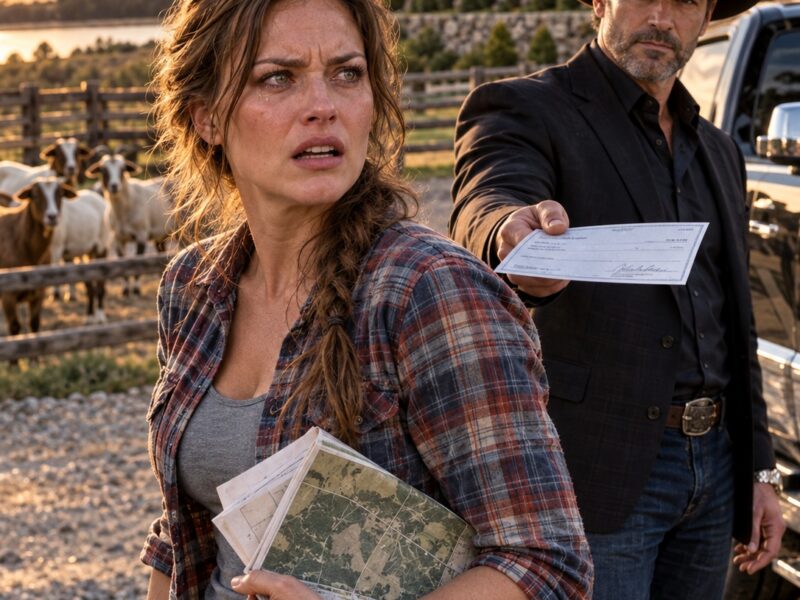
HE TOLD ME TO SELL HIM MY HERD OR WATCH THEM STARVE—SO I BOUGHT THE ONE PIECE OF LAND HE THOUGHT WAS WORTHLESS
“Sell me the herd, Lenora.”
Grant Mercer said it as calmly as if he were asking whether I wanted cream in my coffee.
Behind him, eighteen goats shifted beneath the August sun, hooves scraping dry earth, bells clicking softly against their collars. A hot wind pushed the smell of hay and dust through the open barn doors.
I stared at the white envelope in Grant’s hand.
“What is that?”
“Your refund.”
My stomach tightened.
He extended it toward me.
“I canceled Tuesday’s feed delivery this morning.”
For a moment, I honestly thought I had misunderstood him.
“You canceled my delivery?”
“I refunded it.”
“That isn’t what I asked.”
Grant’s expression barely changed.
He was fifty-two, broad through the shoulders, permanently sun-browned, with the particular calm of a man who had spent enough years being the biggest person in every room that he no longer needed to raise his voice.
“You said no to my offer,” he replied.
“Yes.”
“So I made a business decision.”
I looked past him toward the barn.
Six days.
Maybe seven if I stretched what remained, supplemented carefully, and nothing went wrong.
Grant knew that.
Of course he knew.
“You’re doing this because I wouldn’t sell you my goats.”
“I’m doing this because I run a business.”
“You’ve supplied this property for four years.”
“And now I won’t.”
The words landed without anger.
That made them worse.
I folded my arms because otherwise he might have seen my hands trembling.
“You know I can’t get a bulk truck back here.”
“That’s unfortunate.”
“You know what delivery costs from outside the county.”
“I do.”
“You know I don’t have storage.”
He gave the faintest shrug.
“I know a lot of things.”
That was when I understood.
This wasn’t retaliation.
Retaliation was emotional.
This had been calculated.
Grant stepped closer and lowered his voice, even though there was nobody around to hear us.
“You’ve got maybe a week before those animals start losing condition. Once that happens, buyers notice. Prices drop.”
He pulled a folded check from his shirt pocket.
“My offer still stands.”
I didn’t take it.
He glanced toward the pasture.
“Same price as yesterday.”
“That was already twenty percent below what they’ll bring at market weight.”
“Yesterday you had feed coming.”
His eyes returned to mine.
“Today you don’t.”
There are moments when humiliation feels almost physical.
Not dramatic.
Not cinematic.
It is smaller than that.
It is realizing the person standing in front of you has already calculated how frightened you should be.
Grant held out the check.
“Take it.”
I stared at his hand.
“No.”
His mouth moved slightly.
Not quite a smile.
“Think carefully.”
“I said no.”
“Then think about what no costs.”
He returned the check to his pocket.
Before climbing into his truck, he looked back once.
“When you change your mind, call before the animals get thin. My price won’t improve after that.”
Then he drove away.
I stood beside the barn until the sound of his diesel engine disappeared beyond the trees.
Only then did I let myself breathe.
Six years.
That was what Grant had tried to put a price on.
Six years of waking before dawn.
Six years of bakery shifts with flour beneath my fingernails, then afternoons repairing fence, hauling water, checking hooves, sitting beside sick animals at two in the morning because veterinary bills were cheaper if you noticed trouble early.
I had begun with four goats.
Four.
I remembered bringing them home in a borrowed trailer and standing in that same field terrified that I had just spent nearly everything I owned on animals I barely knew how to raise.
Now there were eighteen.
Not a fortune.
Not an empire.
But mine.
Grant thought he had just reduced my future to six days.
He was wrong about one thing.
I didn’t go inside and cry.
I walked to my truck.
Opened the passenger door.
Reached into the glove compartment.
And pulled out a county property map I had been carrying around for three months.
Because long before Grant Mercer decided I had no options, I had already started looking for one.
I just hadn’t known yet what shape it would take.
And somewhere on that map was a tiny parcel nobody wanted.
Including, I would soon learn, Grant Mercer.
Hartwell, Missouri, was the kind of town where people knew your vehicle before they knew your last name.
Mine was a faded silver Ford with a dent above the passenger-side wheel and enough feed dust embedded in the floor mats to qualify as agricultural soil.
Every morning at 4:47, my alarm went off.
By 5:30, I was at Hartwell Bakery unlocking the side door with my manager, Denise.
By six, the first trays of cinnamon rolls were coming out of the oven.
By seven, construction crews were buying coffee.
By eight-thirty, retired men occupied the same four tables they had occupied since approximately the invention of breakfast.
And by one in the afternoon, I usually smelled like sugar, yeast, coffee, and exhaustion.
Then I went home and started my second job.
The goats.
People liked to call them my “little farm.”
I hated that phrase.
There was nothing little about something capable of bankrupting you.
The half-acre behind the old farmhouse wasn’t mine. I rented it from Walter Simmons, who lived forty miles away and rarely visited.
He had been fair with me.
That mattered.
But six months earlier, Walter had called and told me something I had known would eventually happen.
“When your lease ends,” he said, “I’m selling.”
“How long?”
“Twenty-two months.”
He sounded apologetic.
“I’m not pushing you out early, Lenora.”
“I know.”
“I just want you to have time.”
Time.
It sounded generous until you attached a price to it.
Pasture land with fencing, road access, and a reliable well cost more than I could touch.
My land account contained $3,800.
I checked it constantly, as if staring might cause another zero to appear.
It never did.
So I began looking at bad land.
Small parcels.
Foreclosures.
Odd-shaped leftovers beside county roads.
Anything cheap enough that I might someday put animals on it or trade upward from it.
I kept the map in my truck because hope is embarrassing when you’re poor.
You don’t frame it.
You fold it until the seams go white and hide it in the glove compartment.
Grant knew Walter planned to sell.
Maybe that was why he made his offer when he did.
Maybe he looked at me and saw someone approaching a deadline.
The morning before he canceled my feed, he had leaned against my fence and offered to buy all eighteen goats.
Cash.
One transaction.
Easy.
The amount was low enough that I almost laughed.
Instead, I said, “No, thank you.”
Grant tilted his head.
“You should consider it.”
“I did.”
“That was fast.”
“They’re worth more.”
“They might be worth more later.”
“They will be.”
He looked toward the farmhouse.
“You still renting?”
I should have understood the question.
Instead I answered.
“Yes.”
He nodded.
“Things change.”
Then he left.
The next morning, my feed disappeared.
By three that afternoon, I had called eleven people.
Three didn’t answer.
Two had nothing available.
One could sell me partial bales but couldn’t deliver.
Another could deliver for a price that made me sit down when he said it.
Then something strange happened.
People started telling me stories.
Not dramatic stories.
That was what made them believable.
Dale Whitfield mentioned that Grant had raised his delivery fee after Dale asked about ordering from someone else.
Carol Briggs said a shipment once arrived four days late after her husband challenged an invoice.
A family east of town had been offered a temporary discount after threatening to switch suppliers.
Nobody called Grant dishonest.
Nobody accused him of anything.
They just said things like:
“That’s Grant.”
“He runs things tight.”
“Probably easier not to make trouble.”
And:
“What other choice do we have?”
That sentence stayed with me.
What other choice do we have?
By midnight, I had heard some version of it five times.
I sat at my kitchen table with invoices, a calculator, three supplier websites open on my laptop, and half a sandwich I had forgotten to eat.
At 12:18 a.m., a supplier two counties away returned my message.
The salesman’s name was Rick.
“We can beat that price,” he said.
I almost laughed from relief.
Then he added, “But we can’t bring a commercial rig onto the property you described.”
My relief vanished.
“What would you need?”
“Proper access. Hard surface. Turnaround room. Somewhere we can stage and unload without burying a truck.”
“How much would I have to order?”
He gave me the minimum.
Far more than eighteen goats could use.
I rubbed my forehead.
“What if it wasn’t only my order?”
There was a pause.
“How many customers?”
“I don’t know yet.”
“Fill enough of the truck and everybody’s freight share drops.”
I stopped moving.
“Say that again.”
He did.
And suddenly I wasn’t thinking about feed.
I was thinking about roads.
Truck weight.
Access.
Gravel.
I grabbed the county map from the counter.
There was a property I had circled two weeks earlier and then dismissed.
Four-tenths of an acre.
No well.
No electricity.
Thin soil over rock.
No pasture.
No house.
No barn.
Nothing.
Listed for $2,000 because no farmer with any sense would buy land where almost nothing grew.
I stared at the circle.
Then I stared at the road running beside it.
At 12:41 in the morning, I whispered:
“Oh my God.”
Because maybe I didn’t need land that could grow something.
Maybe I needed land that could hold something.
Like a truck.
I drove there before sunrise.
The property was uglier than I remembered.
Brown weeds pushed through pale gravel. Rusted wire hung from one corner. Somebody had dumped an old tire near the ditch.
There wasn’t a tree large enough to shade a dog.
But the entrance opened directly onto the county road.
I parked my Ford inside the gate and walked the entire parcel.
Thirty-nine steps one direction.
Seventy-three another.
I crouched and pressed my palm against the gravel.
Hard.
Packed.
Stable.
A loaded truck could come through that gate.
A loaded truck could leave.
I stood slowly.
For the first time since Grant had canceled my delivery, I smiled.
Then I remembered I had $3,800 to my name.
The smile disappeared.
Buying this land would consume more than half of everything I had saved toward eventually buying real land.
Land with pasture.
Land where my animals could actually live.
This was not that.
This was a parking lot with weeds.
At 8:02, I called the county.
By 9:17, I had been transferred three times.
At 10:40, I finally reached a woman named Melissa in planning and zoning who patiently listened while I explained what I wanted to do.
“You’re not operating a permanent retail store?” she asked.
“No.”
“No livestock sales?”
“No.”
“Temporary agricultural storage and pickup?”
“Yes.”
“Commercial vehicles?”
“Periodic deliveries.”
She asked for the parcel number.
I read it.
Keyboard clicking.
Then silence.
I held my breath.
“There isn’t anything in the current county use restrictions that prohibits what you’re describing.”
I gripped the phone tighter.
“Can you put that in writing?”
Melissa laughed softly.
“You’ve dealt with county government before.”
“Enough to know a phone call disappears.”
“I’ll email you.”
When the message arrived twenty-three minutes later, I printed three copies.
On Friday afternoon, I bought the ugliest piece of land in Hartwell County.
The closing cost me almost everything I had worked toward for years.
I drove home afterward feeling physically sick.
That night, I opened my banking app.
The number looked wrong.
Small.
Dangerously small.
I sat on my bed staring at it until one of the goats called from the barn.
I went outside.
Hazel, one of my oldest does, pushed her nose against my hand.
“What have I done?” I whispered.
She tried to eat my sleeve.
I laughed despite myself.
Then my phone buzzed.
Grant.
I almost ignored it.
Instead I answered.
“Hello?”
“I heard you bought the Mason lot.”
News traveled quickly in Hartwell.
“It closed today.”
“What are you going to do with that?”
“Not grow corn.”
He was silent.
Then he chuckled.
“You paid two grand for rock?”
“Yes.”
“Lenora.”
The way he said my name sounded almost paternal.
Almost kind.
“You don’t have enough money to waste it proving a point.”
“I didn’t buy it to prove anything.”
“What did you buy it for?”
I looked toward the goats.
Then toward the dark road beyond the pasture.
“You’ll see.”
Grant stopped laughing.
And for the first time since this started, he was the one who didn’t know what happened next.
Five families agreed to join my first order.
It took thirty-two phone calls to get them.
Dale said yes after making me explain the numbers twice.
Carol Briggs said, “I’ll ask my husband,” which I assumed meant no until she called back twenty minutes later.
The Millers had twelve sheep and wanted mineral supplement included.
A younger couple named Tyler and Jess Monroe had recently started raising goats and possessed the dangerous optimism of people who hadn’t yet learned how many different ways livestock could attempt suicide.
The fifth customer, Earl Webb, told me directly:
“I don’t trust this.”
“Fair.”
“You’ve never done it before.”
“Correct.”
“You’ve got a shed sitting on gravel.”
“Also correct.”
“And you want my money upfront?”
“Yes.”
He stared at me.
“At least you’re not overselling it.”
“I don’t have time to.”
He paid two days later.
I bought a portable storage unit.
Installed a better gate lock.
Made labels.
Created pickup sheets.
Wrote a one-page agreement describing exactly what I was responsible for and what I wasn’t.
For three nights, I slept less than four hours.
At the bakery, Denise caught me putting blueberry filling beside the apple turnovers.
“You’re going to kill yourself,” she said.
“Not this week.”
“Comforting.”
She looked at the dark circles under my eyes.
“This about that land?”
“Partly.”
“You know people are talking.”
“People talk when somebody changes toothpaste in this town.”
She smiled.
“Grant came in yesterday.”
My hands stopped.
“What did he say?”
“Nothing about you.”
“That means he came in to talk about me.”
Denise gave me a look.
“Pretty much.”
“What did he ask?”
“Whether business was good. Whether you’d been missing shifts. Whether you seemed stressed.”
I turned back toward the tray.
“What did you tell him?”
“That my employees’ personal lives aren’t served with coffee.”
I looked at her.
“Thank you.”
“Don’t thank me. Just stop putting blueberries in the apple section.”
The first truck was scheduled for Thursday at four.
At 4:15, nothing.
At 4:30, nothing.
At five, Dale began checking his watch.
At 5:18, Earl asked, “You sure it’s coming?”
“Yes.”
I wasn’t.
At 5:32, I called dispatch again.
“Forty minutes,” they promised.
The truck arrived at 5:40.
One hour and forty minutes late.
I nearly kissed the hood.
Then the driver opened the trailer.
We discovered the pallet jack couldn’t fit through the storage unit door.
I stared at the opening.
Then at several tons of feed.
Then at the five families looking at me.
Dale said, “Well.”
I closed my eyes.
“Don’t.”
He smiled.
“Was just gonna say we’ve got hands.”
So we unloaded it manually.
Bag after bag.
Bale after bale.
August heat clung to our shirts.
Sweat ran into my eyes.
A tarp ripped.
One stack shifted and had to be rebuilt.
I spent money I hadn’t budgeted on straps, water, and replacement plastic.
By the time the sun dropped behind the fields, my processing fee had almost disappeared into unexpected costs.
I had earned practically nothing.
I stood beside my truck exhausted, filthy, and wondering whether I had invented the world’s most labor-intensive method of losing money.
Then Earl pulled out his phone.
He checked something.
Looked at his stack.
Counted.
Checked again.
“What?” Carol asked.
He showed her.
“My last three invoices from Mercer.”
Nobody spoke.
“And?” Dale asked.
Earl looked at me.
“Even with today’s circus?”
“Yes?”
“I paid less.”
Not enormously less.
That wasn’t the important part.
It was less.
Consistently.
And nobody had been forced to sell an animal to get it.
Earl loaded his trailer.
Before leaving, he stopped beside me.
“When’s the next one?”
I stared at him.
“You said you didn’t trust this.”
“I didn’t.”
“And now?”
He considered the question.
“Now you’ve delivered once.”
He drove away.
Three days later, someone posted the cost comparison on a local farming forum.
No accusations.
No speeches.
Just numbers.
By Monday, I had fourteen messages asking how to join the next run.
Tuesday morning, Grant called.
His voice was friendly.
That scared me more than when it wasn’t.
“I’ve been thinking,” he said.
“Congratulations.”
“Cute.”
“What do you want?”
“I can put your account back on regular delivery.”
I leaned against the bakery’s back wall.
“What changed?”
“Market conditions.”
I almost smiled.
“Of course.”
“I’ll match what you’re paying now. Maybe beat it depending on volume.”
“That sounds generous.”
“It is.”
“What do you need?”
Silence.
There it was.
“Stop aggregating other people’s orders.”
I looked across the alley at a dumpster.
“You canceled my account.”
“And I’m offering to restore it.”
“You told me to sell you my herd.”
“I made you an offer.”
“You removed my feed first.”
“Lenora, don’t turn business into something personal.”
I actually laughed.
“Grant, you canceled food for eighteen living animals because I wouldn’t sell them to you.”
“They weren’t going to starve.”
“Because you assumed I’d panic first.”
His voice hardened slightly.
“I’m giving you an easy way out.”
And the worst part?
For approximately three seconds, I wanted it.
I was exhausted.
I was still waking at 4:47.
Still working bakery shifts.
Still caring for my herd.
Now I was answering messages about freight costs while brushing my teeth.
Taking orders on lunch breaks.
Calculating pallet space at midnight.
Grant was offering to make everything easy again.
I could keep the land.
Keep my goats.
Stop managing everyone else’s problems.
Go back to my life.
“I’ll think about it,” I said.
After hanging up, I hated myself for how relieved those words made me feel.
That afternoon, Dale drove onto the lot.
He brought three invoices.
“Thought you might want to see these.”
I spread them across my tailgate.
His delivery charge had increased.
Not by much.
Just enough to be irritating rather than catastrophic.
“When did this start?”
He pointed.
I read the date.
The week Grant canceled my account.
“Why didn’t you tell me?”
Dale shrugged.
“Didn’t think much of it.”
“You’re showing me now.”
“Because he called yesterday offering to reduce it again.”
I looked up.
Dale met my eyes.
“Asked if I was planning to keep buying through you.”
Something cold moved through me.
Grant wasn’t offering peace.
He was closing exits.
One household at a time.
I called him before I could change my mind.
“I’m not taking the deal.”
A pause.
“You sure?”
“Yes.”
“You’re taking on risk you don’t understand.”
“Probably.”
“You could lose that herd.”
“Probably.”
“You could lose people’s money.”
That one landed.
Grant heard my silence.
His voice softened.
“Running something is different from complaining about the person who already does.”
“I know.”
“Do you?”
I looked at Dale’s invoices.
“I guess we’re going to find out.”
I ended the call.
Then I opened registration for the second delivery.
Eighteen households signed up.
And that was when everything almost collapsed.
The second run was too large for my storage unit.
That problem appeared first.
Then people wanted credit.
“No,” I told them.
One man became angry.
“You don’t trust me?”
“It isn’t about trust.”
“Sounds like it.”
“I don’t have enough cash to cover your portion if you don’t pay.”
“So you’re making your cash problem mine.”
“No. I’m refusing to make your cash problem everyone else’s.”
He didn’t like that answer.
Neither did I.
But I kept it.
Two households dropped out after Grant offered them temporary discounts.
Their departure raised the freight cost for everybody else.
I recalculated.
Posted the new numbers publicly.
Cut my processing fee.
Nobody applauded.
This wasn’t that kind of story.
People asked practical questions.
“How much more?”
“What happens if another family leaves?”
“Is the date still guaranteed?”
I answered as honestly as I could.
That last question haunted me later.
The delivery was scheduled for day twenty-eight.
Some families had rationed feed around that date.
They weren’t starving animals.
But they were running lean inventory because that was the entire point of coordinated deliveries.
On day twenty-six, rain began before dawn.
By noon, it was coming sideways.
At 3:14 p.m., the county posted a road closure.
Flooded culvert.
I saw the alert while standing behind the bakery counter.
My chest tightened.
I called the freight company immediately.
“There’s another route,” dispatch said.
Relief came too quickly.
Then:
“But there’s a bridge restriction.”
“What restriction?”
“Loaded weight.”
“How much?”
He told me.
Our truck exceeded it.
“Can you reroute somewhere else?”
“Not without adding hours, and with current conditions—no.”
“When can you deliver?”
“Seven to ten days.”
I stopped hearing the bakery.
The espresso machine.
Customers.
Denise calling an order number.
Everything went distant.
“People can’t wait ten days.”
“We can transfer the load to smaller vehicles.”
“Yes.”
“But there’s a transfer and secondary freight charge.”
“How much?”
He gave me the number.
I asked him to repeat it.
Not because I hadn’t heard.
Because I needed the number to become different.
It didn’t.
I checked my account.
Not enough.
Not even close.
By six that evening, messages began arriving.
Is tomorrow still on?
Any update?
My feed is getting low.
Please confirm.
At 6:43, Carol called.
“I’ve got four days.”
“I know.”
“You said the twenty-eighth.”
“I know.”
There was silence.
Then:
“Lenora, I need you to tell me whether I should find something else.”
I closed my eyes.
“I’ll have an answer tomorrow.”
“You sure?”
No.
“Yes.”
I hung up and sat alone inside the portable shed while rain hammered the metal roof.
This was exactly what Grant had warned me about.
Not because he was right to trap people.
Because he had been right about something more uncomfortable.
Running something meant being responsible when reality refused to cooperate.
I had eighteen households’ money tied up in inventory sitting two counties away.
My savings had become a piece of gravel.
My reserve was almost gone.
And I had promised reliability before I understood how expensive unreliability could become.
At 7:12 the next morning, a truck pulled outside the gate.
Not the delivery truck.
Grant’s.
He climbed out wearing clean boots.
Behind his pickup was an empty livestock trailer.
I stared at it.
Grant walked toward me.
“Heard about the road.”
Of course he had.
“How?”
“Small town.”
I said nothing.
His eyes moved toward the pasture beyond the road.
Then back to me.
“My offer still stands.”
I felt something inside me drop.
“How much?”
He named the price.
Lower than before.
I laughed once because otherwise I might have screamed.
“You reduced it.”
“Circumstances changed.”
“You mean you waited until I was desperate.”
“I mean you’re carrying more risk now.”
“You brought a trailer.”
“Figured I’d save us both time.”
That sentence hurt more than I expected.
Not because I believed I had to sell.
Because part of me wanted to.
I imagined signing over the herd.
Paying the transport cost.
Returning everyone’s feed.
Ending the calls.
Ending the fear.
Going home.
Sleeping.
Grant watched my face and knew.
“You tried,” he said quietly.
I hated him for making the words sound compassionate.
“You proved your point.”
“This was never about proving a point.”
“Then stop before you lose more.”
I looked at the trailer.
For one terrible second, I pictured Hazel inside it.
Then Daisy.
Then June.
Animals I had raised.
Animals whose personalities I knew better than some people.
Grant reached into his pocket.
The same gesture as before.
A check.
“Take it.”
I looked at the paper.
Then at him.
“Give me until noon.”
He smiled.
Not triumphantly.
Worse.
Patiently.
“I’ll be around.”
He drove away with the empty trailer.
And for the next two hours, I tried to find a way not to call him back.
Pete Daniels answered on the fourth ring.
“Daniels Hauling.”
“My name is Lenora Bennett.”
“Know who you are.”
That surprised me.
“You do?”
“Everybody does this week.”
Great.
I explained the bridge.
The warehouse.
The weight limit.
Pete had two medium-duty trucks that could legally cross.
He could make multiple trips.
He gave me a price.
Still too high.
“What if some customers collect directly from the warehouse?”
“Reduces my load.”
“How much?”
We calculated.
Still short.
I called the supplier.
Then the freight company.
Then Pete again.
At 11:43, Grant texted.
Still thinking?
I turned my phone facedown.
At noon, I sent one message to all eighteen households.
Please meet me at the staging lot at 6:30 tonight. I need to explain a problem with tomorrow’s delivery. It isn’t good news.
Then I spent six hours preparing to be hated.
At 6:30, pickups began pulling through the gate.
People stood around the gravel.
Some worried.
Some annoyed.
Carol arrived with her husband.
Dale came alone.
Earl folded his arms.
I lowered the tailgate of my truck.
On it, I placed three pieces of paper.
The original freight confirmation.
The new transportation estimate.
My current business account balance.
Nobody spoke.
I began.
“The primary road is closed because of flooding.”
A few people nodded.
“The alternate bridge cannot legally carry the delivery truck at its loaded weight.”
Earl asked, “So when’s the feed coming?”
“I don’t know yet.”
Faces changed.
Not dramatically.
Just enough.
I continued.
“The freight company can hold the load seven to ten days or transfer it to smaller trucks for an additional charge.”
“How much?” someone asked.
I pointed to the paper.
Carol stepped forward and read it.
“Jesus.”
“Yes.”
“You don’t have that.”
“No.”
Someone behind her said, “Then where’s our money?”
“With the supplier.”
“So you can’t refund us?”
“Not tonight.”
That produced exactly the reaction I feared.
Voices.
Questions.
One curse.
A younger man named Ben crossed his arms and stared at the ground.
Carol’s husband asked:
“You knew this could happen?”
“No.”
“Roads flood.”
“Yes.”
“Trucks break.”
“Yes.”
“You didn’t keep enough reserve?”
“No.”
Silence.
I swallowed.
“That was my mistake.”
Nobody rescued me.
Nobody told me it was okay.
It wasn’t okay.
I forced myself to continue.
“I planned for damaged product. I planned for late delivery. I planned for customers dropping out. I did not hold enough cash to cover a complete transportation failure after inventory had already been purchased.”
Earl stared at me.
“So what now?”
I laid down another sheet.
“Here’s the plan.”
Pete could move most of the inventory within forty-eight hours.
Customers with trailers could drive directly to the supplier and collect their portions.
That would reduce Pete’s trips.
I would take no processing fee.
Nothing.
The remaining gap—
I stopped.
Because this was the part that hurt.
“I’ll cover it.”
“With what?” Dale asked.
I looked at him.
“I’ll find it.”
After the meeting, nobody hugged me.
A few people thanked me for being upfront.
A few left angry.
One asked to exit the order entirely.
I helped arrange it.
Then I drove home.
The goats came toward the fence when they heard my truck.
I stood there in darkness.
There were two animals close enough to market weight.
Not quite ready.
Selling now meant losing part of the return I had spent months building.
Hazel wasn’t one of them.
I told myself that mattered.
It didn’t help much.
The next morning, an independent buyer came at 8:20.
He inspected both goats.
Named a price.
I negotiated once.
He raised it slightly.
I nodded.
We loaded them.
One balked at the trailer ramp.
I put my hand beneath her jaw.
“Come on, girl.”
She trusted me.
That was the worst part.
She walked forward.
The gate closed.
The buyer handed me the check.
After his truck disappeared, I stood alone beside the road.
My herd had been eighteen.
Now it was sixteen.
I had spent six years building it.
And I had just sold two animals early because I had made a mistake.
I cried then.
Not for long.
Maybe two minutes.
Then I deposited the check.
Paid Pete.
And went to work.
Because there was a difference between losing two animals to fix a promise I had made and surrendering all eighteen to the man who had manufactured my desperation.
From the outside, both looked like selling goats.
Inside me, they were nothing alike.
Day thirty began before sunrise.
Pete’s first truck arrived at 7:16.
The second came at 9:03.
Three families drove directly to the warehouse.
Another two combined trailers.
We changed pickup windows twice.
A pallet arrived with torn wrapping and had to be inspected bag by bag.
One customer’s order was placed in the wrong stack.
We caught it.
Fixed it.
Counted everything again.
I stood at the gate with my ledger.
Name.
Quantity.
Condition.
Signature.
Again.
Again.
Again.
By four in the afternoon, my shirt was soaked through.
My throat hurt from talking.
My hands were black with dust.
Carol backed her trailer toward the final stack.
Her husband loaded while she walked over to me.
For several seconds, she said nothing.
Then:
“You scared the hell out of me.”
“I know.”
“I was furious.”
“I know.”
She looked at the ledger.
“You should’ve had reserve money.”
“Yes.”
“You won’t make that mistake again?”
“No.”
She nodded.
“Good.”
Then she squeezed my shoulder once.
“See you next run.”
I watched her walk away.
That nearly broke me more than the anger had.
At 5:42, the last customer pulled through the gate.
I counted his bags twice.
He signed.
I drew a line through the final entry.
Every household had received what it had paid for.
Not on the day I promised.
Not through the system I designed.
Not elegantly.
But nobody’s animals went without feed.
I sat on my tailgate after the last truck left.
For the first time in thirty days, nobody needed anything from me.
The gravel lot was covered in tire marks.
Empty straps lay beside the shed.
A torn piece of plastic fluttered against the fence.
It looked terrible.
It looked beautiful.
Two days later, Grant Mercer returned.
No trailer this time.
He parked outside the gate and walked in carrying a folder.
“I heard you got everything delivered.”
“I did.”
“Cost you.”
“Yes.”
“Two goats, I heard.”
I stared at him.
“You hear a lot.”
“Town’s small.”
He held up the folder.
“I’ve got a proposal.”
I almost laughed.
“Of course you do.”
He opened it on my tailgate.
Regular deliveries.
Competitive pricing.
Scheduled volume.
He would supply the staging lot directly.
No need to coordinate with companies two counties away.
No expensive freight transfers.
No uncertainty.
Grant spoke like the previous month had never happened.
Like he had not stood in my driveway with an empty livestock trailer waiting for me to fail.
“It makes sense,” he said.
“For whom?”
“Everybody.”
I read the numbers.
They were good.
Very good.
Grant watched me.
“You wanted competition. Congratulations. You created some.”
There was irritation underneath the compliment.
I closed the folder.
“I’ll consider any supplier who meets my terms.”
His eyebrows rose.
“Your terms?”
“Yes.”
I went into the storage unit and returned with a sheet of paper.
“Written price schedule. Defined delivery windows. Cancellation policy. Minimum notice for changes. No unexplained account penalties.”
Grant’s jaw tightened.
“And?”
“And one more.”
I met his eyes.
“No customer buying through this lot will ever be asked to sell livestock as a condition of continuing to purchase feed.”
Silence.
A truck passed on the county road behind him.
Grant looked down at the paper.
Then at me.
“You’re making this personal again.”
“No.”
I shook my head.
“I’m making it written.”
For the first time since I had known him, Grant Mercer had no immediate answer.
He picked up his folder.
Walked to his truck.
Opened the door.
Then looked back.
“You think that gate makes you powerful?”
I glanced at the rusted posts.
The gravel.
The ugly storage shed.
“No.”
“Then what?”
I thought about it.
“The fact that you can’t close it does.”
Grant stared at me another second.
Then he drove away.
I never knew whether he understood.
Maybe it didn’t matter.
The operation didn’t become an overnight success.
That would make a better internet story.
It just wouldn’t be true.
There were late trucks.
Wrong quantities.
Customers who paid slowly.
Customers I had to refuse because they wanted credit I couldn’t afford to extend.
A winter delivery had to be moved because of ice.
One supplier raised prices unexpectedly.
Another stopped carrying a product three families depended on.
So I changed things.
I capped each run.
Built a reserve before confirming orders.
Opened accounts with two additional suppliers.
Required payment deadlines.
Created contingency routes.
Made Pete one of the first calls instead of the last.
The processing fee increased slightly because I finally understood that pretending my labor cost nothing wasn’t generosity.
It was bad accounting.
Some people complained.
Most stayed.
I still worked at the bakery.
Still woke before five.
Still smelled like cinnamon in the morning and livestock by evening.
My herd stayed at sixteen for months because I couldn’t afford to rebuild quickly.
Sometimes I looked at the empty places near the feeder and remembered the two I sold.
Winning didn’t erase that.
That became important to me.
Because people like to tell stories about independence as though it feels powerful.
Usually it feels expensive first.
Sometimes lonely.
Sometimes stupid.
Sometimes you stand on land where nothing grows and wonder whether you destroyed your future because you were too stubborn to accept the future somebody else selected for you.
Then a truck comes through your gate.
And another.
And someone who used to have one supplier suddenly has three.
And the thing begins to make sense.
One afternoon the following spring, I was sitting outside the storage shed entering invoices when Walter Simmons stopped by.
He looked around.
“Still can’t believe you bought this place.”
“Neither can I.”
He kicked at the gravel.
“You ever going to put anything in the ground?”
“No.”
“Could bring topsoil in.”
“Why?”
“Make it look like something.”
I smiled.
“It already looks like something.”
Walter surveyed the lot.
A storage shed.
A gate.
A gravel pad.
Tire tracks.
Nothing beautiful.
“What?”
I closed the ledger.
“I didn’t buy it to grow anything.”
He waited.
I looked toward the road.
“I bought it so I’d have a place where nobody could lock the gate in my face.”
Walter didn’t answer immediately.
Then he nodded.
“That’ll do.”
After he left, I sat there until the evening light turned the gravel gold.
Six years earlier, I had believed independence meant owning the animals.
Then I thought it meant owning land.
Grant taught me something I wish I had learned another way.
You can own something and still be controlled by whoever owns the road to it.
Whoever controls your feed.
Your credit.
Your transportation.
Your access.
Your next yes.
The little lot never became impressive.
No farmhouse rose on it.
No green pasture appeared.
Nobody driving past would have guessed what it cost me.
Two thousand dollars.
Most of my savings.
Two goats.
Months of sleep.
More pride than I knew I had.
And the night I stood in front of eighteen angry customers and said the hardest words I had ever learned to say:
I got this wrong.
Here’s how I’m going to fix it.
That was the real price.
Not the land.
Accountability.
Grant’s mistake had been believing desperation always made people easier to own.
Sometimes it does.
Sometimes people sign the check because they’re tired, frightened, broke, and out of time.
I almost did.
There are nights when I still wonder what would have happened if his trailer had arrived one day later.
Maybe I would have surrendered.
Maybe the difference between the person I became and the person Grant expected me to be was only forty-eight hours and one desperate phone call to a man named Pete Daniels.
That thought keeps me humble.
Because I didn’t beat Grant by being stronger than he was.
I wasn’t.
I didn’t have his acreage.
His trucks.
His money.
His connections.
I didn’t destroy his business, expose him in court, or watch the whole town turn against him.
Life rarely delivers endings that neat.
Grant kept farming.
He kept selling feed.
Some families kept buying from him.
Eventually, under written terms, he even supplied occasional loads to our staging point when his price made sense.
The difference was that now he was one supplier.
Not the supplier.
And that single word changed everything.
One.
One option among several.
One truck among others.
One man standing outside a gate he did not own.
Years later, I still kept the original county map in my Ford.
The folds had nearly split through.
The ink had faded.
A blue circle remained around four-tenths of an acre that everyone else had considered useless.
Sometimes new customers would look at the lot and ask why I chose it.
I usually gave them the practical answer.
Road access.
Commercial vehicle clearance.
Stable gravel.
Affordable price.
Those things were true.
But they weren’t the whole truth.
The whole truth was harder to explain.
I bought that land because a man stood in front of eighteen hungry animals and tried to make my fear more valuable than my work.
He showed me a check and expected me to see rescue.
Instead, I finally saw the trap.
And once you see the trap clearly, you start noticing where the door might be.
Sometimes the door isn’t impressive.
Sometimes it is four-tenths of an acre of bad Missouri soil.
Sometimes freedom doesn’t look like green pasture.
Sometimes it looks like gravel.
A dented storage shed.
A ledger.
Sixteen goats instead of eighteen.
And a gate that opens from your side.
On certain evenings, after the last trailer pulls away, I still stand beside that gate and listen until the road becomes quiet.
I think about the morning Grant held out his check.
About the certainty in his face.
About how close he came to being right.
Then I lock the storage shed, tuck the ledger beneath my arm, and close the gate behind me.
Not because anyone else told me to.
Because I can.
And after everything it cost to earn that choice, the click of that lock is still one of the most beautiful sounds I know.









