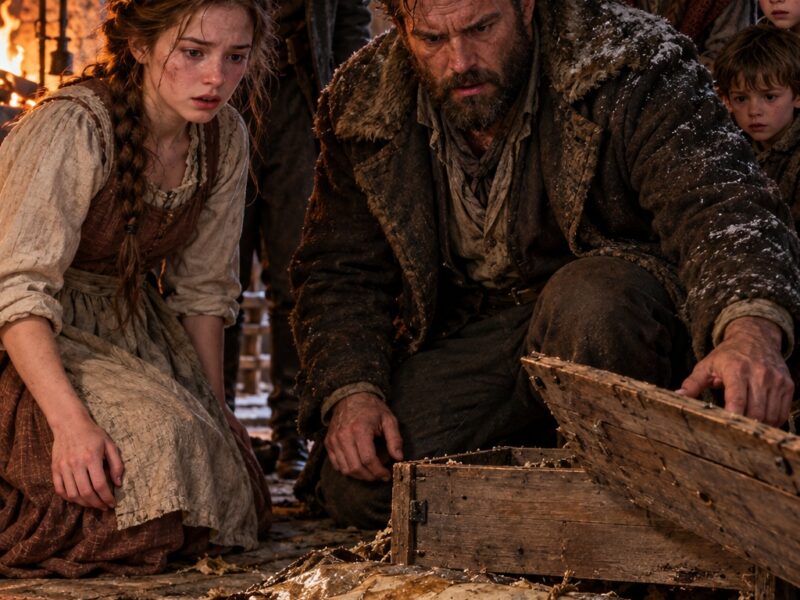
HE TRADED THREE SACKS OF WHEAT FOR A 19-YEAR-OLD GIRL—BUT WHEN HIS SON KNOCKED HER DOWN, THE MOUNTAIN WIDOWER DISCOVERED THE TERRIBLE SECRET HIS DEAD WIFE HAD HIDDEN
He brought her home for three sacks of wheat.
Seven days later, his oldest son knocked her to the floor—and she stood up holding a burning log.
But the real danger was hidden beneath a crate of rotten bear fat, where his dead wife had left something that could destroy them all.
PART 1 — THE GIRL NOBODY WANTED AND THE HOUSE THAT COULDN’T FORGET
Gideon Mercer had survived a mountain winter with a broken leg, buried his wife beneath frozen ground, and raised five children with hands better suited to chopping wood than comforting frightened little ones. People in Red Creek called him a giant, a brute, and sometimes worse. Yet on the afternoon he traded three sacks of winter wheat for a nineteen-year-old girl, even Gideon did not understand how completely his life was about to change.
The bargain took place in the back room of Harlan’s General Store, beneath a crooked oil lamp that hissed whenever the wind slipped through the window frame. Arthur Bell stood beside a barrel of flour with his hat crushed between his hands. His daughter, Kora, waited near the door wearing a faded blue dress that had been carefully mended at the elbows.
Harlan opened his ledger. “Three sacks of wheat, delivered by Saturday. Arthur’s outstanding store debt marked settled upon delivery.” He dipped his pen into the ink. “And the girl agrees to work at Mercer’s place through the winter.”
Kora looked at the page. She was nineteen, old enough to know that men could put almost anything into a ledger if they believed nobody would challenge them. But the neat columns didn’t tell the whole truth: her father’s gambling losses, the empty pantry, or the fact that Arthur had spent the morning telling her she was one more mouth he couldn’t afford.
“Am I being hired,” she asked quietly, “or sold?”
Arthur’s eyes flashed. “Mind your tongue.”
Gideon, who had been standing against the far wall, shifted his weight. He was a massive man with a black beard threaded with gray and a wolf-hide coat that made his shoulders look even broader. He glanced toward Arthur, then at Harlan’s ledger.
“She’ll have her own room,” Gideon said. “Food. A warm bed. And I’ll pay wages when the trapping money comes in.”
Kora studied him. It was the first time anyone in that room had spoken as though her living conditions mattered. But a promise from a stranger did not make the arrangement less humiliating.
“Can I leave if I choose?”
Gideon considered the question longer than she liked. “The mountain trail closes when the heavy snow comes. Before then, I won’t bar the door.”
Arthur made an irritated sound. “She’ll do what she’s told.”
Gideon turned his head. “She’s speaking to me.”
The room fell silent. Kora could not decide whether the words were protection or simply another man’s claim over her choices. She signed her name anyway, slowly enough that the scratching pen seemed unbearably loud.
At 4:17 that afternoon, Harlan closed the ledger. Arthur reached for his coat, and Kora waited for him to look at her. She hoped he might say he was sorry, or that he would come for her in spring, or even that he had made a terrible mistake.
Instead, he muttered, “You’re getting a roof over your head. That’s more than I can give you.”
Kora took the small bundle containing her mother’s sewing needles, two dresses, a comb, and a handkerchief she had kept since childhood. She climbed into Gideon’s wagon without answering. Her father was already halfway down the street when the horses started moving.
The mountain road grew narrower as evening settled over the pines. Snow gathered on the wagon boards and melted against Kora’s boots. Gideon drove in silence, occasionally turning his head to listen for sounds beneath the horses’ hooves.
After an hour, he passed her a folded wool blanket. “You’ll freeze sitting like that.”
“Thank you.”
He nodded once. Another mile disappeared beneath the wheels before he spoke again. “The children’s mother died last winter.”
Kora looked toward him. “I’m sorry.”
“The little ones still ask when she’s coming home.” His jaw tightened. “The older two know better.”
Kora waited, sensing there was something else he wanted to say.
“They aren’t easy children.”
“Children don’t have to be easy.”
Gideon’s hands tightened around the reins. He glanced at her as though nobody had ever given him that answer before, then returned his attention to the road.
They reached the cabin shortly after sunset. It stood beneath towering pines at the edge of a clearing, with a crooked porch, a sagging woodshed, and a chimney coughing gray smoke into the snowy air. There was a small barn nearby, but its roof had been patched with mismatched boards.
The moment Gideon opened the door, Kora understood why no one in Red Creek had wanted the position.
The cabin smelled of spoiled grease, old smoke, unwashed clothes, and food left too long in damp corners. A pot sat crusted with burned beans beside the hearth. Blankets were piled against the back wall, and a sticky darkness coated the table where five children had been eating.
They looked at her without speaking.
Caleb, fourteen, stood nearest the fireplace. He had his father’s dark eyes and a narrow face made older by suspicion. Twelve-year-old Mae sat beside him, one arm protectively around seven-year-old Ruth. Nine-year-old Samuel watched from behind a chair, while four-year-old Ben curled beneath a blanket in the corner.
“This is Kora,” Gideon announced. “She’s going to help around here.”
Caleb’s face hardened. “We don’t need her.”
Gideon hesitated. His eyes traveled across the filthy room, toward the smaller children, then back to his eldest son. But instead of answering, he took his axe from beside the door.
“I’ll bring in more wood.”
The door shut behind him.
Caleb stepped toward Kora. “You’re not our mother.”
She held his gaze. “I know.”
“Then don’t touch her things.”
“I won’t without asking.”
“You won’t touch anything.”
Kora looked past him toward Ben, whose small chest shook with a dry cough. She had once helped nurse her neighbor’s children through winter illnesses, and the sound immediately troubled her. Yet before she could speak, Caleb spat on the floor beside her boots.
“Go back where you came from.”
Kora stood perfectly still. She had survived her father’s drunken anger, neighbors’ pity, and the humiliation of being traded like livestock. But the hatred in that boy’s eyes came from a wound she had not caused, and she had no idea how to reach him.
Later, while Gideon chopped wood behind the cabin, she slipped outside and knelt beside the woodpile. She vomited into the snow, then pressed her cold hands against her face until the shaking passed.
She could leave. Gideon had said so himself. But she pictured the four-year-old coughing beneath his filthy blanket, and the little girl clinging to her older sister as though the world might fall apart if she let go.
Kora wiped her mouth with the back of her sleeve.
Then she went inside.
The following morning, she rose before sunrise and heated water in the blackened kettle. By the time Gideon came downstairs, she had scrubbed the skillet, cleared the hearth, and carried three pails of dirty wash water into the yard. Her fingers were red and cracked from the soap.
He looked around the kitchen. “You don’t have to finish everything today.”
“If I leave the food where it is, we’ll have mice at the table by supper.”
He glanced at the cupboard and said nothing more.
For the next six days, Kora worked while the family watched her with varying degrees of resentment. She washed clothing in freezing water, aired blankets beneath weak winter sunlight, and cleaned mold from the shelves. She found enough flour to bake bread, though it had to be stretched with cornmeal to feed everyone.
Caleb followed her whenever she approached one of the younger children. Mae answered questions with shrugs or silence. Samuel stole a biscuit from the cooling rack and then looked almost disappointed when Kora simply handed him another.
Ben rarely spoke. He coughed at night and slept beside the back wall, where the air smelled particularly sour.
One evening, Kora found Mae trying to mend a little dress by firelight. The stitches were uneven, and the needle kept slipping through the girl’s tired fingers. Kora sat on the opposite side of the table and opened the small sewing bundle she had brought from Red Creek.
“My mother taught me a stitch that holds better,” she said.
Mae didn’t look up. “Our mother knew how to sew.”
“I’m sure she did.”
“She made this dress.”
Kora folded her hands. “Then it’s worth mending properly.”
For several seconds, Mae stared at the needle. Then she pushed the dress across the table.
It was the first thing anyone in that house had willingly given Kora.
On the seventh morning, while Gideon split logs outside, Kora decided to clean the space behind the children’s beds. She pulled away an old quilt and discovered a wooden crate darkened by grease.
The smell nearly knocked her backward.
Inside were lumps of rancid bear fat wrapped in stained cloth. Grease had seeped through the boards into the floor, and the bedding beside it carried the same sour odor. A dark patch of mold spread behind the crate where melted snow had repeatedly soaked into the wall.
Kora crouched beside Ben, who lay curled beneath his blanket.
“How long has this been here, sweetheart?”
He rubbed his nose. “Since Mama.”
Kora closed her eyes for a moment. She understood that the crate meant something to the family, but she could not leave rotting grease beside a sick child. She opened a shutter, covered the crate with the quilt, and began dragging it toward the door.
She had moved it less than two feet when Caleb shouted.
“STOP!”
Kora turned. “Caleb, we need to get this outside.”
He rushed toward her, his eyes wild. “That was Mama’s!”
“The fat has spoiled.”
“She was saving it!”
“I know it mattered to her, but—”
“YOU DON’T KNOW ANYTHING ABOUT HER!”
He slammed his shoulder into Kora.
Her feet slipped on the dirty floorboards. She struck the edge of the hearth with her hip and fell hard enough that the iron kettle rattled on its hook. Pain shot through her side, and for a moment she could barely breathe.
Mae screamed his name.
Caleb stood over Kora, his hands shaking. “Get out,” he whispered. “Just get out.”
Kora pressed one palm against the floor. She felt tears gathering and hated that he could see them. But when she looked at him, she didn’t see a cruel young man. She saw a fourteen-year-old boy who had mistaken grief for a duty to fight everyone who threatened change.
She rose slowly, bracing herself against the hearth. Caleb stepped closer, still blocking the crate, and Kora reached for the long iron fireplace hook standing beside the stones. She used it to shift a burning log back from the hearth’s edge, lifting its glowing end away from the scattered quilt.
Orange sparks curled into the air.
Caleb recoiled.
At that instant, the door opened.
Gideon filled the doorway, his axe in one hand and snow clinging to his shoulders. He looked from Caleb’s furious face to Kora’s ash-stained dress, then to the glowing log hanging above the hearth.
“What happened?”
Nobody answered.
Kora lowered the log back onto the coals. She put the iron hook aside and faced Caleb, ignoring the pain in her hip.
“I am not your mother,” she said.
His jaw trembled. “I know that.”
“And I will never ask you to forget her.”
Caleb’s eyes shone.
“But Ben is coughing every night. That crate is full of rotten fat, and the wall behind it is wet and covered in mold. Keeping something that makes your brother sick isn’t the same as keeping your mother’s memory alive.”
“She was going to use it,” he whispered.
“Then tell me what she planned to make.”
Caleb stared at her.
“Tell me about everything she made,” Kora continued. “Show me her sewing. Her favorite cup. The things she kept because they mattered. I’ll help you look after them, and I won’t throw them away.”
His face twisted. “You didn’t know her.”
“No,” Kora said. “But you did.”
The simple admission seemed to hurt him more than an argument would have. He lowered his eyes, and tears dropped onto his shirt.
Kora took one careful step toward him.
“You can be angry that I’m here. You can wish I had never come. But you cannot knock me down because I’m trying to keep this family safe.”
The cabin was silent.
Gideon slowly lowered his axe. For the first time, he looked at the bruise forming beneath Kora’s sleeve, then at his son’s clenched fists. Shame moved across his face.
He opened his mouth, but Kora had already turned toward the crate.
She bent to lift it again.
This time, Caleb didn’t stop her.
Mae came forward instead. Her eyes were wet, and she knelt beside Kora without speaking. Together they raised the heavy wooden box and began dragging it toward the door.
Then Caleb spoke.
“Wait.”
Everyone stopped.
His face had changed. The anger was gone, replaced by a fear so sharp that even Gideon noticed it.
“Before Mama died,” Caleb whispered, “she told me never to let anyone open the bottom.”
Gideon went still.
“What did you say?”
Caleb swallowed hard. “She told me that if somebody came asking about what she hid inside, I had to take the children and run.”
Kora looked down at the crate.
Gideon crossed the room, took the iron hook, and pried beneath the bottom board. A rusted nail snapped. The wood gave way with a dry crack.
Something wrapped in oilcloth dropped onto the floor.
Gideon knelt, picked it up, and carefully unfolded the covering.
Inside was a thick packet of papers tied with blue ribbon.
Across the top envelope, in a hand he recognized instantly, was written:
FOR GIDEON—IF HARLAN EVER COMES TO CLAIM THE LAND.
Gideon’s face drained of color.
And beneath the envelope lay a document bearing his dead wife’s signature—a signature dated four months after the day they buried her.
PART 2 — THE SECRET HIS WIFE TOOK INTO THE GRAVE
For several seconds, nobody in the cabin moved.
Gideon stared at the date as though he might force the numbers to change. His wife, Eliza, had died the previous February. The document was dated June 18.
“That’s impossible,” he said.
Kora crouched beside him. “May I see?”
His fingers tightened around the paper. Then he handed it over.
The ink was dark, the handwriting formal, and the signature looked almost convincing. But the document contained a clause transferring the Mercer timber tract to Harlan’s creditors in exchange for an alleged debt of $480. Below it was the signature of a witness Kora recognized.
Arthur Bell.
Her father.
Kora felt the blood rush from her face.
“What is it?” Gideon demanded.
She looked toward Caleb and the younger children. They were watching with the terrible stillness of children who had already learned that adults could disappear without warning.
“My father’s name is on this.”
Gideon took the paper back. His eyes moved slowly across the page. “Arthur never came up here when Eliza was alive.”
Kora pressed a hand against the edge of the crate. She remembered her father stumbling home with expensive tobacco he couldn’t afford, complaining that Harlan always demanded more for loans than he had agreed to. She had believed those were ordinary debts, ugly but unsurprising.
Now she was no longer certain what her father had been paid to do.
Gideon opened the envelope.
Inside was a letter written in Eliza’s familiar, slanting script. The first words were uneven, as though she had been writing with a trembling hand.
Gideon,
If you’re reading this, I wasn’t able to tell you what I found.
Harlan has been preparing papers against our land. He says the old timber debt belongs to us, but I found the original receipt among your father’s belongings. It was paid in full years ago.
He came to the cabin while you were away. He wanted me to sign a new agreement. When I refused, he told me the children would be homeless by winter.
I’ve hidden the receipt with the false papers he left behind. There is another copy at the county records office, if it hasn’t been taken.
Please believe that I tried to protect what your father left us.
And please don’t let Caleb think he must carry this alone.
Gideon stopped reading.
He pressed the letter against his knee and bowed his head. Nobody had seen him cry since the funeral. Now his breath shuddered once, then again, and Kora turned her eyes away to give him what little privacy the crowded room allowed.
Caleb moved closer. “Mama told me to keep it safe.”
Gideon looked up.
“She made me promise,” the boy whispered. “I didn’t know what was in there. She said not to tell you until she was strong enough to explain.”
“Why didn’t you tell me after she died?”
Caleb’s mouth trembled. “Because you wouldn’t talk about her. Every time I asked, you went outside.”
The words landed harder than any blow.
Gideon looked toward the axe lying beside the door. For months, he had believed he was protecting his children by working until exhaustion left him no strength for grief. He had cut enough firewood for three households while his own children slept beside mold and spoiled grease.
He had mistaken providing for them for being present with them.
“I’m sorry,” he said.
Caleb’s face crumpled, but he didn’t move. Gideon rose slowly and opened his arms. It was awkward, almost painfully so, and Kora wondered whether the boy would refuse.
Then Caleb crossed the room and buried his face against his father’s chest.
Mae began to cry.
Gideon held his son with one arm and reached for his daughter with the other. Soon Ruth and Samuel were pressed against his legs, while little Ben watched from his blanket, confused by the sudden tears.
Kora stood back near the hearth.
She had not been there when Eliza died. She had no right to the grief filling that cabin. But as Gideon bent to gather Ben into his arms, Kora felt the room change in a way no amount of scrubbing could accomplish.
For the first time since arriving, she was looking at a family instead of five frightened children and a silent man.
That evening, Gideon carried the crate outside and buried the spoiled grease far from the well and cabin. Kora scrubbed the contaminated boards with hot water, while Mae helped carry the blankets to a dry corner. They moved Ben’s sleeping place closer to the warm hearth, away from the damp wall.
Gideon worked beside them without being asked.
By bedtime, the children had clean blankets, the shutters had been repaired, and Gideon had promised to take Ben to the settlement doctor as soon as the trail was passable. Kora sat beside the little boy, listening to his breathing while the fire burned low.
He touched the edge of her sleeve.
“Are you leaving?”
She looked down.
“Not tonight.”
“Caleb was mean.”
“He was hurting.”
Ben considered this. “Does hurting make people mean?”
“Sometimes,” Kora said. “But it doesn’t make hurting someone else right.”
He nodded as though the distinction mattered. Then he curled against his pillow and closed his eyes.
The next morning, Gideon read every document again.
The original receipt was folded inside Eliza’s letter. It showed that his father had settled the timber debt in 1879, with Harlan himself acknowledging payment. The later agreement, supposedly signed by Eliza, claimed the same debt remained outstanding and had accumulated interest.
A second page contained a rough map of the Mercer property, including a valuable stand of old-growth pine on the eastern ridge. The value of those trees was considerably greater than the debt Harlan claimed.
Kora watched Gideon trace the boundary lines.
“He wants the timber,” she said.
Gideon nodded grimly. “And the road through it. If he owns that ridge, he controls the easiest wagon route to the upper mills.”
“Then why trade wheat for me?”
Gideon looked at her, puzzled.
Kora pointed to Arthur’s signature. “Harlan knew my father was in debt. He knew you needed someone for the children. He arranged to have me sent here.”
Gideon’s expression darkened. “I approached him about a housekeeper.”
“And he offered my father a way to settle his debt.”
Kora glanced toward the window, where the mountains rose dark against the winter sky. “Maybe it was only convenience. But if he thought I would report what happened here, he misjudged me.”
Gideon folded the documents carefully. “You’re not going to confront Harlan.”
“I’m not proposing to confront anyone alone.”
His jaw tightened. “This is dangerous business.”
Kora met his eyes. “Then stop deciding what I can bear without asking me.”
He opened his mouth, then closed it again.
She returned to mending Ben’s torn sleeve. After a moment, Gideon pulled up a chair.
“What would you do?”
It was the first time he had asked her opinion.
Kora set down her needle. “I’d start with the county records. If Eliza was right and there’s an older copy of the receipt, we need it before Harlan knows we’ve found these papers. And we need somebody who can confirm when she died.”
“I buried her myself.”
“I know. But a court will need more than your word if another man claims his records are genuine.”
Gideon nodded reluctantly.
They made plans over a bowl of oatmeal. He would ride to the county seat in the morning, taking the original receipt and Eliza’s letter. Kora would remain with the children, though Gideon promised not to keep her ignorant of what happened.
He had barely finished speaking when the dogs began barking.
A wagon stood at the edge of the clearing.
Harlan climbed down, wearing a dark coat and polished boots utterly unsuitable for the muddy trail. Arthur Bell followed him, looking miserable beneath his battered hat.
Kora felt her stomach tighten.
Gideon stepped onto the porch. “You’re a long way from town.”
Harlan smiled. “Business carries a man farther than he’d like.”
Arthur looked past Gideon and saw his daughter standing in the doorway. For one fleeting moment, shame crossed his face.
Then Harlan removed a folded document from his coat.
“I’m here about the Mercer property.”
Gideon didn’t move.
“I have a properly witnessed agreement showing that your late wife acknowledged an outstanding debt. Payment is overdue, and the creditor intends to exercise his rights.”
Kora watched Harlan carefully. His tone was smooth, but his gloved fingers repeatedly flattened the paper against his palm.
“Your wife should never have signed it,” Harlan added. “But she understood that debts don’t disappear because a family falls on hard times.”
Gideon’s face turned dangerous.
Kora stepped beside him.
“What date was that agreement signed?” she asked.
Harlan’s gaze flickered toward her.
“I beg your pardon?”
“The date,” she repeated. “When did Mrs. Mercer sign it?”
Harlan glanced at Arthur. “June eighteenth.”
Kora let the silence stretch.
Snow drifted between the porch and the wagon. Somewhere behind the cabin, a loose shutter tapped against the wall.
“Mrs. Mercer died in February,” she said.
Arthur closed his eyes.
Harlan’s expression barely changed. “A clerical mistake is unfortunate, but hardly unusual.”
“Then I’m sure the county clerk can correct it.”
Harlan studied her. His smile slowly faded.
“Young lady, you would be wise not to involve yourself in matters you don’t understand.”
Gideon stepped forward, but Kora raised a hand.
“I understand that my father witnessed a dead woman’s signature.”
Arthur flinched.
For the first time, Harlan’s composure cracked.
He looked at Arthur sharply. “Get in the wagon.”
Arthur obeyed without a word.
Harlan folded the document and returned it to his coat. “You’ll hear from my attorney, Mercer.”
Gideon watched him climb aboard. “And you’ll hear from mine.”
Harlan gave a short laugh. “You don’t have an attorney.”
The wagon turned, its wheels cutting dark tracks through the snow.
Kora watched until the trees swallowed it.
Then she turned toward Gideon.
“Harlan knows we found something.”
Gideon’s face was grim. “Yes.”
“Then you cannot ride to the county seat alone.”
Before he could answer, Mae called from inside the cabin.
“Pa?”
Her voice was thin with fear.
Gideon turned.
Mae stood in the doorway holding Eliza’s letter. She had been reading the last page, where a few words were written so close to the fold that they had escaped Kora’s notice.
“There’s something else.”
Gideon took the paper.
At the very bottom, beneath his wife’s signature, was a warning written in faded pencil.
If Arthur Bell comes back with Harlan, don’t let either man near the children. Arthur knows where the other papers are.
Kora felt the cold settle into her bones.
Because Arthur Bell, the father who had traded her for wheat, was the only other person who knew about a sealed packet Eliza had hidden beneath the old well.
And less than an hour after Harlan’s wagon disappeared, Samuel came running from the barn.
“Pa! Somebody’s been digging behind the house!”
PART 3 — THE PRICE OF A DAUGHTER
The ground near the old well had been disturbed.
Gideon knelt beside the stones, scraping away a thin crust of snow. Fresh shovel marks cut through the frozen dirt, and a narrow hole had been dug beneath the wooden curb.
Kora stood close enough to see the dark earth but said nothing. She knew her father’s habits too well. Arthur was careless when drunk, but when frightened, he could become meticulous.
Gideon reached beneath the loose stones and pulled out a small tin box.
Its lid was dented, and a strip of cloth had been tied around it to keep it closed.
“Eliza kept her planting notes in one of these,” Gideon murmured. “I never thought to look here.”
Kora glanced toward the trees. “Someone already did.”
The box contained several folded receipts, a page torn from a ledger, and a letter from a timber company offering to purchase the eastern ridge directly from Gideon. The offer had been written months before Eliza died, but Gideon had never seen it.
Attached was a note in Eliza’s hand.
Harlan keeps intercepting our mail. I think he has been using Arthur Bell to carry messages from the mills. I found these when Harlan dropped his satchel in our kitchen. If anything happens, take them to Judge Whitcomb.
Gideon stared at the note.
Kora could feel him fighting anger, guilt, and a terrible suspicion about his wife’s final months. Eliza had been gravely ill with pneumonia. He had believed her growing fear was part of the fever that left her weak and confused.
Now he knew she had been frightened for a reason.
“She tried to tell me,” he whispered.
Kora touched the edge of the tin box. “Then we listen now.”
They could not safely leave the cabin unguarded, and there was little food to spare for an extended trip. Gideon decided to wait until the next morning, when his neighbor, Daniel Pike, was expected to bring supplies from the lower valley.
But before dawn, a sharp crack woke Kora.
At first, she thought the wind had broken a branch.
Then she smelled smoke.
She hurried to the window. A dull orange glow flickered near the woodshed, and flames were climbing the dry wall where Gideon stacked kindling.
“Fire!”
Gideon was awake before she reached the stairs.
Caleb rushed out of his sleeping place, his face white. Kora grabbed the bucket beside the door and thrust it into his hands.
“Take water from the barrel. Samuel, wake Mae. Mae, get the little ones outside!”
Gideon threw open the door.
Cold air swept through the cabin. Flames were spreading rapidly along the woodshed roof, and sparks were blowing toward the main house.
For one terrible moment, Kora saw how easily both buildings could burn.
Gideon seized an axe and began tearing away the narrow wooden walkway connecting the shed to the porch. Kora and Caleb formed a chain from the water barrel, carrying buckets through the snow as sparks landed on their sleeves.
Mae led the younger children toward the barn, wrapping Ruth and Ben in blankets. Samuel dragged the family dog by its collar when the frightened animal tried to run back toward the flames.
Kora slipped on the icy boards and struck her knee. She scrambled upright, ignoring the pain.
“Caleb, don’t come too close!”
The boy looked at the flames, then toward his father. He was shaking, but he kept moving.
A section of the woodshed roof collapsed with a roar.
Gideon staggered backward. Burning boards struck the snow near his feet, and a shower of sparks rose into the dark.
By the time dawn began to gray the horizon, the shed was destroyed. The cabin still stood, its porch blackened but intact.
Gideon sat on a stump, coughing smoke from his lungs. Kora crouched beside him and examined a blister along his wrist.
“We need clean cloth,” she said.
He looked toward his children huddled near the barn. “You got them out.”
“Mae did. Samuel helped.”
“And Caleb?”
Kora followed his gaze.
The fourteen-year-old stood at the edge of the clearing, staring at the ruined shed. His hands were blistered from carrying hot buckets, but he seemed barely aware of the pain.
Gideon rose and went to him.
“You did well.”
Caleb shook his head. “I was scared.”
“So was I.”
The boy looked up sharply.
Gideon put an arm around his shoulders. “Being frightened doesn’t mean you failed.”
Caleb leaned against him.
Kora watched from the porch, feeling a strange ache in her chest. A week earlier, the same boy had shoved her to the floor because he could not bear to lose another piece of his mother. Now he had fought beside her to save the home she was helping restore.
But the fire had not started by accident.
Beneath the ashes, Gideon found the broken neck of an oil bottle. Its stopper smelled strongly of lamp fuel, and fresh boot tracks led from the edge of the woods toward the shed.
Someone had come to frighten them.
And perhaps to burn the documents before they could reach the county seat.
When Daniel Pike arrived later that morning, he took one look at the wreckage and told Gideon to saddle his horse.
“Whitcomb’s in Red Creek for a land hearing,” he said. “If we ride now, we can reach him before Harlan hears what happened.”
Gideon looked toward the children.
Kora stepped beside him. “Daniel’s wife can stay with them. I’ll go with you.”
Gideon frowned. “The road is dangerous.”
“The man who set that fire already knows where I sleep. Staying behind won’t make me safe.”
Daniel pretended to examine the horses while Gideon studied her. Finally, the widower gave a reluctant nod.
They rode toward Red Creek under a sky the color of iron.
Kora carried Eliza’s letter beneath her coat. Gideon kept the original receipt and ledger pages inside a leather pouch tied to his belt. Neither spoke much during the first hour, though Gideon occasionally looked over to make sure Kora was managing the difficult trail.
At the edge of town, they found Arthur Bell standing beside the blacksmith’s shop.
He looked as though he had not slept.
When he saw Kora, he took a hesitant step toward her.
“Kora, I need to speak to you.”
She stopped her horse.
Arthur glanced at Gideon. “Alone.”
“No,” she said.
His face tightened. “I’m your father.”
“Then you can speak to me as my father in front of a witness.”
Arthur’s eyes filled with an expression Kora had rarely seen on him. Not anger. Not self-pity. Fear.
“Harlan told me the document was only a formality,” he whispered. “He said Mercer already owed the money.”
“You witnessed Eliza Mercer’s signature four months after she died.”
Arthur lowered his head.
Kora waited.
“I needed money.”
Her stomach turned. “So you lied.”
“Yes.”
“And when Harlan needed someone to keep quiet, you gave him me.”
Arthur flinched. “I thought Mercer would treat you decent.”
“You didn’t ask me.”
The words came out quietly, but Arthur seemed to hear them more clearly than anything else she had said.
He removed his hat. His thinning hair lifted in the cold wind, and suddenly he looked much older than the man who had stood in Harlan’s store a week earlier.
“I was wrong.”
Kora could see that he meant it. But meaning it did not restore what he had taken from her.
“Are you willing to tell the judge?”
Arthur stared at the ground.
Gideon shifted in his saddle. He had not intervened, but Kora could sense his growing impatience.
Finally, Arthur said, “If I tell the truth, Harlan will ruin me.”
Kora looked at him for a long moment.
“You already ruined us both trying to avoid that.”
She turned her horse toward the courthouse.
Arthur followed.
Judge Whitcomb was a lean, silver-haired man with a reputation for impatience and an unusual willingness to listen to people who had nothing to offer him. He received them in a crowded room above the town offices, where snow leaked through the window frame and a coal stove struggled against the cold.
He read Eliza’s letter twice.
Then he examined the original receipt, the later forged agreement, and the old ledger page. He asked Gideon when his wife had died, and Gideon produced the church burial record Daniel had brought from his saddlebag.
Whitcomb’s expression hardened.
“Mr. Bell,” he said, “is this your signature as witness?”
Arthur’s hands trembled. “Yes, sir.”
“Did you witness Mrs. Mercer sign this document?”
“No, sir.”
“Then whose signature is it?”
Arthur swallowed. “Harlan had it copied. I don’t know who held the pen.”
The judge set down the paper.
For a moment, only the stove made a sound.
“Do you understand what you’ve just admitted?”
Arthur nodded.
“And will you put it in writing?”
Arthur glanced at his daughter.
Kora did not soften her expression.
“Yes,” he said.
Whitcomb ordered the clerk to take a sworn statement and preserve the documents. He also arranged for the disputed property claim to be challenged in court, preventing Harlan from quietly taking possession before the evidence could be examined.
But the judge was careful with his words.
“This doesn’t settle every question, Mercer. We’ll need the county land records and testimony about the debt. There may be criminal charges if the district prosecutor determines the evidence supports them.”
Gideon nodded.
Kora let out the breath she had been holding.
At least the documents would no longer be locked inside a mountain cabin where one fire could destroy them.
Harlan arrived at the courthouse near midday.
He walked into the room smiling, escorted by a clerk who clearly had not warned him who was waiting inside. His expression changed when he saw Arthur seated beside a signed statement.
“What’s the meaning of this?”
Judge Whitcomb gestured toward an empty chair.
“Sit down, Mr. Harlan.”
Harlan’s gaze moved from Gideon to Kora.
“You,” he said.
Kora stood perfectly still.
He turned to Arthur. “Whatever she has told you—”
“Mr. Bell has made a statement under oath,” the judge interrupted. “You will have an opportunity to answer the allegations through the proper proceedings.”
Harlan’s face flushed. “This is absurd.”
Whitcomb remained unmoved. “Then you’ll have little difficulty producing the records that support your claim.”
For the first time, Harlan looked genuinely frightened.
Kora saw it in the way his fingers tightened around the chair back, and in the swift glance he gave Arthur. Harlan was not a desperate gambler or a careless liar. He was a man who had spent years relying on the silence of people he considered powerless.
Now that silence had broken.
But the victory was not complete.
As Gideon and Kora stepped outside, Sheriff Dawson approached them with two deputies.
“We caught a man near the east trail,” he said. “He’s been hired on and off by Harlan for hauling timber.”
Gideon’s eyes narrowed. “And?”
“He had a bottle of lamp oil in his saddlebag. Says he was paid to scare you away from the place.”
Kora felt a chill that had nothing to do with the weather.
The sheriff glanced toward the courthouse window.
“He’s willing to name who hired him.”
Gideon looked at Kora. She could see the fury building in him, the desire to settle the matter with his fists and protect his family through sheer strength.
She touched his arm.
“Let the sheriff handle it.”
His jaw worked. Then he took a slow breath and nodded.
They stayed in town long enough to learn that the sheriff intended to hold the suspected arsonist for further questioning and that Harlan would be required to answer the allegations. Then they began the journey home.
Snow fell heavily by the time they reached the lower ridge.
Kora’s fingers were numb. Gideon noticed her struggling with the reins and guided both horses beneath an overhanging pine where the wind was less vicious.
He dismounted and approached her.
“Your hands.”
“I’m all right.”
“They’re blue.”
Before she could argue, he took her reins, helped her down, and wrapped his spare gloves around her fingers. They were much too large, but wonderfully warm.
Kora looked up at him.
“Why did you come to Red Creek that day?” she asked. “For me, I mean.”
Gideon hesitated.
“I went because I couldn’t manage the children anymore.”
“That isn’t what I asked.”
He looked away toward the valley. For several seconds, the only sound was snow whispering against the pine needles.
“I thought I could bring someone into the house and ask her to do what Eliza had done,” he admitted. “Keep the children clean. Cook the meals. Make the place feel normal again.”
Kora waited.
“I thought I was solving a problem.”
“And now?”
Gideon met her eyes.
“Now I know I brought a young woman into a home full of grief and expected her to carry it for all of us.”
His voice was rough.
“I had no right.”
Kora looked down at the oversized gloves.
“I didn’t know if you understood that.”
“I didn’t. Not until Caleb hurt you and you stood up anyway.”
She swallowed.
“I was frightened.”
“I know.”
“I still am, sometimes.”
Gideon’s expression softened in a way she had never seen. “You don’t have to stay.”
Kora looked at him sharply.
“I mean it,” he continued. “The wages I promised are yours. I’ll see you’re paid for every day you’ve worked. If you want to return to town, I’ll find you a respectable place to stay until you decide what comes next.”
For the first time since Harlan opened that ledger, Kora felt that her future might belong to her.
She looked toward the trail leading home.
“What about the children?”
“They’re my responsibility.”
“And the cooking?”
“I’ll learn.”
A small laugh escaped her before she could stop it.
Gideon almost smiled.
Kora considered the man standing before her. He was still awkward, still frightening to strangers, and still carrying more grief than he knew how to express. But he had listened when she spoke, stood beside her in court, and finally understood that she was not an object purchased with wheat.
“I’d like to stay through winter,” she said. “As a paid member of the household. With my own room, and my own wages.”
Gideon nodded immediately.
“And if I decide to leave in spring, you won’t stop me.”
“No.”
Kora glanced at his gloves around her hands.
“Then perhaps we can start over.”
They reached the cabin after dark.
The children rushed onto the porch before Gideon could dismount. Mae threw herself into Kora’s arms, and Kora staggered backward beneath the unexpected embrace.
“Did you find the judge?”
“We did.”
“Are we losing the house?”
“No,” Gideon said. “Not tonight. And we’re going to fight to keep it.”
Caleb remained near the doorway.
He watched Kora help Ruth down the steps, then approached with his hands tucked awkwardly beneath his arms.
“I fixed the loose board by the stove,” he said.
Kora looked at him. “Thank you.”
He stared at his boots.
“And… I’m sorry I pushed you.”
Kora did not immediately answer. She wanted him to understand that an apology was not a magic word that erased what had happened.
“You frightened me,” she said.
“I know.”
“And if you’re angry again, you can tell me. But you can’t hit me.”
Caleb nodded.
After a moment, he took something from his pocket. It was a small wooden button, carved with the rough shape of a pine tree.
“Mama used to sew these onto our coats.”
Kora accepted it carefully.
“Would you help Mae put it on Ben’s jacket?” Caleb asked.
Her throat tightened.
“I’d be glad to.”
Winter did not become easy after that night.
The woodshed had to be rebuilt. Ben needed a doctor’s care for his persistent cough, which improved after the family removed the damp bedding and repaired the back wall, though the doctor warned them to watch for any return of fever or breathing difficulty. The family still had too little money, and Gideon had to work long hours to replace lost supplies.
The legal dispute dragged on into early spring.
Harlan contested the receipts and tried to cast doubt on Arthur’s testimony. The county clerk eventually located an older registry entry that matched Eliza’s original receipt, and the district prosecutor examined the forged agreement and the testimony concerning the attempted arson.
Gideon did not win his land back through violence or intimidation. He kept it because Eliza had preserved evidence, Arthur finally admitted what he had done, and Kora refused to let powerful men decide the outcome in silence.
When the court rejected the fraudulent debt claim, Gideon walked out carrying a certified copy of the ruling.
He brought it home and placed it in a tin box beside Eliza’s letter.
Caleb watched him close the lid.
“Are we keeping it all?”
Gideon nodded. “Every page.”
“And Mama’s letter?”
“Especially that.”
By then the cabin smelled of fresh bread, clean wool, and the pine shavings Gideon left behind after repairing the kitchen shelves. Mae had begun helping Kora sew again. Samuel swept the porch without needing to be chased, though he still complained about it. Ruth liked to sit beside Kora while she kneaded dough, and Ben had finally returned to running through the cabin with the other children.
One afternoon, near the beginning of spring, Arthur Bell came up the mountain.
He arrived alone, leading a thin horse and carrying a small cloth sack. Gideon saw him first and went to the door, but Kora stepped past him.
“I’ll speak to him.”
Arthur stood below the porch, looking tired and uncomfortable.
“I brought your mother’s sewing scissors,” he said. “Found them behind the kitchen shelf. Thought you might want them.”
He held out the sack.
Kora descended the steps and took it.
“Thank you.”
Arthur swallowed. “I don’t suppose you’ll come home.”
Kora looked at the man who had traded her for three sacks of wheat. She remembered waiting in Harlan’s store for an apology that never came.
“Not with you.”
He nodded slowly.
“I can’t change what I did.”
“No.”
“I wish I could.”
Kora studied him. There was genuine remorse in his expression, and she found that she could recognize it without feeling obliged to comfort him.
“Then make sure you never treat another person as something you can trade away.”
Arthur lowered his eyes. He said goodbye, mounted his horse, and rode down the trail.
Kora watched until he disappeared.
Then she went inside.
Gideon stood by the table holding a newly made wooden box. It was small, with a hinged lid and a smooth surface that smelled faintly of cedar.
“For your things,” he said.
Kora opened it.
Inside were compartments for needles, thread, buttons, and the sewing scissors her father had returned. On the underside of the lid, Gideon had carefully carved her name.
KORA BELL.
She touched the letters.
“You made this?”
He looked almost embarrassed. “Caleb helped with the hinges.”
Kora smiled.
It was not an expensive gift. Gideon could barely afford nails that spring. But he had given her something that belonged entirely to her, in a house where she had once arrived carrying only a bundle and no real choice.
“Thank you,” she whispered.
Gideon shifted his weight.
“There’s something else.”
Kora looked up.
“I’ve written down what I owe you. For the winter. You’ll be paid from the timber proceeds once the next cutting is sold. Daniel’s keeping a copy, so there’s no misunderstanding.”
Kora felt tears sting her eyes.
The man who had once let a storekeeper record her future beside three sacks of wheat had learned to put her freedom in writing.
“And if you stay?” Gideon asked.
Kora glanced toward the kitchen, where Mae was arguing with Samuel about whose turn it was to fetch water. Ruth was laughing at something Ben had said, and Caleb was repairing the latch on the back door.
Outside, winter was retreating into the high mountains.
“I think,” Kora said slowly, “I’d like to see what this place looks like in summer.”
Gideon smiled.
Not the cautious movement of his mouth she had seen once or twice before, but a real smile that softened his entire face.
“Then we’d be glad to have you.”
Kora turned toward the sound of the children.
Nothing about her life had become simple. She still missed the girl she had been before Arthur brought her to Harlan’s store, and she still carried anger for what had happened. Some nights she woke remembering the cold floorboards beneath her hip and the terrible helplessness of being sent away without a choice.
But now she had her own room, her wages, and a family that was learning to live without treating love as something that had to be defended with cruelty.
That summer, Gideon repaired the porch, Mae planted flowers beside the steps, and Caleb began teaching Ben how to carve little animals from pine. Kora filled her new sewing box with thread, buttons, and small treasures the children brought her.
One evening, as the sun disappeared beyond the ridge, she stood in the doorway watching them play.
Gideon came to stand beside her.
“Three sacks of wheat,” he said quietly.
Kora looked at him.
“That was all Harlan asked.”
She held his gaze. “That was never my worth.”
Gideon nodded.
“No,” he said. “It wasn’t.”
For a long while they stood together without speaking, listening to the children’s laughter drift through the clearing.
The mountain had not given Kora a perfect home, and Gideon had not rescued her simply by bringing her there. They had built something better through hard choices, painful apologies, and the slow work of learning to trust one another.
And when Ben ran up the steps, reached for Kora’s hand, and asked her to come see the first wildflowers growing beside his mother’s grave, she went with him.
They brought fresh water and a little wooden pine tree Caleb had carved.
Kora knelt beside the headstone and brushed away the fallen needles, while Gideon stood behind the children. Nobody asked her to replace the woman buried there.
They simply made room for her beside them.
THE END.









