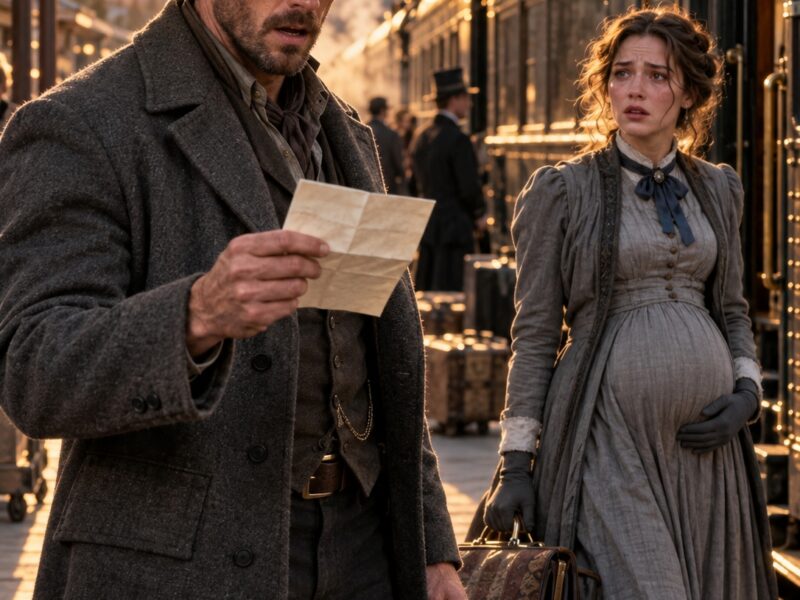
HE WAITED 12 YEARS FOR HIS MAIL-ORDER BRIDE—THEN SHE STEPPED OFF THE TRAIN PREGNANT WITH ANOTHER MAN’S CHILD
The first thing Caleb Hartwell noticed about the woman he had waited twelve years for was that she had lied to him.
The second thing he noticed was that she was terrified.
And the third was impossible to miss.
She was pregnant.
Not newly pregnant.
Not in the uncertain early months when a woman might hide the truth beneath a traveling coat and a carefully folded shawl.
Six months, Caleb guessed.
Maybe seven.
Far enough along that the gray dress described in her letters curved unmistakably over her stomach as she stepped down from the Number 410 and onto the wooden platform at Greybute, Montana Territory.
For several seconds, Caleb forgot how to breathe.
The train hissed behind her.
Steam rolled beneath the wheels.
A porter shouted something Caleb didn’t hear.
The young woman stood with one gloved hand gripping a worn carpetbag and the other resting instinctively over the child beneath her dress.
At her collar was a blue ribbon.
Exactly as promised.
Everything else was not.
Caleb felt the folded letter inside his left hand.
He had read it so many times that the creases had gone soft.
Eleanor Frost.
Twenty-six years old.
Able to cook.
Able to read.
Not afraid of hard work.
Willing to build a life in the West with an honest man.
There had been nothing about a husband.
Nothing about a child.
Nothing about the fact that the woman coming west to become Caleb Hartwell’s wife was already carrying another man’s baby.
Around them, the station seemed to become unnaturally quiet.
A traveling salesman standing near the baggage cart looked over.
Two ranch hands who had climbed down from the same train stopped talking.
Even Amos Bell, the stationmaster, suddenly became fascinated with sweeping a patch of platform that had not needed sweeping five minutes earlier.
Greybute was a small town.
By supper, everyone would know.
By breakfast tomorrow, the story would have acquired details that had never happened.
By Sunday, half the town would have decided what kind of woman Eleanor Frost was.
Caleb had not said a word.
Neither had she.
Then Eleanor lifted her chin.
That was the moment he remembered later.
Not the pregnancy.
Not the shock.
Not even the lie.
The chin.
Because she knew.
She knew exactly what he was thinking.
She knew what the men behind her were thinking.
She knew what the stationmaster would tell his wife and what his wife would tell the woman at the mercantile and what the woman at the mercantile would tell everyone else.
And still Eleanor Frost did not turn around.
She did not hide.
She did not cry.
She walked toward him.
Three feet away, she stopped.
Up close, she looked younger than Caleb had expected.
And much more tired.
There were faint shadows beneath her eyes. Her gloves had been repaired twice at the fingers. Her gray dress was clean but worn shiny at the cuffs, and the blue ribbon at her throat was probably the newest thing she owned.
She looked at the tall rancher in the good coat and new hat.
“Mr. Hartwell?”
Her voice was steady.
Barely.
Caleb swallowed.
“Miss Frost.”
Something passed across her face.
“Mrs.”
Caleb’s eyes narrowed.
She glanced toward the tracks.
“It was Mrs. Frost.”
That sentence landed harder than the sight of her belly.
Caleb’s hand tightened around the letter.
Eleanor saw it.
“I suppose that’s the first thing I lied about.”
“The first?”
Her mouth trembled once.
Then stopped.
“I expect it won’t be the last thing you hold against me.”
The salesman behind her abruptly found somewhere else to look.
Caleb felt heat climb into his face.
He had imagined this meeting for months.
On sleepless nights he had rehearsed what he would say.
Welcome to Montana.
I hope the journey wasn’t too difficult.
You look just like I imagined.
He had even considered bringing flowers before deciding that a forty-one-year-old cattle rancher carrying flowers at a train station might look ridiculous.
Now every prepared sentence was gone.
Eleanor looked past him toward the station clock.
“The eastbound train leaves at six.”
Caleb said nothing.
“If you’ll spare me the fare,” she continued, “I’ll be on it.”
Her voice softened.
“You’ll never have to explain me to anyone.”
Caleb stared at her.
The strangest thing was that she did not plead.
A woman who had crossed half a continent with almost no money, carrying a child and expecting to marry a stranger, should have been begging.
Eleanor did not.
She simply stood there waiting for his judgment.
And suddenly Caleb hated the fact that everyone else was waiting for it too.
He looked toward the ranch hands.
They looked away.
He looked toward Amos Bell.
The stationmaster became intensely interested in his broom.
Caleb turned back to Eleanor.
“You eaten?”
She blinked.
“What?”
“Today. Have you eaten?”
“I had something this morning.”
“What?”
Her silence answered him.
Caleb reached for her carpetbag.
Eleanor tightened her grip.
“I can carry it.”
“I didn’t say you couldn’t.”
He took it gently.
For a moment her arms remained curved around the empty space where the bag had been.
Caleb noticed.
He noticed too much about her already.
“The hotel serves supper until five-thirty,” he said. “We’ll eat.”
“Mr. Hartwell—”
“Then we’ll talk.”
Her face hardened with confusion.
“About the train?”
“About everything.”
He looked deliberately at the men pretending not to listen.
“Somewhere the whole town isn’t leaning out its windows.”
For the first time since stepping off the train, something in Eleanor’s expression changed.
Not relief.
She was too frightened for relief.
But perhaps surprise.
Caleb started toward the hotel.
After several seconds, he heard her footsteps behind him.
He had no idea yet whether he was taking Eleanor Frost to supper or simply feeding her before sending her back east.
But he knew one thing.
He would not decide the rest of her life while Greybute watched.
Because Caleb Hartwell knew something about being judged by what a man lacked.
He had spent twelve years trying to prove the judgment wrong.
He had come west at nineteen with forty dollars and his dead father’s pocket watch.
The watch lasted one winter.
When the cold came hard and his first milk cow fell sick, Caleb sold the only thing his father had left him and bought another cow.
The forty dollars stayed hidden inside a tobacco tin beneath a loose floorboard.
He never spent it.
Not because he did not need it.
There were winters when forty dollars might have felt like forty thousand.
But spending it would have meant admitting that Montana had beaten him.
So he worked.
He fenced land.
Dug post holes.
Cut timber.
Lost cattle.
Bought cattle.
Nearly froze twice.
Nearly went broke three times.
Dug a well by hand because hauling water through dry summers was slowly destroying him.
He built a barn.
Then another.
Then a house.
Not much of one at first.
Four walls.
A roof.
A stove.
A table.
One chair.
Years later there were proper floors, a second bedroom, shelves, curtains he had purchased because someone told him curtains made a house look less like a bunkhouse.
By thirty-five, Caleb Hartwell owned one of the best small ranches east of Greybute.
He had nearly a section of land.
Healthy cattle.
Good horses.
Money in the bank.
People respected him.
None of it changed the sound of his house at night.
Silence had weight.
A man discovered that after enough years.
There had once been a woman in Ohio.
Caleb almost never thought about her anymore.
At least that was what he told himself.
He had asked her to come west.
She married a banker in Columbus instead.
She had not been cruel about it.
That somehow made it worse.
She simply wanted a different life.
Caleb had interpreted her choice as proof that he had nothing worth choosing.
So he spent the next decade acquiring things.
Land.
Cattle.
A better stove.
A better roof.
A good well.
And every night he sat alone at a table large enough for a family and listened to the wind scrape branches against the window.
Eventually he saw an advertisement in a matrimonial newspaper circulated out of Chicago.
Men in the territories seeking wives.
Women back east seeking husbands.
People laughed about such arrangements.
Caleb didn’t.
Loneliness had cured him of laughing at other lonely people.
His first letter was painfully honest.
I am forty-one years old.
I am not handsome.
I am not wealthy, though I am comfortable.
I own land and cattle.
I don’t drink more than occasionally.
I don’t gamble.
I want a partner, not a servant.
He almost didn’t mail it.
Three weeks later, Eleanor Frost answered.
Her handwriting was neat.
Her humor was quiet.
She wrote about books.
Weather.
Cooking.
Her dislike of men who exaggerated themselves.
Caleb wrote back.
Then she did.
One letter became six.
Six became twelve.
He began recognizing the days the mail coach arrived by the way his own mood changed before breakfast.
Once, he carried one of her letters in his coat pocket for nearly a month.
He never told anyone.
For the first time in years, another voice existed inside his house.
Then he bought her ticket.
And now that voice was sitting across from him in the Greybute Hotel dining room, pregnant with a dead man’s child.
Caleb watched Eleanor eat beef and boiled potatoes.
She tried to eat slowly.
Hunger defeated manners.
Caleb pretended not to notice.
Finally, he said, “Tell me.”
Her fork stopped.
“Everything?”
“The parts you thought would make me put you back on that train.”
She set the fork down.
Outside the window, afternoon sunlight had begun turning amber.
The six o’clock train would arrive in less than an hour.
Eleanor folded her hands.
“My husband was named Thomas.”
Caleb waited.
“Thomas Frost.”
So Frost was real.
“He was a clerk in Baltimore. We married when I was twenty-four.”
“Were you happy?”
The question surprised her.
“I think we were trying to be.”
Not yes.
Caleb noticed.
“He wasn’t a bad man,” Eleanor continued. “He was just better at believing tomorrow would solve things than he was at solving them today.”
“Debts?”
She nodded.
“More than I knew.”
“How much?”
“Enough.”
“What happened to him?”
“Fever.”
Her eyes lowered.
“Fourteen months after we married.”
Caleb’s anger shifted.
Not disappeared.
Shifted.
“And his family?”
“They blamed me.”
“For the debt?”
“For everything.”
She gave a humorless smile.
“Grief makes accountants of people. Everyone starts deciding who owes whom.”
Caleb looked at her stomach.
Eleanor followed his gaze.
“I learned I was carrying his child shortly before he died.”
“His?”
Her eyes snapped back to his.
“Yes.”
Caleb held her stare.
Then nodded.
“All right.”
She looked almost offended.
“That’s all?”
“I asked. You answered.”
“You believe me?”
“I haven’t decided what else I believe. I believe that.”
Something in her shoulders loosened.
Only slightly.
“The creditors came after Thomas died. His family wouldn’t help. They said I’d encouraged his spending.”
“Had you?”
“No.”
The answer came sharp enough that Caleb believed that too.
“I sold furniture. Jewelry. Everything Thomas had that anyone would buy.”
Her fingers touched the worn edge of the table.
“When I saw your advertisement, I had enough money for maybe six more weeks.”
Caleb sat back.
“So you answered me.”
“Yes.”
“Because I had a ranch.”
“Yes.”
That answer hurt.
She saw it.
“But that isn’t the whole answer.”
Caleb said nothing.
Eleanor took a breath.
“I had been spoken about for two years as if I were someone’s burden. Thomas’s wife. Thomas’s widow. Thomas’s debt. Thomas’s mistake.”
Her eyes lifted to Caleb’s.
“Your letters were the first time anyone had written to me as though I were simply a person.”
The room seemed quieter.
“I read them until I knew whole paragraphs by memory.”
Caleb looked toward the window.
She continued.
“I told myself I would tell you about the baby.”
“When?”
“Before I came.”
“But you didn’t.”
“No.”
“Why?”
“Fear.”
“That’s not much of an answer.”
“It’s the only honest one.”
Her voice cracked.
She looked down.
“One week passed. Then another. Every day I didn’t tell you made telling you the next day harder. Then you bought the ticket.”
“And you came anyway.”
“Yes.”
“Expecting what?”
Eleanor was silent.
Caleb leaned forward.
“Did you come here to use me?”
Her eyes filled.
She didn’t look away.
“At first?”
Caleb hadn’t expected that qualification.
“At first,” she said, “I came because I wanted my child to survive.”
There it was.
Ugly.
Simple.
True.
“I knew you had a house. Food. Land. I knew you wanted a wife. I told myself I could be a good one.”
Caleb’s jaw tightened.
“That’s using a man.”
“Yes.”
No defense.
No excuse.
That made being angry more difficult.
Eleanor continued.
“Then your letters kept coming.”
She wiped quickly beneath one eye.
“And you were kind when there was nothing to gain by being kind.”
Caleb looked away.
“I began wanting the thing I had pretended to want.”
“What thing?”
“A life here.”
The clock behind the hotel desk ticked.
Outside, someone called for baggage.
Eleanor whispered, “I didn’t let myself hope.”
She looked at him.
“But the hoping happened anyway.”
Caleb slowly turned his coffee cup.
“Why didn’t you tell me at the station?”
“I did.”
“After I saw you.”
“Yes.”
“That’s not the same.”
“No.”
Her honesty kept leaving him nowhere comfortable to stand.
Then she said something he would remember for the rest of his life.
“I prayed you would be cruel.”
Caleb frowned.
“What?”
“On the train.”
“Why?”
“Because if you were cruel, you could send me away and I could hate you.”
Her lips trembled.
“If you’re kind, Mr. Hartwell, then I have to live knowing what my fear cost a kind man.”
Caleb stared at her.
For twelve years, he had believed loneliness was the worst thing a house could contain.
Now he wondered whether shame might be heavier.
The station whistle sounded in the distance.
Eleanor looked toward the window.
“The train.”
Caleb reached for his hat.
She closed her eyes.
He stood.
Then picked up her carpetbag.
“Come on.”
She followed him outside without speaking.
The eastbound train stood steaming beside the platform.
Passengers boarded.
Eleanor stopped.
Caleb kept walking.
Past the ticket office.
Past the platform.
Straight toward the wagon tied beside the hotel.
Eleanor stared at him.
“Mr. Hartwell?”
He put her bag behind the seat.
“The ranch is eleven miles.”
She didn’t move.
“What are you doing?”
“Taking you there.”
Her face went white.
“You don’t owe me that.”
“No.”
“You don’t even know whether you want me.”
“No.”
“Then why?”
Caleb looked toward the train.
“Because you shouldn’t make a permanent decision while you’re hungry and scared.”
The conductor shouted the final call.
Caleb climbed onto the wagon.
“You can stay a week.”
Eleanor stared.
“Eat. Sleep. Look at the place. Look at me when half the town isn’t watching.”
The whistle blew.
“If you want the six o’clock after that, I’ll buy the ticket.”
Eleanor looked at the train.
Then at Caleb.
Then down at the child beneath her dress.
The wheels began turning.
Slowly.
The last carriage passed them.
Eleanor Frost watched her easiest escape disappear eastward into the evening.
Then she climbed into Caleb Hartwell’s wagon.
Neither of them understood it yet.
But the most important decision of their lives had just been made by letting a train leave without them.
The ride to the ranch took nearly two hours.
Montana opened around them until Eleanor seemed unable to decide where to look.
Grasslands turned silver beneath the fading light.
Dark hills rose in the distance.
The sky was so enormous it made Baltimore feel like something remembered through a keyhole.
“It’s bigger than I imagined,” Eleanor finally said.
Caleb glanced at her.
“The ranch?”
“Everything.”
He almost smiled.
“I wrote small.”
“Why?”
“Didn’t want to sound proud.”
“Are you proud?”
“Sometimes.”
“Of what?”
Caleb considered.
“The well.”
“The well?”
“Dug it myself.”
“That’s your great accomplishment?”
“You haven’t hauled water in August.”
That surprised a laugh out of her.
It was small.
Rusty.
Almost startled.
Caleb felt it somewhere behind his ribs.
He pointed ahead.
“I’ve got near a section now. Cattle on most of it. House isn’t much, but the roof’s tight.”
Eleanor listened.
“And I’ve got the best stove within forty miles.”
She turned toward him.
“How could you possibly know that?”
“Because I paid more than any sensible man would.”
Another laugh.
This one lasted longer.
When they reached the rise above the ranch, Eleanor stopped smiling.
Below them sat a low square house with the barn behind it.
A thin ribbon of smoke lifted from the chimney.
Caleb had seen that house thousands of times.
He had never seen it through someone else’s eyes.
“It’s beautiful,” Eleanor whispered.
“No, it isn’t.”
“It is to me.”
That frightened him more than the lie had.
At the house, Caleb carried her bag inside.
He showed her the spare room.
Clean sheets.
A washstand.
A small dresser.
A bolt on the inside of the door.
Eleanor touched the bolt.
Caleb noticed.
“You lock it.”
She looked at him.
“I sleep in the main room.”
“Mr. Hartwell—”
“Caleb.”
She hesitated.
“Caleb, I don’t know what you expect.”
“Nothing.”
“No man expects nothing.”
“Then expect me to disappoint you.”
She almost smiled.
Caleb leaned against the doorframe.
“No marrying this week.”
Her eyebrows rose.
“The advertisement—”
“Was written by two strangers.”
He nodded toward the bed.
“You’re tired. You’re carrying a child. You don’t know me except through paper.”
He paused.
“Surviving comes first. Everything else can wait.”
Eleanor put one hand over her mouth.
Her shoulders began shaking.
Caleb stood very still.
He didn’t touch her.
He didn’t tell her not to cry.
He didn’t leave.
He simply remained there while a woman who had crossed half a continent finally allowed herself to fall apart.
Outside, Montana stars filled the sky above the house Caleb had spent twelve years building for a family he had stopped believing would come.
Inside, Eleanor Frost cried in the room that had once belonged to his mother.
And for the first time Caleb understood something unsettling.
Sending Eleanor away might have protected his pride.
Keeping her might cost him far more.
By the end of the first week, Greybute had made its decision about Eleanor.
Nobody had bothered asking Eleanor.
At the mercantile, conversations stopped when Caleb entered.
At church, women whispered behind gloves.
Someone called Eleanor a deceiver.
Someone else used a worse word.
Then Reverend Pell arrived at Caleb’s ranch.
He came without invitation.
Caleb found him on the porch Sunday afternoon, black coat buttoned high despite the warmth.
“Caleb,” Pell said, “we need to speak about appearances.”
Caleb leaned against a porch post.
“Appearances don’t usually need my help.”
The reverend ignored that.
“You are a respected man.”
“Some days.”
“You’ve taken an unmarried pregnant woman into your home.”
“Widowed.”
“The distinction will not matter to everyone.”
“It matters to her dead husband.”
Pell’s mouth tightened.
“This is precisely the attitude I’m concerned about.”
“What attitude?”
“Defiance.”
Caleb stared at him.
The reverend lowered his voice.
“There are young people in this community. Families. Standards. A respectable rancher cannot take in a fallen woman and call the arrangement Christian.”
Caleb waited until he finished.
Then he stepped closer.
“Reverend, that woman buried her husband at twenty-five.”
Pell opened his mouth.
Caleb kept talking.
“She crossed half the country pregnant and alone. She stepped into a town where everybody had decided what she was before she’d walked fifty feet.”
His voice stayed quiet.
“I’ve watched grown men face a tenth of that trouble and quit.”
“She deceived you.”
“She did.”
“And yet you defend her.”
“I didn’t say she was perfect.”
Caleb looked toward the house.
“I said she was brave.”
Pell shook his head.
“You are risking your reputation.”
Caleb almost laughed.
“I spent twelve years building fences, Reverend. Turns out reputation’s just another one people build around you.”
He opened the porch gate.
“You can call Eleanor shameful if you want.”
His eyes hardened.
“But I’d be careful how loudly you do it.”
“Is that a threat?”
“No.”
Caleb looked toward the church steeple barely visible miles away.
“Just seems foolish to say ugly things about another human being when you spend Sundays claiming the Lord is listening.”
Reverend Pell left.
He did not return.
He also did not stop talking.
Eleanor heard about the conversation two days later.
“You shouldn’t have done that,” she told Caleb.
They were shelling beans at the table.
“Probably.”
“He can make things difficult.”
“He’s a preacher, Eleanor, not winter.”
“You joke because you don’t understand.”
Caleb stopped shelling.
“Understand what?”
“What happens to women when respectable people decide they’re not respectable.”
That ended the joke.
Eleanor looked at the beans in her hands.
“You can lose work. Housing. Friends. A child can grow up carrying what people decided about its mother before it was born.”
Caleb’s expression softened.
“You’ve thought about this.”
“Every day.”
He wanted to say something comforting.
Instead he said the truth.
“Then they’ll have to get through me too.”
Eleanor looked at him.
And that was somehow worse.
Because cruelty she understood.
Kindness was becoming dangerous.
The confrontation she feared came at the dry goods store.
Hattie Combs ran the boarding house and possessed the particular sharpness of a woman who had buried two husbands and survived both funerals without allowing grief to make her sentimental.
She found Eleanor alone beside the fabric counter.
Hattie’s eyes dropped to Eleanor’s stomach.
Then rose.
“You know what people say?”
Eleanor folded the cloth in her hands.
“I assume they’ve found several versions.”
Hattie almost smiled.
Almost.
“They’ll talk about the child too.”
Eleanor’s hand moved instinctively over her belly.
“Children hear things.”
“I know.”
“It follows them. School. Church. Everywhere.”
Fear flashed across Eleanor’s face.
Then disappeared.
“Then I’ll have to be the kind of mother worth getting through it for.”
Hattie studied her.
“And you’ll have to hope the child is strong.”
“Most people become strong when they aren’t given another option.”
Eleanor met the older woman’s eyes.
“You buried two husbands and still open your boarding house every morning.”
Hattie’s mouth tightened.
“I suppose you know something about that.”
For a long moment neither woman moved.
Then Hattie took the folded cloth from Eleanor’s hands.
“That color washes badly.”
She reached for another bolt.
“Take this instead.”
Nothing else was said.
A week later, Caleb found a basket on the porch.
Inside were knitted baby clothes.
Tiny socks.
A blanket.
No note.
Caleb held up one sock.
“Hattie?”
Eleanor touched the stitching.
“Hattie.”
Neither mentioned returning it.
Something was changing.
Not in Greybute.
Not yet.
Inside the house.
One week became two.
Two became a month.
Nobody said marriage.
The word lived with them anyway.
Eleanor discovered the leak in the root cellar Caleb had ignored for a year.
She reorganized his accounts.
Then one evening she placed his ledger in front of him.
“Your feed merchant is cheating you.”
Caleb frowned.
“Martin?”
“For three years.”
“Martin’s known me fifteen.”
“Apparently that gave him enough time to learn you don’t check arithmetic.”
Caleb stared at the figures.
“Son of a gun.”
Eleanor smiled.
“You said it.”
“I did.”
“You owe me an apology.”
“For what?”
“You told me you could read.”
“I can read.”
“Numbers?”
“Numbers are vindictive.”
She laughed.
By October, laughter had become less unusual in the Hartwell house.
In the evenings, Eleanor read aloud.
Newspapers.
Letters.
A novel she had carried from Baltimore, one of the few possessions she had refused to sell.
Caleb sat in his father’s chair beside the stove and listened.
Sometimes he closed his eyes.
Not because he was tired.
Because it was easier to hear what he had wanted for twelve years when he wasn’t looking directly at it.
One evening Eleanor stopped reading.
Caleb opened his eyes.
“What?”
“You watch me.”
“I do not.”
“You do.”
“Maybe you’ve got ink on your face.”
“I don’t.”
“Then I guess I’m watching you.”
She closed the book.
“Like you’re waiting for me to disappear.”
Caleb looked toward the fire.
“Maybe I am.”
“I’m not going to.”
His eyes returned to her.
It was the first time she had said it.
Eleanor touched her stomach.
“I’m too far along to run and too tired to want to.”
“That isn’t much of a declaration.”
“It gets worse.”
Caleb waited.
“Whatever happens with the child, whatever the town says, I’m not running again.”
She swallowed.
“I tried that once.”
“From Baltimore?”
“From everything.”
Her eyes softened.
“And it brought me to a train platform in Montana where a man took my bag instead of taking what was left of my dignity.”
Caleb couldn’t speak.
Eleanor opened the book again.
He stood.
Put another log into the stove.
Then said, “I’d be glad if you stayed.”
She froze.
He kept his back to her.
“Child and all.”
Then, after a pause:
“Especially the child.”
Eleanor stared at him.
Caleb turned.
Something enormous and frightening stood between them now.
Neither dared name it.
Then the wind struck the house.
Hard.
Caleb looked toward the window.
The sky had changed.
By afternoon the temperature fell.
By sunset the Montana horizon had vanished behind gray.
The storm arrived three weeks early.
Snow came sideways.
Wind screamed against the roof.
Caleb got the horses into the barn and moved cattle behind the south ridge.
When he returned, ice covered his eyebrows.
Eleanor was standing beside the table.
One hand gripped its edge.
The other covered her belly.
Caleb stopped.
“Eleanor?”
She didn’t answer.
Her face tightened.
Then the pain passed.
Caleb’s blood went cold.
“No.”
Eleanor breathed slowly.
“How long?”
“An hour.”
“You should’ve told me.”
“You were with the cattle.”
“How far apart?”
“Closer now.”
Caleb went for his coat.
Eleanor caught his arm.
“Where are you going?”
“Doctor.”
“Greybute is eleven miles.”
“I know.”
“You won’t make three.”
“I’ll make eleven.”
“You’ll die.”
“Then I’ll die annoyed.”
“Caleb.”
Something in her voice stopped him.
She looked toward the window.
White.
Nothing beyond it.
No road.
No barn.
No world.
Only snow.
“It’s too late.”
Caleb stared at her stomach.
“The baby isn’t due for two months.”
“I know.”
Another contraction struck.
Eleanor doubled over.
Caleb caught her.
She gripped his shirt.
When it passed, she looked directly into his eyes.
“I’ve helped at three births.”
He nodded.
“I’m going to tell you what to do.”
“All right.”
“And you’re going to do exactly what I say.”
“All right.”
“You are not going to panic.”
“I’m not panicking.”
“You’re white as flour.”
“I’m naturally pale.”
“Caleb.”
“All right.”
Her fingers tightened around his wrist.
“If something goes wrong—”
“No.”
“Listen.”
“No.”
“If there’s a choice—”
“There won’t be.”
“Caleb.”
She waited until he looked at her.
“You choose the baby.”
His face changed.
“No.”
“Promise me.”
“No.”
“Promise.”
Outside, the storm hammered the house.
Caleb looked at the woman who had stepped off a train expecting judgment.
The woman who had lied to him.
The woman who read beside his stove.
The woman whose laughter had somehow become part of the architecture of his home.
He understood suddenly that she believed he could survive losing her.
She was wrong.
“I promise,” he whispered.
Eleanor searched his face.
And knew immediately he was lying.
Neither said it.
That lie became their first vow.
The next nine hours were terrible.
Water boiled.
Towels piled beside the bed.
The lamp guttered.
Eleanor labored in the room that had once belonged to Caleb’s mother while Montana tried to tear the roof from the house.
Caleb followed every instruction.
More water.
Another cloth.
Lift her.
Turn her.
Wait.
Not yet.
Again.
At midnight Eleanor still had strength.
At two, she had less.
Near three in the morning, fear entered Caleb’s chest and stayed there.
Something was wrong.
The child was turned badly.
Eleanor knew.
Caleb knew because she stopped telling him not to worry.
Her lips had gone pale.
Sweat soaked her hair.
Her fingers barely held the iron bedrail.
“Eleanor.”
Her eyes opened.
“Talk.”
“What?”
“Talk to me.”
She blinked slowly.
“I can’t tell which way is up.”
Caleb sat beside her.
“What do I say?”
“Anything.”
Another contraction seized her.
When it passed, she whispered:
“Tell me about the twelve years.”
Caleb stared.
“What?”
“The ranch.”
So he did.
He told her about coming west at nineteen.
About forty dollars.
About his father’s watch.
About selling it for a milk cow.
About the winter that killed three calves.
About digging the well until his palms split.
About sleeping beside the unfinished barn because thieves had been taking horses.
He told her about Ohio.
“The woman?”
Eleanor whispered.
“Yes.”
“Pretty?”
“Very.”
“Prettier than me?”
Caleb almost laughed.
“You’re in labor and jealous?”
“Answer.”
“No.”
“Liar.”
“Probably.”
Her mouth moved faintly.
He kept talking.
He told her about the house.
The stove.
The table.
The silence.
Then he told her something he had never intended to tell anyone.
“Your first letter stayed in my coat pocket for a month.”
Eleanor’s eyes opened.
“Why?”
“I liked knowing it was there.”
Her eyes filled.
“Caleb—”
“No. You wanted talking.”
He gripped her hand.
“So listen.”
His voice broke.
“The best day of my life was the worst day of yours.”
She stared at him.
“The platform.”
He nodded.
“You stepped off that train thinking everything was finished.”
His thumb pressed against her cold fingers.
“For me, Eleanor, that was the day everything started.”
She began crying silently.
Caleb leaned closer.
“I waited forty-one years for you.”
Another contraction began.
“So you don’t get to die now.”
She gasped.
“You hear me?”
“Caleb—”
“You keep your eyes open.”
Pain tore through her.
“Push when I tell you.”
She screamed.
The storm swallowed the sound.
Again.
Again.
Then Eleanor went terrifyingly quiet.
Caleb thought she was gone.
“Eleanor!”
Her eyes opened.
Barely.
“Still here.”
“Stay.”
“Trying.”
“Try harder.”
“You are a terrible nurse.”
“Complain tomorrow.”
“Planning to.”
Then something changed.
The baby turned.
Caleb saw it happen.
He didn’t understand how.
He didn’t care.
“Again.”
Eleanor gathered whatever remained inside her.
At 4:10 in the morning, a child slipped into Caleb Hartwell’s hands.
For one horrifying second, there was silence.
Caleb stared at the tiny body.
“No.”
Eleanor tried to lift her head.
“Caleb?”
“No, no, no.”
He rubbed the baby’s back.
“Come on.”
Nothing.
“Caleb?”
“Come on!”
Then the baby inhaled.
And screamed.
Small.
Furious.
Alive.
Caleb froze.
Eleanor began laughing.
Or crying.
He couldn’t tell.
Maybe both.
Caleb wrapped the baby.
His own face was wet.
“A girl,” he whispered.
Eleanor reached.
Caleb placed the child against her chest.
The baby carried Thomas Frost’s blood.
Thomas Frost’s history.
Thomas Frost’s name.
Caleb looked at her tiny red face and discovered that none of those things mattered.
She had entered the world inside his house.
Into his hands.
While the woman he loved nearly died bringing her there.
Whatever blood meant, this meant something too.
By sunrise the storm weakened.
Eleanor slept.
Caleb did not.
He sat beside the bed watching the two of them breathe.
Hours later, Eleanor woke.
“What time?”
“Late.”
“The baby?”
“Angry.”
“Good.”
Caleb brought her over.
Eleanor held the tiny girl against her chest.
“We need a name.”
Caleb nodded.
“Grace.”
He looked at her.
“Grace?”
“Yes.”
“Why?”
Eleanor touched the baby’s cheek.
“Because grace is what you give someone who hasn’t earned it.”
Caleb went still.
She looked at him.
“That’s what you gave me on the platform.”
Outside, three feet of snow covered Montana.
Everything looked washed clean.
Caleb stood in the doorway holding two cups of coffee and watched Eleanor holding Grace.
He thought about the six o’clock train.
About how close he had come to putting her on it.
About twelve empty years.
About the table.
The stove.
The letters.
He set down the coffee.
“Eleanor.”
She looked up.
“I’m going to say something badly.”
“That sounds promising.”
He almost smiled.
“I’m not asking you the way the advertisement did.”
Her expression changed.
“That advertisement was written to a stranger.”
He stepped closer.
“You’re not one anymore.”
Eleanor said nothing.
“I don’t want you staying because people will talk if you leave.”
He swallowed.
“And I don’t want you marrying me because you think a woman with a baby needs a man’s name.”
Grace stirred.
“You’ve got your own name.”
Caleb’s voice became quieter.
“And it’s a good one.”
Eleanor’s eyes filled.
“I want you here because someday this winter I’ll come in after dark.”
He looked toward the main room.
“You’ll be reading beside that ridiculous stove.”
“It’s an excellent stove.”
“The best within forty miles.”
“According to one unreliable witness.”
Caleb smiled.
Then the smile disappeared.
“I’ll look at you.”
He looked at Grace.
“At her.”
His voice broke.
“And I’ll know that’s what I spent twelve years building.”
Eleanor stared at him.
“The ranch?”
“No.”
He shook his head.
“Room.”
“For what?”
“For this.”
He had no better word.
Maybe there wasn’t one.
“I want to marry you because I like the man I am when your voice is in my house.”
Silence.
Caleb shifted awkwardly.
“That’s all I’ve got.”
Eleanor wiped her cheek.
“It’s not pretty.”
She laughed through her tears.
“No.”
“But it’s true.”
“Yes.”
Caleb waited.
He had waited twelve years.
These few seconds were worse.
Finally Eleanor said, “Caleb Hartwell.”
He braced himself.
“I have been waiting two months for you to stop being so careful with me.”
His eyebrows lifted.
“Is that a yes?”
“It is.”
Caleb exhaled.
“But I have a condition.”
His expression immediately became suspicious.
“What?”
“The next time there’s a choice to make, you don’t make it for me.”
“Eleanor—”
“And I don’t make it for you.”
She reached for his hand.
“We make it together.”
Caleb looked at her fingers around his.
“Because that’s what marriage is supposed to be.”
He nodded.
“All right.”
She squeezed his hand.
“Then yes.”
They married in April.
The snow had disappeared from the low ground.
Grass returned so violently green that winter seemed like something Montana had imagined.
Reverend Pell did not perform the ceremony.
A young circuit preacher passing through Greybute did.
Hattie Combs came in her best dress.
So did the feed merchant, who had stopped rounding Caleb’s bills upward after Eleanor began keeping the accounts.
Grace slept through nearly everything inside a basket lined with Hattie’s knitting.
The town changed too.
Slowly.
Then suddenly.
People who had whispered about Eleanor began nodding to her.
Women who had avoided her started asking to hold Grace.
By summer, the baby was passed from lap to lap at church socials.
Eleanor never pretended she had forgotten.
She simply refused to spend the rest of her life collecting debts from people who had once been cruel.
Caleb understood that.
He knew something about carrying old debts too long.
Years passed.
Grace grew.
She called Caleb “Pa” before she was old enough to understand why anyone might think she shouldn’t.
Nobody corrected her.
Certainly not Caleb.
The first time she said it, she was sitting on the kitchen floor holding a wooden spoon.
“Pa.”
Caleb stopped walking.
Eleanor looked up from the table.
Grace banged the spoon.
“Pa!”
Caleb slowly crouched.
“What’d you say?”
Grace grinned.
“Pa.”
Eleanor covered her mouth.
Caleb picked the girl up.
He turned away quickly enough that Grace would not see his eyes.
Eleanor saw.
She always did.
The ranch changed.
A larger barn came later.
More cattle.
Another room added to the house.
But Caleb’s favorite view remained the same.
Coming up the rise at dusk.
A lamp in the window.
Smoke from the chimney.
Sometimes Eleanor’s shadow crossing the curtains.
Sometimes Grace waiting at the window.
He still sold the good calves when he needed money.
Still complained about weather.
Still insisted the stove was the finest within forty miles.
Eleanor still corrected his arithmetic.
Still read aloud at night.
And sometimes, when the wind moved across the Montana grass, Caleb remembered another evening.
A train.
A gray dress.
A blue ribbon.
A frightened woman standing three feet away.
He remembered how certain he had been that the worst thing Eleanor could bring him was a lie.
He had been wrong.
The worst thing would have been an empty platform.
Years later, Eleanor once asked him a question while they sat on the porch watching Grace chase fireflies.
“What would you have done if I’d gotten on that six o’clock train?”
Caleb looked toward the horizon.
“I don’t know.”
“Would you have married someone else?”
“No.”
“You can’t know that.”
“I know.”
“Why?”
Caleb watched Grace run through the grass.
Because he had finally understood the twelve years.
The ranch had never been the thing he was building.
Neither was the barn.
Or the well.
Or the house.
Those things were merely walls around an absence.
He had spent twelve years thinking he needed to become worthy of being chosen.
Eleanor had arrived believing she was no longer worthy of being chosen at all.
Both had been wrong.
He looked at his wife.
“I think I would’ve spent the rest of my life believing I lost something that belonged to me.”
Eleanor frowned.
“I never belonged to you.”
Caleb smiled.
“No.”
He reached for her hand.
“That’s why you stayed.”
Across the yard, Grace laughed.
Eleanor leaned her head against Caleb’s shoulder.
The lamp inside the house had not yet been lit.
Soon it would be.
And that was the thing Caleb loved most about evening now.
Darkness no longer meant coming home to silence.
It meant someone would light the lamp.
Someone would open a book.
Someone would complain that he’d tracked mud across a clean floor.
Someone would ask whether he remembered to latch the north gate.
A little girl would climb into his chair despite having a chair of her own.
Ordinary things.
That was the miracle of them.
Caleb Hartwell had waited twelve years for a bride.
What stepped off the Number 410 was not the woman he had been promised.
She was a widow.
She was pregnant.
She was frightened.
She had lied.
She carried debts, grief, shame and another man’s child.
She arrived with almost nothing except a carpetbag and enough courage to stand still while an entire town decided what she was worth.
And Caleb eventually understood that love had never asked him whether Eleanor’s story was clean.
It had asked whether there was room in his life for the whole of it.
There was.
There had always been.
He had simply mistaken the room for emptiness.
Perhaps that was why Eleanor never forgot the platform either.
She had arrived expecting judgment.
Instead, a man took the bag from her hands.
Not because he had forgiven her yet.
Not because he loved her yet.
Not because he knew what would happen.
He simply saw that she was carrying something heavy.
And helped her carry it.
Everything else came afterward.
The trust.
The anger.
The whispers.
The stove.
The books.
The storm.
The blood.
Grace screaming into the world at 4:10 in the morning.
The wedding in April.
The little girl calling him Pa.
The lamp glowing in the window.
A family did not begin when Caleb married Eleanor.
It began months earlier on a wooden platform in Greybute, when a frightened woman told a lonely man that the six o’clock train could take her away forever.
And the lonely man, who had every reason to let it, picked up her bag instead.
Long after the Number 410 disappeared eastward, long after the tracks stopped trembling beneath its wheels, Caleb would remember the strange mercy hidden inside that moment.
One train left.
One woman stayed.
And an empty house finally became a home.









