He Waited for One Mail-Order Bride—Then She Rode Into Town With Forty Apache Behind Her
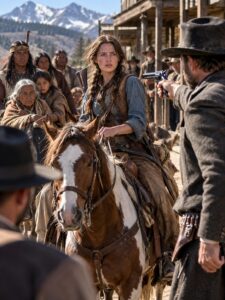
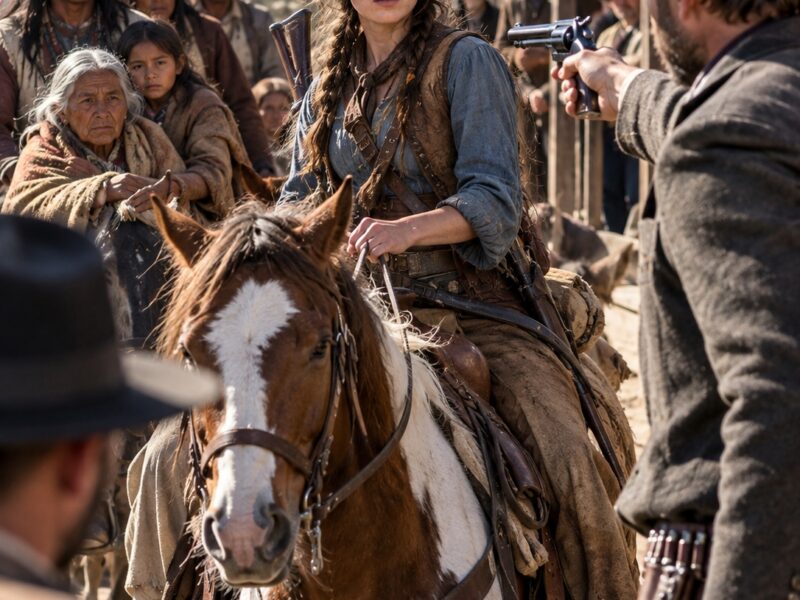
The first man reached for his revolver before Bram Kettle even understood what he was looking at.
“Apache.”
The word moved through Dosa Wells like a match dropped into dry grass.
Men stepped off the boardwalk.
A woman snatched her little boy by the shoulder and dragged him through the mercantile door.
The blacksmith abandoned a glowing horseshoe on his anvil.
Somebody inside the saloon shouted for a rifle.
And Bram Kettle stood in the middle of Main Street, staring at the woman he had come down from the mountains to marry.
She was riding toward him at the head of forty Apache men, women, and children.
For three months, Bram had carried her letters folded inside the breast pocket of his coat.
Wilhelmina Dorsey.
Twenty-seven.
Unmarried.
Capable with horses.
Could cook well enough not to poison a man.
Did not frighten easily.
Preferred silence to foolish conversation.
Those were the things her letters had told him.
They had not mentioned this.
They had not mentioned the paint horse.
They had not mentioned the rifle resting across her saddle.
And they certainly had not mentioned the forty exhausted human beings following her out of the Arizona desert.
Bram’s jaw tightened.
“Well,” murmured Silas Reed, the storekeeper beside him. “That your bride?”
Bram didn’t answer.
He was watching her.
The woman at the front of the column wore a faded blue settler’s blouse beneath a weathered buckskin vest. Dust coated her skirt and boots. Her dark hair had been braided back from a face browned by months beneath the desert sun.
She looked tired.
Not delicate tired.
Not stagecoach tired.
She looked like someone who had spent several nights sleeping with one eye open because other people’s lives depended on her waking before danger arrived.
And yet her back remained straight.
Her chin remained high.
Behind her came old men with hollow cheeks.
Mothers carrying babies.
Children whose clothing hung loose around painfully thin bodies.
A handful of younger Apache men rode along the outside of the group, watchful but not threatening.
They were armed.
So were half the men in Dosa Wells.
That was the problem.
“Bram,” Silas said quietly.
Bram heard metal scrape leather behind him.
Someone was drawing a gun.
The woman on the paint horse heard it too.
Her eyes moved past Bram.
Her right hand shifted toward her rifle.
And suddenly the entire street seemed balanced on a single breath.
Bram stepped forward.
“Put it away.”
Nobody moved.
He turned.
Cal Henson stood outside the saloon with his revolver halfway out of its holster.
“I said put it away.”
Cal stared at him.
“You see what’s behind her?”
“I’ve got eyes.”
“Then use them.”
Cal’s face reddened.
“Forty Apaches just rode into town.”
“No.”
Bram looked beyond Mina at the children.
“Forty hungry people rode into town.”
That distinction did not calm anyone.
The muttering became louder.
“Renegades.”
“Somebody get Sheriff Cole.”
“Send for the fort.”
“They’ll kill us in our beds.”
Bram walked into the center of the street.
He was forty years old, six-foot-three in worn boots, broad through the shoulders from fifteen years of cutting timber, breaking horses, hauling stone, and surviving winters alone in a mountain valley where careless men did not get a second chance.
He wasn’t loud.
He had never needed to be.
“Anybody fires,” he said, “they answer to me first.”
That quieted the street.
Not because Bram Kettle owned Dosa Wells.
He didn’t.
Not because he was rich.
He wasn’t.
But because everyone in town knew there were easier ways to ruin a morning than testing whether Bram Kettle meant what he said.
He turned back.
The woman had stopped ten feet away.
For several seconds neither spoke.
This was the first time they had ever seen each other.
Mina had imagined him taller.
Bram had imagined her softer.
Both immediately understood how useless imagination had been.
“You Bram Kettle?” she asked.
Her voice was low.
“Yes.”
“Wilhelmina Dorsey.”
“I figured.”
Something almost resembling amusement moved through her eyes.
Then disappeared.
“Most people call me Mina.”
“I figured that too.”
This time the corner of her mouth actually moved.
Behind them, forty lives waited.
Bram looked past her again.
Then back at her.
“You planning to explain?”
“Yes.”
“When?”
“As soon as we’re somewhere people aren’t deciding whether to shoot my family.”
That word changed something.
Family.
Bram looked at the old woman riding twenty yards behind Mina.
Small.
Gray-haired.
Wrapped in worn buckskin.
She was watching Mina with the unmistakable terror of a mother who had followed her child into a dangerous place and could do nothing now except trust her.
Bram looked at the children again.
One little boy had fallen asleep against his father’s back.
Another girl stared at the bakery window with an expression Bram had seen on starving animals.
He made his decision.
“Follow me.”
Silas grabbed his arm.
“Bram.”
Bram looked down at the hand until Silas removed it.
“You take them into those mountains, people are going to talk.”
“People already talk.”
“This isn’t talk. Soldiers could come.”
“I know.”
“You could lose your land.”
“I know.”
“You don’t even know why they’re here.”
At that, Bram looked toward the woman who was supposed to become his wife.
“No,” he said.
“I don’t.”
Then he walked toward his horse.
Mina watched him.
For the first time since she had seen the rooftops of Dosa Wells rising from the desert, her composure cracked.
Only slightly.
But the old woman behind her noticed.
Sha always noticed.
She rode closer and spoke quietly in Chiricahua Apache.
“You chose well.”
Mina kept watching Bram.
“I don’t know that yet.”
“You know enough.”
“No.”
Mina’s fingers tightened around the reins.
Because there was something Bram Kettle did not know.
Something none of his letters could have prepared him for.
She had not answered his marriage advertisement because she had fallen in love with the lonely mountain man behind the words.
She had chosen him because she needed his land.
And before the sun went down, she was going to have to tell him.
The ride into Bram’s valley took nearly four hours.
For the first mile, neither Bram nor Mina spoke.
The forty followed behind them.
Bram rode a dark bay gelding named Bishop. Mina rode beside him on her paint mare, keeping enough distance between them that neither could accidentally touch.
The desert fell away slowly.
Mesquite gave way to juniper.
The road narrowed.
Higher still, pine appeared along the slopes, and the air cooled enough that the children behind them stopped shielding their faces from the sun.
Bram finally spoke.
“You’ve got forty people following you.”
“Forty-two when we left.”
He looked at her.
She kept her eyes on the trail.
“What happened?”
“One old man died three nights ago.”
A pause.
“And a baby yesterday morning.”
Bram said nothing.
Mina swallowed.
“The mother is the woman riding near the back with the red blanket.”
Bram glanced behind them.
He found her.
Young.
Perhaps twenty.
Her arms were wrapped around an empty bundle.
Bram faced forward again.
“What happened?”
“Hunger.”
One word.
But it changed the air between them.
Mina continued.
“And fever. And a government agent named Harmon Skett.”
Bram had heard the name.
That was not good.
He looked at her.
“Reservation agent?”
“Yes.”
“What does he have to do with this?”
“Everything.”
They rode another hundred yards.
Then Mina stopped her horse.
Bram stopped too.
The column behind them slowed.
She turned toward him.
“If you’re going to send us away, I need you to do it now.”
His expression hardened.
“Why would I do that?”
“Because I lied to you.”
There it was.
The truth she had carried for months.
Bram waited.
Mina’s heart began beating hard enough to hurt.
She had negotiated with cavalry officers.
She had faced armed settlers.
She had once stood between two men pointing rifles at each other’s chests and talked until both lowered them.
None of those moments had frightened her as much as this one.
“I didn’t lie in my letters about who I was,” she said.
“Didn’t think you did.”
“But I didn’t tell you everything.”
“I noticed.”
Despite herself, she nearly smiled.
It vanished immediately.
“My parents were settlers.”
Bram remained silent.
“They died when I was eight. Flash flood caught our wagon in a wash. Sha found me downstream.”
“The older woman?”
“My mother.”
Bram looked back.
“Apache?”
“Yes.”
“She raised you?”
“For nineteen years.”
Bram absorbed that.
“I speak their language. I know their customs. They’re my family.”
“All right.”
Mina stared at him.
“All right?”
“You expecting me to argue with your childhood?”
“No.”
She took a breath.
“The rest is worse.”
Bram waited.
“Harmon Skett has been stealing government supplies from their reservation.”
Something changed in Bram’s face.
Mina continued.
“Beef. Flour. Medicine. Blankets. Anything he can sell.”
“How do you know?”
“I watched wagons leave.”
“You have proof?”
“Some.”
“Enough?”
“Not yet.”
Bram’s eyes narrowed.
“He starved them?”
“Yes.”
“And the government doesn’t know?”
“Or doesn’t care enough to look.”
A muscle moved in Bram’s jaw.
Mina looked back at her people.
“They weren’t going to survive another winter.”
“So you left.”
“We escaped.”
That word carried different consequences.
Bram understood them immediately.
“You’re fugitives.”
“In Skett’s version.”
“And in yours?”
“People trying not to die.”
Bram stared into the mountains.
Mina forced herself to continue.
“I saw your marriage notice six months ago.”
He looked back at her.
“My valley.”
“Yes.”
“You knew where it was.”
“Approximately.”
“Remote.”
“Yes.”
“Hard to reach.”
“Yes.”
“Plenty of water.”
“Yes.”
“Far from the reservation.”
“Yes.”
The silence stretched.
Mina could hear horses shifting behind them.
“You chose me because of the valley.”
Her mouth went dry.
“Yes.”
There was no kindness in Bram’s face now.
No anger either.
That was worse.
She wished he would curse.
She wished he would accuse her.
Instead he simply looked at her.
“I intended to marry you,” she said. “I intended to be a real wife. I wasn’t planning to rob you and disappear.”
“That’s comforting.”
She accepted the blow.
“I thought if you were the man your letters made you seem to be, perhaps after we married—after you knew me—I could ask whether a few families might stay through winter.”
“A few.”
“Yes.”
He looked behind them.
Mina followed his gaze.
“Things got worse.”
“So instead of a few families…”
“I brought everyone.”
Bram gave a humorless breath.
“Efficient.”
“I had nowhere else.”
“And you thought I’d say yes.”
“I hoped.”
“Not the same thing.”
“No.”
“Why me?”
“Because people said you traded fairly with Apache.”
“People say lots of things.”
“They said you once rode two days to return money because a trader overpaid you.”
Bram frowned.
“Man couldn’t count.”
“They said you gave winter pasture to a Mexican family whose cattle would have frozen.”
“They had children.”
“They said you’ve lived fifteen years without asking anyone’s permission for anything.”
“That part’s true.”
Mina met his eyes.
“I needed a man who might care more about forty human beings than about what respectable people would say.”
That landed.
Bram looked away.
For the first time Mina allowed fear into her voice.
“I used you.”
He said nothing.
“I know that.”
Still nothing.
“If you tell me to leave, I’ll leave.”
“Where?”
“I don’t know.”
“That’s not an answer.”
“It is the only one I have.”
“And them?”
She looked behind her.
The answer was visible.
Bram stared at the children.
The mother with the empty red blanket.
Sha.
The old chief riding with his shoulders bent from exhaustion.
Then he looked north.
“How many horses?”
Mina blinked.
“What?”
“How many horses can still travel?”
“Maybe eighteen.”
“Any cattle?”
“No.”
“Food?”
“Two days if we ration.”
“Rifles?”
“Seven good ones.”
“Blankets?”
“Not enough.”
Mina stared at him.
“Why are you asking?”
Bram pointed toward the ridge.
“North end of my valley has a spring that doesn’t freeze.”
She didn’t move.
“Canyon walls cut the wind,” he continued. “Pines are thick enough nobody sees smoke from the southern trail. There’s an old line cabin up there. Roof leaks, but we can fix it.”
Mina’s lips parted.
“Bram—”
“How many children?”
“Eleven.”
“We’ll need more blankets.”
“You’re saying yes?”
He looked at her.
“I’m saying winter doesn’t care whether you’ve got government paperwork.”
She couldn’t speak.
For months she had prepared arguments.
Promises.
Deals.
Ways to make herself useful enough that a man might consider forty lives worth the trouble.
She had never prepared for simple mercy.
“Why?”
Bram frowned.
“Why what?”
“Why would you do this?”
“Because they’re hungry.”
“You could lose everything.”
“Probably.”
“Soldiers could come.”
“Probably.”
“Skett will come.”
“Then we’ll deal with Skett.”
“You don’t know these people.”
“No.”
“You barely know me.”
“That’s also true.”
“Then why?”
Bram leaned slightly toward her.
“Because if I turn forty starving people back into the desert because I’m afraid of what my neighbors might think, I have to live with the man who did that.”
He straightened.
“I don’t care to be that man.”
Then he nudged Bishop forward.
Mina remained frozen in the trail.
Sha rode up beside her.
This time the older woman said nothing.
She didn’t need to.
Mina watched Bram Kettle riding toward the mountains, already studying the terrain as though the forty strangers behind him were no longer a question but a problem to be solved.
And something inside her shifted.
Something dangerous.
Because Mina Dorsey had chosen Bram Kettle for his valley.
But somewhere on that mountain trail, she began to understand she might stay for the man.
The first snow arrived six weeks later.
By then, Dosa Wells hated them.
Rumors had multiplied faster than rabbits.
Forty Apache had become sixty.
Then eighty.
Someone claimed Bram was selling them rifles.
Someone else said Mina was an Apache spy.
A rancher swore three missing cattle had been butchered in the north valley despite finding them two days later in his own western pasture.
Fear did not require evidence.
It required repetition.
Mina understood that better than anyone.
“They’ll come eventually,” she told Bram one evening.
They were sitting at his kitchen table.
Their kitchen table now, although Mina still had trouble thinking of anything in the cabin as hers.
Bram sharpened a knife.
“Who?”
“The town.”
“Town’s already there.”
“With torches.”
The whetstone stopped.
Bram looked at her.
“You certain?”
“No.”
“But you think so.”
“Yes.”
Bram resumed sharpening.
“What do you suggest?”
Mina stared into the fire.
“Don’t hide the band.”
“That sounds backward.”
“It is.”
“They’re afraid of them.”
“Exactly.”
“So your solution is to show them more Apache.”
“Yes.”
Bram stopped again.
Mina looked at him.
“People can hate an idea forever. It’s harder to hate the woman who saved your child.”
Something in her tone told Bram this wasn’t theory.
“What are you planning?”
“Mrs. Holloway’s youngest has fever.”
“How do you know?”
“Silas mentioned it.”
“Doctor?”
“Drunk.”
“Again?”
“Since Tuesday.”
Bram sighed.
Mina stood.
“Sha knows how to bring down that kind of fever.”
“And Mrs. Holloway is going to let an Apache woman touch her child?”
“No.”
“Then?”
“She might let me.”
Bram understood.
“And once you’re inside?”
“I tell her who taught me.”
He watched her pull on her coat.
“You’ve done this before.”
“My entire life.”
“What?”
“Stand between people who are afraid of each other.”
The words were matter-of-fact.
That made them sadder.
Bram studied her.
“Must get lonely.”
Mina’s hand stopped on the door latch.
For a moment she did not turn around.
Then she said quietly:
“You get used to it.”
Bram knew enough about loneliness to recognize a lie when he heard one.
The Holloway boy survived.
Three days later, his mother appeared at Bram’s gate carrying a pie.
She refused to go farther.
She also refused to look directly at Sha.
But she placed the pie on the fencepost.
“This is for the woman who helped Tommy.”
Mina translated.
Sha nodded.
Mrs. Holloway left.
It wasn’t friendship.
But it wasn’t hatred either.
A week later, two Apache hunters left venison outside the home of a settler widow whose pantry was empty.
Then another family.
Then another.
Nobody discussed where the meat came from.
They simply ate.
By December, hunger had become a better negotiator than Mina.
By January, gratitude had begun doing what argument could not.
Then came the torches.
Seven men rode up the mountain after midnight.
Bram saw them from the ridge.
He saddled Bishop without waking Mina.
She woke anyway.
“Where are you going?”
“Back to bed.”
She looked through the window.
Orange points of fire moved between the trees.
“Bram.”
“Stay here.”
“No.”
“Mina.”
“They’re coming for my family.”
“And if you ride down armed, they’ll believe every story they’ve told themselves.”
That stopped her.
Bram put on his coat.
“So what are you going to do?”
“Talk.”
“With seven drunk men carrying torches?”
“Yes.”
“That’s your plan?”
“Pretty much.”
She stared at him.
“You’re insane.”
“So I’ve been told.”
“Bram.”
He stopped at the door.
For the first time since their marriage, Mina looked genuinely frightened for him.
Not for the band.
For him.
He noticed.
So did she.
“Don’t get killed,” she whispered.
Bram looked at her for a long moment.
“Wasn’t planning to.”
Then he left.
Mina stood at the window and watched him ride alone toward seven armed men.
And suddenly she understood something she had been trying not to name.
She loved him.
That realization frightened her more than the torches.
Because Bram still did not know how much of her first letter had been calculation.
And she did not know whether love discovered after deception could ever erase the deception itself.
Bram returned before dawn.
No blood.
No gunshots.
No burned camp.
“How?” Mina asked.
He removed his gloves.
“Told them to go home.”
“And they did?”
“Eventually.”
“What did you threaten them with?”
“Nothing.”
She stared.
“Seven men rode up here planning to burn an Apache camp, and you politely asked them to reconsider?”
“Wasn’t especially polite.”
Despite herself, Mina laughed.
It came unexpectedly.
A full laugh.
Bram looked at her.
Mina stopped.
“What?”
“Never heard you do that.”
“Do what?”
“Laugh.”
“I laugh.”
“Not like that.”
She looked away.
He stepped closer.
The room suddenly felt smaller.
“Mina.”
“Yes?”
“You afraid of me?”
Her eyes returned to his.
“No.”
“Good.”
“Why?”
“Because I’m going to kiss you.”
She forgot how to breathe.
Their marriage existed legally.
They shared a roof.
Meals.
Work.
Danger.
But Bram had never treated the paper between them as permission to take what Mina had not freely offered.
That restraint had become another unbearable kindness.
“You could ask,” she whispered.
“I just did.”
“That wasn’t a question.”
“Want me to stop?”
She looked at him.
“No.”
He kissed her.
Slowly.
Carefully.
Nothing like a man collecting what a marriage contract promised.
Everything like a man asking again without words.
Mina’s fingers caught the front of his shirt.
For the first time in nineteen years, she was not translating anything.
Not settler to Apache.
Not Apache to settler.
Not fear into reason.
She was simply a woman standing beside a fire, kissing the man she loved.
And that was exactly why she pulled away.
Bram frowned.
“What?”
“I have to tell you something.”
His face changed.
Mina’s eyes filled.
“I married you for the valley.”
“I know.”
She froze.
“What?”
“Figured that out first day.”
“You—”
“About ten minutes after you told me.”
“No. I mean before I brought them. When I answered your notice. I chose you because of this place.”
“I know.”
“How?”
“Mina.”
He almost smiled.
“You asked more questions about water rights and winter access than about whether I drank.”
She stared at him.
“You knew?”
“Suspected.”
“And you married me anyway?”
“Yes.”
“Why?”
Bram looked at her as though the answer were obvious.
“Woman willing to gamble her whole life to save forty people seemed worth taking a chance on.”
Her face crumpled.
She hated that.
She had survived floods, hunger, soldiers, armed men and nineteen years of being considered too white for one world and too Apache for another.
But this quiet mountain man could undo her with one sentence.
“I stayed for you,” she whispered.
Bram touched her cheek.
“I know that too.”
“How?”
“Because you’re terrible at hiding it.”
She laughed through tears.
Then kissed him again.
Outside, snow covered the mountains.
Inside, for the first time in her life, Mina Dorsey understood what it meant to belong somewhere without having to choose which half of herself was allowed through the door.
But fifty miles away, Harmon Skett had just learned where his missing Apache had gone.
And unlike Bram Kettle, Harmon Skett did not see forty human beings.
He saw forty witnesses.
He arrived in Dosa Wells in February with five armed men and government papers folded inside his coat.
Harmon Skett was a narrow man with expensive boots and the smooth manners of someone who had spent years discovering that official language could conceal almost any cruelty.
He walked into the saloon.
“I’m looking for renegade Apache.”
Silence.
Six months earlier, men would have volunteered before he finished the sentence.
Now nobody moved.
Skett smiled.
“I understand a mountain man named Kettle is harboring them.”
Silas wiped a glass.
“He’s got people living up there.”
“People?”
Skett’s smile thinned.
“Apache.”
Silas shrugged.
“Still people.”
That was when Skett realized something had gone wrong.
He had expected fear.
Instead he found hesitation.
He walked into Main Street and produced his papers.
By noon, half the town had gathered.
Mina and Bram arrived from the mountains before one.
Skett recognized Mina immediately.
“There she is.”
Mina dismounted.
“Hello, Harmon.”
“You’ve caused me considerable trouble.”
“Starving people tends to do that.”
His smile disappeared.
“These people belong on federal reservation land.”
“People don’t belong to you.”
“They are wards of the government.”
“They were starving.”
“According to whom?”
Mina stepped closer.
“According to their ribs.”
A few people in the crowd murmured.
Skett noticed.
“Mrs. Kettle, you’re interfering with federal authority.”
“Then federal authority should learn to count cattle.”
That struck something.
His eyes sharpened.
“What does that mean?”
“You received beef allocations for one hundred twelve people.”
Silence.
“You distributed enough for perhaps sixty.”
Skett laughed.
“You have no idea what you’re talking about.”
“Flour shipments disappeared too.”
“You’re making accusations.”
“Medicine.”
His face changed.
“Blankets.”
“Mina,” Bram said quietly.
But she continued.
“Three freight wagons left the reservation in August carrying supplies that had been entered in your ledger as distributed.”
Skett stepped toward her.
“You should be very careful.”
Bram moved between them.
He didn’t touch Skett.
Didn’t need to.
Skett looked up at him.
“This does not concern you.”
“She’s my wife.”
“That makes her lies your concern. Not mine.”
Mina reached into her saddlebag.
She removed a leather packet.
Skett stared at it.
For the first time, she saw fear.
Small.
But unmistakable.
“What is that?” he asked.
“Names.”
“Whose?”
“People who watched your wagons leave.”
She removed another paper.
“Dates.”
Another.
“Amounts.”
Skett’s face drained.
Mina had spent the winter doing more than making neighbors.
She had been building a case.
Every time someone came down from the north camp, she asked questions.
Every trip into Dosa Wells produced another freight receipt.
Every conversation with a trader added another inconsistency.
And three weeks earlier, Bram had ridden through a snowstorm to deliver copies to an army captain at Fort Bowie known for despising corrupt agents.
Skett did not know that part yet.
Mina intended to enjoy telling him.
He lowered his voice.
“You think these people will protect you?”
Mina looked around.
At Mrs. Holloway.
At Silas.
At the widow whose children had eaten Apache venison through December.
At men who months earlier had reached for guns when Mina rode into town.
“I think they’ve learned enough to ask questions.”
Skett’s jaw tightened.
Then hoofbeats sounded at the southern end of town.
Everyone turned.
Six cavalry riders were approaching.
At their head rode an officer.
Skett went completely still.
Mina watched recognition move across his face.
Captain Nathaniel Harrow dismounted.
“Harmon Skett?”
Skett swallowed.
“Captain.”
“We need to discuss your reservation accounts.”
Nobody spoke.
Skett looked at Mina.
She said nothing.
She didn’t need to.
His gaze dropped to the leather packet in her hand.
And at last he understood.
The woman he had dismissed as a troublesome translator had not brought forty starving people to Dosa Wells merely to hide them.
She had brought forty witnesses.
The investigation lasted three months.
Once men began opening ledgers, the theft was impossible to hide.
Beef contracts.
Flour invoices.
Medicine allocations.
Government money paid for supplies that had never reached the people named on the forms.
Harmon Skett had believed starving Apache would never find an audience powerful enough to matter.
He had been almost right.
What he had not anticipated was Mina.
He had not anticipated Bram.
And he had certainly not anticipated Dosa Wells.
Skett was removed from his position.
Then arrested.
The band was not forced back under his authority.
Captain Harrow helped negotiate an arrangement allowing them to settle legally on land near Bram’s valley, close enough to trade with Dosa Wells but far enough to preserve their own community.
It was not perfect justice.
The frontier rarely offered such a thing.
But nobody starved that winter.
And nobody was dragged away.
Spring came late.
Snow disappeared from the valley in patches.
Grass returned.
One evening Mina sat beside Bram outside their cabin while Sha watched two children chasing each other beside the creek.
Bram handed Mina a cup of coffee.
She tasted it.
“Terrible.”
“You drink it every morning.”
“Marriage requires sacrifice.”
He looked offended.
She smiled.
Below them, smoke rose from the settlement.
Farther away, the road wound toward Dosa Wells.
Two worlds.
For most of Mina’s life, she had stood between them alone.
She rested her head against Bram’s shoulder.
“I used to think there was something wrong with me.”
Bram said nothing.
He had learned that Mina sometimes needed silence more than answers.
“I was white when they wanted me to be white. Apache when they needed me to speak Apache. Too Apache for settlers. Too white for people who didn’t know me.”
Bram looked at her.
“I spent my whole life explaining one side to the other.”
She watched the creek.
“Everybody crossed the bridge.”
Her voice softened.
“Nobody stayed on it with me.”
Bram set down his cup.
Mina felt his hand close around hers.
“Until you.”
He looked toward the valley.
“Middle isn’t so bad.”
She smiled faintly.
“You spent fifteen years alone. You’d say that.”
“Wasn’t alone.”
“No?”
“Had Bishop.”
She laughed.
Then Bram’s expression softened.
“I thought I liked being alone.”
“What changed?”
“You rode into town with forty people.”
“Most men would consider that a warning.”
“Probably.”
“And?”
“Never been especially smart.”
She leaned into him.
The sun disappeared behind the ridge.
For once, Mina did not feel divided.
She did not have to decide which language belonged in her mouth.
Which clothing belonged on her body.
Which people were hers.
She had spent nineteen years believing belonging required choosing.
Bram had shown her something else.
Sometimes home was not one side or the other.
Sometimes home was the person willing to stand in the middle with you.
Years passed.
Bram and Mina had children.
Their children learned English from their father and Apache words from their mother and grandmother.
They rode into Dosa Wells without people reaching for guns.
They rode north without needing to explain why their skin, language, or blood gave them the right to be there.
They simply belonged.
Sha lived long enough to see it.
Near the end of her life, she sat outside Mina’s cabin wrapped in a blanket while Mina’s youngest daughter braided flowers into her silver hair.
Sha watched the child run away.
Then she looked at Mina.
“I remember the river.”
Mina knew immediately which one.
“You were so small.”
Sha’s voice had weakened with age.
“Half drowned. Angry.”
Mina smiled.
“I was eight.”
“You tried to bite me.”
“I was frightened.”
“You were always difficult.”
They both laughed.
Then Sha’s eyes filled.
“I thought saving you meant keeping one child alive.”
Mina reached for her hand.
Sha looked toward Bram, who was teaching their son to repair a fence.
“I didn’t know what you would become.”
“Neither did I.”
Sha squeezed her fingers.
“More than one child survived because I pulled you from that water.”
Mina lowered her head.
“Many.”
Sha closed her eyes.
“Then it was a good day.”
She died the following spring.
Mina buried her on a hill overlooking both the Apache settlement and the road to Dosa Wells.
Exactly in the middle.
Decades later, people still told the story of the morning Wilhelmina Dorsey rode into town to meet her mail-order husband.
The numbers changed depending on who told it.
Thirty Apache.
Forty.
Fifty.
Children imagined a hundred.
Some versions gave Mina two rifles.
Others claimed Bram faced the entire town alone with a Winchester.
Legends grew because people preferred miracles to slow work.
But Mina knew what really happened.
There had been no miracle.
There had been hungry people.
Frightened people.
Angry people.
One healed child.
One shared piece of venison.
One conversation.
Then another.
Then another.
Peace had not arrived in Dosa Wells like lightning.
It had been built like a house.
One board at a time.
And Mina spent the rest of her life teaching people how to build it.
When she was an old woman, a young person came to see her.
The child had one Apache parent and one settler parent and carried the same pain Mina had once carried.
“I don’t belong anywhere,” the young person whispered.
Mina was nearly seventy then.
Her hair was white.
Bram’s grave stood beneath the cottonwood near their cabin.
He had been gone three years, and sometimes Mina still turned toward the door expecting to hear his boots.
She took the young person’s hands.
“I used to say that.”
“Did it stop hurting?”
“No.”
The answer surprised them.
Mina smiled.
“Not at first.”
“Then what changed?”
“I learned I was asking the wrong question.”
The young person waited.
Mina looked toward the valley.
Toward the settlement.
Toward Dosa Wells.
Toward everything two frightened peoples had built because, many years earlier, forty starving souls had followed one stubborn woman toward a stranger’s mountain.
“I spent half my life believing two hearts meant I had no home.”
She touched the young person’s chest.
“But belonging to two worlds does not make you homeless.”
“What does it make me?”
Mina smiled.
“A bridge.”
The young person’s eyes filled.
Mina squeezed their hands.
“People will try to make you choose because choosing makes you easier for them to understand. Don’t.”
“What if neither side accepts me?”
“Then stand anyway.”
“Alone?”
Mina looked toward Bram’s grave.
For just a moment, she was twenty-seven again.
Dust on her face.
A rifle across her saddle.
Forty desperate people behind her.
A whole frightened town in front of her.
And one enormous mountain man stepping into the road without knowing why.
“No,” she whispered.
“Not forever.”
The young person followed her gaze.
Mina’s eyes shone.
“Find someone brave enough to stand in the middle with you.”
The evening wind moved through the cottonwoods.
“And when you do?”
Mina smiled through tears.
“The middle stops being lonely.”
Her gaze remained on the grave beneath the tree.
“It becomes home.”
That night, after everyone had gone, Mina sat alone on the porch.
The valley was quiet.
Her hands were old now.
The hands that had once held reins all the way across the Arizona desert trembled slightly around a cup of coffee.
Still terrible coffee.
Bram had taught their eldest son to make it.
Apparently bad coffee was the Kettle inheritance no amount of cultural understanding could overcome.
Mina smiled at the thought.
Then she heard horses on the road.
She looked up.
A group of young riders passed through the valley.
Settler and Apache together.
Laughing.
Arguing.
One boy tossed something at another.
A girl shouted after them in English, then repeated herself in Apache when he pretended not to understand.
None of them seemed to realize how extraordinary they were.
That was perhaps the greatest victory of all.
They did not know they were living inside something their grandparents had believed impossible.
They simply called it home.
Mina watched until the riders disappeared beyond the trees.
Then she looked toward Bram’s grave.
“You were right,” she whispered.
The mountains gave no answer.
They never had.
But Mina could almost hear his voice anyway.
Plain.
Quiet.
Certain.
People are people.
She closed her eyes.
Long ago, she had ridden toward a stranger because she needed his land.
She had expected negotiation.
Suspicion.
Perhaps rejection.
Instead, Bram Kettle had looked at forty starving human beings and asked where the warmest ground was.
That single question had changed everything.
Not because it ended hatred.
It didn’t.
Not because it erased history.
Nothing could.
It mattered because when fear demanded that Bram choose a side, he chose people.
And when the world demanded that Mina choose which half of herself was real, Bram loved both.
The woman who had spent her childhood between worlds finally understood something only at the end of a very long life.
She had never been divided.
She had been doubled.
Two languages.
Two families.
Two histories.
Two ways of seeing the same country.
The thing she had spent years treating as a wound had been her greatest gift.
Night settled across the valley.
Lights appeared below.
One in the settlement.
Another along the road.
Another in Dosa Wells.
Separate fires beneath the same dark sky.
Mina remained on the porch until the cold reached her bones.
Then she stood slowly.
Before going inside, she touched the wooden post beside the door.
Bram had carved their initials there during their first spring.
B.K.
M.K.
She traced them with one finger.
“I found you,” she whispered.
Then she looked one final time toward the road where, nearly half a century earlier, a frightened twenty-seven-year-old woman had arrived carrying the weight of forty lives.
She had believed she was bringing those people to Bram Kettle’s valley.
She understood now that they had all been traveling toward something larger.
A place where an Apache mother could sit beside her settler daughter.
Where children could speak two languages without apologizing for either.
Where a frightened town could discover that the people it had been taught to fear could become the people who fed its hungry families and healed its sick children.
Where a lonely man could discover he had never wanted solitude.
And where a woman who had spent her entire life belonging nowhere could finally stop asking which side was hers.
Mina stepped inside and closed the door.
Outside, the road remained.
So did the bridge.
And long after Mina Dorsey Kettle was gone, people in that Arizona valley continued crossing both.
Most of them never knew how close the whole thing had come to ending before it began.
One frightened man reaching for a revolver.
One frightened woman reaching for a rifle.
One wrong movement.
One shot.
Instead, Bram Kettle had stepped into the road.
And Mina Dorsey had trusted him enough not to run.
Sometimes history turns on battles.
Sometimes it turns on elections, treaties, fortunes, or men whose names end up carved into stone.
And sometimes it turns on something much smaller.
A starving child.
A terrible cup of coffee.
A stranger asking a frightened woman where her people can sleep.
Or a lonely man standing in the middle of a dusty street and deciding that before anyone is an enemy—
they are human.
And somewhere beyond the cottonwoods, where two communities had once watched each other through rifle sights, children laughed together beneath the Arizona stars.
The bridge held.









