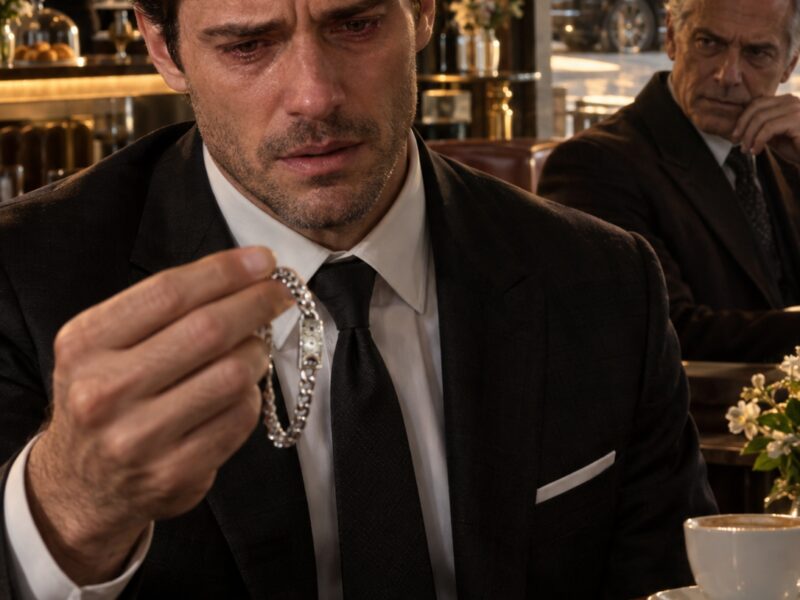
HE WALKED IN FOR COFFEE—THEN SAW THE DAUGHTER HE NEVER KNEW EXISTED

At exactly 3:17 on a Thursday afternoon, Everett Callahan heard a dead woman speak.
Not dead in the literal sense.
Dead in the private, brutal way people sometimes become dead to us when they disappear without a funeral, without a body, without even the mercy of an explanation.
He had spent eleven years teaching himself not to turn around whenever he heard a woman laugh like her in an airport. Eleven years forcing himself not to search familiar faces in hotel lobbies, train platforms, conference rooms, and crowded Manhattan sidewalks. Eleven years telling himself that whatever had happened between them belonged to another version of his life.
Then, inside a roadside café forty-three miles outside Chicago, a woman behind the counter said, “Careful, that lid doesn’t seal all the way,” and Everett forgot how to breathe.
His hand was still wrapped around the glass door.
The brass bell above it gave one last nervous jingle.
Outside, his black sedan idled beside the curb while his driver, Martin, stood near the hood stretching his back. Everett had a flight to New York in less than three hours, six unread messages from his chief operating officer, a board vote scheduled for Monday, and a corporate acquisition worth more money than the entire neighborhood around him.
None of it existed anymore.
Because he knew that voice.
He knew the softness at the end of a sentence.
He knew the slight roughness that appeared when she had been talking too long.
Most of all, he knew the pause before she said something kind, as if kindness were a decision she made every time instead of a habit.
Everett turned.
The woman behind the counter was placing a paper cup in front of an elderly man.
Chestnut hair was pulled into a loose knot at the base of her neck. A few strands had escaped around her face. She wore a faded green apron over a cream blouse, and there was a small burn mark near one wrist.
She was thinner than he remembered.
Older, obviously.
There were faint lines around her eyes that had not existed when they were twenty-three and believed time was something that happened to other people.
But it was her.
Ara Whitmore.
The woman Everett had once planned to marry.
The woman who had disappeared while he was away trying to keep his dying father’s company from collapsing.
The woman whose empty apartment had taught him that a person could leave your life so completely that even the dust seemed to deny they had ever been there.
Ara looked up.
The paper cup slipped half an inch through her fingers.
She caught it before it fell.
Neither of them spoke.
The elderly customer glanced from her to Everett, sensed something private and dangerous in the silence, and quietly carried his coffee toward the window.
Ara’s face lost color.
Everett heard himself say her name.
“Ara?”
It came out smaller than he intended.
Her lips parted.
For one terrible second, he thought she might deny it.
Instead, she whispered, “Everett.”
Eleven years collapsed between them.
He saw a bookstore on a rainy November night.
A one-bedroom apartment above a laundromat.
Cheap Chinese takeout on the floor because neither of them owned a table yet.
Ara laughing because he had tried to assemble a secondhand bookshelf without reading the instructions.
Her bare feet beneath his kitchen table.
Her head against his shoulder on the fire escape.
A silver bracelet around her wrist beneath streetlight.
Then came the other memories.
Her disconnected number.
Returned letters.
An empty apartment.
A landlord saying she had left no forwarding address.
Everett standing alone in the hallway with a cardboard box containing the few things she had forgotten.
He had hated her for leaving.
Then hated himself for still loving her.
Now she stood twelve feet away.
Alive.
The first thing Everett wanted to ask was why.
The second was how.
The third was whether she had ever once looked back.
But none of those questions came out.
Because the swinging kitchen door behind Ara opened.
A little girl stepped through carrying a spiral notebook against her chest.
“Mom, I don’t understand number sev—”
She stopped.
The girl looked at Everett.
Everett looked at her.
And something cold moved through his body.
She could not have been more than eight or nine.
Dark chestnut hair fell over one shoulder. Her eyes were Ara’s—warm hazel with tiny gold flecks near the pupils.
But her chin was not.
Her chin was Everett’s mother’s.
And the small crooked lift on the left side of her mouth when she became uncertain was so painfully familiar that Everett felt his knees weaken.
He had seen that expression every morning of his childhood.
In the mirror.
Ara moved too quickly.
“Maisie, sweetheart, go finish your homework in the office.”
“But—”
“Now, please.”
There was something in her tone the child understood.
Maisie looked at Everett one more time.
Then she disappeared through the swinging door.
Everett did not take his eyes off Ara.
“How old is she?”
Ara’s fingers tightened around the edge of the counter.
“Everett.”
“How old?”
A blender started somewhere in the back of the café and ran for several seconds before stopping.
The refrigerator compressor hummed.
Cars hissed over the road outside.
Ara looked down.
That was when Everett noticed the bracelet.
Thin silver.
A tiny oval charm.
A shallow scratch across the clasp where he had once dropped it on the pavement while trying to fasten it around her wrist in the rain.
He had bought it from a street vendor because it was all he could afford.
She had kept it.
For eleven years.
His voice changed.
“Ara.”
She slowly raised her eyes.
“She’s eight.”
Everett’s pulse stumbled.
Eight.
For half a second, relief tried to enter him.
Then he remembered birthdays.
School enrollment dates.
Children were not always born exactly nine months after conception.
And Ara was terrible at lying.
She always looked slightly to the left.
She was looking slightly to the left now.
“When’s her birthday?”
Ara closed her eyes.
That answer frightened him more than anything she could have said.
Everett took one step toward the counter.
“When is her birthday?”
“November eighteenth.”
He did the math automatically.
Once.
Then again.
Eleven years earlier, he had left Chicago in February.
He had returned in late June.
Ara had vanished by then.
November eighteenth.
His hand went to the back of a chair.
“No.”
Ara said nothing.
Everett stared at the kitchen door through which the child had disappeared.
“No.”
His voice was barely audible now.
“Ara, tell me I’m wrong.”
Her eyes filled.
He waited.
She did not tell him.
The world tilted.
Everett pulled the chair out and sat because he no longer trusted his legs.
A woman near the window lowered her phone and looked away. A college student gathered his laptop and moved to another table. Without anyone saying a word, strangers began quietly creating distance around something that clearly belonged to two people who had just discovered their lives were not what they thought.
Everett looked at Ara.
“My daughter?”
Her mouth trembled.
“Not here.”
“My daughter?”
“Everett, please.”
“Eleven years.”
His voice cracked on the number.
Ara flinched.
That made him angry.
Not because she was afraid of him.
Because part of him still cared that she was.
“You disappeared,” he said. “I came home and you were gone.”
“I know.”
“I wrote to you.”
“I know what I was told.”
“What you were told?”
Ara glanced toward the kitchen.
Then back at him.
The anger that had been missing from her face finally appeared.
“You want to do this now?”
“I’ve wanted to do this for eleven years.”
“You think I haven’t?”
“Then talk.”
She stared at him.
Everett had negotiated hostile takeovers with men who threatened lawsuits across mahogany tables. He had watched lenders dismantle his father’s company while his father lay sedated in a hospital. He had once testified for nine hours in a federal antitrust hearing without visibly losing composure.
But when Ara whispered, “I tried to tell you,” his entire body went still.
“Tried to tell me what?”
She looked toward the kitchen again.
“That I was pregnant.”
Everett stopped breathing.
Ara pressed her palm against the counter as if she needed something solid beneath her.
“I called your office. I called your hotel. I left messages with your father’s secretary. I sent letters.”
“I never got them.”
“I know that now.”
“What does that mean?”
She swallowed.
“One of them reached Roland Vance.”
The name entered the room like smoke.
Everett’s oldest business partner.
The man who had stood beside him at his father’s funeral.
The man who had helped Everett rebuild Callahan Holdings from nearly nothing.
The man who, for more than a decade, had told Everett some variation of the same story whenever Ara’s name came up.
She moved on.
Stop destroying yourself.
Some people leave because they want to leave.
Everett stared at Ara.
“What did Roland tell you?”
Her answer came softly.
“He said you didn’t want me anymore.”
Everett stood so quickly the chair struck the floor behind him.
Several people turned.
Ara jumped.
He barely noticed.
“What?”
“He said you knew about the baby.”
“No.”
“He said you told him to make sure I understood that you had bigger things to deal with.”
“No.”
“He said you couldn’t build a company and carry dead weight from your old life.”
“No.”
The word came out louder each time.
Ara’s eyes filled completely now.
“I was twenty-three, Everett.”
“I never said that.”
“I know.”
“I would never have said that.”
“I know that now.”
“I loved you.”
“So did I.”
“Then why didn’t you wait?”
The instant he said it, something hardened in her.
For the first time since he entered the café, Ara Whitmore looked less like a woman haunted by the past and more like a woman who had survived it.
“Wait?”
Everett heard the edge in her voice and realized, too late, where his anger had taken him.
Ara stepped around the counter.
“You want to ask me why I didn’t wait?”
“Ara—”
“My rent was due. I had morning sickness so bad I lost twelve pounds. The bookstore cut my hours because I couldn’t keep running to the bathroom. Your number stopped working. Your apartment was empty. Your father was dying. Every person I called said you were unavailable.”
She pointed toward the kitchen.
“And I was carrying a child.”
Everett’s anger disappeared.
Ara did not stop.
“Then the one man I believed had direct access to you came to my apartment and looked me in the face.”
Her voice broke.
“He told me you knew.”
Everett felt sick.
“He told me you wanted me gone.”
“Ara—”
“He had details, Everett. Things only someone close to you would know. He knew about our argument before you left. He knew you had said you couldn’t fail your family again. He knew your father’s debts. He knew everything.”
She touched the bracelet unconsciously.
“And he had your handwriting.”
Everett froze.
“What?”
Ara turned toward the office.
She disappeared for less than a minute.
When she returned, she carried a small metal cashbox.
She unlocked it.
Inside were tax papers, Maisie’s birth certificate, a few photographs, an old hospital bracelet, and an envelope yellowed along the edges.
Ara placed the envelope on the counter.
Everett recognized the handwriting immediately.
His own.
He picked it up.
The envelope had been opened.
Inside was a letter he had written from Milwaukee eleven years earlier.
He remembered writing it.
He had sat in a hospital cafeteria at two in the morning while his father underwent another emergency procedure.
Ara,
I don’t know when I’ll get back. I don’t know what we’ll have left when I do. But I need you to know something. You are not the thing I’m trying to escape. You are the place I’m trying to get back to.
I love you.
Wait for me.
E.
Everett looked up slowly.
“You got this.”
“After I left.”
“How?”
“It was forwarded to my aunt’s house almost seven months later.”
His hands shook.
“So you knew.”
“I knew you had loved me when you wrote it.”
“That should have told you Roland lied.”
“It told me somebody lied.”
“Why didn’t you call?”
Ara laughed once.
There was no humor in it.
“Because by then Maisie was six weeks old.”
Everett stared at her.
“I had been alone through the pregnancy. Alone in the hospital. Alone when she stopped breathing for fifteen seconds after delivery and six nurses rushed into the room.”
His face changed.
Ara saw it.
Her anger faltered, but she continued.
“I thought maybe the letter had been written before you changed your mind. I thought maybe Roland had told the truth later.”
“He didn’t.”
“I know.”
“When did you find out?”
“Not until years later.”
“How?”
Ara’s eyes moved toward the front windows.
“Your father.”
Everett went silent.
“My father?”
“He found me.”
The room suddenly felt too small.
Everett’s father, Charles Callahan, had died ten years earlier.
For the final six months of his life, he had barely been able to walk.
“What are you talking about?”
Ara folded her arms.
“He came here.”
Everett looked around the café.
“You owned this place then?”
“No. I worked here.”
“When?”
“Maisie was almost one.”
Everett’s heartbeat became strangely loud.
“My father knew?”
“He suspected.”
“Did he see her?”
“Yes.”
“And he didn’t tell me?”
Ara looked at him with an expression Everett could not read.
“He tried.”
Outside, Martin approached the café window, tapped his watch, then immediately lowered his hand when he saw Everett’s face.
Everett pulled out his phone and canceled his flight.
Then he turned it off.
He stayed in that café until the sun disappeared.
And before the night was over, he would learn that losing Ara had not been an accident.
Someone had made a choice.
Someone Everett trusted had decided what his life should cost.
And the first lie had been only the beginning.
Ara locked the front door at six-thirty.
Maisie sat at a corner table drawing planets in her notebook, unusually quiet.
Everett had not approached her again.
He didn’t know what to say to an eight-year-old girl who might be his daughter.
Hello seemed ridiculous.
I’m sorry seemed insufficient.
I’m your father felt like theft.
So he remained at a table near the window while Ara stacked chairs.
Finally, Maisie looked at him.
“Are you the man from Mom’s old picture?”
Ara stopped moving.
Everett looked at her.
“What picture?”
Maisie frowned.
“The one in the blue box.”
“Maisie,” Ara said softly.
“What?”
Everett’s throat tightened.
“What blue box?”
The girl looked from her mother to him.
“The one under Mom’s bed.”
Ara closed her eyes.
Everett almost laughed, but the emotion caught somewhere between pain and disbelief.
Apparently, eleven years of being erased had not included being forgotten.
Maisie leaned across the table.
“You look younger in it.”
Everett managed a faint smile.
“So do you.”
She giggled.
The sound nearly broke him.
Ara turned away quickly and began wiping a counter that was already clean.
Maisie studied Everett with the unapologetic curiosity of a child.
“Are you famous?”
“No.”
“Mom said you’re rich.”
“Maisie.”
“What? You did.”
Everett looked at Ara.
“You told her about me?”
Ara kept cleaning.
“Not much.”
Maisie lowered her voice as if sharing classified information.
“She said you used to be funny.”
Everett nodded solemnly.
“She remembers incorrectly.”
Maisie smiled again.
There it was.
His crooked smile.
He had no proof.
No test.
No legal document.
Yet something primitive and certain inside him recognized her.
The realization was not joyful.
Not yet.
Joy could not reach him without first passing through eleven years of grief.
“What does your mom say about your dad?” Everett asked carefully.
Ara stopped cleaning again.
Maisie shrugged.
“She said he didn’t know about me.”
Everett looked at Ara.
That mattered.
More than he could explain.
“She never told you I left?”
“No.”
“Maisie,” Ara interrupted gently, “why don’t you get your backpack?”
The girl sensed the adults had reached a border she wasn’t allowed to cross.
She gathered her notebook.
As she passed Everett, she stopped.
“You have my eyebrows.”
Then she walked into the back room.
Everett bowed his head.
His eyes burned.
Ara watched him.
For a moment, neither spoke.
Then Everett asked, “My father.”
Ara sat across from him.
“He came to the café about ten months after Maisie was born.”
“How did he find you?”
“He hired someone.”
“That sounds like him.”
“He looked terrible.”
Everett looked toward the street.
By then, Charles Callahan’s heart disease had advanced significantly.
“He asked if she was mine?”
“He didn’t have to.”
“What did you tell him?”
“The truth.”
Everett turned back.
“And?”
“He cried.”
Everett had seen his father cry exactly twice.
Once when Everett’s mother died.
Once at his older brother’s grave.
Never again.
Ara’s voice softened.
“He said you didn’t know.”
“Why didn’t you believe him?”
“I wanted to.”
“But?”
“He had spent your whole life controlling everything around you.”
Everett couldn’t argue with that.
Charles Callahan had built a regional construction empire with ruthless discipline. He loved his children, but he loved control almost as fiercely.
“He offered me money,” Ara said.
Everett stiffened.
“To disappear?”
“No.”
Her answer surprised him.
“He offered me money to come back.”
Everett stared.
Ara continued.
“He said he’d made mistakes with you. Said he had pushed you too hard after your brother died. Said you believed saving the company was the only way to save him.”
“That was true.”
“He said if he could get you in a room with me, the rest would fix itself.”
“Why didn’t you?”
Ara looked toward the office where Maisie was collecting her things.
“Because I didn’t know who to trust anymore.”
Everett leaned back.
It hurt because he understood.
“He said he’d tell you.”
“Did he?”
“I don’t know.”
Everett thought of his father’s final months.
There had been medications.
Surgeries.
Lucid mornings followed by confused evenings.
And Roland had controlled nearly all access to him because Everett was traveling constantly to secure financing.
“When exactly did my father find you?”
Ara gave him the month.
Everett’s stomach tightened.
That was the same month his father suffered the stroke that left him unable to speak clearly.
Coincidence, perhaps.
Yet suddenly Everett remembered something.
Three days before the stroke, Charles had left him a voicemail.
Everett had been in Denver.
He had listened to it between meetings.
His father’s speech had been labored.
Everett, there’s something about Ara. I need—
Then the message ended.
Everett had called Roland.
Roland told him Charles was confused from medication.
Everett believed him.
Now he felt the room tilt again.
Ara saw something in his face.
“What?”
Everett stood.
“He tried to tell me.”
Silence.
“My father tried to tell me.”
Ara slowly rose.
“And Roland told you he was confused?”
Everett looked at her.
“How did you know?”
“Because that’s what Roland told me too.”
The next morning Everett was back at the café at 7:06.
Ara unlocked the door at seven.
He had been standing outside for twelve minutes.
She found him holding two coffees.
“You own hotels,” she said. “You know cafés sell coffee, right?”
“I panicked.”
Despite herself, she almost smiled.
It disappeared quickly.
“You can’t keep showing up like this.”
“I know.”
“Maisie has school.”
“I know.”
“I have work.”
“I know.”
“And we don’t know what happens next.”
“I know that too.”
Ara studied him.
The Everett she remembered hated uncertainty.
At twenty-four he made lists for vacations.
He researched restaurants before dates.
He once created three backup routes to her college graduation because he was terrified of being late.
Now he stood in front of her with no plan.
That frightened her more than if he had arrived with lawyers.
“I want a paternity test,” he said.
Ara stiffened.
“Not because I don’t believe you.”
“Then why?”
“Because if I’m going to enter her life, I want there to be no ambiguity later. Not for her. Not for me. Not for anyone.”
Ara nodded slowly.
“That makes sense.”
“I’ll follow whatever boundaries you set until then.”
Something in his phrasing made her suspicious.
“Until then?”
“After that, I’ll follow most of them.”
There he was.
The man she remembered.
She almost smiled again.
This time he noticed.
They scheduled the test.
Everett did not tell his board.
He did not tell the press.
He told only Martin and his attorney, Caroline Hayes, who had represented his family for sixteen years.
Caroline went silent when he explained.
Then she said, “Roland?”
“Yes.”
“You’re certain?”
“No.”
“But?”
Everett looked at the old letter on his desk.
“I’ve spent half my adult life trusting the version of my past he gave me.”
Caroline understood immediately.
“What do you want me to do?”
“Nothing yet.”
“Everett—”
“I want records.”
“What kind?”
“Every archived communication from the restructuring year. Office logs. Mailroom scans. Phone messages. Anything involving Ara Whitmore.”
“That was eleven years ago.”
“Then start digging.”
The results of the paternity test arrived six days later.
Everett read the first line once.
Then again.
Probability of paternity: 99.9987%.
He sat alone in his office on the fifty-second floor of Callahan Tower.
Chicago stretched beneath him in glass, steel, and late-afternoon haze.
He had spent twenty years building things tall enough to dominate skylines.
Nothing had ever made him feel smaller than one sheet of paper.
He had a daughter.
Not abstractly.
Not possibly.
Not emotionally.
Legally.
Biologically.
Absolutely.
A daughter who had lost her first tooth without him.
Learned to walk without him.
Started kindergarten without him.
Been sick without him.
Had birthdays without him.
He opened the calendar on his phone.
November eighteenth.
He scrolled backward through old years.
Board meetings.
London.
Singapore.
Acquisition.
Miami.
Charity gala.
On Maisie’s fourth birthday, Everett had been in Boston.
On her fifth, Seattle.
On her sixth, London.
On her seventh, he had spent the evening alone in his penthouse after canceling dinner with a woman he had been seeing because he could not stop thinking about Ara.
His daughter had been forty-three miles away.
The office door opened.
Roland Vance entered without knocking.
At fifty-six, Roland was silver-haired, sharp-featured, and still carried the contained confidence that had once made Everett’s father trust him with everything.
“Caroline’s pulling old archive files,” Roland said. “Any reason I should know about?”
Everett placed the paternity report facedown.
“Probably not.”
Roland’s eyes dropped to the paper.
Then back to Everett.
“Everything okay?”
Everett studied him.
For eleven years, this man had been family.
After Charles died, Roland had stood beside Everett at the grave.
When the banks threatened foreclosure, Roland worked eighteen-hour days.
When Everett’s first major expansion nearly failed, Roland negotiated with creditors.
Maybe Ara was wrong.
Maybe Charles had misunderstood.
Maybe some other explanation existed.
Everett wanted one.
Desperately.
So he asked a simple question.
“Do you remember Ara Whitmore?”
Roland’s expression barely changed.
Barely.
But Everett had negotiated with him too long not to see the fraction of a pause.
“That girl you dated?”
Girl.
As if her name had not lived between them for years.
“Yes.”
Roland shrugged.
“Vaguely.”
“You told me she left Chicago.”
“She did.”
“You told me she didn’t want contact.”
“As I recall.”
“You said you’d spoken to her.”
“I probably did.”
Everett leaned back.
“Did you?”
Roland smiled slightly.
“What is this?”
“A question.”
“I don’t remember every conversation from eleven years ago.”
Everett nodded.
“That makes sense.”
Roland relaxed.
Then Everett added, “She remembers it very clearly.”
The color left Roland’s face.
Only a little.
But enough.
Everett saw it.
Roland said nothing.
Everett stood.
“She remembers you coming to her apartment.”
“Everett—”
“She remembers telling you she was pregnant.”
Roland’s jaw tightened.
“She remembers you telling her I knew.”
“Things were chaotic then.”
“She remembers you telling her I wanted nothing to do with her.”
“I was trying to protect—”
Everett slammed both hands against the desk.
“Finish that sentence.”
Roland went silent.
The sound echoed through the office.
Everett had never struck him.
Never threatened him.
But something in his face made Roland step backward.
“Finish it.”
Roland exhaled.
“You were twenty-four.”
Everett felt his hands go cold.
“No.”
“Your father was dying. The company owed forty-eight million dollars. We had banks calling loans every day.”
“No.”
“You were barely sleeping.”
“Did you tell her I didn’t want my child?”
Roland looked away.
That was the answer.
Everett walked around the desk.
“Look at me.”
Roland did.
“Did you?”
“I told her what needed to be said.”
Everett’s voice became almost calm.
“What needed to be said.”
“You were about to throw your life away.”
“My life?”
“You think I didn’t know you? If you’d found out she was pregnant, you would have left Milwaukee that night.”
“Yes.”
“Exactly.”
“To go to my child.”
“To abandon the restructuring.”
“My child.”
“And hundreds of employees would have lost their jobs.”
Everett stared.
Roland continued, more urgently now, trying to transform betrayal into logic.
“Your father’s company would have collapsed. His medical coverage would have disappeared. Your family would have lost everything.”
“So you decided for me.”
“Someone had to.”
The sentence hung between them.
Everett’s expression changed.
Roland noticed too late.
“You stole eleven years from me.”
“I saved the company.”
“You stole my daughter.”
“I didn’t know she’d disappear.”
“You told a pregnant twenty-three-year-old woman that the father of her child considered her dead weight.”
Roland looked uncomfortable.
“I was harsher than necessary.”
“Harsher?”
“Everett—”
“My daughter asked me yesterday if Saturn has a solid surface.”
Roland frowned, confused.
Everett’s voice broke.
“I didn’t know the answer.”
He looked toward the windows.
“I should know what questions she asks. I should know what cereal she likes. What scares her. What she calls a nightmare. What she wants for Christmas.”
His eyes returned to Roland.
“And you decided a balance sheet mattered more.”
Roland’s face hardened.
“The company you are standing in exists because of the decision I made.”
Everett stared at him for a long moment.
Then he said, “Get out.”
“Think carefully.”
“Get out.”
“You destroy me over this, you expose yourself too.”
Everett went still.
Roland’s tone changed.
“There are records, Everett. Decisions from that restructuring year. Aggressive decisions. Your signature is on them.”
“Are you threatening me?”
“I’m reminding you that memory becomes complicated when lawyers are involved.”
Everett stepped closer.
“Then let’s make it very simple.”
Roland held his gaze.
Everett pointed toward the door.
“You will never again enter this office unless my attorney is present.”
“Everett—”
“You will not contact Ara.”
Roland’s expression shifted.
“You will not contact Maisie.”
Now Roland looked frightened.
“And if you so much as speak my daughter’s name outside a privileged meeting, I will spend whatever remains of my life making sure the truth of what you did follows yours.”
Roland stared at him.
Then he left.
Everett stood alone.
Five minutes later, Caroline Hayes called.
“We found something.”
Everett closed his eyes.
“What?”
“A scanned incoming envelope from March eleven years ago.”
“From Ara?”
“Yes.”
“Where is the original?”
“That is the problem.”
Everett gripped the phone.
“The archive notation says it was redirected personally.”
“To whom?”
Caroline hesitated.
“Roland Vance.”
That should have been the end of it.
Instead, it was the beginning.
Ara did not welcome Everett back into her life because DNA said she should.
That was the first thing Everett had to learn.
Money could speed up investigations.
Money could move meetings.
Money could charter airplanes and buy buildings and hire experts.
Money could not make an eight-year-old trust you.
And it definitely could not make Ara forget.
For the first few weeks, Everett came to the café only when she agreed.
Sometimes he sat with Maisie while she did homework.
Sometimes he fixed things.
The first thing was the front door, which stuck whenever the weather became humid.
Everett spent an hour adjusting the hinges.
Ara watched from behind the counter.
“You could pay someone.”
“I could.”
“You have people.”
“I do.”
“You probably have a door person.”
“I don’t have a door person.”
“You look like someone who has a door person.”
Everett laughed.
Ara froze.
It was the same laugh.
Lower now.
More tired.
But the same.
She looked away.
Everett noticed.
He didn’t say anything.
Maisie did.
“Mom, your face is red.”
“Finish your math.”
The next week Everett assembled a bookshelf that had remained unopened in a cardboard box for five months.
He put one panel backward.
Maisie noticed.
“That’s wrong.”
“I know.”
“You said that ten minutes ago.”
“I was hoping it would become less wrong.”
“It didn’t.”
Everett looked at her.
“You’re extremely judgmental.”
“You’re extremely bad at shelves.”
Ara laughed from the espresso machine.
The sound stopped all three of them.
For a heartbeat, the café felt like a room from eleven years earlier.
That frightened Ara.
So she turned toward the coffee grinder and made unnecessary noise until the moment passed.
Everett understood.
He never pushed.
He learned Maisie loved astronomy because Ara had once taken her outside during a meteor shower when she was four.
He learned she hated peas but would eat broccoli if it had enough cheese.
He learned she drew when she was nervous.
He learned she had inherited Ara’s habit of biting the inside of her cheek when thinking.
He learned she had inherited his inability to admit she was tired.
He learned that when she was six, she had asked Ara whether her father was dead.
Ara had said no.
Then Maisie asked why he wasn’t there.
Ara answered, “Because sometimes grown-ups lose each other.”
She had never told her Everett chose not to come.
That mercy hurt him more than cruelty would have.
One Saturday, Maisie asked the question everyone had been avoiding.
They were sitting at a park near the café.
Ara had gone to buy lemonade.
Maisie swung her sneakers beneath a picnic bench.
“Did you know I existed?”
Everett looked at her.
“No.”
“Mom says somebody lied.”
“Yes.”
“Who?”
“A man I trusted.”
“Why?”
Everett thought carefully.
“Because he thought he knew what was best for me.”
“Did he?”
“No.”
Maisie picked at the corner of a napkin.
“If you knew, would you have come?”
Everett’s answer required no thought.
“Yes.”
“What if you were busy?”
“Yes.”
“What if your dad was sick?”
“Yes.”
“What if your company was breaking?”
“Yes.”
“What if Mom was mad at you?”
“Yes.”
“What if—”
“Maisie.”
She stopped.
Everett crouched beside the bench so they were eye level.
“If I had known you existed, there is nowhere on Earth I would have wanted to be more than wherever you were.”
Her eyes filled slightly.
She blinked hard.
Then she whispered, “Okay.”
Ara had returned with the lemonade.
She had heard everything.
That night, after Maisie was asleep, Ara sat alone in her apartment kitchen staring at the silver bracelet on her wrist.
For eleven years she had preserved a version of Everett in memory.
Not the billionaire.
Not the magazine covers.
Not the interviews she sometimes accidentally saw online.
Her Everett.
The broke young man who once walked two miles in snow because his car would not start.
The man who wrote grocery lists on his hand.
The man who could not fry an egg without burning the edges.
Memory was easier when it could not speak back.
Now Everett was real again.
And reality was dangerous.
Because she still loved him.
Not in the dramatic way she had at twenty-three.
That love had been fire.
This was something older.
Buried deeper.
More frightening because she had survived without it.
Her phone buzzed.
A message from Everett.
Maisie left her purple pencil in my car. I can drop it tomorrow.
Ara smiled despite herself.
Then another message appeared.
Also, I have been informed Pluto is still emotionally a planet even if scientists disagree. Please adjust future lessons accordingly.
Ara laughed quietly.
Then she covered her mouth.
Because laughter could become hope.
And hope was the one thing she still did not trust.
Three weeks later, Roland Vance came to the café.
Ara was alone.
The lunch rush had ended.
Maisie was at school.
The moment Roland walked through the door, Ara knew him.
He had aged.
His hair was silver now.
His shoulders slightly rounded.
But his eyes were unchanged.
“Get out.”
Roland stopped.
“Ara.”
“You have five seconds.”
“I want to explain.”
“Four.”
“Everett is making this more destructive than it needs to be.”
“Three.”
“This could damage the entire company.”
“Two.”
“I saved his life.”
Ara picked up her phone.
“One.”
Roland’s jaw tightened.
“You think he came back because of love?”
Ara paused.
Roland saw the hesitation and moved closer.
“He came back because he discovered a daughter.”
“Leave.”
“Do you know Everett?”
“I knew him before you decided to redesign his life.”
“You knew a boy.”
Ara’s eyes hardened.
Roland continued.
“He’s not that boy anymore. He has shareholders. Boards. Hundreds of millions in obligations.”
“And?”
“And people like him don’t get simple lives.”
“You said that eleven years ago.”
“I was right.”
Ara nearly called the police.
Then Roland said something that stopped her.
“Ask him why he hasn’t told you what his father did after finding you.”
Ara froze.
“What?”
Roland smiled faintly.
“Charles didn’t only offer you money, did he?”
Ara stared.
“What are you talking about?”
“He left something for Maisie.”
Her heart jumped.
“No.”
Roland reached inside his coat.
Ara immediately raised the phone.
“Do not.”
He slowly removed an envelope.
“I found this after Charles died.”
The envelope bore Everett’s father’s handwriting.
For Maisie Whitmore.
Ara stopped breathing.
Roland placed it on a table.
“You should ask Everett why his attorneys never gave it to you.”
Then he walked out.
Everett arrived twenty minutes later.
Ara stood behind the counter holding the envelope.
“What is this?”
His face changed.
“Where did you get that?”
“Roland.”
“He came here?”
“What is it?”
Everett took the envelope but did not open it.
“I’ve never seen this.”
“Don’t lie to me.”
“I’m not.”
“He said your attorneys had it.”
“My father’s estate had thousands of documents.”
“So there could be more things no one told us?”
“Yes.”
Ara stared at him.
The old fear returned immediately.
Information controlled by powerful men.
Decisions made behind closed doors.
Her future negotiated while she stood outside.
Everett recognized it.
“Ara.”
“No.”
“Look at me.”
“I trusted somebody once because he said he spoke for you.”
“I am standing here speaking for myself.”
“And that is supposed to erase it?”
“No.”
His answer stopped her.
“No,” Everett repeated. “Nothing erases it.”
He placed the envelope on the counter between them.
“We open it together.”
Ara said nothing.
Everett did not touch it again.
Finally, she reached forward.
Her fingers trembled as she broke the seal.
Inside was a handwritten letter.
Ara read first.
Then Everett.
My dear Maisie,
You do not know me.
I hope someday you will know that I knew about you, even if only for a short time.
Your father does not know.
That sentence alone nearly destroyed Everett.
He continued.
That is partly because I failed him long before you were born. I taught Everett that duty means carrying everything alone. When my company began failing and my health followed, he believed saving me was his responsibility.
It wasn’t.
Ara covered her mouth.
The letter continued.
I found your mother because I began to suspect Everett had not been told the truth.
I intended to bring them together.
I ran out of time.
If you ever read this, I hope someone was braver than I was.
Do not inherit our family’s worst habit, little one.
Do not confuse silence with strength.
Love loudly.
Tell the truth early.
And when someone matters, do not assume there will always be another day.
Charles Callahan
Everett sat down.
Ara remained standing.
Neither spoke for several minutes.
Then Everett looked at the date.
Two days before his father’s stroke.
Roland had found the letter after Charles died.
He had hidden that too.
This time Everett did not rage.
That frightened Ara more.
He simply folded the letter carefully.
Then he said, “I’m done letting him decide what survives.”
The confrontation with Roland did not happen in a dark alley or behind a locked door.
It happened beneath white conference-room lights in front of nine board members, three attorneys, and a digital recorder.
Caroline placed copies of the archived correspondence on the table.
There was Ara’s original letter.
There were routing logs.
There was Charles Callahan’s handwritten note.
There were internal memos proving Roland had personally ordered incoming correspondence related to Ara diverted from Everett’s office.
Roland tried to defend himself.
He said it had been a chaotic restructuring.
He said his intentions had been protective.
He said Everett had been emotionally unstable because of his father’s illness.
He said thousands of jobs had been at stake.
Then Caroline produced one final document.
A handwritten note Roland had attached to Ara’s first letter.
Personal matter. Do not forward to E.C. until restructuring closes.
Everett stared at the words.
There was no confusion.
No mistake.
No lost mail.
Roland had made a deliberate choice.
One that lasted eleven years.
Everett did not shout.
He did not threaten.
He looked at the board.
“Mr. Vance’s access to all company systems is terminated effective immediately.”
Roland leaned forward.
“You owe me everything.”
Everett turned to him.
“I owe you the truth.”
“You wouldn’t have this company without me.”
“Maybe.”
“You’d have nothing.”
Everett thought of Maisie.
Her purple pencil.
Her crooked smile.
The eight birthdays he had missed.
Then he looked at Roland.
“I would have had my daughter.”
Silence filled the room.
Roland looked away first.
Months passed.
Everett did not suddenly become a perfect father.
He was late once because a meeting ran over.
Maisie refused to speak to him for an entire afternoon.
He apologized without excuses.
He attended a school astronomy night and accidentally brought professional binoculars so expensive that Ara accused him of trying to observe Jupiter’s tax returns.
He laughed.
Maisie laughed.
Then Ara did too.
He learned how to braid hair badly.
He learned the difference between “I need help” and “I want you to listen.”
He learned that being a father was less about dramatic sacrifices than consistency.
Pickups.
Phone calls.
Remembering library day.
Knowing which stuffed animal had to be packed for overnight trips.
Being there.
That was the word that mattered.
And Everett was there.
Slowly, Maisie stopped calling him Mr. Callahan.
Then Everett.
Then, one rainy afternoon, she came running out of school holding a paper solar system she had made from painted foam balls.
She spotted him near the curb.
“Dad!”
Everett froze.
Maisie did not.
She ran straight toward him.
He caught her.
For a second he simply held her while rain struck the umbrella in his other hand.
Ara stood ten feet away.
She watched Everett turn his face so Maisie would not see him cry.
He failed.
Maisie saw anyway.
“Why are you crying?”
“Rain.”
“We’re under an umbrella.”
“Very aggressive rain.”
She rolled her eyes.
“Dad.”
He laughed through tears.
And Ara knew something inside him had finally come home.
The café changed too.
Not because Everett bought it.
Ara refused that immediately.
“You are not buying my life.”
“That’s not what I meant.”
“I know. I’m saying it before your billionaire brain says it.”
Instead, Everett offered a small business loan at the same rate Ara could have received from a local bank, personally guaranteed so she could renovate without taking on dangerous debt.
Every condition was reviewed by Ara’s independent attorney.
She insisted.
Everett insisted harder.
“Never sign anything because you trust me.”
Ara stared at him.
“That is an odd thing for a man trying to regain my trust to say.”
“No. It’s exactly the right thing.”
The renovated café added eight tables, a small reading corner, and a wall where local children could display artwork.
Maisie painted the first picture.
Three people beneath a night sky.
One woman.
One little girl.
One absurdly tall man.
Everett stared at it.
“Why am I so large?”
Maisie shrugged.
“You’re dramatic.”
Ara almost choked on her coffee.
By late spring, something had shifted between Everett and Ara.
They no longer spoke only about Maisie.
They began talking about themselves.
Not who they had been.
Who they had become.
Ara told him about the nights after Maisie’s birth when she had been too afraid to sleep because she feared the baby would stop breathing.
Everett told her about the years he worked until midnight because empty apartments felt louder than offices.
She told him she had dated twice.
Neither relationship lasted.
He admitted he had dated more than twice.
Ara raised an eyebrow.
“How much more?”
“I feel this line of questioning has become hostile.”
“How much?”
“Enough that my publicist once asked me to stop being photographed.”
Ara laughed.
Then she asked quietly, “Did you ever love anyone?”
Everett looked at her.
“No.”
She looked away.
He did not ask the question back.
He was afraid of the answer.
So Ara gave it voluntarily.
“Neither did I.”
The silence after that felt different.
Warm.
Dangerous.
Everett reached across the table.
Then stopped before touching her.
Ara noticed.
“You can.”
He looked at her.
“What?”
“Hold my hand.”
He did.
There was no music.
No rain.
No audience.
Just his hand around hers on a scarred wooden table inside the little café where he had once stopped because he wanted fifteen minutes of quiet.
For eleven years, Everett had imagined what he would say if he ever saw Ara again.
He had imagined demanding explanations.
Imagined telling her how much she had hurt him.
Imagined walking away before she could hurt him twice.
He had never imagined this.
Her hand in his.
Older.
Stronger.
Still familiar.
“There is something I need to say,” he whispered.
Ara looked at him.
“If it’s dramatic, keep it short.”
He smiled.
“I spent years thinking you left because I wasn’t enough.”
Her expression softened.
“And I spent years thinking you left because I was too much.”
Everett looked down at their hands.
“What a waste.”
“Yes.”
“I can’t give us those years back.”
“No.”
“I can’t give Maisie her first eight years with me.”
“No.”
“I can’t undo Roland.”
“No.”
He looked at her.
“But I can stop wasting what’s left.”
Ara’s eyes filled.
Everett did not ask her to marry him.
Not then.
He had learned that love did not need to sprint simply because regret had made it late.
Instead, he asked, “Can I take you to dinner Friday?”
Ara laughed through tears.
“You’re asking me on a date?”
“Yes.”
“After we have a child together?”
“The timeline is unusual.”
“Very.”
“Friday?”
She squeezed his hand.
“Friday.”
They went to a small Italian restaurant.
Not one Everett owned.
Not somewhere with private rooms and celebrity chefs.
Ara chose it.
She ordered pasta.
Everett spilled wine on his sleeve.
She laughed for almost a full minute.
He pretended to be offended.
For the first time since he was twenty-four, Everett Callahan went on a date without thinking about what came next.
They walked afterward.
At one corner, Ara stopped beneath a streetlamp.
Everett saw the silver bracelet.
“You still wear it.”
She looked at her wrist.
“Most days.”
“Why?”
Ara thought.
“At first because I couldn’t let you go.”
Everett waited.
“Then because I was angry.”
He smiled slightly.
“That’s healthy.”
“Very.”
“And after that?”
She ran her thumb over the scratched clasp.
“Eventually it stopped being about you.”
He looked surprised.
“It reminded me of who I was before everything got hard.”
Everett nodded.
“I understand.”
Ara looked up at him.
“But lately…”
“What?”
“It’s about you again.”
Everett did not move.
Ara stepped closer.
“Only this time, it’s not about waiting for you.”
She touched his cheek.
“It’s about knowing you came back.”
Then she kissed him.
Eleven years disappeared for exactly one heartbeat.
Then they returned.
Not as a wound.
As history.
There were still difficult days.
Love did not erase trauma.
Ara sometimes panicked when Everett became unreachable for several hours.
Everett sometimes overcompensated with Maisie because guilt convinced him every missed moment had to be repaid immediately.
They argued.
Once badly.
Everett offered to pay for an elite private school after Maisie was teased by another student.
Ara refused.
Everett pushed.
Ara accused him of using money to solve emotional problems.
He accused her of rejecting help simply because it came from him.
They did not speak for an hour.
Then Maisie walked into the room carrying three bowls of ice cream.
“Are you divorced?”
Ara nearly dropped a spoon.
“We aren’t married.”
“Oh.”
Maisie thought.
“Then are you pre-divorced?”
Everett laughed so suddenly he had to turn away.
The argument ended.
Not because Maisie solved it.
Because they remembered something important.
Conflict was not abandonment.
A disagreement did not mean someone was leaving.
Silence did not have to last eleven years.
That became the lesson they practiced hardest.
Say it now.
Tell the truth early.
Do not assume tomorrow.
Charles Callahan’s final advice became the unofficial rule of their strange little family.
Nearly a year after Everett walked into the café, he arrived one afternoon carrying a small wooden box.
Ara looked suspicious.
“No.”
“You don’t even know what’s inside.”
“If that’s an engagement ring, I am throwing you out.”
Maisie gasped from the reading corner.
“Mom!”
Everett frowned.
“Why are you here?”
“I live in society.”
“You were supposed to be doing homework.”
“I am emotionally available for important events.”
Ara pointed at Everett.
“See what you’ve created?”
Everett placed the box on the counter.
“It isn’t a ring.”
Ara hesitated.
“Open it.”
Inside was a silver clasp.
Tiny.
Scratched.
Old.
Ara stared.
Her hand immediately went to her bracelet.
“What is this?”
Everett smiled.
“The original clasp.”
She looked confused.
“When I bought you the bracelet, the vendor replaced the clasp because I broke the first one trying to put it on you.”
“You kept this?”
“I found it in one of my father’s storage boxes.”
Her eyes filled.
Everett looked embarrassed.
“Apparently twenty-three-year-old me was sentimental.”
“You cried over a movie about a dog.”
“The dog was loyal.”
“The dog survived.”
“That doesn’t invalidate emotion.”
Maisie appeared beside them.
“Are you proposing or not?”
“Maisie.”
“What? I’m busy.”
Everett laughed.
“No proposal.”
The girl looked disappointed.
Ara looked relieved.
Mostly.
Everett reached for her hand.
“I don’t want our second chance to become another version of our first one.”
Ara listened.
“Back then, we thought loving each other was enough.”
“It wasn’t.”
“No.”
“We didn’t know how to ask for help. We didn’t know how to question the people we trusted. We assumed forever gave us time.”
Ara’s fingers tightened around his.
Everett continued.
“I don’t want to promise you nothing will ever go wrong.”
“Good.”
“Because things will.”
“Definitely.”
“I’ll annoy you.”
“You already do.”
“You’ll terrify my finance team.”
“I consider that a community service.”
He smiled.
Then became serious.
“But I can promise that nobody speaks for me except me.”
Ara’s eyes filled.
“Nobody decides for me except me.”
He touched the bracelet.
“And if I’m scared, angry, lost, ashamed, or confused, I will tell you before silence turns into something neither of us can undo.”
Ara did not answer immediately.
Then she leaned forward and rested her forehead against his.
“That promise means more than a ring.”
Maisie groaned.
“Very romantic. Very slow.”
They laughed.
Six months later, Everett did give Ara a ring.
It happened after closing.
No photographers.
No orchestra.
No rooftop.
No champagne tower.
The café smelled faintly of cinnamon and coffee.
Maisie’s artwork still covered one wall.
Everett waited until Ara finished locking the front door.
Then he stood beside the exact table where he had sat after discovering Maisie.
Ara saw his face.
“Oh.”
Everett took one breath.
Then another.
“I had a speech.”
“How long?”
“Seven minutes.”
“No.”
“I reduced it.”
“To?”
“Three.”
“Still no.”
Everett laughed.
Then his eyes filled.
Ara’s teasing disappeared.
He took out a small ring.
Nothing extravagant.
A thin platinum band with one modest stone.
Ara stared.
“When I was twenty-three, I thought love meant promising I’d never walk away.”
She looked at the silver bracelet.
Everett continued.
“Then life proved promises don’t matter if people don’t know how to protect them.”
He stepped closer.
“I can’t promise we’ll never get lost.”
Ara’s eyes shimmered.
“But if we do, I promise I’ll look for you.”
Her lips trembled.
“I promise I’ll listen when you call.”
A tear slipped down her cheek.
“And I promise no lie, no company, no fear, and no person will ever again convince me that loving you is something I need to sacrifice.”
Ara covered her mouth.
Behind the kitchen door came a muffled sob.
Everett closed his eyes.
“Maisie.”
The door cracked open.
“I’m not here.”
Ara laughed through tears.
Everett looked back at her.
“So now that the emotional surveillance unit has been identified…”
Maisie stepped completely into the room.
“Ask her!”
Everett sighed.
Then lowered himself onto one knee.
“Ara Whitmore, will you marry me?”
Ara looked at him.
Then at her daughter.
Then around the café.
This ordinary place had witnessed the return of everything she once believed was gone.
It had watched Everett discover a daughter.
Watched Maisie discover a father.
Watched anger become conversation.
Suspicion become trust.
Memory become something alive again.
Ara looked at the man kneeling before her.
Eleven years earlier, she would have answered before he finished speaking.
Now she understood that real love deserved a slower answer.
A deliberate one.
A free one.
“Yes.”
Maisie screamed.
Everett stood and slipped the ring onto Ara’s finger.
Then Maisie threw herself between them.
Their three-person hug nearly knocked over a chair.
Everett laughed.
Ara cried.
And somewhere between both sounds was the life they should have had and the life they had somehow managed to find anyway.
Years later, people who knew the story often described that Thursday afternoon as fate.
Everett never did.
Fate sounded too clean.
Too magical.
It erased the damage people had done.
It erased Ara raising a child alone.
It erased birthdays Everett missed.
It erased a frightened twenty-three-year-old woman being lied to by a powerful man.
It erased an equally frightened young man being manipulated while his father died.
Their reunion had been chance.
What came after was choice.
Everett chose to return the next morning.
Ara chose not to close the door.
Maisie chose, slowly, to trust him.
They chose difficult conversations.
They chose boundaries.
They chose counseling.
They chose apologies without excuses.
They chose to stop treating silence as strength.
The café remained open.
Ara eventually opened a second location, entirely on her own terms.
Maisie grew taller.
Her interest in astronomy became serious enough that Everett bought her a telescope, which Ara allowed only after confirming it was not “something NASA would classify as infrastructure.”
Roland Vance disappeared from their lives.
Legal proceedings followed.
Money changed hands.
Board seats changed.
Newspapers wrote stories.
Everett stopped reading them.
None of it could return what Roland had taken.
Punishment was not time travel.
That truth took Everett years to accept.
On Maisie’s fifteenth birthday, she gave him a framed photograph.
It showed three people standing outside the café.
Ara in the middle.
Maisie beside her.
Everett on the other side.
On the back, Maisie had written:
You missed the beginning.
But you stayed for everything after.
Everett sat alone in his study that night holding the photograph.
He cried harder than he had when she first called him Dad.
Ara found him there.
She did not ask what was wrong.
She saw the photograph.
Then she sat beside him.
Everett looked at her.
“I still think about it.”
“I know.”
“What?”
“The years.”
Ara rested her head against his shoulder.
“So do I.”
“I hate that I wasn’t there.”
“I know.”
“I hate that you had to do it alone.”
“I know.”
He looked toward the dark window.
“I don’t know if I’ll ever forgive myself.”
Ara lifted her head.
“You didn’t know.”
“I should have.”
“How?”
“I should have found you.”
“You tried.”
“Not enough.”
Ara studied him.
Then she touched his face.
“You know what Maisie remembers?”
Everett said nothing.
“She remembers you fixing the café door.”
He smiled faintly.
“She remembers the terrible bookshelf.”
“It wasn’t terrible.”
“One shelf still leans.”
“Structural personality.”
“She remembers you learning the names of Jupiter’s moons because she asked.”
Everett’s expression softened.
“She remembers you sitting outside her bedroom when she had the flu because she didn’t want you to come inside and get sick.”
Ara looked at the photograph.
“She doesn’t measure you by the years you didn’t know about.”
Everett swallowed.
“She measures you by what you did once you did.”
He looked at her.
Ara smiled.
“That is all any of us get, Everett.”
“What?”
“The moment after we know better.”
Outside, the city glowed beyond their windows.
Not golden and cinematic.
Not perfect.
Just alive.
Everett thought again about the afternoon he had entered the roadside café.
He had been tired.
Impatient.
Thinking about an airport.
Thinking about business.
Thinking about getting through another day.
He had almost remained in the car.
Martin had been the one who suggested they stop.
Five more minutes of driving and Everett might never have heard Ara’s voice.
For years that thought frightened him.
Eventually, it became something else.
Gratitude.
Not because life had returned what it stole.
Life rarely worked that way.
The lost years remained lost.
Charles remained dead.
Ara’s lonely nights still happened.
Maisie’s first steps still existed only in an old phone video Everett had watched more times than he admitted.
Some wounds could be healed.
Others could only become part of the person carrying them.
But perhaps second chances were never meant to erase the first ending.
Perhaps their purpose was simpler.
To ask what we would do differently if the door opened again.
Everett knew his answer.
He would turn around when he heard the voice.
He would ask the question.
He would listen to the answer.
And this time, he would stay.
Ara reached for his hand.
The silver bracelet moved softly against her wrist.
After all those years, the little scratch was still visible on the clasp.
Everett sometimes wondered why she had never replaced it.
One evening, he finally asked.
Ara smiled.
“Because perfect things don’t remind you of anything.”
He looked at the scratch.
“And broken things do?”
“No.”
She intertwined her fingers with his.
“Repaired things do.”
Everett said nothing.
He simply held her hand while the city moved beyond the glass.
Eleven years earlier, two people had loved each other and believed that meant they could not lose each other.
They had been wrong.
Now they knew something harder.
Love could be interrupted.
Misunderstood.
Manipulated.
Buried under pride, fear, distance, and time.
But sometimes, if truth arrived before it was too late, love could also be found again.
Not where it had been left.
Not unchanged.
Not innocent.
But deeper.
Wiser.
Scarred in all the places that proved it had survived.
And on quiet afternoons, when sunlight crossed the café floor at exactly the right angle, Everett could still see the place where he had stood with one hand on the door and heard a familiar voice behind the counter.
People later said he had stopped that day because he wanted coffee.
Everett always smiled when they did.
Because he knew better.
He had walked through that door believing the most important chapter of his life had ended eleven years earlier.
Instead, a woman looked up.
A little girl walked out of a back room.
And the past, which he had spent more than a decade trying to bury, quietly looked him in the eyes and asked whether he was finally ready to tell the truth.
This time, he was.
And this time, when life gave him a door back into the family he had lost before he ever knew it existed—
Everett Callahan did not walk away.









