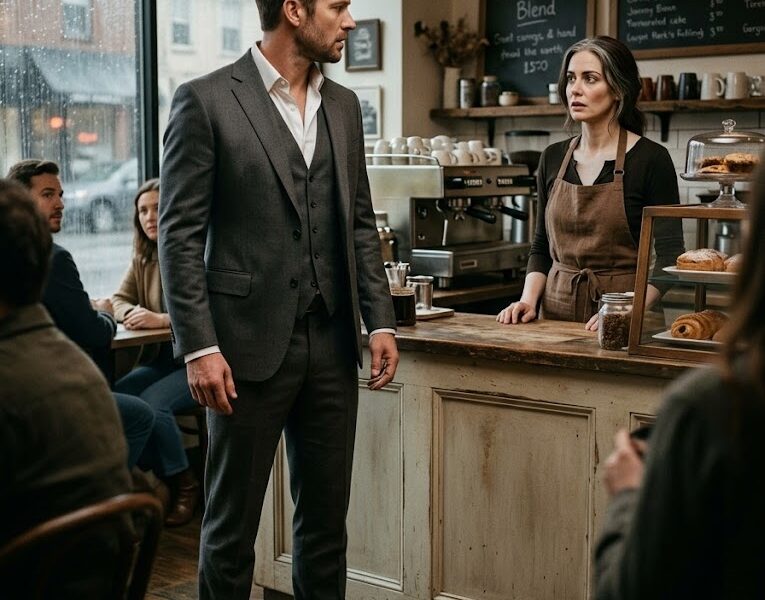
HE WALKED INTO A CAFÉ FOR COFFEE—THEN HEARD THE VOICE OF THE WOMAN HE’D LOST 12 YEARS AGO

The coffee cup slipped from Daniel Mercer’s hand before he even saw her.
It struck the hardwood floor hard enough to split the white ceramic in two. Coffee splashed across his polished black shoes, and somewhere behind him, a woman gasped.
Daniel barely noticed.
Because from behind the counter, through the hiss of steaming milk and the soft jazz playing over an old ceiling speaker, a woman had just said six ordinary words.
“Give me one minute, sweetheart.”
His entire body went still.
Twelve years disappeared.
The conference call waiting on his phone disappeared. The quarterly projections sitting in his leather briefcase disappeared. The black Mercedes parked at the curb, the seven-figure contract he was supposed to discuss downtown, the company bearing his name across four states—all of it vanished beneath the sound of a voice he had spent more than a decade teaching himself not to remember.
Daniel slowly turned toward the counter.
At first, all he saw was the back of a woman in a brown apron.
Dark hair twisted into a loose knot.
A few silver strands near her temples.
Thin shoulders.
One hand resting on the espresso machine while the other passed a paper cup to an elderly customer.
Then she turned.
Daniel forgot how to breathe.
Emma.
Older, yes.
Tired in ways the twenty-five-year-old woman in his memories had never been.
There were faint lines beside her eyes now. Her face was thinner. Her hands looked rougher. The bright red nail polish she used to wear was gone, replaced by short, unpainted nails.
But those eyes—
God.
Those eyes had not changed.
Emma Whitmore looked directly at him.
For three full seconds, neither of them moved.
Then the color drained from her face.
The paper cup in her hand tilted.
A drop of coffee spilled over the lid and landed on her wrist.
She didn’t flinch.
“Daniel?”
His name sounded different in her voice.
Smaller.
More dangerous.
Like something that had been buried alive.
He stared at her.
“Emma.”
Outside, rain hammered the windows of the little café so violently that the street beyond them had become a blur of headlights and silver water.
Inside, everything was warm.
Cinnamon.
Roasted coffee.
Old wood.
Fresh bread.
A dozen strangers sat beneath hanging amber lights, unaware that two people standing fifteen feet apart had just been dragged backward through twelve years of silence.
Emma recovered first.
She looked down at the broken cup near Daniel’s feet.
“You dropped your coffee.”
It was such an absurd sentence that Daniel almost laughed.
Instead, he looked at the mess.
“Apparently.”
“I’ll get a towel.”
“Emma.”
She stopped.
Daniel had imagined this moment hundreds of times.
Sometimes he imagined seeing her at an airport. Sometimes at a restaurant. Once, during a particularly lonely Christmas in Chicago, he had imagined opening his front door and finding her standing on the porch with snow in her hair.
In every version, he knew what to say.
Why did you leave me?
Why did you stop answering?
Did you ever love me?
Did you marry someone else?
Did you ever think about me?
But now that she was actually standing in front of him, the only thing he managed was, “How are you?”
Emma gave him a look so painfully familiar that it almost broke something inside him.
“I’m working.”
Then she turned away.
Daniel stood among the broken pieces of his cup and realized that twelve years had apparently not been long enough to make seeing her hurt less.
It had only taught them both how to hide it better.
He hadn’t planned to stop there.
That was the part Daniel would think about later.
If the storm had started ten minutes later, he would have driven straight to the downtown office of Halpern & Wade.
If traffic on Route 16 had been moving normally, he would never have taken Ashford Street.
If his assistant, Melissa, had not texted to say the meeting had been pushed back twenty minutes, he probably would not have noticed the little café tucked beneath the faded red-brick building at all.
Twelve years of separation had been undone by weather, traffic, and twenty spare minutes.
The place was called Willow & Bean.
The gold lettering on the window had begun to peel.
One corner of the ceiling showed an old water stain, and the table nearest Daniel had a folded piece of cardboard shoved beneath one leg to keep it from wobbling.
It wasn’t the kind of place Daniel usually entered anymore.
His meetings happened in glass towers.
His coffee arrived in conference rooms before he did.
People knew how he took it.
Black. No sugar.
But once, a long time ago, he and Emma had shared convenience-store coffee because neither of them could afford two cups.
He remembered her making a face after the first sip.
“This tastes like motor oil.”
“You’ve never tasted motor oil.”
“I don’t need to. I have imagination.”
“You’re drinking half of it.”
“Because I love you.”
“That seems extreme.”
“It is. Appreciate my sacrifice.”
He had.
He just hadn’t appreciated it enough.
Daniel bent down to pick up the broken ceramic.
A young employee rushed toward him. “Sir, please, don’t touch that. I’ll get it.”
“I broke it.”
“It’s fine.”
“No, it isn’t.”
The employee hesitated.
Daniel almost smiled.
That sentence had nothing to do with the cup.
He moved to a table beside the rain-streaked window.
His phone vibrated.
MELISSA: Halpern team is ready whenever you are. Want me to push another 15?
Daniel looked toward the counter.
Emma was pretending not to look at him.
He typed:
Push thirty.
Then, after a second:
Actually, cancel.
Three dots appeared immediately.
MELISSA: Cancel the meeting?
Yes.
MELISSA: Daniel, this is the acquisition meeting.
I know.
He turned his phone facedown.
Across the room, Emma’s shoulders tightened as if she had somehow sensed what he’d done.
For the next fifteen minutes, Daniel watched her work.
He hated himself a little for it.
It felt invasive, studying someone who had once slept with her head on his chest, someone whose shampoo he could still remember if he let himself.
But he couldn’t stop.
Emma moved differently now.
At twenty-five, she had rushed everywhere. She had always been late, always dropping something, always laughing at herself.
Now her movements were careful.
Economical.
Tired.
An elderly man entered carrying a wet umbrella and favoring his right knee. Before he could ask, Emma brought him a chair.
“Arthur, you’re supposed to use the cane.”
“The cane makes me look old.”
“You are old.”
“I’m seventy-two.”
“Ancient.”
Arthur grinned.
She brought him tea before he ordered.
A young mother struggled through the door with a crying girl in a yellow raincoat. Emma crouched beside the child, whispered something, and produced a chocolate-chip cookie from beneath the counter.
The girl stopped crying.
Her mother reached for her wallet.
Emma shook her head.
“Emergency cookie. Those are free.”
A teenage boy counted coins beside the register and came up short.
Emma glanced at the money.
“You’re good.”
“I’m like a dollar eighty short.”
“Then you owe me a dollar eighty when you’re a millionaire.”
The boy smiled.
“What if I’m never a millionaire?”
“Then bring back the mug you stole last month.”
His face went red.
Emma laughed.
Daniel looked away.
That was the moment that hurt most.
Not seeing her.
Remembering her.
Kindness had never been something Emma performed.
It wasn’t a personality she put on for people.
It was simply the way she moved through the world.
Twelve years ago, when Daniel had been twenty-seven and broke enough to calculate whether he could afford gasoline and dinner in the same week, Emma had quietly filled his refrigerator without telling him.
He had found eggs, bread, sandwich meat, oranges and a six-pack of cheap beer.
When he confronted her, embarrassed and angry, she had shrugged.
“You’re feeding me when you become rich.”
“I’m serious.”
“So am I.”
“What if I never become rich?”
Emma had kissed him.
“Then feed somebody else.”
Daniel looked around the aging café.
Something tightened in his chest.
She had spent her whole life feeding somebody else.
And he had spent twelve years becoming rich.
At 3:42 p.m., the lunch crowd was gone.
Only three customers remained.
Daniel stood.
Emma saw him coming.
Her expression changed.
Not fear.
Preparation.
She wiped her hands on her apron.
“You should probably go to your meeting.”
Daniel stopped.
“You remember I had meetings?”
“You always had meetings.”
“Twelve years ago I barely had a job.”
“You still found reasons to be busy.”
There it was.
The first cut.
Daniel absorbed it.
“I deserved that.”
Emma’s eyes flickered.
“I wasn’t trying to hurt you.”
“You don’t have to try.”
Silence.
The espresso machine hissed behind her.
Daniel lowered his voice.
“I thought you hated me.”
Emma looked toward the remaining customers.
“This isn’t the place.”
“Then tell me where.”
“There isn’t a where.”
“Emma.”
“Daniel, please.”
“Please what?”
Her jaw tightened.
“Don’t come in here after twelve years looking like that and start asking questions as if we misplaced a weekend.”
Daniel stared at her.
“Looking like what?”
She laughed once, but there was no humor in it.
“Like your life worked out.”
That stopped him.
Emma immediately seemed to regret saying it.
Daniel looked down at his suit.
Custom charcoal.
Italian shoes.
A watch he’d bought after his company crossed fifty million in annual revenue.
He suddenly hated every visible symbol of the life he had built.
“You think that means my life worked out?”
“I think it means you did okay.”
“I searched for you.”
Emma’s face changed.
Only slightly.
But Daniel saw it.
“I called,” he continued. “For months.”
“Don’t.”
“I wrote to you.”
“Daniel.”
“I went back to your apartment.”
“Stop.”
“You were gone.”
Emma pressed both palms against the counter.
“And whose fault was that?”
The words came quietly.
Daniel swallowed.
“My father was dying.”
“I know.”
“You didn’t know then.”
“I knew enough.”
“No. You didn’t.”
Her eyes flashed.
“Then maybe somebody should’ve told me.”
Daniel opened his mouth.
Nothing came out.
Because she was right.
Because once upon a time, he’d believed love meant being understood without explaining.
He had been young enough to think silence could communicate sacrifice.
Emma looked away.
“I have customers.”
“There are three people in here.”
“One of them is you.”
“Then make it two.”
Her eyes returned to his.
Daniel could hear his own heartbeat.
“I need to know what happened.”
“No.”
“Why?”
“Because knowing now doesn’t give us twelve years back.”
“I’m not asking for twelve years.”
“What are you asking for?”
“The truth.”
Emma stared at him for a long time.
Then a door behind the counter opened.
Small sneakers slapped against the floor.
“Aunt Em?”
Daniel turned.
A boy came running from the back room.
Nine, maybe ten years old.
Dark brown hair.
Gray-blue eyes.
He wore a red hoodie and carried a pencil in one hand.
He ran directly to Emma and wrapped both arms around her waist.
Daniel’s world tilted.
Emma immediately put a protective hand against the back of the boy’s head.
“You’re supposed to be doing math.”
“I finished.”
“All of it?”
“Most of it.”
“That means no.”
The boy smiled.
Then he noticed Daniel.
His smile disappeared.
He studied him with open curiosity.
Daniel couldn’t move.
The boy had Emma’s eyes.
But there was something else.
Something in the shape of his mouth.
Something about the dark hair falling across his forehead.
Something that struck Daniel with such irrational force that his fingers went numb.
The boy looked from Daniel to Emma.
“Who’s he?”
Emma didn’t answer immediately.
Daniel noticed that.
So did the boy.
Finally she said, “Someone I used to know.”
The words landed harder than Daniel expected.
The boy nodded.
Then he looked at Daniel again.
“I’m Noah.”
Daniel forced himself to breathe.
“Daniel.”
Noah offered his hand with surprising seriousness.
Daniel shook it.
That was when he saw the small pale scar above the boy’s left eyebrow.
A thin crescent.
Daniel’s stomach dropped.
He had seen that mark before.
Not on Noah.
In an old photograph Emma had carried in her wallet.
Her little brother, Michael, sitting on a bicycle with a scraped knee and the exact same crescent-shaped scar above his left eyebrow.
Michael had died when Emma was seventeen.
Daniel knew scars weren’t inherited.
He knew that.
But grief wasn’t logical, and neither was shock.
Noah pulled his hand away.
“Aunt Em, can I have the blue notebook?”
Emma stiffened.
“What blue notebook?”
“My project.”
“I’ll get it.”
“I know where it is.”
Before she could stop him, Noah disappeared into the back room.
Daniel looked at Emma.
She would not meet his eyes.
“How old is he?”
Her head snapped up.
“No.”
Daniel’s voice dropped.
“How old is Noah?”
“Don’t do this.”
“Emma.”
“Don’t you dare.”
“I’m asking a question.”
“And I’m telling you that you don’t get to walk into my life after twelve years and interrogate me about a child.”
Daniel took a step backward.
“I’m not interrogating you.”
“Yes, you are.”
“I saw his face.”
“You saw what you wanted to see.”
“What does that mean?”
“It means exactly what I said.”
The back door opened again.
Noah returned holding a blue spiral notebook.
A sheet of construction paper slipped from inside and fluttered to the floor.
Daniel bent instinctively to pick it up.
“Daniel, don’t—”
Too late.
It was a child’s drawing.
Three figures beneath a yellow sun.
A woman with dark hair.
A little boy in red.
And a tall man wearing a black suit.
At the bottom, written in uneven pencil, were the words:
MY FAMILY SOMEDAY.
Daniel stared at the tall figure.
Dark hair.
Blue eyes.
A black briefcase in one hand.
His throat closed.
Noah reached for the page.
“That’s mine.”
Daniel handed it back slowly.
“Who’s the man?”
Noah shrugged.
“I don’t know yet.”
Emma closed her eyes.
“What does that mean?” Daniel asked.
Noah looked confused by the tension.
“Aunt Em says families can get bigger.”
“Noah.”
“What?”
“Go finish your math.”
“I finished—”
“Please.”
The boy heard something in her voice and stopped arguing.
He took the drawing and disappeared.
Daniel waited until the door closed.
Then he looked at Emma.
“How old is he?”
Her eyes were wet now.
Not crying.
Almost.
“Nine.”
Daniel did the math anyway.
His face must have revealed what he was thinking, because Emma’s expression hardened.
“No.”
“Emma—”
“He is not your son.”
Daniel said nothing.
“Noah is my nephew.”
The air left his lungs.
Emma folded her arms, suddenly looking exhausted.
“My sister, Rachel, was his mother.”
Daniel remembered Rachel.
Six years younger than Emma.
Always stealing fries from his plate.
Always teasing Emma about marrying him.
“What happened?”
Emma stared toward the back room.
“Car accident. Four years ago.”
Daniel’s anger disappeared.
“Emma…”
“Rachel died at the scene. Noah’s father died two days later.”
“I didn’t know.”
“Of course you didn’t.”
The sentence wasn’t cruel.
That made it worse.
Emma swallowed.
“I was the only family he had who could take him.”
“What about nursing?”
A strange smile touched her mouth.
“You remember.”
“You wanted to work pediatric oncology.”
“I did.”
“Did you?”
“For six years.”
Daniel stared.
“You became a nurse.”
“Yes.”
He felt something almost like pride, immediately followed by grief that he hadn’t been there to see it.
“Then Rachel died,” Emma continued. “Noah was five. He stopped talking for almost two months. He had nightmares. He couldn’t be left with strangers. I used every leave day I had. Then unpaid leave. Eventually the hospital couldn’t keep my position open.”
“So you quit.”
“I chose him.”
There was no hesitation.
Daniel looked around the café again.
“You own this place?”
Emma laughed softly.
“I own approximately fourteen percent of the problems.”
“What does that mean?”
“The owner, Mrs. Bell, is seventy-eight. I manage it. She lets Noah stay in the back after school. I can work around his schedule.”
“And the nursing career?”
“It didn’t fit anymore.”
“You gave it up.”
“I changed it.”
Daniel recognized the distinction.
Emma had always hated being pitied.
“I’m sorry about Rachel.”
“Thank you.”
“Why didn’t anyone tell me?”
Emma stared at him.
“Who exactly was supposed to tell you?”
He had no answer.
Her expression softened for half a second.
Then she looked toward the window.
The rain had begun to weaken.
Daniel understood that his thirty borrowed minutes were gone.
But he couldn’t leave.
Not yet.
“Emma.”
She sighed.
“What?”
“You said you knew my father was sick.”
“I found out later.”
“How?”
“Your mother.”
Daniel went completely still.
“My mother?”
“She came here.”
“When?”
“Eleven years ago.”
He stared at her.
“My mother knew where you were?”
“Yes.”
“Why didn’t she tell me?”
Emma looked confused.
“I assumed she did.”
Daniel felt the first cold movement of something much larger beneath the conversation.
“What did she say to you?”
Emma hesitated.
“Daniel.”
“What did my mother say?”
“She told me your father survived the surgery. She said you were working in Chicago. That your career was taking off.”
“What else?”
Emma rubbed her thumb against the edge of the counter.
“She said you were doing well.”
“That isn’t what I asked.”
Her eyes lifted.
“She said I should let you.”
Daniel’s jaw tightened.
“Let me what?”
“Go.”
He stared at her.
Emma continued carefully.
“She said you had an opportunity neither of us could have imagined when we were together. She said you were finally becoming the man you wanted to be.”
“My mother said that?”
“Yes.”
“And you believed her?”
“What was I supposed to believe?”
“Me.”
“You weren’t there.”
“I called you.”
“My number changed after I moved.”
“I wrote.”
“I received one letter.”
Daniel’s pulse accelerated.
“One?”
“Yes.”
“I sent two.”
Emma frowned.
Daniel stepped closer.
“The first one said my father had been admitted and I had to leave immediately. The second explained the job. It explained everything. It said the company was paying for my father’s treatment if I accepted the transfer. It said I wanted you to come with me.”
Emma’s face emptied.
Daniel continued.
“I put a plane ticket inside.”
“No.”
“Yes.”
“No, you didn’t.”
“I did.”
Her eyes filled.
“Daniel, the letter I received said you needed time. You said you didn’t know when you’d be back.”
“That was the first letter.”
“There was no second letter.”
“I mailed it three days later.”
“I never got it.”
“I called twenty-three times.”
“My phone had been disconnected.”
“I came back six weeks later.”
“I had moved.”
“I went to the bakery.”
“I wasn’t working there anymore.”
“I asked your landlord.”
“She hated you.”
“She hated everyone.”
Despite everything, Emma almost smiled.
It disappeared immediately.
Daniel’s hands had begun to shake.
“I thought you left because you didn’t want to wait for me.”
Emma looked at him as if he had spoken in another language.
“I thought you left because I wasn’t worth taking with you.”
Neither moved.
Twelve years stood between them.
Not as time.
As evidence.
Birthdays.
Funerals.
Promotions.
Hospital shifts.
Christmas mornings.
Business launches.
Rachel’s death.
Noah’s first day of school.
Daniel’s father’s recovery.
Every moment one of them had endured without the other because each believed the silence meant rejection.
Emma whispered, “Where did the second letter go?”
Daniel didn’t answer.
Because suddenly he remembered something.
Something stupid.
Something he’d forgotten.
Three months after he moved to Chicago, a packet of old mail had arrived from his previous apartment.
Bills.
Advertisements.
A credit card offer.
And an envelope addressed in his handwriting.
RETURN TO SENDER.
He had been working eighteen-hour days.
His father was recovering.
Daniel had opened the packet at midnight, seen Emma’s name, and assumed she had refused the letter.
He had thrown it into a desk drawer.
He hadn’t opened it.
He hadn’t checked why it had been returned.
He had simply believed the worst.
“I got it back,” he said.
Emma’s face went pale.
“What?”
“The second letter.”
“When?”
“Months later.”
“And you never…”
“I thought you refused it.”
Her eyes closed.
Daniel could barely hear himself.
“I thought you sent it back.”
“You thought I—”
“I was angry.”
“So was I.”
“I was twenty-seven.”
“I was twenty-five.”
“I thought if you loved me, you’d call.”
Emma laughed, and this time a tear escaped.
“I thought if you loved me, you’d come back.”
The café suddenly seemed impossibly quiet.
Daniel looked at her.
“We lost twelve years because of an envelope.”
Emma wiped the tear away immediately.
“No.”
He frowned.
“No?”
“We lost twelve years because of us.”
Her voice steadied.
“The letter started it. Your father’s illness started it. Your mother probably made it worse. But we did the rest.”
Daniel said nothing.
“I could’ve found you,” Emma continued. “Your company was online within a few years. Your name started appearing in business articles. I saw one.”
“When?”
“Eight years ago.”
His chest tightened.
“And?”
“You were standing beside some woman at a charity event.”
Daniel almost laughed from disbelief.
“Rebecca Hale?”
“I don’t know.”
“My CFO. She was sixty.”
Emma blinked.
“She photographed younger.”
Despite himself, Daniel laughed.
Emma stared at him.
Then, impossibly, she laughed too.
It lasted only seconds.
But for those seconds, the twelve years cracked open.
Daniel saw the girl on the park bench.
Emma saw the broke young man with impossible plans.
Then the laughter faded.
Emma looked down.
“I closed the article.”
“Why?”
“Because seeing you hurt.”
Daniel’s voice softened.
“Seeing you hurts too.”
“That doesn’t mean we can fix this.”
“I know.”
“Do you?”
“Yes.”
Emma studied him.
For perhaps the first time since he’d walked into the café, she seemed to believe him.
Daniel reached into his coat for his wallet.
Emma’s expression hardened immediately.
“If you try to give me money—”
“I’m paying for the coffee I destroyed.”
“That cup cost three dollars.”
“Then I’m paying three dollars.”
“Good.”
He placed a five on the counter.
She pushed two dollars back.
He smiled faintly.
“Still stubborn.”
“Still bad at boundaries.”
“Fair.”
Daniel put the bills into his wallet.
Then his fingers brushed something tucked behind an old business card.
A tiny folded piece of faded yellow paper.
He froze.
Emma noticed.
“What?”
Daniel pulled it out.
A paper star.
Crushed at the edges.
Nearly colorless with age.
Emma stared.
Her lips parted.
“You still have that?”
Daniel looked down at it.
“You made it the night my first loan application was rejected.”
“That was twelve years ago.”
“Thirteen.”
“You kept a piece of paper for thirteen years?”
“You told me it was lucky.”
“I was trying to make you stop feeling sorry for yourself.”
“It worked.”
Emma touched the edge of the star with one finger.
The gesture was so gentle Daniel almost couldn’t stand it.
“Why did you keep it?”
He looked at her.
“Because it was the last thing I had that proved somebody once believed in me before I had anything worth believing in.”
Emma pulled her hand away.
Daniel saw her eyes fill again.
This time she turned before he could see the tears fall.
“I need to close early.”
He nodded.
“I’ll go.”
He took his coat.
At the door, he stopped.
“Emma?”
She didn’t turn.
“I don’t want twelve years back.”
Her shoulders tightened.
“I know we can’t have them.”
Still nothing.
“But if you ever want coffee with me…”
Emma looked around the café.
Daniel followed her gaze.
He smiled.
“Right. Bad choice.”
A tiny smile touched her face.
“Goodbye, Daniel.”
He opened the door.
Cold air rushed inside.
Daniel stepped beneath the awning.
The rain had stopped.
He should have felt relieved.
Instead, he felt as if the storm had only moved inside him.
Then Emma called his name.
He turned.
She stood in the doorway.
Her apron was still tied around her waist.
Her hair had begun to come loose.
For one impossible second, she looked twenty-five again.
“There’s something else,” she said.
Daniel’s heartbeat changed.
Emma glanced toward the café.
Toward the back room where Noah was doing homework.
Then back at him.
“Your mother didn’t just tell me to let you go.”
Daniel slowly stepped toward her.
“What else did she say?”
Emma hesitated.
“She offered me money.”
The world seemed to narrow.
“What?”
“Twenty thousand dollars.”
Daniel stared.
“To do what?”
“To disappear.”
He could hear traffic moving through wet streets.
Nothing else.
Emma’s voice shook.
“She said your father’s medical bills were destroying your family. She said this job was your only chance. And she said if I loved you, I wouldn’t make you choose.”
Daniel’s face went cold.
“Did you take it?”
Emma’s eyes flashed.
“No.”
He immediately regretted asking.
“I’m sorry.”
“She left the check anyway.”
“What happened to it?”
“I tore it up.”
Daniel looked away.
His mother had died three years earlier.
There would be no confrontation.
No explanation.
No chance to ask whether she had believed she was protecting him or simply controlling him.
Only another silence.
Another thing he could never repair.
Emma spoke more gently.
“She was scared.”
“That doesn’t excuse it.”
“No.”
“She knew I wanted you with me.”
“I don’t think she believed that.”
“She had no right.”
“No.”
Daniel looked at Emma.
“Why didn’t you tell me?”
“How?”
“You could’ve found me.”
“So could you.”
The answer landed cleanly.
Daniel nodded.
“You’re right.”
Emma seemed surprised.
The younger Daniel would have argued.
He would have explained.
Defended.
Justified.
The man standing before her now simply accepted it.
“I’m right about a lot of things,” she said.
“I remember.”
Another almost-smile.
Then Emma went inside.
Daniel stood beneath the awning for several minutes after the door closed.
For the first time in twelve years, he knew why he had lost her.
And somehow knowing was worse.
Because there was no villain he could blame completely.
Not his mother.
Not the returned letter.
Not the dying father.
Not ambition.
They had been two frightened young people who loved each other and mistook silence for an answer.
And silence had cost them twelve years.
Daniel returned three days later.
Emma saw him through the window.
Her expression made it clear she had not expected him.
He held up a coffee cup from another shop.
She opened the door.
“You brought coffee into a café?”
“Neutral territory.”
“That is offensive.”
“I didn’t want you thinking I came for free coffee.”
“I never thought that.”
“Good.”
“Now I think you came to insult my profession.”
Daniel looked at the cup.
“I can throw it away.”
“You already paid for it.”
“So?”
Emma sighed.
“You haven’t changed at all.”
“That isn’t true.”
“No?”
“I own more jackets.”
She laughed before she could stop herself.
Daniel considered that a victory.
He didn’t ask about the past that day.
Instead, he helped Noah with a math problem.
He learned that Noah loved astronomy, hated mushrooms, and believed adults exaggerated the importance of handwriting.
Daniel learned Emma closed the café at seven.
He learned she took the bus home because her twelve-year-old Honda had finally died.
He learned she lived in a small duplex six blocks away.
He learned she still drank coffee with too much cream.
Emma learned Daniel’s father had lived another seven years after the surgery.
She learned Daniel had sat beside him when he died.
She learned his company had almost failed twice before succeeding.
She learned he had never married.
That detail changed the room.
Emma had been wiping the counter.
Her hand stopped.
“Never?”
“No.”
“Why?”
Daniel looked at her.
“You really need to ask?”
She resumed wiping.
“Yes.”
He could have said because of you.
That would have been dramatic.
It would also have been unfair.
“I tried,” he said instead.
Emma looked up.
“There were relationships. Good women. One lasted almost three years.”
“What happened?”
“I couldn’t give her what she needed.”
“Because of me?”
“Because of me.”
Emma’s face softened.
Daniel continued.
“I spent a long time blaming you because that was easier than admitting I had built my entire life around avoiding anything I couldn’t control.”
“Businesses are easier?”
“Much.”
“Employees?”
“Predictable.”
“Markets?”
“Not remotely.”
“Love?”
Daniel smiled without humor.
“Terrifying.”
Emma put the cloth down.
“Maybe you’re smarter than I remember.”
“Absolutely not.”
The days became weeks.
Daniel told himself he returned because he liked the coffee.
Emma never believed him.
Neither did Noah.
“You like Aunt Em,” the boy announced one Saturday.
Daniel nearly choked.
Emma, standing behind the counter, dropped a spoon.
“Noah.”
“What?”
“Homework.”
“It’s Saturday.”
“Then find some.”
Daniel hid a smile.
Noah leaned closer.
“She likes you too.”
“Noah!”
The boy fled laughing.
Daniel looked at Emma.
Her cheeks were red.
“I’m sorry.”
“No, you’re not.”
“No.”
She shook her head.
Something had begun changing between them.
Not quickly.
Not cleanly.
There were days Emma became distant for no obvious reason.
Days Daniel arrived and she found work in the back room.
Once, he mentioned a restaurant they used to visit and Emma abruptly went silent.
“What?” he asked.
“That was where you told me about Chicago.”
Daniel remembered.
A cheap Italian place.
Plastic candles.
Emma had been wearing a blue sweater.
He had told her there might be an opportunity.
He had not told her he had already accepted the interview.
“I handled that badly.”
“You handled a lot badly.”
“So did you.”
The moment the words left his mouth, he regretted them.
Emma stiffened.
Daniel almost apologized automatically.
Then stopped.
Because rebuilding something did not mean pretending.
“You did,” he said gently. “You shut me out too.”
Emma stared at him.
“I was hurt.”
“So was I.”
“You left.”
“My father was dying.”
“You chose Chicago.”
“I chose his medical care.”
“You didn’t tell me that.”
“I tried.”
“With a letter.”
“I was stupid.”
“Yes.”
“But you decided what my silence meant without asking.”
Emma’s eyes filled with anger.
“And you did exactly the same thing.”
“I know.”
Silence.
Then Emma whispered, “I hate that you’re right.”
“I hate that we’re both right.”
She looked away.
Daniel reached for his coat.
“I’ll go.”
“Daniel.”
He stopped.
Emma stared at the floor.
“Don’t.”
“Don’t what?”
“Go every time this gets uncomfortable.”
He slowly removed his hand from the coat.
It was the first real invitation she had given him.
So he stayed.
By January, Daniel knew every broken thing in Willow & Bean.
The leaking pipe behind the sink.
The cracked front window.
The ancient refrigerator that rattled every seventeen minutes.
The bathroom lock Noah had learned to fix with a butter knife.
One evening, water began dripping from the ceiling directly onto a customer’s table.
Daniel looked upward.
Emma placed a bucket beneath it.
“Don’t.”
“I haven’t said anything.”
“Your face did.”
“My face said your roof is leaking.”
“My face says I know.”
“Let me fix it.”
“No.”
“Emma.”
“No.”
“Why?”
“Because you don’t solve everything with money.”
“I know.”
“Do you?”
“Yes.”
She folded her arms.
“Then why are you offering?”
“Because the roof is leaking.”
Emma glared at him.
Daniel pointed toward the bucket.
“This isn’t emotional symbolism. There is literally water falling from the ceiling.”
Noah burst out laughing.
Emma looked at him.
“Traitor.”
Daniel smiled.
But he understood her fear.
Money had become part of the story that separated them.
She would not allow it to become the thing that reunited them.
So Daniel did something he rarely did in business.
He negotiated badly on purpose.
He proposed a renovation plan in writing.
Mrs. Bell remained the owner.
Daniel’s company would finance repairs at cost.
The café would repay only what it could afford from future profits.
No interest.
No ownership.
No hidden equity.
Emma read every page.
Twice.
Then she took the contract to an attorney.
Daniel loved her more for that.
“You checked me?”
“You own four companies.”
“Three.”
“The article said four.”
“I sold one.”
“You see? Already unreliable.”
“Your lawyer approve?”
“He said you’re either being honest or planning the least profitable scam in American history.”
“That’s my specialty.”
She signed.
The renovation took eleven weeks.
Daniel came whenever he could.
Sometimes in a suit.
Sometimes in jeans.
Once, Noah handed him a paint roller without warning and Daniel ruined a four-hundred-dollar shirt.
Emma laughed so hard she had to sit down.
He stared at the paint across his chest.
“You know this shirt cost more than my first car payment?”
“That makes this better.”
“You’re enjoying my pain.”
“Immensely.”
Daniel dipped the roller into paint.
Emma backed away.
“Don’t.”
“Oh, now we respect clothing?”
“Daniel.”
He flicked a tiny drop toward her.
It landed on her cheek.
The room went silent.
Noah whispered, “Run.”
Daniel did.
Emma chased him through the half-renovated café with a paintbrush.
For thirty seconds, they were young again.
Not because the past had returned.
Because something new had finally become light enough to carry.
The café reopened in March.
New windows.
Warm cream walls.
Restored wood tables.
Better lighting.
A children’s reading corner beside the fireplace.
Emma cried when she saw the brass plaque on the bookshelf.
THE RACHEL WHITMORE READING CORNER.
She turned toward Daniel.
“You didn’t ask.”
“I asked Noah.”
“You manipulated a child.”
“He’s an excellent business partner.”
Noah nodded solemnly.
Emma wiped her eyes.
Then she noticed another envelope on the shelf.
“What is that?”
Daniel suddenly looked nervous.
It was a rare sight.
Emma opened it.
Inside were documents establishing a small educational fund for children who had lost one or both parents.
Not enormous.
Not branded with Daniel’s company.
Named for Rachel.
Emma read the first page twice.
Then she closed the folder.
“You can’t keep doing this.”
Daniel’s smile faded.
“Doing what?”
“Making it impossible for me to stay angry at you.”
“I didn’t do it for that.”
“I know.”
That was the problem.
She looked at him.
For months, Emma had waited for the catch.
For Daniel to become impatient.
For him to remind her how much he had done.
For generosity to turn into leverage.
It never happened.
He showed up.
That was all.
When Noah had the flu, Daniel left soup at the door and went home.
When Emma had to take Noah to a school meeting, Daniel covered the café with Mrs. Bell.
When she refused a ride, he didn’t insist.
When she needed one, he came.
He never asked her to forgive the past.
He never asked whether she loved him.
He never kissed her.
Until one night in April.
The café had closed.
Noah was asleep in the back office after staying late for a school project.
Rain tapped gently against the new windows.
Not a storm.
Just rain.
Emma stood near the espresso machine.
Daniel sat at the table where he had been sitting the afternoon they found each other again.
Three cups of hot chocolate rested between them.
One for him.
One for Emma.
One waiting for Noah when he woke.
Emma looked at the third cup.
“You know it’ll be cold.”
“He likes it cold.”
“He told you that?”
“He says hot chocolate being hot is false advertising because then you have to wait.”
“That sounds like Noah.”
Daniel smiled.
Emma sat opposite him.
For a while, neither spoke.
They had become comfortable with silence.
That was new too.
Once, silence had destroyed them.
Now they were learning that silence could mean something else when nobody was running away.
Daniel reached into his jacket.
He placed the old paper star on the table.
Emma smiled.
“You’re going to destroy that thing carrying it around.”
“I’ve considered having it laminated.”
“Don’t you dare.”
“Framed?”
“Worse.”
“Bronze statue?”
She laughed.
Daniel looked at her.
The laughter faded.
“Emma.”
She knew.
Whatever came next, she knew.
“Don’t make this bigger than it is,” she whispered.
“I’m trying not to.”
“We’ve had a few good months.”
“I know.”
“Noah loves you.”
“I love him.”
The words came naturally.
Emma’s eyes changed.
Daniel noticed.
“I didn’t mean to—”
“I know.”
He waited.
Emma folded her hands.
“I’m scared.”
“So am I.”
“You don’t look scared.”
“I negotiate corporate acquisitions for a living. I’ve trained my face.”
That earned the smallest smile.
Then he became serious.
“I don’t want the old relationship back.”
Emma stared at him.
“I don’t want to pretend we’re twenty-five and twenty-seven. I don’t want to erase Chicago or Rachel or Noah or the company or the hospital or any of it.”
“What do you want?”
Daniel looked toward the rain.
Then back at her.
“Tuesday.”
Emma frowned.
“Tuesday?”
“And Wednesday. Maybe Thursday if things go well.”
She almost laughed.
“I want ordinary days with you. I want Noah complaining about homework. I want you telling me I ordered the wrong coffee. I want to argue about leaking roofs and terrible movies.”
“That’s your pitch?”
“It’s getting worse.”
“Much.”
Daniel leaned forward.
“I spent twelve years thinking happiness was something I’d missed. Like a train that left while I was standing on the wrong platform.”
Emma’s eyes became wet.
“And then I walked into this place.”
“Because of rain.”
“Because of rain.”
“And you broke a cup.”
“It was a dramatic cup.”
“It was four dollars.”
“You told me three.”
“Inflation.”
Daniel laughed.
Then he reached across the table.
He did not take her hand.
He simply placed his palm upward between them.
The choice was hers.
“I don’t know what happens next,” he said.
Emma looked at his hand.
“That’s unusual for you.”
“Terrifying.”
“You like plans.”
“I love plans.”
“You hate uncertainty.”
“Deeply.”
“And you’re asking me for something you can’t control.”
“Yes.”
Emma stared at him for a long time.
Then she placed her hand in his.
Daniel closed his fingers gently around hers.
Nothing exploded.
No music rose.
No twelve lost years came rushing back.
It was simply warm skin against warm skin in a quiet café after closing.
And somehow that felt more important than anything dramatic could have.
Emma whispered, “You know this doesn’t fix everything.”
“I know.”
“I’m still angry sometimes.”
“I know.”
“I might always be a little angry.”
“That’s probably fair.”
“You’re annoying.”
“I’ve heard.”
“And I don’t need saving.”
Daniel’s thumb moved once across her knuckles.
“I know.”
That was the answer she had been waiting for.
Emma leaned across the table.
She kissed him.
It was not the kiss Daniel remembered.
That surprised him.
The young Emma had kissed like she was always running out of time.
This Emma kissed carefully.
Slowly.
Like someone opening a door she had once watched slam shut.
Daniel did not pull her closer.
He let her decide the distance.
When she finally moved back, both of them were quiet.
Then a sleepy voice came from the hallway.
“That took forever.”
Emma jerked away.
“Noah!”
The boy stood in the doorway rubbing his eyes.
“What?”
“How long have you been standing there?”
Noah shrugged.
“Long enough.”
Daniel covered his mouth to hide a smile.
Emma pointed toward the back room.
“Bed.”
“This is a café.”
“Then couch.”
Noah picked up his hot chocolate.
“It’s cold.”
Daniel looked at Emma.
“I told you.”
Noah took a sip.
“Perfect.”
Emma groaned.
“You two are becoming unbearable.”
Noah smiled.
Daniel watched them.
And for the first time in longer than he could remember, he did not feel like a visitor in someone else’s life.
But second chances, Daniel would learn, were not endings.
They were responsibilities.
Two months later, Emma received a phone call from St. Matthew’s Children’s Hospital.
A former colleague had recommended her for a newly created outpatient pediatric coordinator position.
Part-time.
Flexible schedule.
Three days a week.
Emma hung up and stared at the phone.
Daniel found her sitting alone after closing.
“What happened?”
She handed him the job description.
He read it.
Then smiled.
“Emma.”
“I can’t.”
“Why?”
“Noah.”
“He’s ten.”
“He still needs me.”
“Of course he does.”
“The café.”
“Mrs. Bell has two new employees.”
“I’ve been out of nursing four years.”
“So?”
“So maybe I’m not that person anymore.”
Daniel put the paper down.
He understood then.
This wasn’t about Noah.
Not entirely.
Emma had spent years surviving by shrinking her own future around the needs of other people.
She had become good at sacrifice.
So good that wanting something for herself now felt selfish.
Daniel sat beside her.
“You once told me something.”
“That sounds dangerous.”
“When my first company failed.”
Emma smiled faintly.
“I told you a lot of things.”
“You said failure doesn’t get to decide who you are unless you let it.”
“I was very wise at twenty-four.”
“You were unbearable.”
“True.”
Daniel pushed the job description toward her.
“Rachel dying changed your life. Taking care of Noah changed your life. But neither of those things means the part of you that wanted this stopped existing.”
Emma looked at him.
“What if I fail?”
“Then I’ll buy you terrible coffee.”
“That isn’t helpful.”
“It helped me.”
She laughed softly.
Then her face became serious.
“You would really be okay?”
“With what?”
“With me having something that isn’t this café. Isn’t Noah. Isn’t…”
She stopped.
“Isn’t me?” Daniel asked.
Emma nodded.
He felt something break inside him.
Not painfully.
Like a chain finally giving way.
“Emma, the last time we loved each other, we were both terrified that the other person’s future meant there wouldn’t be room for us.”
She said nothing.
“I’m not doing that again.”
Her eyes filled.
Daniel continued.
“If you want the job, take it.”
“What if it changes things?”
“It will.”
“And you’re okay with that?”
“No.”
Emma blinked.
Daniel smiled.
“I’ll probably hate parts of it. You’ll be tired. Schedules will get complicated. Noah will complain. I’ll get jealous of some handsome pediatrician.”
“There is no handsome pediatrician.”
“There will be. Life is cruel.”
Emma laughed through her tears.
“But we’ll talk,” Daniel said.
The laughter disappeared.
He took her hand.
“We’ll talk before silence gets to make decisions for us.”
Emma looked down at their hands.
Then she nodded.
She accepted the job.
A year after the rainy afternoon that brought them together, Daniel returned to Willow & Bean at almost exactly the same hour.
3:17 p.m.
Rain tapped against the windows.
He stood inside the entrance and watched Emma behind the counter.
She had come directly from the hospital and still wore navy scrubs beneath her café apron.
Her hair contained more silver than it had the year before.
Daniel loved every strand.
Noah sat at a corner table pretending to study while actually drawing rockets.
Mrs. Bell slept in a chair near the bookshelf.
Arthur argued with a college student about baseball.
Nothing about the scene looked extraordinary.
Daniel had spent most of his adult life in rooms designed to impress people.
Penthouse restaurants.
Boardrooms forty floors above Manhattan.
Hotel suites overlooking Chicago.
Private clubs where nobody looked at prices.
Yet he had never seen anything more beautiful than that small café on an ordinary rainy afternoon.
Emma looked up.
She saw him.
And smiled.
Not the cautious smile she had given him months earlier.
Not the wounded smile of someone measuring how close she could safely stand to the past.
A real smile.
“Coffee?” she called.
Daniel removed his coat.
“Is it still terrible?”
“Get out.”
Noah laughed from the corner.
Daniel approached the counter.
Emma poured his coffee.
He looked at the cup.
Then at her.
“You know, statistically, I should probably drop this.”
“Try it and you’re cleaning the floor.”
“Yes, ma’am.”
He took the cup.
Emma’s hand remained on it for half a second longer than necessary.
Daniel looked at her fingers.
No ring.
Not yet.
He was carrying one.
He had been carrying it for three weeks.
But he did not reach for it.
That surprised the younger version of himself who still lived somewhere inside him.
The old Daniel would have wanted the perfect moment.
A reservation.
Candles.
Champagne.
Certainty.
The man he had become understood something different.
Love did not need to race toward proof.
It needed room.
Time.
Truth.
He could wait.
He had once lost twelve years because he had mistaken urgency for courage and silence for dignity.
He would not make that mistake again.
So he drank his coffee.
Emma complained about a difficult patient.
Noah showed him a science project.
Mrs. Bell woke up and demanded pie.
Outside, rain ran down the glass in silver lines.
Eventually, Emma came around the counter and sat beside Daniel.
Her shoulder touched his.
Neither moved away.
“Do you ever think about it?” she asked.
“What?”
“The twelve years.”
Daniel looked through the window.
“Sometimes.”
“Do you wish we could change them?”
He considered the question.
Once, his answer would have been immediate.
Yes.
Of course.
He would have traded money, success, houses, cars—anything—to return to that cheap apartment, find Emma before she moved, and tell her everything.
But life was cruel in complicated ways.
Without those twelve years, there might be no Noah in their lives.
Emma might never have become the woman sitting beside him.
Daniel might never have learned that success without vulnerability was only another kind of hiding.
“I wish we hadn’t hurt so much,” he said.
Emma nodded.
“But I don’t want to erase who we became.”
She looked at him.
“Even if it means losing those years?”
“We didn’t lose all of them.”
“How do you figure?”
“You became a nurse.”
Emma smiled.
“I built a company.”
“You became insufferable.”
“Successful people prefer ‘confident.’”
“No.”
Daniel smiled.
“You saved Noah.”
Emma’s expression softened.
“He saved me too.”
“I know.”
“And you?”
“What about me?”
“What did those years give you?”
Daniel thought about it.
Then he looked at the woman beside him.
“They taught me the difference between building a life and having one.”
Emma’s eyes lowered.
For several seconds, the café existed around them in soft fragments—the clink of a spoon, Noah turning a page, rain against glass, the espresso machine releasing steam.
Then Emma said, “That’s annoyingly good.”
“I’ve had twelve years to think of it.”
She rested her head against his shoulder.
Daniel closed his eyes.
He thought about the first night they had shared a sandwich on a park bench.
The second letter.
The returned envelope.
His mother’s check.
Emma’s anger.
Rachel.
Noah.
The broken coffee cup.
All the tiny accidents and terrible choices that had shaped their lives.
People liked to believe the biggest moments announced themselves.
A wedding.
A funeral.
A promotion.
A birth.
A goodbye.
But Daniel knew better now.
Sometimes the moment that changed everything looked like nothing.
A storm arriving ten minutes early.
A meeting being delayed.
A driver choosing one street instead of another.
A man walking into a café because he wanted five quiet minutes.
A familiar voice behind a counter.
One sentence.
One turn of the head.
One person you thought life had taken forever standing only a few feet away.
Months later, Daniel finally gave Emma the ring.
Not in a restaurant.
Not beneath fireworks.
Not in front of anyone.
It happened on a Tuesday morning at 6:43 while Emma stood in her kitchen wearing one sock and searching for her hospital badge.
Noah was upstairs complaining that he couldn’t find his history assignment.
Daniel was making toast.
Emma opened the refrigerator.
“Why is the milk empty?”
“Noah.”
“I can hear you!” Noah shouted from upstairs.
“Then bring down your history assignment!”
“I can’t find it!”
“You put it in your backpack!”
“No, I didn’t!”
Daniel looked at the backpack beside the kitchen table.
The assignment was sticking out of the front pocket.
He smiled.
Emma saw the expression.
“What?”
“Nothing.”
“That is not your nothing face.”
“I have a nothing face?”
“You have seven faces. I know all of them now.”
Daniel reached into his pocket.
Emma turned back to the refrigerator.
“We need milk.”
“Emma.”
“And bread.”
“Emma.”
“And Noah needs poster board after school.”
“Emma.”
She finally turned.
Daniel was holding the ring.
No speech.
No kneeling.
Just the ring between his fingers and terror in his eyes.
Emma froze.
Upstairs, Noah shouted, “FOUND IT!”
Daniel laughed nervously.
Emma covered her mouth.
“I had a whole plan,” he said.
She stared at him.
“A good one?”
“No.”
“Okay.”
“There was a restaurant.”
“Of course.”
“And flowers.”
“I hate roses.”
“They weren’t roses.”
“Good.”
“And I was going to say something impressive.”
“What happened?”
Daniel looked around the messy kitchen.
The toast had begun to burn.
Rain tapped against the window.
A school backpack lay open on the floor.
Emma wore one sock.
“I realized I don’t want the impressive moment.”
Her eyes filled.
“I want this one.”
The toaster popped.
Neither looked at it.
Daniel stepped closer.
“I can’t promise we’ll never misunderstand each other.”
Emma lowered her hand.
“I can’t promise I won’t get scared.”
“I can’t promise work won’t make me stupid sometimes.”
“It will.”
“Thank you.”
“You’re welcome.”
He smiled.
“But I can promise I won’t let silence answer for me again.”
Emma started crying.
Daniel’s voice broke.
“And if you’re angry, tell me. If you’re scared, tell me. If you want something different, tell me. If you wake up one day and hate me—”
“I already do before coffee.”
“Fair.”
She laughed through her tears.
Daniel held up the ring.
“I lost you once because I thought love was supposed to understand what I was too afraid to say.”
He swallowed.
“I don’t believe that anymore.”
Emma looked at him.
“So I’m saying it.”
Upstairs, Noah yelled, “WE’RE GOING TO BE LATE!”
Emma laughed harder.
Daniel glanced toward the ceiling.
“This child has terrible timing.”
“He gets it from Rachel.”
Daniel looked back at Emma.
“Marry me.”
She stared at him for one heartbeat.
Two.
Three.
Then she said, “Yes.”
No hesitation.
No dramatic pause.
Just yes.
Daniel slipped the ring onto her finger.
Emma looked at it.
Then at him.
“You know what’s funny?”
“What?”
“If you’d done this twelve years ago, I probably would’ve wanted a huge wedding.”
“And now?”
She glanced toward the stairs as Noah came running down with one shoe untied.
“Now I just want breakfast.”
Noah stopped.
He saw the ring.
His eyes widened.
“No way.”
Emma smiled.
Noah looked at Daniel.
“You finally did it?”
Daniel frowned.
“Finally?”
“I’ve known for months.”
Emma stared at her nephew.
“Knew what?”
Noah rolled his eyes with the exhaustion of a child surrounded by incompetent adults.
“That he was going to ask you.”
Daniel pointed at him.
“You said nothing.”
“You told me not to.”
Emma’s mouth fell open.
“You knew?”
Noah grabbed a piece of toast.
“You two wasted twelve years. I wasn’t letting you mess this up too.”
Then he walked out of the kitchen.
Daniel and Emma stared after him.
Finally Emma whispered, “He’s terrifying.”
Daniel nodded.
“He’ll run my company someday.”
“Absolutely not.”
From the hallway, Noah shouted, “I HEARD THAT.”
Daniel laughed.
Emma leaned against him.
And there, in a kitchen that needed milk, beside burnt toast and an abandoned backpack, Daniel understood the strange mercy of a second chance.
It was not life returning what had been taken.
Nothing could return twelve years.
Nothing could give Emma back the nights she had cried alone or Daniel the Christmas mornings when he had set one place at a table built for two.
Nothing could bring Rachel back.
Nothing could make Daniel’s mother explain herself.
Nothing could place the second letter into Emma’s hands at the moment when it might have changed everything.
The past remained the past.
That was the price.
But perhaps forgiveness was never about changing what happened.
Perhaps it was about refusing to let what happened own everything that came afterward.
Years later, the paper star still existed.
Emma eventually convinced Daniel to stop carrying it in his wallet before it disintegrated.
They placed it inside a small glass frame near the register at Willow & Bean.
No plaque.
No explanation.
Customers sometimes asked what it meant.
Emma would smile and say, “An old promise.”
Daniel preferred another answer.
“Proof.”
“Proof of what?” people would ask.
He would look across the café at Emma.
Sometimes she would be talking to Noah.
Sometimes pouring coffee.
Sometimes standing beside the window while rain blurred the street beyond her.
And Daniel would think of the twenty-seven-year-old man who had believed becoming successful would make him whole.
He would think of the twenty-five-year-old woman who had believed being left meant she had not been worth choosing.
He would think about an unopened returned letter sitting in a drawer while two people built separate lives around the same wrong conclusion.
Then he would look at the little paper star.
“Proof,” Daniel would say, “that some things survive longer than they should.”
Emma would usually correct him.
“Longer than you think they can.”
Maybe she was right.
She usually was.
Because love had not waited for Daniel and Emma untouched.
It had not remained young and perfect somewhere in the past.
It had been bruised.
Misunderstood.
Abandoned.
Buried beneath pride, grief, work, distance, and twelve years of unanswered questions.
When they found it again, it looked different.
So did they.
And perhaps that was why it finally had a chance to last.
One rainy afternoon, long after Noah had grown tall enough that customers no longer recognized the little boy from the café, Daniel sat alone at the table beside the window.
Emma was late coming from the hospital.
The café was nearly empty.
Rain moved softly against the glass.
Daniel held a cup of black coffee between his hands.
Then the door opened.
Emma stepped inside.
Silver now ran openly through her dark hair.
She saw him.
She smiled.
And Daniel felt the same impossible shift inside his chest that he had felt the first day he heard her voice again.
Only this time, he wasn’t afraid she would disappear.
Emma hung her wet coat beside the door and crossed the room.
“You waited.”
Daniel looked at her.
“I learned how.”
She sat across from him.
Outside, cars moved through the wet street.
Inside, the lights glowed warm against the windows.
Emma reached across the table.
Daniel took her hand.
Neither of them spoke.
They no longer needed silence to say what they were afraid to put into words.
They had learned better than that.
Now silence was simply a place where two people could sit after spending years finding their way back to each other.
Daniel had once believed the cruelest thing life could do was take someone away.
He had been wrong.
Sometimes the cruelest thing was letting two people love each other while convincing both of them they had been forgotten.
But life could be merciful too.
Sometimes it gave no warning.
No grand announcement.
No perfect explanation.
Sometimes mercy arrived disguised as bad weather.
As a delayed meeting.
As an old café beneath a brick building.
As a coffee cup falling from a man’s hand.
As the voice of a woman he had loved when he had nothing.
A voice he had spent twelve years believing he would never hear again.
And sometimes, when that voice finally said your name, the most important thing you could do was not run from the pain of everything you’d lost.
It was to turn around.
And listen.









