HE WALKED INTO HIS OWN LUXURY HOTEL LOOKING HOMELESS—BY MORNING, EVERY EMPLOYEE WHO HUMILIATED HIM WAS SUMMONED TO THE LOBBY
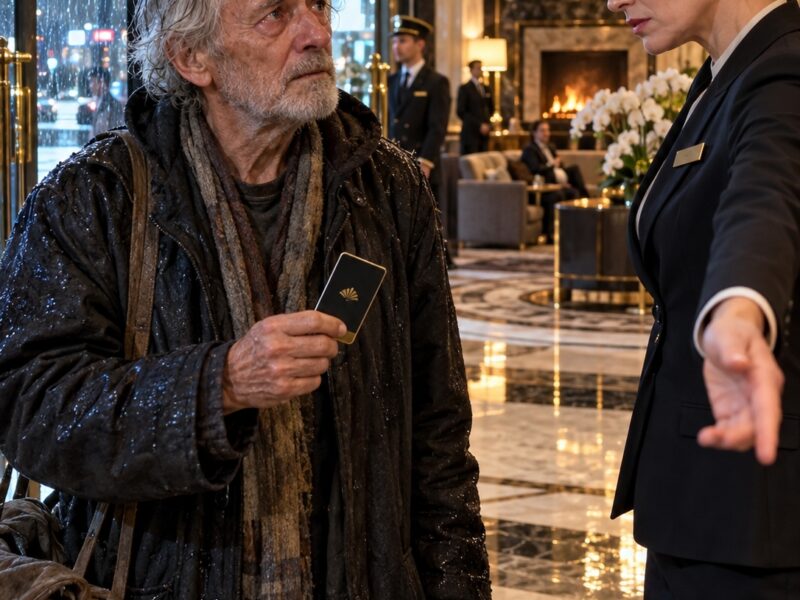
At 7:15 on a freezing Monday morning, Richard Cole walked into one of the most expensive hotels in Chicago wearing a torn coat, muddy boots, and three days of gray stubble on his face.
Nobody recognized the man who owned the building.
That was exactly what he wanted.
The revolving doors of the Whitmore Hotel turned slowly behind him, carrying in a gust of January air that smelled of wet pavement and exhaust. Outside, sleet tapped against black town cars lined beneath the awning. Inside, the lobby glowed beneath chandeliers imported from Italy, their light spilling over polished marble, fresh orchids, brass luggage carts, and furniture chosen specifically to make wealthy people feel they had entered a world ordinary people could not afford.
Richard stopped just beyond the entrance.
For several seconds, he said nothing.
He simply looked around.
Twenty-seven years earlier, before there had been a Whitmore Hotel Group, before magazine profiles had called him a visionary, before his signature could move millions of dollars with a few strokes of a pen, Richard had stood in another hotel lobby wearing another cheap coat.
He had been twenty-six then.
Broke.
Cold.
Terrified.
He remembered how invisible poverty could make a person feel.
That memory was why he had come.
But no one in the lobby knew that.
To them, Richard Cole was simply an old homeless man who had wandered somewhere he did not belong.
Emily Parker noticed him first.
She was twenty-four, impeccably dressed in the Whitmore’s charcoal-gray front-desk uniform, her blond hair pinned neatly behind her head. She had been working there for six months and still checked her reflection in the brass elevator doors before every shift.
Richard saw her eyes move over him.
Shoes.
Coat.
Unshaven face.
Hands.
It took less than three seconds.
Her professional smile disappeared.
She stepped from behind the reception desk.
“Sir?”
Richard looked toward her.
“Good morning.”
Emily hesitated.
“Are you a guest here?”
“No.”
Her shoulders stiffened almost imperceptibly.
“Do you have a reservation?”
“No.”
“I’m sorry, but…”
She glanced toward the revolving doors.
Richard understood the sentence before she finished it.
He had spent enough years sitting in executive meetings to recognize discomfort disguised as politeness.
“I was hoping I could sit somewhere for a few minutes,” he said.
Emily looked at the armchairs beside the fireplace.
Then back at him.
“I don’t think the manager will like that.”
Richard’s eyes remained calm.
“The chairs are empty.”
“That’s not really the point.”
“What is the point?”
Emily opened her mouth.
Nothing came out.
A couple crossing the lobby looked toward them. The woman tightened her grip on her handbag.
Emily noticed.
So did Richard.
Her voice became quieter.
“Sir, this lobby is for registered guests.”
“I understand.”
“There’s a coffee shop about two blocks east.”
“It’s raining.”
“I’m aware.”
Richard studied her face.
She wasn’t cruel.
Not yet.
She was nervous.
There was a difference, and Richard had learned over a lifetime that the difference mattered.
“Could I sit until the rain lets up?”
Emily glanced toward the front desk again.
“I really can’t authorize that.”
Richard nodded slowly.
“Then perhaps someone else can.”
That was when Daniel Price appeared.
Daniel was the morning guest-services supervisor, thirty-eight, tall, sharply dressed, and permanently irritated by anything that disrupted the smooth choreography of the Whitmore lobby.
He had noticed Emily leave her station.
Now he noticed Richard.
His expression changed immediately.
“Everything okay here, Emily?”
Emily lowered her voice.
“I don’t know what to do with him.”
Daniel looked directly at Richard.
He didn’t ask Richard’s name.
He didn’t ask whether he needed help.
He didn’t ask why an older man was standing inside during a freezing rainstorm.
He simply said, “Sir, I’m going to need you to head out.”
Richard turned toward him.
“I’m not looking for trouble.”
“I hear you, man. But rules are rules here.”
“What rule am I breaking?”
Daniel’s jaw tightened.
“This isn’t a public space.”
Richard glanced toward the lobby bar, where a businessman sat alone scrolling through his phone without ordering anything.
Then toward two women taking photographs beneath the chandelier.
Then toward a delivery driver waiting beside the concierge desk.
None of them were being questioned.
Richard looked back at Daniel.
“I see.”
Daniel shifted his weight.
“Good.”
But Richard didn’t move.
He walked toward an empty chair near the fireplace.
Emily whispered, “Sir—”
“I’ve been outside since before sunrise,” Richard said. “Give me five minutes.”
There was no anger in his voice.
That somehow made Daniel more uncomfortable.
Before he could answer, a woman in a camel-colored coat approached the elevators.
She stopped when she saw Richard.
Her eyes widened.
“Is this what this place has come to?”
Richard looked at her.
Daniel moved immediately.
“I’m sorry, ma’am.”
“You’re letting anyone wander in now?”
“No, ma’am. He’s leaving.”
The woman gave Richard a look that lasted less than a second but said more than words could have.
Disgust.
Fear.
Judgment.
Then she stepped into the elevator.
Daniel waited until the doors closed.
His politeness vanished.
“You need to go.”
Richard slowly rose.
“I didn’t speak to her.”
“Doesn’t matter.”
“I didn’t approach anyone.”
“Sir.”
“I didn’t ask anyone for money.”
Daniel lowered his voice.
“You’re making guests uncomfortable.”
Richard stared at him.
“By sitting?”
Daniel didn’t answer.
The lobby suddenly seemed very quiet.
Then heels struck marble.
Fast.
Precise.
Authoritative.
Vanessa Grant, the Whitmore’s general manager, crossed the lobby from the administrative corridor with an expression that made employees straighten before she even spoke.
“What is going on in my lobby?”
Daniel exhaled with relief.
“Just handling it.”
Vanessa’s gaze landed on Richard.
She didn’t hide her reaction.
“Who is he?”
Richard almost smiled.
Not what is your name?
Not can we help you?
Who is he?
As though he were an object someone had accidentally left beside the fireplace.
Emily began, “He came in because—”
Vanessa raised a hand.
“I wasn’t asking you.”
She turned to Daniel.
“He came in from outside. Says he wants somewhere to sit.”
Vanessa looked Richard over.
“Sir, we can’t have people like you here.”
Richard’s expression changed.
Only slightly.
But something behind his eyes hardened.
“People like me?”
Vanessa seemed impatient with the question.
“You’re scaring off our guests.”
“I only wanted to sit for a minute.”
“Sit somewhere else.”
“It’s freezing outside.”
“There are shelters.”
“I didn’t ask for a room.”
“This hotel isn’t a charity.”
Emily looked down.
Richard noticed.
Daniel noticed too.
But Vanessa wasn’t finished.
“Get him out. Now.”
For the first time that morning, Richard felt something dangerous rise beneath his calm.
Not humiliation.
He was too old and had survived too much to be humiliated by a stranger’s opinion of his coat.
It was disappointment.
Because Vanessa Grant had been appointed general manager eighteen months earlier.
Richard had approved the promotion.
Her performance reports were exceptional.
Occupancy was up.
Luxury-suite revenue was up.
Customer satisfaction among premium guests was among the highest in the company.
Her numbers were beautiful.
And Richard suddenly wondered what those numbers had concealed.
Vanessa turned away.
“Some people just don’t know where they belong.”
She hadn’t meant for Richard to hear.
But he did.
He stood completely still.
There it was.
The sentence.
The entire reason he had come.
Richard reached inside his coat.
Daniel immediately tensed.
“Sir.”
Richard pulled out nothing more dangerous than an old pair of gloves.
He put them on.
Then he looked around the lobby he owned.
The chandelier.
The marble.
The flowers.
The uniforms.
The golden “W” embedded in the floor.
He had spent millions building an atmosphere of dignity.
Yet somehow, dignity had become something his employees believed customers had to purchase.
“The exit is this way,” Daniel said.
Richard nodded.
“All right.”
Daniel escorted him toward the revolving doors.
As they approached the entrance, Daniel’s voice softened.
“Look, man. It’s not personal. I just work here.”
Richard stopped.
Rain streaked the glass in front of them.
He turned.
Daniel looked uncomfortable now.
Almost guilty.
Richard gave him a tired smile.
“I understand.”
Then he said something Daniel would remember for years.
“Everyone’s just doing their job.”
Richard stepped outside.
The wind hit his face.
Behind him, the doors rotated closed.
And less than ten feet away, sitting beneath the awning with a paper cup of coffee, was a young bellman named Marcus Reed.
Marcus had seen everything.
And unlike everyone else inside, he got up.
“Hey.”
Richard turned.
Marcus couldn’t have been older than thirty.
His Whitmore jacket was too thin for the weather, and his name tag sat slightly crooked above his chest.
“Sir.”
Richard waited.
Marcus pointed toward a service entrance around the side of the building.
“Do you want to come inside out of this rain?”
Richard stared at him.
For the first time that morning, he didn’t know what to say.
Marcus mistook his silence for suspicion.
“It’s okay. I’m not trying to get you in trouble.”
Richard glanced through the lobby windows.
“You saw what happened.”
“Yeah.”
“And you’re inviting me back inside?”
“Not into the lobby.”
Marcus gave a small grin.
“There’s a staff loading area around back. It’s ugly, but the heater works.”
Richard almost laughed.
“You’re not afraid I’ll cause trouble?”
Marcus shrugged.
“Everybody’s fighting something.”
He stepped into the rain.
“Come on. Just for a bit.”
Richard followed him around the building.
Nobody saw them disappear through the service door.
And nobody upstairs knew that the decision Marcus Reed had just made was about to change every life inside the Whitmore Hotel.
The employee break room was barely large enough for six people.
A scratched table sat beneath fluorescent lights. Two vending machines hummed against the wall. Someone had taped a handwritten sign to the refrigerator warning coworkers not to steal yogurt.
It wasn’t glamorous.
It wasn’t designed by an architect.
There were no orchids.
No Italian marble.
But it was warm.
Marcus pulled out a chair.
“Sit.”
Richard lowered himself into it.
Marcus opened a cabinet.
“Coffee?”
“Do I look like I need coffee?”
Marcus studied him.
“Honestly?”
Richard nodded.
“You look like you need coffee, food, sleep, and maybe a winning lottery ticket.”
Richard laughed.
A real laugh.
The first one all morning.
“Coffee will do.”
Marcus poured him a cup.
There was half a breakfast sandwich sitting inside a paper container.
Marcus pushed it across the table.
“Take it.”
Richard looked at him.
“That’s yours.”
“I already ate.”
Richard glanced at the untouched sandwich.
“No, you didn’t.”
Marcus sighed.
“Fine. I was going to.”
“Then eat it.”
“I can buy another.”
Richard noticed the frayed edge of Marcus’s wallet when he reached for it.
“You don’t make enough money here to buy two breakfasts.”
Marcus froze.
Then smiled.
“Maybe you don’t know hotel wages.”
“I know more than you think.”
Something passed between them.
Marcus broke the sandwich in half.
“Then we’ll split it.”
Richard accepted.
For several minutes, they ate in silence.
No one had asked Richard to explain himself.
That interested him.
Eventually Marcus said, “You got somewhere to stay tonight?”
“Not exactly.”
Marcus nodded.
No judgment.
No lecture.
No instant promise he couldn’t keep.
He simply absorbed the answer.
“My dad used to say something.”
Richard waited.
Marcus stared into his coffee.
“‘You can tell everything about a man by how he treats people who can’t do anything for him.'”
Richard’s hand stopped around the cup.
“Your father sounds wise.”
“He was.”
“Was?”
Marcus nodded.
“Heart attack. Three years ago.”
“I’m sorry.”
“Yeah.”
Marcus looked toward the door.
“He worked maintenance. Not here. Apartment buildings mostly. People treated him like furniture.”
Richard listened.
“He’d fix someone’s heat at two in the morning, and they wouldn’t even remember his name the next day. But he’d remember theirs.”
Marcus smiled faintly.
“He remembered everybody.”
Richard looked down at the cheap coffee.
“That’s a rare way to see the world.”
Marcus shrugged.
“I guess.”
Then, embarrassed by his own seriousness, he laughed.
“I completely forgot why I started telling you that. Sorry. I’m rambling. You probably just want peace and quiet.”
Richard repeated softly, “Peace and quiet.”
Marcus nodded.
Richard looked at him.
“No.”
Marcus raised his eyebrows.
“This is the first real conversation I’ve had in a long time.”
The humor disappeared from Marcus’s face.
He sat across from Richard.
“You married?”
Richard glanced at his left hand.
No ring.
“Was.”
Marcus understood.
“Sorry.”
“Eleven years.”
“Since she passed?”
Richard nodded.
“Her name was Margaret.”
The name still hurt.
It surprised him sometimes.
Richard could negotiate acquisitions worth hundreds of millions without his pulse changing, but one name could still hollow out his chest.
“She would have liked you,” he said.
Marcus smiled.
“She had low standards?”
“Extremely.”
Both men laughed.
Then Richard’s phone vibrated inside his coat.
He didn’t answer.
Marcus glanced at it.
“Someone looking for you?”
“Probably.”
“You should tell them you’re okay.”
Richard looked toward the small window in the service door.
“I haven’t decided whether I am.”
Marcus didn’t ask what that meant.
And Richard appreciated him for it.
Twenty minutes later, Marcus had to return to work.
He found an unused employee raincoat.
“Keep this until the weather clears.”
“I can’t take company property.”
Marcus grinned.
“Now you suddenly care about hotel rules?”
Richard smiled.
“Apparently.”
Marcus walked him to the service exit.
“There’s a church shelter on Madison. They open early when temperatures drop.”
“I know it.”
“If they’re full, come back.”
Richard stared at him.
Marcus seemed to realize what he’d offered.
He looked toward the hallway nervously.
“Not through the lobby.”
Richard laughed.
“Understood.”
Marcus held out his hand.
“I’m Marcus.”
Richard looked at it.
A strange emotion moved through him.
Everyone inside the lobby had looked at his clothes before looking at his face.
Marcus had offered his name before asking for Richard’s.
Richard shook his hand.
“Richard.”
“Take care of yourself, Richard.”
“You too, Marcus.”
Richard walked into the rain.
This time, he wasn’t cold.
Across the street, a black Mercedes waited beside the curb.
Marcus didn’t notice it.
Richard opened the rear door.
A man in a dark suit sat inside.
“Mr. Cole.”
Richard climbed in.
The driver turned.
“Sir, we’ve been worried.”
Richard removed Marcus’s borrowed raincoat.
“How long have you been waiting?”
“Since six thirty.”
Richard looked back toward the Whitmore.
“Did you record everything?”
The man beside him raised a small camera.
“Everything in the lobby.”
“And the employee area?”
“No, sir. You specifically told us not to follow you beyond public areas.”
Richard nodded.
“Good.”
His chief operating officer, Nathan Wells, studied him.
“How bad was it?”
Richard stared through the rain-streaked window.
He could see Vanessa crossing the lobby.
Emily at reception.
Daniel speaking with another employee.
And Marcus pushing a luggage cart toward the entrance.
“Worse than the numbers suggested.”
Nathan frowned.
“You want me to call corporate HR?”
“No.”
“Legal?”
“No.”
“What do you want?”
Richard leaned back.
“Tomorrow morning.”
Nathan waited.
“Nine o’clock. Full staff.”
“At the Whitmore?”
“Yes.”
“Should Vanessa know you’re coming?”
Richard looked at him.
“No.”
Nathan understood.
Richard’s gaze returned to Marcus.
“And find out everything you can about that bellman.”
“Marcus Reed?”
Richard turned.
“You know him?”
“Only from payroll.”
Richard nodded.
“Then tomorrow, we’re going to learn whether payroll knows the man I met today.”
The following morning, Emily Parker arrived at 6:42.
She knew something was wrong immediately.
Three black SUVs were parked outside.
Two men from corporate stood beside the concierge desk.
The regional director was speaking quietly to Vanessa.
And Vanessa looked furious.
“What’s happening?” Emily whispered.
Daniel shook his head.
“No idea.”
At 8:15, an email arrived.
MANDATORY STAFF MEETING.
9:00 A.M.
GRAND LOBBY.
ATTENDANCE REQUIRED.
By 8:40, rumors had spread through every department.
Someone thought the hotel was being sold.
Someone else said there had been a major security breach.
The kitchen staff believed corporate was announcing layoffs.
Marcus heard the rumors while unloading luggage.
He had other concerns.
The old man from yesterday hadn’t returned.
Marcus had looked toward the service entrance twice that morning.
Nothing.
At 8:58, employees assembled beneath the chandelier.
Housekeepers stood beside accountants.
Bell staff stood beside department heads.
Emily whispered to Daniel, “Do you think this has something to do with yesterday?”
Daniel looked at her sharply.
“Why would it?”
“I don’t know.”
“Then stop talking about it.”
Vanessa stood near the front.
She checked her watch.
9:00.
The revolving doors turned.
Four men in suits entered.
Nathan Wells was among them.
Vanessa immediately smiled.
“Mr. Wells.”
Nathan didn’t return the smile.
“Gentlemen,” Vanessa said, stepping forward. “Welcome to the Whitmore.”
Nathan glanced toward the doors.
“Mr. Cole will be here shortly.”
Vanessa froze.
Richard Cole.
The owner.
He visited properties occasionally, but rarely without weeks of preparation.
Vanessa turned toward Daniel.
“Why wasn’t I informed?”
Daniel whispered, “I didn’t know.”
“Get the executive suite checked immediately.”
“It’s already occupied.”
“Then move them.”
Before Daniel could answer, the elevator chimed.
Everyone turned.
A man stepped out.
For half a second, Emily didn’t understand what she was seeing.
The man wore a tailored navy suit.
His silver hair was combed neatly.
His face was clean-shaven.
His shoes probably cost more than her monthly rent.
But his eyes—
Emily knew those eyes.
Her mouth opened.
“No.”
Daniel went pale.
Vanessa stared.
Marcus, standing near the luggage carts, narrowed his eyes.
Richard Cole walked slowly across the marble floor.
Yesterday, security had escorted him out.
Today, corporate executives followed behind him.
Nobody spoke.
Richard stopped beneath the chandelier.
He looked at Emily.
Then Daniel.
Then Vanessa.
Finally Marcus.
Marcus’s eyes widened.
“Richard?”
A murmur moved through the employees.
Nathan stepped forward.
“For anyone who hasn’t met him, this is Richard Cole, founder and owner of Cole Hospitality Group.”
Silence.
Emily gripped the reception desk.
Daniel seemed unable to breathe.
Vanessa recovered first.
“Mr. Cole, I—”
Richard raised one hand.
She stopped.
He looked around the lobby.
“Yesterday morning, I came through those doors wearing clothes most of you would never choose to wear.”
Nobody moved.
“I hadn’t shaved. My coat was torn. My shoes were dirty.”
Richard walked toward the chair beside the fireplace.
“I sat here.”
Emily’s eyes filled with tears.
Richard touched the chair.
“I didn’t ask for money.”
He looked at Daniel.
“I didn’t threaten anyone.”
Daniel swallowed.
“I didn’t approach guests.”
His gaze moved to Vanessa.
“I asked for five minutes out of the rain.”
Vanessa stepped forward.
“Sir, if I had known—”
Richard turned sharply.
“That’s exactly the problem.”
The words cracked through the lobby.
Vanessa stopped.
Richard’s voice remained controlled.
“If you had known what?”
She said nothing.
“If you had known my name?”
Silence.
“If you had known I owned the hotel?”
Her face drained of color.
“If you had known how much money was in my bank account?”
“Mr. Cole, that’s not what I meant.”
“Then tell me what you meant.”
Vanessa looked around at the employees.
Her authority was evaporating in front of them.
“We have security standards.”
“Did I violate one?”
“You were unidentified.”
“So are half the people who walk through this lobby.”
“We have to protect our guests.”
“From what?”
Vanessa had no answer.
Richard stepped closer.
“From poverty?”
Nobody breathed.
“You told me this hotel wasn’t a charity.”
Vanessa’s lips parted.
“You said I was scaring guests.”
“I was responding to complaints.”
“You told your employees to get me out.”
“I made a judgment call.”
Richard nodded.
“Yes.”
His voice softened.
“You did.”
Somehow, that was worse.
Richard looked around.
“Hospitality isn’t chandeliers.”
His hand gestured toward the lobby.
“It isn’t marble.”
He looked toward the reception desk.
“It isn’t charging twelve hundred dollars a night for a suite.”
Then he looked at every employee gathered there.
“Hospitality is what remains when you don’t know whether the person standing in front of you can reward you.”
Marcus stared at him.
Richard continued.
“Yesterday I came here as a man who appeared to have nothing.”
He looked toward Vanessa.
“And I learned exactly who this hotel really was.”
Vanessa stepped forward.
“Mr. Cole, please. I’ve given six years to this company.”
“I know.”
“Our guest-satisfaction numbers—”
“I’ve seen them.”
“Our revenue increased eighteen percent.”
“I know.”
“I rebuilt this team.”
Richard nodded.
“And somewhere along the way, you taught them that dignity is a luxury amenity.”
Vanessa’s face tightened.
“That’s unfair.”
Richard paused.
For the first time, anger appeared clearly in his eyes.
“Unfair?”
Vanessa immediately regretted the word.
Richard moved closer.
“Yesterday you looked at a freezing old man and decided he didn’t deserve a chair because his clothes offended the room.”
He pointed toward the entrance.
“You sent him into a storm.”
Vanessa whispered, “I was protecting the hotel’s image.”
Richard stared at her.
Then he said quietly, “You are done here.”
A gasp moved through the staff.
Vanessa blinked.
“What?”
“Effective immediately.”
“Richard—”
“Mr. Cole.”
She stopped.
His voice didn’t rise.
That made the dismissal final.
“Corporate HR will meet with you upstairs.”
Vanessa’s eyes burned.
For a second, Richard saw something beneath her arrogance.
Fear.
He knew what unemployment meant.
He knew what losing status could do to a person.
But leadership had consequences.
Especially when cruelty flowed downward.
Vanessa looked around at the staff who had obeyed her yesterday.
Nobody met her eyes.
She walked toward the elevators.
The doors closed.
Richard turned.
Daniel looked terrified.
Emily was already crying.
Richard let the silence stretch.
Then he asked, “Marcus Reed?”
Marcus slowly raised a hand.
“Sir?”
Richard smiled faintly.
“Come here.”
Marcus walked forward.
His coworkers moved aside.
He stopped several feet from Richard.
“Last night,” Richard said, “you were the only person here who saw a person.”
Marcus glanced around.
“I didn’t do anything special.”
“That’s what worries me.”
Marcus frowned.
Richard continued.
“You offered me warmth.”
“You were freezing.”
“You shared your breakfast.”
“It was half a sandwich.”
A few employees laughed nervously.
Richard smiled.
“You offered to help me find somewhere safe to sleep.”
Marcus looked embarrassed.
Richard stepped closer.
“You didn’t know my name.”
“I knew your first name.”
“You didn’t know who I was.”
“No.”
“You had no reason to believe I could ever repay you.”
Marcus shook his head.
“That’s not why you help somebody.”
Richard’s expression softened.
“Exactly.”
Marcus finally understood why Richard had called him forward.
“No.”
Richard raised an eyebrow.
“No what?”
“Whatever you’re about to do, don’t.”
A few people laughed again.
Richard almost did too.
“Why?”
“Because I don’t want people thinking I was nice because I wanted something.”
“You couldn’t have known.”
“I know. But still.”
Richard studied him.
There was no performance in Marcus.
No sudden change because he now knew Richard was wealthy.
He was the same man from the break room.
That mattered more than anything.
Richard turned toward Nathan.
Nathan handed him a folder.
Richard opened it.
“Marcus Reed. Twenty-nine years old. Four years at the Whitmore.”
Marcus stared.
Richard continued.
“Started in overnight maintenance.”
“Yes, sir.”
“Moved to bell services after eleven months.”
“Yes.”
“Applied for assistant guest-services manager twice.”
Marcus’s expression changed.
Daniel looked down.
Richard noticed.
“Rejected twice.”
Marcus said nothing.
“Why?”
Marcus glanced toward Daniel.
Richard followed his gaze.
Daniel swallowed.
“We had more experienced candidates.”
Richard opened the folder.
“The first candidate had been here eight months.”
Daniel’s face tightened.
“The second had been here eleven.”
No answer.
Richard read further.
“Marcus has nineteen written guest commendations.”
He looked up.
“Zero disciplinary complaints.”
Marcus shifted uncomfortably.
Richard closed the folder.
“Interesting.”
Daniel finally spoke.
“Mr. Cole, promotions involve more than customer comments.”
“Of course.”
Richard handed the folder back to Nathan.
“That’s why I spent most of last night reviewing this hotel’s management files.”
Daniel’s eyes widened.
Richard looked toward Emily.
“Emily.”
She flinched.
“Yes, sir?”
“Come here.”
She walked forward, wiping tears from her cheek.
“Yesterday you were the first employee who approached me.”
“I’m sorry.”
“I know.”
“I should have helped you.”
Richard waited.
Emily forced herself to look at him.
“I was afraid I’d get in trouble.”
There it was.
Not an excuse.
The truth.
Richard nodded.
“Thank you.”
She looked confused.
“For what?”
“For telling the truth.”
Emily swallowed.
“I knew it felt wrong.”
“Then why did you do it?”
Her eyes moved toward where Vanessa had been standing.
“Because everybody here learns quickly what matters.”
Richard said nothing.
“Guests with money matter. Reviews matter. VIPs matter. Making sure management doesn’t get complaints matters.”
Her voice shook.
“And sometimes you stop asking whether something is right because you’re too busy asking whether you’ll get blamed.”
The lobby was silent.
Richard looked at the young woman for several seconds.
“That’s how bad cultures survive.”
Emily nodded through tears.
“Yes, sir.”
“They don’t require everyone to be cruel.”
He looked toward Daniel.
“They only require good people to become afraid of objecting.”
Daniel lowered his eyes.
Richard returned his attention to Emily.
“You made the wrong choice yesterday.”
“I know.”
“Make a different one tomorrow.”
She blinked.
“You’re not firing me?”
“No.”
A sob escaped her before she could stop it.
Richard’s expression remained serious.
“Don’t make me regret that.”
“I won’t.”
He turned to Daniel.
Daniel straightened.
“Mr. Cole.”
“You told me it wasn’t personal.”
Daniel closed his eyes briefly.
“Yes.”
“You said you were just doing your job.”
“I did.”
Richard nodded.
“Do you believe that excuses what happened?”
Daniel thought for several seconds.
“No.”
“Good.”
Richard’s answer surprised everyone.
“Because I’m not interested in running a company where people hide behind job descriptions.”
Daniel looked up.
Richard continued.
“You will meet with HR and regional management today. Your supervisory duties are suspended pending review.”
Daniel nodded.
“Understood.”
Richard looked around the lobby.
“Some of you may think yesterday was a test.”
It had been, in a sense.
But Richard no longer liked the word.
Tests implied tricks.
Yesterday hadn’t created anyone’s character.
It had revealed it.
“I didn’t make anyone insult me.”
His voice echoed softly beneath the chandelier.
“I didn’t force anyone to ignore me.”
He looked toward Marcus.
“And I certainly didn’t force anyone to share half a breakfast sandwich.”
Marcus smiled.
Richard’s gaze returned to the employees.
“Money didn’t change what happened.”
He paused.
“It only changed how embarrassed some people felt after discovering who I was.”
Nobody looked away.
“That should bother you.”
Richard turned toward Nathan again.
“Now we have one more piece of business.”
Marcus immediately looked suspicious.
Richard noticed.
“Relax.”
“That’s usually what people say before something terrible happens.”
This time, laughter moved naturally through the lobby.
Even Richard laughed.
Then Nathan handed him another envelope.
Richard held it.
“Marcus, when you applied for management, what did you write in your personal statement?”
Marcus frowned.
“I don’t remember.”
“I do.”
Richard opened the paper.
“You wrote, ‘Luxury shouldn’t mean making ordinary people feel small. It should mean making every person who enters feel cared for.'”
Marcus looked stunned.
Richard lowered the paper.
“Do you still believe that?”
“Yes.”
“Even after four years of being overlooked?”
Marcus glanced toward his coworkers.
“Especially after four years.”
Richard nodded.
Then he faced the assembled employees.
“Starting today, Marcus Reed will serve as acting general manager of the Whitmore Hotel.”
For a moment, nobody reacted.
The sentence seemed too impossible to process.
Marcus stared at Richard.
Then applause erupted.
A housekeeper started it.
Then a valet.
Then Emily.
Within seconds, the entire lobby filled with sound.
Marcus didn’t move.
Richard extended his hand.
Marcus stared at it.
“You’re serious?”
“Unfortunately.”
“Mr. Cole, I’ve never managed a hotel.”
“You’ve spent four years learning how this one works.”
“That’s not the same.”
“No.”
Richard leaned closer.
“You’ve also spent four years learning how it shouldn’t work.”
Marcus looked around.
The applause continued.
Richard waited.
Marcus finally took his hand.
“Acting general manager?”
“For ninety days.”
Marcus exhaled.
“And after ninety days?”
“You prove I was right.”
Marcus laughed nervously.
“No pressure.”
“Plenty of pressure.”
Richard handed him the envelope.
Inside was an employment agreement, salary adjustment, executive training schedule, and temporary appointment.
Marcus stared at the salary.
His eyes widened.
“Sir.”
Richard smiled.
“Apparently bellmen are underpaid.”
Marcus looked as though he might cry.
Instead, he folded the document carefully.
“Thank you.”
“Don’t thank me yet.”
Richard gestured toward the hotel.
“Now you have to fix this place.”
Over the next three months, Marcus learned that kindness was easier when you weren’t responsible for payroll, complaints, staffing shortages, budgets, security, and five hundred guests who all believed their emergency was the most important one in the building.
Richard knew that would happen.
That was why he didn’t disappear after the announcement.
Every Friday at 6:30 a.m., before most executives arrived, Richard called Marcus.
Sometimes Marcus answered from his office.
Sometimes from the kitchen.
Once from a guest bathroom because a pipe had burst above the ceiling.
“You wanted management,” Richard reminded him.
“I’ve reconsidered.”
“Too late.”
Marcus changed things slowly.
The first policy he eliminated was the unofficial practice of judging lobby visitors by appearance.
Security protocols remained.
Trespassing rules remained.
But staff were retrained to begin with questions rather than assumptions.
“Can I help you?”
Not—
“You need to leave.”
Emily became one of Marcus’s strongest front-desk employees.
Months later, a woman came into the Whitmore wearing hospital scrubs and crying.
She wasn’t a guest.
She had walked three blocks after learning her mother had died.
Emily saw her sit near the fireplace.
The old instinct surfaced.
Then she remembered Richard.
Emily brought her water.
She sat beside her.
And she didn’t ask whether she had a reservation.
Daniel returned after six weeks, no longer as a supervisor.
Richard had expected him to resign.
He didn’t.
He accepted a lower position and began again.
One evening, Marcus saw him helping an elderly delivery driver carry boxes through the service corridor.
No one was watching.
Marcus didn’t say anything.
He didn’t need to.
Vanessa never returned to the Whitmore.
But six months after her dismissal, Richard received a handwritten letter.
He recognized her name on the envelope and nearly left it unopened.
Eventually, he read it.
She didn’t ask for her job back.
She wrote that losing the Whitmore had forced her to confront something she had spent years refusing to see.
She had become obsessed with belonging to rooms that once intimidated her.
Then she had begun protecting those rooms from anyone who reminded her of the person she used to be.
Richard read that sentence twice.
At the bottom she had written:
I thought excellence meant making wealthy people feel important. I forgot hospitality was supposed to make people feel human.
Richard folded the letter.
He kept it.
Not because it erased what happened.
It didn’t.
But because accountability without the possibility of change was merely punishment.
And Richard had never wanted revenge.
He had wanted to know what his company had become.
A year later, on another cold Monday morning, Richard arrived at the Whitmore at 7:15.
This time he wore his own coat.
No disguise.
No hidden cameras.
No corporate entourage.
The doorman recognized him immediately.
“Morning, Mr. Cole.”
“Morning.”
Richard entered the lobby.
The marble still gleamed.
The chandelier still shimmered.
The orchids had been replaced by winter roses.
He saw Marcus near the front desk, now permanently appointed general manager.
Marcus was speaking to a family checking out.
Richard started toward him.
Then he stopped.
Near the fireplace sat an older man.
His clothes were worn.
A battered backpack rested between his shoes.
He was holding a paper cup with both hands.
Richard watched quietly.
A newly hired receptionist approached him.
For one second, Richard felt the old tension return.
Then she smiled.
“Good morning, sir. It’s cold out there. Would you like some coffee?”
The man looked surprised.
“I don’t have money.”
“That’s okay.”
Richard’s throat tightened.
Marcus had noticed him standing near the entrance.
He walked over.
“You’re early.”
Richard nodded toward the fireplace.
“Who’s that?”
Marcus followed his gaze.
“No idea.”
“Guest?”
“Don’t think so.”
Richard looked at him.
Marcus smiled.
“But the chair was empty.”
For a few seconds, neither man spoke.
Then Richard laughed softly.
“We actually did it, Marcus.”
Marcus shook his head.
“No.”
Richard raised an eyebrow.
“No?”
Marcus looked around the lobby.
At Emily greeting a couple.
At Daniel helping luggage staff near the entrance.
At the receptionist handing the older stranger a fresh cup of coffee.
“You can’t finish something like this.”
Marcus slipped his hands into his pockets.
“You just keep choosing it.”
Richard looked toward the stranger by the fireplace.
Years earlier, Margaret had once told him that buildings remembered the people inside them.
At the time, Richard had dismissed it as one of those sentimental things she liked to say.
Now he understood.
A hotel remembered through habits.
Through rules.
Through what employees tolerated.
Through the tiny decisions nobody photographed and nobody put in annual reports.
Through who was offered a chair and who was told to leave.
Richard had spent most of his life believing success could be measured.
Revenue.
Occupancy.
Profit.
Growth.
Market share.
He had built towers, bought properties, signed deals, and watched his name appear on buildings across the country.
Yet one of the most important things he had ever learned about his company had cost him half a breakfast sandwich.
He looked at Marcus.
“Coffee?”
Marcus grinned.
“Lobby café?”
Richard shook his head.
“Employee break room.”
Marcus laughed.
“Still terrible coffee.”
“Some traditions shouldn’t change.”
They walked toward the service corridor together.
Behind them, the older stranger sat beside the fireplace while freezing rain streaked the enormous windows.
Nobody asked him what he owned.
Nobody asked what he could afford.
Nobody wondered whether he might secretly be important.
For once, none of those things mattered.
A chair had been empty.
A man was cold.
And someone had finally understood that should have been enough.









