HE WAS TOLD TO SEND ME AWAY IN 48 HOURS—OR LOSE HIS CHILDREN. THEN HIS EIGHT-YEAR-OLD DAUGHTER STOOD UP IN CHURCH.
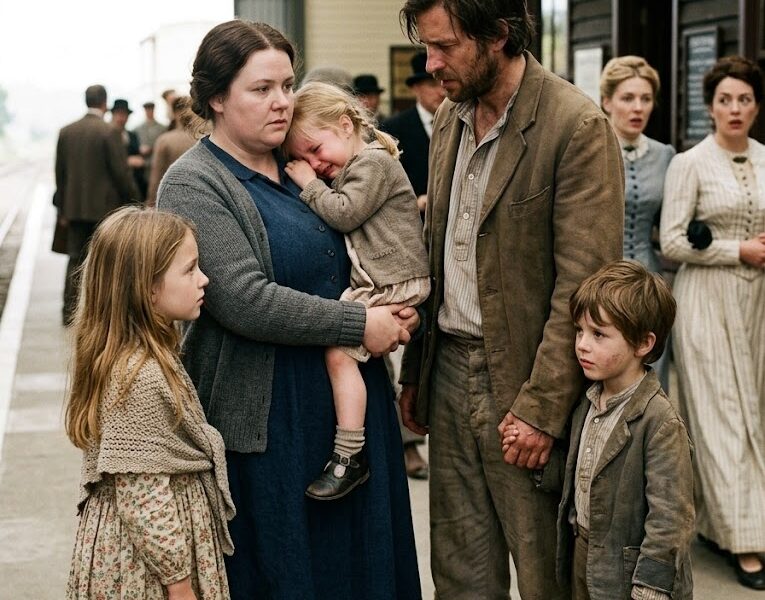
“I am not fit for any man, sir.”
The words left Ruth Brennan’s mouth before she could stop them.
For one terrible second, the entire train platform seemed to go silent.
The women who had been laughing beside the ticket office stopped laughing.
The stationmaster paused with one hand on a wooden crate.
Even the horses hitched beside the road seemed unnaturally still.
Ruth could feel every eye on her.
She had spent years learning how to disappear under people’s stares. She knew how to lower her chin. How to fold her hands over the widest part of her dress. How to stand slightly behind other women in photographs. How to laugh when someone made a joke about her size so nobody would realize the joke had hurt.
But she did none of those things now.
She kept her eyes on the tall, exhausted widower standing beside the wagon.
James Hartley.
His shirt sleeves were rolled above weathered forearms. Dust clung to his boots. His dark hair had been flattened by his hat, and there were deep shadows beneath his eyes that made him look older than he probably was.
Behind him stood three children.
Emma, eight.
Thomas, five.
And Lucy, three.
They were too quiet.
Children should not have known how to stand that still.
The youngest girl had tears sliding down her cheeks without making a sound.
Ruth looked at them, and something inside her shifted.
So she finished the sentence.
“I know I’m not what anyone comes looking for,” she said, her voice trembling. “But I can love your children.”
Someone behind her inhaled sharply.
Ruth swallowed.
“I can feed them. I can keep them clean. I can sit beside them when they’re sick. I can listen when they’re frightened. I can make this little girl feel safe enough to cry out loud instead of pretending she isn’t crying.”
Lucy stared at her.
Ruth’s voice grew steadier.
“I can be what they need, even if I’m not what anyone wants.”
James Hartley said nothing.
And Ruth knew that silence.
She had heard it before.
Two years earlier, she had stepped off another train after traveling three days to meet a man who had advertised for a wife.
She had spent almost everything she had on the ticket.
She had worn her best blue dress.
She had fixed her hair twice before the train arrived.
For three days she had imagined what he might say when he saw her.
Welcome.
You must be Ruth.
I’m glad you came.
Instead, the man had looked her up and down, laughed once, and left her suitcase sitting beside her feet.
“You’re not what I ordered.”
Ruth had thought those were the worst words anyone could say to a woman.
Then he added five more.
“You’re not fit for any man.”
He never asked her name.
She took the next train back.
But the sentence came home with her.
It followed her into every boarding house room, every church pew, every kitchen where prettier women whispered about weddings while Ruth washed dishes.
Eventually, she stopped arguing with it.
That very morning, Mrs. Henderson, the boarding house matron, had found Ruth at the sink and folded her arms.
“Every girl your age has gone somewhere, Ruth. Married. Chosen. Settled. And here you are.”
Ruth had continued washing the same plate.
Mrs. Henderson looked her over.
“Aren’t you fit for any man?”
The plate stopped moving in Ruth’s hands.
For a moment she was back on that platform two years earlier.
Then she dried her hands.
“No, ma’am,” she said softly. “I suppose I’m not.”
Mrs. Henderson had smiled as though Ruth had finally admitted something obvious.
“Then you’d better find work. This house closes in two weeks.”
That night Ruth counted her money twice.
Seventeen dollars.
That was everything.
Seventeen dollars and a small suitcase containing two dresses, a comb, three letters from her dead mother, and a baby blanket she could never bring herself to throw away.
She had nowhere to go.
Then she saw the handwritten notice pinned crookedly to the church bulletin board.
WIDOWER. THREE CHILDREN. NEED HELP. ROOM AND BOARD. SEND WORD TO JAMES HARTLEY, REDEMPTION CREEK.
Ruth stood beneath the church lamp reading it until the flame began to flicker.
Three children.
Not a wife.
Not romance.
Not a man choosing her.
Work.
Something she understood.
That night she sent a telegram.
The next morning she spent her last seventeen dollars on a train ticket.
And now, standing in Redemption Creek with an empty purse and nowhere to return to, she waited for James Hartley to decide whether she was worth taking home.
A red-haired woman near the station gave a cruel little laugh.
“Oh, this is embarrassing.”
Ruth felt heat crawl up her neck.
The woman had been one of four who had arrived expecting employment with the widower.
All four were younger than Ruth. Slimmer. Prettier.
They had surrounded James minutes earlier.
“What are the wages?” the blonde had asked.
“Room and board. Ten dollars a month.”
She laughed.
“For three children?”
Another demanded Sundays off.
A third wanted a clothing allowance because farm work would ruin her dresses.
Then one looked at the children and asked, “Are they well behaved? I won’t tolerate wild children.”
James’s jaw tightened.
“They’re grieving.”
The woman blinked.
“Their mother died four months ago,” he added.
The answer changed nothing.
Within minutes, all four women were walking away.
Then Ruth stepped forward.
Now the red-haired woman stared at her.
“You honestly think he wants you?”
Ruth’s stomach twisted.
“Look at yourself.”
There it was again.
The old judgment.
The old sentence.
But this time Ruth did not look down.
She looked at James.
He was not looking at her body.
He was looking at her face.
Then he asked quietly, “Will you stay?”
Ruth forgot how to breathe.
“What?”
“My children need someone who means what she says.” His eyes moved toward Lucy. “Will you stay?”
Ruth’s throat tightened.
“Yes.”
James nodded once.
Then he did something no one expected.
He turned, lifted Lucy into his arms, walked toward Ruth—and placed the little girl against her chest.
Lucy weighed almost nothing.
Ruth instinctively supported her back.
For half a second, the child remained stiff.
Then she collapsed against Ruth’s shoulder.
A sound tore out of her.
Not ordinary crying.
Gasping, broken sobs.
The kind a child makes after learning for too long that nobody is coming.
Ruth held her tighter.
James looked away.
“This is Lucy,” he said.
Ruth stroked the child’s hair.
“Hello, Lucy.”
“That’s Thomas.”
A small boy watched her suspiciously.
“And Emma.”
The oldest girl did not smile.
Emma’s eyes were hard in the way only a frightened child’s eyes could be.
Ruth recognized something in them.
Don’t promise me anything.
Promises disappear.
James picked up Ruth’s suitcase.
“The ranch is about an hour.”
Ruth nodded.
Then Emma spoke for the first time.
“How long are you staying?”
Ruth looked at her.
“As long as you need me.”
Emma’s expression did not change.
“That’s what the last one said.”
Ruth felt the first warning then.
This family did not need a housekeeper.
It needed someone willing to walk into a graveyard of unfinished grief and stay there long enough for the dead to stop controlling the living.
And Ruth had no idea yet how much that would cost her.
The Hartley ranch looked beautiful from the ridge.
Golden evening light stretched across the pasture. A red barn stood beyond a weathered fence. Cottonwood trees moved gently near the creek, and the farmhouse sat against the horizon with a broad porch facing west.
For several seconds, Ruth thought perhaps she had made the right decision.
Then the wagon got closer.
Laundry lay in a damp pile on the porch.
The garden had disappeared beneath weeds.
A broken chair leaned against the railing.
Chickens wandered everywhere.
One shutter hung crooked from an upstairs window.
The place was not neglected because no one cared.
It was neglected because everyone who lived there was surviving something.
James climbed down.
“It’s not much.”
Ruth looked at the strong house beneath the disorder.
“It’s not bad.”
James glanced at her.
“It’s grief.”
His face changed.
Only slightly.
But Ruth saw it.
Inside, the evidence was everywhere.
Unwashed dishes.
Dust.
Children’s shoes in the hallway.
A tiny pink sweater hanging from the back of a chair.
A woman’s sewing basket beside the fireplace, untouched.
James saw Ruth notice it.
“That was Sarah’s.”
Ruth said nothing.
“My wife.”
“I know.”
“She died in February.”
His voice became flat.
That told Ruth more than tears would have.
He showed her a small room beside the kitchen.
“There’s a lock on the inside.”
Ruth looked at him.
James seemed uncomfortable.
“The last woman said she didn’t feel safe sleeping under the same roof with an unmarried man.”
“Thank you.”
Emma stood in the doorway.
“You won’t need the room long.”
James sighed.
“Emma.”
“What?”
Ruth turned.
Emma crossed her arms.
“Five women came after Mama died. They all left.”
“Why?”
“One said Lucy cried too much. One said Thomas was strange because he didn’t talk enough. One said Papa was rude. Another stayed eleven days.”
“What happened?”
“She got tired of us.”
James’s face tightened.
“Enough.”
But Ruth knelt until she was level with Emma.
“I understand why you don’t believe me.”
“I don’t.”
“You don’t have to.”
Emma looked surprised.
“I’m here today,” Ruth continued. “Tomorrow morning, I’ll still be here. After that, we’ll see.”
Emma studied her.
“You promise?”
Ruth almost said yes.
Then she remembered all the promises people had made her.
Instead she said, “I’ll show you.”
Something flickered behind Emma’s eyes.
Then she walked away.
That night Ruth waited until the children were asleep.
Then she entered the kitchen, tied an apron around her waist, and stared at the mountain of dishes.
She began washing.
One plate.
Then another.
Then another.
She scrubbed the counters.
Swept the floor.
Put flour back into jars.
Folded towels.
Repaired a torn curtain with thread from Sarah’s sewing basket, then stopped halfway through because touching another dead woman’s things suddenly felt too intimate.
An hour later, the back door opened.
James stepped inside.
He froze.
The kitchen smelled like soap instead of old grease.
“You didn’t have to do this.”
“I know.”
“I hired you for the children.”
Ruth rinsed another plate.
“I need to work.”
“Why?”
She paused.
Because silence made memories louder.
Because when her hands stopped moving, she remembered a tiny baby who had lived only nine days.
Because there were griefs she had never told anyone about.
Because she understood James’s house better than he knew.
“It keeps me from thinking.”
James studied her.
He did not ask about what.
Instead, he picked up a towel.
“What are you doing?”
“Drying.”
“You don’t have to.”
“I know.”
Ruth almost smiled.
They worked side by side.
When the last dish was put away, James made coffee.
He placed a cup in front of her.
“You’re good at taking care of things.”
“My mother taught me.”
“She still living?”
“No.”
“I’m sorry.”
Ruth wrapped both hands around the warm cup.
“So am I.”
Lucy slept in a small bed near the fireplace because she had refused to sleep upstairs since Sarah died.
Ruth watched the rise and fall of the child’s chest.
James followed her gaze.
“She wakes screaming sometimes.”
“What does she say?”
“Mama.”
He stared into his coffee.
“I don’t know what to tell her.”
Ruth looked at him.
“Maybe you don’t have to tell her anything.”
James frowned.
“Maybe you just hold her.”
That night, at 2:17 in the morning, Lucy screamed.
Ruth was out of bed before she fully woke.
She found James standing beside the little bed, helpless, while Lucy kicked beneath the blankets.
“Mama! Mama!”
James’s face had gone white.
Ruth knelt.
“Lucy.”
The child opened terrified eyes.
Ruth held out her arms.
Lucy climbed into them.
Ruth rocked her slowly.
“I know.”
“Mama.”
“I know.”
“She’s gone.”
“Yes.”
“I want her.”
Ruth closed her eyes.
“I know, sweetheart.”
Across the room, James turned his face away.
And Ruth understood something.
The children were not the only ones in that house who had forgotten how to cry.
Two weeks passed.
Lucy stopped flinching when Ruth reached for her.
Thomas began following Ruth through the kitchen asking questions.
Why does bread rise?
Why do chickens eat rocks?
Can God see through roofs?
Why does Papa look sad when nobody is talking?
That last question Ruth did not answer.
Emma remained different.
At eight years old, she buttoned Lucy’s dresses, reminded Thomas to wash his hands, checked the stove before bed and counted eggs every morning.
She had become the woman of the house because nobody had told her she was allowed to remain a child.
One morning Ruth found her in the chicken coop trying to repair a nesting box.
Emma swung a hammer.
Missed.
Hit her thumb.
She gasped.
But she did not cry.
Ruth crouched beside her.
“That hurt.”
“I’m fine.”
“You’re allowed to say it hurt.”
“I said I’m fine.”
Ruth looked at the hammer.
“Want help?”
“No.”
“Your mother teach you how to fix things?”
Emma’s face hardened.
“Don’t talk about Mama.”
Ruth remained still.
“She taught you well.”
Emma blinked.
“You take good care of Thomas and Lucy.”
“I have to.”
“Why?”
“Because nobody else will.”
The words came too quickly.
Then Emma realized what she had admitted.
Her mouth trembled.
“Everyone leaves.”
Ruth’s heart tightened.
Suddenly Emma’s coldness made perfect sense.
The child was not rejecting Ruth.
She was preparing for Ruth’s disappearance.
“You’re right,” Ruth said.
Emma looked suspicious.
“You are very good at taking care of them.”
“I know.”
“But you’re eight.”
“I’m the oldest.”
“That doesn’t make you their mother.”
Emma looked down.
“Someone has to be.”
Ruth sat in the straw beside her.
“What if someone helped?”
“Why?”
“Because you’re tired.”
“I’m not.”
“Emma.”
The child’s eyes filled.
“I can’t be tired.”
“Why not?”
“Because if I stop—”
Her voice broke.
“If I stop, everything falls apart.”
There it was.
The terrible belief holding the little girl together.
Ruth reached for the hammer but did not touch Emma.
“Then don’t stop.”
Emma stared at her.
“Just let me carry some of it.”
Silence.
Then Ruth pointed toward the broken nesting box.
“I don’t know how Thomas likes his eggs.”
Emma frowned.
“What?”
“I keep making them wrong.”
“They’re too wet.”
“I suspected that.”
“He likes them scrambled dry, with pepper.”
“How much?”
“Not too much.”
“You’ll have to teach me.”
Emma’s expression softened.
“You want me to teach you?”
“You know them better than anyone.”
For the first time, Emma smiled.
Barely.
But it was real.
That afternoon, Emma found Ruth in the kitchen.
“Lucy needs her hair braided.”
“All right.”
“She won’t sleep if it’s loose.”
Ruth found the brush.
Emma hesitated.
“Mama braided it differently.”
Ruth handed her the comb.
“Show me.”
They sat on the porch with Lucy between them.
Emma guided Ruth’s fingers.
“Under. Then over. No, not like that.”
“I’m terrible.”
“You are.”
Ruth laughed.
Emma almost did.
“Mama used to sing when she did this.”
“What song?”
Emma began softly.
A lullaby about stars.
Halfway through, her voice broke.
Ruth did not tell her not to cry.
She simply hummed the melody.
After several seconds, Emma joined her again.
When they finished, Lucy touched her braid.
“I miss Mama.”
Emma looked away.
“Me too.”
Thomas had been standing in the doorway.
He asked the question none of them expected.
“Can we miss Mama and love Miss Ruth at the same time?”
Ruth’s breath caught.
Emma looked at her.
Ruth said nothing.
This answer belonged to Sarah’s daughter.
Finally Emma nodded.
“Yes.”
Thomas relaxed.
“I think we can.”
That night, someone knocked on Ruth’s door.
Emma stood outside in her nightgown.
“What is it?”
Emma stared at the floor.
“I’m tired.”
Ruth waited.
“I’m tired of being strong all the time.”
Ruth opened her arms.
Emma collapsed into them.
She cried so violently Ruth had to sit on the floor.
For months, the child had been holding an entire family together with eight-year-old hands.
Now those hands clutched Ruth’s dress.
“I want my mama.”
“I know.”
“I want her back.”
“I know.”
“I don’t want to take care of everybody anymore.”
“You don’t have to.”
“Who will?”
Ruth held her tighter.
“Let me be strong for a while.”
Neither of them noticed James standing in the dark hallway.
He heard every word.
And something inside him began to break open.
James started watching Ruth differently after that.
He saw Thomas learning letters at the kitchen table.
He saw Emma laughing while planting beans.
He saw Lucy fall asleep against Ruth’s chest.
He saw Ruth burn biscuits, swear under her breath, then look horrified when she realized Thomas had heard.
He saw life returning in ordinary pieces.
One evening Emma brought schoolwork to the table.
“I have to draw my family.”
James sat down.
“I’ll help.”
His drawing of the house looked so terrible Thomas burst out laughing.
“That looks like the barn after a tornado.”
“It does not.”
“It does,” Emma said.
Even James laughed.
Then Emma pushed the paper toward Ruth.
“Your turn.”
Ruth drew the house.
The porch.
Flowers.
Chickens.
James.
Emma.
Thomas.
Lucy.
She stopped.
Emma frowned.
“You forgot someone.”
Ruth looked at the drawing.
“Who?”
“You.”
The room became quiet.
Ruth’s fingers tightened around the pencil.
“I’m not family.”
Emma’s face fell.
James said softly, “Draw yourself.”
Ruth looked at him.
His eyes held hers.
So she added a fifth figure.
Small.
Standing slightly apart.
Emma took the pencil and drew a line connecting Ruth’s hand to Lucy’s.
Then another connecting Ruth to Emma.
“There.”
Ruth’s throat tightened.
“Now it’s right.”
Later that night, James found Ruth on the porch.
“They’re different.”
Ruth looked toward the upstairs windows.
“Children change quickly.”
“No.”
He sat beside her.
“They’re coming back.”
Ruth said nothing.
“Emma smiled at school today.”
“She smiles here.”
“Not like that.”
James stared into the darkness.
“I thought keeping them fed was enough. Keeping the roof repaired. Keeping the ranch running.”
“You were grieving too.”
“I’m their father.”
“You’re also human.”
“I don’t get to fall apart.”
Ruth looked at him.
“Who told you that?”
He almost laughed.
“Life.”
“Life lies.”
James turned toward her.
For a moment neither spoke.
Then he said, “You gave them hope.”
Ruth felt warmth rise into her face.
“They already had it.”
“No.”
His voice lowered.
“You brought it back.”
Their shoulders almost touched.
And for the first time since arriving, Ruth became afraid.
Not of James.
Of wanting something.
Because wanting was dangerous.
Wanting meant imagining she might stay.
The following Sunday, Emma’s teacher stopped Ruth after church.
“Emma’s reading has improved remarkably.”
“She’s always been bright.”
“She’s happier.”
Ruth smiled.
“James has been working with her.”
The teacher shook her head.
“She specifically told me it was because of you.”
Ruth glanced toward Emma.
The girl was chasing Thomas around a tree.
“She asked whether you’d attend the school meeting Tuesday.”
“I’m not her mother.”
“No.”
Miss Adelaide smiled.
“But you’re the person she wants there.”
On Tuesday, Ruth and James walked to the schoolhouse together.
Emma’s face lit up when she saw them.
For an hour, Ruth forgot that she did not belong.
Then Mr. Blackwell stopped them outside.
He was a school trustee and one of Redemption Creek’s wealthiest landowners.
“That woman isn’t the children’s mother.”
James’s expression hardened.
“Her name is Ruth.”
“People are talking.”
“People usually do.”
“This arrangement is inappropriate.”
Ruth felt her stomach drop.
Mr. Blackwell looked directly at her.
“An unmarried woman living in a widower’s home. Acting as mother to his children. Sharing meals. Appearing publicly together.”
“She has her own room,” James said.
“That hardly changes appearances.”
“My children are healthy.”
“That isn’t the only concern.”
James stepped closer.
“What exactly are you accusing her of?”
Blackwell’s expression tightened.
“The school board has a responsibility to protect children from morally questionable environments.”
Ruth felt as though the train platform had appeared beneath her feet again.
Not fit.
Unwanted.
Improper.
James’s voice became dangerously calm.
“My children are fed, clean, loved and happier than they’ve been since their mother died. If that offends you, I suggest you learn to live with being offended.”
Blackwell stared at him.
“You should care what the community thinks.”
“I care what my children need.”
“You may regret that distinction.”
He walked away.
Ruth stood frozen.
“I should leave.”
James turned immediately.
“No.”
“If people are talking—”
“Let them.”
“They can hurt you.”
“They already tried.”
“James.”
He stepped closer.
“Emma smiled today.”
Ruth stopped.
“She smiled when she saw us walk through that door.”
His voice softened.
“Do you know how long it had been since she looked at me like that?”
Ruth’s eyes burned.
“They need you.”
Then James added, almost too quietly:
“We all do.”
Neither moved.
The words hung between them.
And neither understood yet that someone else had heard enough to decide Ruth Brennan needed to disappear.
The children were healing.
James was not.
Ruth noticed it in the barn after dark.
In the way he worked until his hands bled.
In the way he spoke about Sarah only as “their mother.”
Never Sarah.
Never my wife.
One evening Thomas asked at supper, “Papa, did Mama like flowers?”
James stopped chewing.
“Eat your supper.”
“Emma says Mama liked daisies.”
James stared at his plate.
“Thomas.”
“But I don’t remember.”
“That’s enough.”
Thomas went quiet.
Ruth watched his face fall.
Later she found James in the barn repairing a harness that did not need repairing.
“You can’t keep doing that.”
He did not turn.
“Doing what?”
“Punishing them whenever they remember her.”
His hands stopped.
“I’m not punishing anyone.”
“They ask about Sarah and you shut the door.”
James flinched at the name.
Ruth saw it.
“Say her name.”
“Don’t.”
“Sarah.”
“Ruth.”
“Your wife’s name was Sarah.”
He slammed the harness onto the workbench.
“I know her name.”
“Then why are you making your children afraid to say it?”
His face changed.
“Because talking about her makes it real.”
Ruth’s anger disappeared.
James gripped the edge of the bench.
“If I talk about her laugh, I remember I’ll never hear it again. If I tell them she loved daisies, I remember where we buried her. If I tell Lucy how Sarah held her when she was born, I remember standing beside that grave while Lucy kept asking when her mother was coming home.”
His voice cracked.
“I cannot do that every day.”
Ruth stepped closer.
“But your children are doing it every day without you.”
James closed his eyes.
“They think grief is something they have to hide because their father can’t bear to see it.”
“What if I can’t?”
His voice was barely audible.
“What if I start and I can’t stop breaking?”
Ruth looked at him for a long time.
“Then break.”
He opened his eyes.
“We’ll be there when you’re finished.”
That Sunday, James took the children to Sarah’s grave.
Ruth stayed several yards away.
James knelt.
Emma wrapped her arms around his neck.
Thomas touched the stone.
Lucy picked dandelions and laid them on the ground.
Then James cried.
Not quietly.
Not privately.
He cried like a husband who had spent four months pretending grief was a job he could outwork.
His children cried with him.
And when they came home, Thomas ran into the kitchen.
“Mama did like flowers.”
Ruth smiled.
“She did?”
“Papa said she planted daisies.”
That evening James sat with them.
“Your mother used to sing a song.”
Emma looked up.
“The mockingbird song?”
James nodded.
He started singing.
His voice broke on the second line.
Emma continued.
Thomas hummed.
Lucy fell asleep in Ruth’s lap.
When they finished, Emma asked, “Can we talk about Mama now?”
James pulled her close.
“I’ll always be sad when we do.”
Emma waited.
“But yes.”
She buried her face against him.
“I’m scared I’ll forget her voice.”
James kissed her hair.
“I won’t let you.”
Ruth looked toward the fire.
Something had changed.
The Hartley family was no longer trying to move away from Sarah.
They were learning to carry her forward.
And that made room for something none of them had expected.
Ruth.
The days settled into rhythm.
James and Ruth worked side by side.
They stopped asking who should do what.
He chopped wood while she prepared supper.
She held fence posts while he repaired them.
He learned that she liked coffee too strong.
She learned that he always gave Lucy the last biscuit.
One morning their hands touched in the garden.
Neither pulled away.
James looked at her fingers beneath his.
“You’re good at this.”
“Planting beans?”
“All of it.”
Ruth’s heart began pounding.
“Being here.”
He moved slightly closer.
“Being part of us.”
Thomas shouted from the fence.
“Miss Ruth!”
They separated instantly.
Ruth almost laughed.
Almost.
That afternoon they made bread.
Thomas covered himself in flour.
Lucy ate raw dough.
Emma declared herself the only competent baker in the family.
James leaned against the doorway watching.
Ruth caught him.
“What?”
“Nothing.”
“You’re staring.”
“I know.”
“Why?”
His smile faded into something gentler.
“This house hasn’t felt alive in a long time.”
“It’s the children.”
“It’s you.”
Ruth looked down.
“You brought life back.”
Later, while putting Lucy down for her nap, Ruth heard the question she had secretly feared.
“Will you be my mama now?”
Ruth froze.
Lucy blinked sleepily.
“Your mama is in heaven.”
“I know.”
“I can’t replace her.”
“I know.”
“Then what do you mean?”
Lucy touched Ruth’s cheek.
“Can you be my mama too?”
Ruth’s eyes filled.
“Emma says people can have two mamas. One in heaven and one here.”
Ruth could barely speak.
“If that’s what you want.”
Lucy smiled.
“It is.”
Then she yawned.
“I love you, Mama Ruth.”
Ruth sat beside the bed long after Lucy fell asleep.
That evening she told James.
He went very still.
“What did you tell her?”
“That I’d never replace Sarah.”
He nodded.
“And?”
“I told her that if she wanted me to be another mother to her…”
Ruth looked down.
“…I would.”
James was silent.
Ruth’s stomach tightened.
“I’m sorry. Maybe I crossed a line.”
“No.”
He shook his head.
“Sarah would have liked you.”
“You can’t know that.”
“I do.”
“How?”
“Because she loved those children more than anything.”
His eyes held Ruth’s.
“She would have loved the way you see them.”
He paused.
“And the way you see me.”
Ruth’s breath caught.
“James.”
“I know this is complicated.”
“Yes.”
“I know I’m still grieving.”
“Yes.”
“And I know you came here for work.”
Ruth waited.
“But you’re not the woman I hired anymore.”
Her heart seemed to stop.
“What am I?”
James looked toward the window where the children were playing outside.
Then back at her.
“Necessary.”
Ruth tried to smile.
“That doesn’t sound romantic.”
A faint smile touched his face.
“I’m not very good at romantic.”
“No.”
“You’re becoming necessary to all of us.”
The silence between them changed.
That night they sat on the porch.
Their shoulders touched.
Neither moved away.
Ruth looked at the stars and thought about the woman who had stepped off a train two years earlier believing a stranger had correctly measured her worth in five cruel words.
Not fit for any man.
For the first time, she wondered whether he had been wrong.
And that was precisely when Redemption Creek decided to punish her for believing she might belong.
Tuesday morning began with clean sheets snapping in the wind.
Ruth was pinning one to the clothesline when she saw two riders coming up the road.
The sheriff.
And a stranger in a black suit.
James emerged from the barn.
“Sheriff Patterson?”
The sheriff removed his hat.
“James.”
The other man dismounted.
“This is Judge Winters.”
Ruth’s hands went cold.
The judge opened a leather folder.
“Mr. Hartley, we have received a formal complaint concerning the welfare of your children.”
James stepped forward.
“From whom?”
“That is not presently relevant.”
“It’s relevant to me.”
The judge’s eyes moved toward Ruth.
“The complaint alleges that an unmarried woman of questionable character is residing in this household and assuming maternal authority over three minor children.”
Ruth felt the sheet slip from her fingers.
James’s voice hardened.
“Questionable character?”
“The county is concerned about the moral environment.”
“This woman has done nothing except care for my children.”
“That may be your opinion.”
“It’s a fact.”
Emma appeared on the porch.
“Papa?”
Thomas and Lucy stood behind her.
The judge looked toward them.
“I need to speak with the children separately.”
“No.”
James moved between him and the porch.
“You’re not interrogating my children.”
“Mr. Hartley, I can conduct this inquiry with your cooperation, or I can return with deputies.”
James’s hands curled into fists.
Ruth touched his arm.
“It’s all right.”
“It isn’t.”
“They’ll tell the truth.”
Emma went first.
The door closed.
Ruth could hear the judge’s voice.
“Does Miss Brennan sleep in your father’s room?”
“No, sir.”
“Has she ever?”
“No.”
“Does your father touch her?”
A pause.
“What do you mean?”
Ruth closed her eyes.
James looked ready to tear the door from its hinges.
Thomas went next.
“Does Miss Brennan tell you to keep secrets?”
“No, sir.”
“Has she told you not to tell adults what happens in this house?”
“No.”
“What does she tell you?”
Thomas answered softly.
“Not to lie.”
Then Lucy.
Within minutes the child began crying.
“Mama Ruth!”
Ruth moved toward the door.
The sheriff blocked her gently.
“You can’t interfere.”
“Mama Ruth!”
Ruth’s whole body shook.
James stared at the wall.
His fists were white.
When the judge finally emerged, Lucy ran straight into Ruth’s arms.
He inspected Ruth’s bedroom.
The lock.
The beds.
The pantry.
The kitchen.
The children’s clothes.
He wrote everything down.
Finally, he closed the folder.
“The children appear physically cared for.”
James gave a bitter laugh.
“Appears?”
“However, the moral concern remains.”
Ruth felt Lucy tighten her arms around her neck.
“What does that mean?” James asked.
The judge looked directly at Ruth.
“Miss Brennan has forty-eight hours to leave this property.”
Silence.
James stared at him.
“No.”
“If she remains beyond that time, I will authorize removal of the children pending further proceedings.”
Emma gasped.
Thomas grabbed Ruth’s skirt.
James stepped forward.
“You will do what?”
“The children will be placed temporarily in the church orphanage.”
“You are not taking my children.”
“Then Miss Brennan leaves.”
Ruth felt the earth tilt.
James pointed toward the road.
“Get off my property.”
The judge closed his folder.
“The complaint came from several concerned citizens, including members of your church and school community.”
Blackwell.
Ruth knew instantly.
James said, “Then I’ll marry her.”
Ruth looked at him.
The judge shook his head.
“This inquiry concerns an established period of impropriety. A rushed marriage will not automatically erase the record.”
“You said the problem was that she’s unmarried.”
“I said the arrangement was morally questionable.”
“So this was never about marriage.”
The judge’s silence answered him.
“Forty-eight hours.”
He mounted his horse.
“After that, Miss Brennan, if you are still here, the county will act.”
They rode away.
Emma ran to Ruth.
“You can’t leave.”
Ruth held her.
“You promised.”
Thomas began crying.
Lucy had never stopped.
James stood in the yard staring after the riders.
And Ruth understood the trap.
If she stayed, the children could lose their father.
If she left, she would become exactly what Emma had always expected.
Another person who promised to stay.
Then disappeared.
That night Ruth packed.
Her suitcase looked exactly as it had when she arrived.
Two dresses.
A comb.
Three letters.
The baby blanket.
Except now there were things that did not fit inside.
Lucy’s arms around her neck.
Thomas asking impossible questions.
Emma finally sleeping through the night.
James sitting beside her beneath the stars.
He appeared in the doorway.
“What are you doing?”
Ruth folded a dress.
“You know.”
“No.”
“James.”
“No.”
“I’m saving your children.”
“By leaving them?”
“By keeping them out of an orphanage.”
“We fight.”
“And if we lose?”
“We won’t.”
“You don’t know that.”
“I know what’s right.”
“Courts don’t always care.”
James stared at her.
Ruth’s hands shook.
“If I stay and they take Emma, Thomas and Lucy away, I will never forgive myself.”
“If you leave, Emma will never believe anyone again.”
Ruth closed her eyes.
“Don’t.”
“It’s true.”
“That’s cruel.”
“So is watching you pack.”
Ruth pushed the dress into the suitcase.
“I came here with nothing.”
“That’s not true.”
“Seventeen dollars. Two dresses. That was everything.”
“No.”
James stepped closer.
“You came here with exactly what this family needed.”
Ruth looked away.
He caught her hand.
“I love you.”
Everything stopped.
James seemed almost angry with himself for saying it.
But he did not take it back.
“I don’t know when it happened.”
Ruth’s eyes filled.
“Maybe when Emma started laughing. Maybe when Thomas began following you everywhere. Maybe the first night I saw you holding Lucy while she screamed for Sarah and you didn’t try to make her stop.”
His grip tightened.
“Maybe it happened slowly enough that I didn’t notice until somebody told me you had to leave.”
Ruth cried silently.
“But I love you.”
“James—”
“My children love you.”
He swallowed.
“You’re not necessary anymore.”
A tear slid down Ruth’s cheek.
“You’re ours.”
The word broke her.
She pressed a hand over her mouth.
James moved closer.
Ruth shook her head.
“That’s why I have to go.”
His face fell.
“Because I love you too.”
He stared at her.
“All of you.”
“Then stay.”
“I love you too much to gamble with your children.”
She pulled her hand free.
James stood in the doorway for several seconds.
Then he walked away.
An hour before dawn, Ruth lifted her suitcase.
She had already said goodnight to the children.
She had kissed Lucy’s forehead.
She had tucked Thomas’s blanket around him.
She had stood beside Emma’s bed longer than the others.
Emma had been asleep.
Or Ruth thought she had.
Ruth reached the front door.
A floorboard creaked.
She turned.
Emma stood at the bottom of the stairs.
Barefoot.
Nightgown wrinkled.
Eyes enormous.
“You’re leaving.”
Ruth’s throat closed.
“I have to.”
“You promised.”
“I promised to protect you.”
“No.”
“This is how I protect you.”
Emma’s face collapsed.
“No!”
The scream woke the house.
Thomas came running.
Then Lucy.
James appeared behind them.
Lucy saw the suitcase.
“Mama Ruth?”
Ruth began crying.
Lucy ran.
“Don’t go!”
Thomas wrapped both arms around Ruth’s waist.
Emma clung to her from the other side.
Three children.
Three terrified voices.
Three bodies shaking against hers.
“You said you were different!” Emma sobbed.
“I am trying to save you.”
“I don’t want to be saved from you!”
Ruth froze.
James stood several feet away.
His eyes were wet.
“There has to be another way.”
Ruth looked down at Lucy.
At Thomas.
At Emma.
At the family she had never expected anyone to let her have.
All her life, Ruth had survived by accepting other people’s verdicts.
Too large.
Too plain.
Unwanted.
Unfit.
Improper.
Leave.
For the first time, she wondered what would happen if she stopped obeying.
She slowly lowered the suitcase.
Emma looked up.
Ruth wiped her face.
“There is another way.”
James stepped forward.
“What?”
Ruth looked at him.
“We fight.”
By Sunday afternoon, everyone in Redemption Creek had heard.
The church was packed.
Some came because they supported James.
Some came because they supported Blackwell.
Many came because scandal was more interesting than scripture.
Judge Winters sat near the front.
Mr. Blackwell sat beside him.
Ruth entered with James and the children.
Whispers followed them.
She heard fragments.
That’s her.
The large woman.
Living with him for months.
Children calling her Mama.
Ruth’s old instincts screamed at her to shrink.
Instead she took Emma’s hand.
The judge stood.
“Mr. Hartley has requested a public hearing regarding the custody concern.”
James rose.
“My children were dying before Ruth came.”
The church quieted.
“Not from hunger. Not from cold.”
He looked at Emma.
“From grief.”
His voice carried through the room.
“Emma stopped sleeping. Thomas barely spoke. Lucy stopped eating unless I forced her.”
Thomas leaned against Ruth.
“I kept them alive.”
James swallowed.
“But they weren’t living.”
Nobody moved.
“Then Ruth Brennan stepped off a train.”
His eyes found hers.
“She taught Emma she didn’t have to become a mother at eight years old.”
Emma began crying.
“She taught Thomas that asking questions was better than being silent.”
A few people smiled.
“She taught Lucy that loving someone new didn’t mean betraying the mother she lost.”
James’s voice broke.
“And she taught me that being a father meant more than keeping food on a table.”
Judge Winters started to speak.
Emma stood.
“I want to say something.”
Ruth touched her arm.
“You don’t have to.”
“I know.”
Emma walked to the front.
She looked impossibly small.
“My mama died.”
Her voice trembled.
“I thought that meant I had to become her.”
James covered his mouth.
“I thought I had to take care of Thomas and Lucy because Papa was sad.”
Emma wiped her face.
“I was tired all the time.”
Nobody whispered now.
“I missed Mama, but I was scared to talk about her because Papa looked like he was going to break.”
James lowered his head.
“Then Miss Ruth came.”
Emma looked at Ruth.
“She didn’t tell me she was my new mother.”
Ruth began crying.
“She asked me how Thomas liked his eggs.”
A soft laugh moved through the church.
“She let me teach her how Mama braided Lucy’s hair.”
Emma’s voice cracked.
“She told me I could miss my mama and love somebody else too.”
Judge Winters shifted.
Emma looked directly at him.
“So if loving Miss Ruth is wrong, I don’t understand what right is.”
Silence.
Then Miss Adelaide stood.
“I teach Emma.”
Blackwell frowned.
“She has improved academically and emotionally since Miss Brennan arrived. I have never seen evidence that Ruth Brennan is anything but a stabilizing influence.”
Another person rose.
Then another.
Finally, near the back of the church, an older woman stood.
Ruth recognized her.
Mrs. Henderson.
The boarding house matron.
Ruth stared.
Mrs. Henderson’s voice was unsteady.
“I knew Ruth before she came here.”
Ruth’s stomach tightened.
“I once asked her whether she was fit for any man.”
The church became silent again.
“I thought I was being practical.”
She looked at Ruth.
“I was being cruel.”
Ruth could not move.
“I called her unfit.”
Mrs. Henderson wiped her eyes.
“But I’ve watched those children today.”
She looked toward Emma, Thomas and Lucy.
“And I realize I was the one unfit.”
Her voice broke.
“Unfit to judge.”
Ruth felt something inside her finally loosen.
Not because Mrs. Henderson apologized.
But because Ruth suddenly understood she no longer needed the apology.
She stood.
Her legs shook as she walked forward.
Judge Winters watched her.
So did Blackwell.
So did the entire town.
Ruth took a breath.
“Two years ago, I traveled three days by train to meet a man who said he wanted a wife.”
She heard Emma inhale.
“He looked at me once.”
Ruth’s voice remained steady.
“And he told me I wasn’t what he ordered.”
James’s jaw tightened.
“He said I wasn’t fit for any man.”
Ruth looked around the church.
“I believed him.”
That confession was harder than anything else.
“I believed him because other people had taught me to believe that being wanted was something women earned by looking a certain way.”
She looked at her hands.
“So I learned to be useful instead.”
Her voice softened.
“I washed dishes. I cleaned rooms. I took care of other people. I made myself small enough that nobody would have to notice me.”
She looked at James.
“Then I came here.”
Lucy reached toward her.
Ruth smiled through tears.
“And these children noticed me.”
She looked at Emma.
“They chose me when I had nothing.”
Thomas.
“They trusted me when I didn’t trust myself.”
Lucy.
“They loved me before I understood I was allowed to be loved.”
Finally, Ruth faced the judge.
“You say I’m unfit to be part of their lives.”
Her voice strengthened.
“But you are measuring this family by appearances.”
She glanced toward Blackwell.
“I have spent my entire life being measured that way.”
The church was completely still.
“I will not let these children be punished because people prefer a respectable-looking house to a loving one.”
Judge Winters’s expression shifted.
Ruth continued.
“I cannot replace Sarah Hartley.”
James closed his eyes briefly.
“I would never try.”
She looked at the children.
“But love is not a chair with only one seat.”
Emma began sobbing.
“Those children taught me that.”
Ruth’s own tears fell freely now.
“They made room for me without erasing their mother.”
Then she said the words she had spent years trying to believe.
“I am not ashamed of loving them.”
She looked directly at Blackwell.
“And I will not apologize for being loved back.”
Nobody spoke.
Judge Winters looked around the church.
At Miss Adelaide.
At Mrs. Henderson.
At James.
At three children pressed close to Ruth.
Finally, he stood.
“The children are clearly well cared for.”
Ruth held her breath.
“The testimony presented today strongly indicates that Miss Brennan has contributed positively to their welfare.”
Blackwell shifted angrily.
The judge continued.
“Therefore, I am dismissing the complaint.”
For one second nobody reacted.
Then the church erupted.
Emma threw her arms around Ruth.
Thomas shouted.
Lucy started crying because everyone else was crying.
James closed his eyes.
But the judge raised a hand.
“However.”
The room quieted.
“The household arrangement remains vulnerable to future challenge.”
James’s expression hardened.
The judge looked at him.
“If Miss Brennan intends to remain permanently in a maternal role, I strongly recommend that you formalize this family legally.”
From the second pew, the preacher stood.
“I can solve that problem.”
Several people laughed.
James turned toward Ruth.
She stared at him.
He walked to her.
“Ruth Brennan.”
She wiped her face.
“This is terrible timing.”
James almost smiled.
“I know.”
“You’re proposing because a judge told you to.”
“No.”
His expression became serious.
“The judge is just late.”
A ripple of laughter moved through the church.
James took both Ruth’s hands.
“I wanted to ask you before this.”
“You did?”
“I was afraid.”
“Of me?”
“Of wanting a future again.”
Ruth’s face softened.
James looked toward his children.
“I loved Sarah.”
“I know.”
“I will always love her.”
“I know.”
“And loving you doesn’t erase her.”
Ruth squeezed his hands.
“No.”
“That’s what you taught us.”
He took a breath.
“So I’m not asking because the county wants a proper household.”
He looked directly into her eyes.
“I’m asking because my children chose you before I had the courage to.”
Emma smiled through tears.
“And now I choose you too.”
Ruth’s lips trembled.
“Not because I need a woman to cook.”
“Good.”
“I can cook.”
“No, you can’t.”
The church laughed.
James smiled.
“Not because I need someone to raise my children.”
His eyes filled.
“Because when I imagine this house without you now, it feels empty in a way it never did before.”
Ruth cried openly.
“I love you.”
He squeezed her hands.
“Will you marry me?”
Ruth looked at Emma.
Thomas.
Lucy.
Then at James.
For years she had imagined that if anyone ever proposed, she would feel grateful.
That was what unwanted women were supposed to feel.
Grateful to be chosen.
But standing there, Ruth felt something entirely different.
Equal.
“I choose you too.”
James exhaled.
“All of you.”
Lucy shouted, “Does that mean yes?”
Ruth laughed.
“Yes.”
The preacher stepped forward.
The ceremony was simple.
No flowers had been prepared.
No dress.
No rings except Sarah’s old wedding band, which James refused to reuse because, as he quietly told Ruth, “That belongs to a different love.”
The town jeweler removed a plain silver band from his own display case and handed it to James.
“Pay me when you can.”
Mrs. Henderson gave Ruth a small bouquet of daisies she found beside the church fence.
Sarah’s flowers.
Ruth almost cried again.
James did.
When the preacher pronounced them husband and wife, James hesitated before kissing her.
Ruth whispered, “What?”
“I want to make sure.”
“Of what?”
“That you’re ready.”
Ruth smiled.
“James Hartley, I spent my last seventeen dollars getting here.”
He laughed.
Then kissed her.
The church erupted.
Emma, Thomas and Lucy rushed forward before the preacher had finished speaking.
“We’re a real family now!” Emma shouted.
Ruth dropped to her knees and wrapped her arms around them.
“We already were.”
Emma looked confused.
Ruth kissed her forehead.
“We just made it official.”
Six months later, Ruth knelt in the garden with dirt beneath her fingernails.
Spring had returned to Redemption Creek.
So had the ranch.
The porch had been repaired.
The garden was alive.
Laundry still piled up sometimes.
Dishes still waited overnight.
Thomas still asked impossible questions.
Lucy still occasionally woke calling for Sarah.
But now nobody panicked when she did.
Sometimes Ruth held her.
Sometimes James did.
Sometimes Emma climbed into bed beside her sister and told stories about their mother.
Sarah’s photograph remained above the fireplace.
Ruth had been the one to put it there.
James had found her dusting the frame one afternoon.
“You don’t have to do that.”
Ruth smiled.
“Yes, I do.”
“Why?”
“Because she belongs here too.”
James kissed her forehead.
Now Emma worked beside Ruth planting carrots.
Thomas chased a chicken across the yard.
Lucy slept beneath the cottonwood tree.
James came up behind Ruth and wrapped his arms around her waist.
“Happy?”
Ruth leaned against him.
“I didn’t know people could be this happy.”
“Neither did I.”
That evening they sat on the porch.
Emma read aloud.
Thomas interrupted every third sentence.
Lucy curled against Ruth.
James held her hand.
Then Thomas looked up.
“Tell us the story again.”
Ruth smiled.
“Which one?”
“How you came here.”
Emma rolled her eyes.
“We know it.”
“I like it.”
Ruth looked toward the road.
Six months earlier she had traveled down it with an empty purse and a suitcase containing almost everything she owned.
“I came because I had nowhere else to go.”
Emma corrected her.
“And you stayed because you loved us.”
Ruth looked at her.
“No.”
Emma frowned.
“No?”
Ruth squeezed James’s hand.
“I stayed because you loved me first.”
Thomas considered this.
“That sounds better.”
“It’s the truth.”
Lucy opened sleepy eyes.
“Forever?”
Ruth looked down.
“What?”
“You stay forever?”
The question no longer frightened her.
“Yes.”
James squeezed her hand.
“Unfortunately, you’re stuck with us.”
Ruth smiled.
“Forever.”
Stars appeared above the pasture one by one.
Ruth thought of that other train platform.
The stranger.
His laughter.
The sentence she had carried for years like a verdict.
You’re not fit for any man.
She remembered Mrs. Henderson repeating it.
She remembered believing it.
And Ruth finally understood how dangerous cruel words became when the wounded person began repeating them to herself.
She had spent years trying to become smaller.
Quieter.
More useful.
Less visible.
She had thought love belonged to beautiful women, thin women, charming women, women who stepped off trains and made men smile.
But Emma had never cared what Ruth looked like when she cried in her arms.
Thomas had never cared when she burned breakfast.
Lucy had never once asked whether Ruth was beautiful before calling her Mama.
And James had not fallen in love with a body that satisfied someone else’s expectations.
He had fallen in love with the woman who stayed awake through nightmares.
The woman who washed dishes because silence hurt.
The woman who taught his daughter she was allowed to be eight.
The woman who told him to say his dead wife’s name.
The woman who made room for Sarah instead of competing with a ghost.
Ruth looked at the house.
Warm light glowed through the windows.
Sarah’s daisies grew beside the fence.
Emma’s laughter drifted across the porch.
Thomas was arguing with James about whether chickens dreamed.
Lucy had fallen asleep against Ruth’s chest.
Nothing about this family was perfect.
Grief still lived here.
So did memory.
Sometimes James became quiet in February.
Sometimes Emma cried without warning.
Sometimes Lucy asked questions about a mother she would barely remember.
And sometimes Ruth still heard that old voice inside herself.
Not fit.
Not wanted.
Not enough.
But now another voice always answered.
Emma asking her to stay.
Thomas asking whether he could love two mothers.
Lucy whispering, Mama Ruth.
James saying, I choose you.
Ruth looked toward the dark road beyond the ranch.
Once, she had thought being chosen by a man would prove her worth.
Now she knew better.
Love had not rescued her.
James had not rescued her.
Marriage had not transformed an unwanted woman into a worthy one.
She had always been worthy.
She simply had not known it.
The children had not created her value.
They had reflected it back to her until she could finally see it herself.
James rested his cheek against her hair.
“What are you thinking about?”
Ruth watched the first fireflies appear near the garden.
“The woman who came here.”
“What about her?”
“She was scared.”
James nodded.
“She was brave.”
“No.”
Ruth smiled faintly.
“She was desperate.”
“Sometimes that’s where bravery starts.”
Ruth looked at him.
Then she looked at the children.
Perhaps he was right.
She had boarded that train because she had seventeen dollars and nowhere else to go.
She had stepped toward James because she saw a crying child.
She had stayed because three grieving children slowly taught her that belonging was not something a person had to earn by being beautiful enough, useful enough or acceptable enough.
It was built.
One breakfast at a time.
One nightmare.
One braid.
One difficult conversation.
One grave visited together.
One promise tested.
One morning when leaving would have been easier.
One decision to remain.
Love, Ruth finally understood, was not about finding someone perfect.
It was about finding people whose broken places did not frighten you away.
People who allowed you to bring your own broken pieces to the table.
People who remembered the dead without refusing the living.
People who chose one another again after grief, fear, shame and other people’s judgment gave them every reason not to.
Years ago, a stranger had looked at Ruth Brennan and decided she was not fit for any man.
He had been wrong.
But not for the reason Ruth once would have imagined.
She did not become beautiful enough.
She did not become smaller.
She did not transform herself into the woman that man had wanted to see stepping off the train.
She remained Ruth.
Work-worn hands.
Soft body.
Quiet courage.
Old scars.
A heart that understood abandoned things.
And as darkness settled over the Hartley ranch, James reached for her hand.
Emma leaned against her shoulder.
Thomas continued arguing about chickens.
Lucy slept safely in her lap.
Behind them, Sarah’s photograph remained above the fireplace.
Ahead of them waited another spring.
Ruth looked at the family gathered around her and smiled.
She had once believed she was not fit for any man.
Maybe that had never been the question.
She had never needed to be fit for any man.
She was exactly right for this one.
Exactly right for these children.
And after a lifetime of believing love was something other people were allowed to have, Ruth Brennan finally understood the quiet truth that had been waiting for her at the end of a seventeen-dollar train ride:
She had not arrived in Redemption Creek because nobody wanted her.
She had arrived because somewhere beyond everything she had lost, four broken people were waiting to discover that they needed her.
And she needed them too.
On the porch, Lucy stirred in her sleep and curled closer.
Ruth kissed the top of her head.
James squeezed her hand.
Nobody said anything.
They didn’t need to.
The house behind them was no longer silent.
The garden was growing.
The children were laughing again.
And beside the fence, where grief and spring had somehow learned to exist together, Sarah’s daisies opened toward the last fading light.









