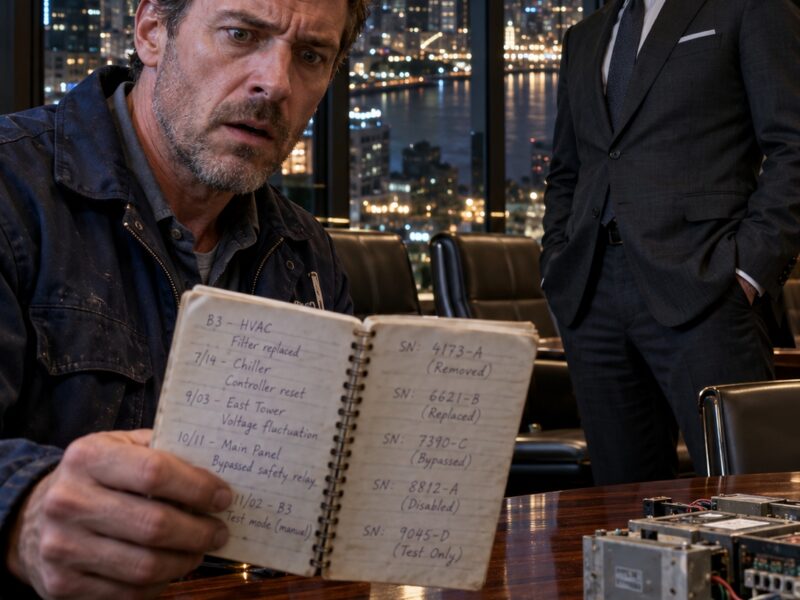
HE WENT BACK FOR HIS FORGOTTEN JACKET—AND FOUND THE CEO HOLDING THE NOTEBOOK THAT COULD DESTROY HER COMPANY
At 11:47 p.m., Nolan Pierce returned to Blackthornne Meridian headquarters for a jacket.
By midnight, the chief executive of the company was sitting in the basement with his private notebook open beneath her hand.
And by sunrise, both of them would understand that somebody had spent millions of dollars making a forty-two-story building look safer than it actually was.
Nolan knew something was wrong before he fully opened the maintenance-room door.
The light was on.
That was the first thing.
The engineering level should have been nearly dark at that hour, reduced to emergency strips, status LEDs, and the pale glow of monitoring screens nobody watched unless an alarm appeared.
Instead, white fluorescent light spilled through the gap beneath the door.
Nolan stopped with one hand on the handle.
He had driven eleven minutes toward home before realizing he had left his navy work jacket upstairs after an emergency repair. He had considered leaving it until morning.
Then he remembered the notebook in the inside pocket.
So he turned around.
Now, standing in the basement corridor, he heard nothing beyond the door.
No tools.
No radio.
No voices.
He pushed it open.
Adrienne Blackthornne was sitting on a metal stool beside his workbench.
For half a second, Nolan genuinely wondered whether exhaustion had caused his mind to put the wrong person in the wrong room.
The CEO belonged thirty floors above him.
She belonged behind glass walls and walnut tables, in elevators that opened onto carpet instead of concrete.
Yet there she was.
Forty years old. Dark coat still buttoned. Hair pulled back. Face composed in the severe, unreadable way Nolan had seen in company photographs.
His faded navy jacket had been folded neatly on the bench.
His notebook rested on top of it.
Open.
Adrienne did not say hello.
She placed two fingers against the cardboard cover and pushed it toward him.
“Can you explain this?”
Nolan did not move.
The door swung shut behind him with a metallic click.
He looked at the notebook.
Then at her.
Then back at the notebook.
There were thirty-one entries inside it.
Thirty-one things he had seen that the company’s computers insisted he had not seen.
And twelve of those entries described equipment Blackthornne Meridian had already paid someone to replace.
Nolan finally set his keys on the bench.
“What page?”
Adrienne’s eyes narrowed slightly.
“That’s your first question?”
“It matters.”
She studied him for another moment, then turned the notebook around.
“September ninth.”
Nolan glanced at the entry.
“Twenty-eighth floor. East pressure zone. Differential sensor faulted at 2:10 p.m. Ticket was opened at 2:18. When I checked the system the next morning, the fault had cleared and the ticket had been closed.”
“Who repaired it?”
“Nobody.”
“The record says it was repaired.”
“I know.”
Adrienne’s fingers went still.
Nolan looked directly at her.
“That’s why I started writing things down.”
And that was the moment the night changed.
Not when she found the notebook.
Not when Nolan returned for the jacket.
It changed when the chief executive of Blackthornne Meridian realized that the man standing in front of her was not trying to convince her that the company’s records were wrong.
He was telling her he had stopped trusting them months ago.
Blackthornne Meridian Technologies occupied forty-two floors of gray glass along the north edge of the financial district.
From the river, the headquarters looked almost weightless.
Inside, it was anything but.
The upper floors held executive offices, legal teams, strategy groups, investor relations, private conference rooms, polished stone, hand-finished walnut, and windows large enough to make powerful people feel that the city existed below them for decorative purposes.
The lower floors held the things that kept those people alive.
Pumps.
Chillers.
Air handlers.
Transfer switches.
Fire alarm interfaces.
Smoke-control fans.
Electrical distribution panels.
Miles of conduit.
Miles of pipe.
Machines with no understanding of stock prices, hierarchy, reputation, or embarrassment.
Nolan preferred those machines.
Machines could fail.
Machines could wear out.
Machines could be installed incorrectly.
But machines did not care who your father had been.
They did not change their story because a board member entered the room.
Nolan was forty-four and had worked at Blackthornne Meridian for six years as a building systems technician on the afternoon-and-evening shift.
He had no office.
He had a locker.
A rolling cart.
A steel workbench.
A company laptop older than his daughter’s phone.
And an access badge that opened rooms most executives did not know existed.
He liked it that way.
Once, his life had been different.
Before Naomi died, Nolan had been a commissioning engineer.
He was the person developers hired near the end of major construction projects to prove that the expensive equipment hidden behind walls actually did what the drawings claimed it did.
He had been good at it.
Annoyingly good, according to some contractors.
Nolan would not initial a form because somebody told him the system had passed.
He wanted to see it run.
Under load.
Under failure conditions.
Under the circumstances that mattered.
Then Naomi got sick.
Cancer rearranged their life with terrifying efficiency.
Schedules became appointments.
Savings became bills.
Weekends became hospital rooms.
And when she died, their daughter was nine years old.
Nolan looked at the career he had built—a career that involved airports, hotel rooms, construction sites hundreds of miles from home—and understood that none of it mattered as much as being there when his daughter woke up.
So he stepped down.
Smaller title.
Smaller salary.
Shorter drive.
Predictable shift.
He never called it sacrifice.
Not to his daughter.
Not to friends.
Not even to himself.
By seventeen, Laya was sharp, funny, stubborn, and eight months away from leaving for college.
College tuition had become the background arithmetic of Nolan’s life.
He thought about it at red lights.
At grocery stores.
When the truck made a noise.
When the furnace ran too long.
Eleven years remained on the mortgage.
His pension was modest.
His emergency savings had never fully recovered from Naomi’s illness.
Stability was not something Nolan found boring.
Stability was something he had built with both hands after watching the rest of his life collapse.
Which was why he had spent months trying very hard not to believe what the building was telling him.
The first warning had been small.
Emergency transfer equipment serving the executive wing occasionally responded half a second slower than specification.
Not catastrophic.
Not even dramatic.
Just wrong.
Then two differential pressure sensors generated faults and somehow cleared themselves overnight.
Then the smoke evacuation system on the thirty-first floor failed during a scheduled test.
When another technician arrived, it worked perfectly.
Then Nolan opened a panel containing a controller that company records said had been replaced six months earlier.
The controller inside was old.
Not used.
Old.
Dust in the corners.
Faded plastic.
Original serial number.
Nolan reported it.
The ticket came back marked RESOLVED.
Nobody had touched the equipment.
He filed another discrepancy.
DUPLICATE.
Closed by a supervisor Nolan did not recognize.
He filed a third.
Two days later, that ticket no longer existed.
He searched by asset.
Nothing.
By date.
Nothing.
By floor.
Nothing.
He stared at the screen long enough that another technician asked if his computer had frozen.
“No,” Nolan said.
The computer was working perfectly.
That was the problem.
On his way home that evening, he stopped at a drugstore and bought a small cardboard notebook.
The same kind he had carried twenty years earlier.
He began recording everything.
Date.
Floor.
Asset.
Condition.
No accusations.
No theories.
Just facts.
By the second week of October, the notebook contained thirty-one entries.
Twelve involved work that the official system claimed had already been completed.
Nolan still told himself there could be an explanation.
Bad data migration.
Incorrect asset tags.
Sloppy vendor closeout.
Administrative errors.
He wanted those explanations to be true.
Then, on a Tuesday evening at 6:40, his radio cracked to life.
“Pierce, priority request. Thirty-first floor executive conference.”
Nolan pressed the transmit button.
“Problem?”
“Temperature. Seven above set point. Board meeting at eight.”
He checked his watch.
“Copy.”
Then the dispatcher added, “COO’s office called it in.”
Nolan looked at the radio.
That meant one thing.
Move.
The thirty-first-floor conference room was the nicest place Nolan had ever been summoned to repair.
Glass stretched across the north wall.
The river reflected the last light of evening.
A walnut table ran nearly the length of the room.
Folders waited at every seat.
And at the head of the table stood Everett Ashborne.
Fifty-three.
Silver at the temples.
Charcoal suit.
Perfect posture.
Everett had worked for Blackthornne Meridian for nineteen years and had served under Adrienne’s father before she inherited the chief executive role twenty-two months earlier.
His title was chief operating officer.
His influence was considerably larger.
Operations.
Facilities.
Procurement.
Vendor relationships.
Everett controlled the arteries through which money and authorization moved.
He rarely raised his voice.
Men like Everett did not need volume.
They had organizational charts.
When Nolan entered carrying his tool bag, Everett glanced at his watch.
“You have ten minutes.”
Nolan nodded once.
Everett gave him a thin smile.
“After that, this room stops belonging to your world.”
Nolan had spent enough time around wealthy men to know when a sentence had been designed to remind him of his place.
He also knew responding never improved the equipment.
So he took off his navy jacket, folded it over the chair at the far end of the table, removed the access panel beneath the return-air grille, and went to work.
The thermostat was fine.
The control valve was fine.
The zone controller was not.
Nolan pulled it halfway from its housing.
His hands stopped.
Yellowed label.
Faded housing.
Fourteen-year-old service stamp.
He took out his phone and opened the asset record again.
According to Blackthornne Meridian’s infrastructure-upgrade program, that exact controller had been replaced five months and nine days earlier.
Nolan looked at the serial number.
Then at the record.
Then at the serial number again.
Behind him, Everett quietly rehearsed figures from his presentation.
Nolan wrote the number on his palm.
When he stood, he took the notebook from his jacket.
UNIT 31B.
ORIGINAL SERIAL STILL INSTALLED.
REPLACEMENT INVOICE APPROVED.
He added the date.
Approval code.
Dollar amount.
Then he noticed something that made him read the line again.
The approval prefix matched the other suspicious replacements.
Operations.
He closed the notebook.
At 7:51, the room temperature was back within range.
Nolan told the assistant that his temporary adjustment was exactly that—temporary—and the controller required proper service.
Then he left.
Eleven minutes into the drive home, he realized his arms felt strangely cold.
He looked at the passenger seat.
No jacket.
“Damn it.”
He took the next exit.
At 8:00 p.m., while Nolan was driving away from downtown, the Blackthornne Meridian board meeting began.
Adrienne Blackthornne sat at the head of the same table.
She was forty, disciplined, controlled, and still young enough in the role that certain board members watched her mistakes more closely than her successes.
Her last name opened doors.
It also created a permanent suspicion that she had never earned the right to walk through them.
That night, Adrienne was questioning $14.8 million spent over less than two years on the headquarters infrastructure-upgrade program.
Everett answered every question.
Smoothly.
Completely.
Critical equipment had been replaced.
Milestones achieved.
Scope completed.
He displayed a closeout summary.
Green.
Green.
Green.
Grant Wikliffe, the sixty-one-year-old vice chairman and Everett’s longtime ally, finally leaned back.
“I’m struggling to see the value in relitigating completed work.”
Adrienne looked at the green indicators.
Something about them bothered her.
Not enough to make an accusation.
Only enough to keep the discomfort alive.
The meeting ended at 9:25.
At 9:40, Adrienne’s assistant returned to collect water carafes.
She found Nolan’s jacket on the last chair.
When she lifted it, a small notebook slipped from the inside pocket and landed open on the carpet.
She brought both to Adrienne.
Adrienne reached down to close the notebook without reading it.
Then she saw one line.
UNIT 31B — ORIGINAL SERIAL STILL INSTALLED. REPLACEMENT INVOICE ALREADY APPROVED.
Below it sat an approval code.
Adrienne knew the code.
She had seen it less than an hour earlier.
Her hand remained on the page.
Then she read the next entry.
And the next.
Thirty-one.
No accusations.
No emotional language.
No claims of corruption.
Just equipment.
Dates.
Serial numbers.
Work orders.
Twelve items marked unrepaired in Nolan’s handwriting but completed in the company database.
Adrienne found the name inside the cover.
N. PIERCE.
At 11:15 p.m., she went downstairs alone.
At 11:41, security notified her that Nolan Pierce’s badge had entered the north lobby.
She waited.
Six minutes later, he opened the door.
Now they were staring at each other across his workbench.
“Who told you to write these down?” Adrienne asked.
“Nobody.”
“Why did you?”
“Because your system doesn’t remember what I report.”
Adrienne leaned back slightly.
“My system?”
“Company system.”
“You understand the distinction?”
“I’m starting not to.”
That answer almost irritated her.
Almost.
She selected another entry.
“October third.”
“North riser. Controller communication failure.”
“You remember without looking?”
“Most of them.”
Another page.
“September twenty-second.”
“Smoke evacuation test. Thirty-first floor.”
Another.
“August eighteenth.”
“Emergency transfer delay. Executive wing.”
Adrienne closed the notebook.
“You remember all thirty-one?”
“No.”
Nolan tapped the cover.
“That’s why I wrote them down.”
She opened her laptop.
“I pulled the maintenance records.”
She turned the screen toward him.
Nolan leaned closer.
His expression changed.
Two work orders showed his employee number.
His initials.
Closeout notes.
He read them twice.
“That’s not mine.”
Adrienne watched him.
“Your ID is attached.”
“I can see that.”
“You’re saying somebody used your credentials?”
“I’m saying I didn’t write those closeouts.”
“How can I know that?”
Nolan looked at her.
“Because I don’t close work I didn’t perform.”
“That isn’t evidence.”
“No.”
He straightened.
“It’s just the one rule I’ve never broken.”
Adrienne walked slowly around the bench.
“Why didn’t you come to me?”
Nolan almost smiled.
Not because the question was funny.
Because it revealed how different their worlds were.
“Come to you?”
“You had thirty-one entries.”
“I’m a basement technician.”
“So?”
“So basement technicians don’t elevator up to the CEO and announce that operations records might be false.”
“You could have escalated.”
“I did.”
“To whom?”
“My manager.”
“And?”
“He closed the ticket.”
“Then his manager.”
“Facilities.”
“And facilities reports to?”
Nolan stopped.
They both knew.
Operations.
Everett.
Adrienne looked down at the notebook again.
Nolan spoke more quietly.
“The system is supposed to work upward. I report what I see. My manager deals with it. His manager deals with what he can’t. Eventually somebody with authority acts.”
“And when that system doesn’t work?”
Nolan glanced at the notebook.
“I’m the guy left holding paper.”
For several seconds, neither spoke.
The ventilation system started overhead.
A compressor cycled somewhere beyond the wall.
Adrienne finally said, “I need this notebook.”
“No.”
She looked up sharply.
Nolan did not change his tone.
“You can photograph every page.”
“I’m the chief executive of this company.”
“Yes, ma’am.”
“And you’re refusing?”
“I’m keeping the original.”
“Why?”
“Because right now it’s the only record I have that nobody else can edit.”
The sentence landed harder than either of them expected.
Adrienne stared at him.
Then she pulled out her phone.
“Hold the pages flat.”
For the next twenty minutes, the CEO photographed all thirty-one entries beneath a fluorescent work light while a technician held his own notebook open for her.
At the door, Adrienne stopped.
“One last question.”
Nolan waited.
“What happens if the company records are right?”
He said nothing.
“And your notebook is wrong?”
Nolan picked up his jacket.
“Tomorrow morning, you can look at the machine yourself.”
“That’s your answer?”
“It doesn’t care what either of us thinks.”
Adrienne stared at him for a moment.
“Seven o’clock. Thirty-first floor.”
She opened the door.
“And Nolan?”
“Yes?”
“Discuss this with no one.”
At 6:58 the next morning, Adrienne was waiting.
No assistant.
No entourage.
No Everett.
Nolan removed the access panel and handed her a flashlight.
She crouched.
The controller was exactly where he said it would be.
Old.
Faded.
Original serial number.
Adrienne opened the procurement record on her tablet.
NEW CONTROLLER.
Different serial number.
Delivered.
Installed.
Signed off.
Paid in full.
She looked at Nolan.
“Show me another.”
They went to the twenty-eighth floor.
Original equipment.
Then the north riser.
Original equipment.
By 8:15, Adrienne stopped calling it a records problem.
“Somebody paid for work that was never done.”
Nolan did not answer.
Adrienne stared at the open panel.
Saying it aloud had made it real.
Four days later, internal audit found the name.
Ashborne Infrastructure Partners.
Nineteen of twenty-six upgrade line items.
More than nine million dollars.
The company was not directly registered to Everett.
That would have been too easy.
One holding company owned another.
That entity connected to a family trust.
Two Ashborne names appeared among the beneficial interests.
Neither was Everett.
It was not proof of a crime.
It was worse in a different way.
It was a structure designed to survive casual inspection.
The vendor had been approved eleven years earlier.
No competitive rebid since.
And suddenly Nolan understood why his maintenance tickets disappeared.
Facilities reported to operations.
Operations belonged to Everett.
Every discrepancy traveled through the same narrow pipe.
And one man controlled the valve.
By Thursday afternoon, Everett knew somebody was looking.
Friday morning, Nolan’s radio summoned him to the thirty-eighth floor.
Everett’s office overlooked two bridges.
There was no visible computer.
Architectural models sat on a low table.
Everett gestured toward a chair.
“Coffee?”
“No, thank you.”
“Sit.”
Nolan sat.
Everett placed a folder between them.
Nolan recognized his personnel file.
Everett did not open it.
“You’ve been here six years.”
“Yes.”
“Reliable employee.”
Nolan waited.
“Difficult work. Often invisible work.”
Still Nolan said nothing.
Everett smiled.
“You understand something many people don’t. Organizations survive because people accept that not every question belongs to them.”
“There a reason I’m here?”
“There is.”
Everett rested his hand beside the folder.
“I understand you’re raising your daughter alone.”
Nolan’s face changed.
Only slightly.
Everett saw it.
“Laya, correct? Senior?”
Nolan did not answer.
“College is expensive.”
“Leave my daughter out of this.”
Everett’s expression remained warm.
“I’m discussing your future.”
“My daughter isn’t employed here.”
“No. But your employment affects her.”
Everett knew his salary.
His years of service.
His mortgage situation.
Enough.
Then came the offer.
A supervisory position at another company facility.
Substantial raise.
Relocation paid.
Manager title.
Real authority.
Real money.
For a few seconds, Nolan hated himself for calculating what it would mean.
College deposit.
Mortgage.
Savings.
Maybe Laya could choose a school without pretending price did not matter.
Everett leaned back.
“All I’m suggesting is that a man with responsibilities should think carefully before appointing himself an auditor.”
There it was.
Nolan looked at the personnel file.
Then at Everett.
“How far away?”
Everett almost smiled.
“About four hundred miles.”
Nolan nodded slowly.
Four hundred miles from the equipment.
Four hundred miles from the notebook.
Four hundred miles from the problem.
He thought about Naomi.
Not sentimentally.
Practically.
He remembered one of their final arguments before she became too sick to argue about ordinary things.
Nolan had wanted to cancel a project trip.
Naomi had told him not to.
“You keep thinking being responsible means making sure nothing changes,” she had said. “Sometimes responsible means being the person willing to change it.”
At the time, he thought she was talking about work.
Now he was no longer sure.
“I appreciate the offer,” Nolan said.
Everett waited.
“I’m staying.”
Nothing changed in Everett’s face.
That frightened Nolan more than anger would have.
Everett stood.
He walked Nolan to the door.
Then, with one hand resting lightly against the frame, he said, “You think this is about some old equipment?”
Nolan turned.
Everett’s voice remained almost friendly.
“You have no idea what you’re standing in the middle of.”
The elevator ride down lasted less than a minute.
It felt longer.
Because until then, Nolan had believed he was looking at theft.
Ugly.
Expensive.
But finite.
Everett had just suggested something larger.
Back at his bench, Nolan opened the infrastructure-upgrade scope.
Controllers.
Smoke-control equipment.
Fire alarm interfaces.
Fire pump controls.
Emergency power.
His stomach tightened.
Comfort equipment fails and people complain.
Life-safety equipment fails and people die.
That afternoon he found Adrienne.
“If the controllers weren’t replaced,” he said, “we need to inspect everything tied to life safety.”
Adrienne looked at him.
“You think it goes that far?”
“I don’t know.”
“That’s not an answer.”
“It’s the only honest one.”
She was quiet.
Then she said, “Money can be measured. Money can be repaid.”
Nolan understood what she meant.
Lives could not.
She authorized him personally.
That night, Nolan entered the emergency power room at ten.
At 3:00 a.m., he was still there.
The automatic transfer system had supposedly been replaced in March.
Cost: $410,000.
At first glance, it looked legitimate.
New enclosure.
New door.
New labels.
New contactor.
New monitoring relay.
Clean wiring.
Then Nolan saw something behind the main assembly.
He moved his flashlight.
A timing module.
Fourteen years old.
Carried over from the original equipment.
“Jesus.”
He crouched closer.
Then he found the bypass.
Small.
Simple.
Temporary.
The kind of manual bypass an installer might use during commissioning.
Except this one had been left in place.
Nolan stared at it.
With the bypass energized, the system would respond perfectly to a test command.
Monitoring software would show normal behavior.
An inspector following a checklist would see what he expected to see.
But during a real utility failure, under real load, the building would depend on the old timing module hidden behind the new hardware.
It might work.
It might transfer late.
It might not transfer at all.
Emergency lighting.
Stairwell pressurization.
Fire pumps.
A forty-two-story tower could lose the systems designed to keep thousands of people alive while evacuating.
Nolan sat on an overturned crate.
For the first time since this began, he felt afraid.
Not for his job.
For everyone upstairs who had no idea they were working above a lie.
He photographed the bypass.
Then the module.
Then the date code.
Then the wiring.
Four new entries went into the notebook.
At six in the morning, he called Adrienne.
She answered on the third ring.
“Nolan?”
“We have a problem.”
“How bad?”
He looked at the open cabinet.
“Nine days from now, you’re bringing four hundred people into this building for the investor summit.”
Silence.
“Yes.”
“You can’t.”
Adrienne postponed nothing immediately.
That was not how companies like Blackthornne Meridian worked.
First came meetings.
Then lawyers.
Then numbers.
Then the horrifying discovery that being correct did not necessarily make a decision easier.
Everett opposed postponement in the executive session.
Calmly.
“Cancelling the investor summit nine days out is not a scheduling decision,” he said. “It is a disclosure event.”
Adrienne sat across from him.
“We have an unverified life-safety system.”
“We have an allegation.”
“We have photographs.”
“Taken by an employee.”
“Of equipment.”
“Taken by an employee.”
The distinction was deliberate.
Everett placed financial estimates on the table.
Event costs.
Pending financing discussions.
Investor confidence.
Potential stock impact.
Tens of millions.
Grant Wikliffe backed him.
“We should consider the reliability of the source before detonating the company’s largest investor event.”
Then Everett produced two pages.
Nolan Pierce’s employment history.
Eleven years earlier, Nolan had refused to sign a commissioning closeout.
He escalated above his principal.
A dispute followed.
Four months later, Nolan left the company.
Every fact was true.
That was what made the document so effective.
It did not say Nolan was unstable.
It did not call him vindictive.
It merely arranged facts until the reader could reach those conclusions alone.
By the following afternoon, the question on the executive floor was no longer:
What if Nolan is right?
It had become:
What if Nolan wants to be right?
A board member asked whether a bypass could have been installed recently.
Perhaps even by the person who conveniently discovered it.
Nobody formally accused Nolan.
They did something more sophisticated.
They turned him from witness into suspect.
And Adrienne wavered.
That was the part she would later remember with the most shame.
Thursday evening, she sat alone in her office.
One monitor displayed Nolan’s notebook.
The other displayed the investor summit attendance list.
Four hundred names.
Board members.
Investors.
Analysts.
Journalists.
Partners.
Cancelling would cost millions.
Proceeding could mean nothing happened.
Probably nothing would happen.
Buildings survived imperfect equipment every day.
That was how bad decisions often introduced themselves—not as obviously bad choices, but as statistically comfortable ones.
For forty minutes, Adrienne did not know whom she believed.
Nolan was summoned upstairs again.
Two board members joined her.
Questions came from different angles.
Why had he left his previous employer?
Why had he documented equipment privately?
Why had he not reported directly to senior management?
Could he have installed the bypass?
Had he touched it before photographing it?
Was he angry about his position?
Did he believe he had been underpaid?
Nolan answered technical questions.
He refused to defend his personality.
Finally, one board member said, “Mr. Pierce, surely you understand why your history matters.”
Nolan reached into his jacket.
He removed the notebook.
Placed it in the middle of the table.
“Don’t believe me.”
Adrienne looked at him.
“What?”
“Don’t believe me.”
He pointed toward the notebook.
“Test it.”
Silence.
Nolan pushed the notebook farther toward them.
“You don’t need to decide whether I’m a good employee. You don’t need to decide whether I’m bitter. You don’t even need to decide whether you like me.”
He looked at Adrienne.
“Take the bypass out. Put the system in the condition it would be in during a real outage.”
Then he sat back.
“Test it.”
Nobody in the room had an answer to that.
Because refusing a test would reveal more than failing one.
Adrienne hired an independent engineering firm that had never worked for Blackthornne Meridian.
Everett did not oppose the test directly.
Instead, obstacles appeared.
Insurance requirements.
Procurement restrictions.
Vendor approval rules.
Documentation questions.
Every objection was technically legitimate.
Together, they threatened to delay the test beyond the summit.
Adrienne finally used emergency board authority.
She bypassed procurement.
Signed the waiver herself.
Moved the test forward.
Watching her, Nolan understood something.
She was not trusting him.
Not yet.
She was defending the right to discover the truth.
That was enough.
Meanwhile, Nolan reviewed old inspection reports.
He found the pattern late one evening.
Every quarterly inspection.
Every annual inspection.
Before each test, a contractor crew had accessed the emergency-power cabinet.
Forty minutes before one.
Ninety minutes before another.
Two hours before another.
The bypass had been activated before inspection.
The system passed.
Then the cabinet was closed.
Six successful inspections.
Not one authentic test.
Internal audit found something else.
Forty-one invoices from Ashborne Infrastructure Partners fell between $84,000 and $96,000.
Blackthornne Meridian required a second executive signature at $100,000.
Work that should logically have been billed as one job had been split across invoices.
Different cost centers.
Same operational chain.
Everett had explanations for everything.
Milestone billing.
Supply shortages.
Vendor mistakes.
Contractor error.
Documentation interpretation.
Nothing alone was enough.
That was when Nolan understood the trap.
They were trying to prove Everett was corrupt.
They did not need to.
Not yet.
They only needed to prove one thing.
The company had paid for new equipment.
The old equipment was still inside the walls.
A serial number did not care about corporate explanations.
A fourteen-year-old module did not understand legal strategy.
It simply existed.
Monday morning.
4:50 a.m.
The independent test began.
Two outside engineers.
One company electrician as witness.
Adrienne.
Nolan.
The bypass was photographed.
Removed.
The control circuit was restored to design configuration.
The building remained under overnight load.
The lead engineer gave the instruction.
Utility failure simulated.
For an instant, nothing happened.
Then the sequence initiated.
Nolan watched the timer.
One second.
Two.
Three.
Four.
The delay window approached its limit.
Five.
Six.
Adrienne looked at him.
Seven.
Eight.
The allowable window expired.
Nine.
Nine and a half.
The old timing module dropped the command.
The generator failed to transfer.
Then the sequence restarted.
The generator caught on the second attempt.
Nobody spoke.
The lead engineer looked at his instruments.
“Run it again.”
Second test.
Same fault.
Within half a second.
The engineer slowly removed his gloves.
He turned to Adrienne.
“You should not operate this building at event load until this system is corrected.”
Adrienne stared at him.
“You’ll put that in writing?”
“I’ll put it in writing right now.”
At 7:24 that morning, Adrienne postponed the investor summit.
The stock fell.
Analysts speculated.
Calls flooded investor relations.
By ten, Everett was standing in her office holding two analyst notes.
“This is exactly what I told you would happen.”
Adrienne looked at him.
“No.”
She closed the report in front of her.
“This is what happens when the truth costs money.”
At two that afternoon, the board assembled on the thirty-first floor.
Nolan entered carrying his laptop.
Three weeks earlier, Everett had stood in that same room and told him he had ten minutes before it stopped belonging to his world.
This time, Nolan walked to the head of the table.
He did not make a speech.
He showed six things.
Purchase order.
New equipment serial number.
Photograph of the old installed controller.
Closed work order.
Notebook entry.
Independent test report.
Then he pointed toward the wall.
“That controller is eleven feet behind the chair at the end of this table.”
No one moved.
“The company paid $4,200 to replace it in June.”
He paused.
“If anyone doubts the serial number, you can walk over there and read it yourself.”
Nobody did.
Everett immediately shifted blame toward vendor oversight.
It was skillful.
Reasonable.
Almost persuasive.
Then the head of internal audit opened her presentation.
Ashborne Infrastructure Partners.
Holding company.
Second holding company.
Family trust.
Ashborne names.
For nineteen years, nobody had said that ownership chain aloud in front of the board.
Now everyone heard it.
Grant Wikliffe began distancing himself before the presentation ended.
“I want the minutes to reflect that my support for proceeding with the summit was based on information provided by management.”
Everett slowly turned toward him.
For the first time, Nolan saw something break through the man’s composure.
Not panic.
Recognition.
The room had moved away from him.
Everett looked at Nolan.
His voice was still civilized.
“Do you imagine this makes you important?”
Nolan thought about the question.
Then shook his head.
“No.”
Everett waited.
“It makes what I reported important.”
Adrienne did not declare Everett guilty.
She was the CEO of a public corporation, not a judge.
The board did something more practical.
Everett Ashborne was relieved of operational authority pending investigation.
System access revoked.
Vendor contracts frozen.
Ashborne Infrastructure Partners suspended from company sites.
Records placed under litigation hold.
External forensic accountants engaged.
Independent inspections authorized across every Blackthornne Meridian property.
There were no handcuffs.
No dramatic police entrance.
No cheering.
Just permissions disappearing from Everett’s account one after another.
He could no longer close a ticket.
Delete a record.
Change a contractor.
Alter a file.
Whatever investigators eventually found would be found in records he could no longer touch.
The meeting ended slowly.
People collected papers without looking at one another.
Adrienne remained behind.
Nolan disconnected his laptop.
She looked toward the chair at the far end of the room.
The chair where his jacket had been forgotten.
“What if you hadn’t come back that night?”
Nolan followed her gaze.
He considered the question seriously.
Then shrugged.
“I’d have needed the coat in the morning.”
Adrienne laughed.
Once.
Unexpectedly.
Nolan smiled despite himself.
For the first time in three weeks, a sound existed in that building that had nothing to do with money, liability, danger, or blame.
But the story did not end in that conference room.
Real investigations rarely end cleanly.
The forensic review took five months.
Blackthornne Meridian disclosed procurement irregularities.
Eleven company properties underwent expanded inspections.
Everett formally resigned within a month under language negotiated by attorneys and admitting nothing.
The matter eventually reached people whose letterhead carried a state seal.
The physical repair took nine weeks.
Crews worked through 260 devices.
They checked invoices against serial numbers.
Installation records against actual equipment.
Sixty-one devices turned out to be original equipment wearing new paperwork.
Sixty-one.
Nobody had died.
Nobody had been trapped in a dark stairwell.
No fire pump had failed during an emergency.
No evacuation had become a disaster.
That absence would never make a headline.
There was no photograph of the people who did not die.
No names for the victims who never existed.
Nolan considered that the best possible outcome.
Adrienne changed the company’s reporting architecture.
A technician’s safety ticket could no longer be deleted, merged, downgraded, or closed by a single manager.
Every alteration created a permanent audit entry.
Name.
Time.
Change.
Nothing glamorous.
Nothing investors would applaud at a conference.
Just a system designed so the next Nolan Pierce would not need a cardboard notebook to prove he had spoken.
In January, Nolan received a message asking him to report to the thirty-eighth floor.
He assumed there would be a thank-you.
Maybe an award.
Possibly a gift card large enough to be awkward.
Instead, Adrienne offered him a new job.
Director of Systems Reliability and Infrastructure Integrity.
Authority across every property.
Direct reporting line to the CEO.
Nolan did not accept.
Adrienne blinked.
“You want to think about it?”
“Yes.”
“Salary isn’t negotiable enough?”
“It’s not the salary.”
He went home.
That evening, he sat across from Laya at the kitchen table.
She read the offer twice.
“You’re going to say yes.”
“Am I?”
“Dad.”
“What?”
“You’ve complained for six years that nobody listens to the people who actually know how the building works.”
“I don’t complain.”
Laya stared at him.
“You absolutely complain.”
“I make observations.”
“You make observations for forty-five minutes while reheating chili.”
He smiled.
Then she became serious.
“You’re scared.”
Nolan looked down at the offer.
“Little bit.”
“Of the job?”
“Of becoming one of the people upstairs.”
Laya thought about that.
“Then don’t.”
He looked up.
“Don’t what?”
“Become one of them.”
She pushed the papers back toward him.
“Take the job. Stay you.”
For a moment, Nolan saw Naomi in her.
Not her face.
Something harder to explain.
The ability to make a complicated thing sound embarrassingly simple.
Nolan returned to Adrienne with three conditions.
“No technician gets disciplined, transferred, or negatively reviewed for filing a safety report.”
Adrienne nodded.
“Written policy?”
“Written.”
“Second, nobody can delete safety tickets.”
“Agreed.”
“Including me.”
Adrienne paused.
Then nodded.
“Including you.”
“Third.”
Nolan sat back.
“I’m not spending four nights a week on airplanes.”
“The position covers eleven properties.”
“I know.”
“Some travel is unavoidable.”
“Some.”
“What’s the limit?”
“My daughter leaves for college in eight months.”
Adrienne waited.
“I spent enough of my life in hotels before her mother died. I’m not giving away these eight months.”
Adrienne closed the folder.
“Done.”
Nolan looked at her suspiciously.
“You didn’t negotiate any of that.”
“I’m learning.”
The raise was significant.
Not life-changing in the cinematic sense.
Nolan did not buy a sports car.
He did not move into a gated house.
He kept the truck.
Kept the mortgage.
Kept fixing things around the house himself even when he could have paid someone else.
But when the college deposit came due in April, he paid it without doing arithmetic at a red light first.
The biggest change was invisible.
When Nolan said something was wrong, people stopped.
They listened.
Then they went and looked.
On the evening of his first day in the new role, Nolan crossed the lobby carrying a laptop bag he still felt ridiculous holding.
Adrienne approached the elevators from the opposite direction.
She stopped.
Looked at him.
Then looked down.
“You’re kidding.”
Nolan frowned.
“What?”
“The jacket.”
He glanced at himself.
Same navy work coat.
Nine years old.
Worn cuff.
Small soldering burn on the left sleeve.
Notebook-shaped bulge inside the pocket.
“You’re a director now,” Adrienne said.
“It still works.”
She smiled.
“Just don’t leave it behind this time.”
The elevator arrived.
Nolan stepped inside.
Before the doors closed, he looked once through the lobby.
People crossed polished stone carrying phones, coffee, briefcases, problems.
Forty-two floors rose above them.
Same glass.
Same steel.
Same pipes hidden behind the walls.
But not the same building.
Because buildings were never only concrete and machines.
They were systems of trust.
Someone inspected.
Someone signed.
Someone reported.
Someone believed the report.
And sometimes the most dangerous failure was not a broken component.
It was a system that taught the person who noticed the broken component to remain quiet.
The doors began to close.
Nolan slipped one hand into the jacket pocket.
His fingers touched the cardboard notebook.
For months, he had carried it because the company’s computers could forget.
Now the company had built a system designed to remember.
He could probably stop carrying it.
He knew that.
But he also knew he wouldn’t.
Not yet.
Maybe never.
The elevator doors met with a soft metallic click.
Above him were executive offices.
Below him were mechanical rooms.
And somewhere inside the walls, thousands of components were doing their quiet work without anyone thinking about them.
That was the strange thing about safety.
When it worked, nothing happened.
No headline.
No applause.
No dramatic photograph.
People simply went home.
Nolan Pierce had spent most of his life being one of the people responsible for making sure nothing happened.
For years, almost nobody knew his name.
Maybe that had never been the insult he once thought it was.
Maybe the real insult had been that when he spoke, the system had learned how not to hear him.
That was different now.
Not because Nolan had become powerful.
Not because Everett had lost power.
Not even because Adrienne had finally listened.
It was different because one forgotten jacket had exposed something the entire company had been structured not to see:
Truth does not always arrive in a boardroom wearing a suit.
Sometimes it is written in pencil inside a cheap cardboard notebook.
Sometimes it is hidden behind an electrical cabinet.
Sometimes it is carried by a man whose name the executives upstairs could not have remembered three weeks earlier.
And sometimes, when protecting everything you have depends on staying quiet, the smallest act of courage is simply refusing to erase what you saw.
That evening, the forty-two-story tower glowed against the dark river exactly as it always had.
From outside, nobody could see the difference.
But Nolan could.
Because somewhere between the basement and the thirty-eighth floor, the building had finally learned the one lesson no machine could teach it.
When the person closest to the problem says something is wrong—
you stop.
You listen.
And you go look.









