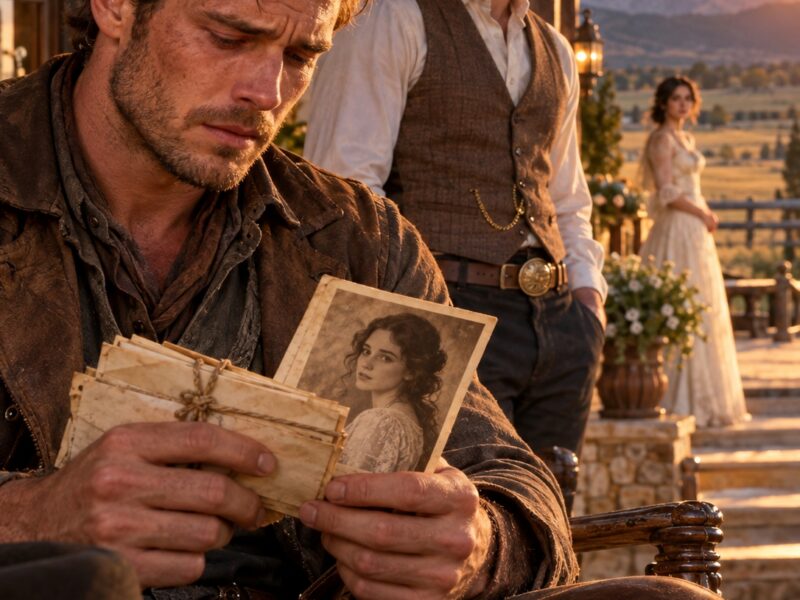
He Went to Pick Up His Brother’s Mail-Order Bride—By the Time They Reached the Ranch, He Was in Love With Her
By the time Weston Lang realized he was falling in love with his brother’s bride, they were less than an hour out of Maricopa Wells.
There were still three days of desert between them and the Lang Ranch.
Three days before he would have to deliver Lucy Barrow to Ellis.
Three days before the woman sitting beside him would become his younger brother’s wife.
And there was absolutely nothing honorable Weston could do about what had already begun.
He tightened both hands around the leather reins and stared at the road.
Beside him, Lucy laughed.
It was not a dramatic laugh. Not flirtatious. Not even particularly loud.
That almost made it worse.
She laughed because Weston had pointed toward a cluster of saguaros standing against the copper-colored hills and told her they were Arizona’s welcoming committee.
“They don’t look very welcoming,” she said.
“They’re doing their best.”
“They have thorns.”
“So do most respectable people.”
She turned toward him then.
For one dangerous second, their eyes met.
Lucy smiled.
Weston looked back at the road.
That was when he knew he was in trouble.
Not the ordinary kind of trouble a man could fix with money, wire, fencing, a rifle, or another twelve-hour day in the saddle.
This was worse.
Because Weston Lang had arranged this marriage himself.
He had found the matrimonial agency.
He had paid the fee.
He had helped Ellis compose the advertisement.
He had encouraged the letters.
And when Lucy Barrow finally agreed to leave Ohio and travel west to marry Ellis Lang, Weston had been the one who rode three days to the railroad depot to collect her.
Now every turn of the wagon wheels carried her closer to becoming his brother’s wife.
And every mile made Weston wish the road would never end.
He hated himself for it.
Lucy Barrow had stepped off the train that morning wearing a pale traveling dress coated with dust around the hem and carrying one battered leather case in her hand.
She was twenty-three, though something in her expression made her seem older.
Not tired.
Tested.
There was a difference.
She had clear gray-blue eyes, brown hair pinned beneath a practical hat, and a way of looking directly at people that made dishonesty feel difficult.
Weston had noticed that immediately.
He had noticed too much immediately.
“Miss Barrow?”
She turned.
“Yes?”
“Weston Lang.”
Something brightened in her expression.
Then she hesitated.
“Ellis?”
“No, ma’am.”
He had nearly smiled.
“His brother.”
“Oh.”
That one word should not have disappointed him.
It did.
Weston extended his hand.
“Ellis asked me to come get you. Ranch is three days from here if the weather holds.”
She shook his hand.
Her grip was firm.
“I’m glad to meet you, Mr. Lang.”
“Weston.”
“Then I’m Lucy.”
That should have been nothing.
A name.
A courtesy.
Instead, he remembered exactly how she had said it.
Lucy.
As though she were handing him something he had no right to keep.
He loaded her trunk, helped her into the wagon, bought additional water for the crossing, and told himself that by sundown she would simply be Ellis’s intended bride.
By the end of the first hour, that lie was already falling apart.
She asked questions.
Real questions.
Not whether there were Indians behind every rock or whether rattlesnakes crawled into beds every night, questions Eastern travelers seemed determined to ask.
She wanted to know why some stretches of land were green while others were burned almost white.
She wanted to know how far cattle could be driven without water.
She asked about rainfall, cattle prices, the Mexican families they passed, the old trail south, the distant mountains, and whether the ranch survived on cattle alone.
“You always ask this many questions?” Weston finally said.
Lucy looked embarrassed.
“I can stop.”
He glanced at her.
“I didn’t say I minded.”
Her smile returned.
That was another mistake.
By noon he knew she read whenever she could get books.
By midafternoon he knew she hated boiled turnips, could mend almost anything made of cloth, had once broken a schoolmaster’s nose accidentally with a cricket bat when she was twelve, and believed people revealed themselves by how they treated animals when nobody important was watching.
By sunset, Weston knew something worse.
He liked talking to her.
He had forgotten that conversation could be something a person wanted to continue.
For years, his days had been instructions.
Move those cattle.
Repair that fence.
Order grain.
Check the north pasture.
Pay Ramirez.
Send the telegram.
Find Ellis.
Ask Ellis.
Protect Ellis.
There had always been work.
There had always been responsibility.
But somewhere between Maricopa Wells and the first night’s camp, Weston found himself telling Lucy things he had not intended to tell anyone.
Not secrets.
Just pieces of himself.
And that frightened him more.
They camped beneath a sky so crowded with stars that Lucy stood beside the wagon for several minutes without speaking.
Weston was making coffee when he noticed.
“Something wrong?”
She shook her head.
“I’ve never seen anything like that.”
He followed her gaze.
To him, it was simply the sky.
To Lucy, apparently, it was a miracle.
“You get used to it,” he said.
She looked at him.
“I hope I don’t.”
The answer stayed with him.
Weston looked down at the coffee.
He suddenly understood something he did not want to understand.
He should have sent one of the ranch hands.
He should have sent anyone else.
Because there were still two days left.
And already he was wondering what Lucy Barrow would look like beneath those stars for the rest of his life.
That night, lying on his blanket twenty feet from the fire, Weston stared into the darkness and called himself every name he knew.
Fool.
Scoundrel.
Traitor.
Bad brother.
Ellis trusted him.
Ellis had always trusted him.
Weston had been seventeen when their parents died in the same terrible summer.
Ellis had been eleven.
Their father had gone first, fever taking him so quickly that Weston remembered being angry at the doctor for looking defeated before the man was even dead.
Their mother followed before autumn.
And just like that, Weston had inherited two things.
A failing ranch.
And a frightened eleven-year-old boy.
He had saved both.
At seventeen, he stopped being a brother and became something else.
Father.
Mother.
Foreman.
Teacher.
Protector.
He learned to stretch flour through another week and negotiate with cattle buyers twice his age.
He learned to repair roofs and settle debts.
He learned that Ellis had nightmares after their mother died and would sleep if Weston left a lamp burning outside his room.
He learned to hide his own fear because there was no one left above him in the world.
Every year other young men spent courting girls, attending dances, drinking too much whiskey and dreaming about futures, Weston worked.
He did not resent Ellis.
That was the important part.
He loved him.
But love could cost a man everything without either person noticing the bill.
By thirty, Weston had stopped expecting a wife.
He had stopped imagining children.
His life had acquired a shape, and he had learned to live inside it.
Then Ellis turned twenty-four.
Quiet Ellis.
Gentle Ellis.
The boy who could calm a nervous horse but could barely speak to an unmarried woman without turning red.
Weston worried about him.
So Weston did what Weston always did when he worried.
He fixed things.
The matrimonial advertisement had been his idea.
Ellis had resisted weakly.
“I don’t know, Wes.”
“What don’t you know?”
“It seems strange.”
“Half the territory was settled by people doing strange things.”
“I suppose.”
“You want to be alone forever?”
Ellis had looked away.
Weston remembered that now.
At the time, he had interpreted the silence as embarrassment.
He had never considered that it might mean something else.
“I just think maybe—”
“You think too much.”
Weston had clapped him on the shoulder.
“We’ll find you a good woman.”
We.
That was how Weston had approached Ellis’s entire life.
We need cattle.
We need another well.
We need to repair the house.
We need you married.
It had never occurred to him to ask the simplest question.
Ellis, what do you want?
Instead, he had found the advertisement.
He had paid the agency.
When Lucy answered, Weston encouraged Ellis to write.
When Ellis’s letters seemed too short, Weston urged him to write more.
When Lucy accepted, Weston celebrated as if he had solved another ranch problem.
Now the solution was sleeping on the opposite side of the fire.
And Weston could not stop thinking about her.
Lucy was awake too.
She listened to the fire collapse inward and tried to picture Ellis.
She had his letters memorized almost against her will.
They had been kind letters.
That mattered.
When Lucy answered his advertisement, she had not been searching for romance.
Romance was a luxury.
Security was not.
Her father’s business had collapsed first.
Then illness had taken her mother.
Her father followed within a year.
At twenty-one, Lucy discovered there was a particular cruelty in being respectable and penniless.
She was educated enough to know what she had lost and poor enough to have very few choices about what came next.
She became a governess.
She was good at it.
That was almost the problem.
Her employers praised her.
The children loved her.
She ate upstairs but slept downstairs.
She lived inside other people’s homes without ever belonging to them.
Every birthday made the walls feel narrower.
So she read matrimonial advertisements.
Not romantically.
Practically.
Ellis Lang’s stood out because it did not boast.
No promises of wealth.
No absurd claims.
Working cattle ranch in Arizona Territory. Honest household. Seeking practical woman willing to build a life in the West.
His letters were the same.
Short.
Shy.
Kind.
Lucy had decided kindness was enough.
Then Weston Lang met her at the train.
By the second morning, she understood how badly she had miscalculated.
She had prepared herself for a marriage without passion.
She had not prepared herself to discover passion on the road to that marriage.
Especially with the wrong brother.
Weston made coffee before sunrise.
When he handed her the tin cup, their fingers touched.
Both pulled away too quickly.
Lucy noticed.
So did Weston.
Neither mentioned it.
That second day was worse because they tried not to become closer.
And failed.
They discussed books.
They discussed family.
They argued about whether people could choose happiness or merely recognize it when it appeared.
“You make happiness sound like a stray dog,” Lucy said.
“Sometimes it is.”
“And what do you do when it follows you home?”
“Depends whether you can afford to feed it.”
Lucy laughed.
Weston wished she hadn’t.
Because he would remember that sound later.
By evening, Lucy had admitted the truth to herself.
She was falling in love with Weston Lang.
Not because he was handsome, though he was in the weathered, hard-edged way of men who had spent more years outdoors than in.
Not because he had rescued her from anything.
Not yet.
She loved the way he watched the horizon while listening to her.
The way he quietly placed the less-burned biscuit on her plate.
The way he spoke of Ellis with a tenderness he seemed embarrassed to possess.
The way he never presented his sacrifices as sacrifices.
And the terrible irony was that those very qualities were the reason she could never ask him to betray his brother.
That night she made a decision.
She would marry Ellis.
She would honor her word.
Whatever she felt for Weston would be buried.
She had survived grief.
She had survived poverty.
She could survive this too.
She lay beneath the stars and repeated the promise until she almost believed it.
Then the desert nearly killed them.
The third afternoon was brutally hot.
They were crossing a wide arroyo, dry for months, when Weston suddenly lifted his head.
Lucy heard nothing at first.
Then she heard it.
A distant roar.
“What is that?”
Weston’s face changed.
Not fear.
Something more frightening.
Recognition.
“Hold on.”
“What?”
“Lucy. Hold on!”
He snapped the reins.
The horses lunged.
The wagon shot forward.
Lucy grabbed the sideboard.
“Weston!”
“Flood!”
She looked at the cloudless sky.
“What flood?”
“Upcountry storm. Hold on!”
Then she saw it.
Brown water appeared around a bend in the wash like an animal released from a cage.
Not water.
A wall.
Branches, mud, stones and foam rolling inside it.
Weston drove the team toward the bank.
The slope was too steep.
Lucy knew it immediately.
So did the horses.
The wagon struck a rock.
The left wheel lifted.
Lucy screamed.
Weston threw one arm across her body while keeping the reins in his other hand.
The wagon tipped.
For one suspended instant Lucy saw nothing except his face.
His jaw clenched.
His shoulder against hers.
His body between her and the fall.
Then the wheel slammed down.
The horses clawed upward.
The bank crumbled beneath them.
“Come on!” Weston shouted.
The team lunged one final time.
The wagon cleared the lip.
Four seconds later, the flood exploded through the place where they had been.
Weston stopped the horses.
Nobody moved.
The animals trembled.
Lucy trembled harder.
Below them, the dry arroyo had become a violent brown river.
Weston’s arm was still across her.
Lucy’s hands were gripping his shirt.
Their faces were inches apart.
Neither pretended anymore.
Not in that moment.
Something had happened between them that had nothing to do with rescue.
The flood had stripped away the lies.
Lucy slowly released his shirt.
Weston withdrew his arm.
“You all right?”
His voice sounded rough.
“Yes.”
A lie.
“You?”
Another pause.
“Yes.”
Another lie.
They finished the journey mostly in silence.
When the Lang Ranch finally appeared beneath the late afternoon light, Lucy felt no relief.
She felt grief.
Weston did too.
Because the ranch meant Ellis.
It meant vows.
It meant the end of three impossible days.
A man stood on the porch.
Lucy knew before Weston said his name.
“Ellis.”
Her future husband came down the steps.
He was younger than Weston, slimmer, softer around the face.
Kind-looking.
Exactly as she had imagined.
And when Ellis smiled nervously and offered his hand to help her down, Lucy felt—
Nothing.
Not disgust.
Not disappointment.
Nothing.
“Miss Barrow.”
“Lucy, please.”
“Lucy.”
Ellis blushed.
She tried to smile.
Then she glanced toward Weston.
He was already unloading her trunk.
He did not look at her.
And Lucy understood that the hardest part had only begun.
The weeks before the wedding became a quiet form of torture.
Weston made himself scarce.
He worked before sunrise.
He rode distant fence lines that did not need checking.
At supper, he spoke to Ellis, to the ranch hands, to anyone except Lucy.
When Lucy entered a room, Weston often found a reason to leave it.
She understood why.
That made it worse.
Lucy threw herself into becoming the bride everyone expected.
She learned the kitchen.
She inventoried linens.
She discussed curtains with Ellis.
She planned a wedding for the end of the month.
Ellis was kind to her.
Always kind.
And kindness became its own cruelty.
Because Lucy liked him.
Had circumstances been different, she might have loved him as a brother.
But every pleasant conversation made one truth clearer.
She could not love him as a husband.
Stranger still, she began to suspect Ellis did not love her either.
He was attentive but never eager.
Courteous but never jealous.
He seemed almost relieved when their conversations ended.
Once Lucy deliberately touched his hand across the table.
Ellis looked startled.
Then guilty.
Not shy.
Guilty.
Lucy remembered it.
Ellis, meanwhile, noticed everything.
He noticed Lucy listening whenever Weston’s horse entered the yard.
He noticed Weston’s silence when Lucy laughed.
He noticed how carefully they avoided one another.
Most of all, he noticed that two people trying desperately not to look at each other somehow made their feelings more obvious than people who stared openly.
Ellis knew why.
And his knowledge filled him with shame.
Because Ellis Lang had a secret of his own.
Her name was Cleo Price.
She lived five miles away.
And Ellis had loved her for two years.
Cleo was the daughter of a neighboring rancher, dark-haired, sharp-witted and far less fragile than Ellis imagined women were supposed to be.
They had ridden together.
Talked beside fences.
Shared coffee at church gatherings.
Once, beneath a cottonwood, Cleo had nearly asked him the question he had never found courage to answer.
Then Weston began talking about a mail-order bride.
Ellis should have refused.
Instead, he thought of everything Weston had given him.
His youth.
His chances.
His sleep.
His labor.
His whole life.
How could Ellis say, after all that, No, Weston, I don’t want the future you’ve arranged for me?
So he agreed.
And Cleo withdrew.
Now Ellis watched Weston destroy himself for a marriage Ellis had never wanted.
The Lang Ranch became a house of three silences.
Weston was silent because he loved Ellis.
Lucy was silent because she had given Ellis her word.
Ellis was silent because he believed he owed Weston obedience for a lifetime of sacrifice.
Each thought silence was love.
None understood that silence was slowly ruining them.
Three days before the wedding, Lucy finally broke.
She found Weston in the barn near dusk.
He was repairing a bridle that did not need repairing.
“Weston.”
His hands stopped.
“Lucy.”
“I need to speak to you.”
“About the wedding, Ellis—”
“No.”
That stopped him.
Lucy stepped closer.
Her hands were cold.
Her voice shook.
Her eyes did not.
“I cannot marry your brother.”
Weston went completely still.
“Don’t.”
“I have to.”
“Lucy—”
“I have spent nearly three weeks doing exactly what you are doing.”
His expression hardened.
“You don’t know what I’m doing.”
“Yes, I do.”
“No.”
“You are avoiding me because you think wanting anything for yourself makes you disloyal to Ellis.”
His jaw tightened.
“Stop.”
“And I have been preparing to marry a good man I do not love because I gave my word before I understood what that word would cost.”
“You gave your word to my brother.”
“I know.”
“Then this conversation cannot happen.”
“It already is.”
Weston turned away.
Lucy’s heart hammered.
She could leave.
She could take the train east.
She could return to being a governess.
She could grow old inside someone else’s house.
But she would not stand before God and make a vow she knew was false.
So she said it.
“I love you.”
Weston closed his eyes.
The barn seemed to become utterly silent.
Lucy continued because stopping now would destroy her.
“I love you, Weston Lang. I think I began falling in love with you before the first night’s camp. I knew it by the second. And after the flood, pretending became ridiculous.”
He turned.
There was anguish in his face.
“You think I don’t know?”
Lucy stopped breathing.
Weston stepped toward her.
Then stopped himself.
“You think I haven’t spent every day since we arrived wishing I’d sent another man to that station?”
Her eyes filled.
“Then why—”
“Because Ellis is my brother.”
“And I am not his property.”
“That isn’t what I meant.”
“I know.”
Her voice softened.
“That’s why I love you.”
That hurt him more.
Lucy wiped a tear angrily.
“I am not asking you to run away with me. I am not asking you to betray him. I am telling you that I will not marry him.”
“What will you do?”
“Go back east if I must.”
“To what?”
“My old life.”
“You hated that life.”
“Yes.”
The word landed between them.
“But I would rather live an honest life I hate than build a comfortable one on a lie.”
Weston stared at her.
For the first time in thirty years, the man who always knew what needed to be done had no answer.
Then hoofbeats thundered into the yard.
A ranch hand shouted.
“Weston!”
The barn doors opened.
Tom Alvarez stood there, breathless.
“They’re damming the creek.”
Weston’s entire expression changed.
“Who?”
“Estus’s men. Above the north cut.”
Colonel Abram Estus.
The name was enough.
For nearly a year, the wealthy rancher upstream had been squeezing the Lang operation.
Water rights.
Boundary disputes.
Claims.
Petitions.
Every move legal enough to be dangerous and dirty enough to reveal the intention beneath it.
Estus wanted control of the water.
Without it, the Lang cattle would die.
The ranch would collapse.
“How many men?”
“Eight. Maybe ten.”
Weston grabbed his hat.
Lucy caught his arm.
“What happens if they finish?”
He looked at her.
“We lose the ranch.”
The personal crisis vanished beneath a larger one.
Within minutes, Ellis was saddling horses.
Ranch hands were being sent in different directions.
Weston wanted to ride straight to the dam.
Ellis stopped him.
“If you go armed, Estus gets exactly what he wants.”
“He cuts our water, we don’t have time for lawyers.”
Lucy stood in the doorway.
“Actually, you might.”
Both brothers looked at her.
“What documents govern your water rights?”
Weston frowned.
“Documents?”
“Deeds. Territorial grants. Prior claims.”
“There are boxes in the office.”
“How old?”
“My father’s time. Some older.”
“Show me.”
Weston almost dismissed the idea.
Then he remembered who Lucy was.
Educated.
Precise.
Unusually good with written language.
They spent half the night opening boxes that had not been touched in years.
Dust covered the desk.
Lucy read until her eyes burned.
Ellis brought lamps.
Weston paced.
Near two in the morning, Lucy stopped.
“Wait.”
She pulled one brittle document closer.
“What?”
“This.”
Weston leaned over her shoulder.
Their faces were close.
Neither moved away.
Lucy traced a paragraph.
“This grant predates Estus’s claim.”
“How far?”
“Almost nineteen years.”
Ellis came closer.
“Does that matter?”
“It might matter completely.”
She kept reading.
Then she looked up.
“This isn’t merely permission to draw water. It appears to establish prior beneficial use through the Lang property.”
Weston stared.
“My father never said anything.”
“Perhaps he didn’t know what he had.”
Lucy looked at the remaining documents.
“Or perhaps he assumed you would.”
They rode for the territorial land office before dawn.
Weston and Lucy together again.
Just like the wagon journey.
Only now they were not carrying a bride toward a wedding.
They were carrying a piece of paper that might save everything Weston had spent his life building.
The hearing was ugly.
Estus had influence.
Money.
Men who knew how to make theft look administrative.
But Lucy had something better.
She had read every page.
When Estus’s attorney claimed uninterrupted priority, Lucy quietly passed Weston a dated filing.
When they disputed the boundaries, she found the original survey description.
When Estus himself sneered that “the little schoolteacher” did not understand western water, Lucy looked him directly in the eye.
“I understand dates, Colonel.”
The room went silent.
“And unfortunately for you, dates understand you.”
Even Weston nearly smiled.
The ruling did not come immediately.
But an injunction did.
Estus’s dam could not remain.
The Lang water would continue flowing while the claim was reviewed.
It was enough.
For now.
Outside the office, Weston stood beside Lucy in the hard afternoon sunlight.
“You saved the ranch.”
“No.”
She looked at him.
“Your father saved it decades ago. I just read what he wrote down.”
Weston shook his head.
“You always do that?”
“Do what?”
“Make something extraordinary sound ordinary?”
Lucy gave him the faintest smile.
“I learned from you.”
Ellis had seen enough.
That evening he found Weston alone near the corral.
“I need to tell you something.”
Weston looked exhausted.
“If this is about cattle, wait until morning.”
“It’s about Lucy.”
Weston froze.
Ellis swallowed.
“And Cleo.”
Weston slowly turned.
“What about Cleo Price?”
Ellis’s face reddened.
Then the words came.
All of them.
“I love her.”
Weston stared.
“I have for two years.”
Silence.
“You what?”
“I love Cleo.”
Weston stepped closer.
“Then why in God’s name are you marrying Lucy?”
“Because you wanted me to.”
The sentence hit harder than any fist.
Weston recoiled.
“I never forced you.”
“No.”
Ellis’s voice broke.
“You only raised me.”
Weston said nothing.
“You gave up everything for me. Every time I looked at you, I remembered it. You never married. You never left. You never had anything that wasn’t somehow tied to keeping this place and keeping me safe.”
“Ellis—”
“So when you said the ranch needed a wife and I needed settling, what was I supposed to say?”
“The truth!”
“I was eleven when you became my whole family!”
Ellis’s eyes filled.
“You taught me to trust you before I was old enough to know what trusting someone could cost.”
Weston looked as though Ellis had shot him.
“I thought you wanted this.”
“I know.”
“Why didn’t you tell me?”
“Why didn’t you ask?”
That ended the argument.
Because Weston had no answer.
Ellis wiped his face.
“I saw you with Lucy the day she arrived.”
Weston looked away.
“I knew.”
“You knew?”
“Not everything. But enough.”
“Ellis—”
“I watched you both making yourselves miserable because of me, and all the while I was making myself miserable because of you.”
A broken laugh escaped him.
“We Lang brothers may be the stupidest honorable men in Arizona.”
Despite everything, Weston almost laughed.
Then Ellis stepped closer.
“You gave up your youth for me.”
His voice trembled.
“Do you really think I’m going to let you give up the first woman you have ever loved too?”
Weston looked at him.
“I will not take your bride.”
“She isn’t my bride.”
“She came here for you.”
“And she loves you.”
Weston flinched.
Ellis saw it.
“She told you.”
Weston did not answer.
“That’s what I thought.”
Ellis exhaled.
“I never wanted this marriage, Weston. Lucy doesn’t want it. You don’t want it. The only reason it still exists is because three people are trying to protect one another from a pain nobody actually wants protection from.”
He shook his head.
“I love Cleo.”
“You should have told me.”
“Yes.”
Ellis looked at him steadily.
“And you should have asked.”
For a long moment, the brothers simply stood there.
Then Weston did something Ellis had not expected.
He pulled him into his arms.
Ellis held on.
They were no longer seventeen and eleven.
No longer father and child.
Just brothers.
Two grown men who had nearly destroyed four lives trying to repay debts of love that neither had ever demanded.
When they separated, Weston looked older.
And lighter.
“What are you going to do about Cleo?”
Ellis almost smiled.
“If she doesn’t shoot me?”
“Reasonable possibility.”
“I’m going to tell her.”
“All of it?”
“All of it.”
“Good.”
Ellis started toward his horse.
Then stopped.
“And you?”
Weston looked toward the house.
Lucy’s lamp was burning upstairs.
“I don’t know.”
Ellis groaned.
“Good Lord, Weston.”
“What?”
“I confess two years of cowardice and somehow you’re still worse at this than I am.”
Cleo Price made Ellis suffer.
Not cruelly.
Just enough.
She stood on her porch the next morning with her arms crossed while Ellis confessed everything.
When he finished, she remained silent.
“So,” she finally said, “you agreed to marry a woman from Ohio because you were afraid to tell your brother you loved me.”
“Yes.”
“And you allowed me to believe you had simply changed your mind about me.”
Ellis lowered his head.
“Yes.”
“And now you are here because that woman loves your brother.”
“That isn’t the only reason.”
Cleo raised an eyebrow.
“Choose the next sentence very carefully.”
Ellis did.
“I’m here because I should have come two years ago.”
Something changed in her face.
Only slightly.
Ellis stepped forward.
“I love you. I loved you before Lucy ever answered that advertisement. I loved you while I wrote letters I didn’t want to write. I loved you every time I saw you and pretended I didn’t know why you looked hurt.”
Cleo’s eyes filled.
“You are a coward, Ellis Lang.”
“I know.”
“A spectacular one.”
“I know.”
“And if you ever make a decision about my life without asking me what I want, I will personally throw you into your brother’s creek.”
Ellis swallowed.
“Understood.”
Cleo finally smiled through her tears.
“Then ask me.”
Ellis stared at her.
“What?”
“Ask me what I want.”
So he did.
And for perhaps the first time in his life, Ellis Lang discovered how much simpler love became when people actually answered one another.
Back at the ranch, Weston still had one person left to confront.
Himself.
Lucy was packing.
He found her folding a dress into her trunk.
His stomach dropped.
“What are you doing?”
She looked up.
“Preparing to leave.”
“Why?”
“The wedding is canceled.”
“I know.”
“And Ellis has Cleo.”
“I know.”
“So there is no reason for me to remain unless—”
She stopped.
Weston understood.
Unless he asked.
All his life he had known how to give.
Money.
Labor.
Time.
Protection.
Sleep.
Youth.
He knew how to stand between another person and danger.
He knew how to go without.
He knew how to surrender something before anyone asked him to.
What Weston Lang did not know was how to accept a gift intended only for himself.
Lucy waited.
Finally, he said, “I’m afraid.”
She had expected many things.
Not that.
“Of me?”
“No.”
He looked down.
“Of wanting this.”
Her expression softened.
Weston struggled for the words.
“I spent so many years believing my life had already happened. That whatever chances men get for… this… I had traded mine for the ranch and for Ellis.”
“You didn’t trade them.”
“Feels like I did.”
“And now?”
“Now you’re standing here.”
His voice dropped.
“And I don’t know how to take something this good without wondering who I’m stealing it from.”
Lucy crossed the room.
She stopped directly in front of him.
“You are still doing it.”
“What?”
“Making love into a debt.”
He stared at her.
“You did not raise Ellis so he would owe you his life.”
“No.”
“Then stop treating his happiness as repayment for yours.”
Weston’s throat tightened.
Lucy reached up and placed both hands against his weathered face.
It was the touch she had denied herself since the flood.
“You have spent your whole life making sure everyone around you was cared for.”
He closed his eyes.
“Lucy—”
“No. Listen.”
He opened them.
“Let someone care for you.”
Something inside him broke.
Not violently.
Quietly.
Like a locked door finally opening after years in the weather.
“That isn’t selfishness, Weston.”
Her thumb brushed his cheek.
“That is letting yourself be loved.”
He looked at her as though the idea had never occurred to him.
Perhaps it hadn’t.
“And if I don’t know how?”
Lucy smiled.
“Then I suppose I have a great deal of work ahead of me.”
A laugh escaped him.
Small.
Unsteady.
Real.
“You’d stay?”
“I crossed half a country for a life.”
She looked around the room.
“I simply had the wrong brother’s name attached to it.”
That did it.
Weston pulled her toward him.
Then hesitated one final time.
Lucy saw it.
So she closed the distance herself.
Their first kiss happened beneath the Arizona evening sky, beside a house where she had been expected to marry another man.
There were no witnesses.
No dramatic music.
Only wind moving through cottonwood leaves, horses shifting in the corral, and the distant sound of water running through a creek Colonel Estus had failed to steal.
For Lucy, it felt less like beginning something than finally stopping a lie.
For Weston, it felt terrifying.
And then it felt like home.
The territorial review eventually confirmed the Lang claim.
Estus’s attempted diversion collapsed.
His men dismantled the dam.
The cattle drank.
The ranch survived.
But the victory over the water dispute became almost secondary to what had happened inside the Lang household.
Because one honest sentence had undone weeks of suffering.
I cannot marry your brother.
Then another.
I love Cleo.
Then another.
I love you.
That autumn, there were two weddings at the Lang Ranch.
On the same day.
People came from across the valley, partly because they loved the Lang brothers and partly because no living person could resist the story.
Lucy Barrow had traveled west to marry Ellis Lang.
She married Weston instead.
Ellis married Cleo Price.
And somehow, against all probability, nobody was abandoned at the altar.
Nobody became the villain.
Nobody lost the person they loved.
Before the ceremony, Weston found Ellis behind the barn adjusting his collar for the sixth time.
“You nervous?”
“No.”
“You’re strangling yourself.”
Ellis loosened it.
“A little.”
Weston smiled.
Ellis studied him.
“What?”
“Nothing.”
“You’re staring.”
“I’ve never seen you look like that.”
“Like what?”
“Happy.”
Weston glanced away.
The old instinct.
Ellis put a hand on his shoulder.
“Don’t.”
Weston looked back.
“Don’t what?”
“Apologize for it. Not even in your own head.”
Weston’s smile faded.
Ellis knew him too well.
“You gave me a life,” Ellis said. “Let me see you have one.”
For once, Weston did not argue.
Later, the two brothers stood beside one another while Lucy and Cleo approached.
Weston looked at Lucy.
And nothing else existed.
Not the agency fee.
Not the wagon.
Not the weeks of guilt.
Not the years he had spent assuming happiness belonged to other people.
Only Lucy.
She reached him.
“You’re staring,” she whispered.
“I’m allowed now.”
Her smile nearly ruined him.
“Yes,” she said.
“You are.”
Years later, people still told the story incorrectly.
Some said Lucy had fallen scandalously in love with her intended husband’s brother.
Others said Weston had stolen his brother’s bride.
A few claimed there had been a duel.
There had been no duel.
No theft.
No seduction.
The truth was quieter.
And perhaps stranger.
Three people had nearly ruined their lives by trying too hard to be good.
Weston believed love meant sacrifice.
Ellis believed gratitude meant obedience.
Lucy believed honor meant keeping a promise even after she understood that fulfilling it would make the promise itself dishonest.
Each was willing to suffer.
None thought to ask whether the suffering was necessary.
That was the mistake.
The Lang Ranch prospered.
The water remained secure.
Ellis and Cleo built a small house within sight of the original ranch house, close enough for the brothers to work together and far enough for Cleo to insist she was not spending her marriage “living in Weston’s pocket.”
Children eventually ran between both homes.
Lucy became the keeper of the ranch records and acquired a reputation for finding mistakes in contracts that men twice her age had overlooked.
No one ever again mocked the former governess for knowing how to read a deed.
Weston remained Weston.
He woke before dawn.
Worked too hard.
Worried about everyone.
But gradually, under Lucy’s stubborn instruction, he learned a few things.
He learned to sit on the porch after supper without inventing work.
He learned that Ellis could solve his own problems.
He learned to say when he was tired.
He learned that when Lucy brought him coffee, he did not need to immediately find something to give her in return.
And sometimes, on clear nights, they walked beyond the barn and stood beneath the same impossible Arizona stars that had watched them fall in love on the road.
Once, years after their wedding, Lucy asked him a question.
“If you could go back to that morning at Maricopa Wells, knowing everything you know now, would you still come to get me?”
Weston considered it.
She expected a sentimental answer.
Instead he said, “Absolutely not.”
Lucy stared at him.
Then he smiled.
“I’d send Tom.”
She hit his arm.
He laughed.
Then caught her hand.
“But I’d ride halfway out and intercept the wagon.”
“You are impossible.”
“I learned from my wife.”
They stood there together, older now.
Behind them, light spilled from the ranch house.
Somewhere near Ellis’s place, a child called for another child to stop cheating.
Cleo shouted something from a porch.
Ellis answered.
Lucy rested her head against Weston’s shoulder.
And Weston thought of the boy he had been at seventeen.
A frightened boy pretending to be a man because an eleven-year-old brother needed him.
He wished he could tell that boy something.
Not that the sacrifice would be worth it.
It had been.
Not that everything would turn out perfectly.
It hadn’t.
He would tell him something harder.
You do not have to earn every good thing by suffering first.
That had taken Weston Lang half a lifetime to learn.
His first lesson came in the form of a young woman stepping off a train.
His second came when he nearly lost her because he confused silence with honor.
And his last came slowly, over all the years afterward, whenever Lucy reached for his hand and he resisted the old urge to ask what he had done to deserve it.
He simply took her hand.
Because Lucy had taught him that love was not always the thing you gave away.
Sometimes love was the thing standing in front of you, asking you to stop sacrificing it.
And sometimes the most honorable thing a man could do was finally admit what he wanted.
Weston had traveled to Maricopa Wells to collect a bride for his brother.
He had loaded her trunk.
Helped her onto the wagon.
Driven her across three days of desert.
He had fallen in love with her before the first sunset.
Then he had spent weeks trying to give her away.
In the end, no gunfight saved them.
No miracle did.
No grand act of sacrifice.
Four lives changed because, one by one, frightened people finally said the words they had been withholding.
Lucy first.
Then Ellis.
Then Weston.
And years later, when the ranch was quiet and the desert turned gold at sunset, Weston could still hear the sentence that had broken open the life he thought he was destined to endure.
I cannot marry your brother.
At the time, it had sounded like disaster.
It turned out to be the first honest sound of home.









