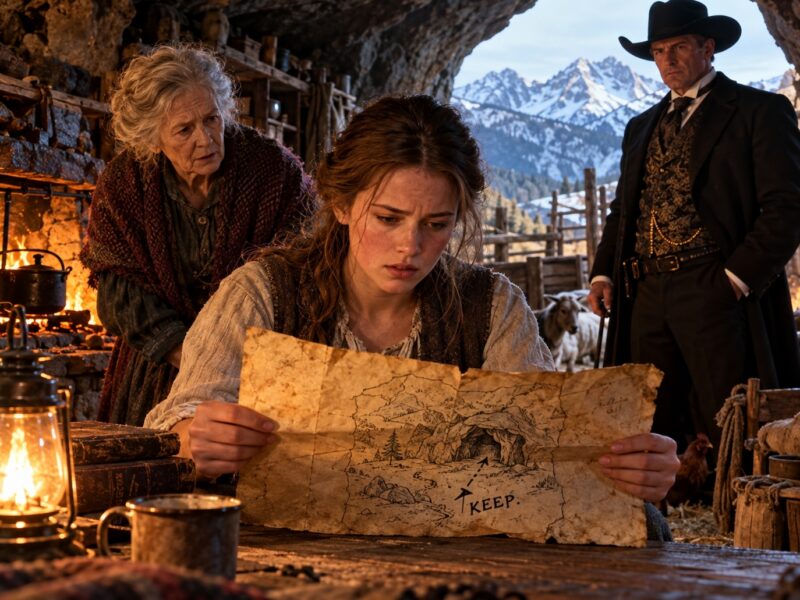
HER FATHER THREW HER OUT WITH $17 AND A WORTHLESS CAVE—BUT WHAT HER GRANDMOTHER HID INSIDE WOULD BRING A POWERFUL RANCHER TO HIS KNEES
PART 1 — THE GIRL WHO INHERITED NOTHING BUT A MOUNTAIN
“The coyotes will be picking your bones before October.”
The trapper laughed as eighteen-year-old Jessimine Whitmore struggled to lift her suitcase into the back of a borrowed wagon. Behind her, the father who had raised her stood on the porch with his arms folded, watching as though she were a stranger trespassing on his property.
Jessimine had seventeen dollars, a rusted key, and a deed to forty acres of Wyoming wilderness that nobody wanted.
What she didn’t know was that her grandmother had left her something far more valuable than land.
And somewhere beneath that mountain, a secret had been waiting thirty years for someone brave enough to find it.
It was September 1886, and the morning wind had already turned sharp along the foothills outside Red Willow, Wyoming Territory.
Jessimine’s father, Harold Whitmore, had given her until noon to leave.
He had not shouted when he told her. That was the part she would remember most clearly. He had simply finished his coffee, folded his newspaper, and announced that she was old enough to make her own way.
For the last six years, Jessimine had cooked his meals, washed his clothes, mended fences, tended the vegetable garden, and helped raise her younger brother, Thomas. She had done it all since her mother died of pneumonia when Jessimine was twelve.
Her father called it her duty.
Now Thomas was sixteen and strong enough to help with the ranch. Harold had also begun courting a widow from Cheyenne who had made it clear she did not intend to share a household with another grown woman.
Jessimine had become inconvenient.
“You’re giving me seventeen dollars?” she asked, staring at the coins spread across the kitchen table.
“And the land,” Harold replied.
He pushed a folded document toward her.
“Your grandmother Edith left it to you. Forty acres in Split Rock Hollow. The taxes are paid through next year. What more do you expect?”
Jessimine examined the deed.
She remembered her grandmother speaking about Split Rock when she was little. Edith had called it the place where the mountains kept their promises.
But nobody had lived there in decades.
“There isn’t a house,” Jessimine said.
“Then build one.”
“I don’t have a horse.”
“That’s not my problem.”
Thomas stood beside the kitchen doorway, his face pale.
“Pa, she can’t live up there alone.”
Harold turned toward him.
“Go tend the horses.”
Thomas hesitated, then lowered his head and obeyed.
Jessimine looked at the man who had taught her to read by lantern light, who had once carried her home after she broke her ankle, and searched his face for some trace of the father she remembered.
She found only impatience.
“Can I at least take Mother’s quilt?”
Harold looked toward the bedroom.
“Take what belongs to you. Leave what belongs to this house.”
She left with the quilt, two dresses, her mother’s sewing needles, an iron skillet, and a small photograph of her grandmother.
The seventeen dollars were wrapped in a handkerchief and tucked beneath her blouse.
By the time she reached Red Willow, she had stopped crying.
Not because she wasn’t hurt.
Because she had discovered that grief made it difficult to breathe, and she needed every breath for what came next.
The general-store owner, Mr. Pritchard, studied her list with a troubled expression.
“Flour, beans, salt, lamp oil, matches, a hatchet, nails, and rope,” he read. “You planning to build a house, Miss Whitmore?”
“A small one.”
“Where?”
“Split Rock Hollow.”
His pencil stopped moving.
“That’s no place for a girl alone.”
“Is the hatchet good steel?”
He looked at her for a moment before answering.
“Best I have.”
She bought only what she couldn’t reasonably carry from her father’s property. By the time she finished, she had almost nothing left.
Mr. Pritchard added a packet of needles and a tin of salve without charging her.
“For the hands,” he said quietly. “You’ll need both.”
A wagon driver agreed to take her partway into the mountains for the price of helping unload his lumber.
By late afternoon, Jessimine stood beside a narrow trail, surrounded by pine trees and enormous gray rocks.
The wagon driver pointed north.
“Another two miles. Follow the creek until you see the split cliff. Cave’s underneath.”
Then he studied her face.
“You can still come back to town.”
Jessimine tightened her grip on the rope around her supplies.
“No,” she said. “I can’t.”
The wagon disappeared down the trail.
For the first time in her life, there was no one telling her what to do.
The silence should have felt like freedom.
Instead, it felt enormous.
She made two trips carrying her supplies along the creek. By the time she reached Split Rock Hollow, the sky had turned violet and her shoulders burned.
The cave appeared beneath a limestone bluff, partly hidden behind tangled juniper.
Its opening was wider than she expected, nearly twelve feet across, with a stone shelf extending beneath an overhang.
She stood outside for several minutes, listening.
Water dripped somewhere inside.
A wind moved through the pines above her.
Nothing stirred in the darkness.
Jessimine struck a match and raised her lantern.
The cave floor was surprisingly dry.
About twenty feet inside, a narrow stream of water trickled from a crack in the stone and collected in a shallow natural basin before disappearing beneath gravel.
She cupped some water in her hands.
It was painfully cold.
She tasted it cautiously, then filled her canteen.
Further inside, the passage narrowed and curved into darkness. But near the entrance, the ground was level, and the cliff shielded the opening from the worst of the mountain wind.
It wasn’t a home.
Not yet.
Jessimine spread her mother’s quilt across a patch of dry earth, placed the hatchet beside her, and sat down.
Her stomach growled.
She had eaten nothing since morning.
For supper, she chewed a piece of hard bread and listened to the creek.
Then she took out her grandmother’s photograph.
Edith Whitmore had been a small woman with fierce eyes and hands roughened by a lifetime of work.
When Jessimine was ten, her grandmother had once told her, “A thing doesn’t lose its worth just because foolish people can’t recognize it.”
At the time, Jessimine had thought she meant the old silver spoon Edith insisted on polishing every Sunday.
Now she looked around the cave and wondered whether her grandmother had meant something else.
Outside, a coyote called.
Another answered from farther down the valley.
Jessimine pulled the quilt around her shoulders.
She was frightened.
She did not pretend otherwise.
But when dawn came, she was still alive.
And for the first time, the ground beneath her belonged to her.
The next six weeks almost broke her.
She gathered deadfall, cut poles, and dragged timber across the rocky ground until blisters opened along her palms.
She built a crude lean-to against the cliff, using the cave entrance as its rear shelter and setting her cooking fire outside beneath the overhang.
Her first wall collapsed during a thunderstorm.
Her second held.
She learned to work slowly enough to avoid mistakes, because mistakes in the mountains could cost more than time.
One afternoon, while carrying a heavy log, she slipped on loose gravel and struck her knee against a stone.
The pain was so sharp she dropped to the ground.
For several minutes, she sat in the dirt, shaking.
Then she began to cry.
Not softly.
Not prettily.
She cried because her father had not asked whether she was warm. Because her mother was dead. Because she was eighteen, alone, hungry, and trying to build a life out of things other people had thrown away.
When the tears finally stopped, she wiped her face with her sleeve.
Then she stood, took the log by one end, and dragged it the remaining distance.
Three days later, someone appeared at the edge of her clearing.
Jessimine was chopping kindling when she heard a woman’s voice.
“You’ll split your thumb before you split that knot.”
An elderly woman stood beside a small gray mule, wearing a brown wool shawl and a hat that had seen better years.
Her silver hair was braided beneath the brim.
Jessimine straightened.
“Who are you?”
“Birdie Tanfield. I live over the ridge.”
Birdie looked at the crooked walls, the pile of wood, and Jessimine’s bandaged hands.
Then she looked at the smoke curling from the cooking fire.
“Well,” she said, “you’re a stubborn little thing.”
Jessimine lowered her eyes.
“I’ve been called worse.”
Birdie smiled faintly.
“I imagine you have.”
She reached into a saddlebag and brought out two potatoes, a small sack of onions, and a jar of preserved peaches.
“Brought too much from my garden.”
Jessimine knew perfectly well that wasn’t true.
But she accepted the food.
Birdie returned the next day.
And the next.
She showed Jessimine how to chink gaps between the logs with clay and moss, how to shape a simple wooden door, and how to bank a fire safely so that coals would survive until morning.
More importantly, she knew how to listen without making every silence uncomfortable.
One evening, as they worked beside the fire, Jessimine unfolded her grandmother’s deed.
“There’s something strange on the back.”
Birdie leaned closer.
A faint drawing covered the parchment.
It showed the outline of Split Rock, the creek, and what appeared to be the cave entrance.
Several lines disappeared into the mountain.
At their end was a small arrow.
Beneath it, in Edith’s familiar handwriting, was a single word.
KEEP.
Birdie’s face changed.
She reached for the document, then stopped herself.
“Where did you get this?”
“My grandmother left it to me.”
Birdie stared into the fire.
For a long time, she said nothing.
Then she spoke so quietly Jessimine almost missed the words.
“Edith made me promise not to speak of what she found here.”
Jessimine turned toward her.
“What did she find?”
Birdie’s hands tightened around her cup.
“I’ve kept that promise thirty years.”
“She’s dead now.”
“I know, child.”
“Then why won’t you tell me?”
Birdie looked toward the darkness beyond the cave entrance.
“Because the last man who went looking for it never came home.”
The following morning, Birdie was gone before Jessimine woke.
She left behind a small iron kettle, a sack of potatoes, and a note reminding Jessimine to reinforce the chimney stones before the first snow.
Nothing about the map.
Jessimine read the note twice.
Then she tucked the deed beneath her mattress.
She told herself she had more important things to worry about.
By November, the little cabin stood firmly against the cliff.
It had a proper door, a small shuttered window, shelves for her food, and a stone-lined hearth positioned to carry smoke away through a narrow chimney opening.
Birdie helped her acquire two hens and an old milk goat in exchange for winter firewood.
Jessimine named the goat Mercy because, as Birdie observed, the animal didn’t have much of it.
The first snow arrived on November 14.
Jessimine watched it settle across the pines from inside her cabin, a cup of hot water warming her hands.
Her roof did not leak.
Her door closed properly.
The fire burned steadily.
She had done it.
For a few precious minutes, she allowed herself to feel proud.
Then a horse approached through the snow.
The rider was a broad-shouldered man in an expensive dark coat, mounted on a chestnut gelding that looked better fed than most families in Red Willow.
He dismounted without introducing himself.
His eyes moved over the cabin, the woodpile, and the cave entrance.
“Jessimine Whitmore?”
“Yes.”
“Leland Stowe.”
She knew the name.
Everyone did.
Stowe owned the largest cattle operation in that part of the territory. His fences stretched across valleys where smaller families had once grazed their animals, and his hired men were known for resolving disputes before the sheriff became involved.
He removed his gloves.
“I understand this property belonged to Edith Whitmore.”
“She was my grandmother.”
He nodded.
“I’ll give you fifty dollars for the land.”
Jessimine looked at him.
“It’s not for sale.”
“Fifty dollars is generous for forty acres of rock.”
“Then you won’t miss owning it.”
His expression tightened.
He looked past her toward the cave.
“Your grandmother’s original claim may not have been properly registered.”
Jessimine felt something cold move through her chest.
“I have the deed.”
“A deed isn’t always proof of a valid title.”
“My grandmother paid her taxes.”
“So you believe.”
He pulled on his gloves.
“I’d advise you to reconsider before this becomes expensive.”
Jessimine stood in the doorway until he mounted his horse.
As he turned away, she called after him.
“Why do you want land you say is worthless?”
Stowe stopped.
For the first time, he seemed genuinely annoyed.
“Because I don’t care for obstacles, Miss Whitmore.”
Then he rode away.
That evening, Jessimine spread the deed beside the fire.
She studied the faded lines until her eyes ached.
The mark labeled KEEP did not point to the cabin.
It pointed deep into the cave, beyond the narrow passage where her lantern light had never reached.
Jessimine waited until morning.
Then she tied a rope around her waist, secured the other end to a thick timber near the entrance, and carried her lantern into the darkness.
The passage turned sharply to the left.
Beyond it, the floor rose over a ridge of stone.
She crawled through a narrow opening, scraping her elbows against the rock, until the tunnel widened into a chamber.
There, beneath a layer of dust, she found marks cut into the wall.
Not natural cracks.
Letters.
She brushed away the dirt with her sleeve.
E. W.
And beneath the initials, scratched into the stone, was a date.
1856.
Her grandmother had been there.
Jessimine turned slowly.
On the far side of the chamber stood a pile of stones arranged with unusual care.
She knelt beside them and began moving them one at a time.
Behind the stones was a small hollow.
Inside sat an iron-bound wooden box.
Its leather handle had nearly rotted away.
Jessimine pulled it into the lantern light.
A brass plate was fastened to the lid.
She wiped away thirty years of dust.
Three words had been engraved into the metal.
FOR THE RIGHTFUL HEIR.
And when she lifted the lid, Jessimine discovered why Leland Stowe was willing to threaten an eighteen-year-old girl over forty acres of supposedly worthless mountain.
PART 2 — THE SECRET HER GRANDMOTHER REFUSED TO BURY
The box contained no gold.
No jewels.
Nothing that would have impressed the men who gathered outside the Red Willow saloon and measured a person’s worth by the size of his cattle herd.
Instead, Jessimine found a bundle of oilcloth-wrapped documents, a small brass compass, and a leather notebook secured with a faded blue ribbon.
At the bottom was a sealed envelope.
Her name was written across it.
To Jessimine, when she is old enough to understand.
Jessimine stared at the handwriting.
Her grandmother had died when she was fourteen.
Yet here was a letter waiting for her, hidden inside a mountain.
She carefully broke the seal.
My dear girl,
If you are reading this, you have found the place I loved more than any other.
I wish I could tell you the world will be kind to you. It has not always been kind to the women in our family, and I suspect you will have learned that by the time these words reach your hands.
But there is something I need you to understand.
The land at Split Rock is not barren. It is not worthless. And it must never belong to anyone who wishes to own the water beneath it.
Jessimine stopped reading.
Water?
She glanced toward the thin spring trickling through the cave.
Then she continued.
In the summer of 1856, your grandfather and I discovered a passage through the mountain after a rockslide opened part of the cave.
Beyond it lay a hidden spring, fed by the high mountain snowfields. Even in the driest summer, the water ran cold and clear.
I believed it was a blessing.
Other men saw something they could sell.
The rest of the letter described a dispute that had nearly destroyed Edith’s marriage.
A wealthy land speculator named Amos Stowe had approached the Whitmores after hearing rumors about the spring.
He offered to purchase the land.
When Edith refused, he began pressuring her husband, claiming he could divert the water toward cattle operations farther down the valley.
Jessimine recognized the surname immediately.
Amos Stowe.
Leland’s father.
Edith had known what would happen if a single rancher controlled the valley’s most reliable water source.
The smaller farms would become dependent on him.
Families who had worked the land for years could be forced out.
And during a severe drought, livestock and people alike could be left with nowhere else to turn.
The letter went on.
Your grandfather secured our original claim and kept copies of the survey records. When Amos tried to challenge our ownership, we prepared to defend it.
But there was another danger.
During the summer of 1859, three men attempted to widen the passage without proper supports. One was injured, and another barely escaped a falling slab of stone.
After that, we closed the entrance and kept the spring’s location secret.
Jessimine swallowed.
Birdie had said a man never came home.
Perhaps she had remembered a different incident.
Perhaps there was more to the story.
She unfolded the remaining sheets.
One was an old survey drawing bearing the signature of a territorial-era land agent from an earlier jurisdiction.
Another described a watercourse running beneath Split Rock.
There were also receipts, letters, and a handwritten account of Edith’s dealings with Amos Stowe.
Jessimine examined the final page.
I have left this land to you because you notice what others overlook. Even as a child, you saw when people were thirsty before they asked for water.
If a Stowe ever comes for Split Rock, remember this: do not fight him with anger alone. Find the papers. Find trustworthy witnesses. And let the truth stand where threats cannot reach it.
You may choose what to do with the spring. I ask only that you never let a frightened neighbor go thirsty when you have water enough to share.
Jessimine pressed the letter against her chest.
For several minutes, she remained kneeling on the cold stone.
She had spent months believing her grandmother had left her a place nobody else wanted.
Now she understood that Edith had left her a responsibility.
And that responsibility frightened her almost as much as it filled her with pride.
When she returned to the cabin, she placed the documents beside the fire and began studying the survey.
A dotted line marked the route from the hidden chamber to a second passage.
The passage ended at a symbol resembling a narrow stone arch.
Beside it Edith had written:
Upper spring. Never block the overflow.
Jessimine’s fingers rested on the words.
She remembered something Birdie had said weeks earlier.
“The water comes down from the high country, child. Always has. Sometimes it comes gently. Sometimes it comes all at once.”
The following day, Jessimine went to Birdie’s cabin.
The older woman was sitting beside her stove, sorting dried herbs into jars.
When Jessimine placed the blue-ribboned notebook on the table, Birdie closed her eyes.
“So you found it.”
“Yes.”
Birdie touched the cover with one bent finger.
“She always said someone would.”
“Why didn’t you tell me?”
“Because I promised.”
“Grandmother’s letter says there was an accident. You told me a man never came home.”
Birdie’s face tightened.
“His name was Samuel Pike. He was helping Amos Stowe search the lower passages. There was a fall of stone after heavy rain, and they never found enough of him to bury.”
Jessimine said nothing.
Birdie looked toward the window.
“Amos blamed your grandmother. Said she’d hidden the true passage and sent the men into danger. Edith carried that blame for years, though she had warned them not to enter.”
“Did he know where the spring was?”
“He knew there was water. He never found the source.”
“And Leland?”
Birdie hesitated.
“His father left him a map. An incomplete one.”
Jessimine sat down.
“Then that’s why he wants my land.”
Birdie nodded.
“Leland’s been buying small holdings along the lower creek for years. He says it’s for grazing. But he’s building a cattle empire, and cattle need water.”
Jessimine stared into the stove.
“He offered fifty dollars.”
Birdie made a sound of disgust.
“Fifty dollars wouldn’t buy one of his good saddles.”
The older woman reached across the table and took Jessimine’s hand.
“Listen to me carefully. That man can afford lawyers. He knows people in Cheyenne. If you intend to defend your land, you’ll need more than an old letter.”
“I have surveys.”
“Then we find out whether they’re worth anything.”
Two weeks later, Jessimine rode into Red Willow in Birdie’s wagon carrying copies of the documents wrapped inside her coat.
She visited the county clerk’s office first.
The clerk, a thin man named Arthur Bell, spent nearly an hour searching through ledgers.
Finally, he located the record.
Edith Whitmore’s property had been transferred through an earlier land claim and later entered into the official county records.
Taxes had been paid.
The boundaries matched the deed.
Jessimine exhaled.
“So the land is mine?”
“The records support your ownership,” Bell replied. “But Mr. Stowe has filed notice that he intends to challenge the original survey.”
Her relief vanished.
“On what grounds?”
“He claims there may have been an error in the western boundary.”
“Is there?”
“I haven’t seen evidence of one.”
“Then why is he allowed to challenge it?”
Bell looked uncomfortable.
“Because a court has to hear a properly filed petition.”
Jessimine carefully folded her copy of the deed.
“Who decides?”
“A judge.”
“And how much will a lawyer cost?”
Bell removed his spectacles.
“More than you have, I expect.”
She thanked him and left.
Outside, snow gathered along the boardwalk.
A man in a dark coat stood beside her wagon.
Leland Stowe.
He smiled when he saw her.
“Miss Whitmore. I understand you’ve been asking questions.”
“About my own property.”
“Questions can be expensive.”
“So I’ve heard.”
He stepped closer.
“I’ll raise my offer to one hundred dollars.”
Jessimine tightened her grip on the wagon rail.
“No.”
“Two hundred.”
She looked at him.
For a moment, she thought about what two hundred dollars could mean.
A proper roof.
Food for a year.
A horse.
A life with fewer cold mornings and fewer nights worrying whether she had enough firewood.
Then she remembered her grandmother’s words.
Never let a frightened neighbor go thirsty.
“Why do you need the spring?” Jessimine asked.
Stowe’s smile disappeared.
A wagon rolled past behind them.
He waited until it had gone.
“What spring?”
“The one inside Split Rock.”
For the first time, she saw uncertainty cross his face.
Then it hardened into something colder.
“You’d be wise not to spread stories you can’t prove.”
“I have proof.”
“An eighteen-year-old girl living in a cave doesn’t have the resources to fight me.”
Jessimine held his gaze.
“Then why are you trying so hard to frighten her?”
Stowe stepped back.
He did not answer.
Instead, he tipped his hat and walked away.
Jessimine returned to Split Rock before sunset.
She found her front door hanging crookedly from one hinge.
The woodpile had been scattered.
Inside, drawers lay open and blankets had been thrown onto the floor.
Someone had searched her home.
Her food stores were untouched.
Her grandmother’s photograph had been knocked from its shelf, its glass cracked.
Jessimine stood motionless.
Then she rushed to the floorboard beneath her bed.
The oilcloth bundle was still there.
The originals were safe.
But on the table, held down by her iron skillet, lay a folded note.
You should have taken the money.
That night, Jessimine did not light the lantern until she had barred the door.
She sat beside the fire with the hatchet across her knees, listening to every sound beyond the walls.
At midnight, she heard a horse move through the trees.
Then another.
She held her breath.
The horses stopped.
A man’s voice spoke somewhere beyond the clearing.
“She’s still inside.”
Another voice answered.
“Then we’ll have to come back.”
The riders left before dawn.
Jessimine did not sleep.
At first light, she saddled Birdie’s mule and rode down the valley.
She did not go to her father.
She went to the sheriff.
Sheriff Caleb Mercer listened while she described the broken door and the note.
He inspected the paper.
“Can you prove Stowe sent anyone?”
“No.”
“Did you see the men?”
“No.”
He sighed.
“Then I can’t arrest him on suspicion.”
Jessimine’s face flushed.
“So I have to wait until they hurt me?”
“No,” Mercer replied. “You have to give me something I can take before a judge.”
He looked at her carefully.
“Keep the note. Don’t touch it more than necessary. And if anyone comes back, send word immediately.”
It wasn’t the protection she had hoped for.
But it wasn’t nothing.
As she left the sheriff’s office, the church bell began ringing.
A crowd had gathered near the general store.
Men stood in the street speaking in worried voices.
A farmer named Owen Briggs was arguing with the miller.
“The creek’s lower than it was yesterday.”
“It’s winter,” the miller said. “Everything’s frozen.”
“Not like this.”
Another man joined them.
“Stowe’s men built a new holding pond upstream. They’re taking what little water’s left.”
Jessimine stopped walking.
She thought of the map.
The hidden spring.
The marked overflow.
For the first time, she understood that the fight over Split Rock might be about more than who owned forty acres.
It might determine whether the people of Red Willow survived the coming winter.
The next morning, she took Birdie into the cave.
Together, they followed Edith’s map through the narrow passage.
Beyond the hidden chamber, they discovered a low stone arch half buried by gravel.
Cold air flowed through the opening.
And beneath that air came another sound.
Running water.
They spent hours clearing small stones from the entrance, careful not to disturb the larger rocks overhead.
At last, Jessimine raised her lantern and looked beyond the arch.
A broad underground stream flowed through a chamber deeper than anything she had imagined.
The water moved steadily across polished stone, disappearing into a natural channel at the far end.
Birdie covered her mouth.
“Lord have mercy.”
Jessimine knelt beside the stream.
Her grandmother had been telling the truth.
The spring was real.
But while studying the stone channel, Jessimine noticed something that made her uneasy.
Fresh tool marks.
Someone had been there recently.
Near the far wall, a wooden stake had been driven into a crack.
A length of new rope disappeared into a side passage.
Then Birdie pointed toward the stream.
“Jessimine.”
The water had begun rising.
Not rapidly.
Not yet.
But a dark wet line on the stone showed it had risen several inches since their arrival.
Birdie’s face turned pale.
“Someone’s blocked the lower outlet.”
Jessimine looked toward the dark passage.
“Stowe?”
“I don’t know.”
The older woman gripped her arm.
“But if that water has nowhere to go, the pressure will find another way out.”
Outside, snow had begun falling heavily.
Jessimine remembered the creek running unusually low through Red Willow.
She remembered the holding pond.
And she remembered the marks someone had made inside the mountain.
Then, from somewhere deep beyond the chamber, came a sound that made both women freeze.
A heavy, cracking groan.
Stone shifted overhead.
Birdie whispered, “We need to get out.”
But Jessimine was staring at the water.
Because floating past her boots was a fresh piece of cut timber.
And branded into its wet surface was a familiar mark.
LS — LELAND STOWE.
PART 3 — THE WINTER THAT EXPOSED THE TRUTH
They escaped the cave just as a low rumble passed through the mountain.
Jessimine stumbled into the snow, pulling Birdie behind her.
For several seconds, the ground trembled beneath their boots.
Then everything went still.
Only the wind moved through the trees.
Birdie leaned against a pine, struggling to catch her breath.
“Don’t you go back in there.”
Jessimine looked toward the cave.
“I saw his timber.”
“I know what you saw.”
“He’s trying to block the water.”
“And the mountain may kill him for it.”
Jessimine helped Birdie toward the cabin.
Inside, she built up the fire and spread Edith’s survey across the table.
She followed the underground stream with her finger.
The main passage ran northeast.
An older outlet led toward the lower creek.
A second natural channel carried overflow toward a narrow ravine above Red Willow.
If the lower outlet had been obstructed, the water would rise until it found the overflow passage.
But if that passage was also blocked, the underground chamber could flood, forcing water through unstable cracks in the rock.
Jessimine studied the drawing again.
Near the lower outlet, Edith had drawn three small crosses.
Beside them were the words:
Old flood gates. Leave open.
Birdie leaned over the parchment.
“Your grandfather put those in. Timber gates, not much more than barriers to direct debris. He wanted to keep spring floods from washing rocks down into the creek.”
“Would they still work?”
“After thirty years? I wouldn’t trust them.”
Jessimine tapped the map.
“But someone has found them.”
Birdie stared at her.
“You think Leland is trying to control the spring from underground?”
“I think he wants the water to stop reaching the lower valley. If people’s farms fail, he can buy their land.”
Birdie was silent.
Then she sat down heavily.
“That’s exactly what his father tried to do.”
They needed proof.
And they needed help.
Jessimine rode to Red Willow the following morning despite the snow.
She found Sheriff Mercer outside the livery stable and showed him the branded timber.
He examined it carefully.
“This came from inside the cave?”
“Yes.”
“Where exactly?”
“Beyond a passage my grandmother sealed years ago.”
Mercer looked toward the mountain.
“Stowe’s hired a crew to dig somewhere near Split Rock. He claims they’re looking for limestone.”
“They’re interfering with the water.”
“Can you show me?”
Jessimine nodded.
“But the passage may be dangerous.”
Mercer summoned Deputy Nolan Price and a miner named Matthew Reed, who had spent twenty years working underground.
They rode to Split Rock that afternoon.
Reed inspected the cave entrance, the hidden chamber, and the partially cleared arch.
Then he crouched near the stream.
His expression darkened.
“These marks are fresh.”
He touched a groove in the rock.
“Someone’s been using steel wedges. And that timber didn’t wash in here naturally.”
He looked at Jessimine.
“You did right staying out.”
They followed the side passage only as far as Reed judged safe.
There, they found a narrow tunnel leading toward the western boundary of Jessimine’s property.
At its end stood a rough timber wall.
Water seeped between the boards.
Reed knelt beside it.
“This isn’t a proper diversion.”
“What is it?” Mercer asked.
“A blockage. Someone’s trying to hold back water long enough to route it through another cut.”
Jessimine looked at the rising stream.
“Could it break?”
Reed stood.
“It will break.”
“When?”
He glanced toward the mountain ceiling.
“I wouldn’t wager my life on a guess.”
Before anyone could speak again, a muffled explosion echoed through the passage.
Dust fell from the roof.
Deputy Price grabbed the lantern.
“What in God’s name was that?”
Reed swore.
“Blasting powder.”
The men turned and hurried toward the entrance.
Outside, a column of gray smoke rose from the western ridge.
Stowe’s crew was blasting into the mountain.
Mercer mounted immediately.
“Price, ride to town. Get men and ropes. Tell the families along the lower creek to move away from the banks.”
Jessimine stepped forward.
“What about the spring?”
Reed looked toward the cave.
“If they keep blasting, they’ll bring the roof down before we can clear that blockage.”
A second explosion sounded.
This one was closer.
The ground shuddered.
Somewhere beneath their feet, water began forcing its way through stone that had held for generations.
By evening, Red Willow was in confusion.
Families hurried to move livestock onto higher ground.
Men hauled carts loaded with blankets, grain, and furniture away from the creek.
Stowe arrived at the sheriff’s office furious.
He denied ordering any dangerous blasting.
“The men were opening an old quarry,” he insisted.
Mercer placed the branded timber on his desk.
“Then explain why your lumber is blocking a water passage beneath Miss Whitmore’s land.”
Stowe’s face tightened.
“Timber can be stolen.”
“Can blasting powder?”
Stowe looked at Jessimine, who stood beside the doorway with snow melting from her coat.
“This girl has filled your head with nonsense.”
Jessimine said nothing.
She had learned that sometimes silence forced people to reveal more than argument ever would.
Mercer folded his arms.
“Your foreman admitted your crew was working near the spring. I want the names of every man involved.”
“My attorneys will answer your questions.”
“Then send for them.”
Stowe turned toward the door.
Before he could leave, a ranch hand burst into the office.
“Sheriff! The lower creek’s gone dry!”
Mercer grabbed his coat.
Jessimine followed him outside.
The creek that ran through Red Willow had dwindled to a thread of water beneath the ice.
Along its banks, families stood staring at exposed stones.
A woman held an empty bucket.
An old farmer knelt beside the frozen mud and touched it with his fingers.
Jessimine recognized him.
Owen Briggs.
His wife had been ill for months, and their cattle were already thin.
He looked up at her.
“My well’s almost empty.”
Jessimine felt her stomach tighten.
For the first time, the problem had a face she knew.
She turned toward Mercer.
“The spring is still flowing underground. We have to restore the outlet.”
Reed approached them.
“I can try to open the old channel from the lower side.”
“How long?”
“Depends what’s blocking it.”
“And if the pressure breaks through first?”
Reed looked at the creek.
“Then the valley gets more water than it can handle all at once.”
They worked through the night.
Men carried tools and lanterns up the mountain.
Women prepared food and blankets at the church.
Birdie organized the older children to help families move supplies away from the creek.
Jessimine stayed with Reed and the sheriff.
The miner found an old drainage opening lower on the slope, partly buried beneath decades of loose stone and roots.
According to Edith’s map, it connected with the blocked channel.
Reed directed the men to clear it by hand.
No blasting.
No reckless digging.
Every stone was examined before it was moved.
Near midnight, water began seeping through the opening.
A little at first.
Then more.
Reed lowered his lantern and studied the flow.
“It’s under pressure.”
Jessimine gripped the map.
“Can you open it?”
“Not safely from this side. We need to relieve the obstruction upstream.”
He pointed toward the cave.
“We’ll have to get closer to that timber wall.”
The sheriff looked at Jessimine.
“You stay here.”
She shook her head.
“I know the passages.”
“Miss Whitmore—”
“The map is my grandmother’s. I know where the narrow turn leads. Reed doesn’t.”
The miner studied her.
“You’ll do exactly what I say?”
“Yes.”
“And if I tell you to run?”
“I’ll run.”
Reed nodded.
“Then stay behind me.”
They entered the cave with three other men.
The air felt colder than before.
Water rushed through the hidden chamber, its surface now dangerously close to the stone arch.
Reed examined the timber barrier.
He identified a section that could be removed without disturbing the main supports.
Jessimine held the lantern while the men worked.
For nearly an hour, they loosened wedges and cut away smaller pieces of timber.
Then the water changed.
Its low rushing sound became a deep, steady roar.
Reed looked up sharply.
“Everybody back.”
One of the men hesitated.
“The last brace—”
“Leave it!”
He grabbed the man’s collar and pulled him away.
An instant later, the weakened barrier gave way.
Water surged through the opening.
The rush struck the far wall with enough force to throw spray across the chamber.
Jessimine stumbled.
Her lantern slipped.
Reed caught her by the coat before she fell into the channel.
“Move!”
They hurried through the narrow passage.
Behind them, water thundered into the restored outlet.
When they reached the cave entrance, the ground beneath their feet was wet, and the sound of the creek had returned.
But they could also hear shouting from below.
Mercer raced toward them.
“It’s coming down fast!”
Jessimine looked toward the valley.
The released water was moving through the old creek bed, carrying ice, branches, and debris.
It was not the sudden wall of water Reed had feared, but the first rush was strong enough to threaten livestock and anyone standing too close to the banks.
The sheriff’s warnings had given the town time to move.
Now the remaining families watched from higher ground as the creek filled again.
At dawn, Red Willow was still standing.
The lower fields were soaked.
Several fences had washed away.
One footbridge had been damaged beyond repair.
But no one had died.
And the wells along the creek began slowly recovering as water returned to the valley.
Jessimine sat on a fallen log outside her cabin, shaking from exhaustion.
Her hands were blistered.
Her coat was torn.
Mud covered her skirt.
Birdie wrapped a blanket around her shoulders.
“You look terrible.”
Jessimine gave a weak laugh.
“I feel worse.”
Birdie sat beside her.
For a while, neither spoke.
Then the older woman looked toward the cave.
“Edith would have been proud.”
Jessimine lowered her head.
That was when she finally cried.
Not because she had saved the land.
Because someone had spoken her grandmother’s name as though love could still cross the distance between the living and the dead.
But the battle with Leland Stowe was not finished.
Two days later, he filed his formal claim.
He insisted the western boundary had been incorrectly recorded decades earlier and that the cave entrance belonged to land he had recently purchased.
He also claimed Jessimine had interfered with his lawful excavation work.
The hearing was scheduled for January.
Jessimine had little money, and the lawyer Birdie recommended wanted payment she could not provide.
Then Mr. Pritchard came to Split Rock carrying a small envelope.
Inside were twelve dollars.
Jessimine stared at it.
“I can’t take this.”
“It’s not charity,” he said.
He unfolded a paper containing a list of names.
Owen Briggs.
The miller.
The schoolteacher.
Three widows.
The blacksmith.
Even the wagon driver who had once warned her against living in the cave.
They had contributed what they could.
“People are paying you back,” Pritchard said.
Jessimine covered her mouth.
For months, she had believed she was entirely alone.
Now she discovered that kindness sometimes returned quietly, in coins saved from hard weeks and names written on ordinary paper.
A young attorney named Daniel Keene agreed to take the case for a modest fee after reviewing Edith’s records.
He warned Jessimine not to expect an easy victory.
“Stowe has influence,” he said.
Jessimine placed the original deed on his desk.
“I have the truth.”
Keene looked at the documents.
“Then we need to make certain the court can see it.”
Over the next three weeks, he and the county clerk verified the chain of ownership.
They traced the old boundary markers.
They compared Edith’s records with newer surveys.
They interviewed Birdie, Sheriff Mercer, Matthew Reed, and the men who had worked near the damaged passage.
One of Stowe’s employees, a frightened laborer named Frank Dugan, eventually admitted that his foreman had ordered the crew to install the underground blockage.
Dugan had not known how much water lay behind it.
When the pressure rose, he had begged the foreman to stop.
The foreman refused.
Keene took his statement.
Then he obtained the most important document of all.
A signed work order from Stowe’s ranch office authorizing the excavation near Split Rock.
The order referred to the spring and instructed the crew to secure control of the lower watercourse before the property dispute was resolved.
When Jessimine read it, her hands began trembling.
Stowe had not merely wanted her land.
He had been willing to endanger an entire valley to force her to surrender it.
On the morning of the hearing, snow covered the courthouse steps.
Jessimine wore her best blue dress, repaired at the cuffs and collar.
Birdie had braided her hair.
Thomas Whitmore waited near the entrance.
Jessimine stopped.
Her younger brother looked older than he had in September.
He held his hat in both hands.
“Jess.”
She said nothing.
“Pa told me not to come.”
Her stomach tightened.
“Then why are you here?”
Thomas looked down.
“Because I should’ve helped you.”
She swallowed.
He reached into his coat and took out a small cloth pouch.
Inside were the silver buttons from their mother’s wedding dress.
“I kept these before Pa sold her trunk.”
Jessimine stared at them.
Thomas’s voice broke.
“I didn’t know how to stop him.”
She closed her fingers around the pouch.
“You were sixteen.”
“I could’ve said something.”
“Yes,” she replied softly. “You could have.”
Thomas lowered his head.
After a moment, she touched his arm.
“I’m glad you came.”
It was not forgiveness.
Not yet.
But it was a beginning.
Inside the courtroom, Leland Stowe sat beside two attorneys.
He barely glanced at Jessimine.
The hearing began with the history of the property.
The county clerk testified that Edith Whitmore’s ownership had been recorded and that the documents supported Jessimine’s title.
The surveyor explained that the cave entrance fell within the boundaries of her forty acres.
Birdie testified about Edith’s discovery and the long dispute with Amos Stowe.
Then Matthew Reed described the blocked water passage.
He explained the fresh tool marks, the timber barrier, and the danger the obstruction had created.
Stowe’s attorneys objected repeatedly.
The judge allowed the testimony where it related to the disputed property and the excavation.
Then Frank Dugan took the stand.
He looked at Leland Stowe once before lowering his eyes.
“My foreman told us the boss wanted that water turned before the hearing,” he said.
One attorney rose.
“Objection. The witness cannot testify about what Mr. Stowe personally intended.”
The judge nodded.
“Sustained as to Mr. Stowe’s intentions. The witness may describe the instructions he received.”
Dugan swallowed.
“We were told to close the old outlet and cut a new channel toward the west pasture.”
“Did you know the property was disputed?”
“Yes, sir.”
“Were you warned the work could be dangerous?”
“Yes, sir.”
The courtroom went silent.
Then Daniel Keene introduced the signed work order.
Stowe’s face changed.
He leaned toward his attorneys.
For the first time since Jessimine had met him, he looked uncertain.
The judge studied the evidence for a long time.
Finally, he announced that the ownership records supported Jessimine’s title and rejected Stowe’s boundary claim.
He ordered Stowe’s crews to stay off her property and referred the evidence concerning the excavation to the appropriate authorities for further investigation.
Stowe rose abruptly.
“This is absurd.”
The judge looked over his spectacles.
“Sit down, Mr. Stowe.”
The rancher’s jaw tightened.
For a moment, it seemed he might refuse.
Then he sat.
Jessimine stared at the table in front of her.
She had imagined that winning would feel like shouting.
Instead, she felt an almost unbearable quiet.
Her land was still hers.
Her grandmother’s papers had protected it.
And Leland Stowe, who had once offered her fifty dollars for everything she owned, had been forced to hear the word no from a man he could not threaten into silence.
Outside the courthouse, reporters from two neighboring towns questioned the witnesses.
Jessimine answered only a few questions.
Then she climbed into Birdie’s wagon.
The older woman glanced at her.
“Well?”
Jessimine looked at the snowy street.
“I want to go home.”
Birdie smiled.
“Then let’s get you there.”
PART 4 — WHAT SEVENTEEN DOLLARS COULD NEVER BUY
Spring came slowly to Split Rock Hollow.
The snow retreated from the pines.
The creek ran clear again.
Small yellow flowers appeared between the rocks near Jessimine’s cabin.
By April, she had repaired her door, expanded the goat shelter, and planted potatoes in the small patch of soil beside the creek.
But the court victory had changed more than her property records.
People began coming to Split Rock.
First came Owen Briggs with two sacks of grain and a repaired shovel.
Then the blacksmith arrived to reinforce her hinges.
Mr. Pritchard brought a windowpane that fit the cabin’s crooked frame.
A carpenter from Red Willow offered to help build a safer roof over the entryway.
Jessimine tried to pay them.
Most refused.
One afternoon, Owen stood beside the spring with his hat in his hands.
“My wife says we’d have lost the cattle without you.”
Jessimine looked down at the water.
“Mr. Reed did most of the dangerous work.”
“He did his share,” Owen replied. “But you found the place. And you wouldn’t let that man take it.”
Jessimine did not know what to say.
So she invited him inside for coffee.
By summer, the old wagon trail had been widened enough for supplies to reach the cabin.
With advice from Reed and a surveyor, Jessimine arranged to protect the spring’s natural drainage and keep the dangerous inner passage closed except for supervised inspection.
She wanted the water to remain available to the valley without inviting strangers to wander into unstable tunnels.
Daniel Keene helped her prepare a written agreement granting limited access for emergency water collection while preserving her ownership and responsibility for the property.
She signed it carefully.
Jessimine Whitmore.
The name looked different now.
Not because it had changed.
Because she had.
In June, her father came to Split Rock.
Jessimine saw him walking up the trail late in the afternoon.
Harold Whitmore wore the same dark hat he had worn the morning he told her to leave.
He stopped beside the woodpile.
For several moments, he looked at the cabin without speaking.
“You built all this?”
“Yes.”
His eyes moved toward the small vegetable garden, the goat enclosure, and the sturdy door.
“Thomas says you won your court case.”
“I did.”
Harold shifted his weight.
“I heard Stowe offered you a lot of money afterward.”
“He did.”
“Did you take it?”
“No.”
Her father frowned.
“Still stubborn.”
Jessimine rested one hand on the doorframe.
“I suppose so.”
A silence settled between them.
Finally, Harold cleared his throat.
“The house has been quiet.”
She looked at him.
He seemed older.
His shoulders had rounded slightly, and the lines around his mouth were deeper than she remembered.
But she was no longer the girl who searched his face for permission to exist.
“Thomas misses you,” he added.
“I see Thomas whenever he comes.”
Harold looked toward the mountains.
“I didn’t think you’d last the winter.”
“I know.”
“I thought you’d come back.”
Jessimine felt something tighten beneath her ribs.
For a moment, she remembered the cold kitchen, the seventeen dollars, and her mother’s quilt folded inside a suitcase.
Then she looked at the home she had built.
“You could have asked me to stay,” she said.
Harold lowered his eyes.
“I wasn’t fair to you.”
It was not the apology she had imagined.
There were no tears.
No dramatic embrace.
Only an aging man standing awkwardly beside a pile of firewood, finally acknowledging what he had done.
Jessimine let the silence remain.
Then she said, “No. You weren’t.”
Harold nodded slowly.
After a moment, he asked whether she needed help chopping wood.
She glanced at the stacked logs beside the cabin.
“I’m managing.”
He understood.
When he turned to leave, Jessimine called after him.
“Pa.”
He stopped.
She held the door open.
“There’s coffee, if you want some.”
Harold looked at her for a long moment.
Then he removed his hat and stepped inside.
They did not repair everything that afternoon.
Some wounds were too deep for one conversation.
But for the first time, Jessimine could speak to her father without fearing that he might take away the roof over her head.
That alone felt like a kind of freedom.
Later that summer, Birdie came to visit with a basket of fresh bread.
Jessimine was sitting at the table, carefully writing in her grandmother’s leather notebook.
Birdie looked over her shoulder.
“What are you putting in there?”
“The names of people who helped.”
Birdie smiled.
“That’s going to be a long list.”
Jessimine turned the page.
At the top, she had written:
What the mountain gave back.
Below it were the names of the people who had contributed money, tools, food, labor, testimony, and courage.
She had also begun recording the spring’s seasonal changes, the condition of the cave, and the work needed to keep the water flowing safely.
Birdie watched her for a moment.
Then she pointed toward a blank space.
“You’ve forgotten someone.”
Jessimine looked up.
“Who?”
“Yourself.”
Jessimine laughed softly.
“I don’t think Grandmother intended this to be a book about me.”
Birdie sat down beside her.
“Your grandmother knew perfectly well what she was doing when she left you this place.”
Jessimine looked toward the window.
Beyond it, the afternoon sun warmed the limestone cliff.
Water spilled gently through the creek.
The goat grazed beside the fence.
The hens scratched beneath the juniper.
Everything was ordinary.
Everything was precious.
She remembered the first night she had slept inside the cave, frightened by every sound, believing she had been abandoned to a place that held nothing.
Now she understood what Edith had seen there.
Not treasure hidden in gold.
Not a fortune waiting to be claimed.
Something that could not be measured by a rancher’s offer.
Shelter.
Water.
A place where a person could stand without asking permission.
Jessimine picked up her pen and wrote one final sentence beneath the list of names.
The mountain was never worthless. It was only waiting for someone willing to care for it.
Years later, people in Red Willow would still tell the story of the eighteen-year-old girl who arrived at Split Rock Hollow with seventeen dollars and a deed nobody respected.
They would remember the winter the creek nearly vanished.
They would remember the young woman who refused to sell her land and the hidden spring that helped save the valley.
Some would say she had been lucky.
Others would say her grandmother had known exactly what she was leaving behind.
But Jessimine remembered something different.
She remembered her father’s voice telling her to build a house if she wanted one.
She remembered the first crooked wall, the bleeding hands, the cold nights, and the sound of water moving through darkness.
And whenever someone asked what it had felt like to inherit forty acres of worthless mountain, she would smile and answer:
“My grandmother didn’t leave me a cave because it was all she had.”
She would look toward the little cabin beneath the rock, where smoke rose peacefully into the Wyoming sky.
“She left it to me because she knew it was the one place nobody could tell me I didn’t belong.”









