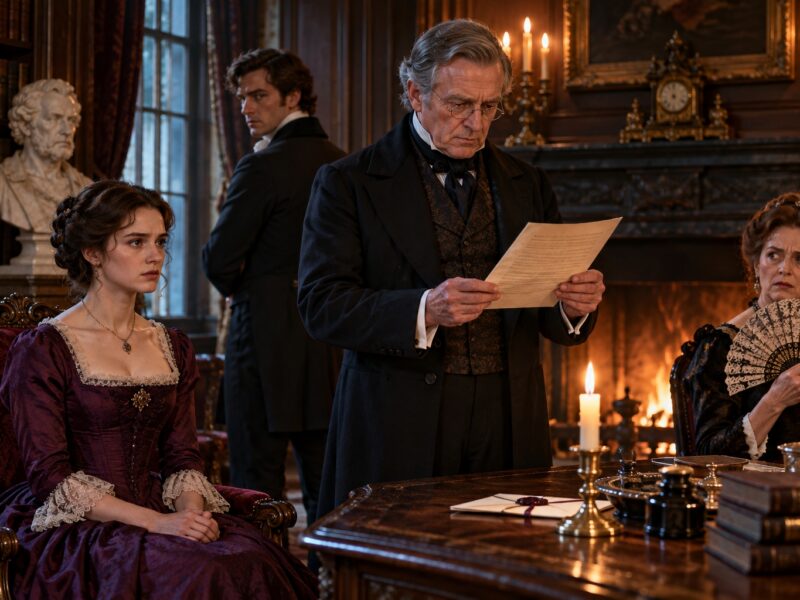
HER FATHER’S WILL FORCED HER TO MARRY ENGLAND’S MOST FEARED DUKE—BUT HIS FIRST WORDS AT THE DOOR HID A SECRET THAT COULD DESTROY THEM BOTH

Her father left her a fortune—but she could inherit it only by marrying a duke accused of murdering his first wife.
When she arrived at his isolated mansion, he refused to let her through the door.
Then she spoke eleven words that made the coldest man in England go completely still.
PART 1 — THE WILL THAT SENT HER INTO A MURDERER’S HOUSE
The solicitor had read the dead man’s will twice before Honoria Waywright fully understood that her father had arranged her future with a stranger.
Rain tapped against the windows of the London drawing room. The fireplace smoked, and her aunt’s ivory fan opened and closed with a nervous clicking sound. Across the carpet, her cousin Percival stood beside the window, wearing the small, satisfied smile of a man who had already counted his inheritance.
Honoria sat perfectly straight in her plum-colored silk gown. It had been altered three times to disguise its age, and the lace at her wrists had been carefully replaced the previous evening. At twenty-five, she possessed good manners, an excellent education, and very little money.
Three months earlier, she had also possessed a father.
Now she had only his will.
“The principal estate, including the residence on Renn Street and the sum of four thousand pounds, shall pass to Mr. Percival Waywright,” Mr. Grindle announced, adjusting his spectacles. “Subject to the provisions concerning Miss Honoria Waywright.”
Percival turned away from the window. “Naturally, my dear cousin will be well provided for.”
Honoria did not look at him.
Mr. Grindle continued. “Your father established a marriage settlement in your favor. It provides a substantial dowry and an independent income, but the arrangement is contingent upon your accepting an offer from the gentleman he named.”
Lady Waywright’s fan stopped moving.
“And if I decline?” Honoria asked.
“You will receive a modest annuity and permission to occupy the cottage adjoining the Renn Street property. The property itself will remain under your cousin’s control.”
Percival smiled more broadly. “You needn’t trouble yourself about practical matters, Honoria. Mother and I shall see that you’re comfortable.”
She remembered the last winter spent beneath her aunt’s roof, when every candle she burned had been counted and every visitor she received questioned. She remembered asking for money to repair her father’s winter coat and being told that sentiment was an expensive weakness.
She had no intention of living that way again.
“Who is the gentleman?” she asked.
Mr. Grindle reached for a sealed document.
The black wax cracked beneath his thumb.
“His Grace, Alistair Vance, Duke of Blackmore.”
Lady Waywright dropped her fan.
Percival’s smile disappeared.
For several seconds, no one spoke.
Then her aunt rose so suddenly that her chair struck the wall. “John cannot possibly have intended this!”
Honoria remained seated.
She knew the name.
Every unmarried young woman in London knew the name.
The Duke of Blackmore had once been considered one of the most eligible men in England. Wealthy, handsome, titled, and descended from an ancient family, he had married a celebrated beauty who died three years later under circumstances so terrible that society still whispered about them.
His duchess had been found dead in her bath.
The official finding was accidental death.
London preferred a darker explanation.
People claimed the duke had discovered his wife’s affair and killed her in a fit of jealousy. Others insisted his cruelty had driven her to take her own life. No evidence had ever established either accusation, yet the rumors had followed him until he abandoned London entirely.
He had lived at Blackmore Hall, his remote Northumberland estate, ever since.
“He is a dangerous man,” Lady Waywright whispered. “Your father knew that.”
“My father knew him before any of us did,” Honoria replied.
“That was years ago!”
“Then perhaps my father remembered something everyone else has chosen to forget.”
Percival came forward with his hands loosely clasped behind his back.
“Honoria, please. You cannot seriously consider attaching yourself to a man whose own wife died under such dreadful circumstances.”
“And you would prefer that I rely upon your generosity?”
He gave a wounded little laugh. “I am your family.”
“Yes,” she answered quietly. “That is precisely what concerns me.”
Mr. Grindle cleared his throat. “There is a further condition, Miss Waywright. His Grace must accept the proposed match. Your father understood that neither party could be compelled into marriage.”
“Then why name him?”
The solicitor hesitated.
“Your father wrote a private explanation. He instructed me to give it to you only after you heard the terms.”
He passed her an envelope.
Inside was a single sheet of paper covered in her father’s familiar handwriting.
My dearest Honoria,
I have not left you an easy road. I know that. But I have seen how men behave when power is placed in their hands, and I have learned that the gentlest face does not always conceal the kindest heart.
Alistair Vance once saved my life at considerable cost to himself. I have never forgotten what he did, nor the character he showed when no one was watching.
I cannot command you to marry him. I ask only that you meet him before you believe what others say.
Your loving father, John.
Honoria read the letter twice.
Her father had never been sentimental with promises. He was a practical man who repaired broken furniture instead of replacing it and preferred a difficult truth to a comforting lie.
If he had trusted the Duke of Blackmore, there had been a reason.
She folded the letter carefully.
“I shall write to him.”
Lady Waywright stared. “You will do no such thing.”
Honoria stood.
“Madam, I have spent the last three months being informed of what I may not do. I believe I should like to discover what I can.”
She left before her aunt could answer.
That evening, in her narrow bedroom overlooking Renn Street, Honoria wrote to the Duke of Blackmore.
She explained the will, the proposed settlement, and the limited time in which she had to make her decision. She did not flatter him. She did not plead poverty or appeal to his sympathy.
She requested the courtesy of a meeting.
Three days later, a reply arrived.
The paper was expensive. The handwriting was bold and severe.
There were only two sentences.
I have no wish to marry again.
Come to Blackmore Hall if you insist upon discussing the matter.
No signature appeared beyond his title.
Mrs. Potts, the elderly housekeeper who had served the Waywright family for nearly twenty years, read the note over Honoria’s shoulder.
“Oh, miss,” she whispered. “Surely you cannot mean to go.”
Honoria placed the letter beside her father’s.
“I have been invited.”
“That is not an invitation. It is a warning.”
“Then he shall discover that I am capable of understanding both.”
Mrs. Potts studied her for a long moment before pressing a hand against her mouth.
“You are so like your father.”
Honoria smiled, although her stomach was tight with fear.
“I hope so.”
Four days later, her carriage passed through the iron gates of Blackmore Hall.
The estate stood beneath a colorless winter sky, its immense stone walls rising above bare trees and frozen lawns. One of the towers was blackened by age, and the narrow windows reflected the clouds without offering any glimpse of warmth within.
Ruth, Honoria’s maid, leaned forward to look.
“It resembles a prison, miss.”
“Most great houses do until one knows the people living inside them.”
“There appears to be only one person living inside this one.”
Honoria could not disagree.
No footman appeared when the carriage stopped.
No servant hurried to open the doors.
The great entrance remained shut beneath a carved stone arch, its iron knocker fashioned into the head of a wolf.
Honoria climbed the steps herself.
She lifted the knocker.
The sound traveled through the house.
After a long silence, the door opened.
The man standing before her was not the monster she had imagined.
He was tall, perhaps thirty-eight, with broad shoulders beneath a dark coat and a face made striking by the severity of its expression. His black hair was touched with gray at the temples. Deep lines marked the corners of his mouth, and his eyes were the cold, watchful gray of a winter sea.
He looked at her luggage.
Then at her face.
“Miss Waywright.”
“Your Grace.”
“I believe my letter was sufficiently clear.”
“It was brief,” she replied. “That is not quite the same thing.”
A muscle shifted in his jaw.
“You have traveled a considerable distance for nothing.”
“That remains to be seen.”
“I will not marry you.”
Ruth made a small frightened sound behind her.
Honoria kept her eyes on the duke.
“Then I should be grateful if you would permit me to explain why I have come.”
“There is nothing to explain. I do not want a wife, and I have no intention of acquiring another.”
His words were harsh enough to make the maid step backward.
Honoria felt her own confidence waver. She had spent the entire journey preparing for an unpleasant conversation, but she had not anticipated being dismissed on the front steps.
Still, she had not endured four days in a freezing carriage merely to retreat at the sight of an angry man.
“Your Grace,” she said, “I am not asking you to love me.”
His expression changed.
“Then what are you asking?”
“I am asking you to consider an arrangement that would allow us both to live without pretending to be something we are not.”
He said nothing.
“I can manage a household. I understand accounts, rents, and agricultural improvements. I do not require grand entertainment or constant attention. I would be content to fulfill the duties of your duchess and leave you the privacy you plainly desire.”
“You speak of marriage as though it were an arrangement for purchasing horses.”
“I speak of it as a woman who has very few other means of protecting her future.”
For the first time, he looked directly into her eyes.
“You know what they say about me.”
“I do.”
“They call me a murderer.”
“I am aware.”
“And you would still enter my house?”
Honoria felt the wind strike her face. Her fingers had gone numb inside her gloves, but she did not lower her gaze.
“My father trusted you.”
The duke became utterly still.
Then he spoke in a voice so quiet that Ruth could barely have heard it.
“Your father knew me before I became what I am.”
Honoria took one step closer.
“Then prove to me that he was right about you.”
Something painful moved across his face.
For several seconds, he appeared incapable of answering.
Finally, he stepped aside.
“Come inside, Miss Waywright. You are turning blue.”
Blackmore Hall was no warmer within.
Its enormous entrance hall contained magnificent furniture covered in dust, chandeliers without candles, and a sweeping staircase whose polished banister had not been touched by cheerful hands in years.
Yet there were books everywhere.
Shelves lined the hallways. Volumes lay stacked beside chairs. A worn collection of Shakespeare rested open near the fireplace.
Honoria noticed a child’s wooden horse on a table beneath a portrait.
The duke saw her looking.
“It belonged to me.”
“You kept it.”
“My mother kept it.”
He said no more.
In the small drawing room, he offered her a seat beside the fire and remained standing.
“I will make you an offer,” he said at last. “You may stay here for one month. During that time, you may judge whether this house and its master are as terrible as people claim.”
“My father’s settlement requires an answer sooner than that.”
“I shall have my solicitor obtain an extension. If he cannot, I will provide you with independent security myself. You will not be forced into a marriage merely to save yourself from poverty.”
Honoria looked up sharply.
He seemed irritated by her surprise.
“I may be unsociable, Miss Waywright. I am not accustomed to buying women’s consent.”
She lowered her eyes to conceal the sudden sting of tears.
“And if I still wish to marry you when the month is over?”
He stared into the fire.
“Then I shall consider giving you the most disappointing husband in England.”
It was almost a joke.
Almost.
She smiled.
“I suspect I could do worse.”
For the first time, his mouth moved with the faintest suggestion of amusement.
Then he turned and left the room.
The following morning, Honoria discovered why Blackmore Hall seemed to be dying around its master.
The household ledgers were a catastrophe.
Rental payments had gone uncollected. Repair expenses had doubled without explanation. The southern farms were losing money, and several tenants had abandoned their holdings.
She spent three hours examining the books before asking Mrs. Cade, the housekeeper, who managed the accounts.
“Mr. Fenwick, the steward, Your Ladyship.”
“I am not Her Ladyship yet.”
Mrs. Cade’s expression did not soften.
“Then perhaps it would be best to leave the estate business to the gentlemen, miss.”
Honoria turned another page.
“That is precisely what has been done. The results are before us.”
By afternoon, she had prepared a list of discrepancies.
The duke summoned her to the library just before dinner.
He stood by the fireplace holding a letter.
“Your cousin has written to me.”
Honoria felt her stomach tighten.
“Has he?”
“He informs me that you are manipulative, extravagant, and inclined to steal what does not belong to you.”
“Percival has always possessed a lively imagination.”
“He recommends that I send you back to London immediately.”
“And will you?”
Alistair looked at her for a long moment.
Then he tossed the letter into the fire.
“I have known Percival Waywright since we were children. I learned not to trust him before I learned to shave.”
Honoria released a breath she had not realized she was holding.
The duke turned toward his desk.
“Was there something you wished to tell me?”
“Yes.”
She placed her papers before him.
“Your steward is robbing you.”
His head lifted.
“What?”
“I cannot yet establish the full amount, but these accounts contain repeated payments for repairs that were never completed. One tenant appears to have paid his rent twice, while another payment was recorded against land that has been vacant for six years.”
Alistair stared at the columns.
Then he looked at her.
“You have been here less than two days.”
“I read quickly.”
For several seconds, he studied her as though she had become a different person.
Then he pulled out a chair.
“Show me.”
They worked together until the candles burned low.
For the first time since arriving at Blackmore Hall, Honoria forgot to be afraid.
And for the first time in three years, the Duke of Blackmore laughed.
It was a small, startled sound, prompted by her description of Mr. Fenwick’s arithmetic as “the creative efforts of a criminal who has never met a competent accountant.”
Alistair covered his mouth almost immediately.
But she had heard it.
And she understood then that there was a different man somewhere beneath his silence.
During the following weeks, Honoria visited farms, questioned tenants, reviewed contracts, and helped the duke dismiss his dishonest steward.
She arranged repairs to the village school, negotiated a reasonable extension for a struggling tenant family, and proposed draining the marshy southern field.
The duke initially resisted the expense.
Then he read her calculations.
“Do it,” he said.
“You trust my judgment?”
“I trust that you have done the work.”
It was the closest thing to praise she had received in years.
A week later, a heavy winter cloak appeared in her wardrobe.
It was dark blue, lined with fur, and precisely her size.
No note accompanied it.
At dinner, Honoria wore the cloak over her shoulders because the room remained cold.
The duke looked at it once.
Neither mentioned its arrival.
But afterward, he ordered another fire lit.
The first evening they spoke of something other than estate business, snow was falling against the library windows.
Alistair had poured himself a glass of brandy.
Honoria sat across from him, mending a tear in one of Ruth’s aprons.
“You have never asked about my wife,” he said.
Her needle stopped.
“I assumed you would tell me when you wished to.”
“Everyone else asks.”
“I am not everyone else.”
He turned the glass slowly in his hands.
“She loved another man.”
Honoria remained silent.
“I discovered their correspondence. I was angry, but I did not shout at her. I sent her letters back with a note asking her to decide what she wanted.”
His fingers tightened around the glass.
“The following morning, she was dead.”
Honoria put down the apron.
“I am sorry.”
“She died in her bath. The coroner believed she had fallen asleep after taking laudanum. London decided I had killed her.”
“Did you?”
He looked at her with something close to anger.
“No.”
“Then I believe you.”
He seemed genuinely startled.
“You do not know me.”
“I know enough to believe you are telling me the truth about that.”
His face changed.
But there was more grief than relief in his eyes.
“I should have spoken to her. I should have seen how unhappy she was. Instead, I left her alone with a choice she could not bear to make.”
“That was a failure of understanding,” Honoria said softly. “It does not make you her murderer.”
“You are very certain.”
“No. I am simply unwilling to confuse regret with guilt.”
He looked away.
For a long time, neither spoke.
Then he asked, “If we marry, will you one day regret it?”
Honoria watched the flames bend beneath the draft.
“I cannot promise never to regret anything, Alistair. I can promise not to spend our marriage punishing you for a life you lived before we met.”
His eyes returned to hers.
She had never used his Christian name before.
Something unguarded passed between them.
The next morning, a formal marriage settlement arrived from his solicitor.
It granted her an independent income and permanent rights to the Dower House, regardless of whether they had children. He had also arranged for her mother’s jewels, portrait, and books to be recovered from Percival.
She found him in the library.
“You have protected me from every possible misfortune,” she said.
“That was the intention.”
“Except one.”
He looked up.
“Which one?”
“That I might come to care for a man who refuses to believe himself worthy of affection.”
Alistair slowly rose.
“Honoria.”
She placed the settlement on his desk.
“I shall marry you. Not because I am frightened of my cousin, and not because my father wished it.”
“Then why?”
“Because I have watched you do the right thing when no one expected it of you. Because you listen when I speak. Because you have given me the right to leave, and that has made me want to stay.”
His face seemed to lose every trace of color.
He crossed the room and stopped before her.
“I cannot promise that I will be an easy man to love.”
“I have not asked for an easy man.”
His hand rose slowly toward her face.
When his fingertips touched her cheek, she felt him trembling.
They married quietly in the village church before Christmas.
There were no grand celebrations, no fashionable guests, and no flowers beyond a small winter bouquet gathered by a tenant’s daughter.
But when Alistair spoke his vows, his voice was steady.
And when Honoria placed her hand in his, she felt a warmth that had nothing to do with the weather.
For a little while, Blackmore Hall began to resemble a home.
Then a letter arrived from London.
Alistair read it at breakfast.
The color drained from his face.
“Who is it?” Honoria asked.
He handed her the paper.
The letter announced the imminent arrival of Lord Bertram Vance, Alistair’s cousin, accompanied by Lord Julian Ashworth.
She recognized neither name.
Alistair spoke quietly.
“Bertram has spent twenty years resenting the title that came to me. Ashworth is a barrister who has made a career of turning scandal into profit.”
“Why are they coming?”
“They have discovered that I am married again.”
Honoria looked down at the letter.
The final sentence made her blood run cold.
We believe your new duchess deserves to know what truly happened to the last one.
Alistair looked toward the snow falling beyond the windows.
Then he said something she would remember for the rest of her life.
“Honoria, there is a reason those two men have never stopped investigating my wife’s death.”
He paused.
“And I fear they know something I do not.”
PART 2 — THE DEAD DUCHESS’S LETTERS
Lord Julian Ashworth arrived at Blackmore Hall smiling.
He was handsome in the polished, effortless manner of a man who had rarely been denied anything he wanted. His fair hair was neatly arranged, his boots gleamed, and his gloves were so immaculate that Honoria suspected he had changed them before stepping out of the carriage.
Lord Bertram Vance descended behind him.
Bertram was older than Alistair by several years, thin and restless, with sharp features that seemed permanently arranged in an expression of dissatisfaction.
He looked up at the house with a proprietary interest that Honoria disliked immediately.
“Blackmore!” Bertram exclaimed when Alistair appeared. “How long it has been.”
“Not long enough,” Alistair replied.
Ashworth laughed.
“A family reunion already full of affection. How delightful.”
At dinner, the visitors spoke pleasantly about London, Parliament, the weather, and the latest marriages among the nobility.
Only Honoria noticed how carefully Ashworth watched her husband.
Whenever Alistair spoke, Ashworth listened with unnatural attention. Whenever Honoria answered a question, his eyes sharpened.
After dessert, he approached her beside the library doors.
“Your Grace, may I congratulate you on your marriage?”
“That would be customary.”
“I confess I was astonished. Most young ladies would have hesitated before marrying a man with your husband’s reputation.”
“Perhaps most young ladies have never considered how easily reputations can be manufactured.”
His smile widened.
“You are considerably cleverer than Percival led me to believe.”
Honoria felt the blood leave her face.
“You know my cousin?”
“Very well.”
He reached inside his coat and withdrew a folded paper.
“A remarkable correspondent. Particularly when the subject concerns his female relatives.”
She recognized Percival’s handwriting.
“What has he told you?”
“That you came north intending to secure the duke’s fortune. That you offered to supply information about his private affairs in exchange for reclaiming your family’s property.”
“That is a lie.”
“Of course it is,” Ashworth replied pleasantly. “The difficulty is that lies become rather useful when repeated often enough.”
She looked at him steadily.
“What do you want?”
He leaned closer.
“I want your husband exposed.”
“For what crime?”
“For the death of a woman who was inconvenient to him.”
“You have no evidence.”
“Not yet.”
His smile vanished.
“But I believe you may help me acquire some.”
Honoria took one deliberate step backward.
“You mistake me for someone who can be frightened into betraying her husband.”
“No, Your Grace. I believe you are someone who understands the value of survival. That makes you far more interesting.”
He bowed and walked away.
The next morning, Honoria heard rumors in the village.
The schoolmaster had been told that the Duke of Blackmore would soon face a criminal inquiry. Two tenants claimed they had been questioned about violent behavior at the hall. Mrs. Cade reported that Ashworth had offered money to several former servants for details concerning the late duchess.
Within days, the village had begun speaking of Alistair as though his guilt had already been established.
He responded by withdrawing into the west wing.
He stopped joining Honoria for dinner.
His study remained locked.
At night, she heard his footsteps moving above her bedroom, slow and restless.
Finally, she found him sitting alone beside the cold library fireplace.
“You are hiding,” she said.
“I am thinking.”
“Then think somewhere the candles are lit.”
He raised his eyes.
“Honoria, please.”
“No. You have spent three years allowing these men to define you. I have spent three weeks watching them do it again.”
“What would you have me do?”
“Stand beside me. Answer their accusations. Refuse to surrender your name simply because defending it is exhausting.”
He stared at her.
“They will destroy your reputation as well.”
She approached his chair.
“I knew what people said about you before I arrived. I married you after discovering the man they described did not exist.”
He reached for her hand.
“You have already given me more than I ever intended to ask.”
“Then stop trying to protect me by leaving me alone.”
The room fell quiet.
At last, he nodded.
“What do you propose?”
Honoria sat beside him.
“We begin by discovering what Ashworth actually knows.”
The opportunity came two days later.
She encountered Ashworth in the walled garden, examining the dead rosebushes with theatrical interest.
“You are wasting your time, Lord Ashworth,” she said.
He looked amused.
“Am I?”
“My husband did not murder his first wife.”
“Then perhaps you can prove it.”
“I know she was involved with another man. I know she received a letter from the duke asking her to choose between them.”
Ashworth’s expression changed.
It was brief, but she noticed.
“The duke told you that?”
“He has nothing to hide from me.”
“Then he must have shown you the correspondence.”
Honoria hesitated.
The slightest pause was enough.
Ashworth smiled.
“Ah. He has told you a story, and you have accepted it because you wish to believe him.”
She stepped closer.
“Suppose those letters existed. Suppose they showed exactly what happened. Would you abandon your accusations?”
“Certainly. If they were genuine.”
“Then give me until tomorrow.”
He studied her with an expression she could not understand.
Finally, he bowed.
“Until tomorrow, Your Grace.”
Honoria returned to the house knowing she had made a reckless promise.
That evening, she told Alistair.
“The original correspondence is gone,” he said immediately. “I burned what remained after Caroline’s death.”
“Then we must recover copies.”
“There are none.”
She looked toward the desk, where he had preserved years of family correspondence.
“I remember some of the phrases you told me. We could reconstruct the exchange.”
Alistair’s expression hardened.
“You mean forge it.”
“Only to establish what was true.”
“The truth does not become stronger when written on false paper.”
She knew he was right.
Yet Ashworth had made it clear that he cared little whether his accusations were supported by genuine evidence. He intended to ruin Alistair through public suspicion.
Honoria wanted something tangible enough to force him to retreat.
For two nights she worked on reproducing the correspondence, using the old letters in Alistair’s desk as handwriting references. Alistair helped her reconstruct the wording, although he warned her repeatedly that the plan was dangerous.
When she finished, three pages lay before her.
They told a story of a loveless marriage, an affair, and a husband who had asked for an honest decision.
They contained no threats.
No violence.
No confession.
Honoria carried them into the garden the following morning.
Ashworth waited beside the stone fountain.
He read the pages slowly.
Then he smiled.
“How beautifully done.”
Relief rose in her chest.
“You see? There was never any threat.”
“Oh, I see considerably more than that.”
He folded the letters.
“These are excellent forgeries.”
Honoria stopped breathing.
“I beg your pardon?”
“Your husband has reproduced his handwriting rather well. Unfortunately, I have seen the original letters.”
The frost beneath her shoes seemed suddenly unstable.
“How?”
“The late duchess’s lover kept them.”
He withdrew a second envelope from his coat.
“This one came from him.”
Honoria reached for it, but Ashworth moved it away.
“I have been waiting to discover how far your husband would go to conceal the truth.”
“You know perfectly well that these pages were intended to correct your lies.”
“Can you prove that?”
He tucked the forged correspondence into his pocket.
“Your Grace, you have given me something even better than a witness.”
His voice softened.
“You have given me evidence of a deception.”
She stared at him.
“And when London learns that the Duke of Blackmore has fabricated correspondence concerning his dead wife, what do you imagine people will believe?”
He turned away before she could answer.
Honoria remained by the fountain, unable to move.
For the first time since her father’s funeral, she felt entirely helpless.
She had not simply failed to protect her husband.
She had handed his enemy the weapon he needed.
Alistair found her still standing in the cold.
He took one look at her face and understood.
“He knows.”
She nodded.
“I am so sorry.”
Alistair removed his coat and placed it around her shoulders.
“Come inside.”
“I have ruined everything.”
“No.”
She looked up.
“I gave him false documents.”
“Because he was determined to use false accusations against us.”
“That does not make what I did right.”
“No,” Alistair said quietly. “It does not.”
For a moment, she believed he would turn away from her.
Instead, he took her hands.
“But I allowed it. I was as responsible as you were. And I will not let you face the consequences alone.”
She began to cry.
Not loudly. Not dramatically.
Only a few tears, which she tried to wipe away before he could see them.
Alistair drew her against him.
“I spent three years believing that everyone close to me would eventually regret knowing me,” he whispered. “You are the first person who has made that fear seem foolish.”
She looked up at him.
“I love you.”
The words came without preparation.
He went completely still.
Then he kissed her.
It was the first kiss they had shared since the brief, formal kiss after their wedding vows. This one contained everything neither had known how to say: fear, gratitude, longing, and a tenderness that made Honoria cling to the front of his coat.
When he finally drew back, his forehead rested against hers.
“I love you too,” he said.
She closed her eyes.
For one moment, the world beyond the garden disappeared.
Then he spoke again.
“We are going to London.”
She pulled away.
“London?”
“Yes.”
“You said you would never return.”
“I had no reason to.”
His thumb brushed a tear from her cheek.
“Now I have you.”
They departed that evening.
By the time they reached the duke’s London townhouse, Ashworth had already spread word that new evidence implicated Alistair in the death of his first wife.
The story moved through drawing rooms, gentlemen’s clubs, and newspaper offices with astonishing speed.
London was eager for a fallen duke.
It was even more eager for the spectacle of his second wife discovering that she had married a murderer.
Honoria refused to give it that satisfaction.
She wore her mother’s recovered pearls when she stepped outside.
She held Alistair’s arm.
And when people whispered as they passed, she looked straight ahead.
Their first visit was to Lord Harrow, an old friend of Alistair’s father.
Harrow listened carefully as they explained everything, including Honoria’s disastrous decision to create the letters.
He did not offer the comforting assurances she had hoped for.
“The correspondence must be admitted for what it is,” he said. “If Ashworth has copies, concealment will destroy you.”
“I agree,” Alistair replied.
“Then we need something stronger than society gossip.”
Harrow leaned forward.
“The woman who attended Caroline on the night she died. Have you ever located her?”
Alistair shook his head.
“She disappeared after the funeral.”
“Then perhaps it is time someone found her.”
Over the following days, Lord Harrow employed an investigator. Honoria visited women who had known Caroline and asked questions no one had thought to ask three years earlier.
Slowly, a different picture emerged.
Caroline had been deeply unhappy.
She had struggled with the isolation of her marriage and had relied heavily on laudanum prescribed for sleeplessness.
Several acquaintances remembered her speaking of leaving England.
One recalled that she had been frightened by something, but refused to say what.
Meanwhile, Ashworth continued preparing his allegations.
Then the summons arrived.
Alistair was required to appear before a magistrate in connection with new information concerning Caroline’s death.
On the morning of the hearing, Honoria helped him fasten his coat.
His hands were steady.
Hers were not.
“You needn’t accompany me,” he said.
She adjusted his collar.
“You have a remarkable habit of forgetting that I am your wife.”
His mouth softened.
“Not for a single moment.”
They entered the crowded hearing room together.
Ashworth was already waiting.
Bertram sat beside him.
The room contained gentlemen who had once called Alistair a friend, women who had spent years repeating accusations they could not substantiate, and reporters eager to record whatever humiliation might follow.
Ashworth presented witness statements and extracts from correspondence.
Then he produced Honoria’s forged letters.
“The duke and his new wife,” he announced, “have gone to extraordinary lengths to manufacture an innocent explanation.”
Honoria felt dozens of eyes turn toward her.
Alistair rose.
“My wife and I made a serious error in judgment,” he said. “Those reconstructed letters are not genuine historical documents. We do not offer them as evidence.”
A ripple of surprise moved through the room.
Ashworth’s smile faltered.
Alistair continued.
“But our foolish decision to reconstruct correspondence does not prove that I killed Caroline. I ask the court to consider actual evidence concerning her death.”
Ashworth stood.
“Your Grace, you ask this court to trust a man who has already admitted that he fabricated documents.”
“No,” Alistair answered. “I ask the court to examine facts rather than impressions.”
The magistrate called for order.
Then a disturbance began near the rear doors.
A woman dressed in black had entered the room.
She was small, pale, and visibly frightened.
She clutched a worn leather bag against her chest.
“Please,” she called. “I need to speak.”
The magistrate frowned.
“Who are you?”
The woman looked toward Alistair.
“My name is Eliza Pimton.”
His expression changed.
“I was Her Grace’s maid,” she continued. “The first duchess.”
The room fell silent.
Eliza swallowed.
“I was there the night she died.”
Ashworth rose so abruptly that his chair scraped the floor.
“Your Worship, this witness has not been properly introduced.”
But Eliza kept speaking.
“And I have kept something for three years because I was too frightened to tell anyone the truth.”
She opened her bag.
Inside was a letter.
The paper was worn along the folds.
The seal had been broken long ago.
Eliza held it out with shaking hands.
“The duchess wrote this before she died. She asked me to give it to her husband.”
Honoria felt Alistair grip her hand.
“Why did you not deliver it?” the magistrate asked.
Eliza began to cry.
“Because someone threatened me.”
A low murmur spread across the room.
The magistrate leaned forward.
“Who threatened you?”
Eliza looked directly at Lord Julian Ashworth.
And whispered his name.
PART 3 — THE TRUTH THE DEAD WOMAN LEFT BEHIND
Ashworth did not immediately deny the accusation.
That frightened Honoria more than anger would have.
He stood with one hand resting on the back of his chair, his expression carefully composed, while Eliza Pimton described the weeks preceding Caroline’s death.
The late duchess had been desperately unhappy in her marriage. She had loved another man, hoped to leave England with him, and feared the scandal that would follow.
She also feared that her private correspondence would be used against her.
“Mr. Ashworth knew the gentleman she loved,” Eliza said. “He came to the house more than once. He told Her Grace that the letters could ruin her.”
Ashworth gave a sharp laugh.
“Entirely absurd.”
Eliza reached into her bag again.
“He told me that if I disclosed the correspondence, I would be accused of stealing from my mistress. He said no respectable household would employ me afterward.”
“That is a lie.”
“Then why did you offer me money to leave London?”
The magistrate ordered silence.
Eliza’s voice shook as she described the night Caroline died.
The duchess had received Alistair’s note asking her to choose between her husband and the man she loved.
She had wept for hours.
Later, she took more laudanum than her physician had prescribed and entered her bath.
Eliza had found her unresponsive.
A physician was summoned, but Caroline could not be saved.
The original investigation had concluded that the death was accidental, likely involving the effects of the medication. Whether Caroline had intended to end her life remained uncertain.
The letter Eliza carried explained that uncertainty in Caroline’s own words.
She apologized to Alistair for deceiving him.
She wrote that she was overwhelmed, exhausted, and unable to see a way forward. She did not accuse him of violence, nor did she suggest he had threatened her life.
Most painfully, she asked him not to believe that her unhappiness meant he had been cruel.
As the magistrate read the document, Alistair lowered his head.
Honoria felt him trembling.
She did not tell him to be strong.
She simply kept hold of his hand.
Further questioning revealed that Eliza had not come forward voluntarily at first.
Lord Harrow’s investigator had found her in a small village outside Bath, where she worked under her married name.
When she learned that Alistair might face criminal proceedings, she agreed to testify.
She had carried Caroline’s letter for three years.
And she could bear it no longer.
The magistrate ordered the correspondence examined and the allegations against Ashworth investigated.
There was no immediate dramatic conviction, no sudden punishment announced from the bench. But the accusations against Alistair lacked the evidence required to proceed, and the hearing ended without a charge against him.
Bertram slipped out before the proceedings concluded.
Ashworth attempted to follow.
A court officer stopped him to request further information concerning the alleged intimidation of the witness and the provenance of the documents he had submitted.
For the first time, his composure cracked.
Honoria watched him turn pale.
She felt no triumph.
Only a profound, exhausted relief.
Outside the hearing room, Alistair stopped beneath the gray London sky.
He had spent three years imagining Caroline’s final hours.
He had blamed himself for every silence, every disappointment, every moment when he might have acted differently.
Now he knew that she had not hated him.
But she had been terribly unhappy.
And nothing could restore the years lost to the terrible misunderstanding between them.
He turned toward Honoria.
“I thought that knowing the truth would make me feel innocent.”
She touched his sleeve.
“You are innocent of what they accused you of doing.”
“But I still failed to understand her.”
“Then remember her honestly,” Honoria replied. “Not as a woman you murdered, and not as a perfect wife you could have saved by becoming a different man. Remember her as she was.”
He closed his eyes.
When he opened them, tears had gathered along his lashes.
“I do not know how to stop grieving.”
“You needn’t stop.”
She stepped into his arms.
“You only need to let yourself live.”
He held her in the cold street while carriages rolled past and strangers stared.
For once, he did not seem to care.
The weeks that followed were difficult.
The duke’s reputation did not recover overnight. Society had spent years repeating an accusation, and many found it uncomfortable to admit they had been wrong.
But Lord Harrow stood publicly beside him.
Eliza’s testimony was corroborated.
Questions concerning Ashworth’s conduct grew impossible to dismiss.
Bertram fled to France after his involvement in paying informants and encouraging false allegations came under scrutiny.
Ashworth remained in England to face legal proceedings relating to his conduct, and his professional standing deteriorated as the evidence against him accumulated.
Honoria found little satisfaction in the downfall of either man.
She had learned how easily fear could lead otherwise intelligent people toward desperate and dishonest choices.
Her own forged correspondence had nearly destroyed the very thing she wanted to protect.
She vowed never again to mistake a convincing document for the truth.
Spring arrived while they were still in London.
One evening, Alistair found Honoria standing in the townhouse garden.
The first green leaves had appeared along the branches.
“I have neglected you,” he said.
She turned.
“You have been rather occupied.”
“I have spent most of my life being occupied by the wrong things.”
He approached her with a small velvet box.
Honoria looked at it.
“What is that?”
“Something I should have given you on our wedding day.”
He opened the lid.
Inside lay an old diamond ring surrounded by sapphires.
The setting was beautiful but slightly worn, as though it had been loved and worn daily rather than preserved for display.
“It belonged to my grandmother,” he said. “My mother wore it after her. I kept it because it reminded me of a time when this family was happy.”
Honoria looked from the ring to his face.
“Alistair.”
“I married you because I believed I owed your father a kindness. I wanted to protect you from your cousin and give you a secure home.”
His voice grew softer.
“I did not understand that you would give me one in return.”
He took her hand.
“I cannot rewrite the past. But I can promise not to let it steal the future we might have.”
He slipped the ring onto her finger.
Honoria’s eyes filled with tears.
“Then come home with me,” she whispered.
He smiled.
“To Blackmore Hall?”
“Yes. The southern fields will need inspecting, Mrs. Cade will have reorganized the kitchens in my absence, and I strongly suspect that the tenants have been allowing the new steward to approve expenses without consulting me.”
Alistair laughed.
It was a full, unguarded laugh.
He kissed her forehead.
“I believe I married the most terrifying woman in England.”
“How fortunate that you are the most feared man.”
They returned to Northumberland in April.
The snow had melted from the hills. Lambs crowded the lower meadows, and the village school reopened beneath its repaired roof.
Blackmore Hall no longer stood in silence.
There were servants in the corridors, fires in the drawing rooms, and the smell of bread drifting from the kitchens.
Alistair began visiting his tenants personally again.
He rode through the fields with Honoria, listened to their concerns, and restored contracts that his former steward had neglected.
The southern field produced its first promising growth of clover.
One afternoon, Honoria found him standing near the stone wall overlooking the estate.
“Do you miss London?” she asked.
“Not particularly.”
“The theater?”
“Occasionally.”
“The balls?”
“Never.”
She smiled.
“And what do you want now?”
He looked toward the distant rooftops of the village.
“A house that remains warm in winter. Fields that can feed the people who work them. Perhaps children, if you wish for them.”
Then he turned to her.
“And enough ordinary days with you that I might finally learn not to be afraid of happiness.”
Honoria took his arm.
“That seems a reasonable ambition.”
Their peace was interrupted three months later by another letter from Lord Harrow.
Bertram, now living in France, had begun spreading a new accusation.
He claimed that Alistair’s mother had not died of a fever, as the family believed, but had taken her own life after years of cruelty from her husband.
He claimed that the Vance family carried a hereditary tendency toward madness.
And he suggested that Alistair was unfit to father children.
When Honoria found her husband in the library, he was standing with both hands gripping the mantelpiece.
“He’s lying,” she said after reading the letter.
“I do not know that.”
“Your mother died when you were ten.”
“Yes.”
“And everyone told you it was fever.”
“Yes.”
He turned toward her.
“But I remember my father’s silence afterward. I remember being forbidden to ask questions. What if there was something else?”
Honoria approached him.
“Then we shall discover it.”
“What if Bertram is telling the truth?”
“Then it will remain the truth, and we will face it. But it would not make you unworthy of love, nor would it determine the lives of children we may have.”
He looked away.
“I am afraid I might become like my father.”
Honoria placed her hand on his chest.
“Then continue making the choices you have already begun to make differently.”
He closed his eyes.
“I am afraid of losing you.”
She leaned against him.
“Then do not push me away whenever you are afraid.”
The following morning, Alistair instructed his solicitor to examine the family records.
The inquiry took several weeks.
When the documents finally arrived, they included a physician’s surviving account, correspondence between relatives, and entries from the household books recording the illness that had swept through the estate.
His mother had indeed died after a severe fever.
There was no evidence supporting Bertram’s accusations.
Alistair read the report twice.
Then he set it down.
“I was frightened of a story someone invented.”
Honoria sat beside him.
“Stories can wound people when they are repeated often enough.”
He took her hand.
“And truth?”
“Truth can sometimes heal what those stories have damaged.”
He looked at her for a long time.
Then he smiled.
That summer, they hosted a grand ball at Blackmore Hall.
It was the first large celebration the estate had seen in years.
Carriages filled the courtyard. Candlelight sparkled against polished silver. The ballroom rang with music and laughter, and the servants moved through the crowded rooms with the proud satisfaction of people who had helped bring a house back to life.
Honoria stood at the top of the staircase in a deep blue silk gown.
The sapphire ring gleamed on her hand.
Alistair approached in formal evening dress.
“You look beautiful,” he said.
She looked down at the ballroom.
“I was remembering the first day I came here.”
“When you informed me that you intended to marry me whether I liked the idea or not?”
“I was rather more polite than that.”
“Only slightly.”
She laughed.
He offered his arm.
“Shall we?”
They had just begun descending the staircase when the music faltered.
A commotion broke out near the ballroom entrance.
Honoria turned.
Lord Julian Ashworth stood in the doorway.
He had been released pending the outcome of proceedings against him, and the months of public disgrace had left his face leaner and his expression harder.
He carried a folded letter.
Alistair stopped.
“You were not invited.”
Ashworth smiled.
“I have come to offer my congratulations.”
“Then you have done so. Leave.”
“Not before your guests hear one final truth.”
He turned toward the room.
The conversations died.
“This celebrated romance began with a dead duchess and an accusation that has never been properly answered,” Ashworth announced. “I possess a letter that proves the Duke of Blackmore threatened his first wife shortly before her death.”
A shocked murmur spread through the crowd.
Honoria felt Alistair’s arm tighten beneath her hand.
Ashworth raised the paper.
“It bears her handwriting. It has been examined by experts. And it proves that the story you were told was a lie.”
Alistair descended the last steps slowly.
“May I see it?”
Ashworth hesitated.
The room grew quiet.
Then he handed over the letter.
Alistair read the first page.
He read the second.
When he finished, he looked almost disappointed.
“This is not Caroline’s handwriting.”
Ashworth lifted his chin.
“My experts disagree.”
“Then your experts have been deceived.”
Alistair turned toward the assembled guests.
“My first wife’s genuine correspondence is preserved in my library. Anyone who wishes to compare it may do so.”
Ashworth’s expression tightened.
Alistair looked down at the paper again.
“There is another problem.”
“What problem?”
“This letter refers to an evening at the Ashbourne ball.”
Ashworth said nothing.
“That ball was postponed because of a death in the family. It took place a week after Caroline died.”
A silence settled over the ballroom.
Then someone near the musicians gasped.
Alistair held out the paper.
“A woman cannot describe attending an event that had not yet occurred. Whoever prepared this document failed to check a very simple fact.”
Ashworth reached for the letter.
Alistair did not release it.
“You have spent years attempting to turn my grief into your fortune,” he said. “You have threatened witnesses, circulated lies, and now you have entered my home to accuse me before my family and friends.”
His voice remained quiet.
“You will not do it again.”
The constables were summoned, and Ashworth was escorted from the estate after Alistair insisted that the new letter be preserved for examination.
The musicians gradually resumed their places.
The guests began speaking again.
But Alistair remained standing beside the staircase.
Honoria approached.
“Are you all right?”
He looked toward the doors where Ashworth had disappeared.
Then back at her.
“Yes.”
She searched his face.
“Truly?”
He took her hand.
“Three years ago, I would have hidden upstairs and allowed him to say whatever he wished.”
“And tonight?”
“Tonight, I wanted him out of my house before the musicians forgot how to play.”
Honoria laughed.
He drew her close.
“Will you dance with me, Duchess?”
“With pleasure, Your Grace.”
They danced beneath the chandeliers while the house glowed around them.
Six months later, Honoria gave birth to a son.
They named him John, after the father whose faith had brought them together.
Alistair held the baby with the stunned reverence of a man who had once believed that every good thing placed in his hands would eventually be taken away.
His son opened his small fingers and gripped the edge of his father’s shirt.
Alistair began to cry.
Honoria watched from the bed, exhausted and smiling.
“He has your hands,” she whispered.
Alistair looked at her.
“And your determination, I suspect.”
“Then heaven help us.”
He sat beside her, their son nestled carefully between them.
For a long time, they said nothing.
Outside the windows, the northern hills lay under a soft blanket of snow.
Blackmore Hall was warm.
The fires were burning.
The rooms were filled with the quiet sounds of people living their lives.
In the years that followed, the duke and duchess expanded the village school, improved the tenants’ housing, and helped establish a small charitable hospital. They supported families who had suffered unjust accusations and women left without financial security.
Their marriage was not untouched by disagreement.
Honoria was stubborn.
Alistair could still retreat into silence when troubled.
But he learned to return to the conversation, and she learned that not every silence concealed rejection.
They built their life through thousands of ordinary choices.
One winter evening, many years after the reading of her father’s will, Honoria found Alistair in the library.
He was sitting beside the fire with their son asleep against his shoulder.
She stood in the doorway for a moment, watching them.
Alistair looked up.
“What are you thinking?”
“That I once stood on these steps believing I was entering the home of a monster.”
“And what did you discover?”
Honoria crossed the room.
She touched the gray beginning to show in his dark hair.
“A man who was frightened of being loved.”
He smiled.
“And you?”
“A woman who had forgotten she deserved a home of her own.”
Alistair reached for her hand.
“Have you found it?”
She looked at their sleeping child, the books around them, and the firelight moving across the familiar room.
Then she bent and kissed her husband.
“Yes,” she whispered. “I believe I have.”
And somewhere in the quiet of Blackmore Hall, the last echo of her father’s final wish seemed to settle into peace.
He had not given her a perfect husband.
He had given her the chance to discover a man worth knowing.
And when the whole world had demanded that she fear him, she had chosen to learn the truth.
That choice had changed both their lives.









