
Her Friends Set Her Up for a Cruel Blind-Date Joke—But the Man Waiting at the Table Was a Millionaire Who Changed Everything
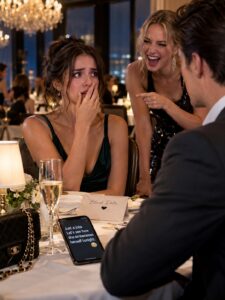
The first thing Elena Morales noticed when she stepped into Bellamy House was not the crystal chandelier hanging three stories above the marble lobby.
It was the laughter.
Soft at first. Almost hidden beneath the piano playing near the bar and the low murmur of dinner conversations. But Elena had spent enough of her life learning the difference between people laughing near her and people laughing at her.
She stopped just inside the restaurant doors, one hand still wrapped around the strap of her old black purse.
Across the room, two women quickly looked away.
Elena’s stomach dropped.
The dress she was wearing belonged to her upstairs neighbor, a retired schoolteacher named Mrs. Landry. It was dark green, elegant but slightly too loose at the waist, and Elena had spent twenty minutes before leaving home trying to pin the fabric without ruining it. Her heels were from a clearance rack. One had already rubbed a blister into her left ankle.
She had known she would look ordinary in a place like this.
What she had not known was that ordinary was exactly what someone wanted her to look like.
A hostess approached with a practiced smile. “Reservation?”
“Daniel Hart,” Elena said.
Something changed in the hostess’s face.
Not much. Just enough.
“Of course. Mr. Hart is waiting.”
Elena swallowed.
From somewhere behind her, another burst of laughter rose and disappeared.
She almost turned around.
Then she remembered her mother’s voice.
Never measure your value by the way other people treat you.
Elena drew in a slow breath and followed the hostess deeper into the restaurant.
She had no idea that the night had been designed to humiliate her.
She had even less idea that the man waiting at the corner table could change the direction of her entire life.
Daniel Hart stood the moment he saw her.
For a man who rarely looked surprised, he looked completely unprepared.
At thirty-two, Daniel had become very good at controlling his face. Investors studied him during negotiations. Reporters searched his expressions for weakness. Executives twice his age watched his eyes across conference tables, hoping to predict whether he was about to approve an acquisition or destroy one.
But for several seconds, Daniel simply stared.
Elena felt the heat climb into her cheeks.
“I’m sorry,” she said. “I know I’m a little late.”
Daniel blinked, recovering.
“No. You’re fine.”
The hostess pulled out Elena’s chair.
Daniel waited until she sat before returning to his own seat.
Elena looked at him for the first time properly.
He was younger than she had expected.
Her coworkers had described her blind date as an “awkward businessman who couldn’t meet women normally.” Brooke had laughed when she said it. Tessa had added that he was “probably one of those guys who talks about cryptocurrency for three hours and thinks that’s flirting.”
Nobody had mentioned the quiet confidence.
Nobody had mentioned the tailored charcoal suit.
Nobody had mentioned that three people had greeted him by name before Elena even reached the table.
And nobody had mentioned the watch on his wrist, though Elena wouldn’t have known what it cost even if they had.
“You look nervous,” Daniel said.
Elena gave a short laugh.
“Is it that obvious?”
“Only because I am too.”
She stared at him.
“You?”
“Why is that surprising?”
Elena glanced around the restaurant.
The white linen. The wine wall. The waiters moving like they had rehearsed every step. The pianist playing something soft enough to make expensive people feel relaxed.
Then she looked back at him.
“You look like you’ve been here before.”
Daniel smiled.
“That doesn’t mean I’ve been on this date before.”
Something about the answer loosened the knot in her chest.
Only slightly.
But enough.
A waiter arrived with menus.
Elena opened hers and immediately wished she hadn’t.
There were no dollar signs beside the prices, just numbers that made her wonder whether she was looking at dinner or monthly utility bills.
She scanned the page once.
Then again.
Daniel watched her without appearing to.
Elena found the cheapest entrée she could recognize.
Roasted chicken.
Forty-two dollars.
She almost laughed.
At the bakery where she worked, forty-two dollars was nearly half a shift.
The waiter returned.
“May I start you with the oysters?”
Elena’s expression must have betrayed her because Daniel answered before she could.
“We’ll take a few minutes.”
“Of course, Mr. Hart.”
When the waiter walked away, Elena lowered the menu.
“I should probably tell you something.”
Daniel leaned back.
“That sounds serious.”
“I don’t usually eat in places where the water has its own accent.”
For half a second, Daniel said nothing.
Then he laughed.
Not politely.
Actually laughed.
Elena’s shoulders relaxed.
“Good,” she said. “Because I was worried that joke might get me escorted out.”
“I own hotels, Elena. I don’t own the water.”
Her smile faded by a fraction.
“You own hotels?”
Daniel paused.
It was the first moment he realized she truly did not know who he was.
Most people knew before meeting him. Some pretended not to. He had learned to recognize that particular performance years ago.
Elena wasn’t performing.
“Among other things,” he said.
“Oh.”
No widening eyes.
No sudden interest.
No questions about money.
She simply reopened the menu.
Daniel found that more disarming than admiration would have been.
“So what do you normally eat?” he asked.
“Normally?”
“Normally.”
“Whatever the bakery doesn’t sell by closing.”
He waited for the punch line.
None came.
Elena noticed.
“It’s not as depressing as it sounds. Yesterday there were almond croissants.”
Daniel’s smile disappeared.
“You skip meals?”
“Sometimes.”
“Because you’re busy?”
“Because life gets expensive.”
She said it casually.
That was what stayed with him.
Not embarrassment.
Not a request for sympathy.
Just a fact.
Life gets expensive.
Daniel looked down at his menu and realized he could not remember the last time he had checked the price of anything he ordered.
Elena did it instinctively.
Two people sitting three feet apart, both adults, both exhausted in ways the other could not yet understand, and somehow they seemed to have arrived from entirely different planets.
Neither of them knew that several tables away, three women were watching.
Tessa Monroe held her phone beneath the table.
Brooke leaned toward her.
“Is he still there?”
Tessa angled the screen.
“He’s still talking to her.”
Madison frowned.
“This wasn’t supposed to take this long.”
The three women worked with Elena at Riverside Bakery.
Technically, Tessa was a shift supervisor.
Unofficially, she had spent two years deciding which employees deserved to feel included.
Elena never fought with her.
That seemed to irritate Tessa even more.
When Tessa mocked Elena’s thrift-store coat, Elena smiled.
When Brooke joked that Elena’s dating life was “probably sponsored by public transportation,” Elena changed the subject.
When Madison once asked whether Elena had ever owned anything new, Elena answered, “A toothbrush,” and went back to frosting cupcakes.
The less Elena reacted, the harder they pushed.
The blind date had started as a joke over lunch.
Tessa knew a woman who knew someone in Daniel Hart’s social circle. Daniel’s grandmother had been pestering him to meet people outside business, and through a ridiculous chain of introductions, a blind dinner had been arranged.
Daniel had been told the woman was hardworking, private, and “refreshingly normal.”
Elena had been told the man was socially hopeless.
Tessa had discovered the restaurant reservation and decided it would be entertaining to watch Elena enter a room where everyone else wore a month of her salary.
They had even provided the dress.
What they had not predicted was Daniel Hart standing when Elena arrived.
Or Daniel Hart laughing at something she said.
Or Daniel Hart looking at Elena as though the rest of the restaurant had slowly disappeared.
“This is getting weird,” Brooke muttered.
Tessa’s jaw tightened.
“No. It’s getting boring.”
She picked up her wine.
Then she looked toward Elena and made a decision that would cost her far more than she understood.
At the table, Elena had begun talking about Mrs. Carter.
“She’s seventy-eight,” Elena explained. “Arthritis, bad knees, excellent opinions about everybody else’s business.”
Daniel smiled.
“You take care of her?”
“Not exactly. Her daughter moved to Arizona. She pays me a little to help with groceries and laundry, but mostly I think she likes having someone to argue with.”
“What do you argue about?”
“Television.”
“Important.”
“Very. She thinks every detective show was better before 1995.”
“She’s probably right.”
Elena laughed.
Daniel watched her.
There was nothing strategic about the sound.
No calculation.
No attempt to impress him.
For years, Daniel had lived in rooms where every sentence seemed to contain a hidden invoice.
People congratulated him and wanted introductions.
They complimented his judgment and wanted funding.
They invited him to dinner and eventually mentioned a company, a property, a nephew looking for work.
Elena had spent twenty minutes describing an old woman’s hatred of modern television.
He couldn’t remember the last time he’d enjoyed a conversation this much.
“So what about you?” Elena asked.
“What about me?”
“You’ve asked me about work, Mrs. Carter, the bakery, my neighborhood. That’s a suspicious amount of information.”
Daniel folded his hands.
“What do you want to know?”
Elena thought.
Then she asked the question that nearly ended the conversation.
“Are you happy?”
Daniel looked at her.
Elena immediately regretted it.
“Sorry. That’s probably too personal.”
“No.”
He stared at the candle between them.
“No, it’s just…”
He stopped.
Across thirty-two years of birthdays, graduations, promotions, magazine profiles, mergers and funerals, Daniel could not remember the last person who had asked that question without attaching something to it.
Are you successful?
Yes.
Are you seeing anyone?
No.
How is the company?
Growing.
What are you worth now?
Enough that strangers discussed the number more comfortably than he did.
But happy?
Daniel leaned back.
“I don’t know.”
Elena’s expression softened.
“That’s an honest answer.”
“It doesn’t feel like a good one.”
“They aren’t always the same thing.”
Daniel smiled faintly.
“You do this often?”
“What?”
“Make strangers reconsider their lives over roasted chicken.”
Elena looked at her plate.
“I usually charge extra.”
He laughed again.
And that was when Tessa arrived.
“Oh my God.”
Elena froze.
Tessa approached the table with a hand pressed theatrically against her chest.
“Elena? What are you doing here?”
Elena stared at her.
Behind Tessa, Brooke and Madison watched from their booth.
Something cold moved through Elena’s stomach.
“Tessa.”
“I can’t believe this.”
Tessa turned to Daniel.
“I’m sorry. I just didn’t realize she was actually going to come.”
Daniel’s expression changed.
The warmth disappeared.
“What does that mean?”
Elena looked between them.
Tessa laughed.
“It’s nothing. We were just having a little fun at work.”
Elena stopped breathing.
“Tessa.”
“Oh, come on. Don’t look at me like that.”
Tessa touched the sleeve of Elena’s borrowed dress.
“You look nice. Mrs. Landry has good taste.”
Daniel’s eyes dropped to Tessa’s hand.
Elena pulled her arm away.
The blood had drained from her face.
“What did you do?”
Tessa’s smile flickered.
“It was a joke.”
“What did you do?”
Several diners had begun looking over.
Tessa lowered her voice.
“We thought it would be funny. You know, sending you somewhere fancy. You always act like you don’t care what anybody thinks.”
Elena stared at her.
The restaurant sounds blurred.
The piano.
Silverware.
Conversation.
All of it seemed to move farther away.
“You told me this was real.”
“It is real. Sort of.”
Brooke was covering her mouth across the room, though Elena could tell she was still laughing.
Tessa leaned closer.
“We didn’t think you’d actually stay this long.”
That sentence did it.
Not because it was the cruelest thing Elena had ever heard.
It wasn’t.
Life had done worse.
Her father leaving when she was seven had been worse.
Her mother dying three years earlier had been worse.
Standing at a pharmacy counter deciding which prescription her mother could delay had been worse.
But this humiliation had arrived wearing the costume of hope.
That made it different.
Elena slowly placed her napkin on the table.
Daniel stood.
“Elena.”
She reached for her purse.
“I’m sorry.”
His brow tightened.
“For what?”
“For wasting your evening.”
“You didn’t.”
Tessa opened her mouth.
Daniel turned toward her.
“Don’t.”
One word.
Quiet.
Absolute.
Tessa closed her mouth.
Elena’s eyes burned.
She hated crying in front of people.
She hated crying in front of cruel people most of all.
She looked at Daniel.
“You seem like a good person.”
Something in his face shifted.
“So do you.”
“Then let’s not make this worse.”
“You’re not making anything worse.”
But Elena was already stepping away from the table.
Tessa moved aside.
Elena walked past her.
Past Brooke.
Past Madison.
Past the hostess who had welcomed her less than an hour earlier.
Every step toward the door felt longer than the last.
She could feel people watching.
Maybe they knew.
Maybe they didn’t.
It didn’t matter.
Humiliation had a way of convincing you that the whole world had seen it.
Elena reached the doors.
Daniel grabbed his coat.
Tessa stared.
“You’re going after her?”
Daniel looked at her for a long moment.
“No.”
Tessa blinked.
“I’m leaving you.”
Then he walked out.
Rain had begun falling hard enough to erase the reflections of the streetlights.
Elena stood beneath the awning, arms folded tightly across herself.
She was trying to book a rideshare, but her hands were shaking.
The price had surged because of the weather.
Thirty-eight dollars.
She couldn’t justify it.
She could take the bus two blocks away.
She put her phone back into her purse.
“Elena.”
She closed her eyes.
Daniel stopped several feet away.
He did not touch her.
That mattered.
He didn’t tell her to calm down.
That mattered too.
He simply stood there while rain hammered the edge of the awning between them.
“I’m sorry,” Elena said.
“You’ve apologized three times.”
“I know.”
“For things you didn’t do.”
She looked away.
Daniel shoved his hands into his coat pockets.
“What they did was cruel.”
Elena laughed once, but there was no humor in it.
“I should’ve known.”
“Why?”
“Because things like this don’t happen to women like me.”
His expression hardened.
“What things?”
She gestured toward the restaurant.
“That.”
“Dinner?”
“Being invited somewhere because someone actually wants me there.”
Daniel said nothing.
The sentence seemed to embarrass her after she spoke it.
She wiped quickly at her cheek.
“I don’t mean that in some pathetic way.”
“I didn’t think you did.”
“I’m just tired.”
The words came out smaller than she intended.
Daniel waited.
Elena stared at the street.
“I’m tired of pretending it doesn’t hurt when people talk to me like I’m something they stepped around on the sidewalk. I’m tired of being the woman people ask to cover their shift because they know I’ll say yes. I’m tired of people making jokes about my clothes, my apartment, the bus, the bakery.”
Her voice trembled.
She looked angry now, which felt safer than looking wounded.
“And the stupidest part is that I believed them tonight. I actually stood in my apartment and thought maybe something good was happening.”
Daniel watched the traffic moving through the rain.
Then he said, “Something good did happen.”
Elena turned.
He looked at her.
“I met you.”
For a moment, neither moved.
Elena’s eyes filled again.
Daniel immediately looked almost annoyed with himself.
“That sounded smoother in my head.”
She laughed through the tears.
He smiled.
The tension cracked.
Only a little.
But enough for both of them to breathe.
Daniel nodded toward the curb.
“My driver can take you home.”
“No.”
“Why?”
“Because then I’ll spend the entire ride wondering how much the car costs.”
“It’s raining.”
“I’ve survived rain.”
“The bus stop is two blocks away.”
“Also survivable.”
Daniel studied her.
Then he removed his coat.
Elena narrowed her eyes.
“If you try to put that over my shoulders, I’m going to be offended.”
He paused.
Slowly put it back on.
“Good to know.”
Despite herself, she smiled.
Then Daniel surprised her.
“I know what it’s like.”
Elena looked at him.
“What?”
“To realize people aren’t standing beside you for the reason you thought they were.”
Something in his voice changed.
No charm.
No teasing.
Just fatigue.
“My father died when I was twenty-four.”
Elena’s expression softened.
Daniel continued.
“Heart attack. No warning. He was at the office on a Tuesday afternoon, arguing about construction permits. By Wednesday morning, people were asking me what would happen to the company.”
“Daniel…”
“I thought grief would buy me a week.”
He smiled bitterly.
“It bought me about six hours.”
The rain grew louder.
Daniel looked through it rather than at her.
“Relatives who had spent every Christmas in our house suddenly became very interested in whether I was qualified to run what my father built. Men who had called me ‘son’ started calling board members. Friends I trusted showed up with investment proposals.”
Elena said nothing.
“Dating got worse.”
Daniel’s mouth tightened.
“I stopped being able to tell whether someone liked me or liked access to my life.”
Elena watched him carefully.
“So you stopped trying.”
“Mostly.”
“And tonight?”
“My grandmother threatened to put my photograph on a dating app herself.”
Elena laughed.
Daniel smiled.
“She knows my passwords.”
“That’s terrifying.”
“She’s seventy-six and deeply dangerous.”
For the first time since leaving the restaurant, Elena’s shoulders lowered.
She looked at him.
“Money really doesn’t protect anybody from loneliness, does it?”
“No.”
Daniel’s answer came immediately.
“No, it doesn’t.”
A bus appeared at the end of the street.
Elena stepped toward the rain.
Daniel looked at it.
“You’re actually taking the bus.”
“I told you.”
“At least take my umbrella.”
“You have one?”
“My driver does.”
“Then technically that’s his umbrella.”
“I pay him very well.”
She smiled.
The bus slowed.
Elena turned before stepping off the curb.
“Thank you.”
“For what?”
“For following me.”
Daniel met her eyes.
“I wasn’t ready for the evening to end like that.”
Neither was she.
But she got on the bus anyway.
Daniel stood beneath the awning as the doors closed.
Elena found a seat near the window.
The bus pulled away.
She looked back once.
He was still standing there.
That should have been the end of it.
For Elena, it almost was.
She returned to her apartment above Salvatore’s Market shortly after ten.
The building was old enough to complain whenever anyone used the stairs. Pipes rattled behind the walls. Somewhere below, an employee dragged crates across the grocery-store floor.
Elena kicked off Mrs. Landry’s heels and stared at herself in the bathroom mirror.
Mascara under one eye.
Hair slightly damp.
Borrowed dress.
Borrowed hope.
She laughed once at the absurdity of the whole night.
Then she cried.
Quietly.
Not because Daniel Hart was rich.
Not because the restaurant was expensive.
Not even because Tessa had humiliated her.
She cried because for forty minutes before the truth arrived, she had forgotten to protect herself.
She had enjoyed dinner.
She had asked a man whether he was happy.
She had laughed.
She had allowed herself to imagine another dinner.
That frightened her more than the cruelty.
Hope had always been expensive in Elena’s life.
And she had learned to budget carefully.
Across the city, Daniel Hart did not sleep.
At 1:17 a.m., he stood barefoot in the kitchen of a penthouse that looked like a magazine spread no one actually lived in.
His refrigerator was almost empty.
Sparkling water.
Fruit.
Prepared meals his housekeeper labeled by day.
Daniel opened the refrigerator three times without taking anything.
Life gets expensive.
Elena’s words had followed him home.
At two o’clock, he poured whiskey and didn’t drink it.
At 2:30, he opened his laptop.
At 2:34, he closed it.
At three, he sent his assistant, Marcus Bell, a message.
Need something tomorrow morning.
Marcus replied within one minute.
Is someone buying us?
Daniel stared at the screen.
No.
Worse.
I went on a date.
The typing indicator appeared.
Disappeared.
Appeared again.
Finally:
Call me at 7.
Daniel smiled despite himself.
At seven the next morning, Marcus entered Daniel’s office carrying coffee and the expression of a man who had prepared for either a corporate crisis or emotional disaster.
“Before we begin,” Marcus said, “I want the record to show that your grandmother is going to be unbearable if this turns into anything.”
Daniel looked up from his desk.
“Good morning.”
“So?”
“So what?”
“The date.”
Daniel leaned back.
“It was complicated.”
Marcus sat.
“Define complicated.”
Daniel told him.
Not everything.
Enough.
When he finished, Marcus looked genuinely angry.
“They set her up?”
“Yes.”
“And you want me to find the coworkers?”
“No.”
Marcus paused.
“No?”
“I don’t want anyone punished.”
“That’s surprisingly mature.”
“I also don’t want you investigating Elena.”
Marcus looked at him.
Daniel continued.
“No address searches. No financial records. No family background. Nothing personal.”
“Then what do you want?”
Daniel looked out at the city below.
“Find the bakery.”
Marcus frowned.
“That’s technically an investigation.”
“The business is public.”
“And then?”
Daniel thought about Elena choosing the cheapest entrée.
About her folding a piece of untouched bread into her napkin.
About the casual way she had described missing lunch.
“Find out whether our events division needs a new bakery vendor.”
Marcus understood immediately.
“You want to help her.”
“I want to send business to a bakery.”
“Because she works there.”
“Coincidence.”
Marcus smiled.
“Right.”
Daniel pointed toward the door.
“And Marcus?”
“Yes?”
“She never finds out unless there’s a legitimate reason.”
Marcus’s smile faded.
Daniel was serious.
“I don’t want gratitude.”
“Understood.”
Daniel looked down at the reports on his desk.
For the first time in years, the numbers felt strangely unimportant.
Riverside Bakery received the first Hart Group order three days later.
Four hundred pastries for a leadership conference.
The owner, Ruth Alvarez, nearly dropped the phone.
“Four hundred?”
Elena looked up from the counter.
Ruth held up one finger.
“Yes, absolutely. We can do that.”
Elena mouthed, Who is it?
Ruth covered the receiver.
“Hart Group.”
Elena froze.
Ruth turned away before noticing.
The second order came a week later.
Then a catering contract.
Then monthly breakfast deliveries for two hotels.
Ruth hired another baker.
Elena’s schedule dropped from sixty hours a week to forty-six.
For the first time in nearly two years, she had two evenings free.
She used one to help Mrs. Carter organize medication.
She used the other to sleep for eleven straight hours.
Her body seemed confused by rest.
Then came the envelope.
Ruth placed it beside the register.
“Bonus.”
Elena stared at it.
“For what?”
“For helping me keep this place from collapsing.”
“I didn’t—”
“Take it before I change my mind.”
Inside were eight hundred dollars.
Elena stood in the bakery bathroom and cried again.
Not dramatically.
Just four silent tears she wiped away with cheap paper towels.
That evening, she paid the overdue electric bill.
She bought Mrs. Carter’s groceries without using a credit card.
She put one hundred dollars into savings.
Then she sat on the edge of her bed staring at the remaining money.
Stability felt unfamiliar.
Almost suspicious.
And for reasons she could not explain, she thought of Daniel.
Three weeks after the blind date, the bell above the bakery door rang at 7:42 p.m.
Elena was wiping down the espresso machine.
“We close in eighteen—”
She looked up.
Daniel Hart stood inside wearing jeans, a navy jacket and absolutely no tie.
Elena blinked.
He lifted a paper bag.
“I come bearing a peace offering.”
She stared.
“Is that food?”
“Technically.”
“What happened to you?”
Daniel looked down at himself.
“I dressed like a civilian.”
“You look lost.”
“I am.”
Ruth appeared from the kitchen.
Her eyes widened.
Elena quickly stepped around the counter.
“What are you doing here?”
“Coffee.”
“Your company owns coffee machines.”
“Not this one.”
Elena crossed her arms.
“That is a terrible answer.”
“It’s been a difficult week.”
Something in his face made her stop teasing.
She gestured toward a table.
“Sit.”
Daniel sat near the window.
Elena made him coffee.
He took one sip and looked surprised.
“This is good.”
“You expected punishment?”
“I’ve had office coffee for eight years.”
“Then your standards are medically compromised.”
Daniel laughed.
Ruth watched from the kitchen doorway.
Elena ignored her.
Mostly.
They talked for thirty minutes.
Then an hour.
No expensive restaurant.
No hidden audience.
No borrowed dress.
Daniel told Elena he hated cooking.
She told him that was not a personality trait but a solvable problem.
He admitted he worked until midnight when stressed.
She called that “a terrible coping mechanism wearing a business suit.”
He asked what she did when stressed.
“Clean.”
“That sounds healthier.”
“You’ve never seen me attack a bathroom with bleach at two in the morning.”
He smiled.
When Ruth finally announced she was locking up, Daniel looked genuinely disappointed.
Outside, there was no rain.
Elena stood beneath the bakery’s faded red awning.
Daniel put his hands into his pockets.
“I had a good time.”
“So did I.”
“Can I come back?”
Elena studied him.
There it was.
The question beneath the question.
Not May I buy coffee?
May I remain in your life?
Elena had become very careful with doors.
People could walk through them carrying warmth.
They could also walk through carrying damage.
Daniel waited.
Finally, Elena said, “The coffee gets more expensive every time.”
“How much next time?”
“Three dollars.”
He nodded solemnly.
“I’ll speak to my financial advisers.”
She laughed.
Daniel walked toward the black car waiting at the curb.
Elena watched him go.
Then Ruth appeared beside her.
“So.”
Elena did not turn.
“No.”
“I didn’t ask anything.”
“You were about to.”
Ruth folded her arms.
“That man looked at you like the bakery was empty.”
Elena’s smile disappeared.
“Don’t.”
“Don’t what?”
“Make it into something.”
Ruth’s expression softened.
“Why are you scared?”
Elena looked down the street.
Because she knew how stories like this worked in movies.
Poor woman meets rich man.
Rich man rescues poor woman.
Music plays.
Life improves.
But Elena did not want rescuing.
Rescue created debt.
Debt created power.
She had spent too long fighting to own herself.
“I’m not scared,” she said.
Ruth said nothing.
Elena sighed.
“Fine. I’m terrified.”
Daniel returned the following Thursday.
Then the Thursday after that.
Sometimes for coffee.
Sometimes with no excuse.
Once he arrived carrying a burnt loaf of bread.
Elena stared at it.
“What is that?”
“I baked.”
“You committed a felony.”
“You said cooking was solvable.”
“I was wrong.”
They sat on milk crates behind the bakery eating the least damaged section.
Another evening, Elena took him to Mrs. Carter’s apartment.
Daniel arrived with flowers.
Mrs. Carter looked him over for ten seconds.
“Too handsome.”
Daniel blinked.
Elena covered her face.
Mrs. Carter pointed at him.
“Men that handsome create paperwork.”
Daniel nodded.
“That’s fair.”
By the end of the evening, Mrs. Carter had beaten him twice at gin rummy and made him repair a loose cabinet hinge.
Elena watched him kneeling on the kitchen floor in a shirt that probably cost more than her monthly rent.
He didn’t complain.
He didn’t photograph himself doing something charitable.
He didn’t act like the apartment smelled strange or the furniture was old.
He simply tightened the hinge.
That was the moment Elena began to trust him.
Not love.
Not yet.
Trust was harder.
Daniel began trusting her in quieter ways.
He told her about panic attacks he had experienced after his father’s death.
He never called them panic attacks at the time.
He had called them “chest tightness.”
Then “exhaustion.”
Then “probably caffeine.”
A doctor eventually told him the truth.
“I thought strong people weren’t supposed to have them,” Daniel said one night.
They were sitting inside the closed bakery while snow began dusting the sidewalk.
Elena wiped crumbs from a table.
“Strong people aren’t supposed to get headaches either?”
“That’s different.”
“Why?”
Daniel opened his mouth.
Closed it.
Elena smiled.
“Exactly.”
He watched her.
“You make everything sound simple.”
“No. I make complicated things sound human.”
Daniel was quiet.
Then he said, “That’s why I like being here.”
Elena looked at him.
“Because of my wisdom?”
“Because nobody needs anything from me.”
She almost answered.
Then stopped.
Daniel noticed.
“What?”
“That’s not true.”
His face changed.
Elena leaned against the table.
“I need things from you.”
Daniel waited.
“I need honesty. I need you not to decide what I can handle because you have more power than I do. I need you not to secretly fix my life.”
The room became very still.
Daniel’s pulse changed.
Elena saw it.
Her eyes narrowed.
“What?”
“Nothing.”
“Daniel.”
He looked toward the window.
Elena straightened.
“What did you do?”
He could have lied.
For perhaps one second, he considered it.
Then he remembered why he trusted her.
“The bakery contracts.”
Elena did not move.
Daniel continued carefully.
“My company needed vendors.”
“Did it?”
“Yes.”
“Would your company have chosen Riverside without me?”
Silence.
That was enough.
Elena stepped away.
“How long?”
“Elena—”
“How long?”
“Since after the restaurant.”
She stared at him.
The bonus.
The new employee.
The shorter hours.
The groceries.
The money in savings.
All of it rearranged itself in her head.
“You’re the reason.”
“I directed business here. Ruth earned the contracts. You all did.”
“You didn’t tell me.”
“I didn’t want you to feel obligated.”
“So you made the decision for me.”
Daniel stood.
“I was trying to help.”
“I know.”
Her voice broke slightly.
“That’s what makes this difficult.”
He stopped.
Elena looked at him.
“You thought because your intentions were good, I didn’t deserve the truth.”
“No.”
“Then why didn’t you tell me?”
Daniel had negotiated billion-dollar agreements more easily than he answered that question.
Finally, he said, “Because I was afraid you’d refuse.”
Elena laughed quietly.
“There.”
Daniel frowned.
“There what?”
“That’s the truth.”
She picked up her coat.
“You didn’t hide it because you wanted to protect me. You hid it because you wanted the outcome.”
His face tightened.
“That’s not fair.”
“No. It’s accurate.”
She put on the coat.
Daniel stepped closer but stopped before entering her space.
“I wasn’t trying to buy you.”
Elena’s eyes flashed.
“I know that.”
“Then what are we arguing about?”
“Choice.”
One word.
Daniel went silent.
Elena took a breath.
“My whole life, people with more money have assumed they know what poor people need. Sometimes they’re right. That’s not the point.”
She looked at him.
“I need to know that when you care about me, you still see me as an adult.”
Daniel’s anger disappeared.
What replaced it was worse.
Understanding.
Elena opened the door.
“Good night.”
“Elena.”
She turned.
Daniel looked genuinely ashamed.
“I’m sorry.”
She nodded once.
“I know.”
Then she left.
For eight days, Daniel did not come to the bakery.
Elena hated how much she noticed.
Every time the bell rang, some stupid part of her looked toward the door.
Every navy jacket on the sidewalk became him for half a second.
Mrs. Carter noticed immediately.
“You fought.”
Elena folded laundry.
“No.”
“You fold towels like that when you’re angry.”
“How does someone fold a towel angrily?”
Mrs. Carter pointed.
“Like you’re preparing it for burial.”
Elena sat down.
“He helped the bakery.”
Mrs. Carter waited.
“Secretly.”
“Oh.”
“That’s all you have to say?”
Mrs. Carter adjusted her glasses.
“Did he hurt you?”
“I don’t know.”
“Did he lie?”
“By omission.”
“Did he benefit?”
Elena hesitated.
“No.”
“Did you?”
“That’s not the point.”
“I know.”
Mrs. Carter leaned forward.
“Then what is the point?”
Elena stared at the floor.
“He made me feel small for a minute.”
Mrs. Carter nodded.
“There it is.”
Elena looked up.
“I know he didn’t mean to.”
“Intent doesn’t erase impact.”
“Exactly.”
“But impact doesn’t always reveal character either.”
Elena frowned.
Mrs. Carter continued.
“Watch what a person does after you tell them they hurt you. That’s often where character lives.”
Elena said nothing.
Three days later, Ruth called her into the bakery office.
A new contract sat on the desk.
Elena recognized the Hart Group letterhead.
Her stomach tightened.
Ruth pointed at the document.
“They’re renewing for twelve months.”
Elena looked away.
Ruth added, “Daniel removed himself from the account.”
Elena turned.
“What?”
“Procurement handles everything now. Competitive pricing. Normal terms.”
Ruth leaned back.
“He also sent me a note saying any future business decisions involving us should be evaluated without reference to his personal relationships.”
Elena stared at the contract.
No flowers.
No grand apology.
No public gesture.
No attempt to force forgiveness.
Just a boundary corrected quietly.
Mrs. Carter’s words returned.
Watch what a person does after you tell them they hurt you.
That evening, Elena took the subway downtown.
Daniel was still in his office at 8:40.
His assistant looked startled when she appeared.
“Elena.”
“You know who I am?”
Marcus smiled.
“I know more about pastries than any corporate lawyer should.”
She almost smiled.
“Is he busy?”
“Always.”
“Can I see him?”
Marcus looked through the glass wall toward Daniel’s office.
“Absolutely.”
Daniel looked up when Elena entered.
For the first time since she had known him, he appeared uncertain.
“Hi.”
“Hi.”
She closed the door.
Daniel stood.
Elena glanced around the office.
City lights through floor-to-ceiling windows.
Artwork she couldn’t identify.
A desk large enough to land an aircraft on.
“This place is ridiculous.”
Daniel exhaled a surprised laugh.
“It came with the job.”
“No, it didn’t.”
“No.”
Silence.
Elena walked toward the windows.
“I saw the bakery contract.”
Daniel nodded.
“I meant what I said.”
“I know.”
He waited.
Elena turned.
“I was hard on you.”
“No. You were clear.”
“I can be both.”
Daniel smiled faintly.
She continued.
“You helped people. Ruth. Me. Mrs. Carter indirectly.”
“But?”
“But kindness without permission can still become control.”
“I understand that now.”
“I think you do.”
Daniel looked at her.
Elena swallowed.
“I also think I was waiting for a reason to run.”
That surprised him.
She continued before she lost courage.
“The first night we met, people made me feel stupid for hoping. I told myself I got over it.”
Her eyes dropped.
“I didn’t.”
Daniel walked closer.
Not too close.
“I’ve been waiting for you to prove that I was stupid again.”
“Elena.”
“So when I found out about the bakery, part of me thought, There. That’s it. That’s the trap.”
Daniel’s face softened.
“There is no trap.”
“I know.”
She looked at him.
“I came here because I know.”
For several seconds, neither spoke.
Daniel finally said, “Can I ask you something?”
“Depends.”
“Dinner.”
Elena stared.
“You’re asking me on another blind date?”
“Not blind. We’ve both seen enough.”
She smiled.
“Where?”
“Your choice.”
Elena thought.
Then her smile widened.
“There’s a taco truck three blocks from my apartment.”
Daniel nodded.
“What should I wear?”
“Something you don’t mind getting salsa on.”
“Terrifying.”
Their first real date cost twenty-six dollars.
Daniel paid.
Elena bought dessert.
Neither kept score.
The relationship that followed did not transform them overnight.
That was what made it real.
Daniel still worked too much.
Elena still apologized when people gave her things.
He occasionally solved problems before asking.
She occasionally disappeared emotionally when frightened.
They argued.
They learned.
They apologized.
They learned how to return.
Months passed.
The city moved from winter into spring.
Riverside Bakery expanded its commercial accounts beyond Hart Group.
Ruth promoted Elena to operations manager.
The raise was large enough that Elena stared at the offer letter for almost a minute.
“I can’t accept this.”
Ruth rolled her eyes.
“If you say that again, I’m lowering it.”
Elena laughed.
“I’m serious.”
“So am I.”
Elena took the promotion.
Not because Daniel had opened a door.
Because she had learned how to walk through one without believing she had stolen the space from somebody else.
Tessa noticed.
Of course she noticed.
The first apology arrived by text.
Hey. I know things got weird. I never meant to hurt you.
Elena read it twice.
Then deleted it.
Brooke tried in person.
She appeared at the bakery one Saturday wearing sunglasses large enough to disguise discomfort.
“Can we talk?”
Elena looked at the line of customers.
“I’m working.”
“It’ll only take a second.”
Elena handed an order to a teenager.
Then she stepped aside.
Brooke twisted the strap of her purse.
“I just wanted to say I’m sorry.”
Elena waited.
Brooke continued.
“We didn’t know Daniel was, you know…”
Elena’s expression changed.
“Was what?”
Brooke stopped.
Rich.
Important.
Useful.
She didn’t say any of those words.
She didn’t need to.
Elena folded her arms.
“Would you be sorry if he had been the awkward man you thought he was?”
Brooke looked down.
That answer was enough.
Elena nodded.
“I hope you’re kinder now.”
“Elena—”
“I mean that.”
Brooke looked up.
Elena’s voice was calm.
“I don’t need you to feel guilty forever. I don’t need revenge. I don’t even need you to like me.”
She glanced toward the busy bakery.
“I just hope the next person you think is beneath you gets treated better.”
Brooke’s eyes filled.
Elena returned to work.
For years, she had imagined strength as the ability to withstand cruelty without reacting.
She was beginning to understand that strength could also mean refusing to carry cruelty forward.
Daniel saw that change in her before Elena did.
One evening, he took her to dinner with his grandmother.
Margaret Hart lived in the same stone house where Daniel had grown up.
She greeted Elena at the door, studied her face and immediately said, “Thank God.”
Daniel closed his eyes.
“Grandmother.”
“What?”
Elena laughed.
Margaret took her hands.
“You’re real.”
Elena looked at Daniel.
“I’m concerned about what usually comes through this door.”
“You should be,” Margaret said.
Dinner lasted three hours.
Margaret told embarrassing childhood stories.
Daniel threatened legal action.
Elena laughed until her face hurt.
After dessert, Margaret asked Elena to walk with her through the garden.
Daniel watched them from the terrace.
Margaret moved slowly with a cane.
“You know he loves you,” she said.
Elena nearly tripped.
“Excuse me?”
Margaret continued walking.
“He hasn’t told you.”
“No.”
“Good.”
Elena blinked.
“Good?”
“He should earn the right to say important things.”
Elena smiled.
Margaret stopped beside a rosebush.
“My grandson spent years believing being needed was the same thing as being loved.”
Elena looked toward the terrace.
Daniel was pretending not to watch them.
“He doesn’t believe that anymore,” Elena said.
Margaret’s eyes softened.
“No.”
She looked at Elena.
“I think you taught him the difference.”
Two weeks later, Daniel invited Elena to the Hart Foundation Spring Benefit.
She almost said no.
The event would be held at the Metropolitan Grand Hotel.
Eight hundred guests.
Investors.
Politicians.
Executives.
People whose names appeared in newspapers.
Elena stood in her apartment staring at the invitation.
A familiar feeling returned.
The same feeling she had experienced outside Bellamy House.
I don’t belong there.
Daniel did not pressure her.
“If you don’t want to go, we won’t.”
“It’s your foundation.”
“It will survive.”
“You need to attend.”
“Probably.”
Elena looked at him.
“You’d really go alone?”
“Yes.”
She narrowed her eyes.
“Without making me feel guilty?”
“I’ve been studying.”
She smiled.
Then she looked down at the invitation.
“I want to go.”
Daniel waited.
“I’m just scared.”
He stepped closer.
“Of what?”
Elena thought of Tessa.
The borrowed dress.
The laughter.
“Being the joke again.”
Daniel’s expression changed.
He reached for her hand but waited until she took his.
“Then we leave whenever you want.”
She nodded.
“No speeches about how nobody is judging me?”
“No.”
“Good.”
“Some of them probably will.”
Elena stared.
Daniel shrugged.
“They’re terrible.”
She laughed.
“And?”
“And they don’t get a vote.”
The night of the benefit, Elena wore a dress she bought herself.
That mattered more than anyone there could understand.
It was midnight blue.
Not designer.
Not borrowed.
She had saved for it.
When Daniel saw her step out of the elevator, he went still in exactly the same way he had on the first night they met.
Elena noticed.
“You’re doing that thing again.”
“What thing?”
“Where you forget words.”
Daniel offered his arm.
“I have no idea what you’re talking about.”
They entered the ballroom together.
Elena felt every old insecurity wake up at once.
The diamonds.
The gowns.
The cameras.
A senator shook Daniel’s hand.
A technology founder greeted him.
A woman wearing earrings that probably cost more than Elena’s apartment smiled at her.
“And you are?”
Before Elena could answer, Daniel did.
“This is Elena Morales.”
Nothing else.
No explanation.
No label.
Not my girlfriend.
Not the bakery manager.
Not the woman from the charity story.
Just Elena.
The woman waited.
Daniel added, “She’s the person who reminded me that kindness isn’t impressive unless you practice it when nobody is watching.”
Elena turned toward him.
He hadn’t rehearsed the sentence.
She could tell.
The woman smiled warmly.
“I’d like to hear that story someday.”
Elena looked at Daniel.
“Most of it involves burnt bread.”
The woman laughed.
The evening changed after that.
Not because Elena suddenly belonged to the wealthy world around her.
She didn’t need to.
That realization freed her.
She spoke to people without trying to impress them.
She met a nurse who ran a mobile health clinic.
A hotel employee whose mother had Alzheimer’s.
A retired teacher raising two grandchildren.
Elena found the human stories hiding beneath expensive clothes.
They were everywhere.
Then Daniel walked onto the stage.
Elena expected the usual remarks.
Donors.
Growth.
Programs.
Instead, Daniel stood beneath the lights and looked toward her.
“Several months ago,” he began, “someone asked me a question I couldn’t answer.”
Elena’s heart started beating faster.
“She asked whether I was happy.”
Soft laughter moved through the room.
Daniel smiled.
“I had financial reports. I had metrics. I had a schedule planned eighteen months in advance.”
He paused.
“I did not have an answer.”
The ballroom became quiet.
Daniel continued.
“Over the months that followed, I began noticing how often people who work the hardest are asked to survive choices nobody should have to make.”
Elena’s throat tightened.
“Food or medicine. Work or caregiving. Rent or transportation. A paycheck or staying home with an aging parent.”
Daniel looked toward a screen behind him.
A foundation logo appeared.
The Hart Family Care Initiative.
Elena covered her mouth.
Daniel continued.
“Tonight, we’re establishing a program providing financial assistance, home-support services and emergency grants to low-income families caring for elderly relatives.”
Applause rose.
Elena barely heard it.
Mrs. Carter.
He had listened.
Not just to the funny stories.
To the pharmacy trips.
The laundry.
The fear of falls.
The impossible math of aging without money.
Daniel had listened to all of it.
Tears filled Elena’s eyes.
Daniel looked directly at her.
“This program exists because someone taught me that dignity should never be treated like a luxury.”
The applause became louder.
Elena stood among hundreds of people and remembered arriving at Bellamy House in a borrowed dress while coworkers waited to laugh.
For the first time, the memory did not make her feel small.
It made her understand distance.
How far she had traveled without actually becoming someone else.
Later, on a quiet balcony above the ballroom, Daniel found her alone.
“Too much?” he asked.
Elena wiped her cheek.
“Maybe.”
“I should have told you.”
She smiled.
“That would have ruined the surprise.”
“I’ve been informed surprises involving money are dangerous.”
“You’re learning.”
He leaned against the railing.
Elena looked through the glass doors at the ballroom.
“You really remembered everything I told you about Mrs. Carter.”
“I remember most things you tell me.”
“That’s either romantic or alarming.”
“Depends on the jurisdiction.”
She laughed.
Then became quiet.
“Daniel.”
“Yeah?”
“I think I’m happy.”
He looked at her.
Elena stared at the city.
“I don’t mean because of this.”
She gestured toward the ballroom.
“I mean… I used to think happiness would arrive when life stopped being difficult.”
Daniel listened.
“But life didn’t stop.”
“No.”
“Mrs. Carter still has bad days. The bakery is chaos. I still panic when something expensive breaks.”
Daniel smiled.
“You called me when your refrigerator made a noise.”
“It was an aggressive noise.”
“It was ice.”
Elena ignored him.
“My point is, I thought being happy meant finally feeling safe enough that nothing could hurt me.”
Her eyes softened.
“Now I think maybe it means knowing I’ll still be myself when something does.”
Daniel looked at her for a long moment.
“Your mother would be proud of you.”
Elena’s breath caught.
He had never said that before.
Tears rose immediately.
She looked away.
“That’s unfair.”
“What?”
“You can’t say things like that when I’m wearing mascara.”
Daniel smiled.
Then Elena leaned her head against his shoulder.
He did not move.
For a man who had spent most of his adult life acquiring buildings, companies and influence, Daniel had never understood how powerful it could feel to simply be trusted with another person’s silence.
A year after the blind date, Riverside Bakery opened a second location.
Elena became general manager of both stores.
Ruth made the announcement in front of the staff.
Elena protested for almost thirty seconds.
Then accepted.
The apartment above Salvatore’s Market remained hers for another six months.
Daniel never asked her to leave it.
He knew better.
Eventually, Elena moved because she wanted more space, not because anyone rescued her from the old one.
Mrs. Carter moved into a supported senior community funded partly through the new foundation, but only after making Daniel promise the television package included the classic detective channel.
“It does,” Daniel told her.
“If you’re lying, I’ll know.”
“I believe you.”
She pointed at Elena.
“Marry that one.”
Elena nearly dropped a grocery bag.
Daniel turned red.
Mrs. Carter looked delighted.
Outside, Elena glared at him.
“Don’t.”
“I didn’t say anything.”
“Your face did.”
“My face is innocent.”
“Your face owns hotels.”
“That’s not how faces work.”
She laughed.
Life did not become perfect.
It became theirs.
There were still disagreements.
Daniel’s company went through a difficult restructuring, and he disappeared into work for nearly three weeks before Elena called him on it.
Elena’s bakery expansion nearly exhausted her, and she insisted she was fine until she fell asleep sitting upright at Mrs. Carter’s kitchen table.
They hurt each other’s feelings occasionally.
They learned that love did not erase old wounds.
Sometimes it exposed them.
Daniel feared being valued only for what he could provide.
Elena feared being valued only until someone wealthier, prettier or easier appeared.
His instinct was to give.
Hers was to refuse.
His instinct was to solve.
Hers was to survive alone.
They met somewhere in the middle.
Not every day.
But often enough.
On the anniversary of their first meeting, Daniel sent Elena one text.
Dinner tonight?
She replied:
Where?
His answer came immediately.
Trust me.
Elena stared at the message.
Then smiled.
At seven thirty, Daniel’s car stopped outside Bellamy House.
Elena’s smile disappeared.
For a moment, she was twenty-six again in a borrowed dress.
She could hear Tessa laughing.
Feel the blister on her ankle.
See Brooke watching from across the room.
Daniel noticed.
“We can leave.”
Elena looked at the restaurant.
Rain had started falling.
Almost exactly like the first night.
“No.”
“You sure?”
She took a breath.
“Yeah.”
This time, she opened the door herself.
Bellamy House looked almost unchanged.
Same chandelier.
Same piano.
Same polished floors.
The hostess led them toward the corner table.
The table.
Elena stopped.
Daniel watched her.
“If this is too much—”
“No.”
She walked forward.
The chair where she had sat was empty.
No hidden coworkers.
No cruel laughter.
No borrowed dress.
Daniel waited until Elena sat.
Then he took the chair across from her.
For a while, neither said anything.
The past was sitting with them.
Not like an enemy.
More like a witness.
Elena touched the edge of the table.
“I hated this place.”
“I know.”
“I blamed the table for a while.”
Daniel looked down at it.
“It does look suspicious.”
She smiled.
Then Daniel became serious.
“I’ve wanted to bring you back here for months.”
“Why?”
“Because I didn’t want this room to belong to them.”
Elena looked at him.
Daniel continued.
“They got one night.”
He reached across the table.
“You got everything after.”
Elena’s eyes filled.
She placed her hand in his.
A waiter approached with menus.
Elena opened hers.
She stared at the prices.
Daniel watched.
“What?”
She smiled.
“Still ridiculous.”
He laughed.
Elena ordered what she wanted.
Not the cheapest thing.
Not the most expensive.
What she wanted.
Such a small choice.
Once, it would have seemed meaningless.
Now she understood how many pieces of a person’s life were built from small choices made without fear.
Halfway through dinner, rain began striking the windows harder.
Elena looked outside.
“Do you remember the bus?”
Daniel groaned.
“I remember offering you a perfectly good car.”
“You were very offended.”
“I was concerned.”
“You were offended.”
“I stood in the rain.”
“Under an awning.”
“Emotionally, I was in the rain.”
Elena laughed so loudly another table looked over.
She didn’t care.
Later, when dinner ended, Daniel did not call the driver immediately.
They stood beneath the same awning.
The city glowed through the rain.
Elena folded her arms.
“Funny.”
“What?”
“The first night, I thought everybody inside that building could see exactly what was wrong with me.”
Daniel looked at her.
“What did you think was wrong with you?”
She stared at the wet pavement.
“Everything they could see.”
Her clothes.
Her job.
Her empty bank account.
The bus pass inside her purse.
The apartment over a grocery store.
The tiredness she could never quite hide.
Elena shook her head.
“I thought people could look at my life and know my value.”
Daniel was quiet.
“And now?”
She looked through the restaurant windows.
People talking.
Eating.
Laughing.
Living private lives behind polished glass.
“Now I know most people don’t see enough to judge anybody.”
Daniel smiled.
Elena looked at him.
“And the people who judge anyway?”
“They don’t get a vote.”
She laughed.
“You stole that from me.”
“I improved it.”
The rain eased.
Daniel took something from his pocket.
Elena immediately narrowed her eyes.
“If that’s jewelry, I’m going home.”
He laughed.
“It’s not.”
He placed a folded paper napkin in her hand.
Elena stared at it.
“What is this?”
“Open it.”
Inside was a small piece of bread.
Elena looked up slowly.
Daniel was smiling.
She remembered the first dinner.
The uneaten bread she had quietly wrapped because wasting food felt wrong.
“You remember that?”
“I told you. I remember most things.”
Elena stared at the bread.
Something inside her broke open.
Not painfully.
The opposite.
She started laughing and crying at the same time.
Daniel stepped closer.
“Was this too weird?”
“Extremely.”
“I can throw it away.”
“Don’t you dare.”
He smiled.
Elena looked at the bread again.
On the worst night she could remember in years, Daniel had noticed the smallest thing.
Not the borrowed dress.
Not the cheap shoes.
Not her embarrassment.
He had noticed that she saved food.
He had noticed that she asked whether he was happy.
He had noticed her.
That was the difference.
People often imagine that being seen means being admired.
Elena had learned something else.
Being seen meant someone noticing who you were when there was nothing impressive to photograph.
It meant Daniel repairing Mrs. Carter’s cabinet without announcing it.
It meant Elena telling him when his kindness crossed into control.
It meant arguments survived.
Boundaries respected.
Apologies changed behavior.
It meant neither person had to become smaller so the other could feel larger.
The people who had sent Elena into Bellamy House to laugh at her eventually moved on with their lives.
Tessa left the bakery.
Brooke married.
Madison relocated to another state.
Perhaps they remembered the prank.
Perhaps they didn’t.
Cruel people often forget moments their victims remember for years.
Elena never forgot.
But the memory changed.
At first, it had been evidence that she was foolish for hoping.
Then it became evidence that people could be cruel.
Eventually, it became something else entirely.
Proof that humiliation did not get to write the next chapter.
Elena had entered that restaurant believing dignity meant keeping her head high while people tried to make her feel small.
She left a year later understanding that dignity was much larger than pride.
It was choosing who could enter your life.
Choosing when to forgive.
Choosing when forgiveness did not require reconnection.
Choosing help without surrendering independence.
Choosing love without surrendering yourself.
Daniel had changed too.
He once believed wealth could insulate him from pain.
It could buy privacy.
Security.
Doctors.
Lawyers.
Beautiful homes.
It could not buy certainty that someone loved the man rather than the life around him.
Elena gave him that certainty gradually.
Not because she rejected his wealth.
Not because she pretended it didn’t exist.
Because she challenged the power that came with it.
She could say no to him.
She could disagree.
She could leave the room.
And every time she returned by choice, Daniel understood something money had never been able to purchase.
Trust.
They remained beneath the awning until the rain became a mist.
Daniel’s driver waited across the street.
Elena slipped the folded napkin into her purse.
“You’re keeping that?”
“Obviously.”
“It’s bread.”
“It’s evidence.”
“Of what?”
Elena looked at him.
“That you were paying attention.”
Daniel’s expression softened.
She took his hand.
They walked toward the car.
Behind them, the restaurant doors closed.
A year earlier, Elena had walked through those doors believing she was the punch line of somebody else’s joke.
She had thought her cheap shoes mattered.
She had thought the borrowed dress mattered.
She had thought people with money occupied rooms she was only allowed to visit by mistake.
She knew better now.
A person’s worth was not determined by the room that welcomed them.
Or the room that rejected them.
Not by their salary.
Not by their clothes.
Not by their job title.
Not by the table where someone decided they did or did not belong.
Her mother had tried to teach her that long before Daniel ever entered her life.
Never measure your value by the way other people treat you.
For years, Elena thought those words meant learning how to endure being underestimated.
Now she finally understood the rest of the lesson.
Knowing your value was not only about surviving disrespect.
It was about recognizing respect when it finally appeared.
It was about allowing yourself to receive love without mistaking it for charity.
It was about no longer apologizing for taking up space.
Daniel opened the car door.
Elena stopped.
“You know what the strangest part is?”
“What?”
“If Tessa had never done what she did, we might never have met.”
Daniel considered that.
“Are you suggesting I should send her a thank-you card?”
Elena stared at him.
“Absolutely not.”
He laughed.
She climbed into the car.
Daniel followed.
As they pulled away, Elena looked back through the rain-streaked window.
Bellamy House grew smaller behind them.
She expected to feel something dramatic.
Triumph.
Revenge.
Closure.
Instead, she felt quiet.
And perhaps that was the better ending.
The restaurant no longer frightened her because it no longer possessed anything she needed.
She did not need the people inside to approve of her.
She did not need the women who mocked her to regret it.
She did not need Daniel’s wealth to prove she had become worthy.
She had been worthy while standing at the bus stop in borrowed heels.
She had been worthy while counting coins for groceries.
She had been worthy while decorating cakes before sunrise and carrying Mrs. Carter’s laundry upstairs after dark.
Daniel had not created her value.
He had simply been one of the first people in a long time to recognize it without asking her to become someone else.
And Elena had given him the same gift.
He had not been a bank account sitting across from her that first night.
Not a headline.
Not a company.
Not one of the youngest wealthy businessmen in the city.
He had been a lonely man who could not answer one simple question.
Are you happy?
Now, sitting beside Elena while rain moved softly across the windows, Daniel looked at their intertwined hands.
Elena caught him.
“What?”
He smiled.
“Nothing.”
“You’re terrible at nothing.”
Daniel looked out at the city.
Then back at her.
“I was just thinking about your question.”
“What question?”
“The first one.”
Elena understood.
Her expression softened.
“And?”
Daniel squeezed her hand.
This time, he did not need several seconds to search for the answer.
“Yeah,” he said quietly. “I am.”
Elena rested her head against his shoulder.
Outside, the city moved past them in silver reflections.
Inside the car, neither spoke again.
They didn’t need to.
Some love stories begin with flowers.
Some begin with perfect timing.
Some begin with two people who are already healed enough to recognize exactly what they want.
Theirs began with a cruel joke, a borrowed dress, an expensive menu, a piece of bread, and two lonely people asking questions neither expected to answer.
Maybe that was why it lasted.
Because neither of them had rescued the other.
They had simply seen each other clearly.
Then, slowly and imperfectly, they had created a place where both of them could finally stop hiding.
And long after Elena forgot what the borrowed dress looked like, long after Bellamy House renovated its dining room, long after the women who had laughed moved into lives of their own, she still remembered the man standing beneath the awning in the rain.
Not because he was rich.
Not because he followed her.
But because when Elena was certain the worst thing about that night was that everyone had finally seen how little she mattered, Daniel had looked at her as though the truth was exactly the opposite.
Years later, that was the part she would remember most.
Not the humiliation.
Not the money.
Not even the romance.
The moment she finally stopped confusing the way people treated her with the measure of who she was.
And once Elena learned that difference, nobody could ever make her feel like the joke again.









