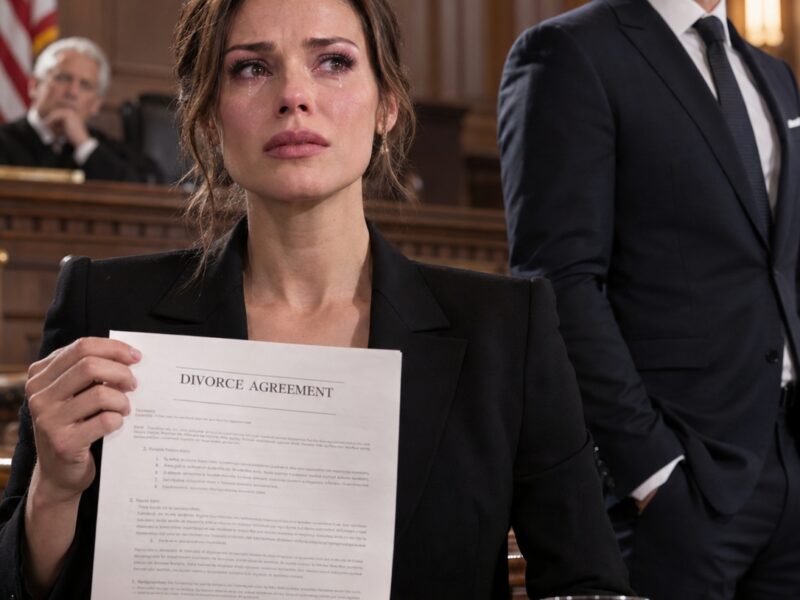
Her Husband Tried to Leave Her With Nothing—Then the Stranger in the Back Row Stood Up

The first lie Daniel Carter told in court was so clean, so calmly delivered, that for one terrible second Emily wondered whether eight years of marriage had happened only inside her own memory.
“She contributed almost nothing,” he said.
No hesitation. No shame.
Daniel sat beside his attorney in a charcoal suit that probably cost more than Emily had spent on groceries in the last three months. His silver watch caught the fluorescent courtroom light each time he moved his wrist. He looked rested. Prepared. Certain.
Emily sat twelve feet away with her hands folded beneath the table because if she left them where anyone could see them, the judge would notice they were trembling.
Almost nothing.
The words seemed to remain in the air after Daniel stopped speaking.
Almost nothing.
Not the second job she had taken when his first company failed.
Not the credit cards she had quietly paid when he was too embarrassed to tell anyone he was drowning.
Not the eighteen months she had cared for his mother after the stroke while Daniel spent fourteen-hour days chasing investors.
Not the earrings she had sold.
Not the retirement account she had emptied.
Not the nights she had slept four hours and told him the next morning that everything would be okay.
Almost nothing.
Emily lifted her eyes.
Daniel was looking directly at her.
And then he smiled.
It was barely there, just one corner of his mouth rising, but she knew that smile. She had seen it after arguments when he realized she was too tired to keep fighting. She had seen it when he rewrote conversations until she doubted what she remembered. She had seen it the night he told her that leaving him would be a mistake because no one else would ever value a woman who had “wasted her best years playing assistant to somebody else’s success.”
Now he wore the same smile in front of a judge.
He believed this was already over.
Emily’s attorney, Rachel Morrison, leaned slightly toward her.
“Don’t react,” she whispered.
Emily swallowed.
“I’m trying.”
Across the aisle, Daniel’s lawyer rose.
Martin Keller had the polished confidence of a man who billed in six-minute increments and never seemed to sweat. He buttoned his jacket and stepped toward the center of the courtroom.
“Your Honor, Mr. Carter is not suggesting that Mrs. Carter contributed nothing emotionally during the marriage. The issue before the court is financial contribution and ownership.”
Emily’s stomach tightened.
There it was.
The careful version.
Not she did nothing.
Just nothing that counted.
Keller continued.
“Carter Dynamics was created, financed, expanded, and managed primarily through my client’s labor, business relationships, and strategic leadership. Mrs. Carter chose not to pursue a substantial career of her own during much of the marriage.”
Emily almost laughed.
Chose.
Rachel’s pen stopped moving.
Daniel didn’t look at her this time.
The judge, Honorable Margaret Hale, adjusted her glasses.
“Mr. Keller, I assume you’ll be presenting documentation supporting that position.”
“Yes, Your Honor.”
“Then let’s stay with documentation.”
Keller nodded.
Emily tried to breathe normally.
Three rows behind her, someone shifted.
She didn’t turn around.
She had been aware of the man since she entered the courtroom that morning, though she couldn’t have explained why.
He appeared to be in his late sixties, maybe seventy. Tall even while seated. Silver hair. Dark wool coat despite the mild October weather outside.
He hadn’t looked at his phone.
Hadn’t whispered to anyone.
Hadn’t reacted when attorneys entered or when the clerk called the case.
He had simply watched Emily.
Not Daniel.
Emily.
The first time she noticed him, she assumed he had mistaken her for someone else.
The second time, their eyes met.
Something about his expression unsettled her.
It wasn’t curiosity.
It wasn’t pity.
It looked almost like grief.
Emily had turned away.
She had enough ghosts in the room already.
She didn’t need a stranger adding another one.
Keller approached the evidence monitor.
A photograph appeared.
Daniel at a downtown Chicago charity gala.
Black tuxedo. Champagne glass. Three investors beside him.
Another photograph.
Daniel accepting a regional entrepreneurship award.
Another.
Daniel at a technology conference in San Francisco.
Then a picture of Emily.
She was carrying grocery bags from the trunk of their old Honda outside the townhouse they had rented six years earlier.
She stared at it.
She remembered that day.
Daniel had called her at 4:17 p.m. from the airport because his flight was delayed.
His mother had needed medication.
Emily had left her afternoon shift early, bought groceries, picked up Evelyn Carter’s prescriptions, driven forty minutes to Evelyn’s house, prepared dinner, helped her shower, changed her bedding, and then gone home to finish bookkeeping for Daniel’s company until nearly two in the morning.
The photograph showed none of that.
It showed a woman in sweatpants carrying paper bags.
Keller let the image remain on the screen.
“The contrast is relevant, Your Honor. During the years Mr. Carter was developing the company, Mrs. Carter was largely absent from its professional operations.”
Emily heard Rachel inhale slowly.
Then another photograph appeared.
Emily sitting alone on the steps outside Evelyn’s house.
Her hair was tied carelessly behind her head.
Her face looked exhausted.
She remembered that day too.
Evelyn had fallen in the bathroom.
Emily had spent five hours in the emergency room with her.
Daniel had been in New York.
He had sent one text.
Can’t leave meeting. Keep me updated.
His lawyer was now using that photograph to prove she had done nothing.
Something hot rose through Emily’s chest.
Rachel touched her arm beneath the table.
Not yet.
Emily looked down.
On the back row, the older man’s jaw tightened.
The attorney sitting beside him leaned over and murmured something.
The man didn’t answer.
His eyes never left the screen.
Judge Hale frowned.
“Mr. Keller, photographs showing where individuals physically appeared at isolated moments are not particularly persuasive evidence of financial contribution.”
“Understood, Your Honor. They establish context.”
“They establish that Mr. Carter owned a tuxedo.”
A few people in the gallery shifted, suppressing smiles.
For the first time that morning, Daniel’s expression changed.
Only slightly.
Emily noticed.
So did Rachel.
Keller moved on.
He displayed tax filings, corporate registrations, salary statements.
Daniel’s name appeared everywhere.
Daniel Carter.
Daniel Carter.
Daniel Carter.
Emily had known it would.
She had typed half of those forms herself.
In the beginning, Carter Dynamics hadn’t been a company.
It had been Daniel sitting at their kitchen table with a secondhand laptop and a whiteboard leaned against the refrigerator.
He had been thirty-one.
Emily was twenty-nine.
They had been married fourteen months.
Daniel had come home one February evening and said he was quitting his job.
Emily had stared at him across a plate of spaghetti.
“You already quit?”
He looked embarrassed.
“Technically, yes.”
“Daniel.”
“I couldn’t do it anymore.”
“We have rent.”
“I know.”
“Student loans.”
“I know.”
“And you quit before telling me?”
He had walked around the table, crouched beside her chair and taken both her hands.
“I can build something better.”
She remembered the fear in his eyes.
She also remembered squeezing his fingers.
“Then we’ll figure it out.”
Not you.
We.
Within two months, Emily had increased her hours at the dental office where she handled billing and patient accounts. At night, she served three evenings a week at a restaurant near Wicker Park.
Daniel hated that job.
Not because she was tired.
Because one evening an investor saw her carrying plates.
“You don’t need to do that anymore,” Daniel had said when she came home.
“Yes, I do.”
“It looks bad.”
She stared at him.
“What looks bad?”
“My wife waiting tables while I’m trying to convince people this company has momentum.”
Emily took off her shoes.
“Your company currently has seventy-three dollars in its business account.”
“That’s temporary.”
“So is the restaurant job.”
Daniel hadn’t apologized.
Two weeks later, he asked her for $4,800 to pay a software contractor.
She transferred it the next morning.
That transfer was not on Keller’s screen.
Neither were the dozens after it.
The courtroom door opened softly behind them.
A clerk entered.
Emily’s attention returned to the present when Keller said, “Mrs. Carter’s personal income during several years of the marriage was modest.”
Rachel stood.
“Objection to characterization.”
“Sustained.”
Keller nodded.
“Her documented wages were considerably lower than Mr. Carter’s compensation after Carter Dynamics became profitable.”
Emily almost admired the trick.
He began the story after the sacrifice was finished.
Start late enough, and the truth looked completely different.
Rachel had warned her.
“That’s what they’ll do,” she said two nights earlier in her office.
“They’ll start the clock when Daniel started winning.”
Emily had been sitting on Rachel’s couch surrounded by banker boxes.
“What do we do?”
“We move the clock backward.”
Now Rachel stood.
“Your Honor, may we reserve response until counsel finishes?”
Judge Hale nodded.
“Proceed.”
Keller turned toward Daniel.
“Mr. Carter, did you ever prevent your wife from pursuing a career?”
“No.”
The answer came immediately.
“Did you ever insist that she abandon employment?”
“No.”
Emily looked up.
Daniel continued.
“In fact, I encouraged Emily many times to figure out what she wanted professionally.”
Rachel’s pen moved.
Emily stared at her husband.
One memory rose above the others.
Daniel standing in their kitchen five years earlier, his mother newly discharged from rehabilitation.
Emily had been offered a full-time position managing accounts for a medical practice.
Better salary.
Benefits.
A future.
She had been excited.
Daniel barely let her finish.
“What about Mom?”
“We’ll need someone during the day.”
“A nurse?”
“Maybe.”
“Do you know what that costs?”
“I do.”
“And who is supposed to take her to physical therapy?”
“We can work something out.”
Daniel had stared at her as though she had betrayed him.
“Right when the company is finally getting traction?”
“My job has nothing to do with your company.”
“It has everything to do with it.”
“How?”
“Because I can’t run a company if I’m constantly worried about what’s happening here.”
Emily said nothing.
Daniel softened his voice.
“Just give me another year.”
Another year became three.
Evelyn eventually improved.
By then Carter Dynamics had grown from six employees to eighty-four.
Daniel stopped asking what Emily wanted to do.
Now he sat beneath the state seal and told the court he had encouraged her.
Emily’s pulse throbbed in her ears.
Rachel whispered, “Let him keep talking.”
That was when Emily understood something.
Every lie Daniel told felt unbearable because she still expected the man she had loved to eventually appear inside the man speaking.
He wasn’t going to.
Maybe that man had never existed.
Or maybe success had simply given Daniel permission to become what he had always been.
Keller walked closer.
“Mr. Carter, did Mrs. Carter have access to joint household accounts?”
“Yes.”
“Credit cards?”
“Yes.”
“Vehicles?”
“Yes.”
“Did she live comfortably as the business became successful?”
Daniel paused just long enough to look thoughtful.
“Yes.”
Emily felt something inside her go still.
That word hurt more than the others.
Comfortably.
She remembered standing in Target counting how many weeks she could stretch a bottle of shampoo because Daniel needed every available dollar for payroll.
She remembered wearing the same black dress to four business events because she refused to buy another.
She remembered Daniel complaining that investors’ wives dressed better.
She remembered the year she skipped a root canal because their insurance had lapsed.
Comfortably.
Keller turned toward the judge.
“Ultimately, Your Honor, we believe this is a relatively straightforward matter. Mrs. Carter benefited from my client’s entrepreneurial success. The breakdown of their marriage does not now transform her into a co-founder.”
Rachel stood.
“No one has claimed she was a co-founder.”
Keller glanced toward her.
“Her requested distribution suggests otherwise.”
“Her requested distribution reflects marital property law.”
“Counsel.”
Judge Hale’s voice cut through the room.
Both attorneys stopped.
The judge looked at Keller.
“Finish your presentation.”
“Yes, Your Honor.”
He returned to his table.
Daniel leaned toward him.
They whispered.
Emily watched them.
Then Daniel’s eyes moved toward her again.
This time there was no smile.
Something colder.
A warning.
She remembered the final night they had lived under the same roof.
Daniel had come home at midnight.
Emily was waiting in the living room.
On the coffee table were six printed bank statements.
Daniel stopped when he saw them.
“What is this?”
“You tell me.”
He glanced down.
She pointed at three transfers.
$38,000.
$22,500.
$61,000.
All moved from company-linked accounts into another account Emily had never seen.
Daniel removed his coat.
“You went through my private financial records?”
“Our accountant emailed them to the house account.”
“That doesn’t mean you had permission to interrogate me.”
“I’m your wife.”
“And?”
The word had changed everything.
Emily had stared at him.
“And I want to know where the money went.”
Daniel loosened his tie.
“Business restructuring.”
“What does that mean?”
“It means exactly what I said.”
“No. It means something you don’t want to explain.”
He had walked close enough that she smelled bourbon.
Then he lowered his voice.
“Emily, you need to understand something. You have lived inside a world I built for so long that you’ve started confusing access with ownership.”
She had never forgotten the sentence.
Three weeks later, she filed for divorce.
Now Daniel’s lawyer pulled a document from a folder.
Rachel stopped writing.
Emily noticed.
“What?” she whispered.
Rachel’s eyes narrowed.
“I don’t know yet.”
Keller approached the bench.
“Your Honor, I’d like to introduce Respondent’s Exhibit Fourteen.”
Rachel rose immediately.
“We have not seen Exhibit Fourteen.”
“It was produced electronically yesterday.”
“At eleven forty-eight last night.”
“And received.”
Judge Hale looked over her glasses.
“Mr. Keller.”
“It is directly relevant to Mrs. Carter’s claimed interest in Carter Dynamics.”
Rachel held out her hand.
“Then I’d like to see it before it appears on a screen.”
Keller gave her a copy.
Emily watched Rachel read.
One line.
Two.
Three.
Then Rachel’s face changed.
Not dramatically.
That frightened Emily more.
“What is it?”
Rachel didn’t answer.
She turned the document toward Emily.
At the top was a familiar company logo.
Below it:
SPOUSAL ACKNOWLEDGMENT AND WAIVER OF OWNERSHIP INTEREST
Emily’s eyes moved downward.
Legal language.
Dates.
Initials.
And on the last page—
her name.
Her signature.
She stared at it.
For a moment she heard nothing.
Not Keller.
Not the air-conditioning.
Not the clerk moving papers.
She saw only the handwriting.
Emily Carter.
It looked like hers.
Almost.
Keller spoke.
“Dated May 14, four years ago. The document acknowledges that all ownership interests in Carter Dynamics were and would remain the separate property of Daniel Carter.”
Emily leaned closer.
Rachel whispered, “Do you remember this?”
“No.”
“Think.”
“I am thinking.”
“Did you sign anything around that date?”
Emily’s heart began hammering.
May.
Four years ago.
Carter Dynamics had been renegotiating investor agreements.
Daniel brought papers home constantly.
NDAs.
Insurance forms.
Tax forms.
Vendor authorizations.
He often left yellow tabs beside signature lines.
“Just sign where I marked.”
She had trusted him.
Then she saw something.
The E in Emily.
She always looped the middle stroke slightly downward.
This one didn’t.
Her breathing changed.
“That’s not mine.”
Rachel looked at her.
“Are you sure?”
Emily touched the page.
“That is not my signature.”
The courtroom seemed to shrink.
Rachel stood.
“Your Honor, we contest authenticity.”
For the first time all morning, Daniel turned sharply toward Keller.
Keller whispered something.
Daniel whispered back.
Judge Hale looked at Emily.
“Mrs. Carter, you’re stating under oath through counsel that you did not execute this document?”
Emily stood because sitting suddenly felt impossible.
“Yes, Your Honor.”
“Take your time.”
Emily looked at the page again.
“I’ve signed many documents connected to Daniel’s company. I never signed away my rights to marital property.”
Keller rose.
“Your Honor, Mrs. Carter’s recollection four years later—”
Rachel snapped around.
“She has disputed a signature on a document your office produced less than twelve hours ago.”
“I’m simply pointing out—”
“You can point it out after forensic examination.”
Judge Hale raised a hand.
“Enough.”
Silence.
The judge looked toward Keller.
“Do you possess the original?”
A beat.
“We are locating it.”
Rachel almost laughed.
“Locating it?”
Keller ignored her.
Judge Hale’s expression hardened.
“You’re offering a purported waiver carrying a contested signature and you do not presently have the original document?”
“It was maintained in corporate records.”
“That was not my question.”
Daniel shifted in his chair.
Emily saw it.
For the first time since walking into court, he looked afraid.
Not worried.
Afraid.
And three rows behind them, the silver-haired stranger leaned forward.
The attorney beside him whispered, “Robert.”
So softly that almost no one heard.
Almost.
Emily did not.
But Daniel’s attorney did.
Martin Keller turned toward the gallery.
His eyes found the older man.
Something drained from his face.
He looked back at Daniel.
Then he bent close and whispered urgently into his ear.
Daniel frowned.
“What?”
Keller whispered again.
Daniel glanced backward.
His gaze landed on the older stranger.
He looked confused.
Then irritated.
Then he turned away as though the man meant nothing.
The older man continued watching Emily.
Judge Hale addressed both attorneys.
“I will allow the document to be marked for identification only. Authenticity is unresolved. I am ordering counsel to preserve all originals, associated electronic records, metadata, email transmissions, and document-management records relating to this purported waiver.”
Daniel’s face tightened.
The judge continued.
“No destruction. No alteration. No migration. No excuses.”
Rachel said, “Thank you, Your Honor.”
Judge Hale looked at Keller.
“Do you understand?”
“Yes.”
Emily slowly sat.
Rachel leaned toward her.
“That document may have just changed the entire case.”
Emily stared at Daniel.
He avoided her eyes.
“What happens now?”
“If it’s forged?”
“Yes.”
Rachel paused.
“Then Daniel has a problem much bigger than property division.”
Emily looked down at the signature again.
For the first time that morning, she did not feel small.
She felt furious.
And fury, she discovered, was much easier to breathe through than fear.
The judge called a twenty-minute recess.
Daniel stood immediately.
Emily remained seated.
Her knees didn’t trust her yet.
People began moving toward the hallway.
Rachel gathered the papers.
“I’m calling a forensic document examiner.”
Emily nodded.
“And I want the electronic file.”
“We’ll demand it.”
“I mean the original file. Whatever computer created it.”
Rachel looked at her.
“Good.”
Emily blinked.
“What?”
“That’s exactly the question we need to ask.”
Something almost like confidence moved through Emily.
Then Daniel appeared beside the table.
Rachel straightened.
“You should speak through counsel.”
Daniel ignored her.
He looked at Emily.
“You’re making this worse than it has to be.”
Emily stared at him.
He lowered his voice.
“You should have accepted the settlement.”
The old Emily might have asked what he meant.
Might have tried to understand his anger.
Might even have worried she had done something wrong.
This Emily looked at the man she had slept beside for eight years and finally saw a stranger.
“You offered me our car and six months of rent.”
“You’d have walked away clean.”
“Clean?”
“You know what I mean.”
“No, Daniel. I don’t anymore.”
His jaw tightened.
“Be careful.”
Rachel stepped between them.
“That’s enough.”
But Emily stood.
She was shaking again.
This time she didn’t hide it.
“I accepted your excuses for years,” she said. “I accepted your promises. I accepted being blamed every time something went wrong. I accepted being invisible whenever things went right.”
Daniel’s face hardened.
People nearby had gone quiet.
Emily continued.
“I even accepted that our marriage failed.”
She looked directly into his eyes.
“But I will not accept a lie with my signature underneath it.”
Daniel said nothing.
That silence told her more than any confession could have.
Rachel touched Emily’s elbow.
“Let’s go.”
They turned.
That was when the older man from the back row stood.
He was taller than Emily expected.
The attorney beside him rose too.
The older man removed his glasses and held them in one hand.
For several seconds, he did not move.
Emily noticed something astonishing.
He looked nervous.
Not courtroom nervous.
Personal nervous.
As though the next ten feet were more difficult than anything he had ever done.
Then he walked toward her.
“Emily?”
She stopped.
“Yes?”
Up close, she saw his eyes clearly.
Gray-blue.
Her mother had called Emily’s eyes strange when she was little.
“Neither mine nor your grandmother’s,” she used to say.
Emily looked at the stranger.
The same eyes.
A small pressure began behind her ribs.
The man swallowed.
“My name is Robert Harrison.”
Emily waited.
Nothing.
The name meant nothing to her.
But it meant something to Rachel.
Emily saw her attorney’s posture change.
Daniel’s lawyer had also stopped several feet away.
Robert glanced at the people around them.
Then back at Emily.
“I hoped to do this differently.”
Emily frowned.
“Do what?”
The man beside him stepped slightly away, giving them privacy without actually leaving.
Robert’s hand closed around his glasses.
“I’ve been looking for you.”
Emily felt cold.
“For me?”
“Yes.”
“Why?”
His eyes filled before he answered.
And for reasons she couldn’t explain, Emily’s first instinct was to run.
“I believe,” Robert said quietly, “that I am your father.”
The hallway disappeared.
There were still people moving.
Court clerks talking.
Elevators chiming.
Shoes crossing polished floors.
But Emily heard none of it.
She stared at Robert.
Then she gave a short laugh.
Not because anything was funny.
Because the alternative was falling down.
“My father is dead.”
Robert’s face changed.
“Who told you that?”
“My mother.”
He looked away.
That tiny reaction frightened her.
Emily stepped backward.
“My father died before I was old enough to remember him.”
“No.”
The word was gentle.
Still, it hit like a slap.
“No?”
Robert shook his head.
“I didn’t die.”
Emily looked at Rachel.
Rachel looked as stunned as she felt.
Robert reached slowly inside his coat.
Emily stiffened.
He stopped.
“Documents. That’s all.”
She said nothing.
He removed a thin leather folder.
Inside were photographs.
A laboratory report.
Copies of old letters.
A birth record.
Emily didn’t touch them.
“What is this?”
“Proof that I’m not asking you to believe a stranger based on emotion.”
Her eyes fell to the first photograph.
A woman in her early twenties stood beside a younger version of Robert.
Emily’s breath caught.
Her mother.
Catherine.
Laughing.
Not the exhausted mother Emily remembered from childhood.
Young.
Carefree.
In love.
Robert watched her.
“We met in college.”
Emily looked up.
“My mother never went to college.”
“She attended Northwestern for three semesters.”
“No, she didn’t.”
“She did.”
“You’re lying.”
“I understand why you think that.”
“You don’t understand anything.”
Robert flinched.
Emily hated that she noticed.
Hated that some part of her already recognized pain in his face.
She shoved the photograph back toward him.
“My mother raised me alone. She worked every job she could find. She got sick and still went to work. Where were you?”
Robert went completely still.
Emily’s voice cracked.
“Where were you if you were alive?”
“I didn’t know where you were.”
“That’s convenient.”
“It’s the truth.”
“She said you were dead.”
“I know.”
“How could you possibly know?”
“Because I found a letter she wrote to my parents.”
Emily stared at him.
Robert opened the folder.
“My family did not approve of our relationship.”
“Why?”
“My father was a controlling man.”
“That doesn’t answer me.”
Robert drew a slow breath.
“Your mother came from a working-class family. My father had already chosen the kind of woman he expected me to marry. When Catherine became pregnant, things became ugly.”
Emily shook her head.
“No.”
“My parents told me she had left.”
“No.”
“They told her I had chosen my family over her.”
“Stop.”
“I spent months trying to find her.”
“Stop.”
“They intercepted letters. Phone calls. I didn’t know you had been born until—”
“Stop!”
The word echoed down the hallway.
Several people turned.
Robert fell silent.
Emily pressed a hand against her mouth.
The hallway blurred.
Her mother had been dead six years.
There was no one left to question.
No one to confront.
No one to tell her whether this was truth or another manipulation arriving on the worst day of her life.
Daniel suddenly appeared.
“What the hell is going on?”
Emily closed her eyes.
Of course.
Of course he would come now.
Robert’s entire demeanor changed.
The vulnerable man disappeared behind something controlled and hard.
He turned.
“This is a private family conversation.”
Daniel looked from Robert to Emily.
“Family?”
“Daniel,” Keller said quietly.
Daniel ignored him.
“What did he tell you?”
Emily stared at her husband.
“My husband?”
Robert’s eyebrows lifted slightly.
Emily laughed bitterly.
“Technically.”
Daniel looked at Robert.
“Who are you?”
Keller stepped close.
“Daniel.”
“What?”
“Not here.”
“Why?”
Keller’s voice dropped.
“That is Robert Harrison.”
Daniel frowned.
Then recognition arrived.
Emily saw it happen.
Carter Dynamics had once spent six months trying to secure a contract with a Harrison-controlled logistics group.
They hadn’t gotten it.
Daniel had spoken about Harrison Holdings for years.
A private conglomerate with interests in manufacturing, freight, software infrastructure, commercial property, and medical technology.
Daniel’s expression shifted.
Confusion.
Recognition.
Calculation.
Emily felt sick.
The change happened too quickly.
A minute ago Robert was an old stranger.
Now Daniel knew he was wealthy.
Suddenly Daniel’s voice softened.
“Mr. Harrison.”
Robert looked at him.
Daniel extended his hand.
Robert did not take it.
Daniel slowly lowered it.
Keller stared at the floor.
Robert spoke calmly.
“I’ve spent the past hour listening to you describe my daughter as a financial burden.”
Daniel’s face reddened.
“There are legal issues you may not fully understand.”
Robert almost smiled.
“You’d be surprised what I understand.”
Emily looked between them.
The word daughter hit differently this time.
She didn’t know whether she wanted to hear it again.
Or never hear it again.
Daniel looked at her.
“Emily, we should talk privately.”
“No.”
“This changes things.”
Something inside her snapped into place.
“What changes?”
Daniel hesitated.
She waited.
“What changes, Daniel?”
His silence answered.
Emily nodded.
“Right.”
She stepped closer.
“Thirty minutes ago I contributed nothing.”
“That isn’t what I said.”
“I heard you.”
“My attorney was making a legal argument.”
“You said the words.”
Daniel glanced toward Robert.
Emily saw him do it.
And suddenly the situation became painfully clear.
Daniel didn’t fear losing Emily.
He feared discovering she might have value he hadn’t calculated.
That hurt.
But it also freed her.
She turned away.
“Rachel, I need air.”
Robert stepped aside immediately.
“I won’t follow you.”
Emily looked at him.
For the first time, she believed something he said.
Outside the courthouse, Chicago was bright and cold.
The wind moved between the buildings, lifting Emily’s hair.
She walked halfway down the steps before stopping.
Rachel stayed several feet behind.
No advice.
No questions.
Emily appreciated her for it.
Cars moved through the intersection.
Someone laughed across the street.
A cyclist shouted at a taxi.
The world had the indecency to continue.
Emily looked at the courthouse doors.
“This morning I thought the worst thing that could happen was losing my house.”
Rachel folded her arms against the wind.
“Life has terrible timing.”
“My dead father is apparently alive.”
“Apparently.”
“And a billionaire.”
“Also apparently.”
Emily laughed.
Then the laugh became a sob.
She covered her face.
Rachel approached.
Emily wiped her eyes quickly.
“I’m sorry.”
“Never apologize to your divorce attorney for crying outside family court. Half my job would disappear.”
Emily smiled despite herself.
Then she looked back at the doors.
“Do you know who he is?”
“Yes.”
“Is he really that rich?”
Rachel considered the question.
“Rich enough that I don’t think the number matters.”
Emily closed her eyes.
Perfect.
Her husband had spent years teaching her that money determined value.
Now a stranger claiming to be her father had enough money to make Daniel afraid.
It felt less like rescue than a cruel joke.
“I don’t want his money.”
Rachel nodded.
“I know.”
“How?”
“Because your first question was where he had been. Not what he had.”
Emily looked at her.
Rachel continued.
“And that matters.”
Twenty minutes later, the hearing resumed.
Robert did not return to the back row.
Emily noticed his empty seat.
She was relieved.
She was disappointed.
Both feelings angered her.
Judge Hale reviewed procedural matters regarding the contested waiver.
Then Rachel stood.
“Your Honor, with permission, I’d like to respond to several assertions concerning Mrs. Carter’s contribution to the marriage.”
“Proceed.”
Rachel connected her laptop to the monitor.
The first exhibit appeared.
A bank statement dated eight years earlier.
Emily recognized it immediately.
Checking account ending in 4419.
Her account.
A transfer highlighted in yellow.
$4,800 — Carter Dynamics LLC
Rachel faced Daniel.
“Mr. Carter, do you recognize this transaction?”
Daniel shifted.
“I’d need context.”
“The context is that your company had insufficient funds to pay a software contractor.”
“I don’t remember.”
Rachel clicked.
Another transfer.
$2,100.
Another.
$7,600.
Another.
$3,400.
Another.
$11,000.
The numbers continued.
Small compared with Daniel’s present wealth.
Enormous compared with what Emily had earned then.
Rachel spoke.
“Over thirty-one months, Mrs. Carter transferred forty-seven separate payments from accounts containing her wages into accounts associated with Carter Dynamics.”
Daniel leaned toward Keller.
Rachel continued.
“Totaling $83,640.”
Emily knew the number.
Still, hearing it aloud hurt.
Eighty-three thousand six hundred forty dollars.
Money she had never thought of as an investment.
It had been survival.
Their survival.
Rachel displayed payroll records.
“Mrs. Carter also maintained employment during most of the startup period.”
Keller rose.
“Her income was not substantial.”
Rachel turned toward him.
“It was substantial enough to keep the lights on.”
“Counsel.”
Rachel nodded.
“Withdrawn.”
The judge looked at the records.
Rachel changed the screen.
A spreadsheet appeared.
Daniel’s original startup expense tracker.
Emily had built it.
Color-coded cells.
Vendor categories.
Cash-flow projections.
Judge Hale leaned forward.
“Who prepared this?”
Rachel looked at Emily.
“My client.”
Keller stood.
“Basic household bookkeeping does not establish company ownership.”
“No,” Rachel said. “But counsel repeatedly characterized Mrs. Carter as absent from business operations.”
She clicked.
Emails appeared.
From Daniel to Emily.
Can you fix the projections before tomorrow?
Need payroll numbers tonight.
Can you call vendor and negotiate 30-day terms?
Investor wants cleaner financial model. Please work your magic.
And then one message sent at 2:13 a.m. six years earlier:
I couldn’t do this without you.
Emily stared at the words.
She remembered reading them in bed while Daniel slept beside her.
She had saved the message because at the time it made every sacrifice feel worthwhile.
Now it appeared twenty feet wide on a courtroom wall.
Daniel stared down at his hands.
Rachel allowed several seconds of silence.
Then she said, “We agree Mrs. Carter was not formally designated a co-founder. We are not asking the court to invent a title she did not have.”
She turned toward the judge.
“We are asking the court not to erase labor simply because it occurred inside a marriage.”
Emily looked at Rachel.
Something in her chest loosened.
The evidence continued.
Records from the restaurant where she worked.
Dental office wages.
Credit card statements.
Payments toward Daniel’s graduate loans.
Receipts for Evelyn Carter’s medical equipment.
Physical therapy transportation.
Household bills.
Then came the transfer Emily had nearly forgotten.
$26,000.
Judge Hale looked up.
Rachel said, “This transaction occurred eleven days before Carter Dynamics closed its first institutional investment.”
Keller rose.
“The investment was secured through Mr. Carter’s business activity.”
“Agreed.”
“So this is irrelevant.”
Rachel faced him.
“No. Mr. Carter’s company required operating capital to remain solvent during the closing period. This transfer provided part of that capital.”
Judge Hale looked toward Daniel.
“Where did Mrs. Carter obtain twenty-six thousand dollars?”
Daniel said nothing.
Rachel answered.
“She liquidated an investment account left to her by her grandmother.”
The room became very quiet.
Emily looked down.
Her grandmother had worked as a public-school librarian for thirty-eight years.
She left Emily a modest account with one instruction.
“Don’t spend it making somebody else happy.”
Emily had thought about that sentence when Daniel asked for the money.
He promised it would be temporary.
Six months, maybe nine.
“I’ll replace every dollar.”
He never did.
The company survived.
The investors signed.
Three years later Daniel bought a Porsche.
Emily had never asked for the money back.
Judge Hale looked toward Daniel.
“Was the money repaid to Mrs. Carter?”
Daniel’s answer was almost inaudible.
“No.”
Rachel sat.
Emily expected triumph.
Instead she felt grief.
Evidence was strange that way.
Each document proved she mattered.
Each document also proved how long she had accepted being treated as though she didn’t.
When court adjourned that afternoon, Rachel received an email before they reached the elevator.
She opened it.
“What?”
Rachel’s eyes moved quickly.
“Daniel’s side has produced a PDF copy of the waiver.”
“The fake one?”
“The contested one.”
“Can we tell anything?”
“Maybe.”
Rachel forwarded it.
“Who are you sending it to?”
“Forensic examiner.”
The elevator arrived.
They stepped inside.
A man in a navy suit hurried toward them.
He held the doors.
Emily recognized Robert’s attorney.
“Ms. Carter?”
She stiffened.
“Yes?”
“Mr. Harrison asked me to give you this.”
A plain white envelope.
Emily didn’t take it.
“What is it?”
“Nothing financial.”
She almost laughed.
“He told you to say that?”
“Yes.”
That answer surprised her.
The attorney continued.
“It contains his phone number, the DNA report, and copies of the letters he mentioned. He said you should read them only if and when you want to.”
Emily took the envelope.
“Where is he?”
“He left.”
“Why?”
“He thought staying might pressure you.”
The elevator doors began closing.
The attorney stepped back.
Then he added, “For what it’s worth, I’ve worked for Robert Harrison for twenty-two years. I have seen him remain calmer during federal investigations than he was before speaking to you.”
The doors closed.
Emily stared at her reflection in the polished metal.
The envelope felt impossibly heavy.
She did not open it that night.
She placed it on her kitchen table.
Then moved it to the counter.
Then into a drawer.
At 1:14 a.m., she took it out again.
At 2:03, she opened it.
The DNA report was first.
Probability of biological relationship: greater than 99.99 percent.
Emily read the line five times.
She put the paper down.
Then she opened the letters.
Most were decades old.
The earliest was written in Robert’s handwriting.
Catherine, please call me. I went to your apartment. It was empty. My father says you left Illinois. I don’t believe him. Please tell me where you are. Whatever they told you, I did not leave you.
Another.
I found your aunt’s address in Milwaukee. She says she hasn’t heard from you. I am beginning to think someone is keeping information from both of us.
Another.
If the baby has been born, please tell me. Even if you never want to see me again, I need to know that you are safe.
Emily stopped.
The baby.
Her.
She pressed both palms against the table.
Another letter had never been mailed.
A handwritten note from Catherine.
Robert had apparently found it among his father’s papers after the older man died.
You made your choice. Your family made it clear there is no place for me or my daughter in your world. Do not contact us again. I will not raise Emily waiting for a father who is ashamed of her.
Emily’s breath stopped.
Her name.
Emily.
Her mother had known Robert knew about the pregnancy.
Robert had believed Catherine chose to disappear.
Catherine had believed Robert abandoned them.
Somebody had engineered both beliefs.
Emily sat in her kitchen until dawn.
At 6:41 a.m., she called the number in the envelope.
Robert answered before the second ring.
“Emily?”
His voice was awake.
She wondered whether he had slept.
“Did you know my name?”
Silence.
Then, “Yes.”
“Before I was born?”
“Your mother chose it.”
Emily closed her eyes.
“Why didn’t you keep looking?”
The silence lasted longer.
“I did.”
“For how long?”
“Years.”
“Years isn’t forever.”
“No.”
At least he didn’t lie.
Robert continued.
“I eventually received legal notice through an attorney representing your mother. It said further contact was unwanted and would be considered harassment.”
“My mother sent that?”
“I believed she did.”
“You don’t anymore?”
“I don’t know.”
Emily pressed her forehead against one hand.
“This is insane.”
“Yes.”
“My mother told me you died in a car accident.”
Robert exhaled.
“I learned that yesterday.”
“How?”
“You mentioned it.”
“No. Why would she do that?”
“I can’t answer for her.”
“Try.”
His voice became quieter.
“Maybe she believed I had abandoned you.”
“So she killed you in the story?”
“Maybe it hurt less than telling a child her father chose not to come.”
Emily’s eyes filled.
“But you didn’t.”
“No.”
She wanted certainty.
A villain.
A clean explanation.
Robert’s father had manipulated them.
Her mother had lied.
Robert had stopped searching.
Every person had failed in a different way.
Truth, she realized, was rarely kind enough to arrive with only one person to blame.
“Why now?” she asked.
Robert paused.
“My sister died last year.”
Emily said nothing.
“She found old letters among family records before she passed. Letters I had never seen. One referenced the hospital where Catherine planned to deliver. That led to records. Those led to you.”
“You had me investigated.”
“Yes.”
She almost hung up.
Robert spoke quickly.
“Not because I wanted to invade your life.”
“But you did.”
“Yes.”
Again, no excuse.
“I needed to know whether approaching you would cause harm. I learned you were married. I thought you were happy.”
Emily laughed bitterly.
“So you watched me?”
“For a short period.”
“That’s disturbing.”
“I know.”
“And you came to my divorce hearing?”
“My attorney learned it was scheduled. I told myself I would sit in the back, see you once, and leave.”
“You’re very bad at plans.”
A pause.
Then Robert laughed.
Softly.
Emily hated how familiar the sound felt.
The next three weeks transformed the divorce.
The forensic examiner found that the signature on the waiver had been digitally assembled from portions of Emily’s signatures appearing on two unrelated company documents.
Not merely copied.
Constructed.
The metadata showed the PDF had been created eleven days before Daniel’s legal team produced it.
Not four years earlier, as the document claimed.
Rachel called Emily at 8:17 on a Tuesday morning.
“Are you sitting down?”
“No.”
“Sit.”
Emily sat on the edge of her bed.
“What?”
“We got the forensic report.”
Her heart hammered.
“And?”
“The signature is fabricated.”
Emily closed her eyes.
She had known.
Still, hearing someone else confirm it changed everything.
Rachel continued.
“There’s more.”
“Of course there is.”
“The file originated from a laptop registered to Carter Dynamics.”
Emily stood again.
“Daniel’s?”
“Not directly. Executive administration.”
“His assistant?”
“Possibly.”
“So he can blame someone.”
“He can try.”
Rachel paused.
“But metadata isn’t our best evidence.”
Emily gripped the phone.
“What is?”
“Your husband has a habit of giving instructions in writing.”
An email.
From Daniel to his chief financial officer eighteen months earlier.
Not discussing a waiver.
Something worse.
We need to isolate marital exposure before Emily gets ideas. Move IP ownership through the holding entity and keep her off anything that creates visibility.
Another.
The house is sentimental to her. Use that if this ever turns into a negotiation.
Another, sent to a private wealth manager:
She doesn’t understand corporate structure. I want liquid reserves beyond domestic reach before year-end.
Emily stopped breathing for a moment.
“What does that mean?”
Rachel’s voice became very calm.
“It means Daniel was preparing for a divorce before you were.”
Emily sat again.
“How long?”
“At least two years.”
Two years.
Emily looked around her bedroom.
Two years earlier Daniel had taken her to Napa for their anniversary.
He had arranged champagne on the balcony.
He had made a toast.
“To us.”
Two years.
He had been hiding money while kissing her goodnight.
Rachel continued.
“We found accounts associated with entities in Delaware and the Cayman Islands. We’re subpoenaing records.”
Emily whispered, “He planned everything.”
“Almost everything.”
“What didn’t he plan?”
“You fighting back.”
The next hearing lasted two days.
This time Daniel arrived without the confidence.
He still wore the expensive suit.
Still had the watch.
But the performance had cracks now.
His attorney requested time to address the forensic findings.
Judge Hale denied most of it.
“The document was introduced by your client,” she said. “The court will not reward delay created by questionable evidence.”
Daniel stared forward.
Emily felt no satisfaction.
Only clarity.
Rachel introduced the forensic examiner.
The woman explained the signature manipulation in language so precise that Daniel could not hide behind confusion.
Pixels.
Layer inconsistencies.
Compression artifacts.
Source signatures.
Creation dates.
Keller objected repeatedly.
Most objections failed.
Then the hidden asset records began.
Companies Emily had never heard of.
Accounts she had never seen.
Transactions made while Daniel told her their cash flow was tight.
Judge Hale’s expression changed with every page.
At one point, she removed her glasses and looked directly at Daniel.
“Mr. Carter, this court has broad authority to sanction intentional concealment of marital assets.”
Daniel’s voice was tight.
“I relied on financial professionals.”
Rachel stood.
“Your Honor, we have emails in which Mr. Carter personally directs the transfers.”
Keller closed his eyes for half a second.
The judge looked at him.
“I assume counsel has reviewed those.”
“Yes, Your Honor.”
“Good.”
Daniel finally testified.
Rachel approached him slowly.
“Mr. Carter, did your wife contribute money to Carter Dynamics during its early years?”
“Yes.”
Emily looked up.
The admission came reluctantly.
Rachel continued.
“Did you repay those funds?”
“No.”
“Did she perform bookkeeping work?”
“Informally.”
“Did you compensate her?”
“No.”
“Did she negotiate payment terms with vendors?”
“Sometimes.”
“Did she prepare cash-flow reports?”
“She helped.”
“Did she care for your mother during the same period?”
Daniel looked at Emily.
“Yes.”
“Allowing you to travel for business?”
“Yes.”
“Did you ever tell investors your wife’s unpaid work made it possible for you to focus on the company?”
Keller stood.
“Objection. Foundation.”
Rachel lifted a document.
“I can establish foundation.”
Judge Hale nodded.
“Proceed.”
Rachel displayed an email Daniel sent to an early investor.
Emily is the reason I can do this. She handles everything I can’t right now. I owe her more than I’ll ever be able to repay.
Emily looked at Daniel.
His face had gone pale.
Rachel let silence work again.
Then she asked, “Did you write this?”
“Yes.”
“When you wrote it, were you lying?”
Keller stood.
“Objection.”
Judge Hale looked at Rachel.
“Rephrase.”
Rachel nodded.
“Did you believe it when you wrote it?”
Daniel stared at the email.
“Yes.”
Emily looked away.
That was somehow worse.
For years she had wondered whether Daniel simply failed to understand what she had done.
Now she knew.
He understood.
He had always understood.
He simply decided later that acknowledging it would cost him too much.
Rachel asked the next question.
“When did you stop believing your wife’s sacrifices had value?”
Daniel looked at her.
Keller objected immediately.
“Sustained.”
But the question had already landed.
Emily saw it in Daniel’s face.
So did everyone else.
During lunch recess, Emily sat alone on a bench across from the courthouse.
Robert had attended that morning but remained far from her.
He had kept his promise.
No grand interventions.
No teams of lawyers replacing Rachel.
No phone calls to judges.
No threats.
He simply came.
Sometimes he brought coffee.
Sometimes he said nothing.
That day he approached only when Emily waved him over.
He sat beside her.
For a while neither spoke.
Then Emily said, “You could destroy him financially, couldn’t you?”
Robert looked at her.
“If I chose to use everything available to me?”
“Yes.”
She nodded.
“Would you?”
“If you asked?”
“Yes.”
Emily looked across the street.
“And if I don’t?”
“I won’t.”
She studied him.
“You mean that.”
“Yes.”
“Why?”
Robert took a moment.
“Because controlling your life in the name of protecting you would still be controlling your life.”
Emily swallowed.
Her mother had controlled the truth to protect her.
Daniel had controlled money to protect himself.
Robert, for all his power, was doing something neither had managed.
Giving her a choice.
“I don’t want you to destroy him,” she said.
Robert nodded.
“He should face whatever the law gives him. Nothing more.”
“Okay.”
“You think I’m being weak?”
Robert turned fully toward her.
“No.”
“What do you think?”
“I think you’ve had enough men deciding what justice should look like for you.”
Emily stared at him.
Then she laughed quietly.
“That sounded rehearsed.”
“It wasn’t.”
“You’re sure?”
“I had twenty-seven years to think about what I would say if I ever found you.”
She looked at him.
“Thirty-four.”
He blinked.
“What?”
“I’m thirty-four.”
Robert’s face fell.
“I know.”
“No, you said twenty-seven.”
“I stopped actively searching after the legal notice.”
Emily looked down.
There it was.
The wound beneath the reunion.
He had searched.
Then he had stopped.
She could understand why.
She could also hurt because of it.
Both things could be true.
“I’m still angry with you,” she said.
“I know.”
“I may be angry for a long time.”
“I know.”
“You don’t get to show up rich and sad and make that disappear.”
A faint smile.
“I was hoping the sad part might help.”
She laughed.
Then tears came unexpectedly.
Robert didn’t touch her.
He waited.
Finally Emily leaned against his shoulder.
Only slightly.
Robert stopped breathing.
She noticed.
Neither of them mentioned it.
The court’s ruling came six weeks later.
Emily stood beside Rachel.
Daniel stood beside Keller.
Judge Hale spent nearly forty minutes reviewing findings.
The marriage.
The financial records.
Emily’s documented contributions.
The hidden assets.
The questionable corporate transfers.
The fabricated waiver.
Every sentence peeled away another layer of Daniel’s story.
The judge ruled that the business interests accumulated during the marriage were subject to equitable distribution to the extent required under state law.
Several transferred assets were brought back into the marital estate.
Emily received a substantial financial award reflecting her contributions and marital rights.
She received her share of the residence.
Retirement assets.
Investment accounts.
And compensation connected to funds Daniel had attempted to conceal.
But the money barely registered when Judge Hale reached the forged document.
“The court finds substantial evidence that the purported spousal waiver was not executed by Mrs. Carter.”
Daniel stared down.
“The matter will be referred to the appropriate authorities for further review.”
Keller’s jaw tightened.
Daniel closed his eyes.
Emily waited for triumph.
It never came.
She remembered the man at the kitchen table eight years earlier.
Scared.
Brilliant.
Hopeful.
She had loved him.
Maybe some version of him had loved her.
That did not erase what he became.
But grief did not disappear simply because the person who hurt you finally lost.
After the ruling, Daniel approached her outside the courtroom.
Rachel stayed nearby.
Robert was farther down the hall.
Daniel looked older.
It was the first time Emily had noticed gray at his temples.
“So this is what you wanted.”
She stared at him.
“What?”
“All of this.”
He gestured vaguely toward the courtroom.
“The investigation. The public records. The company getting dragged through this.”
Emily shook her head.
“You still think this happened to you.”
“You could have settled.”
“You could have told the truth.”
His mouth tightened.
“It isn’t that simple.”
“It is now.”
Daniel looked toward Robert.
Emily followed his gaze.
Then she understood.
“You think he did this.”
Daniel said nothing.
“You think I won because my father has money.”
“I think suddenly every door opened for you.”
“No.”
Emily stepped closer.
“Every document that hurt you came from your own computer.”
Daniel looked away.
“You forged my signature.”
“I never said I did that.”
“You hid assets.”
“My advisers structured—”
“You wrote the emails.”
Silence.
Emily nodded.
“There it is.”
“What?”
“The thing I spent eight years waiting for.”
Daniel frowned.
“For you to just say, ‘I did it.’ No explanation. No person to blame. No reason I caused it. No story where you had no choice.”
His face hardened.
Emily felt something inside herself release.
“You know what the worst part is?”
Daniel looked at her.
“I would have forgiven almost anything if you had told me the truth before you made me fight to prove I existed.”
For one second, something broke in his expression.
Regret.
Maybe.
Then pride covered it again.
“You’re going to regret letting Harrison into your life.”
Emily smiled sadly.
“There you go.”
“What?”
“Still trying to tell me which person I should be afraid of.”
She stepped back.
“I’m done being afraid on your schedule.”
Daniel said nothing.
Emily turned and walked away.
Her legs shook for the first twenty steps.
Then they didn’t.
Robert waited near the courthouse doors.
He did not ask how much she received.
He did not ask what Daniel said.
He held out her coat.
Emily put it on.
“Lunch?” he asked.
She looked at him.
“Somewhere normal.”
Robert considered.
“I know a place with twelve-dollar sandwiches.”
“You?”
“I contain multitudes.”
She smiled.
“That sounded rehearsed too.”
“It was.”
Three months later, Emily signed a lease on a one-bedroom apartment overlooking a narrow tree-lined street in Lincoln Park.
Robert hated it.
Not openly.
He walked through the apartment, inspected the windows, looked at the aging radiator and stared at the kitchen cabinets with visible suspicion.
Emily watched him.
“Say it.”
“It’s nice.”
“You’re lying.”
“The natural light is excellent.”
“Robert.”
He looked at the ceiling.
“There appears to be a water stain.”
“It’s old.”
“Old water can become new water.”
She folded her arms.
“I am not moving into a penthouse.”
“I didn’t say penthouse.”
“You showed me one yesterday.”
“That was technically a condominium.”
“It had an elevator inside it.”
“A useful feature.”
“It had four bedrooms.”
“Storage.”
“For what?”
Robert glanced around her nearly empty apartment.
“You could acquire things.”
Emily laughed.
“No.”
He smiled reluctantly.
“Fine.”
“Fine?”
“Fine.”
“Say my apartment is nice.”
Robert sighed.
“Your apartment is nice.”
“And safe.”
“I had someone verify the building.”
Emily stared at him.
“You what?”
He froze.
“That was the wrong answer.”
“Yes.”
“I’m learning.”
“You investigated my building?”
“Only public safety records.”
“Robert.”
“And structural records.”
“Robert.”
“I’ll stop.”
“You’d better.”
He smiled.
That became their rhythm.
Boundaries.
Mistakes.
Corrections.
Trying again.
Emily refused every offer of extravagant help.
Robert eventually stopped offering extravagant things.
Mostly.
On her birthday, he gave her a leather-bound book.
Inside were copies of every letter he had written to Catherine while searching.
At the back were blank pages.
Emily looked at him.
“For what?”
Robert seemed suddenly shy.
“I thought maybe we could put the years ahead in there instead.”
Emily closed the book.
“You’re getting better at this.”
“At gifts?”
“At not giving me real estate.”
He smiled.
The career came almost by accident.
One afternoon Rachel asked Emily to review financial records for another divorce case involving a family-owned business.
“I need someone who notices inconsistencies,” she said.
“I’m not an accountant.”
“No. Accountants sometimes accept numbers because the columns balance. You ask why the number exists.”
Emily took the work.
She found three questionable transfers in two hours.
Rachel stared at her.
“You know you’re good at this, right?”
Emily shrugged.
“I did Daniel’s books for years.”
“No. You kept Daniel’s company alive for years.”
The sentence unsettled her.
Not because it was exaggerated.
Because it might have been true.
Rachel began referring more work.
Then another attorney did.
Then a small forensic accounting practice offered Emily a position combining case review, financial organization, and litigation support.
The salary was less than Daniel spent annually on cars.
Emily had never been prouder of anything.
On her first morning, Robert called at 7:03.
“Do not send flowers,” she said before hello.
“I wasn’t going to.”
“Good.”
“I sent coffee.”
Emily stopped outside her office.
“How much coffee?”
“A normal amount.”
“Define normal.”
A delivery van pulled up.
Two men began unloading boxes.
Emily closed her eyes.
“Robert.”
“It’s for the entire office.”
“How many people do you think work here?”
“I asked.”
“You called my office?”
“I’m hanging up now.”
She laughed so loudly a woman passing on the sidewalk smiled at her.
Life did not become magically painless.
Daniel’s legal problems continued.
There were investigations.
Negotiations.
Corporate consequences.
Several executives left Carter Dynamics.
A major client suspended a contract.
Emily followed the headlines at first.
Then less often.
One evening she realized she had gone nine days without searching Daniel’s name online.
That felt like freedom.
Another month passed.
Then twenty-two days.
Then she stopped counting.
Her relationship with Robert remained more complicated.
There were questions he could not answer.
Years he could not return.
Sometimes he spoke about Catherine and Emily became angry.
Sometimes she wanted every story.
How her mother laughed.
What music she liked at twenty.
Whether she had always bitten the inside of her cheek when nervous.
Robert remembered things no one else alive could tell Emily.
“She hated olives,” he said once.
Emily stared at him.
“She loved olives.”
Robert frowned.
“She absolutely hated them.”
“She put them on everything.”
He considered.
“Maybe she changed.”
The simplicity of that answer broke Emily’s heart.
Her mother had lived an entire life after Robert lost her.
Changed tastes.
Changed apartments.
Changed dreams.
Robert’s memories were not wrong.
They were simply frozen.
One Saturday they drove to the cemetery where Catherine was buried.
Robert carried no flowers.
Emily noticed.
“You didn’t bring anything.”
“I didn’t know what she would have wanted.”
“She hated roses.”
“I remember.”
They stood before the stone.
Catherine Anne Carter.
Beloved Mother.
Emily watched Robert read it.
His face collapsed quietly.
Not dramatically.
Just one man losing a woman for the second time.
“I’m angry with her,” Emily admitted.
Robert looked at her.
“I’m angry with you too.”
“That seems fair.”
“I’m angry with your father, and he’s dead.”
“Also fair.”
“I’m angry at everybody.”
Robert put his hands into his coat pockets.
“You’re allowed.”
Emily stared at her mother’s name.
“She lied to me.”
“Yes.”
“She also gave up everything for me.”
“Yes.”
“Those things don’t fit together.”
“They don’t have to.”
Emily looked at him.
He continued.
“People can love you and still make choices that wound you.”
She thought of Daniel.
Then Catherine.
Then Robert.
Maybe maturity was not learning who had been good and who had been bad.
Maybe it was learning that love did not erase harm, and harm did not automatically erase every moment of love.
Emily crouched and brushed a leaf from the gravestone.
“I wish she were here so I could yell at her.”
Robert’s voice broke.
“So do I.”
A year after the first hearing, Emily returned to the courthouse.
The building looked smaller.
That surprised her.
She remembered it as enormous.
Stone columns.
Security gates.
Long hallways where every footstep seemed to announce disaster.
Now it was simply a building.
She had come to sign the final documents resolving the last outstanding issues from her divorce.
Rachel met her upstairs.
“You okay?”
Emily looked around.
“Actually, yes.”
Daniel was already inside.
They had not spoken in nearly seven months.
He looked thinner.
Less polished.
Still handsome.
Still Daniel.
When he saw Emily, something unreadable crossed his face.
They signed documents at separate tables.
No speeches.
No final battle.
Just initials.
Dates.
Signatures.
This time Emily examined every page.
When it was done, Rachel closed the folder.
“That’s it.”
Emily stared at her.
“That’s it?”
“That’s it.”
Eight years of marriage.
A year of litigation.
Millions of dollars disputed.
A forged document.
Hidden accounts.
A father returned from the dead.
And it ended with two words.
That’s it.
Emily stepped into the hallway.
Daniel came out behind her.
“Emily.”
She stopped.
He stood several feet away.
For once, he seemed uncertain.
“I heard you’re working with Morrison’s firm sometimes.”
“Related cases.”
“You always were good with numbers.”
She almost laughed.
A year earlier he had argued in court that she contributed almost nothing.
Now he said it casually.
You always were good.
Emily nodded.
“I know.”
Daniel looked down.
“I’m sorry.”
Her breath caught.
He continued before she could respond.
“For how everything happened.”
The old instinct appeared immediately.
Translate.
Interpret.
Help him say what he means.
She resisted it.
“For how everything happened,” she repeated.
Daniel looked at her.
Emily waited.
His face tightened.
Then he tried again.
“I’m sorry for what I did.”
There.
Small.
Late.
But real.
Emily felt tears threaten.
She didn’t know whether he deserved forgiveness.
She finally understood that she did not have to decide today.
“Thank you for saying it.”
Daniel nodded.
“Are you happy?”
Emily thought about her apartment.
Her job.
Late-night calls with Robert.
The tiny basil plant on her kitchen window.
Saturday mornings when nobody criticized how long she slept.
The strange, ordinary peace of making decisions without preparing to defend them.
“I’m becoming happy,” she said.
Daniel swallowed.
“That sounds like you.”
“No.”
Emily smiled softly.
“It finally sounds like me.”
She walked away.
Robert waited outside.
Not in a limousine.
Emily had threatened consequences.
He stood beside an ordinary black SUV holding two paper coffee cups.
She walked down the courthouse steps.
For a moment the year folded over itself.
She remembered the woman who had entered those doors with trembling hands, afraid a judge might confirm what her husband had spent years teaching her to believe.
That she was dependent.
Replaceable.
Unimportant.
She wished she could reach backward through time and touch that woman’s shoulder.
Not to tell her everything would be fine.
It wouldn’t.
The next year would hurt.
Truth would dismantle nearly every story she had depended on.
Her marriage.
Her mother.
Her father.
Even her own understanding of who she had been.
But beneath all those broken stories, something would survive.
Her.
Robert handed her a coffee.
“No flowers,” he said.
“Good.”
“No penthouse.”
“Excellent.”
“No surprise financial instruments.”
Emily narrowed her eyes.
“That was suspiciously specific.”
Robert smiled.
She took the coffee.
For several seconds they stood together beneath the autumn sun.
Then Robert said, “Do you regret it?”
“The divorce?”
“Yes.”
Emily looked back at the courthouse.
Once, she had thought losing Daniel would mean losing the life she had built.
Now she understood she had spent years building a life around someone who kept moving the walls inward.
“No,” she said.
Robert nodded.
Emily looked at him.
“Do you regret finding me?”
His answer came instantly.
“I regret not finding you sooner.”
She had heard him say it before.
This time it didn’t hurt as much.
Maybe healing was not reaching a day when the past stopped hurting.
Maybe it was reaching a day when the hurt no longer made every decision for you.
They walked toward the car.
Halfway there, Emily stopped.
Robert turned.
“What?”
She reached into her bag.
Inside was the leather book he had given her.
The first half held decades-old letters.
The second half had once been blank.
It wasn’t anymore.
Emily opened to the newest page.
There were photographs.
Her apartment.
Robert burning pancakes.
Emily on her first day at work.
Catherine’s grave beneath autumn leaves.
A terrible selfie Robert had accidentally taken while trying to switch camera modes.
Receipts from diners.
Ticket stubs.
Small notes.
Ordinary life.
Robert looked at the pages.
“You filled it.”
“Not yet.”
She flipped toward the back.
Dozens of pages remained empty.
Robert touched the paper.
Emily closed the book.
“We have time.”
He looked away quickly.
She pretended not to notice his eyes filling.
They continued walking.
Behind them stood the courthouse where Daniel had once tried to prove Emily Carter had contributed almost nothing.
In a strange way, he had given her one final thing without meaning to.
A question.
What was she worth if nobody else was allowed to answer?
For most of her life, Emily had let love and usefulness become the same thing.
She was valuable when Daniel needed bookkeeping.
When Evelyn needed care.
When bills needed paying.
When somebody needed encouragement.
When someone else was falling apart and she knew how to hold everything together.
She had mistaken being necessary for being loved.
The divorce had taken that role from her.
And in the terrifying silence afterward, she finally discovered something nobody had ever taught her.
She did not have to earn her place in a room by rescuing someone.
She did not need a husband’s success to validate her sacrifice.
She did not need a billionaire father’s name to prove her worth.
She did not even need the court’s judgment, although she was grateful for its justice.
Her dignity had existed before Daniel denied it.
Before Robert found her.
Before anyone stood up in a courtroom and called her daughter.
That evening, Emily sat on the narrow balcony of her apartment while the city lights appeared one by one.
Robert sat opposite her.
Two mugs of coffee cooled on the table between them.
Below, a couple argued about parking.
Someone walked a dog.
A siren passed several blocks away.
Nothing about the night looked extraordinary.
Emily preferred it that way.
Robert looked toward the skyline.
“Your apartment is nice.”
Emily smiled.
“You’ve been practicing.”
“And safe.”
“Careful.”
He raised both hands.
“No investigation.”
“Good.”
A quiet minute passed.
Then Robert asked, “What are you thinking about?”
Emily looked through the balcony door at the life behind her.
Secondhand couch.
Stacks of case files.
Shoes beneath a chair.
A framed photograph of her mother.
Another of Robert making a ridiculous face at her birthday dinner.
There was no mansion.
No husband.
No perfect family restored exactly as it should have been.
There were only imperfect people, imperfect memories and an imperfect woman who had finally stopped apologizing for taking up space.
“I was thinking about the first day in court.”
Robert’s expression darkened.
“I hated that day.”
“So did I.”
“You were terrified.”
“Yes.”
“I wanted to walk across the room.”
“I’m glad you didn’t.”
Robert looked surprised.
Emily smiled.
“If you had stood up immediately and rescued me, Daniel would have been right about one thing.”
“What?”
“I would have looked dependent on another man to save me.”
Robert considered this.
“I hadn’t thought about that.”
“I know.”
She reached across the table.
He took her hand.
“But you stayed.”
“Yes.”
“And when I finally knew who you were, you didn’t tell me what to do.”
“I wanted to.”
Emily laughed.
“I know that too.”
Robert squeezed her fingers gently.
Below them, a car horn sounded.
The city continued moving.
Emily looked toward the darkening sky.
For years she had believed the story of her life was about people leaving.
A dead father.
A husband who stopped loving her.
A mother who carried secrets to the grave.
But perhaps she had been reading it from the wrong direction.
Maybe some endings were not abandonment.
Maybe some doors closed because the room behind them had become too small.
And maybe the stranger sitting silently in the last row of your worst day was not always there to witness your humiliation.
Sometimes he had crossed decades of regret just to find the courage to say your name.
Sometimes the marriage you fought desperately to save had to end before you could see how much of yourself you had surrendered to keep it alive.
Sometimes the truth arrived late.
Sometimes painfully late.
But late did not mean worthless.
Emily looked at Robert.
“Dad?”
The word came naturally.
For the first time.
Robert froze.
Emily immediately saw what she had done.
His mouth opened.
Nothing came out.
She smiled through tears.
“I was going to ask if you want dinner.”
Robert blinked several times.
“Dinner.”
“Yes.”
He nodded too quickly.
“I can do dinner.”
“You’re crying.”
“I am not.”
“You absolutely are.”
“It’s windy.”
“We’re on a protected balcony.”
“Very localized wind.”
Emily laughed.
Robert laughed too.
And somewhere inside that ordinary laughter, decades of absence loosened their grip by one more inch.
Not erased.
Never erased.
Just no longer powerful enough to steal the moment in front of them.
Emily stood and opened the balcony door.
Robert followed.
She looked back once at the city.
A year earlier she had walked into court believing Daniel might take everything.
The house.
The money.
The business she had quietly helped build.
Her reputation.
Her confidence.
Maybe even the story of who she had been inside their marriage.
He had tried.
But Daniel had made one mistake.
He assumed that because Emily had spent years being quiet, she had forgotten how to speak.
He assumed that because she had given without demanding credit, she had no record of what she gave.
He assumed that because she had loved him enough to protect his reputation, she would protect it even while he destroyed hers.
Most of all, he mistook kindness for surrender.
And by the time he understood the difference, Emily no longer needed him to understand anything.
She closed the balcony door.
The courthouse was miles away.
The divorce papers were filed.
Her mother’s secrets could no longer be changed.
The missing years with her father would remain missing.
Not every wound received a perfect explanation.
Not every betrayal ended with an apology big enough to match the damage.
Life rarely balanced its books so neatly.
But Emily had learned something from all those years studying numbers.
An account did not become honest because someone hid a transaction.
Eventually, if you looked long enough, everything left a trace.
A transfer.
A message.
A signature.
A sacrifice.
A lie.
A truth.
And sometimes, buried beneath all of it, proof that the person everyone had underestimated had been carrying more than anyone knew.
Robert walked toward the kitchen.
“What are we eating?”
Emily smiled.
“Something normal.”
“Define normal.”
“Nothing that requires a reservation.”
“That eliminates most of my expertise.”
She opened the refrigerator.
“You’re learning.”
He leaned against the counter.
“I have time.”
Emily looked at him.
This time, those three words did not sound like a promise about the past.
They sounded like a promise about tomorrow.
And for the first time in a very long time, tomorrow was enough.









