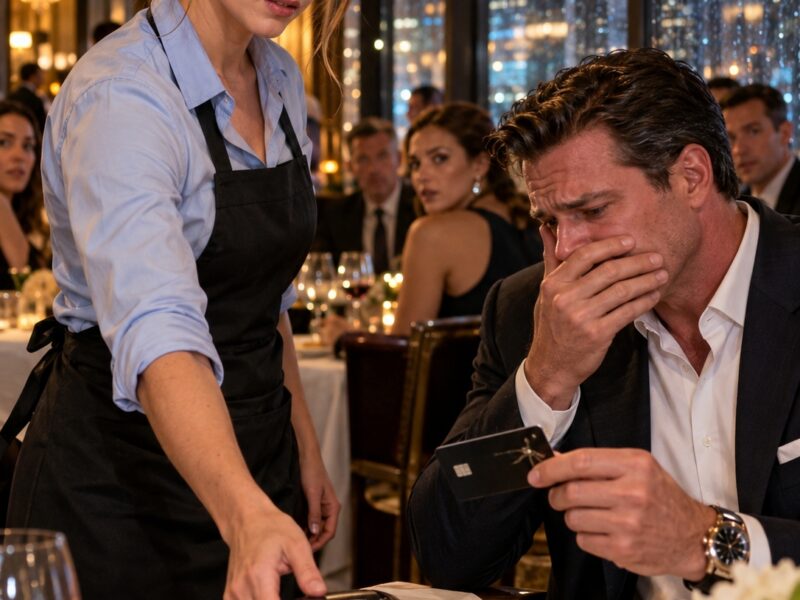
HIS BLACK CARD WAS DECLINED—THEN A BROKE WAITRESS PAID HIS BILL WITHOUT KNOWING HE WAS A MILLIONAIRE

The first time Daniel Mercer’s black card was declined, the waiter pretended not to notice.
The second time, the payment terminal made a sharp electronic chirp loud enough for the couple at the next table to turn their heads.
By the third attempt, half the restaurant seemed to know.
“Sir…” the waiter said carefully.
Daniel stared at the small red word glowing on the screen.
DECLINED.
For a man whose signature could move eight figures before lunch, it should have been funny.
It wasn’t.
Rain streaked the tall windows of Bellamy’s, a quiet upscale restaurant in a part of Chicago where Daniel believed no one would recognize him. Warm amber light pooled over white tablecloths. Crystal glasses caught reflections from the chandeliers, and beyond the windows, headlights smeared across wet pavement like paint.
Daniel felt every eye in the room even though most people were trying very hard not to look.
The waiter cleared his throat. “Would you like me to run it again?”
“You’ve run it three times.”
“I know, sir. I just—”
“Try the other one.”
Daniel slid a second card across the leather bill folder.
The waiter disappeared.
Thirty seconds later, he returned looking even more uncomfortable.
“That one was declined too.”
A woman near the bar whispered something to her husband.
The husband looked directly at Daniel.
Daniel Mercer, owner of Mercer Hospitality, Mercer Urban Properties, and controlling investor in more companies than most people could name, suddenly understood what humiliation felt like when no one in the room knew who you were.
And that, ironically, was exactly why he had come there.
He had spent two decades wondering whether anyone still saw a man when they looked at him.
Tonight, for the first time in years, nobody saw the money.
And Daniel was discovering he didn’t like what came with being ordinary nearly as much as he had imagined.
“I can call my office,” he said.
The waiter hesitated.
“My phone’s almost dead. Give me five minutes.”
“I understand, but our policy—”
“You think I’m going to run?”
“I didn’t say that.”
“You didn’t have to.”
The waiter’s face flushed.
Daniel immediately regretted the sharpness in his voice. The young man couldn’t have been older than twenty-three. He was doing his job, and Daniel knew better than anyone that rules usually existed because somebody above you was afraid of taking responsibility.
Still, shame has a way of making decent people cruel for a few seconds.
Daniel reached for his phone.
One percent battery.
No signal notification from his assistant. No useful number he could call without searching. He had silenced almost everything before entering the restaurant because he had wanted, for one evening, to stop being Daniel Mercer.
Now he almost laughed.
Apparently, the universe had taken him literally.
Then a woman’s voice came from behind the waiter.
“I’ll cover it.”
Daniel looked up.
She wore the restaurant’s black apron over a pale blue blouse, her dark brown hair pulled into a loose ponytail that looked as tired as she did. A few strands had fallen against her cheeks. She held a tray of empty glasses against one hip.
The waiter blinked. “Emily, you don’t have to—”
“I said I’ll cover it.”
Daniel stared at her.
“No.”
She looked at him for the first time.
Her eyes were hazel. Not dramatic, not suspicious, not impressed. Just tired and strangely calm.
“No?” she repeated.
“I appreciate it, but no.”
She shifted the tray into the waiter’s hands.
“You have another plan?”
Daniel opened his mouth.
Nothing came out.
Emily Carter reached into the back pocket of her apron and pulled out a worn leather wallet.
Daniel noticed the frayed corner.
He also noticed that when she opened it, there were three bills inside.
A twenty.
A ten.
A five.
And one debit card.
The waiter leaned closer. “Emily, seriously.”
She gave him a look.
“Run it.”
Daniel stood.
“Absolutely not.”
Emily turned toward him.
He was six-two, dressed in an ordinary dark jacket instead of his usual tailored suit, but years of boardrooms had given him a posture that made most people step back when he stood.
Emily didn’t.
“Sit down,” she said.
Daniel almost laughed from disbelief.
“I’m not letting you pay my bill.”
“And I’m not spending another ten minutes watching everyone make you feel like you committed a felony because a piece of plastic stopped working.”
“That’s not the point.”
“Then what is?”
The question landed harder than it should have.
Daniel had negotiated hostile acquisitions with people who hired entire legal teams to intimidate him.
Yet standing in a restaurant across from a twenty-seven-year-old waitress, he suddenly didn’t have an answer.
Emily turned to the waiter.
“Run it, Chris.”
“Emily—”
“Please.”
Chris looked between them, then reluctantly took the card.
Daniel lowered his voice.
“You don’t even know me.”
“No.”
“I could be lying.”
“You could.”
“I could actually have no money.”
“Then you definitely need somebody to pay for dinner.”
He stared at her.
For the first time that evening, Emily almost smiled.
It wasn’t flirtation.
It wasn’t admiration.
It was simply the expression of a woman who had seen enough difficult days to recognize one sitting across from her.
The terminal chirped.
APPROVED.
Daniel looked at the screen.
Then at Emily.
Something shifted inside him.
It was small.
Unwelcome.
And almost painful.
Because for twenty years, people had paid attention to Daniel because of what he could do for them.
This woman had just spent money she clearly needed on him because she believed he needed help.
And she had no idea she had just paid for dinner for one of the richest men in Chicago.
Chris handed her the receipt.
Emily folded it without looking at the total.
Daniel did.
One hundred eighty-seven dollars and forty cents.
His eyes snapped back to her.
“That’s almost two hundred dollars.”
“I can read.”
“You just paid two hundred dollars for a stranger.”
“Yes.”
“Why?”
Emily tucked her card away.
“Because you looked like you needed somebody to.”
Then she picked up the tray and walked toward the kitchen.
Daniel stayed frozen beside the table.
He had come to Bellamy’s because he wanted to know what the world looked like when his money disappeared.
He had not expected the answer to cost a waitress two hundred dollars.
And he certainly hadn’t expected that answer to follow her through the kitchen door.
Daniel caught up with her near the service hallway.
“Emily.”
She stopped.
Her name tag had told him her first name.
The rest of her life remained a mystery.
“I’m paying you back.”
“No.”
“That isn’t negotiable.”
She lifted one eyebrow. “Everything negotiable where you come from?”
Daniel went still.
Emily studied his expression.
“There it is.”
“What?”
“That face.”
“What face?”
“The one people make when nobody obeys them.”
Despite himself, Daniel smiled.
It had been months since anyone spoke to him that way.
Maybe years.
“You don’t know where I come from.”
“No. But I know you expect people to listen when you use that voice.”
“What voice?”
“That one.”
For a second, they simply looked at each other.
Then Daniel reached for his wallet.
“I have some cash.”
“You already showed me you have about twelve dollars.”
He frowned.
She laughed softly.
“I saw you checking.”
He looked inside.
Eleven dollars.
He had forgotten he almost never carried cash.
“That’s embarrassing.”
“Tonight seems to be going around.”
Daniel exhaled.
“Give me your address. I’ll send you the money tomorrow.”
“No.”
“Your phone number.”
“No.”
“Your last name?”
She tilted her head.
“Why do you need it?”
“To pay you back.”
“You want to pay me back?”
“Yes.”
“Fine.”
Daniel waited.
Emily picked up the tray again.
“Next time you see somebody having a terrible day, help them.”
He stared.
“That’s it?”
“That’s it.”
“You don’t want your money?”
“Of course I want my money.”
That surprised him.
She looked exhausted, but there was humor in her expression now.
“I’m going to think about that bill every time I buy groceries for the next two weeks.”
“Then let me repay you.”
“No.”
“That makes absolutely no sense.”
“It does to me.”
She started toward the kitchen, then glanced back.
“If kindness only works when you get reimbursed, it’s just a loan.”
The kitchen door swung closed behind her.
Daniel stood alone in the hallway.
Those words followed him all the way home.
The next morning, they were still there.
His penthouse occupied most of the forty-sixth floor of a building his own company had developed along the river. Floor-to-ceiling windows offered a panoramic view of downtown Chicago. Lake Michigan gleamed steel blue in the distance.
Daniel normally loved the view.
That morning it made him feel strangely detached from the world below.
His assistant, Rebecca Sloan, entered the breakfast room carrying a tablet.
“I’ve been trying to reach you since last night.”
“My phone died.”
“I noticed.”
She set the tablet down.
“You triggered the fraud system.”
Daniel looked up from his coffee.
“How?”
“The purchasing department ran a large software transaction through an account you rarely use personally. Then you used two cards at a restaurant outside your normal area. Security flagged the pattern.”
“So the bank froze them.”
“Yes.”
“That’s ridiculous.”
“It saved you six million dollars four years ago.”
Daniel paused.
“Fine.”
Rebecca gave him the patient look of somebody who had worked for him for nine years and therefore no longer found him intimidating.
“I’m glad you survived.”
Daniel stared into his coffee.
“I need you to find someone.”
Rebecca’s eyebrows rose.
“That sentence is usually expensive.”
“A woman named Emily. She works evenings at Bellamy’s.”
“Last name?”
“I don’t know.”
“Department?”
“Waitress. Or server. Maybe both.”
Rebecca studied him.
“What happened?”
“She paid my bill.”
Silence.
Rebecca blinked.
“I’m sorry?”
“My cards were declined.”
“I understood that part.”
“She paid the bill.”
“How much?”
“One eighty-seven forty.”
Rebecca stared at him.
Daniel looked back.
Finally she said, “And she thinks you’re…?”
“I have no idea what she thinks I am.”
“Did she recognize you?”
“No.”
“Did you tell her?”
“No.”
Rebecca slowly sat down across from him.
That got Daniel’s attention.
His assistant rarely sat unless invited.
“Daniel.”
“What?”
“Please tell me you aren’t about to do something strange.”
“I’m not.”
“You asked me to investigate a woman who paid for your dinner after meeting you once.”
“I didn’t say investigate.”
“You said find.”
“I want to reimburse her.”
“Then go back and give her two hundred dollars.”
“She won’t take it.”
Rebecca narrowed her eyes.
“So you already tried.”
“Yes.”
“And?”
“She said to help someone else.”
Rebecca was quiet.
Daniel looked toward the windows.
“She had almost no cash.”
“You noticed?”
“She opened her wallet in front of me.”
“And she still paid?”
“Yes.”
Rebecca’s expression softened.
Daniel disliked how much that bothered him.
He stood.
“Just find out her last name.”
“Nothing invasive?”
“No.”
“Financial records?”
Daniel hesitated.
Rebecca saw it.
“No.”
“Publicly available information only.”
“Fine.”
“Daniel.”
He turned.
Rebecca leaned back in her chair.
“What are you actually trying to find out?”
Daniel looked at the city below.
He could have answered with something easy.
Whether Emily needed money.
Whether she was honest.
Whether the gesture had been real.
But none of those were quite right.
Finally, he said, “I want to know what kind of person spends money she doesn’t have on someone she’ll never see again.”
Rebecca studied him for another moment.
Then she picked up the tablet.
“Maybe the kind you stopped believing existed.”
The words irritated him because they felt true.
By noon, Daniel knew more about Emily Carter.
Not everything.
Enough.
Twenty-seven.
Bachelor’s degree unfinished.
Currently taking evening classes toward healthcare administration certification at Harold Washington College.
Day job: receptionist and medical assistant at a family health practice.
Three nights a week at Bellamy’s.
One younger brother, Noah, twenty-one, engineering student at the University of Illinois Chicago.
Mother: Susan Carter.
That line was followed by a medical record Rebecca had not accessed but a crowdfunding page she had found online.
Ovarian cancer.
Eight months of treatment.
Hospital bills.
Fundraiser closed.
Goal: $40,000.
Raised: $11,860.
Daniel stared at the page longer than he meant to.
A photograph showed Emily with an older woman wearing a knitted cap and smiling from a hospital bed.
Noah stood on the other side.
Daniel scrolled.
There were dozens of small donations.
Twenty dollars.
Fifty.
Ten.
One hundred.
Nothing huge.
Rebecca sat across from him.
“She’s two months behind on rent.”
Daniel looked up sharply.
“You said public information.”
“Court filing. Her landlord started a preliminary payment action but hasn’t filed eviction.”
“How much?”
“Thirty-eight hundred.”
Daniel leaned back.
“That’s nothing.”
Rebecca’s expression changed.
He heard himself.
Nothing.
Thirty-eight hundred dollars was nothing to Daniel.
To Emily, it could mean losing her home.
He rubbed his jaw.
“Pay it.”
Rebecca didn’t move.
“Through the foundation?”
“No. Just take care of it.”
“She’ll know.”
“Not if—”
“She will.”
Daniel frowned.
Rebecca continued.
“If somebody secretly clears your rent after you pay a stranger’s restaurant bill, even Scooby-Doo could solve that mystery.”
Daniel almost smiled.
Then he looked again at Emily’s photograph beside her mother.
“What about the medical bills?”
“Daniel.”
“Pay those too.”
“She told you to help someone else.”
“I am helping someone else.”
“You’re helping her.”
“That’s different.”
“How?”
He had no answer.
Rebecca closed the tablet.
“You can write a check big enough to fix every immediate problem in her life.”
“I know.”
“But if you do that, you turn what she did into a transaction.”
Daniel’s eyes narrowed.
“She’s struggling.”
“Yes.”
“I can fix that.”
“Maybe that’s the problem.”
He looked at her.
Rebecca spoke gently.
“You’re used to solving things with money. She gave you something that wasn’t money, and now you’re uncomfortable because you don’t know how to repay it.”
Daniel looked away.
Again, the truth annoyed him.
Rebecca stood.
“I’m not telling you not to help her. I’m telling you to figure out whether you’re helping her because she needs it… or because owing someone makes you uncomfortable.”
After she left, Daniel remained in the office.
At 2:15 that afternoon, he canceled three meetings.
At 3:40, he looked up Bellamy’s schedule.
At 6:30, Daniel Mercer drove himself across Chicago in a car worth less than most of his employees assumed he would ever touch.
And at 7:12, Emily Carter saw him walk into the restaurant.
Her expression changed instantly.
Not admiration.
Alarm.
“Oh, no.”
Daniel stopped beside the host stand.
“Oh, no?”
“You came back.”
“I said I would repay you.”
Emily was carrying a coffee pot.
“You did not say you would come back.”
“I implied it.”
“No, you argued about it for ten minutes.”
“Which strongly implied I wasn’t giving up.”
She shook her head.
“You’re exhausting.”
“I’ve been told.”
“A lot?”
“Constantly.”
She tried to hide a smile.
Daniel noticed.
He liked that more than he should have.
“Coffee,” he said.
“That’s all?”
“That’s all.”
“Because if your card gets declined on a four-dollar coffee, I’m calling the police.”
Daniel laughed.
It surprised both of them.
Emily poured his coffee.
For the next forty minutes, Daniel watched her work.
Not in the way men sometimes watched attractive women.
He watched how she noticed everything.
An elderly man dropped a fork; Emily replaced it before he could ask.
A teenage busboy knocked over a tray near the kitchen; she crouched and helped him clean it before the manager could see.
A woman dining alone began crying quietly while staring at her phone.
Emily brought her tea without asking.
Daniel had spent years studying talent.
He knew how to identify people who could generate profit, manage teams, negotiate contracts, build systems.
Emily possessed a different skill.
She made people feel less alone.
And nobody had put that on a résumé.
When the dinner rush slowed, Emily approached his table.
“You’re still here.”
“I’m a slow coffee drinker.”
“You’ve had four cups.”
“I’m extremely slow.”
She crossed her arms.
“What do you really want?”
Daniel looked up at her.
“A conversation.”
“That sounds suspiciously like something serial killers say.”
“Do I look like a serial killer?”
“You own a dark jacket and ask strangers personal questions.”
“Fair.”
She sat across from him.
Only because the dining room was nearly empty.
Daniel noticed her rubbing one wrist.
“Tired?”
“Twelve-hour day.”
“You always work this much?”
She shrugged.
“Some people have hobbies.”
“What would you do if you didn’t have to work two jobs?”
Emily studied him.
“Why?”
“Curious.”
“About what?”
“You.”
She laughed once.
“That’s a dangerous sentence.”
Daniel smiled.
“Humor me.”
Emily looked toward the rain-streaked window.
For a while, she didn’t answer.
Then she said, “I’d finish school without calculating how many shifts equal one textbook.”
Daniel said nothing.
“I’d help my brother graduate without borrowing more money. I’d sleep eight hours once just to see what people are so excited about.”
Her smile faded.
“And someday…”
She stopped.
“What?”
“It’s stupid.”
“I own at least three businesses people told me were stupid ideas.”
That was too revealing.
Emily caught it.
“Own?”
Daniel recovered.
“Owned. With partners.”
“What kind of businesses?”
“Different kinds.”
“That sounds deliberately vague.”
“It is.”
She narrowed her eyes.
“You’re weird.”
“So I’ve also been told.”
She looked down at her hands.
“Someday I’d like to open a clinic.”
Daniel’s expression changed.
“A clinic?”
“Community clinic. Basic primary care. Mental health referrals. Women’s health. Somewhere people don’t have to decide whether being sick is financially convenient.”
Her voice became quieter.
“My mom ignored symptoms for months because she didn’t want to miss work. By the time she finally went in…”
Emily stopped.
Daniel understood.
“Cancer.”
She looked at him sharply.
“How did you know?”
His heart kicked.
He had made a mistake.
“Lucky guess.”
“That’s a terrible thing to guess.”
“My mother got sick too.”
It was not a lie.
Just not the whole story.
Emily’s suspicion softened.
“Did she make it?”
Daniel looked at his coffee.
“No.”
“I’m sorry.”
“Long time ago.”
“Doesn’t mean it stopped mattering.”
Daniel looked at her.
There it was again.
She noticed people.
Even him.
Especially the things he tried hardest to hide.
“She worked in a bakery,” he said. “Every morning before sunrise.”
Emily leaned back.
“You loved her.”
It wasn’t a question.
Daniel swallowed.
“She was the only person who knew me before I became…”
He stopped.
“Became what?”
He met her eyes.
“Complicated.”
Emily smiled sadly.
“Aren’t we all?”
Daniel returned home that night with something more dangerous than curiosity.
He had begun to care.
And caring, he knew, made people unpredictable.
Three days later, Rebecca placed a folder on his desk.
“I have an idea.”
Daniel looked up.
“That usually means paperwork.”
“This one means restraint.”
“I already dislike it.”
Rebecca sat down.
“Your mother’s foundation scholarship program.”
Daniel frowned.
“What about it?”
“Applications close next week.”
“So?”
“So Emily qualifies.”
Daniel’s attention sharpened.
“She hasn’t applied.”
“Not yet.”
“Why?”
“She probably doesn’t know it exists. It’s targeted toward working adults finishing degrees in healthcare and community service.”
Daniel picked up the folder.
The Eleanor Mercer Opportunity Scholarship.
Named for his mother.
He had funded it twelve years ago.
He had attended the first award ceremony.
After that, staff handled everything.
He felt a pang of shame.
“How many applicants?”
“Usually between three hundred and five hundred.”
“How many recipients?”
“Twenty-five.”
“Put her in.”
Rebecca stared at him.
“No.”
Daniel looked up.
“You said she qualifies.”
“She does.”
“Then—”
“Have her apply.”
“She might not.”
“Then she doesn’t get it.”
“You’re being difficult.”
“I’m protecting the one thing you claim to respect about her.”
“What?”
“Her dignity.”
Daniel’s jaw tightened.
Rebecca continued.
“If she earns it through the same anonymous process as everyone else, then you’re giving her an opportunity.”
“And if she loses?”
“She loses.”
“I can prevent that.”
“Exactly.”
Daniel leaned back.
He hated games he could not control.
Rebecca smiled faintly.
“I’ll have the foundation circulate the scholarship through her college.”
“And you won’t tell the review committee?”
“No.”
“Nothing?”
“Nothing.”
Daniel glanced at the folder.
“What if she doesn’t get it?”
Rebecca stood.
“Then maybe the world will teach you something else you need to learn.”
Two weeks later, Emily received an email while sitting in the break room at Dr. Patel’s clinic.
She almost deleted it.
The subject line read:
ELEANOR MERCER OPPORTUNITY SCHOLARSHIP — APPLICATION STATUS.
She had applied at two in the morning after seeing a notice posted on the student portal.
She remembered filling out the essay while eating cereal from a mug because every bowl in her apartment was dirty.
Emily opened the email.
Then she stopped breathing.
“Emily?”
Her coworker Jasmine looked up.
Emily covered her mouth.
“What happened?”
Emily turned the phone.
Jasmine read the first line.
Then screamed.
“You got it?”
Emily started crying.
“I got it.”
“How much?”
Emily scrolled.
Her knees almost gave out.
Full tuition for the remainder of her program.
Required books.
Professional certification fees.
And a modest monthly living stipend.
Jasmine hugged her.
Emily laughed through tears.
For the first time in months, perhaps years, she felt the pressure around her chest loosen.
She called Noah.
He answered on the third ring.
“What’s wrong?”
“Why do you always assume something’s wrong?”
“Because you never call at eleven-thirty unless Mom’s doctor said something.”
Emily wiped her cheeks.
“I got a scholarship.”
Silence.
Then Noah shouted so loudly she pulled the phone away.
“You did?”
“I did.”
“Em, that’s—Jesus. That’s huge.”
“I know.”
“You don’t have to keep working at Bellamy’s.”
“I might cut shifts.”
“You can sleep.”
“That sounds suspicious.”
Noah laughed.
Then his voice softened.
“I’m proud of you.”
Emily closed her eyes.
Those four words almost broke her.
Because she had spent two years keeping everything together so tightly that she had forgotten what it felt like when something good happened without demanding a sacrifice first.
That evening at Bellamy’s, Daniel came in for coffee again.
Emily walked straight to his table.
“I got a scholarship.”
Daniel looked up.
He had known for seven hours.
But seeing her face was different.
She was glowing.
Not because of money.
Because she believed she had earned a future.
“That’s incredible.”
She slid into the seat.
“Full tuition.”
Daniel smiled.
“You deserve it.”
“You don’t even know my grades.”
“I know enough.”
Her smile weakened.
Then she watched him.
Daniel felt the shift immediately.
“What?”
“What scholarship did you say your mother got?”
“My mother didn’t get a scholarship.”
“No. You said she worked in a bakery.”
“Yes.”
Emily leaned closer.
“The foundation is called Eleanor Mercer.”
Daniel’s pulse changed.
“And?”
“Your mother’s name?”
He should have lied.
Instead he said, “Eleanor.”
Emily stared.
Daniel held her gaze.
She laughed slowly.
“That’s a coincidence.”
“Could be.”
“Your last name?”
He hadn’t told her.
Not once.
Daniel’s mind moved quickly.
Too quickly.
Emily’s eyes narrowed.
“You never told me your last name.”
“No.”
“What is it?”
A waiter dropped a tray in the distance.
Daniel looked toward the sound for half a second.
When he looked back, Emily was still waiting.
“Daniel.”
“What?”
“Your last name.”
He opened his mouth.
Then Rebecca’s voice echoed in his head.
Her dignity.
He was not ready.
“Marshall.”
The lie came out smoothly.
Too smoothly.
Emily nodded.
“Daniel Marshall.”
He hated himself instantly.
She smiled.
“Okay. Maybe I’m getting paranoid.”
Daniel forced a smile.
“Occupational hazard of knowing strange men who drink four cups of coffee.”
Emily stood.
But before she walked away, she glanced back.
Something uncertain remained in her eyes.
And Daniel realized he had crossed a line that would eventually demand a price.
He just didn’t know how high that price would be.
The anonymous tip came the following Friday.
Five thousand dollars.
Emily was called into the manager’s office after her shift.
“Someone left this for you.”
She stared at the number.
“That’s impossible.”
Manager Paul Brennan shrugged.
“Credit card cleared.”
“Who?”
“Customer requested anonymity.”
Emily’s stomach tightened.
“Was he sitting alone?”
Paul frowned.
“I don’t know.”
“Dark jacket?”
“No idea.”
“Tall?”
“Emily, I run a restaurant. I don’t interrogate generous customers.”
She took the receipt.
Her hands trembled.
Daniel.
It had to be Daniel.
The next night, when he appeared, Emily intercepted him before he reached his usual table.
“Did you leave me five thousand dollars?”
Daniel looked genuinely surprised.
Because for once, he hadn’t.
“No.”
“Don’t lie.”
“I didn’t.”
“You expect me to believe some random customer gave a waitress five thousand dollars?”
“I don’t know what you expect.”
“I expect the truth.”
Daniel’s expression tightened.
“I did not leave the tip.”
She stared at him.
“Swear.”
“On my mother.”
That stopped her.
Daniel would later learn the donation had come from a retired cardiologist Emily had waited on for nearly two years.
But in that moment, something else happened.
Emily realized she had begun connecting every good thing in her life to Daniel.
And Daniel realized that by hiding who he was, he had made himself impossible for her to trust.
“What aren’t you telling me?” she asked.
Daniel’s heartbeat accelerated.
“Everyone has things they don’t tell people.”
“That isn’t an answer.”
“No.”
“Who are you?”
The words hung between them.
For several seconds, Daniel considered ending the lie.
He could tell her right there.
He could explain everything.
The frozen cards.
The company.
The foundation.
The scholarship he had not rigged but had quietly set in motion by making sure she knew it existed.
Instead, fear won.
Not fear of losing money.
Not fear of embarrassment.
Fear of seeing her look at him the way everyone else eventually did.
With calculation.
“Just a man who likes your coffee,” he said.
Emily stared at him.
Then nodded.
“Fine.”
She walked away.
Daniel sat alone.
His coffee arrived five minutes later.
Emily didn’t bring it.
For the first time, it tasted bitter.
Weeks passed.
Emily continued working.
Daniel continued visiting, although less often.
Their conversations slowly recovered.
Not completely.
Something fragile had entered between them.
Meanwhile, the scholarship allowed Emily to drop one restaurant shift each week. She paid down debt. She spent more time with her mother, whose treatments had finally begun showing encouraging results.
She also excelled in school.
Her professors noticed.
So did the Mercer Foundation.
None of the people evaluating her work knew that Daniel Mercer knew Emily personally.
Rebecca made certain of that.
Emily proposed a community healthcare access project for her final practicum.
It focused on families who delayed basic treatment because of cost.
The proposal was so detailed that one professor forwarded it to a nonprofit director.
That director forwarded it to someone else.
Eventually, without Emily knowing, it reached Daniel’s desk.
He read all forty-three pages.
Twice.
The next morning he called Rebecca.
“She understands the problem better than our consultants.”
“I know.”
“We spent eight hundred thousand dollars last year studying access gaps.”
“I remember.”
“This is better.”
Rebecca smiled.
“I know.”
Daniel tapped the document.
“She needs to be at the foundation.”
“As what?”
“Community outreach.”
“She hasn’t graduated.”
“Part-time.”
“You’re doing it again.”
“Doing what?”
“Deciding what her life should look like because you have the power to rearrange it.”
Daniel leaned back.
He was silent.
Then he asked, “How do normal people offer somebody a job?”
Rebecca laughed.
“Usually by telling them the truth about who they are first.”
Daniel ignored that.
Instead, he invited Emily to a charity event.
He approached the conversation carefully at Bellamy’s.
“There’s a healthcare foundation hosting an event next Saturday.”
Emily eyed him.
“And?”
“You should go.”
“Why?”
“Networking.”
“Do I look like someone who enjoys networking?”
“No.”
“Good.”
“But you want to open a clinic.”
“That’s a dream.”
“Dreams usually require meeting people who can help build them.”
Emily narrowed her eyes.
“Why are you invited?”
Daniel paused.
“I know someone involved.”
“Of course you do.”
“Is that yes?”
“What’s the dress code?”
“Formal.”
She groaned.
“I knew there was a catch.”
Daniel smiled.
“I can get you a ticket.”
“How much?”
“Free.”
“That sounds even more suspicious.”
“Everything is suspicious to you.”
“Mostly you.”
But she accepted.
And Daniel spent the next seven days wondering how to confess everything.
He never found the courage.
The charity gala was held at the Langham Grand Ballroom overlooking the Chicago River.
Emily nearly turned around in the lobby.
She had borrowed a navy dress from Jasmine. It fit well, but every woman walking past seemed dressed in something that cost more than Emily’s car.
Men in tuxedos greeted one another by names she recognized from newspapers.
A photographer called out to a tech CEO.
Someone from a local television station adjusted a camera near the entrance.
Emily checked the invitation again.
THE ELEANOR MERCER FOUNDATION
ANNUAL COMMUNITY HEALTH INITIATIVE GALA.
Her stomach tightened.
Mercer.
Again.
She thought of Daniel’s mother.
Eleanor.
The coincidence suddenly seemed less funny.
“Emily.”
She turned.
Daniel stood twenty feet away.
For one second she forgot the questions.
He looked completely different.
Tailored black tuxedo.
White shirt.
No tie pin, no flashy watch, nothing excessive.
Yet people moved around him differently.
A security employee nodded to him.
An event director hurried over, whispered something, and waited for Daniel’s answer.
Emily watched.
Daniel saw her watching.
His face changed.
“Hi.”
Emily didn’t return the greeting.
“Daniel.”
“You look beautiful.”
“Who are you?”
He froze.
Around them, glasses clinked. A quartet played near the windows.
Emily’s voice was barely above a whisper.
“Who are you?”
Daniel took a step closer.
“Emily—”
“Don’t.”
Her eyes moved past him.
A giant photograph stood beside the ballroom doors.
ELEANOR MERCER FOUNDATION.
Below it was an image of the foundation’s founder cutting a ribbon at a children’s center five years earlier.
Daniel.
Older photograph.
Same face.
Same eyes.
Different suit.
Emily looked from the picture to the man in front of her.
All color drained from her face.
Daniel’s throat tightened.
“I can explain.”
“Daniel Mercer.”
He said nothing.
She stepped backward.
“Daniel Mercer.”
Several people turned.
Emily laughed once, but there was no humor in it.
“You told me your name was Daniel Marshall.”
“I know.”
“You own Mercer Hotels.”
“Emily—”
“Mercer Properties. Mercer Technologies.”
“Some of those names are—”
“Stop.”
Her voice broke.
Daniel stopped.
Emily looked around the ballroom.
Every detail rearranged itself in her mind.
The scholarship.
The mysterious invitations.
His strange evasions.
His questions about her life.
His ability to appear at the restaurant whenever he wanted.
“You investigated me.”
Daniel’s face tightened.
“No.”
“You knew about my mother.”
“I found public information.”
“You knew about Noah?”
“Yes.”
“My rent?”
Daniel hesitated.
That hesitation answered her.
Emily’s eyes filled.
“Oh my God.”
“I didn’t pay it.”
“But you knew.”
“Yes.”
“Why?”
Daniel stepped closer.
“Because I wanted to understand who you were.”
“You could have asked.”
“I did.”
“No. You sat across from me pretending to be someone else while you already knew things I hadn’t chosen to tell you.”
Daniel flinched.
She was right.
“I’m sorry.”
Emily shook her head.
“Was the scholarship you?”
“No.”
“Don’t lie to me again.”
“I didn’t select you.”
“Was it you?”
“I made sure your college knew the scholarship existed.”
Emily stared.
“That’s not what I asked.”
“The applications were anonymous. I told them nothing.”
“But you put it in front of me.”
“Yes.”
“And the tip?”
“No.”
“The job you keep hinting about?”
Daniel looked at her.
“How much of my life have you been arranging?”
“Emily, I was trying to help.”
“You don’t even hear yourself.”
People were watching now.
Daniel didn’t care.
Emily did.
Her embarrassment sharpened into anger.
“You made me feel like I earned my way into this room.”
“You did.”
“Did I?”
“Yes.”
“You lied about your name.”
“Yes.”
“You knew everything about me while I knew nothing real about you.”
“Yes.”
“Then how am I supposed to know what was real?”
That question silenced him.
Across the ballroom, the lights dimmed.
The host stepped onto the stage.
“Ladies and gentlemen, please take your seats. In just a moment, we’ll welcome the founder of the Eleanor Mercer Foundation…”
Emily closed her eyes.
Daniel watched the pain move across her face.
“I have to go on stage.”
She looked at him.
For some reason, that hurt more than everything else.
Of course he did.
This was his world.
And she had been foolish enough to believe he was simply a tired man who needed someone to pay for dinner.
“Go,” she said.
“Emily.”
“Go be who you really are.”
Daniel walked toward the stage.
For the first time in his life, applause sounded like accusation.
He stood beneath white spotlights while hundreds of people clapped.
Emily remained near the back wall.
The host spoke about Daniel’s achievements.
Hotels.
Technology.
Urban development.
Philanthropy.
Daniel barely heard a word.
He watched Emily.
And Emily watched the stranger she thought she knew become one of the most powerful men in the room.
Then the host handed him the microphone.
Daniel had prepared a seven-minute speech.
He ignored it.
“When my mother was alive,” he began, “she used to tell me something I didn’t understand.”
The ballroom quieted.
“She said, ‘Money tells you what people want. Hard times tell you who people are.’”
Emily looked up.
Daniel swallowed.
“I spent most of my adult life becoming very good at the first part.”
A few guests smiled.
Daniel didn’t.
“I built companies. I learned how to price assets, negotiate contracts and measure risk. Eventually, I became surrounded by people who treated nearly everything like a transaction.”
He paused.
“And somewhere along the way, I started doing the same.”
Rebecca stood near the side of the stage.
She knew immediately Daniel had abandoned the speech.
“A few months ago,” Daniel continued, “I had dinner alone at a restaurant. My cards were declined because of a banking security freeze.”
Murmurs moved through the ballroom.
Emily stopped breathing.
Daniel looked directly at her.
“I was embarrassed.”
No one laughed.
“Not because I couldn’t pay. Because for a few minutes, nobody knew I could.”
His grip tightened around the microphone.
“And then someone who had far less money than I did paid my bill.”
Emily’s eyes filled.
“She had no reason to help me. She didn’t know my name. She didn’t know what I owned. She didn’t ask for anything.”
Daniel’s voice lowered.
“When I tried to repay her, she told me to help someone else.”
The ballroom was completely silent.
“I thought I understood generosity before that night.”
He shook his head.
“I didn’t.”
Emily wiped one tear angrily from her cheek.
Daniel continued.
“Generosity is easy when what you give doesn’t cost you anything.”
His gaze never left hers.
“But when someone gives from the part of their life they actually need… that does something to you.”
He paused.
“Or it should.”
Emily turned away.
Daniel finished the speech without naming her.
When he left the stage, she was gone.
He found her outside beneath the hotel awning.
Rain had begun.
Of course it had.
For some reason, every significant moment between them seemed to happen in the rain.
Emily stood near the curb, trying to summon a rideshare.
Daniel stopped several feet away.
“I’m not asking you to forgive me.”
“Good.”
“I’m asking you to listen for two minutes.”
She looked at her phone.
“Your two minutes probably cost more than my annual salary.”
He winced.
“I deserved that.”
“Yes.”
Rain hammered the street.
Daniel stepped closer but not too close.
“The cards that night really were frozen.”
Emily looked at him.
“I wasn’t pretending.”
She said nothing.
“I didn’t go there planning to test a specific person. I wanted one evening where nobody knew me.”
“That sounds like a test.”
“Maybe it was.”
Daniel breathed out.
“I was tired of people treating me differently because of my money.”
“So you lied to me because you were afraid I’d become like them.”
“Yes.”
Emily’s expression hardened.
“That’s insulting.”
“I know.”
“No, I don’t think you do.”
She stepped toward him.
“You decided I was kind enough to pay for your meal but not trustworthy enough to know your last name.”
Daniel looked down.
“You wanted proof that I was a good person before you risked being honest.”
“Yes.”
“And while you were testing whether I cared about money, you were using money to quietly move things around me.”
“I didn’t buy the scholarship.”
“But you could have.”
“Yes.”
“That’s the problem.”
Her voice broke.
“I don’t know where your influence ends.”
Daniel absorbed the words.
Emily looked away.
“I need to know whether something good happened because I earned it or because Daniel Mercer decided I deserved a reward for being nice to him.”
“The scholarship was earned.”
“You swear?”
“I swear.”
“All applications anonymous?”
“Yes.”
“You never spoke to the committee?”
“No.”
“Never?”
“Never.”
Her shoulders loosened slightly.
But only slightly.
“What about that five-thousand-dollar tip?”
“Not me.”
“The rent?”
“I wanted to pay it.”
“But?”
“Rebecca told me not to.”
Emily almost smiled.
“Who’s Rebecca?”
“My assistant.”
“She sounds smarter than you.”
“Significantly.”
For the first time that night, Emily laughed.
It lasted less than a second.
Then sadness returned.
Daniel looked at her.
“I’m sorry I lied.”
Emily nodded slowly.
“I believe you.”
Hope moved through him.
Then she said, “That doesn’t mean I trust you.”
The hope disappeared.
Her car pulled up.
Before she got in, Daniel said, “There was one thing tonight I hadn’t planned.”
She turned.
“The speech.”
Emily studied him.
“Good night, Daniel.”
The car door closed.
Daniel stood beneath the awning until the taillights disappeared.
For years, he had believed money protected him from helplessness.
That night he learned there were some things no amount of money could repair faster.
Trust was one of them.
Daniel didn’t return to Bellamy’s for three weeks.
Emily noticed.
She hated that she noticed.
She also hated that part of her missed their conversations.
It would have been easier if Daniel had been cruel.
Or arrogant.
Or if everything had been an elaborate game.
But the truth was more complicated.
He had lied because he was lonely.
That didn’t excuse the lie.
It only made it sadder.
One afternoon, Rebecca Sloan walked into Bellamy’s alone.
Emily recognized her from the gala.
“You’re Rebecca.”
Rebecca smiled.
“And you must be the woman who has made my boss nearly tolerable.”
Emily stared.
“That sounds serious.”
“You have no idea.”
Rebecca ordered tea.
Emily brought it.
Neither mentioned Daniel for several minutes.
Then Rebecca said, “He doesn’t know I’m here.”
“I’m not sure whether that makes this better.”
“It probably doesn’t.”
Emily sat across from her.
Rebecca looked directly at her.
“I want you to know something about the scholarship.”
Emily’s stomach tightened.
“No one interfered.”
Rebecca slid a printed document across the table.
Redacted scoring sheets.
Applicant numbers instead of names.
Emily’s score ranked fourth out of 436 applicants.
She stared.
Rebecca said, “Daniel never saw this until after the awards were final.”
Emily ran her fingers over the page.
“Why are you showing me?”
“Because he won’t.”
“Why?”
“Because after you confronted him, he decided anything he did to prove himself would feel like manipulation.”
Emily looked up.
“That sounds surprisingly self-aware.”
“I said nearly tolerable.”
Emily smiled.
Rebecca stood.
“One other thing.”
“What?”
“The job.”
Emily’s expression changed.
“He wanted to offer you one because of your healthcare access proposal.”
“You read it?”
“Our program directors did.”
“Daniel?”
“Twice.”
Emily lowered her eyes.
Rebecca continued.
“If you’re interested, apply. It will be a normal hiring process.”
“And Daniel?”
“Will be removed from it.”
Emily looked at the scholarship scores again.
“Did he agree to that?”
“He hated it.”
That made her laugh.
“Then yes, I believe you.”
Two months later, Emily Carter became a part-time community outreach coordinator at the Eleanor Mercer Foundation.
She earned the role after three interviews.
Daniel attended none.
On her first day, she found an envelope on her desk.
Inside was a handwritten note.
No money.
No gift.
Just six words.
You earned the chair. Welcome aboard.
Daniel.
Emily kept the note.
She never told him.
Their relationship rebuilt slowly.
Not romantically.
Not at first.
Daniel treated her professionally.
Sometimes almost painfully professionally.
He called her Ms. Carter in meetings.
Emily eventually pulled him aside.
“If you call me Ms. Carter one more time, I’m quitting.”
His eyes widened.
“That feels disproportionate.”
“You’re making everyone think I threatened you with litigation.”
“You did threaten me with emotional destruction.”
“I said I didn’t trust you.”
“It had a similar effect.”
She smiled.
Daniel smiled back.
The distance between them grew smaller.
More importantly, the foundation changed.
Emily refused to design programs from the executive floor.
She spent mornings in neighborhood churches.
Afternoons in public libraries.
Evenings at housing centers.
She asked parents why they missed medical appointments.
Transportation.
Childcare.
Unpaid time off.
Fear of bills.
Language barriers.
Embarrassment.
One woman told Emily she had ignored chest pain for four months because she believed an emergency room visit would bankrupt her family.
Emily carried that sentence into the next board meeting.
Daniel was there.
So were twelve executives.
One consultant presented a forty-slide report about “engagement deficiencies.”
Emily waited.
Then she said, “People aren’t disengaged. They’re scared.”
The consultant frowned.
“That’s an oversimplification.”
“No. Your report is.”
Silence.
Daniel hid a smile.
Emily continued.
“You keep asking why people don’t access services. Ask what it costs them to access services.”
The board listened.
She proposed transportation vouchers, evening clinics, childcare partnerships and automatic sliding-scale billing disclosures.
The plan cost less than the consultant’s research contract.
Six months later, appointment attendance in pilot neighborhoods increased thirty-eight percent.
Daniel called Emily into his office.
She walked in holding coffee.
“You’re staring at data like it personally offended you.”
“It did.”
She sat.
He turned the monitor toward her.
Thirty-eight percent.
Emily read it twice.
Then covered her mouth.
Daniel smiled.
“You were right.”
“Say that again.”
“No.”
“I want to record it.”
“I’m ending this meeting.”
She laughed.
Daniel watched her.
Sometimes he still saw the tired waitress holding a nearly empty wallet.
But now he also saw what he had missed that first night.
Emily wasn’t simply kind.
She was formidable.
Kindness had never been weakness in her.
It was discipline.
And Daniel began changing too.
Quietly.
He started eating lunch in company cafeterias.
At first employees froze when he entered.
Then they began talking.
He discovered one hotel housekeeper had created a faster room inventory method than the software team.
A maintenance worker had been reporting a dangerous elevator issue for six months.
A receptionist had an idea for reducing guest complaints that saved one property nearly half a million dollars in a year.
Daniel listened.
Really listened.
One afternoon he called Rebecca.
“Why wasn’t I hearing any of this?”
“You were.”
“No.”
“You received reports.”
“That’s not the same thing.”
Rebecca smiled.
“No. It isn’t.”
Daniel looked toward the city.
For twenty years, he had built systems designed to bring information upward.
Somewhere along the way, he had forgotten that people were not data.
The irony was impossible to miss.
He had needed his credit card to fail before he finally understood how much of his life had been filtered through money.
A year passed.
Then another.
Emily finished her degree.
Noah graduated.
Susan Carter entered remission.
At the graduation ceremony, Emily searched the crowd and found Daniel sitting three rows behind her family.
No reserved section.
No security visible.
No billionaire entrance.
Just Daniel.
Afterward, he handed her a small box.
Emily stared suspiciously.
“We have discussed gifts.”
“Open it.”
“If there’s a car key in here, I’m throwing it into Lake Michigan.”
“No car.”
She opened the box.
Inside was an old silver pen.
Worn along the edges.
Emily looked at him.
“My mother’s,” Daniel said.
Her expression changed.
“She used it to write every bill, grocery list and birthday card I remember.”
“Daniel…”
“I want you to have it.”
“I can’t.”
“Yes, you can.”
“This isn’t like buying me something.”
“That’s why I chose it.”
Emily touched the pen.
“Why?”
Daniel’s voice softened.
“Because she used to say people should sign their names only to things they believed in.”
Emily looked at him.
“I think she would’ve believed in what you’re building.”
Tears filled her eyes.
She closed the box.
“Thank you.”
It was the first gift from Daniel she accepted without arguing.
Three months later, Emily placed a proposal on his desk.
Daniel looked at the title.
COMMUNITY HEALTH ACCESS CENTER — SOUTH SIDE PILOT.
He read the projected cost.
Then looked at her.
“You want a clinic.”
“I’ve always wanted a clinic.”
“This is bigger than the original program.”
“Yes.”
“Twenty exam rooms.”
“Eventually.”
“Mental health services.”
“Yes.”
“Women’s health.”
“Yes.”
“Pediatrics.”
“Yes.”
“Dental partnerships.”
“Yes.”
Daniel leaned back.
“What do you need from me?”
Emily smiled.
“Nothing.”
He frowned.
“That’s offensive.”
“I need the board.”
“That’s basically me.”
“No. That attitude is why I said nothing.”
Daniel laughed.
Emily sat.
“I want this approved because the data supports it. Not because you know me.”
His smile faded.
He understood.
“Then I’ll abstain.”
She blinked.
“What?”
“When it goes to the board, I won’t vote.”
Emily studied him.
Two years earlier, Daniel Mercer would have considered that absurd.
Now he understood exactly what she was asking.
She didn’t want a gift.
She wanted her work to stand without him.
“All right,” she said.
The board approved the clinic eleven votes to zero.
Daniel abstained.
Construction began the following spring.
On opening day, hundreds of people gathered outside the new brick-and-glass building.
Children held balloons.
Doctors stood near the entrance.
Local families filled the sidewalk.
Emily wore a blue dress and the old silver pen was clipped discreetly inside her jacket.
Above the doors was a sign.
THE ELEANOR MERCER COMMUNITY HEALTH CENTER.
Emily had proposed the name.
Daniel had opposed it.
She won.
When he arrived, he stopped on the sidewalk and stared upward.
“You did this.”
Emily stood beside him.
“We did this.”
“You named it after my mother.”
“She started it.”
Daniel turned.
“She died fifteen years before you came here.”
Emily smiled.
“She raised you.”
He looked away.
For a while, neither spoke.
Inside the clinic, a little girl laughed somewhere down the hall.
A nurse called a patient’s name.
An elderly man filled out paperwork while a volunteer helped translate.
The building was alive.
Daniel’s eyes filled.
He hated crying in public.
Emily pretended not to notice.
“That night at Bellamy’s,” he said quietly, “you spent one hundred eighty-seven dollars and forty cents on me.”
“You remember the cents?”
“I remember everything.”
“I was furious about the forty cents.”
He laughed softly.
“You told me to help somebody else.”
“Yes.”
“I thought you meant once.”
Emily looked through the glass doors at the waiting room.
“I didn’t put a limit on it.”
Daniel nodded.
Then he reached into his jacket.
Emily narrowed her eyes.
“If that’s a check—”
“It isn’t.”
He pulled out a folded piece of paper.
Old.
Creased.
She opened it.
It was the receipt from Bellamy’s.
$187.40.
Emily stared.
“You kept this?”
“For two years.”
“Why?”
Daniel looked toward the clinic.
“Because it’s the most valuable bill I ever received.”
Emily swallowed.
“Daniel…”
“I spent most of my life thinking wealth meant getting to a point where you never needed anybody.”
He looked at her.
“I was wrong.”
People moved through the bright clinic behind them.
“When my cards failed, I thought it was humiliating because I couldn’t pay.”
He smiled faintly.
“But that wasn’t what scared me.”
“What did?”
“For a few minutes, nobody cared who I was.”
Emily waited.
“And then you did.”
Her eyes softened.
Daniel folded the receipt again.
“You cared before you knew there was anything to gain.”
Emily looked away, fighting tears.
“That should be normal.”
“It should.”
“But it isn’t.”
“No.”
They stood together.
Not millionaire and waitress.
Not benefactor and scholarship recipient.
Not employer and employee.
Just two people whose lives had crossed on a rainy Thursday because a bank’s fraud algorithm had made a mistake.
Later that afternoon, after the speeches ended and the reporters left, Emily found Daniel sitting alone in the clinic cafeteria.
No cameras.
No executives.
No audience.
She placed a tray in front of him.
Turkey sandwich.
Coffee.
A slice of pie.
Daniel looked at the food.
“What is this?”
“Dinner.”
“It’s four-thirty.”
“You’re old. It counts.”
“I’m forty-four.”
“Ancient.”
He shook his head.
She sat across from him.
Daniel picked up the coffee.
“Do I have to pay?”
Emily smiled.
“Definitely.”
He reached for his wallet.
She put one hand over it.
Daniel looked up.
For a moment they were back in Bellamy’s.
The rain.
The declined card.
The glances.
The nearly empty wallet.
Emily smiled.
“This one’s on me.”
Daniel stared at her.
Then laughed.
“You never learn.”
“Neither do you.”
Outside the cafeteria windows, families came and went beneath the name of a woman who had once counted coins at a kitchen table because she could not always afford groceries and electricity in the same week.
Daniel thought of his mother.
Of Emily’s worn wallet.
Of all the years he had spent making certain he would never again know what it felt like to have too little.
Only now did he understand that having enough was never the same as being rich.
Real wealth had walked toward him carrying a tray of dirty glasses.
It had looked tired.
It had worn a cheap name tag.
It had possessed thirty-five dollars in cash and still found a reason to give.
And perhaps that was why Daniel kept the faded restaurant receipt in the top drawer of his desk for the rest of his life.
Not because it reminded him of the night a millionaire’s card was declined.
But because it reminded him of the night money finally stopped protecting him long enough for another human being to reach him.
Years later, when reporters asked Daniel Mercer which investment had produced the greatest return of his career, they expected him to name a hotel acquisition, a technology company, or one of the towers carrying his family name.
Daniel would smile.
Then he would think about a rainy restaurant, a red word glowing on a payment terminal, and a young woman opening a wallet she could barely afford to open.
And although he never explained the answer completely, he always gave them the same one.
“One hundred eighty-seven dollars and forty cents.”
Most people assumed he was joking.
Emily never did.
Because she knew the truth.
The richest transaction of Daniel Mercer’s life had happened on the only night he couldn’t pay.









