His Fiancée Paid Me to Disappear With His Twin Sons—Then One of Them Looked at Him and Whispered, “Daddy.”

Celeste Marlo never raised her voice.
That was what made the moment so ugly.
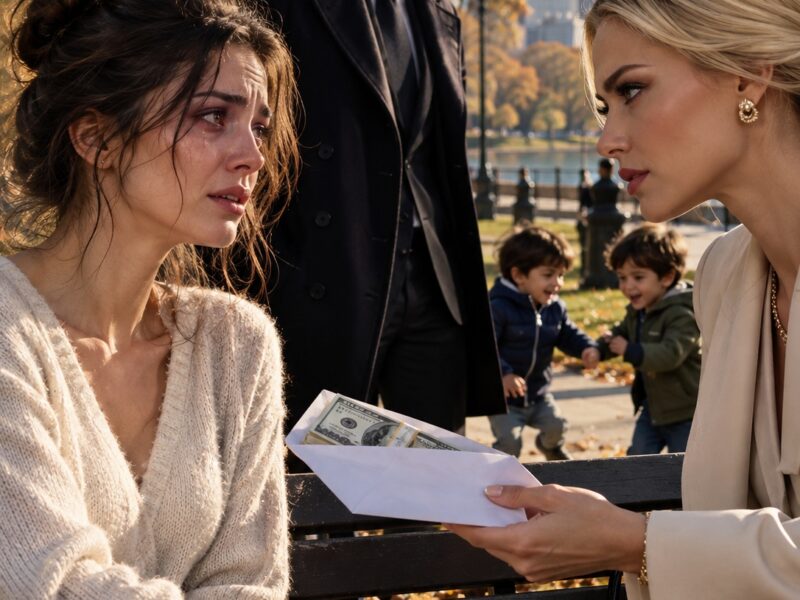
She stood beneath the burning orange leaves of Lincoln Park in a cream wool coat that probably cost more than Aara Quinn’s monthly rent, holding a slim white envelope between two manicured fingers.
Behind her, Chicago moved as if nothing important was happening.
Joggers passed.
A woman pushed a stroller toward the lake.
Somewhere beyond the trees, a dog barked twice.
And twenty feet away, Dante Vascari stood absolutely still, staring at two four-year-old boys who had his eyes.
His sons.
Sons he had discovered existed less than an hour earlier.
“Take it,” Celeste said.
Aara looked at the envelope.
Then at Celeste.
“What is it?”
“Enough.”
“For what?”
Celeste’s mouth curved slightly.
“To make this easier.”
Aara felt Nico press closer against her left leg. Adrien had both hands wrapped around her coat now, his face half-hidden against her hip.
Celeste lowered her voice.
“There’s enough money in there for you to relocate somewhere quiet. Somewhere comfortable. Somewhere no one knows your name.”
Aara stared at her.
“Or theirs,” Celeste added.
That was when Aara understood.
Not assistance.
Not kindness.
A disappearance.
Her disappearance.
Her children’s disappearance.
Aara slowly lifted her eyes toward Dante.
He had heard every word.
His face revealed almost nothing, but she knew that face. Once, years ago, she had known it better than her own.
She knew the small muscle moving beside his jaw meant fury.
She knew the stillness in his shoulders meant something worse.
And she knew the way he was looking at the twins was not calculated.
That frightened her more than anything.
Because Dante Vascari calculated everything.
He calculated risks, people, rooms, exits, alliances.
Six years earlier, he had apparently calculated Aara out of his life.
But there was nothing calculated in his face now.
He looked devastated.
Celeste extended the envelope another inch.
“You came here with children,” she said quietly. “That tells me you’re practical.”
Aara almost laughed.
Instead she said, “Does it?”
“Practical women understand when a situation has become bigger than them.”
Aara’s fingers tightened around Nico’s hand.
Celeste’s expression remained polished.
“Practical women take the money.”
Then Adrien looked around Aara’s coat toward Dante.
The boy had been watching him almost continuously since they met on the path.
Watching his face.
His hands.
His eyes.
Trying to solve a puzzle no four-year-old should have been able to understand.
Adrien tugged Aara’s sleeve.
“Mommy?”
“Yes, baby?”
He pointed toward Dante.
“Is Daddy coming with us?”
Silence.
Real silence this time.
Not the absence of noise.
The absence of oxygen.
Celeste’s hand dropped.
Dante’s face changed.
And Aara realized, with a sick certainty, that whatever life she had built during the last six years had just split open.
The worst part was that none of them yet understood what had crawled out of the crack.
Because the story had not started with Celeste’s envelope.
It had started that morning with maple syrup on Aara’s sleeve.
She was seven minutes late.
That was the unglamorous truth of it.
No warning.
No premonition.
No strange chill moving through the apartment.
Just a Thursday morning on North Clark Street, two four-year-old boys, one missing shoe, half a cup of spilled syrup and a mother trying to get everyone out the door without losing her mind.
“Nico, backpack.”
“I have it.”
“Adrien, shoe.”
“I don’t like that shoe.”
“You liked it yesterday.”
“Yesterday is finished.”
Aara stopped.
She looked at him.
Adrien looked back with the solemn confidence of a tiny philosopher who had just ended the argument permanently.
From the kitchen, Nico said, “He has a point.”
“You are not helping.”
“I know.”
Aara closed her eyes for one second.
Then she laughed.
She couldn’t help it.
This was her life.
Messy. Loud. Exhausting.
Hers.
She had spent years building it from wreckage.
By the time they reached Lincoln Park, the October air had sharpened and the trees had turned copper, red and gold. Aara took one small hand in each of hers and started down the path.
Nico pulled left.
Adrien pulled right.
She kept moving.
That was essentially how motherhood worked.
“Mommy.”
“What?”
“That man is staring.”
Aara kept walking.
“Lots of people are out today.”
“Not people.”
Adrien tugged her hand.
“That man.”
She looked up.
And the world went quiet.
Dante Vascari stood twenty feet away.
For half a second, Aara’s body recognized him before her mind did.
The height.
The shoulders.
The controlled stillness.
The charcoal suit beneath a dark overcoat.
Then she saw his face.
Older.
Leaner.
Harder around the mouth.
But still Dante.
The man she had once intended to marry.
The man whose child she had discovered she was carrying three weeks after he ended their engagement.
The man who had never answered the letter she sent telling him she needed to speak with him.
The man she had eventually forced herself to believe simply did not care.
A beautiful dark-haired woman stood beside him with one hand resting casually on his arm.
Aara noticed the diamond first.
Of course she did.
It flashed in the October sunlight.
Dante was engaged.
For some reason, that detail hurt more than it should have.
Then Dante looked at Nico.
Then Adrien.
Then back at Aara.
His face emptied.
Aara knew immediately what he had seen.
Nico had Dante’s eyes.
Not similar eyes.
His eyes.
Dark, steady, observant.
Adrien had his jaw and the slight crookedness in one eyebrow.
There was no plausible lie available.
Adrien stared at Dante.
Then, very softly, he said, “Daddy.”
Aara’s heart stopped.
She looked down sharply.
“Adrien.”
But Dante had heard him.
The woman beside him had too.
Her hand slipped from Dante’s arm.
Dante crossed the distance between them slowly.
Not because he was uncertain.
Because Aara’s expression told him not to come any faster.
He stopped six feet away.
“Aara.”
She had imagined hearing him say her name again.
In angry fantasies.
In weak moments.
In dreams she hated herself for having.
None of those imaginings had included two children standing between them.
“Dante.”
His gaze dropped to the boys.
“How old are they?”
No hello.
No how have you been.
Of course not.
Dante had always gone directly to the wound.
“Four.”
Something moved in his face.
“When?”
She knew what he meant.
“They turned four in May.”
He calculated instantly.
She watched him do it.
His eyes returned to hers.
“They’re mine.”
It was not a question.
Aara felt six years of anger rise into her throat.
“You don’t get to say that like you just discovered a misplaced watch.”
The woman beside him inhaled softly.
Dante did not look away.
“Are they mine?”
Aara stepped closer.
“Lower your voice.”
“I am speaking quietly.”
“You’re interrogating me in front of my children.”
“Our children.”
The words came too quickly.
Aara slapped him.
The sound cracked across the path.
A nearby couple turned.
Dante’s head shifted slightly with the impact.
He did not move otherwise.
Celeste stared at Aara.
Aara’s palm burned.
“Do not,” Aara whispered, “claim four years of their lives because you recognized your own face.”
Dante looked back at her.
“What happened?”
Aara almost laughed.
“You happened.”
His expression tightened.
“I didn’t know.”
“No. You didn’t.”
“Why?”
There it was.
The question she had known would come.
She had prepared answers for it years ago.
Then stopped preparing because she believed she would never see him again.
“I tried to tell you.”
Dante went still.
Aara continued.
“I called your office. I called your private number. I sent a letter.”
“I never received a letter.”
“Then somebody did.”
The woman beside him finally spoke.
“Dante.”
He barely seemed to hear her.
“When did you send it?”
“Six years ago.”
“Where?”
“Your River North office.”
“Addressed to me?”
“Yes.”
“Marked personal?”
“Yes.”
His eyes changed.
Not disbelief.
Calculation.
That frightened Aara.
Because she remembered that look.
It meant pieces were moving.
“Who handled my personal correspondence then?” he asked, almost to himself.
Aara stared at him.
“I have no idea.”
Dante looked at the boys again.
Nico had moved slightly in front of Adrien.
Protective.
Always protective.
Dante noticed that too.
“What are their names?”
Aara hesitated.
It felt ridiculous.
He was their father.
He was also a stranger.
“Nico.”
Dante looked at the boy.
“Nico.”
Nico stared back.
“And him?”
“Adrien.”
Adrien smiled cautiously.
Dante swallowed.
Aara had known him for years before their relationship ended.
She had seen him angry.
Bleeding.
Laughing.
Exhausted.
She had once watched him receive news that one of his closest associates had been killed and respond with such controlled calm that she had wondered whether something inside him had been permanently frozen.
She had never seen him struggle to breathe.
He was struggling now.
Celeste touched his arm.
This time Dante looked at her.
Something passed between them.
A conversation Aara could not hear.
Then Dante said, “Aara, I need to talk to you privately.”
“No.”
“Please.”
That word stopped her.
Dante Vascari did not say please often.
“Not here,” he added.
“Definitely not here.”
“Tomorrow.”
“I’ll decide.”
“I need—”
“You need nothing from me.”
His jaw tightened.
Aara stepped closer.
“You ended our engagement in twelve minutes, Dante.”
Celeste looked at him.
Aara kept going.
“You told me whatever you felt had been a mistake. You said I had misunderstood the seriousness of the relationship. You told me not to contact you again.”
Dante’s face went pale beneath the controlled expression.
“I remember what I said.”
“Good. Because I spent three years trying to forget it.”
“Aara—”
“And when I found out I was pregnant, I tried anyway. Because my anger wasn’t more important than your right to know.”
She pointed at the boys.
“But you didn’t answer.”
“I never knew.”
“Maybe.”
“I didn’t.”
“Maybe.”
His voice dropped.
“I would not have abandoned my sons.”
Aara’s laugh contained no humor.
“You abandoned their mother before you knew they existed. Forgive me for not having complete confidence in the distinction.”
That landed.
She saw it.
Dante did not defend himself.
Aara took the boys’ hands.
“We’re leaving.”
Adrien looked disappointed.
“Daddy isn’t coming?”
Aara closed her eyes briefly.
When she opened them, Dante was staring at Adrien.
“No, sweetheart.”
“Why?”
Because your father shattered me six years ago.
Because I don’t know whether he is safe.
Because his world was the reason I learned to check the street before entering my own building.
Because he once loved me enough to promise forever and then became a stranger in twelve minutes.
Instead she said, “Because we already have plans.”
Adrien considered that.
“Tomorrow?”
Dante answered before Aara could.
“If your mom says it’s okay.”
Aara shot him a look.
But she noticed what he had done.
He had not promised.
He had not overruled her.
He had put the decision back in her hands.
Six years earlier, Dante had made the biggest decision of both their lives without asking her.
Apparently even he understood he would not survive making that mistake twice.
Aara started away.
She had gone perhaps thirty feet when Nico tugged her hand.
“Mom?”
“Yes?”
“Why does he look like me?”
Aara stopped.
Behind her, she knew Dante had heard.
She did not turn around.
“Because sometimes families look alike.”
Nico thought about this.
“Is he family?”
Aara looked back then.
Dante had not moved.
Celeste stood beside him.
The diamond on her hand flashed beneath the trees.
Aara looked at the man she had once loved and at the life he had built after destroying theirs.
“I don’t know yet,” she said.
She walked away.
Dante watched until the three of them disappeared beyond the trees.
Then Celeste asked the question he had been avoiding.
“You really didn’t know?”
“No.”
“She tried to tell you.”
“Yes.”
“And somebody made sure you never found out.”
Dante looked toward the empty path.
“Yes.”
Celeste folded her arms.
“And you’re going to find out who.”
It was not a question.
“No,” Dante said.
For the first time that morning, something dangerous entered his voice.
“I’m going to find out why.”
The next morning, Aara met him at a café on Armitage.
She arrived first.
She chose a table near the window.
She also chose the chair facing the entrance.
Old habits.
Dante noticed when he arrived.
Of course he did.
He sat across from her.
No bodyguards.
No assistant.
No Celeste.
“You came alone,” Aara said.
“You told me to.”
“That never used to stop you.”
“Things change.”
She looked at him.
“Apparently.”
A waitress brought coffee.
Neither touched it.
Dante placed his hands flat on the table.
“I need to tell you something before I ask anything.”
Aara waited.
“Six years ago, I was told there was a credible threat against you.”
She blinked.
“What?”
“Against you and your family.”
“From whom?”
“At the time, I believed it came from the Vasic network.”
She stared at him.
“You broke our engagement because someone threatened me?”
“Yes.”
The anger came so fast she almost stood.
“You absolute bastard.”
Dante accepted it without flinching.
“You let me believe you stopped loving me.”
“Yes.”
“You humiliated me.”
“Yes.”
“You looked me in the face and told me I had imagined how serious we were.”
“Yes.”
Her voice cracked.
“Why?”
“Because I thought if you believed I no longer cared, you would leave Chicago.”
“I did.”
“I know.”
“And you thought that was protection?”
“At the time.”
She laughed once, sharply.
“At the time?”
“I was wrong.”
“You were monstrous.”
“Yes.”
The immediate agreement disarmed her more effectively than an argument would have.
Aara leaned back.
Dante looked exhausted.
Not tired.
Exhausted in a way that suggested sleep would not solve it.
“Who told you about the threat?”
“Marcus Vale.”
The name meant something to her.
She remembered a silver-haired man at dinners years ago. Calm voice. Expensive bourbon. The kind of man who could make an insult sound like advice.
“Your father’s friend.”
“My father’s partner. Later mine.”
“And you trusted him.”
“With my life.”
Aara looked out the window.
“That wasn’t the question.”
Dante understood.
“With yours too,” he said.
She looked back at him.
“Yes.”
“And now?”
“I don’t know.”
That answer was worse.
Dante continued.
“Yesterday afternoon, after I left the park, photographs were waiting on my desk.”
Aara’s stomach tightened.
“Photographs of what?”
“You.”
She stopped breathing.
“The boys.”
Her hands went cold.
“Where?”
“Your building. Their preschool. Lincoln Park. A grocery store. The pediatric clinic on Belmont.”
Aara stood.
Dante stood too.
“Sit down,” she whispered.
“Aara—”
“Sit down before I throw this coffee at you.”
He sat.
She remained standing.
“How long?”
“The oldest photograph I have is seven months old.”
Her face drained.
“Seven months?”
“Yes.”
“Someone has been photographing my children for seven months?”
“Yes.”
“And you’re telling me now?”
“I found out yesterday.”
“Who sent them?”
“I’m determining that.”
“Determining?”
“I have people working on it.”
“Your people?”
“Yes.”
“The same people who somehow lost a letter telling you that you were going to be a father?”
That silenced him.
Aara sat slowly.
For several seconds, neither spoke.
Then Dante said, “That is a fair question.”
“Damn right it is.”
“I am treating everyone as potentially compromised.”
“Including Marcus?”
A pause.
“Yes.”
Aara saw it.
The smallest hesitation.
“You think Marcus is involved.”
“I think the timing requires me to consider it.”
“Say it like a human being.”
Dante’s eyes hardened.
“I think the man I trusted for twenty-two years may have lied to me six years ago, intercepted your attempt to contact me, and spent months having my sons photographed.”
There.
Human enough.
Aara stared at him.
“And Celeste?”
“What about her?”
“She offered me money.”
Dante froze.
“What?”
Aara almost enjoyed the shock.
Almost.
“Yesterday. In the park. You stepped away to answer your phone. She gave me an envelope.”
His expression became terrifyingly blank.
“What did she say?”
“That practical women take the money.”
“How much?”
“I don’t know.”
“You didn’t open it?”
“No.”
“Where is it?”
“In Adrien’s trash can. Torn in half.”
For one second, Dante looked like he might laugh.
Not because anything was funny.
Because it was so exactly Aara.
Then the expression vanished.
“I’ll speak to her.”
“No.”
He frowned.
“You will not punish your fiancée because she reacted badly to finding out her future husband has two children with a woman he was once engaged to.”
“Aara—”
“She was cruel. She was insulting. I don’t like her. But she is not the problem we are discussing.”
Dante stared at her.
“What?”
“The photographs are the problem.”
He sat back.
“You’re defending Celeste?”
“I’m prioritizing.”
Something almost familiar moved between them.
For one dangerous second, it felt like six years earlier, when they had been two intelligent, stubborn people at the same table arguing toward the same solution.
Aara killed the feeling immediately.
“What do you want from me?”
“Permission to protect you.”
“No.”
“Aara.”
“No men following me. No cars outside my apartment. No strangers near my children.”
Dante’s eyes shifted.
She saw it.
“What?”
“Nothing.”
“Dante.”
He exhaled.
“There is already someone outside your building.”
Aara stared.
“You put someone outside my home?”
“Yes.”
“Since when?”
“Five this morning.”
She stood again.
“Remove him.”
“I can’t do that.”
Her face changed.
Dante saw it and corrected himself.
“I won’t.”
“That’s not better.”
“No. But it’s honest.”
She grabbed her bag.
He stood.
“Aara.”
She turned.
“You don’t get to control my life because you’re frightened.”
“I know.”
“Do you?”
“Yes.”
“Because six years ago, you were frightened and you destroyed my life without asking permission.”
“I know.”
“Then learn from it.”
He nodded once.
She was almost at the door when he spoke.
“Tell me what the boys like.”
She stopped.
The question was so small that it hurt.
“What?”
“I know their names. Their birthday. Nothing else.”
Aara did not turn around.
“Nico likes dinosaurs, blueberry pancakes and knowing the plan before everyone else.”
Dante listened.
“Adrien likes anything with wheels, strawberry ice cream and sleeping with one sock on for reasons no scientist has yet explained.”
A sound escaped Dante.
Almost a laugh.
Aara looked back.
“He hates peas.”
“Which one?”
“Both. They agree on very little, but they have formed a unified political position against peas.”
Dante smiled.
It disappeared quickly.
But she saw it.
And that was somehow worse than his power, his money, his frightening stillness.
Because for one second, she remembered loving him.
Aara opened the door.
“Don’t contact me unless the situation changes.”
“What about seeing them?”
“Not yet.”
Pain flickered across his face.
She forced herself not to soften.
“Those are my terms.”
Dante nodded.
“Then those are the terms.”
Eleven days later, Aara noticed the man in the navy jacket.
He stood across from her building with an empty coffee cup.
Same corner.
Different times.
She called Dante.
He answered on the second ring.
“The man outside my building.”
Silence.
“Navy jacket,” she continued. “Coffee cup.”
“His name is Rowan.”
“Yours?”
“Yes.”
“You told me one man.”
“It is one man.”
“You told me you’d remove him.”
“No. You told me to remove him.”
Aara closed her eyes.
“I hate you.”
“I know.”
“Stop saying that like it fixes anything.”
“It doesn’t.”
She looked through the blinds.
Rowan did not look up.
“Has something changed?”
“Yes.”
Aara’s anger vanished.
“What?”
Dante was silent for a beat.
Then he said, “Marcus lied.”
Those two words opened the next door.
Celeste had found the proof.
Not because she was trying to destroy Aara.
Not even because she wanted to save her engagement.
She had hired a private researcher because Celeste Marlo had spent her entire adult life refusing to remain ignorant about circumstances that affected her future.
What the researcher found was a chain of old financial records, private security contracts and communications connecting the threat against Aara six years earlier to men inside Dante’s own organization.
And at the center of that chain was Marcus Vale.
The threat had not simply been discovered by Marcus.
It had been constructed around information Marcus supplied.
Marcus had created the danger.
Then he had presented himself to Dante as the man who knew how to save Aara from it.
Dante understood the design immediately.
Marcus had wanted Aara gone.
Because Aara had been the one person capable of making Dante imagine a life beyond the organization.
A marriage.
Children.
Distance.
A future in which Dante eventually walked away.
Marcus had been promised succession years earlier.
Aara threatened that promise without even knowing it.
So Marcus removed her.
And when Aara left Chicago pregnant, someone intercepted her letter.
Marcus had known.
For years.
Dante sat alone in his office with the documents spread across his desk.
He read them twice.
Then a third time.
There are betrayals that hurt because you never saw them coming.
And there are betrayals that destroy you because, once exposed, they explain everything.
Marcus had not simply lied.
He had authored six years of their lives.
Aara’s loneliness.
Dante’s guilt.
The twins growing up without their father.
Celeste building a future with a man whose past had been deliberately mutilated.
All of it.
Dante called Marcus.
“Dinner Thursday,” he said.
Marcus sounded warm.
“Of course. Everything all right?”
“Organization business.”
“I’ll be there.”
Dante hung up.
He had four days.
Four days to learn how deep Marcus’s betrayal went.
Four days before he sat across from the man who had known him for twenty-two years and pretended not to know anything at all.
Thursday night, Marcus arrived at the Streeterville restaurant precisely on time.
He smiled.
Ordered bourbon.
Asked about business.
Dante let him.
For forty minutes, they discussed money, territory, personnel and a dozen ordinary matters.
Then Dante placed one photograph on the table.
Aara leaving her apartment with Nico and Adrien.
Marcus looked at it.
His expression did not change.
“Beautiful boys,” he said.
Dante felt something inside him go cold.
“You knew.”
Marcus lifted his bourbon.
“About?”
“My sons.”
A pause.
Not long.
Too long.
Marcus set down the glass.
“I suspected.”
“Six years ago?”
“No.”
“Wrong answer.”
Marcus studied him.
There was no point pretending anymore.
“You were going to leave,” Marcus said.
Dante stared.
“For her.”
“So you threatened her?”
“I protected what your father built.”
“You threatened a civilian.”
“I created pressure.”
“She was pregnant.”
“I learned that later.”
“And said nothing.”
Marcus leaned back.
“What would you have done, Dante?”
Dante did not answer.
Marcus smiled sadly.
“Exactly.”
“You intercepted her letter.”
“Yes.”
The honesty almost made Dante lunge across the table.
Instead he stayed still.
Marcus continued.
“You were twenty-nine years old and carrying an organization that would have torn itself apart if you walked away. You were talking about restructuring. Legitimate holdings. Exit strategies. She was changing you.”
“That was my decision.”
“You weren’t making decisions. You were in love.”
Dante’s voice dropped.
“Those are not opposites.”
Marcus looked almost disappointed.
“Your father would disagree.”
“My father is dead.”
“Yes.”
Marcus took another drink.
“And somehow I’m still cleaning up after his son.”
Dante stood.
Marcus looked up.
“You should be careful.”
Dante buttoned his jacket.
“Is that a threat?”
“No.”
Marcus smiled.
“It’s history repeating itself.”
Dante left.
By Saturday night, Marcus had moved first.
Two men Dante believed were loyal received warnings that Dante was cooperating with federal investigators.
One of them, Costello, tried to verify the claim.
At midnight, his car was found two blocks from his building.
Costello was found alive.
Barely.
That changed everything.
Dante met Special Agent Reeves in a nearly empty coffee shop before sunrise.
For fourteen months, Dante had been negotiating an exit from the criminal structure he inherited.
He had been supplying information about the Vasic network in exchange for reduced exposure and a path into legitimate life.
Marcus had known.
Now the careful exit was collapsing.
“We need everything,” Reeves said.
“Tonight.”
Dante looked at him.
“Everything?”
“Internal structure. Accounts. Names. Operations. Ten years.”
“That brings down the entire organization.”
“Yes.”
“And Marcus?”
“Within twenty-four hours.”
Dante thought of Nico.
Four years old.
Already learning not to ask for help.
He thought of Adrien saying Daddy to a stranger because biology had apparently whispered something before anyone else could explain it.
“What about my family?”
“We can arrange protective custody.”
“No.”
“Mr. Vascari—”
“They’re four.”
“There is a safe house.”
Dante looked at him.
“A real house,” Reeves continued. “Not a facility. Unofficial location. Minimal paper trail.”
“Where?”
“I tell Ms. Quinn. Not you.”
Dante almost smiled.
Reeves had learned quickly.
“Good.”
“Get her there today.”
Dante called Aara.
She answered while making pancakes.
He could hear Adrien arguing in the background.
“No, Nico! That one has more!”
“They’re the same size!”
“They’re emotionally different sizes!”
Aara sighed.
“Dante?”
He closed his eyes.
For one second, the sound of his children arguing about pancakes felt like the most valuable thing he had ever heard.
“I need you to listen carefully.”
Her voice changed immediately.
“What happened?”
“Marcus knows your Sunday routine.”
Silence.
“He knows the boys’ preschool. He knows your building. He knows about Reeves.”
“Who is Reeves?”
“I’ll explain later.”
“No. Explain now.”
“Federal agent.”
A longer silence.
“What have you done?”
“Something I should have done years ago.”
“Dante.”
“I need you and the boys out of the apartment.”
“Where?”
“A safe house.”
“No.”
“Aara.”
“No.”
“He moved against one of my men last night.”
“Moved how?”
Dante hesitated.
“Hospital.”
Her breathing changed.
“He knows about the boys?”
“Yes.”
“And you want me to take them somewhere I don’t know?”
“Yes.”
“Controlled by whom?”
“Reeves.”
“Not you?”
“No.”
That mattered.
She went quiet.
“Give me forty minutes.”
“Aara—”
“Forty minutes.”
She hung up.
Thirty-eight minutes later she called back.
“Tell me about the house.”
Four hours after that, Aara walked out of her apartment with two backpacks, one duffel bag, two frightened children and enough fear in her chest to make breathing painful.
She did not look back.
That was the first mistake.
The second was trusting the car.
Marcus had spent months preparing for Dante’s betrayal.
The driver assigned to the safe-house transfer had been replaced.
The dispatcher had been paid.
The route had been altered before Aara ever stepped outside.
By the time Dante discovered the safe-house team had never received them, Aara and the twins had already disappeared.
His phone rang.
Chicago number.
Dante answered.
“Marcus.”
“You sound calm.”
“Where are they?”
“They’re safe.”
“Where?”
“Dante.”
Marcus sounded almost paternal.
“I have no interest in hurting children.”
“Then release them.”
“I will.”
“What do you want?”
“A conversation.”
“You have thirty seconds.”
Marcus sighed.
“Walk away.”
Dante said nothing.
“You continue your deal with Reeves regarding the Vasic network,” Marcus said. “You receive your negotiated outcome. You take Aara and the boys and build whatever quiet little life you suddenly think you want.”
“And?”
“You stop giving Reeves the internal structure.”
There it was.
Marcus wanted the organization.
Intact.
Dante gone.
The succession he believed had always been promised.
“You kidnapped my sons to negotiate a promotion.”
“No.”
Marcus’s voice hardened for the first time.
“I secured leverage against a man who has spent his life pretending he has none.”
Dante gripped the steering wheel.
“Let me speak to Aara.”
A pause.
Then movement.
Aara came on.
“Dante?”
“Are they hurt?”
“No.”
“The boys?”
“Scared. Not hurt.”
He closed his eyes.
“Listen to me.”
“I am.”
“I’m getting you out.”
Marcus’s voice appeared faintly in the background.
Aara said quietly, “Don’t promise things you can’t control.”
The sentence cut straight through him.
Six years earlier, Dante had destroyed her life because he believed control was the same thing as protection.
Now, when everything mattered, she was asking him to understand the difference.
“I’m coming,” he said.
“Dante—”
The line went dead.
Reeves stared at him when Dante explained Marcus’s offer.
“He wants you to withdraw the internal testimony.”
“Yes.”
“And in return?”
“My family.”
Reeves was silent.
Dante looked at the federal agent.
“You think I’m considering it.”
“Aren’t you?”
“No.”
Reeves studied him.
“Then what are you doing?”
“Buying time.”
Marcus had made one fatal error.
He still believed Dante’s weakness was Aara.
It wasn’t.
Aara had never made Dante weak.
She had made him imagine becoming someone else.
There was a difference.
And now his sons had made the difference permanent.
Dante sent Reeves everything.
Accounts.
Names.
Routes.
Properties.
Internal hierarchy.
Evidence going back ten years.
He burned the organization to the ground from the inside.
Then he went after his family.
The location came from an old Bridgeport warehouse connected through a shell company Marcus believed no one had traced.
Dante arrived before the federal tactical team.
That was reckless.
Reeves told him so later.
Aara told him much worse.
But when Dante entered that warehouse and heard Adrien crying somewhere beyond a metal door, strategy became something smaller than instinct.
The fight lasted less than three minutes.
It felt like an hour.
A man caught Dante across the cheekbone.
Another drove him into a concrete pillar hard enough that something in his ribs screamed.
Dante kept moving.
He reached the back room.
Aara was on the floor with both boys behind her.
Marcus stood near the opposite wall.
He had a gun.
Dante stopped.
Marcus looked almost sad.
“You always were predictable eventually.”
Dante tasted blood.
“Let them go.”
“You gave Reeves everything.”
“Yes.”
Marcus shook his head.
“Your father spent forty years building what you destroyed in an afternoon.”
“My father built a cage.”
“He built your name.”
“My sons have my name without any of this.”
Marcus laughed.
“You think she’s going to forgive you?”
Dante looked at Aara.
“No.”
That answer surprised everyone.
Especially Aara.
Dante continued.
“I don’t need her to.”
Marcus’s expression changed.
“I need them alive. I need them free. Whatever happens after that is theirs to decide.”
Aara stared at him.
Marcus raised the gun slightly.
“So noble.”
“No.”
Dante’s voice was quiet.
“Just late.”
Sirens sounded outside.
Marcus turned his head.
One second.
That was enough.
Dante moved.
The gun went off.
Aara screamed.
Nico covered Adrien.
Dante hit Marcus before he could fire again.
They crashed against the wall.
The weapon skidded across concrete.
By the time federal agents entered, Marcus Vale was on the floor and Dante Vascari was on one knee, blood running from his mouth, one arm wrapped around his ribs.
He did not look at Marcus.
He looked at his sons.
Adrien ran first.
Not to him.
To Aara.
Dante felt something painful and correct about that.
Aara caught both boys.
Nico buried his face against her.
Adrien cried into her neck.
Dante stayed where he was.
He did not approach.
He had learned something.
Finally.
Love did not give him permission.
Then Adrien lifted his head.
He saw Dante.
“You have blood.”
Dante almost laughed.
“I know.”
“Did he hurt you?”
“A little.”
Adrien looked at his mother.
Then at Dante.
Then he held out one hand.
Dante stared at it.
Aara did too.
Adrien wiggled his fingers impatiently.
“Come here.”
Dante crossed the room.
Slowly.
He crouched beside them.
Adrien put one tiny hand against the uninjured side of Dante’s face.
“You have an owie.”
“Yes.”
“Mommy has Band-Aids.”
Aara laughed.
It came out broken.
Half sob.
Half relief.
And Dante, who had survived things most people never knew existed, lowered his head because he could not survive the kindness of a four-year-old without breaking.
That night they stayed in an empty federal apartment in Ukrainian Village.
The boys eventually fell asleep on the couch.
Nico had one arm thrown over Adrien.
Dante sat on the floor nearby with ice against his ribs.
Aara sat in a chair across from him.
Reeves called shortly after midnight.
Marcus was in custody.
Simultaneous raids had begun.
The Vasic network was collapsing.
Dante’s evidence had been enough.
“It’s done,” he said after hanging up.
Aara looked at the boys.
Then at him.
“No.”
Dante frowned.
“The dangerous part is done,” she said. “That’s not the same thing.”
He nodded.
She looked exhausted.
“You need sleep.”
“So do you.”
“I’m not ready.”
Dante started to stand.
Aara held up a hand.
“Don’t.”
He stopped.
“I don’t need you to fix anything tonight.”
He sat back down.
“I need you to stop trying to fix everything.”
Dante looked at her.
“Can you do that?”
He leaned his head against the wall.
“Yes.”
Outside, Chicago continued beneath a gray-black sky, carrying a million private disasters without noticing theirs.
Two boys slept.
A mother watched them breathe.
And a man who had spent his life believing power meant controlling outcomes finally understood that sometimes love meant sitting on the floor and waiting to be told what came next.
Morning arrived slowly.
Nico woke first.
He walked into the kitchen with his hair flattened on one side.
He saw Dante sitting at the table.
“Hi.”
Dante looked up.
“Hi.”
“I’m hungry.”
Aara pointed toward a cabinet.
“There might be cereal.”
Nico found the box.
“No bowls.”
“Eat from the box,” Dante said.
Nico considered him.
Then climbed onto the chair and ate directly from the box.
For several minutes, he watched Dante over the cardboard.
Dante watched back.
There was an entire conversation between them for which neither had words.
Adrien woke twenty minutes later.
He walked into the kitchen, saw Dante’s bruised cheek and stopped.
“You still have the owie.”
“Apparently.”
“Does it hurt?”
“A little.”
Adrien nodded seriously.
Then climbed into Aara’s lap and stole cereal from Nico.
Nico protested.
The argument lasted thirty seconds.
Normal life reentered the room without asking permission.
At ten that morning, they returned to North Clark.
Dante stopped inside the apartment.
Drawings covered part of one wall.
Two tiny jackets hung by the door.
A preschool calendar was attached to the refrigerator with alphabet magnets.
There were dinosaur stickers beneath the kitchen table.
A blue plastic truck was missing one wheel.
Four years of life.
His sons’ life.
Every ordinary Tuesday.
Every fever.
Every birthday candle.
Every scraped knee.
Every bedtime story.
Every morning when Aara had been exhausted and alone.
All of it had happened without him.
No apology could reclaim those years.
Aara watched him understand that.
“Sit,” she said.
He sat.
She made coffee.
Then she sat across from him.
“The whole truth.”
Dante looked at her.
“Everything,” she said. “No protecting me. No edited version. No deciding what I can handle.”
So Dante told her.
He told her about the threat six years earlier.
About Marcus.
About believing that making Aara hate him was the cleanest way to keep her alive.
About rehearsing the cruel sentences before he said them.
About spending the next three years refusing to ask anyone where she was because knowing would make the sacrifice harder to live with.
He told her about Celeste.
About Reeves.
About the fourteen months he had spent building an exit.
About seeing the photographs.
About realizing Marcus had turned his sacrifice into a weapon.
When he finished, the coffee was cold.
Aara sat with both hands flat on the table.
“You made every decision without me.”
“Yes.”
“You decided I was safer heartbroken.”
“Yes.”
“You decided I couldn’t know about the threat.”
“Yes.”
“You decided what kind of pain I could survive.”
“Yes.”
She looked at him.
“And you were wrong.”
“Yes.”
Aara’s eyes filled.
She did not wipe them.
“I would have gone with you.”
Dante stopped breathing.
“What?”
“If you had told me.”
Her voice shook now.
“If you had said, ‘Aara, there is danger. We need to leave. I don’t know what happens next, but I need you to trust me,’ I would have gone.”
Dante looked down.
“I know that now.”
“No. You need to hear the rest.”
He looked up.
“You didn’t lose me because Marcus was smarter.”
Dante said nothing.
“You lost me because you believed loving me gave you the right to decide for me.”
That landed deeper than Marcus’s fists.
Deeper than the lost years.
Because it was true.
Aara stood.
Dante remained seated.
“What happens now?” he asked.
“With Marcus?”
“With us.”
“There is no us.”
He absorbed it.
She continued before he could misunderstand.
“There are two children.”
Dante looked toward their bedroom.
“Yes.”
“You are their father.”
“Yes.”
“If you want to know them, really know them, then you do it slowly.”
“Whatever you want.”
“No.”
Aara shook her head.
“Not whatever I want. Whatever they need.”
Dante corrected himself.
“Whatever they need.”
“No disappearing.”
“I won’t.”
“No expensive gifts to compensate for time.”
“Understood.”
“No bodyguards they don’t know unless there is an actual threat.”
A faint expression crossed his face.
“Understood.”
“No making promises because you’re emotional.”
He nodded.
“And Dante?”
“Yes?”
“If you ever make a life-changing decision for them without involving me because you think you know best, I will personally make sure you regret surviving Marcus.”
For the first time in twenty-four hours, Dante laughed.
A real laugh.
Aara hated that it still did something to her.
“Understood,” he said.
Thursday dinners began two weeks later.
The first was terrible.
Dante brought food from an expensive Italian restaurant.
Adrien refused to eat it because the pasta had “green things.”
Nico wanted to know why Dante’s car had black windows.
Aara spilled water.
Dante answered a work call and received a look from her so lethal he ended it in four seconds.
The second Thursday was less terrible.
The third almost felt normal.
By November, Adrien demanded Dante sit beside him.
Nico remained cautious.
He asked questions.
Where did Dante live?
Did he have a dog?
Why not?
What was his job?
That last question stopped him.
Dante looked across the table at Aara.
Then back at Nico.
“I’m figuring that out.”
Nico considered this.
“That’s okay.”
“It is?”
“Mom says you don’t have to know everything yet.”
Dante looked at Aara again.
She focused very hard on her plate.
“You just have to be trying to find out,” Nico added.
Dante swallowed.
“Your mom is right.”
The legal process took months.
Dante’s organization collapsed.
Some men were arrested.
Some cooperated.
Others disappeared into legitimate lives or less legitimate ones.
Dante stopped trying to carry the weight of every consequence.
He had enough of his own.
Celeste called in December.
She was moving to New York.
Their engagement had ended quietly after the warehouse.
Not because Aara had “won.”
No one had.
Celeste had simply understood that the future she had planned no longer existed.
“I was angry with you,” she told Dante.
“You had every right.”
“I was angry with her too.”
“She didn’t do anything.”
“I know.”
A pause.
“That was why I eventually stopped.”
Dante thanked her for the evidence she found on Marcus.
“You could have used it differently.”
“I almost did.”
“But you didn’t.”
“No.”
“That mattered.”
Celeste was silent.
Then she said, “I hope things work out with the boys.”
“Thank you.”
She did not say Aara.
Dante respected the omission.
“Goodbye, Dante.”
“Goodbye, Celeste.”
By January, Dante had left the River North apartment.
He moved to a smaller place in Lincoln Square, twenty minutes from Aara and the twins.
Nobody looking at it would have guessed a man like Dante Vascari lived there.
That was partly why he chose it.
He began therapy.
He hated the first three sessions.
Then he kept going.
He learned words he had previously dismissed as soft descriptions for hard realities.
Hypervigilance.
Control.
Trauma.
Avoidance.
His therapist told him something in February that stayed with him.
“The threat can disappear before the habit of expecting it does.”
Dante thought about that for weeks.
In April, Aara called him on a Saturday.
It was the first genuinely warm weekend of the year.
“The boys want to feed ducks.”
Dante looked at his calendar.
He had nothing scheduled.
He would have canceled it if he did.
“Where?”
“Lincoln Park.”
Silence.
“Not that part,” Aara said.
“I know.”
“There’s a quieter section north.”
“I know it.”
“Bread at two?”
“I’ll be there.”
He arrived early.
They were already there.
Adrien wore mismatched socks.
Nico carried the bread because apparently Adrien could not be trusted with distribution.
“I can distribute!” Adrien shouted.
“You threw half of it at one duck last time.”
“He looked hungry.”
“They’re all hungry. They’re ducks.”
Dante crouched.
“What’s the problem?”
Both boys began speaking simultaneously.
He listened.
Actually listened.
Then he negotiated a system.
One piece each.
Alternating turns.
No favoritism based on perceived duck sadness.
It took considerably longer than simply taking the bread and distributing it himself.
It also left both boys satisfied.
Aara watched from several feet away.
Dante caught her looking.
“What?”
“Nothing.”
“That was definitely something.”
“You’re learning.”
He nodded.
“I’m trying.”
After the bread was gone, Adrien fell asleep on the grass.
One moment he was talking.
The next, gone.
Nico sat beside him automatically.
Protective.
Dante sat beside Nico.
Aara came over and sat on Dante’s other side.
For a while, nobody spoke.
Children ran nearby.
A dog chased a ball.
Chicago rose beyond the trees.
“How’s work?” Aara asked.
“More work than I expected.”
Dante had begun consulting in security and risk assessment.
Legal.
Boring by his former standards.
Useful.
He liked useful.
“The legal case is finished?”
“March thirtieth.”
“How does that feel?”
Dante considered the question.
“Like putting down something heavy after carrying it so long you forgot your hands weren’t supposed to hurt.”
Aara turned toward him.
“That was almost poetic.”
“Don’t tell anyone.”
Something almost like a smile crossed her face.
Dante noticed.
He had been keeping count of those smiles since October.
Nico leaned against his arm.
Dante froze.
Not visibly.
But inside.
Everything stopped.
Aara saw it.
“He does that when he trusts someone.”
Dante looked toward the water.
“I know I have a long way to go.”
“Yes.”
“And the distance is mine to cover.”
“Yes.”
He looked at her.
“I’m not going anywhere.”
Aara’s expression tightened slightly.
“Don’t make promises—”
“I know.”
He stopped her gently.
“Not as a promise.”
She waited.
“As a decision I keep making.”
That was different.
Dante looked at Nico leaning against him.
“At first I thought I had to make up for four years.”
“You can’t.”
“I know.”
“And?”
“I think maybe I’m supposed to stop trying to recover what’s gone and be here for what isn’t.”
Aara looked at him for a long time.
“That’s worth something.”
Dante did not move.
“How much?”
“I’m not telling you yet.”
He smiled.
“Fair.”
Adrien woke and immediately demanded ice cream.
They found a cart twenty minutes later.
Nico changed his mind twice.
Adrien dropped his cone after three bites and cried as if betrayed by the fundamental laws of physics.
Dante gave him his own.
Aara watched.
“You know that means he’ll expect yours every time now.”
“I’m learning.”
“You’re learning badly.”
“Apparently.”
Late afternoon turned the park gold.
They began walking back.
Nico carried a stick he had declared scientifically important.
Adrien held Aara’s hand.
The path stretched ahead of them.
Then Adrien reached up with his free hand.
He did not look at Dante.
He simply reached.
Dante looked down.
A small hand waited beside him.
Six months earlier, that same child had stood on another path in the same park and called him Daddy before Dante had earned anything the word meant.
Now Dante took his hand.
Carefully.
Adrien kept walking.
No ceremony.
No dramatic music.
No forgiveness speech.
Just a child’s warm hand inside his.
Dante looked toward Aara.
She was watching Nico.
Or pretending to.
He did not force the moment into something larger.
That had been another thing he was learning.
Not every beautiful thing needed to become a promise.
Sometimes it could simply be true for one afternoon.
Thursday dinners continued.
When Dante needed to miss one, he told the boys days in advance because Nico had established that same-day notice was unacceptable.
Adrien agreed, although his reasoning was different.
“I’m already ready by then.”
“For dinner?”
“For Thursday.”
Dante understood.
He began learning the architecture of children.
How routine became safety.
How showing up mattered more than explaining why you had once failed to.
How a four-year-old could forgive faster than an adult but remember inconsistency with terrifying precision.
He stopped arriving with gifts.
He started arriving with groceries.
He learned Nico wanted the crust cut off only on grilled cheese but not regular sandwiches.
He learned Adrien claimed to hate baths until he was in one and then refused to leave.
He learned both boys slept sideways.
He learned that when Nico was scared, he became quieter.
When Adrien was scared, he became louder.
He learned Aara rubbed the inside of her wrist when she was anxious.
She had done that six years earlier.
He had forgotten.
Or perhaps he had forced himself to.
One Thursday in May, almost exactly five years after the twins were born, Nico asked him something after dinner.
“Were you there when we were babies?”
The kitchen went silent.
Aara did not rescue Dante.
She shouldn’t.
Dante put down his fork.
“No.”
“Why?”
Because Marcus lied.
Because your mother’s letter was intercepted.
Because I was arrogant enough to believe pain inflicted deliberately could be called protection.
All true.
None appropriate for a five-year-old.
“I made a mistake before you were born,” Dante said.
Nico watched him.
“A big one?”
“The biggest one of my life.”
“Did Mommy make it too?”
“No.”
Aara looked at him.
“No,” Dante repeated. “That one was mine.”
Nico processed this.
“Did you know about us?”
“No.”
“Would you have come?”
Dante felt Aara go still.
“Yes.”
Nico looked at his plate.
“Okay.”
That was all.
Later, after the boys were asleep, Aara walked Dante to the door.
“You handled that well.”
“I told the truth.”
“A version they could carry.”
Dante met her eyes.
“I’m learning the difference between protecting someone and lying to them.”
Aara’s expression changed.
Barely.
But he saw it.
“Goodnight, Dante.”
“Goodnight.”
He reached for the door.
“Dante.”
He turned.
Aara stood in the hallway light, arms folded.
For a second she looked like the twenty-six-year-old woman he had planned to marry.
Then the image disappeared.
That woman did not exist anymore.
Neither did the man who had loved her.
Maybe that was the point.
“Thank you for not blaming Marcus tonight.”
Dante understood immediately.
He could have told Nico another man had kept him away.
Technically true.
Emotionally dishonest.
Marcus had built the trap.
Dante had chosen how to respond to it.
“He didn’t make the decision,” Dante said.
“No.”
“I did.”
Aara nodded.
“Goodnight.”
The door closed.
Dante stood in the hallway for several seconds.
He should have felt punished.
Instead he felt strangely lighter.
Accountability, he was discovering, weighed less than denial.
Summer came.
Then another autumn.
The trees in Lincoln Park began changing again.
Almost a year after the morning everything started, Aara took the boys there.
Dante met them after work.
Nico ran ahead.
Adrien had recently decided running was more efficient than walking under all circumstances.
Aara shouted for both of them to slow down.
Neither did.
Dante caught Adrien before he collided with a bench.
“Got you.”
Adrien laughed.
“I knew you would.”
Four words.
Dante stopped.
Adrien wriggled.
“Put me down.”
Dante did.
The boy ran after his brother.
Aara had heard.
She stood beside Dante.
Neither spoke for a moment.
“I knew you would.”
Such a small sentence.
Such an ordinary certainty.
Dante looked toward his sons.
A year earlier, they had not known him.
Now one of them ran without looking back because he assumed his father would catch him.
Dante’s throat tightened.
Aara touched his arm.
It was brief.
Almost accidental.
But not accidental.
Dante looked down at her hand.
Aara removed it.
“Don’t make it weird.”
“I didn’t say anything.”
“You were about to.”
“I wasn’t.”
“You have a face.”
“I’ve always had a face.”
“That particular face.”
He smiled.
Aara rolled her eyes.
Then she started walking.
Dante followed.
They reached the same stretch of path where they had seen each other the year before.
Aara recognized it first.
Dante knew because her pace changed.
So did his.
Neither mentioned Celeste.
The envelope.
The photographs.
Marcus.
The word Daddy spoken by a child who had no idea he was detonating six years of lies.
Nico stopped beneath a tree.
“Mom!”
Aara looked over.
“What?”
“Look!”
He held up a red leaf.
Adrien immediately searched for a better one.
Within seconds, the boys were arguing about whether larger meant prettier.
Dante stood beside Aara.
“Do you ever think about it?” he asked.
“This place?”
“Yes.”
“Sometimes.”
“Do you wish we hadn’t run into each other?”
Aara considered the question seriously.
Dante appreciated that she did not rush to comfort him.
“No.”
He looked at her.
“That doesn’t mean I’m grateful for everything that happened.”
“I know.”
“It doesn’t make the six years okay.”
“I know.”
“And it doesn’t mean I trust you the way I did before.”
“I know.”
She glanced at him.
“You really have to find another phrase.”
“I’m working on it.”
Aara looked toward the boys.
“But no. I don’t wish we missed each other that morning.”
Dante breathed out.
“Why?”
“Because they know their father.”
His eyes dropped.
“And because,” she continued, “you’re becoming someone worth them knowing.”
He looked at her.
Aara held his gaze.
There was no easy absolution in her expression.
No erased past.
No fairy-tale forgiveness.
Something harder.
Something earned.
Something alive.
Dante looked away first.
Nico and Adrien came running back.
“Daddy!”
Both shouted it now.
Naturally.
Without hesitation.
Dante crouched.
They collided with him.
Aara watched the three of them.
Once, years ago, she had imagined a version of this scene.
Dante with their children.
Autumn.
Laughter.
A family.
The fantasy had been softer.
Cleaner.
No betrayal.
No lost years.
No scars.
Reality was messier.
Reality had lawyers and federal agents and therapy appointments.
Reality had Thursday dinners.
Missed birthdays that could never be recovered.
Trust rebuilt in increments so small they sometimes seemed invisible.
Reality had a father learning that showing up once dramatically meant less than showing up a hundred ordinary times.
Reality had a mother who could love the person a man was becoming without pretending she had forgotten the man he had been.
Maybe that was why the real thing felt heavier.
And strangely more beautiful.
Adrien grabbed Dante’s hand.
Nico took Aara’s.
They started down the path.
After several steps, Nico reached his other hand backward without turning.
Toward Dante.
Dante took it.
That left Aara walking beside him.
Their shoulders almost touched.
Almost.
Ahead of them, the path curved through the trees.
Dante could not see where it ended.
Once, that would have bothered him.
He had spent most of his life needing to know the next move.
The next threat.
The next outcome.
Now he understood something he wished he had understood six years earlier.
Not knowing what came next was not always danger.
Sometimes it was simply life.
Aara looked at him.
“What?”
Dante shook his head.
“Nothing.”
“You’re doing the face again.”
“What face?”
“The one where you’re thinking something dramatic and pretending you aren’t.”
He almost laughed.
“I was thinking about the future.”
Aara’s expression became cautious.
Dante noticed and immediately added, “Not planning it.”
That made her smile.
A real one.
Not the almost-smiles he had once counted.
Not the cautious warmth she had rationed in April.
A full smile.
Dante stared a second too long.
Aara looked away.
“Keep walking, Vascari.”
“Yes, ma’am.”
“Don’t ruin it.”
“I’m trying.”
“I know.”
This time, when she said those words, they meant something entirely different.
They walked on.
Behind them was the place where a frightened woman had once been offered money to disappear.
Where a powerful man had discovered that power could not return four stolen years.
Where two children had unknowingly exposed a lie older than they were.
Where one word—Daddy—had broken open every secret the adults around them had spent years protecting.
Ahead of them there was no promise that Aara and Dante would become what they once planned to be.
Maybe they would.
Maybe they wouldn’t.
That question no longer needed an answer today.
There would be another Thursday.
Another dinner.
Another school morning.
Another fever.
Another argument over pancakes.
There would be birthdays Dante could attend instead of mourning the ones he had missed.
There would be moments when Aara remembered the twelve minutes that destroyed her trust.
There would be moments when Dante reached for control and had to force his hand open.
There would be hard conversations.
There would be ordinary ones.
And perhaps, somewhere inside enough ordinary days, something new could grow without pretending to be the thing they had lost.
Adrien stumbled.
Dante caught him.
The boy barely noticed.
He simply kept walking.
Because he had known he would be caught.
Aara saw it.
So did Dante.
Neither said anything.
They did not need to.
The October light fell through the trees, turning the path gold beneath their feet.
Four shadows stretched ahead of them.
Separate.
Then touching.
Then separating again as the path curved.
Imperfect.
Unfinished.
Real.
And for the first time in six years, Dante Vascari did not try to control where the road was taking them.
He simply held his sons’ hands—
and walked beside the woman whose trust he finally understood he had no right to demand,
only the privilege of earning,
one ordinary day at a time.









