His Mail-Order Bride Vanished in a Blizzard—Then His 6-Year-Old Daughter Said the One Thing He Couldn’t Ignore
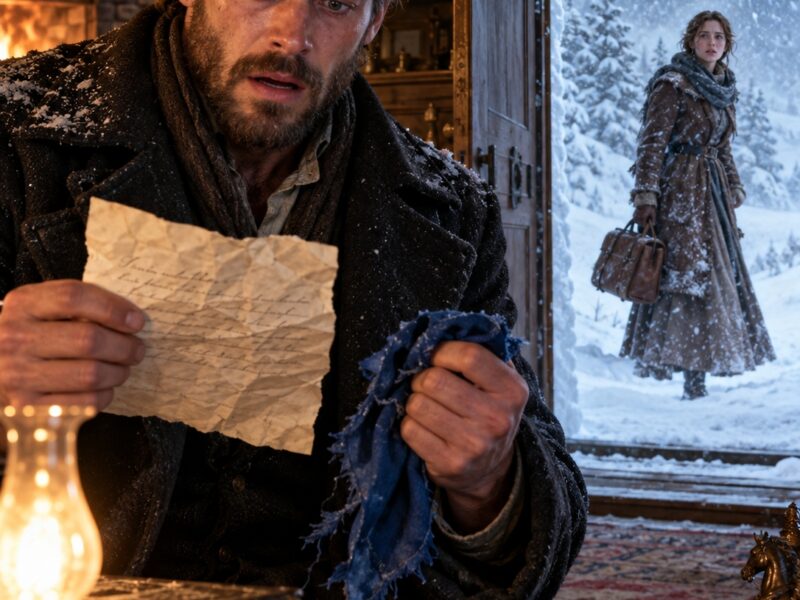
By the time Malcolm Teague realized he loved the woman coming to marry him, everyone else believed she was already dead.
The news arrived on a Thursday afternoon with a half-frozen mail rider, a horse white with snow, and six words Malcolm would remember until the day he died.
“She left the station on foot.”
For several seconds, Malcolm did not understand.
Behind him, the kitchen fire cracked softly.
Outside, an early winter storm was swallowing the Sawtooth Mountains whole.
And somewhere beyond those mountains was Winona Seer—a woman Malcolm had never touched, never heard laugh, never even seen with his own eyes.
A woman he had spent months insisting he did not love.
The mail rider pulled his scarf away from his mouth.
“Stage is safe at the way station,” he said. “Driver refused the pass yesterday. Sensible thing to do.”
Malcolm gripped the doorframe.
“And Winona?”
The rider looked away.
That was when Malcolm knew.
“She asked about another trail.”
Malcolm’s stomach turned cold.
“What other trail?”
“The lower pack trail.”
“In this?”
“I told you what I heard.”
The rider’s face was gray from cold.
“Station keeper tried stopping her. Said she wouldn’t listen. She was bound for your place.”
Malcolm stared past him into a world that had disappeared.
Fence posts had vanished beneath drifting snow.
The road was gone.
The mountains themselves were barely visible behind a moving wall of white.
“How long?”
The rider hesitated.
Malcolm stepped outside without a coat.
“How long has she been out there?”
“Since yesterday afternoon.”
Something inside Malcolm collapsed.
A full day.
One night.
Temperatures low enough to freeze water inside a bucket before dawn.
A woman from Nebraska alone on a mountain she did not know.
Malcolm had spent two years teaching himself how not to feel.
It took one sentence to destroy all his work.
Then a small voice came from behind him.
“Papa?”
Malcolm turned.
Birdie stood barefoot on the kitchen floor in her nightgown.
She was six years old, thin as a reed, with dark hair hanging crookedly around her face because Malcolm had never mastered braiding it properly.
She had heard everything.
Children always heard the things adults prayed they would miss.
Her face had gone pale.
“The letter lady is lost?”
Malcolm could not answer.
Birdie looked at the mail rider.
Then at the storm.
Then back at her father.
And Malcolm saw something in his daughter’s eyes that frightened him more than tears would have.
Certainty.
“You have to go get her.”
“Birdie—”
“She was coming to us.”
“I know.”
“She went into the snow because she was coming to us.”
“I know.”
“Then go.”
The word struck harder than an accusation.
Malcolm knelt in front of her.
“Sweetheart, listen to me. That mountain—”
“No.”
“Birdie.”
“No.”
Her chin trembled.
But she refused to cry.
“She said it in her letter.”
Malcolm frowned.
“What?”
Birdie ran to the shelf.
Before he could stop her, she dragged down the bundle of correspondence he had deliberately placed where he believed she could not reach it.
She pulled out one letter.
The folds were soft from being opened too many times.
Malcolm recognized it immediately.
Winona’s third letter.
Birdie could not read every word, but she had memorized the ones that mattered.
Her finger moved down the page.
Then she looked up.
“Where there’s love, there’s life.”
Malcolm stopped breathing.
Birdie clutched the letter against her chest.
“You said there wasn’t any love left.”
He felt the old wound open beneath his ribs.
“Birdie—”
“But she’s alive, Papa. I know she is.”
Her voice finally broke.
“So there has to be love.”
And then his six-year-old daughter said the thing that sent him into the mountains.
“So you have to go.”
Three nights earlier, Birdie Teague had announced Malcolm’s future over supper as casually as if she were discussing the weather.
“You’re going to marry Winona.”
Malcolm had nearly spilled his coffee.
Birdie continued eating bread and jam.
“You’ll probably have to clean the good room first.”
Malcolm slowly lowered his cup.
“Will I?”
“Yes.”
“And who decided all this?”
“I did.”
“That’s what I was afraid of.”
Birdie swung her feet beneath the chair.
There was jam at the corner of her mouth.
Malcolm reached across the table with a cloth and wiped it away.
“Grown people don’t decide marriages at supper.”
“You already decided.”
“No.”
“You wrote for a wife.”
“I wrote to an agency.”
“For a wife.”
“For help.”
Birdie gave him the look children reserve for adults being deliberately foolish.
Malcolm sighed.
The house was small but solid, built at the foot of the mountains where the valley widened enough for pasture. He had built part of it himself when he married Marta.
The kitchen had once been the loudest room.
Marta had sung while cooking.
Badly.
She had known she sang badly.
That had never stopped her.
Two years after her death, Malcolm could still remember exactly how her voice sounded bouncing off the timber walls.
Sometimes that was worse than forgetting.
Birdie pushed her plate away.
“Winona likes stories.”
“Miss Seer.”
“Winona.”
“You haven’t met her.”
“Neither have you.”
Malcolm stared at his daughter.
She smiled.
He hated when she won.
“Finish your supper.”
Birdie climbed down from her chair instead.
“Birdie.”
She marched toward the shelf near Malcolm’s writing desk.
Then she stretched onto her toes and retrieved something from behind an old account book.
Malcolm’s eyes narrowed.
“How did you know those were there?”
She ignored him.
The letter she held had been opened so many times the paper had begun wearing thin along the fold.
Birdie carefully flattened it on the table.
“I know this part.”
“That’s private correspondence.”
“She wrote to me.”
“She wrote a note inside a letter addressed to me.”
“So it’s partly mine.”
Malcolm opened his mouth.
Closed it.
Birdie began reading.
Slowly.
Carefully.
“If your little girl likes to be read to, I have a whole trunk of stories and nobody to read them to.”
She looked up triumphantly.
“A whole trunk, Papa.”
“I heard you.”
“A whole trunk.”
“Yes.”
“She’ll need somewhere to put it.”
“We have a house.”
“She’ll need somewhere to sleep.”
“We have a spare room.”
“She’ll need a husband.”
Malcolm rubbed his forehead.
“Go to bed.”
Birdie grinned.
“She’s coming Thursday.”
“If the weather holds.”
“You’re going to marry her.”
“Bed.”
Birdie gathered the letter and kissed his cheek before running down the hallway.
At her bedroom door, she stopped.
“Papa?”
“What?”
“I think she’ll like you.”
Malcolm looked at the fire.
“That makes one of us.”
Birdie’s smile disappeared.
“I like you.”
Something twisted inside him.
“I know, sweetheart.”
“And Mama liked you.”
The room went still.
Children could step directly onto wounds adults spent years walking around.
Birdie seemed to realize she had touched something painful.
Her voice softened.
“Maybe Winona can like you too.”
Malcolm could not answer.
Birdie went to bed.
He remained at the table long after the coffee had gone cold.
Eventually, against his better judgment, he picked up Winona’s letter.
He read it once.
Then again.
The second reading had nothing to do with practicality.
That was the part he never admitted.
Not even to himself.
Marta had been dead for two years.
Sometimes Malcolm measured his life that way.
Not by seasons.
Not by harvests.
Not by Birdie’s birthdays.
Before Marta died.
After Marta died.
She had gone into labor during a wet April when the mountain roads had turned to mud. By the time the doctor arrived, there was almost nothing he could do.
The baby had not survived.
Marta followed before sunrise.
Malcolm remembered sitting beside the bed holding her hand while she slipped away.
He remembered saying her name.
Again.
Again.
Again.
As if enough repetitions could anchor a soul inside a body.
They couldn’t.
By breakfast, Malcolm was a widower.
Birdie was four.
He had walked into the kitchen that morning and found her waiting at the table.
“Where’s Mama?”
There were questions a man should never have to answer.
He answered anyway.
Because fathers did.
Then he went outside and vomited behind the barn where his daughter could not see.
Afterward, he kept moving.
There were cattle to feed.
Wood to cut.
Bills to pay.
A child to raise.
A man with a little girl did not have the luxury of collapsing.
So Malcolm learned to grieve standing up.
The problem was that after enough time, standing became hiding.
He left Marta’s sewing basket untouched.
Her shawl remained on its peg for a year.
He slept on one side of the bed.
He stopped laughing loudly because the sound seemed disrespectful in a house where she no longer could.
Birdie adapted because children do.
That was what finally frightened him.
She became too independent.
She learned not to ask for help with her hair.
She stopped complaining when Malcolm burned biscuits.
She talked to herself while playing because there was no one else.
One winter evening, Malcolm found her sitting beside Marta’s old sewing basket telling a doll about her day.
The sight broke something in him.
Not because Birdie remembered her mother.
Because she was lonely.
A week later, Malcolm wrote to a matrimonial agency.
He hated every word.
He hated himself for writing them.
He was brutally honest.
Widower, thirty-five.
One daughter, six.
Modest property.
Steady income.
No expectation of romance.
Seeking practical woman willing to help establish a respectable household and provide maternal companionship to child.
He nearly tore the advertisement up.
Instead, he added one final sentence.
My little girl deserves a mother, even if her father has forgotten how to be a husband.
That sentence was why Winona Seer wrote back.
Winona was twenty-eight years old when Malcolm’s advertisement found her in Nebraska.
She read it three times.
Not because Malcolm sounded charming.
He didn’t.
He sounded almost aggressively unromantic.
She had seen other advertisements.
Men promising prosperous farms.
Men boasting about acreage.
Men describing themselves as handsome, healthy and God-fearing with suspicious enthusiasm.
Malcolm Teague promised none of those things.
He offered honesty.
And one sentence about a little girl.
Winona folded the advertisement and put it in her pocket.
Then she went back to sewing Mrs. Holloway’s blue church dress.
For the next three hours, she tried not to think about Idaho.
She failed.
Winona had become skilled at being alone.
There was a difference between being alone and being good at it.
She had buried both parents before twenty-three.
She had no brothers.
No sisters.
No inheritance worth mentioning.
She taught school when work was available and sewed when it wasn’t.
People called her dependable.
Sensible.
Useful.
Those words sounded like compliments until you realized nobody ever used them while asking you to stay.
At twenty-eight, Winona had begun accepting that her life might remain small.
A rented room.
A sewing machine.
Children belonging to other women.
Christmas dinners at other people’s tables.
Then Malcolm’s advertisement arrived.
She wrote to him that night.
Mr. Teague,
You say you prefer honesty, so I will begin there.
I am not beautiful enough to make a man forget his supper.
I am not an especially gifted cook, although no one has yet died from anything I prepared.
I sew extremely well.
I can teach.
I am patient with children unless they are cruel to animals, in which case my patience becomes unreliable.
I have no expectation of grand romance either.
But I understand what it means to need a household to become a home.
She stopped.
Then added:
And if your daughter likes stories, I own a trunk full of them with no child to read them to.
Malcolm answered.
Then Winona answered him.
Weeks became months.
Their letters grew longer.
Malcolm asked practical questions.
Could she manage livestock?
No.
Could she preserve food?
Yes.
Was she comfortable with severe winters?
She lied slightly.
She had experienced Nebraska winters.
Surely mountains could not be that different.
They were.
Winona asked questions about Birdie.
What color did she like?
Yellow.
Could she read?
Some.
What frightened her?
Thunder, though she denied it.
What made her laugh?
Malcolm paused over that question.
Then wrote:
Almost everything, thank God.
Winona began slipping small notes into the envelopes.
Dear Birdie,
Your father says you like horses.
I confess I am suspicious of any animal large enough to have opinions about carrying me.
Perhaps you can teach me.
Birdie answered in enormous uneven letters.
DEAR WINONA,
HORSES ARE NICE.
PAPA IS NICER THAN HE SOUNDS IN LETTERS.
HE BURNS BISCUITS.
I CAN TEACH YOU BOTH THINGS.
Winona laughed until she cried.
That was when she understood she was in danger.
She had intended to consider a practical marriage.
Instead, she was falling in love with a child she had never met.
And perhaps—with terrifying caution—with the child’s father too.
Malcolm never said anything romantic.
That made it worse.
He wrote things like:
Birdie lost another tooth. She insisted I tell you.
Or:
The first snow reached the north ridge today.
Or:
I tried your suggestion for the biscuits. They remain dangerous.
Sometimes a whole life hides inside ordinary sentences.
Winona began imagining his kitchen.
His hands holding the paper.
Birdie waiting for replies.
She began imagining herself there.
She knew Malcolm’s terms.
He had loved his wife.
He could offer respect.
Security.
Partnership.
Not love.
Winona told herself that would be enough.
But when the final arrangements were made and Malcolm wrote that she should arrive on Thursday’s stage, Winona packed her trunk of stories.
And quietly admitted the truth.
She was not crossing nine hundred miles because she wanted employment.
She wanted a family.
The whole frightening thing.
The storm reached the mountains one day before she did.
The stage driver saw the sky changing and cursed.
By noon, the wind had risen.
By two, snow was coming sideways.
By three, the road disappeared.
The driver stopped at a way station on the near side of the pass.
“We stay here.”
Winona stared through the window.
“For how long?”
“Until the mountain says otherwise.”
“My destination is on the other side.”
“So is mine.”
“I am expected Thursday.”
“You’ll be expected Friday.”
The driver began unhitching the horses.
“Maybe Saturday.”
Winona felt something sink inside her.
The station keeper was an old man named Pierce.
He gave her coffee and told her she was fortunate.
“Fortunate?”
“You’re inside.”
He pointed toward the windows.
“That’s what fortunate looks like tonight.”
Winona knew he was right.
She sat near the stove.
She tried reading.
She couldn’t.
She imagined Birdie waiting.
Thursday.
Winona had promised Thursday.
A ridiculous thought.
Children understood weather.
Children survived disappointment.
Winona had survived twenty-eight years of it.
But that was precisely the problem.
She had spent twenty-eight years being sensible about disappointment.
She suddenly couldn’t bear one more.
Late that afternoon, she overheard Pierce speaking to the driver about a lower trail.
“How far?”
Both men turned.
Pierce frowned.
“How far is the trail?”
“No.”
“I asked how far.”
“And I answered.”
The driver laughed without humor.
“Lady, don’t.”
Pierce pointed toward the storm.
“Eight miles, maybe. In summer.”
“Does it reach Teague Valley?”
“In fair weather.”
Winona stood.
The station keeper’s expression changed.
“Don’t even think about it.”
“If the trail is shorter—”
“There is no trail anymore.”
“I could follow—”
“You could freeze.”
Winona looked outside.
“Storm may ease.”
“It won’t.”
“How do you know?”
“Because I’ve lived here forty-three years.”
He stepped closer.
“Listen to me. Snow makes a fool believe distance is the danger. Distance isn’t the danger. Losing direction is. Cold is. Falling is. Getting wet is. You walk out there and ten minutes later you may not see this building.”
Winona knew he was right.
She sat down.
For twenty minutes.
Then she took Birdie’s last note from her pocket.
I WILL WAIT BY THE WINDOW THURSDAY.
Winona closed her eyes.
Nobody had ever waited at a window for her.
That simple fact made the decision.
She stood.
Pierce swore when he saw her putting on her coat.
“No.”
“I can make eight miles before dark.”
“You can’t make eight miles through that.”
“I have to try.”
“For God’s sake, why?”
Winona tied her scarf beneath her chin.
She could not explain it without sounding insane.
Because a six-year-old girl was waiting at a window.
Because a lonely widower had finally asked somebody to come.
Because somewhere beyond those mountains might be the first place in twenty-eight years where her absence would matter.
“I gave my word.”
Pierce grabbed her arm.
“A promise isn’t worth dying for.”
Winona looked at him.
“Some are.”
Then she walked into the storm.
Within fifteen minutes, the station vanished behind her.
Within an hour, so did the trail.
By the second hour, Winona understood that she might have made the worst decision of her life.
By the third, she understood she might die for it.
The cold did not feel dramatic.
That surprised her.
It felt methodical.
First her fingers hurt.
Then they stopped hurting.
That was worse.
Snow collected inside her collar.
Ice formed in her hair.
She kept moving because stopping seemed too much like agreeing with death.
“Eight miles,” she whispered.
But distance had become meaningless.
There was only white.
White above.
White below.
White moving sideways.
She could no longer tell whether she was following the trail.
Several times she fell.
The third time, she remained on her knees too long.
She thought about the station.
Warm stove.
Coffee.
Men who had warned her.
“You foolish woman.”
Her own voice disappeared into the wind.
She forced herself up.
Winona had spent years believing she was ordinary.
In the mountains, ordinary things became precious.
One more step.
One more breath.
One more tree.
One more minute.
She began tearing strips from the blue lining of an extra skirt beneath her coat.
At every recognizable tree or snag, she tied a strip as high as she could reach.
Not because she knew anyone would search.
Because if someone did, she wanted to give them a chance.
Blue against white.
Proof that she had passed.
Proof that she had been alive there.
Night began arriving.
Panic followed.
Winona thought of Birdie.
She imagined the little girl reading her notes.
Then Malcolm.
She had built a face for him from his handwriting.
Serious eyes.
Tired mouth.
Hands rough from work.
She wondered whether the real man looked anything like the imaginary one.
“You had better,” she whispered.
Another step.
Then another.
Her boot struck something hard.
Winona stumbled.
Through the snow she saw a dark vertical shape.
Wood.
A wall.
She stared.
For a moment she thought she was hallucinating.
Then she touched it.
A building.
A one-room line shack used by cattlemen during summer.
The door was nearly buried.
Winona dug with her hands.
Her gloves tore.
She kept digging.
When she finally forced the door open, she fell inside.
There were blankets.
Old wood.
A small stove.
Matches in a tin.
Winona began laughing.
Then crying.
Then laughing again.
She got the fire started on her third attempt.
She wrapped herself in every blanket she could find.
And through the longest night of her life, she repeated one thought.
Thursday.
Birdie was waiting Thursday.
So Winona intended to be alive Thursday.
On Thursday afternoon, Malcolm Teague rode into the mountain.
The neighbor, Mrs. Bell, held Birdie tightly as Malcolm saddled his strongest horse.
“Don’t make promises you can’t keep,” Mrs. Bell warned.
Malcolm looked at his daughter.
Too late.
He knelt.
“I’ll bring her home.”
Birdie’s lower lip trembled.
“Alive.”
Malcolm could not say it.
Birdie grabbed his coat.
“Alive, Papa.”
He covered her small hand with his.
“Alive.”
Then he rode.
The mountain fought him immediately.
Snow reached the horse’s knees.
Then its belly.
Wind erased his tracks almost as quickly as he made them.
Malcolm called Winona’s name.
The storm swallowed it.
“WINONA!”
Nothing.
He climbed.
“WINONA!”
Nothing.
Hours passed.
His face went numb.
His horse stumbled twice.
Every sensible instinct told him to turn around.
He kept climbing.
Because Malcolm had finally understood something terrible.
He had lied.
Not merely to Winona.
To himself.
He had said he wanted a practical wife.
A mother for Birdie.
Someone to manage the house.
He had pretended Winona was interchangeable with the role he needed filled.
But she wasn’t.
Somewhere between the letter about failed cake and the note about Birdie’s fear of thunder, Winona had become herself to him.
He knew the shape of her humor.
The stubbornness beneath her politeness.
The loneliness she tried hiding.
He knew she hated raisins.
He knew she loved Dickens.
He knew she believed children should never be lied to about important things.
He knew she sometimes put ink on the side of her hand.
He knew she had once walked three miles to return a library book because she had promised.
And now she had walked into a blizzard because she had promised Birdie Thursday.
Malcolm bent over his horse’s neck.
“God.”
His voice broke.
“Don’t let me understand this too late.”
For two years, Malcolm had treated grief like loyalty.
He had believed loving Marta meant remaining emotionally buried beside her.
Now, on a mountain that could kill him before sunset, he finally saw the cruelty of that idea.
Marta had loved life.
She had loved Birdie.
She had loved him.
She would have slapped him for turning her memory into a prison.
He could almost hear her.
You stubborn fool.
Malcolm laughed once.
It came out like a sob.
Then he saw blue.
He pulled the horse to a stop.
A strip of cloth fluttered from a branch.
Malcolm stared.
Blue fabric.
Deliberately tied.
His heart slammed against his ribs.
He dismounted.
Touched it.
Fresh tear.
Not old.
“Winona.”
He looked uphill.
Another blue strip.
Then another.
She had marked her path.
Of course she had.
The woman who wrote sensible letters while making jokes about cake had been sensible enough to leave a trail even while doing the most reckless thing imaginable.
Malcolm climbed faster.
“WINONA!”
A blue strip.
Another.
Then one tied to a wooden latch.
Malcolm almost missed the shack beneath the snow.
He threw himself against the door.
It wouldn’t move.
“Winona!”
He dug.
Pushed.
Shouldered it again.
The door gave.
Malcolm fell into darkness and smoke and warmth.
Someone moved beneath a pile of blankets.
He froze.
A pale face appeared.
Dark hair.
Blue lips.
Eyes very much alive.
For the first time, Malcolm Teague saw Winona Seer.
She stared at the snow-covered stranger in her doorway.
Then, impossibly, she smiled.
“You would be Mr. Teague.”
Malcolm could not speak.
Winona’s teeth chattered.
“I am afraid I’ve made a very poor first impression on your Thursday.”
Malcolm laughed.
He had forgotten what his own laugh sounded like.
The sound cracked through him.
Then he was on his knees beside her.
“You damn fool.”
Winona blinked.
“That seems uncharitable.”
“You walked into a blizzard.”
“I noticed.”
“You could have died.”
“I also noticed that.”
His hands shook as he checked her fingers.
Her face.
Her feet.
He needed anger because the alternative was grabbing a woman he had never met and weeping into her hair.
“You left a safe station.”
“I had an appointment.”
“With a six-year-old.”
“Those are the most serious kind.”
Malcolm looked at her.
Winona looked back.
And suddenly neither of them was joking.
“You came for me,” she whispered.
Malcolm’s throat closed.
“Yes.”
“Why?”
There it was.
The question he had ridden eight miles through hell trying not to answer.
He looked away.
“Birdie sent me.”
Something changed in Winona’s face.
Not much.
Just enough.
“Of course.”
Malcolm hated himself immediately.
But fear was an old habit.
And old habits often survive the things that should have killed them.
The storm trapped them in the shack for two days.
It was perhaps the best and worst thing that could have happened.
By the first night, Malcolm had stopped seeing Winona as handwriting.
She was smaller than he had imagined.
Her hair refused to stay pinned.
Her nose turned pink near the fire.
She spoke to herself while organizing things.
She was also infuriating.
“You should eat more.”
“I ate.”
“You had half a biscuit.”
“I’m not hungry.”
“You rode through a blizzard.”
“So did you.”
“I walked.”
“That does not improve your argument.”
She pushed the tin plate toward him.
Malcolm stared.
Winona raised an eyebrow.
He ate.
Later they sat across the fire.
The wind shook the walls.
“Tell me about Marta.”
Malcolm went still.
Winona did not apologize.
That surprised him.
Most people did.
They treated Marta’s name like a glass object that might shatter if handled.
“What do you want to know?”
“Anything.”
“Why?”
“Because she mattered.”
The answer disarmed him.
Malcolm looked into the fire.
“She sang badly.”
Winona smiled.
“How badly?”
“Terribly.”
“Did she know?”
“She considered herself gifted.”
Winona laughed.
Malcolm smiled before he could stop himself.
Then guilt hit.
The smile disappeared.
Winona saw it.
“There.”
“What?”
“That.”
“I don’t know what you mean.”
“Yes, you do.”
She pulled the blanket tighter around her shoulders.
“You smiled because you remembered something happy. Then you punished yourself.”
Malcolm’s jaw tightened.
“You’ve known me one day.”
“I’ve known your letters for five months.”
“That isn’t the same.”
“No.”
Winona held his gaze.
“It’s sometimes more honest.”
Malcolm stood.
“More coffee?”
“Sit down.”
He stared at her.
“You cannot order me around in my own rescue.”
“I nearly froze to death yesterday. It has made me ambitious.”
Despite himself, he sat.
Winona’s expression softened.
“I am not coming to replace her.”
Malcolm looked at the fire.
“I never said you were.”
“You didn’t need to.”
Silence.
“I couldn’t replace Marta if I wanted to. And I don’t want to.”
Winona spoke carefully.
“Birdie had a mother. You had a wife. You loved her. She existed. She matters. If I came into your house pretending otherwise, I would be insulting all three of you.”
Malcolm swallowed.
“Then what are you coming for?”
Winona looked at him.
There were moments in life when another person offered you truth without protection.
This was one.
“A chance.”
“At what?”
“A family.”
The word hung between them.
Winona looked down at her hands.
“I told you I wanted a practical arrangement.”
“You did.”
“I wasn’t entirely honest.”
Malcolm waited.
“I’ve spent most of my adult life being sensible.”
Her smile was small.
“I’ve been sensible through funerals. Sensible through lonely Christmases. Sensible when women younger than I was married and had children and stopped inviting the unmarried seamstress except when they needed a hem repaired.”
Malcolm said nothing.
“I became very good at not wanting things.”
She looked at him again.
“Then your advertisement said your little girl deserved a mother.”
Her eyes filled.
“And I wanted something.”
“Birdie.”
“Yes.”
The answer came without hesitation.
Malcolm felt an irrational stab of jealousy.
Winona noticed.
She smiled.
“And perhaps her father.”
He stopped breathing.
“Perhaps?”
“I had never met him.”
“You have now.”
“Yes.”
“And?”
Winona studied him.
“The jury remains out.”
Malcolm laughed.
This time he did not stop himself.
Winona smiled.
And for a few seconds the shack felt warmer than it was.
Then Malcolm remembered Marta.
He hated that memory and happiness had become enemies inside him.
Winona seemed to read the shift.
“Malcolm.”
It was the first time she used his given name aloud.
He looked at her.
“Love isn’t a ration.”
He frowned.
“It doesn’t run out because you’ve already given some away.”
“You don’t know that.”
“I do.”
“How?”
“Because I already love Birdie.”
The simplicity of it silenced him.
“I’ve never touched her. Never seen her. But I love her.”
Winona’s voice shook now.
“I loved my parents. They’re dead. Loving that little girl didn’t take anything from them. It didn’t steal anything. It made something new.”
She reached across the space between them.
Her hand stopped halfway.
Giving him the choice.
Malcolm looked at it.
Then placed his hand in hers.
Her fingers were cold.
Something inside him was not.
Winona whispered, “Where there is love, there is life.”
Malcolm closed his eyes.
“Birdie quoted that at me.”
“I taught her well.”
“She used it to send me into a blizzard.”
“Then I taught her too well.”
He opened his eyes.
They were still holding hands.
For the first time since Marta died, Malcolm wanted to kiss someone.
The realization terrified him.
He pulled away.
Winona’s hand remained suspended for a second before returning to her lap.
“I can’t.”
Her face went still.
“I see.”
“No, you don’t.”
“I think I do.”
“I loved her.”
“I know.”
“If I do this—”
“You live.”
“It feels like leaving her.”
Winona stared at him.
Then her voice became very quiet.
“Perhaps that’s because you’ve confused standing beside her grave with staying married to her.”
The words hit hard.
Malcolm stood.
“That is enough.”
“Probably.”
“You know nothing about losing her.”
“No.”
Winona’s eyes shone.
“But I know something about wasting years because you’re afraid wanting more makes you ungrateful for what you once had.”
Malcolm said nothing.
Winona turned toward the wall.
“I can be patient, Malcolm.”
She lay down beneath the blankets.
“I’ve waited twenty-eight years to belong somewhere. I can wait a little longer.”
He stared at her back.
Then she added:
“But I hope you don’t spend the rest of both our lives standing in a doorway you’re afraid to walk through.”
Malcolm did not sleep.
The storm broke on the third morning.
They descended together.
Winona rode.
Malcolm walked beside the horse.
For miles, neither mentioned what had happened in the shack.
Then they reached the valley.
A small figure appeared outside Mrs. Bell’s house.
Birdie.
She stood motionless for half a second.
Then screamed.
“WINONA!”
She ran.
“Birdie, slow down!” Malcolm shouted.
Birdie ignored him.
Winona slid from the horse.
She barely had time to kneel before Birdie launched herself into her arms.
The impact knocked them both backward into the snow.
Winona laughed.
Birdie cried.
Then Winona cried too.
“You came.”
“I said I would.”
“You were late.”
“I know.”
“Very late.”
“I apologize.”
Birdie squeezed her harder.
“I forgive you.”
Malcolm stood several feet away.
He had believed he understood what bringing Winona home meant.
He hadn’t.
Watching them in the snow, he realized something had already formed between them.
Something that did not require his permission.
Birdie touched Winona’s face.
“Are you really the letter lady?”
“I believe so.”
“You’re prettier than Papa said.”
Malcolm coughed.
Winona looked over Birdie’s shoulder.
“Did he describe me as ugly?”
“He said appearance wasn’t important.”
Winona narrowed her eyes at him.
Malcolm suddenly found the mountains fascinating.
Birdie whispered loudly, “He likes you.”
“Birdie.”
“He rode into a blizzard.”
“Birdie.”
“He doesn’t do that for everybody.”
“Inside,” Malcolm said.
Birdie grinned.
Winona did too.
And for one dangerous moment, Malcolm could see the whole life.
Winona at the kitchen table.
Birdie beside her.
Laughter in the rooms.
Books stacked near the stove.
Someone occupying the empty half of his bed.
Someone saying his name in the dark.
The vision was so beautiful it frightened him.
So Malcolm did what frightened people often do.
He tried to destroy the thing before it could hurt him.
That evening, after supper, Malcolm cleared his throat.
Winona sat near the stove.
Birdie was arranging the storybooks Winona had brought in the trunk delivered later from the station.
“We should discuss expectations.”
Winona looked up.
Birdie stopped moving.
Malcolm continued.
“Our original arrangement remains sensible.”
Winona’s face changed.
Barely.
But Malcolm saw it.
“Does it?”
“Yes.”
He forced himself onward.
“You will have your own room.”
Birdie frowned.
“We have already discussed household expenses. I will provide—”
“Malcolm.”
Winona’s voice was gentle.
That somehow made it worse.
“What are you doing?”
He knew.
“I am clarifying matters.”
“No.”
She stood.
“You are hiding.”
Birdie looked between them.
Malcolm’s jaw hardened.
“This marriage was proposed as a practical partnership.”
“Before you rode into a blizzard.”
“That changes nothing.”
The lie hurt even while leaving his mouth.
Winona went pale.
“Nothing?”
Malcolm could not look at her.
“We should not mistake an extreme circumstance for—”
Birdie began crying.
Both adults turned.
She stood beside the trunk.
Tears rolled down her cheeks.
Not the dramatic tears of a child denied something.
These were different.
Heartbroken tears.
“You’re ruining it.”
Malcolm froze.
“Birdie.”
“You’re ruining everything.”
She hit him with both fists when he knelt.
“You went and got her!”
“I know.”
“You went into the mountain!”
“I know.”
“You said where there’s love, there’s life!”
“Birdie—”
“And now you’re being cold!”
Winona turned away.
That hurt Malcolm more than Birdie’s fists.
His daughter sobbed.
“Why are you being cold when you love her?”
The room stopped.
Malcolm stared at Birdie.
She stared back through tears.
“I know you love her.”
Malcolm’s defenses had survived death.
Two years of grief.
Months of letters.
A mountain.
A blizzard.
Two nights alone with Winona.
They did not survive his six-year-old daughter.
He gathered Birdie into his arms.
She buried her face against him.
Malcolm looked over her shoulder.
Winona stood by the stove.
Her chin was lifted.
Her eyes were bright.
She was trying very hard not to hope.
And Malcolm finally understood that courage was not riding into a storm.
That had been easier.
Snow could kill a man only once.
Love could ask him to risk losing everything again.
That was what frightened him.
Malcolm kissed Birdie’s hair.
“You’re right.”
Birdie went still.
Winona did too.
Malcolm stood.
“I’ve been afraid.”
His voice shook.
He did not care.
“I thought if I loved somebody again, it meant I was leaving your mother behind.”
Birdie wiped her face.
“But Mama is dead.”
Children.
Merciless.
Malcolm almost laughed.
“Yes.”
Birdie looked confused.
“She can’t be behind.”
“No.”
Malcolm’s eyes burned.
“She can’t.”
He turned toward Winona.
“I think I have spent two years trying to prove I loved Marta by refusing to live without her.”
Winona said nothing.
“I told myself grief was loyalty.”
He took one step.
“I told myself wanting you was betrayal.”
Another.
“I told myself I wrote those letters because Birdie needed a mother.”
He stopped in front of her.
“But I read every one twice.”
Winona’s lips parted.
“The first time because I needed to know whether you could survive here.”
A tear slipped down her cheek.
“The second because I wanted to hear your voice in my head.”
Birdie sniffed behind them.
Malcolm continued.
“I lied when I said I had nothing left to give.”
His throat tightened.
“I think I began falling in love with you somewhere around the letter about the cake.”
Winona laughed through tears.
“That cake was a tragedy.”
“It was.”
“You never tasted it.”
“You described it very thoroughly.”
She covered her mouth.
Malcolm stepped closer.
“I fell in love with a Nebraska postmark before I was brave enough to admit there was a woman attached to it.”
Winona’s tears came freely now.
“And when that rider told me you were missing…”
His voice broke.
“I knew.”
Silence.
“I knew because the thought of a world where I never got to meet you felt unbearable.”
Winona stared at him.
“I don’t want a housekeeper.”
Malcolm shook his head.
“I don’t want some cold arrangement.”
Another step.
“I don’t want you sleeping down the hall while I spend the rest of my life pretending I don’t listen for your footsteps.”
Birdie smiled through her tears.
“I want you.”
Winona inhaled sharply.
“All of you.”
Malcolm’s voice dropped.
“The woman who walked into a blizzard because she promised a little girl Thursday.”
A trembling smile appeared on Winona’s face.
“The woman who insults my biscuits.”
“They deserve it.”
“The woman who tells me the truth when I don’t want it.”
“Someone has to.”
“The woman who has already loved my daughter more honestly than I knew how to ask.”
Malcolm reached for her hand.
This time he did not pull away.
“I love you, Winona.”
There.
The words existed.
Nothing broke.
Marta did not disappear.
The house did not reject them.
The world simply became larger.
Malcolm smiled through tears.
“I love you. And if you can forgive a man foolish enough to need a six-year-old child and a blizzard to teach him what he already knew, I would like very much to marry you for reasons that have nothing practical about them.”
Winona stared at him for three long seconds.
Then she crossed the final distance herself.
She put both hands against his face.
“You are an extremely slow man, Malcolm Teague.”
“I’ve been told.”
“Stubborn.”
“Yes.”
“Emotionally exhausting.”
“Probably.”
“And your biscuits are terrible.”
“Winona.”
She kissed him.
Birdie screamed with delight.
Malcolm laughed against Winona’s mouth.
Birdie began jumping around them.
“I told you!”
Neither adult paid attention.
“I told you! I told you! I told you!”
The house that had spent two years holding its breath suddenly filled with noise.
Real noise.
Living noise.
Winona pulled away just far enough to look into Malcolm’s eyes.
“I chose your advertisement because of one sentence.”
“Which?”
“Your little girl deserved a mother.”
Malcolm glanced at Birdie.
Winona touched his cheek.
“But I crossed the country because of everything you wrote after it.”
“And the mountain?”
“That was mostly poor judgment.”
Malcolm laughed.
She smiled.
Then her expression softened.
“I would choose you again.”
“Even knowing everything?”
“Especially knowing everything.”
Birdie squeezed between them.
“What about me?”
Winona immediately bent and kissed the top of her head.
“You were never the difficult choice.”
Birdie looked pleased.
Then she reached for Winona’s hand and Malcolm’s.
She pulled them together.
“There.”
“What?” Malcolm asked.
Birdie smiled.
“Family.”
They did not marry immediately.
Winona insisted Malcolm prove he could survive being happy for several months without panicking.
Malcolm accused her of exaggeration.
Then he panicked twice before Christmas.
Winona counted both occasions.
Birdie kept score.
Life changed slowly.
That mattered.
Winona did not enter the Teague house and erase Marta.
She did something harder.
She made room for her.
One afternoon Malcolm found Winona cleaning Marta’s sewing basket.
He stopped in the doorway.
Winona noticed him.
“I can put it back.”
“No.”
He entered.
She held a spool of green thread.
“I thought Birdie might want some of these things someday.”
Malcolm sat beside her.
For several minutes they sorted in silence.
Then he picked up Marta’s thimble.
“She wore this every day.”
Winona smiled.
“Tell me.”
So he did.
And when he finished, he was crying.
Winona did not tell him to stop.
She simply sat beside him.
That night Malcolm understood something.
Healing was not forgetting where the wound had been.
Healing was being able to touch the scar without bleeding.
Winona never asked him to love Marta less.
And because of that, he found himself able to love Winona without shame.
Birdie flourished.
She followed Winona everywhere.
Into the kitchen.
Into the garden.
Around the yard.
“Why?”
“Because.”
“How?”
“Carefully.”
“Can I?”
“Not with that knife.”
“Why?”
“Because your father would blame me if you lost a finger.”
“Papa loses things.”
“Not fingers.”
At night, Winona opened the trunk.
That became the ritual.
Birdie chose a book.
Malcolm pretended not to listen from his chair.
Winona always caught him.
“You could come closer.”
“I can hear.”
“You’re leaning so far you’ll fall.”
“I am comfortable.”
“You’re ridiculous.”
Eventually he moved closer.
By January, Malcolm sat on the sofa with Birdie’s head against one leg and Winona’s shoulder against his.
The first time he noticed the arrangement, he became very still.
Winona looked at him.
“What?”
“Nothing.”
But it was not nothing.
It was everything he had once believed impossible.
Spring came late to the Sawtooths.
Snow retreated from the valley.
Water ran beneath the ice.
The roads opened.
And one bright morning, Winona stood inside the small church at the foot of the mountains wearing a dress she had sewn herself.
Birdie walked ahead carrying flowers.
She looked so proud that several guests laughed.
Mrs. Bell whispered, “That child thinks she’s responsible for this.”
Malcolm heard.
“She is.”
Birdie turned.
“I heard that.”
“Good.”
Winona reached him.
For a moment Malcolm forgot the minister.
The congregation.
The mountains.
Everything.
He saw only the woman who had once existed as folded paper beside his lamp.
The woman who had walked through a storm.
The woman who had survived.
The woman who had taught him that loving again was not evidence that the first love had been false.
It was evidence that he was still alive.
“You’re staring,” Winona whispered.
“I know.”
“People can see.”
“Let them.”
Her eyes filled.
The minister began.
Birdie shifted impatiently through the vows.
When Malcolm finally kissed Winona, she clapped loudly.
Nobody corrected her.
Years later, Birdie would insist the marriage had been her idea.
Nobody argued.
She was right.
The trunk of stories remained in the house.
First Winona read them to Birdie.
Then, in time, to Birdie’s little brother.
And later to her little sister.
Three children would crowd around Winona beneath the same lamplight where Malcolm had once sat alone reading letters from Nebraska and pretending he was interested only in practical matters.
The house changed.
Boots accumulated by the door.
Someone was always hungry.
Someone was always laughing.
There were arguments.
Broken dishes.
Sick nights.
Christmas mornings.
Birthdays.
Mud.
Music.
Books everywhere.
Malcolm occasionally burned biscuits for old times’ sake.
Winona claimed it was no longer accidental.
He never admitted anything.
Marta’s photograph remained on the mantel.
Winona placed flowers beside it every spring.
Once, years later, Birdie asked why.
Winona looked at the photograph.
“Because she loved you first.”
Birdie was quiet.
“And Papa?”
“Him too.”
“Doesn’t that make you sad?”
Winona considered the question.
“No.”
“Why?”
“Because somebody loving your father before I did doesn’t make what we have smaller.”
Birdie smiled.
“Love doesn’t run out.”
Winona looked at her.
“No.”
“It makes more.”
“Yes.”
From across the room, Malcolm heard them.
He said nothing.
He only looked toward Marta’s photograph.
Then toward his wife.
His children.
The warm, crowded room.
And for once, the memory did not hurt.
It simply belonged.
Much later, when Malcolm’s hair had gone silver and Birdie had children of her own, someone asked him how he had met his wife.
Malcolm always told the story badly.
Winona always corrected him.
“You left out the blue flags.”
“I was getting there.”
“You never get there.”
“You interrupt.”
“You exaggerate the storm.”
“I was in the storm.”
“So was I.”
“You were inside the shack.”
“After walking there.”
Then Birdie would inevitably appear.
“You’re both telling it wrong.”
Malcolm would groan.
Winona would laugh.
And Birdie would begin where she believed the story truly started.
With a supper table.
A six-year-old girl.
And a letter.
She would tell them that her father had written for a practical wife because he believed his heart had died with his first one.
She would tell them about the woman in Nebraska who owned a trunk full of stories.
She would tell them about Thursday.
About the storm.
About blue strips of cloth fluttering against impossible white.
About the line shack.
About the father who rode into a mountain after a woman he claimed not to love.
And Birdie would always end the story the same way.
“Papa thought he went up there to save Winona.”
At this point Malcolm would shake his head because he knew what was coming.
Birdie would smile.
“But that isn’t what happened.”
Someone would ask, “What happened?”
And Birdie would look across the room at her father.
“The letter lady saved him.”
Malcolm never corrected her.
Because she was right about that too.
Winona had nearly died crossing the mountains to reach a family.
But Malcolm had been frozen long before the snow came.
He had spent two years standing beside the life he had lost, believing grief demanded that he lose the rest of it too.
Then a woman he had never met wrote his daughter a letter.
A child believed it.
A storm tested it.
And somewhere on a mountain between one blue flag and the next, Malcolm Teague finally understood the truth he had been too frightened to see.
Love was not a room with only one chair.
It was not a cup that emptied.
It was not a betrayal of the dead to keep living.
Love made room.
Love multiplied.
Love remembered what came before without refusing what came next.
And in the little house at the foot of the Sawtooths, the proof of it could be heard every evening.
Children laughing.
Pages turning.
Winona reading beneath the lamp.
Birdie interrupting every third paragraph.
Malcolm pretending to complain.
A house once so quiet that grief seemed to live inside the walls had become too loud, too crowded and too warm for silence to rule it anymore.
Sometimes Malcolm would stand in the doorway and simply listen.
He would remember a Thursday afternoon.
A rider covered in snow.
A six-year-old girl clutching a letter against her chest.
And the impossible command she had given him.
Go find her.
He had thought Birdie was asking him to save a stranger.
He understood now that his daughter had been asking him to save something else.
The part of himself he had buried with Marta.
The part still capable of hope.
The part still capable of choosing tomorrow.
The part still alive.
Then Winona would look up from whatever story she was reading.
“Malcolm?”
He would blink.
“Yes?”
“Are you planning to stand there all night?”
“Maybe.”
Birdie would laugh.
Winona would shake her head.
And Malcolm would cross the room.
Always.
Because after losing two years to grief and nearly losing Winona to a mountain, Malcolm Teague had finally learned never to spend another moment standing in a doorway he was afraid to walk through.
He would sit beside his wife.
His children would make room.
Winona would resume reading.
And outside, snow might fall against the windows of the house at the foot of the mountains.
But inside, there would be lamplight.
There would be stories.
There would be voices.
There would be memory without imprisonment.
There would be grief without surrender.
There would be love.
And where there was love, Malcolm finally understood, there was life.









