His Mother Kept Calling My Phone—When I Finally Told Him Why, He Couldn’t Speak

“Your mother keeps calling me.”
Daniel Carter’s hand froze on the edge of his apartment door.
For a second, I thought he hadn’t heard me.
Then all the color disappeared from his face.
“My mother?”
His voice came out quieter than I expected.
“Why would she call you?”
I had rehearsed this conversation three times while climbing the stairs to his apartment. In every version, I sounded calm. Careful. Like someone delivering a message that wasn’t hers to carry.
But standing there, looking at Daniel, I suddenly understood that I had stepped into something much older than a few unanswered phone calls.
There was history in the way his shoulders stiffened.
There was hurt in the way he wouldn’t quite look at me.
And there was fear in his eyes when I said the words I had come upstairs to say.
“Because she left you one last message.”
His fingers tightened around the door.
“What message?”
I swallowed.
“She said she’s proud of you.”
Daniel didn’t move.
Not even slightly.
The hallway around us was so quiet I could hear the old radiator ticking against the wall.
Then his eyes filled.
And that was when I realized I had been wrong about the quiet man who lived above me.
I had thought Daniel didn’t care.
I had thought Margaret was simply a lonely mother whose son had become too busy to call.
I had thought the distance between them could be measured in missed dinners, unanswered texts, and a flight of wooden stairs.
I didn’t know yet that some families can love each other deeply and still spend years standing on opposite sides of one terrible silence.
And I certainly didn’t know that Margaret had chosen a near stranger to carry the words she had been unable to say to her own son.
My name is Emily Parker.
Three months earlier, I had moved into an old brick apartment building in Evanston, just north of Chicago, because I needed somewhere inexpensive enough to afford and quiet enough to start over.
I was thirty-two years old, newly single, working remotely for a nonprofit, and still pretending the end of a six-year relationship hadn’t shaken me as badly as it had.
The building wasn’t glamorous.
The elevator worked when it felt like it. The radiators hissed all winter. The wooden floors complained beneath every footstep, and the front door had to be pulled toward you before the deadbolt would turn.
But I loved the tall windows.
I loved the narrow fire escapes.
I loved the smell of coffee that somehow lived permanently in the first-floor hallway.
Most of all, I loved that nobody there knew anything about me.
After six years of being half of an “Emily and Mark,” anonymity felt strangely luxurious.
My apartment was on the second floor.
Daniel lived directly above me.
I knew his name because it was printed in small black letters beside his mailbox.
DANIEL CARTER — 3B.
For the first few weeks, that was almost everything I knew about him.
He left early.
He came home late.
Sometimes I heard his boots crossing the floor above my bedroom around eleven at night.
He looked somewhere around thirty-seven or thirty-eight, usually wore faded jeans, work boots, and dark button-down shirts with the sleeves rolled to his forearms.
He drove an aging silver pickup.
He rarely smiled.
But he wasn’t unfriendly.
That distinction mattered.
If we passed each other on the stairs, he moved aside.
If my hands were full, he held the door.
Once, when a package had been left outside during freezing rain, he carried it upstairs and placed it beside my apartment before I got home.
There was never a note.
He never mentioned it.
Daniel seemed like the kind of man who would help you change a tire in a snowstorm and disappear before you could thank him.
Which made what happened next even stranger.
It was a Saturday morning in late November when I first met Margaret.
Chicago had gotten its first real cold snap of the season.
The sky was pale gray, the wind sharp enough to make your eyes water, and I was walking back from the grocery store carrying two paper bags because I had once again forgotten to bring reusable ones.
That was when I saw her.
She stood beside the bus stop at the corner of Ridge and Greenleaf, clutching a small brown paper bag against her coat.
She was probably in her late sixties.
Maybe seventy.
Silver hair curled beneath a knitted burgundy hat, and she wore a camel-colored coat that looked warm but old.
What caught my attention wasn’t her age.
It was the way she kept looking down the street.
Then at the bus schedule.
Then at her phone.
Then down the street again.
I slowed.
Normally, I might have kept walking.
Not because I didn’t care.
Because city life teaches you to respect the invisible boundary between noticing someone and intruding on them.
But there was something in her face.
Not panic.
Embarrassment.
That was worse somehow.
“Excuse me,” I said.
She turned.
“Are you waiting for the 213?”
She looked toward the empty street.
“I was.”
I glanced at the schedule.
“You just missed it.”
“I know.”
She smiled, but it was the kind of smile people use when they don’t want strangers to know they’re struggling.
“My timing has apparently become terrible with age.”
I laughed.
“Mine was terrible at twenty-five.”
That got a real smile.
I shifted the grocery bags against my hip.
“Do you need to get somewhere?”
“Oh, no. I’m fine.”
The automatic answer.
I recognized it immediately.
I had been saying the same thing for months.
“I’m heading toward Main Street,” I said. “If you’re going that direction, I can give you a ride.”
Her expression changed.
“You don’t know me.”
“That’s true.”
“You could be dangerous.”
I looked down at the two grocery bags cutting circulation from my fingers.
“I’m currently being defeated by canned tomatoes.”
She laughed again.
Then she looked at her phone.
The screen was nearly black.
“I need to get to the pharmacy,” she admitted. “My prescription was supposed to be delivered yesterday, but there was some problem. And my phone is almost dead.”
“I can take you.”
She hesitated.
“I don’t have money for gas.”
“I’m going that direction.”
That wasn’t exactly true.
But she didn’t need to know.
After another few seconds, she nodded.
“All right. But only because you look like someone who would be very bad at kidnapping people.”
“That’s the nicest thing anyone has said to me all week.”
Her name was Margaret Carter.
I learned that before we reached the first stoplight.
She learned my name, my job, how recently I had moved, and that I had a bad habit of buying houseplants I didn’t know how to keep alive.
Margaret had the conversational instincts of someone who had spent decades making other people feel comfortable.
She asked questions.
Then actually listened to the answers.
By the time we reached the pharmacy, I knew her husband had died four years earlier, that she hated television game shows, loved mystery novels, and believed most restaurants ruined mashed potatoes by “trying to make them interesting.”
I waited in the parking lot while she went inside.
Ten minutes passed.
Then fifteen.
I considered leaving.
Instead, I went inside.
Margaret was sitting in one of the plastic chairs near the pharmacy counter while an employee typed something into a computer.
“Insurance problem,” she explained.
Her smile was still there.
But she looked tired.
So I sat beside her.
“You don’t have to wait.”
“I know.”
“It could take a while.”
“I know.”
She studied me.
“You always this stubborn?”
“Only when I’m trying to impress strangers.”
That made her laugh.
Thirty minutes later, she finally got her prescription.
I drove her home.
The address she gave me was less than half a mile from my building.
A small apartment complex tucked behind a row of bare maple trees.
When I pulled up, Margaret looked at me for a moment.
Then she reached into her purse.
“I want your phone number.”
I stared at her.
“That escalated quickly.”
“I’m seventy-one. I don’t have time to play hard to get.”
I laughed so hard I nearly dropped my phone.
“Fine. But only if you promise not to call me at three in the morning.”
“No promises.”
She entered my number.
Then, before getting out, she touched my arm.
“Thank you, Emily.”
“It was just a ride.”
Margaret’s smile softened.
“People always say ‘just’ before the things that matter.”
I watched her walk toward the entrance.
At the time, I thought that was the end of it.
It wasn’t.
The next afternoon, my phone rang.
Unknown number.
“Hello?”
“Emily?”
I smiled immediately.
“Margaret?”
“I’m violating our agreement.”
I glanced at the clock.
“It’s two-thirty in the afternoon. You’re safe.”
She chuckled.
Then her voice became slightly embarrassed.
“I hate asking this.”
“What happened?”
“I bought groceries.”
“That sounds serious.”
“Four bags.”
“Tragic.”
“And the elevator in my building is broken.”
Twenty minutes later, I was carrying groceries up the stairs to Margaret’s apartment.
Her home was small but warm.
Not warm because of the thermostat.
Warm because nearly every surface contained evidence of a life.
Books.
Ceramic birds.
Handwritten recipes stuck beneath magnets on the refrigerator.
A knitted blanket folded over the couch.
Photographs everywhere.
Margaret young beside a tall man with dark hair.
Margaret holding a baby.
A little boy wearing a Cubs cap.
A teenager standing beside a bicycle.
A young man in a graduation gown.
Then I stopped.
There was a framed photograph on the wall beside the kitchen.
Margaret stood next to a man I recognized.
He was younger in the picture.
Clean-shaven.
Smiling.
But there was no mistake.
“Daniel?”
Margaret turned from the counter.
“You know Daniel?”
“He lives above me.”
For the first time since I had met her, Margaret became completely still.
“Above you?”
“Apartment 3B.”
She lowered the can she was holding.
For a moment, something passed through her expression that I couldn’t identify.
Relief.
Pain.
Maybe both.
“That sounds like him.”
I frowned.
“You didn’t know where he lived?”
“I knew the address.”
Her voice changed slightly.
“I just didn’t know exactly which apartment.”
That answer made no sense.
I almost asked why.
But something told me not to.
Instead, I picked up another grocery bag.
Margaret began putting things away.
We talked about ordinary things.
The weather.
Rent.
The pharmacy.
But every few minutes, I caught her glancing at the photograph.
Eventually, she said, “Daniel moved back six months ago.”
“Oh.”
“He works maintenance operations for a hospital system downtown. Long hours.”
“He seems busy.”
“Yes.”
One word.
Carefully spoken.
I heard everything underneath it.
Over the next few weeks, Margaret began calling me.
Not constantly.
Just enough that her name slowly became familiar on my screen.
Sometimes she needed something.
A jar opened.
A package carried.
A ride to the grocery store when the sidewalks were icy.
But often, she didn’t need anything at all.
“Did I tell you Daniel once tried to build a treehouse in our garage?”
“No.”
“He was nine. Used my dining chairs as lumber.”
“What happened?”
“The chairs survived. His father nearly didn’t.”
Her laughter filled the phone.
Another afternoon, she called to tell me Daniel had hated peas as a child.
Another time, she told me he had slept beside their dog for three nights when the dog became sick.
The stories were never random.
I understood that eventually.
Margaret wasn’t telling me about Daniel.
She was keeping him alive inside a relationship where he was no longer present.
The more she talked about him, the stranger the situation seemed.
Daniel lived half a mile away.
Sometimes less than five hundred yards from his mother.
Yet Margaret talked about him like he lived on another continent.
One evening, while I was sitting at her kitchen table drinking tea, I finally asked.
“Why don’t you call him?”
Margaret’s fingers tightened slightly around her mug.
“I do.”
“And?”
“Sometimes he answers.”
“Sometimes?”
She looked toward the window.
“He’s busy.”
I waited.
Margaret gave a small shrug.
“It’s complicated.”
That phrase usually means the truth hurts more than the explanation.
I didn’t push.
A few minutes later, she changed the subject.
But that night, as I walked home, I looked up at Daniel’s third-floor window.
The light was on.
His mother was sitting alone less than ten minutes away.
And somehow neither of them knew how to cross the distance.
A week later, I finally learned why.
Not all of it.
Just enough.
Margaret and her husband, Thomas, had raised Daniel in a blue-collar neighborhood on Chicago’s northwest side.
Thomas had been an electrician.
Margaret had worked in a public elementary school office for nearly thirty years.
Daniel was their only child.
According to Margaret, father and son had loved each other fiercely and fought almost as fiercely.
Thomas believed stability mattered above everything.
Daniel wanted more.
When Daniel was twenty-four, he received an opportunity to work in Seattle.
Thomas hated the idea.
Margaret hated it too.
But unlike her husband, she didn’t say, “I’m afraid you’ll leave and never come back.”
She said something worse.
“If you go, don’t expect us to keep rearranging our lives every time you decide you miss home.”
She told me that sentence while staring into her tea.
“I thought I was being strong,” she said.
“You were angry.”
“I was scared.”
“Did Daniel know that?”
Margaret looked at me.
“No.”
That single word seemed to shrink the room.
Daniel left anyway.
At first, he called every Sunday.
Then every other Sunday.
Then once a month.
Life happened.
Promotions.
Relationships.
Flights canceled.
Birthdays missed.
Thomas became ill.
That was where the real fracture began.
Daniel came home whenever he could, but “whenever he could” never felt like enough to two frightened parents watching illness change their household.
Then, three days before Thomas died, Daniel missed a flight from Seattle.
A storm had grounded half the airport.
By the time he reached Chicago, his father was gone.
Margaret met him in the hospital hallway.
She had been awake almost thirty hours.
She was grieving.
Angry.
Terrified.
And Daniel asked the one question grieving children always ask even when they already know the answer.
“Was Dad asking for me?”
Margaret should have hugged him.
She knew that now.
Instead, she said, “He waited as long as he could.”
Four years later, she still remembered Daniel’s face.
“I watched something close inside him,” she whispered.
I didn’t know what to say.
Margaret looked down.
“He thought I blamed him.”
“Did you?”
She took a long time to answer.
“For a while.”
That honesty surprised me.
Then she added, “But mostly I blamed myself.”
Daniel returned to Seattle after the funeral.
Calls became shorter.
Then rarer.
Margaret didn’t know how to apologize without admitting how cruel she had been.
Daniel didn’t know how to forgive something she had never apologized for.
So they did what families sometimes do when love becomes tangled with pride.
They waited.
Each believed the other should speak first.
Four years disappeared.
Then Daniel accepted a job back in Chicago.
Margaret thought that would fix everything.
It didn’t.
Physical distance had never been the real problem.
Silence was.
And silence had followed him home.
I began seeing Daniel differently after that.
When we crossed paths, I noticed the exhaustion beneath his eyes.
I noticed he sometimes sat in his truck for ten minutes before entering the building.
I noticed that every Sunday evening, around the same time Margaret usually called me, Daniel’s apartment went quiet.
Once, I nearly said something.
I didn’t.
It wasn’t my family.
That was what I told myself.
Then December arrived.
The city turned white.
Christmas lights appeared in windows.
Margaret placed a small artificial tree beside her couch and decorated it with ornaments she had collected over forty years.
One ornament was a crooked wooden star.
“Daniel made that.”
She handed it to me.
The word MOM had been written across it in a child’s uneven handwriting.
“He was seven.”
“You kept it?”
She gave me a look.
“Of course I kept it.”
Then she smiled.
But her eyes were wet.
“Does he come for Christmas?”
The question slipped out before I could stop it.
Margaret looked toward the tree.
“I invited him.”
“What did he say?”
“He said he might be working.”
Something about her voice bothered me.
“Is he?”
“I don’t know.”
That evening, Margaret called Daniel while I was still there.
I hadn’t expected her to.
Neither, apparently, had she.
She stared at her phone for nearly a minute before pressing his name.
It rang.
Once.
Twice.
Three times.
Voicemail.
Margaret hung up before the recording finished.
“You can leave a message.”
“No.”
“Why?”
She placed the phone face down.
“Because I’m tired of talking to machines.”
There was irritation in her voice.
But beneath it was humiliation.
She had reached out.
Again.
And nobody had reached back.
Three days later, I saw Daniel carrying a toolbox up the stairs.
“Hey,” I said.
He glanced over.
“Hey.”
“Long day?”
“They’re all long lately.”
He smiled faintly.
I almost said, Your mother called you Sunday.
Instead, I asked, “Working Christmas?”
His expression changed.
“Probably.”
“Your mom mentioned—”
Daniel stopped climbing.
The temperature in the stairwell seemed to drop.
“She talked to you about Christmas?”
“A little.”
He looked away.
“I’d appreciate it if you didn’t get involved.”
His tone wasn’t cruel.
That somehow made it worse.
“I’m not trying to.”
“She’s good at making things sound simple.”
I stared at him.
“What does that mean?”
Daniel gave a tired laugh with no humor in it.
“It means there are two people in every family story.”
Then he walked upstairs.
That sentence stayed with me.
Because he was right.
I had heard Margaret’s grief.
I hadn’t heard Daniel’s.
A few nights later, I did.
It happened by accident.
I came home late from dinner with a coworker and found Daniel sitting on the front steps of our building.
No coat.
Just jeans and a gray sweatshirt despite the freezing air.
“Are you trying to die of hypothermia?”
He looked up.
“Considering it.”
I sat beside him.
For almost a minute, neither of us spoke.
Then he said, “She tell you I abandoned them?”
“No.”
“She tell you I didn’t make it home before my dad died?”
I hesitated.
Daniel laughed bitterly.
“There it is.”
“She told me your flight was canceled.”
“She knows that now.”
“What does that mean?”
Daniel stared at the street.
“My dad got sick while I was in Seattle. I came back seven times in five months. Seven.”
His jaw tightened.
“I burned every vacation day I had. Took unpaid leave. Almost lost my job.”
I said nothing.
“The last week, Mom called and said he was stable. Told me not to come because there was nothing I could do.”
He rubbed his hands together against the cold.
“So I stayed for a project review. Then she called two days later and said he’d gotten worse.”
His voice cracked almost imperceptibly.
“I was at the airport within an hour.”
He looked at me.
“My flight never left.”
I knew the rest.
But Daniel needed to say it.
“When I finally got there, Dad had been dead six hours.”
The streetlight reflected against the wet pavement.
“I asked her if he’d been asking for me.”
Daniel swallowed.
“She said, ‘He waited as long as he could.’”
Hearing the sentence from him changed it.
It no longer sounded like grief.
It sounded like a verdict.
“I spent four years hearing that sentence every time I closed my eyes.”
“Daniel…”
“She never apologized.”
I thought about Margaret sitting at her kitchen table saying she blamed herself.
“She regrets it.”
Daniel looked at me sharply.
“Then she should tell me.”
That silenced me.
Because he was right too.
Two people.
Two stories.
One wound.
Neither knew the other was still bleeding.
After that night, I stopped trying to fix them.
I continued seeing Margaret.
I continued saying hello to Daniel.
But I refused to become the messenger between two adults who needed to find their own courage.
At least that was the plan.
Until Margaret’s calls changed.
It started on a Wednesday.
She called around eight.
Her voice sounded weaker than usual.
“You okay?”
“Just tired.”
“You sound different.”
“I’m old, Emily.”
“You’re seventy-one.”
“Exactly. Ancient.”
I didn’t laugh.
“Do you want me to come over?”
“No.”
“Margaret.”
“I said no.”
The sharpness surprised me.
Then she softened.
“I’m sorry.”
“What’s wrong?”
Silence.
“I had an appointment.”
My stomach tightened.
“What kind of appointment?”
“Nothing dramatic.”
People only say that when something feels dramatic.
“Margaret.”
“They found something with my heart rhythm.”
I stood from the couch.
“What?”
“It isn’t an emergency.”
“Did your doctor say that?”
“Yes.”
“Exactly?”
“More or less.”
“Margaret.”
She sighed.
“I’m having more tests.”
“Does Daniel know?”
Silence.
That told me everything.
“You have to tell him.”
“No.”
“Why?”
“Because I don’t want the first honest conversation I have with my son in four years to happen because he’s afraid I might die.”
The sentence landed hard.
“Then have it before that.”
Margaret didn’t answer.
“Call him.”
“I have called him.”
“Then call again.”
“No.”
For the first time, I heard anger in her voice.
“I spent his childhood telling him not to quit because something was difficult. I’m not going to spend my old age begging my son to answer the phone.”
“That isn’t fair.”
“No.”
She sounded suddenly exhausted.
“It isn’t.”
The next few days passed quietly.
Then one evening, my phone rang three times within fifteen minutes.
Margaret.
The first call came while I was showering.
The second while I was getting dressed.
The third just as I picked up the phone.
“Margaret?”
“Emily.”
Her voice frightened me immediately.
“I need you to come over.”
I didn’t ask questions.
I grabbed my coat.
When I reached her apartment, the door was unlocked.
“Margaret?”
“In here.”
She was sitting in the armchair beside the window.
A blanket covered her knees.
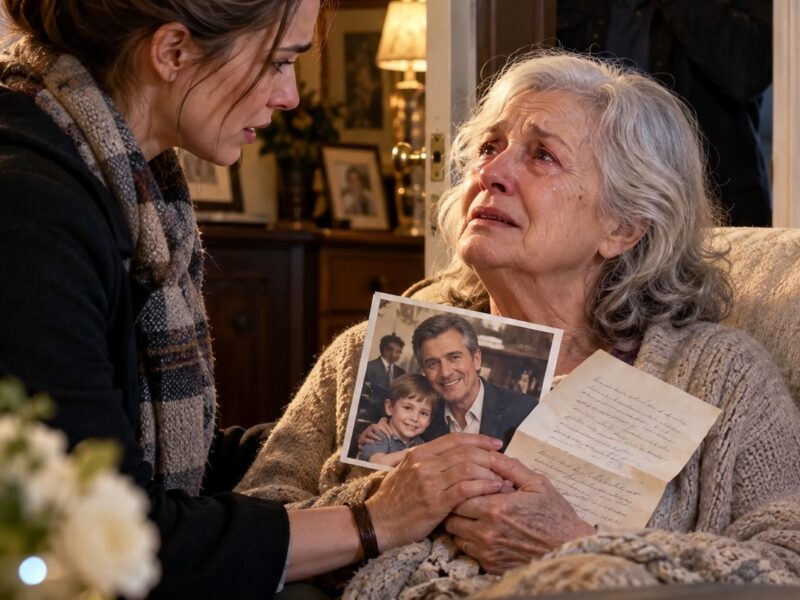
An old photograph rested in her hands.
Daniel.
Maybe sixteen years old.
He stood beside Thomas in front of a fishing boat, both of them sunburned and laughing.
Margaret looked smaller than she had a week earlier.
I crouched beside her.
“Do you need a doctor?”
“No.”
“Are you sure?”
“Yes.”
“Then why did you call me three times?”
She looked at the photograph.
“Because I’m a coward.”
I sat down.
Margaret traced the edge of the picture with her thumb.
“I called Daniel.”
My heart jumped.
“And?”
“He didn’t answer.”
“Leave him a message.”
“I did.”
That surprised me.
“What did you say?”
“Nothing useful.”
She smiled sadly.
“I told him to call when he had time.”
“Margaret.”
“I know.”
She closed her eyes.
“I had four years to say the right thing, and when the machine beeped, I asked him to call when he had time.”
I reached for her hand.
It was cold.
Then she said, “I need you to tell him something.”
“No.”
Margaret looked at me.
“No?”
“You tell him.”
“I’m trying.”
“Try harder.”
Her eyes filled.
“You think I haven’t?”
“I think you’re scared.”
“Yes.”
The answer was immediate.
“I am.”
That stopped me.
Margaret looked toward the dark window.
“When Daniel was little, he used to bring me everything he made. Every drawing. Every test. Every crooked birdhouse.”
She laughed softly.
“He would stand there waiting for me to tell him I was proud.”
Her voice trembled.
“And I always did.”
She looked at the photograph again.
“Then somewhere along the way, I stopped saying it.”
“Why?”
“Because parents are fools sometimes.”
She wiped one eye.
“We think our children know.”
I stayed silent.
“Daniel worked so hard. Built a life. Took care of himself. Came home seven times when Thomas was sick.”
Her mouth tightened.
“And all I let him remember was the eighth time he couldn’t.”
The room became painfully still.
“I punished him because I was angry at death.”
A tear slid down her cheek.
“And he thought I was angry at him.”
“You can still tell him.”
“What if he doesn’t answer?”
“Then knock on his door.”
Margaret smiled weakly.
“I’m not climbing three flights of stairs.”
I almost smiled.
Then her fingers closed around mine.
“If something happens before I get the chance…”
“Nothing is happening.”
“Emily.”
Her tone changed.
Not frightened.
Firm.
“If something happens, tell him I was proud of him.”
I stared at her.
“Margaret—”
“Promise.”
“No.”
“Please.”
I hated that word.
Because it wasn’t dramatic.
It was quiet.
Human.
And impossible to refuse.
“I promise.”
Margaret nodded.
Then she looked back at the photograph.
“And tell him his father was proud too.”
That night, I barely slept.
At seven the next morning, I heard Daniel moving upstairs.
At seven-twenty, his front door closed.
I stepped into the hallway too late.
He was already gone.
I spent the entire day arguing with myself.
It wasn’t my place.
Margaret wasn’t dying.
Daniel had boundaries.
But then I remembered the way Margaret had said promise.
At six-thirty that evening, I heard footsteps above me.
I waited five minutes.
Then I climbed the stairs.
Daniel opened the door wearing a navy work shirt.
He looked exhausted.
“Emily?”
I had planned an introduction.
Instead, I said the sentence that had been sitting inside me all day.
“Your mother keeps calling me.”
His expression changed immediately.
“My mother?”
“Yes.”
“Why would she call you?”
“Because she’s lonely.”
Daniel’s face hardened.
I kept going.
“And because she keeps asking about you.”
He looked past me toward the stairs.
“I told you—”
“Daniel, please.”
Something in my voice stopped him.
“Yesterday she called me three times.”
His anger disappeared.
“What happened?”
“She’s okay.”
“What happened?”
The second time was sharper.
“She’s been having some health tests.”
Daniel went completely still.
“What tests?”
“Something with her heart rhythm.”
“Why didn’t she tell me?”
“She tried.”
His eyes flicked toward me.
“What does that mean?”
“She called.”
He turned away.
“I’ve been working twelve-hour shifts.”
“I know.”
“No, you don’t.”
“I know enough.”
He looked at me.
And for the first time, I stopped trying to protect either of them.
“She thinks you don’t want her anymore.”
Daniel’s face tightened.
“That’s not true.”
“You think she blamed you for your father’s death.”
His silence confirmed it.
“She did blame me.”
“For a while.”
He stared at me.
I continued before I lost my nerve.
“She was grieving.”
“So was I.”
“I know.”
“No, Emily.”
His voice cracked.
“I lost him too.”
“I know.”
“And nobody asked me if I was okay.”
That was the first time I saw the boy inside the man.
Not literally.
But suddenly Daniel wasn’t thirty-eight years old standing in an apartment doorway.
He was a son who had arrived six hours too late.
A son who had spent years punishing himself because grief had given him a sentence he couldn’t appeal.
“She knows,” I said.
Daniel shook his head.
“She knows now.”
“That doesn’t change what she said.”
“No.”
I stepped closer.
“But maybe what she says next matters too.”
He looked at me.
I took a breath.
“She told me something yesterday.”
Daniel’s eyes dropped.
“What?”
“She said she’s proud of you.”
Nothing happened at first.
Then everything did.
His jaw tightened.
His lips parted.
His eyes filled so quickly he turned away.
“She said what?”
“She’s proud of you.”
Daniel stared at the wall.
“She hasn’t said that to me in years.”
“I know.”
“How?”
“Because she told me.”
He covered his mouth with one hand.
I waited.
“She really said that?”
“Yes.”
His eyes closed.
Then I remembered the second half.
“And she said your father was proud of you too.”
Daniel made a sound I will never forget.
Not a sob.
Something smaller.
More wounded.
Like a breath collapsing.
He turned away from me and pressed both hands against the kitchen counter.
For a long time, neither of us spoke.
Finally, he whispered, “Why would she tell you?”
“Because sometimes it’s easier to tell a stranger the truth than the person you’re afraid of losing.”
Daniel wiped his face.
“She’s afraid of losing me?”
I almost laughed from the sadness of it.
“Daniel, she thinks she already did.”
He stood there for several seconds.
Then he reached for his coat.
“What are you doing?”
“Going to see my mother.”
We went downstairs together.
Neither of us spoke during the drive.
Daniel gripped the steering wheel tightly.
At one red light, he asked, “What if she doesn’t want to see me?”
“She calls you every week.”
“That isn’t what I asked.”
I looked at him.
“She wants to see you.”
When we reached Margaret’s building, Daniel stayed inside the truck.
Ten seconds.
Twenty.
Thirty.
“Daniel.”
“I know.”
He stared through the windshield.
“I’ve repaired electrical systems in emergency rooms while surgeons were operating twenty feet away.”
“Okay.”
“I’ve crawled inside mechanical shafts six stories up.”
“Daniel.”
“I’m scared to knock on my mother’s door.”
I understood.
“Then be scared.”
He looked at me.
“And knock anyway.”
We climbed the stairs.
Margaret’s door was closed.
Daniel stood in front of it.
Raised his hand.
Stopped.
Then knocked.
Nothing.
His face changed.
He knocked again.
“Mom?”
Silence.
Daniel tried the handle.
Unlocked.
He pushed the door open.
“Mom?”
I felt my stomach drop.
Then Margaret appeared from the kitchen carrying a dish towel.
She stopped.
The towel slipped from her hand.
For one long second, mother and son simply stared at each other.
Daniel looked like he had forgotten every word he had planned.
Margaret looked like she was afraid blinking might make him disappear.
Finally, she whispered, “You came.”
Daniel swallowed.
“Yeah.”
Margaret nodded.
“Good.”
Another silence.
Then Daniel said, “Emily told me.”
Margaret looked at me.
I stayed near the doorway.
“Told you what?”
“That you’re having tests.”
Her expression tightened.
“And?”
Daniel’s voice broke.
“She told me you’re proud of me.”
Margaret closed her eyes.
When she opened them again, tears were running down her face.
“I am.”
Daniel looked down.
“You never said it.”
“I know.”
“Four years, Mom.”
“I know.”
“You let me think—”
“I know.”
His voice rose.
“No. You don’t get to keep saying that.”
Margaret flinched.
Daniel’s hands trembled.
“I spent four years thinking Dad died waiting for me.”
Margaret covered her mouth.
“I thought you hated me for not getting there.”
“I never hated you.”
“You said he waited as long as he could.”
“I know what I said.”
“Do you?”
“Yes!”
The word came out louder than either of them expected.
Margaret’s shoulders shook.
“Yes, Daniel. I know exactly what I said because I have heard it in my own head every day since.”
Daniel stared at her.
“I was cruel.”
She stepped closer.
“I was exhausted and angry and broken, and I needed someone to blame because blaming death wasn’t enough.”
Daniel’s eyes filled again.
“So you blamed me.”
“For a little while.”
Margaret nodded through tears.
“And then I realized how wrong I was.”
“Why didn’t you tell me?”
“Because I was ashamed.”
The answer stopped him.
Margaret looked smaller than ever.
“I kept thinking I would call when I knew exactly what to say.”
She gave a broken laugh.
“Then a week became a month. A month became a year.”
Daniel looked away.
“And every time you became more distant, I told myself it proved you didn’t want me.”
“I was waiting for you to apologize.”
“I was waiting for you to forgive me.”
“I didn’t know you were sorry.”
“I didn’t know you needed me to say it.”
Daniel stared at her.
“How could you not know?”
Margaret nodded.
“You’re right.”
No defense.
No excuse.
Just that.
“You’re right.”
Then she said the words Daniel had waited four years to hear.
“I’m sorry.”
His face folded.
Margaret stepped toward him.
“I’m sorry I made your father’s death heavier for you than it already was.”
Daniel cried openly now.
“I’m sorry I made you believe being late meant you loved him less.”
She touched his face.
“And I am so sorry I let my pride steal four years from us.”
Daniel’s shoulders shook.
“I should’ve called.”
“You did.”
“More.”
“I should have answered.”
“I should have come.”
“I should have asked you to.”
They stood there listing regrets like people emptying stones from their pockets.
Finally, Margaret whispered, “Your father knew you loved him.”
Daniel closed his eyes.
“He did?”
“Yes.”
“How do you know?”
“Because he told me.”
Daniel opened his eyes.
Margaret smiled through her tears.
“The night before he died, he asked whether your flight had landed.”
Daniel’s breath caught.
“I told him it was delayed.”
“What did he say?”
Margaret touched her son’s cheek.
“He said, ‘Tell Danny not to carry this.’”
Daniel broke.
He wrapped his arms around his mother.
Margaret held him with both hands pressed against his back.
Neither of them spoke.
They didn’t need to.
I stepped quietly toward the door.
Before I reached it, Margaret called my name.
“Emily.”
I turned.
She kept one arm around Daniel and held out her other hand.
I crossed the room.
She took mine.
“Thank you.”
I shook my head.
“You did this.”
“No.”
Margaret squeezed my fingers.
“You answered the phone.”
Months passed.
Margaret’s tests eventually showed an arrhythmia her doctors could manage with medication and monitoring.
It wasn’t nothing.
But it wasn’t the ending she had feared either.
Daniel began visiting every Tuesday and Sunday.
At first, the visits were awkward.
Healing often is.
There were conversations that ended too early.
Apologies that had to be repeated.
Old resentments that surfaced unexpectedly.
Once, Margaret called me furious because Daniel had reorganized her medicine cabinet.
“He thinks I’m eighty-seven.”
“You called me because you couldn’t carry groceries.”
“That was different.”
Another week, Daniel knocked on my door holding a casserole dish.
“My mother says you need to eat.”
“I eat.”
“She disagrees.”
Inside the dish was enough lasagna for six people.
On top was a sticky note.
DON’T RETURN EMPTY.
That became our joke.
Then our routine.
Margaret sent food upstairs.
Daniel fixed things in her apartment she hadn’t asked him to fix.
They argued.
They laughed.
They learned how to talk again.
Not perfectly.
Perfectly would have been dishonest.
There were four years between them.
Four years couldn’t be erased by one hug.
But they could be followed by something better.
One Tuesday evening in early spring, I was carrying groceries into my building when I heard voices on the landing above me.
Margaret.
Then Daniel.
“You’re holding it wrong.”
“I’ve been holding screwdrivers since before you were born.”
“And apparently incorrectly the entire time.”
I climbed the stairs.
Margaret was standing beside Daniel while he repaired the loose railing outside my apartment.
She was holding a flashlight.
Badly.
Daniel looked at me.
“Please tell my mother pointing a flashlight at my ear is not helpful.”
Margaret shrugged.
“You have two hands. Adapt.”
I laughed.
For a second, everything felt ordinary.
And maybe that was the miracle.
Not some grand transformation.
Not forgiveness arriving like lightning.
Just a mother irritating her son while he repaired a railing.
A son pretending to be annoyed because admitting he loved having her there would embarrass them both.
A Tuesday evening.
A grocery bag.
A flashlight pointed in the wrong direction.
Small things.
The same kind of small things that had started all of this.
Months earlier, I had believed kindness had to be visible to count.
Something generous.
Something impressive.
Something people would remember.
Margaret taught me otherwise.
Sometimes kindness is driving a stranger to a pharmacy.
Sometimes it is carrying four grocery bags upstairs.
Sometimes it is listening to the same childhood story twice because the person telling it isn’t really telling you a story.
They are telling you who they miss.
Sometimes kindness is refusing to accept “I’m fine” when someone’s voice says otherwise.
And sometimes it means carrying a sentence up one flight of stairs because two people who love each other have forgotten how to cross the distance themselves.
A few weeks later, I visited Margaret.
She was making coffee.
On the refrigerator was a new photograph.
Daniel and Margaret.
It had been taken recently.
They were sitting in a diner booth, both laughing at something outside the frame.
Beside it was the old picture of sixteen-year-old Daniel and his father.
And beneath both photographs hung the crooked wooden Christmas star.
MOM.
Still written in a seven-year-old boy’s uneven handwriting.
I touched it lightly.
“You moved it.”
Margaret looked over.
“It belongs there.”
Then her phone rang.
She glanced at the screen.
Her entire face changed.
Not dramatically.
Just enough.
Daniel.
She answered immediately.
“Hello?”
A pause.
Then she smiled.
“Yes, I took my medicine.”
Another pause.
“No, you do not need to come check.”
She rolled her eyes at me.
“Yes, Daniel.”
Pause.
“I know.”
Another pause.
Her expression softened.
Then she said something I had never heard her say so easily before.
“I love you too.”
She hung up.
For a moment, neither of us spoke.
Then Margaret looked at me.
“You know what’s funny?”
“What?”
“All those years, I kept waiting for the right moment.”
She looked at the photograph.
“I thought there would be some perfect opportunity to say everything.”
She shook her head.
“There isn’t.”
“No.”
“There’s only the next phone call.”
I smiled.
“Then answer it.”
Margaret smiled back.
“I intend to.”
That night, I walked home through the cool spring air.
When I entered my building, I heard Daniel upstairs.
Music was playing softly through his open apartment door.
A few seconds later, he appeared at the railing.
“Emily.”
I looked up.
“What?”
He held up a casserole dish.
“My mother says this belongs to you.”
I laughed.
“Is it empty?”
Daniel looked inside.
“Unfortunately.”
“You know the rule.”
He groaned.
“I know the rule.”
I carried the dish upstairs.
And standing there in that old hallway, I thought about the morning I had first approached his door.
Your mother keeps calling me.
At the time, the sentence had sounded almost like an accusation.
Now it sounded completely different.
Because some calls are not interruptions.
Some are invitations.
Some are apologies waiting for enough courage.
Some are people reaching across years of hurt to ask, without knowing how to say it:
Are you still there?
Do I still matter?
Is it too late?
And maybe the saddest thing about love is how often we assume there will always be another chance to answer.
Another Sunday.
Another Christmas.
Another ordinary evening.
Another call.
Margaret had nearly learned that lesson too late.
Daniel had nearly learned it after there was nobody left to call.
But this time, a phone rang.
Someone answered.
And two people who had spent four years loving each other from opposite sides of silence finally found their way home.









