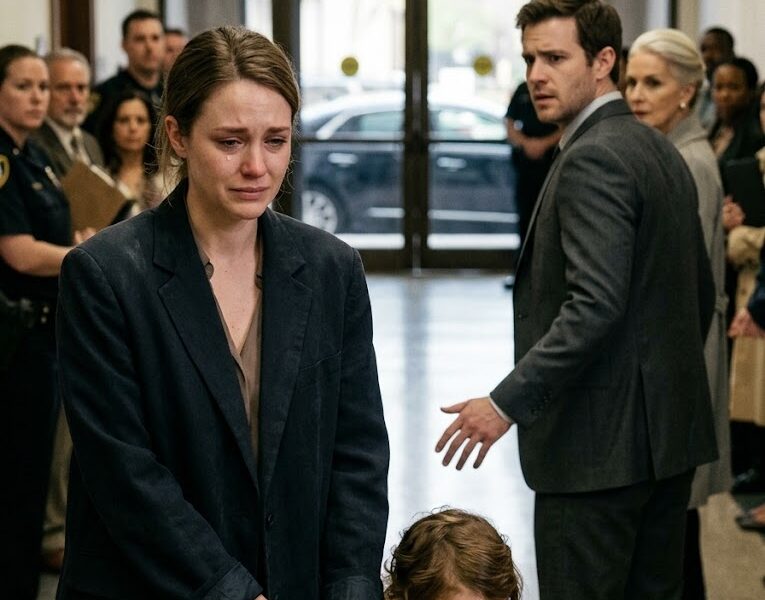
His Mother Tried to Take My Daughter—Then the Judge Read the DNA Results Out Loud
“Leave my son alone before he loses everything because of you.”
Eleanor Hale said it quietly.
That was what made it cruel.
She wasn’t shouting across the courthouse hallway. She wasn’t trembling with anger. She wasn’t even looking at me like I was a person she hated.
She looked at me the way wealthy people sometimes look at a stain on expensive fabric—something unfortunate, something beneath discussion, something that simply needed to be removed.
My two-year-old daughter, Hannah, was holding my hand.
Her fingers were sticky from the strawberry cereal bar she had eaten in the car. One pink sneaker was untied. A tiny yellow rabbit hung from her other hand by one ear.
Eleven minutes from then, a family court judge would decide whether she could continue living with me.
And the woman standing six feet away had spent the last three weeks trying to make sure the answer was no.
I tightened my grip around Hannah’s fingers.
Then immediately loosened it.
She was two.
She didn’t deserve to feel my fear.
“She deserves the truth,” Eleanor continued, smoothing the cuff of her cream-colored coat. “Not your lies. Not your threats. Not whatever revenge you think this child will buy you.”
I stared at her.
For three years, I had imagined what I would say if I ever saw her again.
I had imagined rage.
I had imagined throwing every sleepless night at her feet. Every double shift. Every daycare invoice. Every fever I had sat through alone. Every birthday candle David had never seen his daughter blow out because his mother had made sure he never knew she existed.
But when the moment finally came, I felt strangely calm.
Maybe terror does that when it becomes too large.
Maybe there comes a point when fear stops shaking you and turns into something colder.
“You’re right about one thing,” I said.
For the first time, Eleanor’s expression shifted.
“Hannah deserves the truth.”
The heavy courtroom doors opened behind her.
I looked past Eleanor’s shoulder.
And my heart stopped.
A man stepped through the doorway wearing a charcoal suit and a dark blue tie, one hand still resting on the brass handle.
He was taller than I remembered.
Older around the eyes.
His hair was shorter. His shoulders broader. There was a thin line beside his mouth that hadn’t existed three years earlier.
But I knew that face.
I knew the slight crease between his eyebrows when he was confused.
I knew the small scar beneath his chin from falling off a bicycle at thirteen.
I knew the hands.
God, I knew those hands.
They had once held my face as though I were something precious.
They had once rested against my stomach without knowing what was already waiting there.
David Hale.
The man I had spent three years teaching myself not to love.
The man I believed had chosen his family’s fortune over me.
The man whose mother had just filed a petition to take his daughter away.
He stopped when he saw me.
“Simone?”
The sound of my name in his voice nearly destroyed every wall I had built.
Hannah looked up at me.
Then she followed my gaze.
She studied David with the solemn curiosity toddlers reserve for strangers, dogs, and people they somehow find interesting without knowing why.
Then she lifted one small finger toward him.
“Mommy?”
David’s eyes moved from my face to hers.
Something changed in his expression.
Not recognition.
Not yet.
Something more instinctive.
A question his mind had not caught up with.
Eleanor turned sharply.
“David, you shouldn’t be here.”
He barely looked at her.
“What is this?”
Nobody answered.
His gaze returned to Hannah.
“How old is she?”
My throat tightened.
Behind me, my attorney, Grace Owens, rose from the bench where she had been organizing documents.
“Mr. Hale,” she said carefully, “perhaps you should speak with your counsel.”
David’s face hardened.
“I asked how old she is.”
I could hear the rainwater dripping from the courthouse gutters outside.
I could hear Hannah humming to herself.
I could hear my own heartbeat.
“Two,” I said.
David stared at me.
Then at Hannah.
Then back at me.
I watched the arithmetic begin behind his eyes.
And for the first time that morning, Eleanor Hale looked afraid.
Three years earlier, David had asked me to meet him beneath the rose arbor behind the Harbor Grand Hotel in Charleston.
I was twenty-six.
I had been in South Carolina less than four months, working a temporary nursing contract at St. Matthew’s Medical Center and still occasionally getting lost driving home after night shifts.
David and I had met in the least romantic place imaginable.
The emergency department.
He had cut his palm badly enough to need eleven stitches after trying to repair an antique sailboat himself instead of paying someone who knew what they were doing.
“You’re terrible at being rich,” I told him while cleaning the wound.
He laughed.
“You’re assuming I’m rich.”
“You arrived wearing a watch that costs more than my car.”
He glanced at his wrist.
“This?”
“Yes, that.”
“My grandfather gave it to me.”
“Your grandfather had excellent taste.”
“He also had money.”
“So I was right.”
That was how it began.
Not with champagne.
Not with a yacht.
Not with some ridiculous billionaire fantasy.
With blood on a hospital towel and a man trying not to wince while a nurse teased him.
I didn’t learn until our third date that his family owned Hale Maritime Group, one of the largest privately held shipping and logistics companies on the East Coast.
By then, I already liked the way he listened.
That became the dangerous part.
David listened as though what you said mattered.
He remembered that I hated raw onions.
He remembered my mother had died when I was nineteen.
He remembered I wanted to work someday in pediatric oncology.
He remembered the name of the nursing professor who once told me I wasn’t disciplined enough to finish school.
He remembered everything.
Or at least I believed he did.
For eight months, we built a small life between two worlds.
Mine smelled like hospital disinfectant, laundromat detergent, and takeout eaten after midnight.
His smelled like polished wood, salt air, and old money.
I never asked him to choose between them.
I only asked him not to be ashamed of mine.
He wasn’t.
His mother was.
I met Eleanor exactly once before the afternoon she destroyed us.
Dinner at the Hale family home outside Charleston.
It wasn’t really a home.
It was a historic waterfront estate with columns, live oaks, and a dining room table long enough to make conversation feel like diplomacy.
Eleanor asked where my father worked.
“Municipal transit,” I said.
She smiled.
“And your mother?”
“She passed away.”
The smile disappeared for precisely the socially appropriate number of seconds.
“I’m sorry.”
“Thank you.”
“And your family is from?”
“Ohio.”
“No, I meant originally.”
I understood.
David understood too.
His fork stopped against his plate.
“Mother.”
“I’m making conversation.”
“No, you’re conducting an interview.”
Eleanor smiled at him.
Then she looked at me.
That was the first time I understood that she did not see me as David’s girlfriend.
She saw me as a problem he had not yet realized needed solving.
Two weeks later, David asked me to meet him at the Harbor Grand.
He sounded nervous.
Excited.
“I need to talk to you about something,” he said.
“What kind of something?”
“The kind I’d rather say in person.”
I spent the entire afternoon wondering if he was going to ask me to move in with him.
A small, reckless part of me wondered if it might be something more.
I bought a new dress.
Blue.
David once told me blue made my eyes look brighter.
I waited beneath the rose arbor for forty-seven minutes.
David never came.
His mother did.
Eleanor wore pale silk and pearl earrings.
An assistant followed several steps behind carrying a leather folder.
“I’m afraid David won’t be joining you.”
I stood.
“What happened?”
“Nothing happened.”
“Then where is he?”
“Taking care of his future.”
I remember laughing because I thought I had misunderstood.
“I’m sorry?”
Eleanor sat without being invited.
“Sit down, Simone.”
“I’d rather stand.”
“That’s fine.”
She nodded to the assistant.
He placed the folder on the table.
“What is that?”
“A practical solution.”
“I don’t understand.”
“I think you do.”
I didn’t touch the folder.
Eleanor folded her hands.
“David has responsibilities you cannot possibly appreciate. Thousands of employees depend on the decisions this family makes. There are contracts, partnerships, obligations—”
“I’m dating your son. I’m not applying to run your company.”
“You’re interfering with his ability to do so.”
My face grew hot.
“David doesn’t think that.”
“My son is in love.”
She said it like a diagnosis.
“People in love confuse desire with destiny.”
I stared at her.
“And what do you confuse control with?”
For the first time, the smile disappeared.
“You’re intelligent,” she said. “That is one of the reasons this needs to end cleanly.”
She pushed the folder toward me.
“Take it.”
“No.”
“You haven’t opened it.”
“I don’t need to.”
“There is enough money inside to pay off your student loans, purchase a home, and never worry about rent again.”
I felt something cold spread through my chest.
“Does David know you’re doing this?”
Eleanor didn’t answer.
That was answer enough.
I stepped backward.
“Tell him I waited.”
“You will not contact him.”
I almost laughed again.
“You don’t get to decide that.”
Her expression changed.
Only slightly.
But enough.
“Actually, Simone, I do.”
Then she explained exactly how.
My nursing contract depended on immigration and employment documentation that could become complicated very quickly.
My temporary housing belonged to a medical placement agency with business relationships throughout the region.
David was preparing to take a larger leadership role inside Hale Maritime.
And the company was negotiating a merger with another family-controlled transportation group.
A merger Eleanor considered essential.
“You can leave tonight,” she said, “with enough money to begin again.”
“And if I don’t?”
She leaned back.
“I will make sure David understands that you approached this relationship for financial reasons. I will make sure every employer considering sponsoring you receives enough questions about your professional history to become uncomfortable. And I will make sure my son spends the next several years watching everything his grandfather built collapse around him while knowing you were the reason.”
“You’re threatening me.”
“I’m explaining consequences.”
I looked at the folder.
Then at her.
“You really think he’ll believe you?”
Something almost like pity appeared in her eyes.
“I raised him.”
Those three words frightened me more than anything else she had said.
I left without the money.
But I did leave.
That night.
I told myself it was temporary.
I told myself I would contact David after I had found another position.
I told myself I was protecting him from a war he had not asked for.
Six weeks later, I stood alone in a clinic bathroom staring at two pink lines.
Pregnant.
I sat on the closed toilet seat for twenty minutes.
Then I laughed.
Then I cried so hard a woman in the next stall asked whether she should call someone.
I almost said yes.
I almost gave her David’s number.
Instead, I said, “I’m okay.”
It was the first lie I told for Hannah.
It wouldn’t be the last.
I wrote David a letter that night.
Then another three days later.
Then another.
I sent them to his office because Eleanor had made it clear his private number might no longer reach him.
No answer came.
I emailed.
Nothing.
I called once.
His number had changed.
Two months later, a photograph appeared in a Charleston business magazine.
David Hale standing beside Claire Devereaux, daughter of the man whose company was merging with Hale Maritime.
The headline called them “the next generation of Charleston power.”
The article referred to Claire as David’s fiancée.
I read it twice.
Then I threw up in the kitchen sink.
That night, I stopped writing.
Or tried to.
I lasted eleven days.
Then I wrote again.
Seventeen letters over three years.
Some angry.
Some desperate.
Some embarrassingly hopeful.
One contained a photograph from Hannah’s first ultrasound.
One announced her birth.
One contained a tiny ink print of her foot.
One said only:
She has your eyes.
I never received a reply.
Eventually, silence becomes an answer even when nobody actually speaks.
So I built a life around it.
Hannah was born during a thunderstorm.
Seven pounds, two ounces.
A furious little voice.
Dark hair.
David’s chin.
I held her against my chest and promised her two things.
That she would always know she was loved.
And that nobody with more money than me would ever get to decide whether she belonged in my arms.
For almost three years, I kept that promise.
Then the black sedan started appearing outside our apartment.
At first I thought I was imagining it.
Same tinted windows.
Different parking spaces.
Sometimes it stayed twenty minutes.
Sometimes two hours.
Then an anonymous complaint was filed with the hospital questioning irregularities in my employment documentation.
Two weeks later, another complaint reached immigration authorities.
Then Hannah’s daycare received a call from someone claiming to be conducting a “family welfare assessment.”
That was when I contacted Grace Owens.
Grace was thirty-three, five-foot-four, soft-spoken, and terrifying when someone underestimated her.
She listened to everything.
Then she asked one question.
“Who has enough money to make your life fall apart without ever touching you?”
I didn’t hesitate.
“Eleanor Hale.”
Grace investigated.
What she found was worse than I expected.
The custody petition had been filed through a private family trust connected to the Hales.
The argument was that Hannah was biologically connected to the Hale family through “credible but undisclosed evidence” and that I was an unstable guardian.
The petition never named David as Hannah’s father.
It did something more strategic.
It suggested enough to establish standing without giving David enough information to understand why.
“They’re trying to take her without telling him,” I whispered.
Grace looked at me across her desk.
“Yes.”
“Can they?”
“If we let them control the story.”
That was how I ended up standing outside Courtroom Four on a rainy Tuesday morning with Hannah holding my hand and David Hale looking at her like his own face had become a mystery.
Inside the courtroom, the Hale family attorney rose first.
His name was Charles Whitmore.
Silver hair.
Tailored suit.
Voice designed to make cruelty sound reasonable.
“Ms. Carter,” he began, “is a temporary resident whose professional status has been subject to recent review.”
Grace whispered, “Don’t react.”
I kept my eyes on the judge.
“She has relocated three times within two years. She has no immediate family in South Carolina. Her financial resources are limited. Her employment requires irregular hours, including overnight shifts.”
Everything was true.
That was the genius of it.
A lie built entirely from facts.
I had moved because the first landlord suddenly refused to renew my lease.
I left the second apartment after the black sedan appeared.
The third was closer to the hospital and cheaper.
My immigration problem existed because someone had anonymously created it.
My night shifts paid enough to keep Hannah in daycare during the day.
Whitmore turned toward the judge.
“The Hale family can provide permanent housing, full-time childcare, private education, comprehensive medical coverage, and long-term financial security.”
My stomach twisted.
He was describing money as though it were motherhood.
Then he said the sentence that nearly broke me.
“This court must ask whether Ms. Carter’s desire to retain custody serves the child—or herself.”
I heard Hannah shifting behind me in my friend Mira’s arms.
I wanted to turn around.
I didn’t.
Grace rose.
“Your Honor, opposing counsel has spent ten minutes describing the Hale family’s bank account and approximately ten seconds describing Hannah Carter.”
Whitmore frowned.
Grace continued.
“Children are not corporate acquisitions. Stability is not measured by square footage. Parenting is not established through investment portfolios.”
Eleanor remained motionless.
But David looked at his mother.
Then at me.
Confusion had become suspicion.
During recess, he found me near a window at the end of the hallway.
I heard his footsteps before he spoke.
“Three years.”
I closed my eyes.
Then turned.
He stopped several feet away.
“You disappear for three years,” he said, “and I walk into court because my mother tells me there’s a family emergency, and suddenly there’s a two-year-old girl everyone seems afraid to explain to me.”
“David—”
“Is she mine?”
There it was.
No preparation.
No gentleness.
Just the question that should have been asked years earlier.
I looked into his face.
“Do you really want the answer?”
His jaw tightened.
“I wouldn’t have asked.”
Before I could respond, anger rose in me.
Three years of it.
“Where were you?”
His eyes narrowed.
“What?”
“Where were you when she was born?”
“I didn’t know she existed.”
“Where were you when I wrote?”
“You never wrote.”
I stared at him.
“Yes, I did.”
“No.”
“Seventeen times.”
His face changed.
I continued before courage failed.
“I sent ultrasound photographs. I sent her birth information. I sent you a picture when she turned one.”
“Stop.”
“I wrote you when she had pneumonia because I was terrified she was going to die and I had nobody except Mira sitting beside me in the emergency room.”
“Simone, stop.”
“Why? Because it doesn’t fit the story you were told?”
He stepped closer.
“My mother told me you took money.”
The hallway seemed to tilt.
“What?”
“She said you accepted a settlement. She said you admitted you never wanted the relationship to become serious.”
I actually laughed.
It sounded ugly.
“She offered me money.”
“And you took it.”
“No.”
“She showed me documents.”
“I left the folder unopened on the table.”
“She told me you signed.”
“I signed nothing.”
Silence.
For the first time, certainty left his face.
“My mother told me you asked me never to contact you again.”
“Your mother told me she would destroy your career and my ability to remain in the country if I stayed.”
His mouth opened.
Nothing came out.
“I believed you chose Claire,” I said. “I saw the engagement announcement.”
“That engagement was arranged after you disappeared.”
“You still agreed.”
“Because I thought you sold me.”
The words hit harder than I expected.
“And I thought you abandoned me.”
Neither of us spoke.
Through the frosted glass doors, Hannah’s little silhouette moved past in Mira’s arms.
David watched it.
Then he looked at me.
“Is she mine?”
This time his voice was barely audible.
I swallowed.
“Yes.”
He shut his eyes.
Just once.
Like a man absorbing a blow.
When he opened them again, I saw grief before anger.
“How long has my mother known?”
“I don’t know.”
That was true.
But Grace intended to find out.
When court resumed, she requested permission to enter one item into evidence.
A hospital bracelet.
Tiny.
White plastic faded slightly yellow with age.
Hannah Carter.
Date of birth.
St. Matthew’s Medical Center.
Grace held it carefully.
“This bracelet was issued to Hannah Carter on the day she was born.”
Whitmore stood.
“Your Honor, relevance—”
“You’ll have an opportunity, Mr. Whitmore.”
Grace read the date.
Then she entered hotel records showing David and me staying together exactly thirty-eight weeks earlier.
A murmur moved through the courtroom.
The judge looked over her glasses.
“Counsel, are you asserting that Mr. David Hale may be the biological father?”
“We are asserting that the petitioner has attempted to litigate custody around that fact while deliberately preventing the alleged father from knowing it.”
Every head turned toward Eleanor.
She did not move.
Grace continued.
“We request an expedited paternity test.”
The judge approved it.
David sat frozen.
Then he looked at his mother.
Eleanor looked straight ahead.
That was when I understood something.
She knew.
Maybe not from the beginning.
Maybe not every detail.
But she knew enough.
And David understood it too.
During the second recess, he followed her outside.
I didn’t hear their conversation until much later.
David told me every word.
“Did you know?”
Eleanor stood beside her waiting car.
“David—”
“Did you know Hannah might be mine?”
His mother looked toward the courthouse.
“Keep your voice down.”
“That isn’t an answer.”
“You are upset.”
“Did. You. Know?”
A long pause.
Then:
“I knew there was a possibility.”
David stared at her.
“For how long?”
“David, you need to understand what was happening then.”
“How long?”
“Before the merger.”
His face went pale.
Three years.
She had known for three years.
“You hid my daughter from me.”
“I protected you.”
“From my daughter?”
“From a situation that could have destroyed everything your grandfather spent his life building.”
“You mean the merger.”
“I mean thirty years of work.”
David stepped back as if distance could make her words less horrifying.
“You threatened Simone.”
“I gave her a choice.”
“No. You gave her fear and called it a choice.”
Eleanor’s expression hardened.
“You have no idea what leadership costs.”
“And you have no idea what you cost me.”
“She was a foreign contract nurse with no family here. You were about to become president of Hale Maritime. Claire’s family controlled port access we needed for expansion. There were thousands of jobs involved.”
David stared at her.
“Say her name.”
“What?”
“My daughter’s name.”
Eleanor went silent.
“Hannah,” David said. “Her name is Hannah. She is not a complication. She is not a merger risk. She is not an item on one of your spreadsheets.”
His voice broke.
“She’s your granddaughter.”
For the first time in David’s life, his mother looked away first.
The DNA results came back the following afternoon.
Probability of paternity: 99.9998 percent.
David was Hannah’s father.
I expected triumph.
Instead I felt tired.
So tired I wanted to sleep for a year.
David sat beside his attorney staring at the report.
Then the judge asked the question nobody had prepared me to hear.
“Mr. Hale, do you accept legal acknowledgment of paternity?”
He stood.
His voice was steady.
“I accept her completely.”
He looked at Hannah.
“I should have known sooner.”
Eleanor’s attorney immediately requested a private recess.
Grace opposed it.
The judge denied it.
But the DNA test did not end the case.
It made it uglier.
Because now Eleanor was no longer fighting to protect the Hale family from an outsider’s child.
She was fighting to control her own granddaughter.
That evening, David met me in an empty family room at St. Matthew’s.
Hannah was asleep nearby after routine blood work connected to the court proceedings.
Rain tapped against the window.
For the first time in three years, David and I sat alone without lawyers, mothers, judges, or accusations.
He looked exhausted.
“You said she had pneumonia.”
I nodded.
“When?”
“Last winter.”
“How bad?”
“Bad enough that they admitted her for two nights.”
He looked down.
“Was she scared?”
“Yes.”
“What did she want?”
I almost smiled.
“Cartoons. Apple juice. Her rabbit.”
His mouth twitched.
“The yellow one?”
“His name is Mr. Buttons.”
“That rabbit doesn’t have buttons.”
“She was eighteen months old when she named him.”
David nodded as though this were critical information.
“What else?”
“What do you mean?”
“What else did I miss?”
That question broke something in me.
So I told him.
I told him about Hannah’s first tooth.
Her first word—“light.”
Her habit of sleeping sideways.
How she hated peas but loved broccoli for reasons nobody understood.
How she had taken her first steps toward the laundry basket because she wanted to steal a sock.
I told him about night shifts when I had calculated grocery prices down to the dollar.
About learning which pharmacies stayed open after midnight.
About Mira coming over after twelve-hour shifts because I had a fever and couldn’t safely hold Hannah.
About sitting on the bathroom floor crying silently while Hannah slept because my rent had increased and I didn’t know where we would go.
David listened.
He never defended himself.
When I finished, he said, “I checked my phone every day.”
I looked at him.
“For almost two years.”
His eyes were red.
“I kept thinking eventually you’d call. Then I started hating myself for hoping.”
“You could have looked for me.”
“I did at first.”
“How hard?”
He flinched.
The question was cruel.
It was also fair.
“Not hard enough.”
I said nothing.
“I believed her,” he continued. “That’s the part I can’t excuse. She showed me a copy of a settlement agreement with what looked like your signature.”
“I never signed it.”
“I know that now.”
“You should have known then.”
“Yes.”
No argument.
No explanation.
Just yes.
That mattered more than I wanted it to.
“I’m sorry,” he said. “Not because I didn’t know about Hannah. I couldn’t know what was hidden from me. I’m sorry because I knew you, and when someone gave me a version of you that contradicted everything I knew, I chose the easier story.”
I looked at him.
“That doesn’t give us back three years.”
“No.”
“It doesn’t make you her father because a test says so.”
“No.”
His eyes met mine.
“But if you let me, I’d like to spend the rest of my life becoming one.”
For one dangerous second, I saw the man beneath the rose arbor who had never arrived.
Then the door opened.
Grace stood there.
Her face told me immediately something was wrong.
“Simone.”
I stood.
“What happened?”
“They filed new evidence.”
The document was a sworn statement from my former neighbor, Patricia Mills.
According to Patricia, I had repeatedly left Hannah alone overnight.
According to Patricia, Hannah often cried for hours without supervision.
According to Patricia, strangers frequently entered my apartment.
Every accusation was false.
Every sentence was devastating.
Whitmore announced that if the court accepted the statement, the Hale family would request immediate review of my visa status and emergency placement of Hannah.
I felt the room shrink around me.
“They’re going to deport me.”
Grace grabbed my shoulders.
“Look at me.”
“They’re going to take her and deport me.”
“Look at me.”
I forced myself to.
“Do you trust me?”
“Yes.”
“Then don’t collapse before we know whether the floor is actually gone.”
But it felt gone.
Later, in the hallway, I gripped the back of a chair so tightly my fingers hurt.
Mira crouched beside me.
“She won’t stop,” I whispered.
“No.”
“She has more money. More lawyers. More connections.”
“Yes.”
“How do I fight someone who can buy a new truth every time the old one fails?”
Mira squeezed my hand.
“You don’t buy a better truth.”
I looked at her.
“You prove the real one.”
The proof arrived the next morning inside a cardboard box.
A young man approached Grace before court.
His name was Julian Park.
David’s executive assistant.
I had seen him once years earlier outside Hale Maritime headquarters.
Now his hands were shaking.
“I need to give you something.”
Grace immediately asked whether he had counsel.
“I don’t care anymore.”
He set the box down.
Inside were seventeen sealed envelopes.
My handwriting.
My stamps.
My letters.
Every one of them addressed to David.
I stopped breathing.
“No.”
Julian looked at me.
“I’m sorry.”
I picked up the first envelope.
The postmark was three years old.
Unopened.
The second contained Hannah’s ultrasound.
The third had been sent two weeks before her birth.
One by one, the years I thought David had ignored me rose out of that cardboard box.
“Where were these?”
Julian swallowed.
“Mrs. Hale’s private office.”
David had entered the hallway behind us.
He heard everything.
“My mother had these?”
Julian turned.
“I was told to intercept any correspondence from Ms. Carter.”
David went completely still.
“For three years?”
“Yes.”
“And you did?”
“At first.”
Julian looked ashamed.
“Then I started keeping them instead of destroying them.”
“Why?”
“I don’t know.”
His eyes moved toward Hannah, who was coloring at a table nearby.
“Maybe because they didn’t look like threats.”
He looked back at David.
“They looked like someone trying to reach you.”
Grace entered all seventeen letters into evidence.
Then she produced something else.
A recording.
Patricia Mills.
My former neighbor.
Grace had contacted her the night before and confronted her with bank records.
The recording began with Patricia crying.
Then came the words that changed the case.
“I needed the money.”
Grace asked, “Who paid you?”
A pause.
Then:
“A consultant working for Mrs. Eleanor Hale.”
The courtroom erupted.
Whitmore stood.
“Your Honor—”
The judge raised one hand.
“Sit down.”
He did.
The judge listened to the entire recording.
A payment of twenty-five thousand dollars.
Instructions to describe me as negligent.
Promises that Patricia would never need to testify if the custody petition succeeded quickly.
Eleanor sat perfectly straight.
But perfection had stopped looking powerful.
Now it looked desperate.
David did not look at her.
Neither did I.
The judge removed her glasses.
“Mrs. Hale, I strongly advise you not to leave the jurisdiction pending review of these allegations.”
For the first time, Eleanor’s face lost color.
And then something happened nobody planned.
Hannah wriggled out of Mira’s arms.
“Hannah,” I whispered.
She toddled into the aisle.
The courtroom quieted.
She looked at me first.
Then David.
David froze.
Hannah took another step.
Then another.
Her balance was still imperfect, her yellow rabbit dragging against the floor.
David slowly crouched.
He didn’t reach for her.
That mattered.
He waited.
Hannah stared at him.
Then she lifted both arms.
“Up.”
A sound escaped David’s throat.
Not quite a laugh.
Not quite a sob.
He looked at me.
Asking.
Even then.
Even in that moment.
He asked.
I nodded.
David crossed the remaining distance and lifted his daughter for the first time.
Hannah placed one hand against his cheek.
She studied him.
Then she touched his nose.
David laughed through tears.
“Hi.”
Hannah blinked.
“Hi.”
He pressed his forehead gently against hers.
I covered my mouth.
For three years I had imagined justice as Eleanor losing.
I had imagined courtroom victories.
Exposed lies.
Consequences.
But watching Hannah curl one tiny hand around David’s tie, I understood that justice sometimes looked much quieter.
Sometimes it looked like giving back a moment someone had stolen.
The judge’s decision came less than an hour later.
The emergency custody petition was denied.
Full physical custody remained with me.
The fabricated neglect complaint was referred for criminal investigation.
The immigration complaint was flagged for review based on evidence of malicious interference.
David was formally recognized as Hannah’s biological and legal father.
He did not ask for immediate shared custody.
That surprised everyone except me.
When the judge asked what arrangement he sought, David stood.
“Whatever allows my daughter to know me without taking security away from the mother who has been her entire world.”
Eleanor looked at him then.
He never looked back.
The consequences moved quickly after that.
Hale Maritime’s board called an emergency meeting.
The Devereaux merger, the very deal Eleanor had sacrificed our lives to protect, collapsed under scrutiny after internal documents revealed how extensively personal influence had been used to suppress information and pressure outside parties.
Eleanor stepped down from daily control of the company before the month ended.
David’s engagement to Claire Devereaux was formally dissolved.
I later learned Claire had known for years that David did not love her.
When she called me, I expected hostility.
Instead she said, “Your daughter deserved better from all of us.”
“So did you.”
She was silent.
Then she laughed sadly.
“Maybe.”
Eleanor never apologized.
Not to me.
Not to Hannah.
Not really to David.
Months later, she sent Hannah a birthday gift.
A handcrafted dollhouse that probably cost more than my first car.
I returned it.
Not because I wanted revenge.
Because Hannah was learning something I had learned too late.
A gift is not the same thing as love.
Money is not the same thing as repair.
And access to a child is not something you purchase because you share blood.
David understood that.
He never tried to rush us.
He showed up.
That sounds simple until you have lived through years of someone not showing up.
Tuesday pediatric appointment?
He was there ten minutes early.
Daycare Halloween parade?
There.
Hannah’s fever at 2:13 in the morning?
He arrived wearing sweatpants and two different socks because he had apparently dressed while running downstairs.
He learned that Hannah needed Mr. Buttons facing the bedroom door before she would sleep.
He learned she called blueberries “blue balls,” which caused several embarrassing grocery store moments.
He learned she hated having water poured over her head in the bath.
He learned not to promise something unless he was absolutely certain he could do it.
He learned fatherhood the same way Hannah learned stairs.
Carefully.
One step at a time.
Sometimes falling.
Always trying again.
He never asked me to forgive him.
That may have been the reason I eventually did.
Six months after the hearing, Hannah was running around a small park near St. Matthew’s while David and I sat on a bench.
It was one of those bright Charleston afternoons when the air smelled faintly of salt even miles from the water.
Hannah chased bubbles another child was blowing.
David watched her.
“She runs like you.”
“She runs like a drunk penguin.”
He laughed.
“She gets that from me.”
For a while we said nothing.
Silence between us used to feel like abandonment.
Now it felt different.
Safe, maybe.
Or at least no longer dangerous.
David’s hand rested on the bench between us.
Not touching mine.
Close.
Waiting.
He had become very good at waiting.
“Do you ever think about that day?” he asked.
“Which one?”
“The hotel.”
I looked across the playground.
“Yes.”
“What do you think would’ve happened if I had arrived first?”
I considered lying.
Instead I said, “I don’t know.”
He nodded.
“I used to imagine we would’ve gotten married.”
“Maybe.”
“Maybe?”
“We were different people.”
“I loved you.”
“I loved you too.”
He looked at me.
The past tense hurt both of us.
But truth was allowed to hurt now.
We had learned what happened when people tried to make it painless.
“I had a ring,” he said.
I turned.
“What?”
“That afternoon.”
I stared at him.
He smiled without humor.
“I was going to propose.”
For several seconds, the entire park seemed to disappear.
Children.
Cars.
Wind.
Everything.
“You never told me.”
“I didn’t think it mattered anymore.”
“Why tell me now?”
He watched Hannah.
“Because I don’t want there to be another hidden thing between us.”
I swallowed.
“What happened to it?”
“I kept it.”
Of course he had.
I laughed quietly.
“Don’t you dare pull it out right now.”
His eyes widened.
“I wasn’t going to.”
“David.”
“I swear.”
I laughed again.
And suddenly I was crying.
Not violently.
Not dramatically.
Just tears slipping down my face while I smiled at the absurdity of everything we had lost.
David didn’t touch me.
He waited.
So I moved my hand across the bench and placed it over his.
His fingers closed slowly around mine.
No fireworks.
No audience.
No promise that everything would be perfect.
Just a hand.
A choice.
A beginning that knew exactly how much endings could cost.
Hannah came running toward us.
“Mommy!”
She collided with my knees.
David caught her before she fell.
She laughed.
Then she looked down at our joined hands.
Her expression became suspicious.
“What?”
“Nothing,” I said.
She pointed.
“Daddy holding Mommy.”
David looked at me.
I looked at him.
Six months earlier, hearing Hannah call him Daddy would have frightened me.
Now it simply felt true.
“Yes,” I said.
“Daddy’s holding Mommy’s hand.”
Hannah considered this information for approximately two seconds.
Then she grabbed David’s free hand.
“Go.”
“Where are we going?” he asked.
“Bubbles.”
Naturally.
So we went.
The three of us crossed the grass toward a cluster of children chasing soap bubbles through the sunlight.
For a moment, I thought about Eleanor.
About the hotel garden.
The unopened folder.
The seventeen letters.
The black sedan.
The courtroom.
The tiny hospital bracelet Grace held in the air while an entire family’s version of the truth collapsed around it.
I used to think Eleanor had stolen three years from us.
In some ways, she had.
Hannah would never be a newborn in David’s arms.
He would never hear her first word for the first time.
I would never know what pregnancy might have felt like if someone had been beside me rubbing my back when I couldn’t sleep.
There are losses you cannot reverse simply because justice eventually arrives.
That was the hardest lesson.
Winning did not return what had been taken.
Love did not erase betrayal.
DNA did not create trust.
An apology—even if Eleanor had ever offered one—could not rebuild a childhood.
But consequences could stop the theft from continuing.
Truth could reopen doors lies had closed.
And people could choose what they did with whatever time remained.
A bubble floated toward Hannah.
She reached too late.
It burst against her fingers.
She gasped.
Then laughed.
Another drifted toward David.
He caught Hannah beneath her arms and lifted her high enough to reach it.
She squealed.
“Again!”
David lifted her higher.
“Again!”
I watched them beneath the oak trees.
Father and daughter.
Two people who had lost three years without ever knowing the other was waiting.
I thought about the first night after Hannah was born.
I had been alone in a hospital room with rain streaking the window.
She was asleep on my chest.
I remember whispering into her hair, “It’s you and me, baby.”
At the time, it had sounded brave.
Looking back, I realized it had also sounded frightened.
I had believed survival meant needing nobody.
But survival and living are not the same thing.
David lowered Hannah.
She immediately demanded another ride.
He pretended exhaustion.
She did not care.
I laughed.
He glanced toward me.
And there it was.
Not the old love.
Not exactly.
Something quieter.
Something built after illusions.
Something that knew promises could fail and still chose to make small ones.
He mouthed, “Help.”
I shook my head.
“You wanted fatherhood.”
“This is cardio.”
“You own a gym membership.”
“I own access to a gym. Different thing.”
Hannah slapped his shoulder.
“Again!”
“Yes, ma’am.”
He lifted her.
Her laughter rose into the warm afternoon.
I stood there listening.
Years earlier, Eleanor Hale had told me love was not the same as belonging.
For a long time, I believed she had been right.
I thought belonging was something families like hers controlled through names, money, houses, companies, invitations, and closed doors.
But Hannah taught me otherwise.
She belonged wherever she was safe.
Where she was seen.
Where somebody showed up.
Where nobody asked her to become smaller so someone else could remain powerful.
Maybe that was all family ever was.
Not blood.
Not money.
Not even history.
Just people who kept choosing to return.
David carried Hannah toward me.
She stretched her arms out.
“Mommy.”
I took her.
Her cheek was warm against mine.
David stood beside us.
Not ahead.
Not behind.
Beside.
I looked down at Hannah’s tiny hand resting against my collarbone.
Once, in a courtroom filled with strangers, that same hand had reached toward a father she had barely met.
Everyone thought the DNA test was the moment the truth finally arrived.
They were wrong.
The truth had been there all along.
In seventeen unopened letters.
In a mother working double shifts.
In a man checking a silent phone.
In a child growing up between two people who had each been taught that the other had chosen to disappear.
The DNA report merely forced everyone else to stop pretending.
And perhaps that was why I never needed Eleanor’s apology.
She had spent years believing she could control reality if she controlled enough information.
But truth is patient.
It can sit unopened inside a cardboard box for three years.
It can wait inside a hospital bracelet.
It can sleep peacefully in a little girl’s face.
And one day, when everyone who buried it finally believes they have won, it can walk into the middle of a courtroom on unsteady legs, lift both arms, and ask to be held.
Hannah squirmed down from my arms and ran toward the bubbles again.
David started after her.
Then stopped.
He looked back at me and held out his hand.
This time, I didn’t make him wait.
I took it.
And together, we followed our daughter into the light.









