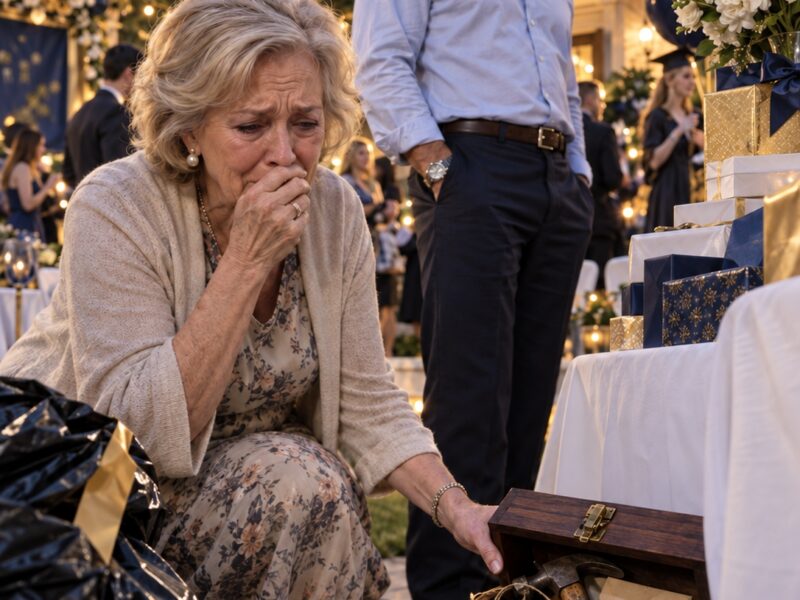
HIS STEPFATHER HID GRANDMA’S GRADUATION GIFT BESIDE THE TRASH—THEN OWEN OPENED THE BOX AND LEFT A $2,000 LAPTOP BEHIND
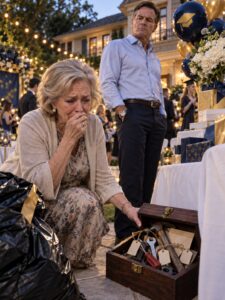
By the time Owen Mercer realized his grandmother had been crying, the graduation party had already become the kind of memory nobody in the family would ever be able to clean up.
Music drifted across the backyard of the polished two-story house in suburban Ohio. Gold-and-navy balloons bounced against the patio railing. A professionally printed banner with Owen’s senior portrait hung above a long gift table covered in white linen, where envelopes stood beside glossy shopping bags and expensive boxes tied with perfect ribbon.
And underneath that table, pushed behind a plastic bin of empty cups and dangerously close to the black trash bags waiting to be taken out, sat a small wooden box.
Nobody had put a card on it.
Nobody had mentioned it to Owen.
Nobody was supposed to notice it at all.
But Owen did.
He crouched beside the table, pulled the box toward him, and recognized the dark walnut lid before he even touched the brass latch.
His stomach tightened.
He had seen his grandmother carrying it when she arrived.
Which meant somebody had deliberately hidden it.
And when Owen looked across the yard and saw seventy-two-year-old Darlene Mercer sitting alone on a folding chair near the side gate, twisting a paper napkin between her fingers while pretending not to cry, he knew exactly who he needed to confront.
What he did not know yet was that the box Grant had called “junk” contained the last thing Owen’s grandfather had ever prepared for him.
And once Owen opened it, the expensive graduation gift waiting upstairs would suddenly mean almost nothing.
Three hours earlier, Darlene had nearly left the box at home.
She stood in the narrow hallway of the modest brick ranch where she had lived for thirty-eight years, one hand resting on the doorframe and the other wrapped around the leather handle.
The box was heavier than she remembered.
Not because of what was inside.
Because of who was no longer there to carry it with her.
Sunlight came through the living-room blinds and landed across the faded recliner that had belonged to her husband, Henry. The chair had been empty for four years, yet Darlene still occasionally glanced toward it when she heard the evening news begin, as if some stubborn part of her expected him to complain about the weather forecast.
That morning, she had looked at the box three separate times.
The first time she told herself Owen was too young to understand it.
The second time she told herself graduation parties were for new beginnings, not old memories.
The third time she carried it to the front door.
“Some things deserve one last chance to be carried forward,” she whispered.
The words sounded strange in the quiet house.
Henry would have laughed at her for being sentimental.
Then he would have been more sentimental than she was.
That was the contradiction of the man she had loved for forty-six years.
He had been a machinist, a stubborn repairman, a terrible dancer, a patient grandfather, and the kind of man who refused to throw away any tool that still had one useful job left in it.
Henry believed objects remembered things.
A screwdriver remembered a bicycle.
A wrench remembered a leaking sink.
A pocket level remembered the bookshelf they built crooked the first time and rebuilt properly the next Saturday.
Darlene used to tease him about it.
“Tools don’t have memories.”
Henry would smile without looking up.
“Maybe not. People do. Sometimes they just need something to hold onto while they remember.”
Four years after his funeral, Darlene finally understood what he meant.
She lifted the box and carried it to her old Buick.
Owen Mercer had been six years old the first time Henry let him hold a real screwdriver.
The bike was red, too large for him, and missing one pedal reflector. Owen had watched his grandfather turn the bicycle upside down in the driveway while Darlene brought lemonade onto the porch.
“Rule number one,” Henry had said.
Owen, solemn with concentration, asked, “What?”
“Don’t lose the screws.”
“That’s the rule?”
“That’s always the rule.”
Owen had laughed so hard he dropped one.
Henry found it under the workbench forty minutes later.
For years, the story became family shorthand for Owen’s impatience.
Don’t lose the screws.
Henry said it when Owen assembled his first model airplane.
He said it when Owen tried helping repair the loose kitchen cabinet.
He said it when twelve-year-old Owen dismantled an old radio because he was certain he could “improve” it and then discovered he had no idea how to put it back together.
Even after Owen became a teenager and started spending fewer weekends at his grandparents’ house, Henry kept the old red-handled screwdriver in the top drawer of his garage workbench.
Darlene did not understand why until after he died.
She had found the wooden box six months after the funeral.
Inside were tools.
Not his best tools.
Not the expensive socket set his neighbor later bought from the estate.
These were scratched, ordinary things that looked almost worthless.
Except Henry had tied a small paper tag to every one.
His handwriting covered each card.
The red screwdriver.
Owen’s first bike. Age 6. Lost the screw. Found it before dinner.
A six-inch adjustable wrench.
Kitchen faucet. Owen held the flashlight backward for twenty minutes. Age 8.
A small hammer with black tape around the handle.
Birdhouse. Crooked roof. Best one we ever made. Age 9.
A pair of pliers.
Fixed Grandma’s garden gate. Owen pinched his finger and didn’t cry until Grandma came outside. Age 10.
There were eleven tools in all.
Eleven memories.
At the very bottom rested an envelope with Owen’s name.
Darlene had never opened it.
Henry had written one sentence on the front.
Give him this when he’s leaving home.
That sentence was why Darlene carried the box to Owen’s graduation party.
It was also why what happened there hurt so much.
The Mercer house belonged technically to Rachel and Grant Holloway now, though it had once been the smaller starter home Rachel purchased after her first marriage ended.
Grant had transformed it.
He expanded the kitchen, rebuilt the deck, replaced the ordinary front door with a custom black one, landscaped the yard, and turned the graduation party into something that looked suspiciously like a corporate reception.
Grant liked things done correctly.
Professionally.
Impressively.
Rachel sometimes joked that Grant could turn a child’s lemonade stand into an investor presentation.
He worked in regional medical equipment sales and was proud that he had built a stable life after growing up with very little.
That pride had become something sharper over the years.
Grant noticed price tags.
He noticed brands.
He noticed what people drove into the driveway.
He noticed when Darlene still wore the same church shoes she had owned since Owen was in middle school.
And though Grant never said outright that Rachel’s mother embarrassed him, Darlene had learned to recognize the small signals.
The smile that tightened when she brought homemade potato salad instead of ordering catering.
The suggestion that she might be “more comfortable” wearing something newer to Christmas dinner.
The way he quickly moved her knitted blankets from the living room before guests arrived.
Each thing alone was small enough to excuse.
Together, they created a message.
Darlene belonged to the family.
But preferably somewhere outside the photographs.
Owen never fully saw it.
That was Grant’s greatest advantage.
He was rarely cruel when Owen was watching.
In front of Owen, Grant was the man who attended football games, paid for driver’s education, helped with college applications, and bought him the laptop he had wanted for nearly a year.
Grant had entered Owen’s life when he was eight.
He had never demanded to be called Dad.
He had driven Owen to emergency care when he fractured his wrist at fourteen.
He had taught him parallel parking.
He had helped pay the remaining tuition difference after Owen received a partial scholarship to a state engineering program.
None of those things were false.
That was what made everything complicated.
People wanted villains to be entirely bad.
Families were rarely that convenient.
Grant could love Owen and still treat Darlene terribly.
He could believe he was protecting Owen while humiliating someone Owen loved.
He could do generous things for reasons that were not always generous.
And on graduation night, Grant convinced himself he knew what Owen needed better than Owen did.
Darlene arrived at 4:18.
Owen spotted her before she had taken six steps from the driveway.
He was standing near the front porch with three classmates when his entire expression changed.
“Grandma!”
Darlene barely had time to set down her purse before Owen wrapped both arms around her.
For one beautiful second, she forgot every worry she had brought with her.
“You came.”
His voice sounded genuinely relieved.
Darlene pulled back and touched his cheek.
“Of course I came.”
Owen smiled.
“I was starting to think this crowd scared you off.”
Darlene glanced toward the backyard, where almost sixty people were already circulating beneath rented string lights.
“Not a chance.”
Then her smile softened.
“I waited eighteen years to see you standing here like this.”
Owen looked down at the navy graduation stole still draped around his neck.
“Then stay close tonight.”
He leaned slightly toward her.
“I want some of this party to actually feel like home.”
Those words stayed with Darlene later.
At the time, they felt like a gift.
Grant appeared in the doorway before Darlene could answer.
He wore a pale blue shirt with the sleeves rolled carefully to his forearms. His smartwatch, leather belt, and spotless white sneakers made him look prepared for photographs even while carrying a tray of drinks.
“Darlene.”
“Grant.”
His eyes dropped immediately to the wooden box.
The pause was almost invisible.
Almost.
“What’s that?”
Darlene adjusted the handle.
“Something for Owen.”
Grant looked toward the backyard gift table.
“We already have a spot for gifts.”
“I know.”
She smiled cautiously.
“I was hoping I could give this one to him myself.”
Something shifted in Grant’s face.
Not anger.
Concern.
The kind of expression someone uses when trying to stop an elderly relative from accidentally embarrassing herself.
“What is it?”
Darlene hesitated.
“A few things that belonged to Henry.”
Grant stopped smiling.
Not dramatically.
Just enough.
“Darlene.”
The way he said her name made her feel like she had broken a rule.
“What?”
He glanced toward Owen, who was laughing with friends fifteen feet away.
“Please tell me you didn’t bring some old garage stuff for him.”
Darlene stiffened.
“It isn’t garage stuff.”
“What is it?”
“It’s personal.”
Grant lowered his voice.
“That’s not what I asked.”
For a moment, Darlene considered refusing to answer.
Instead she said, “Henry saved some tools for him.”
Grant stared at the box.
“You brought used tools.”
“They’re not just tools.”
“He’s going to college.”
“I’m aware.”
“He’s moving into a dorm.”
“I know that too.”
Grant exhaled through his nose.
“Then what exactly is he supposed to do with a box of old screwdrivers?”
Darlene’s fingers tightened around the handle.
“Remember his grandfather.”
That should have ended the conversation.
Instead, Grant glanced toward the catered buffet, the rented photo backdrop, and the elegant gift table.
Then he looked at Darlene’s box again.
“I bought him a new MacBook.”
Darlene did not understand the relevance.
“That was generous.”
“It’s something he actually needs.”
“So is this.”
Grant gave a short, humorless laugh.
“No, Darlene. It isn’t.”
Something inside her went very still.
Across the yard, someone shouted for Owen to pose for a picture.
Grant stepped closer.
“I’m not trying to hurt your feelings.”
Darlene had learned that sentences beginning that way rarely ended kindly.
“But?”
“But he’s eighteen.”
“So?”
“So he doesn’t need another piece of homemade clutter following him into adulthood.”
The words hit harder because Grant spoke them quietly.
Darlene looked down at the box.
She had sanded the walnut herself after Henry died.
The original box had been unfinished pine, stained with motor oil and dark fingerprints. One winter afternoon, Darlene decided to restore it.
She had spent days cleaning the hinges.
She replaced the torn felt lining.
She rubbed beeswax into the wood until the grain became warm again.
Homemade clutter.
She swallowed.
“I made it for him.”
Grant frowned.
“Exactly.”
Darlene looked up.
“What does that mean?”
“It means you’re emotionally attached to it.”
“So?”
“So you’re assuming Owen will be too.”
Grant leaned closer.
“He’s polite, Darlene. Sometimes too polite. He’s not going to tell you he doesn’t want this.”
“He hasn’t even seen it.”
“I’ve known him since he was eight.”
“And I’ve known him since the day he was born.”
Grant’s jaw tightened.
Neither of them raised their voice.
That made the argument worse.
Darlene could hear silverware clinking in the backyard.
Someone laughed near the pool.
A graduation playlist changed songs.
Life continued around the edges of a moment that was becoming increasingly cruel.
Grant reached for the box.
“I’ll put it with the other gifts.”
Darlene did not release the handle.
“You just said—”
“I’ll handle it.”
“No.”
Grant stared at her fingers.
“Darlene.”
“I want to give it to Owen.”
“He’s busy.”
“Then later.”
“He has sixty people here.”
“I can wait.”
Grant’s voice hardened.
“You always say that.”
Darlene blinked.
“What?”
“You wait until these big family moments and then suddenly there’s some emotional thing involving Henry.”
Her mouth fell open.
“I have never—”
“His seventeenth birthday, you brought Henry’s watch.”
“Owen asked about it.”
“Christmas, you told that story about their last fishing trip.”
“Owen brought him up.”
“And tonight you’re bringing a box full of dead man’s tools to graduation.”
Darlene stared at Grant.
Not because of the insult.
Because she finally understood how he saw her grief.
Not as love.
Not as remembrance.
As competition.
“You think I’m trying to make this about Henry.”
“I think Owen deserves one milestone that isn’t turned into another memorial.”
Darlene felt heat behind her eyes.
“He loved that boy.”
“I know.”
“Then why does remembering him bother you?”
“It doesn’t.”
“It seems to.”
Grant stepped back.
His expression had the impatient restraint of someone convinced he was dealing with irrationality.
“This is exactly what I’m talking about. You take everything personally.”
Darlene gave a tiny nod.
“Maybe because some things are personal.”
Owen called from across the yard.
“Grandma!”
She turned automatically.
He waved her toward a group photo near the patio.
Darlene lifted the wooden box.
Grant moved in front of her.
“No.”
One word.
Quiet.
Final.
Darlene stared at him.
“What?”
“Not with the box.”
“Owen just called me.”
“For a picture.”
“I can set this down beside him.”
Grant shook his head.
“No.”
Something in Darlene’s chest tightened.
“I am not asking permission to give my grandson his graduation gift.”
“And I’m telling you this isn’t the moment.”
“Then when?”
“Later.”
“You said he wouldn’t want it.”
“I said he doesn’t need it.”
“That isn’t your decision.”
Grant’s eyes flicked toward the photographer.
People were waiting.
His embarrassment began overtaking his patience.
“Please don’t do this.”
“Do what?”
“Make a scene.”
Darlene stared at him.
Nobody nearby was watching them.
Nobody could hear them.
There was no scene.
Until Grant created one.
He took the box from her hands.
Not violently.
Not forcefully enough to attract attention.
But firmly enough that Darlene understood he expected her to let go.
For one humiliating second, they both held it.
Then Darlene released the handle.
Grant immediately turned away.
“Where are you taking it?”
“I said I’ll handle it.”
“Grant.”
He kept walking.
Darlene followed two steps.
“Please don’t put it somewhere Owen won’t see it.”
Grant stopped beside the gift table.
“I’m not putting this thing on display.”
Her voice shook.
“It is not a thing.”
Grant looked over his shoulder.
Then he lowered the box beneath the table.
“At least leave it with the gifts.”
“I’m trying to save Owen from having to pretend he likes something because he loves you.”
“You don’t know what he’ll feel.”
“I know eighteen-year-old boys.”
“You know yourself.”
Grant stood.
His face went flat.
“That was unnecessary.”
Darlene looked at him.
“No. What you’re doing is unnecessary.”
For a few seconds, they stared at each other.
Then someone called Grant’s name from the backyard.
He adjusted his shirt cuff.
“Take it home if this is going to upset you.”
Darlene’s eyes widened.
“You want me to leave?”
“I didn’t say that.”
“You don’t have to.”
Grant sighed.
“Here we go.”
That sentence did more damage than everything before it.
Because it told Darlene that even her hurt was inconvenient.
She turned away before he could see her cry.
Owen never knew the picture was being taken without her until much later.
He stood between Rachel and Grant under the banner.
Grant rested a hand on his shoulder.
Rachel smiled.
Owen’s half sister, ten-year-old Sophie, leaned against him making a face at the camera.
“Where’s Grandma?” Owen asked.
Grant answered immediately.
“She’ll get in the next one.”
The photographer raised the camera.
“Everyone ready?”
Owen glanced toward the house.
He could not see Darlene.
“Wait.”
Grant squeezed his shoulder.
“We’ve got twenty people waiting, buddy.”
The flash went off.
The picture would later sit in Rachel’s phone for months before she could look at it without noticing the empty space to Owen’s left.
Darlene was in the side yard.
She stood behind the hydrangea bushes where the party sounds became muffled.
Her hands shook.
It embarrassed her that they shook.
She was seventy-two years old.
She had buried a husband.
She had watched her daughter’s first marriage collapse.
She had worked twenty-seven years as a school secretary and survived parents shouting over lost permission slips, administrators blaming her for their mistakes, children vomiting on her shoes, and budget cuts that eliminated half the staff.
She should have been tougher than this.
But cruelty from strangers bruised differently than cruelty from family.
Grant’s words played again.
Homemade clutter.
Dead man’s tools.
Another memorial.
Darlene pressed a paper napkin against her eyes.
“You are not going to cry at that boy’s graduation.”
She said it aloud.
Her voice broke anyway.
A screen door opened behind her.
Darlene turned quickly.
Rachel stepped onto the side patio.
For a second neither woman spoke.
Then Rachel’s expression changed.
“Mom?”
Darlene looked away.
“Hi, sweetheart.”
“What happened?”
“Nothing.”
Rachel came closer.
“You’re crying.”
“Allergies.”
“Mom.”
Darlene gave a shaky laugh.
“I’m fine.”
Rachel glanced toward the party.
“Did Grant say something?”
There it was.
The question Darlene had spent years avoiding.
Not, Did someone say something?
Did Grant.
Rachel already knew.
Maybe not tonight’s details.
But enough.
Darlene folded the napkin.
“I don’t want to cause trouble.”
Rachel closed her eyes briefly.
“That usually means yes.”
“Tonight is about Owen.”
“I know.”
“I’m not ruining his party.”
“You’re not ruining anything.”
Darlene looked toward the backyard.
“Please just go enjoy your son.”
Rachel reached for her mother’s hand.
“What happened?”
Darlene almost told her.
Then she pictured Owen surrounded by classmates, relatives, teachers, and neighbors.
She pictured his graduation cap sitting on the kitchen island.
She remembered him saying, I waited eighteen years to see you standing here like this.
So Darlene made the mistake families make all the time.
She protected the peace instead of telling the truth.
“Nothing happened.”
Rachel studied her.
“Mom.”
“I mean it.”
Rachel did not believe her.
But before she could press harder, Sophie shouted from inside.
“Mom! The cake lady needs you!”
Rachel looked over her shoulder.
Then back at Darlene.
“Stay here.”
Darlene smiled weakly.
“I’m not going anywhere.”
Rachel squeezed her hand.
“I’m coming back.”
Darlene nodded.
But five minutes later she was standing near the front driveway with her purse over one arm, wondering if she could leave unnoticed.
Then she heard Owen laughing.
She stopped.
There had been a time when that laugh was squeakier.
A time when Owen ran through her kitchen wearing dinosaur pajamas.
A time when he slept on Henry’s chest during football games.
A time when he believed his grandfather could fix literally anything.
Darlene closed her eyes.
She had come for Owen.
Not Grant.
Not Rachel.
Not herself.
Owen.
So she stayed.
That decision changed everything.
At 5:12, Owen realized something was wrong.
He had spent almost an hour being passed from person to person.
Neighbors congratulated him.
An aunt asked what he planned to study.
His high school chemistry teacher shook his hand.
Three classmates dragged him toward the photo booth.
Grant made a toast about “next chapters” and “earning your future.”
Then Owen noticed the empty chair beside his mother.
“Where’s Grandma?”
Rachel turned.
“I thought she was with you.”
“No.”
Owen scanned the yard.
Darlene stood near the side fence.
Alone.
She was watching everyone without really looking at them.
Owen knew that expression.
His grandmother had worn it at Henry’s funeral when people kept asking whether she needed anything.
It was the face she made when she was trying to keep emotions from becoming visible.
He set down his soda.
“Wasn’t Grandma just right there earlier?”
Rachel followed his gaze.
“She was.”
“She came in with something.”
Rachel’s eyebrows drew together.
“What?”
“A wooden box.”
Rachel looked at Grant.
Grant was speaking to one of Owen’s teachers.
Owen continued.
“Where is it?”
Rachel said nothing.
Owen looked toward the gift table.
Cards.
Bags.
A new gaming headset from his uncle.
Wrapped boxes.
No wooden case.
He walked toward the table.
Rachel followed.
“Owen.”
“What?”
“Maybe she put it somewhere safe.”
“She brought it for me.”
“How do you know?”
“Because she looked nervous about it.”
He lifted the tablecloth.
Nothing visible at first.
Then he saw one corner behind a recycling bin.
Owen crouched.
He dragged the box forward.
Rachel’s face went pale.
There was a greasy paper plate sitting on top of it.
Beside the box, a trash bag bulged with disposable cups and napkins.
Owen slowly stood.
He looked at his mother.
“What the hell?”
Rachel whispered, “Owen.”
“Why is Grandma’s gift next to the trash?”
“I don’t know.”
“Yes, you do.”
“I really don’t.”
Owen looked across the yard.
Grant had noticed them now.
His expression changed the moment he saw the box in Owen’s hands.
That was enough.
Owen started walking.
Grant excused himself from the conversation before Owen reached him.
“Owen.”
“What did you do?”
Grant frowned.
“Lower your voice.”
“What did you do to Grandma?”
Rachel arrived behind Owen.
“Grant?”
Grant looked from Rachel to the wooden box.
His shoulders dropped slightly.
“So she said something.”
Owen stared at him.
“She didn’t say anything.”
Grant said nothing.
“That’s the problem.”
“Owen—”
“She’s sitting out there by herself trying not to cry, and her gift was hidden beside the garbage.”
“It wasn’t in the garbage.”
Owen actually laughed.
Not because anything was funny.
“That’s your defense?”
“I moved it out of the way.”
“Why?”
Grant glanced around.
A few guests were beginning to notice.
His voice lowered.
“This doesn’t need to become a public argument.”
“Then answer me.”
“I handled something you didn’t need to deal with.”
Owen took one step closer.
“You don’t get to decide what I need to deal with.”
“Watch your tone.”
“Tell me what happened.”
Grant’s expression hardened.
“I told her this wasn’t the right time for that.”
“For what?”
Grant gestured toward the box.
“For turning graduation into another grief ritual.”
Owen went still.
Rachel inhaled sharply.
“Grant.”
“What?”
“You said that to her?”
Grant looked frustrated.
“Not exactly like that.”
Owen stared at the box.
Then toward his grandmother.
She was no longer standing.
Darlene had moved to a folding chair near the garden gate.
Her face was turned away from the party.
One hand covered her mouth.
Owen looked back at Grant.
“Did you call her gift trash?”
Grant hesitated.
The hesitation answered the question.
Rachel whispered, “Oh my God.”
Grant shook his head.
“I said it was clutter.”
Owen looked stunned.
“That’s better?”
“I was trying to protect you.”
“From Grandma?”
“From being emotionally cornered.”
Owen laughed once.
“This is insane.”
“You don’t understand the dynamic.”
“I understand she brought me something and you hid it.”
“She does this every milestone.”
Rachel said, “Grant, stop.”
“No, Rachel. I’m apparently the villain now, so let’s at least be honest.”
Owen’s jaw tightened.
“Honest about what?”
“Your grandmother still lives inside everything that happened with Henry.”
The sound of his grandfather’s name changed Owen’s face.
Grant continued anyway.
“She’s grieving. I understand that. But there comes a point where every birthday, every holiday, every milestone can’t keep revolving around somebody who died.”
Owen stared at him.
“Grandpa died four years ago.”
“I know.”
“You think I forgot?”
“That isn’t what I said.”
“You think because I’m graduating I suddenly don’t want anything connected to him?”
“I think you need to move forward.”
Owen lifted the box slightly.
“Maybe forward doesn’t mean pretending everything behind me never happened.”
Rachel put a hand on Owen’s shoulder.
He stepped away.
“Don’t.”
She froze.
Owen looked between both adults.
“You were here.”
Rachel’s face changed.
“What?”
“When he moved it.”
“No. I wasn’t.”
“But you knew he said something to her.”
Rachel’s silence became its own answer.
Owen swallowed.
“That’s why you went outside.”
Rachel’s eyes filled.
“I knew something was wrong. She wouldn’t tell me.”
“And you came back to the party.”
“I thought she wanted—”
“She was crying.”
“I know.”
“That’s not someone taking a breather, Mom.”
Rachel looked toward Darlene.
Her face crumpled.
Owen’s voice dropped.
“That’s someone trying not to cry where nobody can see.”
Rachel whispered, “You’re right.”
Grant crossed his arms.
“This is exactly what she wanted to avoid.”
Owen turned sharply.
“Don’t put this on her.”
“I’m not.”
“Yes, you are.”
“Owen, enough.”
Grant’s tone carried the authority he had used for ten years.
Normally Owen responded automatically.
This time he didn’t.
“No.”
Grant blinked.
“No?”
“The scene started when you decided my grandmother was embarrassing.”
“I never said she was embarrassing.”
“You didn’t have to.”
Rachel said quietly, “Owen.”
He looked at his mother.
She wiped her eyes.
“Go to her.”
Owen’s anger faltered.
Rachel repeated it.
“Don’t stand here arguing with us while she’s sitting alone.”
Owen looked toward Darlene.
Rachel nodded.
“Go.”
He picked up the box.
Grant spoke behind him.
“Owen, don’t open that in the middle of the party.”
Owen stopped.
Then turned.
“Why?”
Grant spread his hands.
“Because whatever is in there is obviously emotional.”
“That’s a bad thing?”
“Not everything needs an audience.”
Owen looked around at the people who were openly pretending not to watch.
Then he looked at Grant.
“You didn’t care about an audience when you made her stand outside the family photo.”
Grant’s face tightened.
“Owen.”
“You told her immediate family only, didn’t you?”
Grant said nothing.
Rachel turned slowly toward him.
“You did what?”
Grant’s silence was devastating.
Rachel stepped away.
“Grant.”
“She was carrying the box.”
“So?”
“She was making the picture about—”
“She is his grandmother.”
“I know.”
“You told my mother she wasn’t immediate family?”
Grant looked frustrated.
“I said that picture was for the household.”
Rachel stared at him.
“That is not what you just said.”
Owen’s throat tightened.
He suddenly understood why Darlene had disappeared before the photo.
He had thought she was in the bathroom.
Or talking to someone.
She had been excluded.
At his graduation.
And he had smiled for the camera.
Owen looked at Rachel.
“I stood there.”
His mother’s eyes filled.
“He made her leave the picture and I stood there smiling.”
“You didn’t know.”
“I should have noticed.”
Rachel touched his arm.
“You know now.”
Owen nodded.
Then he walked toward his grandmother.
Darlene heard him approaching but did not look up immediately.
She knew his footsteps.
She had known them when they were light and fast and seven years old.
Now they were heavier.
Adult.
He stopped in front of her.
“Grandma.”
Darlene straightened.
“Oh, honey.”
Her eyes went immediately to the box.
Owen noticed.
“This is yours.”
Darlene swallowed.
“It was.”
“Why was it hidden under the table?”
She looked away.
Owen crouched in front of her.
“Grandma.”
“I didn’t put it there.”
“Grant did?”
Her silence answered.
Owen rested the box across his knees.
“Why didn’t you tell me?”
“It’s your graduation.”
“So?”
“I didn’t want your day turning heavy because of me.”
“You didn’t do that.”
Darlene managed a small smile.
“Sweetheart, I should have picked another time.”
“No.”
“Owen.”
“No.”
He looked at her swollen eyes.
“If you brought this for me, then I want it.”
“You don’t even know what it is.”
“Then show me.”
Darlene hesitated.
The noise of the party seemed suddenly far away.
A song played near the patio.
Someone’s child splashed water in the pool.
Cups clinked.
People spoke softly.
Darlene put one hand over the lid.
“Maybe later.”
Owen studied her.
“What is this really?”
She looked up.
“What do you mean?”
“You’re looking at it like it means more than graduation.”
Darlene’s fingers moved across the scratched walnut grain.
“It does.”
Owen waited.
She took a breath.
“It was your grandfather’s.”
His entire expression changed.
“He made the original box.”
Owen looked down.
Darlene continued.
“He kept it on the back shelf of the garage.”
“I remember.”
“I found it after he died.”
Owen brushed his thumb across a small dent near the hinge.
“I thought Grandpa’s was uglier.”
A laugh escaped Darlene before she could stop it.
“It was.”
Owen smiled.
“What happened?”
“I cleaned it up.”
“You did this?”
“I had time.”
Owen understood what she meant.
Too much time.
Darlene reached into her purse.
Her fingers shook slightly as she removed a small brass key.
She held it toward him.
“I promised myself I would give this to you when you were ready to leave home.”
Owen stared at the key.
“Why?”
“Because that’s what Henry asked me to do.”
Owen stopped breathing for a second.
“What?”
Darlene’s eyes filled again.
“He prepared it for you.”
“When?”
“Before he got sick.”
Owen looked at the box.
Darlene pressed the key into his palm.
“He knew you would leave someday.”
Owen’s voice became quieter.
“Grandpa made this for me?”
“He saved it for you.”
The sounds around them seemed to disappear.
Owen inserted the key.
The lock resisted.
He tried again.
Click.
Darlene looked away as the lid opened.
The smell hit her first.
Old wood.
Machine oil.
Metal.
Henry’s garage.
For one impossible second, Darlene was back there.
Summer heat through the open garage door.
A radio playing baseball.
Henry muttering because he had dropped a nut.
Six-year-old Owen holding the flashlight in entirely the wrong direction.
Then she heard Owen inhale.
Inside the box were eleven old tools.
Not polished collectibles.
Used ones.
Scratched handles.
Darkened steel.
Small marks from decades of work.
Each one had a paper tag tied with twine.
Owen touched the first.
He read silently.
Then again aloud.
“‘Owen’s first bike. Age six. Lost the screw. Found it before dinner.’”
He stopped.
A smile appeared before the tears did.
“No way.”
Darlene covered her mouth.
Owen lifted the screwdriver.
“This one?”
“That’s the one.”
“He kept this?”
“All these years.”
Owen stared at the faded red handle.
“I barely remember that bike.”
“Your grandfather remembered everything.”
Owen picked up the wrench.
“‘Kitchen faucet. Owen held flashlight backward for twenty minutes.’”
He laughed.
“I did not.”
“You did.”
“I was eight.”
“You were very confident.”
“I thought I was helping.”
“Henry said confidence and usefulness were rarely the same thing at eight years old.”
Owen looked at her.
“That sounds like him.”
“It does.”
He lifted the hammer.
“Birdhouse.”
His expression softened.
“The roof was crooked.”
“Extremely.”
“He told me rain fell sideways.”
Darlene laughed through tears.
“He was protecting your feelings.”
Owen touched the black tape around the handle.
“I thought Grandpa threw this away.”
“No.”
“Why did he keep all this?”
Darlene looked toward the box.
“Because he knew someday the stories might matter more than the tools.”
Owen said nothing.
Darlene pointed to another tag.
“Read that one.”
Owen picked up the pliers.
His voice became unsteady.
“‘Garden gate. Owen pinched finger. Didn’t cry until Grandma came outside.’”
He closed his eyes.
“I remember that.”
“So do I.”
“I thought Grandpa told you.”
“He absolutely did.”
“I made him promise.”
“He was terrible with secrets involving minor injuries.”
Owen smiled.
Then he saw the envelope.
Everything changed.
The white paper had yellowed around the edges.
His name was written across the front in Henry’s unmistakable block letters.
Owen did not touch it.
For several seconds he only stared.
“Grandma.”
“Yes.”
“Did he write this?”
“Yes.”
“Did you read it?”
“No.”
“Never?”
“It isn’t mine.”
His hand hovered over the envelope.
“When did he write it?”
“I don’t know exactly.”
Darlene swallowed.
“But the box was already finished before we knew how sick he was.”
Owen looked at her.
“You mean he did this before the cancer?”
“I think he started years before.”
The thought seemed to hit Owen harder than grief itself.
Henry had not made the box because he was dying.
He had made it because Owen was growing.
Because every grandparent understands a painful truth children do not.
One day, the small hands reaching for yours will become adult hands packing boxes to leave.
Henry had prepared for that day.
Even though he would never see it.
Owen picked up the envelope.
A shadow fell across them.
Grant.
He stood several feet away.
Rachel was behind him.
A few relatives had gathered at a respectful distance.
Grant looked at the open box.
Then at Owen.
“You actually dug that back out.”
Owen slowly turned.
The warmth left his face.
Grant realized too late how the sentence sounded.
“I mean—”
“You put this beside the trash.”
“Owen.”
“You put Grandpa’s things beside garbage.”
“I didn’t know what was inside.”
“That makes it okay?”
“No.”
“Then why did you do it?”
Grant glanced at Darlene.
“She told me they were old tools.”
Owen laughed incredulously.
“So?”
Grant’s frustration returned.
“This is what I was trying to prevent.”
Darlene whispered, “Grant, please.”
“No. Everybody is standing around looking at me like I threw Henry’s ashes away.”
Rachel crossed her arms.
“Nobody said that.”
“It’s the implication.”
Owen stood.
He still held the red screwdriver.
“What did you think was in here?”
“I told you. Old garage tools.”
“And that made them worthless?”
“To an eighteen-year-old leaving for college?”
Grant shook his head.
“Yes, Owen. I didn’t think you needed a wooden box full of rusty tools in a dorm room.”
Owen stared at him.
“Did it ever occur to you to ask?”
“I know you.”
“Apparently not.”
“I have been your stepfather since you were eight.”
“I know.”
“I know when you’re too polite to say no.”
“You keep saying that.”
“Because it’s true.”
Owen stepped closer.
“No. You know what you would say no to.”
Grant’s face changed.
Owen continued.
“You don’t know what I value.”
“I have spent ten years trying to give you opportunities.”
“This isn’t about money.”
“I never said it was.”
“You bought me a laptop and decided that meant Grandma’s gift was embarrassing.”
“That is not what happened.”
“You told her it was clutter.”
Grant looked at Darlene.
Then back at Owen.
“I said something I shouldn’t have.”
“You called Grandpa’s stuff junk.”
“I didn’t know—”
“You keep saying that.”
Owen’s voice rose for the first time.
“You didn’t know because you didn’t care enough to open the box.”
A hush moved outward through the nearby guests.
Grant’s cheeks reddened.
“Owen, stop right there.”
Owen did.
Grant pointed toward the box.
“Put it down.”
Owen stared at him.
“What?”
“Put the box down and quit turning your party into a scene.”
Owen’s expression became very calm.
That frightened Rachel more than yelling would have.
“The scene started when you treated her like she didn’t belong here.”
“I have never—”
“You told her she wasn’t immediate family.”
Grant looked toward Rachel.
Rachel did not rescue him.
Owen continued.
“You kept her out of my picture.”
“She misunderstood.”
“She didn’t.”
“You weren’t there.”
“Neither were you.”
The words landed between them.
Grant opened his mouth.
Owen spoke first.
“You made sure I wasn’t.”
Darlene stood.
“Owen, honey, please.”
He looked at her.
She shook her head.
“Don’t fight on my account.”
“This isn’t just your account anymore.”
“Owen.”
“He decided for me.”
Darlene’s eyes filled.
Owen looked at Grant.
“You decided what I should want.”
“I was trying to protect you.”
“From what?”
Grant’s answer came slower now.
“From carrying guilt into your future.”
Owen frowned.
Grant gestured toward Darlene.
“Every object she gives you comes with a story. Every story comes with Henry. And then you feel responsible for keeping it because you loved him.”
Darlene flinched.
Rachel whispered, “That is such a cruel way to say that.”
Grant turned toward her.
“You know exactly what I mean.”
“No.”
“Yes, you do.”
“No, Grant.”
Rachel stepped closer.
“I know my mother has been grieving. I know she talks about Dad. I know sometimes it is difficult for you because you came into a family that already had history before you.”
Grant stared at her.
“That isn’t—”
“But you don’t erase history by buying newer things.”
Something in Grant’s face changed.
Rachel had finally named what nobody wanted to say.
Grant was not competing with an old wooden box.
He was competing with a dead man.
Not romantically.
Not literally.
But emotionally.
Henry had been beloved.
He had left fingerprints everywhere.
In stories.
In habits.
In the way Owen still tightened a bolt.
In Rachel’s memories.
In Darlene’s grief.
Grant had spent years building a place for himself in the family and, somewhere along the way, began resenting every reminder that another man had belonged there first.
Darlene saw it now.
So did Rachel.
And judging by Owen’s expression, so did he.
Grant looked around at everyone.
“This has become ridiculous.”
Owen held up the old screwdriver.
“This cost what? Five dollars?”
Grant did not answer.
Owen nodded toward the house.
“How much was the laptop?”
Rachel whispered, “Owen.”
“No. I want to know.”
Grant crossed his arms.
“About two thousand.”
Owen looked at the screwdriver.
Then at Grant.
“This probably cost five dollars.”
“Exactly.”
Grant realized instantly that he had answered wrong.
Owen smiled sadly.
“Exactly.”
He reached into his pocket.
“What are you doing?”
Owen pulled out the key card for his bedroom.
“The laptop’s upstairs, right?”
Grant frowned.
“Yes.”
Owen handed the card to him.
“Keep it.”
For one second, nobody reacted.
Grant actually laughed.
“You’re kidding.”
“No.”
“Owen.”
“I’m serious.”
“You are not leaving a brand-new laptop behind over this.”
“I’m taking Grandma’s gift.”
“You can take both.”
“No.”
“Don’t be childish.”
Owen’s jaw tightened.
“I’m not doing it because I only want one.”
“Then what are you doing?”
Owen looked at his grandmother.
Then back at Grant.
“Making sure you understand which one mattered tonight.”
Grant went silent.
Rachel covered her mouth.
Darlene shook her head immediately.
“No, sweetheart.”
Owen turned.
“Grandma.”
“Take the laptop.”
“I don’t want it.”
“Yes, you do.”
“I did.”
“You’ll need one for school.”
“I can buy another computer.”
“With what money?”
“I have graduation money.”
“That’s supposed to help with books.”
“I’ll figure it out.”
Darlene stepped closer.
“Do not make your life harder because you are angry.”
Owen’s expression softened.
“I’m not.”
“Yes, you are.”
“No.”
He looked down at the box.
“I’m making one thing clear.”
Grant laughed bitterly.
“What? That my gift means nothing?”
Owen looked at him.
“That’s what you thought Grandma’s gift meant.”
Grant’s face went blank.
Owen continued quietly.
“It doesn’t feel great, does it?”
Nobody spoke.
Then Owen handed the bedroom key to Rachel instead.
“Mom, please return the laptop.”
Rachel stared at him.
“You’re sure?”
“Yes.”
Grant said sharply, “Rachel.”
She looked at her husband.
Something in her had changed too.
“Let him decide.”
“I paid for it.”
“And you can return it.”
“That’s not the point.”
Rachel’s eyes hardened.
“No. The point is you’ve spent this whole afternoon telling everyone Owen is old enough to start his own future.”
She placed the key in her pocket.
“Apparently that only applies when he chooses the future you bought.”
Grant looked away.
The silence that followed was brutal.
Owen knelt beside the box again.
He picked up Henry’s envelope.
Darlene watched him.
“You don’t have to read that here.”
Owen studied the handwriting.
“Did Grandpa tell you anything about it?”
“Only that it was for when you were leaving home.”
Owen slid one finger under the sealed flap.
Then stopped.
“No.”
Darlene blinked.
“What?”
“I’m going to read this when I get to college.”
A small smile appeared on her face.
“Why?”
“Because that’s when he wanted me to have it.”
Darlene nodded.
Owen put the envelope carefully back into the box.
Then he noticed something carved along the inner edge of the lid.
The letters were small.
Almost hidden beneath the hinge.
H.M.
O.M.
Owen touched them.
“Grandma.”
Darlene leaned closer.
“I’ve never seen that.”
Owen traced the initials.
“Henry Mercer.”
Then his own.
Owen Mercer.
He laughed softly.
“He put both our initials.”
Darlene’s eyes filled.
“Apparently he did.”
Owen looked toward the old screwdriver again.
“He knew.”
“Knew what?”
“That I’d understand someday.”
Darlene put her hand over his.
“Your grandfather hoped.”
Owen swallowed.
“Same thing.”
“No.”
She smiled through her tears.
“Hope takes more courage.”
For the first time that evening, Grant had nothing to say.
The party did not immediately recover.
Real life rarely does.
People returned awkwardly to conversations.
A few guests left early.
The caterer quietly cleared plates.
Sophie sat beside Darlene and asked to see the birdhouse hammer.
Rachel disappeared into the house for ten minutes.
Grant stood alone near the pool with both hands on his hips, staring into the water.
Owen’s friends behaved with the tact of eighteen-year-olds who suddenly realized adults could break in front of them too.
Nobody mentioned the laptop.
Nobody needed to.
At sunset, Owen carried the wooden box to his bedroom.
He cleared a space on the desk.
For years, the room had been filled with things that represented who he was becoming.
College brochures.
Headphones.
A secondhand monitor.
Engineering magazines.
A 3D-printed model bridge.
Now an old box sat among them.
It did not look out of place.
It looked like an anchor.
Darlene appeared in the doorway.
“You should be downstairs.”
“So should you.”
“I was thinking about leaving.”
Owen turned.
“Don’t.”
“Honey.”
“Please.”
Darlene entered.
He sat on the edge of the bed.
“Grandma?”
“Yes?”
“Did Grandpa know he was sick when he wrote the letter?”
“I don’t think so.”
“You’re sure?”
“No.”
Darlene sat beside him.
“He went to the doctor late. You know how stubborn he was.”
Owen nodded.
“He probably had symptoms longer than he admitted.”
Darlene smiled faintly.
“Probably.”
Owen stared at the closed box.
“I stopped coming over as much.”
Darlene’s heart sank.
“Owen.”
“After I turned fifteen.”
“You were fifteen.”
“I had football. Friends. Madison.”
“You were growing up.”
“I could’ve visited.”
“Of course.”
“I should have.”
Darlene took his hand.
“Do not turn love into accounting.”
Owen looked at her.
“What?”
“You’ll drive yourself crazy trying to calculate whether you gave enough.”
“I didn’t.”
“You loved him.”
“That doesn’t mean I showed it.”
“He knew.”
“How?”
“Because adults remember what teenagers forget.”
Owen frowned.
Darlene continued.
“You called him when your car wouldn’t start.”
Owen smiled slightly.
“He talked me through the battery.”
“You texted him a picture after you fixed it.”
“I forgot that.”
“He didn’t.”
She squeezed his hand.
“You sent him a picture of your first homecoming suit.”
“Mom made me.”
“You called him after your driver’s test.”
“He called me.”
“You answered.”
Owen looked down.
“He saved your voicemail.”
“What voicemail?”
“After you made varsity.”
Owen’s eyes lifted.
“He saved that?”
“For almost two years.”
“Why?”
“Because you said, ‘Grandpa, I did it.’”
Darlene smiled.
“He liked that you called him before telling half your friends.”
Owen stared at the floor.
“I thought he was going to be here.”
“So did I.”
The words settled heavily.
Owen wiped his eyes.
“I hate that he missed this.”
Darlene looked at the wooden box.
“Maybe he didn’t miss all of it.”
Owen followed her gaze.
Neither spoke for a while.
Downstairs, the party continued without them.
Eventually Owen asked, “Was Grant always like this with you?”
Darlene’s expression changed.
“That is not a question for tonight.”
“So yes.”
“I didn’t say that.”
“You didn’t have to.”
“Owen.”
He turned toward her.
“Why didn’t you tell me?”
“Because he’s part of your family.”
“So are you.”
“I know.”
“He made you feel like you weren’t.”
Darlene took a breath.
“Grant has done good things for you.”
“That doesn’t answer me.”
“No. But it matters.”
Owen frowned.
“Why are you defending him?”
“I’m not.”
“It sounds like it.”
Darlene shook her head.
“I’m asking you not to make people simple because you’re angry.”
Owen said nothing.
“Grant hurt me tonight.”
“Yes.”
“He was arrogant.”
“Yes.”
“He was cruel.”
Owen waited.
Darlene looked toward the hallway.
“But he also showed up for you when your father didn’t.”
Owen’s face tightened.
“That doesn’t buy him permission to treat you like this.”
“No.”
“Then why say it?”
“Because if you’re becoming a man, you should understand that people can deserve gratitude for one thing and accountability for another.”
Owen stared at her.
Darlene continued.
“You don’t have to rewrite ten years because tonight was ugly.”
“What am I supposed to do?”
“Remember tonight honestly.”
“That’s it?”
“And decide what behavior you will accept tomorrow.”
Owen looked toward the box.
“Grandpa would’ve hated what he said to you.”
Darlene smiled faintly.
“Your grandfather would have said something unhelpful involving Grant’s expensive shoes.”
Owen laughed.
“What?”
“I’m not repeating it.”
“Grandma.”
“No.”
“Was it bad?”
“It was specific.”
Owen laughed harder.
Darlene finally laughed with him.
For several seconds, the whole house felt different.
Then a knock came at the open door.
Rachel.
Her mascara was smudged slightly.
“Can I come in?”
Owen nodded.
Rachel entered.
She looked at the box.
“I remember that.”
Darlene looked surprised.
“You do?”
“Dad kept spare drill bits in it years ago.”
Owen said, “Not anymore.”
Rachel approached.
Darlene opened the lid.
Rachel saw the tags.
She stopped.
Her hand flew to her mouth.
“Oh.”
That one sound contained thirty years.
Rachel picked up the small hammer.
She read the tag.
Then another.
By the third, tears were running down her face.
“Mom.”
Darlene stood.
Rachel hugged her.
Not the polite kind.
The desperate kind.
“I’m sorry.”
Darlene closed her eyes.
“For what?”
“I should have protected you.”
“Rachel.”
“I knew he was dismissive sometimes.”
“You didn’t know tonight.”
“I knew enough.”
Darlene said nothing.
Rachel stepped back.
“I kept telling myself it was personality.”
Darlene looked at her daughter.
“Part of it is.”
“I told myself he was practical and you were sentimental.”
“That’s also true.”
Rachel laughed through tears.
“Mom.”
Darlene smiled.
“I am sentimental.”
“That doesn’t make this okay.”
“No.”
Rachel looked toward Owen.
“And I should’ve paid attention when Grandma disappeared from the picture.”
Owen shook his head.
“We both should have.”
“No.”
Rachel looked at him.
“This is not your guilt.”
“Why not?”
“Because you are eighteen and celebrating your graduation. Adults were supposed to protect the room around you.”
Darlene glanced at her daughter.
Rachel continued.
“I failed to do that.”
Owen stared at the floor.
“Is Grant mad?”
Rachel gave a tired laugh.
“Yes.”
“At me?”
“At everyone.”
“Good.”
“Owen.”
“What?”
Rachel sat on the desk chair.
“He thinks he was trying to help.”
“That’s worse.”
“Maybe.”
“No. If he knew he was being cruel, at least he could apologize for being cruel.”
Rachel looked at him.
“That may take time.”
Owen shook his head.
“I don’t care.”
Darlene did.
She knew statements like that almost always meant the opposite.
Before she could say anything, Grant appeared in the hallway.
No one invited him in.
He stayed at the threshold.
“I’m not here to start another argument.”
Owen looked away.
Grant’s eyes went to the box.
Then Darlene.
For once, he did not look irritated.
He looked tired.
“I owe you an apology.”
Darlene studied him.
Grant swallowed.
“I was disrespectful.”
Owen muttered, “That’s one word.”
Rachel gave him a warning look.
Grant continued.
“I decided I knew what Owen needed.”
He looked at Owen.
“I didn’t.”
Owen said nothing.
Grant glanced toward the old tools.
“I also didn’t understand what was in there.”
Darlene spoke for the first time.
“Would it have mattered if they were only old tools?”
Grant went silent.
It was the right question.
The hardest one.
Because apologizing after discovering sentimental value was easy.
Respecting something you personally considered worthless was harder.
Darlene waited.
Grant eventually said, “It should have.”
She nodded.
“Yes.”
He looked at her.
“I was wrong.”
Nobody rescued him from the discomfort.
That mattered too.
Grant continued.
“I’ve spent a lot of years measuring things by usefulness.”
Darlene glanced toward the box.
“Those tools were useful.”
“That’s not what I meant.”
“I know.”
Grant nodded.
“I think I’ve been measuring the wrong things.”
Owen looked at him now.
Grant’s voice became quieter.
“When I was your age, I didn’t have grandparents giving me anything.”
Owen frowned.
Grant continued.
“My father left when I was nine. My mother worked nights. We moved four times before I graduated high school.”
Rachel looked at him.
Grant rarely talked about this.
“I spent most of my adult life thinking the way to prove I had become somebody was to make sure my family never had old things when I could afford new ones.”
His eyes moved toward the wooden box.
“I saw that and thought it represented everything I’d spent my life trying to escape.”
Darlene understood before Owen did.
Grant had not looked at her handmade gift and seen love.
He had seen poverty.
Embarrassment.
Secondhand things.
A childhood where nothing new ever arrived.
The realization explained him.
It did not excuse him.
Darlene said exactly that.
“I understand why.”
Grant nodded.
“I know.”
“But you still hurt me.”
“I know.”
“You made me feel ashamed for loving my husband.”
Grant looked down.
“Yes.”
“You made me feel like I had to earn a place in my grandson’s life.”
Grant closed his eyes briefly.
“I’m sorry.”
Darlene let the silence stand.
Then she said, “I believe you are sorry.”
Grant looked up.
“That does not mean I’m ready to pretend it never happened.”
He nodded slowly.
“I understand.”
Owen watched them.
For the first time all evening, he seemed less angry.
Not because everything was fixed.
Because nobody was lying anymore.
Grant looked toward him.
“The laptop is yours.”
Owen shook his head.
“No.”
“I’m not making it conditional.”
“I know.”
“You’re going to need one.”
“I’ll get one.”
Grant frowned.
“Owen.”
The old tension threatened to return.
Then Grant stopped himself.
He exhaled.
“Okay.”
Owen seemed surprised.
Grant gave a sad half smile.
“Apparently I’m supposed to let you decide.”
“You are.”
“I’m learning.”
Owen looked at the wooden box.
“So am I.”
Grant stepped backward.
“I’m going downstairs.”
Rachel stood.
“I’ll come in a minute.”
Grant looked at Darlene one last time.
“I am sorry.”
Then he left.
Owen stared at the doorway.
“That was weird.”
Rachel laughed softly.
“Growth often is.”
Darlene closed the box.
“No speeches.”
Both of them looked at her.
“I mean it.”
Rachel smiled.
“Okay.”
“I’ve had enough emotional breakthroughs for one graduation.”
Owen grinned.
“Deal.”
At eight forty-three, most of the guests had left.
The rented lights still glowed across the backyard.
Paper plates filled two garbage bags.
Half the cake remained.
Someone had forgotten a navy sweatshirt over a patio chair.
The family gathered for one final picture.
Rachel stood beside Owen.
Sophie squeezed in front.
Grant stood on the far side.
Then Owen looked toward Darlene.
She was holding her purse near the back door.
“Grandma.”
Darlene looked up.
“Come here.”
She hesitated.
Owen smiled.
“This one’s immediate family.”
Grant heard him.
For one second, the words hung dangerously in the air.
Then Grant stepped aside.
Not away.
Aside.
Making space next to Owen.
Darlene walked toward them.
Owen put one arm around her shoulders.
Sophie hugged her waist.
Rachel wiped her eyes before the camera flashed.
Grant looked uncomfortable.
But he stayed.
Years later, nobody would remember who took that picture.
They would remember everything else.
The photograph eventually became one of Darlene’s favorites.
Not because everyone looked happy.
They didn’t.
Owen’s eyes were swollen.
Rachel’s smile was exhausted.
Grant looked like a man who had spent several hours confronting parts of himself he did not particularly like.
Darlene’s hair was windblown.
Sophie was looking at the wrong camera.
But everyone was there.
That made it honest.
Two months later, Owen moved into Hawthorne Hall at Western Ohio State University.
His mother carried bedding.
Sophie carried snacks.
Grant carried a mini refrigerator.
Darlene carried nothing because Owen refused to let her.
He carried the wooden box himself.
It sat on the passenger seat during the entire drive.
Grant noticed.
He said nothing.
The dorm room was exactly as small as everyone expected.
Two beds.
Two desks.
Cinderblock walls.
A window overlooking a parking lot.
Owen’s roommate had not arrived yet.
Rachel immediately began wiping surfaces that were already clean.
Sophie claimed the top bunk for a future visit despite being told visitors could not stay there.
Grant assembled a desk lamp.
Darlene stood near the window.
Eventually Rachel said the thing every parent says when there is nothing left to organize.
“We should probably let him settle in.”
Owen looked around.
The sentence made everything real.
This was it.
Leaving home.
Darlene hugged him first.
“Call your mother.”
“I will.”
“Not only when something breaks.”
“No promises.”
She smiled.
Then Owen whispered, “I’m reading it tonight.”
Darlene knew exactly what he meant.
Henry’s letter.
She touched his cheek.
“You don’t have to tell me what it says.”
Owen nodded.
“I know.”
Grant shook his hand.
Then, after a second of awkwardness, pulled him into a hug.
“Don’t destroy your GPA the first semester.”
“I’ll try.”
“And if you need a laptop—”
Owen raised an eyebrow.
Grant stopped.
“Right.”
Rachel laughed.
He had eventually purchased a refurbished computer with his own graduation money and some savings from his summer job.
It was not as sleek.
It worked perfectly.
After everyone left, Owen sat alone on the edge of the dorm bed.
The hallway outside was loud.
Somebody dragged furniture across concrete.
Music thumped two rooms down.
Parents shouted final instructions.
Doors slammed.
College life was beginning everywhere at once.
Owen placed the wooden box on his desk.
For a long time, he did not open it.
Then he turned the key.
He removed the envelope.
The paper felt fragile.
His grandfather had been dead four years.
Yet Henry’s handwriting made time collapse instantly.
Owen broke the seal.
Inside was one folded page.
The first line made him laugh.
Owen, if your grandmother waited until you were actually leaving home like I asked, then congratulations—you finally escaped.
Owen covered his mouth.
That was Henry.
Exactly.
He kept reading.
I’m assuming you are eighteen or close to it. I’m also assuming you think you know more than you do. Don’t worry. That condition improves slowly.
Owen laughed again.
Then came the line that changed everything.
Every tool in this box is ordinary. That is why I saved them.
Owen stopped.
He read more slowly.
Expensive things are easy to value. New things are easy to admire. The harder lesson is learning how much of a life gets stored inside ordinary things. A screwdriver can be worth five dollars and still be priceless to the right person. Learn the difference.
Owen looked at the red screwdriver.
His eyes burned.
He continued.
You will meet people who think price and value are the same thing. They are not. You will meet people who think moving forward means throwing away everything old. It does not. And you will meet people who love you but still get things wrong. Try not to become too proud to forgive them, but never become so eager to keep peace that you let them tell you what should matter to you.
Owen stopped breathing.
He stared at the page.
Henry had written those words years before the graduation party.
Years before Grant hid the box.
Years before Owen left the laptop behind.
Yet every sentence felt written for that exact night.
He read the final paragraph.
The tools are yours. Use them. Don’t put them behind glass. Repair something. Build something. Help somebody who doesn’t know how. And when you are older, if there is someone you love enough to teach, give them one of these tools and tell them the story. That way neither the tool nor the story ever really stops working.
Then the final line.
Don’t lose the screws.
Owen pressed the letter against his forehead.
For several minutes, he cried quietly in a dorm room his grandfather would never see.
Not the broken crying of fresh grief.
Something softer.
Older.
The kind that comes when love reaches you late but somehow still arrives exactly when you need it.
Eventually Owen took a photograph of the letter.
His thumb hovered over Darlene’s number.
He remembered she had told him he did not have to share it.
So he did not send the photo.
Instead he called.
She answered on the second ring.
“Did you forget something already?”
Owen laughed through tears.
“Yeah.”
“What?”
“You.”
There was silence on the other end.
Darlene understood.
“Did you read it?”
“Yes.”
“Was it good?”
Owen looked at the old screwdriver.
“It was Grandpa.”
She laughed softly.
“That good, huh?”
“Grandma?”
“Yes?”
“Thank you for bringing the box.”
Darlene swallowed.
“I almost didn’t.”
“I know.”
“I thought maybe it was too much.”
“It wasn’t.”
He picked up the screwdriver.
“Grant thought I needed a laptop.”
Darlene said carefully, “You did need a laptop.”
Owen laughed.
“You know what I mean.”
“I do.”
He looked around the little dorm room.
“You know what’s funny?”
“What?”
“Grandpa’s box fits perfectly on the desk.”
Darlene smiled alone in her living room.
“I figured it might.”
“How?”
“He measured everything.”
Owen laughed.
Then his voice became quieter.
“I think he knew I’d need this more than I knew.”
“Grandfathers are annoying that way.”
“Grandma?”
“Yes?”
“I’m going to keep it.”
“I know.”
“No.”
Owen touched the carved initials inside the lid.
“I mean always.”
Darlene closed her eyes.
For a moment she could almost hear Henry working in the garage.
Metal tapping against wood.
The radio playing.
A child laughing.
A screw rolling somewhere beneath a workbench.
Then Owen said the sentence that finally made her cry.
“When I have a kid someday, I’m going to teach them with Grandpa’s screwdriver.”
Darlene pressed her hand over her mouth.
On the other end, Owen waited.
“Grandma?”
“I’m here.”
“You okay?”
“Yes.”
She looked toward Henry’s empty recliner.
For four years, she had thought grief was the price of carrying the past.
That night she understood something different.
Sometimes carrying the past was how love reached the future.
“I’m okay, sweetheart.”
Owen smiled.
“Good.”
Darlene wiped her eyes.
“Now go meet some people.”
“I will.”
“And do your laundry.”
“I literally moved in today.”
“I’m preparing you.”
Owen laughed.
“Good night, Grandma.”
“Good night, sweetheart.”
He almost hung up.
Then Darlene said, “Owen?”
“Yeah?”
“Don’t lose the screws.”
Owen looked at the red screwdriver resting beside Henry’s letter.
His eyes filled again.
This time, he smiled.
“Never.”
Years later, Owen would own better tools.
He would own tools Henry could never have afforded.
Cordless impact drivers.
Digital measuring equipment.
A precision torque wrench Grant gave him after graduation from college.
He would eventually own better computers too.
Newer ones.
Faster ones.
More expensive ones.
None of them would survive every move.
But Henry’s wooden box did.
It followed Owen from the dorm to his first apartment.
From his first apartment to a rented townhouse.
From the townhouse to the first home he bought with his wife.
The brass latch scratched.
The walnut darkened.
One hinge eventually needed replacing.
Owen refused to replace the red screwdriver.
By then the handle had faded almost pink.
It still worked.
So did the story.
And whenever somebody asked why an engineer with a garage full of expensive equipment kept an old five-dollar screwdriver in the best drawer, Owen always gave the same answer.
“Because this is the first tool my grandfather ever taught me to use.”
Sometimes people understood.
Sometimes they didn’t.
Owen stopped needing them to.
Because his grandfather had been right.
Price was easy to see.
Value required memory.
And the night Grant hid that wooden box beside the trash, everyone in the Mercer family learned the difference.
Some learned it painfully.
Some learned it too late to avoid causing hurt.
But Owen learned it exactly when Henry had hoped he would—on the edge of adulthood, when the world was beginning to tell him that growing up meant replacing old things with better ones.
The world was wrong.
Some things are not meant to be replaced.
Some things are meant to be carried.
And sometimes the smallest, oldest, least impressive thing in the room is the one thing worth taking with you when you leave.









