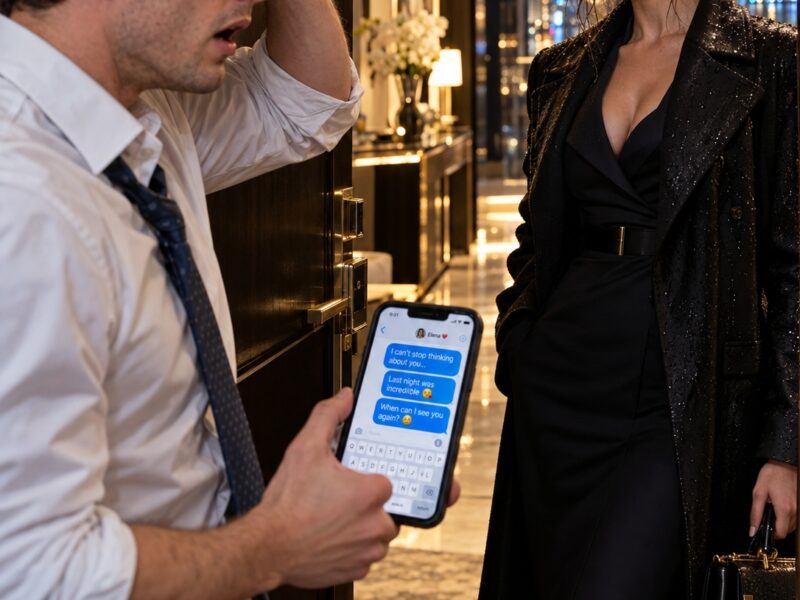
I Accidentally Sent My CEO a Flirty Text at 11:47 P.M.—Five Minutes Later, She Was at My Door

At 11:47 on a rainy Thursday night, I sent the most dangerous text message of my life.
Not to an ex.
Not to a woman I’d met at a bar.
Not even to someone I was dating.
I sent it to Elena Vale.
My CEO.
The woman people at Veil Industries referred to as the Ice Queen only when they were certain she was at least three floors away.
The message had been intended for my best friend, Marcus.
It said:
If Elena Vale smiles at me like that one more time, I swear I’m going to forget she’s my CEO and do something catastrophically stupid.
I stared at the screen.
For three full seconds, my brain refused to understand what my eyes were seeing.
Then I saw the name above the message.
ELENA VALE.
My stomach dropped.
“No.”
I sat up so quickly that my knee slammed into the underside of my cheap kitchen table.
“No, no, no.”
I grabbed the phone with both hands.
The message showed as delivered.
Then read.
And then something happened that made my blood run cold.
Three little dots appeared.
She was typing.
I stopped breathing.
The dots vanished.
They came back.
Vanished again.
I stared at the screen, waiting for the sentence that would end my career.
Come to HR tomorrow morning.
Or maybe:
You’re fired.
Or, knowing Elena:
Security will collect your badge at 8:00 a.m.
But nothing came.
One minute passed.
Then two.
Then five.
I actually began convincing myself that silence was good.
Maybe she’d decided the message wasn’t worth acknowledging.
Maybe she’d forgotten it already.
Maybe powerful CEOs received accidental confessions from terrified junior analysts every Thursday.
Then someone knocked on my apartment door.
Three slow knocks.
I froze.
Nobody visited me at midnight.
Marcus lived twenty minutes away and possessed the civilized habit of calling before appearing.
My landlord never came upstairs unless the building was actively burning.
The knocking came again.
I looked through the peephole.
And nearly died.
Elena Vale was standing outside my apartment.
She was still wearing the long black wool coat she’d worn when she’d left the office.
Rain glistened across her dark hair.
There was no assistant beside her.
No driver.
No security.
Just Elena.
My boss.
The woman whose signature could erase my livelihood before breakfast.
Standing in the dim hallway outside apartment 4B.
I considered pretending I wasn’t home.
Then I remembered she’d just watched me look through the peephole.
I opened the door.
Elena didn’t say hello.
She didn’t ask if she could come inside.
She simply looked directly into my eyes.
“Say it again.”
I swallowed.
“Excuse me?”
“The message.”
Her voice was quiet.
That somehow made everything worse.
“Say it to my face.”
And that was the moment I became certain my life as I knew it was over.
My name is Daniel Carter.
I was twenty-nine years old, $18,700 in debt, living in a one-bedroom apartment with a refrigerator that made a grinding noise every forty-three minutes, and working as a junior financial analyst at one of the most intimidating corporations in Chicago.
I’d become exceptionally talented at being invisible.
Invisible people survived.
That was something my father had never understood.
He’d spent his whole life being the kind of man everyone remembered.
Thomas Carter owned a little repair shop on the west side called Carter & Son Repair, even though for most of my childhood the “son” part consisted of me sitting on an overturned bucket doing homework while he fixed washing machines, generators, lawn equipment, radios, and practically anything else someone dragged through the door.
Dad believed everything could be repaired.
Machines.
Furniture.
Bad decisions.
Sometimes even people.
“Anybody can throw something away,” he’d tell me. “Takes patience to figure out why it stopped working.”
He died when I was twenty-six.
Heart attack.
No warning.
One Tuesday morning he was complaining about the carburetor on a pressure washer.
By Tuesday night, I was sitting under fluorescent hospital lights signing forms I didn’t understand.
His death left me with grief, medical bills, business debt, and a repair shop that had been surviving mostly because my father was willing to accept twenty dollars from customers who owed him eighty.
I tried to save it.
For four months.
Then six.
I sold my car.
Canceled insurance policies.
Used credit cards.
Worked fourteen-hour days.
It didn’t matter.
Kindness had made my father loved.
It had not made his business profitable.
Eventually the bank took the building.
I packed thirty-two years of my father’s life into cardboard boxes.
The last thing I removed was the wooden sign above his workbench.
Anything broken deserves one honest attempt before you throw it away.
I couldn’t bear to keep it.
So I put it into storage.
Three weeks later, I started at Veil Industries.
Veil was everything my father’s shop hadn’t been.
Glass.
Steel.
Efficiency.
Numbers.
Nobody extended payment deadlines because somebody’s daughter needed braces.
Nobody fixed anything for free.
And nobody survived by being sentimental.
Especially Elena Vale.
Her father, Richard Vale, had founded the company thirty-seven years earlier.
By the time Elena inherited control at twenty-six, Veil was reportedly months away from collapse.
By thirty-four, she’d transformed it into a multibillion-dollar industrial technology company.
Business magazines called her ruthless.
Investors called her disciplined.
Employees called her terrifying.
Never where she could hear them.
Elena didn’t yell.
That was what made her frightening.
A screaming executive gave you somewhere to hide.
Elena simply looked at you.
Then asked questions.
Specific questions.
“How did you calculate that?”
“Who verified these numbers?”
“Why wasn’t this flagged Tuesday?”
Watching a senior vice president slowly realize that Elena knew his department better than he did was like watching a building implode without sound.
She remembered everything.
Numbers.
Dates.
Promises.
Mistakes.
She arrived before seven every morning.
Sometimes her office lights were still on when I left at ten.
Nobody seemed to know where she lived.
Nobody knew whether she dated.
Nobody knew what she did on weekends.
There were rumors.
There are always rumors about powerful women.
Someone claimed she’d once been engaged to an investment banker.
Someone else said she fired him from a company dinner after discovering he’d leaked confidential information.
Marcus insisted she probably slept inside a refrigerated vault and recharged herself by absorbing fear from interns.
I laughed.
But I’d noticed things Marcus hadn’t.
Like the afternoon our sixty-three-year-old janitor, Mr. Alvarez, disappeared for a week.
When he returned, his face was swollen from dental surgery.
He told someone in accounting that an “anonymous employee fund” had covered the emergency procedure.
There was no employee fund.
I’d checked.
Two days before his surgery, I’d seen Elena speaking quietly with HR.
I’d also noticed that when layoffs hit one of our suppliers, she spent forty minutes arguing with procurement to create temporary contracts for twelve displaced technicians.
Nobody announced it.
There was no company newsletter.
No photograph.
She seemed almost irritated whenever kindness became visible.
That fascinated me.
Because cruel people generally don’t hide their cruelty.
Kind people sometimes hide their kindness.
And Elena hid hers like evidence.
The Thursday everything changed had already been a disaster before I sent the message.
Our company was considering a major acquisition.
Something in the projections bothered me.
A cost assumption buried in one of the spreadsheets didn’t match a figure I’d seen in another report.
I checked it.
Then checked again.
The discrepancy was enormous.
If I was right, Veil Industries was about to overvalue part of the deal by several million dollars.
If I was wrong, I was a junior analyst preparing to tell executives earning twenty times my salary that they’d missed something obvious.
So I stayed late.
By 10:30, nearly the entire floor was empty.
Rain battered the windows.
My coffee tasted like something recovered from an archaeological dig.
I was comparing spreadsheets when Elena walked past.
Then stopped.
“You’re still here.”
I looked up.
“Apparently.”
One eyebrow lifted.
I immediately regretted attempting humor.
“I mean, yes. Ms. Vale.”
She looked at my monitors.
“Acquisition model?”
“Yes.”
“Problem?”
“Possibly.”
That got her attention.
She stepped closer.
I showed her what I’d found.
She leaned beside my desk, one hand resting against the edge.
She smelled faintly of rain and something clean I couldn’t identify.
I explained the discrepancy.
Elena said nothing for almost thirty seconds.
Then she looked at me.
And smiled.
Not the polite corporate version.
A real smile.
Small.
Tired.
Unexpected.
“Good catch, Daniel.”
She knew my name.
That alone almost killed me.
Then she added, “Send me everything before you leave.”
“Yes, ma’am.”
She started walking away.
Then turned.
“And Carter?”
“Yes?”
“Go home tonight.”
Another tiny smile.
“You look terrible.”
I laughed.
She disappeared around the corner.
Twenty minutes later, Marcus texted.
Still working?
Leaving now.
You need a life.
I have spreadsheets.
Exactly my point. Find a woman.
I took the train home in the rain.
Marcus continued harassing me the entire way.
By the time I reached my apartment, I’d loosened my tie, microwaved something claiming to be lasagna, and poured myself the last inch of bourbon from a bottle my father had bought years earlier.
Marcus sent:
Tell me there is at least ONE woman in that giant building you’d date.
I should have ignored him.
Instead, exhausted and slightly drunk, I typed:
If Elena Vale smiles at me like that one more time, I swear I’m going to forget she’s my CEO and do something catastrophically stupid.
I meant to send it to Marcus.
I didn’t.
And now Elena was standing outside my apartment asking me to repeat it.
“I can’t.”
Her expression didn’t change.
“You could type it.”
“That was different.”
“How?”
“I wasn’t expecting the subject of the message to show up at my apartment.”
Something almost moved at the corner of her mouth.
Almost.
“Say it.”
I rubbed a hand over my face.
“Ms. Vale—”
“Elena.”
That stopped me.
She had never told me to call her Elena.
Not once.
“Okay. Elena. I am unbelievably sorry. It was inappropriate. It wasn’t intended for you. I understand if you need to report it to HR.”
“I’m the CEO, Daniel.”
“Right.”
“I don’t need to report you to anyone.”
Somehow, that wasn’t comforting.
She folded her arms.
“What did you mean?”
“Nothing.”
Her eyes sharpened.
“Don’t lie to me.”
I looked down the hallway.
“Could we maybe have this conversation somewhere I’m not being watched by Mrs. Rosenberg?”
Elena glanced toward apartment 4A.
A curtain moved behind the peephole.
For the first time that night, Elena actually smiled.
“Inside?”
I stepped aside.
And the most powerful woman I’d ever met entered the cheapest apartment she’d probably seen in years.
I suddenly became aware of everything.
The worn sofa.
The stack of unopened bills.
The laundry basket beside the bedroom door.
The toolbox under the window.
A plate in the sink.
“Sorry about the mess.”
Elena looked around.
“Daniel.”
“Yes?”
“I’ve seen manufacturing plants after explosions.”
I stared at her.
“Was that a joke?”
“Possibly.”
That was the second time she surprised me.
The third came when she removed her coat.
Underneath it she was still wearing the charcoal dress from the office.
Except without the coat, without the conference table, without assistants and executives orbiting her, she looked different.
Smaller somehow.
Not physically.
Human.
And tired.
God, she looked tired.
There were shadows beneath her eyes.
For the first time, I wondered whether Elena Vale ever slept.
She looked at me again.
“The message.”
I exhaled.
“You smiled at me tonight.”
“I remember.”
“And I liked it.”
Her face remained still.
“I’ve seen you smile before,” I continued. “But usually it’s the kind of smile people use when they’re about to destroy somebody’s quarterly forecast.”
That earned another almost-smile.
“Tonight was different.”
“How?”
“It looked real.”
Silence.
Rain tapped against the windows.
I forced myself to continue.
“I thought you looked beautiful.”
There.
Career over.
Possibly life.
But Elena didn’t move.
“So you wanted to do something catastrophically stupid?”
“That part was mostly Marcus’s fault.”
“Who’s Marcus?”
“My best friend.”
“The software engineer?”
I blinked.
“You know who Marcus is?”
“You listed him as your emergency contact.”
Of course she knew.
Elena probably knew the blood type of every employee.
“What exactly was the catastrophic thing?” she asked.
I stared at her.
“I think I’ve humiliated myself sufficiently for one evening.”
“I’m curious.”
“You’re enjoying this.”
For one astonishing second, she looked guilty.
Then she sat down on my sofa.
Elena Vale.
On the sofa I’d bought secondhand for eighty dollars.
“Maybe a little.”
I laughed despite myself.
Something changed.
The fear loosened.
Not completely.
But enough.
I sat in the chair opposite her.
“The truth?”
“Yes.”
“I don’t know.”
“That isn’t an answer.”
“The truth is, I don’t know you well enough to have whatever feelings that message implied.”
“Then why send it?”
“Because I notice you.”
Her expression changed.
Barely.
But I saw it.
I continued before courage abandoned me.
“Everyone notices the obvious things. Your title. Your money. The way you can make a vice president apologize to a spreadsheet.”
“Daniel.”
“Sorry.”
She was definitely trying not to smile now.
“But I’ve noticed other things.”
Her smile disappeared.
“What things?”
“Mr. Alvarez.”
She became very still.
“The dental surgery.”
“I don’t know what you’re talking about.”
“You paid for it.”
“No.”
“You created a fake employee assistance reimbursement.”
Her eyes narrowed.
“You spend a surprising amount of time investigating your CEO.”
“I work in finance.”
“That is not a defense.”
“It kind of is.”
Silence.
Then she looked away.
“Who else knows?”
“Nobody.”
“Keep it that way.”
“Why?”
“Because Mr. Alvarez doesn’t need half the company knowing he couldn’t afford surgery.”
The answer came immediately.
No performance.
No hesitation.
And suddenly I understood why I’d sent that message.
It hadn’t really been about her face.
Or the dress.
Or even that smile.
It was about the contradiction.
Everyone said Elena Vale was cold.
Yet I’d repeatedly watched her do warm things when nobody was looking.
“You do that a lot,” I said.
“Do what?”
“Pretend not to care.”
Her head turned slowly toward me.
“That is a dangerous assumption to make about your employer.”
“Probably.”
“You make a lot of dangerous decisions.”
“Only after eleven.”
She studied me.
Then something in her expression collapsed.
Not dramatically.
Just enough.
Her shoulders lowered.
The CEO disappeared for a moment.
A woman remained.
“You really want to know why?”
I didn’t answer.
She looked toward the rain-darkened window.
“My father died when I was twenty-six.”
I knew that.
Everyone knew that.
What I didn’t know was what came next.
“He left me Veil Industries,” she said. “And $418 million in debt.”
I sat forward.
“What?”
“The newspapers didn’t print that part.”
She gave a humorless laugh.
“They preferred the story about the spoiled daughter inheriting an empire.”
Her fingers tightened together.
“The empire was dying.”
She told me suppliers were threatening lawsuits.
Banks were preparing to pull credit.
Executives who had smiled at her since childhood suddenly treated her like an inexperienced girl occupying her father’s chair.
Her uncle wanted control.
Two board members suggested she step aside.
Her mother begged her to sell.
And every time Elena showed uncertainty, somebody used it against her.
“So I stopped showing uncertainty.”
Her voice had changed.
Lower.
Far away.
“I stopped crying at work. Then I stopped crying at home. I stopped asking whether people liked me. I stopped needing them to.”
She paused.
“At least that’s what I told myself.”
A car hissed through rain outside.
I said nothing.
“Every decision mattered,” she continued. “If I made the wrong one, people lost jobs. Families lost insurance. Plants closed.”
She looked at me.
“You know what happens when a twenty-six-year-old woman inherits a company?”
I shook my head.
“Everyone waits for her to fail.”
There was no bitterness in her voice.
That made it worse.
“So I didn’t.”
Three words.
An entire life hidden inside them.
She rebuilt Veil.
Cut divisions.
Renegotiated debt.
Fired executives who’d worked for her father.
Closed two factories to save four others.
For eight years, Elena had won.
And apparently lost pieces of herself with every victory.
“Eventually,” she said, “people stopped waiting for me to fail.”
“That sounds good.”
“It was.”
She smiled sadly.
“Then they became afraid of me.”
I didn’t know what to say.
She looked around my apartment again.
Her eyes stopped on the photograph beside my toolbox.
My father stood outside Carter & Son Repair wearing oil-stained coveralls and holding a wrench.
“Your father?”
I nodded.
“He died three years ago.”
Her expression softened.
“What happened?”
“Heart attack.”
“I’m sorry.”
I almost gave the standard response.
Thank you.
Instead, maybe because she’d just given me something real, I gave her something real back.
“He left me a disaster too.”
That surprised her.
I told her about the hospital bills.
The loans.
The shop.
How I’d tried to save it.
How every morning I’d unlocked the doors and pretended I wasn’t drowning.
How customers kept coming because they loved my father but love didn’t pay suppliers.
How I’d finally stood alone in the empty shop after the bank took possession.
“I thought I’d failed him.”
Elena leaned forward.
“Did he ask you to save it?”
“No.”
“Then why would losing it mean you failed him?”
Because grief isn’t logical.
Because sons measure themselves against dead fathers.
Because sometimes a closed business feels like a second funeral.
“I don’t know,” I admitted.
Elena’s gaze moved toward the toolbox.
“What was he like?”
That question broke something open.
I told her.
I told her how Dad fixed a single mother’s furnace on Christmas Eve and charged her twelve dollars because that was all she had.
How he once spent six hours repairing an old radio because an eighty-year-old customer said it had belonged to her husband.
How he drove twenty miles to restart a generator during a snowstorm and refused payment.
“He was terrible at business,” I said.
Elena smiled.
“Sounds like it.”
“He was also the best man I knew.”
I reached for the photograph.
“He had this saying. Anything broken deserves one honest attempt before you throw it away.”
Elena looked at the photograph for a long time.
Then she whispered, “Did he believe that about people too?”
“Especially people.”
Her eyes lifted to mine.
Something passed between us then.
Something I didn’t understand yet.
Elena looked away first.
“Have you eaten?”
I blinked.
“What?”
“Dinner.”
“Technically.”
“What does technically mean?”
“I microwaved lasagna.”
“Did you eat it?”
I looked toward the kitchen.
The untouched plastic tray sat on the counter.
“No.”
She stood.
For half a second I thought she was leaving.
Instead, she walked toward my kitchen.
“Elena?”
She opened the refrigerator.
The CEO of Veil Industries stared into my refrigerator.
“This is depressing.”
“You’re being extremely judgmental for someone who arrived uninvited.”
“You have mustard, eggs, half an onion and three beers.”
“Four beers.”
“One is empty.”
“Oh.”
She turned.
“When was the last time you went grocery shopping?”
“When was the last time you ate dinner before ten?”
She stared at me.
“That’s different.”
“How?”
“I’m busy.”
“So am I.”
“You’re twenty-nine.”
“You’re thirty-four.”
That slipped out.
Elena raised an eyebrow.
“You know my age?”
“It was in Forbes.”
“Of course.”
She closed the refrigerator.
“Do you have a restaurant nearby?”
Twenty minutes later, I was sitting across from my CEO in a twenty-four-hour diner three blocks from my apartment.
Elena Vale ordered grilled cheese and tomato soup.
That may have been the strangest part of the entire night.
Not the accidental text.
Not her appearance at my door.
The grilled cheese.
“You look disappointed,” she said.
“I expected something more CEO-like.”
“What does a CEO eat?”
“Food with words I can’t pronounce.”
She tore the sandwich in half.
“My father used to make this.”
And there it was again.
Her father.
Mine.
Two ghosts sitting with us.
We talked until almost one in the morning.
Nothing romantic happened.
No kiss.
No dramatic confession.
No movie-perfect moment beneath the rain.
Just two tired people talking in a nearly empty diner while a waitress refilled our coffee.
But sometime around 12:40, Elena laughed.
Really laughed.
Her head tipped back.
Her eyes closed.
And I realized I had never heard that sound before.
I also realized I wanted to hear it again.
That frightened me more than the text message had.
When we returned to my building, the rain had softened.
Elena stood beneath the awning.
“I should go.”
“Probably.”
Neither of us moved.
Finally, I said, “Am I fired?”
She looked genuinely confused.
Then she laughed again.
“No.”
“Written warning?”
“No.”
“Mandatory seminar?”
“Daniel.”
“Sorry.”
She reached for her car door.
Then stopped.
“The message made me angry.”
My stomach tightened.
“For about ten seconds.”
“Oh.”
“Then I laughed.”
She looked down.
“And after that…”
Her voice changed.
“What?”
She looked at me.
“It made me wonder when someone last looked at me as a woman before they looked at me as Elena Vale.”
I didn’t know how to answer.
She got into her car.
“Elena?”
She looked back.
“For what it’s worth, I noticed the woman first.”
Something flashed across her face.
Fear.
Hope.
Maybe both.
Then she closed the door.
The next morning, I arrived at Veil Industries expecting disaster.
At 9:00, I entered conference room twelve.
Twenty-three people were already seated.
Senior executives.
Finance directors.
Legal.
Strategy.
I took the chair closest to the door.
Marcus had called me four times that morning.
I hadn’t answered.
At 9:03, Elena entered.
Charcoal suit.
Hair perfect.
Expression unreadable.
The woman from the diner was gone.
CEO Elena Vale had returned.
She placed a folder on the table.
“Before we discuss the acquisition, there’s an issue with the valuation model.”
My pulse jumped.
The CFO glanced toward his team.
Elena continued.
“A cost assumption was incorrectly carried across three projections. Left uncorrected, it would have materially distorted our valuation.”
The room became silent.
Then she looked directly at me.
“Daniel Carter identified it.”
Every face turned.
I wanted the floor to open.
Elena didn’t smile.
“His analysis saved this company from making a very expensive mistake.”
The CFO nodded.
“Good work, Carter.”
Someone began applauding.
Then others joined.
I looked at Elena.
For half a second, our eyes met.
Nothing about her expression revealed what had happened hours earlier.
But I knew.
And she knew.
That should have been the end of it.
Instead, it was the beginning of the most complicated season of my life.
Elena started asking for my opinion.
At first only about numbers.
Then strategy.
Then people.
“Why is turnover increasing in operations?”
“Because management keeps promoting people who hit targets instead of people who can lead.”
“You’re saying our promotion system is wrong?”
“I’m saying spreadsheets don’t show who makes everyone miserable.”
She stared at me.
Then wrote something down.
Two weeks later, the promotion criteria changed.
People noticed.
They also noticed me.
That was a problem.
“You’ve become interesting,” Marcus told me over beers.
“I hate being interesting.”
“You work for Elena Vale. Nobody accidentally becomes interesting.”
Nothing had happened between Elena and me.
That was the truth.
But rumors don’t require facts.
They require proximity.
I began receiving invitations to meetings above my level.
Elena stopped by my desk.
She occasionally asked whether I’d eaten.
People noticed every single time.
One afternoon, a senior analyst named Preston Hale cornered me near the elevators.
“Enjoying the fast track?”
“I don’t know what you’re talking about.”
He smiled.
“Sure.”
Preston had been at Veil six years.
He wanted a director role badly enough that ambition seemed to leak from his pores.
“You catch one spreadsheet error and suddenly Vale knows your name.”
“She knows everyone’s name.”
“Not like yours.”
The elevator opened.
I stepped inside.
Preston held the door.
“Just be careful, Carter.”
“About what?”
“People who get close to Elena Vale usually discover the temperature eventually.”
The doors closed between us.
That evening, Elena asked me to come upstairs.
Her office occupied the forty-second floor.
At night, Chicago stretched beneath the windows like circuitry.
“You’ve been avoiding me,” she said.
“No.”
“Daniel.”
“Yes.”
“Why?”
I hesitated.
“People are talking.”
Her expression hardened.
“About?”
“You and me.”
“There is no you and me.”
The words landed harder than they should have.
She noticed.
“That isn’t what I meant.”
“I know.”
“No, you don’t.”
Elena walked toward the windows.
“I mean nothing inappropriate has happened.”
“Nothing inappropriate has happened.”
“But they’re talking anyway.”
“Yes.”
She crossed her arms.
“Does that bother you?”
“It could hurt you.”
A short laugh escaped her.
“Daniel, I’ve been called worse things than a woman who speaks to an analyst.”
“You know that’s not what they’ll say.”
Silence.
We both knew.
A powerful male CEO mentoring a young female employee was complicated.
A powerful female CEO doing the same with a younger man generated a different kind of poison.
Elena had spent years making herself impossible to dismiss.
I didn’t want to become the rumor people used to diminish her.
“I don’t want anyone thinking I earned opportunities because…”
“Because I like you?”
The room went still.
I looked at her.
She didn’t retreat.
“Elena.”
“Do you?”
“What?”
“Think I like you?”
My heart was suddenly beating far too hard.
“As an employee?”
“That isn’t what I asked.”
I should have lied.
Instead, I said, “Yes.”
She looked away.
“And does that frighten you?”
“Yes.”
“Why?”
“Because you’re my CEO.”
Her jaw tightened.
“Sometimes I hate that answer.”
“It happens to be a fairly significant detail.”
She almost smiled.
Then her phone rang.
The moment disappeared.
But the question didn’t.
Weeks passed.
Something in Elena began changing.
Not because of me alone.
I’d never give myself that much credit.
But I watched her start making choices she’d apparently denied herself for years.
She took lunch.
Not every day.
But sometimes.
She stopped scheduling Sunday meetings unless there was an emergency.
She promoted a project manager who’d been overlooked twice because she lacked an MBA.
She created an employee hardship fund.
Officially this time.
Mr. Alvarez never knew why I smiled when the announcement went out.
Then, one Tuesday evening, Elena disappeared from the office at 6:15.
People practically checked the fire alarms.
The next morning, I found a coffee on my desk.
No note.
I knew who had left it.
Things might have continued like that indefinitely if Preston hadn’t decided to make them dangerous.
The quarterly executive review was scheduled for Friday.
Thursday afternoon, I was called into HR.
The head of HR, Cynthia Marsh, closed the door behind me.
My stomach turned.
“Daniel, an anonymous concern was submitted.”
“About what?”
“Your relationship with Ms. Vale.”
There it was.
I felt cold.
Cynthia was careful.
Professional.
No accusation.
But the implication was obvious.
Preferential treatment.
Access.
Promotion opportunities.
Possible inappropriate relationship.
“Have you and Ms. Vale engaged in a romantic or sexual relationship?”
“No.”
“Has she offered you professional benefits in exchange for personal attention?”
“Absolutely not.”
“Have you met outside the workplace?”
I stopped.
Cynthia noticed.
“Daniel?”
“One time.”
“When?”
I told her.
Not everything.
But enough.
The text.
The apartment.
The diner.
Cynthia’s expression barely changed.
“Did anything physical happen?”
“No.”
“Has anything happened since?”
“No.”
She wrote something down.
I felt sick.
Because suddenly that rainy night didn’t belong to Elena and me anymore.
It belonged to HR.
Policy.
Risk.
Evidence.
“Am I in trouble?”
“This is a review, Daniel.”
Which is corporate language for possibly.
I left HR and went directly to Elena’s office.
Her assistant tried to stop me.
I walked past.
Elena looked up.
One glance at my face and she knew.
“HR?”
“Yes.”
She closed her laptop.
“I was interviewed this morning.”
“You knew?”
“I was told not to contact you about it until they’d spoken with you.”
“Who filed the complaint?”
“Anonymous.”
“Preston.”
“We don’t know that.”
“I do.”
Elena stood.
“Daniel, listen to me. You did nothing wrong.”
“Neither did you.”
“I know.”
“But this can hurt you.”
Her expression became almost amused.
“You keep worrying about my career.”
“You built this company.”
“My father built it.”
“You saved it.”
Silence.
I stepped closer.
“I don’t want to become the reason anyone questions that.”
Something in her eyes softened.
“You wouldn’t.”
“You don’t know that.”
“Yes,” she said quietly. “I do.”
Then she did something I didn’t expect.
She moved away from me.
Not physically at first.
Professionally.
My meetings with her stopped.
Requests came through my manager.
Emails became formal.
She no longer appeared at my desk.
The coffee stopped.
Everything became appropriate.
Perfectly appropriate.
And absolutely miserable.
Three weeks passed.
The investigation concluded there had been no policy violation.
I should have felt relieved.
Instead, I felt like I’d lost something I had never been allowed to possess.
One Friday night, I stayed late again.
At 9:30, I walked past Elena’s office.
The lights were on.
She was sitting alone.
Exactly as she had been before that text.
Something about it made me angry.
I knocked.
She looked up.
“Daniel.”
“You’re doing it again.”
“Doing what?”
“Turning yourself into a machine.”
Her face hardened.
“You shouldn’t be here.”
“HR cleared us.”
“That doesn’t mean rumors disappear.”
“So that’s it?”
“What do you want me to say?”
“The truth.”
Her chair moved back.
“I am trying to protect you.”
“From what?”
“Me.”
The answer stunned me.
Elena looked toward the windows.
“People around me become targets.”
“I’m not asking you to promote me.”
“This isn’t about promotion.”
“Then what is it?”
Her composure cracked.
“You.”
One word.
Barely audible.
I stopped.
She pressed her palms against the desk.
“I think about you when I shouldn’t.”
The city glittered behind her.
“I wonder whether you’ve eaten. I see something ridiculous and think you’d make some stupid joke about it. I leave meetings wanting to tell you things I can’t tell anyone else.”
She laughed once, bitterly.
“And I hate how much I miss talking to you.”
I couldn’t move.
“Elena…”
“I spent eight years building a life where nobody had enough access to hurt me.”
She looked directly at me.
“Then you sent one idiotic text message.”
Despite everything, I laughed.
“So this is still my fault?”
“Entirely.”
She smiled.
Then the smile disappeared.
“I don’t know how to do this.”
“Do what?”
“Need someone.”
That was the real confession.
Not love.
Not desire.
Need.
For Elena Vale, it was far more dangerous.
I walked toward her.
Stopped several feet away.
“You don’t have to know.”
“I usually know everything.”
“No. You usually make everyone think you do.”
Her eyes filled.
She looked furious about it.
“I hate you sometimes.”
“I’ve heard worse performance reviews.”
She laughed through the tears.
And still I didn’t touch her.
That mattered.
Because whatever existed between us couldn’t begin with her being my CEO and me taking advantage of a vulnerable moment.
So I said the hardest thing.
“I think I need to leave Veil.”
Her face went blank.
“What?”
“If this is real, I can’t work directly inside your organization.”
“No.”
“Elena.”
“No. You’re good at your job.”
“I know.”
“Then don’t sacrifice your career because people gossip.”
“I’m not sacrificing it.”
I took a breath.
“There’s something else.”
I told her about the shop.
Not the old one exactly.
A smaller commercial property had become available near the neighborhood where I’d grown up.
For months I’d been studying the numbers.
Repair businesses were changing.
People repaired less.
Replaced more.
But commercial equipment, specialty appliances and small machinery still created demand.
I’d been developing a plan.
Quietly.
Because dreaming about my father’s shop felt dangerous.
Elena listened.
“You want to reopen Carter & Son.”
“I want to build something that belongs to me.”
Her eyes shifted.
“And you’ve been afraid.”
“Yes.”
“Why?”
“Because I already lost it once.”
Elena walked around the desk.
“My father left me a dying company.”
“Mine left me a dying repair shop.”
“Maybe we’re both terrible at inheritance.”
I laughed.
Then she became serious.
“Show me the business plan.”
“No.”
Her eyebrows rose.
“No?”
“I know what happens if I show you.”
“What?”
“You’ll fix it.”
“Probably.”
“I need to know whether I can.”
That silenced her.
Then she smiled.
“Good.”
Two months later, I resigned from Veil Industries.
Not dramatically.
No scandal.
No grand speech.
I completed my notice.
Trained my replacement.
And on my last afternoon, I returned my badge.
Elena shook my hand in front of everyone.
“Good luck, Mr. Carter.”
“Thank you, Ms. Vale.”
Marcus nearly choked trying not to laugh.
That night, Elena called.
“Are you still my employee?”
“No.”
“Good.”
“Why?”
“Dinner.”
I smiled.
“Is that an order?”
“No.”
A pause.
“I’m trying something new.”
“What?”
“Asking.”
So we went to dinner.
Not the diner.
A small Italian place where nobody knew us.
For the first time, we weren’t CEO and analyst.
We were simply Elena and Daniel.
It was awkward.
Wonderful.
Terrifying.
She told me she’d once wanted to study architecture.
I told her I’d once planned to travel across America with my father repairing old motorcycles.
She admitted she hated champagne.
I admitted I couldn’t understand opera.
She laughed too loudly.
I talked too much.
At the end of the night, we stood outside beneath a streetlamp.
No rain this time.
“Elena?”
“Yes?”
“I’m thinking about doing something catastrophically stupid.”
She smiled.
“Finally.”
I kissed her.
Softly.
No fireworks.
No cinematic music.
Just warmth.
And the unmistakable feeling that something locked for years had finally opened.
But love didn’t magically solve everything.
The shop nearly didn’t happen.
Two banks rejected me.
The landlord wanted a larger deposit.
Equipment costs rose.
My credit still carried scars from my father’s medical debt.
One Tuesday afternoon, I sat inside the empty commercial space staring at numbers that refused to work.
I almost quit.
Then Elena arrived.
She had a folder.
“No.”
She stopped.
“I haven’t said anything.”
“You brought a folder.”
“I frequently carry folders.”
“You’re not buying the building.”
“I wasn’t planning to.”
“You’re not investing.”
“Daniel.”
“No.”
She stared at me.
Then smiled.
“You are incredibly irritating.”
“I learned from you.”
She handed me the folder.
It contained information about a Veil Industries small-business lending program available to former employees and local vendors.
Standard interest.
Formal underwriting.
No special terms.
“You qualify to apply,” she said.
“Apply.”
“Yes.”
“You aren’t approving it?”
“No.”
“What if they reject me?”
“Then improve the plan.”
I stared at her.
She sat beside me on the dusty floor.
“I won’t rescue you, Daniel.”
“I know.”
“But I will make sure you know where the door is.”
That was exactly what I needed.
I applied.
The committee rejected the first proposal.
Elena did not interfere.
I cursed her for forty-eight hours.
Then I rewrote it.
Reduced overhead.
Changed the service mix.
Added commercial maintenance contracts.
Applied again.
Approved.
Six months after leaving Veil Industries, I stood outside a building with a new sign.
CARTER & SON REPAIR
The “Son” still made my throat tighten.
There was no son coming after me.
Not yet.
Maybe never.
But the name wasn’t about inheritance anymore.
It was about memory.
Marcus came.
Mr. Alvarez came.
Three people from my old finance team came.
Even Cynthia from HR appeared, which I found hilarious.
Elena arrived last.
No entourage.
No driver waiting visibly nearby.
She wore jeans, boots, and a cream sweater.
I’d never seen her dressed like that.
For several seconds I simply stared.
“What?” she asked.
“You look…”
“Careful.”
“Human.”
She punched my arm.
Then she saw the wall behind the counter.
And stopped.
Above my father’s old workbench hung his photograph.
Beside it was the wooden sign I’d pulled from storage.
The same sign I hadn’t been able to look at for three years.
ANYTHING BROKEN DESERVES ONE HONEST ATTEMPT BEFORE YOU THROW IT AWAY.
Elena stood beneath it.
Her eyes became glassy.
“You kept it.”
“I wasn’t ready to see it before.”
“And now?”
I looked around.
At the tools.
The shelves.
The customers waiting outside.
The woman beside me.
“Now I understand it.”
Elena looked at me.
“What does it mean?”
I thought about my father.
About his shop.
About Elena sitting in my apartment in a rain-soaked coat.
About a company nearly collapsing.
About grief.
Fear.
Rumors.
Second chances.
About all the ways human beings mistake damage for finality.
“It means broken isn’t the same thing as worthless.”
Elena swallowed.
Outside, Marcus tapped the glass and pointed dramatically at his watch.
People were waiting.
I reached for the door.
Then Elena caught my hand.
“Daniel.”
I turned.
She looked nervous.
Elena Vale.
The woman who could negotiate with bankers, stare down hostile boards, and dismantle a bad acquisition in fifteen minutes.
Nervous.
“I’ve never told you something.”
“What?”
“That night.”
“The text?”
“When I came to your apartment.”
I smiled.
“Hard to forget.”
“I almost didn’t knock.”
“Why did you?”
She looked at the old sign.
“Because I’d spent eight years throwing away every part of myself that looked broken.”
Her voice softened.
“And then some idiot told me he noticed me.”
I laughed.
“That’s very romantic.”
“I’m not finished.”
“Sorry.”
She squeezed my hand.
“You didn’t save me.”
I became still.
“Good.”
“You reminded me I wasn’t something that needed saving.”
That sentence stayed with me.
Because maybe that was the mistake people made about second chances.
We imagine someone arriving to rescue us.
A rich woman saves a struggling man.
A kind man heals a lonely woman.
Love fixes grief.
Money fixes failure.
Success fixes shame.
But life rarely works that way.
Elena didn’t save my father’s shop.
She couldn’t.
It was gone.
I didn’t save Elena from the years she’d spent alone.
I couldn’t give those years back.
My father was still dead.
Her father was still dead.
There were things neither money nor love nor courage could repair.
The doors opened at ten.
By 10:04, someone brought in a generator that hadn’t started in six months.
By 10:12, an elderly man arrived with a radio.
At 10:30, a woman asked whether I could repair a mixer her mother had given her twenty years earlier.
I spent most of the morning with grease on my hands.
Elena sat near the counter answering emails until I told her she was frightening the customers.
At noon, she left for a board meeting.
Before walking out, she kissed my cheek.
Nobody applauded.
Nobody gasped.
Nobody cared.
And that was perfect.
Late that evening, after everyone had gone, I turned off the front lights.
The shop became quiet.
I stood beneath my father’s photograph.
For years, I’d imagined what I would say if I somehow got five more minutes with him.
I’d rehearsed apologies.
I’m sorry I lost the shop.
I’m sorry I couldn’t save what you built.
I’m sorry I became an analyst instead of staying here.
But standing there, I finally understood that my father probably wouldn’t have wanted any of those apologies.
He would have looked around.
Complained about the placement of my workbench.
Asked why I’d bought such expensive diagnostic equipment.
Then he would have smiled.
I touched the edge of his old toolbox.
“I gave it another try, Dad.”
My voice cracked.
Not the old shop.
Not exactly.
Myself.
A car stopped outside.
Through the glass, I saw Elena.
She had returned from her meeting.
She stood beneath the streetlight holding two paper bags from the diner where we’d spent our first night talking.
I unlocked the door.
“You’re back.”
“You forgot dinner.”
“I was working.”
“So was I.”
She held up the bags.
“Grilled cheese?”
“And tomato soup.”
I stepped aside.
She walked in.
For a moment, she looked at my father’s photograph.
Then at me.
No words were necessary.
Months earlier, at 11:47 on a rainy Thursday night, I had stared at my phone believing one careless message had destroyed my future.
I’d thought the worst mistake of my professional life had just been delivered directly to the one person powerful enough to ruin me.
Five minutes later, Elena Vale had knocked on my door.
I didn’t know then that she wasn’t coming because she was angry.
Not really.
She had come because somewhere beneath the title, the money, the reputation, and eight years of carefully constructed armor, a lonely woman had read one ridiculous sentence and realized somebody had been looking closely enough to see her.
And maybe she’d wanted to know whether that person was real.
I was.
So was she.
That didn’t mean we healed each other.
People aren’t machines.
There isn’t always a replacement part.
Some damage stays.
Some losses remain losses.
Some empty chairs never stop being empty.
But my father had been right about one thing.
Broken things deserve honesty before abandonment.
Sometimes the honest attempt fails.
Sometimes the door stays closed.
And sometimes, on an ordinary rainy Thursday, you accidentally send the wrong message to exactly the right person.
Then five minutes later, someone knocks.
And your whole life begins again.









