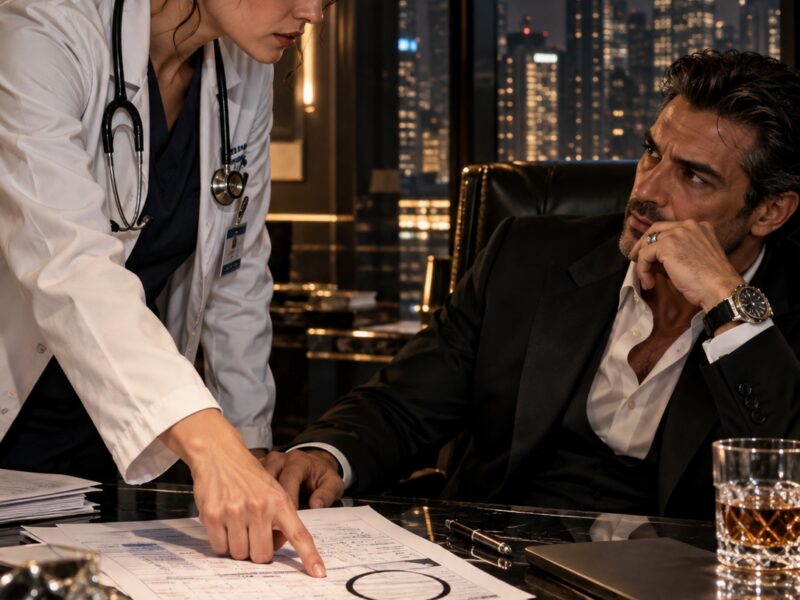
I CALLED NEW YORK’S MOST FEARED MAN HEARTLESS—THEN HE ANSWERED IN MY GRANDMOTHER’S SICILIAN DIALECT

The first time I insulted Silvio Marquetti, I thought I was speaking a language he couldn’t understand.
That was my first mistake.
My second was assuming the most feared man in New York was afraid of dying.
“Your heart doesn’t care who you are,” I told him.
Silvio sat across from me in a charcoal-gray suit that probably cost more than my first car. Beyond the consultation-room window, Manhattan shimmered beneath a cold October rain.
He didn’t look sick.
That was the problem.
Men like him rarely did.
They looked powerful right up until their bodies reminded them that power had limits.
“Your imaging is worse than it was in May,” I continued. “The obstruction has progressed. The valve deterioration has progressed. You have already postponed surgery twice.”
His face remained unreadable.
“I know.”
“Then choose a date.”
“No.”
Just that.
No explanation.
No hesitation.
I set my pen down.
Twenty years.
That was how long I had spent learning to keep my emotions outside operating rooms. Twenty years of residency, fellowships, overnight calls, whispered doubts, and male colleagues being called brilliant for behavior that got women called difficult.
I had operated on senators.
CEOs.
A Broadway producer who tried negotiating his discharge date while still connected to a chest tube.
None of them had irritated me the way Silvio Marquetti did.
“You understand what happens if you keep waiting?”
“Yes.”
“You could die.”
“I understand English, Doctor.”
Something inside me snapped.
I looked down at his chart and muttered the phrase my grandmother used whenever a man behaved as if God had personally excused him from common sense.
“Bastardu senza cori.”
Heartless bastard.
The room went silent.
I froze.
Silvio’s security detail was outside. My nurse had stepped away. There were only two people in the room.
Me.
And a man newspapers had spent thirty years teaching New Yorkers to fear.
Slowly, Silvio leaned back.
Then he smiled.
Not an angry smile.
Not even an offended one.
It was the small, deliberate smile of a man who had just discovered something unexpectedly interesting.
And in the rough mountain dialect my grandmother had carried from western Sicily to Brooklyn, he answered:
“Then cut deeper, Doctor.”
My fingers tightened around the pen.
His pronunciation was perfect.
Not textbook Italian.
Not something learned from an app.
The dialect was old, rural, intimate—the language of kitchens, funerals, church steps and women arguing over tomatoes.
The language my mother used only when she was exhausted.
The language my grandmother had taken to her grave.
I stared at him.
“How do you know that?”
Silvio’s smile disappeared.
For half a second, something passed through his eyes.
Grief, maybe.
Recognition.
Then the wall returned.
“Schedule another evaluation.”
He stood.
“That wasn’t my question.”
“No.”
“It wasn’t.”
His hand settled briefly on the back of the chair.
“You’re a surgeon, Dr. Marini.”
“Yes.”
“Surgeons are supposed to know when to stop cutting.”
Then he walked out.
I should have forgotten the exchange.
Instead, it became the first incision.
My name is Dr. Celeste Marini.
I was thirty-seven years old then, a cardiothoracic surgeon at one of New York’s most respected hospitals, and the unmarried daughter of Sicilian immigrants—which, according to my family, meant I had achieved only half of what adulthood required.
I grew up in a third-floor walk-up in Brooklyn above a butcher shop.
My father repaired elevators.
My mother, Lucia, worked bookkeeping jobs while raising three children and somehow making every Sunday dinner feel like a religious obligation.
By thirty-seven, I had a medical degree, a mortgage, surgical privileges, several journal articles, and enough student-loan trauma to recognize predatory interest rates from across a room.
My Aunt Nena still introduced me by saying:
“This is Celeste. She’s a heart surgeon.”
Then, after a tragic pause:
“Still single.”
My mother usually pretended not to hear.
That almost hurt more.
She understood what medicine had cost me.
She also worried I had built a life so carefully around competence that there was no room left for anyone else.
What she never understood was that I wasn’t lonely.
I was tired of being evaluated.
Too ambitious.
Too stubborn.
Too intimidating.
Too old to be picky.
Too successful to need anyone.
Not successful enough to stop needing approval.
At work, I was judged for every decision.
At home, I was judged for coming home alone.
The operating room was almost peaceful by comparison.
There, at least, the heart didn’t lie.
Neither did blood pressure.
Neither did oxygen saturation.
Numbers had no opinion about whether a thirty-seven-year-old woman should have married by now.
Silvio Marquetti was fifty-two and existed in a world almost opposite mine.
His name appeared on shipping companies, construction firms, medical logistics businesses, restaurants, real-estate holdings, and enough whispered conversations to make respectable people lower their voices.
Nobody at the hospital called him a mafia boss.
Not officially.
Officially, he was chairman of Marquetti Holdings and a major donor.
Unofficially, everyone knew.
Three surgeons had found polite reasons not to take his case.
I hadn’t.
A diseased heart was a diseased heart.
It didn’t become morally different because its owner had bodyguards.
Maybe that was why the hospital assigned him to me.
Or maybe they knew I was too stubborn to be intimidated.
Two weeks after our Sicilian exchange, I was reviewing files for the hospital’s Cardiac Access Fund.
That program mattered to me more than most people knew.
Years earlier, during my residency, my mother had started experiencing chest pressure.
She said nothing.
For months.
When I eventually learned the truth, I was furious.
“Why didn’t you tell me?”
She wouldn’t look at me.
“You had enough bills.”
“Ma, I was a doctor.”
“You were a student with two hundred thousand dollars of debt.”
“I could have helped.”
“With what money?”
That sentence stayed with me.
By the time she finally saw a cardiologist, the blockage was serious.
She survived.
But I never forgot the fear in her face.
Not fear of dying.
Fear of becoming expensive.
That was worse somehow.
The Cardiac Access Fund existed for people like her—patients caught between insurance coverage and actual poverty, people who technically earned too much for one form of assistance and far too little to survive a major medical bill.
I volunteered as a physician liaison.
It wasn’t glamorous.
Mostly spreadsheets, appeals and paperwork.
Then one Thursday night, I noticed the circles.
Small black circles appeared beside certain patient accounts.
At first I assumed they were processing marks.
Then I recognized a name.
Mr. Anthony Anselmo.
Seventy-one.
Retired baker.
Bypass surgery the previous winter.
His wife had brought cannoli to the nurses after he went home.
Anthony had died six months later from an unrelated stroke.
His widow was still paying hospital bills.
I opened the account.
Something was wrong.
Several supply charges were nearly double the expected amount.
Not the surgeon’s fee.
Not room charges.
Vendor costs.
Valve-support equipment.
Suture kits.
Specialty tubing.
I knew roughly what those products cost because surgeons who don’t understand the economics of their operating rooms eventually become administrators’ favorite kind of idiot.
I checked another black-circle account.
Same pattern.
Then another.
Same.
Another.
Same.
By midnight I had twelve patient files open.
The protected patients—those with good insurance or institutional connections—were being billed normally.
The financially vulnerable patients marked with black circles were being routed through unusually expensive supply contracts.
Errors happen randomly.
This wasn’t random.
This was architecture.
And architecture has an architect.
I followed the vendor information.
Every inflated line eventually led to the same company.
Marquetti Medical Logistics.
I sat alone in my office while rain struck the windows.
For the first time since meeting Silvio, I felt something colder than irritation.
Either the man whose heart I was supposed to repair was profiting from sick people too poor to protect themselves—
or someone was doing it under his name.
I spent the next week checking before I accused anyone.
Lot numbers.
Manufacturer prices.
Contract dates.
Insurance controls.
Procurement records.
The pattern held.
Poor patients paid more.
Protected patients didn’t.
Someone knew exactly which people were least likely to challenge an invoice.
And someone had marked them with a black circle.
At Silvio’s next appointment, I placed a photocopied invoice on the table.
He glanced down.
Then stopped.
“What does that mean?” I asked.
His eyes stayed on the circle.
For the first time since I’d met him, his stillness didn’t look like control.
It looked like recognition.
“Where did you get this?”
“Answer my question.”
His thumb touched the edge of the paper.
“Who else has seen it?”
“Answer mine first.”
Silvio looked up.
“What do you think it means?”
“I think poor cardiac patients are being routed through inflated contracts connected to your company.”
No reaction.
I hated him for that.
“You don’t seem surprised.”
“I am.”
“You hide it beautifully.”
“It’s a useful skill.”
“Not in my office.”
His gaze returned to the circle.
I waited.
Finally he said:
“Keep investigating, Doctor.”
I almost laughed.
“That’s your answer?”
“Yes.”
“You’re either stealing from sick people or protecting whoever is.”
His jaw tightened.
“Keep investigating.”
“Why?”
He pushed the paper toward me.
“Because if I tell you what I think that mark means, you’ll start looking where I tell you to look.”
“And?”
“I want to know where you look when nobody guides you.”
I stood.
“You don’t get to test me.”
“No.”
He met my eyes.
“But someone already is.”
Two days later, senior hospital administrator Marianne Holt summoned me upstairs.
Marianne was polished silver in human form.
Perfect suit.
Perfect hair.
Perfectly measured sentences.
She could destroy your career while complimenting your shoes.
She mentioned my upcoming review for associate surgical director.
Then she mentioned professional judgment.
Then institutional relationships.
Then the danger of physicians wandering outside their expertise.
She never said Silvio’s name.
She didn’t need to.
“A promising surgeon,” she said, “should be careful about implying financial misconduct involving major philanthropic partners.”
“I haven’t implied anything.”
Her smile barely moved.
“Good.”
The following Monday, two of my operating blocks were reassigned.
A committee position I’d been promised was suddenly “under review.”
Nobody threatened me.
That would have been easier.
Institutions rarely threaten people directly.
They rearrange the furniture until you understand where the door is.
I documented everything.
Dates.
Times.
Exact words.
Then I went back to the files.
My mother once delayed cardiac care because she was afraid of becoming a financial burden.
Someone was making money from that exact fear.
They had chosen the wrong surgeon to scare.
Somehow, Silvio learned about the pressure.
At his next appointment he said:
“I can make a phone call.”
“No.”
“One call.”
“No.”
“Marianne Holt won’t bother you again.”
I closed his chart.
“If you interfere with my career, I’ll never trust another word you say.”
His expression sharpened.
“You’d rather lose the promotion?”
“I’d rather know whether I earned it.”
“I could solve the problem.”
“That’s exactly the problem.”
Silvio stared at me.
Men like him were accustomed to gratitude when they offered power.
I gave him a boundary.
“Fight your battles your way,” I said. “I’ll fight mine my way.”
The room stayed quiet.
Then he nodded.
“As you wish.”
And he never offered again.
That should not have mattered to me.
It did.
I began watching him differently.
That was dangerous.
Once you truly watch someone, reputation becomes less useful.
Silvio obeyed hospital rules even when his own security hated them.
His guards waited outside restricted areas because I said they would.
He learned the nurses’ names.
He stood when elderly patients’ wives entered a room.
Once, an eighty-year-old volunteer named Mrs. Esposito mistook his security men for orderlies and scolded them for blocking a hallway.
His men looked horrified.
Silvio moved the chairs himself.
Mrs. Esposito patted his cheek.
“You’d have a kind face if you stopped trying so hard not to.”
He thanked her as solemnly as if she’d awarded him a medal.
I watched from the nurses’ station.
Nothing about the moment matched the monster I had built from newspaper headlines.
That didn’t make the headlines false.
It simply meant people could contain more than one truth.
And that made Silvio Marquetti much more dangerous to me.
Because monsters are easy.
Complicated men are not.
The investigation led me into the hospital basement.
Old financial archives were stored there—decades of ledgers, forgotten programs, dead committees and paperwork nobody had digitized because nobody believed it mattered.
At 11:40 one Thursday night, I found a ledger from 1984.
My breath stopped.
Black circles.
The same symbol.
They appeared beside the accounts of immigrant families.
Italian.
Puerto Rican.
Greek.
Polish.
Families whose balances suggested that even a modest hospital bill could have destroyed them.
But the old accounts were different.
Every account marked with a black circle ended at zero.
Not reduced.
Zero.
Beside each adjustment were the initials:
R.M.
No public charity designation.
No collection notices.
No payment plans.
Just debts quietly erased.
I sat on the basement floor.
The black circle hadn’t begun as a target.
It had begun as mercy.
Someone had taken a symbol that once meant—
Leave this family alone.
—and turned it into:
Charge this family more.
That was when the case stopped feeling financial.
It felt personal.
I called my mother.
“Do you remember any old assistance program at the hospital?”
She was quiet.
“A long time ago, maybe. Why?”
“Think.”
“A social worker once told me there used to be help for families who didn’t want charity.”
“What kind?”
“I don’t know. It was gone by the time I needed it.”
Her voice softened.
“Celeste, what are you digging into?”
“I don’t know yet.”
That was true.
But I knew one thing.
The black circle had existed long before Marquetti Medical Logistics.
And someone had deliberately stolen its meaning.
While I was digging into the past, another man kept appearing in Silvio’s present.
Maximo Belandi.
Fifty-five.
Silver hair.
Tailored suits.
Silvio’s closest lieutenant for nearly twenty years.
Brother in everything but blood.
Maximo was charming.
That alone made me suspicious.
He brought espresso for nurses.
Asked about Silvio’s pain levels.
Remembered birthdays.
But his questions always drifted toward time.
“How long would Mr. Marquetti be incapacitated?”
“When could he resume decision-making?”
“If there were complications, who would determine his fitness?”
Each question made sense individually.
Together, they didn’t.
Maximo wasn’t asking when his friend would recover.
He was calculating how long his friend might be powerless.
Then Silvio postponed surgery a third time.
He did it through a liaison.
He didn’t even tell me himself.
I drove to his Brooklyn office furious enough to forget whom I was confronting.
His security guards let me through.
That bothered me too.
They had clearly been instructed never to stop me.
Silvio was standing behind a desk overlooking the river when I entered.
“You’re out of postponements.”
“Doctor—”
“No.”
I threw his latest imaging report onto the desk.
“This isn’t a negotiation anymore.”
“Everything is a negotiation.”
“Not biology.”
His eyes hardened.
“The next delay could kill you.”
“I understand.”
“No, you understand the sentence. You don’t understand what it means.”
I stepped closer.
“You think because you’re choosing the delay, you’re controlling it. You’re not. You’re just giving your disease more time.”
His face changed.
Only slightly.
But I saw it.
Fear.
Not of death.
Something else.
“What aren’t you telling me?”
Silvio turned toward the window.
For the first time, he looked fifty-two.
Not powerful.
Not feared.
Tired.
“If I’m incapacitated,” he said, “existing corporate agreements place temporary operational authority with Maximo.”
Everything inside me went still.
“He becomes acting head?”
“Yes.”
“And he wants the surgery now.”
Silvio looked at me.
“Very much.”
I thought about the inflated contracts.
“Maximo controls Medical Logistics.”
Silence.
That was answer enough.
“He controls the vendor approvals,” I said.
“Yes.”
“And if you’re unconscious—”
“He controls the organization.”
I stared at him.
“You’ve been risking your life because you don’t trust him.”
“I’ve been reviewing what happens if I can’t act.”
“You’ve been hiding.”
His expression hardened.
“Careful.”
“No. You hired the wrong surgeon for careful.”
I pointed at his chest.
“You’re afraid of waking up and discovering your empire belongs to someone else.”
“I built it.”
“And you’ll be buried under it if you keep doing this.”
He said nothing.
“You know what I call men who confuse control with survival?”
“I suspect you’re about to tell me.”
“Fools.”
A flicker of amusement appeared despite everything.
“Not Sicilian this time?”
“I wanted to make sure you understood.”
That almost-smile again.
I hated how much I noticed it.
“Fix the agreements,” I said. “Then let me fix your heart.”
Silvio’s gaze stayed on mine.
“In that order?”
“In that order.”
Nine days later, his attorneys completed a temporary governance structure.
Maximo could retain a title during Silvio’s incapacity.
But major transfers required two signatures.
No restructuring.
No major contract changes.
No permanent appointments.
No sale of core assets.
Silvio had built a cage around his own power so nobody else could steal it while he slept.
Then he came to my office.
He signed the surgical consent.
He pushed it across my desk.
No speech.
No drama.
Just his name.
I’ve seen signatures that transferred millions of dollars.
I’ve never seen one cost a man more.
The night before surgery, I reviewed the procedure twice with my team.
Then a third time alone.
At dawn I found Silvio watching the East River from pre-op.
Without his suit, he looked strangely ordinary.
Hospitals do that.
They strip away uniforms of power.
Eventually everyone wears the same thin gown.
“Are you afraid?” he asked.
“Yes.”
That surprised him.
“You admit that?”
“Every time I open someone’s chest.”
“Why?”
“Because surgeons who stop being afraid become dangerous.”
A nurse entered to prepare his IV.
Silvio watched her leave.
Then, quietly, he spoke in that old Sicilian dialect.
“My aunt would have liked you.”
I turned.
“Which aunt?”
But anesthesia was already being prepared.
Silvio closed his eyes.
And six hours later, I held his heart in my hands.
There are moments in surgery that shouldn’t be turned into poetry.
A human heart is not a metaphor when it is failing beneath your fingers.
It’s muscle.
Electricity.
Blood.
Responsibility.
Near the fourth hour, Silvio’s heart fought me.
I fought back.
And I won.
When they wheeled him to intensive care with a stable rhythm, I went into a supply room, sat on a stool and shook for ten minutes.
Then I washed my face.
Wrote my notes.
Checked him twice.
And went home.
My mother had made soup.
She pretended she hadn’t been waiting awake.
She didn’t ask who the patient was.
Mothers know when not to ask.
Silvio’s recovery became the strangest chapter of my professional life.
He followed every instruction.
Walked when told.
Rested when told.
Complained only when food was involved.
“You call this coffee?”
“Yes.”
“This is punishment.”
“Drink it.”
“I’ve had enemies treat me better.”
“Your enemies probably weren’t monitoring your sodium.”
He looked at the cup.
“You enjoy this.”
“Immensely.”
Something shifted between us.
Quietly.
Dangerously.
I caught myself checking his chart before bed.
He started looking toward the door around the time my rounds began.
He remembered my patients.
Asked about Mr. Anselmo’s widow.
Once, a young intern dropped a tray after recognizing him.
Silvio helped pick it up.
The intern’s hands shook.
Silvio handed him the instruments and said:
“Steady hands are built. Nobody is born with them.”
I filed moments like that under clinical observation.
Scientists can be excellent liars when the person they’re lying to is themselves.
One afternoon, golden light filled his room.
We had been talking too long.
About Sicily.
About my grandmother.
About the strange loneliness of being surrounded by people who needed something from you.
Then I noticed the way he was looking at me.
I stood.
“No.”
Silvio didn’t pretend not to understand.
“No dinner,” I said. “No flirting. No promises. Nothing while you’re my patient.”
He remained quiet.
“If you respect me,” I continued, “you will stop looking at me like that.”
Most powerful men hear a woman’s boundary as the opening bid of a negotiation.
Silvio didn’t.
He nodded once.
“Understood, Doctor.”
And from that moment forward, he never crossed it.
Not once.
That restraint moved me more than pursuit would have.
Because it left me free to see him without defending myself from him.
And what I saw complicated everything.
He knew my grandmother’s Sicilian village.
Not vaguely.
He knew the church steps.
The bakery near the square.
The festival in September.
The narrow street where old women sat outside after sunset.
“How?”
He always redirected.
Until the archives answered for him.
R.M.
Rosalia Marquetti.
I found her name in old hospital documents.
Then in a Brooklyn parish bulletin.
Then in a photograph.
A Sicilian café on Court Street.
Rosalia had managed a quiet mutual-aid network for immigrant families.
No humiliating applications.
No public declarations of poverty.
If she learned that a family was drowning, she marked their account with a black circle.
It meant:
This family owes nothing.
Don’t tell them who paid.
Let them keep their dignity.
Dozens of families had survived because of a mark they never knew existed.
Rosalia Marquetti had turned anonymity into kindness.
And decades later, someone had turned her kindness into a hunting signal.
I went to the café.
It still existed.
Different owners.
Same brick walls.
An old man playing cards remembered her.
“Rosalia fed everybody.”
“Did she have children?”
“No.”
Then he smiled.
“But she raised a boy.”
My heartbeat changed.
“What boy?”
“Her nephew.”
He looked at the old photograph.
“Serious kid. Always carrying groceries to widows.”
“His name?”
The old man looked at me as though the answer should have been obvious.
“Silvio.”
I found the rest in parish records.
Silvio’s mother died when he was thirteen.
Rosalia took him in.
For part of his adolescence, she brought him back to western Sicily.
To the same mountain region where my grandmother had grown up.
That dying dialect wasn’t foreign to him.
It had been the language of his adolescence.
His answer during our first meeting hadn’t been a trick.
It had been memory.
I carried a copy of Rosalia’s ledger to his hospital room.
He stared at it for so long that I wondered if he had forgotten I was there.
Finally his finger touched the black circle.
“My aunt drew this.”
“I know.”
His face tightened.
“She used to tell me that charity could humiliate a man as efficiently as cruelty if you made him kneel for it.”
I sat opposite him.
“You recognized the circle immediately.”
“Yes.”
“And you didn’t tell me.”
“No.”
“Why?”
“Because I didn’t understand why it had returned.”
“You could have told me that.”
“I wanted someone outside my influence to investigate.”
I stared at him.
“So you used me.”
“Yes.”
The honesty landed harder than an excuse.
“You’re admitting that?”
“You deserve the truth.”
He looked back at the ledger.
“I thought if I told you about Rosalia, I would shape your investigation. I needed to know what you would find without me.”
“That was controlling.”
“Yes.”
“Manipulative.”
“Yes.”
“Infuriating.”
A faint smile.
“I had noticed.”
I didn’t smile.
He became serious again.
“Celeste.”
It was the first time he’d used my first name.
“My ignorance isn’t innocence.”
I said nothing.
“The program carried my family’s name. My money. My companies. I assumed the people beneath me were managing it honorably because I had more important matters.”
His mouth tightened.
“There are no more important matters than what people do with your name when you aren’t watching.”
That sentence stayed with me.
Because now the investigation had two halves.
On the hospital side, exceptions routing black-circle patients into inflated contracts traced back to Marianne Holt.
On the corporate side, excess margins flowed through entities controlled by Maximo Belandi.
I brought everything to Silvio.
Invoices.
Approval chains.
Historical ledgers.
Corporate records.
Dates.
Signatures.
He read silently.
Then reached the final page.
Maximo had approved the vendors.
Maximo’s entities had captured the margins.
Maximo had also pressured Silvio to undergo surgery while the old incapacity agreement remained intact.
The truth assembled itself between us.
If Silvio had delayed much longer, he could have died.
If he had undergone surgery on Maximo’s preferred schedule, Maximo would have taken temporary control while Silvio lay unconscious.
And if complications had left Silvio incapacitated—
temporary power might have become permanent.
Maximo had found a way to profit whether Silvio lived or died.
Worse, he had financed part of that betrayal by exploiting the very families Rosalia had once protected.
Silvio closed the folder.
For several seconds, he didn’t move.
Then he looked at me.
“You saved me twice.”
“I performed one operation.”
“You found the second knife.”
I understood.
The first had been inside his chest.
The second had been behind his back for twenty years.
The confrontation happened behind closed doors.
No guns.
No threats.
No cinematic violence.
Just auditors.
Lawyers.
Hospital trustees.
Corporate board members.
And documents.
Marianne arrived prepared to portray me as an overreaching surgeon who didn’t understand procurement.
Maximo arrived smiling.
That smile lasted fourteen minutes.
I began with identical medical supplies billed at different prices.
Then patient classifications.
Then black circles.
Then the old ledgers proving what the symbol originally meant.
Then the modern approval chain.
Date.
Signature.
Exception.
Date.
Signature.
Exception.
Every road ended at Marianne’s office.
She began confidently.
Then carefully.
Then defensively.
She said she didn’t remember certain approvals.
The auditors asked again.
Her answers grew shorter.
Finally someone asked whether she had received anything of value connected to the vendor arrangements.
Silence.
I’ve worked in emergency rooms.
I’ve heard families scream.
I’ve heard monitors flatline.
I’ve heard surgeons swear when seconds mattered.
That silence was louder.
Then Silvio’s attorney opened the second folder.
Maximo’s smile disappeared.
Corporate entities.
Vendor margins.
Control structures.
Emails concerning Silvio’s incapacity provisions.
Formal pressure to preserve the succession arrangement.
The room changed.
Maximo looked at Silvio.
“You believe her?”
Silvio remained seated.
“This isn’t about belief.”
“Twenty years.”
“I know.”
“You would throw away twenty years because a surgeon brought you spreadsheets?”
“No.”
Silvio’s voice was almost gentle.
“I would throw away twenty years because the numbers don’t care how long I loved you like a brother.”
Maximo’s face changed.
There it was.
Not fear.
Betrayal exposed to betrayal.
“You wouldn’t have any of this without me.”
Silvio nodded slowly.
“Perhaps.”
Then he looked at the black circle on the ledger.
“But this existed before either of us.”
Maximo followed his gaze.
For the first time, he understood the deepest part of what he’d done.
He hadn’t merely stolen money.
He had corrupted Rosalia’s legacy.
Silvio didn’t shout.
He didn’t threaten him.
Eleven weeks after I had opened Silvio’s chest, he removed Maximo from every position of trust.
His authority was frozen.
Independent counsel took control of financial recovery.
Maximo left the building with his dignity and almost nothing else.
The hospital removed Marianne within a month.
Quietly, of course.
Institutions prefer to bury their shame in carefully worded announcements.
My operating schedule returned.
My committee position magically reappeared.
I received a formal letter thanking me for my diligence.
I put it in a drawer.
Silvio did something more important.
Every dollar improperly diverted through Marquetti Medical Logistics was returned to the Cardiac Access Fund.
Then he surrendered unilateral control over the program.
Independent physicians.
Hospital representatives.
External auditors.
A board he could not command.
For a man whose entire life had been organized around control, it was the most convincing apology he could have made.
Three weeks after the new structure took effect, I opened the account of an elderly woman who had considered postponing her valve appointment because she couldn’t afford the cost.
Beside her name was a small black circle.
I stared at it.
At the bottom of the account:
BALANCE: $0.00.
She would never know why.
That was the point.
I sat alone holding the page and thought of Rosalia.
Then my mother.
Then every frightened family who had ever sat at a kitchen table choosing between health and money.
Some forms of goodness don’t need witnesses.
They only need to survive.
That afternoon I found Silvio standing at his office window.
I expected satisfaction.
Instead, I found grief.
“Twenty years,” he said.
I knew immediately who he meant.
“I keep going through them.”
“Don’t.”
“I should have seen it.”
“Maybe.”
He turned.
That answer surprised him.
“You’re not going to tell me it wasn’t my fault?”
“No.”
I moved closer.
“You trusted him. You also failed to supervise things carrying your name. Both can be true.”
Silvio looked toward the river.
“And now?”
“Now you don’t confuse guilt with repair.”
“What does that mean?”
“It means guilt keeps reopening the wound. Responsibility closes it correctly.”
He was quiet.
“You always speak to people this way?”
“Only difficult patients.”
“I’m not your patient forever.”
Something passed between us.
I ignored it.
For the moment.
At Sunday dinner, I finally told my mother most of the story.
She stood over a pot of sauce, wooden spoon suspended in midair.
When I finished, she considered everything with the solemnity of a judge.
Then she said:
“So the heartless man had a heart.”
“Ma.”
“He just needed a surgeon.”
“Please don’t.”
“When can I meet him?”
“Never.”
“Next Sunday?”
“No.”
“Christmas?”
“Ma.”
She smiled into the sauce.
Some battles aren’t meant to be won.
My career found its own form of justice.
The following spring, I was named associate surgical director.
My mother cried at the announcement dinner.
Then asked whether the position came with more vacation days so I could finally find a husband.
At Easter, Aunt Nena observed that professional titles did not keep a woman warm at night.
Before I could respond, my mother set down her wineglass.
“Neither does a man who doesn’t respect her.”
The table went silent.
My mother looked at me.
“My daughter chooses for herself.”
I don’t think she ever understood how much those words meant.
Silvio completed his recovery under my care.
We maintained the boundary.
No dinner.
No private promises.
No touching that didn’t belong to medicine.
At his final appointment, I reviewed his imaging.
His recovery was excellent.
“You’re officially discharged from my care,” I said.
Silvio adjusted his cuff.
“So I’m no longer your patient.”
“No.”
He looked at me for one heartbeat too long.
Then he offered his hand.
“Thank you, Dr. Marini.”
I took it.
“Take care of your heart.”
“You’ve made that difficult to ignore.”
Then he left.
He didn’t call the next day.
Or the next week.
He waited.
Months passed.
I thought about him more often than I admitted.
After long surgeries.
While walking home.
During my mother’s strategically unsubtle questions.
But something inside me had changed.
For thirty-seven years, people had asked when someone would finally choose me.
I had spent too long allowing that question to matter.
Then, on an ordinary Thursday in early fall, a cream-colored envelope arrived at my office.
No crest.
No expensive box.
No messenger waiting for an answer.
Inside was a handwritten note.
There is a café on Court Street that once belonged to someone we both owe a great deal.
If you would like to have dinner with me there on Saturday, it would be an honor.
If not, you will never hear another word about it.
The choice, Doctor, is entirely yours.
—Silvio
I read it three times.
He had learned the one lesson his empire could never teach him.
How to ask without taking.
For three days, I carried the envelope in my coat pocket.
Saturday evening, I went.
Rosalia’s café was smaller than I remembered.
Old brick.
Eleven tables.
Espresso in the air.
Silvio was already there.
Alone.
No security detail visible.
No entourage.
He stood when I entered.
For one strange second, neither of us was a surgeon or a feared businessman.
We were simply two people who had opened each other in different ways and survived what we found.
We talked about Rosalia.
About Sicily.
About my grandmother.
About Maximo.
About the strange cruelty of discovering that someone you loved had been betraying you while you were busy trusting them.
Hours passed.
Near the end of dinner, I finally asked the question that had been waiting since our first meeting.
“Are you still heartless?”
Silvio considered it.
Then smiled.
“You repaired the part you could reach.”
“And the rest?”
His eyes held mine.
“The rest will take time.”
There was no promise that love would transform him.
No fantasy that one good deed erased everything he’d done.
No request that I close my eyes to the life he had lived.
That honesty mattered.
He didn’t ask me to belong to him.
He didn’t tell me he could protect me.
He didn’t promise me a kingdom.
He simply asked:
“Would you like to find out what this is?”
I looked around the café.
At Rosalia’s old walls.
At the place where a woman had once drawn black circles beside strangers’ names and quietly returned their dignity.
For years, my relatives had asked when someone would choose me.
They had been asking the wrong question.
The question was never whether someone would choose me.
The question was whether I could choose someone freely—
with my eyes open,
my independence intact,
and no hand around my wrist.
So I stayed for dessert.
Not forever.
Not yet.
Just dessert.
Sometimes the smallest choice is the bravest one because nobody else can make it for you.
Much later, as we stepped outside, Court Street was shining from a recent rain.
Silvio held the door.
I stopped beside him.
“You know,” I said, “you never answered one thing.”
“What?”
“That first day. When I insulted you.”
“I remember.”
“You told me to cut deeper.”
“Yes.”
“Were you challenging me?”
His expression softened.
“No.”
“Then what were you doing?”
For several seconds, the most feared man in New York said nothing.
Then he looked back through the café window.
At Rosalia’s photograph.
“When I was thirteen,” he said, “my aunt told me people spend their lives judging what they can see because they’re frightened of what they might find underneath.”
I waited.
“She said if someone ever had the courage to look deeper, I should let them.”
The street noise seemed to recede.
“And did you?”
Silvio looked at me.
“Eventually.”
I thought about the man I’d first met.
The immaculate suit.
The arrogance.
The dying heart.
The secrets.
The empire he couldn’t control.
The brother who betrayed him.
The aunt whose kindness survived her death.
I thought about my own assumptions too.
I had been right about some things.
Wrong about others.
Silvio was not innocent.
He was not secretly a saint.
He was a complicated man who had done questionable things, loved deeply, trusted badly, controlled too much, and eventually learned that responsibility sometimes meant surrendering power.
And I was not the woman who saved him from himself.
I had saved his heart because that was my job.
I had exposed corruption because looking away would have made me complicit.
Whatever happened after that belonged to two adults making choices with full knowledge of each other’s scars.
Maybe that was less romantic than destiny.
I trusted it more.
Silvio offered me his arm.
I looked at it.
Then at him.
“No.”
For a fraction of a second, confusion crossed his face.
I smiled.
“I can walk.”
Understanding replaced it.
“Of course.”
He lowered his arm.
And we walked side by side.
Years of my life had been spent proving that I deserved a place in rooms where men assumed I didn’t belong.
Years had been spent hearing that success was incomplete without marriage, that independence was a temporary condition, that eventually someone would have to choose me before my life could properly begin.
But under the yellow streetlights of Brooklyn, beside a man who had once believed control was the same thing as strength, I understood something embarrassingly simple.
My life had already begun.
It had been mine the entire time.
If Silvio was going to become part of it, he would walk beside me.
Not ahead.
Not behind.
Beside.
We reached the corner.
He stopped.
“Celeste.”
“Yes?”
His voice changed into the dialect of our grandmothers.
“Still think I’m heartless?”
I looked at him.
At the scar hidden beneath his shirt.
At the café behind us.
At Rosalia’s black circle in my memory.
Then I answered in the same language.
“I think you were harder to diagnose than expected.”
Silvio laughed.
Not the controlled half-smile I had seen in my consultation room.
A real laugh.
Warm.
Unprotected.
For the first time, he looked younger than fifty-two.
Then the traffic light changed.
We crossed Court Street together.
I don’t know whether every damaged thing can be repaired.
A surgeon learns early that some tissue carries scars forever.
The goal isn’t always to make the body what it was before.
Sometimes healing means creating a future the damaged heart can still survive.
Silvio understood that eventually.
So did I.
The black circle returned to what Rosalia had intended.
Families received help without humiliation.
My mother kept making too much food on Sundays.
Aunt Nena kept asking inappropriate questions.
I kept operating.
Silvio kept rebuilding the parts of his world that betrayal had exposed.
And whatever grew between us grew slowly.
Without contracts.
Without demands.
Without anyone surrendering ownership of themselves.
But sometimes, late at night after surgery, I still remember the first moment.
A rain-darkened Manhattan window.
A charcoal suit.
My pen frozen above his chart.
A whispered insult I believed he couldn’t understand.
And the four words that opened everything:
“Then cut deeper, Doctor.”
So I did.
I cut through his chest and kept his heart beating.
I cut through invoices and found theft.
I cut through a black circle and found a dead woman’s mercy.
I cut through twenty years of loyalty and found betrayal.
I cut through a reputation built to frighten an entire city and found something much less convenient than a monster.
I found a man.
Flawed.
Dangerous.
Grieving.
Capable of tenderness.
Capable of mistakes.
Capable, eventually, of surrendering control when control itself had become the disease.
And somewhere along the way, I cut through something in myself too.
The belief that being strong meant never needing anyone.
The belief that love required being chosen.
The belief that independence and intimacy were enemies.
They weren’t.
Not when the person standing beside you understood that your no meant no.
That your career wasn’t a waiting room.
That your independence wasn’t an obstacle to overcome.
And that your heart, unlike a corporate empire, was not something anyone could acquire by force.
That Saturday night, Silvio didn’t ask me for forever.
I wouldn’t have given it to him.
He asked me for another dinner.
I said yes.
And for once, that was enough.
Because the most important thing I learned from the most feared man in New York had nothing to do with power.
It was something Rosalia had understood decades before either of us was wise enough to understand it.
The greatest gifts preserve dignity.
The strongest love leaves room for choice.
And sometimes the difference between a wound and a cure is not how deep you cut—
but whether you are brave enough to look at what you find underneath.









