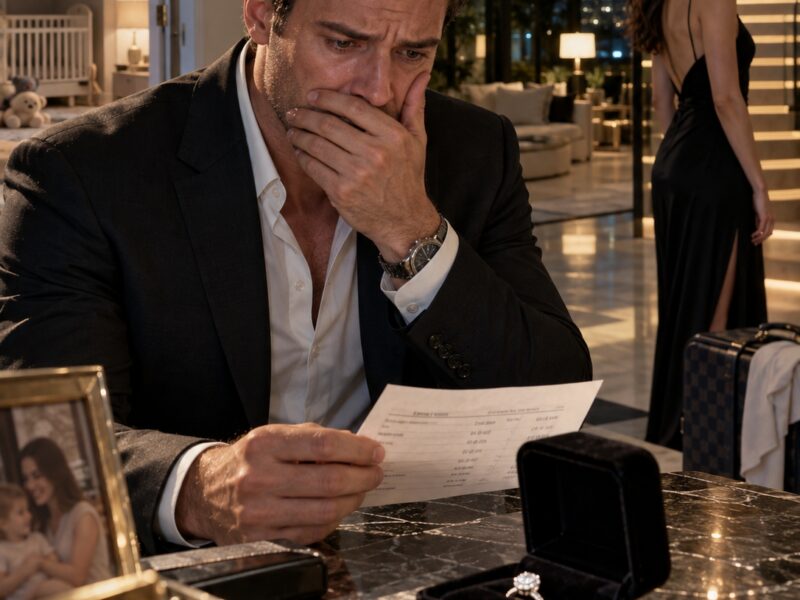
I CAME HOME AT 3:14 A.M. SMELLING LIKE ANOTHER WOMAN—BUT MY WIFE, MY BABY, AND EVERY TRACE OF THEIR EXISTENCE WERE ALREADY GONE

At 3:14 in the morning, Mark Thorne came home smelling like another woman and discovered that his wife had erased herself from his life.
Not left.
Not packed a suitcase.
Erased.
The distinction would matter later.
At first, Mark noticed only the darkness.
His black Audi rolled silently up the curved driveway of the Silver Lake house he had designed himself, a severe monument of glass, steel, limestone, and ego perched above the sleeping lights of Los Angeles. Usually Sophia left the porch light burning when he stayed out late.
She never admitted it was for him.
She would say she forgot to turn it off.
Mark always knew better.
Tonight there was no light.
He killed the engine and sat for a moment with both hands resting on the steering wheel.
Jessica’s vanilla perfume still clung to the collar of his shirt.
There was probably lipstick somewhere too.
He lowered the rearview mirror and inspected his neck.
Nothing obvious.
Good.
The absurdity of that small relief would haunt him later.
Three hours earlier, he had been standing barefoot on the balcony of Jessica Lane’s apartment while downtown Los Angeles shimmered behind him. Jessica was twenty-four, his executive assistant, and young enough to mistake his confidence for certainty.
She had laughed when he told her he needed to leave.
“You always say that.”
“I have a family.”
Jessica had looked at him over the rim of her wineglass.
“You remember that at interesting times.”
Mark had smiled instead of answering.
He was forty-one years old, founder and managing partner of Thorne & Associates, the architectural firm currently attached to one of the largest private redevelopment deals in Southern California.
That afternoon, he’d closed a merger valued at nearly four hundred million dollars.
People had shaken his hand.
Investors had congratulated him.
A city councilman had called him a visionary.
Jessica had called him brilliant.
Sophia, when he’d texted that he would be late, had replied with four words.
Leo has a fever.
Mark had stared at the message for perhaps five seconds.
Then he’d turned his phone facedown.
Now, sitting outside his house, he remembered it.
For the first time that night, something resembling guilt moved through him.
He pushed it away.
Leo had probably been teething again.
Sophia worried about everything since the baby came.
Ten months earlier, she had been the mysterious woman Mark remembered falling in love with—elegant, sharp-eyed, capable of standing in front of a Rothko for twenty minutes without saying a word.
Now their conversations were about formula, pediatric appointments, nap schedules, bottle sterilizers, and whether Mark could please stop slamming the kitchen cabinets after ten.
She had become, in his private and increasingly cruel assessment, predictable.
Maternal.
Dull.
Mark stepped from the Audi.
The night air smelled faintly of jasmine and distant exhaust.
He locked the car.
The chirp echoed strangely across the property.
He looked toward the dark house.
Something felt wrong.
Not dangerous.
Just wrong.
He entered through the front door.
Cold air touched his face.
Mark stopped.
Sophia kept the thermostat at seventy-two because she was obsessive about Leo getting cold at night.
Tonight it felt closer to sixty-five.
“Sophia?”
His voice disappeared into the house.
He dropped his keys into the ceramic bowl beside the door.
The clatter sounded unnaturally loud.
No footsteps upstairs.
No baby monitor humming from the kitchen counter.
No white-noise machine bleeding faintly through the ceiling.
Nothing.
He walked into the kitchen.
The island was spotless.
Mark frowned.
There were always bottles beside the sink.
Always.
Sophia could clean the entire house and somehow there would still be one bottle drying upside down beside a half-finished mug of tea.
Tonight the marble counters gleamed under the blue-white moonlight.
No bottle.
No mug.
No bib thrown across the back of a chair.
Not even the ridiculous yellow giraffe spoon Leo liked chewing on.
“Sophia?”
Louder now.
Silence.
Mark climbed the stairs.
Halfway up, he stopped.
The framed photograph from their wedding that usually hung beside the landing was missing.
He stared at the empty hook.
Then another.
A picture of Sophia holding Leo at three weeks old.
Gone.
Another empty space.
Mark’s pulse accelerated.
He reached the master bedroom.
The door stood open three inches.
“Soph?”
He pushed it.
The bed was made.
Not casually.
Perfectly.
Hospital corners.
Pillows arranged symmetrically.
The charcoal blanket folded across the foot.
It looked like the staged bedroom in a luxury real-estate listing.
Mark remained in the doorway.
Sophia never made the bed like that.
Not anymore.
Not with a ten-month-old baby.
“Where are you?”
His voice had changed.
He crossed the hall quickly and opened the nursery door.
Darkness.
He slapped the dimmer switch.
Warm golden light filled the room.
And Mark Thorne stopped breathing.
The crib was gone.
For several seconds, his brain refused to interpret what his eyes were seeing.
He looked left.
The changing table was gone.
The rocking chair was gone.
The shelves were empty.
The woven basket of stuffed animals had vanished.
Even the framed watercolor Sophia had painted above the crib had been removed.
The nursery was nothing but white walls and pale carpet.
Rectangular depressions remained where furniture had stood.
Ghosts of weight.
Evidence of absence.
“Leo?”
Mark stepped inside.
“Leo?”
Nothing.
His voice cracked.
“Sophia!”
He ran.
He tore open the master closet.
His clothes remained exactly where he’d left them.
Armani suits.
Shoes.
Golf shirts.
Watches.
Sophia’s half of the closet was empty.
Every dress.
Every shoe.
Every coat.
Every handbag.
Gone.
Several empty wire hangers swayed gently from the rail.
They touched one another with tiny metallic clicks.
Mark stared at them.
Click.
Click.
Click.
He rushed into the bathroom.
Her toothbrush was gone.
Skincare bottles gone.
Makeup drawer empty.
Perfume gone.
The hairbrush that had been beside his sink for five years was gone.
“Sophia!”
He ran downstairs again, nearly falling on the last three steps.
His phone was already in his hand.
He called her.
An automated voice answered.
“The number you have dialed is no longer in service.”
Mark stared at the screen.
He called again.
Same message.
Impossible.
He paid the phone bill.
They were on the same family plan.
He opened Find My.
Sophia’s device wasn’t listed.
Neither was the iPad she used in the kitchen.
Neither was the AirTag attached to Leo’s stroller.
Mark’s breathing shortened.
Kidnapping.
The word entered his mind like ice.
Someone had taken them.
Except kidnappers didn’t take wardrobes.
Kidnappers didn’t remove cribs.
Kidnappers didn’t make beds.
He looked around his immaculate house and understood something worse.
Sophia had not fled in panic.
She had executed a plan.
Mark ran toward his office.
Behind an abstract seascape hung a wall safe containing passports, emergency cash, legal papers, and several things Mark preferred not to leave at the office.
He moved the painting aside.
His fingers shook against the keypad.
Their anniversary.
10-24-18.
Red light.
Incorrect.
“What?”
Again.
Incorrect.
Sophia’s birthday.
Incorrect.
Then Leo’s birthday.
02-14-24.
The safe clicked.
Mark stared at it.
He pulled the steel door open.
Empty.
The passports were gone.
Nearly fifty thousand dollars in emergency cash was gone.
Their property documents were gone.
The encrypted drive he’d hidden beneath the removable shelf—
Gone.
Mark didn’t register that last detail yet.
Because something remained.
A small black velvet box sat precisely in the center of the safe.
He knew it immediately.
Sophia’s engagement ring box.
Mark picked it up.
His fingers felt numb.
Inside was the three-carat diamond he’d placed on her finger six years earlier.
Underneath it was a folded piece of paper.
He opened it.
A bank receipt.
Transfer initiated the previous afternoon.
Their savings account had been emptied.
Approximately $2.5 million.
Destination concealed behind an offshore financial entity Mark didn’t recognize.
Account balance:
$0.00.
Across the bottom, in Sophia’s unmistakably angular handwriting, were four words.
Tuition for the lesson.
Mark read them twice.
Then a third time.
The room seemed to tilt.
He dialed 911.
“My wife is missing.”
The dispatcher began asking questions.
“My wife and my son. They’re gone. Somebody took them.”
“Sir, is there evidence of forced entry?”
“No.”
“Any blood?”
“No.”
“Signs of a struggle?”
“No, but the house is empty. She took everything. The baby’s room—Jesus Christ, the crib is gone.”
There was a pause.
“Sir, did your wife leave voluntarily?”
“She emptied our bank account.”
“That may be a civil matter.”
“She took two and a half million dollars!”
His shout echoed through the house.
Mark looked around.
For the first time, the building he’d once considered his masterpiece frightened him.
There was too much glass.
Too many reflections.
Too many places where a person could stand and watch without being seen.
Thirty minutes later, red and blue light washed across the facade.
Detective Raymond Vance arrived wearing a rumpled jacket and the expression of a man who had spent twenty-five years watching married people discover they had never known each other.
He listened while Mark explained.
Vance occasionally wrote something in a small notebook.
When Mark finished, the detective looked toward the stairs.
“Moving an entire nursery takes time.”
“I know.”
“Packing a woman’s wardrobe takes time.”
“I know.”
“Removing furniture without damaging anything takes people.”
Mark’s jaw tightened.
“I know.”
“Neighbors see a moving truck?”
“I haven’t asked.”
Vance glanced at him.
“What time did you get home?”
“Three fourteen.”
“From?”
“Work.”
“At three fourteen in the morning?”
Mark hesitated.
It lasted less than a second.
Vance noticed.
“Client dinner,” Mark said.
“Long dinner.”
“We closed a major transaction.”
Vance wrote something.
Mark hated him immediately.
“My son is missing, Detective.”
“I’m aware.”
“Then stop interrogating me like I’m the problem.”
Vance looked up.
“I’m trying to figure out what kind of problem you have.”
The sentence landed harder than Mark expected.
Vance walked toward the mantel.
Empty spaces marked where photographs had been.
“Full name?”
“Sophia Thorne.”
“Maiden name?”
“Sophia Rostova.”
“Where was she born?”
“Europe.”
Vance waited.
“Latvia, I think. She moved around.”
“You think?”
“Her parents died when she was young. She didn’t like talking about it.”
“Family?”
“None.”
“Friends?”
“Of course she has friends.”
“Names.”
Mark opened his mouth.
Then stopped.
Sophia knew plenty of people.
Gallery owners.
Mothers from a parenting group.
Neighbors.
People she smiled at during fundraisers.
But close friends?
Someone she called when she was afraid?
Someone who had known her before Mark?
He couldn’t think of one.
Vance saw the hesitation.
“What did she do before you met?”
“Art logistics. Curation. She handled international shipments.”
“Where?”
“Different galleries.”
“Which galleries?”
Mark felt irritation rising.
“I don’t know. New York. Europe. Why does this matter?”
“Because you called me at four in the morning and told me your wife disappeared so completely she took the photographs.”
Vance held out his hand.
“Show me one.”
Mark pulled out his phone.
He opened Photos.
Favorites.
He scrolled.
Stopped.
Scrolled again.
His face changed.
“No.”
“What?”
“The pictures.”
“What about them?”
“They’re gone.”
He searched albums.
Family.
Empty.
Leo.
Empty.
Wedding.
Gone.
Mark felt suddenly nauseated.
“We shared cloud storage.”
Vance stepped closer.
“She deleted them?”
“She remotely wiped them.”
“Social media?”
Mark opened Instagram.
Sophia’s profile didn’t exist.
Facebook.
Gone.
LinkedIn.
Gone.
Pinterest.
Gone.
Even an old gallery page where she had once been tagged returned an error.
Mark lowered the phone.
“She erased herself.”
For the first time since arriving, Vance stopped looking bored.
“How long were you married?”
“Five years.”
“Where?”
“Manhattan. City Hall. October twenty-fourth, 2018.”
Vance made a phone call.
Mark paced while he waited.
The detective spoke quietly, gave names, dates, spellings.
Then he went silent.
He listened.
His eyes moved toward Mark.
Something in them changed.
Vance ended the call.
“Mr. Thorne.”
“What?”
“You’re certain about the wedding date?”
“Yes.”
“And her maiden name?”
“Yes.”
“Because New York has no record of a marriage between Mark Thorne and Sophia Rostova in 2018.”
Mark laughed.
It came out wrong.
“That’s impossible.”
“They searched variations.”
“I signed the certificate.”
“Do you have it?”
“In the safe.”
“The empty safe.”
Mark stared at him.
Vance continued.
“We also ran the birth records.”
Mark’s stomach tightened.
“What birth records?”
“Leo.”
The room seemed to become very still.
“There is no birth certificate matching the information you gave us.”
“That’s insane.”
“Maybe.”
“My son exists.”
“I didn’t say he doesn’t.”
“You just said—”
“I said the records don’t exist.”
Mark stepped closer.
“Detective, I’ve changed his diapers. I’ve held him when he was sick. I watched him being born.”
Vance’s eyes sharpened.
“You personally watched the delivery?”
Mark hesitated.
Sophia had delivered at a private birthing facility after insisting she didn’t want a hospital environment.
There had been a doctor.
Nurses.
Paperwork.
Mark had spent most of the labor taking business calls in the hallway.
He had entered near the end.
Hadn’t he?
Suddenly even that memory felt slippery.
Vance lowered his voice.
“Right now, Mr. Thorne, the woman you say you’ve been married to for five years has no marriage record under that identity. Your son’s paperwork isn’t appearing where it should. Her phone is disconnected. Her online identity has been removed. Your photographs are gone. Your safe is empty.”
Mark stared at him.
“What are you saying?”
“I’m saying this is no longer looking like an angry wife leaving her husband.”
A notification sounded.
Mark flinched.
Home security.
MOTION DETECTED — BACKYARD.
03:48 A.M.
“Someone’s outside.”
Vance drew his weapon.
“Stay here.”
Mark followed anyway.
They moved through the dark kitchen toward the rear doors.
Outside, the pool was black glass.
Vance swept a flashlight across the lawn.
Nothing.
Then the beam reached the old oak tree.
Something blue fluttered against the trunk.
Mark’s heart stopped.
He ran outside.
“Wait!”
Vance followed.
Pinned to the bark was a baby’s onesie.
Leo’s favorite.
Mark ripped it free.
Attached to the back was a Polaroid.
He turned it over.
And saw himself.
Taken less than three hours earlier.
Mark stood on Jessica’s balcony smoking a cigarette.
Jessica was behind him, wrapped in a white robe, laughing.
The photograph had been taken from far away with a telephoto lens.
Someone had been watching.
While Mark believed Sophia was home with their sick child, someone had been photographing him with his mistress.
At the bottom of the Polaroid was a set of coordinates.
Vance entered them into his phone.
“Yellowstone.”
Mark looked at him.
“What?”
“Near Grant Village.”
The cold suddenly felt unbearable.
Vance studied his face.
“You recognize it.”
Mark swallowed.
“We honeymooned there.”
“Why Yellowstone?”
“Sophia chose it.”
Vance looked at the Polaroid again.
“You told me she worked in art.”
“She did.”
“You told me she was a mother.”
“She is.”
“You told me she was boring.”
Mark flinched.
Vance held up the photograph.
“Boring women don’t photograph their husbands from rooftops at one in the morning while simultaneously disappearing an entire household.”
Mark looked toward the dark windows of his home.
A thought entered his mind.
His firm.
Passwords.
Servers.
Blueprints.
The merger.
He turned.
“I need to get downtown.”
“You’re not going anywhere.”
“If she accessed my safe, she may have access to my company.”
“Mr. Thorne—”
“You don’t understand.”
Mark was already moving.
“Thorne & Associates has confidential municipal files, private development documents, security plans—”
“What kind of security plans?”
Mark stopped.
Just for a fraction of a second.
Too long.
Vance noticed again.
Mark grabbed his keys.
“My life’s work is in those servers.”
He reached the Audi before Vance could stop him.
As he sped toward downtown Los Angeles, Mark called Jessica.
She answered on the fourth ring.
“Mark?”
She was crying.
His blood went cold.
“Jess?”
“Don’t come here.”
“What happened?”
“My apartment.”
Her breathing was ragged.
“Someone was inside.”
“Call the police.”
“They didn’t take my laptop. They didn’t take my TV. They didn’t even take the cash in my drawer.”
“What did they take?”
A pause.
“Everything you gave me.”
Mark tightened his grip on the steering wheel.
“The bracelet. Earrings. The bag. Everything.”
Then Jessica began crying harder.
“And they left something.”
“What?”
“On my pillow.”
Mark could hear fabric rustling.
“It’s a pacifier.”
He couldn’t speak.
“Blue,” Jessica whispered. “A blue baby pacifier.”
Leo’s.
Mark drove through the red light.
Sophia had known.
Not tonight.
Not recently.
She had known long enough to follow him.
Photograph him.
Identify Jessica.
Enter her apartment.
Remove every gift.
Leave Leo’s pacifier beside the sleeping woman Mark had chosen over his family.
It wasn’t jealousy.
It was demonstration.
I can reach anyone you touch.
“Get out,” Mark said.
“What?”
“Leave the apartment. Now. Hotel. Somewhere crowded.”
“Mark, who is your wife?”
He had no answer.
The question followed him all the way downtown.
Who was his wife?
The private elevator carried him to the top floor of Thorne & Associates.
His office looked untouched.
Awards.
Architectural models.
Photographs of buildings he had designed.
Everything that had once made him feel permanent.
Mark sat at his desk.
Password.
Access denied.
Again.
Denied.
Administrator override.
Denied.
Then the wall monitor switched on by itself.
Mark slowly stood.
A video appeared.
His office.
Three weeks earlier.
Mark was visible behind his desk.
Across from him sat a city councilman.
Onscreen Mark opened a briefcase.
He removed an envelope.
Slid it across the desk.
The audio was perfectly clear.
“This ensures the marina zoning problem disappears.”
The councilman took the envelope.
“Always a pleasure, Mark.”
The screen went black.
White letters appeared.
FILES PREPARED FOR FBI, IRS, AND LOS ANGELES TIMES.
Then:
SCHEDULED RELEASE: 9:00 A.M.
Mark felt the blood leave his face.
Another message appeared.
WANT TO STOP IT?
A pause.
GO TO THE COORDINATES.
Then:
ALONE.
For years, Mark had thought power meant controlling what other people knew.
Sophia knew everything.
His affairs.
His accounts.
His crimes.
His passwords.
His weaknesses.
And apparently she had known exactly what he would do when cornered.
He called Garrison.
The number hadn’t been used in years.
A gravelly voice answered.
“Make it quick.”
“Garrison. It’s Thorne.”
Silence.
Then:
“I don’t handle divorces.”
“This isn’t a divorce.”
Mark explained.
Not everything.
Enough.
When he finished, Garrison didn’t laugh.
That frightened him.
“Send me whatever you have on her.”
“She deleted everything.”
“Nothing is ever completely deleted.”
“The police can’t find a marriage record.”
“Interesting.”
“My son’s records are gone too.”
“More interesting.”
“She gave me coordinates in Yellowstone.”
“Don’t go.”
“She has Leo.”
“Don’t go.”
“She has a recording that can destroy me.”
“That’s still not a reason to walk into a kill box.”
Mark closed his eyes.
“You don’t understand.”
“No, Thorne. You don’t understand. If this woman can erase civil records, compromise financial systems, penetrate your corporate network and surveil you without detection, you’re not dealing with your angry wife.”
“What am I dealing with?”
“I don’t know yet.”
A pause.
“But whoever she is, she’s been studying you for five years.”
Mark said nothing.
Garrison’s voice lowered.
“Which means she probably knows what you’re going to do before you do.”
Mark looked at the coordinates glowing on his screen.
“I’m going.”
“Then stop trying to outsmart her.”
“What am I supposed to do?”
“Survive long enough to learn why she chose you.”
That question followed Mark onto his private jet.
Why him?
As Los Angeles fell away beneath the wings, he opened a backup laptop and searched every corner of his digital life Sophia might have missed.
Then he remembered the baby monitor.
Separate cloud provider.
Separate password.
He downloaded the application.
Tried three passwords.
The fourth worked.
Most recordings had been deleted.
One remained.
9:15 P.M.
The night before.
Mark clicked it.
Black-and-white footage showed Leo asleep.
Sophia entered.
Mark leaned closer.
She wasn’t wearing pajamas.
She wore black pants, boots, and a fitted dark sweater.
Her hair was tied back.
Her movements were economical.
Controlled.
She lifted Leo without waking him.
“Mama has you,” she whispered.
Then Sophia turned toward the camera.
Not accidentally.
Directly.
Mark’s skin went cold.
“Hello, Mark.”
He recoiled from the laptop.
Sophia adjusted Leo against her shoulder.
“I know where you’re watching this.”
Mark’s mouth went dry.
“You always use the jet when you’re frightened. Driving makes you feel trapped.”
She almost smiled.
“You probably called Garrison too.”
Mark stared at the screen.
She knew about Garrison.
That number had been hidden for years.
Sophia’s expression changed.
The softness disappeared.
“You spent five years believing you were the most important person in every room.”
She moved closer to the camera.
“You weren’t.”
Mark couldn’t breathe.
“You think this is about Jessica.”
Sophia shook her head.
“Jessica is irrelevant.”
A beat.
“So am I, in the way you understood me.”
She looked down at Leo.
Then back at the lens.
“Five years ago, Thorne & Associates received a Defense Department contract connected to the Nevada cyber operations facility.”
Mark’s heart stopped.
“You retained a private copy of the architectural and security schematics.”
He whispered, “No.”
Sophia continued.
“You kept it because you keep everything that makes you feel powerful.”
Mark remembered the encrypted drive missing from the safe.
“That was why I entered your life.”
Her voice remained calm.
“No love story. No coincidence in a Soho gallery. No mysterious European curator who happened to understand your work.”
Mark gripped the laptop.
“I married you because you had access.”
She leaned closer.
“You were the assignment.”
Something inside Mark broke.
Not because she had lied.
Because suddenly he could see the architecture of the lie.
The Soho gallery.
Her interest in his projects.
The languages.
The calmness.
The way she noticed exits whenever they entered restaurants.
The way she remembered license plates.
The way she could pack for international travel in seven minutes.
The way she had once disarmed a drunk man at a charity event by twisting his wrist so casually everyone thought he’d simply stumbled.
Mark had laughed about it afterward.
“Where did you learn that?”
Sophia had kissed him.
“Yoga.”
He had believed her.
Because believing her required nothing from him.
Onscreen, Sophia looked at Leo.
“The mission is complete.”
Mark whispered, “And Leo?”
For one impossible second, as though she could hear him across time, Sophia’s expression softened.
“Leo wasn’t part of the assignment.”
She kissed the baby’s forehead.
“He was the complication.”
Then she looked directly into the camera.
“And you, Mark, are the loose end.”
The screen went black.
For the rest of the flight, Mark sat motionless.
He had spent months resenting Sophia for becoming someone different after motherhood.
Now he understood.
Motherhood might have been the only part of her that wasn’t an act.
The jet landed near Yellowstone beneath a ceiling of gray cloud.
Mark drove into the park in a rented Jeep, still wearing yesterday’s suit.
Steam drifted across the road.
Snow clung to the pines.
His phone rang.
Garrison.
“I found her.”
Mark nearly drove off the road.
“Who?”
“Your wife.”
“Tell me.”
“Sophia Rostova doesn’t exist.”
“I know that.”
“Her likely name is Katya Volkov.”
Mark said nothing.
“SVR training history. Old files. Mostly redacted. She disappeared from official intelligence channels approximately seven years ago. After that, she appears in fragments connected to private intelligence operations and corporate extraction.”
“Extraction?”
“She doesn’t break into buildings, Thorne.”
Garrison paused.
“She breaks into lives.”
Mark tightened his hands around the wheel.
“She becomes whatever gives her access.”
“My son is with her.”
“Yes.”
“Will she hurt him?”
Garrison didn’t answer immediately.
That silence terrified Mark more than anything else.
“She completes assignments.”
“That wasn’t my question.”
“No,” Garrison said quietly. “It wasn’t.”
The coordinates led Mark toward an isolated geothermal area.
He abandoned the Jeep and stepped onto a wooden boardwalk.
Steam moved through the landscape like smoke.
The smell of sulfur burned his throat.
“Sophia!”
His voice vanished into the mist.
“Katya!”
Nothing.
Then he saw the stroller.
Charcoal gray.
Leo’s stroller.
Parked near the railing beside a violently blue thermal pool.
Mark ran.
“Leo!”
He reached it.
Empty.
A rugged laptop had been strapped into the seat.
The screen showed a live feed.
Leo.
Sleeping in a car seat.
Alive.
Mark grabbed the laptop.
“Where is he?”
Sophia’s voice came through the speaker.
“You made excellent time.”
“Where is my son?”
“You have something I need.”
“You already took the drive.”
“Encrypted.”
Mark stared at the screen.
“You’ve had five years.”
“And the Department of Defense has excellent encryption.”
“You expect me to help you?”
“I expect you to behave exactly as you’ve behaved your entire life.”
“What does that mean?”
“Choose what belongs to you over what belongs to everyone else.”
A prompt appeared.
VOICE AUTHORIZATION REQUIRED.
Mark understood.
The most sensitive architectural package required biometric authorization from the lead architect.
Him.
Sophia said, “Read the phrase.”
“If I do this, you give me Leo.”
“I’ll give you his location.”
“Promise me.”
She laughed once.
It wasn’t Sophia’s laugh.
It was colder.
“Now you care about promises?”
Mark looked at his son sleeping on the screen.
Ten months old.
Small fist closed beside his face.
He remembered the fever message he’d ignored.
The phone he’d turned facedown.
All the mornings Sophia had walked Leo through the house at four because Mark had an early meeting and needed sleep.
All the times he had described himself as a good father because he paid for everything.
“Ten seconds,” Sophia said.
The countdown began.
Mark leaned toward the microphone.
He read the authorization phrase.
The system processed.
ACCESS GRANTED.
Sophia exhaled softly.
“Goodbye, Mark.”
“Where is Leo?”
“Under the stroller.”
The connection died.
Mark tore at the storage compartment.
A device blinked beneath it.
Five seconds.
Four.
Three.
Explosive.
Mark kicked the stroller.
It went over the railing.
He threw himself backward.
The explosion erupted inside the thermal pool.
Water, steam, and debris burst upward.
The shock wave slammed him against the boardwalk.
For several seconds, Mark heard nothing.
Then pain returned.
Sound returned.
And rage returned.
He called Garrison.
“She tried to kill me.”
“I assumed that from the thermal spike.”
“She has the decrypted file.”
“Then she needs to transmit it.”
“She was transmitting.”
“Not everything. That data package is enormous. She needs serious bandwidth.”
Mark pushed himself upright.
Blood ran from his temple.
“Where?”
“You’re the architect.”
Mark looked across Yellowstone.
And suddenly understood.
“The ranger station.”
“What?”
“Old Faithful. We upgraded the seismic monitoring network. Direct fiber.”
“Go.”
Mark reached the ranger complex with the sun barely breaking through the clouds.
He parked behind trees.
Moved on foot.
Through a side window, he saw her.
Not Sophia.
Not anymore.
Katya sat before a terminal wearing tactical gear.
A pistol rested beside her.
The laptop displayed:
UPLOAD — 45%.
Then Mark saw the car seat.
Leo.
Awake.
Alive.
Everything else disappeared.
Mark wanted to smash through the door.
Instead, he forced himself to look at the building.
Not as a husband.
As an architect.
Ventilation.
Electrical access.
Fire suppression.
He remembered approving the renovation.
External emergency purge.
North wall.
Mark found the utility box and broke the lock with a tire iron.
Inside was a red lever.
He pulled it.
The station erupted.
Gas roared from ceiling vents.
Katya fell from her chair.
Mark entered.
He didn’t attack her.
He attacked the laptop.
The tire iron crashed through the keyboard.
The screen shattered.
Upload frozen.
Katya recovered instantly.
She hit him hard enough to drop him.
Mark rolled.
She was faster.
Stronger.
A knife appeared in her hand.
“You idiot.”
She pinned him.
“You think smashing a laptop stops a cloud transfer?”
Mark struggled for breath.
Her blade touched his throat.
He looked past her.
Leo was crying.
“Did you ever love him?”
Katya froze.
Not much.
Enough.
Mark saw it.
“Leo,” he whispered. “Was any of that real?”
Her jaw tightened.
“You don’t get to ask me about love.”
“I’m his father.”
“Now you remember?”
The knife pressed harder.
“You ignored him for your firm. You ignored me for women who admired your watch and laughed at your jokes.”
“You’re a spy.”
“And you’re a liar.”
“I cheated on you.”
“Repeatedly.”
“You married me to steal classified material.”
“Yes.”
Their eyes locked.
Mark almost laughed.
It was monstrous.
And somehow, absurdly, it was the most honest conversation of their marriage.
“You win,” Mark whispered.
Katya’s eyes narrowed.
“What?”
“You got the file.”
“Almost.”
“It doesn’t matter.”
“Why?”
“Because I changed the authorization.”
For the first time, uncertainty appeared in her face.
Mark saw it.
And invented the rest.
“The phrase I read didn’t just decrypt the package.”
“What did you do?”
“Triggered a thermal failure protocol at the Nevada facility.”
Her grip loosened slightly.
“You’re lying.”
“Maybe.”
“You wouldn’t destroy your own building.”
Mark smiled through blood.
“That’s the mistake you made.”
“What?”
“You spent five years studying the man I was.”
He looked toward Leo.
“I’m not that man anymore.”
Katya hesitated.
One second.
Maybe less.
It was enough.
A red laser appeared on her forehead.
Glass shattered.
“FEDERAL AGENTS! DROP THE WEAPON!”
Katya stopped.
The knife remained suspended above Mark.
Her eyes moved toward the broken window.
Then back to him.
Calculation.
Probability.
Survival.
Slowly, she released the knife.
It hit the floor.
Agents flooded the room.
Mark crawled toward Leo.
He unfastened the straps and lifted his son.
Leo screamed against his chest.
Mark held him tighter.
The smell of baby shampoo and milk filled his lungs.
For the first time since entering the empty nursery, something in the world felt real.
Agents restrained Katya.
As they led her toward the door, she stopped.
“You lied.”
Mark looked up.
She almost smiled.
“There is no thermal failure protocol.”
Mark wiped blood from his mouth.
“No.”
“Your authorization phrase was legitimate.”
“Yes.”
“You gave me exactly what I needed.”
Mark’s expression fell.
Katya tilted her head.
“But you made me hesitate.”
He said nothing.
“Not bad.”
Then, almost casually:
“Check the money.”
“What?”
“I didn’t steal it.”
“You emptied the account.”
“I moved it.”
“Where?”
“For Leo.”
Mark stared at her.
“I’m a professional, Mark.”
For the first time, something vulnerable crossed her face.
So quickly he almost imagined it.
“But I’m not a monster.”
The agents pushed her forward.
Mark called after her.
“Sophia.”
She stopped.
He didn’t know why he’d used that name.
Maybe because Katya was the operative.
Sophia was the woman who had sat barefoot on the nursery floor at two in the morning humming to their son.
Maybe both women were lies.
Maybe both were real.
She looked back.
“Was there ever anything you didn’t fake?”
The question remained between them.
Her eyes moved toward Leo.
That was her answer.
Then she disappeared through the door.
Six months later, Mark lived in a two-bedroom apartment in Santa Monica.
The Silver Lake house was gone.
Sold.
He couldn’t tolerate the silence there.
Thorne & Associates still existed.
Mark didn’t run it.
The official announcement described an indefinite leave of absence for personal reasons.
The truth was buried beneath classified interviews, federal agreements, sealed files, and conversations Mark would never be allowed to repeat.
The bribery investigation disappeared into the same darkness.
So did Katya.
Jessica blocked his number the morning after Yellowstone.
Her final message had been brief.
You brought something terrifying into my life because you were bored with yours. Never contact me again.
Mark didn’t argue.
He didn’t miss her.
That disturbed him.
Something he had once considered exciting now seemed pathetic.
A grown man searching for applause in another woman’s bedroom because the woman at home was too exhausted raising his child to keep admiring him.
Leo learned to walk.
Badly.
He moved through the apartment with the determined instability of a tiny drunk man.
Mark learned things too.
How to warm milk without overheating it.
How to distinguish Leo’s tired cry from his hungry cry.
How to attend a pediatric appointment without checking email every ninety seconds.
How to sit on the floor for forty minutes building a tower that Leo would destroy in four.
It was harder than designing skyscrapers.
There were no blueprints.
One rainy Tuesday morning, an envelope arrived through Mark’s attorney.
No return address.
Inside was a bank statement.
Beneficiary: Leo Thorne.
Trustee: Mark Thorne.
Balance: $5,000,000.
Mark stared.
The $2.5 million had returned.
And another $2.5 million had appeared beside it.
Attached to the statement was a small handwritten note.
He recognized the sharp handwriting instantly.
His pulse slowed.
Then accelerated.
He read it.
He needs a father, not an architect.
Below that:
Build him a life.
And one final sentence.
Or I’ll come back and dismantle yours again.
Mark sat at the kitchen counter for a long time.
He later learned, through channels that refused to officially confirm anything, that Katya Volkov had not remained in American custody.
A prisoner exchange had taken place on a cold runway in Estonia two months earlier.
No photographs.
No press conference.
No acknowledgment.
She was gone.
Back into whatever world she had come from.
Mark folded the note.
From the living room came the sound of wooden blocks crashing.
Leo laughed.
Mark looked toward him.
The boy sat surrounded by ruins.
A crooked tower lay scattered across the rug.
“Da-da.”
Mark stood.
For years, he’d believed buildings were proof that a man had mattered.
Concrete.
Steel.
Glass.
Something permanent enough to outlive him.
Now he walked into the living room and lowered himself onto the carpet.
Leo handed him a blue block.
Mark took it.
“Okay.”
He placed it on the floor.
Leo immediately put a yellow one on top.
The tower leaned.
Mark instinctively reached to straighten it.
Then stopped.
He let it lean.
“Better?” he whispered.
Leo grinned.
They built another level.
Then another.
It fell.
Leo laughed.
Mark did too.
And they started again.
He never completely stopped looking over his shoulder.
Every night, he checked the locks.
Once.
Then twice.
Sometimes three times.
If a woman wearing vanilla perfume passed him in a restaurant, his body reacted before his mind did.
His heart stopped.
His hands went cold.
For half a second, he would expect to turn around and see Sophia watching him from across the room.
Not Katya.
Sophia.
The distinction still mattered.
Because the most frightening thing Mark eventually understood wasn’t that his wife had been a foreign operative.
It wasn’t that she had stolen classified material.
It wasn’t even that she had built an identity so convincing that he’d slept beside it for five years.
The frightening thing was how little curiosity he’d shown about the woman he claimed to love.
He had never asked why she knew four languages.
Never asked why she had no childhood photographs.
Never asked why she could walk into a room and instantly locate every exit.
Never asked why nobody from her past came to their wedding.
He hadn’t wanted to know Sophia.
He had wanted to possess the version of Sophia that made his own life look complete.
Beautiful wife.
Beautiful house.
Beautiful baby.
Beautiful company.
And while he was busy admiring the architecture of his life, he failed to notice the foundations were hollow.
Perhaps Sophia had never loved him.
Perhaps some part of her had.
Mark would never know.
But he knew one thing.
The woman he’d dismissed as boring had understood him better than anyone alive.
She knew his ambition.
His vanity.
His infidelity.
His fear.
She knew he would protect his company before his marriage.
She knew he would take the jet.
She knew he would call Garrison.
She knew he would follow the coordinates.
She predicted almost every move he made.
Almost.
She had not predicted what he would become after he reached Leo.
Neither had Mark.
That man had no company to hide behind.
No mistress to flatter him.
No mansion to display.
No beautiful wife standing beside him at galas.
He had a modest apartment.
A child.
A box of wooden blocks.
And the knowledge that everything he once considered permanent could disappear before dawn.
Late one night, months after receiving the letter, Mark stood outside Leo’s bedroom.
His son was asleep.
The night-light cast a soft amber circle across the carpet.
Mark remembered another nursery.
An empty one.
White walls.
Furniture indentations.
The sound of wire hangers tapping together in an abandoned closet.
He remembered coming home at 3:14 in the morning with another woman’s perfume on his collar, believing the worst thing waiting for him would be an argument.
Instead, he’d found silence.
The silence had followed him across Los Angeles.
Across Wyoming.
Into interrogation rooms.
Into nightmares.
Into this smaller apartment.
But it no longer meant the same thing.
Mark stepped into Leo’s room and pulled the blanket higher over his son’s shoulder.
Leo stirred.
His dark eyes opened halfway.
“Dada?”
“I’m here.”
Two simple words.
Once, Mark would have said them without thinking.
Now he understood what they cost.
Leo closed his eyes again.
Mark remained beside the crib.
Outside, rain whispered against the windows.
Somewhere in the world, a woman who had once called herself Sophia Rostova might have been walking through an airport under another name.
She might have had different hair.
A different passport.
A different accent.
Perhaps she was already sitting across from another target, smiling as though their meeting were accidental.
Perhaps Mark would never see her again.
Perhaps one day he would smell vanilla perfume behind him and discover that she had kept her promise.
He couldn’t control that.
For the first time in his life, Mark Thorne understood that control had always been an illusion.
All he could control was whether he became the man she had accused him of never being.
A father.
He touched two fingers gently to Leo’s back.
“I’m here,” he whispered again.
Then he walked toward the doorway.
Halfway out, Mark looked back.
The nursery wasn’t impressive.
There was no imported Italian crib.
No custom millwork.
No designer furniture.
No architectural magazine would ever photograph it.
But Leo was sleeping safely inside it.
And somehow, after everything Mark had built in his life, this small ordinary room felt like the first thing he’d ever constructed correctly.
He switched off the light.
In the darkness, the apartment settled around him.
Mark checked the front-door lock once.
He stood there with his hand on it.
For a moment, he considered checking it again.
Then he remembered the crooked tower Leo had built that afternoon.
Mark removed his hand.
He walked away.
And for the first time since the night the woman who didn’t exist disappeared from his house, he allowed one locked door to be enough.









