I CAME HOME TWO DAYS EARLY—AND FOUND MY HUSBAND’S MISTRESS WEARING MY SILK ROBE… BUT THE SECRET SHE WAS HIDING WAS EVEN WORSE

Nine years of marriage died in four seconds.
That was how long Victoria Rivers stood in the doorway of her own kitchen, staring at a woman she had never invited into her home.
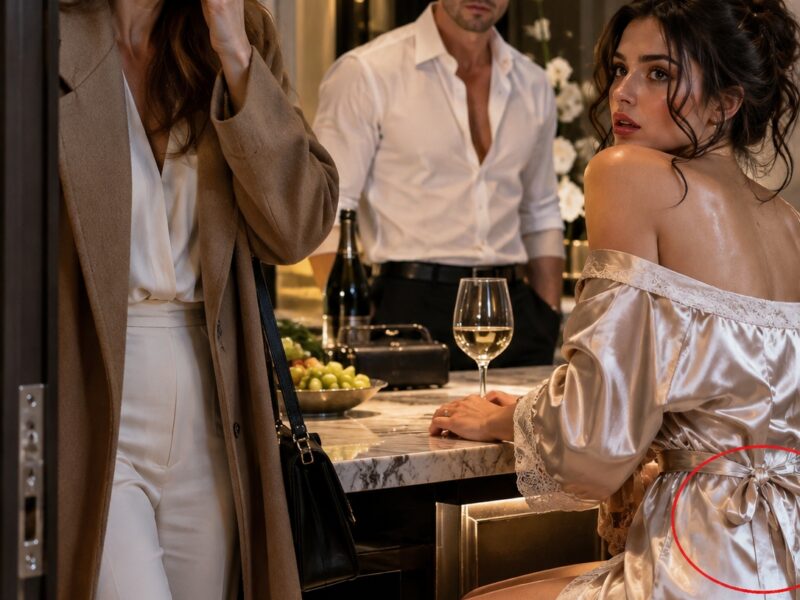
Four seconds to notice the champagne-colored silk robe.
Four seconds to recognize her favorite white porcelain mug between another woman’s manicured fingers.
Four seconds to understand why George, the estate doorman, had been unable to look her in the eye when she arrived home two days early.
And somewhere above them, on the third floor of an eighty-thousand-square-foot mansion in Houston’s River Oaks, Victoria’s husband was still talking to investors as if his life had not just split cleanly in two.
The woman at the kitchen island was young. Twenty-eight, perhaps. Dark hair spilled over one shoulder, deliberately careless, and one bare knee showed beneath the robe as she sat on Victoria’s black leather bar stool.
For one strange instant, neither woman moved.
The stainless-steel oven clock glowed 10:43 P.M.
The refrigerator hummed.
A faucet dripped once into the farmhouse sink.
Victoria could hear all of it.
She could even hear the tiny click when the stranger carefully set down the mug.
“Mrs. Rivers.”
So she knew her name.
That somehow hurt less than it should have.
Victoria lowered her eyes to the robe.
Richard had given it to her on their seventh anniversary. Champagne silk from Milan, absurdly expensive, selected by an assistant and delivered in a black box because Richard had been in New York negotiating a hotel acquisition that night.
He had come home two days later and tied the belt around Victoria’s waist himself.
The knot.
That was what destroyed the final lie.
Richard tied robes strangely—left side folded beneath the right, belt doubled once and looped backward because, years ago, Victoria had laughed and told him he tied everything as though he were securing construction equipment.
The woman was wearing Richard’s knot.
Not something that could be explained away.
Not something that could be blamed on wine.
Not something a secretary accidentally learned.
Victoria looked back at her face.
“What’s your name?”
The woman swallowed. “Ivy.”
“Ivy what?”
“Fontaine.”
Victoria nodded once.
Ivy’s expression shifted. The initial fear disappeared behind something smoother, something prepared.
“I think Richard should explain.”
“I think he already has.”
Victoria turned around.
That frightened Ivy more than screaming would have.
“Victoria—”
But Victoria was already walking away.
She crossed the marble foyer and climbed the sweeping staircase without hurrying. Her small carry-on still stood beside the front door where George had placed it.
Forty-two minutes earlier, on the flight from Chicago, she had imagined coming home quietly.
She had imagined watering the magnolias in the morning.
Maybe sitting beside Richard at breakfast.
Maybe trying, one more time, to have a conversation that did not involve quarterly earnings, investors, schedules, construction permits or somebody calling him “Mr. Rivers.”
The saddest realization was that she had not actually cut the trip short because she missed Richard.
She had missed home.
There was a difference.
She understood that now.
Inside the master bedroom, Victoria opened the enormous custom closet and pulled a black suitcase from the upper shelf.
Then she began packing.
Two dresses.
Three blouses.
Jeans.
Shoes.
Her mother’s framed photograph.
Her grandmother’s worn gold bracelet.
And finally, from the back of a drawer Richard had probably never opened, four music composition notebooks covered in her handwriting.
Her fingers paused on them.
Before Richard Rivers, there had been music.
Before charity galas and investor dinners, before stylists and society photographs and the exhausting performance of being Mrs. Richard Rivers, Victoria had been a pianist.
Not someone who “played piano.”
A pianist.
At twenty-two, she could walk onto a stage and disappear inside Chopin until a room of strangers forgot to breathe.
She had composed music, too.
Then came Richard.
Then marriage.
Then the gradual disappearance.
Not in one dramatic sacrifice.
That would have been easier to recognize.
Instead, her life had vanished through reasonable little compromises.
Could she skip one rehearsal because Richard needed her at a dinner?
Could she reduce her teaching schedule because his mother was hosting a fundraiser?
Could she postpone the conservatory opportunity because they were traveling?
Could she stop teaching altogether because, as Richard once said while signing a document without looking up, “You don’t need to work, Victoria. You have everything.”
Everything.
She stared at the notebooks in her hands.
Then she placed them carefully in the suitcase.
Behind her, a voice said, “What are you doing?”
Victoria did not turn.
Richard stood in the closet doorway, breathing hard.
At fifty-one, Richard Rivers was a man accustomed to rooms changing temperature when he entered them. He had built a four-billion-dollar construction empire by making decisions faster than other men could formulate objections.
Now his shirt was partly untucked.
His face had gone pale.
“I can explain.”
Victoria continued arranging her shoes.
“Victoria.”
“Please move.”
“Just stop for a second.”
She finally looked at him.
He had expected rage.
What he saw was infinitely worse.
Nothing.
No tears.
No trembling accusation.
No wife demanding to know why.
Her face possessed the stillness of a house after everyone had already moved out.
“What you saw downstairs—”
“Was Ivy Fontaine.”
Richard stopped.
“She told me her name.”
His jaw tightened. “It’s complicated.”
“No.”
“Victoria—”
“It is actually the least complicated thing that has happened between us in years.”
He stepped closer. “It was a mistake.”
Victoria almost smiled.
“A mistake?”
“Yes.”
“She knows how you tie my robe.”
That silenced him.
For the first time in perhaps twenty years, Richard Rivers had no useful sentence available.
Victoria closed the suitcase.
“I’ll fix this,” he said.
There it was.
The language of Richard’s universe.
Fix.
Acquire.
Resolve.
Negotiate.
He could buy distressed properties, settle lawsuits, restructure debt and make entire companies disappear behind signatures.
Victoria studied the man she had once loved so fiercely that she had mistaken surrender for devotion.
“You still don’t understand.”
“I understand that I hurt you.”
“No. You understand that something you owned is leaving.”
His expression changed.
“I never thought of you that way.”
“You never had to.”
She reached for the suitcase handle.
Richard blocked the doorway instinctively.
“Where are you going?”
Victoria looked directly into his eyes.
Then she said the sentence he would remember for the rest of his life.
“I’m not going anywhere, Richard.”
She pulled the suitcase past him.
“I’m going home.”
Twenty minutes after the front door closed, Richard was still standing in the foyer.
He stared at the mahogany door as though money might reopen it.
George had disappeared.
The staff had become invisible.
Even the mansion seemed embarrassed for him.
Ivy descended the staircase twenty-five minutes later wearing a fitted black dress and carrying her heels.
“Richard?”
He looked at her.
Three hours earlier, she had seemed exciting.
Now all he could see was Victoria’s robe.
“Leave.”
Ivy stopped. “Excuse me?”
“Get out.”
“You’re upset. I understand.”
“No, you don’t.”
“We knew this might eventually happen.”
Richard stared at her.
We.
He suddenly hated the word.
“There is no ‘we.’”
Her face hardened. “You didn’t seem to feel that way last night.”
“Get out of my house.”
“Richard—”
“Now.”
She left.
And for the first time, Richard was alone with the full dimensions of what he had done.
His phone showed three unread messages from Victoria.
8:06 P.M. — Flight changed. I may be home tonight.
8:19 P.M. — Did you see my message?
9:02 P.M. — Never mind. I’ll get a cab.
He had ignored all three.
Because Victoria could wait.
Victoria always waited.
He called her.
No answer.
Again.
Voicemail.
He poured whiskey and did not drink it.
At one in the morning he entered the bedroom and opened Victoria’s jewelry drawer.
Every diamond he had ever bought her remained inside.
The emerald necklace from Paris.
The sapphire earrings from Geneva.
The bracelet from their fifth anniversary.
And her wedding ring.
Richard picked it up.
For years he had measured generosity in numbers.
He had never understood that Victoria leaving millions of dollars behind was not rejection of his wealth.
It was proof that his wealth had never been the thing holding her there.
At seven the next morning, Richard was outside a modest apartment building in Montrose.
Lucy Bennett opened the door.
She had known Victoria since they were sixteen and had disliked Richard almost as long.
“What do you want?”
“To see my wife.”
“No.”
“Lucy.”
“She slept three hours.”
“I need five minutes.”
“You needed nine years.”
He flinched.
“I made a terrible mistake.”
Lucy leaned against the doorway.
“No, Richard. Forgetting an anniversary is a mistake. Putting salt in coffee is a mistake. Sleeping with your secretary for months requires scheduling.”
His mouth tightened.
“Please.”
For half a second, Lucy’s anger softened.
Not for him.
For Victoria.
Then it returned.
“She doesn’t owe you access because you finally became uncomfortable.”
The door closed.
Richard stood there with a blue velvet jewelry box in his coat pocket.
He had brought a necklace.
Only after Lucy shut him out did he understand how grotesque that was.
By noon, his mother knew.
Catherine Rivers entered the mansion without knocking.
At seventy-two, she moved with the rigid elegance of a woman who considered aging an inconvenience rather than a condition.
Richard met her in the library.
She did not sit.
“How long?”
He knew immediately.
“Mother—”
“How long?”
“Several months.”
“With your secretary?”
“Yes.”
Catherine closed her eyes.
Richard had watched his mother bury her husband without breaking in public. He had seen her negotiate with bankers during recessions and intimidate surgeons twice her size.
He had never seen her look ashamed of him.
Until then.
“Does Victoria know?”
“She came home last night.”
“And found her?”
Richard nodded.
Catherine crossed the room and slapped him.
The sound cracked through the library.
Richard did not move.
“That,” Catherine said quietly, “was from me.”
She picked up her handbag.
“What comes from Victoria will be much worse.”
“I’m trying to find her.”
“Why?”
“To fix my marriage.”
Catherine gave a bitter laugh.
“You still think this is a broken contract.”
“What do you want me to do?”
“Nothing.”
He stared at her.
“For once in your life, do nothing to her. Do not chase her with gifts. Do not send lawyers. Do not buy an apartment beside wherever she is staying. Let that woman breathe.”
Richard sank into a chair.
Catherine studied him.
Then her anger shifted into something sadder.
“Your father made many mistakes,” she said. “But he knew the difference between providing for a woman and loving one.”
“I loved Victoria.”
“I believe you.”
That answer hurt more.
“You simply loved yourself more.”
At three that afternoon, Victoria finally texted him.
Richard grabbed his phone so quickly he nearly knocked over his coffee.
The message contained one sentence.
Please water the magnolias. Nobody else remembers how much they need in this heat.
Richard read it three times.
No accusation.
No mention of Ivy.
No request for money.
The magnolias.
He went outside.
It took him ten minutes to find the hose.
Victoria always kept it coiled behind the tool shed, but somebody had moved it.
That tiny inconvenience almost broke him.
He stood beneath the Houston sun spraying water over the dark soil surrounding trees Victoria had planted during their first year of marriage.
Nine years earlier she had stood barefoot in the dirt laughing because Richard’s loafers were ruined with mud.
“You know,” she had said, “trees remember where they were loved.”
He had teased her for it.
Now he turned off the hose and stared at the blossoms.
For the first time since she left, Richard cried.
Victoria woke Wednesday morning in Lucy’s guest room and felt something unfamiliar.
Lightness.
The ceiling was cracked.
The mattress sagged toward the center.
A garbage truck groaned outside.
She had never slept anywhere less luxurious during her marriage.
And she had never breathed more easily.
In Lucy’s living room stood an old Yamaha upright piano buried beneath plants and photographs.
Victoria touched one yellowed key.
The note was slightly flat.
She sat.
Her fingers trembled through the first scale.
Again.
Better.
Again.
Then something ancient awakened.
Muscle memory.
Rhythm.
A language buried beneath nine years of expensive silence.
Victoria began playing the Chopin nocturne she had mastered at twenty-two.
Halfway through, she heard a sound behind her.
Lucy stood in the hallway crying.
Victoria stopped.
“Don’t.”
Lucy wiped her face. “Don’t what?”
“Look at me like that.”
“Like what?”
“Like I’ve come back from the dead.”
Lucy laughed through her tears.
“You kind of have.”
Victoria looked at the keys.
“No.”
Her fingers returned to them.
“I think I’m still coming back.”
The next morning, she called Alice Moreno at the Houston Cultural Arts Center.
Alice remembered her instantly.
“Victoria Rivers?”
“Victoria Hale,” she corrected, using the name she had performed under before marriage.
There was a silence.
Then Alice said, “How soon can you start?”
Three teaching slots were vacant.
Victoria accepted all three.
Monday morning she entered a classroom carrying binders, pencils and lesson plans she had spent the entire weekend preparing at Lucy’s kitchen table.
No diamonds.
No driver.
No personal assistant.
Just sensible shoes and coffee in a paper cup.
Her first student was a seventy-one-year-old widower named William Carter.
“I’ve always wanted to learn,” he said nervously.
Victoria smiled.
“Then you’re not late.”
William looked at her.
“Feels late.”
She adjusted his hand over middle C.
“Late is still better than never.”
The words stayed with her long after the lesson ended.
Perhaps because she had not really been speaking to William.
The video happened accidentally.
Friday afternoon, Alice allowed Victoria thirty minutes alone with the Steinway in the main rehearsal hall.
Victoria opened one of her old composition notebooks.
Twelve years earlier, she had begun a piece in B minor and never finished it.
She placed her hands on the keys.
This time she knew how it ended.
The melody began softly.
Then grief entered.
Not theatrical grief.
The quieter kind.
A dinner table with two plates and one person looking at a phone.
A woman dressing beautifully for strangers while her husband forgot to ask whether she was happy.
A piano slowly gathering dust.
A silk robe tied around another woman.
Then anger came.
Then freedom.
Victoria played until she forgot where she was.
She did not notice Sophia, a twenty-three-year-old administrative assistant, standing near the rear door with tears on her cheeks and a phone recording in her hand.
Sophia uploaded one minute and forty seconds that evening.
By Saturday morning, it had eighty thousand views.
By Sunday afternoon, more than four hundred thousand.
Monday morning, Victoria arrived at work and found Alice waiting with a phone.
“What did you do?”
Victoria frowned. “What?”
Alice turned the screen toward her.
Comments moved faster than Victoria could read.
Who is she?
I don’t even listen to classical music and I’m crying.
Someone find this woman.
Victoria stared at herself on the tiny screen.
She barely recognized the person playing.
Not because she looked different.
Because she looked alive.
Two days later, Edward Sloan called.
Four Grammys.
Three decades producing some of the most respected instrumental artists in America.
A reputation for impatience.
He spoke with Victoria for twenty-seven minutes.
Then he asked the question everyone eventually asked.
“Why did someone this good disappear for ten years?”
Victoria stood in the arts center hallway looking through a window at cracked asphalt.
Once, she might have protected Richard.
Once, she might have made herself smaller to make the truth less uncomfortable.
Instead she smiled.
“Life pulled me in the wrong direction.”
Edward waited.
“But I have the compass now.”
He offered her a recording contract.
Victoria did not accept.
Not immediately.
“I need time.”
Edward laughed. “Do you know how many musicians spend their entire lives waiting for this phone call?”
“Yes.”
“And you want time?”
“Yes.”
Another silence.
“I like you,” he said.
After they hung up, Victoria leaned against the wall.
She had walked out of River Oaks carrying one suitcase.
Now, for the first time, she understood she had not escaped a life.
She was building one.
But while Victoria was rediscovering herself, another structure was beginning to collapse.
And this one had been built on lies.
Three weeks after Victoria left, Ivy Fontaine sat inside a private medical clinic staring at a sheet of laboratory results.
Dr. Miller spoke carefully.
Ivy barely heard him.
Her mind had already gone elsewhere.
To Gregory Shaw.
Forty-two.
Ambitious.
A minority shareholder in Richard’s empire.
And the man Ivy had been sleeping with long before she began sleeping with Richard.
What Richard believed was an affair born from attraction had never been that simple.
Gregory had wanted access.
Schedules.
Private forecasts.
Internal project budgets.
Acquisition plans.
And Richard, blinded by ego and flattered by the attention of a younger woman, had opened doors Ivy could never have reached alone.
At first she told herself she was merely forwarding harmless information.
Then the payments began.
Then Gregory’s meetings with Meridian Group.
Then the stakes changed.
Now Ivy stared at her medical report and realized that every lie she had balanced so carefully was collapsing at once.
Across Houston, Robert Rivers was discovering the same thing.
Richard’s younger brother had spent two weeks tracing rumors of confidential corporate information appearing in the hands of competitors.
Three secret hotel meetings led back to Gregory.
Gregory led to Meridian.
Meridian led to internal documents.
And internal documents led to one person with both physical and digital access to Richard.
Ivy.
Robert walked into Richard’s office carrying a thin manila folder.
“I need the room.”
Richard glanced at the executives around his conference table.
“Robert—”
“Now.”
Something in his brother’s face made him obey.
Five minutes later they were alone.
Robert placed the folder on the desk.
Richard opened it.
Hotel photographs.
Email logs.
Transfer records.
Meeting dates.
Then one security report.
Richard stopped breathing.
“No.”
Robert said nothing.
Richard turned another page.
“No.”
“Keep reading.”
Richard looked up.
“She was giving Gregory information?”
“Yes.”
“How much?”
“We don’t know yet.”
“Why?”
“Because Gregory appears to have been feeding Meridian.”
Richard rose.
The city stretched beyond the glass wall behind him.
For twenty-five years he had dominated that skyline.
Now he looked suddenly small against it.
Robert’s voice remained cold.
“There’s something else.”
Richard turned.
“They knew your marriage was deteriorating.”
“What?”
“One of my sources heard Meridian executives joking about it. They believed keeping you distracted personally would weaken you professionally.”
Richard stared at him.
The words landed slowly.
Victoria.
The robe.
The suitcase.
Her abandoned wedding ring.
“You’re saying—”
“I’m saying your affair was useful to them.”
Richard’s face twisted.
Robert stepped closer.
“But don’t you dare turn that into an excuse.”
Richard looked at him.
“Ivy may have manipulated you. Gregory may have used her. Meridian may have benefited.”
Robert tapped the folder.
“But nobody forced you to betray Victoria.”
Richard lowered his eyes.
That was the one fact no investigation could alter.
The legal response was immediate.
Forensic accountants traced confidential files.
Digital-security specialists reconstructed access logs.
Ford, the Rivers family attorney, prepared a forty-three-million-dollar civil action against Gregory and initiated provisions that threatened his stake in the company.
Richard signed everything.
Yet victory tasted like ash.
Each night he returned to River Oaks and walked through rooms that seemed designed to amplify absence.
Then George showed him the concert advertisement.
Victoria Rivers — One Night at Independence Theater.
Richard stared at the photograph.
Victoria sat at a Steinway beneath warm golden light.
No jewelry.
No Rivers mansion.
No Richard.
And she looked more powerful than she ever had standing beside him at a gala.
“Tickets?” Richard asked.
George smiled faintly.
“Almost gone, sir.”
Richard bought the last one himself.
He arrived alone.
No security entourage.
No reserved VIP box.
Row twenty.
A corner seat.
When Victoria walked onto the stage in a simple deep-blue dress, four hundred people stood.
Richard remained seated for one stunned second before rising with them.
He had attended hundreds of expensive performances.
He had sponsored orchestras.
Donated to theaters.
Sat beside governors and CEOs at benefit concerts.
But he had never truly listened.
Not until his wife sat beneath a spotlight and placed her hands on a piano.
For ninety minutes, Richard heard the life he had ignored.
He remembered walking past rooms while Victoria practiced.
Remembered telling her, “Beautiful,” without removing his eyes from an email.
Remembered asking her to stop playing once because he was taking a conference call.
He had lived in the same house as this music.
He had been married to the woman creating it.
And somehow he had believed his work was the important thing happening there.
Victoria saved the B-minor composition for last.
By the final notes, Richard was crying openly.
He did not wipe his face.
The audience rose.
The ovation lasted four minutes.
Victoria returned to the stage three times.
Strangers handed her flowers.
Richard watched them celebrate the woman he had trained himself not to see.
Afterward, he waited near the artist exit.
Victoria appeared with Alice and Sophia.
Her laughter stopped when she saw him.
Alice glanced between them.
Victoria touched her arm.
“It’s okay.”
The others left.
Richard and Victoria stood alone.
“You were magnificent,” he said.
“Thank you.”
“I didn’t come to ask you to come home.”
Victoria’s gaze remained steady.
“I came to listen.”
Something softened in her expression, but only slightly.
“I should have done it years ago.”
“Yes.”
Richard swallowed.
“I didn’t know.”
“You didn’t want to know.”
He nodded.
“You’re right.”
That surprised her.
No defense.
No negotiation.
No explanation.
Richard looked toward the theater doors.
“All those people heard you tonight.”
“Yes.”
“And I lived beside you for nine years.”
Victoria said nothing.
“I’m sorry.”
The old Victoria might have rescued him from the discomfort of the silence.
This Victoria let him stand inside it.
Finally she said, “I believe you’re sorry.”
Hope flickered across his face.
She extinguished it gently.
“But being sorry doesn’t return nine years.”
Richard looked down.
“No.”
Victoria tightened her hands around the flowers.
“I’m not your wife anymore, Richard.”
He closed his eyes.
“But for the first time in a very long time…”
She looked toward the doors opening onto the warm Houston night.
“…I am myself.”
Then she walked away.
Richard did not follow.
That was the first loving thing he had done for her in years.
The following week Robert asked Victoria to meet.
They sat in a small coffee shop far from River Oaks.
He told her everything.
Ivy.
Gregory.
Meridian.
The leaks.
The deliberate exploitation of Richard’s affair as a corporate distraction.
Victoria listened without interrupting.
When Robert finished, she stared into her coffee.
“So my humiliation was useful.”
Robert’s jaw tightened.
“I’m sorry.”
“They treated me like collateral.”
“Yes.”
“And Richard?”
“Richard was manipulated.”
Victoria looked up sharply.
Robert continued before she could respond.
“But he wasn’t controlled. I told him that.”
She relaxed slightly.
“Good.”
“Victoria, my brother was a fool.”
“A very expensive fool.”
Robert almost smiled.
“He knows.”
“That doesn’t fix anything.”
“No.”
She appreciated that answer.
Robert did not ask her to forgive Richard.
He did not turn espionage into an excuse for adultery.
He simply gave her the truth.
Outside the café he said, “For what it’s worth, I’m sorry our family failed you.”
Victoria looked toward the bright Texas sky.
“You didn’t fail me.”
“My brother did.”
“Yes.”
She inhaled.
“And for years, I failed myself.”
Robert frowned.
Victoria shook her head.
“I don’t mean his affair was my fault. It wasn’t. I mean I kept disappearing because disappearing made everyone else comfortable.”
She looked back at him.
“I won’t do that again.”
That afternoon she returned to Lucy’s apartment and played until her hands ached.
Not because she was broken.
Because she was free enough to be furious.
Richard wrote the letter on Sunday.
It took twelve attempts.
He discarded every version that contained explanations.
Every version mentioning Ivy.
Every version mentioning Gregory.
Every version asking Victoria to remember their good years.
Finally he understood.
An apology that demanded forgiveness was simply another transaction.
So he wrote the truth.
He wrote about the dinners where he had stared at his phone.
The concerts he missed.
The teaching career he had encouraged her to abandon because her dreams seemed inconvenient beside his.
He admitted that adultery was only the loudest cruelty.
The deeper cruelty had been thousands of ordinary moments when he made the woman beside him feel invisible.
At five that evening, he went to Lucy’s apartment.
Victoria opened the door.
Richard handed her the envelope.
“What is this?”
“Something I should have said years ago.”
“I’m not promising to read it.”
“I know.”
“And if I do, I’m not promising to answer.”
“I know.”
He turned to leave.
“Richard.”
He stopped.
Victoria studied him.
“What do you want from me?”
The old Richard would have said another chance.
He would have said come home.
Instead he answered, “Nothing you don’t freely choose.”
Then he walked downstairs.
At 10:20 that night, Victoria opened the envelope.
Richard’s plain platinum wedding band fell into her lap.
She read the letter once.
Then again.
There was no justification.
No Ivy.
No corporate conspiracy.
No demand.
Only acknowledgment.
For the first time, the man who had caused her invisible suffering had named it accurately.
Victoria placed the ring on the coffee table.
She did not call him.
Forgiveness was not a door she intended to open simply because someone finally knocked correctly.
Weeks passed.
Her career accelerated.
Edward’s contract was renegotiated on Victoria’s terms.
She continued teaching.
She recorded.
She performed.
She rented a small house with enough room for a grand piano and a garden.
Richard sold nothing and bought her nothing.
He attended therapy.
Reduced his travel.
Reorganized his executive schedule.
He learned the names of employees he had walked past for years.
And every Sunday, he watered the magnolias.
He never sent Victoria photographs of himself doing it.
That mattered.
Because for perhaps the first time in his life, Richard was changing without requiring an audience.
Then one Tuesday afternoon, Victoria watched William Carter struggle through a simple passage he had failed for three consecutive lessons.
His hands shook.
“I’m too old for this.”
“You said that on your first day.”
“And I was right.”
Victoria smiled.
“Play it again.”
He did.
He missed a note.
Started over.
Missed another.
Started over.
On the sixth attempt, he played the entire passage correctly.
William stared at his hands.
Then he laughed.
A seventy-one-year-old man laughing like a child because persistence had turned something impossible into music.
Victoria went very still.
That evening, she called Richard.
He answered after one ring.
“Victoria?”
“I’ll meet you.”
Silence.
“Okay.”
“One conversation.”
“Okay.”
“No gifts.”
“Yes.”
“No driver waiting outside.”
“Understood.”
“And Richard?”
“Yes?”
“If you try to sell me a future, I’m leaving.”
His answer came quietly.
“Then I’ll tell you the truth about the present.”
They met at a neighborhood restaurant where nobody cared who Richard Rivers was.
For three hours they dismantled their marriage.
Not romantically.
Painfully.
Victoria told him what it felt like to disappear beside him.
Richard listened.
When instinct pushed him toward explanation, he stopped himself.
When she described lying awake after dinners wondering whether being easier to love might finally make him notice her, he lowered his head.
“I did love you.”
“I know.”
That surprised him.
Victoria continued.
“That was part of what made it so painful. I knew you loved me. You just behaved as though love required nothing from you.”
Richard had no defense.
They discussed Ivy.
They discussed therapy.
They discussed trust.
Finally Richard asked, “Is there any version of this where we try again?”
Victoria looked at him for a long time.
“Yes.”
His breath caught.
“But not the old marriage.”
He nodded.
“I will never stop playing again.”
“I know.”
“My career will not become something we schedule around yours.”
“Agreed.”
“I will never live in that house again.”
Richard blinked.
River Oaks had been his monument.
His achievement.
His fortress.
“Okay.”
“And if I ever feel myself becoming invisible again, I leave.”
Richard looked across the small wooden table.
“Then I’ll spend the rest of my life making sure you never have to.”
Victoria shook her head.
“No.”
He frowned.
“That’s still the wrong answer.”
She touched her coffee cup.
“I’m responsible for making sure I never disappear again.”
Richard absorbed that.
Then Victoria added quietly, “Your responsibility is to love the woman who refuses to.”
Three months later, Catherine Rivers hosted Sunday dinner.
There were no photographers.
No business associates.
No champagne tower.
Just roast chicken, potatoes, fresh bread and too many flowers on a table meant for eight.
Victoria arrived in jeans.
Richard arrived separately.
That was important.
They were rebuilding, not pretending the collapse had never happened.
Her first recording had exceeded every expectation.
The B-minor piece had been released under her own name.
Victoria Hale Rivers.
She kept Rivers not because Richard owned it.
Because she chose what belonged to her now.
During dessert, Catherine asked about the next performance.
“New York,” Victoria said.
Richard looked up.
“When?”
“November.”
“Do you want me there?”
The table became quiet.
Months earlier, Richard would simply have cleared his calendar and appeared.
Now he asked.
Victoria noticed.
“Yes.”
Richard smiled.
“I’d like that.”
Later, Victoria stepped onto Catherine’s back porch.
Richard joined her but kept a respectful distance.
“You’re quiet,” he said.
“I’m thinking.”
“Dangerous.”
She gave him a sideways glance.
For the first time in months, they both laughed.
Richard rested his hands against the railing.
“The magnolias are blooming.”
“I know.”
“George says I overwater them.”
“You do.”
“You could have told me.”
“I did. For nine years.”
Richard winced.
Victoria smiled faintly.
“Sorry.”
“No. I deserved that.”
They stood beneath the evening sky.
Their marriage had not been magically repaired.
Trust did not return because a guilty man wrote a beautiful letter.
Betrayal did not become harmless because the betrayer finally understood its cost.
Victoria still had mornings when the scent of unfamiliar perfume could send a cold memory through her chest.
Richard still sometimes reached for control when fear made him insecure.
But now they spoke.
Sometimes badly.
Sometimes painfully.
Always honestly.
And there were boundaries where silence had once lived.
Months later, before Victoria walked onto another stage, Richard sat alone in the audience.
No VIP section.
No phone in his hand.
No business documents.
The theater lights dimmed.
Victoria appeared.
For one brief second, she found him in the crowd.
Richard did not wave.
He simply looked at her.
And listened.
Victoria turned toward the piano.
Her hands hovered above the keys.
She thought of the kitchen at 10:43 P.M.
The champagne robe.
The suitcase.
Lucy’s cracked ceiling.
The old Yamaha.
William’s trembling fingers.
The letter.
The magnolias.
People often spoke about forgiveness as though it restored what existed before.
Victoria knew better.
Some things should never be restored.
Some houses deserved to remain empty.
Some versions of ourselves deserved to be left behind.
Forgiveness, when it came at all, was not permission to return to the ruins.
It was permission to stop living inside them.
She lowered her hands.
The first note traveled through the dark theater.
Then another.
And another.
Richard listened to the woman he had once nearly erased.
But Victoria was no longer playing for him.
She wasn’t playing against him either.
She was playing because the music belonged to her.
Because her life belonged to her.
Because nine years of silence had not destroyed her voice.
It had only made the moment she reclaimed it impossible to ignore.
Outside, somewhere beneath the humid Houston night, magnolia blossoms opened quietly in the darkness.
And this time, nobody mistook their silence for absence.









