I Carried My Widowed Billionaire CEO Through a Storm—Then She Whispered 4 Words That Left Me Frozen…
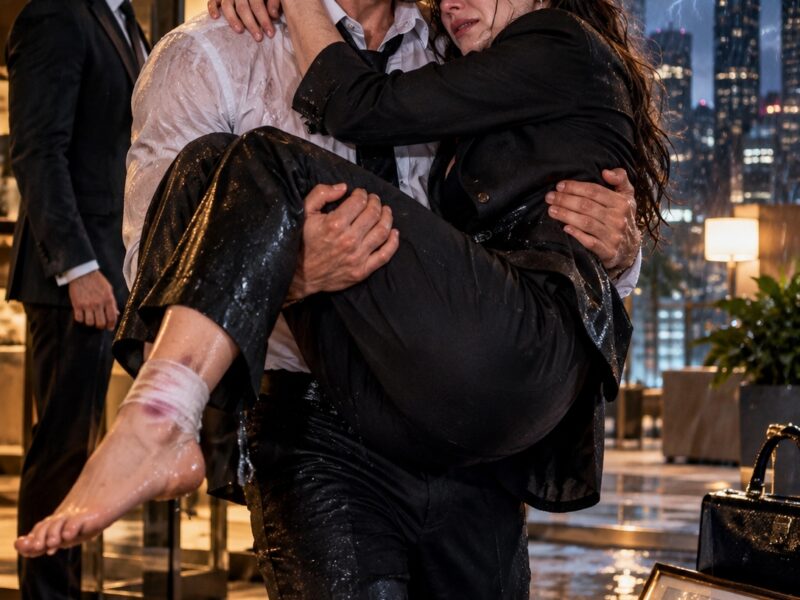
The first time I carried Elena Hart in my arms, she was barefoot, injured, and shaking so badly I could feel it through my shirt.
That alone would have been impossible for anyone at Hartwell Technologies to believe.
Elena Hart did not shake.
She did not stumble.
She did not ask for help.
She had built a billion-dollar technology company before she turned forty, survived a brutal market crash, stared down hostile investors twice her age, and once fired a senior vice president in front of fourteen executives without raising her voice.
People changed the way they stood when Elena entered a room.
They lowered their voices.
Straightened their jackets.
Closed whatever browser window they weren’t supposed to have open.
And yet that night, with rain hammering against forty-two floors of glass and thunder rolling over downtown Chicago, the most powerful woman I had ever known had both arms locked around my shoulders.
Her face was pressed against my chest.
Her injured ankle hung carefully over my arm.
And she was crying.
Not loudly.
That would have been easier.
Elena cried the way people cry when they have spent too many years making sure nobody hears them.
Silently.
Her fingers tightened against the back of my shirt.
Then she whispered four words.
“I’ve missed this, Daniel.”
I stopped walking.
For one reckless second, I forgot about the storm.
Forgot about the dark building.
Forgot that she signed my paychecks.
Forgot that the woman in my arms was my CEO.
Because there are some sentences that sound simple until you realize they are carrying years of loneliness inside them.
And I had no idea yet what Elena Hart really meant.
Three years earlier, I wouldn’t have believed a woman like Elena would ever know my name.
Back then, I was thirty-four, divorced, nearly broke, and living in a one-bedroom apartment above a laundromat in Logan Square.
My marriage hadn’t ended spectacularly.
There was no affair.
No screaming match.
No broken dishes.
Sometimes I thought that would have been easier.
Instead, my ex-wife, Rachel, and I simply became strangers while sitting at the same dinner table.
She wanted a life that felt bigger.
I wanted a life that felt stable.
Eventually she told me stability had started feeling like another word for fear.
I couldn’t tell her she was wrong.
When she left, she took the dining table, the better coffee maker, and most of the future I had assumed was waiting for me.
I kept the couch.
And the debt.
By the time Hartwell Technologies hired me as a senior operations analyst, I wasn’t chasing ambition anymore.
I was chasing rent.
My job put me close enough to the executive floor to see how power worked but far enough away that nobody important remembered my birthday.
That suited me.
Especially when it came to Elena Hart.
Everyone knew her story.
At thirty-eight, Elena was already considered one of the most formidable CEOs in the Midwest.
Hartwell had begun as a tiny cybersecurity startup operating out of a converted warehouse.
Under Elena’s leadership, it became an international company employing nearly six thousand people.
Business magazines loved photographing her.
She photographed beautifully.
Dark hair.
Gray-green eyes.
Perfect posture.
Tailored suits that probably cost more than my first car.
Headlines called her relentless.
Visionary.
Uncompromising.
But there was one part of her biography journalists usually mentioned in a single respectful paragraph.
Her husband, Michael Hart, had died two years earlier.
A highway accident.
Black ice.
A truck that crossed the median.
Michael had been forty.
Elena had been thirty-six.
No children.
No goodbye.
Afterward, according to employees who had been around long enough, Elena changed.
She stopped attending holiday parties.
Stopped joining executives for dinner.
Stopped taking vacations.
Her assistant once accidentally scheduled a meeting on Elena’s wedding anniversary.
Elena conducted the entire ninety-minute meeting without mentioning it.
Then she remained alone in her office until almost two in the morning.
People called it strength.
I wasn’t so sure.
Sometimes staying busy isn’t strength.
Sometimes it’s just grief wearing expensive clothes.
I began noticing things.
Small things.
Elena would finish a meeting, wait until everyone left, then stare at the empty chair beside hers.
She kept two coffee mugs in a cabinet even though she only used one.
On rainy evenings, she stood beside the glass wall of her office longer than necessary.
And there was a photograph.
I saw it by accident.
One evening, her assistant asked me to deliver revised acquisition projections.
Elena was standing near the window when I entered.
She didn’t hear me immediately.
She was holding a photograph.
Michael stood beside her on a beach somewhere, barefoot, his pants rolled above his ankles.
Elena looked completely different.
Her hair was messy.
Her head was thrown back.
She was laughing.
Not smiling for a camera.
Laughing.
I must have stared half a second too long.
Elena noticed.
The photograph immediately went facedown on her desk.
“I’m sorry,” I said.
“For what?”
“I didn’t mean to interrupt.”
Her expression hardened automatically.
Then something softened.
“It’s fine.”
I placed the documents down.
I should have left.
Instead, I said, “You looked happy.”
The instant the words left my mouth, I regretted them.
Elena stared at me.
Nobody spoke to her like that.
Certainly not an operations analyst whose office was twelve floors below hers.
“I was,” she finally said.
I nodded and turned toward the door.
“Daniel.”
I stopped.
Her eyes had returned to the photograph.
“Grief doesn’t disappear just because people become uncomfortable talking about it.”
I didn’t know what to say.
So I said the only thing that felt honest.
“No. I don’t suppose it does.”
Her eyes lifted toward mine.
For perhaps three seconds, neither of us was CEO or employee.
Then her phone rang.
The wall came back.
“Good night, Mr. Carter.”
“Good night, Ms. Hart.”
That should have been the end of it.
It wasn’t.
Over the following months, Elena began noticing me.
Nothing inappropriate happened.
No secret dinners.
No flirtation.
No lingering touches.
Mostly, she simply began asking my opinion during meetings.
At first, senior executives seemed irritated.
Then they became curious.
Then cautious.
Elena didn’t ask questions unless she cared about the answer.
One afternoon, during a brutal budget meeting, the CFO recommended eliminating sixty-three support positions.
Everyone around the table nodded.
I didn’t.
Elena noticed.
“Something to add, Daniel?”
Twelve executives turned toward me.
I swallowed.
“Those numbers assume automation will reduce support demand by eighteen percent.”
“It will,” the CFO said.
“Eventually.”
He frowned.
I continued.
“But the transition model doesn’t include implementation failures. If adoption is even three months slower than projected, we’ll save payroll and lose customers.”
Silence.
The CFO looked annoyed.
Elena looked interested.
“How many customers?”
“Potentially twelve percent of the midmarket portfolio.”
“Show me.”
I did.
She studied the numbers.
Then closed the CFO’s presentation.
“We’re not cutting the positions.”
Afterward, I found a message waiting in my inbox.
From Elena.
Two words.
Good catch.
It shouldn’t have mattered.
It did.
But nothing truly changed until October.
The storm arrived just after nine.
Chicago storms have a particular way of making skyscrapers feel less permanent than they are.
Rain slammed sideways against the windows.
Lightning turned the skyline white.
By nine fifteen, streets around the building were flooding.
By nine twenty, security announced that several lower-level electrical systems were experiencing failures.
I was still on the seventeenth floor finishing an investor-risk report.
Most employees had already gone home.
Elena, naturally, was still upstairs.
At 9:34 p.m., the lights flickered.
Once.
Twice.
Then everything went black.
Emergency lighting came on seconds later, washing the hallways in dim red.
I saved my laptop, grabbed my coat, and headed toward the stairs.
Then I heard something.
A sharp metallic crash.
Followed by a woman’s gasp.
It came from above.
I ran.
“Hello?”
Nothing.
I climbed another flight.
“Is someone there?”
Then I heard Elena’s voice.
“Daniel?”
I found her on the executive-floor landing.
One shoe lay several feet away.
A metal emergency sign had fallen from the wall.
Elena sat against the railing, one hand gripping her ankle.
Even in near darkness, I could see her face had gone pale.
“What happened?”
“I’m fine.”
It was the least convincing sentence I had ever heard.
I crouched beside her.
“Can you stand?”
“Of course.”
She tried.
The moment her right foot touched the floor, her breath caught.
She dropped back against the railing.
“Elena.”
“I’m fine.”
“You’re sitting barefoot in an emergency stairwell during a blackout.”
Her eyes flashed.
“I am aware of my location.”
Despite everything, I almost smiled.
“Can you move your ankle?”
She tried.
Pain crossed her face.
“No.”
“We should get you downstairs.”
“I can walk.”
“No, you can’t.”
Her jaw tightened.
“I don’t need—”
“Help?”
That stopped her.
Thunder exploded somewhere outside.
Elena flinched.
Not much.
But enough.
I had never seen her flinch before.
She looked away.
“I hate this.”
“The storm?”
“Needing someone.”
The answer came so quietly that for a moment I wasn’t certain I’d heard correctly.
I sat on the step beneath her.
“Everyone needs someone sometimes.”
“Not me.”
“That’s a terrible company policy.”
She almost laughed.
Almost.
Then her expression changed.
“You don’t understand.”
Maybe I didn’t.
But I understood enough to recognize fear when I saw it.
“I understand that you’re hurt.”
“I’ll manage.”
“How?”
She had no answer.
Rain rattled violently against the stairwell windows.
I stood.
Then I leaned toward her.
“What are you doing?”
“Getting you downstairs.”
“Daniel.”
“You’re welcome to file a complaint with HR tomorrow.”
Her eyebrows lifted.
“You realize I’m the CEO.”
“Then I’m guessing you know where HR is.”
And before she could stop me, I slid one arm beneath her knees and another behind her back.
Elena gasped as I lifted her.
Her hands instinctively caught my shoulders.
For the first few seconds, her entire body remained rigid.
I could feel the tension in her.
Then thunder shook the building again.
Her grip tightened.
“You’re okay,” I said.
“I know.”
Another crash.
Her forehead touched my shoulder.
“I’m okay,” she repeated.
This time it sounded like she was trying to convince herself.
I carried her through the executive corridor.
Emergency lights painted the glass offices red.
Outside, Chicago disappeared behind sheets of rain.
Halfway toward the stairs, Elena whispered my name.
“Daniel?”
“Yeah?”
“Don’t put me down yet.”
I stopped.
Her eyes remained closed.
That was the moment something changed.
Not romance.
Not yet.
Something more dangerous.
Trust.
We reached the lobby twenty minutes later.
Security informed us that several nearby streets were flooded.
Ride services had suspended pickups downtown.
The building garage exit was temporarily blocked.
Nobody was going anywhere.
I carried Elena into a private executive lounge beside reception.
The room looked like a boutique hotel lobby.
Leather sofa.
Walnut tables.
A fireplace that operated mostly for decoration.
I helped her sit.
Her ankle was swelling rapidly.
“I’ll find ice.”
“You don’t have to.”
“I know.”
I returned with an ice pack and a first-aid kit.
I knelt in front of her.
When I reached for her ankle, she stiffened.
“Tell me if this hurts.”
“It already hurts.”
“Useful information.”
That earned a tiny smile.
I wrapped the ice pack carefully.
When I finished, I looked up.
Elena was staring at me.
Not the way a CEO looks at an employee.
Not even the way a woman looks at a man.
She looked confused.
“What’s wrong?”
She shook her head.
“Nothing.”
“That’s clearly not true.”
Her eyes dropped to my hands.
Then she reached out.
Her fingers closed around mine.
And suddenly her eyes filled with tears.
I froze.
Elena looked almost embarrassed by them.
“I’m sorry.”
“You don’t need to apologize.”
“I don’t do this.”
“Cry?”
“Any of it.”
Her fingers tightened.
Then came the words I would remember for the rest of my life.
“I’ve missed this.”
My heart stumbled.
She saw my expression.
“No.”
She shook her head quickly.
“I don’t mean you.”
“I didn’t think—”
“I mean…”
She stopped.
For several seconds, she couldn’t continue.
Then she whispered, “Being taken care of.”
The storm seemed to disappear.
“Michael used to carry me.”
Her voice broke slightly.
“When I was sick. When I fell asleep on the couch. Sometimes just because he knew it annoyed me.”
A tear slipped down her cheek.
“I used to tell him to put me down.”
She laughed once, painfully.
“I would give almost anything to have him ignore me one more time.”
I didn’t know what to say.
So I didn’t say anything.
Elena stared at our joined hands.
“After he died, everyone wanted something from me. Investors wanted reassurance. Employees wanted leadership. His parents wanted me to be okay because seeing me broken made them hurt more.”
She swallowed.
“My friends wanted the old Elena back.”
Her voice dropped.
“And eventually I realized nobody knew what to do with the version of me that couldn’t breathe.”
I sat beside her.
“You don’t have to be anything tonight.”
She looked at me.
“Then what am I supposed to be?”
“Elena.”
Something inside her broke.
She leaned toward me.
Slowly.
Carefully.
Almost as if waiting for me to move away.
I didn’t.
Her forehead touched my chest.
Then her shoulders began trembling.
I put one arm around her.
And Elena Hart finally cried.
Not for the board.
Not for investors.
Not behind a locked office door.
She cried for Michael.
For the empty side of her bed.
For every dinner eaten alone.
For every morning she’d reached across the mattress before remembering there was nobody there.
And I held her while the storm swallowed Chicago.
By sunrise, the rain had weakened.
Elena’s driver collected her.
Before entering the car, she turned toward me.
The vulnerability from the night before was gone.
Her shoulders were straight.
Her expression controlled.
“Thank you, Daniel.”
“How’s the ankle?”
“I’ll survive.”
“I’m sure shareholders will be relieved.”
A faint smile.
Then she hesitated.
“What happened last night…”
My stomach tightened.
“Stays between us.”
I understood.
“Of course.”
She nodded.
Then got into the car.
Monday morning, Elena Hart was once again untouchable.
She entered the executive conference room in a charcoal suit and orthopedic boot.
Nobody dared mention it.
Neither did I.
For three weeks, we barely spoke beyond work.
I began wondering whether she regretted everything.
Then one Tuesday afternoon, I received a calendar invitation.
Lunch.
Sender: Elena Hart.
No agenda.
I stared at it for nearly a minute.
At noon, I entered her office.
Two salads waited on the small conference table.
“You invited me to lunch?”
“Apparently.”
“Should I bring financial projections?”
“No.”
“Emergency procedures?”
“Daniel.”
I sat.
For several minutes, we talked about work.
Then Elena put down her fork.
“I went to the river Saturday.”
I knew the place.
Michael used to take her there.
“How was it?”
“Awful.”
I smiled.
“That’s encouraging.”
“It actually was.”
She looked toward the window.
“I stayed twenty minutes.”
“Good.”
“Then thirty.”
Her eyes returned to mine.
“I haven’t done that since he died.”
Something warm moved through my chest.
But I was careful.
I knew grief could make kindness feel like love.
And loneliness could make attention feel like destiny.
I wasn’t going to become a substitute for a dead man.
Neither of us deserved that.
So nothing happened.
Weeks became months.
We became friends in quiet, almost invisible ways.
Sometimes Elena appeared beside my desk near six and asked whether I’d eaten.
Sometimes I found coffee waiting outside my office.
She began leaving work before midnight.
Then before ten.
Once, scandalously, at six thirty.
People noticed.
Rumors began.
The CFO, Richard Sloan, cornered me after a meeting.
“You should be careful.”
“About what?”
“Confusing access with importance.”
I looked at him.
He smiled without warmth.
“Elena is vulnerable. That doesn’t make you special.”
I didn’t answer.
But the warning stayed with me.
Especially because part of me feared he was right.
Then Hartwell’s largest institutional investor threatened to withdraw nearly four hundred million dollars.
Everything changed.
The board panicked.
Richard demanded layoffs.
Financial media predicted restructuring.
Elena returned to her old habits almost overnight.
Midnight meetings.
Skipped meals.
Three hours of sleep.
Every conversation became a battle.
One evening, she tore apart a presentation I had spent two days preparing.
“This isn’t good enough.”
“It addresses every scenario you requested.”
“It doesn’t address investor contagion.”
“Because we don’t have enough data.”
“Then get it.”
“From where?”
“That’s your job.”
The room went silent.
Elena had never spoken to me that way.
I closed my laptop.
“Okay.”
I walked out.
At 11:40 that night, she appeared in my office.
“I’m sorry.”
I continued typing.
“Daniel.”
“I heard you.”
“I shouldn’t have done that.”
“No.”
She stood silently.
Then said, “They’re going to leave.”
I looked up.
She wasn’t talking about investors.
Not really.
“They always leave.”
There it was.
The real wound.
Michael.
Loss.
Control.
Fear.
I stood.
“An investor leaving isn’t Michael dying.”
Her face changed.
“Don’t.”
“You can’t control every loss by working harder.”
“I said don’t.”
“And destroying yourself won’t make people stay.”
“Stop.”
Her voice cracked.
I did.
She turned toward the window.
For a long time, neither of us spoke.
Then she said, “Sometimes when I laugh, I feel guilty.”
My anger disappeared.
“When I sleep through the night, I feel guilty.”
Her hands tightened.
“When I enjoy dinner, I think he should be sitting across from me.”
She turned.
“And when I’m with you…”
Silence.
My heartbeat became painfully loud.
She looked terrified.
Not of me.
Of whatever she was about to admit.
“When I’m with you, sometimes I forget to be sad.”
Neither of us moved.
“Then I remember him.”
Her eyes filled.
“And it feels like I’ve betrayed him.”
I crossed the room slowly.
“My father once told me something.”
Elena waited.
“When my family lost our house, I thought moving on meant pretending it never mattered.”
I paused.
“He told me moving forward doesn’t mean leaving something behind.”
Her eyes stayed on mine.
“Sometimes it means carrying what it gave you into whatever comes next.”
Elena wiped a tear away.
“What if I don’t know how?”
“Then don’t figure out the rest of your life tonight.”
“What should I figure out?”
“Tomorrow.”
She laughed through her tears.
And something shifted.
But the crisis wasn’t over.
Three days later, Richard Sloan requested an emergency board meeting.
He argued Elena’s judgment had become unstable.
He cited missed projections.
Executive turnover.
Investor anxiety.
Then, without looking at me, he mentioned “inappropriate emotional dependence on subordinate employees.”
The room went silent.
Elena’s face became stone.
I understood immediately.
He meant me.
“Be very careful, Richard,” Elena said.
“I’m protecting the company.”
“By discussing my personal life?”
“Your personal life becomes relevant when it affects leadership.”
I stood.
Elena looked at me.
“Daniel, sit down.”
“No.”
Everyone stared.
I removed my employee badge.
Then placed it on the table.
Elena’s face drained of color.
“What are you doing?”
“Removing the argument.”
“Daniel.”
“If my presence gives anyone an excuse to question your decisions, then I won’t be the reason they do it.”
Richard almost smiled.
That nearly changed my mind.
Almost.
Elena stared at the badge.
Then at me.
Her voice was dangerously quiet.
“Do not resign because someone else decided to weaponize our friendship.”
“It’s not just friendship they’re questioning.”
Her eyes locked on mine.
That silence told the entire room more than either of us wanted.
I walked out.
For the next two weeks, Elena and I didn’t speak.
I accepted a temporary consulting position.
Hartwell stabilized after two major investors publicly renewed their support.
Richard’s attempted power play backfired when several board members discovered he had been privately encouraging investor concern to strengthen his own position.
He resigned before he could be fired.
I should have felt vindicated.
Instead, I felt empty.
Then, on a freezing January morning, my phone rang.
Elena.
I almost didn’t answer.
“Hello?”
Her voice was soft.
“Are you busy?”
“Not particularly.”
“I need to go somewhere.”
I waited.
“Would you come with me?”
An hour later, I sat beside her in the back of a black SUV.
Neither of us spoke.
Then I saw the cemetery gates.
Michael.
Snow covered the ground.
Elena carried white flowers.
We walked between rows of stones until she stopped.
Michael James Hart.
Beloved Husband.
Beloved Son.
Beloved Friend.
Elena stood there for a long time.
I remained several yards away.
This wasn’t my moment.
Eventually, she knelt.
She brushed snow from the stone.
“Hi.”
One word.
Her voice nearly broke.
She talked to him quietly.
About Hartwell.
About his mother.
About the river.
About how angry she’d been that he died.
Then she began crying.
“I thought loving anyone again would mean I hadn’t loved you enough.”
My chest tightened.
Elena looked down at the grave.
“But I think I finally understand.”
She touched the stone.
“You didn’t teach me how to lose you.”
A trembling smile.
“You taught me what being loved felt like.”
She placed the flowers down.
“And I don’t want to spend the rest of my life pretending that feeling has to be buried here with you.”
She stood.
For a moment, she simply looked at his name.
Then whispered, “Thank you.”
Not goodbye.
Thank you.
She walked toward me.
Her eyes were red.
Her cheeks were wet.
But something in her face had changed.
She reached for my hand.
I let her take it.
We walked away from Michael together.
Not because she had stopped loving him.
Because she finally understood she didn’t have to.
Elena didn’t return to Hartwell immediately.
She took three weeks away.
The longest vacation she’d taken since Michael died.
When she returned, she shocked everyone by restructuring the executive team and establishing mandatory mental-health leave policies for senior leadership.
Then she called me.
“I want you back.”
I smiled into the phone.
“That sounds like a dangerous sentence from a CEO.”
“I’m serious.”
“So am I.”
She laughed.
I had missed that laugh.
“I can’t work directly under you anymore,” I said.
“I know.”
She had already thought of it.
Hartwell offered me an independent strategic role reporting to the board’s operations committee.
No direct reporting line to Elena.
No hidden arrangement.
No whispered favoritism.
I accepted.
But our first real date didn’t happen for another four months.
Elena chose the restaurant.
Then nearly canceled twice.
When I arrived, she was already sitting at the table.
No executive armor.
No tailored black suit.
Just jeans, a cream sweater, and nervous eyes.
“You look terrified,” I said.
“I negotiate acquisitions worth hundreds of millions of dollars.”
“And?”
“This is worse.”
I laughed.
She kicked me beneath the table.
For the first time, our relationship belonged only to us.
Not Michael.
Not Hartwell.
Not grief.
Not gratitude.
Us.
It wasn’t easy.
Healing never is.
There were mornings when Elena woke crying from dreams about Michael.
There were anniversaries she needed to spend alone.
There were moments when I wondered whether there would always be three people in our relationship.
Eventually I realized there were.
And that didn’t frighten me anymore.
Michael was part of the woman I loved.
Erasing him would mean erasing part of her.
So I stopped competing with a dead man who had never asked to be my rival.
A year later, Elena established the Hart Foundation for families dealing with sudden bereavement.
At the launch, hundreds of employees filled Hartwell’s auditorium.
Elena stood beneath the stage lights.
She talked about grief.
Loneliness.
Leadership.
She told them that success had once convinced her she could survive without needing anyone.
Then life proved otherwise.
“Strength,” she said, “is not the absence of need.”
The room became silent.
“Sometimes strength is having the courage to let someone see that you are tired.”
Her eyes found mine.
“And sometimes the person who helps you stand again arrives when you’re still convinced you should be standing alone.”
Nobody in that auditorium knew exactly what she meant.
I did.
Years have passed since the storm.
Sometimes, when rain crashes against our bedroom windows, Elena wakes before me.
I find her standing near the glass.
She still thinks about Michael.
I know she does.
I never ask her not to.
One night, thunder rolled across the city almost exactly the way it had years earlier.
I found her smiling.
“What?”
She turned toward me.
“Do you remember?”
“The night you tried to walk on a sprained ankle because accepting help offended your entire personality?”
“It wasn’t sprained.”
“It was badly sprained.”
“The doctor said moderate.”
“You couldn’t walk.”
“I could have.”
“You literally ordered me not to carry you.”
“And you ignored your CEO.”
“I was young and reckless.”
She laughed.
Then she walked toward me.
There was a softness in her now that hadn’t existed when I first met her.
Not weakness.
Something harder won.
Peace.
She wrapped her arms around my neck.
“Carry me.”
I stared at her.
“Your ankle is fine.”
“I know.”
“Then why?”
She smiled.
Because she knew exactly what she was asking.
And so did I.
I lifted her.
She laughed as I carried her toward the bedroom.
Halfway there, she rested her head against my shoulder.
The laughter faded into something quieter.
“Daniel?”
“Yeah?”
“That night…”
I waited.
“I used to think it was the night I finally became weak.”
I stopped walking.
She looked at me.
“Now I think it was the first night I was strong enough to stop pretending.”
Outside, rain streaked down the windows.
Years earlier, I had carried Elena Hart through a dark building because she couldn’t walk.
I thought the important thing was getting her safely downstairs.
I was wrong.
The real journey had taken much longer.
It had carried her through grief.
Through guilt.
Through fear.
Through the terrible belief that loving tomorrow somehow betrayed yesterday.
And maybe that is what second chances actually are.
They don’t erase the first love.
They don’t return what death took.
They don’t close every wound.
Sometimes a second chance is simply another human being standing beside you long enough for you to realize that surviving isn’t the same thing as living.
Elena never stopped loving Michael.
I never asked her to.
She simply discovered that the human heart is stranger and larger than grief wants us to believe.
It can mourn one person and still reach for another.
It can remember yesterday without refusing tomorrow.
And sometimes the moment that changes everything doesn’t look important at all.
Sometimes it is only a storm.
A dark hallway.
An injured ankle.
Two lonely people.
And one woman who had spent years carrying everyone else’s expectations finally allowing someone else to carry her.
Even now, Elena occasionally whispers those same four words against my chest.
“I’ve missed this.”
But they mean something different now.
Because she isn’t talking about what she lost anymore.
She’s talking about what she finally allowed herself to find.









