I Crossed a Thousand Miles to Marry a Man I’d Never Seen—Then I Almost Left Him at the Train Station
Evelyn Hartwell had crossed more than a thousand miles to marry a man she had never seen.
It took her less than ten seconds to wonder if she had ruined her life.
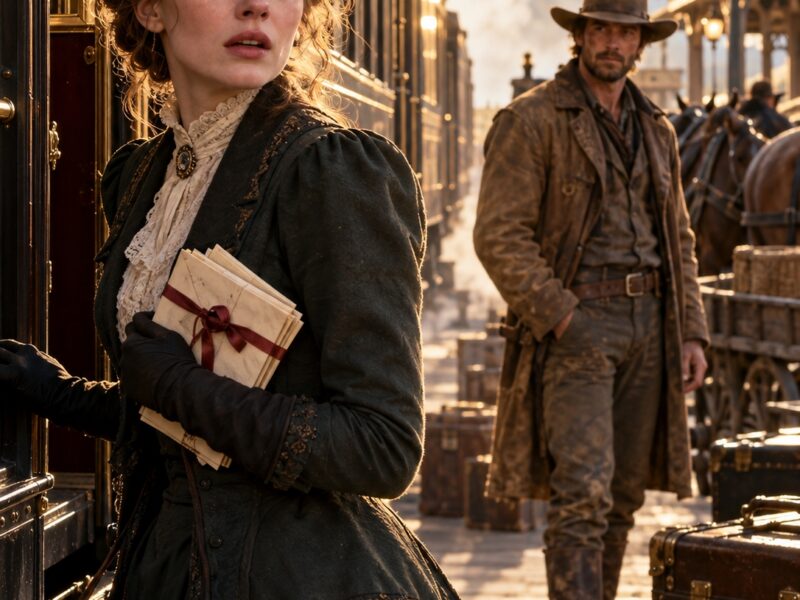
She stood on the wooden platform at Clearwater Junction, Wyoming, with two trunks, one hatbox, and eleven months of love letters packed invisibly around her heart.
Twenty feet away stood Gideon Hale.
At least, she assumed it was Gideon.
The man leaning against the wagon post looked nothing like the man she had built from his words.
His boots were caked with dried mud. His canvas coat had once been brown but had surrendered long ago to rain, dust, cattle, and Wyoming winters. His hat carried a permanent dent. Three days of dark stubble shadowed a face that looked as if wind had been carving it for years.
His hands were enormous.
Calloused.
Weathered.
Working hands.
Not the hands Evelyn had imagined holding the pages that had made her fall in love.
He looked like exactly what he was.
A cattle rancher.
Completely.
Unapologetically.
And terrifyingly.
For one wild moment, Evelyn considered turning around.
The train was still behind her.
Steam curled around the platform.
A porter was hauling luggage from the baggage car.
If she moved quickly enough, perhaps she could get back aboard.
Back to Philadelphia.
Back to her mother’s parlor.
Back to imported lace and afternoon tea and men who smelled of pomade and spoke to educated women as though education were an unfortunate hobby.
Back to the life she had crossed a continent to escape.
Then Gideon looked directly at her.
He pushed away from the wagon post and crossed the platform in eight long strides.
“Miss Hartwell.”
His voice startled her almost as much as his appearance.
Lower than she had imagined.
Flatter.
There was distance in it—the enormous, open distance of Wyoming.
He held out his hand.
Not to kiss hers.
Not to help her.
To shake it.
Evelyn stared at the hand for half a second before taking it.
“Mr. Hale.”
His grip was firm, brief, and practical.
Then he looked past her.
“Two trunks?”
“Yes.”
“Anything in them that can’t survive a rough road?”
She blinked.
“My books, possibly.”
Something changed around his mouth.
Barely.
Not a smile.
Almost one.
“We’ll put those on top.”
He released her hand.
“Creek crossing gets rough this time of year.”
Then he picked up her first trunk as if it contained blankets instead of half her worldly possessions.
No flowers.
No embrace.
No whispered confession that eleven months of letters had meant as much to him as they had to her.
He simply loaded her luggage into a wagon that smelled faintly of leather, hay, and cattle.
Evelyn stood alone on the platform.
And panic opened beneath her ribs.
You don’t know this man.
The thought was brutal because another part of her immediately answered:
Yes, I do.
She knew he drank coffee without sugar.
She knew he had taught himself to understand cattle futures because losing money frightened him less than not understanding why he’d lost it.
She knew he had read David Copperfield twice, called it sentimental both times, and still kept a copy beside his bed.
She knew he believed the federal government had broken its promises to Native tribes and had once filled six pages explaining why.
She knew his dog Frank had died the previous spring.
That letter had been different.
Shorter.
Raw.
He had written only one paragraph about the dog, but Evelyn had read that paragraph until the fold in the paper began to soften.
She knew Gideon’s mind.
She knew his loneliness.
She knew his humor.
She knew the parts of himself he had trusted to ink.
But standing on that platform, Evelyn realized how much paper had hidden.
She didn’t know what his face looked like when he was angry.
She didn’t know whether he shouted.
She didn’t know whether the respect he showed her intelligence in letters would survive the inconvenience of living with an intelligent woman.
She didn’t know whether a man could be honest for eleven months on paper and cruel the first time a door closed behind him.
“Coming?”
Gideon was sitting on the wagon now.
Waiting.
Evelyn looked back at the train.
Then at him.
Then she picked up her hatbox.
And climbed into the wagon.
Without his help.
Because none was offered.
Four hours later, she would begin to understand that this was not necessarily the insult she thought it was.
But first, she had to survive the ride.
The letter that brought Evelyn to Wyoming had arrived on a Thursday.
She remembered because Thursdays were when her mother hosted her tea circle, which meant the Hartwell parlor filled with respectable Philadelphia women discussing marriages, fabrics, reputations, servants, and other people’s failures with the solemnity of diplomats negotiating a treaty.
Evelyn had been sitting beside a window pretending to care about imported lace when Maggie, the housemaid, placed an envelope beside her untouched tea.
Evelyn recognized the handwriting instantly.
Careful.
Slightly slanted.
Gideon Hale.
Powder River County, Wyoming Territory.
She took the letter upstairs before opening it.
Everyone knew about Gideon.
Her father considered the correspondence eccentric.
Her mother considered it humiliating.
Her younger sister considered it romantic because she had never had to risk anything romantic herself.
Only Evelyn’s closest friend, Ruth Albright, seemed to understand.
Perhaps because Ruth had been responsible for the whole thing.
Eleven months earlier, Ruth had shoved a periodical across a café table and tapped an advertisement.
“Read this.”
Evelyn had sighed.
“Why?”
“Because I’m married and therefore entitled to interfere with unmarried people.”
“That’s not a law.”
“It should be.”
Evelyn read.
Wyoming rancher, age thirty-four, seeks educated, clear-minded woman of independent spirit for correspondence leading to matrimony. Must be willing to work and willing to be honest. References available.
Evelyn stared.
“References?”
Ruth grinned.
“I know.”
“Is he requesting them or providing them?”
“It doesn’t specify.”
“This is absurd.”
“Completely.”
Evelyn took the periodical home.
She waited six days before answering.
Not because she was desperate.
At twenty-eight, Philadelphia had already begun treating her unmarried status like a minor physical defect, but desperation wasn’t what drove her.
Boredom did.
Her father had introduced her to two “appropriate” men.
One smelled like old cheese.
The other believed women reading newspapers made them argumentative.
Evelyn already was argumentative.
She saw no reason to surrender newspapers as well.
So she wrote Gideon Hale a careful letter describing herself as educated, practical, interested in politics, literature, agricultural economics, and household management.
His response arrived three weeks later.
The first line infuriated her.
You sound like you’re applying for employment. I’m not hiring anyone. Try again.
She wrote back that afternoon.
And that was how it began.
They argued.
About government.
About land.
About education.
About whether experience created wisdom or merely repeated habits.
He was blunt.
She was precise.
He accused her once of hiding behind elegant sentences.
She accused him of using bluntness as an excuse for laziness.
He wrote back:
Fair.
She laughed so loudly Ruth asked what was wrong with her.
Somewhere between the arguments, something happened.
They stopped performing.
Gideon admitted that loneliness on the ranch sometimes felt like weather—something physical that moved in and stayed.
Evelyn admitted that her comfortable Philadelphia life often felt like living inside a beautiful room where all the windows had been painted shut.
He told her about losing cattle.
She told him about wanting work that mattered.
He told her he stayed when things became difficult.
And finally, eleven months after their first letter, he wrote the sentence that changed everything.
I think you might be a woman who values real.
Then:
If you believe a life here could hold something for you, come.
Her mother cried.
Her father called it madness.
Ruth asked only one question.
“Do you trust him?”
Evelyn had answered too quickly.
“Yes.”
Now, rattling across Wyoming beside a man who had barely spoken twenty sentences since collecting her, she wondered whether she had confused trusting words with trusting a person.
“How far?” she asked.
“Four hours.”
A beat.
“Five if the north road’s bad.”
Another beat.
“It’ll probably be bad.”
Evelyn looked at him.
“I see.”
Silence returned.
She lasted perhaps three minutes.
“You’re quiet,” Gideon said.
“I’m observing.”
“What?”
“Wyoming.”
“And?”
“It looks exactly like your letters said it would.”
“And I don’t.”
Her head turned.
“I didn’t say that.”
“Didn’t have to.”
His eyes remained on the road.
“I know what I look like, Miss Hartwell. Known for thirty-four years. Doesn’t keep me awake.”
Evelyn stiffened.
“Are you calling me shallow?”
That made him glance at her.
Only briefly.
“No.”
“Your tone suggested otherwise.”
“My tone suggested I’m used to it.”
Something about that answer hurt more than defensiveness would have.
Because there was no accusation in it.
Only experience.
She faced the road.
Twenty minutes later, the wagon dropped violently into a rut.
Evelyn grabbed the bench and muttered a word her mother would have considered evidence of spiritual collapse.
Gideon glanced sideways.
“Sorry,” she said.
“Don’t apologize to me.”
He guided the horses around another hole.
“The road deserves worse.”
She almost laughed.
And for the first time since stepping off the train, she heard him.
Not the voice.
The man from the letters.
He was there.
Buried under mud and stubble and silence.
But there.
That realization frightened her almost as much as everything else.
The ranch appeared near dusk.
No grand house.
No picturesque estate.
A weathered two-story structure stood against an enormous sky, with barns and fencing spread around it in practical lines.
Smoke rose from the chimney.
Gideon stopped the wagon.
“That’s it.”
Evelyn stared.
“My God.”
He went still.
She realized immediately how it sounded.
“I meant the mountains.”
He looked beyond the house.
“Oh.”
The Big Horn Mountains rose blue and dark against the horizon.
For several seconds, neither spoke.
Then Gideon climbed down.
“I banked the stove before leaving. House should be warm.”
That sentence should not have mattered.
But it did.
He had thought about her being cold.
He just hadn’t wrapped the thought in anything pretty.
Inside, she found another surprise.
The house was plain.
But clean.
A room had been prepared for her.
Fresh sheets.
A water pitcher.
Extra blankets.
And on the bedside table sat a book.
Middlemarch.
Evelyn picked it up.
There was another copy downstairs.
“You bought this?”
Gideon stood in the doorway.
“You mentioned yours was too heavy to bring.”
“That was seven months ago.”
“I remember.”
“Why two copies?”
“One was already here.”
She stared at him.
“You read Middlemarch?”
“Parts.”
“And?”
“Everyone makes their lives harder by refusing to say what they mean.”
Evelyn almost smiled.
“That may be the least romantic interpretation of George Eliot ever offered.”
“Still true.”
He left her alone.
Evelyn sat on the edge of the bed holding the book.
She had expected tenderness to look like flowers.
Perhaps sometimes it looked like remembering which book a woman couldn’t fit into her trunk.
She wasn’t ready to call that love.
But she noticed it.
They married quietly.
Not because either was ashamed.
Because Gideon disliked ceremonies and Evelyn disliked pretending ceremonies could manufacture certainty.
She kept the bedroom door bolted during the first weeks.
Gideon never commented.
He slept in the front bedroom.
She slept in the back.
They worked.
And slowly, the marriage became something neither had predicted.
Evelyn discovered that Gideon’s ranch records were terrible.
Not inaccurate.
Terrible.
Information lived in his head, on scraps of paper, inside old ledgers, and occasionally written on the backs of receipts.
“How do you operate like this?”
“I remember things.”
“You cannot run six hundred and forty acres on memory.”
“I’ve been doing it for eight years.”
“That isn’t a defense.”
“It sounded like one.”
She created a new system.
Cattle health.
Feed consumption.
Weather.
Pasture rotation.
Costs.
Breeding outcomes.
Water access.
Losses.
At first, Gideon watched without interfering.
Then one morning he brought her three years of old weather notes.
“You’ll need these.”
Evelyn looked up.
“For the system?”
“You’re correlating winter loss with temperature and feed.”
She stared.
He shrugged.
“You said you were.”
He had listened.
Not politely.
Actually listened.
That distinction became the foundation of everything.
They disagreed constantly.
Once over pasture rotation, their argument became so intense that Pete, Gideon’s ranch hand, disappeared into the barn with the strategic instinct of a soldier avoiding artillery.
“I’ve watched that pasture for eight years,” Gideon said.
“And I’ve measured its grass density for six weeks.”
“Grass doesn’t care about your tables.”
“My tables describe the grass.”
“They don’t smell frozen soil.”
Evelyn stopped.
He was right.
Not entirely.
But enough.
“Ten days,” she said.
“What?”
“Rotate in ten days. Not three weeks.”
Gideon studied her.
“Ten.”
“Unless what you see on the ground changes the calculation.”
“All right.”
Ten days later, he walked into the kitchen.
“You were right.”
Evelyn poured coffee.
“I know.”
He stared.
“Nothing else?”
“What do you want?”
“Most people enjoy being told they’re right.”
“I enjoy the ranch operating correctly.”
His mouth moved.
That quarter inch she was learning meant amusement.
“You’re strange, Miss Hartwell.”
“So I’ve been told.”
By February, Evelyn realized something extraordinary.
She wasn’t afraid anymore.
Not of Wyoming.
Not of the ranch.
Not of Gideon.
She trusted him.
The realization was almost frightening because it arrived without ceremony.
She trusted that his yes meant yes.
His no meant no.
His silence meant he was thinking, not punishing her.
She trusted that when he disagreed, he actually disagreed.
Most importantly, she trusted that his respect for her intelligence would survive inconvenience.
She wrote Ruth:
I didn’t know I had spent my whole life waiting to trust someone until I discovered I already trusted him.
She sealed the letter.
That night, she went to bed.
And for the first time since arriving in Wyoming, she didn’t bolt the door.
Spring brought a different battle.
County commissioner Joseph Whitmore wanted a rezoning proposal that would threaten several ranches’ access to grazing and water.
Gideon had quietly begun organizing opposition.
Evelyn discovered this at the Whitmores’ spring gathering.
“You’ve been doing this for three weeks?”
“Talking.”
“Organizing.”
“Marginal distinction.”
“Why didn’t you tell me?”
“I didn’t know if it would go anywhere.”
“That isn’t the point.”
Gideon looked at her.
And there it was again.
The friction between them.
He had lived alone too long.
When uncertain, he contained things.
Evelyn required information.
A year earlier, she might have interpreted that as secrecy.
Now she understood the difference.
“Tell me earlier next time,” she said.
“Even if it isn’t certain?”
“Especially then. I might have something useful to contribute.”
A pause.
“All right.”
She did.
Evelyn drafted the formal objection.
Three evenings.
Kitchen table.
Legal language.
Coffee.
Gideon reading over her shoulder.
“That sentence is weak.”
“Why?”
“You’re asking them to consider jurisdiction. Tell them they don’t have it.”
She rewrote it.
He read again.
“Better.”
“You should have been a lawyer,” Gideon said later.
“Women don’t become lawyers.”
“They should.”
Evelyn looked at him.
He had already returned to the document.
“You say things like that and then behave as though they’re completely ordinary.”
“They should be ordinary.”
The rezoning failed by four votes.
Four.
Barely enough.
But enough.
And when neighboring ranchers came to thank Gideon, more than one also shook Evelyn’s hand.
For the first time in her life, no one introduced her contribution as charming.
She had helped save something.
Something real.
The following year became their best.
Financially.
Operationally.
Personally.
Their marriage didn’t transform through declarations.
It changed through accumulation.
Two cups of coffee instead of one.
A book Gideon brought from town because he thought she’d disagree with chapter four.
A door left open.
A hinge repaired without being mentioned.
An argument finished honestly instead of politely.
The ledger began filling with two handwritings.
His.
Hers.
Their life becoming visible in ink.
Then November came.
And nearly destroyed everything.
They had prepared for winter carefully.
Extra feed.
Emergency supplies.
Roof repairs.
Contingency plans.
Evelyn had even built emergency protocols into her management system.
Then one Thursday morning, she decided to check the east fence line herself.
Pete was away.
Samuel’s knee was bad.
Gideon needed to stay with three cattle nearing delivery.
“I can do it,” she said.
Gideon looked toward the window.
“Weather’s turning.”
“Not yet.”
“Take the gray.”
“I was planning to.”
“Emergency bag. Left side of the tack room.”
“I know.”
“The right one needs restocking.”
“I know that too.”
He looked at her.
Longer this time.
Something in his face made her chest tighten.
Not distrust.
Not authority.
Fear.
Quiet enough that another woman might have missed it.
“I’ll be back by three.”
“If you’re not,” Gideon said, “I’m coming.”
Evelyn smiled.
“I’ll be back.”
She wasn’t.
The creek ice looked stronger than it was.
Evelyn knew she should ride around.
An extra quarter mile.
Safe ground.
She knew.
The gray horse knew too.
It stopped at the bank.
Evelyn urged it forward.
Eight feet onto the ice, the world gave way.
Not with a sharp crack.
With a deep, terrible collapse.
Horse and rider plunged.
Evelyn kicked free.
The gray found the creek bottom and scrambled toward the opposite bank.
Evelyn hit the water.
The cold erased her breath.
She couldn’t scream.
Couldn’t think.
For one violent second there was only water, shock, and the animal certainty that she was dying.
Then training returned.
Feet.
Ground.
Move.
She dragged herself out.
Her clothes were soaked from the waist down.
The temperature was near eight degrees.
The wind was beginning.
She mounted on the third attempt because her legs had already started failing.
Then she rode.
The cold moved through her body with horrifying intelligence.
First pain.
Then numbness.
Then absence.
Her fingers stopped feeling the reins.
Her legs became distant objects.
The ranch road was somewhere ahead.
She kept riding.
And thinking.
I did this.
Not Gideon.
Not Wyoming.
Not bad luck.
She had ignored the horse.
She had chosen speed over judgment.
Competence had become pride for eight stupid feet.
She thought about Gideon’s warning.
If you’re not back by three, I’m coming.
She tried to determine the time.
Couldn’t.
The cold had begun stealing that too.
The gray stumbled.
Evelyn nearly fell.
She corrected once.
Then again.
The third time, her body stopped obeying.
She slid from the saddle near a cottonwood tree.
The horse stood beside her.
The wind screamed across the field.
Evelyn knew she should keep moving.
Instead, she sat against the trunk.
Her hands no longer felt like hers.
She thought of the ledger.
The east fence.
Chapter four.
The kitchen table.
Then Gideon.
Not dramatically.
Not as a prayer.
Simply his name.
Gideon.
A structural fact in her mind.
Something load-bearing.
The gray horse suddenly turned away.
Evelyn tried to call it back.
Her mouth wouldn’t form the words.
The horse ran.
And Evelyn watched it disappear toward the ranch.
Alone.
Gideon saw the gray first.
No rider.
Saddle crooked.
Reins dragging.
He didn’t remember crossing the yard.
One second he was inside the barn.
The next he had both hands on the horse.
Wet saddle.
Wet flank.
Ice.
Creek.
His face changed.
Pete would later say he’d never seen Gideon Hale frightened before.
Not during drought.
Not during cattle sickness.
Not when a roof beam nearly crushed him.
But that afternoon, Gideon looked at the empty saddle and became another man.
He mounted within minutes.
Someone shouted after him.
The weather was worsening.
He didn’t answer.
He rode east.
He found the broken ice.
Then tracks.
Then the cottonwood.
Then Evelyn.
She was curled against the tree.
Too still.
“Evelyn.”
No answer.
He dropped beside her.
“Evelyn.”
Her eyelids moved.
Barely.
“Gideon?”
The sound nearly broke him.
Instead, his voice became flatter.
Calmer.
“I’m here.”
“I made a mistake.”
“We’ll discuss your mistakes later.”
“I went on the ice.”
“I know.”
“The horse knew.”
“I know.”
“I didn’t listen.”
“Evelyn.”
She looked at him.
“Stay awake.”
Then he removed his coat.
Wrapped it around her.
And lifted her.
Later, she would remember almost nothing of the ride home.
Only fragments.
His arm around her.
The horse moving beneath them.
His voice.
Again.
Again.
Again.
“Stay with me.”
At the ranch, he carried her inside.
Warm blankets.
Heated water.
Dry clothing.
Slow warmth.
No fire directly against frozen skin.
Everything done methodically because panic was a luxury Gideon did not permit himself.
Only when her shivering became violent did he sit back.
Only when she could speak clearly did the terrible control in his face crack.
“You could have died.”
“I know.”
“You knew better.”
“Yes.”
“I told you—”
“I know.”
His voice rose.
It was the first time she had heard him raise it.
“I found your horse without you.”
Silence.
There it was.
Not anger.
The thing underneath anger.
She whispered, “I’m sorry.”
Gideon turned away.
His hands were shaking.
She had never seen his hands shake.
“Don’t,” he said.
“Don’t what?”
“Don’t apologize like that fixes what I saw.”
Evelyn swallowed.
“What did you see?”
He didn’t answer for a long time.
Then:
“A saddle without you in it.”
That was all.
He left the room.
Evelyn cried after he was gone.
Not because he’d shouted.
Because for the first time she understood the full weight of being loved by a man who had never learned how to say the word.
The coat he had wrapped around her hung near the barn door afterward.
He never asked for it back.
Technically, he didn’t need to.
It was his coat.
But something had changed.
Evelyn would sometimes touch the canvas as she passed.
A ridiculous gesture.
Sentimental.
She would have mocked herself for it in Philadelphia.
She didn’t anymore.
Winter passed.
Then spring.
Then another summer.
Ruth visited.
At Clearwater Junction, she stepped off the train with too much luggage and immediately stared at Evelyn.
“You look different.”
“I’m the same person.”
“No.”
Ruth studied her.
“You look like you fit somewhere.”
Evelyn laughed.
“Get in the wagon.”
When Ruth met Gideon, she watched him carry both her trunks toward the house.
Then she turned slowly toward Evelyn.
“Yes,” Evelyn said.
“I didn’t say anything.”
“You were extremely loud.”
“He isn’t what I expected from the letters.”
Evelyn watched Gideon disappear into the house.
“No,” she said.
“He never is.”
On Ruth’s last evening, the two women sat on the porch.
“Are you happy?” Ruth asked.
Evelyn didn’t answer immediately.
She thought about the ledger.
The storm.
The coat.
The arguments.
The two cups of coffee.
The pasture compromise.
Gideon telling her women should become lawyers as though anyone who disagreed was simply behind on the facts.
“Yes.”
Ruth waited.
“Not simply,” Evelyn added. “But yes.”
“He loves you.”
“I know.”
“Has he said it?”
“No.”
“Have you?”
Evelyn looked toward the barn.
“No.”
Ruth laughed softly.
“You two may be the most exhausting married couple in America.”
“Possibly.”
“Why haven’t you said it?”
Evelyn thought.
Then answered with the only explanation that felt true.
“I stayed.”
Ruth turned toward her.
“What?”
“He told me in his first honest letter that when things get hard, he stays.”
Evelyn watched the barn light.
“I think staying became our word.”
Ruth was silent.
Then:
“That is either the most romantic thing I’ve ever heard or an enormous rationalization.”
Evelyn laughed.
“Probably both.”
She finally said it one October morning.
No storm.
No sunset.
No music.
Gideon was standing at the stove.
Evelyn was working through records.
She looked up.
“I love you.”
He turned.
For once, his expression opened completely.
Not a quarter inch.
All the way.
“I know.”
Evelyn raised an eyebrow.
Then his voice softened.
“I do too.”
That was it.
He turned back to breakfast.
She returned to the ledger.
Later that morning, Evelyn wrote in the margin:
Year two. Still here.
Then she added:
Better than I knew how to imagine.
That evening, Gideon saw it.
The next morning, beneath her handwriting, appeared one word in his careful slanted script.
Same.
Their life was not easy afterward.
That would have made the story less true.
There was a drought in their fifth year.
They lost thirty head.
For weeks, they went to bed discussing numbers and woke still discussing them.
There were winters that buried fences.
Springs that saved them.
Arguments that lasted three days.
Apologies that took too long.
Three children arrived across eight years.
Their eldest daughter, Clara, inherited Gideon’s stillness and Evelyn’s obsession with systems.
At seven, she began keeping records of animal behavior.
At dinner, she presented findings as though reporting to Congress.
Gideon listened seriously.
One night, after Clara finished explaining why one mare preferred the north side of the paddock, Gideon looked at Evelyn.
“She’s going to be formidable.”
“She already is.”
“Gets it from somewhere.”
“Several places.”
The ranch grew.
Slowly.
Carefully.
Their management system spread to neighboring properties.
Evelyn’s recordkeeping eventually influenced agricultural recommendations beyond Powder River County.
Gideon mentioned this once.
Then never again.
He had never needed credit.
Evelyn took longer to learn that.
She did learn.
Mostly.
The coat remained hanging near the barn door.
Year after year.
It wore thin at the left elbow.
Lost a button.
When the barn entrance was rebuilt, Evelyn moved the coat herself.
It was no longer useful.
Too damaged.
Too important to throw away.
Visitors occasionally asked about it.
“My husband’s,” she would say.
Nothing more.
Thirty-two years after Evelyn nearly boarded the train back to Philadelphia, Gideon woke beside her on a January night.
The room was dark.
He was unusually still.
“Evelyn.”
She woke immediately.
“What?”
A pause.
“I think something’s wrong.”
Those were the most frightened words she had ever heard him speak.
She lit the lamp.
One look at his face told her.
She took his hand.
There was no doctor close enough.
No miracle waiting beyond the mountains.
So Evelyn did what she had always done better than Gideon.
She talked.
She told him the autumn ledger numbers were the best since the drought recovery.
She told him the east fence was in good repair.
She told him Clara’s youngest boy had his eyes.
His fingers tightened faintly around hers.
At four in the morning, Gideon Hale died.
His hand was still inside Evelyn’s.
For a long time, she didn’t move.
Outside, the Wyoming winter pressed against the house.
Thirty-two years earlier, she had arrived terrified of the silence.
Now the silence contained almost her entire life.
Before calling the children, Evelyn went to the barn.
Dawn had barely begun.
She stood before the coat.
His coat.
The one he’d wrapped around her beneath the cottonwood.
She placed her hand on its shoulder.
Cold canvas.
Worn elbow.
Missing button.
She could smell hay.
Leather.
Winter.
And somewhere beneath all of it, memory.
Clara found her there.
Mother and daughter stood together without speaking.
Clara had inherited that from him too.
Finally, she said:
“He was a good man.”
Evelyn looked at the coat.
“No.”
Clara turned.
Evelyn’s eyes filled.
“He was a great one.”
Then she smiled through the tears.
“And I almost missed it entirely.”
“The train station?”
Evelyn nodded.
“You never told us the whole story.”
“The short version is that I stepped off a train, looked at a man, and decided I understood what I was looking at.”
Clara waited.
“I was completely wrong.”
“And the long version?”
Evelyn looked at the worn canvas.
At the missing button.
At the sleeve that had once been wrapped around her while Gideon carried her through a Wyoming storm.
Then she lifted the coat from its peg.
“The long version,” she said, “is everything that came after.”
She carried it back toward the house.
The ranch went on.
That was perhaps the truest thing Gideon had ever taught her.
Things worth building rarely survived because someone conquered them once.
They survived because someone returned tomorrow.
Checked the fence again.
Opened the ledger again.
Had the argument again.
Changed their mind when the evidence required it.
Forgave without pretending nothing happened.
Stayed when staying demanded something.
Evelyn ran the ranch another eleven years.
Eventually, Clara and her husband took over most of the physical work.
Evelyn kept the books until her handwriting no longer met her own standards.
At eighty, she handed the ledger to Clara’s youngest son.
The boy with Gideon’s eyes.
By then, the original pages had become fragile.
Some still contained Gideon’s handwriting beside hers.
Arguments in ink.
Corrections.
Weather.
Losses.
Births.
Numbers.
A marriage hidden inside ranch records.
When people asked Evelyn in her final years how Hale Ranch had become successful, she rarely talked about cattle.
Instead, she said:
“Two people seeing the world differently isn’t always the problem.”
Then she would pause.
“Sometimes it’s the whole point.”
The coat remained beside the kitchen door for the rest of her life.
She never replaced the missing button.
Never repaired the elbow.
Some things, she had learned, became less truthful when you tried too hard to make them look untouched.
And on certain winter mornings, when the mountains disappeared behind snow and the wind pressed against the house exactly as it had all those decades earlier, Evelyn would run her fingers across the old canvas and remember a wooden platform at Clearwater Junction.
A muddy man.
A terrible first impression.
A hand extended for a handshake instead of a kiss.
And a sentence written long before either of them understood how much it would cost to keep it:
When things get hard, I stay.
He had.
So had she.
And in the end, that had been their love story.









