I Crossed the Country to Marry Him—Then Arrived One Day Early and Found His Wedding to Another Woman
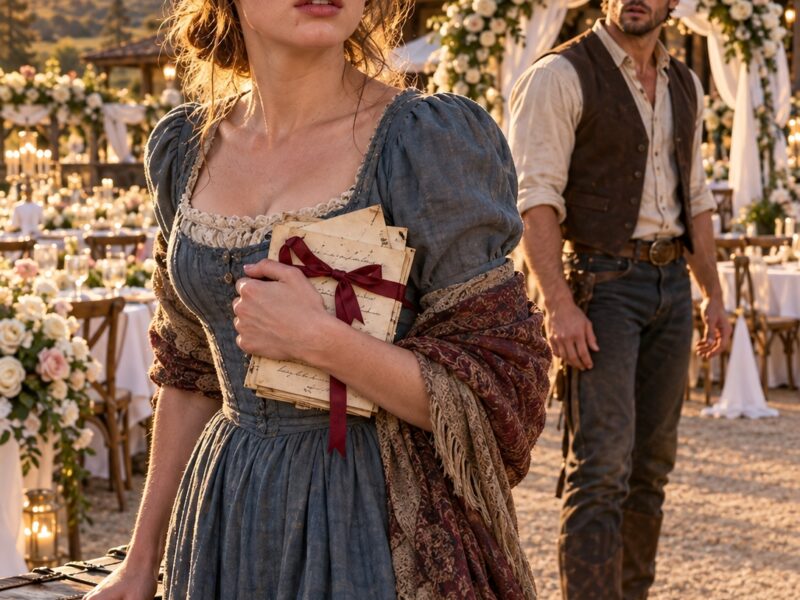
The first thing Faye Bishop saw when she stepped down from the stagecoach was the wedding arch.
White ribbon curled around rough cedar posts. Fresh wildflowers had been wired across the top. Long tables stood beneath cottonwoods in the yard, covered with clean linen and waiting for tomorrow’s feast.
For one foolish, breathless second, Faye smiled.
Callum had surprised her.
After eleven months of letters, after nearly nine hundred miles of dust, bad coffee, cramped coaches, and nights spent sleeping upright with her purse clutched against her ribs, Callum Greer had decided he could not wait.
He was going to marry her tomorrow.
Then an older woman carrying folded linens stopped beside her.
The woman’s smile faded.
“You here for the wedding?”
Faye rested one gloved hand on the small trunk at her feet.
“I suppose I am.”
“Well, you’ve come early.” The woman laughed. “Mr. Greer and Miss Ellery aren’t marrying until morning.”
Faye heard the words.
She simply could not make them mean anything.
“Miss… Ellery?”
The woman looked at her.
Something changed in her face.
Faye would remember that expression for the rest of her life—not cruelty, not suspicion.
Pity.
The kind people give you when they know your life has just broken and you haven’t heard the sound yet.
“Ruth Ellery,” the woman said carefully. “Silas Ellery’s daughter.”
Behind her, two ranch hands were hanging another strand of ribbon.
Someone inside the house laughed.
A man carried a crate of wine toward the porch.
The entire ranch was preparing for a wedding.
Callum’s wedding.
To someone else.
Faye stood very still.
Inside her trunk were eleven months of letters from Callum Greer.
Letters she had read until the folds had gone soft.
Letters in which he had described this ranch during spring rain, the cottonwoods along the Pecos, the stubborn gray mare that bit anyone except him.
Letters in which he had asked whether she liked children.
Whether she would miss St. Louis.
Whether she could imagine a kitchen with morning sunlight through the east window.
One letter ended with:
If you still mean to come, Faye, I think I have begun to build my life around the hope of you.
She had crossed half a country because of that sentence.
Now there were wedding ribbons hanging from his porch.
And another woman’s name attached to them.
Faye’s throat tightened.
But she did not cry.
She had four dollars left.
Her return ticket could not be used for two days.
And pride was the one thing she still possessed in abundance.
“Where is Mr. Greer?” she asked.
The older woman’s eyes dropped briefly to the trunk.
“Miss…”
“Bishop.”
The woman went pale.
Faye watched recognition arrive.
“Oh.”
That single syllable hurt worse than the wedding arch.
So Callum had told them about her.
Which meant they knew exactly who she was.
The mail-order bride who had come too late.
Faye straightened.
“Where is Mr. Greer?”
The woman pointed toward the barn.
Faye could have left.
Every instinct told her to.
Climb back into the coach. Pay whatever it cost. Sit at the station until the next stage east. Let Callum discover someday that she had come, seen everything, and disappeared before he could humiliate her further.
It would have preserved something.
But she had crossed too many miles to be defeated by fifty yards of dirt between herself and the truth.
So she waited.
A minute later, a tall man stepped out of the barn.
He was wiping grease from his hands with a rag.
Faye recognized him immediately, though she had never seen him move before.
Callum Greer.
Thirty-two years old.
Broad shoulders.
Sun-browned face.
Dark hair that needed cutting.
Exactly the serious gray eyes he had described as “unfortunately inherited from a grandfather who looked disappointed even while sleeping.”
Faye had laughed when she read that.
She did not laugh now.
Callum looked toward the yard.
Saw the strange woman beside the trunk.
Stopped.
The rag slipped from his hand.
Even from that distance, Faye saw the blood drain from his face.
He knew.
Neither of them moved.
Between them fluttered white ribbons intended for his marriage to another woman.
“Faye?”
Her name left his mouth like a prayer spoken too late.
She lifted her chin.
“Hello, Callum.”
He crossed the yard quickly.
“You’re here.”
“I noticed.”
“How—when—”
“Apparently one day before your wedding.”
His eyes closed.
Just for a second.
And somehow that frightened her more than denial would have.
“Faye, I can explain.”
“I imagine you can.”
People had stopped pretending not to watch.
Faye felt every eye.
She would not give them tears.
She would not become entertainment.
So before Callum could speak again, she raised one hand.
“No.”
He froze.
“Please let me finish while I’m still capable of doing it politely.”
His face tightened.
Faye forced air into her lungs.
“I can see you’ve made other arrangements.”
“Faye—”
“You owe me no public explanation.”
“I owe you considerably more than that.”
“You are getting married tomorrow.”
Callum looked toward the ribbons as if he hated them.
“Yes.”
There it was.
One word.
A knife pushed cleanly between the ribs.
Faye nodded.
“Then I won’t interfere.”
His head snapped toward her.
“You don’t understand.”
“I understand enough.”
“No. You don’t.”
“I crossed the country expecting to marry you, Callum.”
Her voice almost broke on his name.
Almost.
She swallowed it.
“I arrived and found another woman’s wedding being prepared. Whatever happened between your last letter and today, I will not stand in this yard and beg a man to choose me.”
Something fierce moved through his expression.
“I would never ask you to.”
“Good.”
“Because I thought you weren’t coming.”
The world seemed to pause.
Faye stared at him.
“What?”
“I thought you’d changed your mind.”
“I wrote you.”
“I never received it.”
“My letter gave you the date.”
“I know.”
“You know?”
“I know because I’ve spent six weeks waiting for a letter that never came.”
Faye’s anger faltered.
Callum stepped closer, lowering his voice.
“Then a freight driver came through from east of Santa Rosa. He’d heard from another man that the woman Greer had been writing to had decided against coming west.”
Faye stared at him.
“You believed a freight driver’s gossip over me?”
“No.”
His answer came immediately.
“I believed your silence.”
That landed differently.
Faye said nothing.
Callum looked exhausted suddenly.
“I wrote twice more. Nothing came back. I waited. Then the rumor reached me. I thought it explained why you had disappeared.”
“I didn’t disappear.”
“I know that now.”
He looked at her trunk.
Then back at her.
“God, Faye. I know that now.”
For the first time since stepping down from the coach, her humiliation loosened enough for another possibility to enter.
Not betrayal.
Something worse in a different way.
A mistake.
A terrible, ordinary mistake.
A lost letter.
A rumor.
Distance.
Silence.
And timing cruel enough to feel deliberate.
But the wedding arch remained behind him.
“That still doesn’t explain tomorrow,” she whispered.
Callum looked toward the house.
“No.”
His jaw tightened.
“It doesn’t.”
Then he told her about the drought.
For nearly two years, rain had failed the valley.
Streams had narrowed. Wells had dropped. Cattle were thinner. Families who had held ranches for generations were borrowing against land they could no longer afford to lose.
And into that desperation had come Ivo Apprentice.
A businessman from Denver with polished boots, expensive lawyers, and enough money to wait while everyone else became desperate.
He wasn’t buying ranches.
Not at first.
He was buying water rights.
One family at a time.
A widow who needed cash.
A rancher whose cattle had died.
A farmer facing foreclosure.
Each sale looked small.
Together, they were becoming control of the river.
Callum’s ranch and the neighboring Ellery property depended on overlapping access to one of the stretches Apprentice wanted most.
Separately, both families were vulnerable.
Together, they might survive.
So Silas Ellery had proposed the oldest business merger known to mankind.
Marriage.
Callum Greer would marry Ruth Ellery.
Their properties would effectively become one holding.
Their water claims would be harder to break apart.
Callum had refused at first.
Then another well failed.
Then a neighboring family sold to Apprentice.
Then Callum heard Faye had abandoned him.
“I thought the future I’d been waiting for was gone,” he said quietly. “And I had forty-three people depending directly or indirectly on this ranch surviving another year.”
Faye looked toward the wedding preparations.
“So you agreed.”
“Yes.”
“Do you love her?”
“No.”
The answer was so immediate that Faye hated how much relief it gave her.
“Does she love you?”
Callum hesitated.
“No.”
“Then why—”
“Because sometimes people do what they believe they have to do.”
Faye looked at him for a long moment.
“I came here because your letters convinced me you were not a man who surrendered easily.”
His face tightened.
“I didn’t surrender.”
“You’re marrying a woman you don’t love tomorrow.”
“To save two ranches.”
“And possibly destroy two lives.”
“Faye—”
“No.”
She stepped backward.
“I understand your explanation. I even believe you.”
That surprised him.
“But understanding doesn’t change tomorrow.”
Silence.
Callum’s eyes met hers.
“No.”
And that was the tragedy of it.
Nobody had betrayed anyone.
Nobody was lying.
Nobody was cruel.
Yet Faye had still arrived one day before the man she loved married somebody else.
Sometimes there was no villain.
Sometimes all it took to ruin four lives was a lost letter and a few weeks of silence.
Faye spent that night in the small guest room at the Greer ranch.
She had insisted on the room only because the stage east would not leave for two days.
Her trunk remained packed.
She didn’t unpack a dress.
Didn’t remove Callum’s letters.
Didn’t even open the curtains.
She sat on the narrow bed while laughter and footsteps drifted from downstairs.
Tomorrow, those people expected a wedding.
Faye would be gone before it happened if she could arrange transportation.
That was her plan.
Until someone knocked.
Faye opened the door.
The woman standing outside was beautiful.
Not delicately beautiful.
Strongly beautiful.
Dark hair pinned simply. Clear brown eyes. A face that looked as though it had spent the last month learning how not to reveal pain.
“Faye Bishop?”
Faye knew immediately.
“Ruth Ellery.”
Ruth gave a nervous smile.
“I suppose introductions are unnecessary.”
“I suppose so.”
“May I come in?”
Every sensible part of Faye wanted to say no.
Instead she stepped aside.
Ruth entered and shut the door.
For several seconds, the two women simply looked at each other.
They were supposed to be rivals.
The abandoned bride and the replacement.
The eastern woman and the rancher’s daughter.
Faye expected jealousy.
Ruth looked terrified.
Then she said, “You love him.”
Faye’s shoulders stiffened.
“I don’t think that’s any longer relevant.”
“It is to me.”
“Why?”
“Because I don’t.”
Faye stared at her.
Ruth’s voice trembled.
“I don’t love Callum.”
“Then don’t marry him.”
A bitter little laugh escaped Ruth.
“You think I haven’t said that to myself every night for a month?”
She walked toward the window.
“My father believes this marriage saves our ranch. Callum believes it saves his. Half the valley thinks their survival depends on it.”
“And you?”
Ruth turned.
“I think tomorrow morning I’m going to stand beside a good man I do not love and promise him the rest of my life while the man I do love watches from a horse pasture.”
Faye’s anger disappeared.
“Who?”
“Tobin Reyes.”
Faye had heard the name downstairs.
A vaquero who had worked for the Ellery family since he was seventeen.
Ruth’s eyes softened simply saying it.
“We grew up together.”
“Does he love you?”
“Since we were children.”
“Your father knows?”
“Yes.”
“And?”
“He thinks Tobin is honorable, capable, loyal—and entirely unsuitable to marry an Ellery.”
“Because he’s a ranch hand?”
“Because he owns no land. And no water.”
There it was again.
Water.
Faye sat slowly.
Ruth remained by the window.
“My father isn’t evil,” she said. “He’s frightened. He watched two neighboring ranches collapse this year. Apprentice bought their water, then offered them half what the land had been worth before. Father believes if our claim and Callum’s become one, Apprentice cannot isolate us.”
“So you marry Callum.”
“Yes.”
“And Tobin?”
Ruth looked away.
“He leaves.”
“When?”
“After the wedding.”
Faye closed her eyes.
Four people.
Callum loved Faye.
Faye loved Callum.
Ruth loved Tobin.
Tobin loved Ruth.
And tomorrow Callum would marry Ruth.
For water.
Something inside Faye shifted.
Not hope.
Not yet.
Annoyance.
The practical, almost professional irritation she used to feel in St. Louis when somebody handed her a ledger with numbers that did not add up.
“Explain the water arrangement.”
Ruth blinked.
“What?”
“The exact arrangement.”
“Why?”
“Because everyone keeps telling me two people have to ruin their lives to solve a business problem, and I’ve spent eight years keeping books for men who frequently confused expensive solutions with intelligent ones.”
Ruth stared at her.
Then slowly sat beside her.
For the next hour, Faye asked questions.
Who owned which claim?
Where were the deeds registered?
Could rights be transferred?
Could ownership be shared?
How many ranches remained independent?
What exactly gave Apprentice leverage?
Ruth answered what she knew.
Callum answered the rest when Faye summoned him.
By midnight, papers covered the bed.
Faye stared at them.
And suddenly she saw it.
The mistake wasn’t in their numbers.
It was in their assumption.
“You don’t need a marriage.”
Callum leaned forward.
“What?”
“You need unity.”
“That’s what the marriage creates.”
“No. That’s merely one way of creating it.”
She stood.
“In St. Louis, small merchants form buying associations when wholesalers try to squeeze them individually. Farmers form cooperatives. Businesses form partnerships. People who remain separate owners can still bargain as one group.”
Callum watched her.
Ruth had stopped breathing.
Faye pointed to the papers.
“Apprentice wins because he approaches each rancher separately. One frightened family. One desperate signature. One water claim.”
“Yes.”
“So stop being separate.”
Callum frowned.
“You mean merge the ranches?”
“No.”
Faye looked at him.
“Merge the defense.”
Silence.
Then Ruth whispered, “An association.”
Faye nodded.
“A legal association holding or controlling the water claims collectively for the duration of the threat. Each ranch remains owned by its family. But nobody sells water independently. You hire one attorney. Negotiate as one body. Challenge Apprentice as one body.”
Callum stood.
“Could that work?”
“I don’t know.”
His hope vanished slightly.
Faye continued.
“But neither did anyone know your marriage would work.”
That stopped him.
“You were about to make a permanent decision because of a temporary crisis.”
She looked between Callum and Ruth.
“A drought can end. Apprentice can leave. Laws can change. But you intended to bind two people together for fifty years because of something that may last five.”
Ruth covered her mouth.
Callum stared at the papers.
Faye could almost see the walls of his thinking moving.
“How many ranchers?” she asked.
“Twelve still control their own claims.”
“Then twelve are stronger than two.”
By dawn, nobody had slept.
Silas Ellery arrived furious.
He had expected his daughter to dress for her wedding.
Instead he found her, Callum, and the woman Callum had originally intended to marry sitting around a table covered in water maps.
“What in God’s name is this?”
“Possibly,” Faye said, “a way to save your ranch without sacrificing your daughter.”
Silas glared at her.
“You’ve been here less than a day.”
“Yes.”
“And you believe you understand our problems?”
“No.”
Faye met his stare.
“But I understand leverage.”
That earned his silence.
So she explained.
Slowly.
Precisely.
No romance.
No pleading.
Numbers.
Claims.
Collective defense.
Legal representation.
Shared negotiating power.
Silas interrupted six times.
Faye answered six times.
Then he stopped interrupting.
Callum watched the older man’s face.
“So?” he asked.
Silas walked to the window.
Outside, guests had begun arriving.
Wedding guests.
A fiddle player unloaded his instrument.
Children chased each other beneath ribbons.
Silas looked at Ruth.
“Is this what you want?”
Ruth’s eyes filled.
“No, Papa.”
He swallowed.
“You never wanted this marriage?”
“No.”
“You agreed.”
“Because you told me our ranch depended on it.”
Silas looked suddenly older.
“And Reyes?”
Ruth whispered, “I love him.”
Silas closed his eyes.
Nobody spoke.
Finally, he turned toward Faye.
“If your plan fails?”
“Then we find another.”
“That’s not an answer.”
“It’s the only honest answer.”
She pointed toward the yard.
“But marrying two people who don’t love each other was never certainty either. It was desperation wearing respectable clothes.”
Callum almost smiled.
Silas did not.
But something in his expression broke.
“Send riders,” he said.
Ruth stared at him.
“What?”
“To the other ranches.”
He looked at Callum.
“If we’re going to make fools of ourselves in front of half the county, we’d better at least save the water.”
The wedding disappeared without ever formally being canceled.
It simply transformed.
Guests who arrived expecting vows found ranchers arguing over maps.
The wedding tables became desks.
The preacher ended up carrying messages.
The wedding feast became lunch for twelve ranching families.
By midafternoon, eleven had agreed in principle.
By sunset, all twelve had.
Ivo Apprentice had built his strategy around fear.
He had assumed desperate people would remain isolated long enough to be purchased individually.
He had never expected them to combine.
And he certainly had never expected the person who would show them how to do it to be a twenty-five-year-old bookkeeper from St. Louis who had arrived expecting to become somebody’s wife.
That evening, Faye stepped onto the porch.
The ribbons still moved in the warm wind.
Callum came out behind her.
For a moment neither spoke.
Then he said, “You saved my ranch.”
“We don’t know that yet.”
“You saved my wedding.”
Faye glanced sideways.
“By destroying it.”
“The wrong wedding.”
That made her smile despite herself.
Callum moved closer.
“I owe you an apology.”
“You already explained.”
“Explanation isn’t apology.”
Faye looked at him.
“I believed you had abandoned me,” he said. “That doesn’t make what happened your fault. I should have found a way to know.”
“We were hundreds of miles apart.”
“I should have waited longer.”
“Maybe.”
“I should never have agreed to marry Ruth.”
“Maybe.”
He smiled faintly.
“You make forgiveness difficult.”
“I traveled nine hundred miles to attend your wedding to someone else. I’m entitled to a little difficulty.”
His smile vanished.
“Faye.”
Something in his voice changed.
She turned.
“I loved you before I ever saw your face.”
Her breath caught.
“I loved the woman who argued with me about books in the margins of letters. The woman who told me my cattle accounts made no sense. The woman who wrote that loneliness was not a reason to marry, but hope might be.”
Faye remembered that letter.
She had written it at two in the morning.
“I waited for you,” he said. “Then I believed I’d lost you. And yesterday, when I saw you standing beneath those ribbons…”
He stopped.
“What?”
“It was the worst moment of my life.”
Faye looked down.
“And the best.”
She looked up again.
“That’s an odd combination.”
“I realized the woman I’d mourned wasn’t gone.”
His voice dropped.
“She had crossed a country to find me.”
Faye’s eyes burned.
Callum stepped closer but did not touch her.
“Don’t marry me because you came here intending to.”
She stared at him.
“Don’t marry me because of the letters. Don’t marry me because the wedding decorations are already paid for.”
A laugh escaped through her tears.
“Then why?”
“Stay.”
The word was barely louder than the wind.
“Stay long enough to know me outside those letters.”
Faye’s heart twisted.
“And if I discover I don’t like you?”
“I’ll personally buy your ticket back to St. Louis.”
“First class?”
“If such a thing exists within three hundred miles.”
“And if I do like you?”
Callum smiled.
“Then I’ll ask again.”
So Faye stayed.
Not as Callum’s bride.
Not yet.
As herself.
That mattered.
During the following weeks, riders carried association papers from ranch to ranch. A lawyer in Santa Fe helped formalize the agreement. Families who had barely spoken before began meeting weekly.
Apprentice responded exactly as Faye predicted.
First with money.
Then threats.
Then lawyers.
He offered individual ranchers more than before.
Nobody sold.
He challenged the association.
They challenged him back.
He attempted to secure priority control through the territorial water office.
Twelve families arrived with one attorney and one argument.
His advantage disappeared.
By late summer, Apprentice understood the valley would cost him more to conquer than it could ever earn him.
He left.
The water stayed.
So did Faye.
Ruth married Tobin Reyes in August.
It was a small wedding.
No strategic property.
No merger.
No bargain.
Silas Ellery stood beside his daughter before the ceremony, looking as uncomfortable as a man being asked to publicly admit he’d been wrong.
Then he shook Tobin’s hand.
“Take care of her.”
Tobin looked him straight in the eye.
“Always.”
Silas grunted.
That was as close to a blessing as anyone expected.
But during the ceremony, Faye saw him wipe his eyes.
Callum saw it too.
“Don’t mention it,” he whispered.
“I wouldn’t dare.”
Weeks later, something arrived at the Greer ranch.
A letter.
Water-stained.
Creased.
Stamped twice.
Misrouted through the wrong crossing and eventually found beneath a stack of undelivered mail in a distant post office.
Callum recognized the handwriting before opening it.
Faye’s.
They stood together in the kitchen.
Neither moved.
Finally, Callum broke the seal.
Inside was the letter that had almost destroyed four lives by failing to arrive.
Faye had written her travel date.
Her route.
Her excitement.
Her fears.
At the bottom:
I will arrive June 14. If nothing delays me, I should reach your ranch the following afternoon. I hope when you see me, I will seem at least a little like the woman you have imagined from my letters. I am frightened, Callum. But I am coming.
Callum read it twice.
Then folded it carefully.
“I would have waited at the station.”
“I know.”
“Everything would have been different.”
Faye looked toward the window.
“No.”
He frowned.
“We would have married sooner.”
“Yes.”
“Ruth wouldn’t have nearly married me.”
“No.”
“Then everything would have been different.”
Faye smiled sadly.
“The valley might have lost its water.”
Callum went quiet.
Neither of them had considered that.
Without the lost letter, there would have been no mistaken wedding.
Without the mistaken wedding, Faye might never have met Ruth under those circumstances.
Without Ruth’s confession, Faye might never have studied the water problem.
Without the association, Apprentice might have continued buying families one by one.
Callum looked down at the damaged letter.
“So this nearly ruined us.”
“And possibly saved us.”
He laughed softly.
“I don’t know what lesson I’m supposed to take from that.”
“Perhaps that life is badly organized.”
“That sounds like something a bookkeeper would object to.”
“Deeply.”
Callum kept the letter.
Not because it represented pain.
Because it proved how close they had come.
Autumn reached the valley slowly.
The river remained low, but storms finally gathered over the mountains.
One evening Callum asked Faye to ride with him.
They stopped on a ridge overlooking the ranch.
Below them, cattle moved across the fading grass.
Farther away, cottonwoods traced the river.
Callum dismounted.
Faye narrowed her eyes.
“Why do you look nervous?”
“I’m not.”
“You’re terrible at lying.”
“I’ve been told.”
“By whom?”
“You.”
He reached into his coat.
Faye’s heart stopped.
“Callum.”
“The first time you came here to marry me, you found me preparing to marry somebody else.”
“An unforgettable welcome.”
“The second time, I’m hoping to improve the circumstances.”
He held out a small ring.
Nothing extravagant.
A simple gold band.
Faye looked at it.
Then at him.
“I don’t want you to marry the man from the letters,” he said.
She swallowed.
“I want you to marry the man you’ve lived beside these past months. The stubborn one. The one who leaves boots where you tell him not to. The one whose cattle accounts apparently constitute a crime against arithmetic.”
“They do.”
“The one who nearly made the worst decision of his life because he thought he’d lost you.”
Faye’s eyes filled.
“And the one,” Callum continued, “who knows now that loving someone isn’t only wanting them beside you. It’s trusting the way they see the world.”
He took her hand.
“Faye Bishop, will you marry me?”
She stared at him.
For once, she let silence do its work.
Callum’s confidence began to fail.
“Faye?”
“I was just considering the first-class ticket.”
His mouth opened.
She laughed.
Then kissed him.
“Yes.”
Their wedding took place that October.
The entire water association came.
So did Ruth and Tobin.
Silas gave a toast that began badly, wandered dangerously, and ended beautifully.
“I once thought saving a ranch required my daughter to marry a man she didn’t love,” he said. “Then a stranger arrived one day early and informed me I was solving the wrong problem.”
Laughter rolled through the crowd.
Silas lifted his glass toward Faye.
“Best mistake the mail service ever made.”
Someone had saved the old white ribbons.
The ones prepared for Callum and Ruth.
They hung them again.
This time for Callum and Faye.
Late that evening, after the music softened and lanterns burned low, Faye stood beneath the same cedar arch she had seen when she first arrived.
Callum joined her.
“Thinking about leaving?”
She smiled.
“I did.”
“When?”
“The first day.”
“I know.”
“No. You don’t.”
She looked toward the yard.
“I nearly climbed back into the coach before you came out of the barn.”
Callum’s expression changed.
“How close?”
“Very.”
He slipped his fingers through hers.
“What stopped you?”
Faye thought about it.
“My pride.”
He laughed.
“Your pride made you stay?”
“I couldn’t bear traveling nine hundred miles without at least making you look me in the eye while you broke my heart.”
“Remind me never to underestimate your spite.”
“It has excellent endurance.”
They stood quietly.
Then Faye said, “If I’d left, Ruth would have married you the next morning.”
Callum’s hand tightened around hers.
“Probably.”
“Tobin would have gone.”
“Yes.”
“Apprentice might have taken the valley.”
“Possibly.”
“And you and I would have spent our lives believing the other had chosen differently.”
Callum looked toward the dark road where her stagecoach had arrived months earlier.
“All because of one letter.”
“Not only the letter.”
“What else?”
“We believed silence meant something.”
He looked at her.
Faye rested her head against his shoulder.
“That’s dangerous.”
Years later, people in the valley would remember Faye Greer for the water association.
Some called her the bookkeeper who defeated a water baron.
Others remembered how she could look at a page of figures for ten minutes and find the mistake everyone else had missed for a week.
The association lasted long after Apprentice disappeared.
It survived another drought.
Then another.
Families that once competed for survival learned that standing together made them difficult to exploit.
Faye helped keep the accounts.
Of course she did.
She and Callum built much of the life they had imagined in letters.
Not exactly.
Reality was louder.
Messier.
There were bad harvests, sick cattle, arguments about money, children who refused sleep, winters when pipes froze, and mornings when love looked less like poetry and more like making coffee before the other person asked.
Faye preferred it.
Letters had taught them how to imagine one another.
Life taught them how to know one another.
Ruth and Tobin settled on part of the Ellery property.
Silas eventually gave Tobin responsibility for more of the ranch than he had ever intended, though he spent years pretending this was merely because “the boy happens to know what he’s doing.”
Nobody believed him.
And Callum kept Faye’s lost letter.
For the rest of his life.
It remained water-stained and wrinkled, folded inside a wooden box beside their marriage certificate.
Sometimes Faye would catch him reading it.
“Why keep torturing yourself?” she once asked.
“I’m not.”
“What do you call that?”
He handed her the letter.
“Proof.”
“Of what?”
“That almost isn’t the same as lost.”
Faye looked at him.
Callum nodded toward the faded page.
“We almost missed each other.”
He smiled.
“But we didn’t.”
Long after the wedding ribbons had faded, Faye kept one piece in the bottom drawer of her dresser.
Her children eventually asked why.
She told them the truth.
Those ribbons had originally been meant for another woman.
They had once represented the most humiliating moment of her life.
Then they had decorated her wedding.
The object hadn’t changed.
The story around it had.
And perhaps that was why Faye never taught her children that everything happened for a reason.
She didn’t believe that.
Letters got lost for no reason.
Rumors hurt people for no reason.
Droughts came.
Good people made frightened decisions.
Lives sometimes turned on accidents too small to deserve the power they possessed.
What Faye believed instead was harder.
When something terrible happened, you had to look again before deciding what it meant.
When everyone insisted there was only one answer, you had to ask whether they had stopped searching too soon.
And when silence seemed to tell you what another person felt, sometimes you had to cross the yard and ask.
Because Faye Bishop had once stepped down from a stagecoach with four dollars in her pocket and love letters in her trunk and discovered wedding ribbons hanging for another woman.
She had thought she was one day too late.
Callum had thought she had abandoned him.
Ruth had thought she had to sacrifice love to save her family.
Silas had thought marriage was the only way to save the water.
Everyone had mistaken fear for certainty.
And the strange woman standing beneath the wrong wedding ribbons had asked one question none of them had thought to ask:
What if there is another way?
There was.
Years later, on warm evenings when Callum sat beside Faye on the porch and watched their children running beneath the cottonwoods, he would sometimes tease her about arriving early.
“You know,” he would say, “proper brides usually wait until the correct wedding.”
Faye would look at him over the rim of her coffee.
“Proper grooms usually aren’t marrying somebody else.”
“Fair.”
“And I wasn’t early.”
Callum would smile.
“No?”
She would look toward the river that still belonged to the families who had refused to surrender it.
Toward the Ellery land where Ruth and Tobin had built their home.
Toward the road she had once nearly taken back east.
Then Faye would shake her head.
“No.”
Because after all the years, the lost letter, the wrong wedding, the drought, the humiliation, and the lives that had almost gone in entirely different directions, she understood something neither of them could have known when they first saw each other across that ribboned yard.
She had arrived at the worst possible moment.
She had arrived one day too early.
And somehow—
she had arrived exactly on time.









