I Delivered a Black Box to a CEO—Then I Saw a Signal I Hadn’t Seen in 11 Years
It took me twelve seconds to realize the two men across the street weren’t pedestrians.
The first one stood beside a newsstand holding a folded newspaper he hadn’t turned a page of since I’d noticed him.
The second was twenty feet behind Ardan Whitmore, walking slowly enough to appear casual and precisely enough to remain at the same distance from her.
Neither man looked at her.
That was what frightened me.
Ordinary people look.
Curious people look. Bored people look. People waiting for Uber drivers look at everybody. Men pretending not to stare at an attractive woman usually overcorrect and glance everywhere except where they want to look.
Professionals don’t.
Professionals know exactly what they’re supposed to ignore.
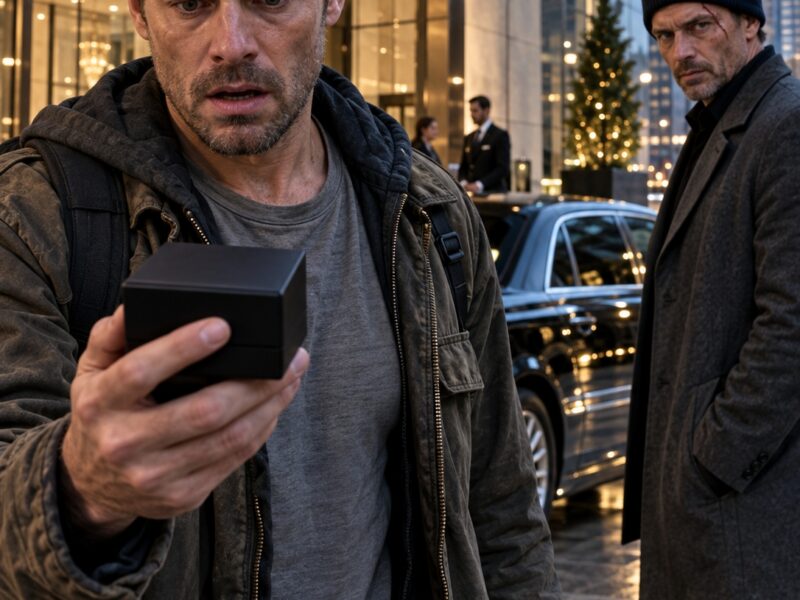
Thirty seconds earlier, I’d handed Ardan Whitmore a small black box inside the marble lobby of Whitmore Meridian Tower. She had signed my scanner, thanked me, and walked away.
My job was finished.
I was forty-two years old. I drove a contract delivery van with a cracked passenger-side mirror. My jacket was eight years old. My watch had cost nineteen dollars.
I had a nineteen-year-old daughter whose spring tuition payment was due in eleven days.
I had soup waiting in my apartment.
And for eleven years, I had worked very hard to become the kind of man nobody remembered seeing.
Then the man beside the newsstand lifted his right hand.
Two fingers touched the inside of his left wrist.
Just once.
Like a man checking a watch he wasn’t wearing.
My hand froze on the van door.
I knew that signal.
I had learned it eleven years earlier in a windowless training room in Virginia from a man who had spent twenty years teaching people how to move human beings through dangerous places without getting them killed.
The signal meant reposition.
The target had passed one observer.
The next observer was taking the eye.
People who used that signal didn’t follow someone because they wanted a photograph.
They followed because they were building a pattern.
And once the pattern was complete, somebody used it.
I looked at Ardan Whitmore disappearing toward a waiting black car.
Then I looked at the little scanner clipped to my belt.
The delivery receipt still glowed on the screen.
One small black box.
Under two pounds.
Direct signature required.
Authorized recipient only.
Ardan Whitmore.
And suddenly I understood something I desperately wanted to be wrong about.
That package had not ended my afternoon.
It had just started something.
And whatever had started had been waiting for me before I ever arrived.
The order had appeared on my scanner at 4:50 that afternoon.
A late route insert was unusual.
This one was stranger than most.
Pickup: a private mail desk on West Jackson.
Destination: Whitmore Meridian Tower.
Fourteen blocks.
Nothing remarkable about that.
The delivery instructions were different.
No front desk signature.
No assistant.
No security proxy.
No safe drop.
No exceptions.
The authorized recipient had to accept the package personally.
Someone had paid nearly four times the normal rate to guarantee it.
People pay that kind of premium for one of two reasons.
They’re careless with money.
Or they’re afraid.
I accepted the run because Mara’s tuition was due.
That was the explanation I gave myself.
The other explanation was that strange instructions still woke up a part of my brain I preferred sleeping.
My name is Everett Cole.
For the last eleven years, that name had belonged to a courier.
I changed oil when the van needed it. Bought groceries on Wednesday nights. Called my daughter on Sundays. Paid taxes. Renewed my lease. Kept my head down.
Before that?
That depended on who was asking.
Whitmore Meridian Tower rose forty-one floors above Chicago in glass and gray stone, the kind of building whose lobby seemed designed to make ordinary people lower their voices.
I entered at 5:20.
The security officer behind the desk categorized me before I crossed half the marble.
His eyes moved from my faded jacket to my work boots to the scanner in my hand.
Then he looked away.
I knew the look.
People in expensive buildings have a remarkable ability to stop seeing anyone who delivers things, cleans things, repairs things, or carries things away.
I never resented it.
Invisibility has advantages.
“I have a direct-signature package for Ms. Whitmore.”
His mouth began forming the word no before I finished.
“Executive deliveries go through mail services. Third floor.”
“Not this one.”
I turned the scanner toward him.
He read the instructions.
His expression changed from dismissal to irritation.
“That’s not our protocol.”
“It’s the shipper’s protocol.”
“Leave it with me.”
“Can’t.”
His eyes came back to my jacket.
“Can’t?”
“Authorized recipient only.”
He picked up the phone.
Before he could finish whatever call he intended to make, a man in a charcoal suit emerged from the elevator bank.
He was already talking.
Some people enter a room.
Preston Carrington entered conversations other people hadn’t agreed to have.
He was forty-six, broad-shouldered, immaculately groomed, and wearing a suit that probably cost more than my van was worth.
“Problem?”
The guard pointed toward me.
I explained.
Carrington listened with the patient expression wealthy organizations reserve for people they intend to remove politely.
“Ms. Whitmore is the chief executive of a company with eleven thousand employees,” he said. “She doesn’t personally accept boxes from drivers.”
Drivers.
He said the word the way some people say weather.
I didn’t argue.
Arguing with a man like Preston Carrington is just donating your afternoon to him.
Instead, I read the instruction again.
“Sole authorized recipient: Ardan Whitmore.”
Carrington inhaled.
He was probably about to have me escorted outside.
Then an elevator opened.
The entire lobby seemed to adjust its posture.
Ardan Whitmore stepped out holding a tablet, a young assistant following half a pace behind her.
She was thirty-eight.
Dark coat.
Practical shoes.
No jewelry worth stealing.
She moved quickly without appearing hurried, which told me more about her than any magazine profile could have.
This was a woman who didn’t manage time.
She expected time to behave.
Carrington intercepted her.
“Ardan, just a delivery issue. I’ll handle—”
She glanced at the scanner.
Then she saw the sender’s name.
She stopped so abruptly her assistant nearly walked into her.
“Let me see it.”
Carrington’s posture changed.
“It hasn’t been screened.”
“Give it to me.”
“Protocol—”
She held out her hand without looking at him.
It was one of the most efficient dismissals I’d ever witnessed.
I gave her the box.
It was matte black, small enough to hold in one hand.
She stared at it for a second.
Not surprise.
Recognition.
Or fear trying very hard to resemble recognition.
I turned the scanner toward her.
She signed quickly.
Then, for the briefest moment, she held the package against her ribs.
“Thank you, Mr…”
“Cole.”
Her eyes lifted to mine.
“Thank you, Mr. Cole.”
Not the automatic thank-you people use to end interactions.
She actually looked at me.
Then she left.
That should have been the end.
Everything that happened afterward depended on approximately thirty seconds in which I was completely free to walk away.
I reached the curb.
Put my keys in my hand.
Looked toward a parking enforcement vehicle two blocks away.
And saw the two men.
Then I saw the wrist signal.
Eleven years disappeared.
My body remembered before my mind did.
I did not shout.
That matters.
Amateurs see danger and run toward it because human instinct tells us that warning someone is always helpful.
Sometimes it isn’t.
If a professional surveillance team knows it has been exposed, it doesn’t simply quit.
It changes the schedule.
Something planned quietly for Friday becomes something violent on Wednesday night.
So I climbed into my van.
Started the engine.
And stayed parked.
Ardan’s black car pulled away at 5:41.
The SUV didn’t follow.
That was my second warning.
Eight seconds later, a gray sedan two blocks east slid into traffic and made the same turn.
Vehicle rotation.
One unit holds.
Another takes the eye.
They trade positions so the target never sees the same grille twice.
I watched the sedan disappear.
This wasn’t a jealous husband hiring a private investigator.
This was money.
Planning.
Rehearsal.
Someone had put a date on whatever came next.
I called Whitmore Meridian Corporate Security.
Carrington answered after ninety seconds of hold music.
“Cole?”
He remembered me.
Unfortunately, recognition had not improved his opinion.
“Your CEO is under mobile surveillance.”
Silence.
Then: “Excuse me?”
“At least three operators. Two vehicles confirmed. Probably more.”
He laughed.
It was short and genuinely amused.
“What exactly does a package courier know about mobile surveillance?”
There are questions that aren’t questions.
That was one of them.
I ignored it.
“Gray sedan. Illinois plate.”
I read him the number.
“Run it.”
He sighed.
“Mr. Cole—”
“Run it while I’m on the phone.”
He did.
Mostly, I suspect, because he wanted the satisfaction of proving me stupid.
Thirty seconds later he returned.
“Registered. Insured. Current plate. No flags. Private owner. No rental designation. Nothing.”
“That’s the problem.”
For the first time, he didn’t immediately answer.
“A vehicle being used in a professional rotation shouldn’t look suspicious,” I said. “A dirty plate means someone got lazy. A clean vehicle package means somebody built it for this.”
“You need to stop calling.”
“Carrington—”
He hung up.
I stared at my phone.
Eleven years earlier, I probably would have done exactly what he had.
A stranger in a cheap uniform had called his office and told him he was failing at the job that defined him.
I couldn’t blame him.
So I put the phone down.
I told myself to go home.
Then I looked across the intersection.
And saw the third man.
He stood beneath the awning of a closed shoe repair store.
No phone.
No coffee.
No cigarette.
No impatience.
Freezing wind off the lake, and he stood with his hands loose at his sides as if the cold had been instructed not to bother him.
He turned his head fifteen degrees.
I saw the jawline.
The balance on the heels.
The stillness.
My throat tightened.
Prague.
Eleven years earlier.
A ninth-floor hotel corridor smelling of old radiators.
A three-vehicle movement I’d rerouted because the primary corridor had two unmanaged choke points.
A man beneath an awning across from the service entrance.
Hands loose.
Two fingers touching his wrist.
I had reported him.
I’d been told he was nobody.
He wasn’t nobody.
Silus Vain.
We had never spoken.
But we’d spent years working in the same industry from opposite ends, the way a locksmith and a burglar can spend their lives thinking about the same door.
My job had been to make human movement unpredictable.
Silus made money by making it knowable.
He wasn’t muscle.
Men like him rarely were.
He built pictures.
Which door you used.
Which coffee shop you preferred.
Which traffic light trapped your driver every morning.
Which eleven-minute window existed in your schedule every Thursday without you realizing it.
Then someone else acted on the picture.
Silus Vain didn’t get hired to photograph CEOs.
He got hired before CEOs disappeared.
I should have driven home.
I had Mara.
Nineteen years old.
Biology midterm Thursday.
A dorm forty minutes north.
She had already lost one parent.
Being somebody’s hero had historically been a terrible way of returning safely to your family.
So I made myself a promise.
Four miles.
Maybe five.
I would confirm the surveillance pattern.
Nothing more.
It was the first lie I told myself that night.
I entered traffic four cars behind the gray sedan.
A bus moved between us on Adams.
I let it stay there.
At Wells, the sedan drifted right.
A silver SUV I’d never seen before picked up Ardan’s vehicle.
Eleven blocks later, the gray sedan returned.
Beautiful work.
Patient.
Boring.
Good surveillance usually is.
Then I checked my own mirror.
The gray sedan had fallen back.
Not to leave.
To look.
The passenger turned his head.
For the first time in eleven blocks, he looked directly at my van.
I felt the old part of me wake all the way up.
I signaled early.
Let a box truck trap me.
Entered a multilevel parking structure.
Up to the third floor.
Past the elevator bank.
Down the opposite spiral.
Out through another street.
No dramatic handbrake turn.
No speeding.
Just arithmetic.
Any car following me through that sequence was making a decision.
Fifty-four seconds later, the gray sedan appeared.
It turned where I turned.
And the entire problem changed.
If their operation was about Ardan Whitmore, I was worthless.
I was a courier.
Background.
Forgettable.
There was no reason to burn a vehicle and an operator following me.
Unless I wasn’t background.
Unless the box mattered.
Unless they knew what I had delivered.
Unless they had known it was coming.
I called the corporate contact number attached to the delivery account.
An assistant answered.
“This is Everett Cole. I delivered a package to Ms. Whitmore forty minutes ago. I need ninety seconds.”
“Ms. Whitmore isn’t available.”
“Tell her it’s the driver.”
“Mr. Cole—”
I heard another voice behind her.
“Who?”
A rustle.
Then Ardan.
“What are you doing calling this number?”
I looked into my mirror.
“Do not go home.”
Three seconds of silence.
For a woman who scheduled her life in quarter-hour increments, three seconds was enormous.
Then Carrington’s voice appeared on the call.
Apparently he’d been patched in.
He began telling Ardan that I was unstable, that corporate security was handling the situation, that impersonating a security professional could carry consequences.
I let him finish.
Then I described the man in the gray jacket.
“Five-ten. Late forties. Navy knit cap. Scar near the left eyebrow. Keeps his hands out of his pockets even when it’s below freezing.”
Ardan said nothing.
When she finally spoke, her voice had dropped half a note.
“I’ve seen him.”
Carrington stopped talking.
“Where?”
“Monday. Outside the Wacker garage.”
A pause.
“And Wednesday morning. Coffee shop near the office.”
“Doing what?” I asked.
“He was in line. Then he left.”
“Without ordering?”
“Yes.”
Carrington said, “Coincidence.”
I almost admired the confidence.
“Ardan,” I said, “ask your driver how long the silver SUV behind you has been there.”
I heard the phone move away.
Her voice became muffled.
A man’s answer.
Then she returned.
“Nine minutes. Maybe ten.”
“Tell him to enter the retail garage on Grand. Up two floors. Come back down.”
“Why?”
“Because I’m going to tell you what happens next. If I’m wrong, you can let Carrington have me arrested.”
Carrington muttered something.
I continued.
“Two vehicles will enter behind you. At least one won’t leave through the same exit.”
Ninety seconds passed.
Then Ardan spoke.
“A silver SUV and gray sedan came in behind us.”
Carrington said nothing.
“The gray sedan left by the north ramp,” she continued. “There’s another dark sedan on Illinois Street now.”
Her breathing changed.
“Who are you?”
“Today?”
I watched the gray sedan disappear in my mirror.
“Today I’m the guy who delivered your package.”
That answer did not satisfy Preston Carrington.
So he investigated me.
Within an hour, he pulled every record money and corporate authority could legally reach.
My driving record was spotless.
My credit was mediocre.
My taxes were boring.
My apartment lease had been renewed four times.
Then he found Northstar Protective Intelligence.
The company hadn’t existed for a decade.
Before it dissolved, Northstar had handled executive movement and protective intelligence for banks, energy companies, media organizations, international aid groups, and people whose names did not appear on public schedules.
Carrington dug deeper.
And found almost nothing.
No meaningful licensing history.
No detailed personnel file.
No interviews.
No trade profiles.
Just fragments.
One fragment contained my name.
Another contained a job code.
Route Intelligence.
Not bodyguard.
Not security officer.
My job had been to decide where a person would be every minute of a day, then examine the city around them the way an engineer examines a bridge.
You don’t look for where the bridge is strongest.
You look for where it fails.
Carrington called me at 7:12.
His voice sounded different.
“What was Northstar?”
“A company that doesn’t exist.”
“Why is your file empty?”
“Because when a firm collapses in the middle of a scandal, powerful people become very interested in making certain names difficult to find.”
“Were you one of those people?”
“Once.”
My phone buzzed.
Unknown number.
I pulled to the curb.
Four words appeared.
You should have stayed gone.
I read them six times.
Not because they frightened me.
They did.
But because of what they proved.
Silus hadn’t merely noticed my van.
Within an hour, he had connected a forty-two-year-old delivery driver to a name from eleven years earlier.
Which meant he remembered that name.
Maybe he’d been carrying it for years.
I called Ardan.
“Meet me somewhere public. Cameras. Multiple exits. Crowded.”
“Where?”
I chose the lower food hall of a downtown transit complex.
Seven hundred people passed through in an hour.
Nobody could hold a fixed position long without becoming visible.
She arrived at 8:40.
Carrington came with her.
So did another security officer.
Good.
Anyone telling a woman under surveillance to meet a stranger alone shouldn’t be trusted.
Ardan sat across from me.
For several seconds, she simply looked.
Courier jacket.
Work boots.
Nineteen-dollar watch.
The man who had predicted three surveillance handoffs before they happened.
Then she placed the black box on the table.
“I haven’t opened it.”
Carrington immediately said, “It needs to go into evidence control.”
Ardan ignored him.
She opened it.
Inside was an encrypted storage drive.
A numbered safe-deposit key.
And a small white card.
Four handwritten words in blue ink.
Trust the route, not the board.
Ardan’s face changed.
“Martin.”
“Who?”
“Martin Keane.”
Her chief internal auditor.
Nineteen years with Whitmore Meridian.
He’d worked for her father before working for her.
Same three ties.
Same quiet office.
Same habit of arriving ten minutes early to every meeting.
Three days earlier, Martin had gone to lunch.
He never returned.
His computer had been logged out.
His coat was gone.
Human Resources classified it as a resignation without notice because corporations have categories for everything, including people disappearing.
Ardan had spent three days feeling mildly betrayed by a man she trusted.
Now she was holding a key he’d mailed directly to her.
Carrington reached toward the drive.
“We need to put that data into secured evidence hold immediately.”
I looked at him.
“No.”
His hand stopped.
Ardan noticed.
“What?”
I kept my voice ordinary.
“Preston, how did you know it contains data?”
Nobody moved.
Carrington looked at me.
“What?”
“You called it data.”
“It’s a storage drive.”
“You were eight feet away when she opened the box. You were watching the room. You never looked down.”
Silence.
“You knew.”
Carrington recovered quickly.
Too quickly.
“I assumed. A missing auditor sends his CEO a package. It’s either documents or electronic storage. The box is too small for meaningful paper records.”
It was reasonable.
That was what bothered me.
Good lies often are.
I didn’t accuse him.
I didn’t need to.
Ardan had heard the mistake.
From that moment on, she stopped looking at her security director as protection.
She started looking at him as a variable.
“Take me somewhere safe,” she said.
“No.”
Carrington looked almost pleased.
I continued.
“I have a daughter named Mara. She’s nineteen. She already lost her mother. I’m not doing this again.”
“Then what should I do?”
“Police.”
“They’ll take a report.”
“Yes.”
“They’ll send patrol cars past my home for a few days.”
“Probably.”
“And whoever is doing this has more money than the district.”
She wasn’t being cynical.
That was the problem.
She was probably right.
“I have eleven thousand employees,” Ardan said quietly. “Four law firms. A security department with a nine-figure budget. A trained driver. A board full of people who tell me they know every risk this company faces.”
She tapped one finger against the card.
“Not one of them noticed the man in the navy cap.”
I said nothing.
“You did.”
“That’s not enough.”
“I’m not asking you to save me.”
Her eyes stayed on mine.
“I’m asking to borrow the way you see.”
That was different.
I hated that it was different.
I looked at the handwriting.
Trust the route, not the board.
“A few hours,” I said.
Ardan nodded.
A few hours.
That was the second lie I told myself.
The first thing I did was change vehicles.
Not in a dark alley.
Not through a criminal contact.
Through paperwork.
The courier company maintained a fleet exchange yard on the near west side. Drivers switched vans at shift boundaries all the time.
Forty minutes later, one white van entered the facility.
A nearly identical van left with another plate.
Boring systems are often the best camouflage because nobody remembers bureaucracy.
We probably had ninety minutes before Silus recovered us.
Maybe two hours.
Ardan sat in the cargo area while Chicago passed outside.
“What did you really do?” she asked.
“Route planning.”
“For whom?”
“People worth kidnapping.”
She waited.
I continued.
“Executives negotiating in places where negotiation could get people killed. Journalists looking at the finances of men who didn’t appreciate curiosity. Auditors. Financial investigators. Aid workers.”
“And your job was?”
“Make their days unpredictable.”
“To everyone?”
“Including them.”
She considered that.
“Were you good?”
“Yes.”
“What happened?”
The question had lived inside me for eleven years.
I watched the road.
“I stopped being good once.”
She didn’t ask again immediately.
I appreciated that.
Eventually I gave her the short version.
Central Europe.
A financial specialist under threat.
Nine days building a movement plan.
Two complete revisions.
On the third day of execution, the opposition knew our route.
Not approximately.
Exactly.
They were waiting at an intersection that existed only in the final version.
We got the client out.
We did not get everybody out.
Dana Reyes died there.
Dana had two brothers and a terrible singing voice.
For eleven years, that was how I remembered her.
Not the blood.
Not the report.
Her singing.
Northstar was accused of an internal leak.
Clients vanished.
Contracts collapsed.
Within six months, the company was finished.
I came home.
Three years later, my wife became sick with something ordinary and slow.
After she died, Mara needed a father who came home at six more than the world needed another man studying choke points.
So I became a courier.
Ardan didn’t tell me she was sorry.
I liked her more for that.
We parked behind a closed hardware store.
She pulled out a laptop with no network card.
Mounted Martin’s drive.
The screen lit her face.
The first folders contained contracts.
Hundreds.
International freight.
Infrastructure.
Chartered vessels.
Aircraft.
Payment routes absent from Whitmore Meridian’s audited statements.
Shell companies spread across jurisdictions.
Commercial movements that made no commercial sense.
And one name appearing again and again.
Rothell Strategic Holdings.
Ardan stopped scrolling.
“Gideon.”
“Gideon Rothell?”
She leaned against the wheel well.
“He was my father’s friend.”
She laughed once.
There was no humor in it.
“At least that’s what I thought.”
Gideon Rothell was fifty-five.
He had sat in the second row at her father’s funeral.
When Whitmore Meridian hit a liquidity crisis during Ardan’s first year in charge, Gideon personally arranged bridge financing in nine days.
He advised her through her first four board meetings.
She had publicly called him the reason she’d survived her first year as CEO.
But I had stopped looking at the contracts.
Farther down was a directory that appeared to contain formatting debris.
Alphanumeric strings.
Offsets.
Sequence markers.
I stared.
My hands went cold.
“What?” Ardan asked.
I didn’t answer.
“What are those?”
“Routes.”
She looked closer.
“They don’t look like routes.”
“They’re not supposed to.”
I enlarged one line.
Two-character choke-point prefix.
Variable anchor.
Movement offsets.
Sequence markers.
A language designed to compress an entire corridor into something meaningless to anyone who didn’t know how to read it.
I knew how.
Because I had helped refine it.
Northstar’s proprietary route-coding system.
Never published.
Never licensed.
Never sold.
Its value depended entirely on outsiders being unable to understand it.
And here it was.
Inside Whitmore Meridian records dated four years after Northstar had ceased to exist.
For hours I’d told myself I had stumbled into somebody else’s conspiracy.
I wanted that to be true.
Coincidences are survivable.
Patterns aren’t.
And a man does not accidentally stumble into his own handwriting.
Someone had taken Northstar’s tools after the company died.
Someone had spent a decade using them.
And Silus Vain had never disappeared.
He had simply found new clients.
Or maybe the same one.
Ardan stared at me.
“This is about you too.”
I looked at the screen.
“No.”
I wanted the word to be true.
But it wasn’t.
“It started before either of us knew it.”
Carrington called eleven times that night.
Each call made him look worse.
He had known too much about the package.
He’d dismissed the surveillance.
He’d tried to take the drive.
Now he desperately wanted Ardan’s location.
So we tested him.
Ardan sent one message.
I’m at the Lake Hurst Hotel. Meet me in the lobby at 1:00.
We weren’t anywhere near the hotel.
Twenty-two minutes later, I accessed public traffic feeds around the intersection.
Silver SUV.
Gray sedan.
Opposite corners.
Then a man in a navy knit cap crossed against the light and stood beneath the hotel canopy.
Silus.
Ardan went completely still.
“There.”
I should have felt vindicated.
Instead, something bothered me.
“What’s wrong?” she asked.
“Too fast.”
“What?”
“Twenty-two minutes.”
“That’s fast?”
“Three assets positioned across downtown at midnight because Carrington received one text? That’s not someone making a phone call.”
I replayed the traffic feed.
“This is automated.”
Ardan looked toward me.
“Meaning?”
“Somebody is watching a data stream.”
I thought about Carrington.
His arrogance.
His fingerprints all over every obvious mistake.
Too obvious.
A guilty man that arrogant would protect himself.
He’d build records.
Create distance.
Carrington looked like somebody wanted us to think Carrington was guilty.
So I returned to Martin’s archive.
Not the contracts.
Metadata.
Access registers.
Whitmore Meridian’s internal security architecture.
Camera systems.
Badge logs.
Vehicle telemetry.
Executive calendars.
Carrington’s credential appeared exactly where it should.
Administrator-level authority.
But underneath it was something else.
A secondary session marker.
I followed it.
Fourteen months.
Every action performed under Carrington’s identity had been mirrored simultaneously to an external server.
Every door he opened.
Every calendar he viewed.
Every vehicle he tracked.
Every camera he accessed.
Somebody else had been walking behind him.
Preston Carrington wasn’t selling Ardan Whitmore.
Someone had been wearing him.
His personality made him perfect camouflage.
If evidence ever surfaced, everyone would believe the arrogant security director had betrayed his employer.
Nobody would defend him.
At 2:00 a.m., my phone rang.
Carrington.
He didn’t say hello.
“My credentials were suspended forty minutes ago.”
“By whom?”
“Authority above mine.”
“What did you pull before they shut you out?”
“Everything I could.”
Files began arriving.
Then an audio recording.
I played it.
A calm male voice informed Preston that the board had concerns regarding his handling of a sensitive matter. His access was being suspended pending review.
Warm voice.
Patient.
Almost kind.
Ardan closed her eyes.
“Gideon.”
Gideon Rothell.
And eleven years of my life came apart in four minutes.
Martin’s archive contained older financial structures.
One led back to Northstar’s final assignment.
The financial specialist we’d been protecting had been tracing a lattice of front companies through freight and insurance records.
Those entities had financing relationships.
One counterparty appeared in the background.
Rothell.
My breathing slowed.
On the third day of that old assignment, the opposition had been waiting at an intersection that existed only in my final route.
For eleven years, there had been one explanation I could live with.
I had failed.
Somewhere in my work, I’d made a mistake.
Dana Reyes died inside that mistake.
That guilt had shaped everything afterward.
Then Martin Keane’s files showed me the truth.
The route hadn’t leaked.
It had been purchased.
The corridor data was already being transmitted before the assignment ever reached me.
Every change I made had been read while I made it.
The operation had been designed to fail.
Northstar itself had been the target.
Destroy the firm.
Make its methods toxic.
Collapse its contracts.
Then acquire its intellectual property, personnel records, tools, and relationships cheaply through intermediaries.
The scandal wasn’t what destroyed Northstar.
Destroying Northstar had been the purpose of the scandal.
I sat in the front seat of the van without speaking.
Dana’s face appeared in my memory.
Then her voice.
Off-key.
Laughing when I told her she couldn’t sing.
For eleven years, I had carried her death as evidence of my own inadequacy.
Now someone had reached into my chest and changed the label.
Ardan spoke softly.
“My father was trying to remove Gideon from the board.”
I looked back at her.
“When?”
“Eight months before he died.”
“And then?”
“He died.”
She looked at the laptop.
“I inherited Gideon.”
A bitter smile crossed her face.
“And thanked him for saving me.”
Neither of us slept.
But there was still one question.
Martin Keane had been an auditor for nineteen years.
He knew how to move evidence.
He could have gone to federal authorities.
Outside counsel.
Journalists.
Why put the most dangerous archive in Illinois inside a cardboard package handled by a commercial courier?
At six in the morning, I pulled the shipment record again.
Then I saw it.
The order had not been assigned by the normal dispatch algorithm.
Martin had specified a route.
Route 17.
Afternoon rotation.
West Financial District.
My route.
For six years.
I stared at the screen until the letters blurred.
Martin hadn’t chosen a delivery company.
He hadn’t even chosen a courier.
He had chosen Everett Cole.
I dug into his work history.
Four years auditing a logistics subsidiary.
That subsidiary appeared three times in surviving Northstar records.
Martin knew.
He knew who I had been.
He knew what happened in Europe.
He knew what Silus Vain looked like.
And he knew exactly what would happen if he placed a black box in my hands and arranged for Ardan Whitmore to walk onto a Chicago sidewalk while professional surveillance watched her.
Every normal channel was compromised.
Corporate security was compromised.
Board communications were compromised.
Executive telemetry was compromised.
If Martin sent the files electronically, Gideon would see them.
If he handed them to security, Gideon would see them.
If he warned Ardan directly, Gideon would see him.
So Martin designed a delivery system nobody could intercept.
A courier route.
A cheap jacket.
A cracked mirror.
A forty-two-year-old widower who had spent eleven years pretending he couldn’t read a street.
Martin had gambled everything on one fact.
If Everett Cole saw Silus Vain again…
Everett Cole would not walk away.
At 7:15, I told Ardan over cold eggs in a diner.
She listened without interrupting.
When I finished, she looked at me.
“So none of this was accidental.”
“No.”
“Not even you.”
I looked through the window at commuters moving past.
“No.”
That was the cruelest part.
I had thought I’d chosen to become involved.
Martin had placed me on the board before the first move.
Running had an expiration date.
Gideon had money.
People.
Systems.
Eventually he’d find us.
So we stopped running.
Ardan returned to Whitmore Meridian at nine that morning.
She announced an emergency board meeting for eleven concerning the disappearance of a senior company officer.
Gideon came.
Of course he did.
Beautiful gray overcoat.
Perfect manners.
Asking directors about their families.
Carrington attended too.
Stripped of authority.
Placed at the far end of the table like something embarrassing nobody wanted to acknowledge.
At 11:09, I walked into the boardroom wearing my courier jacket.
My scanner was still clipped to my belt.
The same lobby officer who had tried to send me away the previous afternoon watched me pass.
His expression almost made the previous eighteen hours worthwhile.
Almost.
Gideon Rothell was magnificent.
Men like Gideon rarely survive for decades because they’re obviously cruel.
They survive because cruelty is inefficient when charm works better.
He expressed concern for Ardan.
Concern for the company.
Concern for shareholders.
Then he gently explained that a young CEO under extraordinary emotional strain appeared to have fallen under the influence of a delivery driver with an unstable past and a largely undocumented professional history.
He never insulted me.
He didn’t need to.
In three sentences, he made me sound dangerous.
Half the table started nodding.
I waited.
Arguing is what people do when they need permission to be believed.
I didn’t.
When Gideon finished, I asked one question.
“Have you told Silus Vain what was inside the package yet?”
He paused.
Less than a second.
His hand didn’t move.
His face barely changed.
But fourteen people were watching.
Everyone in that room heard a name nobody had mentioned publicly.
Everyone watched Gideon take one measured beat before saying:
“I have no idea who that is.”
Ardan leaned forward.
“This meeting is being recorded.”
The room changed.
“Copies of Martin Keane’s archive were delivered to outside counsel at seven this morning. Another copy reached a financial crimes unit at eight.”
Gideon’s expression remained composed.
“The safe-deposit key has already been used with a court officer present.”
For the first time, something appeared behind his eyes.
Not fear.
Calculation.
He was looking for a door.
Then Carrington stood.
Nobody expected him to.
He placed server logs on the table.
“For fourteen months,” he said, “my administrator credential has been mirrored to an external host.”
He spoke with the cold precision of a man finally given a target worthy of his anger.
“My access to cameras, vehicle telemetry, badge records, executive calendars, and security architecture was duplicated in real time.”
Gideon didn’t look at him.
Carrington slid another document forward.
“And this is the intermediary retainer that paid for the infrastructure.”
There was no gunfight.
No shattered glass.
No men crashing through doors.
Real power rarely ends that dramatically.
Sometimes it ends with fourteen people sitting around polished wood while one man realizes every exit has quietly been closed.
Gideon Rothell lost to the three things he’d spent his life believing he controlled.
Money.
Data.
People.
The investigation expanded over the following weeks.
Sixteen contracts were suspended.
Two subsidiaries were frozen.
Financial records were seized.
Men who had spent decades speaking calmly into expensive telephones suddenly began hiring more expensive attorneys.
Martin Keane returned.
Thinner.
Exhausted.
Entirely unapologetic.
He had disappeared because once he understood the extent of the compromised systems, vanishing had been the only way to stay alive long enough for the package to move.
Silus Vain was arrested at an airport hotel in Denver.
Three phones.
Multiple identities.
No useful explanation.
Preston Carrington found me in the Whitmore Meridian parking structure a month later.
He stood beside my van for a while before speaking.
“I’m not particularly good at apologies.”
“I noticed.”
That almost made him smile.
He looked at my jacket.
“I saw this the first day.”
He touched the sleeve.
“And I decided who you were.”
“Most people do.”
“It cost us.”
“Probably.”
He extended his hand.
I shook it.
We have never had a meaningful conversation since.
I’m fine with that.
Ardan offered me a job.
Head of Risk Governance.
Three words in the title.
Six figures in the salary.
Office overlooking the river.
I said no.
Then I went home and looked at Mara’s tuition notice sitting on the kitchen counter.
And I thought about what I’d actually missed.
Not danger.
Not adrenaline.
Usefulness.
There is a difference.
So I called Ardan back.
We negotiated.
Independent advisory contract.
Part-time.
My hours.
My clients.
My evenings.
I still drove deliveries when I wanted.
I did not become rich.
That wasn’t the reward.
The reward was much smaller.
And much more important.
For eleven years, I believed Dana Reyes didn’t come home because I hadn’t been good enough.
I replayed the routes.
The decisions.
The timing.
The intersection.
I imagined alternatives.
If I had moved the departure three minutes.
If I had changed the secondary vehicle.
If I had seen the pattern sooner.
If.
If.
If.
Guilt loves that word because it gives us the illusion that the past was controllable.
Martin’s files finally showed me what I couldn’t have known.
The game had been finished before I’d been allowed to play it.
Being smarter would not have saved Dana.
Being faster would not have saved her.
Being better would not have changed a single minute.
Someone had sold the board before I’d sat down.
A man can carry a great deal of weight for a very long time without ever stopping to ask whether it belongs to him.
I had.
For eleven years.
Then one black box gave me permission to put some of it down.
Not all.
You don’t put all of it down.
That’s another lie people tell.
But enough.
Enough to breathe differently.
Enough to call Mara on Sunday without staring at the clock afterward.
Enough to hear Dana’s name without immediately seeing an intersection in Prague.
Enough to understand that surviving something doesn’t require you to spend the rest of your life serving a sentence for it.
A few months later, I pulled my van up outside Whitmore Meridian on an ordinary afternoon.
Chicago was cold.
People hurried along the sidewalk carrying coffee and staring at phones.
Nobody was being followed.
Nobody was watching the windows.
Nobody touched two fingers to the inside of a wrist.
I opened the cargo door.
Ardan came through the revolving entrance just as I was pulling a box from the shelf.
She stopped.
Looked at the package.
Then looked at me.
“Please tell me that’s not another mysterious black box.”
I checked the label.
“Coffee.”
She raised an eyebrow.
“Coffee?”
“Misrouted to the wrong floor by somebody in purchasing.”
“Less exciting.”
“That’s generally what you want from coffee.”
She smiled.
I handed her the box and turned toward the driver’s door.
“Everett.”
I stopped.
There was a long moment before she asked the question.
“What would have happened that day if you hadn’t recognized Silus?”
The city moved around us.
A bus sighed against the curb.
Someone laughed across the street.
A bicycle messenger swore at a taxi.
Hundreds of strangers passed one another without knowing how extraordinary it was to be ordinary and safe.
I thought about Martin Keane.
About the premium delivery fee.
The exact route number.
The timing.
The box.
The sidewalk.
Silus standing beneath the awning.
And a man who had spent eleven years teaching himself not to see.
“I think Martin knew I would.”
Ardan watched me for another second.
Then she nodded.
No grand speech.
No promise that everything was fixed.
Because it wasn’t.
Gideon’s investigation was still expanding.
Martin still woke up checking locks.
Carrington trusted systems less than he once had.
Ardan had learned that her father’s friend had spent years hollowing out the company he claimed to protect.
And Dana Reyes was still dead.
Truth does not reverse consequences.
It only tells you which ones actually belong to you.
I climbed into the van.
Closed the door.
The cracked mirror caught the afternoon light.
For years, I’d thought becoming invisible had saved me.
Maybe it had.
But invisibility had never been the same thing as peace.
I started the engine.
On the sidewalk, Ardan carried the coffee toward the tower.
People flowed around her.
No gray sedan moved from the curb.
No silver SUV waited at the intersection.
No man stood beneath an awning pretending to do nothing.
Just Chicago.
Cold.
Loud.
Ordinary.
Safe, at least for the moment.
Then my scanner chimed on the dashboard.
A new route appeared.
For an instant, I simply stared at it.
Eleven years earlier, that sound would have meant responsibility.
A few months earlier, it would have meant danger.
Now it meant neither.
It was simply a place someone needed me to go.
I looked through the windshield.
Put the van in gear.
And drove.









