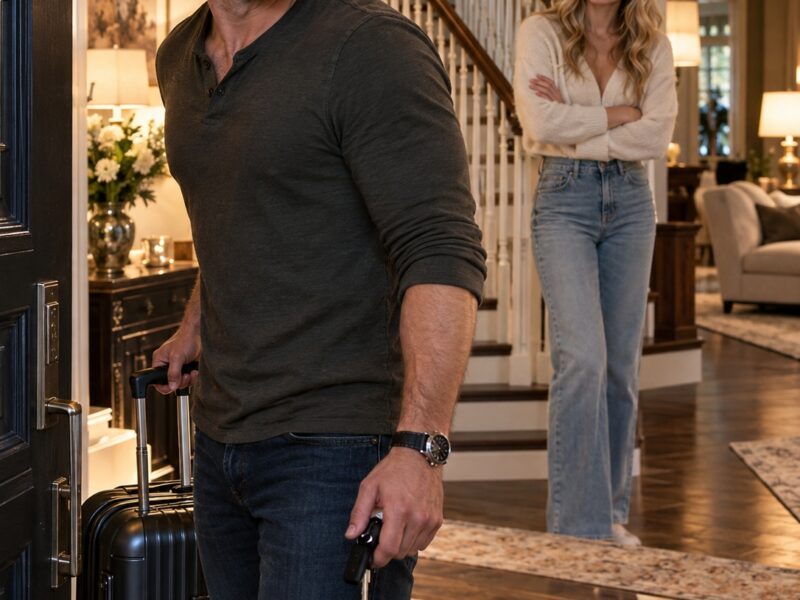
I Gave My Best Friend’s Sister My Guest Room—Then She Saw My Suitcase by the Door and Asked One Question I Couldn’t Answer

The suitcase was already beside the front door when Clare came downstairs.
She stopped halfway down the staircase.
For several seconds, she said nothing.
Her eyes moved from the suitcase to the overnight bag resting on top of it, then to the keys in my hand.
Finally, she looked at me.
“You’re leaving?”
I forced a smile.
“Just for the weekend.”
Clare descended another step.
“But you told me I could stay here.”
“You can.”
“Then why are you leaving?”
There are questions people ask because they want information.
And there are questions that somehow find the exact place inside you that you have spent years protecting.
That was the second kind.
I had explanations ready.
My younger brother lived twenty minutes away.
I had errands to run.
She would be more comfortable having the house to herself.
I didn’t want her to feel awkward sharing a house with a man she barely knew.
Every explanation was reasonable.
Every explanation was also a lie.
Because the truth was standing six feet away from me in gray sweatpants and an oversized college sweatshirt, holding an empty water glass.
The truth was that Clare had been in my house for barely twenty-four hours, and somehow the place had already begun feeling different.
There had been laughter at my dining table.
Two coffee mugs in the sink.
A jacket hanging beside mine.
Footsteps upstairs.
A woman humming quietly while searching through the kitchen cabinets for sugar.
Ordinary things.
Dangerously ordinary things.
For three years, I had trained myself not to miss them.
Then Clare arrived.
And suddenly I remembered.
That was why I was leaving.
Not because I wanted her gone.
Because part of me was beginning to wish she would stay.
And that frightened me more than loneliness ever had.
Clare reached the bottom of the stairs.
“You offered me your guest room,” she said quietly. “But somehow I’m the guest and you’re the one running away.”
“I’m not running.”
Her eyes stayed on mine.
“Then put the suitcase down.”
I couldn’t.
And that was when I realized the problem wasn’t Clare.
It had never been Clare.
The person I had been running from had been living in this house for three years.
His name was Daniel Carter.
And unfortunately, he was me.
I was thirty-four years old then, and if you had met me at work, you probably wouldn’t have guessed anything was wrong.
I worked as the maintenance supervisor at the Hawthorne Inn, a small independent hotel outside Columbus, Ohio.
Nothing glamorous.
Seventy-eight rooms.
Two elevators that seemed to take turns breaking.
An ancient boiler system.
Pipes with personalities.
Guests who somehow believed I personally controlled the weather, water pressure, cable television, and whether their children lost stuffed animals under hotel beds.
I liked the work.
Broken things made sense to me.
A door wouldn’t close because the hinge was loose.
A sink leaked because the washer had worn out.
A light flickered because there was a bad connection somewhere behind the wall.
Find the problem.
Replace what failed.
Tighten what had come loose.
Test it.
Move on.
People were harder.
Three years earlier, I had been engaged to a woman named Emily.
We had been together almost five years.
The wedding invitations had already gone out.
My suit had been fitted.
Her dress was hanging in her mother’s house.
We had paid the deposit on a converted barn outside Cincinnati where one hundred and twelve people were supposed to watch us promise forever.
Then, seventeen days before the wedding, Emily came into our kitchen while I was repairing a cabinet hinge.
I remember that detail because grief is strange.
You forget entire conversations but remember ridiculous things.
The screwdriver in my hand.
The smell of coffee.
The rain tapping against the window.
Emily standing behind me without taking off her coat.
“Daniel.”
I kept turning the screwdriver.
“Give me a second.”
“Daniel.”
Something in her voice made me stop.
I turned around.
She had been crying.
I stood immediately.
“What happened?”
She looked at me for a long time.
Then she said the sentence that changed the architecture of my life.
“I can’t marry you.”
I actually laughed.
Not because it was funny.
Because sometimes the mind rejects pain before the heart understands it.
“What?”
“I can’t do this.”
“Do what?”
“This.”
She gestured around the kitchen.
Our kitchen.
The house we had chosen together.
The life I thought we were building.
I stared at her.
“We’re getting married in seventeen days.”
“I know.”
“Your mother called me yesterday about centerpieces.”
“I know.”
“My parents already booked the hotel.”
“I know, Daniel.”
“Then what are you saying?”
She pressed both hands against her face.
When she lowered them, I saw something worse than anger.
Pity.
“I think you’re a good man.”
Nobody wants to hear that sentence from the person they’re supposed to marry.
“Don’t,” I said.
“You are.”
“Emily.”
“But being with you feels like living beside someone who has already given up on being happy.”
I didn’t understand.
Or maybe I understood too well.
My father had died two years earlier.
After that, something in me had gone quiet.
I worked more.
Talked less.
Stopped planning trips.
Stopped calling friends.
Stopped playing guitar.
Stopped building furniture in the garage.
Emily kept asking what I wanted.
Dinner.
Vacation.
Paint colors.
Children someday.
Life.
My answer became the same.
“Whatever you want.”
I thought that made me easy to love.
I didn’t realize how exhausting it was to love someone who had slowly disappeared while still sitting beside you.
Emily wiped her cheeks.
“I keep waiting for you to come back.”
“I’m right here.”
“No.”
She shook her head.
“You’re not.”
Those three words hurt more than the canceled wedding.
Because somewhere beneath my anger, I knew she was telling the truth.
I didn’t beg her to stay.
That became another regret.
I stood there holding a screwdriver while the woman I loved carried two suitcases through the front door.
Before leaving, she turned toward me.
For half a second, I thought she might change her mind.
Instead, she whispered, “I’m sorry.”
Then the door closed.
The wedding was canceled.
The deposits were lost.
The dress disappeared.
Friends stopped knowing what to say.
Eventually, everyone returned to their lives.
I didn’t.
I simply became better at pretending that isolation was a preference instead of a wound.
I removed photographs from the walls.
Not angrily.
That would have required energy.
I placed them carefully in a drawer.
Emily and me at Lake Erie.
My father holding a fish he had definitely not caught.
Marcus and me after a Browns game.
My mother laughing at something outside the frame.
I removed all of them.
Eventually, my walls looked like the walls in a model home.
Clean.
Neutral.
Unclaimed.
I ate dinner standing over the kitchen counter more often than sitting at the table.
I watched television without remembering what I watched.
Sometimes I would realize at midnight that I hadn’t spoken aloud since leaving work.
My refrigerator made a clicking noise before the compressor started.
I knew because, on enough quiet nights, that sound became company.
Marcus Reed was the only person who refused to let me completely disappear.
We had been friends since high school.
Marcus was the kind of man who believed friendship was less about asking permission and more about showing up until somebody stopped pretending they didn’t need you.
For the first year after Emily left, he invited me everywhere.
Barbecues.
Football games.
His daughter’s birthday.
Christmas dinner.
A fishing weekend in Michigan.
I usually went.
I usually left early.
Eventually, he stopped trying to drag me back into the world.
Instead, he called.
Every few days.
Sometimes for thirty minutes.
Sometimes for thirty seconds.
“You alive?”
“Unfortunately.”
“Good. Talk Thursday.”
That was Marcus.
He never demanded a confession.
He simply kept reminding me somebody would notice if I disappeared.
Then, one Thursday evening, he called with a favor.
“Before you say no,” he began, “remember that I helped you move that refrigerator.”
“That was eight years ago.”
“My back remembers.”
“What do you need?”
“My sister’s coming into town.”
I knew Marcus had a younger sister, but Clare and I had met only twice.
Once at his wedding.
Once at his father’s funeral.
“She has an interview Monday,” he continued. “Her Airbnb canceled. Pipe burst or mold or plague or something. I’m in Indianapolis until Tuesday.”
“And?”
“And you have a guest room.”
I looked toward the hallway.
Technically, yes.
I had a guest room.
Nobody had slept there in almost two years.
“Marcus—”
“Three nights.”
“You know I’m not exactly running a bed-and-breakfast.”
“She doesn’t need breakfast.”
“That’s reassuring.”
“She’s twenty-nine, Daniel. She teaches third grade. She survived thirty children armed with glue sticks. I think she can survive you.”
I smiled despite myself.
Then Marcus became serious.
“I wouldn’t ask if she had another good option.”
That ended the debate.
Marcus had spent nights on my couch after Emily left because he didn’t trust me alone.
He had canceled plans without telling me.
He had answered calls at 2:00 a.m.
Some debts shouldn’t be counted.
“Fine,” I said.
“You’re a saint.”
“No. Saints get statues. I get your sister.”
“Try not to scare her.”
“I’ll put away the chainsaw.”
“You don’t own a chainsaw.”
“Exactly what I’d tell the police.”
He laughed.
I almost canceled the next morning.
Twice.
Instead, I cleaned a house that was already clean.
I changed the guest sheets.
Bought extra towels.
Put bottled water beside the bed.
Then I stood in the doorway and wondered why I was nervous.
It was three nights.
Nothing more.
At 4:47 Friday afternoon, rain began hammering the windows.
At 5:16, someone knocked.
When I opened the door, Clare Reed stood on my porch with a suitcase in one hand and a canvas tote over her shoulder.
Her brown hair was damp around her face.
She looked exhausted.
And embarrassed.
“Daniel?”
“That depends. Are you selling something?”
She blinked.
Then laughed.
“Marcus warned me your hospitality needed work.”
I stepped aside.
“Come in.”
“Thank you. Seriously.”
She wiped her shoes carefully before crossing the threshold.
“You have no idea how much I appreciate this.”
“It’s just a room.”
“It’s not ‘just a room’ when every hotel near the school district is booked because of some youth soccer tournament.”
“Then congratulations. You narrowly escaped spending three nights surrounded by nine-year-olds kicking walls.”
“I teach third grade.”
“Right. So this would have been professional development.”
She laughed again.
It was a small sound.
But something happened in the house when she did.
I noticed it immediately.
That bothered me.
I carried her suitcase upstairs.
The guest room was simple: bed, dresser, nightstand, window facing the maple tree in the backyard.
“I put towels in the bathroom. Wi-Fi password is on the desk. Thermostat’s downstairs. Coffee’s terrible.”
“You’re really selling the experience.”
“I believe in managing expectations.”
She put her bag down.
Then she looked at the room.
“This is perfect.”
“It’s a bed.”
“No.”
She turned toward me.
“It’s somewhere I don’t have to worry tonight.”
Something in the way she said it made me look at her more carefully.
There were faint shadows beneath her eyes.
Not road-trip exhaustion.
Something older.
But I didn’t ask.
People who live behind walls learn to recognize other people’s walls.
That evening, I offered to order dinner.
Clare insisted she wasn’t hungry.
Ten minutes later, her stomach growled loudly enough that we both heard it.
She closed her eyes.
“Please pretend that didn’t happen.”
“I’m a maintenance guy, not a magician.”
We ordered Italian.
When the food arrived, I automatically carried my container toward the kitchen counter.
Clare looked at the dining table.
“You don’t eat there?”
“Sometimes.”
There were four chairs.
All perfectly pushed in.
She raised an eyebrow.
“When?”
I couldn’t remember.
So I put the containers on the table.
That tiny decision changed more than it should have.
At first, conversation stayed safe.
The weather.
Her drive.
Marcus.
The interview.
Then Clare began talking about her students.
There was a boy named Tyler who refused to draw the sun yellow.
“Purple,” she said.
“Why?”
“Because yellow is boring.”
“Reasonable.”
“That wasn’t his argument.”
She tried to imitate a child’s solemn voice.
“He told me, ‘Ms. Reed, the sun is alone all day. Purple is a feeling color.’”
I laughed.
Not politely.
Actually laughed.
It came out suddenly enough that I almost looked behind me to see who had made the sound.
Clare stopped.
“What?”
“Nothing.”
“You’re staring at me.”
“I forgot something.”
“What?”
I shook my head.
“That I could still do that.”
Her expression softened.
She understood.
And because she understood, I immediately regretted saying it.
I looked down at my food.
But Clare didn’t turn the moment into something sentimental.
She simply picked up her fork.
“Well, don’t get too excited. My material gets worse.”
That made me laugh again.
After dinner, she helped clear the table despite my protests.
While I filled the dishwasher, she wandered toward the living room.
“Did you make this?”
I turned.
She was touching the edge of the old oak bookshelf.
“Yes.”
“It’s beautiful.”
“It holds books.”
“So do cardboard boxes. Nobody compliments those.”
I smiled.
“I built it years ago.”
“For the house?”
“For no particular reason.”
She ran her fingers over the wood grain.
“Sometimes things we make for no practical reason become the things that matter most.”
I don’t know why that sentence stayed with me.
Maybe because I had spent three years keeping only what was practical.
Work.
Food.
Sleep.
Bills.
Maintenance.
Survival.
Everything unnecessary had slowly disappeared.
Music.
Friends.
Photographs.
Hope.
That night, I lay awake listening to unfamiliar sounds.
Water running upstairs.
A floorboard creaking.
A bedroom door closing.
Normal sounds.
I hated how comforting they were.
The next morning, I found Clare sitting at the kitchen table with papers spread around her.
“Interview prep?”
She nodded.
“Trying not to panic.”
“You teach children for a living. Administrators should be terrified of you.”
“That is not how interviews work.”
“It should be.”
She smiled, then looked at my coffee.
“Is that drinkable?”
“Legally, yes.”
I made her tea instead.
While the kettle heated, she noticed the walls.
Noticed is too gentle a word.
She studied them.
There was nothing there.
No photographs.
No art except one cheap landscape print in the hallway.
She didn’t ask.
That made me grateful.
And somehow more uncomfortable.
People usually handled visible sadness in one of two ways.
They interrogated it.
Or avoided it.
Clare did neither.
She simply seemed to register things and leave them where they were.
Before noon, she left to tour the neighborhood around the school.
I went to work.
When I returned, there was a grocery bag on my kitchen counter.
Inside were eggs, bread, coffee, tomatoes, pasta and a box of cookies.
Clare emerged from the hallway.
“I replaced your coffee.”
I stared at her.
“What’s wrong with my coffee?”
“I think it may have been manufactured during the Reagan administration.”
“That coffee has character.”
“It has trauma.”
I laughed.
Again.
Too easily.
That should have felt good.
Instead, fear arrived.
Quietly.
Efficiently.
By dinner, I was watching Clare move around my kitchen as though I were witnessing something dangerous.
She wasn’t flirting.
She wasn’t trying to impress me.
She wasn’t promising anything.
That was exactly why it affected me.
There was no performance.
Just presence.
She asked where the colander was.
She complained that my knives were dull.
She put music on her phone while we cooked.
At one point, she danced badly while waiting for water to boil.
I stood beside the stove holding a wooden spoon.
For one second, an image appeared in my mind without permission.
Not Clare specifically.
Something broader.
Someone in the kitchen.
Someone coming home.
Someone asking about my day.
Someone occupying the other side of a bed.
Someone whose shampoo appeared in the shower.
Someone whose absence would hurt.
My chest tightened.
I excused myself.
Upstairs, I opened the closet.
The old suitcase was on the top shelf.
I stared at it.
Then pulled it down.
I told myself Clare deserved privacy.
I told myself I could spend two nights at my brother Nathan’s apartment.
I told myself it was polite.
By the time I finished lying to myself, I had packed two shirts, jeans, underwear, my shaving kit and a paperback I had been pretending to read for six months.
I carried the suitcase downstairs.
I was zipping it beside the front door when Clare appeared above me.
And asked the question I had no answer for.
“Why are you leaving?”
Now she stood at the bottom of the stairs waiting.
“I told you,” I said. “You’ll be more comfortable.”
“Did I say I was uncomfortable?”
“No.”
“Did I ask you to leave?”
“No.”
“Then why are you making that decision for me?”
I felt irritation rising.
It was easier than fear.
“Clare, you’ve known me for twenty-four hours.”
“Exactly.”
“So maybe don’t analyze me.”
“I’m not analyzing you.”
“It sounds like it.”
She crossed her arms.
“You offered me a place to stay. We had dinner. We made pasta. I insulted your coffee. Now suddenly you’re packed.”
“I have things to do.”
“Where?”
“My brother’s.”
“For what?”
“Does it matter?”
“Yes.”
“Why?”
“Because I’m starting to think you’re leaving because I’m here.”
The sentence landed between us.
I looked away.
That was enough.
“Oh,” she said.
Not angrily.
Worse.
Hurt.
“Clare—”
“I can go.”
“No.”
“I’ll find somewhere.”
“That’s not what I want.”
“Then what do you want?”
I opened my mouth.
Nothing came.
Her voice softened.
“Daniel, do you always do this?”
“Do what?”
“Disappear when someone gets close enough to notice you?”
My jaw tightened.
“You don’t know anything about me.”
“No. I don’t.”
She nodded toward the suitcase.
“But I know what that looks like.”
“What exactly does it look like?”
“Fear.”
I almost laughed.
Instead, I felt exposed.
“I’m not afraid of you.”
“I didn’t say you were.”
“Then what am I afraid of?”
Clare hesitated.
When she answered, her voice was almost gentle.
“That somebody might stay long enough for you to care whether they leave.”
The house became completely silent.
There are moments when another person says something you have spent years refusing to say to yourself.
Your first instinct is not gratitude.
It is anger.
“Marcus told you about Emily.”
Clare frowned.
“Who’s Emily?”
That stopped me.
“My ex-fiancée.”
“No.”
“He never told you?”
“No.”
I searched her face.
She was telling the truth.
Which meant she had reached the wound without knowing it existed.
I sat on the arm of the sofa.
Clare remained where she was.
“I’m sorry,” she said. “I shouldn’t have pushed.”
“No.”
I rubbed my hands together.
“You were right.”
She waited.
And for reasons I still don’t fully understand, I began talking.
Maybe because she was almost a stranger.
Maybe because she had nothing invested in the version of myself I had spent three years maintaining.
Maybe because sometimes the truth becomes heavier than the consequences of saying it.
“Emily left seventeen days before our wedding.”
Clare’s expression changed.
“Oh.”
“She said being with me felt like living with someone who had already given up on happiness.”
“That’s a cruel thing to carry.”
“She wasn’t entirely wrong.”
I told Clare about my father.
About withdrawing.
About the canceled wedding.
About standing in the kitchen while Emily walked out.
About the photographs.
About the dinners eaten alone.
About how loneliness had eventually stopped feeling painful because it had become familiar.
Then I said something I had never admitted to Marcus.
“I think part of me decided she proved something.”
“What?”
“That eventually, being around me becomes too heavy.”
Clare sat in the chair opposite me.
“You really believe that?”
“I don’t know.”
“That usually means yes.”
I stared at the floor.
“She knew me for five years.”
“And?”
“And she left.”
Clare was quiet.
I expected reassurance.
The usual phrases.
You’ll meet somebody.
Everything happens for a reason.
Her loss.
You deserve better.
She said none of them.
Instead, she asked, “If someone quits a job after five years, does that mean the company never existed?”
I looked up.
“What?”
“If someone moves out of a city, does it mean the city becomes worthless?”
“That’s different.”
“Why?”
“Because people aren’t cities.”
“Exactly.”
She leaned forward.
“People change. Relationships fail. Sometimes someone leaves because they’re wrong for you. Sometimes they leave because you hurt them. Sometimes both people are good and the relationship still dies. But one person deciding she couldn’t stay does not magically become evidence that nobody ever will.”
I swallowed.
Clare looked toward the blank wall.
“You let one ending become the definition of your entire life.”
I didn’t respond.
She continued quietly.
“And maybe that’s easier.”
My head snapped toward her.
“Easier?”
“Yes.”
“You think this is easy?”
“No.”
She shook her head.
“I think loneliness is painful. But after a while, predictable pain can feel safer than unpredictable happiness.”
That sentence hit harder than everything else.
Because it was true.
I knew exactly what tomorrow would look like when I was alone.
I knew the refrigerator would hum.
I knew I would eat dinner at 7:00.
I knew nobody would disappoint me.
Nobody would leave.
Nobody would die.
Nobody would change their mind.
Nothing would be taken from me because I had stopped allowing myself to possess anything emotionally valuable.
Clare looked down at her hands.
Then she surprised me.
“I understand that more than you think.”
I said nothing.
“My mom got sick last year.”
Marcus had mentioned something about their mother’s health.
I hadn’t known the details.
“Cancer?”
“No. Autoimmune complications. Then pneumonia. Then months of recovery.”
“I’m sorry.”
“She’s better now.”
Clare smiled faintly.
“That’s the strange part. Everybody thinks the story ended when she got better.”
She looked toward the window.
“For almost a year, I organized my entire life around keeping another person alive and comfortable. Medications. Appointments. Food. Bills. Phone calls. Nighttime fevers. Emergency rooms.”
Her voice became quieter.
“I stopped seeing friends because I was tired. I turned down a position at another school. I stopped dating. Stopped traveling. Stopped asking myself what I wanted because what I wanted didn’t matter.”
“Clare—”
“I don’t regret taking care of her.”
She looked directly at me.
“I’d do it again.”
Then came the part that hurt her to say.
“But when she got better, everybody celebrated.”
She smiled without humor.
“And I realized I didn’t know what to do with myself.”
I understood then.
Her interview wasn’t simply an interview.
It was an escape hatch.
Or maybe a doorway.
“I had become useful,” she said. “I forgot how to become happy.”
The room felt different after that.
Two people sitting across from each other.
Two different wounds.
Same instinct.
Disappear into a role where nothing vulnerable was required.
I repaired things.
Clare cared for people.
Neither of us had been living much beyond that.
“I almost canceled this interview,” she admitted.
“Why?”
“Because Mom called yesterday morning and said she had a headache.”
“A headache?”
Clare nodded.
“I was halfway to turning the car around.”
“But you didn’t.”
“No.”
“What stopped you?”
“She told me to stop using her as an excuse not to have a life.”
I smiled faintly.
“She sounds direct.”
“You have no idea.”
Then Clare glanced toward my suitcase.
“Apparently I inherited it.”
That finally broke something in me.
I laughed.
Then, unexpectedly, my eyes burned.
I turned away.
I hated crying in front of people.
Clare didn’t move closer.
Didn’t touch me.
Didn’t say anything.
That made it possible.
I covered my face with one hand.
Three years of grief didn’t pour out dramatically.
There was no breakdown.
Just a few quiet tears from a man who had spent too long pretending that not feeling pain was the same as healing.
After a while, I looked at Clare.
She was still there.
No pity.
No discomfort.
Just presence.
“You should get some sleep,” I said.
“So should you.”
I stood.
Then picked up the suitcase.
Clare watched me.
I carried it upstairs.
Back into my bedroom.
When I came down again, she was filling her glass at the sink.
She glanced at me.
“Changed your plans?”
“For tonight.”
“That’s enough.”
Those three words stayed with me.
For tonight.
Not forever.
No promises.
No grand transformation.
Just one night when I chose not to run.
The next morning, Clare left early for her interview.
Before walking out, she paused at the door.
“Wish me luck.”
“You teach third grade.”
She smiled.
“Daniel.”
“Fine. Good luck.”
“Thank you.”
She reached for the handle.
“Clare?”
She turned.
“Don’t turn around.”
Her face changed.
“Okay.”
Then she left.
At work, I repaired a leaking toilet in 214, replaced a door closer in the conference room and spent forty minutes arguing with an ice machine.
But my mind kept returning home.
Not to Clare.
To the suitcase.
For years, I had thought Emily leaving was the defining act of my adult life.
Suddenly, I wondered if the more important act had been everything I did afterward.
Emily had left once.
I had been leaving every day since.
When I returned home that afternoon, Clare wasn’t there yet.
Sunlight stretched across the living room floor.
I stood inside the doorway.
Nothing had changed.
Same sofa.
Same bookshelf.
Same blank walls.
And yet I noticed details I had stopped seeing.
A scratch on the floor from moving the piano after my father died.
Small dents in the bookshelf where Marcus and I had dropped it during construction.
Faint rectangles on the wall where photographs had once hung.
My house hadn’t become empty when Emily left.
I had emptied it.
That distinction terrified me.
Because if I had done it, perhaps I could undo it.
At 4:36, the front door opened.
Clare stepped inside.
I tried not to read her expression.
“Well?”
She closed the door slowly.
“They want me back Tuesday.”
I stared.
“For a second interview?”
She nodded.
Then smiled.
The smile spread across her face until she looked almost shocked by her own happiness.
“They want me back.”
I grinned.
“That sounds good.”
“I think it’s good.”
“That definitely sounds good.”
“I may throw up.”
“Less good.”
She laughed.
Then she hugged me.
It lasted maybe two seconds.
But I froze.
She noticed immediately and stepped back.
“Sorry.”
“No.”
I shook my head.
“It’s okay.”
For some reason, that tiny awkwardness made the moment more real.
I cleared my throat.
“We should celebrate.”
“With your coffee?”
“I was thinking dinner.”
“Safer.”
“We’re making pasta.”
Clare stared at me.
“You?”
“Yes.”
“Cooking?”
“I know how to cook.”
“You own three spices.”
“Four.”
“Salt isn’t a spice.”
“Get out of my house.”
She laughed.
That evening, we made pasta.
It wasn’t particularly good.
Clare ate two servings anyway.
Over the next few days, something quiet happened.
We became comfortable.
Not romantically.
Not yet.
That distinction mattered.
Clare didn’t arrive to rescue me.
I didn’t suddenly become a different man because a beautiful woman laughed in my kitchen.
Healing isn’t that convenient.
I still went silent sometimes.
She still checked her phone too often when her mother didn’t respond immediately.
Once, during breakfast, her mother failed to answer a text for twenty minutes.
I watched Clare’s entire body change.
Her shoulders tightened.
She called once.
Twice.
Then stood.
“I should drive home.”
“Clare.”
“What if something happened?”
“You said she had a doctor’s appointment.”
“Yes.”
“So maybe she’s at the doctor.”
“She usually answers.”
“Give her ten minutes.”
“I can’t.”
She grabbed her keys.
I recognized the expression.
It was the same one I had worn while packing my suitcase.
Fear disguised as responsibility.
“Clare.”
She stopped.
“You told me not to run.”
Her eyes flashed.
“This is different.”
“Is it?”
“My mother was sick.”
“And she’s recovering.”
“What if—”
“What if she needs you?”
I nodded.
“Then you go.”
She stared at me.
“But what if she doesn’t?”
Clare’s phone rang.
She answered immediately.
“Mom?”
Her shoulders dropped.
A minute later, she hung up.
“She was in the appointment.”
I didn’t say anything.
Clare sat slowly.
Then covered her face.
“I almost drove four hours because she didn’t answer for twenty minutes.”
“You love her.”
“That’s not an excuse for this.”
“No.”
She looked at me.
“How do you stop?”
I thought about the suitcase upstairs.
“Maybe you don’t stop all at once.”
“Helpful.”
“Maybe you wait ten minutes today.”
She gave me a tired smile.
“And tomorrow?”
“Eleven.”
That became our strange agreement.
Not fixing.
Not rescuing.
Just catching each other at the doorway.
Tuesday morning, Clare went to her second interview.
That afternoon, she came home carrying a white envelope.
She stood in the kitchen.
I looked at the envelope.
She looked at me.
“Open it.”
“I already did.”
“And?”
Her mouth trembled.
“I got the job.”
I shouted loudly enough that the neighbor’s dog started barking.
Clare laughed and cried simultaneously.
Then she called Marcus.
I gave her privacy, but I could hear his reaction through the phone from the hallway.
“YOU’RE MOVING THERE?”
Clare held the phone away from her ear.
I laughed.
She glared at me while smiling.
Later, after the calls and congratulations, reality arrived.
The job started in three weeks.
Clare needed an apartment.
Furniture.
A new routine.
A new city.
She was excited.
And scared.
I understood both.
Her final night in my house came too quickly.
We ordered dinner from the same Italian restaurant as the first night.
This time, I set the table without thinking.
Two plates.
Two glasses.
Napkins.
Clare noticed.
She didn’t mention it.
After dinner, I washed dishes while she dried.
“So,” she said, “are you still planning to abandon the house whenever someone visits?”
“I’ve revised the policy.”
“Oh?”
“Visitors are evaluated individually.”
“Very progressive.”
“Anyone who criticizes my coffee gets a probationary period.”
“Reasonable.”
“Anyone who replaces it without permission is permanently banned.”
She smiled.
Then the smile faded.
“Daniel.”
I looked over.
“Thank you.”
“For what?”
“You know.”
“No. I gave you a room.”
“You gave me somewhere to make a decision that belonged to me.”
I turned off the faucet.
Clare folded the dish towel.
“I needed that.”
“You did the hard part.”
“So did you.”
“I carried a suitcase upstairs.”
“You stayed.”
Something about the simplicity of that word silenced me.
Stayed.
Emily had left.
My father had died.
I had spent years believing staying was something other people decided.
Maybe it was also something I could choose.
“I’m still scared,” I admitted.
“Of what?”
“Getting used to this.”
Clare looked around the kitchen.
“This?”
“Another person being here.”
Her eyes returned to mine.
“And then tomorrow, you won’t be.”
There.
The truth.
Not dramatic.
Not romantic.
Just honest.
Clare leaned against the counter.
“I’m going to be forty minutes away.”
“I know.”
“And Marcus has already informed me that you require supervision.”
“He exaggerates.”
“He used the phrase ‘emotionally constipated.’”
“I’m ending that friendship.”
She laughed.
Then became serious.
“Daniel, I can’t promise I’ll always be around.”
I appreciated her for saying it.
“No one can.”
“Exactly.”
She stepped closer.
“But uncertainty isn’t the same thing as abandonment.”
I nodded.
She looked at me for another second.
“Protecting yourself from heartbreak can eventually become protecting yourself from happiness.”
I smiled sadly.
“You practice these lines?”
“All teachers secretly rehearse speeches.”
“I knew it.”
She smiled.
Then we finished the dishes.
Nothing happened that night.
No kiss.
No confession.
No dramatic declaration.
That matters.
Because sometimes the most important relationships begin before anyone understands what they are becoming.
The next morning, I carried Clare’s suitcase to her car.
Rain had stopped.
The air smelled clean.
She put her tote in the passenger seat.
Then turned toward me.
“Well.”
“Well.”
“This was significantly less terrifying than the motel beside the highway.”
“Five-star review?”
“Four.”
“Why four?”
“Coffee.”
I shook my head.
She smiled.
Then hugged me.
This time, I hugged her back immediately.
It wasn’t passionate.
It wasn’t a promise.
It was warm.
Human.
Enough.
When she pulled away, she looked toward the house.
“Put something on those walls.”
I frowned.
“Bossy.”
“I’m serious.”
“Drive safely.”
“Daniel.”
“Fine.”
I nodded.
“I’ll think about it.”
She opened the car door.
“Thinking is how you avoid doing things.”
“Goodbye, Clare.”
She laughed.
Then drove away.
I stood in the driveway until her car disappeared.
When I returned inside, the silence hit me immediately.
For three years, silence had been protection.
Now, for the first time, it felt like absence.
That hurt.
But I didn’t run from it.
I walked into the living room.
Opened the curtains.
Sunlight filled the room.
Then I went upstairs and opened the bottom drawer of my dresser.
The photographs were still there.
I carried the box downstairs.
One by one, I spread them across the dining table.
My father.
My mother.
Marcus.
Old friends.
Emily.
I paused when I found that photograph.
We were standing beside Lake Erie.
Emily had one arm around my waist.
Both of us were laughing.
For years, I had avoided the picture because I thought keeping it meant I still wanted her back.
Now I understood something.
A memory didn’t have to be erased simply because the future attached to it never happened.
Emily had loved me.
I had loved her.
We had failed each other in ways neither of us fully understood at the time.
Then she left.
That was painful.
But pain was not proof that the years before it had been meaningless.
I didn’t put our photograph on the wall.
I also didn’t throw it away.
I returned it to the box.
Not hidden.
Just finished.
Then I chose a photograph of my father holding that ridiculous fish.
I found a frame.
And for the first time in three years, I hammered a nail into the wall.
The sound echoed through the house.
One strike.
Then another.
A tiny act.
But after years of removing evidence that I had ever belonged to anyone, I was finally putting something back.
Clare started her new job three weeks later.
She found a small apartment fifteen minutes from the school.
I helped her move.
Marcus came too.
At one point, he watched Clare and me arguing over how to assemble a bookshelf.
His eyes narrowed.
“What?”
I asked.
“Nothing.”
“You’re looking at me.”
“I’m observing.”
“Stop.”
Clare pointed a screwdriver at him.
“Don’t make it weird.”
Marcus raised both hands.
“I said nothing.”
“You were thinking loudly.”
He smiled.
I wanted to punch him.
Nothing happened between Clare and me for months.
At least nothing that could be named.
We became friends.
Real friends.
She called when one of her students made her laugh.
I called when the Hawthorne’s boiler tried to destroy my weekend.
Sometimes we ate dinner.
Sometimes weeks passed.
Clare built her own life.
That mattered.
She joined a teachers’ group.
Made friends.
Started running in the mornings.
Visited her mother without turning every visit into an emergency assessment.
She learned to let people help her.
I changed too.
Slowly.
I accepted invitations from Marcus.
I went to his daughter’s birthday and stayed until the cake was gone.
I bought a guitar.
Used.
Cheap.
The first night I tried playing, my fingers hurt after fifteen minutes.
I kept going.
More photographs appeared on the walls.
Not many.
Enough.
Then, six months after Clare first arrived at my house, something happened that tested everything I thought I had learned.
Emily called.
I was standing in the hotel basement when my phone vibrated.
Her name appeared on the screen.
For several seconds, I couldn’t move.
Three years.
No real conversation.
One Christmas text.
A condolence message when Marcus’s father died.
Nothing else.
I let the call ring out.
Thirty seconds later, a message appeared.
Daniel, I know this is unexpected. I’m in Columbus for work. I was hoping we could talk.
My chest tightened.
The old instinct returned immediately.
Escape.
Ignore it.
Go home.
Close the curtains.
Pretend the past couldn’t reach me.
Instead, I stared at the message.
Then called Clare.
She answered on the second ring.
“Hey.”
“Emily contacted me.”
Silence.
“Oh.”
“She wants to talk.”
Another pause.
“What are you going to do?”
“I don’t know.”
“Do you want to see her?”
“I don’t know.”
“That wasn’t helpful.”
“I know.”
Clare waited.
Then said, “What are you afraid will happen?”
That question again.
Not what should you do?
What are you afraid of?
“That I’ll become that person again.”
“Which person?”
“The one she left.”
Clare’s voice softened.
“Daniel.”
“Yeah?”
“You aren’t him anymore.”
I closed my eyes.
“And if seeing her proves I am?”
“It won’t.”
“How do you know?”
“Because the old Daniel would have ignored the call, gone home, turned off the lights and spent three days pretending he didn’t care.”
I almost smiled.
“And this Daniel?”
“He called someone.”
That was Clare.
She never told me what decision to make.
She simply reminded me I had one.
I met Emily the next afternoon at a coffee shop.
She looked older.
So did I.
For a few seconds, neither of us knew whether to hug.
We didn’t.
We sat.
She told me she was married.
The information surprised me.
But it didn’t destroy me.
That surprised me more.
She had a baby girl.
Her name was Sophie.
Emily showed me a photograph.
I looked at it.
A beautiful child.
I expected jealousy.
Instead, I felt something quieter.
Relief, perhaps.
Or closure.
“I owe you an apology,” Emily said.
“You already apologized.”
“Not properly.”
She wrapped both hands around her coffee cup.
“I left in the worst possible way.”
“You left before marrying someone you didn’t want to marry.”
“That doesn’t make how I did it right.”
I said nothing.
She looked at me.
“I blamed you for everything.”
“You weren’t completely wrong.”
“No.”
Her eyes filled.
“But neither were you.”
That sentence released something I hadn’t realized I was still carrying.
Emily continued.
“I thought I needed you to become someone different so I could be happy. I didn’t understand how unhappy I was with myself.”
I thought of Clare.
Of caregiving.
Of hiding.
Of all the ways people mistake internal pain for evidence that someone else is failing them.
“I spent years thinking your leaving proved I was impossible to live with,” I said.
Emily looked devastated.
“Daniel.”
“It’s okay.”
“No. It isn’t.”
“It is now.”
And I meant it.
She smiled through tears.
“You seem different.”
“I’m trying.”
“Are you happy?”
Six months earlier, I wouldn’t have known how to answer.
Now I thought about the hotel.
My guitar.
Marcus.
Photographs on my walls.
Dinner with Clare.
Ordinary Tuesdays.
“I’m learning how.”
Emily smiled.
“That sounds like you.”
We said goodbye outside.
This time, watching her walk away didn’t feel like being abandoned.
It felt like witnessing the end of something that had already ended long ago.
I stood there for a moment.
Then my phone buzzed.
A message from Clare.
Still alive?
I laughed.
Unfortunately.
Three dots appeared.
Then:
Good. Dinner at seven?
I looked down the street where Emily had disappeared.
Then at Clare’s message.
For years, I thought healing would feel dramatic.
Like waking up one morning without pain.
It didn’t.
Healing looked like answering a text.
Going to dinner.
Hanging a photograph.
Playing three bad chords on a cheap guitar.
Staying at a birthday party.
Letting someone leave without believing they had taken your future with them.
That evening, I arrived at Clare’s apartment at 6:58.
She opened the door.
“How was it?”
“Strange.”
“Bad strange?”
“No.”
I thought about it.
“Finished strange.”
She understood.
“Come in.”
I stepped inside.
There were photographs everywhere.
Students’ drawings on the refrigerator.
Plants near the window.
Books stacked on the floor.
Evidence of a life being lived.
Dinner was already on the table.
We ate.
Talked.
Laughed.
Afterward, Clare walked me to the door.
I put my hand on the knob.
Then stopped.
“Clare?”
“Yeah?”
“Do you ever think about that first night?”
“What first night?”
“The suitcase.”
She smiled.
“Sometimes.”
“I hated you for about thirty seconds.”
“Only thirty?”
“Maybe forty-five.”
“I’m losing my touch.”
I smiled.
Then looked at her.
“I think you saved my life.”
Her expression changed immediately.
“No.”
The firmness surprised me.
“You did.”
“No, Daniel.”
She stepped closer.
“I asked you a question.”
“That question changed everything.”
“You changed everything.”
I shook my head.
“You don’t understand.”
“I do.”
She touched my arm.
“And that’s exactly why I’m not letting you give me credit for your life.”
I stared at her.
“You carried the suitcase back upstairs.”
“You went to the interview.”
“You put the photographs back.”
“You took the job.”
“You met Emily.”
“You stayed in town.”
We looked at each other.
Then Clare smiled.
“Maybe we just stood near the door while the other person decided whether to walk through it.”
There are sentences you remember forever.
That was one of mine.
I kissed Clare for the first time three weeks later.
Not that night.
That night didn’t need it.
The kiss happened after an ordinary Friday dinner at my house.
She was helping me hang another photograph.
We disagreed about whether it was crooked.
She insisted it was.
I insisted my level proved otherwise.
She accused me of manipulating the level.
I asked how anyone could manipulate gravity.
She laughed.
I looked at her.
And suddenly neither of us was laughing.
“Clare.”
“I know.”
“You know what?”
“I don’t know.”
“That makes no sense.”
“I’m nervous.”
“So am I.”
That made her smile.
I kissed her.
Slowly.
Carefully.
Not like a man claiming something.
Like a man asking whether he was allowed to hope.
She kissed me back.
When we separated, Clare looked toward the photograph.
“It’s still crooked.”
I laughed against her forehead.
“You’re unbelievable.”
“I’m right.”
We didn’t rush after that.
Maybe because both of us knew what happened when people used relationships to escape themselves.
Clare kept her apartment.
I kept my house.
We dated.
Argued.
Learned.
Sometimes I withdrew when something scared me.
Sometimes Clare tried to solve everyone’s problems before they asked.
We called each other out.
Sometimes badly.
Sometimes gently.
Once, after an argument, I almost did what I always did.
I grabbed my keys.
Clare saw.
“Where are you going?”
“I need space.”
“Okay.”
Her answer surprised me.
She moved away from the door.
“Go.”
I stared at her.
She added, “But don’t confuse taking space with disappearing.”
I drove for twenty minutes.
Then came back.
Clare was sitting at the kitchen table.
“I’m still angry,” I said.
“Me too.”
“Okay.”
“Okay.”
We sat down.
That was love, too.
Not never leaving.
Learning how to return.
Two years after the night Clare first arrived with her suitcase, we were standing in my living room when Marcus noticed something.
The walls.
He slowly turned in a circle.
Photographs covered them now.
My father.
My mother.
Marcus and his family.
Clare’s students had given me a ridiculous handmade birthday card.
That was framed too.
There was a photograph of Clare and me hiking in Tennessee.
Another from Thanksgiving.
Another of us standing beside the bookshelf I had built years before.
Marcus stared.
“This place used to look like a dentist’s waiting room.”
“Thank you.”
“No, seriously.”
He pointed at a photograph.
“You voluntarily hung this?”
“Yes.”
“Who are you?”
Clare walked in carrying drinks.
“I fixed him.”
I looked at her.
“You specifically said you didn’t.”
“I changed my mind.”
Marcus laughed.
Later that evening, after everyone left, Clare and I sat on the sofa.
The house became quiet.
But silence no longer frightened me.
There are different kinds of silence.
There is the silence of abandonment.
The silence after an argument.
The silence of grief.
And then there is the silence that exists when two people no longer need words to prove they are still there.
Clare rested her head against my shoulder.
I looked at the bookshelf.
At the photographs.
At the dining table where two plates had replaced one.
And I thought about the suitcase.
For years, I believed the defining moment of my life was watching Emily leave through the front door.
I had been wrong.
The defining moment came three years later.
Another woman stood near that same door.
But this time, I was the one trying to leave.
And she asked me why.
That was all.
No miracle.
No grand rescue.
One question.
Why are you leaving?
At thirty-four, I thought I knew the answer.
Because people leave.
Because happiness ends.
Because loving someone gives them the power to hurt you.
Because hope is simply disappointment that hasn’t happened yet.
Because an empty house cannot abandon you.
Because loneliness, once familiar enough, starts pretending to be peace.
Those were the answers I had lived by.
But they weren’t the truth.
The truth took longer.
The truth was that Emily leaving had hurt me.
But everything afterward had been my choice.
The blank walls.
The empty table.
The unanswered invitations.
The suitcase beside the door.
I had spent years protecting myself from losing another person.
And almost lost myself instead.
Clare never promised she would stay forever.
I never asked her to.
Forever is too large a promise for ordinary human beings.
What we learned was smaller.
And harder.
Stay through the conversation.
Stay through discomfort.
Stay long enough to hear the truth.
Stay when your instinct tells you vulnerability is humiliation.
Stay when someone you love cannot fix you.
Stay when you cannot fix them.
And when leaving really is necessary, leave honestly instead of turning another person’s pain into evidence that they were never worthy of love.
That was what Emily eventually gave me.
That was what Clare taught me.
And perhaps, in some small way, what I taught Clare too.
Years later, I still own the suitcase.
It sits on the top shelf of the bedroom closet.
We use it for vacations now.
Sometimes when I pull it down, I remember that night.
Clare standing on the staircase.
Me beside the front door.
The house quiet around us.
My hand wrapped around a set of keys.
“You offered me a place to stay,” she had said. “But why are you the one leaving?”
I spent years thinking the most important kindness I had shown that weekend was giving Clare a room.
I was wrong about that too.
The room was only a room.
The real gift was what happened afterward.
She allowed me to be seen without trying to repair me.
I allowed her to be cared for without requiring her to earn it.
And somewhere between a terrible cup of coffee, a shared dinner, an unfinished bookshelf, an interview, and a suitcase that never made it through the front door, two lonely people discovered something neither had been searching for.
Not rescue.
Not perfection.
Not a promise that nobody would ever hurt them again.
Something much simpler.
Permission to begin again.
One evening, years after that first visit, I came home and found Clare sitting on the living room floor surrounded by old photographs.
“What are you doing?”
“Organizing.”
“That word frightens me when you use it.”
She held up one photograph.
It was my father with the fish.
The first picture I had returned to the wall.
“You still love this one?”
I sat beside her.
“Yeah.”
“He looks happy.”
“He was.”
Clare leaned against me.
Across the room, the evening sun touched the old bookshelf.
There were scratches in the wood.
Small imperfections.
Evidence of years.
Once, I would have wanted to sand them away.
Now I liked them.
They proved the thing had been used.
Had survived moves.
Arguments.
Dust.
Time.
Life.
Clare looked at me.
“What?”
I asked.
“Nothing.”
“You’re staring.”
She smiled.
“I was just thinking.”
“Dangerous.”
“Very.”
She looked around the room.
“Remember when there was nothing on these walls?”
I did.
Of course I did.
Sometimes I could still see that house beneath this one.
The empty version.
The safe version.
The version where nothing beautiful was allowed to remain long enough to become painful.
“I remember.”
“Do you miss it?”
I looked around.
At the photographs.
At Clare.
At the coffee mug she had abandoned on the table.
At her shoes by the door.
At the jacket hanging beside mine.
At the life scattered everywhere in small, inconvenient evidence.
“No.”
She smiled.
Outside, rain began tapping gently against the windows.
The same sound I remembered from the morning Emily told me she couldn’t marry me.
For years, rain had carried me back to that kitchen.
Back to the screwdriver.
Back to the coat Emily never removed.
Back to a closing door.
But sitting there beside Clare, I noticed something I had never understood before.
The sound was the same.
I wasn’t.
And perhaps that is what healing really is.
The past does not disappear.
The rain still falls.
The scars remain.
Some nights still hurt.
Some people still leave.
But one day, the thing that once sounded like an ending becomes simply rain against a window in a house where you are no longer alone.
Clare slipped her hand into mine.
Neither of us spoke.
We didn’t need to.
Because years earlier, when she asked me why I was leaving, I didn’t have an answer.
Now I did.
I had been leaving because I thought running first would hurt less than being left again.
I had been leaving because loneliness asked nothing from me except everything.
I had been leaving because an empty life felt safer than a full one I might someday lose.
But that night, for the first time in three years, I carried the suitcase back upstairs.
And without knowing it, I made the smallest decision that would change the rest of my life.
I stayed.
Not forever.
Not perfectly.
Just for that night.
And sometimes, that is how a life begins again.
Not with a promise.
Not with a miracle.
Not even with love.
Sometimes it begins with a spare room.
Two plates on a table.
A suitcase beside the door.
And one person looking at another and asking the question they have spent years avoiding:
“Why are you leaving?”
For the first time, I finally understood the answer.
I didn’t have to.









