“I Have Four Children,” the Poor Widow Warned the Duke—But His Answer Changed Everything

“I have four children, Your Grace.”
Every household that had heard those words had turned Faith Abby away.
But the lonely duke sitting across from her smiled—and said something she would remember for the rest of her life.
“Good. This house has been too quiet.”
For several seconds, Faith could only stare at him.
She had rehearsed this conversation during the long walk to Tunnley Hall. She had prepared herself for disappointment, for the polite tightening of a gentleman’s mouth, for another explanation about how four children would be an inconvenience in a respectable household.
She had not prepared herself for a smile.
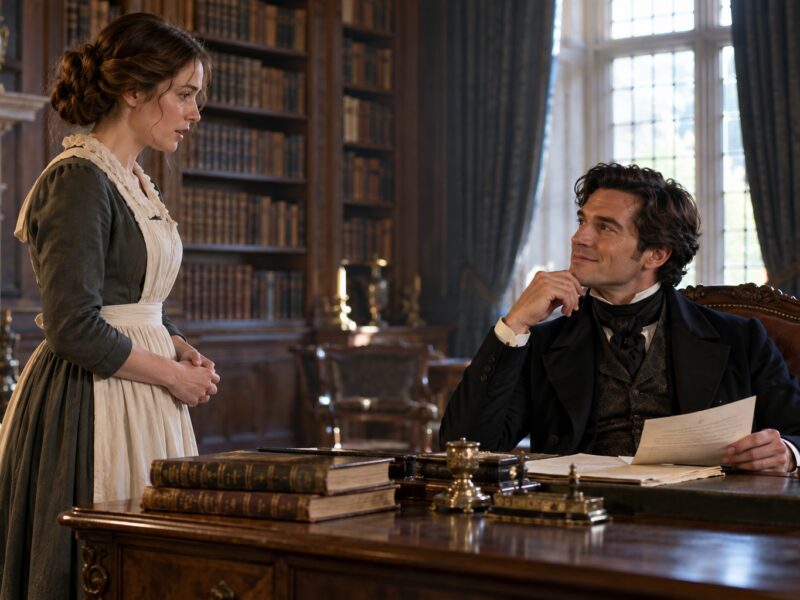
The Duke of Tunnley sat behind an enormous mahogany desk, a letter resting beneath one hand. He was tall, with dark hair beginning to show the strain of years and eyes that seemed older than the rest of him. The library surrounding him was magnificent, lined with books from floor to ceiling, but there was something strangely lifeless about it.
Even the fire seemed reluctant to disturb the silence.
“Your Grace,” Faith said carefully, “perhaps I have not explained myself properly.”
He raised his eyes.
“My eldest is Tom. He is twelve years old. Lucy is nine, Ben is six, and little Rose is only three. They are good children, but they are children. Rose sings whenever she is happy, and she is happy nearly all the time.”
“I heard you perfectly well, Mrs. Abby.”
The duke pushed back his chair and walked toward the tall windows overlooking the grounds.
“Tell me,” he said, “what do you hear?”
Faith listened.
Somewhere far down the corridor, a clock struck the hour. Beyond that, there was nothing.
“I hear nothing, Your Grace.”
He turned toward her.
“Precisely. That is what I hear every day.”
His expression changed, and for the first time Faith noticed the sadness beneath his composed manner.
“My wife died eight years ago. We had no children. Since then, I have lived in a house with forty rooms, thirty servants, and not a single child’s laugh.”
He looked around the library as though seeing it for the first time.
“My steward insists I require a competent housekeeper. Your letter states that you managed your late husband’s inn for ten years without losing a penny through carelessness or dishonesty. Is that correct?”
“It is, Your Grace.”
“Then I believe you are exactly the person I need.”
Faith’s fingers tightened around the worn gloves in her lap.
“And my children?”
“They will live here with you. There are rooms in the east wing, including a nursery that has never been used.”
For a moment, the room blurred.
Faith lowered her eyes before he could see the tears gathering there. She had endured too many humiliations these past months to trust happiness immediately.
“Thank you, Your Grace,” she managed. “I promise you will never regret your kindness.”
“I do not believe I shall.”
He returned to his desk and picked up his letter.
“Bring them tomorrow, Mrs. Abby.”
It was the spring of 1829, and only four months had passed since Faith had buried her husband.
Daniel Abby had been a hardworking innkeeper, a patient father, and the kind of husband who noticed when his wife was tired before she said a word. For ten years, they had worked side by side, keeping their little inn clean, welcoming travelers, balancing accounts, and raising their children in the rooms above the kitchen.
Then a fever had taken him.
Faith still remembered his hand in hers, hot and trembling, and the terrible stillness that followed.
She had barely begun to understand what life without him meant when his brother, Cyril, arrived with a lawyer.
The legal papers declared that the inn now belonged to Cyril.
Faith had protested. She had spoken of the years she and Daniel had spent building the business, the money she had managed, and the children who had known no other home.
None of it changed the document.
Two months after Daniel’s death, she and her children stood outside the inn with two wooden boxes and a bag containing their remaining bread.
Tom had offered to carry the heavier box.
He was twelve, but grief had already taught him to stand as though he were much older.
Now, sitting inside the duke’s magnificent library, Faith could scarcely believe that a stranger had offered her family something she had begun to fear they would never possess again.
A safe place to sleep.
The following morning, a farm cart carried the Abby family along the winding drive toward Tunnley Hall.
Tom sat beside the driver, his shoulders stiff with determination. Lucy guarded a wicker basket containing their few possessions. Ben fidgeted with something hidden inside his coat pocket, while little Rose sat on Faith’s lap, singing to herself about a blackbird.
When the hall appeared between the trees, even Tom forgot to look serious.
It rose from the green countryside in gray stone and glittering windows, enormous enough to make their old inn seem no larger than a cottage.
“Is it a castle?” Ben whispered.
“It is a house,” Faith replied. “And you will all remember your manners while we are here.”
“Yes, Mother,” Lucy said immediately.
Ben nodded with suspicious enthusiasm.
Faith should have recognized that expression.
At the top of the broad stone steps stood a woman dressed in gray silk. She appeared to be about forty, with an elegant figure, a high lace collar, and a face whose beauty was diminished by the sharpness of her expression.
Her gaze traveled over the children before settling on Faith.
“So,” she said, “you are the innkeeper’s widow.”
Faith stepped down from the cart and kept her voice steady.
“I am Mrs. Abby, madam. His Grace has appointed me housekeeper.”
“I am Mrs. Lavinia Crane, the duke’s cousin. I have managed this establishment for six years.”
Her eyes moved toward the children again.
“My cousin occasionally indulges unusual notions. Unfortunately, he also spends considerable time in London. During his absence, this household is under my authority.”
She paused.
“I trust that will be remembered.”
Faith understood the warning perfectly.
Before she could respond, something small and green sprang from Ben’s pocket.
The frog landed squarely on Mrs. Crane’s polished shoe.
A scream shattered the morning stillness.
Lucy gasped. Ben lunged forward to retrieve his escaped companion, and Rose burst into delighted laughter.
Then another laugh came from the doorway.
Deep, astonished, and utterly uncontrolled.
Faith turned.
The Duke of Tunnley stood against the library doorframe, laughing so heartily that he had to steady himself with one hand.
Mrs. Crane stared at him in disbelief.
“Fletcher!”
The duke tried to speak, but another burst of laughter escaped him.
“I beg your pardon, Lavinia. I had forgotten how entertaining a household could be.”
Ben finally captured his frog.
Faith gathered the children and apologized, her cheeks burning.
But the duke merely smiled at the little boy.
“I suggest, young man, that your friend would be more comfortable outside.”
“Yes, Your Grace.”
Mrs. Crane said nothing.
Her face had gone pale, then red, and when her eyes returned to Faith, the hostility in them was unmistakable.
Faith had not been at Tunnley Hall for five minutes.
Already, she had made an enemy.
The weeks that followed were happier than Faith had dared imagine.
She threw herself into her duties with the determination of a woman who understood precisely how much was at stake.
Every morning she inspected the linen cupboards, checked the silver, reviewed the household accounts, and spoke to the servants about their responsibilities. She discovered neglected entries in the books and learned that three maids had gone unpaid for two months.
Faith arranged for their wages to be settled.
The servants, many of whom had become accustomed to being ignored, began to look at their new housekeeper with something approaching affection.
She expected honest work, but she noticed honest work as well.
And slowly, almost without anyone realizing it, the great house began to change.
Tom discovered the stables.
Mr. Hail, the elderly groom, took an immediate liking to the serious boy who asked intelligent questions about horses and never complained about unpleasant chores. Before long, Tom was helping with the tack and learning to ride.
Lucy discovered the library.
She read about birds, flowers, distant countries, and remarkable people, often sitting so quietly beneath a window that the servants forgot she was there.
Ben discovered the lake.
He fell into it twice.
After the second incident, Faith informed him that he was forbidden to approach the water without supervision.
Ben accepted the punishment with a solemn expression that did not entirely conceal his disappointment.
Rose discovered the duke.
Of all the unexpected developments at Tunnley Hall, that one astonished Faith most.
The little girl seemed completely unaware that Fletcher was a powerful nobleman whose name commanded deference across the county. To Rose, he was simply a tall gentleman with a pleasant voice, an interesting desk, and an unusually patient temperament.
She followed him through corridors and into the library. She sat beneath his desk while he answered letters, sometimes singing softly to herself.
He never sent her away.
One evening, Faith went searching for her youngest daughter and heard a peculiar sound coming from the great hall.
It was the duke’s voice.
“Steady, my lady. The journey is a long one.”
Faith stopped in the doorway.
The Duke of Tunnley was crawling across the polished floor on his hands and knees, with Rose sitting triumphantly on his back.
The little girl clutched his coat.
“Faster, Mr. Clipclop!”
Fletcher looked up and saw Faith.
“I fear,” he said, slightly breathless, “that I have been appointed a horse.”
“Your Grace!”
Faith hurried forward.
“Rose, get down at once. You must not trouble His Grace in this manner.”
“No,” Rose announced.
“No,” echoed the duke.
He glanced at Faith with a perfectly serious expression.
“We are on our way to the lake, Mrs. Abby. I understand there is still a considerable distance to travel.”
Rose squealed with delight.
Faith pressed a hand to her mouth.
She tried to maintain her dignity.
She failed.
Her laughter joined her daughter’s, and the duke looked so pleased that for a moment he seemed younger than Faith had ever seen him.
After that evening, the children became regular guests at supper.
The duke abandoned the vast formal dining room in favor of the smaller room overlooking the garden.
Tom discussed horses with him. Lucy described the birds she had read about. Ben told a long, complicated story involving a fish, a slippery stone, and an unfortunate boot.
He told it four times.
Fletcher listened every time.
Faith watched these little exchanges with a mixture of gratitude and caution.
She had not forgotten that she was the housekeeper and he was the duke.
But sometimes, after the children had been put to bed, Fletcher invited her to sit by the fire in the small parlor.
Their conversations began with household matters.
Soon they wandered into memories, books, childhood, and the curious ways in which people survived sorrow.
He spoke occasionally of his late wife, always with tenderness. Faith spoke of Daniel without bitterness, remembering the good years as well as the painful ending.
Neither tried to pretend that the people they had lost could be replaced.
One evening, as rain touched the windows, Fletcher set down the book he had been holding.
“You have changed this house, Faith.”
She looked up.
It was the first time he had called her by her given name.
The sound of it startled her more than it should have.
“I merely keep the household accounts, Your Grace.”
“No,” he said gently. “You do considerably more than that.”
He looked at her for a long moment.
Then he turned toward the fire.
“I must leave for London next week. Parliamentary business. I expect to be away three weeks, possibly four.”
Faith nodded.
“The household will be well looked after.”
“I know.”
Yet the concern in his voice did not disappear.
“Lavinia will remain here.”
Faith lowered her eyes.
“Of course.”
He hesitated.
“Be careful of her.”
Faith met his gaze.
She had never heard him speak of his cousin with such seriousness.
“I shall, Your Grace.”
At the time, she thought she understood the warning.
She did not know how much danger those few words contained.
The duke departed on Monday morning.
By Wednesday afternoon, Mrs. Crane had summoned Faith to the blue drawing room.
The curtains were drawn against the spring sunlight. A porcelain teapot stood on the table, untouched, and Mrs. Crane sat perfectly upright in her chair.
“Sit down, Mrs. Abby.”
Faith obeyed.
“I believe,” Mrs. Crane began, “that it is time we spoke plainly, as women.”
Her smile was controlled, almost pleasant.
“You are a widow with four children and no fortune. My cousin is a duke. He is lonely, and you have encouraged him to behave foolishly.”
Faith felt the first warning of anger.
“I have done nothing improper, madam.”
“Perhaps not openly.”
Mrs. Crane adjusted the lace at her wrist.
“But Fletcher will marry again someday. When he does, his wife will be a lady from a suitable family. She will not be an innkeeper’s widow with four children.”
Faith held herself still.
“I have never claimed otherwise.”
Even as she spoke, she felt her cheeks warm.
She had told herself the same thing many times.
Yet there had been moments beside the fire when she had allowed herself to imagine a happiness she knew she had no right to expect.
Mrs. Crane noticed the color in her face.
Her smile sharpened.
“Then you will have no objection to leaving.”
Faith stared at her.
“I beg your pardon?”
“I will give you twenty pounds. Enough to make a fresh start elsewhere. You and your children must be gone before my cousin returns.”
The room seemed suddenly very cold.
Faith thought of Tom in the stables, Lucy beneath the library window, Ben racing across the lawns, and Rose singing beneath the duke’s desk.
She thought of the two wooden boxes she had carried from her husband’s inn.
“No,” she said.
Mrs. Crane blinked.
“Excuse me?”
“His Grace engaged me as housekeeper. I have fulfilled my duties honestly, and I shall continue to do so. If he wishes me to leave, he must tell me himself.”
For several seconds, neither woman moved.
Then Mrs. Crane’s smile returned.
“Very well, Mrs. Abby.”
She lifted her teacup.
“Remember that you have chosen this.”
Six days later, the duchess’s pearls disappeared.
They had belonged to the duke’s mother, a magnificent necklace kept in a box inside his private apartments.
Mrs. Crane discovered the empty box on Tuesday morning.
By noon, she had summoned the local magistrate, Sir Roger Pile.
By afternoon, the missing necklace had been found.
In Faith’s bedroom.
At the bottom of Rose’s little wooden toy box.
Wrapped in one of Faith’s own handkerchiefs.
Faith stood beside the bed as the magistrate examined the pearls. Four maids crowded near the doorway, frightened and silent.
Mrs. Crane remained beside the window.
Her expression was one of carefully arranged sorrow.
“I did not take them,” Faith said.
Her voice sounded distant to her own ears.
“I have never entered His Grace’s private rooms. I do not even possess the key.”
“The housekeeper has access to every key,” Mrs. Crane replied.
“Then anyone might have entered my room and hidden them.”
“Anyone?”
Mrs. Crane approached the toy box.
“In your bedroom? Wrapped in your handkerchief? Among your child’s possessions?”
Faith looked at the necklace.
She could not understand how something so beautiful could fill her with such terror.
Mrs. Crane turned toward the magistrate.
“I warned my cousin, Sir Roger. I truly did. But he insisted upon trusting her. A woman with four children to feed and no money of her own.”
Sir Roger sighed.
He was a heavyset gentleman with a slow manner and an obvious dislike of complicated disputes.
“Mrs. Abby, I do not intend to have you confined today, particularly given your children. But I cannot allow you to remain in this household.”
Faith gripped the back of a chair.
“Sir, please—”
“You will leave tonight. You may stay at the Bell Inn in the village until His Grace returns. He will then decide whether he wishes to pursue the matter.”
“Please write to him,” Faith begged. “Let him hear what has happened. He knows me.”
Mrs. Crane folded her hands.
“I have already written to my cousin.”
Faith looked at her.
“This morning,” Mrs. Crane added softly. “I explained everything.”
That evening, Faith packed the two wooden boxes again.
Lucy cried as she folded her dresses. Ben kept asking why they were leaving when he had been careful not to go near the lake.
Tom stood beside the doorway, silent and rigid, his hands clenched at his sides.
Rose searched beneath the bed for the little wooden horse Fletcher had given her.
“Where is Mr. Clipclop?” she asked.
Faith could not answer.
They left Tunnley Hall after sunset.
No carriage was offered to them.
The road to the village lay dark beneath the trees, and Faith carried Rose when the child’s legs grew tired.
At the Bell Inn, the proprietor recognized Daniel Abby’s widow and offered them a small room beneath the roof.
It was the only kindness Faith could find.
By morning, the village had heard the accusation.
People stopped talking when she entered a shop.
Women who had previously greeted her turned their faces away.
Faith heard the word thief whispered more than once.
She had survived her husband’s death. She had survived losing the inn. But now, watching strangers judge her children because of an accusation she could not disprove, she felt something inside her beginning to fracture.
She waited for a letter from London.
One week passed.
Then another.
Nothing came.
She began to believe that Fletcher had read Mrs. Crane’s account and decided she was guilty.
Why should he not?
He was a duke.
She was a penniless widow whose stolen necklace had been discovered in her child’s toy box.
One night, after the children had fallen asleep, Faith turned her face into her pillow and wept.
She tried to make no sound.
She did not know Tom was awake.
He lay beneath his thin blanket, listening to the grief his mother was struggling to hide.
He remembered the duke laughing when Ben’s frog had escaped. He remembered the way Mr. Hail had spoken of honor and loyalty. He remembered his mother’s face when the necklace was discovered.
And he decided he could not leave things as they were.
The next morning, Tom disappeared.
He returned shortly before noon, his boots muddy and his face flushed from running.
Behind him came Mr. Hail.
“Mother,” Tom said breathlessly, “I went back to the hall.”
Faith rose in alarm.
“Thomas Abby! You were told not to go there.”
“Please listen.”
Mr. Hail removed his cap.
“The lad came to the stables, ma’am. Asked me a very particular question.”
Faith looked from one face to the other.
“What question?”
“He wanted to know who carries the outgoing post to the coach at Marlborough.”
Mr. Hail paused.
“That would be me.”
Tom moved closer to his mother.
“Tell her, Mr. Hail.”
The old groom nodded.
“Mrs. Crane said she wrote to His Grace about the pearls. But I’ve carried every letter leaving Tunnley Hall, and she has sent nothing to London. Not on the morning she accused you. Not since.”
Faith felt her knees weaken.
She sat on the edge of the narrow bed.
“Then he doesn’t know.”
“No, ma’am,” Mr. Hail replied. “He doesn’t know a thing.”
Faith covered her mouth.
But the groom had not finished.
“My niece Sally is the second housemaid. She came to me last night in a terrible state. Said Mrs. Crane’s personal maid, Pratt, borrowed the key to the east wing the day before the pearls disappeared.”
“Pratt?”
“Aye. Sally gave it to her without thinking. Now she’s frightened of what it might mean.”
Faith turned toward Tom.
Her son was shaking.
He had been brave enough to return to the very house from which his mother had been expelled. Brave enough to question a grown man, and clever enough to understand that the missing letter mattered.
But he was still twelve.
Faith reached for his hand.
“I must write to His Grace immediately.”
Mr. Hail shook his head.
“No need, Mrs. Abby.”
She looked up.
“I sent a boy on my best horse at dawn. He’s carrying the news directly to London.”
For the first time in two weeks, Faith felt something other than fear.
Hope.
It was fragile, and she scarcely dared touch it.
But it was there.
Every year, Tunnley Hall hosted a harvest supper for the tenants, farmworkers, and household servants.
The celebration took place in the great barn, where long tables were arranged beneath heavy wooden beams and lanterns cast warm light across the crowded room.
There was food, music, and dancing.
Ordinarily, the duke attended the gathering himself.
That year, Mrs. Crane presided in his absence.
She wore a gray silk gown, her hair carefully arranged, and around her neck hung the magnificent pearls that had once belonged to Fletcher’s mother.
She told anyone who asked that she had decided to keep the necklace safely in her personal possession.
Faith knew nothing of these preparations.
She had no intention of going anywhere near Tunnley Hall.
Then, on Saturday afternoon, a carriage stopped outside the Bell Inn.
It was the duke’s own carriage.
His coachman stepped down and removed his hat.
“Mrs. Abby, His Grace requests the pleasure of your company at tonight’s harvest supper.”
Faith stared at him.
“His Grace?”
“Yes, ma’am. He asks that you bring all four children.”
Her heart began to pound.
“Is he home?”
The coachman smiled.
“I have been instructed to take you to the hall, Mrs. Abby.”
He opened the carriage door.
Faith dressed the children in their best available clothes.
She brushed Lucy’s hair, straightened Tom’s collar, and persuaded Ben to leave his frog behind.
Rose asked whether Mr. Clipclop would be at the supper.
Faith told her she did not know.
When the carriage arrived at the great barn, the sound of fiddles and conversation spilled into the evening air.
Faith held Rose’s hand and entered with her children.
The music stopped.
A hundred faces turned.
For one dreadful moment, she felt as though she were standing in her bedroom again, with the magistrate examining stolen pearls.
Someone whispered the word thief.
Mrs. Crane rose from her place at the head table.
Her face went rigid.
“How dare you come here?”
Faith drew the children closer.
“Madam, I was invited.”
“Invited? By whom?”
Before Faith could answer, Mrs. Crane turned toward the magistrate.
“Sir Roger, this woman is not welcome. Have her removed immediately.”
Sir Roger began to rise.
Then a deep voice sounded from the far end of the barn.
“I believe Mrs. Abby is very welcome indeed.”
Every head turned.
The Duke of Tunnley stood in the open doorway.
His riding boots were muddy, his coat was dusty, and there were shadows beneath his eyes. He looked like a man who had traveled a great distance with little rest.
But his expression was steady.
Beside him stood Sally, the young housemaid.
On his other side stood a thin, frightened woman wearing a plain gray dress.
Pratt.
Mrs. Crane’s personal maid.
For several seconds, Mrs. Crane could only stare.
Then she forced a smile.
“Fletcher! What a wonderful surprise. I had no idea you were returning.”
The duke stepped inside.
“I rather gathered that.”
“I wrote to you about this unfortunate woman. Surely you received my letter?”
“No, Lavinia.”
His voice carried clearly across the silent room.
“You did not write to me at all.”
Mrs. Crane’s smile faltered.
Fletcher walked down the center of the barn.
“I returned because a messenger from my stables rode through the night to tell me what had happened here.”
He glanced toward Tom.
“And because a boy of twelve had the courage to ask questions that the adults around him had neglected.”
Tom stood very still.
The duke continued.
“On my journey home, I stopped in Marlborough. There I found your maid, Pratt, preparing to board the London coach.”
Mrs. Crane’s face changed.
“She was carrying a bag of your old dresses and ten pounds of your money.”
Fletcher turned toward the thin woman.
“Tell them what you told me.”
Pratt began to tremble.
“I never wanted to do it, Your Grace.”
Her voice cracked.
“Mrs. Crane gave me the pearls. She told me to put them in the little girl’s toy box.”
A murmur spread through the barn.
“She said if I refused, she’d dismiss me without a character reference. She said I’d never find another position.”
Mrs. Crane took a sudden step forward.
“That is a lie!”
Pratt flinched.
“She made me do it.”
“She’s a servant,” Mrs. Crane snapped. “She would say anything to protect herself.”
The duke watched his cousin for a long, silent moment.
“Then perhaps you will explain something else.”
Mrs. Crane stiffened.
“Why,” Fletcher asked, “are you wearing my mother’s pearls?”
The entire room seemed to hold its breath.
“I never gave you permission to wear them. No one did.”
Mrs. Crane’s hand flew to her throat.
For the first time since Faith had met her, the woman seemed to have no prepared answer.
Then her composure broke.
She tore the necklace from her neck and threw it onto the table.
The pearls struck the white cloth and scattered across it.
“You were going to marry her!” she cried.
Her voice rang against the rafters.
“An innkeeper’s widow with four children! You would have given everything away to her and those brats. I was protecting you from yourself!”
Fletcher did not raise his voice.
“No, Lavinia.”
He looked at the scattered pearls, then back at his cousin.
“You tried to destroy an honest woman’s reputation because you wished to preserve your place in a house that was never yours.”
Mrs. Crane stared at him.
“You will leave Tunnley Hall tomorrow. I will provide a small house for you in Bath, but you will not return here.”
For a moment, Faith thought Mrs. Crane might argue.
Instead, the woman straightened her shoulders.
She walked down the aisle between the tables and out through the barn doors.
No one followed her.
No one offered an arm.
The silence she left behind was almost unbearable.
Then Fletcher turned toward Faith.
She stood with Lucy pressed against her side and Ben gripping her skirt. Tom remained beside her, pale and solemn.
Faith wanted to speak.
She wanted to thank him, to explain how frightened she had been, to tell him that she had almost lost hope.
But her throat closed.
Before she could find a single word, Rose pulled free of her hand.
“Mr. Clipclop!”
The little girl ran across the barn as quickly as her short legs would carry her.
Fletcher dropped to one knee and opened his arms.
Rose threw herself against him.
He lifted her high, and laughter rippled through the crowd.
It was the same unrestrained laughter Faith had heard on her first morning at the hall.
The duke carried Rose back toward her.
“I am sorry, Faith.”
His voice had softened.
“I am deeply sorry. I should never have left you in such a vulnerable position. I did not know what was happening.”
Faith looked at him through her tears.
“You came back.”
He held her gaze.
“I will always come back.”
Then he turned to Tom.
“I understand we have you to thank for discovering the truth.”
Tom’s ears turned red.
“I only wanted to help my mother, Your Grace.”
“And you did.”
Fletcher placed a hand on the boy’s shoulder.
“That is what a good man does. He stands beside the people who need him, even when he is afraid.”
Tom lowered his eyes, but Faith saw the pride struggling through his embarrassment.
The duke looked at all four children.
Then he turned back to their mother.
A hush settled over the barn.
“Faith Abby,” he began, “when you first came to my library, you warned me that you had four children.”
Faith remembered that day.
Her worn gloves.
The cold silence of the enormous room.
The terror of another rejection.
“Yes, Your Grace.”
“I have considered the matter very carefully.”
Rose rested her head against his shoulder.
“I want all four of them in my life.”
Faith felt her breath catch.
“And,” he continued, “I want you most of all.”
He stepped closer.
“Will you marry me?”
The question seemed to suspend the entire world.
Faith heard the faint hiss of the lanterns overhead, the shifting of a horse somewhere outside, and the soft rustle of Lucy’s dress as the girl pressed closer to her brother.
She thought of Daniel, whom she would always remember with love.
She thought of the long road after his death, of hunger and humiliation, of the terrible fear that she could no longer protect her children.
And she thought of a lonely man who had opened his doors to four fatherless children because he could no longer endure the sound of an empty house.
“Yes,” she whispered.
Fletcher leaned forward slightly.
Faith smiled through her tears.
“Yes,” she said again, loudly enough for everyone to hear.
The fiddlers began to play.
Ben threw his cap into the air. Lucy embraced Tom, who looked completely overwhelmed by the attention. Around them, farmers, servants, and tenants broke into delighted applause.
Fletcher bent his head and kissed Faith gently.
Rose, still perched in his arms, placed one small hand against each of their faces, as though making certain they stayed together.
They were married that Christmas in the little village church.
All four children stood beside them.
Tom wore his finest coat, Lucy carried flowers, Ben managed to remain reasonably still, and Rose insisted upon holding Fletcher’s hand whenever she could.
When the ceremony ended, the bells rang across the countryside.
That evening, the family returned to Tunnley Hall.
The great house was warm with firelight, footsteps, conversation, and children’s voices.
There were toys in the nursery, muddy boots near the kitchen, books left open on chairs, and the distant sound of Rose singing about her blackbird.
Sometimes Ben caused trouble.
Sometimes Lucy stayed up too late reading.
Tom spent more time in the stables than his mother considered necessary, and Rose still demanded an occasional ride from Mr. Clipclop.
Fletcher never complained about the noise.
Eight years earlier, he had lost his wife and believed the happiest part of his life had ended.
Faith had lost her husband, her home, and nearly her reputation.
Neither had expected to find love again.
But somewhere between a child’s laughter, an old groom’s loyalty, and a twelve-year-old boy’s courage, they had found something neither wealth nor title could guarantee.
A family.
And from that Christmas onward, Tunnley Hall was never quiet again.









