I HID MY 108 FATHERS FROM EVERYONE—UNTIL MY TEACHER ORDERED ME TO CALL ONE

I was five days old when my mother left me in a wicker basket outside the iron gates of the Falcone estate.
According to Papa Sal, it was raining hard enough to wash blood off concrete that night.
That detail mattered because, back then, the men who found me were not good men.
They were smugglers, bookmakers, enforcers, fixers, drivers, soldiers, thieves, and men whose names appeared in federal files beneath words like organized, racketeering, and conspiracy. Some had scars across their faces. Some carried guns under expensive coats. Some had already buried friends before they were old enough to legally rent a car.
There were 108 of them connected to the Falcone organization in one way or another.
And every one of them would later insist he had been the first to hear me cry.
Papa Marco claimed he heard me from the west wing.
Papa Vito swore he was the one who opened the gate.
Papa Enzo said both of them were liars because he had the security logs.
But everyone agreed about what happened next.
Salvatore Falcone walked onto the front steps at two in the morning, wearing a white shirt stained red at one cuff, and looked down into the basket.
I was wrapped in a yellow blanket.
There was no note.
No name.
No explanation.
Just a baby screaming into a storm.
Salvatore bent over me.
And I stopped crying.
My tiny hand closed around one of his fingers.
Then, according to 108 men who had repeated the story so many times it had become family scripture, I made a sound.
“Pa.”
The courtyard went silent.
Marco lowered his cigarette.
Vito crossed himself.
Enzo whispered, “Oh, hell.”
Salvatore stared down at me for several seconds before looking at the men around him.
“What?”
Marco grinned.
“She picked you.”
“I am not keeping a baby.”
I sneezed.
Ten minutes later, Salvatore Falcone had ordered someone to find formula, someone else to locate a pediatrician willing to make house calls at two-thirty in the morning, and three armed men to drive across Southport searching for diapers.
By sunrise, I had a crib.
By lunch, I had twenty-seven stuffed animals.
By the end of the week, I had 108 fathers.
They named me Emma.
And for the first eighteen years of my life, I thought they were still criminals.
That misunderstanding nearly destroyed me.
It also saved my life.
“Say it.”
Claire Whitmore held her phone six inches from my face.
Behind her, three girls laughed.
The girls’ restroom on the third floor of Volante Academy smelled of expensive perfume, industrial cleaner, and the strawberry shampoo Claire had emptied over my head ten minutes earlier.
My blazer lay in a puddle beside the sinks.
One sleeve had been ripped.
My calculus notes were floating in a toilet.
Claire smiled at the screen.
“Come on, Emma. Your audience is waiting.”
I wiped water from my eyes.
“What do you want me to say?”
She tilted her head.
“That you understand your place.”
I looked past her toward the locked bathroom door.
Nobody was coming.
Nobody ever came.
Volante Academy was the kind of school where the parking lot looked like a luxury dealership and the annual tuition could have paid the mortgage on the little apartment where I lived.
Most students had parents who were surgeons, senators, CEOs, venture capitalists, or people whose names were engraved on buildings.
I had told everyone my fathers worked construction.
Technically, several of them did.
I had simply omitted the part about one of them owning the construction company.
Claire stepped closer.
“Say, ‘I’m Emma Falcone, and I’m a charity case who forgot she doesn’t belong here.’”
One of her friends laughed.
“Make her kneel.”
Something tightened behind my ribs.
For six weeks, I had endured it.
The whispers.
The food knocked from my hands.
The anonymous messages.
The photographs of my secondhand-looking clothes posted online with captions about poverty.
I could have bought half the cars in the student lot with one of the black cards my fathers kept trying to force into my wallet.
But I never used them.
Because I believed those cards were paid for with blood.
So I lived carefully.
Quietly.
Normally.
I studied until two in the morning. I bought generic cereal. I took the city bus whenever the weather allowed it. I told my fathers I didn’t need anything because every time one of them disappeared for work, I imagined handcuffs waiting somewhere in the dark.
I was going to graduate.
Get a legitimate career.
And save them.
That was the plan.
Claire kicked my ruined notebook toward me.
“Kneel.”
I looked at her.
“No.”
The smile disappeared.
“What?”
“No.”
She stepped forward and slapped me.
My head snapped sideways.
For a second, the room became perfectly still.
I tasted blood.
Claire raised the phone again.
“There. That’s the face. Say it now.”
Something inside me broke.
Not because of the slap.
Not because of the books.
Not even because thirty thousand people had already watched videos of me being humiliated.
It was because Claire leaned close enough for me to smell mint gum on her breath and whispered:
“Trash like you should be grateful people like us let you exist in our world.”
I grabbed her wrist.
Her eyes widened.
“Let go.”
“No.”
“Emma—”
I shoved past her.
Claire grabbed the back of my blazer.
The fabric tightened against my throat.
I spun.
She stumbled.
We crashed into the door.
It flew open.
The next few seconds became fragments.
A scream.
Shoes sliding on polished tile.
My shoulder striking the railing outside the bathroom.
Claire clutching me.
Then nothing beneath my heel.
We fell.
Not three floors.
One landing.
But when my head hit the stairwell wall, the world disappeared anyway.
When I opened my eyes, fluorescent lights burned above me.
My head throbbed.
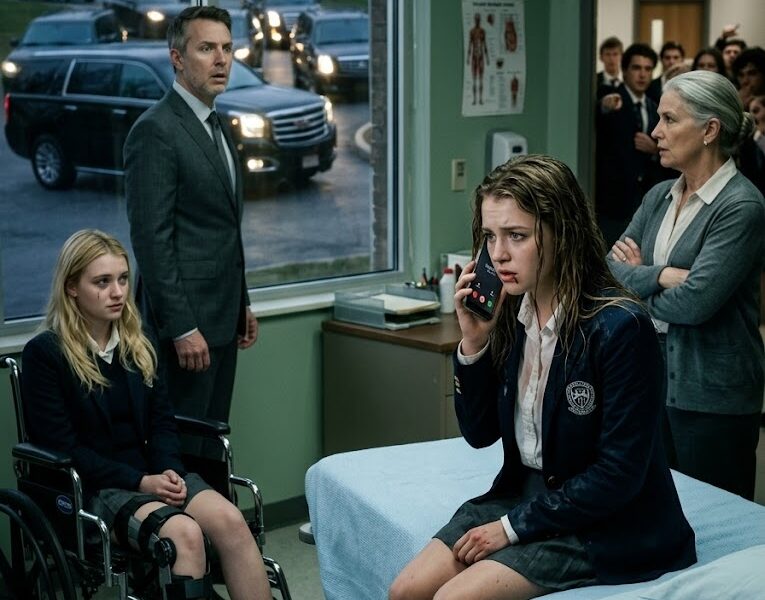
Mrs. Vaughn, the dean of students, stood beside the infirmary bed.
Claire’s father stood behind her.
Richard Whitmore.
Mining magnate.
Donor.
Owner of the Whitmore Science Center on campus.
Claire sat in a wheelchair with a bandage around her wrist, looking fragile enough for a magazine cover.
The moment she saw me awake, she started crying.
“My daughter could have died,” Richard said.
I tried to sit up.
“What?”
“You attacked her.”
“She—”
Mrs. Vaughn raised a hand.
“Emma, don’t make this worse.”
I stared at her.
“You haven’t even asked what happened.”
“I’ve seen enough.”
“No. You saw where it ended.”
Richard stepped closer.
“You threw my daughter down a staircase.”
“She was holding me.”
“You expect me to believe that?”
“I expect you to look at the bathroom cameras.”
Claire stopped crying.
Only for half a second.
But I saw it.
Mrs. Vaughn did too.
Then she looked away.
That frightened me more than anything.
“There are no cameras inside student restrooms,” she said.
“The hallway.”
“The footage is inconclusive.”
Richard laughed once.
Coldly.
“Inconclusive? My daughter is injured.”
“So am I.”
He looked at the cut on my lip.
“That?”
Something changed in me.
Before I could answer, Mrs. Vaughn folded her arms.
“Call your parents.”
My stomach dropped.
“No.”
“Excuse me?”
“I’ll accept detention.”
“Emma—”
“Suspension. I’ll write Claire an apology if that’s what you want.”
Claire smiled faintly.
Mrs. Vaughn’s expression hardened.
“I said call your parents.”
“They’re working.”
“Then they can leave work.”
“They can’t.”
Richard stepped beside her.
“What kind of parents don’t come when their child nearly kills someone?”
I stared at him.
The humiliation was bad.
But fear was worse.
Because my phone contained 108 versions of Dad.
Sal.
Marco.
Enzo.
Vito.
Leo.
Nico.
Gio.
Bruno.
Dante.
Men who had spent my childhood coming home at impossible hours with split knuckles and stories that never made sense.
Men who told me never to ask where the money came from.
Men who smiled when news reports mentioned raids.
At least, that was how I had interpreted everything.
I couldn’t bring them here.
Not over this.
Not if Richard Whitmore had lawyers and political connections.
Not if one stupid school fight could drag my family back into federal attention.
Mrs. Vaughn put my phone on the blanket.
“Call.”
I didn’t touch it.
“Emma.”
I swallowed.
“Are you absolutely sure?”
Richard scoffed.
“What’s that supposed to mean?”
I looked at Mrs. Vaughn.
“You really want my father here?”
“Yes.”
“Okay.”
My fingers shook as I unlocked the phone.
Of all 108 men, Salvatore Falcone was the safest choice.
At least I hoped so.
I pressed CALL.
He answered before the second ring.
“Baby?”
His voice was warm.
My eyes burned instantly.
“Hi, Papa.”
“What’s wrong?”
“Nothing.”
Silence.
Salvatore Falcone could hear lies the way musicians heard wrong notes.
“Emma.”
“My school wants you to come in.”
His voice brightened.
“The school?”
“Yeah.”
“Did you win something?”
“No.”
“Scholarship?”
“No.”
“Top score?”
“Papa—”
“Hold on. Marco! Emma’s school called!”
I heard shouting in the background.
Then a sharp crack.
A man yelled.
Something heavy hit the floor.
My blood went cold.
Sal’s voice moved away from the phone.
“Clean that up.”
I closed my eyes.
Of course.
Of course he was doing something illegal.
“Papa, forget it.”
“What?”
“You don’t need to come.”
His voice changed immediately.
“Emma.”
“It’s nothing.”
“Did someone hurt you?”
I looked at Claire.
She looked bored now.
Richard was checking his watch.
Mrs. Vaughn was staring at me like I was something she wished would disappear.
“No.”
Another silence.
Then Sal spoke softly.
“Stay where you are.”
“Papa—”
“I’m coming.”
The call ended.
I sat frozen with the phone in my hand.
Ten minutes later, Mrs. Vaughn received a call from the front office.
Her face tightened.
“What?”
She listened.
Then frowned.
“How many?”
Another pause.
She looked directly at me.
“No. Absolutely not. Tell them only one parent is allowed upstairs.”
She hung up.
Richard rolled his eyes.
“Finally.”
Mrs. Vaughn walked toward the door.
Then stopped.
Because the sound reached us.
Engines.
A lot of them.
Through the infirmary windows, black vehicles were turning through the academy gates.
Not one.
Not five.
An entire procession.
Claire rolled her wheelchair toward the glass.
Richard’s face changed.
I closed my eyes.
“Oh, God.”
My fathers had come.
All of them.
The door opened.
Salvatore entered alone.
He wore charcoal slacks and a dark coat.
No visible weapon.
No blood.
No bodyguards.
For ten beautiful seconds, he looked like a normal father.
Then I noticed the men filling the corridor behind him.
And the corridor behind that.
And the staircase.
Papa Marco.
Papa Enzo.
Papa Leo.
Papa Vito.
Faces from every birthday, every Thanksgiving, every fever, every scraped knee.
One hundred and eight fathers trying very hard to look inconspicuous.
They failed spectacularly.
Sal didn’t acknowledge Richard.
He walked directly to me.
His gaze landed on my lip.
Then my bruised wrist.
Then the damp hair Claire’s friends hadn’t allowed me to dry.
His jaw flexed.
“Who?”
“Papa.”
“Who did that?”
“I’m okay.”
He crouched beside the bed.
“That’s not what I asked.”
Richard stepped forward.
“Mr. Falcone, your daughter attacked mine.”
Sal finally looked at him.
“Did she?”
Richard hesitated.
Something about Sal’s expression had changed the temperature of the room.
Mrs. Vaughn intervened.
“Mr. Falcone, Emma has been involved in repeated behavioral incidents—”
“Repeated?”
Sal looked back at me.
I wanted to disappear.
He saw it.
That was the moment everything went wrong.
Because anger didn’t appear on his face.
Pain did.
“Baby,” he said quietly, “how long?”
I couldn’t answer.
“How long has somebody been hurting you?”
Claire’s confidence flickered.
I stared at my hands.
“Six weeks.”
Behind Sal, someone whispered a curse.
Another father walked away because he was too angry to remain in the room.
Sal stayed perfectly still.
“And you didn’t tell us?”
“I didn’t want you getting into trouble.”
His eyebrows drew together.
“What trouble?”
I looked toward the corridor full of men.
“Your trouble.”
For the first time, confusion crossed his face.
Then Marco coughed.
Enzo stared at the ceiling.
Vito suddenly became fascinated by his shoes.
Sal looked from them to me.
“Emma,” he said slowly, “what exactly do you think we do for a living?”
I almost laughed.
This was not the time.
“Can we please talk about that later?”
A strange look passed between 108 men.
Sal stood.
“Yes,” he said.
“We definitely will.”
Then Papa Enzo walked into the room carrying a tablet.
He was the quiet one.
Wire-rim glasses.
Always reading.
I had spent my childhood assuming he laundered money because he used the phrase “compliance problem” more often than any normal human being.
He placed the tablet on Mrs. Vaughn’s desk.
“Before we discuss punishment, perhaps we should discuss evidence.”
Claire went pale.
The video began.
Hallway footage.
Claire following me into the bathroom.
Four girls behind her.
Twenty-three minutes later, the door opened.
One girl stepped out carrying my wet blazer.
Another had my backpack.
Then Claire emerged pulling me backward by the collar.
The angle caught everything that happened at the stairs.
Including the moment she grabbed me.
Including the fall.
Richard stared at the screen.
Mrs. Vaughn whispered, “Where did you get this?”
Enzo looked at her.
“Your server.”
“You accessed school servers?”
“No.”
He adjusted his glasses.
“Your IT director did after receiving a preservation notice from counsel.”
Richard’s head snapped up.
“Counsel?”
A woman entered the infirmary.
Then another.
Then three men carrying briefcases.
Sal sighed.
“Emma, sweetheart, your fathers occasionally overprepare.”
“Occasionally?” I whispered.
Marco grinned.
Then Enzo opened another file.
“And while counsel was preserving evidence, we discovered something else.”
Mrs. Vaughn stopped breathing.
Wire transfers.
Donations from Whitmore-controlled entities.
Altered disciplinary reports.
A prior assault complaint against Claire.
Deleted.
Another student’s scholarship revoked after her family threatened litigation.
Richard’s face turned gray.
“That’s confidential.”
Sal looked at him.
“So was my daughter’s suffering.”
Nobody spoke.
I should have felt victorious.
Instead, I felt sick.
Because I suddenly understood something worse than Claire’s cruelty.
Adults had known.
And some of them had chosen money.
Mrs. Vaughn sank into a chair.
Sal looked at her.
“My daughter believed she had to endure this because she was afraid calling her family would create trouble.”
His voice never rose.
“That failure belongs partly to me.”
Then his eyes hardened.
“But yours is much larger.”
He turned to Richard.
“And yours larger still.”
Richard recovered enough to sneer.
“You think showing up with an army intimidates me?”
“No.”
Sal looked toward Enzo.
“I think facts will.”
Enzo tapped the tablet.
“Whitmore Mining. Three unreported fatalities. Environmental monitoring irregularities. Compensation agreements drafted through shell entities. Several permits under review.”
Richard went completely still.
“How do you know about that?”
Sal said nothing.
That silence frightened him.
It frightened me too.
Then sirens sounded outside.
Richard rushed to the window.
Government vehicles were entering campus.
Not police.
Federal investigators.
He turned around.
“What did you do?”
Sal finally looked almost tired.
“I made a phone call.”
My stomach dropped.
I grabbed his sleeve.
“Papa.”
His eyes softened instantly.
“What?”
“Don’t destroy him.”
Everyone stared at me.
Even Richard.
I swallowed.
“If the company collapses, what happens to the workers?”
Sal’s expression changed.
Not surprise.
Recognition.
He looked at me for a long moment.
Then smiled slightly.
“There she is.”
“Who?”
“My daughter.”
He turned toward Richard.
“You heard her.”
What followed wasn’t revenge.
It was worse for Richard because it left him alive to face consequences.
Whitmore Mining entered emergency restructuring.
Independent investigators took over its safety records.
Victims’ families received new settlements.
Richard surrendered controlling interest as part of a larger agreement negotiated under the pressure of investigations and lawsuits.
Mrs. Vaughn resigned before sunset.
Claire was suspended pending disciplinary review.
But when Claire appeared at our apartment the following evening with her father, I stopped her before she could kneel.
“Don’t.”
She froze.
The living room was filled with fathers.
She looked terrified.
I walked toward her.
“You don’t apologize on your knees.”
Her eyes filled.
“I don’t know how.”
“Start by telling the truth.”
She looked at me.
For once, there was no audience.
No phone.
No followers.
Just a frightened girl standing inside a small apartment, finally stripped of everything that had made cruelty easy.
“I hated you,” she whispered.
“Why?”
“Because you didn’t need anyone.”
I almost laughed.
“You thought that?”
“You never begged people to like you. You got the grades I couldn’t get. Teachers remembered your answers. And you wore cheap clothes like you didn’t care.”
“I cared.”
“I know that now.”
Her voice cracked.
“I just needed you to be beneath me.”
That sentence hurt more than the insults.
Because it was honest.
I nodded.
“Then learn how to live without needing someone beneath you.”
Claire left Volante.
She entered a residential behavioral program.
At the time, I thought that was the end of her part in my story.
I was wrong.
But before Claire could return, I had another problem.
I needed to discover who my fathers actually were.
That night, 108 men crowded into our apartment.
Some sat on the floor.
Some leaned against walls.
Several argued over pizza.
I stood in the middle of them with my arms folded.
“Tell me the truth.”
Silence.
Papa Vito looked at Sal.
Sal looked at Enzo.
Enzo removed his glasses.
That terrified me.
“Are you still in the mafia?”
One hundred and eight men started talking at once.
“No!”
“Absolutely not!”
“Jesus, Emma!”
“Who told you that?”
“You did!”
Silence again.
I pointed at Sal.
“You told me your work was dirty.”
“I meant waste management.”
I pointed at Gio.
“You said you were designing something nobody could ever know about.”
“Submarine propulsion.”
“You come home covered in blood!”
Bruno raised his hand.
“Meat-processing plant.”
I stared at him.
He shrugged.
“Beef is messy.”
I turned toward Marco.
“You disappear for months.”
“Deployments.”
I stopped.
“Deployments?”
Marco looked at Sal.
Sal sighed.
“Emma, sit down.”
“No.”
“Please.”
That word made me sit.
Sal crouched in front of me.
“We were criminals once.”
Nobody joked now.
“When we found you, most of us were already looking for exits. Some because they were tired. Some because prison was getting closer. Some because they’d buried too many friends.”
He touched my hand.
“But you changed the timetable.”
I stared at him.
“You called me Papa.”
His mouth trembled.
“And suddenly I had to imagine you at ten. At sixteen. At twenty-five. I imagined you asking what I did for a living.”
He glanced around the room.
“So we made a deal.”
The Falcone organization began dismantling itself.
Smuggling routes became licensed logistics companies.
Illegal lending operations became regulated financial businesses.
Construction crews became legitimate contractors.
Vito moved into casinos through licensed partnerships.
Bruno built food-processing plants.
Marco enlisted, then built a military career.
Enzo went to law school.
Several fathers entered public service.
Others founded companies.
Some spent years cooperating with investigators to unwind old networks without triggering new violence.
“We went to night school,” Nico said.
I blinked.
“That was where you went every night?”
“Accounting.”
He looked offended.
“Hardest thing I’ve ever survived.”
Vito nodded solemnly.
“Taxes nearly killed us.”
Someone laughed.
I didn’t.
My eyes were filling too quickly.
“All those years…”
Sal squeezed my hand.
“We didn’t want you growing up thinking money made you better than anyone.”
“So you made me think we were poor?”
“Well…”
“We weren’t poor?”
Papa Leo made a choking sound.
I stared at him.
“How not poor?”
Nobody answered.
Sal handed me a tablet.
I looked at the number.
Then counted again.
Then once more.
“You’re kidding.”
“No.”
“This is mine?”
“Trust.”
“How many zeros is that?”
Vito leaned over.
“A healthy number.”
I nearly dropped the tablet.
My whole childhood rearranged itself inside my head.
The cheap apartment wasn’t necessary.
The old sedan wasn’t all we owned.
The black cards weren’t blood money.
The nights I had lain awake imagining federal agents breaking down the door—
All of it had existed mostly in my imagination.
I started crying.
Sal panicked.
“Why are you crying?”
“Because I was going to save you.”
That silenced the room.
“I skipped lunches.”
A chair scraped.
“You what?”
“I thought money was hard for you to make.”
Vito looked personally wounded.
“We own banks.”
“I didn’t know!”
Marco covered his face.
“My baby skipped lunch while Leo owns a bank.”
“I don’t own the whole—”
“Shut up, Leo.”
Then 108 men began arguing about whose fault it was.
I laughed through my tears.
For the first time in my life, I understood why the Falcone family had always seemed strange.
They weren’t pretending to be criminals.
They were former criminals pretending to be ordinary men because they wanted their daughter to become something better.
And somehow, in trying to protect me from their past, they had made me afraid of it.
Sal wiped my cheek.
“No more secrets.”
I believed him.
That lasted six days.
Then Papa Enzo came to school and said, “Emma, we need to leave.”
The Whitmore investigation had uncovered an old shipment.
Precision weapons components.
The mining company had unknowingly—or perhaps knowingly—moved them for a paramilitary trafficking network called Scorpion.
Scorpion had learned the investigation originated with the Falcones.
And someone had already been watching me.
The first explosion happened at 9:17 on a Thursday night.
Papa Nico’s house shook hard enough to break windows two blocks away.
He survived.
Barely.
That was when my childhood ended.
Not because I picked up a weapon.
Because I saw fear on Salvatore Falcone’s face.
Fear for me.
He ordered me into the reinforced basement beneath the estate.
Monitors covered one wall.
Men moved across the grounds.
Marco coordinated with law enforcement and military contacts.
Enzo worked through warrants and financial records.
Dante—the father nobody ever explained—finally showed me credentials I wasn’t allowed to photograph.
Federal.
I stared at him.
“You’re joking.”
“I wish.”
“So when you said you worked for the government…”
“I work for the government.”
I looked at Sal.
“How did I miss all this?”
“Because we worked very hard for you to miss it.”
On one security feed, a masked man crossed the eastern wall.
Something about his hand caught my attention.
A tattoo.
A black scorpion.
I had seen it before.
At school.
Our new gym instructor wore long sleeves even in warm weather, but once, while separating Claire from another student, his cuff had pulled back.
Same tattoo.
“Papa.”
Sal turned.
“I know him.”
Within minutes, the investigation changed.
Scorpion had planted people around Volante for weeks.
Claire’s bullying had been real, but the organization had exploited the chaos around her to get closer to me.
The school scandal had accidentally exposed a larger operation.
For the first time, I understood why my fathers had spent eighteen years teaching me to notice exits, remember license plates, and never ignore the feeling of being watched.
I had thought those were strange habits from strange men.
They had been survival lessons.
The attack ended before dawn.
Not with executions.
With arrests.
Warrants.
Asset seizures.
A coordinated federal operation that dismantled most of Scorpion’s domestic network.
When the last vehicles left our estate, Sal found me sitting on the kitchen floor.
“Can’t sleep?”
“No.”
He sat beside me.
For several minutes, neither of us spoke.
Then I said, “Teach me.”
“What?”
“Everything.”
His eyes narrowed.
“Emma—”
“I don’t mean crime.”
“Good.”
“I mean business. Law. Security. Finance. How to protect people without becoming the thing you’re protecting them from.”
He stared at me.
Then smiled.
“That,” he said, “we can teach.”
My life changed after that.
Days belonged to school.
Nights belonged to my fathers.
Marco taught situational awareness.
Enzo taught law.
Leo taught finance.
Vito taught negotiation.
Dante taught me how investigations actually worked and why evidence mattered more than rage.
Sal taught me the hardest lesson.
Power was easiest to misuse when you believed you deserved it.
“Never punish somebody because you can,” he told me.
“Then why have power?”
“So the person without it doesn’t have to beg.”
I carried that sentence to graduation.
I graduated valedictorian.
All 108 fathers came.
They wore matching red ties because matching shirts had been vetoed by Enzo as “aesthetic terrorism.”
When I walked to the podium, I saw men who had once been feared across the city wiping their eyes before I even started speaking.
I told the audience I had been abandoned as a baby.
I told them family wasn’t always the person who gave you blood.
Sometimes it was the person who changed because loving you made their old life unbearable.
I didn’t tell them everything.
I didn’t need to.
When I finished, 108 men stood.
So did everyone else.
That night I told my fathers my plan.
Military studies.
Then law.
Then finance.
Then a foundation for students who had been bullied, abandoned, or priced out of opportunity.
Marco cried.
Enzo cried.
Leo pretended he had allergies.
Sal simply kissed my forehead.
A week later, a letter arrived.
From Claire.
She didn’t ask for forgiveness.
She told me she had spent months in therapy trying to understand why humiliation had once felt like power.
She had begun tutoring children through her program.
She wrote:
I used to think poverty was something ugly about a person. Now I understand the ugly thing was needing somebody else to feel small so I could feel large.
At the bottom, she asked whether, someday, she might volunteer for my foundation.
I wrote one sentence back.
When you’re ready to serve people without needing them to owe you anything, I’ll be waiting.
Three years later, she walked through the foundation doors wearing a plain blue suit and carrying no entourage.
She stayed.
Eventually, she became one of the best attorneys we had.
Nobody was more ruthless about protecting bullied kids than the woman who had once been their bully.
Life was strange that way.
It became stranger when I met Damian Cole.
Damian was an Interpol liaison working a trafficking investigation with Marco’s task force.
He was calm where my fathers were loud.
Patient where I was stubborn.
And, most importantly, entirely unimpressed by the Falcone name.
On our third date, he asked, “How many fathers do I actually have to meet?”
“One hundred and eight.”
He laughed.
I didn’t.
His face fell.
“You’re serious.”
Dinner lasted six hours.
They questioned him about his finances, childhood, driving record, intentions, grandparents, medical history, alcohol tolerance, and whether he knew how to change a diaper.
“We aren’t having children yet,” I protested.
Marco shrugged.
“Preparation.”
Damian survived.
Barely.
When Sal finally asked the only question that mattered, the room became quiet.
“What happens when loving her becomes inconvenient?”
Damian didn’t answer quickly.
That was why I knew I could trust the answer.
“Then I love her while it’s inconvenient.”
Sal stared at him.
Damian continued.
“I don’t promise she’ll never get hurt. That’s a stupid promise. I promise she won’t face it alone.”
Sal nodded once.
Years later, he walked me down the aisle.
Technically, all 108 fathers did.
One after another.
A few feet each.
It took forever.
I wouldn’t have changed a second.
When Sal finally placed my hand in Damian’s, he said, “She’s not yours.”
Damian blinked.
Sal smiled.
“She chose you. Don’t confuse the two.”
“I won’t.”
“Good.”
Then he hugged him.
That was the closest Salvatore Falcone came to giving anyone permission to marry his daughter.
When our daughter Mia was born, the Falcone family lost its collective mind.
A man who had once negotiated hostage releases spent forty minutes arguing about bottle temperature.
Marco bought a military-grade baby monitor.
Enzo created a spreadsheet for feeding schedules.
Gio installed so many sensors around the nursery that Damian needed clearance to enter his own bedroom after dark.
One night, I woke to find Damian climbing through the balcony window.
“What are you doing?”
“Your fathers changed the hallway access code.”
“You could’ve called me.”
“I did.”
“My phone was downstairs.”
“Exactly.”
He took one step toward the bed.
A voice came from above.
“Freeze.”
Damian slowly looked up.
Gio was hanging halfway out of an access panel holding a pacifier.
“Gio.”
“Level-four clearance after eight.”
“This is my bedroom.”
“Rules are rules.”
I laughed so hard I woke the baby.
That became our life.
Ridiculous.
Overprotected.
Loud.
Safe.
For a while.
Then a man named Sterling walked into my foundation and reminded me that old power always believed new power could be bought.
He offered fifty million dollars for three board seats.
I refused.
He insulted my fathers.
Then me.
“You’re an abandoned girl who got lucky,” he said. “Don’t confuse inherited protection with ability.”
Years earlier, those words would have broken something inside me.
Instead, I smiled.
“Claire?”
The conference-room door opened.
Claire entered carrying a legal file.
She placed it in front of Sterling.
His smile disappeared.
His company had been under investigation for procurement fraud and securities violations for months.
We hadn’t destroyed him.
We had simply refused to save him from consequences already coming.
That distinction mattered.
Sterling never understood it.
He blamed us.
Three years later, that resentment almost got my daughter kidnapped.
Mia was three.
She carried a teddy bear named General Buttons everywhere.
One afternoon, Damian entered my office holding a surveillance photograph.
Mia stood outside preschool.
A red mark had been drawn across her face.
My hands went numb.
“Who?”
“Scorpion remnants,” Damian said. “Working with another network. Viper.”
My fear lasted approximately five seconds.
Then it became something colder.
We locked down the estate.
Changed routes.
Moved security.
But whoever was watching us knew too much.
Shift changes.
Blind spots.
Schedules.
Someone had sold them information.
The attempted kidnapping happened outside Mia’s preschool.
Men in fake security uniforms approached her near the side fence.
One held out candy.
“Your mommy sent us.”
Mia frowned.
“No, she didn’t.”
The man smiled.
“Sure she did.”
“My mommy says strangers who say Mommy sent them are extra-strangers.”
Even terrified, I nearly laughed when I later saw the footage.
Then Mia added, “And our driver smells like cinnamon cookies.”
The man’s expression changed.
“You don’t smell like cookies.”
By then, the groundskeeper had stopped trimming hedges.
The janitor had set down his mop.
A cafeteria worker removed his apron.
The kidnappers had chosen a school where half the maintenance staff that week consisted of retired Falcone men working undercover.
Sal stepped out from behind the administration building.
“You should leave the child alone.”
The kidnappers didn’t.
They were arrested less than a minute later.
That night, we discovered who had sold our security information.
Sterling.
The man I had refused to sell my foundation to.
He had lost his company.
His reputation.
Most of his fortune.
And rather than accept responsibility, he had decided my three-year-old daughter was a fair target.
That was when I finally understood something Sal had tried to teach me for years.
Some people don’t want justice.
They want their pain transferred.
We gave Sterling neither revenge nor mercy disguised as stupidity.
We gave him evidence.
Damian’s investigation did the rest.
Viper collapsed over the following months beneath coordinated prosecutions, asset seizures, and testimony from its own frightened members.
The Falcone family never needed to become what it had once been.
That was the victory.
We could protect our children without returning to darkness.
Years passed.
The foundation grew.
Claire became its general counsel.
Damian continued his work.
Mia grew old enough to believe 108 grandfathers were completely normal.
Then one evening, Sal entered my study carrying the basket.
My basket.
The wicker had darkened with age.
One handle was repaired with wire.
The yellow blanket was gone, but I recognized it immediately.
“Why do you still have that?”
Sal placed it on my desk.
“Because it brought you to us.”
He sat down.
He looked older.
That frightened me more than guns ever had.
“We prepared some things.”
He placed several envelopes inside the basket.
“Wills. Trust instructions. Letters.”
“Dad.”
“Listen.”
“No.”
“Emma.”
My throat tightened.
He smiled.
“You can’t protect us from time.”
I looked away.
For eighteen years, I had tried to protect my fathers from prison.
Then violence.
Then their own past.
I had never considered the enemy none of us could negotiate with.
Sal touched the basket.
“When I found you, I thought I was saving a baby.”
His eyes became wet.
“Took me years to understand you were saving us.”
I reached for his hand.
“You did the work.”
“Because you gave us a reason.”
I hugged him.
For a long time, neither of us moved.
Damian stood quietly in the doorway.
When Sal finally rose, he stopped beside him.
“Take care of them.”
Damian nodded.
“With my life.”
Sal shook his head.
“No.”
Damian frowned.
Sal looked back at me.
“With your life is easy. Everybody says that.”
He squeezed Damian’s shoulder.
“Take care of them with your patience. That’s harder.”
Then he left.
I sat beside the old basket until midnight.
I thought that would be the most difficult piece of my past to return.
I was wrong.
Three weeks later, a woman appeared outside my foundation.
She came with cameras.
That told me everything before she said a word.
“My baby!”
She collapsed dramatically beside the entrance.
Reporters surrounded her.
“I’ve been searching for her for years.”
I watched from the security room.
Sal stood behind me.
His face was stone.
“Name?”
“Evelyn Miller.”
“And?”
Claire opened a file.
“DNA indicates a high probability she’s Emma’s biological mother.”
The room went silent.
I stared at the woman on the monitor.
My mother.
I had imagined her thousands of times.
Sometimes young and frightened.
Sometimes sick.
Sometimes dead.
Sometimes standing outside my door saying she had searched every day.
I had never imagined television cameras.
Beside her stood a man around thirty.
“Toby Miller,” Claire said. “Her son.”
My half brother.
On screen, Evelyn cried harder when another camera moved closer.
I felt nothing.
That frightened me.
Damian touched my shoulder.
“What do you want to do?”
“Find out why she’s here.”
Sal stepped forward.
“No.”
I looked at him.
“Dad.”
“She abandoned you.”
“I know.”
“She doesn’t get to walk back because you’re successful.”
“I know.”
“Then why?”
“Because if I don’t know what she wants, I’ll spend the rest of my life wondering.”
He hated that answer.
But he respected it.
I met Evelyn alone in front of the cameras.
She threw her arms around me.
I didn’t return the embrace.
“My beautiful girl.”
I whispered into her ear.
“Why did you bring reporters?”
Her body stiffened.
Only slightly.
Then she pulled back and smiled through tears.
“So people would know I never stopped loving you.”
That was the first lie.
I decided to find the rest.
I took Evelyn and Toby to the old apartment where my fathers had raised me.
We moved the expensive cars.
Damian wore faded jeans.
I dressed simply.
Evelyn’s disappointment appeared within minutes.
“You live here?”
“Yes.”
“But you’re the director of that foundation.”
“Executive director.”
“So what do you make?”
There it was.
Not Are you happy?
Not Did they treat you well?
Not Did you hate me?
How much do you make?
Toby opened the refrigerator.
“Jesus. There’s nothing good in here.”
Damian looked at me.
I looked at him.
Neither of us spoke.
Evelyn sat beside me.
“I’ve thought about you every day.”
“Why did you leave me?”
She blinked.
“I was poor.”
“That isn’t an answer.”
“I couldn’t feed you.”
“So you left me outside a gated estate?”
“I knew rich people lived there.”
That part might even have been true.
Then she squeezed my wrist.
“Maybe God meant for all of this to happen.”
“All of what?”
“You becoming successful.”
Her thumb stroked my hand.
“You can help your family now.”
I looked at Toby.
He smiled.
And finally I understood.
They hadn’t come looking for Emma.
They had come looking for money.
I offered Toby a low-level procurement position at the foundation.
Claire objected immediately.
“He’s going to steal.”
“I know.”
She stared at me.
“You know?”
“I want to know how quickly.”
Three days.
That was the answer.
Toby redirected funds.
Used company accounts for personal expenses.
Then stole one hundred thousand dollars and gambled it.
We documented everything.
I was prepared to confront him.
Then he did something worse.
He forged my signature on a foundation asset document as collateral for a gambling debt.
Damian read the document twice.
“You want me to arrest him now?”
“No.”
“Emma.”
“Not yet.”
His jaw tightened.
“He forged your signature.”
“I know.”
“He’s escalating.”
“I know.”
“And your mother is helping him.”
I knew that too.
But somewhere inside me, a five-day-old baby was still asking one impossible question.
Would she choose me if forced to choose?
The answer arrived the next night.
Toby owed far more than he had admitted.
When the people he owed threatened him, he offered them collateral.
Not money.
Mia.
My daughter.
The recording came from an undercover contact.
Toby’s voice filled the nursery while Mia slept ten feet away.
“My sister’s loaded. Take the kid. She’ll pay anything.”
I stopped breathing.
Damian gripped the crib rail until his knuckles whitened.
Sal stood behind us.
He said nothing.
He didn’t need to.
Something inside me closed forever.
Not violently.
Quietly.
Like a door.
I had given blood a chance to become family.
Blood had answered.
The men Toby contacted arrived at the apartment the following evening.
Law enforcement was already watching.
So were my fathers.
Toby entered behind the collectors wearing the nervous grin of a man who believed he had finally become powerful.
“Where’s the kid?” one man asked.
Damian rose from the couch.
“You came here for my daughter?”
Toby laughed.
“Sit down, rent-a-cop.”
Damian reached inside his jacket.
The badge changed the room instantly.
Toby stared.
“What the hell?”
“Federal liaison,” Damian said. “And you’re currently participating in a recorded conspiracy to kidnap a child.”
One collector raised both hands.
“I am done.”
He turned toward the doorway.
And stopped.
The hallway was full.
Marco.
Vito.
Leo.
Nico.
Dozens more.
Not armed gangsters.
Witnesses.
Security.
Former soldiers.
Attorneys.
Businessmen.
Men who had spent decades building lives that could survive daylight.
Sal stepped forward.
Toby looked at me.
“Emma?”
I stood.
He looked from me to them.
Then back again.
“Who are these people?”
“My family.”
“No. I mean who are they?”
I almost smiled.
“You wanted to know how much money I made.”
His face slowly changed.
“I told you I worked at the foundation.”
I walked toward him.
“I didn’t tell you I built it.”
Evelyn appeared behind him.
Her face drained of color.
“No.”
“Yes.”
“You lied to us.”
“No.”
I looked at her.
“You saw what you wanted to see.”
Toby moved toward me.
“Sis—”
Sal stepped between us.
“You don’t get to call her that.”
Evelyn exploded.
“I am her mother!”
Sal turned.
For once, his anger showed.
“No.”
Her mouth opened.
“I gave birth to her!”
“Yes.”
His voice broke.
“And then you left her outside in the rain.”
Evelyn recoiled.
“You don’t know what I went through.”
“No, I don’t.”
Sal’s voice softened.
“And maybe you suffered. Maybe you were terrified. Maybe leaving her was the only choice you thought you had.”
I looked at him, surprised.
Then he finished.
“But you had thirty years to come back without cameras.”
Evelyn said nothing.
“You didn’t come when she was hungry. You didn’t come when she had nightmares. You didn’t come when she was sick. You didn’t come when she graduated.”
He pointed toward me.
“You came when her name was worth something.”
Evelyn began crying.
This time, I believed the tears.
They just didn’t change anything.
Toby backed toward the wall.
“You can’t prove anything.”
A voice came from the hallway.
“She can’t.”
Papa Dante entered.
“But I can.”
He showed his credentials.
Federal agents followed.
Toby’s face collapsed.
The warrants covered fraud, conspiracy, attempted kidnapping, and financial crimes tied to the gambling network.
When the cuffs closed around his wrists, he screamed my name.
“Emma! We’re family!”
I walked toward him.
“No.”
He stared at me.
“You had the chance to be.”
Evelyn reached for me as agents escorted her past.
“I’m your mother.”
I looked at her hand.
Then her face.
For years, I had imagined this moment as rage.
Instead, I felt something much sadder.
Peace.
“You gave me life,” I said. “But they taught me how to live it.”
Behind me stood 108 men.
Some old now.
Some gray.
Some walking with canes.
Some still built like walls.
Every one of them watching me with the same expression they must have worn when they found a nameless baby in a basket.
Evelyn began to cry again.
I stepped back.
“You don’t get to arrive at the end of the story and claim you wrote it.”
The agents took her away.
The apartment became quiet.
Sal placed his hand on my shoulder.
“Home?”
I looked around the little place.
The scratched table.
The narrow kitchen.
The doorway where fathers had measured my height in pencil until I was sixteen.
The apartment had once embarrassed me.
Then frightened me.
Then confused me.
Now I understood what it really was.
Proof.
One hundred and eight men who had possessed money, influence, violence, and power had deliberately raised me somewhere small enough to teach me the difference between having things and needing them.
I turned to Sal.
“Yeah.”
“Home.”
Years later, we held the first annual Falcone Family Day at the estate.
The idea came from Mia.
She couldn’t understand why we celebrated birthdays but not the day her grandfathers found me.
So we chose the anniversary of that rainy night.
Claire brought thousands of handwritten cards from children our foundation had helped.
Marco pretended not to cry while reading them.
Enzo absolutely cried.
Vito blamed pollen.
Damian spent most of the afternoon moving tables because every father had a different opinion about where they belonged.
Then someone brought out the old basket.
Mia climbed inside.
She was far too big for it.
Nobody stopped her.
Within ten minutes, she had fallen asleep.
Sal found her first.
He stood over the basket without moving.
I came beside him.
“You okay?”
He nodded.
Then shook his head.
Then laughed at himself.
“Look at that.”
Mia stirred.
“Grandpa?”
Sal wiped his face quickly.
“Yeah, princess?”
“Why are you crying?”
He bent down and lifted her.
“Because I’m old.”
She frowned.
“That doesn’t make people cry.”
Behind us, Marco muttered, “She’s got you there.”
Sal ignored him.
Mia touched his cheek.
“Then why?”
He looked at me.
For a moment, the estate disappeared.
The money disappeared.
The investigations, scandals, businesses, uniforms, courtrooms, headlines—all of it disappeared.
I saw only an old man remembering a storm.
A basket.
A baby.
One accidental word.
Papa.
Sal kissed Mia’s forehead.
“Because a long time ago, somebody left a little girl at our door.”
Mia’s eyes widened.
“Mommy?”
“Yeah.”
“Were you scared?”
He smiled.
“Terrified.”
“Why?”
“Because we knew how to fight.”
His eyes found mine.
“We knew how to make money. We knew how to survive.”
He paused.
“We didn’t know how to raise a daughter.”
Mia considered this.
“But you did.”
Sal laughed softly.
“Eventually.”
I slipped my arm around him.
“No.”
He looked at me.
“You knew the important part immediately.”
“What part?”
“You stayed.”
His face crumpled.
Behind us, one father sniffed.
Then another.
Someone cursed whoever was cutting onions.
Mia giggled.
Damian wrapped an arm around my waist.
The photographer called everyone toward the lawn.
Organizing 108 fathers, one husband, one daughter, and one granddaughter for a family photograph took almost an hour.
Marco demanded the front row.
Enzo argued that seniority should be alphabetical.
Vito bribed the photographer.
Gio inspected the camera lens for hidden weapons until Claire threatened to have him removed.
Finally, we settled.
Mia sat in front holding the old basket.
Damian stood beside me.
Sal took my other side.
The photographer lifted his camera.
“Everybody ready?”
Nobody was.
Half the fathers were still arguing.
I started laughing.
So did Damian.
Then Mia.
Then Sal.
The laughter spread through the entire group until 111 people were ruining what was supposed to be a formal portrait.
The photographer gave up trying to control us.
He pressed the shutter.
That became my favorite photograph.
Not because everyone looked good.
They didn’t.
Marco’s tie was crooked.
Vito’s eyes were closed.
Gio was looking suspiciously toward the roof.
Damian was laughing.
Mia was halfway out of the basket.
And Salvatore Falcone—the man the city had once feared—was crying openly.
But every person in that picture was exactly where they had chosen to be.
Together.
When I was young, I thought family was something blood decided.
Then I thought it was something loyalty decided.
I was wrong both times.
Family is built in smaller moments.
It is somebody showing up when the school calls.
It is a bowl of food pushed toward you when you’re too upset to eat.
It is a man going to night school at forty because a baby called him Papa and suddenly he wants to become someone she can be proud of.
It is 108 dangerous men deciding that loving one abandoned child means their old lives have to end.
It is refusing to become cruel merely because cruelty would be easier.
And sometimes family is understanding that the person who gave you life does not automatically earn a permanent place inside it.
That choice belongs to you.
I still have the basket.
It sits behind glass in the lobby of the foundation now.
There is no plaque mentioning the Falcone fortune.
Nothing about organized crime.
Nothing about federal investigations.
Nothing about 108 fathers.
Only one sentence.
Sal wrote it himself.
His handwriting has always been terrible.
But I wouldn’t let anyone correct it.
It says:
SHE ARRIVED WITH NOTHING, AND GAVE US A REASON TO BECOME SOMETHING.
People sometimes stop in front of it and ask me whose basket it was.
I usually smile.
“Mine.”
Then they ask what happened to the people who found me.
I look through the lobby windows.
Most afternoons, at least five black cars are parked illegally outside.
Someone is arguing with security.
Someone has brought Mia too much candy.
Marco is probably telling Damian how to drive.
Enzo is probably correcting Marco.
And somewhere among them is Salvatore Falcone, older now, slower than he used to be, still pretending he doesn’t need help with the stairs.
So when people ask what happened to those men, my answer is always the same.
“They became fathers.”
And if they ask what happened to the abandoned baby?
I look toward the door.
Because sooner or later, it always opens.
And one of them always shouts my name.
I smile.
“She went home.”









